Another Dern Book Micro-Review: Radiant Star, Ann Leckie’s Newest in Her Radch-Universe

By Daniel Dern: Having just (earlier this morning) finished reading Radiant Star, Ann Leckie’s newest sf novel set in her Imperial Radch universe, I cheerfully recommend it.

(I’d say, “without reservations” except that, given that the book went on sale about a month ago, if you’re looking to get it from your library, I urge you make a reservation – like I did, some months back when first learning about the then-upcoming book – to shorten your wait period.)

I don’t think you have to have read her previous Radch U books (Ancillary trilogy Ancillary Justice, Ancillary Sword, and Ancillary Mercy), Provenance, and Translation State), but (a) some things will make more sense if you have, particularly towards the final third of the book, (b) IMHO this series is best read in publication order (unlike, say, Steven Brust’s Vlad Taltos (“tal-tosh”) series). But since I have read them all – including a recent (over the past year) re-read (from which I’ve got a Scroll idea that OGH is patiently waiting for – if nothing else, I want to first wrap up a Westlake/Block one that’s been marinating much longer).

Here’s some of who/what isn’t in Radiant Star (as far as I can tell): Characters we’ve previously met. (E.g., Breq/Justice of Toren, Anaander Mianaa (who is mentioned a few times, though), Translator Dlique, nor (not unreasonably) any talking foxes, although that would make for a fun mash-up. No space shoot-outs, not even (unless I missed something) any weapon-firing at all. And no songs (although there is one musical instrument).

Some of who/what Radiant Star does include: A few Saints and potential Saints (not like the ones in John Crowley’s Engine Summer); tea and other drinks and foodstuffs, and related ceremonies;  Justice Of Albis and of few of the ship’s ancillaries; manners and language across various social/economic classes in the city of Ooioiaa, on the planet Aaa (which has one similarity to the planet He in James Blish’s Cities In Flight Tetrology); food/farming/agriculture/ecology/environment as an essential plot element (which we’ve seen in one or more of the Ancillary books) (and is also a big, albeit different, part of Robert Jackson Bennett’s The Tainted Cup, which I have started reading and cheerfully recommend even before finishing). And a very different narrator/PoV from Leckie’s previous (Radch U) books.

In writing this micro-review, I turned up various summaries, interview(s) with Leckie re this book, and an excerpt…but I’m not naming/linking to them because IMHO, Leckie fans are better served by going directly to the book proper.

Radiant Star is both like and unlike Leckie’s previous five Imperial Radch books. It’s possible it won’t be your (cough) cup of tea. There’s only one way to find out.

David Ferguson Review: Irish Conflict in Comics in the 20th Century

Review by David Ferguson: James Bacon, who is a well-known Filer, convention and fanzine fan has been researching and writing about comics recently appeared on RTE Radio 1’s The History Show with presenter Myles Dungan. The show aims to discover how our world was shaped by history and, appropriately enough, James was on to show to discuss his book, Irish Conflict in Comics in the 20th Century, which in part covers how comics shaped Ireland’s history and vice versa.

The book starts with the early days of the American comic book in the 1940s and brings us right up to the 21st Century. It covers everything from local Irish comics to some of the big names like Marvel Comics. James’ detailed research is obvious from the outset. Chapter One sees a description of Marvel Comic’s Namor’s brief excursion to Dublin in Sub-Mariner Comics issue 3 (1941). As James notes “The Irish connection is short – just one angle in Sub-Mariner’s quest” — the book’s philosophy being that if it fits the book’s subject it is included. And this minor incident fits as it shows us outside views on Ireland in areas like Ireland’s controversial neutrality during World War Two, dubbed “The Emergency.” All covered in the first chapter. 

The book, of course, devotes a lot of time to The Troubles, including the chapters “Captain Britain In Trouble” and “Spidey in the Troubles.” Chapters include interviews from creators about working on comics about such a controversial subject. Ever the comic collector, James notes the relevant comic book issues and provides further reading for each chapter. All accompanied with some wonderful art from said issues.

Of interest to fans of the Daredevil: Born Again TV series is a chapter covering a number of Daredevil issues, including Daredevil issues 205, 216 and 21, all written by the legendary Denny O’Neill. These take place after Frank Miller revolutionised the series in the early 1980s and retain the grittiness of Miller’s era. The issues under discussion feature the tough photographer Glorianna O’Brien who is involved with the IRA, the character seeing the IRA as people fighting oppression not as terrorists.

As James is a supporter of local creators, it is no surprise to see the cover of his book was created by local artists John McGuinness and Triona Tree Farrell, and designed by Paul Carroll. Also, the book is published through Irish publisher Limit Break Comics, which I was happy to hear Myles Dungan mention in the radio interview. The book devotes an entire chapter to Irish Comic Voices in the 1990s and there is an attempt include every relevant local book, with the majority of that sitting in area dedicated to the 21st Century.

This is book that can be read in one go but it is probably something that you will revisit for the references again and again. It’s a natural fit for the comic book fan but will equally be of interest to students of history. It is an area of comic book history hitherto unexplored and I hope this book inspires further research. I don’t think James is done with his. You can pick up the book here.

His next book — A Sensual Cesspool of Iniquity, Censorship and Comics in 1950’s Ireland – is planned for release during the summer.  

Twelve Months, A Harry Dresden book, recommended — A Dern Very Micro Book Review

By Daniel Dern: Having spent much of the weekend reading Twelve Months (Ace books, 480 Pages), Jim Butcher’s twentieth “Dresden Files” book (Novel #18 in the series, plus two story collections), which was released in January (and Item #9 in the February 2, 2026 Scroll), I recommend it without reservations (unless, like me, you would get it as a library borrow (or e-borrow), in which case I recommend a reservation, like I’d done, so you don’t have to hope it shows up in the “Speed Read” section or wait until a copy show up on the regular-circulation shelves).

If you’re unfamiliar with Harry Dresden (and his FILES)

Here’s a non-spoiler general summary, Per the Dresden Files’ Wikipedia page:

The first novel, Storm Front—which was also Butcher’s writing debut—was published in 2000. The books are written as a first-person narrative from the perspective of private investigator and wizard Harry Dresden as he recounts investigations into supernatural disturbances in modern-day Chicago.” [As in, our world, smartphones, Internet, Star Wars (movies) etc… except there’s also magic entities and activity – DPD]

Butcher’s original proposed title for the first novel was Semiautomagic, which sums up the series’ balance of fantasy and hard-boiled detective fiction… In the world of The Dresden Files, magic is real—alongside vampires, demons, spirits, faeries, werewolves, outsiders and other monsters—while both it and the supernatural are widely discredited.” [I.e., the general public doesn’t know about it. -DPD]

…. Harry Dresden is the only advertising wizard in the United States, living in Chicago and investigating supernatural cases on behalf of both human and nonhuman clients. He also serves as a civilian consultant for the Special Investigations division of the Chicago Police Department, and is called upon at times to offer his opinion on cases that appear to have a magical element.

Dern advises: if this makes you Dresden-curious, start with Book #1; while (in most cases) the individual books start-and-wrap plots, there’s longer arcs and developments (and backstory) with each new(er) book. (Like, for example, Ben Aaronovitch’s Rivers Of London stories; unlike, say, Steven Brust’s Vlad Taltos series, or, for the most part, Rex Stout’s Nero Wolfe stories.)

And if you’re already a Dresden fan, but haven’t yet requested/got/read TWELVE MONTHS…

Twelve Months picks up just after the events in the two previous Dresden FilesPeace Talks (July 2020) and Battle Ground (released September 2020) (arguably, these are really Parts 1 and 2 of a single story). As you’d expect, there’s magic prep, research, angst, snark, snappy dialog, fights and battles, f/sf cultural references, and two Spider Robinson/David-Gerrold-worth puns. The immediate plot threads are resolved within this volume…(but) there are larger and looming Next And Bigger Problems left over for the next Dresden File book — and, according to Butcher’s web site, “Mirror Mirror will now be book #19.” (Expected publication January 1, 2027, according to GoodReads.)

(BTW, according to Butcher’s web site (looks like this was written before mid-2020, so it’s possibly the plans have changed), The series is slated to run 23-24 books: 20-21 “case books” like we’ve seen so far, capped by a Big Apocalyptic Trilogy, because who doesn’t love apocalyptic trilogies?“

Speaking for myself, if you’re a Dresden Files fan, I think you’ll enjoy Twelve Months. Or, in the word of Nero Wolfe, “Satisfactory.”

(BTW, one non-spoiler question for Mr. Butcher (if you’re reading this) – one group in Twelve Months says they “like stories”…in the text, we see a kid or two doing the story-telling. Would “like stories” extend also to “see/hear/watch TV/video/movies?” Just wondering.)

Cat Eldridge Review: Elidor by Alan Garner

  • Alan Garner, Elidor (Harcourt Brace & Company, 1999)  

By Cat Eldridge: I started reading this book with the idea of skimming it for information to give when offering it to folk tales reviewers. Before I knew it I had finished it. I found it interesting and enjoyable to read.

Elidor is written for readers of junior high age and older. It is a fantasy about the four Watson children who live in Manchester, England. As the story opens they are looking at a street map and they find the name Thursday Street. They think it is an odd name, and because they are bored and have nothing better to do, they decide to look for the street.

When they find it, they discover that it is in the poor outskirts of town. It was bombed in World War II and some of the rubble still remains. Furthermore, a demolition gang is tearing down the buildings. A church is in the process of being destroyed, though when the children arrive the demolition gang seems to be on a tea break. The children want to watch the destruction, so while they are waiting for the workmen to return they start playing with a football they find.

The youngest child, Roland, accidentally kicks the football through a church window. One by one the children go into the church to retrieve the ball, and do not return. Roland is the last to enter the derelict building. He meets a blind fiddler who asks for help getting down the stairs, and when Roland touches the man’s bow he suddenly finds himself in a different world, a gray wasteland with castles and dead forests.

Roland has some adventures in this other land, Elidor, and eventually finds his brothers and sister there. He also learns that he is the only one who can save Elidor from the darkness which has overwhelmed it. However, most of the story takes place after the children have returned to Manchester. They bring with them four Treasures which the king has told them they must keep safe: a spear, a stone, a cauldron, and a sword. In the real world, these look like old pieces of wood and brick and a cracked cup, but in Elidor they have great power.

The children hide the Treasures, but the magic objects wreak havoc with magnetic and electrical fields in their neighborhood, and they have to hide them again. Meanwhile, evil powers from Elidor are trying to find the Treasures, and get closer and closer. Elidor encroaches more and more on Manchester, and by the end of the story, a unicorn and two spear-wielding men have gotten through the barrier between the two worlds. The climax takes place on New Year’s Eve and is quite exciting.

This book is a quick, easy read, and nothing particularly original takes place in the plot, yet I enjoyed it very much. The children seem believable, as does the setting, and Garner does an excellent job of creating the proper mood of menace and ordinariness combined.

The book starts without any background or explanation of who the children are, why they are at loose ends, or any description of their appearance or character. We join the action when the children are playing with the street map, and the adventure takes off from there. The lack of background information is disorienting and confusing to the reader, and normally I would view this as a flaw in Garner’s writing, but in this instance I felt that it was very effective in forcing me to feel what the children were feeling as they approached the derelict church and were suddenly transported into another world.

I would certainly recommend this book for young people interested in fantasy literature, or as an introduction to such literature. It’s not often that I read a book straight through, but this one is exciting and interesting enough to hold on to till the end.

Paul Weimer Review: Michael Swanwick’s The Universe Box (2026)

  • The Universe Box by Michael Swanwick (Tachyon Publications, February 3, 2026)

By Paul Weimer: The Universe Box is the latest collection of SFF short stories by Michael Swanwick.

Opening a collection of short stories by MIchael Swanwick is, in some ways, like the Forrest Gump approach to chocolates: You never know what you are going to get. That’s not quite true, but only in the broadest of terms. In a more narrow sense, you know you are going to get a variety of short stories with a wide range of tonal moods, characters and devices from Swanwick’s considerable genre arsenal.  If it is not a collection that is focused on a single set of characters, like, for example, The Postutopian Adventures of Darger and Surplus, then you know you are in for a wide range of stories. 

The Universe Box is one of the latter, a diverse group of stories with no central theme, although several of them, as is the wont of any writer with such a long and distinguished oeuvre, resonate with previous stories. Let me tell you about a few of the delights you will find inside this volume:

“Starlight Express”, the story that opens the volume, feels a bit like Robert Silverberg’s Nightwings, in a far future decadent and declined Roma (Rome) and a strange visitor from another solar system.  “The Last Days of Old Night” is a fable and a myth and a fantasy, and corresponds to a real place. I won’t spoil where, or what, Swanwick reveals all in the story. I’ve not been there, and it was sort of on my bucket list. Swanwick’s story makes me want to see it all the more, now. 

“The White Leopard” puts me in the mind of one of the most chilling and favorite short stories of Swanwick’s in my mind, “Moon Dogs”. This time it is a leopard drone robot, not dogs, and the twist that hits at the end hits as strongly as “Moon Dogs” did. This is Swanwick at his sharpest and cruelest to his characters, again showing just how many tools are in his genre box. If you liked “Moon Dogs”, you will love “The White Leopard”.

Is it a truism that every SFF writer (and SFF people in general) want to write a response or reaction to “The Cold Equations”?  Swanwick takes his own spin on it, in the aptly named “The Warm Equations”. Here, the twists and turns are far more heartwarming than in, say, “The White Leopard”. And it feels like a “take that” at Godwin. You don’t have to have read “The Cold Equations” first, but I do think that it helps. 

“Requiem for a White Rabbit” feels like a phantasmagoric drug trip in the manner of Natural Born Killers meets Fear and Loathing in Los Vegas meets Down and Out in the Magic Kingdom (Doctorow) meets Total Recall. He keeps the twists and turns spinning and seems to take utter delight in this story.  

“Dreadnought” is a much more serious story about a homeless man whose fate and actions might well determine the fate of the world, unbeknownst to him.  It’s a downer of an ending, and not the easiest of reads. But again, for every bit of lighthearted mania, there is dark and somber from Swanwick. He’s not afraid to use the whole tonal range in his work. 

The Bones of the Earth, his time travel with dinosaurs novel, is one of my favorite Swanwick novels, because well, Time travel and Dinosaurs. So here is a story if you are like me and like the novel too. “Grandmother Dimetrodon” is set in a similar premise with time travelers going back to the age of the Synapsids (the titular Dimetrodon, which is not a dinosaur!).  And there are visitors and travelers from further up in the timeline (like in Bones) who have quite alien needs and desires, as Douglas, our protagonist, discovers. 

And many more for you to read, discover, and find your favorites.  Swanwick has a short introduction that shows his thinking on several of the stories. If you are the type who wants to go in “cold” with his work and discover for yourself, you might want to skip his introduction until after you have read the dozen and half stories, here. 

And finally there is the titular story, The Universe Box, which ends the collection in the anchor position. I had wondered if he would out the titular story first or last, Swanwick chose to have it go last. And I can see why. It is a story both cosmic and quotidian, as a man named Howard, in a nondescript city, winds up in possession of an artifact stolen by a cosmic-level thief, the titular Universe Box.  It resonates with stories previous in this volume like. A box that contains nothing and everything. A love story that doesn’t end as you expect. A rich and amazing cosmology distilled into a small short story. The Universe Box as a story does many of the things Swanwick’s stories do, showing the craftsmanship, word choice, imagery, humor, levity, blackness, lightness, and spark of his work. It sits admirably to close out this collection. 

Is Swanwick a better short story author than a novelist? That’s a hard question to answer.  I seem to vacillate depending on what I have read more recently, but I think that the sheer variety he brings to his short stories and the honed nature of his craft, as seen in this collection, pushes me to the short story side of the equation. His novels show he can go the distance, but his short fiction show what he can do in a limited time and space, the short sharp punch that leaves you wondering what is next. The arrangement of the stories in here is good, so that you can read this collection throughout without taking a break, because the variety of what he has on offer changes so much from story to story. 

Long ago, a SF collection boldly presented itself as “Science fiction for people who don’t like science fiction.” Michael Swanwick’s The Universe Box goes better and presents itself as “SFF for people who like science fiction and fantasy”. It is not a claim the volume itself makes directly but is clear as day to this reviewer. It is a delight to read.
John Hertz Review: The Mills of the Gods

  • Tim Powers, The Mills of the Gods

Reviewed by John Hertz:  It was published last December, just in time to be Hugo-eligible. Is that a hint? Who, me? You’ll decide for yourself.

Powers’ imagination is superb. His storytelling is excellent. We throw the word unique around; he’s certainly unusual. And strange.

He dreams up things you may never have thought of. Or maybe you knew them all along. But with the mastery of a fine speculative-fiction author (in which I include both science fiction and fantasy, although Heinlein said not to) he shows what those things — or beings, some of them — would do if they were brought into these circumstances. Have they been already? As the late great John Trimble said in a demanding moment, I won’t tell you.

At the front is “All the characters and events in this book are fictional, and any resemblance to real people or incidents is purely coincidental.” How can that be, when Sylvia Beach, Le Corbusier, Ernest Hemingway, Pablo Picasso, Gertrude Stein, Alice Toklas – not in order of appearance, or importance – are here? You’ll decide for yourself.

Also at the front is “The mills of the gods grind slowly;/ But this mill/ Chatters in mechanical staccato,” attributed to Hemingway. He really did write that, in 1923, two years before the events in this book. Does that matter? You’ll —

A.J. Budrys, one of our best authors and one of our best critics, which seldom go together, said “Always ask, Why are they telling us this?” That certainly applies to a Tim Powers story, including this one. As I’ve said before of Powers, Nothing is revealed does not apply.

I happen to be a Heinlein fan. If you just left, too bad for you. He often employed the Heinlein Double Surprise: something strange happens, then something really strange happens. Powers doesn’t do that. He takes the bull by the horns — deliberate metaphor in discussing this book. Stranger and stranger things — or beings, some of them — keep happening.

An unlikely woman, and an unlikely man, meet on the first page. In our own day a friend of mine satirizes movie posters as She’s got a gun. Well, this woman does. And how did she enter a locked room? All those keep coming in.

Someone thinks The Catholic Church is wrong about reincarnation. That keeps coming in too. We labor through and indeed under Paris. We go to Spain. Bullfighting is part of the story, aiee. I warned you. So is purity, which is not a coincidence.

Among Powers’ merits, when many pages (out of three hundred in my hardback copy) work toward a climax, the climax does occur, it is climactic — the meaning of “in the flesh” is also revealed — and if there’s an epilogue, which there is in The Mills, it’s a relief.

What do pistols, and even a gun barrel which some counter-agent cleverly jammed — as characters in Japanese theater often cry, “You won’t get away with it” — have to do with gods? Of course I won’t tell you.

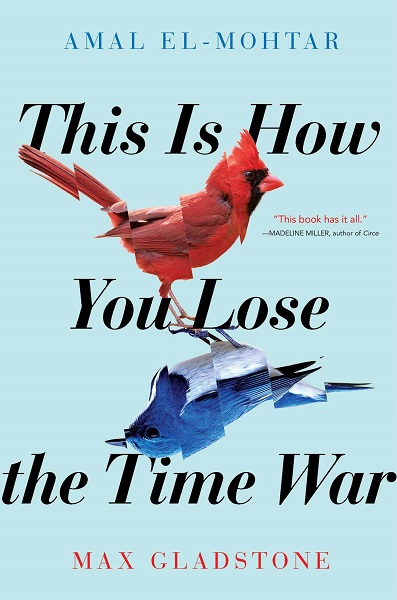
Paul Weimer Review: This Is How You Lose the Time War

  • This is How You Lose the Time War by Max Gladstone and Amal El-Mohtar (Simon & Shuster, 2019)

By Paul Weimer: Max Gladstone and Amal El-Mohtar’s  This is How You Lose the Time War is a rivalry, a love story, a conflict, and a meeting of perspectives told through world-changing time travelers’ letters.

The idea was inevitable, and originated relatively early in the history of time travel narratives. If one person can invent a time machine, and if history can be changed, then more than one person is going to invent a time machine, and the goals of those forces are going to not be congruent. From Jack Williamson and Fritz Leiber to the Terminator, to novellas like Alasdair Reynolds’ Permafrost and Kate Heartfield’s Alice Payne, and to Annalee Newitz’s The Future of Another Timeline, there is a lot of mileage to the idea of a Changewar, where different time traveling factions seek to change history. Readers here at File 770 can cite chapter and verse on stories, novellas and novels that have used the idea.

Max Gladstone and Amal El-Mohtar’s This is How You Lose the Time War takes this subgenre of a subgenre in a unique direction by telling the story of two agents from opposite sides, who find something in each other, greater than the causes they separately serve. That by itself would be an interesting enough concept to pin down a novella, but the authors have an additional, delightful wrinkle: The agents do not meet, but rather communicate in letters to each other.  Yes friends, this is an epistolary novel.

In a world of Twitter, and Bluesky, and instant social media, long form letters are a delightful retro technology and form. Epistolary novels and stories, never the most common of forms even when letters were dominant as a means of communication, are exceedingly distinctive just by their format in this day and age. It’s a bold choice by the authors to have the two agents, Red (from a technological end state utopia) and Blue (from a biological super consciousness utopia) to start their correspondence and to have their letters (which take increasingly unusual forms as described in the narrative) be the backbone of the action. Every chapter has one of the principals in action, and a letter from the other principals, giving a harmonic balance for the reader as far as perspective. But it is within the letters themselves that the novella truly sings and shows its power.

Those letters, those perspectives, shift from adversarial relationship to something more as the two best time agents in all of history find more in common with each other than in their own sides, Agency and Garden. I was half expecting, going in, a narrative more like Leiber or Anderson, or the like, where jonbar points are displayed and fought over, and changed back and forth as the two sides change history. And there is some of that but it is in the most general of senses, with lots of references to alternate strands and timelines. The worlds that were and what might be, and could be, are really just smoke and reflections, pale ghosts compared to how Red and Blue bare their souls and hearts to each other. So this is not a story for deep explorations of how saving Archduke Ferdinand or giving Genghis Khan a longer life might change the timelines. Sure, there are handwaves in the direction of changing things here and there, but those are not the point. The novella is not really oriented toward pulse pounding action, either, although there is a culminating sequence toward the end of the novella where the style does change a bit to allow for it.

What this novella provides for the target readers is an extremely literary focus. There are clever bits with wordplay, allusions, references, and even a book recommendation or two mixed in with that. The letters, starting as boasting and admonitions that each side is going to win, slowly change and evolve, as the adversarial relationship finally turns to respect, and then love. The power and the strength of the letters become richer and richer as the novella continues, as Red and Blue really start to really understand each other, and themselves, that the novella truly shines with the full power of the writers. The seamlessness of the two writers writing is also noteworthy–I can make a guess as to which writer might have written which side more predominantly but I cannot possibly be sure of that. Like Red and Blue themselves, the two sides blend into each other, and while I may slightly prefer the letters of Blue to Red, the beauty and poetry of both sides’ letters, especially in the latter portion, is magical. I was moved deeply by the slow burn love story that unfolds in the words in their letters.

That is the real magic to that writing. Going in, I would have guessed that El-Mohtar would provide the heavy lifting of the poetic language for the letters. I’ve usually had a greater conception of Gladstone in terms of excellent prose, not poetry. But then I remember Gladstone’s history teaching in rural China, and realize that some of the language and forms we get, the style and pacing, have echoes in that corpus of literature as well.

There is a line in one of the letters, “All good stories travel from the outside in”, and This is How You Lose the Time War fulfills that promise.

Jonathan Cowie Review: Halcyon Years by Alastair Reynolds

Halcyon Years (2025) Alastair Reynolds, Gollancz, £25 / US$38, hrdbk, 326pp, ISBN 978-1-399-61176-3

By Jonathan Cowie: To cut to the chase for Reynolds’ fans, the man is on top form. So regulars can skip the rest of this review, just know his latest is out and go and get it.

This wide-screen (we are interstellar) space opera stars Yuri Gagarin, the Russian cosmonaut and first man in space, except this time he is not alone but with eight million others (but many are in suspended animation) on a 50 kilometre long generation ship, Halcyon; well, it is 56 kilometres long on the outside and it is gently spinning to provide artificial gravity on the inside.

They are travelling at 10% the speed of light on the way to Vanderdecken star some 40 light years distant from Earth.

Yuri died in an accident some 200 years before Halcyon’s launch and boarded the starship as a Jack, in frozen suspended animation in Sleepy Hollow. He has been awake now for some years now and working as a private detective in shady part of Belt city taking on married partner cases of suspected infidelity and such like. Life is more or less boring for Yuri but he gets by when he is approached by a lady who calls herself Ruby Blue who works for the company responsible for the starship’s maintenance.  She wants him to investigate two murders, one in each of the two rival families who effectively control society aboard the ship.

Normally, Yuri would not touch the case as murder investigations are for the police, but as the police have closed the cases – both were considered accidental deaths – Yuri is free to take them on and Ruby is paying handsomely as well as giving him a pass that will get him into most places on the starship.

He has barely started on the case when he visits a doctor at the hospital where one of the victims was being treated but who did not survive her injuries gained while on a trip outside the spacecraft.  The doctor leaves the hospital shortly after Yuri has questioned him and Yuri follows.  However, Yuri catches up with the doctor whose car has come off the road badly injuring him.  It seems to Yuri as if this case is deadly.

Adding to his concerns, back at his office he meets another lady called Ruby Red who warns him off the case and who attempts to pay him off.  But Yuri has his scruples and tells her that he cannot be bought and will continue to work for Ruby Blue…

By the way, book collectors may care to note that the UK edition inside front cover teaser reverses Ruby Red and Ruby Blue.  I do not know if this will be corrected with future editions or if the US edition is different; if it is then this British first edition will be something of a curiosity.

I will not go further into the plot at the risk of giving spoilers, but suffice to say that it all somehow leads to the colonisation mission they are on.

Alastair Reynolds has in the past given us different takes on space opera in addition to his well known wide-screen ‘Revelation Space’ series of books.  We have had the trilogy that began with Revenger (2016) which was a high-seas, pirate perspective on interplanetary travel with solar sail vessels.  This time we have a cinematic noir take on the traditional detective story (though technically it is more neo-noir as it takes place on a giant starship).

The set up and, importantly, the pacing is good (there have been just a couple of occasions I have found his books to be too busy with loads of concepts thrown). And then there is a solid Easter egg.  I have kept my eye out for this, as he does include them, as I was once wrong-footed in another novel by a mention of Martian landers which I mistakenly took to be a tip of the hat to the author’s astrophysics days and not plot relevant. But there is a doozy of an egg in Halcyon Years that is best not looked into unless you really are seeking a giveaway.

Gollancz were hugely prudent in giving Reynolds a ten year, £1 million (US$1.62m) deal back in 2009 when Malcolm Edwards was cementing Gollancz’s place as the premiere home for British SF. Though that deal is long since over, and sadly Edwards has retired, Reynolds has continued to supply Gollancz with books ever since.

This is another great one.  It is not ostensibly part of the ‘Revelation Space’ sequence, though it could at a bit of a pinch fit in: ‘Revelation Space’ did see early colonisation attempts and if Halcyon Years was part of Revelation Space (even if a bit of a stretch) a sequel would be possible and another case for Yuri. However, I think this is going to be one of Reynolds’ standalones and there is nothing at all wrong with that.

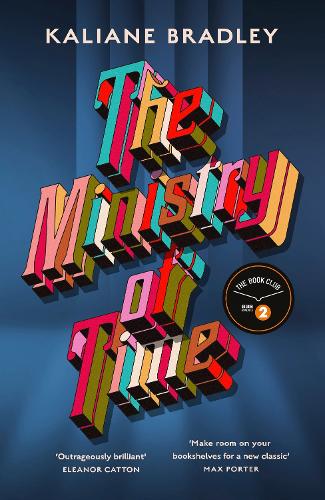
Michaele Jordan Review: The Ministry of Time

  • The Ministry of Time by Kaliane Bradley (Hodder & Stoughton)

By Michaele Jordan: The first thing I thought when I saw the title of The Ministry of Time by Kaliane Bradley was, “Oh, Lordy, not ANOTHER time travel story.” My husband looked over my shoulder, and said the same thing, He hates time travel stories. I’m not crazy about them either. I almost decided not to bother. But it was a Hugo nominee. I always read the Hugo nominees. 

Normally I would have started with The Tainted Cup but I couldn’t get hold of it. There are10 holds waiting on the hard copy at the library, and 38 holds on the ebook. That’s not even counting the audio books. (I never get audio books.-I’m too deaf to follow them.) Anyway, it’s good to know that our Hugo winner is popular, even among non-fan readers.

And  I was wrong to prejudge The Ministry of Time. It is NOT a standard time travel tale. In fact, there is surprisingly little time travel in it. As the title plainly states, it’s about the ministry, not the time travel.

Such time travel as there is remains minimal — a one trick pony, you might say. The ministry has the ability to transport persons from the past to their present, provided they know where and when that person was. They take pains to keep the historical record intact and pinpoint the moment when their target was last seen alive, and presumed to have died shortly thereafter.

Aside from the time travel, their present is not hugely later than ours. Their day to day tech remains much the same. Climate change is a little further advanced than it is now. (Or maybe not. Even now, it’s pretty much always raining in England.) 

One can hardly call the transportees victims, since their lives were saved by the extraction, but they need a lot of support when they first arrive. Each one is assigned a handler. The story follows one such pair, who face some unusual complications.

I’m not going to say more. The story is complex and satsifying — it will keep you reading.

Grey Walker Review: Absinthe: Sip of Seduction

Absinthe: Sip of Seduction: a Contemporary Guide by Betina J. Wittels and Robert Hermesch (Corvus Publishing, 2003)

By Grey Walker: This book promises a great deal, and delivers most of it. It’s designed beautifully from beginning to end — the cover is colored the perfect shade of pale green to match the absinthe in the glass in the photograph under the title. And what a title! It’s been a great conversation starter at parties this past holiday season: “I’ve been reading a book called Absinthe: Sip of Seduction….”

Photographs and art reproductions are plentiful throughout. There’s hardly a page without something intriguing to feast your eyes upon. And the layout complements the lavish visual feast. The pages are generous, with just the right balance between visuals, text and white space. Contrasting fonts and text boxes are used judiciously, without being overdone or confusing. The paper is a nice weight, smooth and satiny, supporting the glorious colors of the reproduced posters and paintings without being unpleasantly shiny or chemical-smelling. All in all, this is a luscious book to hold and look at.

The information and tidbits here are equally luscious. Absinthe has had a cloudy, romantic history, and now I know why. Wittels and Hermesch tell about its beginnings as a wormwood tonic created for health benefits. They recount its rise in popularity to its cult status among Victorian poets, artists and megalomaniacs, Aleister Crowley and Rimbaud among them. And finally they discuss its controversial downfall.

I’ve always known absinthe was illegal, and I’ve heard the usual vague explanations about its poisonous, madness-inducing qualities. The authors of Absinthe: Sip of Seduction present a far more convincing story, involving the Victorian establishment’s misunderstanding of alcoholism and the wine market’s fury over absinthe’s growing profit share. It’s a fascinating look at the way medicine and economics can feed into one another and co-create a popular hysteria.

To round out the picture of this near-mythical libation, Wittels and Hermesch mention modern artists who have taken up the cult of absinthe anew (Johnny Depp, to no one’s surprise), and they supply a host of information about where to find absinthe today, where to go to drink it in company, the best modern makers of absinthe, and purveyors of absinthe collectibles, including all the paraphernalia necessary to serve and drink it properly.

My one negative criticism of this book is that it was poorly edited. It’s littered with syntactical and other grammatical mistakes that, unfortunately, distract from its content. This is inexcusable on Corvus’ part. But I recommend looking past it, if you can, so as not to miss a wonderful piece of folklore.


Grey Walker is a Narrative American (with thanks to Ursula K. Le Guin for coining that term). Although she makes money as a librarian, she makes her life as a reader and writer of stories and reviews of stories. She has a growing interest in the interstitial arts. The album she listens to most often is Morning Walk by Metamora. The book she re-reads most often (and she never owns a book unless she intends to read it more than once) is The Smith of Wootton Major by J.R.R. Tolkien.