Pixel Scroll 6/13/26 One Of Our Check Boxes Is Missing

(1) SOUND FAMILIAR? The New York Times poses a challenge: “Do You Recognize These Lines From Popular Science Fiction?” Link bypasses the NYT paywall.

Welcome to Literary Quotable Quotes, a quiz that tests your recognition of classic lines. This week’s installment highlights observations from future or alternate worlds depicted in popular science fiction. In the five multiple-choice questions below, tap or click on the answer you think is correct. After the last question, you’ll find links to the books if you’re intrigued and inspired to read more.

Here’s where the quiz begins – you’ll have to click the link if you need the multiple-choice options.

Question 1 of 5

Night City was like a deranged experiment in social Darwinism, designed by a bored researcher who kept one thumb permanently on the fast-forward button.

(2) ORIGINALLY IN ANOTHER TONGUE. “Rachel Cordasco on Translated SF” – an interview conducted by James Machell at the Science Fiction Encyclopedia’s Substack newsletter.

Rachel Cordasco has written a variety of entries for the SFE, most notably SF in Translation in which she places the first golden age of science fiction translation in the 1970s (see entry for more details). Her expertise in translation range from her time as translator of works from Italian, reviews for SF Signal, and founding of Speculative Fiction in Translation where she has continued to review translations from over a dozen languages. Small Planet, a magazine dedicated to further discussion, was published on Speculative Fiction in Translation last month. In this interview, she discusses her career so far, underrated works of translated SF, what distinguishes a great translation, and the direction of Small Planet #2….

…JM: Are there particular translated works which you feel deserve greater critical attention?

RC: There are so many worthy works of SFT that I’d like to highlight, but that would take up volumes because, in fact, so much SFT that comes to us is double-vetted. These texts have often already won awards in their native countries or become extremely popular with readers and Anglophone publishers only want to invest in what they think will be successful. The translators then use their talents to not only bring the text into English but also make it a beautiful and readable work. This is why so much SFT is of a very high quality. I will take this opportunity to say, as I complain often on social media, that it’s a shame we no longer have Kurodahan and Haikasoru to bring us some of the greatest Japanese SF written in the twentieth century. Another publisher needs to step into this void and continue the work that those two publishers did for a decade. I’m also always on the lookout for SFT from underrepresented languages: I would love to read more, for instance, Vietnamese SFT, Buglarian SFT, Norwegian SFT, Icelandic SFT, etc.

One more thing: I used to think that Stanislaw Lem and the Strugatskys were so well known in the Anglosphere that I didn’t have to recommend them because, you know, everybody has already read them, right? Well, I’m getting the terrible feeling that this isn’t the case. So for anyone who is just starting with SFT, go read Lem and the Strugatskys.

(3) WORLD WIDE PARTY 2026. [Item by John Hertz.] From Dale Speirs’ Opuntia 628 (p. 18):

Founded by Benoit Girard (Quebec) and Franz Mikiis (Austria) in 1994, the World Wide Party is held on June 21 every year. 2026 will be the 33rd year of the WWP. At 21h00 local time, everyone is invited to raise a glass and toast fellow members of zinedom around the world. It is important to have it exactly at 21h00 your time. The idea is to get a wave of fellowship circling the planet.

At 21h00, face to the east and salute those who have already celebrated. Then face north, then south, and toast those in your time zone who are celebrating as you do. Finally, face west and raise a glass to those who will celebrate WWP in the next hour.

Raise a glass, publish a one-shot zine, have a party, or do a mail art project for the WWP. Let me know how you celebrated the day.

(4) MATT KRESSEL Q&A. In the new episode of the If This Goes On (Don’t Panic) podcast, “The Rainseekers with Matt Kressel”, Alan Bailey and Cat Rambo talk with Matt Kressel “about writing with authenticity, writing unfamiliar cultures, Dungeons and Dragons, what writers can take from RPGs, Matt’s new novels Spacetrucker Jess and The Rainseekers, AI, plagiarism, and much more.”

(5) ORBITAL AIR BAGS – NO, NOT FAN PANELS. [Item by SF Concatenation’s Jonathan Cowie.] In this week’s Science orbital air bags proposed to block Solar storms

In a study published this week in Space Weather, the researchers describe a provocative proposal called “StormWall”: a fleet of satellites that would release hundreds of tons of gases into space just before a solar storm strikes Earth. Computer simulations suggest the artificial cloud could cut the intensity of a major solar storm by half or more.

(6) WINNING STARSCAPES. [Item by Steven French.] For a lovely ’time-line cleanse’ check out these stunning images from the “2026 Milky Way Photographer of the Year Competition” at Capture the Atlas.

Now in its 9th edition, our Milky Way Photographer of the Year brings together 25 inspiring images captured under some of the most remarkable dark skies on Earth. Each photograph in this collection represents a unique moment where planning, patience, creativity, and technical skill came together beneath the stars….

… Beyond their artistic and technical achievement, these photographs also remind us how rare truly dark skies are becoming. As light pollution continues to erase the stars from many places around the world, this collection is both a celebration of what still exists and a reminder of what we stand to lose….

(7) TODAY’S BIRTHDAY.

[Written by Cat Eldridge.]

June 13, 1893Dorothy Sayers. (Died 1957.)

I’m going to talk about Dorothy Sayers tonight who although she wrote a handful of ghost stories is here because of mysteries. Oh, what mysteries they were.

Dorothy L. Sayers

Her first novel, Whose Body?, was published in 1923. Over the next thirteen years, she would write ten more novels featuring the ever so proper Lord Peter Wimsey who solved mysteries. In Strong Poison, we would be introduced to artist Harriet Vane who Wimsey would fall in love with in a properly upper-class manner. Harriet appears off and on in the future novels, resisting Lord Peter’s proposals of marriage until Gaudy Night six novels later.

Yes, I read all ten of these novels in order some forty years back. I like them better than Agatha Christie novels on the whole as the social commentary here gives them a sharper edge and I think Sayers described her society better than Christie did. Now Christie was way more productive over a much longer period of time as Sayers stopped writing these mysteries, which includes short stories, by the later Thirties in favor of writing plays, mostly on religious themes which were performed in cathedrals and broadcast by the BBC. 

So there’s eleven novels and the short story collection, Lord Peter Views the Body, which I’ve not read but now I see is on the usual suspects as a rather good deal of just a dollar, so I’ll grab a copy now. Done. 

I’d like to speak about The Lord Peter Wimsey series starring Ian Carmichael of the early Seventies, it covered the first five novels. Carmichael said he was too old to play the part for the romantic relationship of the later novels, but it didn’t matter as the series was cancelled.  

I thought it was a rather well-done series and I caught it recently on Britbox, one of those streaming services, and it has help up rather well fifty years on with the Suck Fairy concurring. 

He did play Wimsey into the BBC radio series that covered all of the novels and ran at the same time. They are quite excellent and are available on Audible at a very reasonable price. 

Finally she wrote, according to ISFDB, a handful of genre stories, four to be precise —“The Cyprian Cat”, “The Cave of Ali Baba”, “Bitter Almonds” and “The Leopard Lady”. Three seem to be fantasy and the fourth, “Bitter Almonds” I’ve no idea about. Anyone have knowledge of these?

(8) MEMORY LANE.

[Written by Cat Eldridge.]

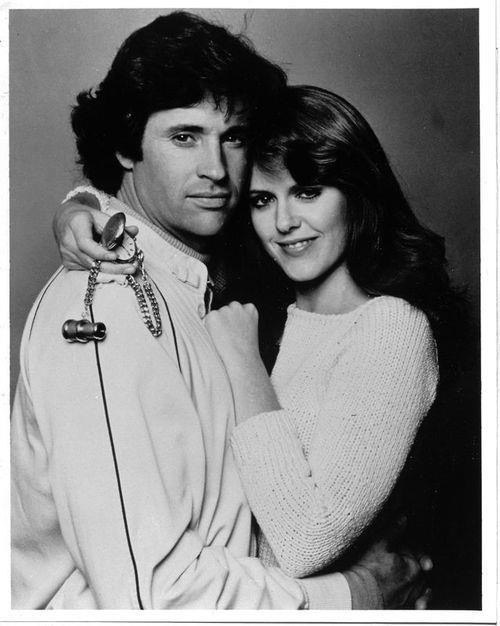
June 13, 1980The Girl, The Gold Watch & Everything

Robert Hays and Pam Dawber from the 1980 movie The Girl, The Gold Watch & Everything

Forty-six years ago, a rather charming film premiered in syndication this evening as produced by Paramount. The Girl, The Gold Watch & Everything was based on the novel of the same name by John D. MacDonald, who of course did the Travis McGee series. I know I watched it and I know I like it even four decades on.

It was written by George Zateslo who hadn’t written anything prior to this save an episode of CHiPS. After writing this, he’d write the script for the sequel, The Girl, the Gold Watch & Dynamite, originally titled the The Girl, the Gold Watch, and Everything Else before they realized that was way too long. Or so they thought.

Actors Lee Purcell and Philip MacHale from the 1981 sequel The Girl, the Gold Watch & Dynamite

The two cast members to note here are Robert Hays as Kirby Winter and Pam Dawber as Bonny Lee Beaumont. That because the story is a rather thin SF plot involving a young male who inherits from his millionaire uncle a gold watch that has the power to stop time. A series of quite unlikely and comic adventures ensue. And yes there’s a girl involved. This girl is entirely, I believe, why the novels were written, but then a girl was always present in John MacDonald’s Travis McGee novels as well. 

An episode of the Twilight Zone, “A Kind of Stop Watch”, has essentially the same story as that of “The Girl, the Gold Watch & Everything”. A lot of Twilight Zone fans would claim very loudly that McDonald ripped off Serling’s script. That episode, however, aired in October of 1963, the year after the publication of the novel on which the movie is based. Sigh. 

Can y’all remember how far back this story plot device goes? I assuming it’s present in the beginning of the genre, isn’t? 

(9) COMICS SECTION.

(10) JUSTICE LEAGUE STANDINGS. “Every Founding Member of the Justice League, Ranked by Importance in 2026” in the opinion of ComicBook.com.

…The League has certainly gotten bigger over the years. The advent of the Justice League Unlimited has seen nearly every superhero alive join their ranks, but the classics should always be respected. Seven people founded the League, and to this day, they are all incredible heroes. To celebrate those heroes, we’re going to take a look at how important each of the original seven is in comics in 2026. We’re only judging them by how much they are impacting overall stories and DC right now, and while each is definitely important, you might be surprised to see that some have waxed or waned more than you think. With all that said, let’s leap into ranking the League….

On the lower end of the list is —

6) Martian Manhunter

Unfortunately, sixth place on our list belongs to the beloved Manhunter from Mars. J’onn has often gotten the short end of the stick compared to his fellow founding Leaguers, especially when it comes to his own storylines. Where he is best shown off in Justice League stories, his teammates each have their own volumes focused solely on them. With the Justice League being so massive right now, that leaves even less time for Martian Manhunter to stake his claim. He’s still DC’s strongest telepath and the person everyone can turn to, but as of right now, he’s not doing nearly as much as his teammates. He is currently helping out Superboy in Action Comics (2016), so at least he’s operating in some spotlight.

(11) SCARF AND GOBBLE. [Item by SF Concatenation’s Jonathan Cowie.] I do like to go to the cinema with local SF group members. (Remember the days when the Eastercon always had a film programme as did British venued Worldcons…?)

For me, watching films is a communal experience to chat about after, or if at home, ‘pausing’ to have a mug of Builders and ask a pressing questions such as “I haven’t seen any 12 monkeys  in The 12 Monkeys so far. where are they?”

However, some can spoil the experience, as described over at the BBC. “Loud eaters and phones nearly spoiled my cinema trip – and it’s not just me” (Subscription required by readers outside the UK.)

The cinema lights are low and you’re cocooned in your seat, ready for the film to transport you to another world. But just as you settle in, you’re jolted back to reality. Audience members around you are scrolling on their phones, talking and munching loudly.

(12) SPACE LOGISTICS. [Item by Steven French.] Can we mine asteroids to colonize Mars? A new study suggests we can, if we use certain asteroids themselves to produce the fuel required: “Mining the solar system to build a new world” at Phys.org.

I watched Armageddon again fairly recently with Bruce Willis, oil drillers in space and an asteroid the size of Texas bearing down on Earth. Buried beneath the Hollywood chaos is a genuinely interesting question: What exactly could we do with an asteroid if we got our hands on one? As it turns out, the answer has nothing to do with blowing it up, sorry Bruce, but everything to do with building a new world.

Building a colony on Mars is not just an engineering problem, it’s a logistics one too. The logistics, unglamorous as it sound, may ultimately determine whether humanity becomes a multi-planetary species or stays firmly rooted on Earth.

Think about what a Mars colony actually needs. Not just food and oxygen, but metal. Structural steel for habitats, aluminum for equipment, iron for tools and many of the components will wear out, break, and need replacing. Shipping all of that from Earth every time is not a serious long-term strategy. A rocket launch costs tens of millions of pounds per ton of cargo, and the journey to Mars takes between six and nine months depending on where the two planets happen to sit in their orbits. You cannot run a hardware store on that kind of supply chain.

new study from researchers at EPFL in Switzerland posted to the arXiv preprint server has now done the hard math on mining asteroids and delivering the metals directly to Mars. The solar system contains millions of asteroids, and the metallic ones, known as M-type asteroids, are essentially giant lumps of iron, nickel, and other valuable materials floating through space. The question is whether we can actually reach them, extract what we need, and get it to Mars efficiently enough to make it worthwhile.

The answer, it turns out, is a careful yes but with conditions….

(13) HOLY VELIKOVSKY! “Scientists Link 3.5 Billion-Year-Old Asteroid Strike To Dawn Of Life On Earth” at HotHardware.

A small stone discovered in the sands of Mali is reimagining what we know about the early solar system. By examining this rare lunar meteorite, planetary scientists have mapped out a sequence of cosmic collisions that retell the history shared by Earth and the Moon.

Thanks (or no thanks) to plate tectonics, erosion, and volcanic activity on Earth, finding pristine physical evidence of what happened here billions of years ago is nearly impossible. To uncover our planet’s earliest chapters, scientists must sometimes look to the Moon, a geologically quiet place where the lack of an atmosphere or weather acts as a permanent cosmic museum.

The meteorite, called Northwest Africa (NWA) 12593, is a lunar breccia, essentially a natural concrete formed when fragments of different rocks are fused together by extreme force. A research team at the University of Colorado Boulder subjected the stone to radiometric dating and chemical analysis, revealing that it survived three distinct impacts. The last collision launched it off the Moon toward Earth, while a prior mid-history strike smashed and welded the fragments into its current concrete-like form.

However, it is the first and oldest impact that is the most interesting. Dated to roughly 3.5 billion years ago, this colossal asteroid strike released enough energy to turn the lunar surface into a sheet of liquid rock. The heat was so intense that it generated cubic zirconia, a mineral that requires extreme, controlled temperatures to form. Though the mineral fragilely dissolved as the magma cooled, researchers successfully identified its chemical fingerprints locked inside the meteorite.

This 3.5-billion-year-old timestamp coincidentally mirrors known impact records found in ancient crusts on Earth, as well as on 4 Vesta, one of the largest objects in the asteroid belt. Finding an identical bombardment signature across three completely separate bodies suggests a coordinated, system-wide event. This possibly indicates that the inner solar system was transitioning away from the constant chaos of planet formation toward a sudden, massive wave of debris, perhaps caused by the breakup of a giant asteroid….

(14) SPIELBERG Q&A. “Steven Spielberg on ‘Disclosure Day’ and alien visitations – YouTube on CBS Sunday Morning.

As a child, Steven Spielberg stared at a meteor shower on a wondrous starry night and began his love affair with the sky. The director of the classic “Close Encounters of the Third Kind” and “E.T.: The Extra-Terrestrial” has returned to the sci-fi genre with “Disclosure Day,” which imagines closely-held secrets surrounding alien visitations. He talks with Turner Classic Movies host Ben Mankiewicz about UAP/UFO phenomena, the paranormal, and his own beliefs regarding intelligent life beyond Earth.

[Thanks to Kathy Sullivan, Steven French, Mike Kennedy, John Hertz, Daniel Dern, Andrew Porter, John King Tarpinian, Cat Eldridge, SF Concatenation’s Jonathan Cowie, Chris Barkley, and Mark Roth-Whitworth for some of these stories. Title credit belongs to File 770 contributing editor of the day OGH.]

Pixel Scroll 6/9/26 MacScroll: Is This A Pixel Which I See Before Me?

(1) THOMAS Q&A. Sheree Renée Thomas was interviewed about her new book Ring Shout on Saturn by WREG’s Live at 9:00 program: “Award-Winning Author On New Book Exploring Black Culture’s Future”. Video at the link.

(2) AUTHORS’ OWN STORES. The Brooklyn Eagle published “A guide to the bookstores owned by your favorite authors” – a list of authors which includes Emma Straub, Judy Blume, and George R.R. Martin.

(3) SCIENCE THRILLERS. “Cristina LePort on Turning Medical Advances into Page-Turning Suspense” at CrimeReads.

Medical advances have always fueled storytelling, but in today’s world—where science routinely crosses lines that once felt absolute—they have become one of the most powerful engines of narrative tension. Among these advances, cryonics stands apart. It doesn’t just push boundaries; it challenges the most fundamental one: death itself.

Traditionally, death is a fixed point, a boundary that cannot be crossed. Medicine has steadily eroded that certainty through resuscitation, organ transplantation and life support. Cryonics goes further. It proposes that what we call “death” may not be final, only temporary—an interruption waiting for technology to catch up. Bodies are cooled. Cellular decay is slowed. Time is, in a sense, interrupted.

Cryonics contains all the ingredients of a gripping story: high stakes, cutting-edge technology, moral ambiguity. If death is no longer final, then every decision surrounding it becomes unstable. Is the person gone, or waiting? Can identity be preserved? And the ultimate question: who decides who deserves another chance? These are not abstract philosophical puzzles. They are plot devices with teeth.

Most genres have to manufacture stakes. Medical stories begin with the highest possible ones. Life and death are already on the table. Medicine deals in outcomes that are final, and that finality gives every scene weight.

Now introduce an advance—something new, unproven, powerful—and the stakes sharpen. The question is no longer just “Will the patient survive?” but “Should this even be attempted?” That shift—from survival to judgment—is where suspense deepens. At the edge of the possible. The conflict is no longer just clinical—it is moral and emotional. The science is not decorative—it drives the plot with built-In stakes: life, death, and judgment….

(4) FAMED SMALL PRESS COMING TO END. “Subterranean Press to Close” reports Locus.

After a long career of publishing gorgeous limited editions, collections, art books, and novellas, publisher Bill Schafer has shared the news that Subterranean Press will be permanently closing in the coming years. Subterranean intends to continue publishing work through the end of 2027, “which may bleed into 2028 as we wrap things up.”…

From their website: Based in Burton, Michigan, Subterranean Press has been putting out approximately 45 titles each year….

(5) ANATOMY OF A POP CULTURE CON. [Item by Bruce D. Arthurs.] AZCentral.com, the online version of The Arizona Republic newspaper, has an article up with an overview of the Phoenix Fan Fusion convention’s growth from a one-day event with less than 500 attendees to it’s current multi-day event with 100,000+ attendees. Includes a big picture gallery of cosplayers over the years. “How Phoenix Fan Fusion evolved into a pop culture giant”. (Paywalled, but reloading several times brought up a “continue without supporting” option.)

There once was a time when Phoenix Fan Fusion wasn’t as it is today.

In fact, when the first ever event took place in June 2002, it was called the Phoenix Cactus Comicon, and it was a single-day convention that was held at the Best Western in Ahwatukee.

Back in those days, Fan Fusion featured a few local creators and exhibitors and mainly focused on comic books, science fiction and fantasy along with film and television. Over the years, this annual event has expanded greatly, moving from a Best Western to the Glendale Civic Center, then to the Mesa Convention Center in 2006 where it ran for two days for the first time. In 2010, Fan Fusion finally found its way to its present-day home: the Phoenix Convention Center.

In addition to expanding yearly attendance, Fan Fusion also continued to expand to other parts of pop culture like anime, manga, toys and collectible card games along with video games, horror, fantasy and sci-fi novels, and beyond….

(6) ABOUT THE NEW KRITZER NOVEL. Cory Doctorow leads today’s installment of Pluralistic with a review of “Naomi Kritzer’s ‘Obstetrix’ (09 Jun 2026)”.

Naomi Kritzer’s Obstetrix is a new, tense thriller in the mode of Atwood’s Handmaid’s Tale and Alderman’s The Power; it’s a beautifully turned, claustrophobic horror novel about an obstetrician who’s been kidnapped by a Christian cult obsessed with fertility…

…All that is in the first few pages, which leaves plenty of room for an expertly spun second act in which we get Kritzer’s trademark interpersonal work, where carefully chosen and smartly wrought small details flesh out a picture of the complex dynamics of life inside a “high-demand” cult, from the way that members are manipulated into policing each other’s compliance to the internal processes that keep members cowed even when they’re unobserved by others. It’s a brilliant work of sociological speculation and the engine that drives it is a series of maneuvers and gambits whereby Dr Liz hopes to make her way to safety….

(7) DR. BATYA WEINBAUM (1952-2026). Feminist scholar Dr. Batya Weinbaum died June 8. She founded the Femspec Journal, an interdisciplinary journal of feminist sf and f. She published 17 books as well as over 500 articles, essays, poems, reviews, and pieces of short fiction in various publications

(8) JOHN A. LENT. (1936-2026). John A. Lent, pioneering comics scholar, died May 16, as a result of injuries sustained in a fall at his home. He was 89 years old. The Comics Journal has published a profile: “Remembering comics scholar John A. Lent, 1936-2026”.

For a generation of scholars and researchers engaged in comics studies, John Lent was a powerful, almost mythic figure. Indeed, the International Comics Arts Forum named its prize for best graduate student paper after him. The short line biography of John is, frankly, astonishing: he taught at the college and university level in the United States, Canada, Malaysia, the Philippines, and China from 1961 to 2011, but spent most of his career at Temple University in Philadelphia. He authored or edited an astounding 91 books about comics, animation, political cartoons, cinema, and other forms of mass communication. Perhaps most impressively, he edited and published the International Journal of Comic Art for twenty-seven years.

John’s accomplishment with IJOCA may be difficult for non-scholars to comprehend because it is challenging even for professional scholars to fully grasp it. In the late 1990s, following the shuttering of the original version of the scholarly journal Inks, John recognized that there were no extant venues for English-language comics scholarship and so he simply bootstrapped a new one into existence….

(9) HE UPDATED HUCK FINN AND TOM SAWYER. The New York Times memorialized “Alan Gribben, Twain Scholar Who Excised Slur From ‘Huck Finn,’ Dies at 84”.

Alan Gribben, a Mark Twain scholar who replaced a racial slur with the word “slave” in revised editions of “The Adventures of Tom Sawyer” and “Adventures of Huckleberry Finn,” igniting an international furor about sanitizing works of literature, died on May 9 at his home in Montgomery, Ala. He was 84.

The cause was pancreatic cancer, his wife, Irene Wong, said.

Renowned by Twain biographers for his decades-long effort to catalog everything that Mr. Twain had read and scribbled notes on, Professor Gribben became an academic outcast in 2011 almost immediately after Publishers Weekly reported on his plan to excise the slur “nigger” from forthcoming editions of the author’s most famous novels.

Professor Gribben, the editor of the Mark Twain Journal and a professor of English at Auburn University at Montgomery, in Alabama, wanted to provide an alternative to schools that had stopped teaching the original texts because of the slur, which appears more than 200 times in “Huck Finn.”

In response, the literary establishment shrieked like the whistle on a steamboat chugging down the Mississippi River….

… Professor Gribben mounted a vigorous defense. Writing in Publishers Weekly, he traced the idea to his time on a lecture series about Mr. Twain’s books. After the events, educators would complain to him about being unable to teach “Tom Sawyer” or “Huck Finn.”

“My aim,” he wrote, “became the rescue of these two novels for students, parents and teachers who have found the works, merely owing to one repugnant racial slur, disturbing to read in our integrated public schools.”

NewSouth Books, an independent publisher, issued the revised novels in 2011. Within five years, more than 20,000 copies had been sold.

Last year, in collaboration with Ms. Wong, Professor Gribben revised both books again, going beyond cutting the slur to render some of the dialect in more contemporary vernacular….

(10) TODAY’S BIRTHDAY.

[Written by Paul Weimer.]

June 9, 1930Lin Carter. (Died 1988.)

Lin Carter. Photo by and (c) Andrew Porter.

By Paul Weimer: First of all, how cool is it that he was tuckerized in a Isaac Asimov mystery novel? Yep, he is Mario Gonzalo of the Black Widowers. I may not be a major mystery reader, but I appreciate someone who can rise to the Doctor’s attention and get immortalized thereby. And he was a longtime fellow and acolyte of L Sprague de Camp, in the bargain.  So Lin Carter’s credentials both in fandom and in the SFF field in general come from deep and abiding roots.

The Wizard of Lemuria, in the tradition of De Camp, would be the first Lin Carter work I read, an old garish paperback I found in a used bookstore. I understand there was a whole series of these, but none of them came on my radar that they existed for decades thereafter.

I read some of his stories, here and there, as they wound up in collections that I read. And of course some of the De Camp Conan stuff he worked on. He was a master of pastiches, too, from Lovecraft to Howard to Dunsany. 

But Carter’s impact on me was not so much as his own work, but his editorial work on the Ballantine Adult Fantasy series. I fell into these after reading Zelazny and Tolkien (his own works early in the line) in the early 80’s. Ballantine under Carter was possibly the first publisher whose work I followed. And thanks to Carter I read Gormenghast, and A Voyage to Arcturus, and Eddison, and perhaps best of all, The Last Unicorn.  (or maybe The Broken Sword by Poul Anderson. Or maybe Katherine Kurtz. Or maybe…You get the picture.  My early exposure to fantasy outside of Tolkien and Zelazny was shaped by Carter. Perhaps his work and line gave me an “earlier perspective” on fantasy, pushing me more into authors like Anderson for a while before I exploded into mid 80’s power fantasy. 

Carter’s influence as an editor, anthologist might outshine his own work, but his essentialness in helping shape the minds of me and many other fantasy readers who read Tolkien and were looking for more had an impact on the field for decades.  

It is said that his eyes were bigger than his belly, as he would often announce works that he would ultimately not write, particularly in sword and sorcery, both in fiction and in nonfiction. It is a shame. I would have liked to read them, too.

Happy Birthday.

(11) TODAY’S OTHER BIRTHDAY.

[Written by Paul Weimer.]

June 9, 1925Keith Laumer. (Died 1993.)

By Paul Weimer: Keith Laumer’s Retief novels, about the adventures of a rather forward thinking and two-fisted diplomat, made the first and strongest impression to me of Laumer’s work, and it is here that I will begin my discussion of it. I think it might also be the closest thing he has to his own heart, because he was a diplomat in the foreign service. He knew the archetypes and kinds of characters on both sides of the political fence, and that all goes into the blender of Retief. And who can resist a two-fisted active diplomat out among the stars?  (I think of him as a first cousin to Poul Anderson’s Flandry.)

I also modeled one of my favorite PCs on him, Diplomat Ingrey Wererathe, who was indeed the most competent person in the Embassy, and that got him into all sorts of adventures and trouble. (The head Ambassador was too interested in political climbing to care– I suspect the GM knew who I was modeling Ingrey on and had read the Retief stories too). 

Besides the best diplomat in science fiction (sorry, Bren Cameron, I take Retief over you when the chips are down), Laumer is next best known for the intelligent robot tanks, the Bolos. Since I came to the Bolos after first encountering the board game OGRE, my inward conception of the Bolos is much more dark and menacing than they actually are in practice. But, nowadays, with the rise of LLMs and other not-AI AIs, and the big rise of drone technology, the Bolos seem more possible than ever before (so do OGREs come to think).

And if that wasn’t enough, Laumer also did a parallel Earths time patrol series, the Worlds of the Imperium. Once again in a parallel with Anderson, his Imperium is based on a potent and powerful Scandinavian polity. And it is the fun “body double across parallel Earths” story that might seem old hat now…but Laumer paved the way with it in Worlds of the Imperium.

Keith Laumer

(12) COMICS SECTION.

(13) THE FATE OF THE UNMODERNIZED BOOK. [Item by Andrew Porter.] Tyrell McAllister made this ironic comment on a New York Times article about updating older books. (Turns out, he’s a math professor at the University of Wyoming.)

Tyrrell McAllister. Wyoming • May 27

Failure to modernize explains why an obscure British series called “The Chronicles of Narnia” failed to catch on. Even one of the titles from this quickly forgotten series, “The Lion, the Witch and the Wardrobe”, makes reference to an item of furniture found in few households today. Moreover, this book begins with the bombing of London, a historical event that modern children cannot be expected to recognize or to be capable of imagining. Later references in the text to a kind of foodstuff called “Turkish delight” can only be bewildering and alienating to today’s readers. A competent modernization protocol would surely have replaced “Turkish delight” with Snickers bars or something like that. This would certainly make the story more immersive for the contemporary market.

(14) WHO’S TO BLAME FOR ‘NEMESIS’? “’He Was A F—ing Editor’: Jonathan Frakes, Brent Spiner And Ron Perlman Skewer ‘Star Trek: Nemesis’ Director” at TrekMovie.com.

2003’s Star Trek: Nemesis was the fourth feature film for the Star Trek: The Next Generation crew and their final big screen voyage. Deemed a bomb by Paramount and panned by critics and fans, the movie was the last one in the Trek film franchise until it got rebooted six years later by J.J. Abrams with Chris Pine and crew. There are multiple reasons for the failures of Nemesis, but many involved in the project point to director Stuart Baird as a primary villain. The latest bit of Baird-bashing comes from Jonathan Frakes (who had directed the previous two Star Trek movies) and Brent Spiner on their new podcast Dropping Names with special guest (and Nemesis co-star) Ron Perlman.

Brent Spiner and Jonathan Frakes have insisted from the jump that their podcast, Dropping Names with Brent and Jonny, is not a Star Trek podcast — but it is at least an interesting coincidence that so far, outside of Seth MacFarlane, the guests with Trek ties that they’ve had on all worked on Star Trek: Nemesis. Their first guest was LeVar Burton, Geordi LaForge himself. Then they had John Logan, the movie’s screenwriter. Most recently, they caught up with Ron Perlman, who played the Reman viceroy in the movie. In their conversation, Perlman joined other members of the cast who say director Stuart Baird, an acclaimed Hollywood editor by that point, was ill-fitted to direct the pivotal and ultimately disappointing final film in the TNG saga.

Perlman said the cast observed Baird “had no people skills whatsoever” and believed he was only there because he had saved some major Paramount projects over the years. “He was not a director, he was a f—ing editor that the studio owed a favor to,” Perlman said. “Because he saved a lot of their turkeys. They would bring him in when they had a turkey, and he would recut it and turn it watchable. So he was a very talented editor, but he was not a director… He’s not a filmmaker. [It’s] that attitude, like, ‘anybody can do this, you know, let’s just give it to that guy.’”…

(15) SECRETS OF A MASTER. Highly recommended – Tadao Tomomatsu’s latest “training video” on Facebook.

(16) THOSE LITTLE STINKERS! BBC Science Focus Magazine tells “The (not so cute) reason your cat loves sitting on your laptop”.

…The real attraction of your laptop to cats? Its scent. Or, to be more precise: the scent you regularly deposit there.

“You won’t be able to sniff it, but a cat can smell you all over the keyboard,” says Sands.

“Cats are scent machines from the end of the tail to the tip of their nose. Their world is about scent – their eyesight’s developed for night-time hunting, meaning their sense of smell is really important at other times.”

However, while it’s possible your cat may sit on your computer as they enjoy this scent, another explanation is far more likely, according to Sands.

“It’s more probable your cat wants to deposit its own scent and supplant yours. It’s all about ownership – by doing this, your cat is effectively saying ‘I own you!’

“People always think cats rubbing themselves against you or things you touch are expressing love. But actually, cats are very possessive individuals. For them, the more they can brush past you and deposit your scent, the better!”…

[Thanks to Cat Eldridge, SF Concatenation’s Jonathan Cowie, Chris Barkley, Paul Weimer, Bruce D. Arthurs, Steve Green, Mark Roth-Whitworth, Kathy Sullivan, Steven French, Mike Kennedy, Andrew Porter, John King Tarpinian for some of these stories. Title credit belongs to File 770 contributing editor of the day John Hertz.]

Niven, More

Larry Niven

By John Hertz: In further honor of Larry Niven’s 88th birthday — a doubly-lucky number, according to some — last month, I offer these thoughts.

I suggest that Niven has an independent mind. When the different drummer he was marching to had a beat we liked, we loved him. When he marched to yet a different drummer, we dropped him. In both cases we’d have done better to notice how well he wrote. I don’t read things to be agreed with. I recommend that to you.

He’s a comedian. Some laughed when in “What Can You Say About Chocolate-Covered Manhole Covers?” a divorcing couple has a cake topped by a man and woman facing apart. Few seem to have noticed the comedy in The Mote in God’s Eye – like Renner’s snarling “Show-off!” Even fewer, how funny The Gripping Hand is — or Escape From Hell – not to mention (oops, too late) all three of these titles. The satire of Whitbread’s asking in Mote “What about ‘Mountains are pretty’?” is piercing -and pivotal. Rainbow Mars is — sorry, Stan Robinson — a satire.

His characters say and do wonderful things. ”Thumbs!” is a great moment in Footfall. As it happens, he does too. Some of us starting a restaurant expedition asked him what he wanted to eat. He said, “Food.” We looked at him blankly. He explained, “It’s the best thing there is to eat.”

“Let’s look at the record” is credited to Alfred E. Newman Smith. Niven is a breathtaking collaborator. Barnes, Benford, Byrne, Cooper, Drake, Flynn, Gerrold, Harrington, Lerner, Pournelle, Stine. If we include Berserker Base, that brings in Anderson, Bryant, Donaldson, Saberhagen, Willis, Zelazny. He even collaborated with me: we did an interview with Hanville Svetz for Argentus, which got reprinted in my collection Dancing and Joking (p. 34.) Each tastes different — but the Niven flavor is unmistakable: which is, as a woman I know says, and maybe you do too, as it should be.

He’s a poet. That divorce cake is poetry. So is shipstar. So is “Inconstant Moon”. So is “floating in the river, his rear end pointing true north, as elf bottoms tended to do.” I could keep quoting, but it’s time for a short paragraph.

Folk outside our field know goldsmiths and silversmiths. Niven is an idea-smith. “World of Ptavvs”. The Ringworld. The Magic Goes Away. People who think they’re in science fiction but, not realizing that time travel is impossible, by operating a time machine put themselves into fantasy. There’s comedy again.

What about realism? What can that mean in SF? Niven says You have to give them something. If everything is strange, what can the reader do? That’s why, in Asimov, Hari Seldon’s father is a tobacco farmer. Of course those are just the points which, when times change, careless readers (not you) call dated. The real realism in SF (“‘Got to make it real’ -compared to what?”) is verisimilitude — the fictioneer’s creating the appearance of truth. Things have to hang together (or, yes, they’ll hang separately). Niven does that.

John Campbell — never mind what you think of him — and if you think what I think you’re thinking, you’d better not throw away the good parts on account of being sore about the bad parts — said, or is credited with, “Show me a being who thinks as well as a man, but not like a man.” In Shakespeare that being is a woman. But I digress. Niven put it Minds as good os you but different. He does that. Sometimes they suppose they’re better. A Motie Mediator shockingly lets slip that Moties are more intelligent than human beings — or so Mediators believed; but Fowler and Blaine out-think zillions of years of Cycles and Crazy Eddies –there’s poetry again.

This year for Niven’s birthday I sent him this poem. It’s an acrostic (read down the first letters of each line) in unrhymed 5-7-5-7-7-syllable lines like Japanese tanka.

Laughter. Some rise to it,
And if they haven’t, they might.
Reaching as I can,
Real, comic, and poetic,
Yet painting it as I see.

Pixel Scroll 3/23/26 You Keep On Saying Those Words

(1) WHO SHOULD WIN THE BRITISH FANTASY AWARDS? The suggestions list for this year’s British Fantasy Awards is now open. Anyone can add their favorite SFF titles first published in 2025. “British Fantasy Awards 2026 Suggestions”.

(2) EARLY GRADUATION. “’Star Trek: Starfleet Academy’ to End With Season 2” reports Variety.

“Star Trek: Starfleet Academy” will end with its upcoming second season, Variety has learned exclusively.

The show was originally picked up at Paramount+ in 2023, with the streamer renewing the show for a second season before the first had aired. The first season debuted in January and aired its season finale on March 12, while the second season recently wrapped production….

… The first season of “Starfleet Academy” reached an 87% critical approval rating on Rotten Tomatoes, with Variety‘s Aramide Tinubu describing it as a “delightful entry point” into the franchise. But the show failed to find a significant audience. Across its 10-episode first season, it has failed to rank on the Nielsen Top 10 streaming viewership charts….

(3) SNAPE ACTOR GETS THREATS. “’Harry Potter’ star details racist ‘abuse’ after joining upcoming TV show”Entertainment Weekly has the story.

Paapa Essiedu is speaking out on “abuse” he’s endured since being cast as Severus Snape in HBO’s upcoming Harry Potter series.

“I’ve been told, ‘Quit, or I’ll murder you,'” the actor told The Times in career-spanning interview published Saturday.

Essiedu is English of Ghanian descent. Though he’s played famous figures like George Boleyn (Channel 5’s Anne Boleyn) and beloved characters from the literary canon (he played Romeo in a 2015 production of Romeo and Juliet) alike, he shared that the Harry Potter casting has brought out the most vicious racist backlash.

“The reality is that if I look at Instagram I will see somebody saying, ‘I’m going to come to your house and kill you,'” he said. “While I hope I’ll be okay, nobody should have to encounter this for doing their job.”

(4) OKORAFOR AWARD ARRIVES. Nnedi Okorafor has posted a video on Facebook of her NAACP Image Award trophy. She won it for her novel Death of the Author.

(5) SF 101. Episode 63 of Phil Nichols and Colin Kuskie’s Science Fiction 101 podcast takes listeners “Back to the Futures”.

 This time on Science Fiction 101, we take some trips down memory lane to revisit classic time travel movies. We mostly focus on the Back to the Future series, but also a couple of wildcards: Primer (2004, Colin’s pick) and Peggy Sue Got Married (1986, Phil’s pick).

(6) SFF INTERVIEWS COLLECTED.  The latest book from Space Cowboy is James Machell’s Human Voices, Alien Conversations.

Human Voices, Alien Conversations is a tour through the modern world of speculative fiction, featuring a variety of perspectives. Authors, critics, editors, and artists, legends and new talents, reflect on their passage through words. Interviewees include a TV star turned novelist, the first transgender woman to win a Hugo Award, and the editor of The Best Science Fiction of the Year (2016 – ). 

The book takes the form of a literal journey, opening with James Machell stepping off a plane to explore SF. Along the way, he learns the secrets of non-fiction writing from the co-editor and biggest contributor to The Encyclopedia of Science Fiction. The intricacies of world building are explained by a bestselling author of epic fantasy. He discovers the background to some of the most iconic images in SF from their artists as well as the literature that inspired them. “Would artificially created animals be kosher to eat?” is just one of the conundrums traversed. 

Featuring candid discussions about creative doubt, the pressures of making art under late capitalism, and how AI threatens a new generation of creatives, Human Voices, Alien Conversations snapshots SF before its predictions come true.

Interviews with: Ken Liu, Bogi Takács, Paolo Bacigalupi, John Picacio, John Clute, Samuel R. Delany, Samantha Mills, Jeff Noon, Steven Youll, P. Djèlí Clark, Chris Moore, Ai Jiang, Cheryl Morgan, Neil Clarke, Pat Cadigan, & Matthew Holness.

Currently available for pre-order and releases on June 1.

(7) SAM KIETH (1963-2026).  “Sam Kieth, Comic Artist, Creator of The Maxx and Co-Creator of Sandman, Passes Away at 63”. The CBR.com profile contains many examples of Kieth’s fascinating art.

Sam Kieth, the beloved comic book artist who co-created The Sandman with Neil Gaiman and Mike Dringenberg in 1988, became one of the most popular Wolverine artists in the business in the early 1990s, and created the hit comic book series (which later became an iconic cartoon on MTV), The Maxx, has passed away at the age of 63.

Rich Johnston has confirmed that the acclaimed artist has passed away from Lewy Body Dementia. He is survived by his wife of 43 years, Kathy Kieth.

Kieth made his comic book debut in 1983 while he was just 20 years old in Comico Primer #5 (the same anthology series where Matt Wagner debuted Grendel in 1982), with a short story about a killer hare named Max…

(8) VALERIE PERRINE (1943-2026). “Valerie Perrine Dead: ‘Superman’, ‘Lenny’, ‘Slaughterhouse-Five’ Actor Was 82”Deadline profiles her career.

Valerie Perrine, whose memorable film roles included a porn actress abducted by aliens in Slaughterhouse-Five, Lex Luthor’s secretary in two Superman films and an Oscar-nominated performance as the wife of Lenny Bruce in Lenny, died Monday at her home in Beverly Hills following a 15-year battle with Parkinson’s disease. She was 82.

… In 1973, Perrine was cast in the PBS presentation of Bruce Jay Friedman’s acclaimed hit Off Broadway play Steambath, a performance that’s often credited for including the first appearance of naked female breasts in network TV history….

If Perrine’s performances to that point had been as infamous as famous, she proved any naysayers wrong in 1974 when she gave an Oscar-nominated (and Cannes-winning) performance in Bob Fosse’s Lenny, playing Lenny Bruce’s stripper wife Honey Bruce opposite Dustin Hoffman’s title character. She followed up that role by appearing two years later in Arthur Hiller’s well-received W.C. Fields biopic W.C. and Me; she played the classic comic’s mistress Carlotta Monti opposite Rod Steiger.

In what would become a signature role, Perrine took on the role of Miss Eve Teschmacher, girlfriend of villain Lex Luthor (Gene Hackman), in the wildly popular Superman (1978) and its sequel Superman II, both starring Christopher Reeve in the title role.

Perrine’s winning streak hit a wall in 1980 when she appeared in the notorious Village People flop Can’t Stop the Music, a performance that earned her a Razzie Award nomination. “It ruined my career,” she later said. “I moved to Europe after, I was so embarrassed.”

If Can’t Stop the Music stalled Perrine’s appearances in top-line projects — as it did with most others associated with it — she nonetheless continued working….

(9) CARRIE ANNE FLEMING (1974-2026). “Canadian actress Carrie Anne Fleming dead at 51” reports The Province.

She died on Feb. 26 in Sidney, B.C., according to Variety.

Her Supernatural co-star Jim Beaver confirmed to the outlet that Fleming died of breast cancer complications.

“My friend, my lover, my bright light, my beautiful costar Carrie Anne Fleming, who played Bobby Singer’s wife Karen on Supernatural died on Thursday, February 26, after confronting cancer for a long time. My heart is broken,” Beaver wrote in a post on the social-media platform Bluesky….

… In 2005, she was cast by director Dario Argento in his show Masters of Horror, playing a disfigured woman with cannibalistic leanings in her Jennifer episode.

She also appeared in various horror shows, including The Tooth Fairy and Bloodsuckers.

Fleming had a recurring role on the popular CW drama show Supernatural, playing Karen Singer, the wife of main character Bobby Singer….

…Fleming’s recurring role on CW’s iZombie had her playing Candy Baker for five seasons….

(10) TODAY’S BIRTHDAY.

[Written by Cora Buhlert.]

March 23, 1904 — H. Beam Piper. (Died 1964.)

By Cora Buhlert:  

Content warning: Discussion of suicide.

Considering how well regarded he was and still is as an author, we know surprisingly little about him. For example, we don’t know whether the H stands for Henry, Horace or Herbert. And while we know how he died, we don’t know exactly when or why.

H. Beam Piper

There’s a lot of evidence that the H stood for “Henry” (it’s on census records, his WW2 draft card, and his gravestone), but there is evidence for Horace and Herbert as well.

H. Beam Piper never received a formal higher education, because he considered the college experience unpleasant, but instead educated himself in science, engineering and history. He worked as a laborer and later as a night watchman at the railroad yard in his hometown.

At some point, Piper began to write and in 1947 at age 43 he sold his first story “Time and Time Again” to John W. Campbell at Astounding Science Fiction. More stories followed, both for Astounding and other magazines. In 1961, finally, Piper published his first novel, the juvenile Four-Day-Planet. On the planet Fenris, a year is only four days long, but each of those days lasts four thousand hours with extreme temperatures. Giant whale-like creatures roam the seas of Fenris and are hunted for their valuable tallow wax, which makes for excellent radiation shielding. Protagonist Walt Boyd is a seventeen-year-old boy reporter, who gets entangled in a conflict between the whalers guild and the corrupt mayor of Fenris and some equally corrupt business people. Basically, this is Tintin and the Space Whalers with a bonus message about the importance of formal education, which is ironic considering Piper’s own life. I have read Four-Day-Planet and enjoyed it quite a bit as a fun science fiction adventure.

However, my introduction to Piper’s work was not Four-Day-Planet, but what is probably his best-known work, the 1962 novel Little Fuzzy. I discovered the book as a teenager at Storm, the one bookshop in town with an extensive foreign language section. Most of that foreign language section actually consisted of dictionaries. There was also a table where one could peruse the huge Books-in-Print catalogues as well as a special order desk, where you could order any book listed in those giant catalogues. That special order desk was always busy with university students ordering otherwise unavailable textbooks and literature. Annoyingly, those students also kept staring at me, especially the male ones, and I was sure that they were judging my reading choices. Yes, I was quite dense.

The foreign language section at Storm also has two spinner racks with mass market paperbacks. The paperbacks in those spinner racks were almost entirely genre fiction. Romance, crime and mystery and of course science fiction, fantasy and horror. Whenever I was in the city center, I would stop at Storm (which still exists, though much diminished), head up to the foreign language section on the first floor and check out the spinner racks for anything that caught my eye, all the while dodging annoying male students staring at me. I discovered a lot of great authors and books in those spinner racks. And one day, I discovered Little Fuzzy, the 1980s Ace Books edition with the Michael Whelan cover of protagonist Jack Holloway surrounded by Fuzzies. The books caught my eye at once, because the Fuzzies were not only cute, but they looked just like the Ewoks from Return of the Jedi. Indeed, Little Fuzzy is widely considered to be the inspiration for the Ewoks and the parallels are quite obvious. The cover intrigued me enough that I plopped down my hard earned pocket money to buy the book. And English language mass market paperbacks were expensive in the 1980s due to the bad exchange rate and high import duties.

On the planet Zarathustra, prospector Jack Holloway discovers a furry alien creature he names Little Fuzzy. Little Fuzzy takes Jack to meet the rest of his tribe and Jack realizes that the Fuzzies are intelligent. This causes a problem for the mining company that has set up shop on Zarathustra to exploit the planet’s natural resources, because if the Fuzzies are declared an intelligent species, they and their habitat will be protected by law and the company will lose their mining rights. Being an unscrupulous company in a science fiction novel, they will of course do everything to prevent this, up to and including murder.

My teen self enjoyed Little Fuzzy a whole lot and it’s easy to see why. The plight of the furry aliens and their human protector against the big bad mining company is highly compelling. Though I never read any of the sequels, neither Piper’s own nor those by other authors, mostly because I didn’t know they existed.

One H. Beam Piper novel I did read, though several years later, was Space Viking, which was serialized in Analog from November 1962 to February 1963 and then appeared as a paperback in 1963. Once again, it was the cover – a glorious Michael Whelan cover with the titular space Vikings in front of a bright purple background – which attracted me along with, “Oh, it’s by H. Beam Piper. Cool. I liked Little Fuzzy.”

The protagonist of Space Viking is Lucas Trask, an aristocrat from the planet Gram. Trask is about to marry Lady Elaine, when a spurned former suitor of Elaine’s crashes the wedding and proceeds to gun down the wedding party (shades of the Red Wedding from A Song of Ice and Fire and the Moldavian wedding massacre from Dynasty, though Space Viking predates them both). Elaine is killed but Trask survives and vows revenge. He joins the Space Vikings, a group of space-faring raiders, to go after the killer, who has escaped aboard a stolen spaceship. In the process, Trask winds up establishing a little galactic empire of his own and also finds a new love. And yes, he gets his man, too, in the end. 

I enjoyed Space Viking, though not nearly as much as Little Fuzzy. Part of the reason may simply be that I was older when I read Space Viking and more critical. The novel offered plenty of adventure and thrills, but also some irritating politics, including a very American view of emigration and colonization that is common, but also plain wrong. In fact, I remember wondering at the time, “Was Piper always like this and I just didn’t notice?”

Little FuzzyFour-Day-Planet and Space Viking are all part of a future history series called the Terro-Human Future History along with the 1963 novel The Cosmic Computer and several pieces of short fiction. The Terro-Human Future History chronicles the rise and fall and rebirth of a galactic civilization and was clearly influenced by the Foundation series by Isaac Asimov. 

Piper also wrote the Paratime series, which chronicles the adventures of the Paratime Police who can move between timelines and alternate histories. The Paratime series consists of several pieces of short fiction and one novel, Lord Kalvan of Otherwhen, which was published in 1965 and would be Piper’s final novel. 

This brings us to the sad part of this birthday note, namely Piper’s untimely death. It is widely known that Piper committed suicide, but both the reason and the exact date of his death are not known. 

What is known is that Piper dated the last entry in his diary November 5, 1964. On November 8, his body was found. Piper had apparently shut off the power and water to his apartment, covered the walls and floors with tarp and shot himself with a handgun from his extensive collection. He left behind a note saying “I don’t like to leave messes when I go away, but if I could have cleaned up any of this mess, I wouldn’t be going away.”

What mess precisely Piper was referring to is not known. The most common explanation is that Piper had financial problems. He had just gone through a painful and costly divorce and his agent was not replying to his letters and calls – due to having died – so Piper assumed his writing career was over. Another explanation is that Piper wanted to prevent his ex-wife from collecting his life insurance payment, so he took his own life to make sure that the insurance company would not pay. Most likely, the reason for his death was a combination of these factors.

More than sixty years after Piper’s death, the legacy that remains is a remarkable body of work, much of which is not only still in print, but is still receiving sequels and prequels written by other authors to this day.

(11) COMICS SECTION.

(12) TYPO FUN CONTINUES. [Item by John Hertz.] (From Vanamonde 1656.) On my office wall at one of those law reviews [out-of-United-States readers, in our law schools the periodicals we call law reviews are edited by students, an academic honor] I had this “Ode to the Typographical Error”, anonymous so far as I know even yet.

The typographical error
Is a slippery thing and sly.
You can hunt until you’re dizzy,
But somehow it will get by.
Till the forms are off the presses
It is strange how still it keeps,
It shrinks down into a corner
And never stirs or peeps,
That typographical error
Too small for human eyes
Till the ink is on the paper
When it grows to mountain-size.
The editor stares in horror,
Then he grabs his hair and groans;
The copy reader drops his head
Upon his hands and moans.
The remainder of the issues
May be clean as clean can be,
But that typographical error
Is the only thing you see.

(13) WONDER AGAIN. “’Wonder Man’ Renewed for Season 2 at Disney+” reports Variety.

…The news comes around two months after the series launched, with eight episodes of the first season debuting on the streamer on Jan. 27. Yahya Abdul Mateen II and Ben Kingsley starred in the series as Simon Williams and Trevor Slattery, respectively. Both will return for Season 2….

… The news comes around two months after the series launched, with eight episodes of the first season debuting on the streamer on Jan. 27. Yahya Abdul Mateen II and Ben Kingsley starred in the series as Simon Williams and Trevor Slattery, respectively. Both will return for Season 2.… 

(14) BREAKER, BREAKER. “NASA’s Hubble unexpectedly catches comet breaking up”Phys.org has the story.

In a happy twist of fate, NASA’s Hubble Space Telescope witnessed a comet in the act of breaking apart. The chance of that happening while Hubble watched is extraordinarily minuscule. The findings are published in the journal Icarus.

The comet K1, whose full name is C/2025 K1 (ATLAS)—not to be confused with interstellar comet 3I/ATLAS—was not the original target of the Hubble study.

“Sometimes the best science happens by accident,” said co-investigator John Noonan, a research professor in the Department of Physics at Auburn University in Alabama. “This comet got observed because our original comet was not viewable due to some new technical constraints after we won our proposal. We had to find a new target—and right when we observed it, it happened to break apart, which is the slimmest of slim chances.”

Noonan didn’t know K1 was fragmenting until he viewed the images the day after Hubble took them. “While I was taking an initial look at the data, I saw that there were four comets in those images when we only proposed to look at one,” said Noonan. “So we knew this was something really, really special.”…

(15) SCIENTISTS REVIVE ACTIVITY IN FROZEN MOUSE BRAINS FOR THE FIRST TIME. [Item by SF Concatenations Jonathan Cowie.]

‘Cryosleep’ remains the preserve of science fiction, but researchers are getting closer to restoring brain function after deep freezing.

I remember the reproductive biologist and SF fan Jack Cohen telling us that cryogenic suspended animation was impossible.  This was back in the day, in the 1980s/1990s when UK Eastercon programming was diverse (talks, games, interviews, films etc) and not largely wall-to-wall filler panels. Jack was one of a number of semi-regular Eastercon speakers. His talks were a bit of a romp and always great fun. He told us on time that the SF trope of cryogenic suspended animation was impossible because you could not get a large brain to flash-freeze fast enough to prevent ice crystals growing and rupturing cells from within.  Of course, Jack said, he could do it with small sperm because they were stored in long and very thin cylinders that could be flash-frozen at the necessary speed and so sperm storage this way was possible….

But, back in the day, suspended animation was an SFnal trope – still is – as a way to get to the stars as was used, for example, in the British/US film Alien (1979).  All well and good, and now we come up to date.

news item in Nature reports on new research recently published in which a whole mouse brain was flash frozen for days and then thawed out.  Cutting the brain into slices they could test individual neuron response to electrical stimuli and the neurons’ responses to electrical stimuli were near normal.

The method necessitates the brain being saturated with cryopreservation chemicals before being rapidly cooled using liquid nitrogen at −196 ºC. They were then kept in a freezer at −150 ºC.  However because the researchers sliced and diced to test neurons, rather than assemblages of them, they were unable to determine whether the animals’ memories had survived cryopreservation.  But that could come.

While there is a very, very long way to go before cryogenic suspended animation is achieved, (if it ever is?) the techniques could lead the way to better tissue and organ preservation for biomedical use.

See Thompson, T. (2026)  “Scientists revive activity in frozen mouse brains for the first time”. Nature. vol. 651, p563-4.

[Thanks to SF Concatenation’s Jonathan Cowie, Mark Roth-Whitworth, Kathy Sullivan, John Hertz, Danny Sichel, Steven French, Mike Kennedy, Andrew Porter, John King Tarpinian, and Cat Eldridge for some of these stories. Title credit belongs to File 770 contributing editor of the day Steve Davidson.]

Pixel Scroll 3/18/26 Smeerp, Credential, Stobor, Dracarys…I Know The Science Fiction Names For Pixels Animalculous

(1) HOT, SEXY, DANGEROUS BOYS CANNOT BE COPYRIGHTED. “Court Rules Tracy Wolff Did Not Plagiarize Crave Series” reports Publishers Weekly.

A judge in the Southern District of New York ruled that Tracy Wolff did not plagiarize her YA fantasy series Crave, according to a report that first appeared in Publishers Lunch.

The ruling concludes a multi-year lawsuit brought against Wolff by writer Lynne Freeman, alleging the series was “substantially similar” to one of her unpublished manuscripts. Freeman also named her and Wolff’s mutual agent Emily Sylvan Kim, Crave publisher Entangled Books, distributor Macmillan, and Universal City Studios—which bought film rights to the first installment in the series—in the suit. 

In the ruling, Judge Colleen McMahon wrote that “Freeman’s novel and Wolff’s Crave novels are indeed similar, but only in the ways that all young adult romantasy fiction novels are similar to each other.” 

The court added that “hot, sexy, dangerous boys—central to virtually all young adult romance novels—cannot be copyrighted.”

Courtney Milan’s comments on Bluesky are gold. Thread starts here.

(2) MORE MURDEBOT TV COMING THIS YEAR. “Apple TV’s Hit Sci-Fi Series Murderbot Will Become More Cyberpunk In Season 2” reports ScreenRant.

Apple TV+’s hit science fiction series Murderbot started out as a comedy, but it will lean much more heavily into the cyberpunk genre in its second season. Apple TV+’s Murderbot is based on The Murderbot Diaries by Martha Wells. Since it’s a direct adaptation of the acclaimed books, we can predict what will happen in the upcoming Murderbot season 2, which is expected to be released in late 2026.

As with any adaptation, however, Apple TV+’s version of Murderbot has also changed some elements of the books while adapting it into a television show. Murderbot‘s showrunners have already noted that they’re making some changes to Martha Wells’ books to keep the cast of Murderbot, which gets separated in the novellas, together for the show. Still, even with the show’s changes, the story is going to become much more cyberpunk in season 2….

…In Murderbot season 2, however, the show will have to delve more deeply into the franchise’s cyberpunk elements. Murderbot season 2 is set to adapt Artificial Condition, which saw Murderbot travel to the RaviHyral mining installation to find out the truth about its dark memories and past. Artificial Condition is when The Murderbot Diaries started to become more serious and mature, and Murderbot the show will have to follow suit….

…The setting of Murderbot season 2, a giant corporate mining installation, will give the show much more of an opportunity to be cyberpunk than the on-planet first season did. RaviHyral is a place that was built by corporations without a care for human lives and later abandoned. There will be ample opportunity to use plenty of neon lights, crowded streets, and other hallmarks of the cyberpunk genre….

The same article also covers the Apple TV+ adaptation of Neuromancer.

…With Murderbot season 2 leaning further into its cyberpunk roots, it’s providing competition for another Apple TV+ sci-fi show based on an acclaimed cyberpunk book: NeuromancerApple TV+ is adapting an adaptation of Neuromancer, the seminal cyberpunk classic by William Gibson. Since Neuromancer is set to release in late 2026, that means the streaming service will have two major adaptations of cyberpunk books airing episodes very close to one another.

In all likelihood, Neuromancer will be a better cyberpunk story than Murderbot season 2. Neuromancer is an all-time classic of the cyberpunk genre, while Murderbot is primarily a sci-fi comedy with a heavy emphasis on wholesome interpersonal connections. Neuromancer is, by design, a lot darker and more aligned with the main attractions of cyberpunk than Murderbot is….

Neuromancer, by virtue of being a pillar of the cyberpunk genre, also has quite a few expectations going along with it. It has a higher bar to surpass, and if Apple TV+ can’t do the source material justice, Neuromancer could actually end up being hated by fans. Murderbot, on the other hand, has already proven its dedication to the source material, and it has delighted critics and audiences alike. Murderbot may just surpass Neuromancer.

(3) REBOOT COMMENTARY WITH A SWIFT KICK. Amazing Stories’ Steve Davidson has a rather visceral reaction to Charlie Jane Anders’ post wishing the Firefly series would not be rebooted: “Why the Animated Version of Firefly is a Good Thing (and those who disagree should STFU)”. The title makes an excerpt redundant.

(4) ALL THE LAST REBOOTS AT ONCE. On the other hand, Camestros Felapton in “My TV Reboot Proposal”, tries to make everybody happy who wants a favorite show revived. Or at least make them laugh.

(5) WHAT REVIEWS ARE FOR. I rather enjoyed the points Sue Burke made at the end of the recently posted “Goodreads review: ‘Electromagnetic Assault’ by Bruce Landay”.

…More broadly, I think there three types of book reviews:
• The first is for readers who haven’t read the book but wonder if they want to. That’s what we’re doing here.
• The second is for readers who aren’t going to read the book but want a useful, thoughtful summary from a professional so they can feel like they’ve read the book. The review provides a lengthy non-tedious analysis. You can often read these in upscale magazines and academic settings, which is not where we are now.
• The third kind of review subjects the novel to literary criticism regarding its writing style and thematic development. I think the very short chapters add to the velocity of the book, which is an appropriate attribute for a thriller. To discuss its literary merits further, we would both need to have read the book, and so far only one of us has.

To conclude, I believe Electromagnetic Assault is a worthy addition to its sub-genre. Enough said.

(6) JUST PLUG IT BACK IN? James Davis Nicoll spotlights “Five Science Fiction Stories About Investigating Enigmatic Artifacts” at Reactor.

… Such enigmas are frustrating in real life. For authors, enigmatic artifacts can be the stuff of plot, allowing their characters to show off their intellectual and athletic prowess. Consider these five examples, drawn from across the decades.

One of Nicoll’s selections is:

“Lost Art” by George O. Smith (1943)

Enthusiastic engineers Barney Carroll and James Baler do not fully understand the forty-century old Martian device. However, the old Martians did believe in technical documentation, so the chums believe they are in possession of all the information they need to unravel the gadget’s secrets. This is why the pair elect to experiment with the relic in the middle of town.

What the old Martians failed to predict is that certain facts considered by them so obvious that they need not be mentioned might be unknown to people from another, alien, civilization. Carroll and Baler lack the information needed to operate the gadget safely. After all, safety is not their primary concern3.

It might seem odd that some core bit of information could be lost so thoroughly. But consider one of the world’s oldest known jokes: “A dog walks into a bar and says, ‘I cannot see a thing. I’ll open this one.’” We know that was a thigh-slapper back in Sumeria. We do not know why.

(7) WILLIAM C. DIETZ (1945-2026). Author William C. Dietz died March 15 at the age of 81. His family made the announcement on Facebook.

Dietz’s first book was War World (now Galactic Bounty), which was published in 1986. He published more than 60 novels including several popular with Halo game players.

According to his website bio, Dietz also wrote the script for the Legion of the Damned game based on his book of the same name, and co-wrote SONY’s Resistance: Burning Skies game for the PS Vita.

He grew up in the Seattle area, spent time with the Navy and Marine Corps as a medic, graduated from the University of Washington, lived in Africa for half a year, and has traveled to six continents.  Dietz has been employed as a surgical technician, college instructor, news writer, television producer and Director of Public Relations and Marketing for an international telephone company.

He is survived by his wife and family members.

(8) PAUL GEREMIA (1944-2026). [Item by Daniel Dern.] I don’t have any SFnal relevance for this other than no doubt many (at least a few?) fellow Fen, particularly from Boston area in the 60’s/70’s/80’s were fans of his.

I had the pleasure and privilege of seeing him bunches of times, back in the day, in Cambridge, at Passim, The Blue Parrot, among other places.

Here’s an obit that’s impressively comprehensive: “Paul Geremia, 1944-2026, giant in the world of acoustic music and hero of the blues, has passed on”  at Daily Kos.

Paul Geremia,guitarist,  songwriter and blues scholar,  left this world Saturday March 14th.  It took the interwebs two days to catch up with the news, but believe me when I say he was a giant in the world of roots music.  if you don’t know about him, you owe it to yourself to check him out.   Influenced variously by ragtime pickers, Delta bluesmen and  folk artists like Tim Hardin, he developed a distinctive voice as a guitarist, stride pianist and harp blower.  He  exclusively championed acoustic music in defiance of all trends.  He added to that body of music with original songs that stand up well with his mentors….

One of my favorite of his songs is “Henry David Thoreau” (to the tune of “Johnny B. Goode/Go, Johnny, Go!”) — here it is on YouTube. (And YouTube has a bunch of nice live recordings of him, too, e.g., via this channel.)

I’ve got a bunch of his CDs (possibly an LP or two).

One of his 2-album CDs is e-available (borrowable) via Hoopla, if your library offers access to it: “I Really Don’t Mind Livin’ / My Kinda Place” and Spotify has a bunch of his albums.

He’ll be missed!

(9) MEMORY LANE.

[Written by Cat Eldridge.]

Rainbow Mars (collection) by Larry Niven (1999)

Twenty-seven years ago this month, Rainbow Mars was published by Tor. It is my absolutely favorite work by Larry Niven, with Ringworld being my second. It contains six stories, five previously published and the longest, “Rainbow Mars”, written for this collection, plus some other material. It is about Svetz, the cross-reality traveler who keeps encountering beings who really should not exist including those Martians. 

The first story, “Get A Horse!” was first published in The Magazine of Fantasy and Science Fiction in October 1969. That was followed by “Bird in the Hand” in the same magazine, October of the next year. Surprisingly the third story, “Leviathan!” was published in Playboy in August of that year. 

(Yes I know Playboy did a lot of SF, it’s just that I wouldn’t have expected this story to show up there. It fits F&SF better in my opinion. Your opinion on that matter of course may and quite possibly will differ. I know why it’s there — just follow the money always.)

Then “There’s a Wolf in My Time Machine” was published in October of that year in the fine zine that printed the first two. Finally the last story that got printed at that time, “Death in a Cage” was published in Niven’s The Flight of the Horse collection in September of 1973 which collected these stories as well. (The Flight of the Horse also had “Flash Crowd” which I like a lot (and was the first of that excellent series) and “What Good is a Glass Dagger?” which is fantastic.) 

Now we get Rainbow Mars, the novel that finishes out the work this delightfully silly work. Some of Pratchett idea’s from a conversation he had with Niven remain in the final version of Rainbow Mars, mainly the use of Yggdrasil, the world tree. Though there’s Norsemen as well. Really there are…

There’s two other two short pieces, “The Reference Director Speaks”, in which Niven speaks about his fictional sources for the Mars he creates, and “Svetz’s Time Line” which is self-explanatory. 

An afterword, “Svetz and the Beanstalk”, rounds out the work in which Niven talks about the fictional sources for Rainbow Mars as a whole.

The fantastic cover art, which was nominated for a Chelsey Award, is by Bob Eggleton who has won, if my counting skills are right tonight, an impressive nine Hugos, mostly for Best Professional Artist though there was one for Best Related Work for his most excellent Greetings from Earth: The Art of Bob Eggleton

The artwork is by him from first and later Tor editions.

(10) COMICS SECTION.

(11) AMAZING VERSE. John Hertz helped celebrate Amazing Stories‘ 100th anniversary earlier this month with these poems dedicated to publisher Steve Davidson and his Experimenter Publishing Company, and Lloyd Penney, Editor-in-Chief. These poems are acrostic (read down the first letters of each line) in unrhymed 5-7-5-7-7-syllable lines like Japanese tanka.

So for a short time
(True in human history),
Experiments we
Value, we’ve been publishing.
Expanding you? We hope so!

Let us think “What if?”
Let it be made a story.
Over the transom
You send it, we’ll look at it;
Dare well, and we’ll dare with you.

(12) CAUTION: MAY CONTAIN SMALL PARTS. (Y’THINK?). Mental Floss says these “8 Rare McDonald’s Happy Meal Toys Worth a Small Fortune”.

When McDonald’s rolled out the Happy Meal in 1979, it had everything a kid could want, from fast food to fun figurines. Unlike its competitors, McDonald’s built an unlikely toy empire on a free-with-purchase model, selling enough burgers and fries to cover the cost of the toys—and then some. The culprits behind the craze? Whimsical Transformer-inspired menu items, customizable McNugget characters, and pint-sized Beanie Babies. While these toys were practically free back then, today they can fetch hundreds or even thousands of dollars as coveted collector’s items. Happy Meals—and their many toy collections—have become a mainstay of ’90s nostalgia, and collectors and millennials alike are using their adult budgets to snap up the childhood toys they grew up loving. Some sell for just a few dollars, while rare or complete sets can command premium prices. Before you rummage through that old toy chest, here’s a look at eight of the most valuable McDonald’s Happy Meal toys today.

Second on their list:

Changeables

In the late 1980s, McDonald’s introduced one of its most inventive Happy Meal toy lines: Changeables. First released in 1987, these plastic toys transformed menu items like hamburgers, fries, and milkshakes into small robots—essentially McDonald’s answer to the wildly popular transforming toys of the era. Kids loved flipping the food-shaped figures into mechanical characters, and multiple waves of Changeables were released through 1990, culminating with the McDino Changeables. Collectors still hunt for complete sets today, including the dinosaur- and robot-themed Changeables McDonald’s re-released in 2026. Unopened Changeables can command especially high prices: a sprawling 150-piece lot from the 2026 series sold for about $250 on eBay. Even pre-owned toys can fetch a solid return: a bundle of 26 Changeables from multiple collections released between 1987 and 1990 sold for $125 despite being listed in “used” condition.

(13) VIDEO OF THE DAY. The Old Sci Fi Movies YouTube channel did a recent segment on “The Time Tunnel (1966) 20 Weird Facts That You Didn’t Know About”.

It was one of the most ambitious sci-fi shows of the 1960s — but behind the time jumps and historical chaos were stories even stranger than the episodes themselves. In this video, we uncover 20 weird and fascinating facts about The Time Tunnel, the short-lived yet unforgettable series that blended science fiction with real historical events. Created by legendary producer Irwin Allen, the mastermind behind big-budget TV spectacles of the era, the show followed scientists Tony Newman and Doug Phillips as they became lost in time — appearing in moments like the sinking of the RMS Titanic and other major historical turning points. Though it aired for only a single season, The Time Tunnel became a cult classic and remains a beloved piece of 60s television history.

[Thanks to Steven French, Mike Kennedy, Andrew Porter, John Hertz, Daniel Dern, John King Tarpinian, Cat Eldridge, SF Concatenation’s Jonathan Cowie, Mark Roth-Whitworth, and Kathy Sullivan for some of these stories. Title credit belongs to File 770 contributing editor of the day Daniel Dern, who says today’s title is, of course, via “The Major General’s Song”, from Gilbert & Sullivan’s The Pirates of Penzance.]

Pixel Scroll 3/5/26 Ain’t No Pixels In My Scroll

(1) 2026 LIBBY BOOK AWARDS. “Libby Names the Winners of the 2026 Libby Book Awards” at OverDrive.

Libby, the leading library reading app, unveils the winners of the third annual Libby Book Awards, recognizing the best books, audiobooks and digital experiences of the year. Selected by expert librarians from across North America, this year’s winners highlight standout works that captured the hearts of readers, featuring both debut authors and beloved names in the literary world.

The complete list is at the link. Here are the winners of genre interest.

(2) SANDERSON OUT FOR ANOTHER RECORD FUNDRAISER. [Item by David Doering.] Hoid’s Storybook Collection by Brandon Sanderson at BackerKit has already raised $7 million from 42,000 backers – and the appeal still has 22 days left to run!

Welcome to the Hoid’s Storybook Collection! I’m so glad you’re here. The inception of this campaign came when I wrote the story of “The Dog and the Dragon” for Rhythm of War. People had been asking me if they could get a picture book version of the “Wandersail” story from The Way of Kings and “The Girl Who Looked Up” from Oathbringer—but I’d been hesitant, as those stories felt like they were for different audiences. With “The Dog and the Dragon,” it clicked for me that what I was writing weren’t quite picture books, and weren’t quite graphic novels, but fables. And they were for everyone.

We’ve chosen to make the presentation of each of these books individual to the given story. Some (like Wandersail) are luxurious, graphic depictions intended to be the perfect collection piece for a Stormlight enthusiast. Others (like The Dog and the Dragon) have been designed to evoke a classic children’s book, to be read to those who are younger. 

However, at their core, these are stories Hoid chose to tell to provoke questions in the listener, regardless of their age. I am so proud of how they turned out, and grateful for the work of the artists over the many years it took to put this project together. (And so excited to add The ChasmFriends Get a Pet to the mix, for those who have been asking for a fully illustrated version of that.)

Also, please don’t forget The Fires of December! If picture books aren’t your thing, you can get your dose of Hoid through this novel, which has quickly become one of the books that make me the most proud. Either way, thank you. Hoid is not me, but I do often feel I’m writing from the heart when I’m using his voice.

(3) BIDS FILE FOR 2028 WORLDCON SITE SELECTION. The LAcon V committee says two bids filed the necessary paperwork to appear on the Site Selection ballot:

  • Brisbane in 2028
  • Nuremberg 2028

Here are the links to the documents on the LAcon V website.

Brisbane in 2028 Bid Organization Documents:
• BCEC Detailed Facilities Layout and Capacity
• BCEC Venue Confirmation
• Brisbane in 28 Bid Q&A Document
• Brisbane in 28 Letter of Intent to Bid
• Brisbane in 28 Letters of Support
• MacGuffins Australia Ltd
• Rydges South Bank Room Block Agreement
• WSFS Service Mark Licensing Agreement Brisbane in 2028 Signed

Nuremberg 2028 Bid Organization Documents:
• Letter of Intent: Worldcon Nuremberg
• Nuremberg 2028 Worldcon Bid Charter
• Nuremberg Bid Filing
• WSFS Service Mark Licensing Agreement Nuremberg Worldcon Signed

(4) NERO GOLD PRIZE. “Claire Lynch wins Nero Gold prize for debut about 1980s homophobia” reports the Guardian.

A debut novel exploring the long-term effects of prejudice and secrecy on a lesbian couple in the 1980s has won the Nero Gold prize.

Claire Lynch was presented with the £30,000 award for her book A Family Matter at a ceremony in London on Wednesday evening….

…The Nero book awards, run by Caffè Nero, were launched in 2023 after Costa Coffee abruptly ended its book awards in June 2022. The prizes aim to point readers “of all ages and interests” towards the best books published in the UK and Ireland over the past year.

Lynch’s novel was among four category winners announced in January, with each subsequently competing for the Nero Gold prize for overall book of the year. A Family Matter won the debut fiction category and was chosen for the overall Gold prize. The other category winners were Seascraper by Benjamin Wood, which won the fiction category; Death of an Ordinary Man by Sarah Perry, winner of the nonfiction category; and My Soul, A Shining Tree by Jamila Gavin, which won the children’s fiction award. Each of the four category winners received £5,000….

(5) BURN NOTICE. Joyce Carol Oates posted this snark in response to Sad Puppy author Brad R. Torgersen’s opinion of the Beatles. Thread on X.com starts here.

(6) YOU COULD LOOK IT UP. Lew Wolkoff says, “You can tell John Hertz that the Oxford English Dictionary says that contact most certainly IS a verb.”

oed.com says, “verb, transitive, to get into contact or to touch with…”

Contact as a verb appears first in the writings of Eden in 1834 and was first published in 1893.

“There is more, but that should do it.”

I assured Lew that will make no difference to John. Indeed, today John sent this reaction to Andrew (not Werdna)’s prior citation showing that “’Contact’ has been used as a verb since the 1830s” —

So?

President Lincoln told of s boy who, when asked how many legs his calf would have if he called its tail a leg, replied “Five”; Lincoln said, “Calling the tail a leg would not make it a leg.”

(7) 2026 KURD LAßWITZ PREIS NEWS. The finalists for the 2026 Kurd Laßwitz Preis were announced today. The award is given to works written in or translated into the German language and published during the previous year. See the list in File 770’s post.

(8) BSFA AWARDS 2026 SHORTLISTS. The British Science Fiction Association released the BSFA Awards 2026 shortlists over the weekend.

(9) ROBERT E. HOWARD FOUNDATION AWARDS. Likewise, the 2026 Robert E. Howard Awards shortlists are out. The award is presented by the Robert E. Howard Foundation. The winners will be announced June 13 during Howard Days in Cross Plains, TX.

(10) ‘HILDE’ HILDEBRAND TRIBUTE. Bruce D. Arthurs reports his wife, “M.R. ‘Hilde’ Hildebrand (1946-2026)”, died yesterday. Read his profile about her at the link.

(11) MEMORY LANE.

[Written by Cat Eldridge.]

Stranger in a Strange Land (1962)

Sixty-four years ago at Chicon III where Earl Kemp was the Chair, Wilson Tucker was Toastmaster and Theodore Sturgeon was the Guest of Honor, Robert A. Heinlein’s Stranger in a Strange Land won the Hugo for Best Novel. It had been published the previous year by G. P. Putnam’s Sons. 

Other nominated works that year were Dark Universe by Daniel F. Galouye, Sense of Obligation (also called Planet of the Damned) by Harry Harrison, The Fisherman (also known as Time Is the Simplest Thing) by Clifford D. Simak and Second Ending by James White.  I know all those authors and have read deeply of them save Daniel F. Galouye. Tell me about him please. 

It was his third Hugo in six years after Double Star at NyCon II and Starship Troopers at Pittcon. He’d win his fourth and final Hugo for The Moon is a Harsh Mistress at NyCon 3 in another five years.

The working title for the book was A Martian Named Smith which was also the name of the screenplay started by a character at the end of the novel. If I remember right, that was Jubal Harshaw but it has been at least thirty years since I read I, I’m just thinking that.

I must note Jubal for me is the most interesting and enjoyable character in the book, an older experienced man who questioned everything, but with compassion, honor and a truly open heart. Harshaw also appears in three later Heinlein novels, The Number of the Beast in the coda, The Cat Who Walks Through Walls and To Sail Beyond the Sunset which I’ll confess I never finished. 

Needless to say the novel is available from the usual suspects. There’s also an audiobook, one of myriad audiobooks done of his novels. 

As always the artwork below is for the first edition. 

(12) COMICS SECTION.

  • Bizarro  needs a better disguise. 
  • Carpe Diem notes this isn’t a multitool. 
  • Lio celebrates old school effects. 
  • Nancy likes manga. 
  • xkcd interprets solar activity. 

(13) LIBRARY SCI-FI COMPETITION. [Item by Olav Rokne.] The International Federation of Library Associations (IFLA) is about to turn 100, so they’re asking the question “what does the next century bring for the work of libraries?” 

To that end, they’re holding a science fiction short story competition, with celebrity judge Mary Robinette Kowal: “Li-Sci-Fi: IFLA100 Library Science Fiction Short Story Competition”. The submissions deadline is September 1, 2026.

The competition

We welcome entries in two categories, with each author limited to one story per category:

  • Flash short story (up to 1000 words)
  • Short story (between 1001 – 2500 words)

(14) TWO MAAS NOVELS REVEALED. “Romantasy author Sarah J Maas announces two new novels in bestselling series” at BBC. (Subscription required for readers outside UK.)

Best-selling romantasy author Sarah J Maas, who has sold more than 75 million books worldwide, has announced two new novels in her A Court of Thorns and Roses (ACOTAR) series.

The 40-year-old American author announced the publishing of her two new books on Alex Cooper’s Call Her Daddy podcast on Wednesday evening, telling fans “the story that was finally ready to come out of me was big – really, really big”.

Her books, which have been published in 40 languages, blend the romance and fantasy genres, and her two latest works will be released in October this year and January 2027.

She is credited with fuelling interest in the romantasy genre, which has skyrocketed in popularity due to its discussion on #BookTok, which is the literature discussion side of TikTok.

Speaking about her new novels, she said “it came out of me in a way that surprised me”, and that there would essentially be four parts being told across three books – ACOTAR 6, ACOTAR 7 and then in a fourth, unannounced book.

“It’s meant to be read ideally as one massive, massive story as opposed to like in a trilogy,” Maas explained.

“It’s not a trilogy. Arcs aren’t wrapped up. It’s like in the way you take my book, it’s like if you expand it all of part one, all of part two, all parts, it would be huge like that.

“And so I just decided, I’ve never told a story that way. This is how it wants to come out,” she also added.

She hasn’t released a book in the ACOTAR series since 2021, so this is an unusual move to publish two within months of each other….

 (15) WHAT DOES IT MEAN? ScreenRant likes to think what Fillion’s string of Instagram posts means is this: “24 Years After Cancellation, Nathan Fillion & OG Firefly Cast Spark Long-Awaited Reboot Speculation Ahead Of Big ‘Announcement’”.

Nearly two and a half decades after Firefly was canceled, Nathan Fillion and several original cast members have fans buzzing with fresh speculation about a reboot ahead of a mysterious big “announcement.”…

…Now, something unusual has been unfolding on Nathan Fillion‘s Instagram, as he has been sharing videos of himself visiting the homes of his former Firefly co-stars – including Gina Torres, Morena Baccarin, Sean Maher, and Summer Glau – and telling them that “it’s time.”…

…In another recent post, visiting the home of Summer Glau, the caption confirms that an “announcement [is] coming soon… Of course, all this sudden activity on social media with the cast has fans buzzing and speculating about its meaning. Clearly, it hints at some kind of reunion, but what exactly it will be remains uncertain. Fillion’s latest update sees him at the front door of former co-star Jewel Staite, finally revealing that the teased announcement will be revealed on Sunday, March 15….

(16) METROPOLIS SCORE. “A Detroit techno visionary soundtracks a German sci-fi classic (again)” at 48 hills.

German director Fritz Lang’s still awe-inspiring, sci-fi-spawning Metropolis of 1927—with its indelible Expressionist images of fluorescent-ringed robots, behemoth industrial architecture, and a sadly familiar dystopian society—has perked the antennae of electronic musicians for decades. Kraftwerk claimed direct descendence from the film, referencing its concepts on groundbreaking 1978 album Die Mensch-Maschine, explicitly in track “Metropolis.” Giorgio Moroder took up soundtracking it in 1984, giving the politically charged yet still sentimental story a goofy layer of rock schmaltz (hello, Billy Squier), though one of Moroder’s own contributions, “Machines,” captures some of his classic dance floor spirit.

Detroit techno wizard Jeff Mills took up the Metropolis baton in 2000s, releasing what would be the first of three completely separate scorings of the film to “reintroduce and educate the theories and ideology” of the film to new generations as the new millennium dawned. Metropolis—the tale of an exploited caste of workers breaking free from their oligarchic oppressors by joining together with them to build a new world, as well as an Orpheus-like love story—has famously been in a state of restoration for almost a century, thanks to studio mangling and the ravages of time. As recently as 2010 (the year of Mills’ second score), 25 whole minutes of footage, not seen in 80 years, were rediscovered and integrated.

So successive sonic re-evaluations definitely make sense, especially coming from one of electronic music’s most crucial visionaries. Mills will be in town to perform his latest iteration “Metropolis Metropolis: Cinemix,” Sat/7, 7pm-10pm at the Palace of Fine Arts, SF—live, alongside the film—as part of the awesome Unabridged event series from the As You Like It party crew, bringing Detroit sounds to the Bay Area though next weekend. (The night before he does the film, he’ll be at the 1015 Folsom club to celebrate 30 years of his brilliant “Live at the Liquid Room Tokyo” mix, which turned very, very many people onto his raw, cosmic techno sounds.)…

(17) HELL’S LIVING ROOM. [Item by Andrew Porter.] “Look Inside Richard Hell’s East Village Tenement Apartment” in the New York Times. Way too many books in an apartment he’s been in since the 1970s. Interactive article, hence the link, which bypasses NYT paywall.

One thing that’s never changed is this rent-stabilized apartment, where Mr. Hell, now 76, spends his days surrounded by poetry and literature. “The dominant message” of the place, he said, is ‘this person likes books.’”

His collection numbers in the thousands, despite periodic attempts to cull it. “I had a transcendent experience three or four years ago when I decided I was going to finally dust my books, and had to take all of them down by hand,” he said. “It was sublime. I couldn’t restrain myself from going through each book. Every one had a whole story for me.”…

… Mr. Hell moved to New York at the age of 17 determined to be a poet. But New York “wasn’t the bohemian paradise I’d fantasized it was going to be,” he said. “Everybody was really competitive, even though there was nothing to win.” Disillusioned, he turned to music. “I thought, as long as I’m going to be here, I might as well be in some profession where I can make a living,” he said with a laugh….

[Thanks to John King Tarpinian, Cat Eldridge, SF Concatenation’s Jonathan Cowie, Lew Wolkoff, Olav Rokne, David Doering, John Hertz, Mark Roth-Whitworth, Kathy Sullivan, Steven French, Mike Kennedy, and Andrew Porter for some of these stories. Title credit belongs to File 770 contributing editor of the day Mark Roth-Whitworth.]

Pixel Scroll 3/4/26 This Scroll Fights Lords of Sith

(1) AUTHORS GUILD’S ‘HUMAN AUTHORED’ CERTIFICATION PROGRAM. The Authors Guild has officially launched its Human Authored certification program. Previously available as a beta program for members, it is now open to the public.

Authors can register to use the Human Authored certification mark to distinguish their human-written books from AI-generated books. Certification costs $10 per book for non-Guild members and is free to members. Next week, the Guild will open the program up to U.S. publishers to purchase certifications in bulk.

According to Authors Guild:

Human Authored is a certification mark owned by the Authors Guild that may be used to indicate that a book was written by a human and not generated by AI. The mark, illustrated below, consists of the words Human Authored in a circle around a human silhouette. To use the Human Authored certification mark, an author or publisher must register the works they wish to certify as Human Authored and agree to the terms of the license.

The certification mark may only be used in connection with literary works for which the text itself was fully authored by one or more human beings and not generated by AI, except for a de minimis amount (such as through the use of AI-powered spelling and grammar check applications). Use of generative AI to create a table of contents, indices, or other auxiliary parts of a book, or for researching, brainstorming, outlining, or any purposes other than generating text does not disqualify a work from being Human Authored.

The complete usage guidelines can be found here.

(2) CALL FOR JOURNEY PLANET SUBMISSIONS. LAcon V approaches, as does an issue of Journey Planet celebrating the city, region, and concept of Los Angeles.

We’re interested in history, cultures, food, architecture, literary and artistic impacts, your personal experiences, you name it. 

Send your articles, artwork, photography, poetry, stories, and other printable media to Christopher J. Garcia at [email protected] or to Chuck Serface at [email protected]. The deadline is April 2, 2026.

(3) JOHN HERTZ SAYS THE ADDRESS IS GOOD. Responding to yesterday’s Scroll, John Hertz writes, “My current mailing address is public (so is my telephone number; voice & voice-mail only); publish if you like.”

Hertz
236 S. Coronado St., No. 409
Los Angeles, CA 90057

(213) 384-6622

This, however, is the address people have been using.

John comments, “The U.S. Postal Service handles 100 billion pieces of mail a year. If 99 44/100 % pure, USPS would make just under a billion mistakes. Thank Roscoe, USPS is better than that.”

By the way, John challenges my usage in yesterday’s Scroll: “’Contact’ is not a verb.”

(4) LAGNIAPPE. The March 2 Scroll title by Daniel Dern – “The Ringworld May Crumble, The Discworld May Tumble, Even Though At Least One’s Made Of Scrith, But This Scroll Is Here To Stay” – playing off the Gershwin tune “Our Love Is Here to Stay”, inspired another verse by Andrew (not Werdna), and this additional parody verse by John Hertz:  

I too want none of blood-wine.
Drinking their life
Would leave me conscience-rife
When I’ve so much fanac to do.
But I get a kick out of you.

(5) BEST OF WORLD SF VOL. 1.  A Deep Look by Dave Hook visits “’The Best of World SF: Volume 1’, Lavie Tidhar editor, 2021 Ad Astra/Head of Zeus”. Here’s his short take; the long analysis is at the link.

The Short: I read The Best of World SF: Volume 1, Lavie Tidhar editor, 2021 Ad Astra/Head of Zeus, a few years ago. It’s a fairly hefty anthology of mostly reprinted world SF, with a generous and interesting introduction by Tidhar, 26 stories and story introductions by Tidhar. The stories range from short stories to novellas, with 588 pages. My favorite is “Prime Meridian“, a science fiction novella by Silvia Moreno-Garcia, 2017 Innsmouth Free Press chapbook. My overall, average rating for the stories is 3.77/5, or “Very good”, but the editorial content and international material push it to “Great” for me. It’s part of a series. Recommended.

(6) TODAY’S BIRTHDAY.

[Written by Cat Eldridge.]

March 4, 1946 Patricia Kennealy-Morrison. (Died 2021.)

Patricia Kennealy-Morrison as she later called herself was hand-fasted to Jim Morrison in a Celtic ceremony in 1970. It would be by no means a traditional relationship and that’s putting it mildly. 

Patricia Kennealy and Jim Morrison

So it shouldn’t surprise you that much of her writing would be Celtic-tinged. The Keltiad, a fantasy series, was set far, far away. I mean really far away, possibly in another galaxy. There are eight novels in the series and one collection of short stories. She intended more works but the publisher dropped it when sales fell off. 

So how are they? Well, maybe I’m not the best judge of literary style. Think clichéd SF blended ineptly with Celtic fantasy.

Now when she decides to write in a more a traditional fantasy vein she is quite fine, as in her Tales of Arthur trilogy which is The Hawk’s Gray Feather, The Oak Above the Kings and The Hedge of Mist. It’s actually pretty good Arthurian fiction. 

Now the last thing I want mention about her is not even genre adjacent. She did two mystery series, the best of which are The Rock & Roll Murders. All but one are set at music events such as Go Ask Malice: Murder at Woodstock and California Screamin’: Murder at Monterey Pop. The era is nicely done by her and the mysteries, well, less evocative than the people and the setting but that’s ok.

The other mystery series, the Rennie Stride Murders, involves and I quote online copy here, “She’s a newspaper reporter whose beat is rock, not a detective, and her best-friend sidekick is a blonde bisexual superstar chick singer.” It’s set in LA during the Sixties and is her deep dive in that music world according to the reviews I came across. 

They have titles, and I’m not kidding, like Daydream Bereaver, Scareway to Heaven and Go Ask Malice. No idea how they are, this is the first time I’ve heard of them. 

(7) COMICS SECTION.

(8) THRONES PROLIFERATION. The Guardian reports “Game of Thrones film adaptation in the works at Warner Bros”.

A Game of Thrones film is set for the big screen, with Warner Bros officially developing a prequel set in the world of Westeros.

House of Cards showrunner and Andor writer Beau Willimon has been recruited to write the script based on George RR Martin’s fantasy series.

According to a recent Hollywood Reporter cover story on Martin, it seems that the movie will be a “Dune-sized feature film” based on King Aegon Targaryen’s conquest of Westeros, which united six of the seven kingdoms about 300 years before the events of HBO’s Game of Thrones pilot. HBO is simultaneously developing a rival TV series inspired by the same story….

(9) THEY’RE ALL WET. The New York Times is reporting, “Sea Levels Are Already Higher Than Many Scientists Think, New Study Shows”. (Article is behind a paywall.)

New research has found that scientists studying sea-level rise have been using methods that underestimate how high the water already is. One result is that hundreds of millions more people worldwide are already living dangerously close to the rising ocean than Western scientists had previously estimated.

The new study, published Wednesday in the journal Nature, has found that the vast majority of scientific studies have made this mistake. Coastal sea levels are, on average, eight inches to a foot higher than many maps and models of the world’s coastlines indicate, the research found.

The discrepancies are much bigger in certain regions, like Southeast Asia and Pacific nations, where ocean dynamics are more complex. There, coastal sea levels are up to several meters higher than commonly estimated.

The new findings don’t mean that these studies are wrong in their broader conclusions about the rate of sea-level rise or the damage it might cause. Coastal sea levels are rising as the world warms. What the new findings mean is that scientists have often been working from the wrong starting point when calculating what land and populations might be affected in the future.

In the simplest of terms, they were underestimating where coastal sea levels already are….

(10) MARTIAN HOP. The New York Times says “Experiment Shows Possibility of Martian Microbes Hitching a Ride to Earth”. (Article is behind a paywall.)

No one really knows how life started on Earth, but one theory is that microbes hitched a ride on meteorites, and we’re the descendants of those tiny vagabonds. They may have even come from Mars.

“We have Martian meteorites” that made it to Earth after prehistoric asteroid strikes on the red planet, said K.T. Ramesh, an impacts expert at Johns Hopkins University. It’s easy to imagine one suffused with microbes plunging through Earth’s primeval skies.

This theory, known as lithopanspermia, remains unsubstantiated, not least because evidence of extinct alien life remains elusive on Mars. But Dr. Ramesh and his colleagues were curious if it was at least possible for microbes to hop between planets. Could bacteria survive if they were flung off a planet’s surface by an asteroid strike?

The team’s lab experiment offers compelling evidence that such a scenario is possible. Published Tuesday in The Proceedings of the National Academy of Sciences NEXUS, the team’s results have implications for how planets like ours might have been seeded with life.

No one is seriously claiming that we might have Martian ancestors. But this research shows that microbes cannot only brush off one of the most violent processes in the cosmos, but also take advantage of it to sail across the stars….

…Scientists have long wondered if microbes can survive meteorite impacts. After all, plenty of organisms known as extremophiles survive high temperatures, extreme acidities and extraordinary salinities — sometimes all at once — on Earth. Others manage to persist in the face of intensive spaceflight clean-room protocols and make it all the way to space, clinging to the insides of spacecraft and even the outside of the International Space Station….

(11) DON’T PANIC – BLACK HOLE ON LOOSE! [Item by SF Concatenation’s Jonathan Cowie.] A ‘runaway’ black hole ejected from its host galaxy is barrelling across space — and leaving behind a wake of newborn stars.

A 2023 paper reported the discovery of a bright, straight feature that the authors suspected to be the wake of a black hole that had ‘escaped’ its home galaxy. But the feature’s identity could not be pinned down.

Now light spectra taken with the James Webb Space Telescope show that this feature, which is some 62 kiloparsecs (200,000 light years in real money) long, is the trail left in the intergalactic medium by a black hole; a big boy at least 10 million times as massive as the Sun. At the tip of the feature is an intense shockwave, which reveals that the object is moving at nearly 1,000 kilometres per second. Other observations show the signatures of young stars, which can be born in cosmic shockwaves, according to Pieter van Dokkum at Yale University in New Haven, Connecticut and his colleagues.

The authors of the new paper say that this is the first conclusive evidence of a runaway black hole.

Primary research here here.

(12) SCIENCE COVER STORY. [Item by SF Concatenation’s Jonathan Cowie.] This week’s Science journal cover story is one for stars in their eyes…

This composite image of the interacting galaxies VV 340 shows x-rays in purple and different optical wavelengths in red, green, and blue. Bright points with diffraction spikes are foreground stars. Multiwavelength observations of the edge-on spiral galaxy VV 340a (top) show that it hosts a wobbling galactic-scale jet of plasma, launched by a supermassive black hole. This jet drives an outflow of gas from the galaxy, affecting the gas reservoir from which stars form. See page 911.

[Thanks to Andrew Porter, John King Tarpinian, Cat Eldridge, Chuck Serface, SF Concatenation’s Jonathan Cowie, Mark Roth-Whitworth, Kathy Sullivan, Steven French, and Mike Kennedy for some of these stories. Title credit belongs to File 770 contributing editor of the day John Hertz.]

Pixel Scroll 3/3/26 I Don’t Care, I’m Still Free, You Can’t Take This Scroll From Me

(1) HAVE YE SEEN THE GREAT WHITE TUNA SURPRISE? Timothy the Talking Cat mentioned File 770’s favorite writer (who is not Timothy the Talking Cat, hard as that is to believe) in his latest critical pronouncement, “Timothy reviews Moby Dick” at Camestros Felapton.

… I only watched the film. Ray Bradbury was in it, setting fire to books, which is another effective way of editing that he invented in the 1950s. That’s why books are shorter now….

(2) HAUNTING IMAGES. Christopher Lockett’s post “On Gremlins” at The Magical Humanist explains why they’re on his mind.

…Watching the “Nightmare at 20,000 Feet” episode of The Twilight Zone: The Movie (1983) when I was eleven was one of those terrifying viewing experiences we sometimes have when we’re young that rewires something in your brain. It disturbed my sleep for months afterward, and I’ve still never seen the 1984 film Gremlins.2 At the same time, the idea of a malevolent creature who plagues airplanes has always been a source of fascination to which my imagination has often returned….

…Gremlins, indeed, almost became the subject of a Disney film: author Roald Dahl, who would go on to write Charlie and the Chocolate Factory (1964) and James and the Giant Peach (1961) among innumerable other beloved children’s books, was an RAF pilot. His first book was titled The Gremlins, about a British Hawker Hurricane pilot named Gus who is first tormented by gremlins but ultimately befriends them and convinces them to use their technical savvy to help the British war effort. In 1942, Dahl was invalided out of active service and sent to Washington, D.C. as an RAF attaché. The Gremlins brought the RAF mythos of airborne imps to America and was popular enough that Disney optioned it as an animated feature. Though Disney ultimately did not make the movie, Dahl convinced them to publish it with the animators’ illustrations in 1943. First Lady Eleanor Roosevelt reportedly delighted in reading it to her grandchildren….

… Though Dahl would later claim to have coined the word “gremlin,” that is demonstrably false, as the term was in use from the 1920s and was featured in Pauline Gower’s 1938 memoir Women with Wings….

(3) ATTENTION JOHN HERTZ. Please advise — what is your current mailing address? Two people have contacted me about letters that bounced from the most recent one I have. And do you want the current address published here?

(4) NO, AND HELL NO. Engadget cheers the news that “The Supreme Court doesn’t care if you want to copyright your AI-generated art”.

As AI-generated artwork becomes more commonplace, it still won’t be able to be copyrighted, according to US courts. On Monday, the US Supreme Court declined to hear a case about whether an artwork generated with the help of AI can be copyrighted. The refusal means that a lower court’s decision to reject the copyright request will stand.

The case dates back to 2018 when Stephen Thaler applied for a copyright of an artwork called A Recent Entrance to Paradise. Unlike using ChatGPT or Midjourney, Thaler, a computer scientist, created an AI system that generated the artwork in question. However, the US Copyright Office rejected his application in 2022 on the grounds that it wasn’t made by a human author. Thaler sought appeals at higher courts, but ultimately had to escalate the case to the Supreme Court after both a federal judge in Washington and the US Court of Appeals ruled against him.

With a refusal from the highest court in the US, it’s unlikely Thaler’s case can continue. The US Supreme Court could always hear a related case in the future, but Thaler’s lawyers said, “even ⁠if it later overturns the Copyright Office’s test in another case, it will be too late,” adding that the decision will have negatively impacted the creative industry during “critically important years.” It’s worth noting that Thaler also filed applications to the US Patent and Trademark Office for AI-generated inventions, which were rejected for similar reasons.

(5) ALA UNIONIZATION EFFORTS. Publishers Weekly reports “ALA Workers Initiate Union Drive”.

Employees of the American Library Association have announced plans to form the ALA Workers United (ALAWU), working with the American Federation of State, County, and Municipal Employees (AFSCME) Council 31 in Illinois.

When ALA staff arrived for work at the association’s main Chicago headquarters on March 2, they were greeted by fellow workers who shared an open letter urging support for the ALAWU and handed out buttons with the union logo…

… Council 31 represents approximately 3,000 Illinois library workers in Chicago and its suburbs, major Illinois cities, and state universities. Nationwide, AFSCME represents more than 35,000 library workers.

The open letter, signed by 40 ALA workers, states that “recent multi-round layoffs, increased workloads, benefit reductions, financial crises, ingrained salary disparities, and lack of transparent decision-making have motivated us to come together in our union.” Their list of concerns refers to the streamlining goals in the ALA strategic plan released last summer and the association’s acknowledgement of workforce reductions in October 2025. Some 30 employees left the association last year, through buyouts and layoffs….

(6) CALLING ALL COLLECTORS. Heritage Auctions’ “Intelligent Collector” newsletter shares a fascinating set of artifacts in “150 Years of the Telephone”. Several are of genre interest – especially this one.

OF ALL THE famous fictional telephones in entertainment history, the Batmobile Batphone from the 1966-68 Batman TV series just might be the most recognizable. While on patrol or in pursuit, the Dynamic Duo could pick up the bat-shaped phone for instant access to the Gotham City Police Department. This version of the futuristic gadget — the only hero working model known to exist — sold for $45,000 in a December 2019 Heritage auction.

(7) BRUCE CAMPBELL MEDICAL UPDATE. “‘The Evil Dead’ Star Bruce Campbell Reveals Cancer Diagnosis; Cancels Upcoming Fan Convention Appearances” reports Deadline.

The Evil Dead star Bruce Campbell revealed he has been diagnosed with a ‘treatable’ but not ‘curable’ type of cancer, forcing him to seek medical care and cancel forthcoming public appearances.

While the horror icon did not specify the details of his diagnosis, he noted in a social media announcement, “I’m posting this, because professionally, a few things will have to change — appearances and cons and work in general need to take [a] back seat to treatment.”

The actor said he hopes to get well by the summer in order to tour his comedy movie Ernie & Emma, which he wrote, directed and stars in, this fall.

“There are several cons this year summer [sic] that I have to cancel. Big regrets on my part. Treatment needs and professional obligations don’t always go hand-in-hand,” he explained.

Concluding, he said, “That’s about it. I’m not trying to enlist sympathy—or advice—I just want to get ahead of this information in case false information gets out (which it will). Fear not, I am a tough old son-of-a-bitch and I have great support, so I expect to be around a while. As always, you’re the greatest fans in the world and I hope to see you soon!”

(8) JEFFREY CARVER FUNERAL UPDATE. Mickey Mikkelsen has passed along all of the info he has thus far for Jeffrey A. Carver’s funeral.

(1) To attend in person, you need to register through Evite. If you need the link, I can provide it – email me at mikeglyer (at) cs (dot) com

(2) The funeral can be viewed online. Currently, we only have the Zoom link that will be used for the reception: https://us06web.zoom.us/j/89922434097?pwd=oScYpgTBEvC3cSEHKfkFD9yra7wkIE.1

It will have an open sharing/speaking time. The service itself will be live-streamed, and they are still working on getting the link for that from the church.

(9) TODAY’S BIRTHDAY.

[Written by Cat Eldridge.]

March 3, 1920 James Doohan. (Died 2005.)

James Doohan, a Canadian, is of course remembered best for being the original Montgomery “Scotty” Scott on the first version of the Enterprise. And doesn’t it say something about the franchise that I had to write the sentence that way? 

He played, definitely way too much in my opinion, the archetypal Scotsman. He even had a Dress Uniform Kilt, something I’m dead certain doesn’t exist in the modern Navy, as on display in “Is There in Truth No Beauty?” and “The Savage Curtain”. And I forget how many characters he drank literally to the floor. No don’t get me wrong, I loved the character, but the depiction was seriously over the top.

So my favorite episode involving him? That had to be when he defended the honor of the Enterprise in a bar brawl with a Klingon in “The Trouble with Tribbles” after that Klingon called his beloved ship a garbage scow. Perfect, just perfect. 

So what else has he done? His first major genre role (he had previously appeared in one episode of Tales of Tomorrow) was as Paul Mitchell on Space Command, an early Fifties Canadian children’s sf series. It only lasted two years but they did one hundred and fifty episodes!  Shatner would appear there.

A decade later, he entered the Twilight Zone playing Johnson, by no means a major role, in the “Valley of the Shadow”.  Around the same time, on Outer Limits he played Police Lt. Branch in “Expanding Human”, this time a lead role. 

He showed up twice in The Man from U.N.C.L.E (in different roles), BewitchedFantasy Island, MacGyver and Knight Rider 2000.

Need I say Next Generation’s “Relics” was wonderful?  And I’m not talking about Trials and Tribble-ations even though it’s a stellar story as he’s only there in existing footage of him.

Filmwise, Trek was his major gig as I see very little genre undertakings at all. He had an uncredited role in The Satan Bug, an sf thriller. It’s so short that IMDB gives the time that he’s in the film.

His only other genre role that I can see in a film outside of Trek was as Judge Peterson in Skinwalker: Curse of the Shaman. If you’ve not seen it don’t feel bad. It’s obscure enough that no one on Rotten Tomatoes has either. 

I think that covers it for him. Now keep in mind that I did love him, despite my criticism of his portrayal of a Scottish character, on Trek as he’s really likeable. He and Nichelle Nichols always seemed to be the two most, well, truly warm, likeable individuals there. 

I think I’ll go watch both of the Tribbles episodes on Paramount+ now.  Yes, I know there’s the animated episode as well, “More Tribbles, More Trouble”, but it just doesn’t have the charm the actual ones with live actors do. 

(10) COMICS SECTION.

(11) FAMILIARITY BREEDS CONTENT. Brian Cronin’s “Look Back” at CBR.com remembers when “DC Launched One of Its Most Historic Science Fiction Comics 75 Years Ago”. His piece includes this bit of “inside baseball”.

…Take a look at the striking Carmine Infantino/Frank Giacoia cover of Mystery in Space #1, and tell me what notable thing you DON’T see on this cover that you would TYPICALLY see on a comic book cover. You’ll note that there isn’t a NUMBER on the cover. That was part of something that DC would often do during this era.

You’ll see it in the house ad announcing Mystery in Space, as well. Note that it simply tells you how awesome the comic book is, it does not tell you that it is a NEW comic book. That is because DC Comics, at the time, believed that comic book readers were turned off by new comic book series. The idea being, “If it is new, how do we know if it is any good? If it’s been around for years, then it MUST be good, right?”

That is sort of the very theory that the early comic book industry operated under, where comic books initially were just reprint collections of famous comic strips, under the theory that, “What would people want to read? The comic strips they already know and love, or some new comic book that you guys came up with? Obviously the former!”…

(12) TODAY’S THING TO WORRY ABOUT. [Item by Steven French.] Another week, another article on the Fermi Paradox! But here a couple of researchers turn it around and use the famous Drake equation together with the lack of evidence for extra-terrestrial civilisations to impose an upper limit on the lifetime on any such civilisation, including ours of course – spoiler alert: the answer’s not encouraging.

(Both researchers are based in Tehran and I’m sure Filers will join me in hoping that they and their families are safe.)

From Phys.org: “How long do civilizations last?”

It is one of the most famous questions in science, and it was asked, as legend has it, over lunch. Enrico Fermi, the physicist who helped build the first nuclear reactor and whose name graces a unit of length so small it makes an atom look generous, was chatting with colleagues about the possibility of alien life when he suddenly asked “where is everybody?”

The universe is 13 billion years old. Our galaxy alone contains hundreds of billions of stars, a significant proportion of which host planets. Many of those planets sit in the right temperature range for liquid water. The numbers, by any reasonable estimate, suggest that life should have emerged many times over, in many places, long before our own planet had even formed. And yet, no signals. No visitors. No evidence of anyone at all. This is the Fermi paradox, and it has remained unresolved for 75 years.

Now, two physicists from Sharif University of Technology in Tehran have approached it from a new angle. Rather than asking why we have not found other civilizations, Sohrab Rahvar and Shahin Rouhani have asked what the silence itself tells us and the answer places a hard mathematical ceiling on how long technologically advanced civilizations are likely to survive….

(13) CLASS D, GRADE F. “NASA lost a lunar spacecraft one day after launch. A new report shows what went wrong” says NPR.

Why did a $72 million mission to study water on the moon fail so soon after launch? A new NASA report has the answer.

SCOTT SIMON, HOST: Thursday marked one year ago today, a NASA probe called Lunar Trailblazer lifted off from Kennedy Space Center in Florida. Its mission was to map the water on the moon, but a day after the launch, mission managers lost contact with the spacecraft. It was never heard from again, unlike B.J. Leiderman, who does our theme music. Now NPR has learned exactly why the $72 million mission failed. Joe Palca has this report.

JOE PALCA, BYLINE: The launch was successful, but the first communication from Lunar Trailblazer showed something was wrong with the power system. A report by a review panel convened by NASA to explore why the mission failed contains the explanation. Software that was supposed to point the spacecraft solar panels toward the sun instead pointed them 180 degrees away from the sun. The panel found other software errors as well….

… PALCA: Lockheed Martin built the low-cost Lunar Trailblazer spacecraft. The NASA panel says the company did not properly test the pointing software before launch. Mission managers might have been able to fix that problem, but other software issues made it ultimately impossible.

Neither Lockheed Martin nor NASA would provide a spokesperson for comment. But in a statement, Lockheed said it had learned lessons from Lunar Trailblazer and would make changes going forward. The statement also pointed out that lower-cost missions are inherently riskier. A NASA statement also talked about lessons learned.

Scott Hubbard is a NASA veteran, now at Stanford University. He says, yes, NASA accepts higher risk with lower cost, or so-called class D, missions…

(14) WHAT PEOPLE ARE WATCHING. JustWatch – The Streaming Guide has shared their Top 10 charts for the month of February.

[Thanks to Mike Kennedy, Andrew Porter, John King Tarpinian, Mickey Mikkelson, Andrew (not Werdna), Cat Eldridge, SF Concatenation’s Jonathan Cowie, Mark Roth-Whitworth, Kathy Sullivan, and Steven French for some of these stories. Title credit belongs to File 770 contributing editor of the day Steve Davidson.]

Remembering Grant Canfield (1945-2025)

By John Hertz: When Grant Canfield left for After-Fandom on October 21, 2025, he had an Attending Membership in Corflu XLIII (27 Feb – 1 Mar 26, Santa Rosa, California). Of course he still has one.

Corflu is a fanziners’ convention, named for mimeograph correction fluid, once indispensable. Corflu XLII was at Newbury, Berkshire, U.K.

Grant was one of our better fanartists. We gave him the Rotsler Award in 1999. You can see the 2025 World Scence Fiction Convention display of Rotsler winners here.

The Rotsler is for long-time wonder-working with graphic art in amateur publications of the science fiction community. It’s sponsored by the Southern California lnsitute for Fan Interests, Inc. (yes, the initials spell SCIFI, pronounced “skiffy”), the non-profit organization producing LAcon V, the 2026 Worldcon.

That kind of wonder-working is one of many things Bill Rotsler (1926-1997) was known for.

Our Gracious Host said Grant’s specialties included “the absurd machine, or robot, plausible but clearly pointless…. also … ogres, trolls, goons, oafs, and monstrosities of all kinds.” But that’s not all, folks. Here’s a front cover by Grant for the paper edition of File 770 (No. 142).

Grant did caricatures too. Here’s one of Rotsler from Portable Storage 3.

In 2016 the Corflu 50, a traveling-fan fund, brought Grant to Corflu XXXIII, held that year at Chicago. The administrators said Grant was “a really nice guy who has remained in touch in a low-key way,”

You can see Grant’s own fanzines Genre Plat (with Allyn Cadogan and Bill Gibson) here and Waste Paper here.

Let us hope that, if we are all good children, we may be granted more such fine friends.

Genial and mild,
Righteous as we mean that term,
Artistry in hand,
Noticing and inventing,
Telling us with pen and ink.

Sandy Cohen (1948-2026)

By John Hertz: Sandy achieved a triple play. He left for After-Fandom just short of making it four.

His club and mine, the Los Angeles Science Fantasy Society (“LASFS” for short, pronounced as if rhyming with a Spanish-English“mas fuss”), oldest in the world (founded 1934), is one of few to have a clubhouse — the only others I know are the Baltimore SF Society, and NESFA the New England SF Ass’n with whom we’ve been friends for years (see “The Shaft” about our giving each other the shaft). Sandy joined the LASFS in 1967, a few years before me — I didn’t arrive in L.A. until 1969. Paul Turner thought we should get a clubhouse. People laughed. But by 1973 we had Clubhouse I. Sandy attended our first meeting there. We’ve had three more clubhouses. Sandy attended our first meetings at  II-III. He left a few weeks before our first meeting at Clubhouse IV on February 12th.

LASFS coat of arms

Sandy wasn’t much for filking (our home-made music, after a typo for “folk”), or costuming, or fanzining (although he did publish Overlord, and contributed to Delap’s F&SF Review — never mind for now whether that was a fanzine). He was swell in what, if you’ll allow me, I’ll call conning. He was one of our best Art Show auctioneers. He ran the Dealers’ Room at the 2019 World Fantasy Con, for which he was praised in Locus (the World Science Fiction Convention started in 1939; the World Fantasy Convention in 197S; they’re not as mutually exclusive as their names might suggest). He sat on the Board of Directors of the Southern California Institute for Fan Interests, Inc. (yes, its initials are SCIFI, pronounced “skiffy”), the non-profit organization producing the 2026 World Science Fiction Convention.

Paul and Sandy were hot-sauce lovers. They tried to out-hot each other. That trick never worked. When Kelly Freas died in 2005, I was writing for Science Fiction Chronicle. It and I wanted a swell Kelly picture for the cover. Sandy had the original of The World Menders (February 1971 Analog; story by Lloyd Biggle). At Sandy’s house I was staggered — but not surprised — to find shelves of hot-sauce. See the March 2005 Chronicle (Vincent Di Fate’s appreciation of Kelly is at p. 34, mine at p. 43; my column “It Seemed the Fannish Thing to Do” is at p. 24).

So his time came, and,
Answering the call, he went.
Neglecting no friends,
Duty done by a wise guy,
Young, old, he was good to know.