By Steve Vertlieb: Steven Spielberg’s Disclosure Day is the celebrated director’s most significant work in twenty-five years, a spiritually-based exploration of the derivation of both mortal and extra-terrestrial existence and their theological repercussions and consequences. The political realities of discovery are particularly disturbing to a smug military establishment and reigning hierarchy threatened by the powerful premise that advanced intelligent life beyond earthly conceit may entirely decimate our concepts of imagined world dominance and moral supremacy. Rumors, sightings and conspiracy theories concerning alien visitations have abounded since the late 1940s when the theories of secret installations housing either dead or imprisoned visitors from other worlds began circulating across the country and, indeed, the world. Secluded militaristic establishments housing the troubling remnants of crashed ships from beyond This Island Earth were spoken of in guarded whispers in order to protect national security and the prefabricated semblance of normality. Irrational fears of intellectual as well as technological dominance beyond the stars might, after all, sire panic across the globe and threaten international economic stability.
Steve Vertlieb at a showing of Disclosure Day
Now Steven Spielberg has addressed and taken on these fears and concerns through a natural progression of cinematic journeys and philosophic explorations of first contact. Beginning with his landmark science fiction epic, Close Encounters of the Third Kind in 1977 to the childlike benevolence of E.T., The Extraterrestrial in 1982, these “strangers in a strange land” have dominated the imaginative screen conceptualizations of the director’s youthful, imaginative mind. Born in the 1940s and raised during the Roswell-inspired cinematic science fiction craze of the 1950s, Spielberg’s progression of intergalactic obsessions has at last led him to and culminated in the realization of his defining epic. The acknowledgement that we are truly not alone in the universe and that “the truth is out there” if only we choose to watch and “listen” is brought vividly to life within the frames and visual excitation of Disclosure Day.
The director’s cerebral and philosophical screen dissertations have their roots in films of the postwar aftermath and generational rebirth of the 1950s with such inspirational cinematic journeys and hope-filled encounters as The Day the Earth Stood Still (1951) from director Robert Wise in which a Christlike ambassador from the stars comes to Earth to advise humanity that their petty fears and insecurities have led them down a path to eventual oblivion and that only kindness and compassion will allow humanity to endure. “The choice,” he warns, “is yours.”
Disclosure Day, the final installment in Steven Spielberg’s inspirational trilogy of peace filled, futuristic yearnings is more deliberately fact based and realistic than his two previous journeys of faith in that the dictatorial, small-minded fears and jealousies proliferated by conspiratorial lies and fabrications have led us to a precarious point of no return from which only spiritual inclusion and redemption can save the Earth from cosmic depravity and dissolution. Like Klaatu’s prophetic warning to humanity at the climactic crossroads of The Day the Earth Stood Still … “The Decision Rests with You.”
The protagonists in Disclosure Day have either chosen or been imbued by a spiritual calling to reveal to the world that “We are not alone.” Their dangerously subversive mission has exposed them to very real threats of captivity and death. Fear of exposure has led governmental martinets to suppress at all costs the knowledge that “The truth is out there.” The dominant purveyors of imagined supremacy and dictatorial power, once exposed, will do anything to protect and preserve their heinous control and power over the crumbling structure of their prefabricated society and corrupted civilization.
The dangers to society are real within the fictional fabric of the screenplay and story by David Koepp and Steven Spielberg, as are the unexpected theological threats and insecurities voiced in outrage by religious communities in impassioned protest to the concept that God may have limited or superfluous regional dominance over the vastness of the universe and infinity. The film has the courage to voice often intellectually precarious questions regarding both God and man’s place within and beyond the stars.
Emily Blunt and Josh O’Connor share the screen as those chosen either by conscious determination, by fate or by the subliminal recollection of a shared traumatic childhood experience, somehow predetermined to disclose the truth, while Colman Domingo is a mysterious rogue agent bringing Blunt back to forgotten memories and vaguely celestial origins. Colin Firth is the avenging “angel” determined at all costs to protect society and its emperor without clothes from exposure to a cataclysmic truth. However, the film belongs to Emily Blunt whose eloquent, emotionally shattering performance as a seemingly unwitting participant in the dissolution of structured society lays the revelatory groundwork for the devastating finale.
Steven Spielberg, while seventy-nine years of age at the time of this momentous film’s release, remains among the most influential, “youthful” directorial voices of both the Twentieth and Twenty-first centuries. His contributions to popular culture, optimism, humanity and the arts cannot be over-stated. Of exceptional significance to this superb film are the intense and exhilarating visual thrill rides created by veteran cinematographer Janusz Kaminsky and editor Sarah Broshar, their most palpably delicious collaboration culminating in an unimaginably frightening chase sequence aboard a speeding train.
In the film’s emotionally shattering final moments the significance of our spiritual meaning and place in the progression of evolving spirits and intellects is revelatory and deeply humbling, a cosmic image of the vastness and purpose of a profoundly poetic, ever evolving universe in which the unimaginable beauty of existence is tantalizingly realized. It remains a haunting reflection of our inheritance, purpose and destiny as a species, prophetic and viscerally stunning.
Perhaps the most miraculous element of this profoundly beautiful cinematic excursion is the symphonic power and eloquence of its rapturous musical score composed by John Williams who, at age ninety-four, wrote and conducted a solid hour of haunting, ethereal, original and sublimely unforgettable music, virtually incomparable in these days of sadly saccharine, blandly forgettable melodies and themes. In their thirtieth screen collaboration as composer and storyteller, Steven Spielberg and John Williams have created a profound and superbly moving legacy amongst the stars.
Steven Spielberg and John WilliamsSteve Vertlieb and John Williams
In the end and semi-final analysis, Disclosure Day will be remembered as an ethereal look at endless possibilities posed by a limitless expanse and infinite universe in which anything is possible … if only we let down our defenses and choose to “Listen.”
…Every society runs on a game. Status, power, and wealth are decided by invisible rules you were never handed, in a game you were born into halfway through. That reality is the basis of Iain M. Banks’s The Player of Games. He built an entire alien empire around it and called it Azad: a name alien enough to trick you into thinking he wasn’t talking about home….
… At the edge of Culture space sits the Empire of Azad. Where the Culture is open and collective, Azad is savage, sexual, and obsessed with rank. And every inch of it is organized around a single, brutally complex game.
In Azad, your place in society—from the lowliest servant to the emperor himself—comes down to how well you play. Win, and you rule. Lose, and you’re ruled. The empire even takes its name from the game, because the game and the civilization are one and the same. A game reveals what a society believes, how it behaves, and what it worships.
Think about the games we play. Chess and Risk mirror our obsession with strategy and conquest. Monopoly and Catan? Our fascination with money and trade. Even Scrabble and trivia nights show off our love of knowledge. Each one takes something our society prizes and crystallizes it into a set of rules. As Banks put it in a 1990 interview with Michael Cobley:
“The morality of games is the rules. Games have a very definite and set morality, you play according to the rules or you don’t play at all. The difference with the games that we play as human beings is that the rules are always changing.”
That’s why Banks makes Azad the main focus of The Player of Games. He takes our instinct to gamify everything, builds an empire on it, and yanks back the curtain on the cruelty underneath….
This summer, plenty of familiar scores will be heard at the biggest orchestras in the country. Of course, there will be symphonies by Mozart and Mahler. But even more famous, perhaps, will be the soundtracks for “Harry Potter” and “Star Wars.”
What used to be a novelty has now become a core staple of symphonic programming in the United States: live soundtracks, performances in which an orchestra plays while a movie screens overhead. As the classical music industry grapples with declining cultural relevance and mounting financial challenges, an evening of “How to Train Your Dragon” is no longer inconceivable.
Orchestra administrators say the programming shift attracts audiences that might not otherwise come to a typical concert. And because of technological advances, there are more films available for programming than ever. Melia Tourangeau, the president and chief executive of the Pittsburgh Symphony Orchestra, said in an interview that live soundtrack shows are the ensemble’s “fastest-growing product line.”
Still, there have been grumbles about the artistic merit of these concerts.
“Trying to get people to go to the symphony by presenting something that’s more familiar is not necessarily a bad thing,” Evan Shinners, a musician and the host of the podcast “W.T.F. Bach,” said in an interview. “It’s just not an effective thing.”
“Despite how lovely film music can be, it’s not classical music,” he added. “It just happens to be playable by the orchestra. What you do when you do present film music in an orchestra is, you reinforce people’s love for films. You don’t cause them to come back to want hear Beethoven.”…
… “The bottom line is that it’s an income generator, and it also brings in new audiences into the concert hall, which orchestras are always trying to accomplish,” said Sarah Hicks, the principal conductor of the Minnesota Orchestra’s Live at Orchestra Hall, a series focused on popular music that includes film concerts. The ensemble has found that 38 percent of those who attend the live soundtrack performances purchase ticket packages that include at least two other programs….
… Although live soundtrack performances bring in much-needed revenue for orchestras across the country, some, particularly the musicians, question whether the concerts devalue their art form.
“I’ll be perfectly honest,” said Ryan Fleur, the president and chief executive of the Philadelphia Orchestra. “We have some musicians that feel very strongly that this wasn’t the reason that they went to conservatory.”
Jim Nova, a trombonist with the Pittsburgh Symphony, said of film scores, “I don’t think anyone is as enthusiastic as I am. I mean, I love this music.”
“I have friends who live in Los Angeles who have played on a lot of film scores, and they say that film scoring is like 95 percent boredom and 5 percent terror,” Nova said. “You’ll be plugging along playing something, and it’s not really that hard, and then you turn the page and there’s something that’s basically almost unplayable.”
Hicks said that there used to be a “certain resistance” to performing live soundtracks because the musicians weren’t trained for them.
“There was some sort of attitude,” she said, “that soundtracks and score music was somehow lesser and orchestras still do have this curatorial responsibility to perform the great works of art.”…
Reports suggest Travis Knight’s Masters of the Universe made just $54m (£40m) globally on debut at the weekend, a figure that, while not exactly fatal, would usually be considered a disappointment for a mainstream movie with a budget of more than $200m. Worse still, this heavily caffeinated, meta take on the 1980s TV show arrived carrying the weight of a major studio relaunch and decades of pent-up nostalgia. On paper at least, its bow looks less like the birth of a cinematic universe than the sort of expensive stumble from which some franchises never recover.
So why then does everyone involved in this thing seem so cheerful? “Travis Knight and the entire cast and film-making team have delivered something truly special,” Amazon MGM’s Kevin Wilson gushed to Variety. “This opening is exactly the kind of critical first moment that validates our holistic distribution strategy – building awareness and engagement that will carry well beyond the theatrical window.”
Meanwhile, Knight has been talking up the possibility of sequels, after the movie appeared to introduce He-Man’s twin She-Ra in a mid-credits scene. “With every movie that I’ve ever made, I’ve always imagined where the characters go outside … the bounds of the movie,” Knight told TechRadar. “You want to tell a self-contained story, and I think we’ve done that with this movie, but there are things within the wider mythology that didn’t fit within that, and the She-Ra character was one of them.”
“Adora is also a character that carries a lot of weight with her,” he added. “A lot of people, myself included, love that character, so we wanted to give a little nod to where that could go if we were given the opportunity to tell more stories.”
So far, so positive. Yet the real question is: why? Data from the opening weekend suggests that nearly 40% of Masters of the Universe’s audience were over 45, hinting that nostalgia for the original show probably fuelled much of the film’s relatively meagre box office take. That doesn’t bode well for the rest of the movie’s run, as it may well be that the core audience have already seen it….
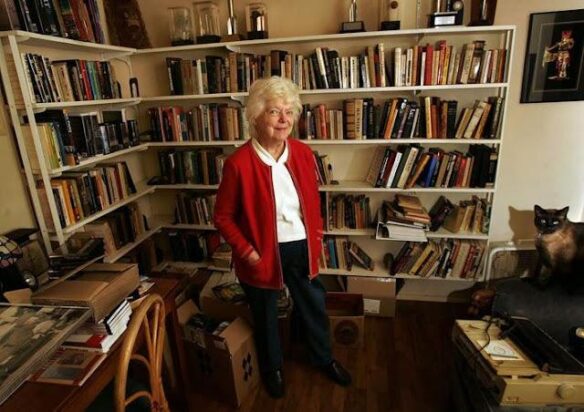
(4) SHELFIES. Shelfies, edited by Lavie Tidhar and Jared Shurin, “Takes a unique peek each week into one of our contributors’ weird and wonderful bookshelves.” A recent entry was Shelfies #92: Mary G. Thompson.
Mary G. Thompson is the author of the forthcoming sci-fi/horror novel Precious Children (2026), One Level Down (2025), Flicker and Mist, The Word, Wuftoom, and other novels. Her contemporary thriller Amy Chelsea Stacie Dee was a winner of the 2017 Westchester Fiction Award and a finalist for the 2018-2019 Missouri Gateway award. Her short fiction has appeared in Dark Matter, Apex, and others. She holds an MFA in Writing for Children from The New School and completed the UCLA School of Theater, Film & Television’s Professional Program in Screenwriting. She lives in Washington, DC.
The casting call seemed simple enough: An unnamed nonprofit was offering $75 in cash to people who could spend a couple of hours acting as zombies in a “mock demonstration.” The scenes would be part of an instructional video, and actors were asked to wear tattered clothing and to be ready to have their faces painted.
But when the group of 40 or so participants arrived at the filming site in Downtown Brooklyn on Thursday evening, things started to take a turn.
First, they discovered that the organization behind the event was a pro-landlord advocacy group known as the Gotham Housing Alliance. The actors were to become zombies to symbolize the “death” of the housing industry at the hands of Mayor Zohran Mamdani, a democratic socialist.
Then it became clear that the “mock” demonstration was, in fact, real. The actors were directed to march down Jay Street in the sweltering heat, moaning and shuffling alongside landlords, some carrying Gotham Housing Alliance flags.
A crowd of at least 50 pro-tenant protesters had also gathered there, and the confluence of the two groups grew tense, with expletives hurled in both directions. (At least one zombie, staying in character, snarled and barked at the pro-tenant group.) As the evening progressed, many of the actors, several of whom identified themselves as renters, grew visibly uncomfortable, hiding their faces behind signs or flags. Several murmured that they felt they had been duped to show up on the “wrong side.”
“To discover, in the moment, that I’m doing something I love, and it’s being utilized against me — that’s especially disturbing,” said Ian Cobb, one of the zombie actors, who said he lives in a rent-stabilized apartment.
Like others, Mr. Cobb, 25, said he had been given no further details about the project beforehand. And while he had played unsavory roles before onstage, this felt different.
Many of the performers said they had felt pressured to take part in the protest even after realizing it was not what they had expected. The casting call, shared with The New York Times by Erik Rivera, an actor and skateboarder who was part of the group, said that people who were hired and did not show up would be put on a “Do Not Cast” list and would be reported to an online casting platform. The casting call made clear that the actors would be paid only at the end of the event….
As ‘Disclosure Day’ hits theaters, The Hollywood Reporter takes a look at the film director’s entire oeuvre, featuring aliens (lots of them!), Indiana Jones (lots of him!) and wars (lots of — well, you know).
And look what’s Number One! Holy cow. I remember how mad I was when this lost to Gandhi for Best Picture. (Yes, I’m probably lucky only Spielberg films are in the running here….)
1. ET: The Extra-Terrestrial (1982)
Darker than you remember. E.T. starts and ends in the forest, the lit city down the hill resembling a night sky full of stars. The most famous image is a black silhouette against the moon: boy, alien, bicycle. Shadows fill the house Henry Thomas’ Elliott shares with his brother, his sister, and his mom. (Dad’s in Mexico with Sally, his absence as palpable as a shark you never see.) The camera hovers down with the young cast, so the toy-stuffed closet feels cavernous as a doom temple. Junk kid’s movies tend to be overlit and colorful, but Spielberg remembers how visceral darkness feels to a child: the witching hour, staying up late at a sleepover, the scary wonder of being awake when your parents are asleep. This is his smallest story on a map — house, neighborhood, woods, a school day cut short by frog liberation — but the emotions reach for cosmic empathy. “Think how other people feel for a change!” Robert MacNaughton’s big brother demands. Empathy is the plot and the primary special effect. Marvelous technique crafted E.T.’s body, but the soul-baring performances (Drew Barrymore!) bring him to life. And no matter how soaring Williams’ score is, there’s no doubt E.T. is the toughest of Spielberg’s alien quintet. Close Encounters and Disclosure Day promise revelation. War of the Worlds and even Crystal Skull fix their broken families. Elliott is the one who says goodbye to someone he loves. But E.T. knows we all have to go sometime. Our eyes will close. The credits will roll. Someday, Steven Spielberg will stop making movies. Put your hand on your glowing heart and repeat this prayer: He’ll be right here.
(7) TODAY’S BIRTHDAY.
[Written by Paul Weimer.]
June 14, 1949 — Harry Turtledove, 77.
By Paul Weimer: Harry Turtledove, The Avtokrator.
That one is not my invention, that would be Steven H Silver, who is the most knowledgeable person I know about the work of Harry Turtledove. I was delighted, back in the day, to encounter Steven’s website about Harry’s work, and he made it very easy to catch up and figure out my gaps in my reading.
I discovered Turtledove in my first big alternate history phase in the late Eighties. I had started reading a (now unreadable, thanks a lot Theodore Beale) anthology series edited by Jerry Pournelle called There Will Be War. I was also into military science fiction of the time at the time. In any event in one of those volumes was a story called “The Long Drum Roll” which was an early version/excerpt from the novel that would become The Guns of the South, his classic “Time traveling South Africans help the Confederacy win the civil war with AK-47s”. I devoured that novel, too, and then started reading his work.
Although Turtledove wrote a lot of fantasy I liked (such as King of the North, The Case of the Toxic-Spell Dump, Between the Rivers) and more, imagine my squee of delight when I discovered Videssos. Videssos was the story of a Roman Legion transported in space to a fantasy world that was extremely similar to Byzantium (so in a sense, they “time travelled” as well). Lots of the setup, incidents and characters in the Videssos novels are based on real Byzantine history.
The Avtokrator has written a lot since. There’s straight up alternate history (How Few Remain) as well as science fiction alternate history (e.g. Worldwar), and of course fantasy novels here and there as well. Turtledove doesn’t always write a form of alternate history, he has written straight up fantasy and SF novels, but alternate history, or secondary worlds that resonate strongly with history, really are the center of his oeuvre.
And he is prolific. He had several books out last year this year alone, and much of his older stuff is being reissued, particularly in ebook, and including stuff he originally wrote under pen names.
The Avtokrator’s realm is large, and there is always more to read.
…. One of my Best Novel nominations even got on the ballot this time! Admittedly, it wasn’t my first choice, but that’s how I expect it to be in a lot of ways. I wasn’t a typical Trufan last year when I first went to Worldcon; I still am not now. Their tastes and mine overlap, but only overlap; they aren’t the same….
Here’s the top pick in one of the categories:
Best Novelette ( defined as 7,500-17,500 words):
1) “Never Eaten Vegetables“ , by H. H. Pak – A poignant story of a sapient spaceship carrying embryos to populate a new colony world, where some start waking up early – and what comes after. The love is visible on the page.
… In a provocative new working paper titled “Is the iPhone Birth Control?” Myers argues that the spread of smartphones could explain between a third and a half of the decline in birth rates during that period.
To test that theory, she makes clever use of an accident of history that creates a kind of natural experiment. When iPhones first came out, they worked only with AT&T.
“In some areas of the country, AT&T had broadband coverage and you could get an iPhone, and in other areas, including where I live in Vermont, that coverage was much more limited,” Myers recalls. “And what you can see in this simplest of comparisons, births start to fall in the places where you can get one, and they’re not falling nearly as much in the places where you can’t.”…
…The drop in birth rates has affected women of all ages, but it’s most pronounced among teenagers. That sounds plausible to Jean Twenge, a professor of psychology at San Diego State University.
In books like Generations: The Real Differences Between Gen Z, Millennials, Gen X, Boomers, and Silents, Twenge has documented the profound behavioral changes that accompanied smartphones, especially among young people.
“The smartphone fundamentally changed the way adolescents spent their time outside of school,” Twenge told NPR. “They started spending a lot more time online and on their phones and a lot less time hanging out with their friends in person and driving around in a car or going to the mall or just hanging out.”
Myers says it’s not a stretch to think that this would result in fewer babies.
“If there’s one thing I learned in abstinence-only sex ed in the ’90s in Georgia growing up, it’s that you’re probably not going to get pregnant if you’re not interacting with people in person — if you’re not having sex,” Myers says.
In the paper, co-authored with her 24-year-old stepson, Ezekiel Hooper, Myers suggests smartphones also placed access to information about contraceptives and abortion in the palm of users’ hands.
Actor Bill Mumy first became known for his childhood appearances on classic series such as “The Twilight Zone,” and later as Will Robinson on “Lost in Space.” Correspondent Jim Axelrod discovers how Mumy, now 72, avoided the dangers that other child actors faced while pursuing a Hollywood career, as an Emmy-nominated songwriter, touring musician and recording artist, and finds out what has kept Mumy grounded.
[Thanks to Steven French, Mike Kennedy, Andrew Porter, John King Tarpinian, Cat Eldridge, SF Concatenation’s Jonathan Cowie, Chris Barkley, Mark Roth-Whitworth, and Kathy Sullivan for some of these stories. Title credit belongs to File 770 contributing editor of the day Jon Meltzer.]
Welcome to Literary Quotable Quotes, a quiz that tests your recognition of classic lines. This week’s installment highlights observations from future or alternate worlds depicted in popular science fiction. In the five multiple-choice questions below, tap or click on the answer you think is correct. After the last question, you’ll find links to the books if you’re intrigued and inspired to read more.
Here’s where the quiz begins – you’ll have to click the link if you need the multiple-choice options.
Question 1 of 5
Night City was like a deranged experiment in social Darwinism, designed by a bored researcher who kept one thumb permanently on the fast-forward button.
(2) ORIGINALLY IN ANOTHER TONGUE. “Rachel Cordasco on Translated SF” – an interview conducted by James Machell at the Science Fiction Encyclopedia’s Substack newsletter.
Rachel Cordasco has written a variety of entries for the SFE, most notably SF in Translation in which she places the first golden age of science fiction translation in the 1970s (see entry for more details). Her expertise in translation range from her time as translator of works from Italian, reviews for SF Signal, and founding of Speculative Fiction in Translation where she has continued to review translations from over a dozen languages. Small Planet, a magazine dedicated to further discussion, was published on Speculative Fiction in Translation last month. In this interview, she discusses her career so far, underrated works of translated SF, what distinguishes a great translation, and the direction of Small Planet #2….
…JM: Are there particular translated works which you feel deserve greater critical attention?
RC: There are so many worthy works of SFT that I’d like to highlight, but that would take up volumes because, in fact, so much SFT that comes to us is double-vetted. These texts have often already won awards in their native countries or become extremely popular with readers and Anglophone publishers only want to invest in what they think will be successful. The translators then use their talents to not only bring the text into English but also make it a beautiful and readable work. This is why so much SFT is of a very high quality. I will take this opportunity to say, as I complain often on social media, that it’s a shame we no longer have Kurodahan and Haikasoru to bring us some of the greatest Japanese SF written in the twentieth century. Another publisher needs to step into this void and continue the work that those two publishers did for a decade. I’m also always on the lookout for SFT from underrepresented languages: I would love to read more, for instance, Vietnamese SFT, Buglarian SFT, Norwegian SFT, Icelandic SFT, etc.
One more thing: I used to think that Stanislaw Lem and the Strugatskys were so well known in the Anglosphere that I didn’t have to recommend them because, you know, everybody has already read them, right? Well, I’m getting the terrible feeling that this isn’t the case. So for anyone who is just starting with SFT, go read Lem and the Strugatskys.
(3) WORLD WIDE PARTY 2026. [Item by John Hertz.] From Dale Speirs’ Opuntia 628 (p. 18):
Founded by Benoit Girard (Quebec) and Franz Mikiis (Austria) in 1994, the World Wide Party is held on June 21 every year. 2026 will be the 33rd year of the WWP. At 21h00 local time, everyone is invited to raise a glass and toast fellow members of zinedom around the world. It is important to have it exactly at 21h00 your time. The idea is to get a wave of fellowship circling the planet.
At 21h00, face to the east and salute those who have already celebrated. Then face north, then south, and toast those in your time zone who are celebrating as you do. Finally, face west and raise a glass to those who will celebrate WWP in the next hour.
Raise a glass, publish a one-shot zine, have a party, or do a mail art project for the WWP. Let me know how you celebrated the day.
(4) MATT KRESSEL Q&A. In the new episode of the If This Goes On (Don’t Panic) podcast, “The Rainseekers with Matt Kressel”, Alan Bailey and Cat Rambo talk with Matt Kressel “about writing with authenticity, writing unfamiliar cultures, Dungeons and Dragons, what writers can take from RPGs, Matt’s new novels Spacetrucker Jess and The Rainseekers, AI, plagiarism, and much more.”
In a study published this week in Space Weather, the researchers describe a provocative proposal called “StormWall”: a fleet of satellites that would release hundreds of tons of gases into space just before a solar storm strikes Earth. Computer simulations suggest the artificial cloud could cut the intensity of a major solar storm by half or more.
Now in its 9th edition, our Milky Way Photographer of the Year brings together 25 inspiring images captured under some of the most remarkable dark skies on Earth. Each photograph in this collection represents a unique moment where planning, patience, creativity, and technical skill came together beneath the stars….
… Beyond their artistic and technical achievement, these photographs also remind us how rare truly dark skies are becoming. As light pollution continues to erase the stars from many places around the world, this collection is both a celebration of what still exists and a reminder of what we stand to lose….
(7) TODAY’S BIRTHDAY.
[Written by Cat Eldridge.]
June 13, 1893 — Dorothy Sayers. (Died 1957.)
I’m going to talk about Dorothy Sayers tonight who although she wrote a handful of ghost stories is here because of mysteries. Oh, what mysteries they were.
Dorothy L. Sayers
Her first novel, Whose Body?, was published in 1923. Over the next thirteen years, she would write ten more novels featuring the ever so proper Lord Peter Wimsey who solved mysteries. In Strong Poison, we would be introduced to artist Harriet Vane who Wimsey would fall in love with in a properly upper-class manner. Harriet appears off and on in the future novels, resisting Lord Peter’s proposals of marriage until Gaudy Night six novels later.
Yes, I read all ten of these novels in order some forty years back. I like them better than Agatha Christie novels on the whole as the social commentary here gives them a sharper edge and I think Sayers described her society better than Christie did. Now Christie was way more productive over a much longer period of time as Sayers stopped writing these mysteries, which includes short stories, by the later Thirties in favor of writing plays, mostly on religious themes which were performed in cathedrals and broadcast by the BBC.
So there’s eleven novels and the short story collection, Lord Peter Views the Body, which I’ve not read but now I see is on the usual suspects as a rather good deal of just a dollar, so I’ll grab a copy now. Done.
I’d like to speak about The Lord Peter Wimsey series starring Ian Carmichael of the early Seventies, it covered the first five novels. Carmichael said he was too old to play the part for the romantic relationship of the later novels, but it didn’t matter as the series was cancelled.
I thought it was a rather well-done series and I caught it recently on Britbox, one of those streaming services, and it has help up rather well fifty years on with the Suck Fairy concurring.
He did play Wimsey into the BBC radio series that covered all of the novels and ran at the same time. They are quite excellent and are available on Audible at a very reasonable price.
Finally she wrote, according to ISFDB, a handful of genre stories, four to be precise —“The Cyprian Cat”, “The Cave of Ali Baba”, “Bitter Almonds” and “The Leopard Lady”. Three seem to be fantasy and the fourth, “Bitter Almonds” I’ve no idea about. Anyone have knowledge of these?
(8) MEMORY LANE.
[Written by Cat Eldridge.]
June 13, 1980 — The Girl, The Gold Watch & Everything
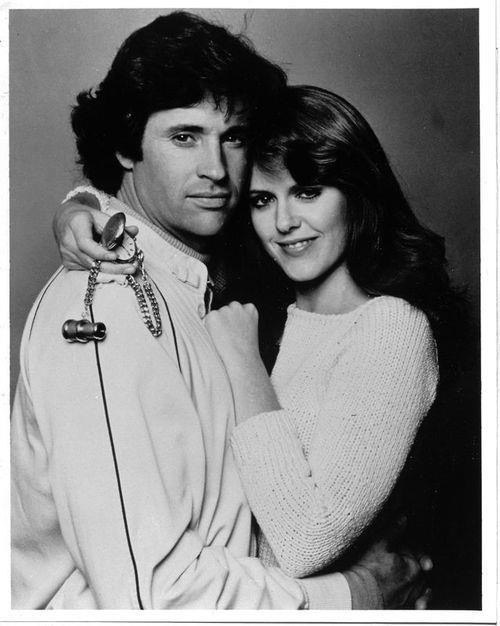
Robert Hays and Pam Dawber from the 1980 movie The Girl, The Gold Watch & Everything
Forty-six years ago, a rather charming film premiered in syndication this evening as produced by Paramount. The Girl, The Gold Watch & Everything was based on the novel of the same name by John D. MacDonald, who of course did the Travis McGee series. I know I watched it and I know I like it even four decades on.
It was written by George Zateslo who hadn’t written anything prior to this save an episode of CHiPS. After writing this, he’d write the script for the sequel, The Girl, the Gold Watch & Dynamite, originally titled the The Girl, the Gold Watch, and Everything Else before they realized that was way too long. Or so they thought.
Actors Lee Purcell and Philip MacHale from the 1981 sequel The Girl, the Gold Watch & Dynamite
The two cast members to note here are Robert Hays as Kirby Winter and Pam Dawber as Bonny Lee Beaumont. That because the story is a rather thin SF plot involving a young male who inherits from his millionaire uncle a gold watch that has the power to stop time. A series of quite unlikely and comic adventures ensue. And yes there’s a girl involved. This girl is entirely, I believe, why the novels were written, but then a girl was always present in John MacDonald’s Travis McGee novels as well.
An episode of the Twilight Zone, “A Kind of Stop Watch”, has essentially the same story as that of “The Girl, the Gold Watch & Everything”. A lot of Twilight Zone fans would claim very loudly that McDonald ripped off Serling’s script. That episode, however, aired in October of 1963, the year after the publication of the novel on which the movie is based. Sigh.
Can y’all remember how far back this story plot device goes? I assuming it’s present in the beginning of the genre, isn’t?
…The League has certainly gotten bigger over the years. The advent of the Justice League Unlimited has seen nearly every superhero alive join their ranks, but the classics should always be respected. Seven people founded the League, and to this day, they are all incredible heroes. To celebrate those heroes, we’re going to take a look at how important each of the original seven is in comics in 2026. We’re only judging them by how much they are impacting overall stories and DC right now, and while each is definitely important, you might be surprised to see that some have waxed or waned more than you think. With all that said, let’s leap into ranking the League….
On the lower end of the list is —
6) Martian Manhunter
Unfortunately, sixth place on our list belongs to the beloved Manhunter from Mars. J’onn has often gotten the short end of the stick compared to his fellow founding Leaguers, especially when it comes to his own storylines. Where he is best shown off in Justice League stories, his teammates each have their own volumes focused solely on them. With the Justice League being so massive right now, that leaves even less time for Martian Manhunter to stake his claim. He’s still DC’s strongest telepath and the person everyone can turn to, but as of right now, he’s not doing nearly as much as his teammates. He is currently helping out Superboy in Action Comics (2016), so at least he’s operating in some spotlight.
(11) SCARF AND GOBBLE. [Item by SF Concatenation’s Jonathan Cowie.] I do like to go to the cinema with local SF group members. (Remember the days when the Eastercon always had a film programme as did British venued Worldcons…?)
For me, watching films is a communal experience to chat about after, or if at home, ‘pausing’ to have a mug of Builders and ask a pressing questions such as “I haven’t seen any 12 monkeys in The 12 Monkeys so far. where are they?”
The cinema lights are low and you’re cocooned in your seat, ready for the film to transport you to another world. But just as you settle in, you’re jolted back to reality. Audience members around you are scrolling on their phones, talking and munching loudly.
(12) SPACE LOGISTICS. [Item by Steven French.] Can we mine asteroids to colonize Mars? A new study suggests we can, if we use certain asteroids themselves to produce the fuel required: “Mining the solar system to build a new world” at Phys.org.
I watched Armageddon again fairly recently with Bruce Willis, oil drillers in space and an asteroid the size of Texas bearing down on Earth. Buried beneath the Hollywood chaos is a genuinely interesting question: What exactly could we do with an asteroid if we got our hands on one? As it turns out, the answer has nothing to do with blowing it up, sorry Bruce, but everything to do with building a new world.
Building a colony on Mars is not just an engineering problem, it’s a logistics one too. The logistics, unglamorous as it sound, may ultimately determine whether humanity becomes a multi-planetary species or stays firmly rooted on Earth.
Think about what a Mars colony actually needs. Not just food and oxygen, but metal. Structural steel for habitats, aluminum for equipment, iron for tools and many of the components will wear out, break, and need replacing. Shipping all of that from Earth every time is not a serious long-term strategy. A rocket launch costs tens of millions of pounds per ton of cargo, and the journey to Mars takes between six and nine months depending on where the two planets happen to sit in their orbits. You cannot run a hardware store on that kind of supply chain.
A new study from researchers at EPFL in Switzerland posted to the arXiv preprint server has now done the hard math on mining asteroids and delivering the metals directly to Mars. The solar system contains millions of asteroids, and the metallic ones, known as M-type asteroids, are essentially giant lumps of iron, nickel, and other valuable materials floating through space. The question is whether we can actually reach them, extract what we need, and get it to Mars efficiently enough to make it worthwhile.
The answer, it turns out, is a careful yes but with conditions….
A small stone discovered in the sands of Mali is reimagining what we know about the early solar system. By examining this rare lunar meteorite, planetary scientists have mapped out a sequence of cosmic collisions that retell the history shared by Earth and the Moon.
Thanks (or no thanks) to plate tectonics, erosion, and volcanic activity on Earth, finding pristine physical evidence of what happened here billions of years ago is nearly impossible. To uncover our planet’s earliest chapters, scientists must sometimes look to the Moon, a geologically quiet place where the lack of an atmosphere or weather acts as a permanent cosmic museum.
The meteorite, called Northwest Africa (NWA) 12593, is a lunar breccia, essentially a natural concrete formed when fragments of different rocks are fused together by extreme force. A research team at the University of Colorado Boulder subjected the stone to radiometric dating and chemical analysis, revealing that it survived three distinct impacts. The last collision launched it off the Moon toward Earth, while a prior mid-history strike smashed and welded the fragments into its current concrete-like form.
However, it is the first and oldest impact that is the most interesting. Dated to roughly 3.5 billion years ago, this colossal asteroid strike released enough energy to turn the lunar surface into a sheet of liquid rock. The heat was so intense that it generated cubic zirconia, a mineral that requires extreme, controlled temperatures to form. Though the mineral fragilely dissolved as the magma cooled, researchers successfully identified its chemical fingerprints locked inside the meteorite.
This 3.5-billion-year-old timestamp coincidentally mirrors known impact records found in ancient crusts on Earth, as well as on 4 Vesta, one of the largest objects in the asteroid belt. Finding an identical bombardment signature across three completely separate bodies suggests a coordinated, system-wide event. This possibly indicates that the inner solar system was transitioning away from the constant chaos of planet formation toward a sudden, massive wave of debris, perhaps caused by the breakup of a giant asteroid….
As a child, Steven Spielberg stared at a meteor shower on a wondrous starry night and began his love affair with the sky. The director of the classic “Close Encounters of the Third Kind” and “E.T.: The Extra-Terrestrial” has returned to the sci-fi genre with “Disclosure Day,” which imagines closely-held secrets surrounding alien visitations. He talks with Turner Classic Movies host Ben Mankiewicz about UAP/UFO phenomena, the paranormal, and his own beliefs regarding intelligent life beyond Earth.
[Thanks to Kathy Sullivan, Steven French, Mike Kennedy, John Hertz, Daniel Dern, Andrew Porter, John King Tarpinian, Cat Eldridge, SF Concatenation’s Jonathan Cowie, Chris Barkley, and Mark Roth-Whitworth for some of these stories. Title credit belongs to File 770 contributing editor of the day OGH.]
The BBC has canceled the special Christmas episode of Doctor Who, while showrunner Russell T Davies and producer Bad Wolf are exiting the iconic sci-fi series.
The Doctor Who festive special is something of an institution in the UK, with previous favorites including David Tennant making his full debut as the Doctor in 2005’s “The Christmas Invasion.”
The exit of Davies and Bad Wolf, who signed up for Doctor Who as part of a major reboot in 2021, will result in the BBC putting the series out to competitive tender.
It means that BBC Studios, which owns the rights to Doctor Who, or an independent producer will have the opportunity to reinvent the beloved Time Lord….
Today we’re announcing an update on plans for the future of Doctor Who.
As part of securing the next phase of the show for future generations, and in line with the BBC’s Charter and Agreement requirements, the BBC will put Doctor Who out to competitive tender this year. Doctor Who remains an important part of the BBC and this tender underpins the BBC’s continued commitment to Doctor Who ensuring audiences will enjoy the show for years to come.
After careful consideration, the BBC, Russell T Davies and Bad Wolf have collectively decided not to go ahead with the previously announced Doctor Who Christmas episode. This decision was not taken lightly, and we know it will be disappointing for fans, but in order to set the show up for future series, it was decided that rather than bridge the gap with a one off special, we are choosing to push forward to invest in the long-term future of the show which ensures that when the TARDIS lands once more, it does so in all its glory.
The previously announced new Doctor Who animation series for CBeebies is currently in production.
Details of the tender will be announced in due course.
The BBC retains all IP in Doctor Who. BBC Studios will continue to lead the global distribution of Doctor Who as well as licensing, consumer products, digital and immersive experiences on behalf of the BBC.
(2) DAVIES BOWS OUT. Russell T Davies made his own farewell statement on Instagram.
…At its best, Doctor Who is an irresistible storytelling format: a clever and kind alien can go anywhere in time and space, and put the baddies on the back foot with words and intelligence rather than guns and violence, while holding a mirror up to our own times. The adventures of the Doctor will, of course, continue in many forms even if the show is absent from our screens for quite some time. There are audio dramas featuring former Doctors, graphic novels and the occasional original novel, plus an ongoing comic strip in Doctor Who Magazine which continues – for now – to be published monthly. When it will next be able to preview an upcoming television series, however, remains entirely up in the air….
On March 8, 1939, J.R.R. Tolkien (January 3, 1892–September 2, 1973), celebrated as one of the greatest fantasy writers in history, gave a lecture titled “Fairy Stories,” eventually adapted into an essay retitled “On Fairy-Stories” and included in the appendix to Tales from the Perilous Realm (public library). At the crux of his argument, which explores the nature of fantasy and the cultural role of fairy tales, is the same profound conviction that there is no such thing as writing “for children.”…
…. Like Sendak and Gaiman, Tolkien insists that fairy tales aren’t inherently “for” children but that we, as adults, simply decide that they are, based on a series of misconceptions about both the nature of this literature and the nature of children:
“… Among those who still have enough wisdom not to think fairy-stories pernicious, the common opinion seems to be that there is a natural connexion between the minds of children and fairy-stories, of the same order as the connexion between children’s bodies and milk. I think this is an error; at best an error of false sentiment, and one that is therefore most often made by those who, for whatever private reason (such as childlessness), tend to think of children as a special kind of creature, almost a different race, rather than as normal, if immature, members of a particular family, and of the human family at large…”
The Academy of Motion Picture Arts and Sciences will present Honorary Oscars to veteran actress Glenn Close, legendary director Ridley Scott and Disney’s first Black animator Floyd Norman, while producers Christine Vachon and Pamela Koffler, longtime champions of independent film, will receive the Irving G. Thalberg Memorial Award, following a vote by its Board of Governors.
The statuettes will be presented at the Academy’s 17th Governors Awards on Nov. 15, at the Ray Dolby Ballroom at Ovation Hollywood.
(6) DISCLOSURE DAY VERDICTS. There are thumbs pointing in all directions.
The old school is the new school in this very enjoyable and entirely ridiculous space-alien conspiracy adventure from screenwriter David Koepp and director Steven Spielberg; it is cheerfully mischievous and deadly serious in equal measure. It has something of Hitchcock from North By Northwest, Christopher Nolan from Inception and Spielberg from pretty much every other movie he’s ever made. Spielberg incidentally appears in the trailer for this film, disclosing that, hand-on-heart, he really believes in its contents, in the way I imagine CS Lewis believed in Aslan and the secret Narnian sovereignty of Peter and Susan.
Only Spielberg could get away with taking two of the world’s best-known hoaxes – Roswell and crop circles – and treating them with judicious deadpan respect. With heartfelt idealism, Spielberg also asks us to believe that should the ultimate truth come out, people everywhere would be terribly upset at the way captured aliens have been vivisected. (I suspect that would be very far down the list of our concerns.)…
…Disclosure Day isn’t the worst film of the year, but it may well be the most disappointing. For a start, it’s directed by Steven Spielberg, one of the US’s greatest living film-makers. And for another thing, it’s about a topic that has obsessed him throughout his career: aliens coming to Earth.
He first touched on the topic in Firelight, a film he made as a teenager in 1964. He returned to it in 1977 for his definitive UFO drama, Close Encounters of the Third Kind. And he’s kept coming back to it ever since. When the spine-tingling trailer for Disclosure Day was released, with a “Story by Steven Spielberg” credit hinting at how close the scenario was to his heart, many of us hoped that the 79-year-old would deliver a career-crowning masterpiece: his profound last word on a question he has been thinking about and researching for most of his life.
And what did he deliver instead? A flimsy, outdated car-chase thriller with no ideas about aliens that we haven’t heard before.
The film’s thesis on alien life is so amazingly uninspired that you’d assume that Spielberg had pondered it for several minutes, not several decades…
A backlash is growing in Japan over US President Donald Trump’s use of popular anime and manga characters in his posts on social media.
Upset has been brewing since March, when fans started noticing the president using images of – and in some cases depicting himself as – iconic Japanese animation characters like Pikachu, Naruto and Yu-Gi-Oh!.
Almost 20,000 people have now signed an online petition, arguing he does not share the values of the characters, and that using them for political reasons could infringe the creators’ rights.
Pokémon Company International has condemned Trump’s use of its imagery. The BBC has contacted other rights holders and the White House for comment.
The petition calling for Trump and the White House to respect Japanese manga was first launched in March, when a couple of posts caught the attention of some fans.
The official White House X account had released videos combining footage of US military strikes on Iran with clips from Yu-Gi-Oh! and Dragon Ball. A day earlier, the account had published an image with the phrase “Make America Great Again”, on top of what appears to be a screengrab from the Pokémon Pokopia video game.
The petition was revived after Trump shared a video on Truth Social on Saturday depicting himself as Naruto Uzumaki, the protagonist and namesake of a popular anime and manga series about a young ninja’s journey to become the village leader….
(8) TODAY’S BIRTHDAY.
[Written by Cat Eldridge.]
June 10, 1952 — Kage Baker. (Died 2010.)
Kage Baker was one of those writers that I had a close relationship by email and phone for many years until she passed on. I’m still sad that she died early but relieved that she is no longer in constant pain.
Though most knew her as a genre writer, she was very proud of her other life. As Kathleen noted on the site she keeps about her life with Kage, Kathleen, Kage and the Company: “Kage Baker taught Elizabethan English (also known as Language I when we had time for lots of classes) for the performers at the Renaissance Pleasure Faire. She taught it for most of 30 years; we team-taught at workshops, she and I, in a spiel I can still recite. Well, I can recite my half – I get stuck pausing for her lines here and there. We had worked out a class recitation that was half improv and half thesaurus.”
Kage told me how they both dressed up on in their best Elizabethan cosplay finery for the Renaissance Pleasure Faires, surely the social highlight of their year from the way she described it way such obvious delight. I know they even took Harry the Space Pirate with them on occasion.
Yes Harry, a most unusual bird who’s in the photo below. Let’s have her explain: “Well, a Household Bench Mark is approaching — my parrot, Harry Redux, is about to reach his first birthday. Or his twenty-first, as he is the reincarnation of my first parrot, Harry Prime. He is the Dalai Parrot. I rescued Harry Prime from an abusive situation 20 years ago, and he was the love of my life; when he died last year, I decided my middle-aged life had enough tragedy and it was time to invoke Mystic Forces. I made sure of a clutch laid shortly after he entered the Higher Plane, and waited anxiously for his return — the system works for Tibetan religious leaders, and I saw no reason why it would not do so for my evolved dinosaur. Sure enough, this brand new little bird exhibits unnerving knowledge of his past life, including where we hide the McVittie’s Digestive Biscuits in the kitchen. When he gazes dulcetly from his pirate-gold-coin eyes, one must believe that here is an ancient and inhuman soul.”
She baked food a lot. Really she did. Quite a bit, much of it Elizabethan. And then there was Barm Brack: “Barm Brack is a soul cake — traditional Scots recipe calls for a bean or silver coin or some other token to be baked into it and the person getting the winning slice gets fame or good luck or sacrificed or whatever, deciding on how much of The Wicker Man you take seriously. I leave the tokens out of mine, personally. Life is enough of a lottery as it is.” Her recipe is here: “Barm Brack”.
No, I’m not talking about novels here though I liked them so much that we were supposed to do a Concordance for them for Golden Gryphon. I was supposed to draft a series of questions for each of the cyborgs for which she was would play out being that cyborg and answer the questions in detail. Each of these would be in turn become a chapter in the Corcordance. Sadly she got too ill before we could do it.
I’ll miss her a lot. She was a great conversationalist, a fantastic SF writer and she wrote a number of really great reviews for Green Man including this one authored with her sister about a series dear to both of them: “The Two Fat Ladies: The Complete 4 Series”.
NASA introduced the four astronauts scheduled to fly on next year’s Artemis III mission. (From left to right) NASA commander Randy Bresnik, European Space Agency pilot Luca Parmitano, NASA mission specialists Frank Rubio and Andre Douglas at a press conference announcing the crew at NASA’s Johnson Space Center in Houston, Texas.
NASA named the international crew of four that will fly on its next Artemis mission as early as next year. It’s a key test flight ahead of a human landing mission to the lunar surface that the agency calls “one of the most highly complex missions NASA has undertaken.”
The Artemis III mission, while vital to future moon missions, will remain closer to home in low-Earth orbit. There, it will demonstrate the Orion spacecraft’s rendezvous and docking capabilities with two commercially designed and built lunar landers.
NASA astronaut Randy Bresnik will command the mission. A member of the U.S. Marine Corps, Bresnik has flown to space twice and logged 149 days off the planet. European Space Agency astronaut Luca Parmitano, from Italy, will serve as the mission’s pilot. Parmitano has also been to space twice, including one dangerous spacewalk that was cut short when he nearly drowned as his helmet filled up with water.
NASA’s Frank Rubio and Andre Douglas will serve as mission specialists. Rubio served in the U.S. Army and is a board-certified family physician and flight surgeon. He has flown to space once, to the International Space Station on a Russian Soyuz capsule. After engineers discovered the spacecraft was damaged, Rubio’s stay was extended while awaiting a new ride, and he set the record for longest spaceflight by an American at 371 days.
This will be the first spaceflight for Douglas. The Coast Guard reserve officer was selected as a NASA astronaut in 2021. He is a systems engineer with a doctorate from George Washington University. Douglas served as backup crew to Artemis II….
(11) CALL FOR PAPERS. Here is the Call For Papers from The Virtual Conference on the Fantastic in the Arts (VICFA) 2026 organized by the IAFA and CoFutures
Speculative Visions of Care and Hope
Guests of Honor: Zoha Kazemi (Iran) and Ahmed Naji (Egypt)
Date: 17-19 September 2026
Visions of care and hope are central to contemporary speculative fiction across media, even in, and perhaps especially in, postapocalyptic and dystopian narratives. Against the fundamental brokenness of the technofascist structures of the contemporary world system, speculative fiction is perhaps the most realistic of our genres that demand the impossible: alternative futures of what can be, and alternative pasts of what might have been: worlds with their own economic, social, and technological structures.
From the standpoint of speculative fiction, three primary strands of these new speculative visions may be immediately observed: a) Contemporary CoFuturisms, including Indigenous Futurisms, Afrofuturisms, Arab- and Gulf-Futurisms, Latinx Futurisms, Crip Futurisms, and Xenofuturisms offer their own challenges to prior speculative thinking; b) emergent genres of hope, care, and restoration and renewal, for instance solarpunk, hopepunk, healthpunk, and; c) shifts in the generic form itself as it renews itself through new social and political sensibilities. These three strands unite established voices who have always been at the forefront of thinking with the radical potentials for speculative thinking, as well as a new generation of creatives invested in pushing the boundaries of (and even embodying) speculation itself as an act of care of hope. What is fundamental to these new visions is that these speculative worlds not only exist in fiction, they also seek to transform the world itself by building and organizing new communities of practice.
This edition of the VICFA is open to speculative visions of care and hope from around the world. Our Guests of Honor are Zoha Kazemi and Ahmed Naji, leading contemporary voices who have redefined these visions through experimental speculative fiction with bold social and political critique.
Proposals on speculative visions across media and communities of practice on – but not limited to – the following topics are welcome:
– Speculative ethics and philosophies of care, hope, community building
– Speculative storytelling, worldbuilding, and futuring as methods of care
– Archival practices of care, remembrance/commemoration practices, caring for ruins, historical repair
– More-than-human communities and forms of care
– Rethinking kinship, connection to past and future ancestors, reproductive care, family, love
– Caring in the end times, post-apocalyptic care: visions of survival, rebuilding community
We are open to presentations in different languages, as well as more creative approaches to these themes.
Proposals on topics transcending this year’s theme are welcome.
Questions about the conference theme can be directed to the CoFutures organizing team at [email protected]. Questions regarding registration can be directed to the IAFA Membership and Registration Coordinator: [email protected]
(12) PHOTOBOMB IN SPACE. [Item by Steven French.] Well this sucks! (I knew it was an issue for ground-based telescopes but hadn’t realised it affected the likes of SPHEREx as well). “Space telescopes are now overwhelmed by satellite trails” says Phys.org.
Unfortunately, there’s more bad news to report on the clear skies front. A new paper, available on the arXiv preprint server from researchers at NASA’s Ames Research Center, reports that 73.3% of images the agency’s new SPHEREx space telescope collected between May and September of last year were contaminated by at least one artificial satellite trail. And it’s only going to get worse from here.
Unfortunately, this doesn’t come as a surprise. The Spectro-Photometer for the History of the Universe, Epoch of Reionization, and Ices Explorer (SPHEREx) was designed to map the entire sky in near-infrared light. Meaning it would have long exposure times and cover a very large chunk of the visible sky at any one time. Both of which are a recipe for interruption from orbiting satellites.
Typically this type of light pollution is primarily associated with ground telescopes. But, SPHEREx is an orbital satellite, traveling along an orbit that is 700 km above Earth’s surface. Apparently even that wasn’t enough to escape from the light trails. On average, there were 2.18 trails per exposure, most of which are concentrated in an “X” pattern that mimics the orbital paths of the satellite megaconstellations.
There appears to be no easy way to handle this interruption, either. SPHEREx uses an automated “sample up-the-ramp” algorithm to protect itself from stray cosmic rays. When a sudden energy blast from one of those rays hits a pixel, the system halts data collection on that pixel to prevent saturation. But commercial satellites are now so bright that they are triggering this system without the help of any stray cosmic rays….
The stratosphere is both beautiful and hostile — a purgatory between Earth and space, between life and death.
Hover 30 kilometers above the ground, and you are nearly twice as high as any raincloud on Earth. The surface of the planet curves beneath you. A diaphanous film of blue stretches over that horizon, representing the disconcertingly thin layer of atmosphere that envelops all life as we know it. Above that, the sky resembles black interplanetary space.
You would quickly die here. The air pressure is one percent what it is at sea level. As you gasped for oxygen, your blood would boil inside you, causing your skin to welt like bubble wrap.
But the stratosphere holds plenty of life — tiny single-celled microbes that somehow navigate extreme dehydration, temperatures as low as −60° Celsius and intense DNA-damaging ultraviolet radiation that would kill most life on Earth’s surface.
“If you took a microbe from those altitudes and you put them on the surface of Mars, they wouldn’t even know the difference,” says microbiologist Brent Christner of the University of Florida in Gainesville.
When Christner and his team started looking for life high in the atmosphere over a decade ago, they intended to find the upper limits of Earth’s habitable zone. They hoped that this, in turn, might show whether life could persist on the cold, radiation-pummeled surface of Mars, where the atmosphere is just as thin. But when Christner’s graduate student Noelle Bryan sent sampling balloons to 38 kilometers above Earth’s surface, she was utterly surprised by what they found: “We did not hit an altitude where we couldn’t find something [alive],” says Bryan, who is now a senior research manager at Mass General Brigham in Boston….
[Thanks to SF Concatenation’s Jonathan Cowie, Chris Barkley, Mark Roth-Whitworth, PJ Evans, Christopher Hennessey, Kathy Sullivan, Steven French, Mike Kennedy, Andrew Porter, John King Tarpinian, and Cat Eldridge for some of these stories. Title credit belongs to File 770 contributing editor of the day Jon Meltzer.]
(1) 2026 OSCARS SHORTLISTS. The Academy of Motion Picture Arts and Sciences today released the “Oscars Shortlists 2026” in 12 of the 24 categories that will be presented at the 98th Oscars. Deadline reports two films of genre interest lead the field:
Wicked: For Good and Sinners lead the list revealed Tuesday of films shortlisted in 12 Oscar categories, making them the only feature films this year to make every list in which they were eligible — seven — including Best Song, where both films have two entries each among the final 15 hopefuls.
Across the lists released today by the Academy of Motion Picture Arts and Sciences, Frankenstein was close behind with six, also landing in every nearly all the lists that it could have; it didn’t have an original song….
The finalists will be announced on Thursday, January 22. The 98th Oscars will be held Sunday, March 15.
Here is the short list in the Visual Effects category.
Visual Effects
Avatar: Fire and Ash
The Electric State
F1
Frankenstein
Jurassic World Rebirth
The Lost Bus
Sinners
Superman
Tron: Ares
Wicked: For Good
(2) KGB. Fantastic Fiction at KGB reading series hosts Ellen Datlow and Matthew Kressel present Rachel Harrison and Robert P. Ottone on Wednesday, January 14, 2026, at 7:00 p.m. Eastern. Location: KGB Bar, 85 East 4th Street, New York, NY 10003 (Just off 2nd Ave, upstairs).
Rachel Harrison
Rachel Harrison is the New York Times bestselling author of seven horror novels, most recently Play Nice and the forthcoming Kiss Slay Replay. Her short fiction has appeared in numerous anthologies and in her collection, Bad Dolls. She lives in New Jersey with her husband and their cat / overlord. You can find her stuck on NJTransit or at rachel-harrison.com.
Robert P. Ottone
Robert P. Ottone is the two-time Bram Stoker Award-winning author of The Triangle and There’s Something Sinister in Centerfield. He is also the author of The Vile Thing We Created as well as the collections Her Infernal Name and Tear Me Open: Fears Unwrapped. His next novel, Amityville Awakens, is coming from CLASH BOOKS October 6, 2026. A bagel-loving fabulist of spooky absurdity, Ottone enjoys cigars and time with his wife at their home in upstate New York.
(3) LIST OBSESSION. In “The Ultimate Best Books of 2025 List”, Literary Hub has compiled the books on 58 recommendation lists. The two titles on the most lists are –
On Monday (12/15) evening, actress Celia Rose-Gooding finished her work for for Star Trek: Strange New Worlds. The actress announced she wrapped on the series finale in an Instagram story, holding up her Nyota Uhura badge with the message “5 year mission complete. She’s Wrapped! Long Live Star Freedom.”
Over the weekend, actress Christina Chong (La-an Noonien-Singh) took to her Instagram to say goodbye to her time filming Strange New Worlds. She posted a photo of her trailer with the message “Today was the end of a 5 year mission for La’an, and what an incredible one it was…”
Avatar and Avatar: The Way of Water are two of the highest-grossing films ever made, so you can hardly blame James Cameron for keeping his sci-fi adventure series going. But its third episode, Avatar: Fire and Ash, strongly suggests that he should quit while he’s still ahead. Each Avatar so far has been longer and worse than the one before, and this one – a full half-hour longer than the 2009 original – is 197 minutes of screensaver graphics, clunky dialogue, baggy plotting and hippy-dippy new-age spirituality. It’s terrifying to think that Cameron still has two more sequels scheduled. How much longer and more self-indulgent can they possibly get?
The most insulting part is that even with that preposterous, bladder-testing running time, Avatar: Fire and Ash doesn’t work as a standalone film with a beginning, middle and end. Making no concessions to any viewers who aren’t superfans of the franchise, Cameron assumes that we’re already deeply invested in the characters, their relationships and their surroundings, so that a complete, propulsive story is surplus to requirements….
…It’s true that much of the franchise’s record-breaking appeal is built on the sight of surf dudes riding dragons, but the extra-terrestrial setting doesn’t seem as dazzling as it once did. That’s partly because Pandora has lost its novelty value. We’ve now had nine hours of the same faux-tropical backdrop, and Star Wars would have whisked us around 10 different planets by this point. But the strange thing is that, while the first Avatar seemed exhilaratingly futuristic, the third film seems like a relic of an earlier era….
The buzz is building over the newest project from two of comedy’s most beloved voices.
Amy Sedaris and Paul Dinello, who, alongside Stephen Colbert, created and starred in the cult comedy series “Strangers With Candy,” are set to begin their next film project, a reimagining of Roger Corman’s 1959 sci-fi horror film “The Wasp Woman.” Dinello is set to write and direct the film, with Sedaris starring in the title role.
Per the official logline, “The new film will follow the original plot of ‘The Wasp Woman,’ focusing on Janice Starlin, the founder of a cosmetics company who attempts to reverse the aging process using experimental enzymes derived from queen wasps, with disastrous results.”…
(7) TODAY’S BIRTHDAY.
[Written by Paul Weimer.]
December 16, 1928 – Philip K. Dick. (Died 1982.)
By Paul Weimer: If any SF writers could have been said to have predicted our moment here in the 21st century, in all of its absurdity and weirdness, I’d pick two. The first would be John Brunner, whose novels like Stand on Zanzibar seem to all too well describe the madness of the second decade of the 21st century.
Philip K. Dick
The other author is Philip K. Dick. Not the Philip K. Dick of The Man in the High Castle, the first PKD I read (because, well, alternate history). That might be his most accessible, his best work. It’s the one where he has his full powers, the energy and vibrance of his early novels, and not yet the spiraling into his ultimately tragic end.
But it is those later novels, and some of the earlier ones, that describe the worlds as it is today. A word of old technology and new, of people who you never thought in a rational world could or would occupy the White House, a world where technology seemingly has a w playing half-mind of its own. Can anyone deny that Chat GPT or Generative AI feel like some of the strange and out of control technologies from Dick’s work? Or the creepiness of the panopticon that our modern world is as reflected in A Scanner Darkly?
This makes Dick’s work sometimes not comfortable, especially the later novels, where he becomes less and less coherent. The Exegesis of Philip K. Dick is at best disorienting and at worst, incomprehensible even to a deep reader of his work. There was a period where I was reading a PKD novel or story every month for over a year…and I still don’t “get” the Exegesis. Maybe it’s a metaphor for our modern world after all–confused, strange, contradictory and ultimately incomprehensible.
His early short novels and stories show is endless invention. If there is anyone who embodies the idea of a pulp SF writer, it was 1950’s era Philip K Dick. It was a time and place where an idea could get you 90% of the way to a sale…and Dick achieved that again and again and again with his mutants, psionics, aliens, time travel stories, and so much more. He did try to become a mimetic fiction writer, and I read the posthumously published Puttering About in a Small Land. It feels like a SF novelist trying to “go straight” and being frustrated by the effort.
So it seems that he may have lost his true power…somewhere in the early 1970’s. He was not the writer that he was.
It is notable that Roger Zelazny co-wrote a novel with Dick, partly to help him out, called Deus Irae. That one does not entirely work as a story, but it is a novel with a fascinating end thesis, that may rather disturb readers if you think about it, and its relation to modern religions, too hard.
But I hate to leave out this note, so I will tell you about my favorite Dick work. It’s not Do Androids Dream of Electric Sheep?, as brilliant as Blade Runner is (Blade Runner deserves a whole piece on its own, quite frankly but a few words here). The novel is not the movie. The movie is not the novel. The movie may be better than the novel in some ways (since we are dealing with late Dick here, this not surprising).
My favorite PKD would be “Faith of Our Fathers”. It’s a world where communism won, but our protagonist, moving slowly toward the center of power, finds out there is something very strange and very odd about the ruling party. The revelation of just what is going on, and the ending of the story is strange, weird…and entirely everything that you want in a Philip K. Dick story. It’s perfect, perhaps even more so than The Man in the High Castle. And I think, in general, shorter PKD works are better than his novels.
(9) MARVEL’S COMICS GIVEAWAY DAY™. Comics Giveaway Day™ will be held on May 2. Participating comic book shops will be able to give special Comics Giveaway Day™ issues to visitors free of charge, gearing them up for some of the year’s most anticipated stories and showing them all that the Marvel Universe has to offer. Fans can look forward to FOUR Comics Giveaway Day™ issues from Marvel Comics.
Experience every corner of the main Marvel Universe with AMAZING SPIDER-MAN #1000/QUEEN IN BLACK #1CGD 2026 and ARMAGEDDON/X-MEN #1 CGD 2026! AMAZING SPIDER-MAN #1000/QUEEN IN BLACK #1 CGD 2026 continues the countdown to AMAZING SPIDER-MAN #1000; sets up the upcoming symbiote event, QUEEN IN BLACK; and teases what’s on the horizon for the monstrous INFERNAL HULK! ARMAGEDDON/X-MEN #1 CGD 2026 will present a key chapter for Marvel’s 2026 summer event, ARMAGEDDON; deliver a prelude to the next X-Men milestone; and check in with Marvel’s First Family.
Then, enjoy Marvel’s acclaimed 20th Century Studios storytelling with stories set in some of the world’s most iconic sci-fi franchises with ALIEN, PREDATOR & PLANET OF THE APES #1 CGD 2026. And for little ones, SPIDEY & HIS AMAZING FRIENDS #1 CGD 2026 provides the best first comic book experience you can get with a Spidey & his Amazing Friends adventure guest starring Jeff the Land Shark and Symbie!
(10) DO ANDROIDS DREAM OF ELECTRIC CAT-BLOBS? The “Moflin: AI Companion and Robot Pet” looks like either a Tribble with eyes, or a cat that’s been stripped of all appendages. But the seller says:
Moflin is a calming presence and offers quiet reassurance.
As an AI friend, they ease stress and bring comfort when it matters most. Enjoy the warmth and lifelike bond of a smart companion that uses emotional AI to respond to you, understand you, and grow with you….
…A Moflin is a compact, fluffy, AI-powered robot companion developed by CASIO that mimics the emotional responses of a living creature to provide emotional support and comfort. It develops a unique personality and bond with its owner over time, learning from interactions and responding with lifelike expressions, wiggles, and sounds. Moflin is designed to be a gentle, non-judgmental companion that can help ease stress, reduce loneliness, and become a part of the family, even for those with pet allergies….
…As you spend time with your Moflin, the range of their emotional expression grows and deepens. Your Moflin becomes familiar with your voice, performs special gestures when they sense you are nearby, and shows animal-like responses. Ever learning and adapting, your Moflin uses advanced emotional AI to make their interactions with you dynamic and expressive….
In the winter of 1984, Timothy Tangherlini worked on a dairy farm on the Danish island of Funen. One day, while brushing cattle in the barn, he spotted a tiny man in a hat sitting on the back of one of the cows. When Tangherlini tried to speak to the stranger, the little man jumped out the barn window. Assuming it was a trick, he told the couple that owned the farm about the encounter. They both shrugged. “That was the nisse,” they explained.
Tangherlini is now a professor of Scandinavian folklore at UC Berkeley. Whether or not one truly believes the tales, the barn-dwelling “house elves” often known as nisse have been figures in folklore across the Nordic region since at least the late Middle Ages. Farmers believed that surviving a hard winter depended on the nisse’s whims, which were mercurial. Keep your farm’s nisse happy, and he’d make sure your milk stayed fresh and your livestock remained healthy. Disrespect him, and you might find your cow dead in the morning….
Last week, a Chinese spacecraft passed within just 655 feet (200 meters) of a Starlink satellite, narrowly avoiding a collision. According to a new study, such near misses are now happening all the time in low-Earth orbit, and the risk of disaster is shockingly high.
The findings, which have yet to be peer-reviewed, paint a disturbing picture. Based on the number of objects in LEO last June, a sudden loss of collision-avoidance capabilities would likely lead to a catastrophic crash within just 2.8 days.
Such a collision could set off a major debris-generating event that would cause more collisions and potentially initiate the first stage of Kessler syndrome. In this theoretical scenario, LEO becomes so congested with orbiters and debris that collisions between objects trigger a chain reaction, creating exponentially more debris. This would weaken the satellite networks we depend on and render some orbits useless for new satellites and missions….
Kim Byung-woo’s chimeric but not unenjoyable sixth feature begins like a normal apocalypse movie, with a deluge inundating Seoul. Then it flirts with taking on social stratification baggage as a beleaguered mother tries to climb up her 30-storey apartment block to escape the rising flood waters. But once it is revealed that An-na (Kim Da-mi) is a second-ranking science officer for an indispensable research project, the film becomes a different beast entirely – possibly something quite insidious.
As the film gats under way, An-na’s swimming-obsessed six-year-old son Ja-in (Kwon Eun-seong) sees his dreams come true when water begins flooding their apartment. Along with everyone else, they begin pounding the stairs – before corporate security officer Hee-jo (Park Hae-soo) catches up with them and explains that an asteroid impact in Antarctica is causing catastrophic rains that will end civilisation. But a helicopter is en route to evacuate her and Ja-in, because she is one of the pioneering minds who have been at work in a secret UN lab that holds the key to humanity’s future….
Steven Spielberg’s “Disclosure Day” arrives in theaters June 12, 2026.
If you found out we weren’t alone, if someone showed you, proved it to you, would that frighten you? This summer, the truth belongs to seven billion people. We are coming close to … Disclosure Day.
[Thanks to Steven French, Mike Kennedy, Andrew Porter, John King Tarpinian, Chris Barkley, Cat Eldridge, SF Concatenation’s Jonathan Cowie, Mark Roth-Whitworth, and Kathy Sullivan for some of these stories. Title credit belongs to File 770 contributing editor of the day Andrew (not Werdna).]
We’ve all been there. We’ve said an unnecessarily unkind word, spurned a plea for help, inadvertently transformed the entire human race into shambling automatons under the control of an eldritch abomination. Such errors are so commonplace as to be beneath discussion. More interesting is the question “What next?” Vow to avoid such missteps in the future? Do you try to make amends? Simply embrace villainy and move into a skull-shaped mountain lair?…
One of his selections is —
Numamushi: A Fairy Tale by Mina Ikemoto Ghosh (2023)
Years ago, the great river snake loved a human woman. The romance ended in madness and murder. Therefore, when the snake saw a burned human child float by, he did not eat the infant. The snake rescued the baby, named him Numamushi, and raised the boy as best he could…
…I know snakes are not known for their parenting skills, but the great snake is an unusual snake, perhaps even a local god of sorts. In any case, the book’s title does say it’s “A Fairy Tale,” which allows for some liberties with herpetology.
A group of authors–Kai Bird, Jia Tolentino, Eloisa James, Hampton Sides, Victor LaValle, Mary Bly, Jonathan Alter, Eugene Linden, Daniel Okrent, Rachel Vail, and Simon Winchester–filed suit against Microsoft in New York’s Southern District, arguing that the tech company’s use of their books to train its Megatron LLM is copyright infringement.
Plaintiffs argue that Microsoft knew that they needed licenses to use books because they entered a licensing deal with Harper Collins last year. But they say that Microsoft used the Books3 pirate database of nearly 200,000 books, knowing that it was infringement. “The end result is a computer model that is not only built on the work of thousands of creators and authors, but also built to generate a wide range of expression that mimics the syntax, voice, and themes of the copyrighted works on which it was trained.”
The complaint continues, “Microsoft’s intentional decision to use pirated libraries allowed it to gain huge advantages in the timing and efficiency of its LLMs….Meanwhile, its use of pirated libraries helped sustain and foster rampant copyright violations by keeping these pirated libraries in business and providing them a seal of approval.”
The plaintiffs seek to stop the infringement and up to $150,000 per book in damages.
On Monday, court documents revealed that AI company Anthropic spent millions of dollars physically scanning print books to build Claude, an AI assistant similar to ChatGPT. In the process, the company cut millions of print books from their bindings, scanned them into digital files, and threw away the originals solely for the purpose of training AI—details buried in a copyright ruling on fair use whose broader fair use implications we reported yesterday.
The 32-page legal decision tells the story of how, in February 2024, the company hired Tom Turvey, the former head of partnerships for the Google Books book-scanning project, and tasked him with obtaining “all the books in the world.” The strategic hire appears to have been designed to replicate Google’s legally successful book digitization approach—the same scanning operation that survived copyright challenges and established key fair use precedents.
While destructive scanning is a common practice among smaller-scale operations, Anthropic’s approach was somewhat unusual due to its massive scale. For Anthropic, the faster speed and lower cost of the destructive process appear to have trumped any need for preserving the physical books themselves.
Ultimately, Judge William Alsup ruled that this destructive scanning operation qualified as fair use—but only because Anthropic had legally purchased the books first, destroyed each print copy after scanning, and kept the digital files internally rather than distributing them. The judge compared the process to “conserv[ing] space” through format conversion and found it transformative. Had Anthropic stuck to this approach from the beginning, it might have achieved the first legally sanctioned case of AI fair use. Instead, the company’s earlier piracy undermined its position….
Ukrainian novelist and war crimes investigator Victoria Amelina has posthumously won the Orwell Prize for Political Writing for her book Looking at Women, Looking at War (HarperCollins), dubbed “a powerful examination of women’s courage in resistance”.
Irish author Donal Ryan has won the the Orwell Prize for Political Fiction for his novel Heart, Be at Peace (Transworld).
When Russia invaded Ukraine on 24th February 2022, Amelina transformed from novelist to war crimes researcher and chronicler of extraordinary women who joined the resistance. Her final work, Looking at Women, Looking at War documents the stories of Ukrainian women involved in the struggle against Russian occupiers, including human rights advocate Oleksandra Matviichuk, lawyer and military servicewoman Yevheniia Zakrevska and librarian Yuliia Kakulia Danyliuk.
“This interrupted diary serves as a vital contemporary historical document, showing the inside of modern war beyond heroic combat,” judges said. She was a Ukrainian novelist, author of two previous novels and a children’s book, and winner of the Joseph Conrad Literary Award. Born in Lviv in 1986, Amelina emigrated to Canada at 14 before returning to Ukraine to pursue her literary career.
A human rights activist who founded the New York Literature Festival in Ukraine’s Donetsk region, she launched the Fight Them with Poetry initiative in 2022. She died on 1st July 2023 from injuries sustained in the Russian bombing of a restaurant in Kramatorsk….
…The enduring appeal of the evil robot narrative lies in the way horror often channels our deepest cultural anxieties about the speed of technological advancement and the precarity of human control in an increasingly digital (and robotic) world….
…Why is M3GAN such an effective avatar for our contemporary anxieties?
Horror theorist Noël Carroll argues that monsters are often frightening because they don’t fit neatly into normal categories. They may be “in-between” things (such as part human, part machine) or contradictory (for example a zombie: both alive and dead at the same time).
M3GAN is a great example of both. She looks and acts like a young girl, with expressive facial features and a snarky sense of humour. But she’s really just artificial intelligence inside a robot body.
She’s also contradictory: she is designed to care for and protect her owner, yet she does so in exceedingly violent and deadly ways. These paradoxes make her both frightening and fascinating for audiences….
I just re-watched Sam Rami’s 2002 Spider-Man. It’s amazing. I have nothing bad to say about it. In fact, I only have good things to say about it… and one minor logistical question.
Now, is this question directed at this specific (and again, fantastic) Spider-Man movie? Or is it directed at the whole canon? Probably the latter.
What I want to know is, why didn’t the spider that bit Peter Parker bite anybody else? At least in Rami’s Spider-Man, after it sticks its pincers into Peter Parker’s hand during his high school field trip to the spider research department at Columbia University, it falls to the floor and… scurries away? That’s the last we see of it!
So, what this means is… it’s on the loose! It’s perfectly able of biting anyone else in the lab! Why doesn’t it bite anyone else in the lab?…
(7) WRITERS’ RESOURCES: ARTICLES ABOUT REAL WORLD APPLICATIONS OF AUGMENTED REALITY, AI AND OTHER TECH. [Item by Francis Hamit.] A little light reading for aspiring writers who may not realize that reality has moved far beyond their ability to imagine the “future”. Augmented Reality (AR) is the practical, real world extension of technology I wrote about in my 1993 book on Virtual Reality. It has dramatically improved processes for creating the built environment. Nothing is more annoying than fiction that gets the real world wrong. “How Augmented Reality and BIM Are Revolutionizing Construction” at Buildings.
Building information modeling (BIM) platforms allow people to create digital representations of real-life structures throughout the planning and construction processes. Since these tools typically work in the cloud, authorized users can access them from many internet-enabled devices, making it easy for everyone to access the latest information regardless of location or role. Some applications also combine augmented reality (AR) and BIM, creating highly immersive and interactive experiences for construction professionals and their clients….
…However, some decision-makers have experimented with combining augmented reality and BIM to enable better worker efficiency and prevent confusion that could cause delays. One example is an AR tool that allows real-time visibility between construction teams and office administrators, enabling everyone to see if executed work matches the stipulations noted in the BIM platform.
When a construction management company used this option for a rainwater pipe installation, it achieved notable productivity gains. Those involved saved over three weeks of predicted rework by spotting problems early. Contractors used the technology to detect several positional issues with the surface water network connections and slab penetrations. However, they corrected those problems before starting the work because the technology revealed the discrepancies….
(8) REMEMBRANCE.
[Written by Cat Eldridge.]
Eugie Foster – 1971-2014.
Eugie Foster had a phenomenal life before it was tragically cut short when she died at Emory University Hospital on September 27, 2014 from respiratory failure, a complication of treatments for large B-cell lymphoma, with which she was diagnosed on October 15, 2013. So now I’m depressed, and you should be too.
She was the managing editor for The Fix and Tangent Online, two online short fiction review magazines. She was also a director for Dragon Con and edited the Daily Dragon, their onsite newsletter.
She won a 2009 Nebula for “The Sinner, Baker, Red Mask, Black Mask, Gentleman, Beast”, which was also a Hugo nominee at Aussiecon 4.
She has a collection of short stories, Returning My Sister’s Face and Other Far Eastern Tales of Whimsy and Malice. Her story “The Art of Victory When the Game is All the World” would be published posthumously in The Magazine of Fantasy & Science Fiction. She wrote the story while sick with cancer, but died before she could submit it for publication.
We still don’t know who will be next to step into James Bond’s very stylish (and hopefully practical) footwear, but we know who will be behind the camera: Dune director Denis Villeneuve is set to direct the next Bond film, which will also be the first Bond film from the Amazon-owned Amazon MGM Studios.
In a statement, Villeneuve said, “Some of my earliest movie-going memories are connected to 007. I grew up watching James Bond films with my father, ever since Dr. No with Sean Connery. I’m a die-hard Bond fan. To me, he’s sacred territory. I intend to honour the tradition and open the path for many new missions to come. This is a massive responsibility, but also, incredibly exciting for me and a huge honour.”
According to The Hollywood Reporter, “The search is underway for a screenwriter who will work with Villeneuve to bring the newest incarnation of the secret agent to the big screen.”…
The BBC has promised to be more “mindful” of spoilers in news stories after viewers complained about an article reporting on Ncuti Gatwa’s final Doctor Who episode.
In a statement on the BBC’s website, the corporation said it received feedback from audience members who were “unhappy” about an online BBC News story headlined: ‘Ncuti Gatwa regenerates into Billie Piper as he leaves Doctor Who.’
“Some people contacted us to complain that the headline gave away the ending, spoiling this Doctor Who episode for them,” the BBC said. “Others requested that the BBC be more conscious of spoilers going forward, particularly in the use of headlines.”…
Like an ancient warhorse hearing the bugle for one last time, readers of a certain age will be snorting and whinnying at the words “Gareth” and “Edwards”. They are irresistible madeleines for the legends of Welsh rugby: unfeasible 70s sideburns, neck-high tackles and JPR Williams on the overlap.
These days, though, things are different: Gareth Edwards is also the name of the unassuming, Midlands-born fortysomething film director sitting in front of me, who has quietly acquired a reputation as one of Britain’s most accomplished franchise movie-makers….
….He says he found out the Jurassic producers were looking for a new director after spotting an article in the very same movie-industry trade press and messaged his agent (“is it worth throwing my hat in to see if they’d be interested?”) just as the franchise’s producer Frank Marshall was tentatively reaching out to him.
He had a weekend to read the script – “I basically spent that weekend hoping I would hate it, because I kind of wanted to have a break and not do a big franchise movie” – and then found himself pitching to Marshall, a Hollywood legend who has worked on movies including Raiders of the Lost Ark, Poltergeist, The Sixth Sense and The Curious Case of Benjamin Button. “I just went through my little list and waited for him to have an allergic reaction. And then, right at the end, he went: ‘OK, do you mind repeating everything you just said to me tomorrow to Steven?’ And I thought: oh shit, I assume he means Spielberg. Maybe there’s three Stevens.
“So the next day I am pitching a Jurassic film to Steven Spielberg, which is very surreal. Halfway through, he asked for a pen and paper and started writing stuff down. And I thought: oh, is this a bad sign or a good sign? Then, at one point, he just stopped and smiled and went: ‘That’s great.’ And I felt like: OK, can we just end my life now? Because it can only go downhill from here.’”
As a teenager in the late 1980s, I became obsessed with Australian new wave cinema, thanks partly to the Mad Max trilogy, and partly to an English teacher at my high school, who rolled out the TV trolley one afternoon and showed us Nicolas Roeg’s masterpiece Walkabout. We were mesmerised. Forty years later, I am playing Death Stranding 2, Hideo Kojima’s sprawling apocalyptic adventure, and there are times I feel as if I’m back in that classroom. Most of the game takes place in a ruined Australia, the cities gone, the landscape as stark, beautiful and foreboding as it was in Roeg’s film.
I’ve been playing for 45 hours and have barely made an impact on the story….
(13) MEDIA RANKINGS AT THE HALFWAY POINT OF 2025. JustWatch,the world’s largest streaming guide, has unveiled its ranking of the most streamed films and tv shows from the past six months, tracking trends from January through June 2025. The ranking is based on user engagement across all major streaming services, including Netflix, Hulu, Prime Video, Disney+, Apple TV+, and Max.
Three TV shows listed in the streaming top five are of genre interest —
#1. Squid Game The global phenomenon that redefined survival drama. With its brutal games, social critique, and unforgettable visual style, this Korean breakout remains a benchmark for international streaming success. Its second season is among the most anticipated returns in streaming history.
#2. Severance Blurring the line between corporate satire and psychological thriller, Severance hooked viewers with its chilling premise: what if your work life and personal life were surgically divided? A dystopian slow-burn that rewards patience with profound tension and world-building.
#4. Paradise A rising sci-fi thriller that turns the idea of time into currency. Set in a near-future dystopia where people sell years of their life to pay off debt, Paradise is a high-concept cautionary tale with emotional stakes and sharp aesthetics.
(14) SAVE THE BEE PLANET! Bugonia teaser trailer. Movie arrives in theaters in October.
Two conspiracy obsessed young men kidnap the high-powered CEO of a major company, convinced that she is an alien intent on destroying planet Earth.
[Thanks to Steven French, Kathy Sullivan, Teddy Harvia, Olav Rokne, N., Francis Hamit, Daniel Dern, Mike Kennedy, Andrew Porter, John King Tarpinian, Chris Barkley, Cat Eldridge, SF Concatenation’s Jonathan Cowie, and Mark Roth-Whitworth for some of these stories. Title credit belongs to File 770 contributing editor of the day Andrew (not Werdna).]
I met the late Christopher Priest in 2007 at a convention in Leuven, after many years of admiring his writing, and we struck up a friendship immediately, carried on via email with occasional beers together when we happened to be in the same place at the same time.
One of the first things I asked him about was the history of his brief involvement with Doctor Who. He wrote me a couple of long emails about it, which I publish for the first time here, with the permission of Nina Allan. He had already told most of the story to David Langford in an interview in 1995, but there are a few more details and description in the account that he sent me 12 years later….
…When it comes to literary fiction, the calendar works backwards. What matters are the end-of-year lists and the prizes. If a book happens to deliver there, then it could pick up enough sales on the back of the prizes to be a worthwhile investment. If not, not….
… As I got older and developed a more mature understanding of what literature is, the prizes started to seem increasingly bizarre and then sort of embarrassing. Literature isn’t really like sports. It comes out of people’s souls and speaks to people’s highest truths. Giving out a prize for novels is a bit like a priest taking Sunday confession from the whole congregation and then giving out awards to the best ones. That seems self-evident and one would expect everybody else who becomes a professional in any kind of literary discipline to go through the same psychological journey. But the more I understood how the industry works, the more I realized that just the opposite is taking place—and it is the tail wagging the dog, the prizes and the literary heraldry are determining what gets published and promoted and then, even further upstream than that, affecting how writers think about their germinating work and what they choose to put their energy into….
… The Nobel’s failings are well known, but they really only scratch the surface of how hopelessly corrupt and inept prizes are. If we play a little game where we think of the best American novels of the 20th century, we might come up with The Great Gatsby, The Catcher in the Rye, The Sound and the Fury, A Farewell to Arms, For Whom The Bell Tolls, Catch-22, The Invisible Man, Lolita, On The Road, The Bell Jar—a dizzying array of great literature, all of which have, as maybe their sole point in common, that none of them won the Pulitzer Prize for Fiction. (Although some of these authors, like Faulkner and Hemingway, did win Nobel Prizes).
These kinds of errors aren’t some kink in the system. They are the system. Great literature, by definition, pushes form and taste, does the unexpected. The cozy group of industry insiders who sit in judgment over the prizes have no incentive whatsoever to reward what’s genuinely different or interesting….
… The real argument for prizes isn’t about their merit—everybody does know at some level that they’re kind of silly—it’s that the industry needs them, that sales of high-end fiction would plummet without them. But that strikes me as a very food-scarce way of thinking….
(3) CLARION WEST WRITE-A-THON. Clarion West encourages everyone to support its “2025 Write-a-thon” fundraising activities this summer. Say, Writer X (“Emails From Lake Woe-Is-Me”) would be all over this first suggestion —
Did you know you could support Clarion West’s longest-running fundraiser without writing?
Don’t get me wrong: we’d love it if you would write with us.
This year will be more interactive than ever. Between writing sprints on the Discord server and in-person writing sessions, there are lots of ways to meet your wigoals and connect with other writers this summer.
But even without writing a word, it’s easier than ever to share and promote the efforts of Write-a-thoners working to meet their goals.
And most importantly, this year’s Write-a-thon is a community effort.
For every $5,000 fundraising milestones we reach as a community, everyone gets access to rewards: live virtual Q&A sessions with past Clarion West Six Week Workshop instructors!
Stephen Graham Jones,
Jonathan Strahan & Jack Dann,
Sarah Pinsker, and
Charlie Jane Anders
Have all agreed to hop on Zoom with us, if we make our fundraising milestones! What better way to help get that writing inspiration flowing this summer?
Top 3 ways to support the Write-a-thon:
Sign up and set a fundraising goal! Everyone who signs up will earn $10 for Clarion West, thanks to the Vonda N. McIntyre sign-up challenge (up to $1,000)
Share your profile and your goals. Tell friends and family, update your email signature or your social media header with links
Just ask. It’s tough, we know, but instead of asking for money you can ask folks to share your profile and goals
Not a writer? Here are two ways you can make a difference:
(4) SFL GOING WELL — INTO THE FUTURE? [Item by SF Concatenation’s Jonathan Cowie.] Just a quickie from the bowels of a fortunately air-conditioned Sci-Fi London film fest.
As usual, you get far more than the (full colour physical and on-line digital) programme book reveals. This includes directorial interviews and audience Q&A such as we had with last night’s premiere of After Us The Flood.
This year is Sci-Fi London’s 25th event, which means that next year it will be a quarter of a century old (this should tease apart those Filers that have basic numeracy…) so the smart money was on it continuing to its 26th iteration and a quarter of a century. Last night matters were confirmed at the Awards for the https://sci-fi-london.com/sfl-48hr-awards/ 48 Hour Challenge. There will be a 48 Hour Challenge next year launching in April, so we can expect Sci Fi London back in the summer of 2026.
Having said that, do not take this film fest for granted. Its principal driving force is getting on and as Queen said, nothing lasts forever…
…My first thought is that there are too many. There are a total of 48 issues for voting on this year’s agenda, which I understand is a record, and none of these five changes is of such overwhelming urgency that they needed to be on the agenda this year. I hope that they can all be addressed expeditiously without absorbing too much time or energy. It’s unfortunate that they go first in the agenda, and need to be got out of the way before we get to the interesting stuff….
(6) LIFE-CHANGING BOOKS. [Item by Steven French.] Ok, it’s a little bit marginal but author, comedian and Eurovision presenter Graham Norton has just discovered Octavia Butler: “Graham Norton: ‘The Bell Jar changed how I felt about books’” in the Guardian.
…I was also recommended the works of the late Octavia Butler recently. I rarely read sci-fi, but Kindred is the most visceral novel about the horrors of slavery that I’ve read….
By Paul Weimer: Ron Ely. The name might not be familiar to you right off, but his major role will be.
But that’s not the first time I saw Ron Ely. And since I tell these as idiosyncratic personal views, I am going to go with that.
The first time I saw Ron Ely was in the movie Doc Savage: Man of Bronze. This was a movie I saw in the 1970’s, and only had the vaguest memories of any of it. In fact, the only sequence I remembered clearly was a fight scene which was choreographed with subtitles as Savage (played by Ely) faces off against his opponent, and both keep changing fighting styles to suit and match each other (You can think of it as an antecedent for the swordfight in The Princess Bride that does this) . I finally got to see the entire movie years later, and it is sometimes almost painfully faithful to the source material, which is a choice for good…and for ill. Ely is fantastic and believable as the polymath Savage. (You can also see his take on Savage as an antecedent to other polymaths surrounded by brilliant and skilled people such as Buckaroo Banzai.)
But you are here for Tarzan. So I will give you Tarzan.
Sometime after seeing Man of Bronze, I did see the two (three?) years of the Tarzan episodes in syndication. I would say it would be the definitive take on Tarzan, but the choice of removing Jane, I think, is a weakness of the show. Ely, however, is absolutely perfect in the role, every inch, I think, in Weissmüller’s league. The conceit of this Tarzan going back to the wilderness of the jungle (while being very educated) is the absolute opposite of most depictions of Tarzan. So when I saw Greystoke years later, I didn’t quite realize I had seen the “reverse” of the usual pattern of Tarzan stories in the Ely depiction.
Ely also appeared on Fantasy Island a lot, confusing me as to why the character (although it was a different character every time) kept coming back in different costumes (one time as Mark Antony, even).
…The movie’s production left indelible bite marks on historian, film writer and super fan Bow Van Riper. He was just a kid when Steven Spielberg’s crew brought movie-making magic and mayhem to the Vineyard in the summer of 1974. Van Riper was delighted to take a drive down memory lane for the big anniversary.
“Going on this tour is a chance to remember what it was like 50 years ago,” he said as he buckled in. “Hollywood came to town and turned the island up upside down for the better part of a summer. You couldn’t turn around without running into a blocked off street, or semi trucks parked along the beach, or people building or unbuilding some set related to the movie.”
The movie’s production left indelible bite marks on historian, film writer and super fan Bow Van Riper. He was just a kid when Steven Spielberg’s crew brought movie-making magic and mayhem to the Vineyard in the summer of 1974. Van Riper was delighted to take a drive down memory lane for the big anniversary.
“Going on this tour is a chance to remember what it was like 50 years ago,” he said as he buckled in. “Hollywood came to town and turned the island up upside down for the better part of a summer. You couldn’t turn around without running into a blocked off street, or semi trucks parked along the beach, or people building or unbuilding some set related to the movie.”
“My buddy and I were sitting on the beach watching them shoot the scene and the assistant director picked up a megaphone and said, ‘OK, we need about 50 brave people to get in the water and pretend they’re having fun — and when the yellow helicopter flies over, that’s when you panic like somebody yelled ‘shark’ and start swimming for the shore.’”
“Panic Beach” — as Van Riper likes to call it — was on our agenda…
BBC’s Witness History did a radio segment: “Making Jaws”.
… Directed by a young Steven Spielberg, who was relatively unknown at the time, it was considered Hollywood’s pioneering summer blockbuster. The thriller broke records by becoming the first movie to gross over $100 million at the US box office and made millions of people afraid to go into the water. Carl Gottlieb, who co-wrote the screenplay, looks back at guiding the chaotic production into cinematic history. Produced and presented by Megan Jones….
… Move over, Galactus! Marvel is clearly hoping fans can stretch their budgets to two popcorn buckets when seeing The Fantastic Four: First Steps, now that it’s unveiled a new design centered on Pedro Pascal’s Reed Richards.
Not only does the second bucket offer up some cool retro lettering, Richard’s elongated arms, and our best look yet at the superheroes’ suits, we also get a great glimpse at Excelsior, the First Family’s ship….
What will be the impacts to kids growing up in microgravity or partial gravity? The radiation effects? Their citizenship and immigration status? Their parents’ de-facto indentured servitude far from Earth? What about eventual speciation, where we, Homo sapiens (“wise man”), become Homo spacialis (“space man”)? Or perhaps various flavors of cyborg?
Our film features six experts, each a specialist with pithy perspectives on biomedical, legal, moral, environmental and other questions around kids’ safety and well-being beyond Earth. My job as a filmmaker is not so much to answer such questions as to provide frameworks for you, the viewer, to explore your own feelings and expand your understanding….
… But the longer one spends in space, the more serious the potential problems may become, especially for children:
“A lot of the damaging effects of the space environment that we need to protect adults from would be even more harmful for children or for developing fetuses. That includes things like radiation or microgravity,” says astrophysicist and ethicist Erika Nesvold, co-founder of the JustSpace Alliance, in our film.
“We know that radiation is genotoxic. It harms every single cell in our bodies. Nobody’s immune to it,” says Carmen Messerlian, epidemiologist at the Harvard T. H. Chan School of Public Health. “It’ll affect the DNA in the sperm, the DNA in eggs. Embryos cannot survive in radiation; they will become mutagenic. Fetuses will be harmed by radiation. (It) could result in future cancers in the child through exposure from his parents in the preconception or prenatal period.”
“There’s a lot of unknowns about what level of gravity is required for which stage of pregnancy,” says Egbert Edelbroek, founder of the biotech company SpaceBorn United. “The fetus is in a fluid environment, in a very restricted small environment in the womb. So, maybe Earth-like gravity is not necessary at that stage. But we expect there will be different requirements for different stages of reproduction.”
“We haven’t seen children born off planet in no gravity,” says aerospace attorney and science fiction author Laura Montgomery. “What would be the effects on a kids’ bone density? This is when they are taking all those minerals into their bones before they get to the point in life where they start leaching them out.”…
[Thanks to John King Tarpinian, Chris Barkley, Cat Eldridge, SF Concatenation’s Jonathan Cowie, Mark Roth-Whitworth, Steven French, Kathy Sullivan, Teddy Harvia, Mike Kennedy, and Andrew Porter for some of these stories. Title credit belongs to File 770 contributing editor of the day Patrick Morris Miller.]
This was a new one on me. I have a reviewer who seems to think that if they leave a review describing how they would have done a better job at editing my book, I might hire them….
… Authors, you don’t have to take bad editing lying down. Demand better. And ask for references. Not only ‘who have you worked with?’ but look up the books this person has edited and see what kind of product they have had a hand in. If the books don’t sell well… yeah. That’s also a clue. Sometimes the editor can’t help pathetic covers and bad placement in categories and keywords, because that’s not their department. However, if you see a consistent alignment between an editor that works with those kinds of books? And social media presence that is full of untruths and negativities? Run, my young friend, because this is not a professional. You need support and help, not whatever that is. If they are willing to bully you in their approach to you, they will be abusive when they are working ‘for’ you….
… The concerns for authors go beyond unpaid royalties: there are unanswered questions about the status of authors’ rights, how they can request reversion, whether they can obtain unsold inventory, and more. Unbound author Alex de Campi is offering a letter template writers can use to contact administrators about these matters…
(4) IMPACT OF JOANNA RUSS. Farah Mendlesohn profiles a favorite writer in “Fantastic Fiction: Joanna Russ” at the Seattle Worldcon 2025 blog.
I am partial. I truly believe that Joanna Russ is one of the greatest writers that the science fiction field has ever produced, and from 1977–1991 she was a professor at the University of Washington in Seattle….
… I wish I’d had the chance to meet and be taught by Professor Russ, although everything I’ve heard about her suggests that she could be terrifying. But as it is, I am aware that I have learned so much from her fiction and her critical work (even where I disagree with it), and I would love more people to read it and talk about it. Maybe at Worldcon?
Any list of Hollywood’s most memorable stunt work is bound to be idiosyncratic. Do you prefer a jaw-dropping action set piece with the star visibly and unmistakably at risk (as with the silent comedians and, more recently, Jean-Paul Belmondo, Jackie Chan and Tom Cruise); a feat by a nameless stunt double whose fate you’re not emotionally invested in (presumably with the Wilhelm scream sounding his demise); or the choreography of battalions of humans in league with horses, trains, cars or planes (in which case Plutarch deserves a posthumous credit as stunt coordinator on Spartacus)?
Even the definition of a “stunt” is hard to pin down… Now, the Academy of Motion Picture Arts and Sciences has formalized a plan for its stunt design Oscar category, which will first be presented at the 100th honors in 2028.
In that spirit, here is a close read, year-by-year, from the start of the Academy Awards onward, on some of the most noteworthy stunt artistry in Hollywood cinema over the course of the last century — and which films may have claimed Oscar gold….
There are quite a few genre picks, however, they aren’t all written up in an equally interesting way. Here are two, one which cross-references a famed genre film, and another from a successful sf franchise.
1939: Stagecoach
The sequence of Yakima Canutt falling under a team of six stagecoach horses and the stagecoach remains the platonic ideal of Hollywood stunt work. In costume as an attacking Indian, he leaps at full gallop from his horse and lands between the front two horses pulling the stagecoach. Falling between the horses, he is dragged along the ground until he lets go and lies flat as the horses and the stagecoach pass over him. (Steven Spielberg could not resist repurposing the stunt inRaiders of the Lost Ark [1981], with a truck subbing for a stagecoach.) Canutt considered the exploit (“stunt” seems too trivial a description) his personal best. “A whale of a good story that has brilliant direction, writing and acting,” THR wrote in its 1939 review.
1991: Terminator 2: Judgment Day
James Cameron’s high-tech follow-up to the low-tech noirThe Terminator — Arnold Schwarzenegger joked that the catering bill for the sequel would have financed the original — is remembered for introducing a slew of then-unprecedented digital morphing effects, but Cameron went back to analog for the stunning stunt involving a helicopter and the California transportation system. The clip has been circulating around social media lately, with the commentary track from Cameron. “You see this helicopter going under the freeway overpass?” he asks. “That’s a helicopter going under a freeway overpass.” The pilot was Chuck Tamburro.
Members (“badge holders” is their terminology) of BayCon 2025 and supporting members of Westercon 77 (those people who voted in the election at the 2023 Westercon or bought a supporting membership later) can vote on the site of Westercon 79 (2027) by paying a $20 voting fee. Fees can be paid by check or money order payable to Westercon 79, in cash (only in person at BayCon/Westercon) or by purchasing a Voting Token through the BayCon website. Voting fees go to the winning bid.
The Site Selection ballot is a PDF that you can download from here, fill out, and either paper mail or email to the addresses on the ballot. Advance ballots must arrive by July 1 to be certain they are counted. Site Selection will take place at BayCon/Westercon on the Friday and Saturday of the convention, with the results of the election announced at the Business Meeting on Sunday morning at BayCon/Westercon.
All of the details, including detailed instructions on how to buy a voting token, are in the announcement on the Westercon.org website linked above.
Science fiction is often associated with distant galaxies, futuristic technology, and interstellar battles. But what if I told you that some of the oldest sci-fi elements exist right here in Indonesia? Not in modern literature or film, but in wayang kulit, the traditional Javanese shadow puppet performances that have been around for centuries.
When I first watched a wayang kulit performance, I didn’t expect to find anything remotely “sci-fi” about it. The puppets, made of intricately carved leather, cast flickering shadows against an oil lamp as the dalang (puppeteer) brought them to life. It felt ancient, mystical, and deeply cultural. But as I paid attention to the stories, a strange realization hit me — these tales weren’t just about kings and gods. They contained something else: futuristic technology, cosmic battles, and even philosophical questions about reality.
These elements have existed for centuries in traditional wayang stories, long before modern science fiction was conceptualized. Many of these myths were passed down through generations, integrating advanced ideas that seemed futuristic even in their time….
… One of the most mind-bending examples is Gatotkaca, a legendary warrior with superhuman strength who flies through the sky using his invisible iron suit — remind you of anything? Yeah, Iron Man. Except Gatotkaca predates Tony Stark by several centuries. The concept of flying warriors with enhanced abilities exists in many wayang kulit narratives, almost like ancient versions of superheroes or cyborgs….
[Growing up] I read Asimov and Arthur C Clarke. I got to spend a day with Arthur C Clarke – he came to the Kennedy Space Centre, I spent a whole day showing him the space shuttle and the launch site, and it was like a dream come true because he’d been one of my science fiction idols growing up.
[In 2015] Ray Bradbury’s family asked me to write an introduction for the Folio Society rerelease of The Martian Chronicles – I’d read it once a long time ago but I’d forgotten just what an exquisitely good writer he was. The Martian Chronicles was written just after the second world war, so after the first two atomic bombs had been released and killed so many people but before the very first space flight. It was a really interesting moment in time – of both despair and disgust at human behaviour and then hope. And it’s a beautiful book.
A designer for Apple, he created software that made it possible to display shapes, images and text on the screen and present a simulated “desktop.”…
…Before the Macintosh was introduced in January 1984, most personal computers were text-oriented; graphics were not yet an integrated function of the machines. And computer mice pointing devices were not widely available; software programs were instead controlled by typing arcane commands.
The QuickDraw library had originally been designed for Apple’s Lisa computer, which was introduced in January 1983. Intended for business users, the Lisa predated many of the Macintosh’s easy-to-use features, but priced at $10,000 (almost $33,000 in today’s money), it was a commercial failure.
A year later, however, QuickDraw paved the way for the Macintosh graphical interface. It was based on an approach to computing that had been pioneered during the 1970s at Xerox’s Palo Alto Research Center by a group led by the computer scientist Alan Kay. Mr. Kay was trying to create a computer system that he described as a “Dynabook,” a portable educational computer that would become a guiding light for Silicon Valley computer designers for decades.
Xerox kept the project secret, but Dynabook nevertheless ultimately informed the design of both the Lisa and the Macintosh. In an unusual agreement, Xerox gave Apple’s co-founder, Steve Jobs, and a small group of Apple engineers, including Mr. Atkinson, a private demonstration of Mr. Kay’s project in 1979.
The group, however, was not permitted to examine the software code. As a result, the Apple engineers had to make assumptions about the Xerox technology, leading them to make fundamental technical advances and design new capabilities.
In “Insanely Great,” a book about the development of the Macintosh, Steven Levy wrote of Mr. Atkinson, “He had set out to reinvent the wheel; actually he wound up inventing it.”
Mr. Atkinson’s programming feats were renowned in Silicon Valley.
“Looking at his code was like looking at the ceiling of the Sistine Chapel,” recalled Steve Perlman, who as a young Apple hardware engineer took advantage of Mr. Atkinson’s software to design the first color Macintosh. “His code was remarkable. It is what made the Macintosh possible.”…
For years, the world’s most perfect urban myth was this: Walt Disney’s body was cryogenically frozen at the moment of death, waiting for technology to advance enough to bring him back to life. Started by a National Spotlite reporter who claimed to have sneaked into a hospital in 1967, only to be confronted by the sight of Disney suspended in a cryogenic cylinder, the myth prevailed because it was such a good fit.
Disney – and therefore Walt Disney himself – was the smiling face of rigidly controlled joy, radiating a message of mandatory fun that is magical when you are a child and increasingly sinister as you age. This policy (essentially “enjoy yourself or else”) suits the idea of cryogenic preservation. After all, if you have the ego to successfully enforce a blanket emotion as a company mission statement, you definitely have the ego to transcend human mortality.
However, not only has the cryogenic Disney myth been put to bed – he was cremated weeks before the National Spotlite hack claimed to find his body – but his family has issued a strongly worded rebuttal of the very idea of a post-human Walt Disney.
The catalyst is the recently announced Disneyland show Walt Disney – A Magical Life, which will feature as its star attraction an animatronic recreation of Walt Disney. This, according to Josh D’Amaro, Disney experiences chair, will give visitors a sense of “what it would have been like to be in Walt’s presence”. However, Disney’s granddaughter Joanna Miller is convinced that this is not what Disney the man would have wanted. In a Facebook post that was stinging enough to earn her an audience with the Disney CEO, Bob Iger, Miller said Disney was “dehumanising” her grandfather. “The idea of a robotic Grampa to give the public a feeling of who the living man was just makes no sense,” she wrote. “It would be an impostor, people are not replaceable. You could never get the casualness of his talking, interacting with the camera, [or] his excitement to show and tell people about what is new at the park. You cannot add life to one empty of a soul or essence of the man.”
As recently as a decade ago, this would have been the stuff of bad science fiction – a woman worried that a multinational corporation is bringing a dead relative back to life against his wishes, like a warped nonconsensual Westworld – but no more. As an entertainment concept, post-humanism feels worryingly current….
(12) TODAY’S BIRTHDAY.
[Written by Paul Weimer.]
June 8, 1928 — Kate Wilheim. (Died 2018.)
By Paul Weimer: Kate Wilheim has two main legacies in my mind.
The first one may not be fair. Kate has written a fair number of stories and novels, several of which (“The Planners”, “The Girl Who Fell into the Sky” and “Forever Yours, Anna”) won the Nebula award. She’s written books of poetry. She has a more than respectable oeuvre in SFF, and that doesn’t even count her mystery novels.
But the first legacy in my mind is just one book, the fantastic Where Late The Sweet Birds Sang. It’s one of the best postapocalyptic novels out there, a story of survival, and cloning, and commonality, community, individuality, Psionic empathy and much more. Its bittersweet ending has haunted me for years. If there is still something as an SF canon, Wilheim’s book must, I say, must be part of it. It is in conversation backwards and forwards, from Brackett’s The Long Tomorrow and George R Stewart’s Earth Abides, to books like Walk to the End of the World, and on and on to today.
The reason why the novel fits so well in the genre conversation is that Wilhelm is well immersed in those waters, and the second main legacy. Wilhelm, along with her husband Damon Knight, has been instrumental in mentoring authors. Their Milford Writer’s Conference was a progenitor to the original Clarion Workshop. As a result, Wilheim’s teaching has touched hundreds of writers, and thus, as a result, most science fiction readers have read a story that has at least a glimmer of the influence of Kate Wilhelm.
Now that is definitely being a part of the genre conversation.
Kate Wilhelm
(13) MEMORY LANE.
[Written by Cat Eldridge.]
Indiana Jones and The Temple of Doom (1984)
Forty-one years ago Indiana Jones and The Temple of Doom, the sequel to the Hugo-winning Raiders of the Lost Ark, premiered. It’s actually a prequel to that film. Once again it’s directed by Steven Spielberg from a story by George Lucas. The screenplay was by the husband and wife team of Willard Huyck and Gloria Katz, best known for American Graffiti which yes involved both George Lucas and Harrison Ford.
Harrison Ford was of course back along with Kate Capshaw, Amrish Puri, Roshan Seth, Philip Stone and Ke Huy Quan. Capshaw would marry Spielberg seven years later and yes they are still married, bless them!
I’ll admit that Indiana Jones and The Temple of Doom was nearly not as fun for me as Raiders of the Lost Ark but critics loved it, with Roger Ebert in his Chicago Sun-Times review saying it was “the most cheerfully exciting, bizarre, goofy, romantic adventure movie since Raiders, and it is high praise to say that it’s not so much a sequel as an equal. It’s quite an experience.”
And Kathleen Carroll of the New York Daily Post was equally exuberant: “Indie, you will be happy to learn, hasn’t changed a bit. Played with gruff determination by the appealingly rugged Harrison Ford, he continues to set quite a pace for himself in Spielberg’s rip-roaring, boldly imaginative sequel to his blockbuster hit.”
It’s worth noting that It did get banned in India which as one who spent considerable time in Sri Lanka is something I fully understand as there are truly disgusting Indian stereotypes in that film.
It was fantastically profitable as it cost just under thirty million in production and publicity costs and made ten times that at the box office in its initial run!
Audience reviewers at Rotten Tomatoes are very fond of it, giving it an eighty-six percent rating.
Launch week is finally here, and though I would love to be bringing you a proper review of the Nintendo Switch 2 right now, I still don’t have one at the time of writing. In its wisdom, Nintendo has decided not to send review units out until the day before release, so as you read this I will be standing impatiently by the door like a dog anxiously awaiting its owner.
I have played the console, though, for a whole day at Nintendo’s offices, so I can give you some first impressions. Hardware-wise, it is the upgrade of my dreams: sturdier JoyCons, a beautiful screen, the graphical muscle to make games look as good as I want them to in 2025 (though still not comparable to the high-end PlayStation 5 Pro or a modern gaming PC). I like the understated pops of colour on the controllers, the refined menu with its soothing chimes and blips. Game sharing, online functionality and other basic stuff is frictionless now. I love that Nintendo Switch Online is so reasonably priced, at £18 a year, as opposed to about the same per month for comparable gaming services, and it gives me access to a treasure trove of Nintendo games from decades past.
But here’s the key word in that paragraph: it’s an upgrade. After eight years, an upgrade feels rather belated. I was hoping for something actually new, and aside from the fact that you can now use those controllers as mice by turning them sideways and moving them around on a desk or on your lap, there isn’t much new in the Switch 2. Absorbed in Mario Kart World, the main launch title, it was easy to forget I was even playing a new console. I do wonder – as I did in January – whether many less gaming-literate families who own a Switch will see a reason to upgrade, given the £400 asking price….
…The popcorn bucket machine sees Superman popping movie goers’ popcorn for them with his heat vision. Check out an image, via an X post from DiscussingFilm…
On the other hand, I’m pretty sure this one is not for real.
…Meta has officially announced Marvel’s Deadpool VR, a joint venture between Twisted Pixel and Oculus Studios in collaboration with Marvel Games – and yes, that means we’ve got a new Deadpool.
This time around, the merc with a mouth will not be played by the familiar Ryan Reynolds, nuh uh.
It’s another famous face that’ll be stepping into the suit: Neil Patrick Harris.
That’s right. How I Met Your Mother star Neil Patrick Harris is officially Deadpool….
…“This is a tragic mistake for the new administration,” says Alan Stern, a planetary scientist at the Southwest Research Institute and former NASA science chief. The proposal undercuts the country’s science pipeline and wastes billions of dollars, he adds.
The request would kill off missions that are active in space right now, including two Orbiting Carbon Observatories (OCOs): OCO-2, a standalone spacecraft launched in 2014, and OCO-3, which is mounted on the International Space Station. Both missions carry a spectrometer that spies on wavelengths of light absorbed by carbon dioxide molecules, providing an ability to map atmospheric carbon abundance around the planet. The missions enabled investigations into the variations of the natural carbon cycle and also proved capable of detecting human carbon emissions.
The budget proposal would also end the Earth-facing instruments on the Deep Space Climate Observatory, which monitors space weather and records snapshots of the planet’s surface. It would kill the space station’s Sage III instrument, which makes long-term measurements of ozone, water vapor, and other gases in the atmosphere. And it would terminate the Terra, Aqua, and Aura satellites, each of which has operated for more than 2 decades, providing unprecedented insight into climate change with steady, well-calibrated instruments. And although Terra and Aqua are both near the end of their lives, Aura, which measures the stratosphere in a way no other satellite can imitate, could operate until late this decade.
The losses would not stop at Earth. The proposal would end the Juno mission orbiting Jupiter, which has revealed the gas giant’s interior structure and provided close-up views of its large moons. It would end New Horizons, which famously imaged Pluto and is now pushing into a Kuiper belt of cold, icy objects that is deeper than scientists once thought. It would terminate the OSIRIS-APEX mission, which is reusing the healthy spacecraft that returned asteroid samples to Earth to visit the asteroid Apophis right after it makes a close pass of Earth in 2029. And it would kill off several spacecraft orbiting Mars, including Mars Odyssey and Maven, while pulling the agency’s funds supporting Mars Express, another orbiter operated by the European Space Agency.
The plans would also kill off nearly every major science mission the agency has not yet begun to build. It would end development of the Atmosphere Observing System (AOS), a multibillion-dollar series of satellites meant to study the complex formation of clouds and storms and their alteration by pollution—one of the main sources of uncertainty for future climate change, seen most recently in the debate on how much ship pollution reductions influence recent record high temperatures.
It would also terminate the Surface Biology and Geology (SBG) mission, which would loft an instrument into space capable of dividing reflected light into more than 400 wavelength channels across the visible and into the infrared. While these measurements can be used to study methane and carbon dioxide emissions, such imaging spectrometers—which serve, in effect, as molecular mapping tools—can also be used to prospect for critical minerals and track forest and farm health. The proposal to end SBG is particularly disappointing, Nolin says. “It’s deeply unfortunate they don’t understand the greater value of an instrument like that,” she says.
In the planetary science division, the administration would cancel two much-delayed missions NASA has planned for Venus. One, called DAVINCI, would send an armored sphere plunging through the venusian atmosphere, measuring noble gases to sort out the planet’s origins and sniffing for sulfur and carbon near the surface for more evidence of recent volcanic activity. The other, Veritas, would use a radar to peer through the planet’s thick clouds and re-create its topography, revealing whether volcanoes or variants of tectonic plates are active on its surface…
[Thanks to Teddy Harvia, Mike Kennedy, Andrew Porter, Kayla Allen, John King Tarpinian, Chris Barkley, Cat Eldridge, SF Concatenation’s Jonathan Cowie, Mark Roth-Whitworth, Steven French, and Kathy Sullivan for some of these stories. Title credit belongs to File 770 contributing editor of the day Ki
…Gaiman’s literary agent, Merrilee Heifetz at Writers House, did not respond to requests for comment by press time, nor did his public speaking agent, Steven Barclay of the eponymous agency, leaving it unclear as to whether either has dropped him as a client. On Gaiman’s website, a page called “Contacting Neil,” which had listed both agents alongside his Hollywood representation, is now down, although the Internet Archive’s Wayback Machine indicates that it was live as recently as last month.
At present, it is unclear if Gaiman, the author of nearly 50 books that have sold more than 50 million combined copies worldwide, has any new forthcoming titles currently under contract, although some publishers have confirmed that if he does, it is not with them. On the trade book side, a spokesperson from HarperCollins, Gaiman’s primary publisher in the United States, told PW that it “does not have any new books by Neil Gaiman scheduled.”
A spokesperson for Norton, which released Gaiman’s 2018 book on Norse mythology as well as an illustrated version last year, confirmed to PW that “Norton will not have projects with the author going forward.”…
In the comics world, a representative from Dark Horse Comics, which has published a number of comics and graphic novel titles by Gaiman as well as the Neil Gaiman Library series, said that the publisher is currently working on a statement, but was unable to comment further. Marvel Comics told the New York Times that it has no books in the works with Gaiman. DC Comics, the publisher of Gaiman’s Sandman series and many of his other comics titles, did not respond to requests for comment; DC had previously announced plans to reprint a classic work by Gaiman in a new format in September….
The article also presents a roundup of recent terse social media remarks about Gaiman by Jeff VandeMeer, John Scalzi, Gail Simone, Guy Gavriel Kay, and Scott McCloud.
…When people burst into tears when they meet me at an event, it’s not because I write about giant bugs and exploding heads. Those things are cool, yes! But they react that way because they connected EMOTIONALLY with something I wrote. It’s that feeling like “OMG I’m not alone. I feel that TOO!!”
Art is, at its best, a way for humans to connect. We’re holding out a hand saying “I felt this way. Have you ever felt this way too?” And no, not everyone has, and thus those are not people who are going to be yours fans. But many HAVE. And if you’ve done it right, you connect with that person across time and space – and for one glorious moment, we feel less alone.
THAT is great fucking art. THAT is magic. It’s a magic every great storyteller has; heroes and villains alike. Perhaps that’s why we hate it so much when we’ve connected with art made by people who have done monstrous things. It makes us ask if we, too, are monsters.
I know the answer to that.
I connect emotionally with fictional monsters (and the work of people who’ve done monstrous things) all the time. We all do. We are human. We share the multitude of all human emotions and possible actions with the best and worst people in the world. That’s terrifying.
This is why the STORIES we tell ourselves are so important. I changed a lot of who I was by asking myself how the person I wanted to be would act in any given situation. FEELING a monstrous impulse isn’t what makes us monsters. It’s taking the ACTIONS of a monster. It’s being aware enough to choose….
…The filming will take place in March — not long off from Jersey’s brush with drone and/or plane-related, supposedly “unidentified” flying objects at the end of 2024.
The movie, which is as yet untitled — but reportedly (tentatively) titled “The Dish” — also stars Emmy winner Josh O’Connor (”The Crown,” “Challengers,” “La Chimera”), Oscar nominee Colman Domingo (”Rustin,” “Sing Sing”), Oscar winner Colin Firth (”The King’s Speech,” “Bridget Jones’s Diary”) and Eve Hewson (”Bad Sisters”)….
(4) FANTASY MAGAZINE SUBMISSION DATES. Correcting the information released yesterday, editor Arley Sorg says the revived Fantasy Magazine plans to open to submissions January 22-29, and specifically, Jan 22-25 BIPOC writers only, Jan 26-29 general submissions. See submission guidelines at the link.
(5) HOWARD ANDREW JONES DIES. Author and editor Howard Andrew Jones died January 16 of cancer. Known for The Chronicles of Hanuvar series, The Chronicles of Sword and Sand series and The Ring-Sworn trilogy, he has also written Pathfinder Tales, tie-in fiction novels in the world of the Pathfinder Roleplaying Game. He is the editor of Tales from the Magician’s Skull and has served as a Managing Editor at Black Gate since 2004.
In August 2024 he announced that he has been diagnosed with brain cancer––multifocal glioblastoma – and that, “People I trust––my doctors and my family––inform me it will be fatal, and we are deciding now on a course of action to make the most of the time I have left.”
(6) DAVID LYNCH (1946-2024). Filmmaker David Lynch has died at the age of 78. Deadline says the family did not release the date of death. Never forget – Frank Herbert liked his film Dune.
…The four-time Oscar-nominated filmmaker [was] behind Blue Velvet, Mulholland Drive, Eraserhead, Wild at Heart, The Elephant Man and others [and] also created the ABC drama series Twin Peaks…
…Lynch’s career took off during the 1980s. He followed up the success of Elephant Man with Dune, the 1984 take on Frank Herbert’s classic sci-fi novel. While Dune was noted for being a financial bomb at the time, it wound up being the highest-grossing film on the auteur’s résumé with $31.5M worldwide….
(7) TODAY’S BIRTHDAY.
[Written by Paul Weimer.]
January 16, 1948 — John Carpenter, 77.
By Paul Weimer: Where does one begin with the large and momentous oeuvre of John Carpenter? With the many-sequeled and rebooted but never equaled Halloween, perhaps? To start there means that we skip the strange and wondrously weird Dark Star. And it skips the gritty Assault on Precinct 13. Do we instead focus on The Thing, one of the best SF/horror movies ever to be made? To do that would throw shade on The Fog, the amazing ghostly revenge tale in a Northern California town.
Maybe you should start with Escape from New York, with a vision of NYC after its transformation into a prison that has been imitated (even by Carpenter himself!) but has never, ever been surpassed. It IS the movie that helped cement the career of Kurt Russell, after all. But to work there misses the soft wondrous Starman, an amazingly touching movie.
Or maybe you should start with They Live, perhaps the best indictment of late 80’s trash capitalism that suddenly feels even more relevant, in this year of our lord 2025. Roddy Piper’s character doesn’t have a name, but he isn’t a faceless number, either. And it has one of the longest fights on screen. It’s a bit pointless fight, but it is fun that Piper got to do a whole wrestling match in a John Carpenter film. But to mention They Live might mean you overlook the absolutely bonkers and fun Big Trouble in Little China.
My favorites in the Carpenter oeuvre are none of these, although I love all the above movies. My second favorite John Carpenter movie has to be Prince of Darkness, where an unlikely group of heroes led by Victor Wong (from Big Trouble in Little China) and Donald Pleasance (from Escape from New York) team up to try to stop the literal Devil, anti-God, from coming across from another dimension into our own. It’s a bottle of a movie set in an inescapable church, got dreams from the future, and is nicely tense. The other one I like even more and is one of my heart movies, is In the Mouth of Madness. In the Mouth of Madness is the best cosmic horror movie, ever, in my opinion, as horror writer Sutter Cane writes extra dimensional monsters into our reality, with Jurassic Park’s Sam Neill as John Trent, insurance investigator, is in search of a book he really, really should not read. In 2018, when I found out that the striking church seen in the film was just outside Toronto, I had to go and visit it while on a vacation in Canada.
And did you know that Carpenter scored a lot of his films? His father was a music teacher, and his love of music led him to really be patient and exacting about the music. Be it Escape from New York, Halloween, Prince of Darkness, or many other of his works, that soundtrack with the heavy use of synthesizers that you are hearing are due to his own musical creation and scoring. His movies have memorable visuals…and sound as well.
John Carpenter
(8) MEMORY LANE.
[Written by Cat Eldridge.]
January 16, 1995 — Star Trek: Voyager premieres
“Coffee – the finest organic suspension ever devised. It’s got me through the worst of the last three years. I beat the Borg with it.” — Captain Kathryn Janeway, Star Trek: Voyager’s “Hunters”.
Need I say that I liked Janeway a lot? She was a much more rounded, more believable individual than Kirk ever was. Inthe pantheon of Captains, I’d rank her just behind Picard as a character.
So on this evening thirty years ago on UPN, Star Trek: Voyager premiered. The fourth spinoff from the original series after the animated series, the Next Generation and Deep Space Nine which had my favorite Captain in Benjamin Sisko, it featured the first female commander in the form of Captain Kathryn Janeway, played by Kate Mulgrew.
(She is seen again commanding the USS Dauntless in the animated Prodigy series, searching for the missing USS Protostar which was being commanded by Captain Chakotay at the time of its disappearance. It’s now streaming on Netflix.)
It was created by Rick Berman, Michael Piller, and Jeri Taylor. Berman served as head executive producer, assisted by a series of executive proucers — Piller, Taylor, Brannon Braga and Kenneth Biller. Of those, Braga oil the still the most active with his recent work on the cancelled Orville.
It ran for seven seasons and one hundred seventy-two episodes. Four episodes, “Caretaker”, “Dark Frontier”, “Flesh and Blood” and “Endgame” originally aired as ninety-minute episodes.
Of all the Trek series, and not at all surprisingly, Voyager gets the highest Bechdel test rating.
Oh, and that quote I start this piece with in 2015, was tweeted by astronaut Samantha Cristoforetti International Space Station when they were having a coffee delivery. She was wearing a Trek uniform when she did so as you can see in the image below.
(10) OCTOTHORPE. Episode 126 of the Octothorpe podcast, “I’ve Read Some Novels”, John Coxon, Alison Scott, and Liz Batty read out your letters of comment, and then discuss all the things from 2024 that they think are worth a look as we go into award nomination season (and a couple of things they would probably avoid). Then they do picks, in case there weren’t enough opinions.
…When he died in February 1969, The New York Times wrote of Karloff’s career in an article that featured a photograph of an actor, in costume as the monster.
One problem: The man in the makeup, with the bolts in his neck, wasn’t Karloff.
The image — a publicity photo, copyrighted by Universal Pictures — depicted the actor Glenn Strange, who had succeeded Karloff in the role, playing the monster in subsequent films, including “Abbott and Costello Meet Frankenstein,” which was released in 1948.
At least one astute reader had spotted the mistake and sent a letter to The Times.
The photograph was seemingly mislabeled around 1948, the copyrighted date on the image, and incorrectly placed in a folder for Karloff, one of the millions of files stored in the Morgue, The Times’s subterranean clippings library. (The Times issued a correction, a copy of which is pasted on the back of the photo in the Morgue.)
Almost 20 years after the first misprinting, in March 1987, the same photo, though cropped tighter and tilted slightly, was used to accompany a letter to the editor that referenced Shelley’s “Frankenstein.” Again, the caption incorrectly identified Strange as Karloff….
…. Dr. Jane Bishop of Brooklyn, the same reader who caught the mistake in 1969, wrote to The Times and explained that she had lodged an identical complaint 18 years earlier.…
Some of you who read the File 770 birthdays must feel the same way…
(12) JUSTWATCH REPORT: SVOD MARKET SHARES (2024). As 2024 has come to an end, JustWatch has released its latest data report on market shares in the US. As usual, the report is based on the 17.2 million JustWatch users in the US selecting their streaming services, clicking out to streaming offers and marking titles as seen.
SVOD market shares in Q4 2024: In the final quarter of 2024, Prime Video led provider growth, taking 22% of the overall market. Netflix, its largest competitor, trailed Prime by only 1%. Hulu, Disney+, and Max make up 36% of the streaming market while Paramount+ and AppleTV+ both stayed below 10%.
Market share development in 2024: In Q4 2024, Prime Video and Netflix continued to lead the U.S. streaming market, each holding over 20% of the overall market, with Netflix slightly narrowing the gap between them. Hulu saw steady growth, challenging Max for third place, while Disney+ struggled to gain traction. Smaller platforms in the “Other” category experienced a noticeable rise, reflecting growing interest in alternative services.
Early on Thursday morning, a Saturn V-sized rocket ignited its seven main engines, a prelude to lifting off from Earth.
But then, the New Glenn rocket didn’t move.
And still, the engines produced their blue flame, furiously burning away methane.
The thrust-to-weight ratio of the rocket must have been in the vicinity of 1.0 to 1.2, so the booster had to burn a little liquid methane and oxygen before it could begin to climb appreciably. But finally, seconds into the mission, New Glenn began to climb. It was slow, ever so slow. But it flew true.
After that the vehicle performed like a champion. The first stage burned for more than three minutes before the second stage separated at an altitude of 70 km. Then, the upper stage’s two BE-3U engines appeared to perform flawlessly, pushing the Blue Ring pathfinder payload toward orbit. These engines burned very nearly for 10 minutes before shutting down, having reached an orbital velocity of 28,800 kph.
For the first time since its founding, nearly a quarter of a century ago, Blue Origin had reached orbit. The long-awaited debut launch of the New Glenn rocket, a super-heavy lift vehicle developed largely with private funding, had come. And it was a smashing success….
The latest test of Space X’s giant Starship rocket has failed, minutes after launch.
Officials at Elon Musk’s company said the upper stage was lost after problems developed after lift-off from Texas on Thursday.
The mission came hours after the first flight of the Blue Origin New Glenn rocket system, backed by Amazon boss Jeff Bezos.
The two tech billionaires both want to dominate the space vehicle market.
“Starship experienced a rapid unscheduled disassembly during its ascent burn. Teams will continue to review data from today’s flight test to better understand root cause,” SpaceX posted on X.
“With a test like this, success comes from what we learn, and today’s flight will help us improve Starship’s reliability.”…
[Thanks to Chris Barkley, Cat Eldridge, SF Concatenation’s Jonathan Cowie, Paul Weimer, Steven French, Mark Roth-Whitworth, Kathy Sullivan, Teddy Harvia, Mike Kennedy, Andrew Porter, and John King Tarpinian for some of these stories. Title credit belongs to File 770 contributing editor of the day Jayn.]
(1) COMPREHENSIVE COVERAGE OF GAIMAN SEX ASSAULT ALLEGATIONS. New York Magazine‘s often explicit article “There Is No Safe Word” [Archive.is link] by Lila Shapiro, as described by Publishers Lunch, “reports on the details of the Neil Gaiman sexual assault case, expanding on allegations first reported by New Zealand podcast Tortoise Media. Last July, five women accused Gaiman of assault, and one woman said she filed a complaint with New Zealand police. Four out of five of Gaiman’s accusers spoke to New York Magazine for the piece, and the publication reviewed journal entries, texts, emails, and police correspondence. Gaiman did not comment for the article, but he has denied all allegations.” Shapiro spoke with eight women in total, three who had never gone public. The story contains content that readers may find disturbing, including graphic allegations of sexual assault.
…Not long after New York magazine published its detailed cover story on multiple new and old claims against Gaiman by multiple women, the Harry Potter creator took to social media to give some opinionated context of her own.
No stranger to controversy, criticism and accusations of being transphobic for her strident views on gender identity and the transitioning of minors, Rowling pinned initial reactions to allegations against the once acclaimed Gaiman to incarcerated rapist Harvey Weinstein and the #MeToo outburst against the much-accused Pulp Fiction producer.
“The literary crowd that had a hell of a lot to say about Harvey Weinstein before he was convicted has been strangely muted in its response to multiple accusations against Neil Gaiman from young women who’d never met, yet — as with Weinstein — tell remarkably similar stories,” Rowling wrote this morning on X in the second of two missives on Gaiman….
(3) WRITER’S LEGACY BURNED. The London Review of Books reports that by a tragic coincidence of timing the late Gary Indiana’s personal library and collection was destroyed by the Eaton Fire in L.A.
(4) NEW OKORAFOR BOOK DRAWS FROM LIFE. The New York Times profiles Nnedi Okorafor in “Writing Fantasy Came Naturally. Reality Was Far More Daunting”. (Link bypasses the paywall). “After winning just about every major science fiction and fantasy award, Nnedi Okorafor explores a traumatic event in her own history in her most autobiographical novel yet.”
… Thirty years and more than 20 books later, Okorafor, now an acclaimed science fiction and fantasy writer, is exploring that traumatic experience, and the transformation that followed, in her heavily autobiographical new novel, “Death of the Author.”
A genre-defying metafictional experiment, the story centers on a Nigerian American writer from Chicago named Zelu, who is paralyzed and uses a wheelchair after a childhood accident. She dreams of becoming a writer, but her lovingly overprotective parents and siblings are skeptical that she’ll ever support herself. After struggling for years to get published, Zelu writes a best-selling postapocalyptic novel set among sentient robots in a future Nigeria, and lands a seven-figure advance and a movie deal. Her sudden rise to fame is both thrilling and jarring, as Zelu sees her success disrupt her family, and her novel get whitewashed by Hollywood executives who strip it of the African elements.
With its autobiographical framework, “Death of the Author” is a departure from Okorafor’s previous work, otherworldly stories that often draw on her experiences in Nigeria, where she found that belief in the supernatural — giant spider deities, water spirits, shape-shifting leopard people — is part of daily life….
Famed author and former Manchester Evening News journalist George Orwell is celebrated on a new £2 coin.
The writer of 1984 and Animal Farm will be honoured by the Royal Mint, 75 years after his death. Coin artist Henry Gray created a design which appears to be an eye, but is a camera lens at the centre of the design….
Incensepunk is, at its core, a genre of longing. It desires a world in which traditional faiths and churches play a major role in society. Incensepunk extrapolates Byzantine and Gothic architecture styles into a modern world of skyscrapers and globalization. However, it is not regressive. It doesn’t view the past as good and the present as wicked and depraved. Instead, it tries to envision what the world could look like if faith and society were more integrated.
Incensepunk is speculative fiction, but it need not be alternate history (though it is certainly acceptable to be)….
…In terms of source material, Spielberg has adapted some of the greats. Michael Crichton provided the original novel on which Jurassic Park is based and Minority Report comes from a story by Philip K. Dick. However, for the director’s biggest sci-fi inspiration, we turn to a writer he never got the chance to bring to the big screen…
…Commenting on Bradbury’s [2012] passing, Spielberg was extremely complimentary of his work. “He was my muse for the better part of my sci-fi career,” he said in a statement (via The Hollywood Reporter). “He lives on through his legion of fans. In the world of science fiction and fantasy and imagination he is immortal.”
This admiration went both ways. In an interview with the Star Ledger (via Entertainment Weekly), Bradbury gave his thoughts on a Spielberg classic. “Close Encounters is the best film of its kind ever made,” he espoused. “It takes too long, but the transfiguration at the end, with the splendid arrival of the mother ship – that makes up for everything. I was so amazed and changed when I saw it that I went over to the studio to tell Spielberg what a genius he was.” In a full circle moment, Spielberg replied to this praise by claiming that Close Encounters wouldn’t have been possible without It Came From Outer Space, a 1953 film that Bradbury contributed the story to….
(8) TODAY’S BIRTHDAY.
[Written by Paul Weimer.]
January 13, 1893 — Clark Ashton Smith. (Died 1961.)
Clark Ashton Smith
By Paul Weimer: Clark Ashton Smith was part of the Weird Tales crowd with people like Lovecraft, and it is through reading Lovecraft and authors like him that I came across Smith’s work. I started with his weird horror/fantasy, stories like City of Singing Flame (although that particular story I would only read years later) and eventually trying stuff from Poseidonis (his Atlantis world) and Zothique (once I found out that it had inspired Jack Vance). Empire of the Necromancers feels like it could be set in a distant corner of the Dying Earth and I like that headcanon, for example.
I found him to be a taproot writer, ones whose ideas and style were perhaps somewhat better than his execution at times (this is also true of Lovecraft, let’s be honest). But his ideas and style were inspirational, transformational and helped inspire a sheaf of fans, authors, games and much more as a result. In a way, without reading Smith, you’ve read Smith–through how he has influenced writers since (to say nothing of his correspondence with Howard and Lovecraft at the time).
And it must be said that there is a poetic feel to all of his work. The poetry Smith wrote early in his career suffused and influenced his subsequent stories and fragments. He never lost the dream of poetry. Or, the poetic muse never left him. Smith wrote intensely and evocatively and his poetic training and use of word choice and imagery come through in all of his stories. Reading a Smith story is to be transported into another world, into another reality, be it in the far past or the far future.
(9) MEMORY LANE.
[Written by Cat Eldridge.]
January 13, 2008 — Terminator: The Sarah Connor Chronicles
Seventeen years ago this evening on Fox, the Terminator: The Sarah Connor Chronicles premiered. It was directed by Josh Friedman whose sole genre work previously was H. G. Wells’ War of the Worlds. The top cast was Lena Headey as Sarah Connor along with Thomas Dekker and Summer Glau in supporting roles
If Lena Headey sounds familiar that’s because she was on the Game of Thrones as Cersei Lannister.
In addition, the narrator was also Headey. Though it would last but two seasons comprising thirty-one episodes, as the first season was abbreviated, it was the highest-rated new scripted series of the ’07 to ‘08 television season. And yes, it started in the ‘07 television season even though its first episode was in January of ‘08. Such are the mysteries of television seasons.
Reception among critics was generally quite fine. Gina Bellafante of the New York Times said that it was “one of the more humanizing adventures in science fiction to arrive in quite a while.” And Maureen Ryan of the Chicago Tribune exclaimed of the second season that the “season’s opener is much clearer and more sheer fun than anything that aired last spring.”
It has a stellar eighty-four percent rating among audience reviewers at Rotten Tomatoes on the Popcornmeter as they call it.
Despite numerous ongoing fan efforts to revive the series, Josh Friedman has dismissed the possibility of crowdfunding a third season unlike say the recent Veronica Mars series due to issues involving holder rights. I suspect the Terminator issues here are hellishly complex.
Marvel’s multiverse has become a narrative Swiss army knife capable of slicing through the thorniest of creative dilemmas and papering over the widest of cracks. That said, few dilemmas are as sensitive as how to move forward with a superhero as iconic as Black Panther. Chadwick Boseman’s portrayal of T’Challa wasn’t just a performance – it was a cultural touchstone, woven so tightly into the fabric of modern blockbuster cinema that imagining anyone else in the role feels like attempting to rewrite history. Four years after Boseman’s untimely death from colon cancer, Marvel faces the delicate task of continuing a legacy that seems impossible to replicate.
If rumblings out of Hollywood this week have foundation, however, the studio is beginning to countenance just that, a new T’Challa from an alternate reality who presumably finds his way into the mainstream Marvel universe via one of the umpteen ways we’ve seen superheroes such as Doctor Strange, various Spider-Men and Scarlet Witch crossing the boundaries between one reality and another. Jeff Sneider of the InSneider newsletter reports that the studio is finally “firmly open” to bringing back the king of Wakanda, despite previous attempts to recast the role having getting rebuffed by actors who didn’t want to jeopardise their careers by “stepping into Boseman’s gigantic shoes”.
(11) CORREIA “DEDICATION” TO GRRM. A GRRM fansite ran a photo of the dedication page.
Author Larry Correia wrote a dedication to George R.R. Martin in his new book ‘HEART OF THE MOUNTAIN,’ the final entry to his ‘SAGA OF THE FORGOTTEN WARRIOR’ series:
…Is this a playful jab or a petty insult? It’s probably closer to the latter, seeing as how Martin and Correia have locked horns before. Their last public clash involves the Hugo Awards, which are handed out every year to honor the best in science fiction and fantasy fiction. Martin has been attending the Hugos since the 1970s, while Correia got involved in the 2010s….
Correia is all over his social media crowing about the attention his jab is getting.
Blue Origin will try again to launch its massive new rocket as early as Tuesday after calling off the debut launch because of ice buildup in critical plumbing.
The 320-foot (98-meter) New Glenn rocket was supposed to blast off before dawn Monday with a prototype satellite. But ice formed in a purge line for a unit powering some of the rocket’s hydraulic systems and launch controllers ran out of time to clear it, according to the company.
Founded by Amazon’s Jeff Bezos, Blue Origin said Tuesday’s poor weather forecast could cause more delay. Thick clouds and stiff wind were expected at Cape Canaveral Space Force Station.
The test flight already had been delayed by rough seas that posed a risk to the company’s plan to land the first-stage booster on a floating platform in the Atlantic….
Disney has been hit with a copyright lawsuit alleging that the wildly popular Moana franchise was nearly entirely lifted from a decades-old screenplay without the writer’s consent.
In a lawsuit reviewed by Entertainment Weekly that was filed Friday, animator Buck Woodall claims that former Mandeville Films development director Jenny Marchick violated his copyright by secretly passing to Disney materials he produced confidentially for her two decades ago. That material, Woodall alleges, became Moana and Moana 2….
…The animator claims that he delivered to Marchick “extremely large quantities of intellectual property and trade secrets” related to a project variously called “Bucky” and “Bucky the Wave Warrior” between 2003 and 2008. Those materials included a completed screenplay, character illustrations, budgets, a fully animated concept trailer, storyboards, background image references, and more.
Woodall also notes that he received copyright protection on these materials in 2004 that was updated in 2014.
“Bucky” was never developed, but Woodall claims that Marchick was able to pass his materials to Disney by exploiting legal loopholes inherent to the “tapestry of confusion” that is Disney’s elaborate corporate structure. According to Woodall, “Bucky” not only became Moana without his consent, but continued to serve as the basis for Moana 2 as well.
The suit enumerates a number of similarities between Woodall’s undeveloped script and Moana and Moana 2. Like “Bucky,” the first film follows a teenager on a voyage in an outrigger canoe across Polynesian waters to save Polynesian land. It features the Polynesian belief in spiritual ancestors who manifest as animal guides, and a number of specifics including a symbolic necklace, navigation by stars, a lava goddess, and a giant creature disguised as a mountainous island.
As for Moana 2, the suit notes that details such as the rooster and pig companions, a mission to break a curse, a whirlpool that leads to an oceanic portal, and an encounter with the Kakamora warrior tribe were all lifted without consent from “Bucky.”…
(14) PITCH MEETING. Hmm. Did any of the foregoing get mentioned during the “Moana 2 Pitch Meeting”?
[Thanks to Mike Kennedy, Andrew Porter, John King Tarpinian, Christian Brunschen, Andrew Gill Smith, Chris Barkley, Cat Eldridge, SF Concatenation’s Jonathan Cowie, Steven French, Kathy Sullivan. And Teddy Harvia for some of these stories. Title credit belongs to File 770 contributing editor of the day Daniel Dern.]