(1) SOUND FAMILIAR? The New York Times poses a challenge: “Do You Recognize These Lines From Popular Science Fiction?” Link bypasses the NYT paywall.
Welcome to Literary Quotable Quotes, a quiz that tests your recognition of classic lines. This week’s installment highlights observations from future or alternate worlds depicted in popular science fiction. In the five multiple-choice questions below, tap or click on the answer you think is correct. After the last question, you’ll find links to the books if you’re intrigued and inspired to read more.
Here’s where the quiz begins – you’ll have to click the link if you need the multiple-choice options.
Question 1 of 5
Night City was like a deranged experiment in social Darwinism, designed by a bored researcher who kept one thumb permanently on the fast-forward button.
(2) ORIGINALLY IN ANOTHER TONGUE. “Rachel Cordasco on Translated SF” – an interview conducted by James Machell at the Science Fiction Encyclopedia’s Substack newsletter.
Rachel Cordasco has written a variety of entries for the SFE, most notably SF in Translation in which she places the first golden age of science fiction translation in the 1970s (see entry for more details). Her expertise in translation range from her time as translator of works from Italian, reviews for SF Signal, and founding of Speculative Fiction in Translation where she has continued to review translations from over a dozen languages. Small Planet, a magazine dedicated to further discussion, was published on Speculative Fiction in Translation last month. In this interview, she discusses her career so far, underrated works of translated SF, what distinguishes a great translation, and the direction of Small Planet #2….
…JM: Are there particular translated works which you feel deserve greater critical attention?
RC: There are so many worthy works of SFT that I’d like to highlight, but that would take up volumes because, in fact, so much SFT that comes to us is double-vetted. These texts have often already won awards in their native countries or become extremely popular with readers and Anglophone publishers only want to invest in what they think will be successful. The translators then use their talents to not only bring the text into English but also make it a beautiful and readable work. This is why so much SFT is of a very high quality. I will take this opportunity to say, as I complain often on social media, that it’s a shame we no longer have Kurodahan and Haikasoru to bring us some of the greatest Japanese SF written in the twentieth century. Another publisher needs to step into this void and continue the work that those two publishers did for a decade. I’m also always on the lookout for SFT from underrepresented languages: I would love to read more, for instance, Vietnamese SFT, Buglarian SFT, Norwegian SFT, Icelandic SFT, etc.
One more thing: I used to think that Stanislaw Lem and the Strugatskys were so well known in the Anglosphere that I didn’t have to recommend them because, you know, everybody has already read them, right? Well, I’m getting the terrible feeling that this isn’t the case. So for anyone who is just starting with SFT, go read Lem and the Strugatskys.
(3) WORLD WIDE PARTY 2026. [Item by John Hertz.] From Dale Speirs’ Opuntia 628 (p. 18):
Founded by Benoit Girard (Quebec) and Franz Mikiis (Austria) in 1994, the World Wide Party is held on June 21 every year. 2026 will be the 33rd year of the WWP. At 21h00 local time, everyone is invited to raise a glass and toast fellow members of zinedom around the world. It is important to have it exactly at 21h00 your time. The idea is to get a wave of fellowship circling the planet.
At 21h00, face to the east and salute those who have already celebrated. Then face north, then south, and toast those in your time zone who are celebrating as you do. Finally, face west and raise a glass to those who will celebrate WWP in the next hour.
Raise a glass, publish a one-shot zine, have a party, or do a mail art project for the WWP. Let me know how you celebrated the day.
(4) MATT KRESSEL Q&A. In the new episode of the If This Goes On (Don’t Panic) podcast, “The Rainseekers with Matt Kressel”, Alan Bailey and Cat Rambo talk with Matt Kressel “about writing with authenticity, writing unfamiliar cultures, Dungeons and Dragons, what writers can take from RPGs, Matt’s new novels Spacetrucker Jess and The Rainseekers, AI, plagiarism, and much more.”
(5) ORBITAL AIR BAGS – NO, NOT FAN PANELS. [Item by SF Concatenation’s Jonathan Cowie.] In this week’s Science orbital air bags proposed to block Solar storms…
In a study published this week in Space Weather, the researchers describe a provocative proposal called “StormWall”: a fleet of satellites that would release hundreds of tons of gases into space just before a solar storm strikes Earth. Computer simulations suggest the artificial cloud could cut the intensity of a major solar storm by half or more.
(6) WINNING STARSCAPES. [Item by Steven French.] For a lovely ’time-line cleanse’ check out these stunning images from the “2026 Milky Way Photographer of the Year Competition” at Capture the Atlas.
Now in its 9th edition, our Milky Way Photographer of the Year brings together 25 inspiring images captured under some of the most remarkable dark skies on Earth. Each photograph in this collection represents a unique moment where planning, patience, creativity, and technical skill came together beneath the stars….
… Beyond their artistic and technical achievement, these photographs also remind us how rare truly dark skies are becoming. As light pollution continues to erase the stars from many places around the world, this collection is both a celebration of what still exists and a reminder of what we stand to lose….
(7) TODAY’S BIRTHDAY.
[Written by Cat Eldridge.]
June 13, 1893 — Dorothy Sayers. (Died 1957.)
I’m going to talk about Dorothy Sayers tonight who although she wrote a handful of ghost stories is here because of mysteries. Oh, what mysteries they were.

Her first novel, Whose Body?, was published in 1923. Over the next thirteen years, she would write ten more novels featuring the ever so proper Lord Peter Wimsey who solved mysteries. In Strong Poison, we would be introduced to artist Harriet Vane who Wimsey would fall in love with in a properly upper-class manner. Harriet appears off and on in the future novels, resisting Lord Peter’s proposals of marriage until Gaudy Night six novels later.
Yes, I read all ten of these novels in order some forty years back. I like them better than Agatha Christie novels on the whole as the social commentary here gives them a sharper edge and I think Sayers described her society better than Christie did. Now Christie was way more productive over a much longer period of time as Sayers stopped writing these mysteries, which includes short stories, by the later Thirties in favor of writing plays, mostly on religious themes which were performed in cathedrals and broadcast by the BBC.
So there’s eleven novels and the short story collection, Lord Peter Views the Body, which I’ve not read but now I see is on the usual suspects as a rather good deal of just a dollar, so I’ll grab a copy now. Done.
I’d like to speak about The Lord Peter Wimsey series starring Ian Carmichael of the early Seventies, it covered the first five novels. Carmichael said he was too old to play the part for the romantic relationship of the later novels, but it didn’t matter as the series was cancelled.
I thought it was a rather well-done series and I caught it recently on Britbox, one of those streaming services, and it has help up rather well fifty years on with the Suck Fairy concurring.
He did play Wimsey into the BBC radio series that covered all of the novels and ran at the same time. They are quite excellent and are available on Audible at a very reasonable price.
Finally she wrote, according to ISFDB, a handful of genre stories, four to be precise —“The Cyprian Cat”, “The Cave of Ali Baba”, “Bitter Almonds” and “The Leopard Lady”. Three seem to be fantasy and the fourth, “Bitter Almonds” I’ve no idea about. Anyone have knowledge of these?
(8) MEMORY LANE.
[Written by Cat Eldridge.]
June 13, 1980 — The Girl, The Gold Watch & Everything
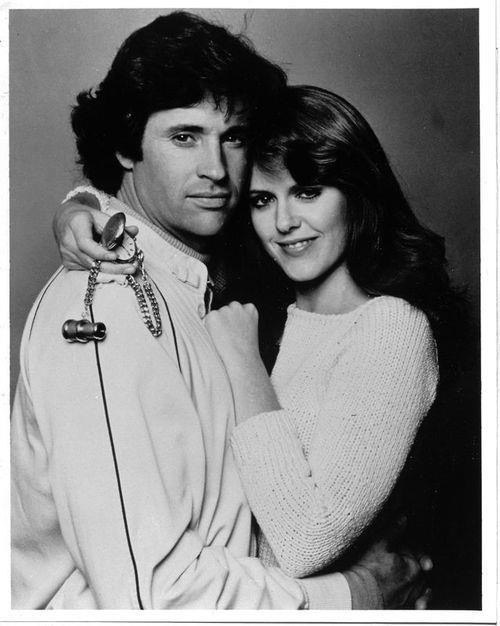
Forty-six years ago, a rather charming film premiered in syndication this evening as produced by Paramount. The Girl, The Gold Watch & Everything was based on the novel of the same name by John D. MacDonald, who of course did the Travis McGee series. I know I watched it and I know I like it even four decades on.
It was written by George Zateslo who hadn’t written anything prior to this save an episode of CHiPS. After writing this, he’d write the script for the sequel, The Girl, the Gold Watch & Dynamite, originally titled the The Girl, the Gold Watch, and Everything Else before they realized that was way too long. Or so they thought.

The two cast members to note here are Robert Hays as Kirby Winter and Pam Dawber as Bonny Lee Beaumont. That because the story is a rather thin SF plot involving a young male who inherits from his millionaire uncle a gold watch that has the power to stop time. A series of quite unlikely and comic adventures ensue. And yes there’s a girl involved. This girl is entirely, I believe, why the novels were written, but then a girl was always present in John MacDonald’s Travis McGee novels as well.
An episode of the Twilight Zone, “A Kind of Stop Watch”, has essentially the same story as that of “The Girl, the Gold Watch & Everything”. A lot of Twilight Zone fans would claim very loudly that McDonald ripped off Serling’s script. That episode, however, aired in October of 1963, the year after the publication of the novel on which the movie is based. Sigh.
Can y’all remember how far back this story plot device goes? I assuming it’s present in the beginning of the genre, isn’t?
(9) COMICS SECTION.
- F Minus praises a student with a skill.
- Free Range benefits from a degree.
- Ink Pen questions superhero logic.
- Lio runs into the past.
- Loose Parts introduces a prince’s relative.
(10) JUSTICE LEAGUE STANDINGS. “Every Founding Member of the Justice League, Ranked by Importance in 2026” in the opinion of ComicBook.com.
…The League has certainly gotten bigger over the years. The advent of the Justice League Unlimited has seen nearly every superhero alive join their ranks, but the classics should always be respected. Seven people founded the League, and to this day, they are all incredible heroes. To celebrate those heroes, we’re going to take a look at how important each of the original seven is in comics in 2026. We’re only judging them by how much they are impacting overall stories and DC right now, and while each is definitely important, you might be surprised to see that some have waxed or waned more than you think. With all that said, let’s leap into ranking the League….
On the lower end of the list is —
6) Martian Manhunter

Unfortunately, sixth place on our list belongs to the beloved Manhunter from Mars. J’onn has often gotten the short end of the stick compared to his fellow founding Leaguers, especially when it comes to his own storylines. Where he is best shown off in Justice League stories, his teammates each have their own volumes focused solely on them. With the Justice League being so massive right now, that leaves even less time for Martian Manhunter to stake his claim. He’s still DC’s strongest telepath and the person everyone can turn to, but as of right now, he’s not doing nearly as much as his teammates. He is currently helping out Superboy in Action Comics (2016), so at least he’s operating in some spotlight.
(11) SCARF AND GOBBLE. [Item by SF Concatenation’s Jonathan Cowie.] I do like to go to the cinema with local SF group members. (Remember the days when the Eastercon always had a film programme as did British venued Worldcons…?)
For me, watching films is a communal experience to chat about after, or if at home, ‘pausing’ to have a mug of Builders and ask a pressing questions such as “I haven’t seen any 12 monkeys in The 12 Monkeys so far. where are they?”
However, some can spoil the experience, as described over at the BBC. “Loud eaters and phones nearly spoiled my cinema trip – and it’s not just me” (Subscription required by readers outside the UK.)
The cinema lights are low and you’re cocooned in your seat, ready for the film to transport you to another world. But just as you settle in, you’re jolted back to reality. Audience members around you are scrolling on their phones, talking and munching loudly.
(12) SPACE LOGISTICS. [Item by Steven French.] Can we mine asteroids to colonize Mars? A new study suggests we can, if we use certain asteroids themselves to produce the fuel required: “Mining the solar system to build a new world” at Phys.org.
I watched Armageddon again fairly recently with Bruce Willis, oil drillers in space and an asteroid the size of Texas bearing down on Earth. Buried beneath the Hollywood chaos is a genuinely interesting question: What exactly could we do with an asteroid if we got our hands on one? As it turns out, the answer has nothing to do with blowing it up, sorry Bruce, but everything to do with building a new world.
Building a colony on Mars is not just an engineering problem, it’s a logistics one too. The logistics, unglamorous as it sound, may ultimately determine whether humanity becomes a multi-planetary species or stays firmly rooted on Earth.
Think about what a Mars colony actually needs. Not just food and oxygen, but metal. Structural steel for habitats, aluminum for equipment, iron for tools and many of the components will wear out, break, and need replacing. Shipping all of that from Earth every time is not a serious long-term strategy. A rocket launch costs tens of millions of pounds per ton of cargo, and the journey to Mars takes between six and nine months depending on where the two planets happen to sit in their orbits. You cannot run a hardware store on that kind of supply chain.
A new study from researchers at EPFL in Switzerland posted to the arXiv preprint server has now done the hard math on mining asteroids and delivering the metals directly to Mars. The solar system contains millions of asteroids, and the metallic ones, known as M-type asteroids, are essentially giant lumps of iron, nickel, and other valuable materials floating through space. The question is whether we can actually reach them, extract what we need, and get it to Mars efficiently enough to make it worthwhile.
The answer, it turns out, is a careful yes but with conditions….
(13) HOLY VELIKOVSKY! “Scientists Link 3.5 Billion-Year-Old Asteroid Strike To Dawn Of Life On Earth” at HotHardware.
A small stone discovered in the sands of Mali is reimagining what we know about the early solar system. By examining this rare lunar meteorite, planetary scientists have mapped out a sequence of cosmic collisions that retell the history shared by Earth and the Moon.
Thanks (or no thanks) to plate tectonics, erosion, and volcanic activity on Earth, finding pristine physical evidence of what happened here billions of years ago is nearly impossible. To uncover our planet’s earliest chapters, scientists must sometimes look to the Moon, a geologically quiet place where the lack of an atmosphere or weather acts as a permanent cosmic museum.
The meteorite, called Northwest Africa (NWA) 12593, is a lunar breccia, essentially a natural concrete formed when fragments of different rocks are fused together by extreme force. A research team at the University of Colorado Boulder subjected the stone to radiometric dating and chemical analysis, revealing that it survived three distinct impacts. The last collision launched it off the Moon toward Earth, while a prior mid-history strike smashed and welded the fragments into its current concrete-like form.
However, it is the first and oldest impact that is the most interesting. Dated to roughly 3.5 billion years ago, this colossal asteroid strike released enough energy to turn the lunar surface into a sheet of liquid rock. The heat was so intense that it generated cubic zirconia, a mineral that requires extreme, controlled temperatures to form. Though the mineral fragilely dissolved as the magma cooled, researchers successfully identified its chemical fingerprints locked inside the meteorite.
This 3.5-billion-year-old timestamp coincidentally mirrors known impact records found in ancient crusts on Earth, as well as on 4 Vesta, one of the largest objects in the asteroid belt. Finding an identical bombardment signature across three completely separate bodies suggests a coordinated, system-wide event. This possibly indicates that the inner solar system was transitioning away from the constant chaos of planet formation toward a sudden, massive wave of debris, perhaps caused by the breakup of a giant asteroid….
(14) SPIELBERG Q&A. “Steven Spielberg on ‘Disclosure Day’ and alien visitations – YouTube on CBS Sunday Morning.
As a child, Steven Spielberg stared at a meteor shower on a wondrous starry night and began his love affair with the sky. The director of the classic “Close Encounters of the Third Kind” and “E.T.: The Extra-Terrestrial” has returned to the sci-fi genre with “Disclosure Day,” which imagines closely-held secrets surrounding alien visitations. He talks with Turner Classic Movies host Ben Mankiewicz about UAP/UFO phenomena, the paranormal, and his own beliefs regarding intelligent life beyond Earth.
[Thanks to Kathy Sullivan, Steven French, Mike Kennedy, John Hertz, Daniel Dern, Andrew Porter, John King Tarpinian, Cat Eldridge, SF Concatenation’s Jonathan Cowie, Chris Barkley, and Mark Roth-Whitworth for some of these stories. Title credit belongs to File 770 contributing editor of the day OGH.]