Pixel Scroll 5/13/26 Pixels All Aglimmer In The Gloamin’

(1) GOOD OMENS 3. The final season of Good Omens has dropped on Prime Video. Here’s what the Guardian’s critic thinks of it: “Good Omens finale review – a heavenly cast, but a script from flaming TV hell”. BEWARE SPOILERS.

… The result is exactly what might be expected of a show with such a gestation: it’s a puzzling mess, its narrative abbreviated to the point of incoherence….

… And so we are ushered towards a final four-way verbal showdown between Crowley, Aziraphale and two supernatural beings, played by two delightful heavyweight guest stars. As they debate what it was all for, Good Omens rehearses its rather basic musings on religion, doling out standard humanist stuff about messy mortals being pretty bloody marvellous things who don’t deserve to be restricted by a fear of judgment in the great beyond. All four players in the scene are wasted: this show has possibly the biggest imbalance in TV history between dazzling cast and stale script….

(2) IF THEY DON’T STOP IT YOU’LL GO BLIND. The New York Times asks experts: “Are Movies Really Getting Darker? Let’s Shine Some Light on the Issue.” (Behind a paywall.)

When 20th Century Studios released a trailer for “The Devil Wears Prada 2” it quickly racked up millions of views. It is impossible to say, however, how many of those views came from the same people rewatching the coming attraction, not because they could not wait to see the sequel, but because they could barely see the trailer.

“The heartbreaking story of a woman who can no longer afford lamps in her office,” read one viral post, showing Meryl Streep’s Miranda Priestly of yore alongside a screenshot from the new dimly-lit trailer. “So did we just forget how to light movies?” asked another, above bright images from the 2006 film beside shadowy, shrouded shots from the sequel. Noting that the sequel employs the same director and cinematographer as the original, one poster lamented “that isn’t a skill issue it’s a choice. So why DO new movies insist on looking like that. Absolutely lifeless.”

Ask anyone on Letterboxd and they’ll surely report that the average movie today lacks the “look” of the average movie from even just 25 years ago: Images are dark and blurry, special effects a C.G.I. sludge, the overall feeling artificial and flat. Even fans who can’t put their finger on what is happening or why seem to be in consensus that it’s happening.

In November, Tom van der Linden, the host of the YouTube channel Like Stories of Old, posted a wonky, nearly 30-minute explainer on “Why Movies Just Don’t Feel ‘Real’ Anymore.” Within a month, it became his most popular video ever. James and Anthony Deveney, independent filmmakers and hosts of “Raiders of the Lost Pod,” also devoted an episode to this issue. An excerpt they shared across social media — titled “Why New Movies Look Bad” — has the highest engagement of any clip they’ve ever made.

“I think over the last 10 years, it’s not even just cinephiles. It’s just everyday moviegoers. We all feel like movies have changed. They don’t look the same anymore,” said James Deveney. “You go back to the 2000s and anytime before that, even B-movies, C-movies, look good!”

These commentators suspect a few culprits: Bottom-line-focused executives for whom cinema is nothing more than “content”; standardization wrought by streamers; the inherent supremacy of shooting on film over now-dominant digital. “People are becoming hip to it, and it’s a big factor in why people aren’t going to the movies anymore,” said Deveney.

To van der Linden, there’s “a moral question” at play. “The reality of a movie is not something that exists on its own,” he said. “It’s solely determined by the viewer’s immersion in the movie. When that breaks, there is a disconnect that is kind of tragic.”

What’s With Those Blurry Backgrounds?

Ironically, several of the features in modern movies these film buffs decry are, according to the industry professionals, likely deployed to make movies shot on digital look more “cinematic.” Take a chief complaint: an overreliance on shallow depth-of-field shots, in which the foreground is in focus and the background is blurry, like Portrait Mode on an iPhone.

“I think there’s a sense [out there] of everything being in focus is video-y, and narrow depth of field is cinematic,” said the cinematographer Steve Yedlin (“Knives Out,” “Star Wars: The Last Jedi.”) He says there is a misconception that “softness” is what makes a movie look like a film….

(3) IKER Q&A. If This Goes On (Don’t Panic) is a podcast about hope and resistance in Science Fiction and Fantasy. In the latest episode, “I’ll Make a Spectacle of You with Beatrice Winifred Iker”, cohosts Alan Bailey and Cat Rambo talk to poet, podcaster, author, and tarot reader, Beatrice Winifred Iker. They discuss religion, horror and religion, queerness, writing neurodiverse characters, Appalachia, organizing complicated plots, Mothman, perfume recommendations, and much more. You can find Beatrice and their books here.

(4) CTHULHU’S BEST FRIEND. Cora Buhlert continues her gallop through this year’s Eastercon by telling us what she did on Saturday: “Cora’s Adventures at Iridescence, the 2026 Eastercon in Birmingham, Part 3: Easter Saturday at the Con”.

…Among others, I chatted with Adrian Tchaikovsky, Anna Smith Spark, Charles Stross, his wife Feorag and their plush Cthulhu, Matt/Womble, Andrew Knighton, Ana Sun, Scott Edelman (who had just enjoyed his first Birmingham balti the day before), Alison Scott, John Coxon, España Sheriff, Sara Felix, James Bacon, S.J. Groenewegen and many, many others whose names I don’t recall. If I talked to you at Eastercon or gave you a koala and failed to mention you, I’m very sorry.

I also took this photo (with permission) of Cthulhu making friends with a tiny koala and posted it on social media, where it went kind of viral and even ended up in the convention newsletter The Fiery Chicken….

Cthulhu has made friends with a tiny koala

(5) LORD OF THE BRICKS. USA Today promises: “Lego to launch the biggest ‘Lord of the Rings’ set yet. See photos”. [Click for larger images.]

Lego’s got a little something magical in store.

To celebrate a quarter century of “The Lord of the Rings,” the Lego Group, in partnership with Warner Bros. Discovery Global Consumer Products, is launching an 8,278-piece set recreating the majestic city of Gondor – the legendary White City of Minas Tirith.

From towering architecture to the iconic citadel, the striking display model captures “one of Middle-earth’s most memorable locations.”

The set, which features a hybrid-scale design, combines an “expansive microscale cityscape with richly detailed minifigure-scale interior scenes,” according to a May 12 news release.

“From afar, builders can admire the sweeping skyline and defensive walls of Minas Tirith,” the release reads. “Up close, they can explore key interior spaces, including the throne room of the citadel, where pivotal moments from the story unfold.”

The set also features 10 minifigures, themed accessories and the legendary Shadowfax horse figure to help bring “the world of Middle-earth to life.”…

… The 25th Anniversary Legacy Collection will be available to Lego Insiders through Early Access on June 1 and to the general population three days later, on June 4….

(6) BANGING ON. “’Big Bang’ Spinoff ‘Stuart Fails To Save The Universe’ Unveils Teaser” reports Deadline.

We’re getting the first look at footage from The Big Bang Theory spinoff Stuart Fails To Save the Universe. The teaser was revealed along with the release date Wednesday during the Warner Bros. Discovery Upfront presentation in New York. The ten-episode season will make its streaming debut Thursday, July 23 at 9 pm ET on HBO Max, followed by a new episode every Thursday.

The spinoff revolves around comic book store owner Stuart Bloom (Kevin Sussman) who is tasked with restoring reality after he breaks a device built by Sheldon (Jim Parsons) and Leonard (Johnny Galecki), accidentally bringing about a multiverse Armageddon. Stuart is aided in this quest by his girlfriend Denise, geologist friend Bert, and quantum physicist/all-around pain in the ass Barry Kripke. Along the way, they meet alternate-universe versions of characters we’ve come to know and love from The Big Bang Theory. As the title implies, things don’t go well….

(7) TODAY’S BIRTHDAY.

[Written by Paul Weimer.]

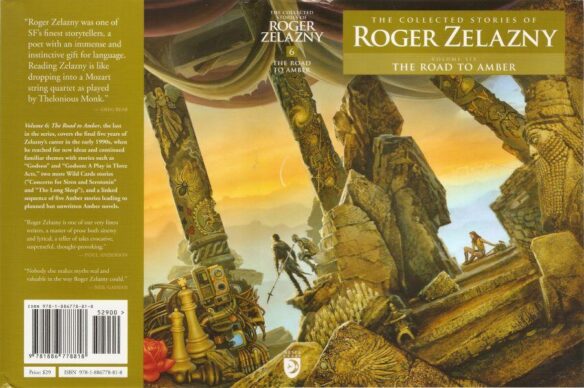
May 13, 1937Roger Zelazny. (Died 1995.)

By Paul Weimer: The author that got me into Science Fiction and Fantasy? Maybe.  My first science fiction and fantasy was Asimov (I,Robot), Bradbury (The Martian Chronicles) and Tolkien (The Hobbit and Lord of the Rings).  But it was Roger Zelazny who really made it stick. Sure, I read more of Asimov, and I tried to read The Silmarillion and failed, but it was reading Nine Princes in Amber and its sequels that really convinced me to get on the endless road through shadow to seek out other science fiction and fantasy. 

It is ironic that for a writer best known for his short stories that I started with, and for a while stuck with, Zelazny’s novels. After Amber came Jack of ShadowsDeus IraeDilvish the DamnedLord of Light and others. 

If I had to point a single novel at a reader for Zelazny, I would go with Jack of ShadowsJack of Shadows does a lot of things that the second Amber series tries to do (and not always successfully) . And I have mentioned before and elsewhere science fantasy IS my jam. How can I resist a novel where the dayside of the Earth is run on science, and the darkside is run on magic? 

 It took me a while to actually find and delve into the short fiction that everyone had raved about.  The Last Defender of Camelot was the first collection of his I read, and then I started hunting his stories in “Best of” collections and other anthologies, and started filling in hjs oeuvre and trying to read all of his work. 

This is a process that continues to this day. 

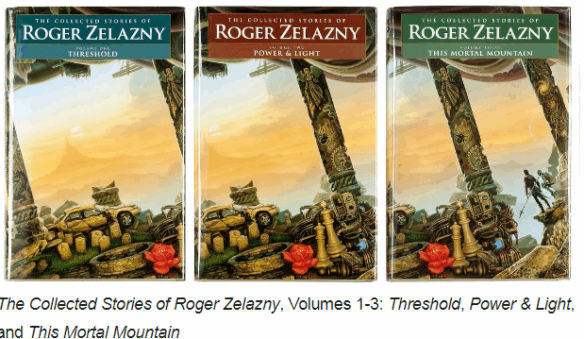
Reading the NESFA collections of Roger Zelazny, which I have been reviewing here at File 770, I have realized how much of the Zelazny stories I have missed, and how much, for even the author that got me into SF and Fantasy, I still have a lot to learn about. My love for Roger Zelazny and his work is a lifelong journey. I suppose in theory there will come a day where I can say I have read all of Zelazny’s work. Someday. 

There are always surprises. I remember reading and liking a story in an old anthology of “best stories” that, much to my surprise, I only recently learned was a Zelazny story. (“The Game of Blood and Dust”). Zelazny continues to delight me.

But why do I like Zelazny’s work in the first place?  Even long before I picked up a camera, I’ve always been interested in imagery, in capturing moments. Zelazny captures these moments, that imagery, those scenes that resonate in my mind. Those moments captured, that lovely writing demands my attention. From Corwin walking down the stairs to Rebma, to Jack coming back from the death at the eastern pole of the world, to the Tristan and Isolde imagery of The Dream Master, to Hellwell in Lord of Light. And on, and on, and on. 

And such well drawn characters in often very limited space. They are often driven, and yes, the women very often have green eyes and red hair. (Zelazny had a type, you see) but I see that as feature, not bug. And yes, too many of them smoked, and that helped take him from us way way too soon. I never got to meet him, much to my sorrow. (He, Pratchett and Banks are three of my regrets in that regard). Dilvish the Damned, particularly comes across as a character we learn in bursts, in small bits of backstory and worldbuilding. (Also a lot of Zelazny’s characters are driven, almost to obsession.  They are passionate and seize things by the horns, and sometimes get the horns as a result.

But, finally, what other SFF author has written properties that I’ve mined and run roleplaying games out of for three decades, after all? Long live the work of Roger Zelazny.

Roger Zelazny

(8) COMICS SECTION.

  • Cornered does commentary on an autopsy.
  • Crankshaft expects a light demand.
  • Wumo has fans demanding service.
  • xkcd tests the vintage of error messages.

(9) FIXED THAT FOR YOU. The Register says “This browser add-in doesn’t just hide ads, it tells you to OBEY”.

A fork of uBlock Origin Lite doesn’t just remove the ads from web pages; it replaces them with tiles containing slogans from John Carpenter’s 1988 film They Live.

Published by Australian Dave Lawrence, the Chromium add-in (so it’ll work in browsers such as Chrome and Edge) takes the uBlock Origin Lite content blocker (also known as uBO Lite) and tweaks it so that rather than simply hiding the ads, the ads are replaced with white boxes containing slogans from the movies. 

Lawrence listed them: “OBEY, CONSUME, WATCH TV, SLEEP, SUBMIT, CONFORM, STAY ASLEEP, BUY, WORK, NO INDEPENDENT THOUGHT, DO NOT QUESTION AUTHORITY.”

But sadly, nothing along the lines of “THIS AD IS HERE SO YOU DON’T HAVE TO PAY TO KEEP THIS SITE RUNNING.”

“Each blocked ad gets a single phrase, picked at random from the list,” Lawrence explained in the project’s repository.

The uBlock Origin project is not involved, and Lawrence noted that only ads blocked by cosmetic filters get the They Live treatment. Custom user-defined cosmetic filters still hide ads normally….

(10) YAKKITY AXE. “Barbaric TV Series, Based on Comic Book, a Go at Netflix” says The Hollywood Reporter.

Medieval-style fantasy continues be a hot genre for streamers looking to cast spells on viewers.

At its Upfronts, Netflix announced it has greenlit Barbaric, a fantasy drama based on the hit Vault Comics title of the same name.

Created by Mike Moreci and Nathan Gooden and edited by Adrian Wassel, Barbaric centers on a ruthless and crass barbarian who is cursed to only use his violence for good, which sends him, his talking axe and a young witch, on a road of self-discovery, redemption and revenge….

… Not mentioned in Wednesday’s announcement are the incoming talent deals featuring Michael Bay as director, and Claflin and Patrick Stewart as the stars. The trio have been involved with Barbaric since it was first revealed that Netflix was developing the project in 2024.

Launched in 2021, Vault’s Barbaric proved to be a surprise, massive hit for the indie publisher, founded by Wassel, with the comics collected into volumes and selling well over 600,000 units, per the publisher. It has been translated into six languages and launched a spin-off series, Queen of Swords, as well as various one-shots….

(11) STARSHIP V3 SCHEDULED. “SpaceX’s Starship V3 megarocket finally has a debut launch date. Here’s when it will fly” reports Space.com.

SpaceX’s advanced new Starship megarocket will fly for the first time a week from today, if all goes to plan.

SpaceX is targeting May 19 for the debut launch of its Starship V3 (Version 3), a bigger and more capable vehicle that could help humanity take its first steps on the moon and Mars, the company announced Tuesday (May 12).

The rocket will lift off from SpaceX’s Starbase site in South Texas on May 19 during a 90-minute window that opens at 6:30 p.m. EDT (2230 GMT; 5:30 p.m. local Texas time). You’ll be able to watch it live here at Space.com when the time comes.

This will be the 12th flight overall for Starship, the biggest and most powerful rocket ever built. But it will be the first for Starship V3, which SpaceX says boasts many improvements over its predecessors.

For example, the V3 Super Heavy first stage now has three grid fins — lattice-like structures that help the booster steer its way back to Earth for recovery and reuse — instead of the original four. And each fin is now 50% larger and significantly stronger, according to SpaceX….

(12) BRIGHT IDEAS. “Look up: Milky Way photographer of the year 2026 – in pictures” – the Guardian has a wonderful gallery at the link.

Photographers search for dark skies in the most remote landscapes to find places where the galaxy shines with extraordinary clarity. They share not only their breathtaking results but also their methods, trials and adventures.

(13) VIDEO OF THE DAY. [Item by Daniel Dern.] Here’s a new SFnal song parody video from Ginny Di, Anjali Bhimani, and Whitney Avalon: “There’s No Realm Like The Fey Realm”.

(Note, their “Dragons are a Girl’s Best Friend” was an item (submitted by Dern) in the Scroll last August,)

[Thanks to SF Concatenation’s Jonathan Cowie, Chris Barkley, Daniel Dern, Mark Roth-Whitworth, Kathy Sullivan, Steven French, Mike Kennedy, Andrew Porter, John King Tarpinian, and Cat Eldridge for some of these stories. Title credit belongs to File 770 contributing editor of the day Cat Eldridge.]

Pixel Scroll 4/15/26 I Scrolled The Pixels And The Pixels Won

(1) SFWA INFINITY AWARD. SFWA Honors Roger Zelazny with Infinity Award – complete details in the File 770 post.

(2) COMPTON CROOK AWARD. Hayley Gelfuso is the winner of the 2026 Compton Crook Award.

(3) PROMETHEUS BEST NOVEL CONTENDERS. The 2026 Prometheus Award Finalists for Best Novel have been announced. See the five titles at the link.

(4) DITMAR FINALISTS. The 2026 Ditmar Awards ballot is out. Eligible to vote for the Australian award are members (including supporting members) of the Continuum, Conflux or Swancon conferences from 2022-2026. 

(5) GREG KETTER IS NOW A T-SHIRT. Cotton Expressions is ready to sell you a Greg Ketter-inspired t-shirt — “I’m Still Angry”. You can choose one with either Ketter’s original sentiment, or a Bowdlerized version.

(6) SIMULTANEOUS TIMES. Space Cowboy Books has dropped Simultaneous Times Episode 98 with work by Eric Fomley and Marie Vibbert. It’s nearing the end of its run — “Only two more to go on the monthly schedule,” says Jean-Paul Garnier.

Stories featured in this episode:

  • “Wired Hearts” by Eric Fomley, with music by Phog Masheeen, read by Jenna Hanchey
  • “The Drive” by Marie Vibbert, with music by TSG, read by Jean-Paul Garnier

Theme music by Dain Luscombe

(7) ANTHROPIC LITIGATION NEWS. SFWA’s “Anthropic FAQ” includes these updates.

  • The Hearing for final approval of the settlement has been moved from April 23 to May 14, 2026. The deadline to submit claims has passed.
  • Attorneys representing authors and publishers in the $1.5 billion Bartz v. Anthropic copyright settlement lowered their bid for attorney fees in the case by more than one hundred and fifty million dollars, from the original 25% of the Settlement Fund ($375,000,000) to 12.5% of the Fund ($187,500.000). The requested amount no longer contains payments to legal firms not associated with the firms acting as Class Counsel.
  • As of March 19, there have been 99,450 claims representing 54% of the titles on the Works List with 350 opt-outs (less than 0.4%), and only 41 objections. At that percentage, claims would pay almost twice as much to authors and publishers as the original figure of $3,000 per work.
  • The following is shared with the permission of the Textbook & Academic Authors Association (TAA) as part of pre- and post-claims guidance for educational authors provided in a 3/19 TAA webinar presented by Brenda Ulrich, a Partner at Archstone Law. For additional guidance on filing claims and navigating the post-claims process, visit https://www.taaonline.net/anthropic-settlement.
    • Under the accepted principle of “contra proferentem” ambiguous contract language should be interpreted in favor of the party that did not write the contract.
    • Under copyright law, “the right to publish” is not the same as “the right to reproduce.” Anthropic used the material it infringed to reproduce material for its LLM, but it did not publish it. If the publishing contract’s “grant of rights” clause only grants the publisher the right to publish the book, but not to “reproduce” it, there may be an argument that the author never granted this right to the publisher, and thus the author is the only party entitled to recover from the settlement.

(8) THE TWO-MINUTE HATE. And Jason Sanford vents again at Genre Grapevine: “On the Anthropic ‘Blood-Money’ Settlement”.

…Despite the settlement being praised as a major win for authors, I still hate it.

As I wrote last year, the settlement doesn’t cover all copyright works, instead only applying to authors who officially registered their books with the U.S. Copyright Office. Almost every other country in the world doesn’t require this registration, so the settlement left out all those authors. Also not included were short story and short-form nonfiction authors, even if their works were officially registered with the copyright office.

In addition, the $1.5 billion settlement is not even a speed bump for Antropic. As Pete Furlong with the Center for Humane Technology has noted, “the same week the settlement was first proposed, Anthropic raised $13 billion at a $183 billion valuation. In effect, Anthropic’s penalty for stealing the creative output and economic livelihood of thousands of authors amounted to less than 1 percent of the company’s total value.”…

(9) WELCOME HOME. Call it the Artemis II “unboxing” video – see it at Facebook.

(10) SURPRISE. And here’s a variation on a humorous meme inspired by the Artemis II mission.

(11) GODZILLA MINUS ZERO TRAILER. Godzilla attacks New York in this 48-second teaser. Godzilla Minus Zero will make landfall in Japan on November 3, with a North American theatrical release on November 6.

(12) TODAY’S BIRTHDAY.

[Written by Cat Eldridge.]

April 15, 1933Elizabeth Montgomery. (Died 1995.)

The beauty of these Birthdays is that I can decide that one series that a performer did is enough to be worthy of a write-up. So it is with Elizabeth Montgomery and her ever-so-twinkly role as the good witch Samantha Stephens on the Bewitched series.

I loved that series and still do. Bewitched is one of those series that the Suck Fairy keeps smiling every time she comes near it. Obviously she too has very fond memories of it. 

Sol Saks in interviews said that the Forties film I Married a Witch based on Thorne Smith’s partially-written novel The Passionate Witch, and John Van Druten’s Broadway play Bell, Book and Candle, adapted into a 1958 film of the same name, were his inspirations for the pilot episode. These films were properties of Columbia Pictures, which also owned Screen Gems, the company that would produce Bewitched

Bell, Book and Candle is the prime story source as that has the good witch Gillian Holroyd, played by Kim Novak, casting a love spell on Shep Henderson as played James Stewart to have a fling with him but she genuinely falls for him.

Bewitched debuted sixty-two years ago this Autumn. It would run on ABC eight seasons, for two hundred and fifty episodes. 

Let’s discuss the other cast of Bewitched. Dick York was Darrin Stephens, her husband and I thought that he was a perfect comic foil for her. Dick Sargent would replace the ailing York for the final three seasons.  It’s been too long since I’ve seen the series but I think I remember his chemistry with her being a little less smooth.

So the next major cast member was Agnes Moorehead as Endora, Samantha’s mother. She worked fine in her role which was that she disapproved of her daughter’s decision to marry a mortal. She often times casts spells on Darrin for her own amusement, but mostly to try to drive Darrin away from Samantha. (It didn’t work. At all.) Despite that, she is the most frequent houseguest and one of the most loyal members of Samantha’s family who dotes on her grandchildren, Tabitha and Adam. 

Then there’s his boss, Larry Tate, who was played by David White, and he was well cast in that role, and many crucial scenes took place at the Madison Avenue advertising agency McMann and Tate where Darrin worked.

So that brings us to Elizabeth Montgomery. She began her performing career in the Fifties with a role on her father’s Robert Montgomery Presents television series. She’d also be a member of his summer theater company. 

She turned out to be very popular and was kept busy performing consistently from there on. She’d have two genre roles prior to Bewitched, the first being as Lillie Clarke on One Step Beyond in “The Death Waltz” and, because everyone seemingly has to be in at least an episode of it, on The Twilight Zone as Woman in “Two”. The only other actor here is Charles Bronson as, oh guess, Man. It’s a piece of pure SF by Montgomery Pittman who also wrote the scripts for “The Grave” and “The Last Rites of Jeff Myrtlebank”. 

So now we come to her in Bewitched, and the role that she was perfect for.  It’s hard to write her up here without noting sexism of the time as her beauty was definitely the attraction for many of the viewers as opposed to her talent according to some of the news articles at the time. Or so said the critics. 

But talented she was, displaying a deft comedic touch that I’ve seen in few female performers since her as she never overplayed her role, something that would’ve been oh so easy to do. She was Samantha Stephens, the very long-lived witch who defied witchery tradition and married a mortal. 

Do note that it openly depicted them sleeping together and sexually attracted to each other. No separate beds here.

The first episode, “I Darrin, Take This Witch, Samantha” was filmed a short while after she gave birth to her first child. 

She was intelligent, not reserved and depicted as more than a match for anyone who might get in her way. Unusual for a female character of that time. 

I have over the years rewatched many of the episodes, and they do hold up rather well provided you like Sixties comedy. I think this along with such shows as My Favorite Martian and The Munsters are some of the finest comic genre work done.

(13) COMICS SECTION.

(14) BROOKLYN COMIC CON ANNOUNCED. Publishers Weekly has the story: “Brooklyn to Get Its Own Comic Convention This Fall”.

The Brooklyn Organization Dedicated to the Endurance of the Graphic Arts (BODEGA), a new nonprofit dedicated to supporting and sustaining comic and graphic arts in Brooklyn and the greater New York area, will host the inaugural Brooklyn Expo of Comics (BEC), a two-day comics festival in Williamsburg, November 14–15.

BEC will feature a varied slate of panel discussions with leading creators and industry voices alongside a convention where over 100 artists will showcase and sell their work. Its goal, per a release, is to spotlight comics talent from New York and around the world while also generating appreciation for independent comics and zines.

BODEGA is led by a team of comics publishers, creators, and industry leaders. Bryce Gold, previously head of content at Comixology and head of comics at Kickstarter, will serve as executive director of the new organization.

Comics writer James Tynion IV will chair the board of directors, on which Gold and illustrator Courtney Menard also sit. Illustrator and educator Christina Lee will be communications manager, comics literary agent Paloma Hernando will serve as outreach manager, and Smoke Signal publisher Gabe Fowler joins as panel coordinator for the convention….

… The event’s bodega-themed branding extends to a number of its initiatives. BEC also plans to debut the BODEGA Comic Arts Trophy (CAT), honoring standout publications presented at the convention with a mid-convention award ceremony, and launch the Brooklyn Annual of Graphically Elevated Literature (BAGEL), a new magazine showcasing comics storytelling and talent from New York-based cartoonists, with future editions premiering annually at BEC.

BODEGA and BEC are supported by an initial donation from Tynion, who is also CEO and founder of multimedia production house Tiny Onion. Tynion lives and works in Brooklyn, so this festival is personal for him, he said….

(15) WRITING FOR A MEN’S MAGAZINE. Lex Berman’s 2021 article “Ted White Goes Rogue” at Yunchtime may have been missed here – and even if it wasn’t this still will be news to someone!

In a recent interview, Ted White talked about his early career as a jazz writer, when he was hanging around in the clubs of Greenwich Village, and how he first got published in Rogue Magazine. His comments sparked my curiosity about that magazine, which was a magnet for talented and eccentric writers and editors. How did a semi-sleazy magazine for men become a cross-roads for so many talented writers and editors? And why were so many of them writers of science fiction?…

…From the start, [publisher William] Hamling and editor Frank Robinson, looked for hungry young writers and sought to give the magazine a literary tone, punching up at their cash-rich competitor, Playboy. Hamling also brought Harlan Ellison onto his staff as associate editor, a position which Ellison used to tout himself and the magazine all over the country. Ellison was promoting his new job at the magazine like nobody’s business, to such an extent that another acti-fan, Bob Tucker, complained that he spent an entire evening listening to Ellison chew his ear off about Rogue in July 1959….

(16) ATTENTION TOM BAKER FANS. “Doctor Who’s Tom Baker, 92, steps back inside the TARDIS in new pics” at Radio Times.

Doctor Who legend Tom Baker has delighted fans by stepping back into the TARDIS for some incredible new photos.

Baker, now 92, famously played the Fourth Doctor, remaining many fans’ favourite incarnation of the Time Lord after his run from 1974 to 1981.

Now, new photos of the actor show him in a very familiar situation – peeping out of the doors of the TARDIS.

(17) SPINDIZZY. “The World’s Largest Wind Turbine Will Smash Previous Records”Scientific American gives details.

…The world’s largest wind turbine—currently being tested off the coast of China—has blades that are more than twice as long as a Boeing 777’s wingspan. It can generate 26 megawatts (MW) of energy, more than double the global average for individual turbines. But its record is about to be smashed to smithereens: another offshore wind turbine that is twice as powerful has been announced by Ming Yang Smart Energy, a company based in southern China.

With a capacity of 50 MW, this supersized structure is designed to float on the ocean’s surface and can withstand typhoons, according to the company, which plans to start making the turbine later this year and to deploy it next year….

(18) WEIRD AI MOVIE TRAILER. If you’d never watch anything made with AI, then definitely don’t watch this fake movie trailer for π Hard, by AI OR DIE featuring Neil deGrasse Tyson and other science and tech celebrities.

(19) SF² CONCATENATION SUMMER EDITION IS HERE. [Item by SF Concatenation’s Jonathan Cowie.] The summer edition (northern hemisphere academic year) edition of SF² Concatenation is now out with news, reviews and articles.

v36(3) 2026.4.15 — New Columns & Articles for the Summer 2026

  • Newscast for the Summer 2026. This includes within it many key sections. See also the master newscast link index that connects to all its SF/F genre and science news sub-sections. In the mix are its Film News;  Television News;  Publishing News;  General Science News  and Forthcoming SF Books from major British Isles SF imprints for the season subsections, among much else.
     
  • Good Luck, Have Fun, Don’t Die – Jonathan Cowie
    Film that is a dark humorous, gritty SFnal adventure in which a wild-eyed man from the future warns that there’s some shιt that’s about to come down. It’s gonna try to give you everything you ever wanted. But in the end, it’ll all be a lie!…  Are any of you listening ?
     
  • Is the speed of light an absolute limit?? – Steven French
    This is one for our physicist regulars but is genre-adjacent.
     
  • Does life on Mars doom humanity?? – Jonathan Cowie
    We do not see alien civilisations, so a ‘Fermi filter’ may prevent their rise. If we find life on Mars then the rise of life is not the difficult evolutionary step. If the Fermi filter is not in our past, then it must be something in our future that prevents us going to the stars. Recent discoveries on Mars may therefore be worrying!
     
  • Gaia 2026
    Annual oddities and whimsy
     
  • Ten Years Ago Exactly. One from the archives.
    German Science Fiction since 1945 – Dirk van den Boom
    Germany has an extensive history of science fiction. Dirk van den Boom provides a summary review of some of Germany’s landmark SF since the end of World War II.
     
  • Twenty Years Ago Exactly. One from the archives.
    Where are the Robots? – Tony Chester
    ‘The future’s here said the pioneer’ but where are the robots? It’s 2006 after all.

v36(3) 2026.4.15 — Science Fiction & Fantasy Book Reviews

v36(3) 2026.4.15 — Non-Fiction SF & Science Fact Book Reviews

[Thanks to Cat Eldridge, SF Concatenation’s Jonathan Cowie, Mark Roth-Whitworth, JJ, Kathy Sullivan, Steven French, Mike Kennedy, Andrew Porter, and John King Tarpinian for some of these stories. Title credit belongs to File 770 contributing editor of the day Mark Roth-Whitworth.]

SFWA Honors Roger Zelazny with Infinity Award

The Science Fiction and Fantasy Writers Association (SFWA) is pleased to announce that the SFWA Infinity Award will be presented this year to Roger Zelazny at the 61st Annual SFWA Nebula Awards® ceremony on June 6, 2026 in Chicago, IL.

Now in its fourth year, the SFWA Infinity Award serves to highlight the achievements of creators who did not live long enough to be considered for the Damon Knight Memorial Grand Master Award but who left a distinct and tremendous legacy in science fiction and fantasy. Although they are no longer with us to celebrate this honor, these writers helped to lay the foundation for today’s science fiction, fantasy, and related genres. Their memory abides not only in the works they published, but also in the worlds they inspired fellow and future writers to dream up in their wake.

SFWA President Kate Ristau reflects fondly on the power of Zelazny’s worlds:

“One of my first deep dives into science fiction was The Chronicles of Amber. Zelazny drew me right into the story with his world-building and world-breaking. Characters could manipulate their reality, walking between worlds, and they didn’t always make the decisions you wanted. There were heartbreaking moments and series-wide challenges that were epic and unforgettable; they lingered with you. Zelazny’s impact lingers on with us, shaping how we think about multiverses and how we create characters that are complicated, nuanced, and sometimes deeply flawed. I am honored to present him with this year’s Infinity Award.”

Challenges of the Multiverse. Roger Zelazny entered our genre’s publishing record in 1962, the same year as Samuel R. Delany and Ursula K. Le Guin, and the era of his ascension as a writer was marked by heated debates about the nature of science fiction and fantasy. Some called the work that he and his peers published “New Wave”, a term bound up in contemporaneous social criticism about the uptick in experimental and more “worldly” art, film, literature, and music.

This catch-all term was used in a positive light by some, to suggest a transformation in the genre: a coming-of-age for SFF as a thoroughly “literary” form, featuring more comfortable and slipstream uses of science-fictional and fantastical tropes to tell more nuanced human stories. It was also used in a negative light by some critics, to cast aspersions on SFF writers who played too poetically with language, “wrote back” against ancient myths and story structures, and wrestled with recent insights from psychology and sociology in their prose.

As for the writers themselves, including Zelazny?

Most were less interested in the labels used by critics to describe their work, and more in how to keep growing their craft – often in publishing contexts we can also learn a great deal from today.

Zelazny developed as a writer in an era when magazines were common incubators for novel-length masters of the craft. Widely read by paying customers, the major magazines of Zelazny’s day had different opportunities to curate budding and distinct voices like his.

That’s why, after publishing in magazines like Amazing and Fantastic, Zelazny was able to win a Hugo for Best Novel with what was first a serial production, delighting readers over two issues of F&SF in 1965. Zelazny’s This Immortal (first printed as “…And Call Me Conrad”) would tie for that Hugo with another patchwork publication by another SFWA Infinity Award recipient: Frank Herbert’s famed fix-up novel, Dune.

Zelazny’s Lord of Light (1967), nominated for a 1968 Nebula and winning the Hugo, would then entrench his distinct voice and approach to mythic world-building as a key component of mid-century SFF canon. That year, he would also support SFWA’s internal curation of canon, by editing our third-ever Nebula Award Stories anthology and providing thoughtful remarks on each tale.

Writers new to Zelazny’s work might be pleasantly surprised to pick up a volume today; most of his stories boast lush language and a fantastical interweaving of science-fictional conceits with allegorical and/or psychologically rich characters.

George R.R. Martin describes Zelazny as follows:

“He was a poet, first, last, always. His words sang. He was a storyteller without peer. He created worlds as colorful and exotic and memorable as any our genre has ever seen.”

Perhaps just as importantly, Zelazny operated in a community of dreamers, experimenters, and literary incubators. He was loved by many of his peers, and flourished within a network of fellow creators. To read Zelazny’s work today, and to reflect on the context in which it was written, is to remember how much the writers of SFF today share with generations of innovators come before.

[Based on a press release.]

Pixel Scroll 2/28/26 The Nature Of My Pixel Emergency? It’s Been Pixelated!

(1) HARLAND PRIJS 2025. [Item by Hinse Mutter.] Today the Harland Prijs 2025 writing contest (“Prijs” = Dutch for award) winner was announced at the Afternoon of the Fantastic Book in Utrecht, the Netherlands.

Pam Hage won for the story Foutmelding 404 (“Error Message 404”) and she receives €1000.

It is one award, for best short story (up to 7500 words) in the genre of scifi/fantasy/horror of the year 2025 in the Netherlands.  This edition had 267 entries, a record number.

The five best stories will be published for free in ebook in March on Hebban.nl (basically Dutch Goodreads). More info here.

It was a cute afternoon with some workshops and interviews as well, along with a book and art market and a few Star Wars cosplayers. I myself participated and came in 52nd (woohoo). Some pictures are on my Bluesky profile.


The stage at the Neude Utrecht Library, featuring Martijn Lindeboom, Heidi (in a mushroom hat), and Pam Hage, who is telling about her winning story. Photo by John Klein Haneveld

(2) HISTORICAL PLAQUE. “U.S. Has Annexed Canada in Toronto Artist’s Speculative Series” – chronicled in the New York Times’ “Canada Letter”. (Behind a paywall.)

Last winter, as Canada was becoming the persistent target of economic, verbal and social media attacks from President Trump, the Toronto multimedia artist Dara Vandor got to work imagining a nightmarish scenario — the annexation of Canada by the United States.

She hung the result — an aluminum plaque, 18 by 24 inches, memorializing a fictitious surrender on Aug. 11, 2031 — in an alley near her home. She did not expect to be continuing the narrative in the continuing series “Pax Americana” a year later.

For nine months Ms. Vandor produced and posted 18 historical plaques in stairwells and a forest, and on buildings, telephone poles and chain-link fences in Toronto, Ottawa, Montreal and Tofino, British Columbia. The signs recounted disturbing scenarios: an invasion by U.S. troops, a Canadian resistance and then a quick surrender in straightforward, chronological detail. Each plaque can stand alone, but taken together they tell a whole story.

People who stumbled on the signs had big feelings — confusion, anxiety and even fury, Ms. Vandor says. People also stole them, which was fine with her. On Tuesday, “Pax Americana” opens at the D.B. Weldon Library at Western University in London, Ontario. (Unlike those in the wild, these are meant to stay put.)

Alongside 20 new plaques will be a collection of books, also hypothetical. Many nod to Canada’s literary past, inside jokes only we would understand — “The Log Driver’s Waltz: Clearcutting a Northern Passage” and “Selected Canadian Apologies”. One volume, “The Lives of The Presidents 1789-2045,” highlights a five-term Trump dynasty….

(3) A ‘REAL’ WRITER. Nnedi Okorafor shared this terrible experience with Bluesky readers last week.

(4) SOLARPUNK ADVOCATE. Clive Thompson has a suggestion for Mother Jones readers: “Tired of Dystopian Sci-Fi? You Might Like Solarpunk”.

…But what enchanted me about [Cory Doctorow’s The Lost Cause] was its vibe of possibility. Here was a world where climate change had gotten worse, but people were adapting—cleverly using tech to rebuild communities that would generate far fewer emissions and far less waste than before. It was a glimpse of a new destination….

…Many solarpunk thinkers told me their first encounter with the idea, though he didn’t coin the term, was a 2014 essay by Adam Flynn, an American writer and public health strategist, titled “Solarpunk: Notes toward a manifesto”—his contribution to the Arizona State University sci-fi collaboration Project Hieroglyph.

“We’re solarpunks because the only other options are denial or despair,” Flynn wrote. Artists and activists needed to envision “ways to make life more wonderful for us right now, and more importantly for the generations that follow us…Imagine permaculturists thinking in cathedral time. Consider terraced irrigation systems that also act as fluidic computers. Contemplate the life of a Department of Reclamation officer managing a sparsely populated American southwest given over to solar collection and pump storage.”

Other writers were, it turns out, having similar thoughts. They were deeply worried about climate and weary of sci-fi’s doomerist turn. They wanted art that elucidated a way forward, so they set about creating fictional glimpses of a sustainable future. In a duet of novels, Becky Chambers sketched out a world where humanity had survived climactic collapse—the robots became self-aware and politely fled into the wilderness—and then figured out how to exist in a better balance with nature: Her characters live in skyscrapers engulfed with vines, ride e-bike camper vans powered by solar panel coatings, and have abandoned swaths of their world to the wild.

In Sarena Ulibarri’s 2023 novel Another Life, a communal society runs solar desalination plants that irrigate Death Valley. The 2018 Brazilian short-story anthology Solarpunk: Ecological and Fantastical Stories in a Sustainable World includes a classic hard-bitten-detective whodunit set in a world where homes have biodigesters that turn kitchen scraps into fuel.

Solarpunk often depicts technology deployed not to conquer nature, but to complement it—sometimes in deeply weird ways. In the story “Thank Geo,” by the author BrightFlame, humanity has wired trees with probes that let people talk to them….

(5) WHAT CAME FIRST? Douglas A. Anderson delves into the history of “Mothra” at Wormwoodiana.

As a youth I enjoyed the various Japanese monster films that showed up on late night television. We didn’t then know to call the monsters kaiju. Godzilla was most frequently encountered, but the monster and film that intrigued me the most was Mothra, because of its very surreal nature. I mean: an island in a radiation zone near Japan is found to be inhabited by savages, overseen by a pair of diminutive women who speak and sing in unison. After the women are taken away from the island by an unscrupulous businessman, in order to exploit them in a carnival-type show, they sing for rescue by Mothra, who, back on the island, hatches from a large egg, and as a larva swims gallantly over the sea, cocoons itself in Tokyo, and emerges as a very large moth with very slow-moving wings, which nonetheless compel hugely destructive winds. That is the kernel of the plot of the film Mosura, released in July 1961, with an English version released the following year as Mothra

I learned recently that the original novella (three connected stories by three different writers), made as a preliminary film treatment, was published in January 1961 in a periodical whose title translates to Asian Weekly Supplement. The story was titled “Hakko yosei to Mosura,” the three parts written successively by Shin’ichiro Nakamura, Takehiko Fukanaga, and Yoshie Hotta. It has now been translated into English for the first time, as The Luminous Fairies and Mothra. The slim book, published by the University of Minnesota Press, contains the translation (42 pages) and a Translator’s Afterword, by Jeffrey Angles, which is almost twice as long as the original story….

(6) A FOOTNOTE IN TELEVISION HISTORY. The Daytonian in Manhattan profiles “The 1931 Dumont Building – 515 Madison Avenue”.

As early as 1936, the burgeoning television industry was represented in 515 Madison Avenue by The Television Corporation of America.  It was joined by the Allen B. Dumont Laboratories, Inc., “manufacturers of television equipment.”  In 1938, Dumont installed a broadcasting antenna on the building and in May 1939 The New York Times reported it would erect an “outdoor studio” for “the transmission of tele-pictures.”  The article said it “will be equipped on a setback of the building to receive the benefit of daylight.  It will be roofed with glass so that inclement weather will not interfere with the schedule.”

Licensing of the Dumont Laboratories television station was granted in April 1940.  Later that year, the station made history.  On November 10, The New York Times reported:

Television has just played with honor and acclaim its most striking role in America’s greatest political show.  Last Tuesday it took its place alongside that more mature trouper of twenty-odd years of Presidential elections, the microphone.

According to the article, “nearly 4,000 television sets were in use,” as the results of the Presidential election came in.

The firm’s visible presence here gave the building its nickname, the Dumont Building.  The following January, the Allen B. Dumont Laboratories, Inc. demonstrated a “625 line definition” receiver here that produced enhanced clarity to the image.  The firm made history again that year by initiating “commercial” television.  The New York Times reported on May 11, “The DuMont station will specialize in outside pick-ups, such as baseball and football games and events.”…

… In 1958, the former Dumont rooftop station became home to the Columbia University WKCR-FM radio station.  It would remain until 1977.

(7) NEVERMORE TO SAY GOODBYE: MICHAEL HARPER (1954-2026). [Tribute by Dave Rowe reprinted with permission.] Michael Harper died on February 24th.  “He had his family around him to the end.”

A year and a day ago he announced he had pancreatic cancer that had spread to his liver.  “Prognosis: 12 months or less.”

He kept up correspondence detailing the ups and downs. What was working and what was not.  All with a stiff upper lip and at times a wry smile.

He came to Canada from India via Manchester, Britain, and Canadians (because they are quiet and sensible) have Medically Assisted Induced Death (aka MAID) for the terminally ill.  Michael said he’d prefer to die with his family around him, rather than receive the wretched news while  they were working abroad.

Michael and I have been friends for seven months shy of half a century.  Sharing a very similar sense of humor.  

Michael kept a youthful enthusiasm about anything and everything he was involved with.

He once said that if he ever produced a fanzine (which unfortunately he never did) he would entitle it BUMPH. Of all the thousands of fanzine names, was there ever a more valid one?

Life was the better for knowing him. 

(8) JOSEPH L. GREEN (1931-2026). [Item by Andrew Porter.] Joseph L. Green, author and science fiction fan, died suddenly on February 20. He was 95.

His daughter Rose-Marie Lillian wrote, “…My father unfortunately passed away on February 20 after a relatively short spate of bad health. The good news is that he was able to go peacefully on his terms, which is not an opportunity afforded everyone.”

His chief employment was in the American space program for which he worked for 37 years, retiring from NASA as Deputy Chief of the Education Office at Kennedy Space Center. His specialty was the preparation of NASA fact sheets, brochures and other such publications for the general public, in which complex scientific and engineering concepts were explained in layman’s language. One of his most important accomplishments was serving as editor and principal writer of the NASA report on the Challenger disaster. 

He also hosted celebrated launch parties for NASA liftoffs which were visible from his house.

Prior to retirement from NASA and becoming a full-time writer, Joseph Green produced five novels and about 70 fiction stories, the latter published primarily in the Analog and The Magazine of Fantasy & Science Fiction, and in original anthologies.

Fanac.org’s one-hour interview with him was posted to YouTube in 2024 – “Joseph L. Green – An Interview conducted by Edie Stern”.

(9) MEMORY LANE.

[Written by Cat Eldridge.]

Damnation Alley by Roger Zelazny

Roger Zelazny’s Damnation Alley is a novel that I’ll admit that I do like.  As a novel it works rather well with protagonist, if that’s the right description for Tanner, a landscape that is truly horrendous and a story that is interesting. The film, well, I’ll deal with that eventually. There will be spoilers for that. 

It was published first in 1969 by G.P. Putnam’s Sons. The cover art (which I think is utterly wrong for the novel) is by Jack Gaughan. It was by no means as bad as what Paul Lehr did for the Berkley Medallion cover that was the next edition.  A recent edition is from a Greek publisher, Mnemos, and there it’s renamed Route 666, but I like its cover over any of the others done so far. 

I did not know until now that a novella length version of this was first published in the October 1967 issue of Galaxy. Who here can tell me how significantly different the two versions are? That novella is in The Last Defender of Camelot collection which is available from the usual suspects.

The novella was nominated for a Hugo at Baycon, the year “Riders of the Purple Wage” by Philip José Farmer won. Lord of Light did win a Hugo that year. That was also the year all Best Dramatic Presentation nominees were Star Trek episodes.

Now the film. May I quote Doctor Seuss’ The Grinch? I thought it stink, stank stunk. 

Two actors, George Peppard and Jan Michael Vincent are really extraneous. Neither is known for his acting skills. They are somewhere in a missile silo in the southwestern desert with a small army of extras fighting over Playboy magazines (no, I’m not kidding) in the aftermath of civilization destroying in World War III. Albany is the only city in the United States still functioning why Albany who knows. Maybe the dry deep snows every year protected it.

Those Playboy magazines? A fight will break out somehow leading to a fire that ignites missiles (don’t ask please), destroys the bunker, and kills everyone but the two leads. Naturally.

We will get bad special effects monsters including giant scorpions beyond belief. It was supposed to cost around the 6-1/2 million dollars that it was budgeted for but it went way over budget. How the film cost that much is something only those who, well, I’ve no idea. 

So that explains why I found it so distracted, so badly done because it really wasn’t a film. It was a collection of stock footage put together like a seamstress who didn’t know what she was doing working with bits and pieces of cloth creating the Frankenstein a patchwork  of costumes for a kid going on Halloween where it didn’t matter that didn’t look good. 

It didn’t help that the script was really a piece of shit. It certainly had very little to do with the original novel. I’m not sure they actually read the novel. I think somebody told them hey this is what it was and they went from there.

Surprisingly Rotten Tomatoes give it a 34% rating. Of course it’s become a cult classic and Vishnu forbid us some films are bad enough that happens and this one certainly is bad enough.

(10) BONUS LEAP BIRTHDAY.

[Written by Cat Eldridge.]

February 29, 1952 Tim Powers, 74.

Now Tim Powers is a writer that I really admire. He’s decently prolific as he has twenty novels published. Now remember this essay is about what I like, so I may or may not mention what something that you, so please do t be too miffed by that. 

Tim Powers

Where to start?  That’s easy as it has to be The Anubis Gates. Victorian London and Egypt. Ancient Egypt. Time travel. Anubis. Oh ymmm. It’s on my list of To Be Listened To list as I’ve already read it several times and the sample at Audible indicates Bronson Pinchot does a great job of narrating this. 

Just as good in a very different manner is On Stranger Tides takes place during the so-called Golden Age of Piracy which was nothing of the kind, when an individual on his way from Britain to Haiti has a series of increasingly wild adventures. I know the novel was purchased to be part on the Pirates of Caribbean franchise. I’ve not seen the film, so I don’t know how much, if anything of his novel made it into the film, but I’m betting nothing except the name did.

Declare, a secret history of the Cold War, is extraordinary. I mean it really. When I was still actually reading novels as opposed to listening to them, as I’m doing now, I didn’t spend six to eight hours a day on one but I remember I did on Declare just to see where the story went. Stellar.

The Vickery and Castine series is just fun, and I mean that as a compliment. Set in contemporary LA, rogue federal agents Sebastian Vickery and Ingrid Castine can see ghosts and other things that are the secret reality of that city. It’s an ongoing series with four novels so far. Highly recommended. 

Then there’s Three Days to Never which I’m not convinced actually makes sense but is really fun to read with its wild mix of supernatural history of what actually happened, time travel and foreign agents. 

Ok, those are my picks as the Powers novels that I really like. So what’s your choices? 

(11) COMICS SECTION.

(12) SUPERMAN AGAINST ABUSE. [Item by SF Concatenation’s Jonathan Cowie.] It is rare that a radio programme grabs you especially at 3.00am in the small hours.  At that time, over here in Brit Cit, BBC Radio 4 (formerly the Home Service) hands over to the BBC World Service so we get a taste of what you folks are given.  Anyway, last night there was a 40 minute documentary on aspects of metal but the first 20 minutes were devoted to the Man of Steel, a.k.a. Superman.  Actually, the subject was Joe Straczynski is an award-winning comic book writer and filmmaker.  It turns out that as an impoverished child, and son of a mother who did not want him and alcoholic and violent father, he sought recluse in science fiction and would steal SF books from his local shop, carefully read them and then return them, finding the most scary part putting them back because if he was caught he knew he would not be believed.  Back then his idol was Superman.

He went on to write (among much else) Superman Earth One and had himself as a ten-year old included (see cover below).

Today, Joe Straczynski is an award-winning comic book writer and filmmaker. He’s created TV shows like Babylon 5, Sense8 and the movie Changeling, directed by Clint Eastwood and starring Angeline Jolie. But he had a tough start to life. Joe was born into a loveless household full of abuse. His escape came through the pages of Superman comics. For him, the ‘Man of Steel’ saved his life and helped form his own moral character, steering him to a better life. Outlook’s Andrea Kennedy spoke to Joe back in 2019.

You can access the programme here  but if outside Brit Cit you may need to subscribe to BBC.

(13) ANOTHER GAME TV ADAPTATION. “’God Of War’: First Look At Kratos & Atreus In Prime Video Series” at Deadline.

We’re getting the first look at Ryan Hurst and Callum Vinson as Kratos and Atreus, respectively, as production begins on Prime Video‘s God of War. You can see the photo above.

The live-action adaptation of PlayStation’s ancient mythology-themed video game, from Sony Pictures Television and Amazon MGM Studios, has received a two-season order.

From writer, showrunner and executive producer Ronald D. Moore (OutlanderFor All Mankind), God of War follows father and son Kratos (Hurst) and Atreus (Vinson) as they embark on a journey to spread the ashes of their wife and mother, Faye. Through their adventures, Kratos tries to teach his son to be a better god, while Atreus tries to teach his father how to be a better human….

(14) RED PLANET COMES TO VISIT. “Last chance to see Mars sculpture in cathedral” reports BBC.

People on the Isle of Man have a final chance to see Mars up close this weekend.

The installation Mars: From Imagination to Science by artist Luke Jerrum draws to a close on Monday at Cathedral Isle of Man in Peel.

The artwork featuring detailed NASA imagery has been on display since 7 February.

Lay preacher and event organiser Rosemary Clarke said about 11,000 people had so far been to see it prior to its final weekend and there had been a “general happy feel about it” from those who visited.

“It’s certainly been a success and it’s just so rewarding to see people come in,” she said.

The exhibition is free to attend and the cathedral is open daily between 09:00 and 21:00 GMT.

The sculpture, has previously been exhibited in several UK locations, as well as in France, Singapore and the United States, followed on from a similar Moon display last year.

Isle of Man Today shared this photo: “Pictures show giant Mars sculpture on display at cathedral”.

(15) IS GOD HIDING IN A TV SHOW? [Item by SF Concatenation’s Jonathan Cowie.] Now, this might seem something of a stretch, but is it?!!!!  Is it really?  Moid Moidelhoff – the British uber-SF-geek behind the quantamazing, magnetically monopolled and fantasomagorical  Media Death Cult YouTube channel – has found connections between hundreds of TV shows and films. What he did was to find over 600 connections and counting (just check that… ‘over 600 connections and counting’!) between films and TV shows. These shows, and their neighbourly connections, he painstakingly constructed from multi-coloured post-it notes on his living room wall. (Much to his wife’s annoyance.)

For example, several shows connect to  St Elsewhere, Oz, Beat, Law and Order, Special Victims Unit. And… Detective John Munch from Special Victims Unit crosses over into Arrested Development to investigate the Bluthe family, and Tobias (again from Arrested Development) is seen in the Collector’s Museum of Avengers: Infinity War.  Of course, this is an Easter Egg put there by the Russo Brothers who directed both Avengers: Infinity War> and some episodes of Arrested Development.  From here, you can see that the connections spread out through the entire Marvel Cinematic Universe….!  Alas, Moid did not have enough coloured Post-It Notes for all of that.

This is a physical representation of the greatest fan theory, the most intricate, interlinked, media hypothesis, the world has ever seen…  We are dealing with several layers of consciousness and realities within realities.  He even finds a connection between these fictional worlds with our reality (other than they are all too obviously shows/films made in our reality). This, is the Tommy Westphall Universe!

But Moid, never satisfied, wants even more! He seeks a unified theme that ties the whole Gordian’s Knot together! Something more satisfying that Tommy Westphall is a metaphor for ‘the simulation is real’.  Maybe it is in this as yet not fully-explored thread that emanates from Firefly which connects to Aliens, which connects to Bladerunner which is an adaptation of Phil K. Dick’s Do Androids Dream of Electric Sheep?… Perhaps it is time to ask Hugh Everett III to step up? (Doncha just’ dig alternatives to the Copenhagen interpretation?)

We may have discovered the DNA of all speculative, drama, entertainment, information and reality, hiding in the corridors of a fictional Boston Hospital and echoed in the mind of a 20th century SF author….

Spooky, huh?

You can see the 12-minute video below….  Tread boldly (but softly, oh, so softly).

[Thanks to Mark Roth-Whitworth, Kathy Sullivan, Steven French, Hinse Mutter, Andrew (not Werdna), Dave Rowe, Mike Kennedy, Andrew Porter, John King Tarpinian, Cat Eldridge, and SF Concatenation’s Jonathan Cowie for some of these stories. Title credit belongs to File 770 contributing editor of the day Mark Roth-Whitworth.]

Pixel Scroll 2/24/26 Elderly Pixels From Other Scrolls Dress In Regency Costume And Drink Tea Wherever They Wish

(1) OKORAFOR WINS NCAAP IMAGE. Nnedi Okorafor’s novel Death of the Author won the 2026 NAACP Image Award for Outstanding Literary Work – Fiction. See the announcement on the “57th NAACP Image Awards Virtual Pre-Show Night One” at the 18:25 mark.

Nnedi Okorafor receives NCAAP Image Award. Photo by Nollywood director Tchidi Chikere.

(2) NOTES ON LTUE. [Item by David Doering.] John Hertz kindly upbraided me for not keeping File 770 updated on our annual Life, the Universe, & Everything event here in Provo. I definitely need to repent, as we had a fabulous time–all 1300+ of us–with Ron Clements of Disney, Matt Dinniman, and Charlie Holmberg. Already planning for next year under our new non-profit “Light the Fire Foundation” auspices.

Here’s the over 600 teens, YA, and us seasoned folk showing Matt Dinniman how everyone  has a hard-copy of his latest book. Who says reading dead tree editions is over??? 

(3) RECOVERING FROM BURNOUT. Priya Sridhar counsels readers “How to Recover from Volunteer Burnout” at SFWA’s Planetside.

I’ve volunteered with several organizations; at least one has proved disillusioning. Yet many large creative projects and events require unpaid labor of love. Otherwise, nonprofits would go bankrupt in a matter of months. 

A few scandals have plagued popular writing organizations. Who bears the emotional brunt, in addition to any victims? The volunteers. That experience inevitably leads to burnout, that loss of energy and willpower to engage in such creative activities. …

The scandal that changed my relationship with NaNoWriMo emerged in 2023, and the emotional fallout still wreaks havoc years later….

…Many former volunteers and I have talked about how much we put into NaNoWriMo. Local members in my group have voted on a new Discord server name, but the previous unity has evaporated. We keep missing each other when scheduling write-ins….

Sridhar discusses six helpful steps. Here are the first two:

…Some steps align, however, with treating burnout in general. No solution is one-size-fits-all; recovering requires strategy.

Commiserate. Chances are, you aren’t the only disappointed volunteer. Large organizations have large groups. Due to the law of averages, you can find people in the same boat as you: disappointed and burned out. Knowing you aren’t alone makes a huge difference. 

When the NaNo news broke, so did the official volunteer server. In fact, it had to shut down for legal reasons. If you can meet in person, I’ve found that gathering to commiserate over hot food is therapeutic. I generally go for locally made pizza. Hot food is generally key; if you’re not a pizza person, ramen that accommodates lifestyle choices and allergies is another option. The reason I think this works? Because hot food warms you from head to toe and allows you to relax while feeling catharsis. You can open up about what’s been troubling you. 

Grieve. Accept that you won’t be okay for a while. A cause you believed in failed you. It’s okay to not be okay with that anguish. Feeling frustrated with the subsequent hurt and exhaustion is perfectly normal….

(4) URBAN FANTASY. Marie Lu names “Fantasy Books That Imbue the Real World With Magic” in the New York Times. (Link bypasses the NYT paywall.)

There’s a door in the alley that people only seem to enter but never leave. There’s an old woman stirring her coffee with a spoon that you could have sworn was a fork a second ago. There’s a shadow on the wall that doesn’t seem to match its owner.

Perhaps you’ve experienced a moment like this, where you witnessed something that can’t quite be explained away. Urban fantasy is the genre that invites us to dwell on those everyday moments and ask ourselves: What if that old woman really were a magician? What if that door really were charmed? More grounded than high fantasy, with its swords and dragons, urban fantasy sets speculative stories in the cities of our world (or something closely resembling it), exploring the possibility that the mundane byways of reality can in fact be where magic exists.

Here are 10 novels where the real world is enchanted….

This is one of Lu’s picks:

The Extraordinary Disappointments of Leopold Berry

When a story opens with a boy seeing a raccoon with its tail on fire and a man feeding a tooth into a parking meter, you know you’re in for a wild ride. Leopold Berry is a California teen who is “average absolutely to the decimal point.” But when he starts seeing things that seem to come straight out of a 1990s fantasy television show called “Max’s Adventures in Sunderworld,” he learns that Sunder is not only real, but also in grave danger. Riggs’s intimate knowledge of Los Angeles transforms this urban jungle into a place where dark magic whispers from every alley.

(5) TELL TCHAIKOVSKY THE VIEWS. A Deep Look by Dave Hook opens up “’The Best of Adrian Tchaikovsky’, February 28, 2026 Subterranean”. Here’s the short take. The long commentary is at the link.

The Short: I just read an Advance Reader Copy (ARC) of The Best of Adrian Tchaikovsky, scheduled for release on February 28, 2026, Subterranean. It’s noted as available in hardcover and e-book. It’s hefty, 37 stories and over 600 pages of SF, fantasy, and “weird fiction”. Picking favorites is hard, but I especially loved the great short stories “Crossed Gates“, from Breakout, Nick Gevers editor, 2015 PS Publishing (it features trains), and “Difficult Times“, a short story, NewScientist December 2020 (music and a surprise to me). It has strong essay content, featuring both section/story essays by Tchaikovsky and a good introduction by John Scalzi. I like the “Author’s Note: What’s Not Here” by Tchaikovsky, which is great for a “Best of” collection. My overall, average rating for the stories was 3.75/5, or “Very good”. I enjoyed this a lot. Recommended….

(6) COVER STORY. Adafruit Industries points to “The book so dangerous the CIA stole it: Roger Zelazny’s Lord of Light”. They start with a synopsis of the novel:

In Lord of Light, published in 1967, Roger Zelazny wrote about a swordfight between the Buddha and the God of Death where both combatants quote ancient scripture at each other while trying to achieve philosophical clarity through mutual annihilation. Reminds me of social media sometimes…

In the book, colonists from a dead Earth use technology to become the Hindu pantheon. They control who gets reborn and as what, using a psych-probe that reads your entire mental history and a karma system that makes modern social credit scores look quaint. They suppress the printing press, gunpowder, indoor plumbing….

Then they remind you the reason why the CIA stole it.

Agent Tony Mendez grabbed the dead Lord of Light script off a shelf, renamed it “Argo,” and the rest is detailed in Ben Affleck’s Oscar-winning movie, which never even mentions Zelazny, but there is a book about all of this too.

A 60’s sci-fi novel about gods who suppress technology to maintain power, whose screenplay was stolen by an intelligence agency and used to rescue people from a theocratic revolution. You couldn’t make it up if ya tried….

(7) AI HYPOCRISY. [Item by Cliff Ramshaw.] I’m sure File 770 readers will appreciate the irony here: “US AI giant accuses Chinese rivals of mass data theft” – the Guardian has the story.

US artificial intelligence company Anthropic said on Monday it had uncovered campaigns by three Chinese AI firms to illicitly extract capabilities from its Claude chatbot, in what it described as industrial-scale intellectual property theft. OpenAI leveled similar charges last month.

Anthropic said DeepSeek, Moonshot AI and MiniMax used a technique known as “distillation” – using outputs from a more powerful AI system to rapidly boost the performance of a less capable one.

“These campaigns are growing in intensity and sophistication,” the company said in a statement. “The window to act is narrow.”

Distillation is a common practice within AI development, often used by companies to create cheaper, smaller versions of their own models….

(8) TODAY’S BIRTHDAY.

[Written by Cat Eldridge.]

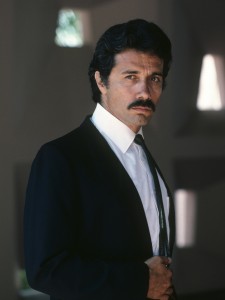
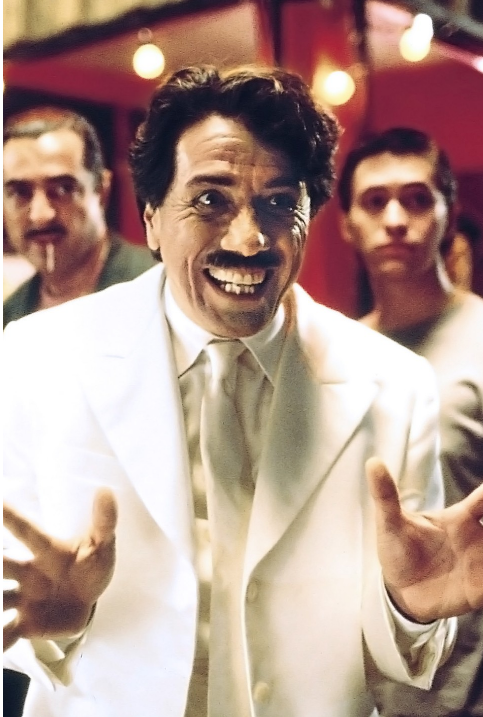
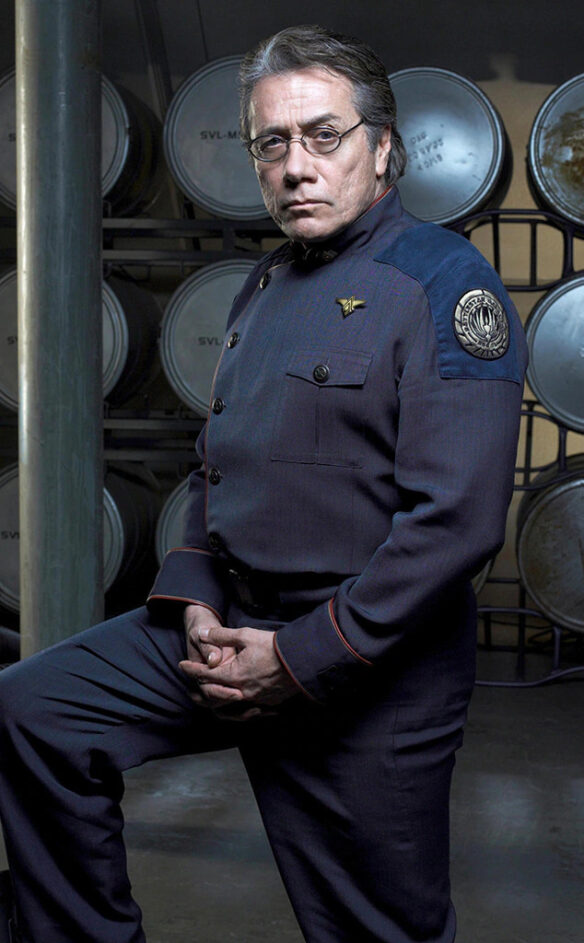
Born February 24, 1957 — Edward James Olmos, 69.

Where I first experienced the acting of Edward James Olmos was as Detective Gaff in Blade Runner, a role I see he reprised in Blade Runner 2049.

Edward James Olmos

No, I’ve not seen the latter film, nor do I have any intention in doing so as I consider Blade Runner one of the finest SF films ever done and nothing will sully that for me. We gave it a Hugo at ConStellation, so there later films!

It wasn’t his first genre film as that was the Japanese post-apocalyptic science fiction film Virus (1980), but his first important role came in Wolfen (1981), a fascinating horror film about, possibly, the idea that werewolves are real, or maybe not, in which he was Eddie Holt who claims to a shapeshifter. 

He has an almost cameo appearance in Even Cowgirls Get the Blues as a musician at the barbecue.

It was supposed to have a theatrical release but that was not to be, so Ray Bradbury’s The Wonderful Ice Cream Suit was released directly to video. In it Olmos was Vámonos. I’ve not seen it. It sounds, well, intriguing. Who’s seen it? 

Edward James Olmost in The Wonderful Ice Cream Suit

He’s in the debacle that was The Green Hornet in one of the primary roles as Mike Axford, the managing editor of The Daily Sentinel

As you most likely know, he was William Adama on the rebooted Battestar Galactica. At seventy-three episodes, it didn’t even come close to his run on Miami Vice as Lt. Martin Castillo which was one hundred and six episodes. Now there was an interesting character! 

Olmos as Adama in Battlestar Galactica

I’ll end this Birthday note by note noting he had a recurring role on Marvel’s Agents of S.H.I.E.L.D. as Robert Gonzales.

(9) COMICS SECTION.

(10) NEW HOLOCAUST RESEARCH. “How Bookbinders Used Old Records to Help the Nazis Find Their Victims” – in the New York Times. (Behind a paywall.)

Bookbinders and restorers in the 1930s and ’40s used their craft to help the Nazi regime create a database that was used to persecute and kill Jews and others who were deemed racially impure, a British researcher has found.

Key to building this database were church, civil and synagogue records, which were often hundreds of years old and damaged beyond legibility when the Nazis came to power in 1933.

By tasking professionals with cleaning up these documents, which held information about millions of people, the Nazis gained access to generations’ worth of material — which they used to target specific population groups, the new research shows.

The findings are the result of more than two decades of work by Morwenna Blewett, an expert in conservation history.

She was working as a conservation fellow at the Worcester Art Museum in Massachusetts in 2004 when a question came to her: What had happened to the art restorers who did not flee Nazi Germany during World War II?

She pondered the question while sorting through an old filing cabinet in the museum’s basement — where, as she recalled in a book published this month, “Art Restoration Under the Nazi Regime: Revelation and Concealment,” the “warm, dark air smelt faintly of cigarettes, coffee and engine oil.”

Soon, she had expanded on her query: “How did the Nazi regime intend to use conservation and restoration to achieve its aims?”

The answer, she discovered, was that paper restorers and bookbinders in Nazi Germany had helped the regime track down people’s Jewish ancestry by conserving and cleaning up old records from churches, as well as from synagogues and civil registers.

Dr. Blewett said that, by publishing her book, she hoped to shed light on this part of the Holocaust, which she called “one of the longest and most insidious of all National Socialism’s projects to exploit the field of conservation and restoration.”

Her focus on bookbinders and restorers reinforces the idea that the Nazis were helped “from the ground up” by many disparate facets of German society.

“It just gives us the cogs of how the regime relied on myriad professions and myriad methods in their move toward genocide,” Dr. Blewett said in a phone interview….

(11) THEY KEPT WATCHING THE SKIES. BBC explains, “Mysterious blue glow traced to Flying Banana”. (Requires a subscription outside the UK.)

The blue hue has been spotted across Lincolnshire over the past few nights

Is it a UFO? Is it the Northern Lights? No, it’s the “Flying Banana”.

A blue glow that has lit up Lincolnshire’s night sky in recent weeks has been traced to an unlikely source: a bright yellow train. 

Network Rail said the mysterious light comes from its new measurement train – nicknamed the Flying Banana – which looks for faults on the line for engineers to repair.

The company said on hazy nights, equipment from the yellow train can create a blue glow “that looks like something from the X-Files” as it tests overhead lines.

“But it’s not flying saucers,” a spokesperson said. “Just our Flying Banana helping to keep trains running reliably.”

The bright blue glow has been spotted across the county, including from stations such as Metheringham….

(12) HORROR MOVIE TIME! “This detached hand robot has a thing for skittering on its fingertips” reports Science News.

If The Addams Family was a science fiction show, “Thing” might look something like this.

Researchers have developed a robotic hand that can not only skitter about on its fingertips, it can also bend its fingers backward, connect and disconnect from a robotic arm and pick up and carry one or more objects at a time, researchers report January 20 in Nature Communications. With its unusual agility, it could navigate and retrieve objects in spaces too confined for human hands….

(13) VIDEO OF THE DAY. Ryan George illustrates what happens “When Ancestors Appear In Your Time Of Need”.

[Thanks to Andrew Porter, John King Tarpinian, Cat Eldridge, David Doering, Cliff Ramshaw, SF Concatenation’s Jonathan Cowie, Mark Roth-Whitworth, Kathy Sullivan, Steven French, Mike Kennedy for some of these stories. Title credit belongs to File 770 contributing editor of the day Steve Davidson.]

Pixel Scroll 12/17/25 This Starship Is Bound For Glory, Every Pixel On Her Must Be Scrolly

(1) FUTURE TENSE. The new Future Tense Fiction story for December 2025 is “Bonum Certamen,” by Andrés Martinez. It’s being published a bit earlier this month, to avoid the winter holiday break/crush. The story is about English football, AI, and the interplay of on-field performance and strategy with sporting values like fair play.

The response essay  “Can an AI Manage the ‘Beautiful Game’?” is by the fantastic speculative fiction author Deji Bryce Olukotun, who also works for the sound technology company Sonos and has a background in digital rights law.

(2) JOANNA RUSS, AGE 16. A photo of Joanna Russ when she was a finalist in the “Science Talent Search 1953” has been making the rounds. You can view it at the link.

(3) GERROLD GOFUNDME UPDATE. As of today, “David Gerrold’s Health and Leukemia Fundraiser” has raised over $45,000 of its new $50,000 target.

(4) TOLKIEN STUDIES NEWS. David Bratman has announced his retirement as co-editor of Tolkien Studies., and the name of his successor.

Though thirteen years is too short a time to live among such excellent and admirable hobbits, I regret to announce that, as of this year, I am retiring from the co-editorship of the journal Tolkien Studies: An Annual Scholarly Review.

Health concerns are the proximate cause for my retirement. But I will continue to be associated with and do work for the journal as availability permits.

My co-editors, Michael D.C. Drout and Yvette Kisor, have appointed as the new co-editor of the journal, with my enthusiastic approval, Kristine Larsen, noted and prolific Tolkien scholar, sometime contributor to TS, and professor at Central Connecticut State University.

They are hoping to send the next issue, Tolkien Studies 22, to press with our courteous publisher, West Virginia University Press, sometime in the spring of 2026.

– David Bratman, former co-editor, Tolkien Studies

(5) COLLATERAL DAMAGE. “Google AI summaries are ruining the livelihoods of recipe writers: ‘It’s an extinction event’” reports the Guardian.

This past March, when Google began rolling out its AI Mode search capability, it began offering AI-generated recipes. The recipes were not all that intelligent. The AI had taken elements of similar recipes from multiple creators and Frankensteined them into something barely recognizable. In one memorable case, the Google AI failed to distinguish comments on a Reddit thread from legitimate recipe sites and advised users to cook with non-toxic glue.

Over the past few years, bloggers who have not secured their sites behind a paywall have seen their carefully developed and tested recipes show up, often without attribution and in a bastardized form, in ChatGPT replies. They have seen dumbed-down versions of their recipes in AI-assembled cookbooks available for digital downloads on Etsy or on AI-built websites that bear a superficial resemblance to an old-school human-written blog. Their photos and videos, meanwhile, are repurposed in Facebook posts and Pinterest pins that link back to this digital slop.

Recipe writers have no legal recourse because recipes generally are not copyrightable. Although copyright protects published or recorded work, they do not cover sets of instructions (although it can apply to the particular wording of those instructions).

Without this essential IP, many food bloggers earn their living by offering their work for free while using ads to make money. But now they fear that casual users who rely on search engines or social media to find a recipe for dinner will conflate their work with AI slop and stop trusting online recipe sites altogether….

(6) MORE THUMBS FOR AVATAR. Two more reviews – one positive, one negative.

Deadline likes it: “‘Avatar: Fire And Ash’ Review: James Cameron’s Thrilling Third Trip To The Pandora Universe Is A War Epic For The Ages”.

…Cameron knows how to do spectacle better than anyone, and this Avatar builds out its worlds to such a high degree I would dare to say you could put the first two films together and it still wouldn’t add up to the fierce levels and magnitude of the fight in this one. Compared to The Way of Water, this version has far more land action although rest assured, the fan-favorite Tolkuns seafaring whales are back in action when you need them most.

This is what they used to call in Hollywood a true epic, taking place in the sky, water and land in a visual knockout like you rarely see on this level these days. Its secret sauce however is our emotional connection through the Sully family. They are again the hook, and Cameron and co-writers Rick Jaffa and Amanda Silver know you have to deliver a compelling family story to keep this all from drowning in too much fire and water. It is a credit to the actors, most having to do performance capture and somehow making us feel for them throughout. Led by exceptional turns again from Worthington and Saldaña, along with standouts Dalton and Champion, plus of course Weaver (convincing even as a 14 year old), there is also room for greater character development than before from Lang, who masters the villainry of Colonel Quaritch in his new guise, but also manages a three-dimensional relationship with Spider that feels authentic. Edie Falco, Jemaine Clement and Giovanni Ribisi also get their moments on the human side of things….

The Guardian doesn’t: “Avatar: Fire and Ash review – witchy new sex interest can’t save this gigantically dull hunk of nonsense”.

…On and on and on it goes. The planet-sized movie franchise of Avatar continues to spin massively in the cosmos – yet without affecting the tides in any other world. Maybe Avatar is the cosmos and its originator James Cameron is the new L Ron Hubbard; the creator, or rather prophet, of a new belief system involving big blue creatures with pointy ears that flap and twitch when they talk, to whom we will all one day be required to bow down when they float past. And while the rest of the cinema industry has quietly abandoned 3D without ever quite admitting it, theatres showing James Cameron’s giant new three-hour hunk of nonsense are still handing out the 3D specs to the customers….

…As ever, the look of this film is impressive and yet strange. Billions upon billions of pixels have been crunched to create its huge, infinitesimally detailed digital world. Like Middle-earth, it is probably the key to the franchise’s great success but, presented as it is in motion-smoothed high-definition, it looks to me like a “making of” featurette projected on to the white cliffs of Dover. And when ordinary human faces appear, they seem bizarrely out of context, as if Photoshopped in, like seeing American movie stars’ faces on a poster advertising a panto. Edie Falco again plays the general, her face set in an unvarying expression of pop-eyed annoyance at everything that presents itself to her senses. As an actor, she probably thinks it’s the only way to get through this. Jemaine Clement has a cameo that oddly humanises the film.

What we are heading for is yet another mighty struggle between the Na’vi and the evil human invaders, the “pink-skins”, and (as ever) it needs to be conveniently resolved by calling on the assistance of huge undersea creatures whose presence certainly levels the playing field….

(7) GIL GERARD (1943-2025). Actor Gil Gerard died December 16. He was best known for playing the title character in the Buck Rogers movie that was retooled into the opening episode of the Buck Rogers in the 25th Century TV series. It ran on NBC from 1979 to 1981. The New York Times obituary, “Gil Gerard, Star of ‘Buck Rogers,’ Dies at 82” (behind a paywall), shares his memory of that role:

“I thought the character had a sense of reality about him,” Mr. Gerard said of the part in 2017. “He wasn’t a stiff kind of a guy. He was a guy who could solve problems on his feet, and he wasn’t a superhero.”

Despite only running for two seasons, the show was well-received among television viewers and for years has been remembered fondly by fans.

And another sff series was noted among his other credits by the Times:

Mr. Gerard went on to produce the 1983 Broadway musical “Amen Corner” by James Baldwin, and continued acting, with roles in the 1990s on the CBS series “E.A.R.T.H. Force” and on the NBC soap opera “Days of Our Lives.”

(8) BOB BURNS III (1935-2025). Archivist and actorBob Burns III, a well-known historian of props, costumes, and other paraphernalia from sff/h movies, died December 16 at the age of 90. Here’s some key memories from his profile at Eve’s Obits: “Bob Burns III, 1935 – 2025”:

…Burns acted in 40-some movies and TV series, often as a gorilla, mummy, or other monster (Invasion of the Saucer Men, Capt. America vs. the Mutant, The Lucy Show, My Three Sons, The Ghost Busters—the 1970s TV series—The Vampire Hunters Club). His “Bob’s Basement” contained tons of props, costumes, and other memorabilia, which he frequently loaned out to production companies, and assisted with makeup and special effects. Burns was the subject of the 2012 documentary Beast Wishes….

Burns and Paul Blaisdell also co-published a monster magazine together in the early 1960s called Fantastic Monsters of the Films.

(9) TODAY’S BIRTHDAY.

[Written by Paul Weimer.]

December 17, 1944Jack Chalker. (Died 2005.)

By Paul Weimer: Jack Chalker may have had a “bit”, but he worked that bit rather well.

Jack Chalker

His bit was transformation. I have a friend, he’s not much into reading SFF books. He loves SFF movies, though and he loves physical transformations. Give him a werewolf transformation or something else, and he is there for it.  If he ever decided to try science fiction or fantasy, I would hand him a Jack Chalker novel and let him go to town on it.

Because Jack Chalker and his works were all about transformation. 

This is most evident in his most popular series, the Well World novels. The Well World itself, shorn of the transformational aspects, is one of the most interesting concepts for a SF novel or series.  A supercomputer that, in effect, stabilizes and controls our universe, posing as a planet that is cut up into 1500 hexagons. If you use one of the gates from our universe (available in old ruins on various worlds) to enter a hex of the Well World, you are usually automatically transformed into a form appropriate for that hex — because normal oxygen-nitrogen land hexes are not the only hexes to be had.  The partial maps of the Well World show all sorts of intriguing things such as the “Sea of Chlorine”, “Sea of Storms” and other intriguing bits. 

Even more intriguing is that given the reality warping available to the computer in the well world, the hexes can and do enforce levels of technology that work in a hex. It’s an amazing setting (but the RPG made from it was terrible).  This all puts Chalker’s Well World firmly in the realm of science fantasy. 

The real comp for that would be Farmer’s World of Tiers, which has plenty of gates and artificial worlds…but without the transformational elements therein. 

Much of the rest of Chalker’s oeuvre is more science fictional than science fantasy, but as noted before, people winding up in new bodies (long before things like Altered Carbon, sorry Richard Morgan) were de rigueur in Chalker’s books. Although he did not do as much with it as some might like, winding up in a body of a being of different gender (or genders) was par for the course for Chalker. Unfortunately, I can think of multiple times where women (and it seemed to be frequently women) who wound up in new bodies of lesser intelligence and usually higher sex appeal in combination (you don’t need a further picture than that). That wasn’t so great. 

Chalker grew more enthusiastic with his world the longer he wrote, right up to his unfortunate passing. Midnight at the World of Souls is a lean and mean book, the books grew longer and longer as that series went on, and he went to other books.  But I think that first novel still holds up, especially if you don’t know the answer to the question of who or what Nathan Brazil really is. I think the revelation of that deflates the works, just a little bit. But still, in the end, Chalker had his bit and he worked his bit to a fine edge. If transformation is your thing, Chalker is here for you.

(10) COMICS SECTION.

(11) THE YEAR’S FEEL-GOOD SCIENCE STORIES. [Item by Steven French.] The recovery of the ampurta in Australia and the further shrinking of the Antarctic ozone hole – just a couple of the feel good science stories that we all need: “Seven feel-good science stories to restore your faith in 2025” in Nature.

…Our recent Nature’s 10 package includes many good news stories — and there were many more. From gene-editing firsts to rapid disease containment and policy victories, Nature takes a look at some positive science stories of 2025….

(12) TINY TYRANT. [Item by SF Concatenation’s Jonathan Cowie.] The latest Nature cover story relates to who ruled the dinosaur world.  Apparently a smaller than T. rex dinosaur is a contender.

Tyrannosaurus rex is one of the most iconic and well-known dinosaurs — but it has also been beset for decades by a controversy. At the heart of the debate is a fossil skull from what appeared to be a smaller cousin of T. rex, discovered in the 1940s. Initially described as a new species, Nanotyrannus lancensis, this skull has more recently been labelled as merely a juvenile Tyrannosaurus. In this week’s issue, Lindsay Zanno and James Napoli present evidence that should settle the debate. The authors describe a new skeleton of a small tyrannosaur found in the Hell Creek Formation in Montana. The remains are exceptionally well preserved, and the researchers were able to determine that it was a young adult — not yet fully grown, but also, crucially, unlikely to grow to anywhere near the size of an adult.

T. rex. Their analyses reveal that Nanotyrannus, a small, swift predator, hunted in the same ecosystems as the colossal apex predator T. rex at the end of the Cretaceous.

(13) LOOKING BACK AT ‘THE LORD OF LIGHT’. [Item by SF Concatenation’s Jonathan Cowie.] Moid Moidelhoff, over at the reasonably popular Media Death Cult YouTube Channel, took down his archive a few years ago. (He is bigger on Patreon these days.) However, he is now re-posting some of the best short videos including here a review of Roger Zelazny’s The Lord of Light (the 1968 Hugo winner).  Moid read this first as a teenager and is now having a blast re-reading some SF classics including this one.

You can check out his 12-minute review, with countless cover variants, below…

[Thanks to Steven French, Mike Kennedy, Andrew Porter, Paul Weimer, Olav Rokne, Joey Eschrich, John King Tarpinian, Chris Barkley, Cat Eldridge, SF Concatenation’s Jonathan Cowie, Mark Roth-Whitworth, Kathy Sullivan for some of these stories. Title credit belongs to File 770 contributing editor of the day Randall M.]

Re-visiting a minor classic! Damnation Alley by Roger Zelazny

By SF Concatenation’s Jonathan Cowie: Every now and then it is good to revisit books one read years (decades!) ago. Sometimes one needs a prompt and here videos by SF BookTubers are one such. So it was something of a delight when the Grammaticus Books’ YouTube channel took a short, 11-minute dive into Roger Zelazny’s Damnation Alley.

Back in our college days in the late 1970s, my long-standing friend and SF fan, Graham Connor, turned me on to Zelazny with the Hugo-winning The Lord of Light. Shortly after that there was news of a film adaptation of his story Damnation Alley (1969) was coming out. And so, when it did, we flocked to the cinema. Alas, oh boy, it was a disappointment. The story was butchered, characters greatly changed. There were though rather pretty skies with the then (but now dated) state of the art special effects. The film had a budget of around US$8 million which was a fair bit but still quite modest for a film supposedly of that scope and it struggled even to break even, this despite it being post-Star Wars and the then something of an SF boom: but the big cinematic release of that year was Close Encounters of the Third Kind and that easily outshone the Damnation Alley film.

However, the following year we were to get another SFnal riff on the novel with the Judge Dredd epic The Cursed Earth which has been released a few times as a graphic novel. This Dredd adventure was inspired by Zelazny’s Damnation Alley and sees Judge Dredd lead an expedition from Mega-City One, through the Cursed Earth, to deliver a life-saving vaccine to the plague-ridden Mega-City Two on the West Coast: zombies’ – disease victims – had overrun Mega-City Two’s spaceport necessitating ground transportation. Accompanying him Dredd chooses Spikes Harvey Rotten, a rebel and a skilled biker, Spikes becomes an unlikely ally for Dredd. Spikes is clearly an analogue of ‘Hell’ Tanner, an imprisoned Hells Angels member and the protagonist of Damnation Alley (in the novel and not the film), who is offered a full pardon for his crimes in exchange for taking on a suicide mission to deliver a vaccine.

The Judge Dredd: The Cursed Earth adventure is also noted for having some of its episodes ‘banned’ as they featured Dredd coming across warring factions in the Cursed Earth where the local McDonald’s and Burger King franchises have mutated into fiefdoms, routinely waging gang wars over new ‘customers’. McDonalds and Burger King took IPC (who then owned 2000AD in which the Dredd strip appears) to court. 2000AD settled and agreed to not reprint those stories and to publish a half-page apology. However, 34 years later a European directive on copyright law came into effect that allowed the use of copyright-protected characters for parody and with glee, Rebellion, the new and current owners of 2000AD, reprinted the uncensored version…

That Damnation Alley has had such an impact is a testimony to the Zelazny story. This more or less brings us up-to-date and the new Grammaticus Books short video. In it, Grammaticus notes another reviewer spotted that ‘Hell’ Tanner must have inspired another cinematic SF hero… You can see the 11-minute video here.

Paul Weimer Review: The Collected Stories of Roger Zelazny: The Road to Amber

The Collected Stories of Roger Zelazny: Volume 6: The Road to Amber, Edited by David G. Grubbs, Christopher S. Kovacs and Ann Crimmins (NESFA, 2023)

Review by Paul Weimer: And so we come to the sixth and final volume of the NESFA Press collections of the works of Roger Zelazny. It is the end, but it has been prepared for, to quote the Fourth Doctor in Logopolis.

The amount of short fiction in these last years of Roger Zelazny is rather small. Both his health problems, and his focus on novels means that in terms of short fiction, this volume has the least of the six volumes in terms of short fictional material of the sort that has dominated the earlier volumes.

So let’s turn to that short fiction first. As the title, and people who know the bare outlines of Zelazny’s career can guess, this is the volume that collects all of the Amber short stories and other material that Zelazny wrote in and after the final Merlin novel of Amber. (There are a few other stories and works here as well, mind but Amber makes up more than half of the fiction in the book) Would these stories have been a springboard to a third series of Amber books? We’ll never know. Certainly, fan fiction writers and roleplayers (like myself) have used these stories as springboards and launching pads for roleplaying campaigns and other works. 

Are the stories of interest to a reader not steeped in Amber? Honestly (and I say this as someone who I think you all know is pretty in deep in this stuff), probably not.  The novels, as you know, feature Corwin (first series) and Merlin (second series) as singular points of view throughout their series. No breaking point of view, a strict close first person point of view. (In a way, the new enthusiasm for that in epic fantasy is, well, something Zelazny did decades ago)

These short stories break that convention. “The Salesman Tale” is from Luke’s perspective as he gets caught in Amber politics and makes a bargain with Vialle, Queen of Amber. “Blue Horse, Dancing Mountains” does return us to Corwin’s perspective, as he flees captivity in Chaos and gets mixed up in mysterious portents along the way. “The Shroudling and the Guisel returns us to Merlin’s perspective as he meets a childhood friend and deals with a extradimensional monster. “Coming to a Cord” is perhaps the most experimental of the lot, as it tells a story from the perspective of Merlin’s sapient artifact Frakir as they try to figure out mysterious events in the castle after being abandoned by Merlin.

 “Hall of Mirrors”, the last and final story, has Corwin and Luke team up in the titular portion of the Castle, with even more dire portents, and mixes in Flora (seen in Coming to a Cord) in the bargain. There is also a map, an unusual ficlet of Amber written in collaboration with Ed Greenwood, the unpublished prologue to Trumps of Doom (where Merlin walks the Logrus, and first gets the aforementioned Frakir), and an Amber questionnaire which answers some questions about the Amberverse. It’s a decent chunk of the book, but again, in the end, if you don’t know who Rilga’s three sons are (1), or know whose symbol is a lion rending a unicorn (2), then these stories and bits and bobs are, I am afraid, not going to be a hit for you. They don’t stand alone, and aren’t meant to stand alone. 

Fair enough. What else is here? More poetry (because the NESFA Press editors led by Kovacs have been so good as to sprinkle poetry from his entire career through the volumes). There are some interesting stories and curiosities as well. (Including an outline for what would become, with collaboration after his passing, the novel Donnerjack

Of particular interest may be the remainder of the Croyd Crenson Wildcard stories and matter that Zelazny did in his lifetime, completing the collection of that work began in volume five. We get the character outline, which has been invaluable for people using the character ever since (Croyd is very popular in the Wild Cards universe), and the stories “Concerto for Siren and Serotonin” and the final story he did for Croyd, “The Long Sleep”.

There is also a surprising amount of work around the story Godson, which is about the godson of Death, and his unusual power and abilities as a result. I would have thought that maybe Pratchett was inspired by Godson in the creation of Susan in the Discworld novels, but I learned after reading the Godson material that there is an old Grimm’s fairytale about Godfather Death that Zelazny and Pratchett are both borrowing from. In addition to the story Godson, here, there is also a play adaptation of the story here, complete.  The willingness of Zelazny to experiment and escape his own bounds by trying a play treatment of one of his stories just reinforces my conviction of his inventiveness and cleverness as a writer. 

One of Zelazny’s finest short stories, “The Three Descents of Jeremy Baker” feels like, upon rereading (I read it long ago but forgot most of the details), as it is an inspiration for a particular scene in Interstellar. The story, about the eponymous space traveler trapped near a black hole and his attempts to escape his fate, is funny, poignant and amusing. It also occurs to me that Baker’s final fate also might tie into an idea that Gene Wolfe used in one of his later novels. 

There is also the background and interstitial matter for Zelazny’s own attempt to do a shared world volume, Forever After. The conceit for Forever After is a good one–once the heroes have gathered all the magical geegaws, trinkets, tchotchkes and the like to defeat the Dark Lord (or Dark Lady, or Dark Being), what happens to them? Why are they found in such begotten places in the first place rather than gathered together? Zelazny’s idea is that having too many of the things in close proximity for too long turns out to be a bad thing. So, once the big bad is defeated, the magical artifacts have to be scattered all over again. And thus this anthology (which included David Drake, Jane Lindskold, Mike Stackpole and Robert Asprin) came to be. Zelazny provided the background and some interconnecting materials, the authors tells the story of the scattering of the artifacts again (and the consequences of doing so). It’s full of light fantasy humor (there is even a fight that is beat by beat a Three Stooges routine).  And the whole idea feels like a deconstruction of fantasy quest narratives that could be published today (Django Wexler’s How to be the Dark Lord and Die Trying feels resonant with Forever After)

And then there are the remembrances and elegies. I’ve not really talked about these much in length in the previous volumes, but it is here that they hit, and hard. In particular, I was moved by the aforementioned Jane Lindskold’s piece simply titled “Roger Zelanzy “, which tells the story of their relationship in Zelazny’s last years of his life. I found it elegiac, moving and beautiful. Gerald Hausman and Gardner Dozois also have remembrances in this volume as well. However, Lindskold’s feels far more personal and real, and vital, and perhaps essential. While reading remembrances and elegies is something I am not wont to linger over, this one, giving perspective to the end of Roger’s life from Lindskold’s perspective, is the exception that proves the rule for me.

 In some way, this volume, with those pieces, and the final pieces of Zelazny’s work, does make this volume both a wake and a celebration of life for Zelazny’s oeuvre. Certainly, the previous five volumes fit that role as well, but especially the early volumes felt more like an exploration of his earlier work, whereas where we come here, to the end of all things for Zelazny, it is a chance to read it to the end and think about, celebrate Zelazny’s work and his life, and mourn his too-early passing.

 This is where we think about Zelazny in the main, in the complete, in the whole. I’ve highly enjoyed this exploration of his oeuvre, from its passionate and wild beginnings, through his phases of work, and here to the end. The biographies, poems, interstitial matter, curiosities and more have kept the books fresh and interesting. These have been far from being a dogmatic “death march” through his work. The six NESFA Press volumes of the Collected Work of Roger Zelazny have been a joyous shadowshift, and sometimes a glorious hellride, through the multitudinous worlds of Zelazny’s work. The journey has been the destination, even as this volume evokes Nine Princes of Amber and Corwin and Random driving toward the city, worlds changing as they go.

So we come to the end of this book, and the six book series. (There is a seventh book that is strictly a bibliography, The Ides of Octember.) As for me on a personal note, now that I have completed the Zelazny NESFA Press volumes, I look to move on to another heart author with a sheaf of NESFA Press books, and another of my heart authors, Poul Anderson. 

So, to quote Corwin at the end of The Courts of Chaos:

“Hello, and goodbye, as always” 

Footnotes.

(1) Gerard, Caine and Julian

(2) Dalt, son of Deela and Oberon.  The character in my RPG scenarios and campaigns that players just love to hate.

Pixel Scroll 5/18/25 Pixels Tickle When They Walk Through You

(1) ZELAZNY-INSPIRED ART. Michael Whelan discusses the series of covers he created for “The Collected Stories of Roger Zelazny” from the NESFA Press.

I rank Roger Zelazny as one of the best F/SF writers of his generation. One of my prime regrets is that I never got to meet him.

I was immediately intrigued when offered the chance to provide covers for a multi-volume collection of his works by NESFA Press, the publishing side of the New England Science Fiction Association.

While pitching the project, the publisher explained that Roger had said in an interview that he always wished to have me do a cover for one of his books; alas that it didn’t come to pass during his lifetime. But I was happy to show my respect for his legacy through my art….

…Upon reflection I settled on a blend of 1) managing elements of RZ stories that applied to tales within a particular volume, and 2) adding things ‘on the fly’ as a part of the process of doing the painting, using connections that popped up while adding details to the composition.

I’m not going to lie…it did occur to me that I could paint anything at random, knowing that a connection could be found between what I chose to depict and some narrative or thematic element in Zelazny’s writing.

That was liberating. I felt free to develop the composition from a “big design” standpoint since there was such a wealth of material to draw on to “populate” the image areas.

The idea of running one image across the spines of the seven books was discussed early on; I believe Alice Lewis, jacket designer on this project, was the one who originally mentioned it. The challenge of making it work seemed exciting, so I was drawn to that approach right away….

(Paul Weimer has reviewed the first five books in the series for File 770: “Paul Weimer Review: Roger Zelazny’s Threshold”; “Paul Weimer Review: The Collected Stories of Roger Zelazny, Volume Two: Power & Light”; “Paul Weimer Review: The Collected Stories of Roger Zelazny, Volume Three: This Mortal Mountain”; “Paul Weimer Review: The Collected Works of Roger Zelazny, Volume Four, Last Exit to Babylon”; and “Paul Weimer Review: The Collected Stories of Roger Zelazny: Volume 5: Nine Black Doves”.)

(2) SEATTLE WORLDCON 2025 CONSULTATIVE VOTE IS OPEN. Seattle Worldcon 2025 is holding a consultative vote of WSFS members on two of the proposed Constitutional amendments passed on from the Glasgow 2024 Business Meeting. Voting runs from May 1 to May 31 and is accessed through the member registration portal in the same manner as the Hugo Award voting. More information is available on the Consultative Vote Webpage.

As previously announced, Seattle Worldcon is holding a consultative vote of WSFS members on two of the proposed Constitutional amendments passed on from the Glasgow 2024 Business Meeting to the Seattle Worldcon: the proposed revisions of the Hugo Award categories for best professional artist and best fan artist, and the proposed amendment to abolish the Retro Hugo Awards.

The purpose of the consultative vote is to test whether this type of vote is feasible, in case the practice is someday adopted as a formal part of the WSFS decision-making process. These proposals were chosen because they have clearly generated wide interest among the Worldcon community.

(3) ON THE WAY. “Frankenstein in the Age of CRISPR-Cas9” at Nautilus.

…[Mary] Shelley drew on a mythology of technology that goes back to the 6th century B.C. when the figure Prometheus stole fire from the gods and bestowed it to mankind. The “fire bringer,” is often associated with Lucifer, (literally meaning “light bearer”), who pilfered light from the heavens and brought it down to Earth. The “fall of man” implies an age when mortals are illuminated with knowledge. Immanuel Kant was the first to modernize the term, when he nicknamed his pal, Benjamin Franklin, “the Prometheus of modern times” for his nifty work with kites. In the early 19th century, Shelley’s Frankenstein, or The Modern Prometheus put the concept into terms of controlling biological forces. She not only arguably invented science fiction, but her novel offered a plot device for modern tales, including Flowers for AlgernonThe StandThe Andromeda StrainJurassic Park2001: A Space Odyssey, and Yann Martel’s short story “We Ate the Children Last.” We all understand the illusions. A scientist sets out to create a more perfect entity, only to have it backfire as the thing he creates gets out of control.

…By the early 1980s, Richard Mulligan at the Massachusetts Institute of Technology isolated genetic code and wrapped it up in a virus, returning it to humankind as a tool. In the same decade, companies such as Biogen and Genentech claimed the patents to control the first applications of genetic engineering. Scientists today are using the gene editing tool CRISPR to do things such as tinker with the color of butterfly wings, genetically alter pigs, and engineer microbes with potentially pathogenic or bioterror purposes. Last year, a group of 150 scientists held a closed-door meeting at Harvard Medical School to discuss a project to synthesize the code of a human genome from scratch using chemical techniques. As Andrew Pollack wrote in The New York Times, “the prospect is spurring both intrigue and concern in the life sciences community because it might be possible, such as through cloning, to use a synthetic genome to create human beings without biological parents.” In August, Shoukhrat Mitalipov at the Oregon Health and Science University in Portland reported using CRISPR to alter a human embryo….

…We are at the very start of the “industrial revolution of the human genome,” just as Shelley was writing at the start of the Industrial Revolution. Her essential insight is that science and technology can progress but will never achieve social control without a willful and ongoing abdication, or repression, of our agency. Shelley wants to tell us that what we seek from technology is based on our existential fear of being in control over our own lives, which have no ultimate solution, and which compels us to so eagerly pursue what psychologists call an external locus of control. But mythology is often first presented as a utopia, only to result in a dystopian reality…

(4) THE SF COLLECTION SOME OF US GREW UP WITH. “A Treasury of Great Science Fiction, Volume One & Two, Anthony Boucher editor, 1959 Doubleday & 1960 SF Book Club” features at A Deep Look by Dave Hook.

The Short: I recently reread one of my favorite SF anthologies as a much younger person, A Treasury of Great Science Fiction, Volume One and Volume Two, Anthony Boucher editor, 1959 Doubleday/1960 Science Fiction Book Club. It was available for purchase only as a two volume set when new. I am not aware of any other SF anthology that includes two novels and 10 pieces of short fiction, much less one that includes four novels and 20 short fiction works in the set. My favorite novel included is the classic The Stars My Destination by Alfred Bester, and my favorite short fiction is the classic “The [Widget], the [Wadget], and Boff“, a novella by Theodore Sturgeon. My overall average rating is 3.73/5, or “Very good”. It was great to rediscover how great the John Wyndham novel Re-Birth is…. 

(5) GOING ROGUE IS RECOMMENDED. “Five Takeaways From Rewatching ‘Rogue One’ After ‘Andor’” at The Ringer.

…The makers of Andor have teased how transformative it can be to revisit Rogue One after the prequel-to-a-prequel’s conclusion. As of last week, Andor creator Tony Gilroy hadn’t rewatched Rogue since finishing Andor, but he hyped the practice anyway: “Other people around me have done it. So I’ve been reassured. And I’ve seen bits and pieces of it; it comes on, and you’re like, ‘Oh my god, holy crap. Look what that does.’” Diego Luna was even more insistent. “I urge people to see Rogue One right after the end of Season 2,” the actor who plays Cassian said. “They’re going to see a different film.”…

There follow five takeaways which, as you should expect, are full of spoilers.

(6) AS IMAGINED IN THE TWENTIETH CENTURY. [Item by Andrew Porter.] “When a president goes rogue: In these books, it already happened” at Salon. Discussion of several novels including The Man In The High Castle and Parable of The Sower.

…As the second Trump administration lurches into its third month, moving fast and breaking government, I’ve been studying what American writers have suggested would occur if a demagogue were elected president. A next step, in novels such as Sinclair Lewis’ “It Can’t Happen Here,” involves a direct attack on the Supreme Court if it declines to affirm a president’s agenda. Much the same forces are at work 90 years later. Alternative histories, particularly dystopias, reflect their societies’ radical pessimism, as  Harvard professor and New Yorker writer Jill Lepore suggested in 2017:  

“Dystopia used to be a fiction of resistance; it’s become a fiction of submission, the fiction of an untrusting, lonely, and sullen twenty-first century, the fiction of fake news and Infowars, the fiction of helplessness and hopelessness.”…

(7) INTERNATIONAL BOOKER THOUGHTS. [Item by Steven French.] A couple of genre related novels top the Guardian’s list of contenders for the International Booker Prize: “A Danish Groundhog Day or tales of millennial angst… What should win next week’s International Booker?”

What unites the books on the shortlist for this year’s International Booker prize? Brevity, for one thing: five of the six are under 200 pages, and half barely pass 100. They are works of precision and idiosyncrasy that don’t need space to make a big impression. Themes are both timely – AI, the migration crisis – and evergreen: middle-class ennui; the place of women in society. And for the second consecutive year, every book comes from an independent publisher, with four from tiny micropresses. Ahead of the winner announcement on 20 May, here’s our verdict on the shortlist….

(8) MEMORY LANE.

[Written by Cat Eldridge.]

May 18, 1962 — Twilight Zone’s “I Sing The Body Electric”

They make a fairly convincing pitch here. It doesn’t seem possible, though, to find a woman who must be ten times better than mother in order to seem half as good, except, of course, in the Twilight Zone. — Intro narration.

On this date in 1962, The Twilight Zone aired “I Sing The Body Electric”. 

It was scripted by Ray Bradbury and although he had contributed several scripts to the series, this was the only one produced. (His first script, “Here There Be Tygers,” was accepted but never filmed.)

It became the basis for his 1969 short story of the same name, named after an 1855 Walt Whitman poem which celebrates the human body and its connection to the universe. It was according to Whitman anti-slavery. The original publication, like the other poems in Leaves of Grass, did not have a title. In fact, the line “I sing the body electric” was not added until the 1867 edition.

Bradbury’s short story would be published first in McCall’s, August 1969. Knopf would release his I Sing The Body Electric collection in October of that year. It’s been included in least fifty collections and anthologies.) 

James Sheldon and William F. Claxton directed the episode; Sheldon directed some of The Man from U.N.C.L.E episodes; Claxton is known for Bonanza and Little House on the Prairie. I’ll confess to having seen a fair amount of the former but none of the latter. 

A large ensemble cast was needed as, minor spoiler alert, the primary cast here are shown at two ages, hence Josephine Hutchinson, David White, Vaughn Taylor, Doris Packer, Veronica Cartwright, Susan Crane and Charles Herbert all being performers even though the actual script calls for very few characters. 

Another spoiler alert. Perhaps I’m being overly cautious but we did get a complaint about spoiling a 50-year-old episode of a program by not noting that I was going to say something about that program, hence spoiler alerts for these programs.

Auntie, the organic one, caring for the children has decided they are too much of a burden and has decided to leave. So father decided to get a robot grandmother, a new fangled invention in their city. The mechanical grandmother after some resentment by one child is accepted by all after she saves one child from mortal injury and Serling says after that —

As of this moment, the wonderful electric grandmother moved into the lives of children and father. She became integral and important. She became the essence. As of this moment, they would never see lightning, never hear poetry read, never listen to foreign tongues without thinking of her. Everything they would ever see, hear, taste, feel would remind them of her. She was all life, and all life was wondrous, quick, electrical – like Grandma.

So this gentle tale that only Bradbury could write of the children who love her and the ever so wonderful mechanical grandmother ends with Serling saying the words scripted of course by Bradbury for him:

A fable? Most assuredly. But who’s to say at some distant moment there might be an assembly line producing a gentle product in the form of a grandmother whose stock in trade is love? Fable, sure, but who’s to say?

This was the year that the entire season of the series won the Best Dramatic Presentation Hugo at Chicon III. Just my opinion, but I think of all the nominees that it was clearly the far superior choice to win the Hugo. Really superior. 

It is streaming on Paramount+. 

There’s also a boy in the family but I couldn’t find an image of all three children, the father and the grandmother that was as good as this one is.

(9) COMICS SECTION.

(10) EXPECT A CODA FOR THIS SEASON OF DOCTOR WHO. BBC Doctor Who reveals: “Special episode of Doctor Who: Unleashed announced celebrating 20 years of revival”.

Travel back with David Tennant, Billie Piper and host Steffan Powell through a host of Whoniversal history…

As Season 2 comes to a climax, a special edition of Doctor Who: Unleashed is set to air on BBC Three, BBC iPlayer and BBC Wales. Steffan Powell is once again set to take a trip through the time vortex as he invites viewers on a journey celebrating the last twenty years since Doctor Who returned, and he will be joined by a host of cast and creatives that have played a part in bringing the show back into the Whoniverse.

Joining Steffan for the ride are some of the show’s most recognisable faces, including past Doctors David Tennant and Jodie Whittaker, former companions Billie Piper, Pearl Mackie, and Mandip Gill, ex-showrunners Steven Moffat and Chris Chibnall, the current Doctor Ncuti Gatwa alongside his newest companion Varada Sethu, as well as the current showrunner and the man who brought the show back in 2005, Russell T Davies.

As well as chatting with the stars about what Doctor Who means to them, Steffan will be revealing secrets from behind the scenes with interviews with those who work behind the cameras to bring Doctor Who to life….

 (11) PRECURSORS? Facebook’s group for David Attenborough Fans discusses the Silurian Hypothesis.

…The idea of the Silurian Hypothesis was inspired by an episode of Doctor Who, where intelligent reptilian creatures called Silurians awakened from 400 million years of hibernation due to nuclear testing. While this was a work of fiction, the hypothesis raised a profound possibility: What if there were once other advanced civilizations on Earth that have completely vanished?

Humans often think that their existence and their civilization are eternal, but history teaches us otherwise. Take ancient Egypt, for instance. For over 3,000 years and across 30 dynasties, Egyptians lived under the shadow of the pyramids, fished the Nile, and mingled with other cultures. To them, their civilization seemed everlasting, yet it too disappeared. Similar fates befell the Mesopotamians, the Indus Valley civilization, the Greeks, Nubians, Persians, Romans, Incas, and Aztecs. These great empires, once thriving with millions, left behind scant evidence of their grandeur.

Modern humans have been around for about 100,000 years, a mere blip in the hundreds of millions of years that complex life has existed on Earth. Given this vast expanse of time, it’s conceivable that other intelligent species might have risen and fallen long before us. Would we even know they had been here?…

…The Silurian Hypothesis suggests looking for markers of industrialization on a global scale. One key marker is changes in the isotopic composition of elements, which can be detected in sedimentary layers. For instance, human activities have altered the nitrogen cycle and increased the levels of certain metals like gold, lead, and platinum. Most notably, the burning of fossil fuels has changed the carbon isotope ratios in the atmosphere, known as the Suess effect, which is detectable in sediment cores.

Interestingly, a sudden global change in carbon and oxygen isotope levels was observed 56 million years ago during the Paleocene-Eocene Thermal Maximum (PETM). The PETM saw Earth’s temperature rise by six degrees Celsius over 200,000 years, with fossil carbon levels spiking. Some scientists speculate that a massive volcanic eruption caused this, but the exact cause remains unknown. Could it have been evidence of an ancient civilization? Probably not, but it does show how such an event could leave a detectable mark.

The Silurian Hypothesis, while not proving the existence of ancient civilizations, provides a framework for searching for them, not just on Earth but also on other planets. The Drake Equation estimates the number of extraterrestrial civilizations in our galaxy, suggesting there could be anywhere from 150,000 to 1.5 billion. If intelligent life can arise multiple times on a single planet, as the Silurian Hypothesis proposes, it opens up exciting possibilities for finding civilizations throughout the galaxy….

(12) THE INSIDE (THE BOOKSHOP) STORY. [Item by John King Tarpinian.] The Howling (1981) Bookshop scene was filmed at the Cherokee Bookshop, which was on Cherokee just off of Hollywood Boulevard.  The wandering customer is Forry Ackerman.   

(13) PITCH MEETING. Ryan George takes us inside the “Thunderbolts* Pitch Meeting”.

[Thanks to Kathy Sullivan, Teddy Harvia, Mike Kennedy, Jeffrey Smith, Andrew Porter, John King Tarpinian, Chris Barkley, Cat Eldridge, SF Concatenation’s Jonathan Cowie, Mark Roth-Whitworth, and Steven French for some of these stories. Title credit belongs to File 770 contributing editor of the day Cat Eldridge.]

Pixel Scroll 5/12/25  I Heard It Through The Godstalk

(1) ARTHUR C. CLARKE SHORTLIST. The Arthur C. Clarke Award 2025 Shortlist was announced today. File 770 lists the six finalists at the link.

(2) HAPPY 90TH! On Wednesday May 14 “Griffith Observatory celebrates 90th birthday” reports LAist. (The official website with more detail about the celebration is here: “Griffith Observatory – Southern California’s gateway to the cosmos!”)

A star was born in 1935, when Griffith Observatory became the first public observatory west of the Mississippi.

Now, “Griffith Observatory is the most visited public observatory on the planet,” says Ed Krupp, longtime director of the observatory.

In the 90 years since its founding, more than 7 million people have peered through the historic Zeiss telescope that adorns the peak of Mount Hollywood in Griffith Park.

“More than any other telescope on Earth,” Krupp adds.

Celebrations kick off with a special opening ceremony on the observatory’s front lawn at 11:30 a.m., before doors open at noon. Visitors will receive limited-edition 90th anniversary buttons while supplies last.

Throughout the day, the observatory will host special programming highlighting both astronomical phenomena and the building’s history as a center for public astronomy.

“People on site will get to see how the sky really works,” Krupp said. “It’s a reminder that the observatory itself is an instrument.”

In the evening, a program in the Leonard Nimoy Event Horizon Theater will honor California’s Indigenous astronomical traditions. And visitors will gather on the West Terrace to salute the sunset “as the sun salutes Griffith Observatory’s birthday,” Krupp said. “It’s a cosmic party.”

As night falls, the celebration will continue with a rare event: the Southern Major Standstill Moonrise, part of an 18.6-year lunar cycle. The event will also be live-streamed on Instagram.

(3) IT’S BOT TIME. NPR’s TV reviewer says this is what to watch for: “On TV this week: ‘Murderbot’ and a Joan Rivers tribute on NBC”.

Think back to a time about six years ago, before the explosion of streaming services that included Apple TV+, and it’s tough to imagine a TV show like Murderbot getting made.

Not just because its star, dreamboat actor Alexander Skarsgård, might be more focused on big films. But because the eye-popping special effects and high-quality production involved in developing a project from Martha Wells’ ambitious science fiction novel series The Murderbot Diaries might be a stretch even for a major motion picture – let alone a TV series on a platform that struggles to build big hits.

In fact, Murderbot is the latest example of a trend I’ve noticed on streaming TV – exquisitely produced science fiction and fantasy shows that may not be seen outside of a small-yet-passionate fanbase.

Apple TV+’s Murderbot, debuting Friday, has quite a few hallmarks of high-quality TV. Not only is Skarsgård magnificent in playing a cyborg who has secretly become an independent, free thinking artificial being – he’s in a series created and executive produced by Chris and Paul Weitz, brothers who worked on acclaimed films like About a Boy and American Pie….

…It’s an innovative, creative story told in 10 short episodes, satirizing everything from ruthless corporatism to blithely naive social justice stands. And it will be catnip for science fiction fans who love all the actors who pop up in it. But it’s also not likely to get wide viewing, because Apple TV+ has made a habit of spending loads of money on beautifully shot science fiction stories that have a tough time making a wide impact….

(4) PARTING SHOT. The release of the pre-publication version of the third part of the Copyright Office’s report “Copyright and Artificial Intelligence” came the day before — “Copyright Chief Fired Amid AI Debate”. Publishers Weekly reports on the suspicious move.

On Saturday, the Trump administration fired Shira Perlmutter, the register of copyrights and director of the U.S. Copyright Office, just two days after the dismissal of Librarian of Congress Carla Hayden, under whose auspices the U.S. Copyright Office operates. Perlmutter was appointed by Hayden in 2020….

… The move, like Hayden’s dismissal before it, was immediately blasted by Democratic members of Congress. Rep. Joe Morelle (Dem., N.Y.), the top Democrat on the Committee on House Administration, called the move “a brazen, unprecedented power grab with no legal basis,” adding, “It is surely no coincidence he acted less than a day after she refused to rubber-stamp Elon Musk’s efforts to mine troves of copyrighted works to train AI models.”

On Friday, Perlmutter’s office released the pre-publication version of the third part of the Copyright Office’s report “Copyright and Artificial Intelligence,” following a first segment released in July 2024 and a second released this January. This third part focuses on the impact of generative AI training across a wide range of topics, from the origins of the technology, to AI companies’ possible infringement in training their data sets, to those companies’ defense that the training counts as fair use, to what potential licensing scenarios might look like.

Morelle and others have speculated that Perlmutter’s dismissal was likely due to her release of the preliminary report. But sources close to the office, who spoke with PW on condition of anonymity, suggest that it is more likely that Perlmutter, having heard of her impending dismissal, ordered the report released beforehand to ensure it entered the public record in spite of its incomplete status. (The report, for instance, lacks some citations.)…

(5) POSTER BOY. “’I add the human touch’: the beautiful, bespoke work of Berlin’s last cinema poster artist” – a Guardian profile.

Götz Valien is Berlin’s last movie poster artist, for more than three decades earning a modest living producing giant hand-painted film adverts to hang at the city’s most beloved historic cinemas – a craft he says will probably die with him, at least in western Europe. The studios’ own promotional posters serve as a template, but Austrian-born Valien, 65, adds a distinctive pop art flourish to each image coupled with the beauty of imperfection – part of the reason he has managed to extend his career well into the 21st century.

“Advertising is about drawing attention and I add the human touch, which is why it works,” he said. Valien’s work plays up the image’s essence: the imposing bow of a ship, the haunting eyes of a screen siren, a mysterious smile. He jokingly calls himself a Kinosaurier – a play on the German words for cinema and dinosaur….

(6) TODAY’S BIRTHDAY.

[Written by Paul Weimer.]

May 13, 1937Roger Zelazny. (Died 1996).

I’ve mentioned many times that Roger Zelazny, in conjunction with Tolkien, got me into fantasy. And you’ve possibly read my reviews of the collected Roger Zelazny short stories here at File 770. Or one of my many other reviews in various places over the years. 

So what else can I tell you about my relationship with Zelazny that you haven’t read already?  Surely you know that I started with Zelazny’s work with Nine Princes in Amber, and so with Zelazny, I gained a permanent love of multiversal fiction that would lead me to Moorcock and many other authors in due course. Amber also was one of my entry points into RPGs and so along with D&D, and Traveller, and Call of Cthulhu, there was the tiny but influential Amber Diceless Roleplaying Game. So Zelazny has been always a part of my RPG life.

Imagery. Powerfully invoked scenes. Poetic prose (the collected Zelazny, with his poetry, was revelatory as to where all that came from). Sharp archetypal characters, that feel like they came out of a tarot deck (or a Trump deck?) As a stylist, in my personal constellation of reading, he has no equal. 

As I have said in my reading of the collections, I inadvertently stumbled upon many Zelazny stories outside of his novels when I was young, and not knowing what they really were. There are several Zelaznys inside of himself, as he changed, evolved and always trying new things. The author of Amber is also the author of Damnation Alley and also the author of Lord of Light and also the author of “24 views of Mount Fuji, by Hokusai”. All of these are very different, and yet indubitably Zelazny.

Zelazny has been part of my reading since the beginning of my SFF reading, and will continue to do so for as long as I have strength. For as long as I have that strength, I will keep walking that Road to Amber, revisiting the sights and wonders Zelazny has left for us along the way.

I never got to meet him, alas. Requiescat in pace

Roger Zelazny

(7) COMICS SECTION.

(8) ON A MISSION. James Bacon’s article “The Leprechaun, and the Irish War on Comics” at downthetubes.net is a companion piece to his article here, “Greann — Ireland’s First Comic Book, from a veteran of the 1916 Rising”.

With its colourful front cover and striking red masthead The Leprechaun may have seemed very attractive to children in 1953, and this tabloid-sized Irish comic feels like it may have been influenced by and created to compete with the likes of the British comic Eagle – but in actual fact it was not, although its publisher, like the Eagle’s editor, the Reverend Marcus Morris, did have similar aims. The Leprechaun was also created to combat “the outcry against the harm being done by imported comics” and to provide for “the need for clean comics” for Irish readers.

As Mr. French of Bray Urban District Council noted about American Comics they “were nothing but sensual cesspools of iniquity” when he proposed a resolution calling on the Minister for Justice to ban the importation of all comics emanating from American publishers (reported in the Irish Independent on Wednesday, 11th June 1952).

The Horror Comics Campaign in Britain that the late Martin Barker so brilliantly wrote of in A Haunt of Fears encompassed a movement between 1949 and 1955 that brought about the Children and Young Persons (Harmful Publications) Act of 1955. The fear was mirrored in Ireland, and comics continually featured in contemporary newspaper reports across the country. 

On 8th November 1952, the Connacht Tribune reported about the “COMICS: DÁIL QUESTION” with the Minister for Justice responding to a question with, “I have no information that objectionable comics are printed in Ireland.”

Into this hot fray of emotion, intellectual anxiety and fear of God, the first issue of the fortnightly comic The Leprechaun was published in early July 1953…..

(9) IF LOVING YOU IS A CRIME, I’LL ALWAYS BE GUILTY. [Item by Steven French.] As with fantasy, so with games – GTA comes over all romantic: “GTA6 gets it on: can the notoriously cynical action series finally find time for romance?” asks the Guardian.

Something new is coming to the Grand Theft Auto universe next year. I don’t mean super-high-definition visuals, or previously unexplored areas of Rockstar’s take on the US. This time it’s something much more profound. If you’ve seen the newly released second trailer from GTA6 – somewhat cruelly released just days after we discovered the game won’t be out until next May – then you might know what I mean. The brand new thing is romance.

It’s now clear that the key protagonists of the latest gangland adventure are Lucia Caminos and Jason Duval, two twentysomething lovers from the wrong side of the tracks. He’s ex-army, now working for drug runners; she’s fresh out of jail, looking to make a better life for herself and her beloved mom. They fall for each other, hatch a plan to get out of Vice City, and then when their simple heist goes wrong, they find themselves at the sharp end of a state-wide conspiracy. You always knew that if Rockstar were going to tell a love story, it would involve a formidable cast of underworld kingpins, gang members, conspiracy nuts and corrupt politicians, and you were right….

(10) OLD IN NEW YORK. Deadline is there when “Nicolas Cage Makes Photo Debut As Aging Web Slinger in ‘Spider-Noir’”.

Nicolas Cage made his photo debut in Spider-Noir at Amazon’s annual upfronts presentation this afternoon and can be seen below. Spider-Noir will be available in both black and white and color when it premieres in 2026.

The live-action series from MGM+ and Prime Video, based on the Marvel comic Spider-Man Noir, tells the story of an aging and down-on-his-luck private investigator (Cage) in 1930s New York, who is forced to grapple with his past life as the city’s one and only superhero….

(11) ANIME MVP’S. “MLB Anime: Heroes of the Game (ft. Shohei Ohtani, Aaron Judge, more!)”

MLB has teamed up with a crew of creators from the world of anime, tapping animators from One Piece and Full Metal Alchemist to release Heroes of the Game! The power, precision, and skill needed for MLB players to reach the top of their game is almost superhuman. Now, that intensity is being showcased through the world of anime—connecting fans from America, Japan, the UK, and beyond. The campaign features Shohei Ohtani as the Master of Both Sides of the Game, Paul Skenes as the pitcher with ferocious power to unleash, Aaron Judge as the Herculean hitter on a mission to become one of the all-time greats, and Juan Soto as the man who sees all and can change the game with just one swing.

(12) VIDEO OF THE DAY. [Item by SF Concatenation’s Jonathan Cowie.] Isaac Arthur’s latest video title made me think of J. G. Ballard’s book. However I am not sure I buy into the concept of complex crystal biology as Isaac does.  (Though I loved Crichton’s The Andromeda Strain.) “Crystal Aliens: Life, But Not As We Know It”.

Crystals are not alive, yet they grow, form complex structures, and even conduct electricity. Could life emerge from crystals rather than carbon-based molecules? Explore the intriguing possibility of crystal-based lifeforms, the challenges they would face, and the conditions where they might thrive. We journey to five exotic worlds—Vulcan, Ribbon World, Longenacht, Telluride, and Tempest—each offering unique environments where crystalline life might take hold. Could such life develop naturally, or might humanity one day engineer it? Join us as we dive into the cutting-edge science and speculative possibilities of crystalline biology.

[Thanks to Andrew Porter, John King Tarpinian, Chris Barkley, Paul Weimer, Cat Eldridge, SF Concatenation’s Jonathan Cowie, Mark Roth-Whitworth, Steven French, Kathy Sullivan, Teddy Harvia, and Mike Kennedy for some of these stories. Title credit belongs to File 770 contributing editor of the day Daniel Dern.]