(1) CON OR BUST BESET BY BOGUS APPLICATIONS. The Dream Foundry told newsletter readers today that its Con or Bust project, which makes cash grants to creators or fans of color to help them attend industry events, has been plagued with fake applicants.

After receiving a substantial number of fraudulent applications (from fake identities, to fake events, and in one case impersonating a person who did not actually apply) we’ve had to implement tighter vetting procedures as part of our application review process. This is slowing down the review process, and in some cases, undermining our ability to make grants on the timeline we’ve previously operated on. It has also made the process more cumbersome for applicants. We regret the delays and inconvenience, but we also take our responsibility to be stewards of the resources donated to us for this program very seriously.
In the coming months as we develop consistent procedures to streamline our new verification requirements you’ll see some significant changes to the Con or Bust application itself, as well as the process and communication around application reviews. In the meantime it’s going to be extremely helpful if you apply as early as possible for a grant, especially if you don’t have a social security number and passport or US-based ID. When we’re confident we have a grasp of what our new timelines and process looks like, we’ll be updating the website to reflect that information, too.
(2) FUTURE OF ELLISON COLLECTIONS? Chris Barkley asked Harlan Ellison literary executor J. Michael Straczynski about the prospects for Ellison’s short story collections being reissued.


(3) LGBTQ+ PUBLISHING UPDATE. Danika Ellis tells BookRiot readers “Queer Books and Authors are at a Breaking Point”.
I’ve noticed a trend in the news stories coming out about queer books and authors: it’s clear that five years of unrelenting and escalating censorship has brought us to a breaking point. It’s not sustainable for authors, librarians, and teachers to endure years of anti-LGBTQ abuse. It’s becoming harder to get queer books published, harder to sell queer books, and harder to make a living doing it—especially when it comes to queer kidlit and YA. For queer authors of color and other multiply marginalized people, the pressure is even more intense. There’s no sign of this slowing down, either: a national “Don’t Say Trans” bill just passed the House. The fight for queer books badly needs reinforcements.
School Library Journal published an article called “Are LGBTQIA+ Voices Being Pushed Out of Kid Lit?” that includes interviews with authors and agents describing how publishers have stopped acquiring “diverse” books or dramatically reduced their numbers.
For queer books that have already been published, sales have cratered. Small publishers focusing on diverse books have seen their sales to libraries and schools drop by 50%. Jason Low, co-owner of the publisher Lee & Low Books, said, “Our salespeople have told us that books that feature a rainbow on the cover, even if the rainbow has nothing to do with a Pride flag, are being omitted from orders.”
Children’s book authors often depend on school visits for a good portion of their income, and writers of queer books have reported that those invites have dried up almost entirely. Adib Khorram, who writes award-winning queer YA novels, reported that his royalties dropped by 70% amidst increased censorship of queer books, and other queer authors have seen their titles go out of print after 10+ years of success….
… Author and LGBTQ Reads creator Dahlia Adler notes that publishers are stepping back from queer books because of the risk of bans. She’s been tracking queer book deal announcements in Publishers Weekly for many years, and they’ve been declining. Even when queer books are acquired, the language used in the announcements is often coded, obscuring the queer representation. Adler sees this chilling effect of publishers hiding the queer content in books as a result of the Trump administration….
(4) FUTURE TENSE. This month’s Future Tense Fiction story: “Golden Rule” by Monica Byrne explores a future with a criminal justice system based on an “eye for an eye” retributive logic, and invites us to ponder what kinds of values and outcomes our current justice system is optimized for, the fundamental aims of criminal punishment, as well as the ethical and logistical difficulties of establishing an alternative system.
There is a response essay by attorney Randy McDonald, “The Purpose of Punishment”.
…Eighteenth-century philosopher Jeremy Bentham, for instance, wrote that all punishment is inherently evil, and should only be applied to exclude a greater evil. The purpose of punishment is thus to increase total happiness throughout the polity by preventing future crime, rather than to exact vengeance for past offenses.
Today, criminal law is based on the idea that there are effectively four “purposes” of punishment: to remove some people who cannot conform to the law (incapacitation); to reform those who are able to be productive and law-abiding members of society (rehabilitation); to dissuade others from violating the law (deterrence); and, of course, retribution. Supporters of America’s modern, supposedly enlightened criminal justice system like to think it focuses on rehabilitation over retribution. (In Arizona, where I practice, the organization that administers prisons has just rebranded itself as the Arizona Department of Corrections, Rehabilitation, and Reentry, a title that I decline to use because I don’t think that it actually does those last two things.)
With this background, it is no surprise that “Golden Rule” is provocative. It presents a world in which society has shed the “myth” that the purpose of criminal punishment is rehabilitative instead of purely retributive….
(5) REFERENCE DIRECTOR! The Wrap calls out “10 Classic Film References in The Mandalorian and Grogu”.
In 1977, George Lucas took practically every movie he loved and shoved them all into a single motion picture. The blockbuster “Star Wars” not only referenced classic, art house and cult cinema, it also found the unexpected connective tissue between seemingly disparate works of art. “Star Wars” was full of direct shout-outs to sci-fi serials like “Flash Gordon,” World War II epics like “The Dam Busters,” samurai movies like “The Hidden Fortress,” and experimental Canadian short films like “21-87.”
Every “Star Wars” project since has, to one extent or another, followed suit, and Jon Favreau’s “The Mandalorian and Grogu” is no exception. The latest trip to a galaxy far, far away is full of direct and indirect references to classic movies, new and old, including Oscar-winners, blockbusters, notorious but influential duds, and ultraviolent action adventures. And since it’s “Star Wars,” we wouldn’t have it any other way.
Here’s one of the references they spotted:
‘Chef’ (2014)
After directing two “Iron Man” movies and the big budget box office dud “Cowboys and Aliens,” Jon Favreau returned to his indie roots with “Chef,” a film about another promising artist who burned out and went back to his indie roots. It’s arguably Favreau’s best film, an honest and self-reflective film about creative inspiration and sharing what you love with your family, and the food truck Favreau’s protagonist drives appears to have been the inspiration for the food truck run by the alien snitch Hugo Durant in “The Mandalorian and Grogu.” In “Chef” the signature dish is a Cubano, in Favreau’s latest it’s a similar sandwich called a “flat meat fry.” As a nice little bonus, both “Chef” and Favreau’s new “Star Wars” movie are also about a father and son bonding while on the job. Aw, that’s kinda nice.
(6) PEAK NOVELLA. A Deep Look by Dave Hook asks “Is the Golden Age of the Novella Over?” Here’s Dave Hook’s short take. The long analysis is at the link.
The Short: I continue to think that the novella (17,500 to 40,000 words) is the perfect story length for speculative fiction, and I’m not the only one. Looking at one aspect of how healthy and popular the novella format is, I looked at ISFDB at how many novella titles were published each year from 1800 to 2025. Although the number of novella titles published has declined substantially from the peak in 2016 and 2017, there are still more novellas being published then every year before 2008. The importance of novellas in speculative fiction is reflected by the four major awards that include a novella category every year, the Hugo, Nebula, Locus, and World Fantasy Awards. Is the Golden Age of the novella over? I hope not, but it’s too early for me to tell.
(7) THE ENVELOPE, PLEASE. Mike Allen relates his experience of winning the 2026 Webster Award at Ravencon: “TRAIL OF SHADOWS … wins the Webster Award, what???”
Last month, my Weird Haunted Appalachia novel Trail of Shadows won the Webster Award. This fact still shocks me, in the best possible way. I was there at the ceremony, but did not at all expect my name to be the one inside the envelope. (And I for sure did not win the popular vote. In fact, my fellow nominee Dennis M. Myers won that, and received a trophy of his own, which was also awesome.)
Most wonderful for me: Bud was a friend and confidant, which gave this event the feel of a touching reunion. Bud and I first connected when I recruited his side-splittingly funny short story “The Slithery Dee” for my first-ever anthology project, New Dominions, and that connection grew into a friendship….

(8) MEMORY LANE.
[Written by Paul Weimer.]
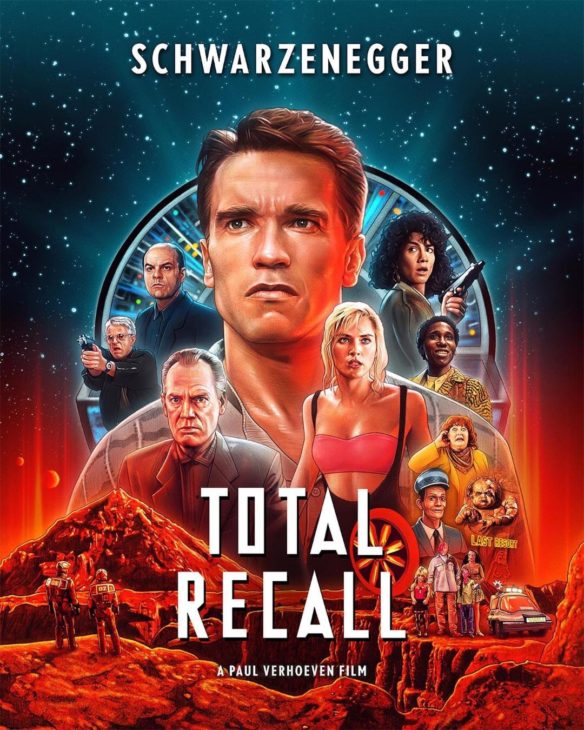
May 31, 1990 — Total Recall
By Paul Weimer: “Get your ass to Mars”.
Sure, I think as social satire The Running Man is probably better science fiction as a movie. But as a vehicle for 1980’s SF for Schwarzenegger that wasn’t Terminator, I think you can’t do better than one of my favorites, Total Recall. The excitement of a movie “based on a story by Philip K. Dick” (which I subsequently read and was confused by how little it actually had to do with it.)
But the movie is a corker from start to finish and so much of the movie is imprinted in my brain to this day. The movie’s insistence on keeping it very ambiguous, right to the end, if Quaid was dreaming or not , charmed me. I argued with my brother over this, who thought the “sweat drop” scene with Dr. Edgemar proved it was all real. I disagreed, and pointed out things like “Bluesky on Mars” being the name of his program, and how Melina resembled the woman programmed for his vacation. And if you listen to the commentary, Paul Verhoeven directed the movie with the point of view that it was all a dream, and Schwarzenegger acted with the point of view that it was reality. It makes for an interesting tension on screen and it works.
There are lots of little details that happen in the background. The change in geopolitical setup to a North-South Cold War. The Tokyo Samurai are trying to go for a fifth and deciding win in the World Series (so now the American Baseball leagues have teams in Japan…and the World Series is a best of nine affair). The movie is visually rich and generous like that, showing a lived in world that you can believe is real. Two worlds to be precise, both Earth and Mars. And the brutalist architecture pattern works for this authoritarian future.
And of course the movie is hideously violent. The body count is high.
The movie remains ever relevant with its critiques of colonialism, and authoritarianism. We are meant to side with the Free Mars movement, and maybe not until Cox’s Cohagen decides to kill everyone by asphyxiation does he really go from a tyrannical colonial figure who is vaguely understandable, to a true and undeniable monster that is irredeemable. But that steady revelation of just how horrible he can be starts with him looking sympathetic at first, and then unfurling his true nature and the extent of what he has done, and is willing to do. It’s a dive into authoritarian and colonialist mindsets, and in this day and age, even more relevant than ever.
And the movie follows through on the implications of its technology with the character beats. When Richter is told that Quaid/Hauser won’t remember anything, he just has to punch him hard, because of all what he’s put Richter through at this point. It’s a character beat that makes sense given the tech. And we have Chekov’s guns all over the place, which all fire, which propel us to the final confrontation. Sure, the “Ten second terraforming method of Mars” is bonkers and would not work. The movie doesn’t explain that there are more steps to the breathable atmosphere than melting the ice to get oxygen. I don’t care.
I read the novelization, done by Piers Anthony, because “I wanted to know more”. And I wish I hadn’t. I had not yet discovered how terrible Anthony was as a writer, but the novel’s insistence at each and every chance to say “yes this is real” over and over, was disappointing. Even at the end, when Quaid points out to Melina that she looks like the woman from Rekall, she casually says she used to do modeling for them. The book was determined to squash any ambiguity, and it was a major turn off. It did more solidly explain the terraforming, though and how it would work.
But the movie remains solid. Don’t bother with the remake. Watch the original. Don’t let me down, buddy, I’m counting on you.
(9) COMICS SECTION.
- Bizarro features a known killer.
- Brewster Rockit little suspects rover envy is real.
- Carpe Diem screens attendees of this event.
- Heart of the City looks for the right net.
- Off the Mark runs a test.
- Six Chix needs meaning.
- The Argyle Sweater is hiding out.
(10) CLASSIC, NOT DUD. Two Ars Technica writers are “Reassessing 1986’s SpaceCamp”.
…The loss of Challenger in January 1986—carrying educator Christa McAuliffe, who would have been the first private citizen in space—put the kibosh on all of that. The shuttle, while fantastically advanced, would never be the vehicle to help humankind slip all of our surly bonds, so to speak. Even operating at its most frantic peak in 1985 just before Challenger’s loss, the shuttle hardware managed a maximum of nine flights in one calendar year; for most of the 1990s, it performed at five or six flights per year. Civilians in space—to say nothing of Big Bird—would have to wait.
And into that post-Challenger disillusioned summer of 1986, Hollywood brought us SpaceCamp. It had all the right ingredients: A stacked cast with a solid leading duo (Kate Capshaw and Tom Skerritt), tons of real NASA location footage, and a big, brassy score by none other than John Williams. The film was completed before the Challenger disaster, leaving 20th Century Fox with something of a nightmarish choice on their hands—to shelve the film and lose millions, or send it to theaters and risk a PR disaster.
For better or for worse, Fox chose to release the film, which ultimately made about $9.6 million on a reported $25 million budget. Ouch. Audiences, it seemed, weren’t really interested in watching a bunch of kids in peril on a space shuttle. Today, on the rare occasions SpaceCamp comes up in film discussions at all—usually among geeks of a certain age who encountered it when they were younger—it’s often spoken of with derision. Kids! Robots! Thermal curtain failures! Preposterous!
But is it really a bad movie? It’s not currently available for streaming, but this is exactly the kind of scenario that physical media is made for. And so, with the movie’s 40th anniversary looming, Senior Space Editor Eric Berger and I [Lee Hutchinson] grabbed the DVD and watched our way through it—and this is what we thought….
Here’s an excerpt from their dialog:
Eric: What is striking to me is that, despite the movie’s poor timing, it has had a long shelf life. It only came out four years after the actual Space Camp opened in Huntsville, and I’ve spoken with more than one space enthusiast who watched the movie and then signed up for a week in Alabama. In its own way I think the film helped to fuel interest in the space program at a time, the late 1980s and 1990s, when quite frankly there was just not that much exciting happening in human spaceflight. The movie also correctly anticipates NASA having a large space station in orbit, called Daedalus, nearly a decade and a half before one exists. Man, I’ve got to tell you I could not get over the station’s truss design. There was so much metal for no apparent purpose, other than serving the plot I suppose.
(11) SPEAK FOR YOURSELF, CHATBOT. Mark Roth-Whitworth asks “What do you know about AI/chatbots, *really*?” The post transcribes several statements by different chatbots about themselves and their nature.
(12) CASTING CALL. [Item by Steven French.] Ben Child offers an interesting sliding door speculation in the Guardian’s “Week in Geek”: “Nicolas Cage as the Green Goblin? It will always be one of Hollywood’s great might-have-beens”.
There are numerous sliding doors moments in Hollywood that, had they actually happened, would have fractured the space-time continuum like a DeLorean hitting potholes at 88mph. Tom Selleck as Indiana Jones, Eric Stoltz as Marty McFly, Sean Connery as Gandalf, Bill Murray as a distinctly sardonic Batman. And yet, if there has ever been a more deliciously unhinged alternate timeline than Nicolas Cage as the Green Goblin/Norman Osborn in Sam Raimi’s Spider-Man from 2002, it has probably already been confiscated by the time police for crimes against narrative stability….
(13) SUPER SENSES. [Item by SF Concatenation’s Jonathan Cowie.] In SF we have as tropes out of the ordinary senses, be it spidey-sense, telepathy, precognition, etc. But in the real world there are unusual senses too, including how do birds navigate?
This is the topic for this week’s Science journal’s cover story…
How animals sense Earth’s magnetic field is one of biology’s enduring mysteries. Researchers have now identified superparamagnetic macrophages in the livers of rock pigeons (Columba livia) to be crucial for magnetic sensing. The finding uncovers an unexpected role for immune cells in sensory perception and may fundamentally change our understanding of animal navigation. See pages 919 and 985.

[Thanks to SF Concatenation’s Jonathan Cowie, Chris Barkley, Mark Roth-Whitworth, Joey Eschrich, Paul Weimer, Mike Allen, Kathy Sullivan, Steven French, Mike Kennedy, Andrew Porter, John King Tarpinian, and Cat Eldridge for some of these stories. Title credit belongs to File 770 contributing editor of the day Kevin Lighton.]