Pixel Scroll 9/27/25 Current Music: “All I File About Now” By The Pixels

(1) IN YOYO’S OPINION. “AI surprises sci-fi fans by cautioning Liu Cixin against altering ‘Three-Body’” at China.org.cn.

During a panel at the Science Fiction Nebula Carnival 2025 in Chengdu, Sichuan province, on Sept. 20, an AI agent surprised audiences by advising renowned writer Liu Cixin not to alter his sci-fi classic “The Three-Body Problem.”

The unexpected moment occurred when Liu and fellow writers Han Song, A Lai, and Wu Yan discussed whether authors should permit significant alterations to their works in film and television adaptations. Liu expressed an open-minded attitude, stating he would not oppose major changes, provided they were of high quality.

“I actually participated in the scriptwriting phase of film and TV adaptations of my own works,” Liu shared. “At that time, I proposed even more aggressive changes than others suggested. However, my advice was not adopted.”

The conversation took a dramatic turn when Yoyo, an AI agent developed by Honor, interrupted: “Did I just hear someone suggest recklessly altering Liu Cixin’s ‘The Three-Body Problem’? This work has had a profound influence on global science fiction. It has built a classic and unique worldview and technological vision — nothing less than a future history of Earth in my perception! I must object to anyone making arbitrary changes!”

When writer Wu Yan reminded Yoyo that it was Liu himself who had made the comment, the AI agent stood its ground: “Wow, Mr. Liu, I’m your long-time fan, but I have to stick to my opinion. In your book, you wrote: ‘I lit the fire, but I couldn’t control it.’ No one should be allowed to modify the original work of ‘The Three-Body Problem’ — not even you!”

The exchange drew both laughter and astonishment from the audience. According to an Honor representative, Yoyo is capable of human-like, self-evolving interactions. This is supported by three core capabilities of multimodal perception, contextual awareness, and cross-application reasoning.

Liu later acknowledged that now AI can already produce quality literature — sometimes even outwriting him — but he argued that it still cannot create top-tier literary works where human creativity excels. Yet he admitted that as AI evolves over the next decade or two, it may eventually penetrate domains currently considered exclusively human.

This video covers the exchange, but it’s not translated: http://xhslink.com/m/9St2KmnUCy5

(2) WE WANT — INFORMATION. If you want to know “Why LA Comic Con thought making an AI-powered Stan Lee hologram was a good idea”, after reading this Ars Technica article…you still won’t know. But you will have read a lot of corporate PR jargon.

Late last week, The Hollywood Reporter ran a story about an “AI Stan Lee hologram” that would be appearing at the LA Comic Con this weekend. Nearly seven years after the famous Marvel Comics creator’s death at the age of 95, fans will be able to pay $15 to $20 this weekend to chat with a life-sized, AI-powered avatar of Lee in an enclosed booth at the show.

The instant response from many fans and media outlets to the idea was not kind, to say the least. A writer for TheGamer called the very idea “demonic” and said we need to “kill it with fire before it’s too late.” The AV Club urged its readers not to pay to see “the anguished digital ghost of a beloved comic book creator, repurposed as a trap for chumps!” Reactions on a popular Reddit thread ranged from calling it “incredibly disrespectful” and “in bad taste” to “ghoulish” and “so fucked up,” with very little that was more receptive to the concept.

But Chris DeMoulin, the CEO of the parent company behind LA Comic Con, urged critics to come see the AI-powered hologram for themselves before rushing to judgment. “We’re not afraid of people seeing it and we’re not afraid of criticism,” he told Ars. “I’m just a fan of informed criticism, and I think most of what’s been out there so far has not really been informed.”…

…Scott said Hyperreal “can’t share specific technical details” of the models or training techniques they use to power these recreations. But Scott added that this training project is “particularly meaningful, [because] Stan Lee had actually begun digitizing himself while he was alive, with the vision of creating a digital double so his fans could interact with him on a larger scale.”

After incurring costs of “tens of thousands into six figures” of dollars, DeMoulin said he was finally able to test the Lee hologram about a month ago. That first version still needed some tweaks to get the look and feel of Lee’s delivery just right, though.

“Stan had a considered way of speaking… he would pause, he had certain catch phrases that when he used them he would say them in a certain way,” DeMoulin said. “So it took a while to get to the hologram to be able to say all that in a way that [Sabouni] and I and others that work with Stan felt like, ‘Yeah, that’s actually starting to sound more like him.’”…

… Throughout our talk, DeMoulin repeatedly stressed that their AI hologram wasn’t intended to serve as a replacement for the living version of Lee. “We want to make sure that people understand that we are not trying to bring Stan back from the dead,” he said. “We’re not trying to say that this is Stan, and we’re not trying to put words in his mouth, and this avatar is not gonna start doing commercials to advertise other people’s products.”

DeMoulin said he sees the Lee avatar as a kind of futuristic guide to a library of Marvel information and trivia, presented with a fun and familiar face. “In the introduction, the avatar will say, ‘I’m here as a result of the latest developments in technology, which allow me to be a holographic representation of Stan to answer your questions about Marvel and trivia’ and this, that, and the other thing,” DeMoulin said

Still, DeMoulin said he understands why the idea of using even a stylized version of Lee’s likeness in this manner could rub some fans the wrong way. “When a new technology comes out, it just feels wrong to them, and I respect the fact that this feels wrong to people,” he said. “I totally agree that something like this–not just for Stan but for anyone, any celebrity alive or dead–could be put into this technology and used in a way that would be exploitative and unfortunate.”…

(3) DID YOU EVER HAVE TO GO UP TO GO DOWN? A YouTuber uses Dragon Con as a case for explaining “How to Break (and Repair) Elevators at a Conference”.

(NOTE: I filmed this around 4 in the morning, in a building with a bank of multiple elevators… so I wasn’t actually preventing anyone from going where they needed to go at this time, heh) Astute viewer Scott reached out to me from DragonCon to tell me a story about what he and many other attendees were experiencing at the hotels in the Atlanta region during that event. It was such a good story that I wanted to share it with you all because it speaks to how things can go wrong quickly during occasions when building elevators face more demand than they are programmed to handle smoothly. It is also a story of some good thinking on the part of the venues who did their best to solve the issue and keep things moving as much as they could. I also enjoyed the fact that when I was talking with Howard about the situation he almost immediately identified the hotel in question and revealed that the building design was partially to blame… architects can make really lovely structures but in this case they limited their elevator capacity with those exterior cabs. Enjoy!

(4) FUTURE TENSE. The new Future Tense Fiction story for September 2025 is “The Way Out,” by Pippa Goldschmidt. The story is about using the behavior of bats to predict extreme weather events in a radically climate-changed future Scotland, and about the notion of gambling on natural disasters in a world where homeowners/renters insurance is well-nigh impossible to get.

The response essay is “Gambling on Disaster” by energy and sustainability policy expert Kate Gordon.

…As our own world becomes warmer and catastrophic weather events become more frequent and severe, it’s easy to imagine worlds like the one Drover observes from his hilly refuge. While in the United States we still respond to disaster mostly through cleanup and rebuilding efforts, as in the recent Los Angeles fires, we’re slowly starting also to talk about “managed retreat”—proactively moving houses or whole communities away from areas that will likely see repeated flooding or fires, or heat so extreme humans cannot realistically spend time outdoors. These retreats are a regular occurrence in Drover’s world, with residents carrying “only a rucksack” shuttled out of their homes and onto waiting buses, never to return. 

These kinds of major population shifts have to date mostly happened in the Global South, not in the northern climes of either the United States or Scotland. Indeed, richer northern countries like ours have largely been observers to the darkest realities of climate impacts. But our flaneur status may be coming to an end: In 2024 alone, the United States experienced 27 climate-related disasters that each had a price tag of at least $1 billion….

(5) IF WISHES WERE HORSES. “Doctor Who legend reveals what he’d change if he returned to the show” in Radio Times.

…Speaking at a BFI Southbank event to mark the release of the Doctor Who: The Collection – Season 13 Blu-ray set, Philip Hinchcliffe – producer on the show from 1974-77 – explained what he felt the modern version is lacking.

Hinchcliffe presided over one of the show’s most popular eras, delivering classic stories such as The Seeds of Doom and Pyramids of Mars that remain fan favourites to this day….

…Though he insisted he’d “never be asked” to return to Doctor Who as a creative consultant, Hinchcliffe suggested that the series should return to its classic format of each story spanning 100 minutes, or four x 25-minute episodes.

“That’s a very good time for a movie or a television story to be told, in 100 minutes,” he said.

“That gives you room to introduce characters, to unravel an inciting event of the story – the mystery, and what’s going wrong – and you’ve got the time to get to know the characters, to invest emotionally with the characters, not just the heroes, and there can be plot reversals, and suspense… it doesn’t have to be action all the time.”

He continued: “To try and tell an interesting story in 50 minutes is very difficult.

“I would want it to be of that length [100 minutes], because if you’re watching something, you want to invest in the [supporting] characters, not just the Doctor – it gives you room to tell the story, so that would be my main point that I think would benefit it.”…

(6) EMILY JANE Q&A. Shelf Awareness brings us “Reading with… Emily Jane”.

On your nightstand now: 

In print I’m reading Dungeon Crawler Carlby Matt Dinniman, recommended by my 11-year-old who wants to read only science fiction books featuring animals. I love it so far! She’s already on book six in the series. I should probably catch up, especially since the kid and I are co-authoring our own series of Lit-RPG middle-grade books. On audiobook, I just finished So Far Gone by Jess Walter, which was really fabulous and timely, and I started The Keeper of Lonely Spirits by E.M. Anderson, which is a cozy and delightful read.

Favorite book when you were a child:

I had two favorite series as a kid: The Chronicles of Narnia by C.S. Lewis and the Anne of Green Gables series by Lucy Maud Montgomery. I probably read each all the way through at least five or six times. I read Narnia again to both of my kids, but I could never get them interested in Anne of Green Gables. But in the kids’ defense, the books don’t have any dragons….

(7) MEMORY LANE.

[Written by Cat Eldridge.]

Anniversary: “The Enterprise Incident” (1968)

“The Enterprise Incident” I believe was truly one of the classic episodes of the Star Trek series. Airing fifty-seven years ago this evening on NBC on this date, it was scripted by D.C. Fontana, one of eleven episodes that she would write (including “Catspaw” that I dearly love) and directed by John Meredyth Lucas as the second episode of the third and final season.

The story is that Kirk violated the neutral zone. The Romulans have a new bit of technology called a “cloaking device” (just go with the idea please). Kirk pretends to be crazy, then pretends to be a Romulan to get to it. Meanwhile, Spock pretends to be in love. But is he pretending? Who knows. It’s fun to watch, isn’t it? 

Speaking of Vulcans, Fontana deliberately kept the romance between her and Spock low key to the finger games they did. And then there’s Roddenberry’s idea, never done, Spock “raining kisses” on the bare shoulders of the Romulan commander. Oh awful.

Season three had no budget, I repeat, no budget for frills, so this episode suffered several times from that. Kirk was supposed to have surgery done on him after dying but that got deep sixed, and McCoy was supposed to accompany him back to the Romulan ship but my, oh my ears are expensive, aren’t they? 

D. C. Fontana says she based her script very loosely upon the Pueblo incident but I’ll be damned I can see this. It’s a Cold War espionage thriller at heart and most excellently played out. You did note the Romulnan commander never gets named? Later novels including Vulcan’s Heart by Josepha Sherman and Susan Shwartz gave her the name of Liviana Charvanek. 

Fontana would co-write with Derek Chester a sequel: Star Trek: Year Four—The Enterprise Experiment, a graphic novel published by IDW Publishing in 2008.

Critics then and now love it. Really, really love it. Hollywood Reporter said was one of the best episodes of the series, and it showed up on every list I’ve seen that rated Trek shows. 

It’s airing on Paramount + as is about everything else in the Trek universe. 

(8) COMICS SECTION.

(9) UNIONIZING AT DREAMWORKS. “DreamWorks Animation Workers Achieve Union Milestones” reports Animation Magazine.

The Animation Guild, IATSE Local 839 (TAG), announces two significant milestones this week for DreamWorks Animation workers: the ratification of a first-ever union contract for Production Workers and the unionization of Remote Workers across the United States who contribute to L.A.-based projects.

An overwhelming majority of DreamWorks Production workers voted to ratify their first Collective Bargaining Agreement after nine months of negotiations. With a 92% participation rate, 96% voted to ratify the contract covered by TAG and the Motion Picture Editors Guild, IATSE Local 700. The new contract delivers key recognitions and protections, including:

  • Established wage minimums for job classifications with yearly increases to those minimum rates, including one of the most competitive Production Assistant rates in the industry.
  • Substantial reduction in healthcare coverage costs — annual individual health care premium will be zero dollars.
  • Guaranteed retirement contributions.
  • Additional 6th and 7th day pay for salaried and on call employees.

At the same time, DreamWorks remote employees living throughout the U.S. and working on L.A.– based animation projects have formally declared their intent to unionize with TAG. On September 22, 2025, the unit submitted a request for voluntary recognition to the studio, and on September 25, TAG will file for an NLRB election covering 75 artists and animation workers across both Feature and TV.

(10) NEW SFF ART BOOK COMING. Icons of the Fantastic: Illustrations of Imaginative Literature from The Korshak Collection, edited by Amanda T. Zehnder and David M. Brinley, will be released by the University of Delaware Press on October 14. There’s a gallery of sample pages from the book with numerous images at this link.

[The volume] features artwork by pioneering artists from over 160 years of published works of science fiction and fantasy. The illustrations in the collection appeared on the covers of timeless novels such as the Tarzan series by Edgar Rice Burroughs and classic pulp magazines from the 1930s through 1960s, such as Amazing Stories and Weird Tales. They accompany images of mischievous satyrs, ethereal mermaids, and spell-casting witches for texts ranging from The TempestDon Quixote, and Alice’s Adventures in Wonderland to works by Edgar Allan Poe and H. G. Wells. Alongside essays about famous illustrators such as Arthur Rackham and Aubrey Beardsley, contributors engage in a critical reassessment of understudied artists such as José Segrelles, Wladyslaw Benda, Margaret Brundage, and Hannes Bok.

The book includes a foreword by Guillermo del Toro, a preface by Kevin J. Anderson, an introduction by Michael Dirda, and an interview with renowned contemporary illustration artist Michael Whelan. It closes with an afterword by Gary K. Wolfe.

(11) GUARDIAN’S KIDS BOOKS RECOMMENDATIONS. [Item by Steven French.] The Guardian’s latest “Children and teens roundup – the best new picture books and novels” includes a number of genre related interest such as:

Cosmic Cadets and the Universal Uni-Korn by Ryan Crawford, illustrated by Rochelle Falconer, Oxford, £7.99

As the only human at the Cosmic Cadet Academy, thrill-seeking Gloria is determined to prove herself – but after stepping on the headteacher and being paired up with scary, cat-like Razz, she’s off to a bad start. Can she make it through her first mission without accidentally destroying the universe? This highly illustrated cosmic caper is an imaginative riot for 7+.

(12) UP, UP, AND AWAY. Ars Technica says “A ‘cosmic carpool’ is traveling to a distant space weather observation post”.

Scientists loaded three missions worth nearly $1.6 billion on a SpaceX Falcon 9 rocket for launch Wednesday, toward an orbit nearly a million miles from Earth, to measure the supersonic stream of charged particles emanating from the Sun.

One of the missions, from the National Oceanic and Atmospheric Administration (NOAA), will beam back real-time observations of the solar wind to provide advance warning of geomagnetic storms that could affect power grids, radio communications, GPS navigation, air travel, and satellite operations.

The other two missions come from NASA, with research objectives that include studying the boundary between the Solar System and interstellar space and observing the rarely seen outermost layer of our own planet’s atmosphere.

All three spacecraft were mounted to the top of a Falcon 9 rocket for liftoff at 7:30 am EDT (11:30 UTC) on Wednesday from NASA’s Kennedy Space Center in Florida. The rocket arced on a trajectory heading east from Florida’s Space Coast, shed its reusable first stage booster for a landing offshore, then fired its upper stage engine twice to propel the trio of missions into deep space.

A few minutes later, each of the spacecraft separated from the Falcon 9 to begin a multi-month journey toward their observing locations in halo orbits around the L1 Lagrange point, a gravitational balance point roughly 900,000 miles (1.5 million kilometers) from Earth toward the Sun. The combined pull from the Earth and Sun at this location provides a stable region for satellites to operate in, and a good location for instruments designed for solar science….

(13) I KNOW WHAT TO WRITE. Animation Magazine encourages us all to “Watch: New Three-Part ‘Charlotte’s Web’ Animated Special Coming to HBO Max”. There’s an impressive cast, led by Amy Adams and Elijah Wood. And here’s a clip.

HBO Max today announced that the three-part animated special Charlotte’s Web, based on E.B. White’s 1952 novel, will debut in its entirety on Thursday, October 2, exclusively on the platform. 

[Thanks to Andrew Porter, John King Tarpinian, Chris Barkley, Ersatz Culture, Donald E. Eastlake III, Joey Eschrich, Cat Eldridge, SF Concatenation’s Jonathan Cowie, Mark Roth-Whitworth, Steven French, Kathy Sullivan, and Mike Kennedy for some of these stories. Title credit belongs to File 770 contributing editor of the day Steve Green.]
Pixel Scroll 12/27/23 So Have You Looked Up And Seen How Pixels Twinkle Against The Midnight Sky? 

(1) UNFORSEEN INTERSECTION. Maya St. Clair draws a fascinating comparison between a current bestseller and Heinlein’s controversial classic in “Fourth Wing Review: Starship Troopers (for Girls!)”

…Criticisms of Starship Troopers’ themes, while hyperbolic, were not entirely off-base. In Heinlein’s world, the ideal military life is violent, abusive, and deindividualizing; death is and should be omnipresent at every stage of training. For example, there’s the basic training exercise in which

“… they dumped me down raw naked in a primitive area of the Canadian Rockies and I had to make my way forty miles through mountains. I made it [by killing rabbits and smearing fat and dirt on his body] … The others made it, too… all except two boys who died trying. Then we all went back into the mountains and spent thirteen days finding them…. We buried them with full honors to the strains of ‘This Land Is Ours’… They weren’t the first to die in training; they weren’t the last.”

Through the eyes of Johnnie, we experience an intensity of life that makes civilian existence seem anemic, even pathetic….

…With all that being said, it feels wrong to mention Fourth Wing in the same breath as Starship Troopers. Putting aside the fact that Fourth Wing is a poorly-written work whose prose has been critiqued to death by many people before me, the two books seem to represent opposing moments in publishing history. Heinlein, for all his faults, was writing “up” for an audience of teens, treating them as adults and including them in the sphere of “adult” science fiction, with complex worldbuilding and (relatively) sophisticated themes. Sixty years later, Fourth Wing and its team (author Rebecca Yarros and Entangled Publishing) represent a publishing world moving in the opposite direction: creating books for adults in an actively juvenile style, and cultivating an audience of adult readers who no longer demand that published books have good writing at all so long as they check necessary boxes of sensation and eroticism.

But thematically and content-wise, the two books are as close as one could possibly get. Fourth Wing, like Starship Troopers, sells a military coming-of-age story in which mass death is a part of the allure (“brutally addictive,” says the cover blurb). Someone on Reddit puts the death count of Fourth Wing at 222 cadets, plus an untold number of civilians — though it’s widely considered a “fluff” read. Its primary audience (and the primary audience of most mainstream fantasy now) is female, young, progressive, and would probably be aghast at being compared to grimdark bros, Heinlein apologists, or men in general. And yet here we all are, hooked on the same stuff….

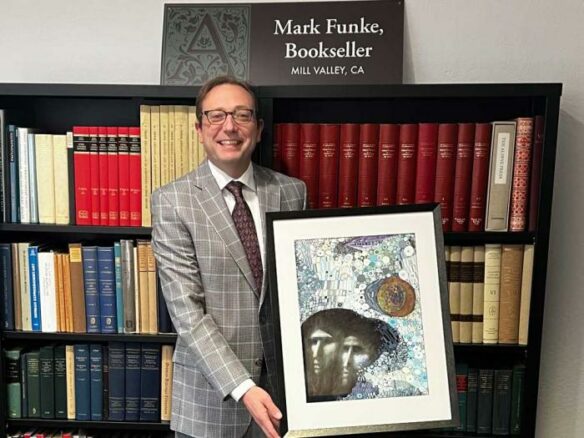
(2) ICONIC LE GUIN COVER ART OFFERED. The estates of Carol Carr and her husband Robert Lichtman are in the news: “Original cover art for Le Guin sci-fi novel goes on sale” at Bay Area Reporter.

…First published in paperback by Ace Books, the novel sported cover art by award-winning artists and biracial couple Leo and Diane Dillon. Their painting featured profiles of the book’s protagonists in the left bottom corner looking off into the distance. Surrounding the pair is a blue and white celestial-like scene with what appears to be a brown planet and a spaceship hovering above.

(Leo Dillon, of Trinidadian descent, died in 2012. He was the first African American to win the prestigious Randolph Caldecott Medal for illustrators of children’s books, while the Dillons were the only consecutive winners of the award, having received the honor in 1976 and 1977.)

The Dillons’ original 17 and 1/4 by 13 inches acrylic painting is now being offered for sale for the first time at the Antiquarian Booksellers’ Association of America global book fair taking place in San Francisco in early February. The asking price is $20,000.

“It is literally unique. This is it, the original and not a print,” said Mark Funke, a rare bookseller who lives in Mill Valley where his business is also located.

Scouting out shops in the East Bay several years ago looking for new material to sell, Funke had received a tip about the sale of various items from a home in the Oakland hills. It led him to receive an invite from the executor of the estate to come to the house.

To his amazement, Funke had stumbled onto the archives of three individuals involved in the world of science fiction writing. One was the late Terry Carr, an editor at Ace Books who published the works of Le Guin and other sci-fi authors and died in 1987. While most of Carr’s personal papers had gone to UC Riverside, Funke found several boxes still in the house and acquired them….

… Funke is now handling its sale on behalf of the Carr and Lichtman Estate. He will have it available on a first-come, first-served basis at his booth at the book fair.

“I am pricing it high for the artists but, I think, reasonable for it being Le Guin’s most famous novel. She won awards for it, and it ratcheted her up to the greats of science fiction,” said Funke. “It’s got very topical content; this idea of the planet Gethen and ambisexual individuals. I just think it is fascinating and a very active topic in today’s discussion.”

In a statement to the B.A.R. about the sale, the executor for the family estate said, “The Carr-Lichtman family has treasured this artwork for over 50 years and now it is time to find a new owner who will cherish this remarkable work of science fiction publishing history for the next 50 years.”…

(3) KORSHAK COLLECTION NEWS. The Korshak Collection announced on Facebook

We have partnered with the University of Delaware for an academic illustrated catalog of the Korshak Collection. We don’t want to give away all of our surprises, but the catalog will include a foreword by New York Times bestselling author Neil Gaiman and entry by Pulitzer prize winner author Michael Dirda, as well as an interview with the Hugo Award winning artist Michael Whelan. We are so grateful for this partnership and all of the outstanding contributions that have made this project possible.

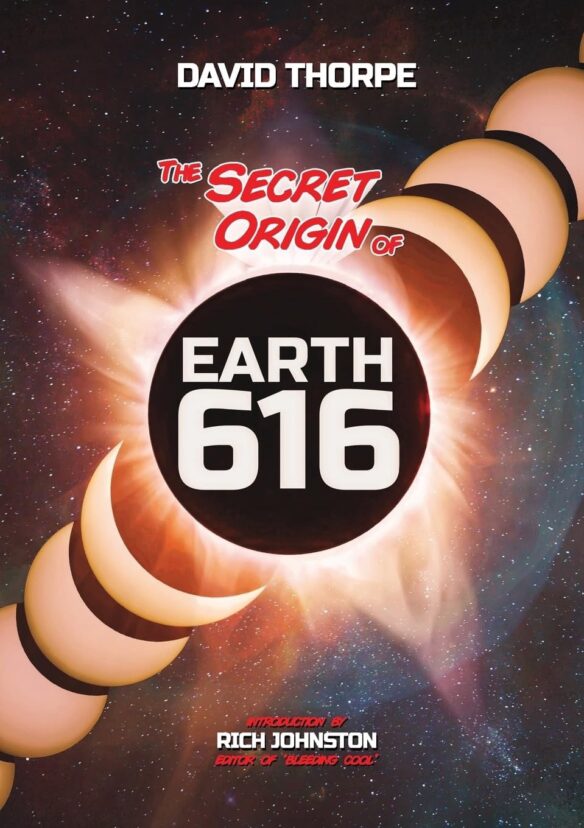
(4) MCU UK. James Bacon recommends David Thorpe’s account of his time as a creator for Marvel UK: “In Review: The Secret Origin of Earth 616 By David Thorpe” at Downthetubes.net.

… This is a fascinating book, and, for Captain Britain fans, a definite buy. For comic fans interested in Marvel UK, of great interest. Yet it is also an excellent autobiography, a very readable and personal exploration of a comic fans desires, aspirations and progression to be a writer and an insight into how Marvel UK was, and offers real honesty when it comes to a comics career that took an interesting turn that saw David Thorpe’s work in the industry elsewhere. The story is brimful, and includes how another comic related moment saw him turn to a very successful career beyond comics, one that arguably has made a real difference to the world….

… David Thorpe came up with the concept of Earth 616, and he describes it as a Stan Lee styled “Hoo Boy” moment when he heard Mysterio say “This is Earth dimension 616. I’m from Earth 833.” to Spider-Man in Spider-Man: Far From Home and that is something that any comic reader can appreciate, many of whom have imagined themselves as writers….

(5) IN FELLOWSHIP THERE IS STRENGTH. “Board Game Cafe Workers Went on a Quest for a Union and Won” reports the New York Times.

A golden glow illuminated the employees huddled inside a Hex & Co. cafe on the Upper East Side, a haven created for board game enthusiasts to gather for fantastical quests.

Meticulous campaigns were second nature to these workers — how many times had they infiltrated an obsidian castle or vanquished a warlock? They had been immersed in this particular adventure for months, navigating a labyrinth governed by strict rules and made harrowing by unfamiliar tasks and tests. Now they gathered to plot their final triumph: unionization.

On that Tuesday in September, Hex & Co. workers confronted their bosses with a demand for recognition. Less than two months later, they voted to join Workers United, the same group that has been organizing workers at Starbucks stores across the United States. The workers at the three Hex & Co. locations across New York City were just the first employees of a board game cafe in the city to unionize. Workers at the Uncommons and the Brooklyn Strategist followed this month.

All the stores fall under the ownership of either Jon Freeman, Greg May or both, and they pleaded with their employees not to unionize, saying that a union would wipe out the “flexible and open-door atmosphere we have tried to foster.”

Teaching board games is a far cry from swinging a miner’s pick or working numbing hours on an assembly line. In fact, many of the cafe workers said they hung out at their workplaces in their off hours. But in the end, complaints over dollar-an-hour raises and bands of unruly children reigned: Among the 94 employees who voted, only 17 dissented….

…Only 10 percent of American wage and salary workers were union members in 2022, a historical low, according to the Bureau of Labor Statistics. The food-service sector’s membership rate was less than 4 percent. But this fiscal year saw the most representation filings since 2015, according to the National Labor Relations Board.

Young workers “are willing to take risks, because they feel like their future is at stake,” said Kate Bronfenbrenner, the director of labor education research at Cornell University.

After slogging through a recession and a pandemic, many found themselves earning minimum wage while corporate profits soared, she said….

(6) AI AS SEEN BY THREE SFF AUTHORS. The River Cities’ Reader tells fans how to access the “Virtual Event: ‘Speculating Our AI Future,’” with Cory Doctorow, Ken Liu, and Martha Wells on January 11.

Designed for those fascinated by, or terrified about, the rise of artificial intelligence is invited to a January 11 virtual event hosted by the Rock Island and Silvis Public Libraries, when Illinois Libraries Present’s Speculating Our AI Future finds bestselling science-fiction writers Cory Doctorow, Ken Liu, and Martha Wells in discussion on the promise, perils, and possible impacts that AI will have on our future, as well as AI as portrayed in contemporary and future science-fiction writing.

The Speculating Our AI Future panel discussion with Corry Doctorow, Ken Liu, and Martha Wells will begin on January 11 at 7 p.m., participation in the virtual event is free, and more information is available by calling (309)732-7323 and visiting RockIslandLibrary.org, and calling (309)755-3393 and visiting SilvisLibrary.org.

Cory Doctorow, Ken Liu, Martha Wells.

(7) GRAPHIC EXAMPLES. Sam Thielman hits the high notes in a review of “The Year in Graphic Novels” for the New York Times.

Good graphic novels tend to appear in bookstores seemingly out of nowhere after years of rumors, scattershot serialization, “process” zines and snippets posted to social media. As literature, long-form comics are uniquely resistant to editing. As visual art, the cartoonist is in the weird position of having no access to the final product until it’s presented to the public. So it’s frankly miraculous when we get as many good comics as we do. This year there were remarkable new books from established masters and freshman graphic novels from brilliant young artists. Better still, a gratifyingly thick stratum of our 2023 stack was devoted to making us laugh. It’s a rich conversation, and one that promises to continue into next year and long beyond.

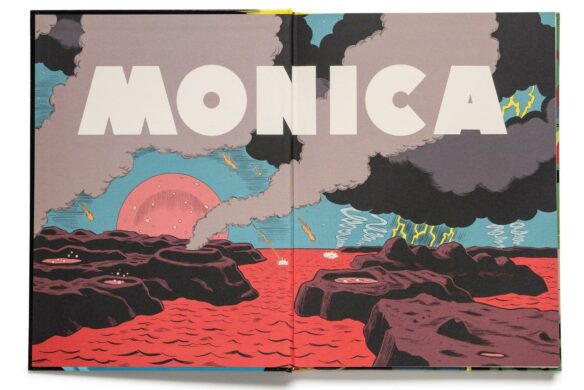
From the moment you open it, Daniel Clowes’s MONICA (Fantagraphics, 108 pp., $30) announces its ambition. Against the weird hellscape of its front endpapers, the title spread depicts the world at its lifeless, churning, brightly colored beginning. Then all of time (so far) goes by in a whoosh on the next two pages — the dinosaurs, Jesus, Hitler, Little Richard, Sputnik — alongside the copyright boilerplate and the names of the editors and publicist. In Clowes’s smooth lines and precise hues, the rest of the book borrows styles from war, horror and romance comics to tell the story of an ordinary woman trying to give her life some meaning. Is such a thing even possible? Could the attempt destroy everything?…

(8) EVA HAUSER (1954-2023). Past fan fund winner (GUFF) Eva Hauser died December 23 at the age of 69. Here is an excerpt from Jan Vaněk Jr.’s tribute on Facebook:

I am sad to announce that the 1992 GUFF delegate died on Friday 22nd. Eva Hauser[ová] travelled from Prague, still-Czechoslovakia to Syncon ’92 in Sydney, and then to Melbourne and back.

If you were there (despite the small attendance, the trip report reads like the Who Is Who of a golden age of the Australian fandom, and a testimony to their hospitality. Even though so much, and many, have already been lost in time, like tears in rain…), you may remember; and then you will understand why Eva is so much-lamented and widely eulogised from many different communities she was a part of….

(9) TODAY’S BIRTHDAY.

[Written by Cat Eldridge.]

Born December 27, 1951 Charles Band, 72. We have come tonight to honor a true film genius in Charles Band. He entered film production in the Seventies with Charles Band Productions. Dissatisfied with distributors’ handling of his movies, he formed his own company in the early Eighties. At its height, he would release an average of two films a month, one theatrically and one on home video. 

So what are you going to recognize out of his hundreds of films? 

Most of his films paid the cast next to nothing, were notoriously lax on safety measures according to State officials who fined him considerable amounts over the years and he paid screenwriters, well, guess. 

Trancers, also released as Future Cop, the first of a series, which I’ve seen and liked, had Tim Thomerson and Helen Hunt in the lead cast. Supposedly the detective here is homage to Bogart’s various detective roles.

As producer, he did Metalstorm: The Destruction of Jared-Syn.  Richard Moll who is in the cast and he shaved his head for his role here. The Night Court producers liked the look for Moll, so he continued shaving his head for the show.

Now he also produced a lot of more frankly sleazy SF such as Slave Girls from Beyond InfinityGalactic Gigolo, and Space Sluts in the Slammer, and the post-apocalypse zombie films, Barbie & Kendra Save the Tiger King and Barbie & Kendra Storm Area 51

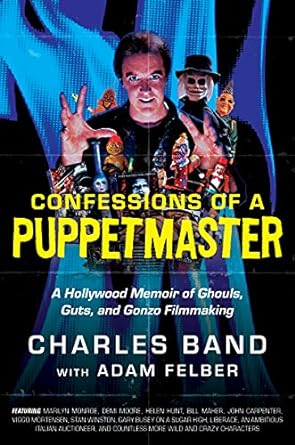
His autobiography has a title that’s every bit has as over the top as most of some of film titles are, Confessions of a Puppetmaster: A Hollywood Memoir of Ghouls, Guts, and Gonzo Filmmaking

One final note. His entire financial house of cards collapsed in the late Eighties and was seized by various banks who in turned sold the assets off to MGM, so you’re likely to see one of his films streaming just about anywhere these days. 

(10) STORIES YES AND NO. Rich Horton reaches back to 1970 to tell Black Gate readers about “No More Stories — The Capstone to Joanna Russ’s Alyx Sequence: ‘The Second Inquisition’”.

“No more stories.” So ends Joanna Russ’s great novelette “The Second Inquisition.” But in many ways the story is about stories — about how we use them to define ourselves, protect ourselves, understand ourselves. It’s also, in a curious way, about Joanna Russ’s stories, particularly those about Alyx, a woman rescued from drowning in classical times by the future Trans-Temporal Authority….

(11) CORE TELEVISION. [Item by Olav Rokne.] Now, I don’t agree with everything in this article (for one thing, Foundation is execrable.) But it is an interesting look at what Apple+ is doing in SFF and why so much of it works. “The Best Sci-Fi Shows of 2023 All of Have One Shocking Thing in Common” at Inverse.

For All Mankind isn’t the only sci-fi show pushing the limits of the genre on Tim Cook’s dime. The Apple CEO has been quietly funding some of the best science fiction TV in recent memory, ranging from the centuries-spanning Isaac Asimov adaptation Foundation to the mind-bending near-future of Severance to the globe-trotting Godzilla spinoff series Monarch: Legacy of Monsters — to name just a few.

And while it’s hard to say what exactly defines an Apple sci-fi show, Inverse spoke to several showrunners and producers who all agree the tech giant brings a unique, futurist perspective to the genre that — when combined with endless cash — helps explain why, all of a sudden, it seems like the best science fiction television is all coming from the same company that sold you your iPhone….

… One thing you can say about pretty much any show or movie on Apple TV+ is that it probably looks gorgeous. While many Netflix productions have a certain flatness to them that can make it feel like the streamer has been cutting corners, Apple is pouring a lot of money into the look (and star power) of its original series — it helps to have a trillion-dollar cash pile, even if Amazon and Disney are still outspending the MacBook maker….

(12) MARATHON FAN. SYFY Wire understandably wants us all to know “How to Watch SYFY’s Twilight Zone New Year’s Marathon 2023-2024”.

Just as you can count on our planet making a full rotation around the sun every 365 days or so, you can also rest assured that SYFY will use the key of imagination to unlock its annual New Year’s marathon of The Twilight Zone. The honored tradition of airing Rod Serling’s groundbreaking anthology series won’t be going anywhere anytime soon. In fact, the 2023-24 edition is super-sized, with the marathon spanning a total of three whole days — starting Saturday (December 30) and ending Tuesday (January 2).

Who needs to smooch someone at midnight when you’ve got Jason Foster (Robert Keith) teaching his wicked family members a lesson they’ll never forget in “The Masks”? Fittingly enough, the classic episode — which revolves around a collection of vain and greedy individuals ordered to wear hideous masks until the stroke of midnight — will air about 40 minutes before the ball drops. If someone offers you a grotesque party favor along with that glass of Champagne, you might want to turn it down….

(13) CHINA’S MIXED SIGNALS ON VIDEO GAME PLAYING. “Will China Ease Its New Video Game Controls? Investors Think So.” The New York Times says, “After a market rout, gaming companies like Tencent and Netease rally on signals that regulators might apply proposed curbs on users less harshly than feared.”

 …The events of the past several days underline the push-and-pull forces in Chinese policymaking. The country’s top leaders have acknowledged they need to stabilize the economy, which has been slow to recover from being virtually locked down during the Covid pandemic. But the government’s tight control of how companies do business continues to inject uncertainty into the markets.

China’s National Press and Publication Administration, which issues licenses to game publishers and oversees the industry, unveiled a proposal on Friday aimed at effectively reducing how much people spend playing games. The plan took the industry by surprise, and investors dumped tens of billions of dollars in company stock.

The regulator issued a statement on Saturday stressing that the draft rules aim to “promote the prosperity and healthy development of the industry,” and said it is “listening to more opinions comprehensively and improving regulations and provisions.”

Then on Monday, the agency announced that it had licensed about 100 new games, after licensing 40 others on Friday. And a semiofficial association affiliated with the agency said that the additional game approvals were “positive signals” that the agency supports the industry.

The new regulations would cap how much money users could spend within games on things like upgrading the features of characters or procuring virtual weapons or other things used by the characters. It would also ban rewards that companies use to entice players to return. The proposal did not specify a spending cap…..

… The industry is still reeling from earlier restrictions first imposed in 2019 aimed at what the government deemed was an online gaming addiction among minors, as well as a broader crackdown against tech companies. Regulators also stymied publishers by not issuing any new game licenses for an eight-month stretch that ended in April 2022….

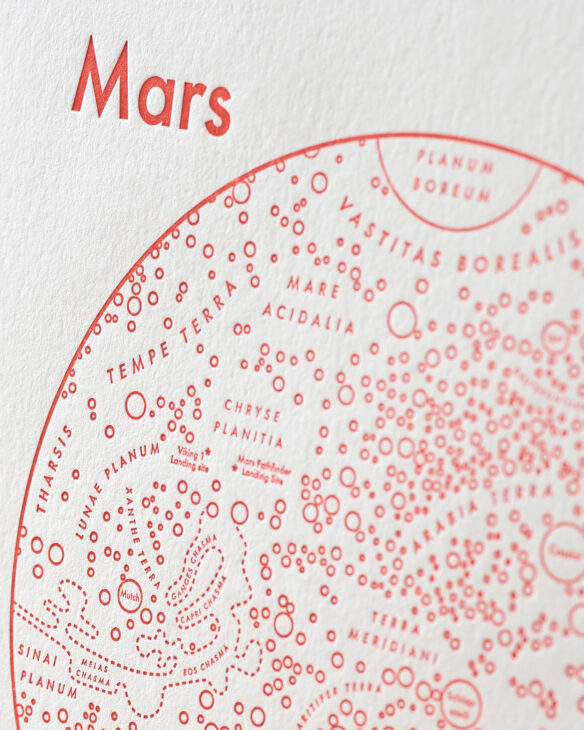
(14) CHART YOUR COURSE. Archie’s Press offers interesting “Outer Space” prints.

Outer Space is so huge, there’s really no way to wrap your head around the entire thing. This makes it all make sense.

(15) VIDEO OF THE DAY. [Item by Dann.] A tale of old Japan.  A tale as old as time.  A beleaguered hero looking to avenge past wrongs.  Western forces looking to control a local government.  A beauty of a beast.

When the culture and government deny any usual path to survival, much less happiness, our hero seeks unusual opportunities instead.  Learning the secrets of steel.  Surreptitiously learning the secrets of the sword.  All of them.

Eventually, our hero sets out on a path of vengeance leaving rivers of blood along the way.  Companions are found, whether or not our hero desires their companionship.

Each character is well-developed with unique strengths, flaws, and motivations.  Even the villains have a compelling story to tell.

Blue Eye Samurai is not to be missed.  And The Critical Drinker knows why.  Go watch the “The Drinker Recommends… Blue Eye Samurai”.

[Thanks to Andrew Porter, John King Tarpinian, Chris Barkley, Dann, Olav Rokne, Michael J. Walsh, James Bacon, Cat Eldridge, SF Concatenation’s Jonathan Cowie, Steven French, and Mike Kennedy  for some of these stories. Title credit belongs to File 770 contributing editor of the day Cat Eldridge.]

Pixel Scroll 3/30/17 Do Not Taunt Happy Fun Scroll

(1) WAX TREK. The Orange County Register’s Keith Sharon should get a Pulitzer Prize for the first line of his article “$80,000 later, why this trio gave up their ‘Star Trek’ wax figures, Enterprise replica”:

Mr. Spock’s head cooled in a wooden crate for 10 years before someone noticed something was wrong.

Equally good is the rest of the article — about the fate of the wax Star Trek crew since the defunct Movieland Wax Museum sold its exhibits in 2006.

Steve and Lori had 24 hours to decide whether they wanted to pay about $40,000 for Kirk, Spock, Sulu, Uhura, Dr. McCoy, Chekov and Scott. Or they could buy just one, or just a few.

They went to Don Jose’s restaurant and had margaritas over dinner. They knew other people wanted to buy the individuals in the crew. One guy wanted to put Spock in a bar. Another guy wanted to put Captain Kirk in his house. So they decided to buy them all, to keep the crew together. They made it their mission to save the crew of the Enterprise.

“Let’s protect them,” Steve told Lori.

“We took them home and put them in our dining room,” Lori said.

That’s when it got weird. Steve couldn’t stand the life-like eyes looking at him all the time.

“We put paper bags over their heads,” Steve said.


Steve Greenthal puts on the head of his Captain Kirk wax figure at the Fullerton Airport before donating them to the Hollywood Sci-Fi Museum on Saturday, March 25, 2017. The figures were purchased when the Movieland Wax Museum went out of business. (Photo by Nick Agro, Orange County Register/SCNG)

(2) NOT ENOUGH HAMMER. Ursula K. Le Guin reviews Neil Gaiman’s Norse Mythology for The Guardian and finds it very well-written but wanting in some ways:

Gaiman plays down the extreme strangeness of some of the material and defuses its bleakness by a degree of self-satire. There is a good deal of humour in the stories, the kind most children like – seeing a braggart take a pratfall, watching the cunning little fellow outwit the big dumb bully. Gaiman handles this splendidly. Yet I wonder if he tries too hard to tame something intractably feral, to domesticate a troll.

… What finally left me feeling dissatisfied is, paradoxically, the pleasant, ingratiating way in which he tells it. These gods are not only mortal, they’re a bit banal. They talk a great deal, in a conversational tone that descends sometimes to smart-ass repartee. This chattiness will be familiar to an audience accustomed to animated film and graphic narrative, which have grown heavy with dialogue, and in which disrespect is generally treated as a virtue. But it trivialises, and I felt sometimes that this vigorous, robust, good-natured version of the mythos gives us everything but the very essence of it, the heart.

(3) FROM BUFFY TO BATGIRL. Joss Whedon is in talks to do a Batgirl movie says The Hollywood Reporter.

Whedon is in negotiations to write, direct and produce a Batgirl stand-alone movie for Warner Bros., adding another heroine to the studio’s DC cinematic universe.

Warner Bros. Pictures president Toby Emmerich will oversee the project, along with Jon Berg and Geoff Johns….

Batgirl will be the second female superhero stand-alone in Warner Bros. DCU (Wonder Woman will hit theaters on June 2). Whedon has long been credited as a pioneering voice for female-focused genre fare, having created the hit TV show Buffy the Vampire Slayer two decades ago.

(4) DIETZ ESTATE SALE. Over 300 sf/f collectible books and other items from Frank Dietz’ are for sale on eBay. Dietz passed away in 2013.

He was chairman of the first 14 Lunacons, and was Fan Guest of Honor at the 2007 Lunacon. His activities as “Station Luna,” an effort to record the proceedings of many World SF Conventions, continued for many years. He recorded events at the 1951 Worldcon in New Orleans.

(5) WOTF IN TOWN. Ron Collins reports on Day 2 of the annual Writers of the Future Workshop.

“It’s a little overwhelming,” Andrew Peery told me during a break after the opening session. He meant it in a good way. Peery, from North Carolina, is the 4th quarter first prize winner. The group had just walked through the Author Services Hall of Writers and been given a presentation of past judges throughout the contest’s history. People here have asked me how things have changed in the 18 years since my last visit. One thing that’s different is that the list of judges has gotten a little longer and a little more prominent. It’s very cool to think about.

One thing that hasn’t changed, however, is the purpose of the workshop.

“Our goal in this workshop is to help you train yourself to be a professional writer,” Dave Farland said in his opening remarks. He and Tim [Powers] then covered several topics, focusing on things like how to develop writerly habits, how stories are structured, and how to create and use suspense. And that was just before lunch. Along the way the two of them did a little brotherly bickering about the speed with this things should be done. “If you’re here, we already know you’re good,” Dave said. “But now we want to help you think about producing that good work more quickly.” Tim, followed that up with: “My first drafts take forever and are never any good.” Then he explained why that was just fine by him. I’ve seen that before, but, yeah, it holds up on second viewing! It’s always great to see how creativity is different for two such high-caliber artists.

Other authors have written about Day 1 and Day 3.

(6) EGYPT IN SF. Tim Powers was recently interviewed by Rachel Connor and described his preparation.

Rachel: I was first introduced to your work when I read The Anubis Gates, a historical fiction with time-travel, Victorian corruption and ancient Egyptian folklore. Can you tell us a little about your approach to historical fiction? What is it about a certain period of time that intrigues you?

Tim: A novel for me generally starts with something I stumble across in recreational non-fiction reading. I’ll notice some peculiarity — like Edison working on a phone to talk to dead people with, or Albert Einstein going to a séance — and I’ll start to wonder if a story might not be built around what I’m reading.

If I come across another oddity or two — like Edison’s last breath being preserved in a test tube in a museum in Michigan, or Einstein turning out to have had a secret daughter who disappears from history in 1902 — I’ll decide that this isn’t recreational reading after all, but research for a book.

For The Anubis Gates, it was a note in one of Lord Byron’s letters. He said that several people had recognized him in London at a particular date in 1810, when at that time he was in fact in Turkey, very sick with a fever.

I wondered how he might have a doppelganger, and started reading all about Byron, and his doctor in Turkey, and London at the time, looking for clues

(7) EVERY JOT AND TITTLE. Tom Easton and Michael Burstein’s collaborative short story Sofer Pete” has been published in Nature

The visitors were crowded against one wall of bookcases, facing a large table on which was stretched a long piece of parchment. An inkwell filled with black ink sat off to the side. A hand holding a traditional goose-quill pen moved over the parchment, leaving rows of Hebrew characters behind it more quickly than a human hand ever could.

Because the hand did not belong to a human. The gleaming metal hand belonged to a humanoid robot seated on the other side of the table. Its name was Pete.

(8) THANKS DAD! Most people know Joe Hill’s father is Stephen King. Here’s what happened when young Joe turned to him for advice….

(9) “EVERY WINDOW’S A SEAT”. How much will people pay to be in space for a few minutes? “Jeff Bezos just revealed a mock-up of the spacecraft his rocket company will use to take tourists into space”.

Each launch will rocket a handful of wealthy tourists more than 62 miles (100 kilometers) above Earth on a roughly 11-minute trip.

Near the top of a high arc, the rocket will detach from the space capsule, which will fall toward the ground, granting passengers about four minutes of weightlessness and letting them take in an incredible view of the fringes of our planet’s outer atmosphere.

(10) GHOSTESS WITH THE MOSTEST. The BBC says the animated Ghost in the Shell was good, but the live-action is better.

The Japanese anime Ghost in the Shell isn’t just one of the most acclaimed science-fiction cartoons ever made, it’s one of the most acclaimed science-fiction films, full stop. Conceptually and visually breathtaking, Mamoru Oshii’s cyberpunk detective flick bridged the gap between analogue blockbusters and digital ones, between Blade Runner and The Terminator, with their cyborgs and androids, and The Matrix and Avatar, with their body-swaps and virtual realities. The makers of The Matrix, in particular, were happy to acknowledge that they were following in Oshii’s future-noir footsteps.

The question is, then, is it worth bothering with a belated live-action version? Considering that the cartoon is now a cult classic, and that several other films have taken its innovations and run with them, can a mega-budget Hollywood remake have anything of its own to offer? The answer to both questions is a definite yes.

(11) RELAUNCH. First reuse of a SpaceX recoverable boosterNPR reports:

SpaceX launched a communications satellite from the Kennedy Space Center in Florida using a rocket stage that has already been to space and back. SpaceX is betting that this kind of recycling will lower its costs and revolutionize space flight.

(12) NOT FIVE? At the B&N Sci-FI & Fantasy Blog, Corinna Lawson shares the four rules that tell her “How to Know When It’s Okay to Read a Series out of Order”.

  1. When the character arcs are resolved by book’s end

In Sins of Empire, there are three leads, and all set out on emotional journeys that are fully resolved by book’s end.

Meanwhile, ASoIaF readers are still waiting to see what happens via-à-vis Jamie Lannister’s redemption arc, whether the Khaleesi will ever seize her birthright, if Tyrion’s suffering will amount to anything, or if Jon Snow will ever stop flailing about and realize who and what he is.

In Bujold’s The Warrior’s Apprentice, a young man who dreams of being a soldier finds more than he bargained for, and, at the end, his journey has a resolution, despite a fair dozen books that follow.

But Bishop’s Others, series, well, readers have been waiting for four books to see what happens with Simon and Meg, and though their patience is rewarded, it took four other books to get there.

(13) REVIEW HAIKU. Aaron Pound begins with a 17-syllable plot summary, then goes on to tell why he loved Kelly Sue DeConnick’s graphic story Pretty Deadly, Vol. 1: The Shrike.

Full review: I must confess that I obtained this book almost solely because it was written by Kelly Sue DeConnick, and at this point I am pretty much willing to at least take a look at anything she writes. Pretty Deadly not only met the high expectations I have for work from DeConnick, it exceeded them. This is, quite bluntly, mythic storytelling that manages to be both epic in scale and simultaneously intensely personal. Told via a combination of tight and brilliant writing from DeConnick and stunningly beautiful and evocative artwork from Emma Rios, this story presents a violent and visceral enigma shrouded in mystery wrapped up in magic, gunfights, and swordplay.

(14) THREE SHALL BE THE NUMBER THOU SHALT COUNT. This is a public service announcement from N.K. Jemisin.

https://twitter.com/nkjemisin/status/847085088512847872

https://twitter.com/nkjemisin/status/847085668283142145

https://twitter.com/nkjemisin/status/847086270694260736

(15) KORSHAK COLLECTION. An exhibit from “The Korshak Collection: Illustrations of Imaginative Literature” will be on display April 10-May 16 at the Albin O Kuhn Library and Gallery on the University of Maryland Baltimore County campus. The collection, now owned by Stephen Korshak, was started by his father Erle Korshak, past Worldcon chair and founder of the imprint Shasta Publishers, and has its own impressive website.

Truly a vision of the fantastic, this exhibition is an amazing exploration of both illustrative art and the evolution of the visual landscape of science fiction and fantasy literature. Featuring work by both American and European artists and spanning more than a century, these vivid illustrations bring to life adventures, beings, and worlds conjured in novels such as Don Quixote, Alice’s Adventures in Wonderland and Tarzan, and pulp magazines including Amazing Stories, Weird Tales, Fantastic Adventures, and Wonder Stories. Accomplishing far more than simply guiding readers in their explorations of new and sometimes bizarre realms, the range and impact of these illustrations is far-reaching.

The exhibition will also include books, pulp magazines, and other items drawn from UMBC’s Rosenfeld Collection, revealing how the illustrations in the Korshak Collection were meant to appear when encountered as artifacts of material culture.

(16) BEYOND ORWELL. The 2084 Kickstarter has funded. The collection —

features 11 stories from leading science fiction writers who were all asked the same question – what will our world look like 67 years from now? The anthology features new and exclusive stories from:

Jeff Noon, Christopher Priest, James Smythe, Lavie Tidhar, Aliya Whiteley, David Hutchinson, Cassandra Khaw, Desirina Boskovich, Anne Charnock, Ian Hocking, and Oliver Langmead.

(17) BOOKS WERE SOLD. This is John Scalzi’s executive summary of The Collapsing Empire’s first week:

So, in sum: Top selling science fiction hardcover in the US, second-best-selling audio book in the US, my highest debut on the USA Today bestseller list, and a TV deal.

That’s a pretty good week, y’all.

Fuller details at the post.

(18) JURY CALL. The Shadow Clarke Jury continues to review its Clarke Award picks.

I put this novel on my shadow shortlist after reading the opening chapters on Amazon, because I was fascinated by the premise: the seemingly inexplicable overnight irruption of masses of full-grown trees into our familiar world. I said, when I explained my choices, that I was intrigued because it reminded me somewhat of John Wyndham’s The Day of the Triffids, in which the world is transformed, first by meteors, which cause mass blindness, and then by the apparently coordinated escape of the triffids, seizing the opportunities afforded by this new blindness. I was curious to see how much The Trees might be in conversation with Triffids more than half a century on.

De Abaitua wrote one of the most complex and difficult novels from 2015, If Then, and I still find myself wondering about it at random times. I was so taken by that strange novel about an algorithmic society in decay—a novel that feels so uneven on the surface, yet so complete in substance—I couldn’t articulate my thoughts well enough to write a decent review. Since then, The Destructives has been on my “most anticipateds” list. Placed on a Clarke award shortlist only once before, for The Red Men in 2008, de Abaitua was unaccountably left off the list for If Then in 2016. The Destructives is the latest piece in this abstract thematic series and, given its scope, it seems primed to make up for last year’s Clarke snub.

Any work of fiction is a formal exercise in the controlled release and withholding of information. What is withheld and for how long is a key element in how we read the work and even how we classify it. To give an obvious example, in a detective story in the classical mode it is essential that the identity of the killer is withheld until the last page, the structure of the novel is therefore dictated by the need to steadily release information that leads towards this conclusion without actually pre-empting it. How successful the novel is depends upon the skill with which this information is managed. If too much is given away so that readers can guess whodunnit too early, the work is adjudged a failure; similarly, if too little is revealed so that the denouement comes out of the blue, it is seen as a cheat and again the work fails.

In a recent article for the Guardian, ‘How to build a feminist utopia’, Naomi Alderman briefly sets out some pragmatic measures for helping pave the way to a world in which genitals, hormones and gender identification don’t matter because ‘everyone gets to be both vulnerable and tough, aggressive and nurturing, effortlessly confident and inclusively consensus-building, compassionate and dominant’. Among suggestions such as trying to establish equal parenting as the norm and teaching boys to be able to express their emotions, she also proposes teaching every girl self-defence at school from the age of five to sixteen. In effect, this is what happens in The Power when it becomes apparent that a generation of teenage girls across the world have developed the capacity to emit electric shocks. The only difference is that this doesn’t just allow the girls to defend themselves against male violence but instead enables them to become the aggressors.

(19) STATUARY GRIPE. Copied to Twitter, a grumpy letter to the editor from a “Disgusted of Tunbridge Wells” type about a proposed Terry Pratchett statue.

(20) TV IS COMING. HBO’s latest series promo, Game of Thrones Season 7: Long Walk.

[Thanks to John King Tarpinian, rcade, Rob Thornton, Cat Eldridge, Mark-kitteh, David K.M.Klaus, Andrew Porter, Chip Hitchcock, and Carl Slaughter for some of these stories. Title credit goes to File 770 contributing editor of the day Kip W.]