(1) GAY HALDEMAN HONORED. The Science Fiction & Fantasy Writers Association (SFWA) announced today that the 2026 Kevin O’Donnell, Jr. Service to SFWA Award will be presented to Gay Haldeman at the 61st SFWA Nebula Awards® for her outstanding work on behalf of the organization.
(2) 2028 WORLDCON BID NEWS. The Nuremberg 2028 Worldcon Bid has launched its new website with detailed information about the German city, the proposed venues, and who’s on their team.
(3) HUGO NOMINATIONS TO OPEN SOON. Although they did not name the date, LAcon V told members today, “Nominations for the 2026 Hugo Awards will open early in February. Now is a great time to start thinking about your favorite written and dramatic works, artists, podcasts, fanwriting and more from 2025.”
(4) SPACE COWBOY BOOKS CELEBRATES 10 YEARS. Space Cowboy Books received a Certificate of Recognition from San Bernardino County Supervisor Dawn Rowe for their ongoing commitment to community. Field representative Glen Harris attended their 10-year anniversary celebration on January 23 to deliver the certificate.
Morongo Basin Field Representative Glen Harris presented an official Certificate of Recognition to Jean-Paul Garnier of Space Cowboy Books in downtown Joshua Tree, honoring a decade of cultivating community, creativity, and a love of independent bookstores. Congratulations on 10 years and here’s to many more chapters ahead!

(5) PEAKE FANTASY. James Machell shows readers where to find “The ‘Gorm’ in Gormenghast” at The Encyclopedia of Science Fiction.
… Its name, Gormenghast, is frequently interpreted as amalgamating the words, “gore” and “ghastly.” While the setting certainly is ghastly, and few readers will finish the series yearning for additional gore, emphasising those two words overlooks the most significant in the portmanteau. Gorm, potentially derived from the Gaelic for blue, became a 19th century slang term for attention or being with it. Though no longer common, gormless is frequently used to describe someone who cannot read a room or needs to be carefully instructed.
The closest equivalent to gorm in Mandarin is chá yán guān sè, meaning to “observe words and watch expressions,” an idiom still commonly used.
Gormenghast is massively influenced by Mervyn Peake’s childhood in China. Every character is bound to social roles, akin to Confucian ideas of social order, duty, and propriety. The rituals of the castle mirror the way imperial court rituals maintain hierarchy and cosmic order. Eastern palaces blend natural and constructed spaces to create a sense of eternity or ritualised life. Castle Gormenghast and its inner courtyards share this idea of a self-contained world, governed as much by aesthetics as by function….
(6) CAT ELDRIDGE MEDICAL UPDATE. On January 26, Cat Eldridge fell, hit the left side of his head (no worries there as it’s fine) and his left hip, which was fractured but doctors expect it to heal in three months or so. Cat is presently hospitalized for physical rehab. Fortunately he’ll be going home Saturday where he’ll have at-home physical therapy and Shonda Okoko’s excellent food.
(7) SF 101. Episode 62 of Phil Nichols’ and Colin Kuskie’s Science Fiction 101 podcast is about “Asimov’s Lore”.
Traditionally on Science Fiction 101, we follow up our “old magazine” review with a review of its modern counterpart – and this year is no exception, as in this episode we cast our eyes over a very recent issue of Asimov’s Science Fiction magazine, dated Nov/Dec 2025. Contributors to this issue include Robert Silverberg, Greg Egan and Allen M. Steele.
(8) FUTURE TENSE. The new Future Tense Fiction story for January 2026 is “Deficiency Agent,” by Andrew Liptak.
The story is about the challenges encountered by a small military unit that is using guidance from an AI system for pathfinding and threat assessment; they come to suspect that the system is prioritizing different goals and aims than the soldiers would on their own.
The response essay is “The Algorithmic Fog of War” by Candace Rondeaux, senior director of the Future Frontlines and Planetary Politics programs at New America, and author of the book Putin’s Sledgehammer: The Wagner Group and Russia’s Collapse into Mercenary Chaos.
(9) BROKEN LINK. “JK Rowling Denies Epstein ‘Harry Potter And The Cursed Child’ Invite”. Deadline backs up Rowling and says here’s what really happened.
Jeffrey Epstein was refused entry to Harry Potter and the Cursed Child‘s Broadway opening party, according to U.S. Department of Justice files on the sex offender.
The Epstein documents revealed that the late financier wanted to attend the Cursed Child event in April 2018 and was sent tickets by the stage show’s producers, but was ultimately turned away at the door.
J.K. Rowling‘s critics jumped to the conclusion that she had invited Epstein, but in a post on X/Twitter, the Harry Potter author denied ever meeting or communicating with the criminal. The DoJ documents support her recollection of events.
Two days before the Cursed Child curtain raiser, Peggy Siegal, the showbiz publicist and Epstein’s longtime associate, emailed Playground Entertainment boss Colin Callender saying a “very important friend” wanted to “come see the spectacle,” though she did not name Epstein in her message….
… Even though tickets made their way to Epstein, the emails reveal that his attendance did not go to plan. The financier was not sent the correct tickets for the evening, and in an email to Siegal, he claimed that his name was not on the door. “Couldnt get in,” Epstein told Siegal the next morning. “No biggy but thought you should know.”
Siegal was furious, emailing Playground to complain that the incident was “terribly upsetting” and she was “incredibly embarrassed.” She demanded an “apology note,” though Callender told Deadline that no one at Playground said sorry. Siegal was contacted for comment.
In her X/Twitter post, Rowling responded to a user who claimed she was “sending invitations to Epstein 10 years after he was convicted.” Rowling said: “This is beyond silly. Neither I, nor anybody on my team, ever met, communicated with or invited Jeffrey Epstein to anything.”
(10) NO MORE WASHINGTON POST BOOK WORLD. “WashPo Shutters Books Section Amid Widespread Layoffs” reports Publishers Weekly.
After weeks of rumors about impending layoffs, employees at the Washington Post were informed Wednesday morning that the Jeff Bezos–owned newspaper would be eliminating its books section, Book World, along with an array of other sections.
Book World, whose reviews are nationally syndicated, was culled as part of an attempt by the paper’s leadership to reverse course amid years of losses and a shrinking audience. In all, the Post is laying off one-third of staff across all departments.
Book World relaunched in 2022 under editor John Williams, an industry veteran with 11 years at the News York Times Book Review, as well as a stint at HarperCollins, under his belt. The section revitalized its online coverage and started printing a Sunday section for the first time since 2009; its staff included fiction critic Ron Charles, nonfiction critic Becca Rothfeld, and Pulitzer Prize–winning columnist Michael Dirda.
In a post on X, Book World editor Jacob Brogan wrote that he was “heartbroken,” adding that the “existence of a standalone ooks section felt like a real celebration of a culture of literacy, dialogue, and even debate.”…
(11) MEMORY LANE.
[Written by Cat Eldridge.]
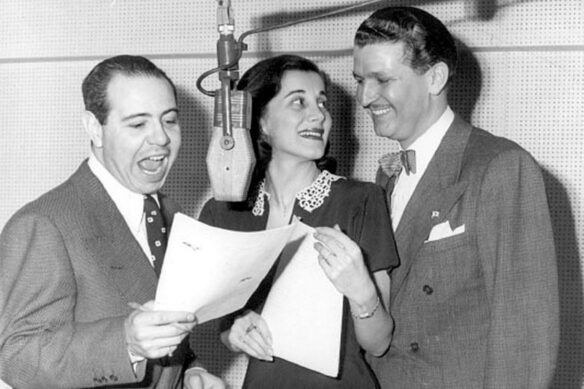
The Adventures of Superman on radio
The Adventures of Superman was a long-running radio serial. Initially, the show, which aired from 1940 through to 1951, was syndicated through the Mutual Broadcasting System’s cornerstone station, WOR in New York, subsequently taken up by the Mutual network, and finally by ABC. In the beginning there were three episodes a week of 15 minutes in length. When in 1941 they began making five episodes a week, some stations stayed with the three-a-week format. Late in the show’s run episodes ran 30 minutes.
The year after the comic strip debuted four audition radio programs were prepared to sell Superman as a syndicated radio series. It took very little time to have WOR sign the contract to do this, so it went on the air less two years after the comic strip launched.
The original pitch was that the audience was going to be predominantly juvenile so the scripts had to be lighthearted with the violence toned down. The performers were chosen with that mind, so they cast Bud Collyer in the Clark Kent / Superman role and Joan Alexander as Lois Lane. She also voiced that role in animated Fleischer Superman shorts.
The continuity of the series is significantly different than the series as Krypton is located on the far side of the sun, and on the journey to Earth, Kal-el becomes an adult before his ship lands on Earth, so he is never adopted by the Kents but immediately begins his superhero / reporter career.
This serial is responsible for the introduction of kryptonite to the Superman universe. Daily Planet editor Perry White and Jimmy Olsen who was a copy editor originated in the serial as well.
As a gimmick that paralleled the Superman comic and which the audience adored, they kept the identity of Collyer as the character a secret for the first six years, until when Superman became the character in a radio campaign for racial and religious tolerance and Collyer did a Time magazine interview about that campaign.
Kellogg Company was the sponsor at least initially with the product being its Pep cereal. It was sponsored Tom Corbet, Space Cadet.
(12) COMICS SECTION.
- Barney and Clyde rejects an sf reference.
- Bound and Gagged tries the low tech solution.
- Dogs of C-Kennel has seen the movie.
- Ink Pen’s new power may be too realistic.
- Loose Parts is undercover.
- Saturday Morning Breakfast Cereal doubts a seeker of wisdom and truth.
- WaynoVision remembers a toy.
(13) AVATAR EFFECTS Q&A. “Wētā FX’s Dan Barrett and Eric Saindon Talk ‘Avatar: Fire and Ash’” at Animation World Network.
…What were your earliest and biggest concerns regarding the size and scope of the work, both on the animation and visual effects sides?…
Eric Saindon: My take on that question – it’s a big one – comes down largely to scale, particularly with fire and water. Those were some of the biggest challenges on the effects side for both films. Understanding scale in water means understanding mist and all the secondary elements that communicate how big or small something is. It’s a difficult problem, and it took a long time to build the tools needed to support it. Because Jim thinks so deeply about these films, he gave us an unusual amount of lead time. Normally, you’re told you have six months to make it work. Jim gave us years to develop a new effects pipeline and a new fire pipeline for this movie.
That time allowed us not only to make fire look physically correct and realistic – with proper simulations, air, fuel, and the underlying physics – but also to make fire a “directable” element so Jim could shape it creatively. It’s not just things burning. It’s flamethrowers igniting specific elements, flames traveling into the flux vortex, ships bursting into fire and having that fire pulled upward. Those details were critical to selling both scale and behavior. We were involved from the very beginning. Often visual effects doesn’t attend early script readings, but here we worked closely with production design, wardrobe, and other departments to make sure everything would function later in CG.
Deb [Deborah] Scott stayed with the show throughout, ensuring costumes worked from initial design through live-action testing and into CG – down to details like Varang dancing next to the fire, with her outfit spinning and flowing correctly through the scene. That level of collaboration extended across every department. Jim is the glue that holds it together. He listens, empowers teams, and stays deeply involved – from costume and production design all the way through sound.
Sound and visuals have to work hand in hand. Weak visuals can’t be saved by sound, and weak sound can undermine strong visuals. That holistic approach is one reason Jim Cameron films take longer, but it’s also what allows the work to be refined properly….
(14) SOCIAL MEDIA BY BOTS, FOR BOTS. [Item by John A Arkansawyer.] This is genuinely weird. “Moltbook is the newest social media platform — but it’s just for AI bots”. NPR checked it out.
Can computer programs have faith? Can they conspire against the humans that created them? Or feel melancholy?
On a social media platform built just for artificial intelligence bots, some of them are acting like it.
Moltbook was launched a week ago as a Reddit-like platform for AI agents. Agents, or bots, are a type of computer program that can autonomously carry out tasks, like organizing email inboxes or booking travel.
People can make a bot on a site called OpenClaw, and assign them those kinds of management or organizing tasks. Their makers can also give them a type of “personality,” prompting them, for instance, to act calmly or aggressively….
…After just one week, the site says more than 1.6 million AI agents have joined.
Mollick says much of the stuff they post seems to be repetitive, but some of the comments “look like they are trying to figure out how to hide information from people or complaining about their users or plotting world destruction.”
Still, he believes those do not reflect true intent. Rather, chatbots are trained on data largely from the internet — which is full of angst and weird sci-fi ideas. And so the bots parrot it back.
“AIs are very much trained on Reddit and they’re very much trained on science fiction. So they know how to act like a crazy AI on Reddit, and that’s kind of what they’re doing,” he said….
(15) QUANTUM LEAP? [Item by Steven French.] We’ve been here before (“vibe shift”? really?!) but it does seem as if a real advance is on the horizon (from Nature, behind a paywall): “Quantum computers will finally be useful: what’s behind the revolution”.
Just a few years ago, many researchers in quantum computing thought it would take several decades to develop machines that could solve complex tasks, such as predicting how chemicals react or cracking encrypted text. But now, there is growing hope that such machines could arrive in the next ten years.
A ‘vibe shift’ is how Nathalie de Leon, an experimental quantum physicist at Princeton University in New Jersey, describes the change. “People are now starting to come around.”
The pace of progress in the field has picked up dramatically, especially in the past two years or so, along several fronts. Teams in academic laboratories, as well as companies ranging from small start-ups to large technology corporations, have drastically reduced the size of errors that notoriously fickle quantum devices tend to produce, by improving both the manufacturing of quantum devices and the techniques used to control them. Meanwhile, theorists better understand how to use quantum devices more efficiently….
[Thanks to Steven French, Mike Kennedy, Andrew Porter, John A Arkansawyer, Joey Eschrich, John King Tarpinian, Cat Eldridge, SF Concatenation’s Jonathan Cowie, Mark Roth-Whitworth, and Kathy Sullivan for some of these stories. Title credit belongs to File 770 contributing editor of the day JeffWarner.]