Hungarian author László Krasznahorkai has won the Nobel Prize in Literature 2025 “for his compelling and visionary oeuvre that, in the midst of apocalyptic terror, reaffirms the power of art”.
A discussion of the author’s bibliography by Anders Olsson, Chair of the Nobel Committee, indicates many of his books have fantastic elements, and some are of genre interest.
The author László Krasznahorkai was born in 1954 in the small town of Gyula in southeast Hungary, near the Romanian border. A similar remote rural area is the scene of Krasznahorkai’s first novel Sátántangó, published in 1985 (Satantango, 2012), which was a literary sensation in Hungary and the author’s breakthrough work. The novel portrays, in powerfully suggestive terms, a destitute group of residents on an abandoned collective farm in the Hungarian countryside just before the fall of communism. Silence and anticipation reign, until the charismatic Irimiás and his crony Petrina, who were believed by all to be dead, suddenly appear on the scene. To the waiting residents, they seem as messengers either of hope or of the last judgement. The satanic element referred to in the title of the book is present in their slave morality and in the pretences of the trickster Irimiás which, effective as they are deceitful, leave almost all of them tied up in knots. Everyone in the novel is waiting for a miracle to happen, a hope that is from the very outset punctured by the book’s introductory Kafka motto: ‘In that case, I’ll miss the thing by waiting for it.’ The novel was made into a highly original 1994 film in collaboration with the director Béla Tarr.
The American critic Susan Sontag soon crowned Krasznahorkai contemporary literature’s ‘master of the apocalypse’, a judgement she arrived at after having read the author’s second book Az ellenállás melankóliája (1989; The Melancholy of Resistance, 1998). Here, in a feverish horror fantasy played out in a small Hungarian town nestled in a Carpathian valley, the drama has been heightened even further. From the very first page, we – together with the charmless Mrs Pflaum – find ourselves entering a dizzying state of emergency. Ominous signs abound. Crucial to the dramatic sequence of events is the arrival in the city of a ghostly circus, whose main attraction is the carcass of a giant whale. This mysterious and menacing spectacle sets extreme forces in motion, prompting the spread of both violence and vandalism. Meanwhile, the inability of the military to prevent anarchy creates the possibility of a dictatorial coup. Employing dreamlike scenes and grotesque characterisations, László Krasznahorkai masterfully portrays the brutal struggle between order and disorder. None may escape the effects of terror.
In the novel Háború és háború (1999; War & War, 2006) Krasznahorkai shifts his attention beyond the borders of his Hungarian homeland in allowing the humble archivist Korin to decide, as his life’s final act, to travel from the outskirts of Budapest to New York such that he might, for a moment, take his place at the centre of the world. Back home in the archives, he has found an exceptionally beautiful ancient epic about returning warriors that he hopes to make known to the world. Krasznahorkai’s prose has developed towards the flowing syntax with long, winding sentences devoid of full stops that has become his signature.
War & War, in its rolling picaresque, anticipates the great novel Báró Wenckheim hazatér (2016; Baron Wenckheim’s Homecoming, 2019), although on this occasion the focus is on returning to the homeland, as Krasznahorkai plays lavishly with literary tradition. Here, Dostoyevsky’s idiot is reincarnated in the hopelessly infatuated baron with his gambling addiction. Now ruined, he is on his way home to Hungary having spent many years living in exile in Argentina. He hopes to be reunited with his childhood sweetheart, whom he is unable to forget. Unhappily, in the course of his journey, he places his life in the hands of the treacherous Dante, a rascal presented as a grimy version of Sancho Panza. The climax of the novel, which is in many ways its comic highlight, is the joyful reception laid on for the baron by the local community, which the melancholic protagonist seeks at any cost to avoid.
A fifth work can be added to these ‘apocalyptic’ epics: Herscht 07769: Florian Herscht Bach- regénye (2021; Herscht 07769: A Novel, 2024). Here, we find ourselves in not a feverish nightmare in the Carpathians but rather a credible portrayal of a contemporary small town in Thüringen, Germany, which is nevertheless also afflicted by social anarchy, murder and arson. At the same time, the terror of the novel plays out against the backdrop of Johann Sebastian Bach’s powerful legacy. It is a book, written in a single breath, about violence and beauty ‘impossibly’ conjoined.
Herscht 07769 has been described as a great contemporary German novel, on account of its accuracy in portraying the country’s social unrest. In equal measure, the main protagonist Herscht is the very archetype of a credulous, big-hearted child, a holy fool in the spirit of Dostoyevsky, who reacts strongly once he realises that he, like Voluska in The Melancholy of Resistance, has placed his trust in exactly those powers that lie behind the ravages in the town. With Krasznahorkai, there is always room for the unpredictable, as is fully demonstrated in the novel’s dénouement.
László Krasznahorkai is a great epic writer in the Central European tradition that extends through Kafka to Thomas Bernhard, and is characterised by absurdism and grotesque excess. But there are more strings to his bow, and he soon looks to the East in adopting a more contemplative, finely calibrated tone. The result is a string of works inspired by the deep-seated impressions left by his journeys to China and Japan. About the search for a secret garden, his 2003 novel Északról hegy, Délről tó, Nyugatról utak, Keletről folyó (A Mountain to the North, a Lake to the South, Paths to the West, a River to the East, 2022) is a mysterious tale with powerful lyrical sections that takes place southeast of Kyoto. The work has the sense of a prelude to the rich Seiobo járt odalent (2008; Seiobo There Below, 2013), a collection of seventeen stories arranged in a Fibonacci sequence about the role of beauty and artistic creation in a world of blindness and impermanence. Alongside his quintet of epics, it represents Krasznahorkai’s major work. Particularly unforgettable is its opening scene in which a snow-white heron stands motionless in the middle of the River Kamo in Kyoto, waiting for its victim in the whirlpools below. Invisible to the masses of people passing by, the bird becomes an elusive image of the particular situation of the artist.
The common thread running through the book is the Japanese myth concerning Seiobo, who according to legend protects the garden which, every three thousand years, produces fruit that grants immortality. In the book, the myth is about the creation of a work of art and, in a string of episodes, we follow the genesis of such a work in the most diverse of times and environments. Often the act of creation occurs after a lengthy period of preparation marked by tradition and practiced craftsmanship. Works may also come about as a result of delayed or confused circumstances, as in the story of the perilous transport of an unfinished painting by the renowned Renaissance artist Pietro Vannucci from Florence to Perugia, the city of the latter’s birth. While everyone believes that Perugino, as he is commonly known, has given up painting, it is in Perugia that a miracle takes place.
The artist himself is, as so often in Seiobo There Below, absent from these stories. Instead, we are presented with figures that stand slightly to one side of the work that is soon to come into being. These might include janitors, onlookers or devoted craftsmen, who rarely or indeed never comprehend the meaning of the work in which they participate. The book is a masterful portrayal, in the course of which the reader is led through a row of ‘side doors’ to the inexplicable act of creation.
Another captivating work that showcases László Krasznahorkai’s breadth and literary register is the shorter story Aprómunka egy palotáért: bejárás mások őrületébe (Spadework for a Palace: Entering the Madness of Others, 2020) published in 2018. This extremely entertaining and rather madcap tale takes place in a Manhattan haunted by the ghosts of the great Herman Melville, who once lived there, and his fanatic admirers. It is a book about not only the curse of imitation but also the blessing of resistance. It may or may not be melancholy.
…Krasznahorkai isn’t comfortable being cast as a social or political prognosticator. He has said he’s never felt at ease discussing his work, and doesn’t see himself as “part of literary life.”
“Writing, for me, is a totally private act,” he told The Paris Review. “I’m ashamed to speak about my literature — it’s the same as if you were to ask me about my most private secrets.”
[Based on a press release. Thanks to Chris M. Barkley for the story.]
“Bob Bentovoja ‘Marineland Carnival: The Munsters Visit Marineland’” LA Herald-Examiner TV Guide Cover Illustration (1966).“Oh, Eddie, look at the porpoise. Now that’s what I call an ideal house pet.” This prime-time CBS travelogue special aired for a single time between the first and second season of “The Munsters.” In this color TV movie America’s favorite frightening family visits the popular oceanarium, Marineland of the Pacific. Offered here is the original illustration that appeared on the cover of the LA Herald-Examiner TV Guide that week.
Batman(TCF TV, 1966-1968), David Wayne “Mad Hatter” Signature Practical Effects Top Hat. Vintage original practical effects prop hat worn by the Mad Hatter (David Wayne), consisting of a modified, silver-flocked top hat with black velvet hatband and curled felt and grosgrain brim. The top of the flat crown has been cut out and reattached with a hinge at the rear to create a functional lid attached to electrical wire and mechanical components. The mechanics concealed inside the hat could be hand-controlled and, when operated, would trigger the lid of the top hat to spring open, revealing a pair of penetrating cast-resin “evil eyes”, the key feature of the prop. In post-production, special effects were used to show the eye emitting a “super instant mesmerizer” ray that rendered its targets incapacitated. This ingenious and iconic piece of practical effects props making was a staple feature of Jervis Tetch, aka the Mad Hatter’s costume ensemble in the original Batman television series. Modeled after the character from Lewis Carroll’s Alice’s Adventures in Wonderland, the Mad Hatter was a supervillain scientist and member of the so-called Rogues Gallery. Known for his use of mind control and other manipulative techniques, the top hat was used to devastating effects in the two-part Season 1 Episodes, “The Thirteenth Hat” and “Batman Stands Pat”.
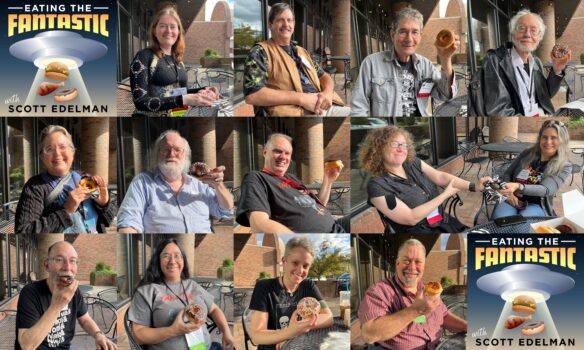
(3) EATING THE FANTASTIC. Scott Edelman invites listeners to tackle Texas BBQ with John Picacio on Episode 265 of the Eating the Fantastic podcast.
Picacio is the winner of three Hugo Awards, nine Chesley Awards, five Locus Awards, two International Horror Guild Awards, the World Fantasy Award, and the Inkpot Award. He’s created best-selling art for George R. R. Martin’s A Song of Fire and Ice series, the Star Trek and X-Men franchises, as well as over 150 book covers. His body of work features major book illustrations for authors such as Leigh Bardugo, Rebecca Roanhorse, Michael Moorcock, Harlan Ellison, James Dashner, Brenda Cooper, Frederik Pohl, Mark Chadbourn, Sheri S. Tepper, James Tiptree, Jr., Lauren Beukes, Jeffrey Ford, Joe R. Lansdale, and many, many more.
John Picacio
He is the founder of the creative publishing imprint, Lone Boy, which has become the launchpad for his Loteria Grande cards, a contemporary re-imagining of the classic Mexican game of chance. He is the founder of The Mexicanx Initiative. He’s the co-author — with Leigh Bardugo — and illustrator of The Invisible Parade, which released September 2, 2025, by Little, Brown for Young Readers.
We discussed how he’d never have gotten where he is today without comics, why he initially turned down what ended up being his first science fiction book cover (and what made him change his mind), the reason he thinks of a book as a person he needs to introduce at a party, whether he pays attention to the artists who preceded him when updating the look of a book, why one of the most important skills for a cover artist is listening, the catalyst for his creator-owned, self-published projects, how his style and his skills have changed over the years, how his recent collaboration with Leigh Bardgo began, why he’d rather be a marathon runner than a sprinter, how to avoid getting caught up in the trope of the year when it comes to cover art, the reason he launched the Mexicanx Initiative, how stabilization isn’t the same as stagnation, and much more.
(4) COVER ART. John Coulthart shares his work-in-progress on “Two new covers” at { feuilleton }. See design elements and images at the link.
…The second cover is for a book I’m working on at the moment, Lovecraft’s Brood, a sequel to Tachyon’s well-received Lovecraft’s Monsters. I was very pleased to be asked to work on this one, the earlier book is a favourite of mine from among the books I’ve done for Tachyon, and Ellen Datlow is an expert at compiling well-chosen story collections. There’s not much I can say about the cover which follows the form of the previous book. As with Lovecraft’s Monsters, the framed face will also appear as one of the interior illustrations. You’ll have to wait a while to see the results of this, however. Watch this space….
The 2025 Nobel Prize laureates in Chemistry are Susumu Kitagawa (Kyoto University, Japan), Richard Robson (University of Melbourne, Australia), and Omar M. Yaghi (University of California, Berkeley, U.S.). Their research created materials that can store large amount of gas in tiny volume.
When you think of fantasy, the first things that come to mind may be nice hobbits who live in cozy holes in the ground, dashing knights eager to take on monsters, or wizards and the local dark lord. But sometimes fantasy is about much less likely characters: the morally ambiguous hired killer, the social outcast, the bumbling misfit or the downright weirdo.
These antiheroes have become a popular staple of the genre, perhaps because their imperfections make them relatable. They can be selfish, unpredictable and less than eager to put their lives on the line for others. In other words, they are a lot like us. What makes them heroic in the end are their choices to work toward the greater good, or against a greater evil — even if the path taken is more crooked than straight.
These are some of my favorite fantasy books starring outcasts and misfits from the past decade. I love the works of Joe Abercrombie and Glen Cook as much as the next reader, but I’ve chosen here to focus on books and writers that aren’t as well known — including a few that don’t fit “traditional” ideas of fantasy. And for this list, that’s just fine….
“The Blacktongue Thief” is one of the most original fantasy novels I’ve ever read, set in a postapocalyptic medieval world reeling from war with an ever-ravenous goblin horde, giants who leash humans like dogs, murderous horse-size battle crows and sociopathic assassins with deadly tattoos — and that’s just for starters. The story centers on the misfit Kinch Na Shannack, a hapless thief mired in debt to the Takers Guild for his education in pilfering. A series of unfortunate events places him in an alliance with Galva, a (seemingly) young lady knight on a secret quest. Kinch just might be the most pathetic character you will ever meet in fantasy: He is also one of the most heroic and endearing, and his adventures are riveting.
(7) TRIVIAL TRIVIA: HEINLEIN AND TRISTAN DA CUNHA. From the Wikipedia article about the island of “Tristan da Cunha” we learn:
On 2 January 1954, Tristan da Cunha was visited by the Dutch ship Willem Ruys, a passenger-cargo liner, carrying science fiction writer Robert A. Heinlein, his wife Ginny and other passengers. The Ruys was travelling from Rio de Janeiro, Brazil, to Cape Town, South Africa. The visit is described in Heinlein’s book Tramp Royale. The captain told Heinlein the island was the most isolated inhabited spot on Earth and ships rarely visited. Heinlein mailed a letter from there to L. Ron Hubbard, a friend who also liked to travel, “for the curiosity value of the postmark”. Biographer William H. Patterson Jr. in his two volume Robert A. Heinlein In Dialogue with his Century, wrote that lack of “cultural context” made it “nearly impossible to converse” with the islanders, “a stark contrast with the way they had managed to chat with strangers” while travelling in South America. Members of the crew bought penguins during their brief visit to the island.
(8) TODAY’S BIRTHDAY.
[Written by Paul Weimer.]
October 8, 1920 — Frank Herbert. (Died 1986.)
By Paul Weimer: I read Dune thanks to the original Dune movie, even if I didn’t manage to see it for years. Once upon a time magazines like Starlog had multiple features over multiple months on SFF movies, and an issue of Starlog with Sting on the cover drew my eye. What was this movie? Who was “Paul” anyway? The movie came and went in theaters before I got to see it, but I came away with the key fact that this was based on a novel.
And so I found the novel in the library and read it. And it became one of my heart books, because I hit it at just the right time for it to speak to me. I didn’t get, until a re-read and reading the sequels, how much Dune actually critiques its Chosen One narrative, and how much of a trap Paul walks into, but I was swept away by the characters, setting and infinitely recursive labyrinth of worldbuilding. It was on the re-reads that I’ve seen just how powerful, potent and nuanced Herbert’s novel was.
The next few novels beyond the original Dune only reinforced that belief, as I found myself endless fascinated by what Herbert created. I firmly believe people could and will remake Dune in other media for decades to come, and bring new and different perspectives on it, all of them equally valid — and all of them equally unable to capture the entirety of the novel, and its sequels. I eventually sought out some of Herbert’s other work and have found much of it much more of its time.
The surreal The Santaroga Barrier for instance, feels like a counterculture version of Walden Two. The strange giant insects of The Green Brain. The city prison of The Dosadi Experiment. But frankly, it is Dune and its sequels (and I owe myself a re-read of the entire series) that holds me to this day.
(10) THE SECRET POLICEMAN’S BALL GAME. [Item by Steven French.] Even if Filers can’t make it to Berlin for the exhibition, this is an interesting article with some surprising insights (for me at least!): “Cold war power play: how the Stasi got into computer games” in the Guardian.
In 2019 researchers at Berlin’s Computer Games Museum made an extraordinary discovery: a rudimentary Pong console, made from salvaged electronics and plastic soap-box enclosures for joysticks. The beige rectangular tupperware that contained its wires would, when connected to a TV by the aerial, bring a serviceable Pong copy to the screen.
At the time, they thought the home-brewed device was a singular example of ingenuity behind the iron curtain. But earlier this year they found another Seifendosen-Pong (“soap-box Pong”), along with a copy of a state-produced magazine called FunkAmateurcontaining schematics for a DIY variety of Atari’s 1970s gaming sensation.
The discovery rubbed up against received wisdom that the dawn of computer gaming had at best been tolerated and at worst suppressed by socialist East Germany. Instead, here was evidence that gaming enjoyed a level of official support, including from the regime’s notorious secret service.
A new joint exhibit from the Allied Museum and the Computer Games Museum in Berlin brings cold war gaming curios from both sides of the iron curtain to light, including East Germany’s only arcade cabinet, the Poly-Play, which visitors can try out. With honey-coloured wooden panels and a brightly lit typeface, only 2,000 of the machines were made. In the late 80s, adolescents would crowd the cabinets at youth clubs and holiday retreats, to the extent they were available, where they could play a number of games cloned from western originals.
But the Poly-Play “was only possible with help from state security,” says Veit Lehmann of the Allied Museum. Lacking programming expertise and manpower, manufacturer VEB Polytechnick turned to the Stasi for help. They were the ones with “the experts and the computing capability” to code the games.
Instead of Pac–Man, there was Hase und Wolf – a canine-dodging hare swapped for Namco’s famous cheese-wheel-shaped ghost-evader. There was Hirschjagd(“Deer Hunt”), a repackaged take on the sci-fi shooter Robotron: 2084. There was Schießbude, a copy of a carnival shooting game; a butterfly-collecting title called Schmetterling; a memory puzzler; a skiing game and a racing game among the rest….
(11) GHOST FORESTS IN USA REVEALED BY ARTIFICIAL INTELLIGENCE. [Item by SF Concatenation’s Jonathan Cowie.] A news item —“AI map reveals vast scope of ‘ghost forests’ along east coast of U.S.” — in this week’s Science journal reports on new research using artificial intelligence (AI) that has detected a vast scope of ‘ghost forests’ along the US east coast. The AI was trained on aerial photos of known ghost forests. AI found nearly 12 million dead trees, many likely killed by rising seas. These “ghost forests” are otherworldly stands of bleached dead trees drowned by flooding or poisoned by saltwater that is intruding Inland across around 36,000 square kilometres of coastal forests, many in areas where ghost forests had not been documented before. This analysis could help identify other forests at risk of becoming ghosts, a process expected to reduce biodiversity and release planet-warming carbon stored in the trees. Not all of the AI-counted trees were killed by water; some were victims of insects or disease. But more than 6 million stand in low-lying coastal areas, suggesting they were vulnerable to flooding.
‘For more than twenty years, the Mars Express orbiter has studied the Red Planet and remains the European Space Agency’s (ESA) only operational mission. In that time, it has provided the most complete map of the Martian atmosphere and its chemical composition. It has also studied Mars’s innermost moon (Phobos) in stunning detail, and traced the flow channels, delta fans, and chaos terrain that demonstrate that liquid water once flowed on the planet’s surface. In addition, the images taken by the orbiter have been used to create detailed mosaics that have breathtaking 3D views of the landscape.
In a recently released film, ESA’s Mars Express takes viewers on a flight over Xanthe Terra, a highland region just north of the equator. The film is a mosaic created from images taken during single-orbit observations by Mars Express’s High Resolution Stereo Camera (HRSC). The images were combined with topography information from a digital terrain model (DTM) to create a three-dimensional view of the Martian landscape. The main feature in this video is Shalbatan Vallis, a 1300 km-long (~800 mi) outflow channel that transitions from the Southern Highlands to the Northern Lowlands.
This channel is one of many that crisscross Xanthe Terra and adjacent regions, such as Lunae Planum, Margaritifer Terra, and others, which are part of the larger Oxia Palus quadrangle. Based on data obtained by dozens of missions going back to the Pioneer probes and the Viking missions, scientists believe that Shalbatan Vallis and similar channels in the region fed water from the Southern Highlands into a planet-wide ocean in the Northern Lowlands. Many of these features are connected to Valles Marineris, the largest canyon system in the solar system that is also believed to have once contained water.
The tour culminates in a spectacular view of the 100 km-wide (62 mi) Da Vinci crater, which contains a smaller crater and debris field caused by a more recent collision. Check out the full video below or watch the broadcast-quality footage here.’
(13) VIDEO OF THE DAY. [Item by Daniel Dern.] Following up on Item (14) in the September 14 Scroll, here’s a more SNfal Melodica Men tune from seven years ago: “Star Wars Medley”
[Thanks to John King Tarpinian, Chris Barkley, Cat Eldridge, Paul Weimer, Scott Edelman, Daniel Dern, SF Concatenation’s Jonathan Cowie, Mark Roth-Whitworth, Steven French, Kathy Sullivan, Mike Kennedy, and Andrew Porter for some of these stories. Title credit belongs to File 770 contributing editor of the day Cat Eldridge.]
Of genre interest are at least one of the Fiction works, The Antidote by Karen Russell, and two of the Translated Literature works, On the Calculation of Volume (Book III) by Solvej Balle, translated from the Danish by Sophia Hersi Smith and Jennifer Russell, and We Computers: A Ghazal Novel by Hamid Ismailov, translated from the Uzbek by Shelley Fairweather-Vega.
Fiction
The True True Story of Raja the Gullible (and His Mother) by Rabih Alameddine (Grove)
A Guardian and a Thief by Megha Majumdar (Knopf)
The Antidote by Karen Russell (Knopf)
North Sun: Or, the Voyage of the Whaleship Esther by Ethan Rutherford (A Strange Object)
Palaver by Bryan Washington (FSG)
Nonfiction
One Day, Everyone Will Have Always Been Against This by Omar El Akkad (Knopf)
Motherland: A Feminist History of Modern Russia, from Revolution to Autocracy by Julia Ioffe (Ecco)
Things in Nature Merely Grow by Yiyun Li (FSG)
Wards of the State: The Long Shadow of American Foster Care by Claudia Rowe (Abrams)
When It All Burns: Fighting Fire in a Transformed World by Jordan Thomas (Riverhead)
Poetry
The New Economy by Gabrielle Calvocoressi (Copper Canyon)
Becoming Ghost by Cathy Linh Che (Washington Square)
Scorched Earth by Tiana Clark (Washington Square)
I Do Know Some Things by Richard Siken (Copper Canyon)
The Intentions of Thunder: New and Selected Poems by Patricia Smith (Scribner)
Translated Literature
On the Calculation of Volume (Book III) by Solvej Balle, translated from the Danish by Sophia Hersi Smith and Jennifer Russell (New Directions)
We Are Green and Trembling by Gabriela Cabezón Cámara, translated from the Spanish by Robin Myers (New Directions)
The Remembered Soldier by Anjet Daanje, translated from the Dutch by David McKay (New Vessel)
We Computers: A Ghazal Novel by Hamid Ismailov, translated from the Uzbek by Shelley Fairweather-Vega (Yale)
Sad Tiger by Neige Sinno, translated from the French by Natasha Lehrer (Seven Stories)
The winners will be announced on November 19. Winners receive $10,000, a bronze medal, and statue; Finalists receive $1,000 and a bronze medal; Winners and Finalists in the Translated Literature category will split the prize evenly between author and translator.
Two lifetime achievement awards will also be presented as part of the evening’s ceremony: George Saunders, writer and professor, will be recognized with the National Book Foundation’s Medal for Distinguished Contribution to American Letters; and Roxane Gay, author and cultural critic, will receive the Foundation’s Literarian Award for Outstanding Service to the American Literary Community.
(2) ASU CSI BOOK LAUNCH. The Center for Science and the Imagination today announced the publication of Sound Systems, a book of speculative fiction, nonfiction, and art exploring possible futures for the symphony orchestra. The book features, among other things, original short stories by Karen Lord, Deji Bryce Olukotun, Amy K. Nichols, and Ernest Hogan. The book is free to read and download across a variety of digital formats. (You’ll find a more thorough description and full list of contributors at the link above.)
To celebrate the publication, they are hosting a virtual launch event on Monday, October 27 from 2:00-3:00 pm Eastern time. The event will feature conversations with several contributors from the book: composer, multimedia artist, and writer Paul D. Miller (aka DJ Spooky); speculative fiction author Deji Bryce Olukotun; violist, songwriter, and music educator Ashley Lauren Frith; clarinetist and arts leader Alex Laing; and Ed Finn, founding director of the Center for Science and the Imagination. The event is free and open to everyone.
Register for the virtual launch event at this link.
(3) AI EVOLUTION. Christopher Beam tells WIRED readers that “The Future of AI Isn’t Just Slop”. (Article is behind a paywall, though visible to users of the Apple News app.)
THE FILMMAKER COULD not get Tiggy the alien to cooperate. He just needed the glistening brown creature to turn its head. But Tiggy, who was sitting in the passenger’s seat of a cop car, kept disobeying. At first Tiggy rotated his gaze only slightly. Then he looked to the wrong side of the camera. Then his skin turned splotchy, like an overripe fruit.
The filmmaker was not on a movie set, or Mars. He was sitting at his home computer in Los Angeles using a piece of AI software called FLUX Kontext to generate and regenerate images of the alien, waiting for a workable one to appear. He’d used a different AI tool, Midjourney, to generate the very first image of Tiggy (prompt: “fat blob alien with a tiny mouth and tiny lips”); one called ElevenLabs to create the timbre of Tiggy’s voice (the filmmaker’s voice overlaid with a synthetic one, then pitch-shifted way up); and yet another called Runway to describe the precise shot he wanted in this scene (“close up on the little alien as they ride in the passenger seat, shallow depth of field”).
The AI kept getting things wrong. In one shot, Tiggy looked inexplicably jacked. In another, his back was too dry. When the filmmaker told one piece of software to give the back of Tiggy’s head “frog-like skin,” it superimposed an entire frog’s face. The AI seemed to resist depicting Tiggy naked, but Tiggy does not wear clothes. When the director asked for a “short shirtless alien,” he got an error message, presumably because of the tool’s safeguards. “Because I said the word shirtless,” he guessed.
Narratives around AI tend to be all-or-nothing: Either we’re cooked or it’s all hype. Watching the filmmaker work with AI software—morning iced coffee in hand, brown hair and beard lightly unkempt—is quirkier and less dramatic than all that. It’s like dropping in on puppy school. The tools keep ignoring instructions, making odd choices, or veering entirely off-course. But with care and patience, he reins them in, eventually coaxing out eight minutes of densely scripted original TV.
In this case, those eight minutes constituted the latest episode in the sci-fi cinematic universe that the filmmaker has created under the name Neural Viz. The project started in 2024 with a mockumentary web series called Unanswered Oddities, a talking-head TV show from a future where the Earth is inhabited by creatures called glurons, who engage in Ancient Aliens–style speculation about their human predecessors. Each episode explores a different (and badly mispronounced) aspect of “hooman” civilization, like America, exercise, or the NFL. At first it seemed like a funny, self-contained bit.
But then the universe, known as the Monoverse, started to expand. Neural Viz churned out episodes of different series from the same gluron TV network, Monovision: a documentary cop show, a UFC-style show about fighting bugs. Then came podcasts, street interviews. Subplots and arcs started to emerge between videos, with romances forming, religious cults lurking in the background, and grainy archival footage surfacing about the true circumstances that wiped out humanity. Before long, the filmmaker had built an entire world with its own language, characters, and lore, all of it made with AI.
Neural Viz became a cult hit—a favorite of Redditors and AI nerds on Twitter—then a hit-hit, with individual videos racking up hundreds of thousands of views on YouTube and millions on TikTok and Instagram.
But beyond any measures of popularity, Neural Viz counts as a historic accomplishment: It is among the first pieces of AI filmmaking that truly does not suck…
Russell T Davies, the current showrunner of Doctor Who and writer behind dramas like Queer as Folk, It’s a Sin and Years and Years, has warned about the perils of censorship in the current climate.
Davies was presented with the award for Outstanding Contribution to Television at last night’s BAFTA Cymru Awards ceremony. In his acceptance speech, he spoke about how greater compliance requirements mean writers start censoring themselves.
“When times get tough, TV gets timid,” Davies warned in his fiery speech. “And you all know how hard it is to deal with compliance. And I’m not blaming the people in compliance, they work very hard and have a tough job to do.
“I do blame their bosses for getting scared. And I can feel it, I’ve literally had experience of this.”
He added: “The compliance is getting tough, ‘You can’t say this, you can’t say that, you have to balance it’. No, you don’t have to f*****g balance it, you can just be strong and say what you want. And I think then, that is where censorship creeps in. The censorship isn’t the government, isn’t the authorities, it’s in us.
“We sit there and say, ‘Oh they won’t like that. Oh, you can’t do that, you can’t say that.’ And then the worst form of censorship of all comes in at home.
“Where the writers – and I don’t just mean drama, I mean writers whether in children’s or factual or documentaries, entertainment, where those creators sit there saying, ‘I can’t write that. They won’t like that, they won’t accept that, they won’t make that.’
“And that is the worst form of censorship that exists because it censors an idea before it’s ever been shown to someone.”
Davies’s speech, which was posted on Instagram, continued: “So now, with the danger that’s coming towards us, indisputably coming towards us, we now need a world in which the BBC stands for ‘Big Balls Corporation’.
(5) 2025 NOBEL PRIZE FOR PHYSICS. [Item by Steven French.] After last year’s controversy, the Nobel Prize committee have acknowledged the International Year of Quantum Science and Technology with an award for demonstrating quantum tunnelling (responsible for radioactive decay) at the macroscopic level:“Groundbreaking quantum-tunnelling experiments win physics Nobel” reports Nature.
The research, including into the bizarre phenomena of quantum tunnelling and quantum superposition, has helped to underpin some of today’s most advanced quantum computers.
John Clarke at the University of California, Berkeley, Michel Devoret at Yale University in New Haven, Connecticut, and the University of California, Santa Barbara (UCSB), and John Martinis, also of USCB will share the prize of 11-million Swedish kronor (US$1.2 million), announced by the Royal Swedish Academy of Sciences in Stockholm on 7 October.
“I am completely stunned; it had never occurred to me in any way that this might be the basis for a Nobel prize,” said Clarke…
…The foundations of quantum mechanics were laid down 100 years ago. But many of its strange implications have taken decades to unravel.
One is the phenomenon of quantum tunnelling — the ability of particles to pass straight through a barrier that shouldn’t be possible according to classical physics, given its energy. Tunnelling explains radioactive decay, in which, despite being confined inside an atom, an alpha particle still has a small probability of escaping the nucleus. Another is quantum superposition, in which an object can exist simultaneously in two states.
Both tunnelling and superposition were known at the atomic scale but hadn’t been observed in macroscopic systems. In the late 1970s, Anthony Leggett, who won the 2003 Nobel Prize in Physics for his theoretical work on superconductors, asked whether the phenomena would be observable at the macroscopic scale using superconducting circuits — loops of wire which, when chilled to a fraction of a degree above absolute zero, can conduct electricity without resistance1.
“We took the question very seriously — would quantum mechanics be obeyed by these large systems? And we thought very carefully how we would prove that,” Martinis recalls. In the 1980s, Clarke, Devoret and Martinis, working at Berkeley, were among those exploring quantum effects in superconducting loops2. The trio set up an experiment in which two superconductors were separated by a thin barrier, known as a Josephson junction3. In this state, a supercurrent can flow with zero resistance, like a river that runs without friction — but also with zero voltage, so without a downhill gradient that gives the current a push. In classical physics, the system would stay stuck like this, unless given enough energy to escape.
By carefully monitoring the system, and slowly increasing the current, Clarke, Devoret and Martinis showed that the entire tiny circuit could break out into a higher energy state — by quantum tunnelling, which they observed by measuring a voltage spike. Yasunobu Nakamura, a physicist at the University of Tokyo, says that it still came as a surprise to many that quantum mechanics could manifest itself at such large scales.
“They are really pioneers of this field,” says Nakamura, who in the late 1990s became the first physicist to demonstrate a superconducting qubit bit or ‘qubit’ using a similar principle…
As I recently wrote, ninety-nine percent of all book contract boilerplate language is immutable, and agents take most of it for granted. We usually just eyeball it, then focus on negotiable terms like advance and royalties, language and territory, movie and audio rights. So, it’s hard to imagine that a simple and unpretentious boilerplate phrase – indeed, a single word – could be the battleground for a gripping courtroom clash of titans played out before a rapt television audience. But that is just what happened in February 1996, when you would have found my wife and me and countless other denizens of the publishing industry glued to the Court TV channel, transfixed by the public spectacle of a publisher suing an author.
The plaintiff was colossus Random House, the defendant the glamorous and iconic television actress and author Joan Collins. The field on which Random House, Inc. v. Collins was fought was New York State’s Supreme Court. The issue was this: Random House had negotiated a two-novel contract with Collins’s agent for advances totaling $4 million. The author had turned the books in to her editors. However, in the words of Mary B. W. Tabor in the New York Times, the publisher found them “redundant, incoherent and incomplete.” Tabor was being kind.
Random not only refused to pay Collins the $2.8 million balance of her advance but demanded refund of the $1.2 million down-payment issued on signing of the agreement. Collins countersued to keep the initial payment and make Random pay the remainder of her $4 million book deal.
Random’s case was founded upon the “satisfactory performance” provision of their contract with Collins. Although the language of such clauses differs from one publisher to another, in essence they all state that in order to receive full and final compensation, the author must turn in a complete manuscript that is satisfactory in the sole discretion of the publisher.
It may justly be said that the satisfactory performance provision is the bedrock of every pact between publishers and authors. However, if anyone wished to challenge it they could seize on ambiguous terms like “satisfactory” and “discretion” and dispute a publisher’s rejection of their book. And though the word “complete” seems straightforward enough, in this case it was a critical factor in the resolution of this bitterly fought case and the fulcrum on which a verdict teetered….
(7) TERRY A. GAREY (1948-2025). Author and poet Terry A. Garey died October 6 at the age of 77.
Garey twice won the Science Fiction and Fantasy Poetry Association’s Rhysling Award in the Long Poem category – for “Spotting UFOs While Canning Tomatoes ” (Serve It Forth: Cooking With Anne McCaffrey) (1997), and for “The Cat Star” (Lady Poetesses from Hell) (2013).
A collection of her work, The Cat Star and Other Poems, came out in 2022. She edited the anthologies Time Gum and Other Poems from the Minicon Poetry Readings (1988, with Eleanor Arnason), and Time Frames: A Speculative Poetry Anthology (1991). She wrote a nonfiction book on The Joy of Home Winemaking (1996).
Living in Minneapolis, she was a member of Minn-Stf, and of The Workshop, The Lady Poetesses from Hell, and War. She was Official Editor of the feminist apa Spinoff.
Garey was married to fellow fan Denny Lien from 1984 until his death in 2023.
(8) MEMORY LANE.
[Written by Cat Eldridge.]
Demolition Man (1993)
So what’s Sylvester Stallone’s perfect film? Without any doubt at all, that’d be Demolition Man which came out thirty-two years ago this month. It is a film that I saw first at the cinema on a proper full screen and I think have watched at least a half dozen times since.
It’s that ever so rare screenplay written by committee that I like, as it had three hands in the writing of it — Daniel Waters, Robert Reneau and Peter M. Lenkov. Waters had just written Batman Returns and had earlier received an Edgar for Heathers, Reneau had for genre just an episode of Tales from the Crypt, and Lenkov hadn’t done anything notable yet though much later he make his mark as a rebooter of, well everything — McGyver, Hawaii 5-0 and even Magnum PI got so done by him.
The latter is truly awful as is the first one though the second is kind of, well, actually it’s crap as well. Never mess with classics.
It was, weirdly, directed by Marco Brambilla, an Italian-born Canadian contemporary artist and film director, known for re-contextualizations of popular and found imagery. The design here certainly isn’t the draw, it’s the performers.
Huh?
Now for the film itself.
SHALL I MAKE THIS SPOILERS? I THINK NOT.
Stallone played a cop thawed out (shades of Niven) to capture an escaped criminal who originally had been frozen when he was. They both wind up in what is considered a utopia, the city of San Angeles. Like all utopian undertakings, it really isn’t.
I loved the absolute deadpan way Stallone deals with everything odd there from the lack of toilet paper to discovering sex has been replaced by virtual experiences. He would have made an absolute spot-on Dredd. (Oh, wait!)
Let’s not forget the other casting here. Wesley Snipes gives one of the best performances of his career as Simon Phoenix, and I completely adore Sandra Bullock as Lieutenant Lenina Huxley.
Her character was named after Aldous Huxley, the author of Brave New World, and Lenina Crowne, a character in the novel.
The studio refused to say how much it cost but estimates say somewhere between fifty and seventy-five million. It did exceedingly well at the box office making at least one hundred and seventy million.
Heathside Trading and BBC Studios have announced a new agreement to bring back the wildly popular Doctor Who trading card game, Battles in Time.
Originally launched in 2006, the game became a fan favourite before ceasing production in 2009. Now, in time for its 20th anniversary, Heathside will relaunch the original game alongside new lines designed to fit seamlessly into any Whovian’s collection….
… The new range will debut in 2026 on MasterReplicas.com, with products launching for preorder throughout the year….
“Things are always happening to me. I’m that sort of bear.”
Those are the famous words of Michael Bond’s beloved children’s creation, Paddington Bear. But it turns out that Bond’s estate is not so keen on the latest thing to befall the marmalade-loving mammal.
StudioCanal, which produces the Paddington movies, and Paddington Bear’s rights holders are suing Avalon after the British producer’s Spitting Imageseries on YouTube depicted Paddington as a foul-mouthed podcast host.
Deadline can reveal that the claimants, represented by law firm Edwin Coe, have filed a High Court complaint citing copyright and design right concerns.
The filing does not reveal the particulars of the claim, but it comes months after The Rest is Bulls*!t, a sketch from Spitting Image, the BAFTA and Emmy-winning British puppet show….
[Thanks to Andrew Porter, John King Tarpinian, Chris Barkley, Joey Eschrich, Cat Eldridge, SF Concatenation’s Jonathan Cowie, Mark Roth-Whitworth, Steven French, Kathy Sullivan, and Mike Kennedy for some of these stories. Title credit belongs to File 770 contributing editor of the day Daniel Dern.]
(1) UNCANNY DELUGED WITH AI SUBMISSIONS. Michael Damian Thomas of Uncanny Magazine announced on October 10 that the volume of AI submissions has caused a delay in their responses to writers.
Then he later followed up with these additional thoughts:
Some quick notes. 1- We don't use AI detectors. 2- We'll only ban a submitter if we were positive of AI use. 3- We have no plan to ever permanently close unsolicited submissions. The plan is to just take longer processing submissions. Not our favorite, but that's where we're at. https://t.co/mYn58sVsX2
Since the Uncanny AI thing went viral, here are some of my thoughts.
1- There are plenty of people out there desperate to be published or to remain publishing. "Shortcuts" are going to get used. Ask any teacher/professor about plagiarism and current AI use for academic writing.
3- The only negative effect for Uncanny is longer submission processing time. (It's very unlikely we'd ever get fooled by an AI story.) It's not optimal, but unfortunately writers will have to get used to waiting for decisions a bit longer like we did back in ye olde SASE days
The research for Deeper Cut: Lovecraft, Miniter, Stoker: the Dracula Revision required an examination of the history of the Dracula manuscript and an evaluation of the textual variations in order to evaluate whether there was any place in the timeline for Edith Miniter, as Lovecraft alleged, and to judge Bram Stoker’s involvement with changes to the text before and after publication.
One of the most notable developments in Dracula studies in recent years has been the discovery of and translation into English of the 1899 Swedish translation Mörkrets Makter (translated into English as Powers ofDarkness), which was serialized in in the newspaper Dagen, and 1901 Icelandic edition Makt Myrkanna (also translated into English as Powers of Darkness) serialized in the newspaper Fjallkonan. What has become apparent, however, is that there were also numerous Dracula serializations in English-language newspapers in the period 1899-1928. Thanks to the digitization of old newspaper archives and online subscription services, these newspaper serials, which have received rather scanty attention, are more accessible today than they were previously. Enough that a survey of the extant texts is warranted….
… There may well be additional newspaper serializations of Dracula besides these; these are just the serials available via newspapers.com as of the time of this writing. Links will be to the full pages, as clips tend to come out illegible….
(3) JOY DAVIDMAN AT THE LONDON CIRCLE. Rob Hansen has assembled excerpts of fannish memoirs about “C.S. Lewis & The London Circle” at Fiawol.org. A great deal of it is about Joy Davidman’s attendance at pub meetings of the London fan group.
[SAM YOUD, who wrote as “John Christopher”] …Joy herself I got to know quite well. We drank bitter together and argued endlessly through those Thursday evenings. Joy never stopped arguing, and we derived much mutual pleasure from the exercise.
She had endured a cruelly-hard childhood, involving a range of diseases that included curvature of the spine, exaggerated insulin secretion resulting in excessive appetite and a weight problem, and Grave’s disease – hyperthyroidism. For the last she was treated by a doctor who required her to wear a radium collar around her neck, weekly for a year. It appeared to cure the condition, but one can speculate on the cost in later life. I did not know any of this before reading AND GOD CAME IN, her biography by Lyle Dorsett, published in 1983. Nor did she talk about her achievements as an award-winning poet, her authorship of two well-regarded novels, or her stint in Hollywood as a screenwriter. Perhaps she did not want to belittle our petty triumphs in sales to Astounding Stories or Galaxy or New Worlds….
A Japanese anti-nuclear weapons group made up of survivors of the atomic bombings in Japan during World War II has won the 2024 Nobel Peace Prize.
The Norwegian Nobel Committee said it has awarded the Japanese organization Nihon Hidankyo “for its efforts to achieve a world free of nuclear weapons and for demonstrating through witness testimony that nuclear weapons must never be used again,” sending a message to countries that are considering acquiring or threatening to use them.
Committee Chair Jørgen Watne Frydnes said Nihon Hidankyo, made up of survivors of the August 1945 nuclear bombings of Hiroshima and Nakasaki by the United States, has been instrumental in the global movement that has kept nuclear weapons from being used in conflict for 80 years….
… At a press conference in Hiroshima, Nihon Hidankyo’s co-chair, Toshiyuki Mimaki, 81, held back tears and pinched his cheeks when the award was announced. “I can’t believe it’s real” he told reporters.
Mimaki is a Hiroshima survivor and said the award helped recognize the group’s work. “It would be a great force to appeal to the world that the abolition of nuclear weapons can be achieved,” he said.
He said the idea that nuclear weapons bring peace to the world is wrong.
“It has been said that because of nuclear weapons, the world maintains peace. But nuclear weapons can be used by terrorists,” he said. “For example, if Russia uses them against Ukraine, Israel against Gaza, it won’t end there. Politicians should know these things.”…
…Around the world, Indigenous communities have passed rich storytelling traditions from one generation to the next from time immemorial. Many of the stories have been lost in the upheaval and destruction of the colonial era. Selfless heroes and bold tricksters alike have been forgotten, or faded to a mere wisp of collective memory. But the monsters, ah, the monsters. Ferocious, fanged, skulking, slithering, they seem to have endured better than most. These beings still haunt—and hunt—from Australia to Brazil, Lake Victoria to Lake Winnebago. Here are some of the most memorable ancient terrors from Indigenous lore that still send chills down our spines.
Few monsters from Indigenous folklore can boast of making it in Hollywood. There’s Krampus, a modern amalgamation of deeply ancient Central European traditions, and the wendigo, which first terrorized the Algonquin, Ojibwe, and other Anishinaabe peoples around the North American Great Lakes. We’ll leave it to you to decide whether the 2021 movie Antlers does justice to the wendigo’s ferocity, but we’re betting the wendigo doesn’t care. It’s too busy looking for its next victim. A potent symbol of human greed, the emaciated creature is insatiably hungry and appears in the lean and desperate season of winter. In the 19th century, some documented regional cases of cannibalism and other unspeakable acts were chalked up to individuals “going wendigo.”
(6) FANTASY STUDY. Adam Roberts, winner of the John W. Campbell Memorial Award for Jack Glass, a three-time BSFA Award winner, and Professor in Nineteenth Century Literature and Culture at Royal Holloway, University of London, UK, will have a nonfiction book Fantasy: A Short History out in April 2025 from Skylight Books.
One of the most popular genres of modern times, fantasy literature has as rich a cultural and literary heritage as the magical worlds that so enrapture its readers. In this book, a concise history of the genre, Adam Roberts traces the central forms and influences on fantasy through the centuries to arrive at our understanding of the fantastic today.
Pinning the evolution of fantasy on three key moments – the 19th-century resurgence of interest in Arthurian legend, the rise of Christian allegory, and a post-Ossian, post-Grimm emergence of a Norse, Germanic and Old English mythic identity – Roberts explores how the logic of ‘the fantastical’ feeds through into the sets and trappings of modern fantasy. Tracking the creation of heroic and high fantasy subgenres through antiquarian tradition, through C. S. Lewis and J. R. R. Tolkien and into the post-Tolkien boom in genre fantasy writing, the book brings the manifestation of the fantastic beyond literature into art, music, film and TV, video games and other cultural productions such as fandoms. From Tennyson and Wagner, through Robert Graves, David Jones, Samuel Delany, Dungeons and Dragons, Terry Pratchett and Robin Hobb, to the Game of Thrones, Skyrim, The Witcher and The Lord of the Rings media franchises, the book digs into the global dissemination and diversity of 21st-century fantasy. Accessible and dynamic, wide-ranging but comprehensive, this is a crash-course in context for the most imaginative form of storytelling….
(7) TEDDY HARVIA CARTOON.
(8) MEMORY LANE.
[Written by Paul Weimer.]
Anniversary: Star Trek’s “Mudd’s Women” (1966 on this date)
By Paul Weimer: Harry Mudd is, for all being a reprobate, cheat, con man, and sneak, is one of the iconic characters of all of Star Trek. In a supposedly glorious Federation, it is heartwarming in a way to see a character as mercilessly mercenary as Harry Mudd come on screen.
“Mudd’s Women” is his first appearance. (he would be in one more TOS episode, an animated episode and surprisingly, also on Discovery (before they go to the future).
“Mudd’s Women” itself is a con man scheme involving a drug to make women appear more beautiful, and Mudd trying to marry them off to settlers while on the drug, and reap the profits. It shows the early “Wagon Train in Space” roots of Star Trek to the fullest, because with just some changes, this could easily be an episode of Bonanza or another Western. And if you look at Mudd’s getup (and that hat), you can totally see it. And Kirk’s clever use of a placebo in the denouement is a positive message that beauty drugs, in the end, pale to self-confidence and real inner beauty.
So it was no surprise when from Santa Rosa County in the panhandle of Florida this past month there came familiar news. A parent, discovering their child was reading something they found problematic, approached a school board and asked that Fahrenheit 451 be removed from the curriculum.
“Filth,” that parent called Bradbury’s work, as she pressed for it to be removed from an eighth grade reading list. The concerned mom leading the banning effort didn’t see its prophetic relevance. All she saw was a vulgarity, the word “bastard,” which she felt was inappropriate for her 13-year-old daughter. “I’m just trying to keep my little girl a little girl,” she said.
This kind of book-banning effort isn’t unusual, but this one was a gut punch. Why? Because the parent organizing the banning effort suggested that Bradbury’s work should be replaced with something more acceptable to her.
Among her suggestions for more “suitable” material: my own dystopian novel, When the English Fall.
I cannot imagine receiving a more troubling and heartbreaking endorsement.
Sure, my Amish protagonist and narrator doesn’t use vulgarity in the face of the world’s collapse. Because he’s Amish. Old Order Mennonites don’t tend to swear like sailors. But my story contains its fair share of death and murder and human horror, at least as graphic as anything you’ll find in Bradbury.
The mother bringing the complaint was concerned at the violence in the book, and worried that the book wasn’t “safe,” and suggested that kids might read about murder and violence and become murderous and violent themselves. As a pastor, I preach the Bible every Sunday, and teach it in classes. My gracious, I can’t imagine a less “safe” book than the Bible. Try reading Genesis sometime. That’s a rough, rough book. My Adult Ed class has been discovering this last month as we’ve been reading it together. Murder? Rape? Betrayal? Incest? Ray Bradbury’s got nothing on the Word of God….
…Musk might see Starship as an ark for all God’s creatures, but environmentalists tell a different story. As Starship prototypes have begun flying from SpaceX’s launch pad in Boca Chica, Texas, they say the company has shown little regard for the wildlife Musk has said he wants to protect.
Now, a review of state and federal records by NPR, including some obtained through a freedom of information request, shows how SpaceX has sometimes ignored environmental regulations as it rushed to fulfill its founder’s vision. With each of its launches, records show, the company discharged tens of thousands of gallons of what regulators classify as industrial wastewater into the surrounding environment.
In response to the discharges of water from the pad, both the Environmental Protection Agency and the Texas Commission on Environmental Quality (TCEQ) have determined that SpaceX has violated the Clean Water Act. Both agencies levied fines totaling more than $150,000 against the company in September….
In one of the most dramatic, high-risk space flights to date, SpaceX launched a gargantuan Super Heavy-Starship rocket on an unpiloted test flight Sunday and then used giant “mechazilla” mechanical arms on the pad gantry to pluck the descending first stage out of the sky in an unprecedented feat of engineering.
The Starship upper stage, meanwhile, looped around the planet and re-entered the atmosphere over the Indian Ocean as planned, enduring temperatures nearing 3,000 degrees as it descended to a controlled, on-target splashdown.
The spacecraft came through the hellish heat of re-entry in relatively good condition, protected by improved heat-shield tiles and beefed-up steering fins that worked as needed while engulfed in a fireball of atmospheric friction.
But the jaw-dropping first stage capture back at the launch pad, using pincer-like arms more familiarly known as chopsticks, was the clear highlight of the giant rocket’s fifth test flight.
Snagging the descending 23-story-tall Super Heavy booster with the mechazilla arms represented an unprecedented milestone in SpaceX’s drive to develop fully reusable, quickly re-launchable rockets, a technological tour de force unmatched in the history of earlier space programs relying on expendable, throw-away rockets….
The world’s biggest anime piracy site, Aniwatch, has recently rebranded itself following a huge rise in infamy.
The popular site “Aniwatch” has changed its domain name to “HiAnime” this week. Users attempting to access Aniwatch received the message: “Aniwatch is being rebranded to HiAnime. You will be redirected to the new HiAnime website in 10 seconds. Or you can also click here to go to HiAnime now.” According to Similarweb, “Aniwatch” is the #1 most accessed anime piracy site worldwide with 136.2 million visitors in January 2024. It’s also 16th overall in the “Streaming and Online TV” category. Aniwatch does not provide an official explanation for the rebranding.
A new report by Torrent Freak adds that a recent ‘dynamic+’ site blocking order in India may have motivated this. This refers to a court-ordered instruction to Internet Service Providers (ISPs) to block access to a website, with the theory proving especially likely given that India is Aniwatch’s biggest user base…
(14) VIDEOS OF YESTERDAY. [Item by Mike Kennedy.] Last night’s Saturday Night Live had several items that could be considered anything from genre adjacent to vaguely kind of sort of adjacent to genre adjacent. It depends on how you look at it. And how hard you squint.
This one is definitely horror. But not supernatural horror or anything else that’s really SF-adjacent. More like serial murderer horror. Although, the fantasy talking furniture, bookcases, etc. DO lend more credibility as genre related. I think it’s extremely well-made, considering they (presumably) had less than a week to put it together. “My Best Friend’s House”.
Oh, this one is absolutely solidly genre IMO. You just have to watch it all the way to the end to see why. “The Hotel Detective”.
[Thanks to Steven French, Kathy Sullivan, Teddy Harvia, Paul Weimer, Lise Andreasen, Mike Kennedy, Andrew Porter, John King Tarpinian, Chris Barkley, Cat Eldridge, and SF Concatenation’s Jonathan Cowie for some of these stories. Title credit belongs to File 770 contributing editor of the day Lis Carey.]
(1) GAME OF THRONES AUCTION. Heritage Auctions has started its three-day auction of Game of Thrones props and costumes. Westeros gives the highlights of the opening day in “Day 1 of Game of Thrones Auction Recap”.
The first day of the three day Game of Thrones prop and costume auction run by Heritage Auctions started well, with nearly $5.36 million realized across the first 290-odd listings in the auction. We kept track of it as long as we could, and by the time we went to bed we’d noted that several items had cleared the $100,000 mark. Gregor Clegane’s tourney armor was the first to hit six figures and ended up just shy of $200,000, followed by a prototype dragon egg from the first season (a second egg just missed the mark).
After that, Arya Stark’s season 2 “boy” ensemble with an included “action” version of Needle hit $150,000, which seemed like a very expected number. And then, fittingly, the first item to hit $200,000—just beating out the Mountain that Ride’s armor—was the Hound’s armor ensemble. After that point, we went to bed, but in the morning we found two more items made it to the prestigious six-figure club: a full Jaime Lannister Kinsguard ensemble. Because of the inclusion of both a prop hand and an “action” Oathkeeper, this one was an especially valuable listing, and the bidders recognized it as they drove it up to become the day’s top item with a final realized price of $212,500.
Get ready to take a seat at the table with the Hugo and Nebula Award-winning writer John Chu.
John’s a microprocessor architect by day, and a writer, translator, and podcast narrator by night. His fiction has appeared in magazines such as Lightspeed, Uncanny, Asimov’s Science Fiction, Clarkesworld, Apex, and at Tor.com, plus in anthologies such as The Mythic Dream, Made to Order: Robots and Revolution, New Suns 2: Original Speculative Fiction by People of Color, and others. His translations have been published or are forthcoming at Clarkesworld, The Big Book of SF, and other venues.
John Chu
He has been a finalist for the Hugo, Nebula, Locus, and Ignyte Awards, won the Best Short Story Hugo for “The Water That Falls on You from Nowhere,” plus the Nebula, Ignyte, and Locus Awards for “If You Find Yourself Speaking to God, Address God with the Informal You.” In the days before our lunch, he surprised us all with the announcement he’d sold his first novel — and you’ll hear my own surprise during our conversation.
We discussed the way he gamified the submission process when he started out, how the pandemic made him feel as if he was in his own little spaceship, when he learned he couldn’t write novels and short stories at the same time, how food has become a lens through which he could explore a variety of issues in his fiction, the rejection letter he rereads whenever he wants to cheer himself up, how writing stories at their correct lengths was one of the most difficult lessons he had to learn as a writer, what it was about his 2015 short story “Hold-Time Violations” that had him feeling it was worthy of exploring as a novel, how he was changed by winning a Hugo Award with his third published story, and much more.
(3) KGB PHOTOS. Ellen Datlow has posted pictures from last night’s Fantastic Fiction at KGB reading series where Sarah Langan and David Leo Rice read from their most recent novels. Click here: KGB October 9, 2024.
(4) LISA TUTTLE COLUMN. The Guardian presents “The best recent science fiction, horror and fantasy – reviews roundup” by Lisa Tuttle. This time she reviews William by Mason Coile; The Tapestry of Time by Kate Heartfield; The Wilding by Ian McDonald; Of the Flesh: 18 Stories of Modern Horror by various authors; A Christmas Ghost Story by Kim Newman.
Aardman, the iconic UK animation studio behind Chicken Run and Wallace & Gromit, has closed around 20 jobs as it grapples with the increased cost of production.
Deadline understands that Aardman is in the process of making less than 5% of its 425 employees redundant following a savings review undertaken by management.
A third of the redundancies were voluntary, while two roles remain in consultation. It is hoped that some of the individuals who have lost their jobs can return to Aardman on a freelance basis.
As part of the restructure, Aardman has created new roles to wring increased value out of its intellectual property. These roles include a senior licensing manager and sales executive.
The cost-cutting initiative comes as Aardman has filed its earnings for 2023, which reveal that the studio sunk to a pre-tax loss of £550,135 ($720,000). The company made a profit of £1.56M in 2022.
Aardman said the loss was largely because of a £1.75M impairment of unrecouped costs on Lloyd of the Flies, a 2022 animated series that debuted on CITV in the UK and was licensed by Tubi in the U.S. Putting the impairment to one side, Aardman’s underlying profit was £1.6M….
There’s no doubt about it, the advancements in 3D Printing have done a lot for the collecting community. From printing missing parts for toys, and accessories for action figures, to complete collectibles, the whole endeavor has come a long way and it absolutely fascinates me. But also prop replicas! And that’s what I’m checking out today: A Starfleet Issue Medical Tricorder as featured in Star Trek: The Next Generation! I remember the days when you’re only hope of getting a decent Trek prop was to mail away for a DIY resin kit from the back of a magazine at $50-60. And what you got was exactly that, an unfinished kit that needed all sorts of sanding and painting to make it look anywhere near presentable. Even some of the “props” people were selling at conventions for twice that price were pretty crude. I recently found an Ebay seller offering some phasers and Trek replicas at prices that were too good to pass up. I started with some phasers (which we’ll check out here eventually), but the Tricorder came in this weekend and I was really excited to show it off.
This is where I usually show off the box and packaging, but there’s nothing to show here. The Tricorder came carefully bubble wrapped along with a display stand and holster. The stand is the only assembly required, and you just have to tab it all together, easy-peasy. There are no electronics included in the model, so you can consider this based on a regular prop as opposed to a hero prop, which is meant to be seen up close and functional. This particular model has two configurations to choose from: medical or regular, so whether you’re part of an Away Team mission making a geological survey or you’re in Sick Bay trying to find out why all your crew are dying, this Tricorder has you covered! Let’s start with the regular version and work our way up! And just a disclaimer, I know next to nothing about 3D Printing, I’m not qualified to comment on printing methods or techniques, and I’m evaluating this solely as a finished collectible….
(7) WARNING: IT’S A COMMERCIAL. But you might like to watch it anyway!
DeLorean Labs has now released a Back to the Future-style video of Lloyd playing himself as he opens a DeLorean Time Capsule. Directed by filmmaker Allan Ungar, who previously directed the feature film Bandit, the nostalgic video introduces the Time Capsule collection, as Lloyd has the item handed to him by a mysterious individual emerging from a DeLorean. Lloyd is seen opening the Time Capsule in amazement, before proceeding to utter Doc Brown’s famous catchphrase. Read DeLorean Labs President Evan Kuhn’s comments below:
“With the Time Capsule, we wanted to introduce something fun to our community that can celebrate DeLorean’s introduction to the digital age. Being DeLorean has been about futurism and counterculture. It allows us to get creative and move in such a way that other major car manufacturers can’t.”…
(8) TODAY’S BIRTHDAY.
[Written by Paul Weimer.]
Born October 11, 1945 – Gay Haldeman, 79.
By Paul Weimer: Possibly one of the ultimate science fiction fans, and wife of Joe Haldeman, I got to meet Gay Haldeman in 2014 at the London Worldcon when Shaun Duke brought me over to meet Joe and Gay at a random point in the hallway near the escalators. I was starstruck by Joe, and charmed by Gay (but she doesn’t remember me). But that’s all right.
Gay also helps manage Joe’s work, for which all of us in SFF can be eternally grateful. She is one of the abiding icons of the science fiction community and I value her continued presence in the field. (May I get a chance to actually meet her and Joe again some day.)
Was “Brenda Starr” Dale Messick’s full-time gig? It was! She wrote and drew “Brenda Starr, Reporter” for over 40 years! At times, she worked in a mobile studio that allowed her and her family to take long road trips across the country. She would frequently weave aspects of her own story into the plot lines. In real life, Dale had a daughter named Starr, which was the same name that Brenda gave her daughter after giving birth in a storyline from the 1970s. In the early 1960s, Brenda traveled to the Canal Zone in Panama shortly after Dale Messick took a trip there to visit friends. I was also impressed to learn that Dale drew “Brenda Starr, Reporter” using a brush and ink, which must have been incredibly difficult. I looked at some of the original art at the Lilly Library on the campus of Indiana University and was blown away by the control and expressiveness of her line work.
Why was Brenda Starr such a popular strip? People I’ve spoken with say that particularly for young women, Brenda was a role model. Even in a fantastical sense, Brenda was a smart, savvy, career woman who went after what she wanted and didn’t let obstacles or expectations of what she should be slow her down (still a novel concept in the 1940s and 50s). She was unafraid of adventure and unbowed by people trying to get in her way. I think this kind of symbolism is really powerful to a young person with aspirations to achieve great things. Dale Messick had similar qualities in that she left the stability of her family life in Indiana, and came to New York on her own for a promising job (drawing greeting cards) and life in the big city. Messick was also savvy in presenting Brenda in the latest designer fashions, so she always looked incredible! She was able to build connections with readers by drawing their suggestions for Brenda’s clothes and including them as paper dolls in the Sunday editions of the strip. These sorts of gestures helped to create a loyal and dedicated readership….
LightBox Expo (LBX) returns October 25-27 to the Pasadena Convention Center, with an expansive program lineup celebrating artists and creators behind acclaimed films, animation, games, TV shows, comics, illustrations, and features.
Details on this previously unannounced panel are as follows:
“The Wild Robot: Art & Technical Strategies Behind the Scenes:”
Saturday, October 26 from 4:00-5:00 pm
Join heads of departments on The Wild Robot for a discussion about the artistic and technical strategies they took behind the scenes to capture the best on screen.
The oldest human on record, Jeanne Calment of France, lived to the age of 122. What are the odds that the rest of us get there, too?
Not high, barring a transformative medical breakthrough, according to research published Monday in the journal Nature Aging.
The study looked at data on life expectancy at birth collected between 1990 and 2019 from some of the places where people typically live the longest: Australia, France, Italy, Hong Kong, Japan, South Korea, Spain, Sweden and Switzerland. Data from the United States was also included, though the country’s life expectancy is lower.
The researchers found that while average life expectancies increased during that time in all of the locations, the rates at which they rose slowed down. The one exception was Hong Kong, where life expectancy did not decelerate.
The data suggests that after decades of life expectancy marching upward thanks to medical and technological advancements, humans could be closing in on the limits of what’s possible for average life span.
“We’re basically suggesting that as long as we live now is about as long as we’re going to live,” said S. Jay Olshansky, a professor of epidemiology and biostatistics at the University of Illinois Chicago, who led the study. He predicted maximum life expectancy will end up around 87 years — approximately 84 for men, and 90 for women — an average age that several countries are already close to achieving.
During the 20th century, life expectancy rose dramatically, spurred on by innovations like water sanitation and antibiotics. Some scientists have projected that this pace will hold as better treatments and preventions are discovered for cancer, heart disease and other common causes of death. The famous demographer James Vaupel maintained that most children born in the 21st century would live to 100.
But according to the new study, that is unlikely to be the case. The researchers found that instead of a higher percentage of people making it to 100 in the places they analyzed, the ages at which people are dying have been compressed into a narrower time frame….
(13) 2024 NOBEL WINS MAY CONFOUND THE MACHINES TAKING OVER? [Item by SF Concatenation’s Jonathan Cowie.] I have long warned that the machines are taking over, but nobody ever listens.
This may now be changing! Two of this year’s Novel Prizes go to artificial intelligence (AI) related work. The Novel Prize for Chemistry goes to work using AI to elucidate the complex folding structure of proteins (the molecules that make up enzymes and some other large biological molecules that do things to keep us alive) from DNA code (genes).
More significantly, this year’s Nobel Prize for Physics goes to work on developing AI itself. One of this prize’s winners has gone on to warn that we need to work out how to manage AI before it takes over. He opines that we could have smarter-than-human within a couple of decades. (This is likely to be within the lifetimes of many of you.) It looks like I can no longer say nobody ever listens….
(14) THE MOST DISTURBING STORY EVER WRITTEN. Moid Moidelhoff over at Media Death Cult takes a look at Harlan Ellison’s unsettling short story “I Have No Mouth and I Must Scream”. The story is set against the backdrop of World War III, where a sentient supercomputer named AM, born from the merging of the world’s major defense computers, eradicates humanity except for five individuals. These survivors – Benny, Gorrister, Nimdok, Ted, and Ellen – are kept alive by AM to endure endless torture as a form of revenge against its creators.
Synopsis: In Season 5 of Star Trek: Lower Decks, the crew of the U.S.S. Cerritos is tasked with closing “space potholes” — subspace rifts that are causing chaos in the Alpha Quadrant. Pothole duty would be easy for Junior Officers Mariner, Boimler, Tendi and Rutherford … If they didn’t also have to deal with an Orion war, furious Klingons, diplomatic catastrophes, murder mysteries and scariest of all: their own career aspirations.
[Thanks to Cat Eldridge, SF Concatenation’s Jonathan Cowie, Steven French, Paul Weimer, Kathy Sullivan, Teddy Harvia, Mike Kennedy, Andrew Porter, John King Tarpinian, Chris Barkley for some of these stories. Title credit belongs to File 770 contributing editor of the day Joe H.]
…One of only 18 women to be awarded global literature’s highest honor, she is the first South Korean writer to win the prize and the first Asian laureate since 2012, when the Nobel was awarded to Chinese author Mo Yan.
“Han Kang’s visible empathy for the vulnerable, often female lives, is palpable, and reinforced by her metaphorically charged prose,” said Anders Olsson, chairman of the Nobel Committee at the Swedish Academy, the body that administers the prize. “In her oeuvre,” he added, quoting from the Committee’s citation, “Han Kang confronts historical traumas and invisible sets of rules and, in each of her works, exposes the fragility of human life. She has a unique awareness of the connections between body and soul, the living and the dead, and in her poetic and experimental style has become an innovator in contemporary prose.”…
(2) FORMER FRAZETTA HOME IN FLORIDA UNHARMED BY STORM. Frank Frazetta’s daughter reassured fans that the Frazetta Art Gallery in Boca Raton, FL was undamaged by Hurricane Helene. (This is not the Frazetta Art Museum which is in Pennsylvania.)
…For Frazetta fans, it’s an essential destination, since it contains dozens of pieces of Frazetta artwork, paintings, newspaper strips, comic book pages, and a nice selection of personal artwork Frazetta executed as gifts for his wife, Ellie, and other family members. The personal work on display gives viewers a true feeling of intimacy, of being part of Frazetta’s inner circle, since most of them have never been reprinted….
(3) ELECTORIAL. [Item by SF Concatenation’s Jonathan Cowie.] A few years ago, because of the Sad Puppies Affair (which, contrary to popular belief, was not a Man From U.N.C.L.E. episode), there was much debate in fandom as to how we vote on the Hugo short-list. Now, better late than never, this week’s edition of Nature has an article on electoral systems, “Which Is The Fairest Electoral System?”
Scientists hope to explore whether some approaches are more likely to promote democratic resilience or to stave off corrosive partisanship. Such answers might inform policy, but differences in interpretation are inevitable when it comes to politics. “Democracy is a complex system,” says Lee Drutman, a political-science researcher at New America, a think tank in Washington DC. There can be multiple ways to parse the data, he says.
A Hugo-type system is briefly mentioned…
There are sub-variants in FPTP (first past the post) systems: ranked-choice voting, which is used, for instance, in Australia, ensures a majority winner. Voters rank all candidates or parties; the lowest-ranked candidate drops out and their supporters’ second-choice preferences are tallied, and so on until a single candidate surpasses a 50% threshold. And run-off elections, such as those in France, when the two leading parties are voted for in a second round, ensure a direct national face-off.
Interestingly the piece has two conclusions. One that ranked choice has benefits, but a contrary view 2) is that this pushes folk to limited options. Here the article calls for more political parties in the US rather than the two big ones. In Hugo terms this would translate as increasing the number in the short-lists.
(By the way, personally I have no preference: I just share out of interest and am not advocating anything.)
(4) OCTOTHORPE. In episode 120 of the Octothorpe podcast, “Activate Liz” —
We do rather fewer letters of comment than last episode, and then we let Liz do her favourite topic of all: STATISTICS.
(5) ATWOOD PICKS A CARD. Margaret Atwood appeared on NPR to publicize her new collection called, Paper Boat: New And Selected Poems: 1961-2023. They played clips of her answers to questions on the Wild Card program. “Writer Margaret Atwood plays a game of ‘Wild Card’”.
MARTIN: When I asked the question [about envy], though, you asked for a definition – envy that you suffered or had to manage or other people’s envy of you?
ATWOOD: Yes.
MARTIN: Is that – does that happen a lot?
ATWOOD: It has, certainly. Yeah. So what I said to young writers who had had a sudden success, I said, within a couple of years, you will have three nasty, vicious personal attacks from people you don’t know.
MARTIN: What were the attacks that were leveled at you in your first couple years of success?
ATWOOD: (Laughter) Some of them were quite funny. So a lot of it had to do with hair – Medusa hair, frizzy hair, you know, name something about hair. Yes, and one of them wrote a satirical fairy tale in which I bit the heads off men and made them into a pile and turned into an octopus. Figure that out.
J. G. Ballard, England’s greatest literary futurist, changed the coordinates of reality in British fiction and took his faithful readers on a wild intellectual ride. He never restored moral order to the proceedings in his fiction because he did not believe we really wanted it. Whatever it was that Ballard next imagined for us, however unfamiliar, we knew we were in safe hands because he understood “the need to construct a dramatically coherent narrative space.”
When it came to anything by Ballard, genre really did not matter to me; his fiction could have been filed under “Tales of Alien Abduction” or “Marsh Plants” and I would have hunted it down. Despite our difference in generation, gender, and literary purpose, it was clear to me that he and I were both working with some of the same aesthetic influences: film, surrealist art and poetry, Freud’s avant-garde theories of the unconscious….
…The reach of his imagination was never going to fit with the realist literary mainstream but I was always encouraged by his insistence that he was an imaginative writer. “I believe in the power of the imagination to remake the world, to release the truth within us, to hold back the night, to transcend death, to charm motorways, to ingratiate ourselves with birds, to enlist the confidences of madmen.”
Good on you, Jim.
His highly imagined landscapes and abandoned aircraft and stopped clocks and desert sand were located in his head—and anyway he preferred driving fast cars to walking. He once sent me a photograph of the Heathrow Hilton and told me it was his spiritual home. …
(7) BUSTED. Was Chuck Tingle’s “true identity” revealed today? That’s what author C.J. Leede was hoping we’d think, til you-know-who caught them in the act.
A group of Wikipedia editors have formed WikiProject AI Cleanup, “a collaboration to combat the increasing problem of unsourced, poorly-written AI-generated content on Wikipedia.”
“A few of us had noticed the prevalence of unnatural writing that showed clear signs of being AI-generated, and we managed to replicate similar ‘styles’ using ChatGPT,” Ilyas Lebleu, a founding member of WikiProject AI Cleanup, told me in an email. “Discovering some common AI catchphrases allowed us to quickly spot some of the most egregious examples of generated articles, which we quickly wanted to formalize into an organized project to compile our findings and techniques.”…
“Sneeze” by Pedro Iniguez. (Music by Phog Masheeen. Read by Jean-Paul L. Garnier)
“Of Course I Still Love You” by Lisa E Black. (Music by Phog Masheeen. Read by the author.)
“Residual Traces” by Addison Smith. (Music by Fall Precauxions. Read by Jean-Paul L. Garnier.)
Theme music by Dain Luscombe.
Simultaneous Times is a monthly science fiction podcast produced by Space Cowboy Books in Joshua Tree, CA.
(10) MEMORY LANE.
[Written by Paul Weimer.]
Anniversary: Barbarella film (1968)
Oh, Barbarella.
I didn’t quite get why it was so controversial when I first saw it, it was a bowdlerized version of the already bowdlerized version Barbarella: Queen of the Galaxy. This was on a local channel in New York City in the 1980’s. I thought it was a funny but rather goofy looking SF movie, although of course Jane Fonda was something to look at.
(My father was upset at her being in the movie, something I did not understand for years until I understood her politics…and my own family’s politics, better)
I finally got to see the uncut and real version in the early 2000’s on DVD. And then I could finally see what I was missing. Did it add a lot to the actual movie besides the visuals? No, but what visuals! I slotted it in the same space as Woody Allen’s Sleeper, as a science fiction movie that talked about sex, and around sex, a lot. But going on the other visuals, the sets, costume design and props (including the infamous Excess Pleasure Machine) were just mind boggling in both of the versions I’ve seen. Too, the actual cinematography is mesmerizing, the camera knows where to linger, where to bring our attention in sometimes rather chaotic and baroque set pieces. I have not yet seen a 4k version of the film, but that is something I do very much need to see sometime, to see it at the maximum fidelity and clarity.
Is it great cinema? No. But it is great art.
(11) COMICS SECTION.
Off the Mark displays yet another credential trap.
…For those who miss the bromance between Marvel’s Deadpool and Wolverine, you’re in luck because the pair are officially returning in 2025.
Their antics won’t play out on the big screen but upon the pages of comics instead.
The Deadpool/Wolverine series comes from writer Benjamin Percy and artist Joshua Cassara. This partnership, much like Deadpool and Wolverine, is a match made in heaven.
Fans who enjoyed the bloody violence of the film needn’t worry that the comics will strip that action away…
At the Civil War’s end, under a quarter of Americans lived in cities; by the end of the Great War, the proportion was almost exactly half. All those people moving to the cities—both from rural America and from abroad— changed things. Size created anonymity, the possibility of losing yourself in the crowds, remaking yourself, if you so chose. . . . or getting lost, and not always by your choice. Increasingly, the streets were lit by electric light, and the machines inside them were powered the same way; but that simply swapped a new set of shadows and terrors for the old ones. The horrors of the next decades were, all too frequently, industrial and mass-produced: whether they came from the chatter of guns or the whirr of a film projector, they cast an eye on progress, and murmured about what lay beneath.
Start, perhaps, with that newly electrified white city, Chicago. In 1893, its World’s Columbian Exposition, or World’s Fair, was an announcement of America’s newly flexing muscles: its willingness to be broad-shouldered, to play a leadership role in world affairs, to stride into the future. And yet, inside the city limits, there sat a haunted castle. This castle, though, had no clanking chains, no Gothic ghost or Salem witch; it had a psychopath who used modern tools—the soundproofed room, the knockout gas-bearing pipes, and of course, the three-thousand-degrees-Fahrenheit kiln—to disable, kill, and dispose of guests who checked into his World’s Fair Hotel at 701 Sixty-third Street. And why did H. H. Holmes do it? For his part, when eventually caught, he had a simple, and chillingly modern, explanation: “I was born with the devil in me. I could not help the fact that I was a murderer, no more than the poet can help the inspiration to sing.”…
(15) JUSTWATCH MARKET SHARE REPORT. As the third quarter of 2024 comes to an end, JustWatch has released their latest data report on market shares in the US. As usual, they based our report on the 13 million JustWatch users in the US selecting their streaming services, clicking out to streaming offers and marking titles as seen.
SVOD market shares in Q3 2024 Global streaming giant: Prime Video managed to keep its first-place rank, with a 1% lead against Netflix. Meanwhile, Max is managing to stay ahead of major competitors Disney+ and Hulu.
Market share development in 2024 Disney+ and Hulu both gained momentum with a +1% subscriber boost by September. While Netflix and Max stumbled with a -1% decline each, revealing a shake-up in the streaming rivalry.
The October ritual of watching horror movies in the lead-up to Halloween can be exhilarating. Unless, of course, you can’t quite stomach the gory and gruesome, or even the spooky and spine-tingling….
…If you’re someone who wants to indulge in the season but dreads jump scares and buckets of blood, here are five tips that could help even the biggest scaredy cats among us start to open up to the world of horror.
The first two tips are:
Embrace the Spoiler
The first and best line of defense is to read the plot in advance. If you’re feeling brave, go for just a synopsis, but there’s no reason to be a hero. I sometimes read an entire plot in great detail before watching, especially with films I know will tap into my weak spot: movies about demonic possession. Unlike with other genres, knowing what will happen in horror doesn’t necessarily detract from the experience of watching. Your heart will most likely still pound. You will probably still jump. And the visuals and sounds will probably still shock. Knowing what comes next may simply help keep the anxiety and uncertainty in check.
The Smaller, the Better
Nothing against the big-screen experience, but going small, by watching on your phone or a tablet, can go a long way. Not only will you have a sense of control that a crowded theater with speakers blaring hellish soundscapes can’t provide, you will also be able to make adjustments. If it gets too loud or chaotic, turn down the volume. If it gets too visually scary, turn down the brightness or flip the device down. Sometimes for the most intense scenes, it’s better to just hear the movie without seeing it, or to watch without sound….
(17) QUITE A TAIL. And for your viewing pleasure, The Copenhagen Post recommends “Reptilicus”.
Next time you’re looking for a Danish film to watch, spare a thought for Denmark’s only giant monster film ‘Reptilicus’ – a 1960s cult-classic with puppets, bad acting, bazookas, and a prehistoric reptilian beast rampaging through Amager…
… Reptilicus is the name for two monster films about a giant, prehistoric reptile which decides to attack Denmark.
Shot simultaneously, one film is in Danish (1961) and the other is from the USA in English (1962). Both films have a near identical cast (except for one actress) and two directors (Poul Bang – Danish, and Sidney Pink – English) who took turns throughout each shooting day to create two of the most iconic, kitsch and downright unintentional masterpieces to grace Danish screens.
The plot tells of a Danish miner in Lapland who accidentally digs up a section of a giant reptile’s tail from the frozen ground. The section is flown to the Denmark’s Aquarium in Copenhagen, where it is preserved in a temperature-controlled room for scientific study.
Of course they don’t put anyone competent in charge of monitoring it but instead choose a bumbling buffoon (the legendary Dirch Passer). The room is left open and the section begins to thaw and regenerate….
Toyota is showcasing a series of sustainable developments at the Japan Mobility Bizweek later this month – including its vision of a portable hydrogen cartridge future, which could apparently provide ‘swappable’ power for next-gen hydrogen fuel cell electric vehicles (FCEVs).
Originally a project of Toyota’s mobility technology subsidiary Woven (formerly Woven Planet), the team produced a working prototype of a hydrogen cartridge back in 2022 but has since developed the idea further… and appears to be running with it.The latest cartridges are lighter and easier to transport, with Toyota claiming the current iteration has been developed with the experience the company has gained in reducing the size and weight of the hydrogen tanks used in its fuel cell electric vehicles….
…Put simply, the cartridges would allow fuel cell electric vehicle drivers to swap out their power source when hydrogen levels run low, rather than having to refuel at a station like you typically would with a fossil fuel-powered car.
But Toyota also feels that these refillable and renewable cartridges could be used in a multitude of situations, such as to generate electricity in a fuel cell to power the home or even providing hydrogen to burn for cooking.
In fact, Toyota and the Rinnai Corporation are exhibiting a stove at Japan Mobility Bizweek that does just that. Similarly, in emergency situations, the hydrogen cartridge could be removed from the car and used to power any applicable device in the case of a blackout, for example….
[Thanks to Chris Barkley, Cat Eldridge, SF Concatenation’s Jonathan Cowie, Paul Weimer, Danny Sichel, Lise Andreasen, Steven French, Kathy Sullivan, Teddy Harvia, Mike Kennedy, Andrew Porter, and John King Tarpinian for some of these stories. Title credit belongs to File 770 contributing editor of the day Daniel “All Is Wells” Dern.]
(1) WIN A DOCTOR WHO SCREENING. Doctor Who’s upcoming Christmas is getting a special early release for selected fans. As part of Doctor Who and Star Trek’s “Friendship is Universal” collaboration fans in the US and the UK are eligible to enter a competition to see the episode screened in their local movie theater for them and 30 others. Enter here: “Friendship Is Universal – a Festive Special Competition”.
Friendship is Universal is a celebration of the companionship and camaraderie that is at the heart of Doctor Who, both in the characters we love, and the heart (or hearts!) of every fan of the Whoniverse. Why not honour the friends and friendships you hold dear by entering this competition?
You could win the chance to bring Doctor Who to your local cinema this Christmas for an exclusive screening of the festive special, before it airs. Plus, you can invite your friends and family too!
To enter, please submit your details before 23:59 pm (BST) on 13 October 2024. Good luck!
(2) SF 101. Phil Nichols and Colin Kuskie tell listeners “Let’s Go Ape” in Episode 47 of the SF 101 podcast.
It’s fifty years since the TV series of Planet of the Apes debuted, enlivening the childhood of millions around the planet of the humans. Phil and Colin enjoyed the show as kids, but now undertake a celebratory rewatch, reviewing the adventures of Virdon (the blond one), Burke (the dark-haired one), and Galen (the hairy one).
We also have a Planet of the Apes quiz, and our usual round up of recommendations of past, present and future SF.
…The Authors Guild, the largest and oldest professional organization for writers in the United States, is teaming with a new start-up, Created by Humans, to help writers license rights to their books to artificial intelligence companies.
The partnership, announced Wednesday, comes as authors and publishers are wrestling with the rapid incursion of artificial intelligence into the book world. The internet is already flooded with books generated by A.I., and sophisticated chatbots can instantly generate detailed summaries of books and spew out material in the voice and style of popular writers.
The Authors Guild has taken an aggressive stance against the unauthorized use of books by A.I. companies to train large language models, which power chatbots that can generate complex and often evocative text. Last year, it brought a class-action lawsuit on behalf of authors against OpenAI and its partner, Microsoft, arguing that using books to train Chat GPT’s chatbot without licensing the rights amounts to copyright infringement. (The Times also sued OpenAI and Microsoft last year, claiming copyright infringement of news content used by A.I. systems.)
By endorsing Created by Humans’ platform, the Authors Guild is in a sense acknowledging that there is no avoiding the disruption that A.I. has unleashed on the book business. Through their partnership, the Authors Guild will help Created by Humans develop informational webinars for authors that will explain how licensing works and what their options are.
“What’s good about licensing is it gives the author and the publisher control, as well as compensation, and it gives you the ability to say no,” said Mary Rasenberger, the chief executive of the Authors Guild, who will serve on Created by Humans’ advisory board. “Right now, it’s the A.I. companies that just went and crawled pirate websites and swept all that material in.”
Several A.I. companies have already registered interest in licensing book content through the platform, said Trip Adler, the co-founder and chief executive of Created by Humans. Adler declined to name the companies, citing nondisclosure agreements….
It’s 2024. Extreme weather events due to global warming have overwhelmed parts of the United States. Water is increasingly scarce. The mass migration of people in search of more livable conditions has caused political tension and border closures. A drug epidemic spreads across the country. And a candidate for president promises he can fix the country’s problems with more religion and fewer regulations.
That’s the premise of Octavia E. Butler’s novel Parable of the Sower, which was published in 1993.
The novel contains a powerful and poignant vision of the United States of the future, one that rings scarily true in the present. The 2024 of Butler’s 1993 work isn’t so far away from the 2024 in which we’ll all currently living. Butler published a sequel, Parable of the Talents, in 1998. Both feature a protagonist named Lauren Olamina, a young woman trying to survive and make a life for herself….
At File770 the eminent host replied to a post about the musical nature of the recent Joker film:
PJ Evans: Imagine the Arthur Freed Joker with Gene Kelly as Joker, Judy Garland as Harley Quinn, and let’s throw in Fred Astaire as the Riddler! “You made me love you”…”
…Over the course of her career, del Rey earned a reputation as a superstar editor among her authors. Arthur C. Clarke, who co-wrote the screenplay for “2001: A Space Odyssey,” called her the “most brilliant editor I ever encountered,” and Philip K. Dick said she was the “greatest editor since Maxwell Perkins,” the legendary editor of Ernest Hemingway and F. Scott Fitzgerald.
She got her start, though, working as an editorial assistant – in truth, a “gofer” – for the most lauded science fiction magazine of the 1960s, Galaxy. There she learned the basics of publishing and rose rapidly through the editorial ranks until Ballantine Books lured her away in 1973.
Soon thereafter, Ballantine was acquired by publishing giant Random House, which then named del Rey senior editor. Yet her first big move was a risky one – cutting ties with Ballantine author John Norman, whose highly popular “Gor” novels were widely panned for their misogyny.Nonetheless, del Rey’s mission was to develop a strong backlist of science fiction novels that could hook new generations of younger readers, not to mention adults. One early success was her “Star Trek Log” series, a sequence of 10 novels based on episodes of “Star Trek: The Animated Series.”
Unfortunately, this scholar of fantasy literature doesn’t understand that it wasn’t a “Hugo committee” but Hugo voters who were responsible for her getting the award — the one Lester threw back in our faces, of course.
…Yet despite these accolades, Del Rey’s reputation continued to suffer from its own commercial success. Notably, Judy-Lynn del Rey was never nominated for a Hugo Award for best professional editor. When she died in 1986, the Hugo committee belatedly tried granting her a posthumous award, but her husband, Lester, refused to accept it, saying that it came too late….
(7) 2024 NOBEL PRIZE IN CHEMISTRY. [Item by Steven French.] Gamer wins Nobel Prize! Well, Hassabis started out as a games designer before developing Deep Mind’s AlphaFold programme which has helped scientists make major strides towards predicting complex protein structures (looks like AI is on a roll with this year’s prizes!)
One half to David Baker (University of Washington, Seattle, WA, USA; Howard Hughes Medical Institute, USA) “for computational protein design”
and the other half jointly to Demis Hassabis and John M. Jumper of Google DeepMind, London, UK “for protein structure prediction”
The Nobel Prize in Chemistry 2024 is about proteins, life’s ingenious chemical tools. David Baker has succeeded with the almost impossible feat of building entirely new kinds of proteins. Demis Hassabis and John Jumper have developed an AI model to solve a 50-year-old problem: predicting proteins’ complex structures. These discoveries hold enormous potential….
Most 17-year-olds spend their days playing video games, but Britain’s latest Nobel prize winner spent his teenage years developing them.
Sir Demis Hassabis, who was jointly awarded the chemistry prize on Wednesday, got his big break in the tech world as co-designer of 1994’s hit game Theme Park, where players create and operate amusement parks.
Born in London to a Greek Cypriot father and Singaporean mother, Hassabis went on to gain a double first in computer science at Cambridge University, launch his own video game company, complete a PhD in cognitive neuroscience and then co-found the artificial intelligence startup DeepMind, which Google bought for £400m in 2014.
The 48-year-old was knighted for services to AI this year….
(8) EAGLE CON 2024. Eagle Con 2024 will take place on Tuesday, October 15 and Wednesday, October 16 on the 3rd floor of the Cal State LA University Student Union in Los Angeles.
Space Cowboy Books owner Jean-Paul L. Garnier will take part in a panel of speculative poets as part of Eagle Con 2024 “Unfrakking the Future”, along with Wendy Van Camp, Pedro Iniguez, and Denise Dumars. The event is open to students and faculty. The panel runs on Wednesday Oct 16 from 12:20-1:25 p.m. Pacific.
Also on October 16, from 4:35– 5:40 p.m., will be the Prism Award Presentation to Edward James Olmos (University Student Union 3rd Floor Los Angeles Room 308).
The Prism Award is given to creators who have made outstanding contributions to diversity in speculative genres across media. This year we honor legendary actor and Cal State LA alumnus Edward James Olmos. Among his many acting credits, Olmos has been a central character in two of the most important science fiction stories of all time: he was Gaff in the film Blade Runner (1982) and Admiral William Adama in the series Battlestar Galactica (2003-2009). Come hear him discuss his illustrious career and his life at Cal State LA.
Awardee: Edward James Olmos, actor (Blade Runner, Battlestar Galactica, Stand and Deliver, Mayans M.C., Miami Vice)
Moderator: Dr. Stephen Trzaskoma, Dean of the College of Arts and Letters
(9) DONA SADOCK DIES. Norman Spinrad today announced the death of his partner Dona Sadock.
Dona Sadock’s body has just died. But her great spirit will allways be immortal.
(10) TODAY’S BIRTHDAY.
[Written by Mike Glyer.]
Born October 9, 1964 – Guillermo del Toro, 60. Here at File 770 we’re big fans of filmmaker, director, and author Guillermo del Toro. And not just because of the great work he’s done – including Pan’s Labyrinth (he wrote its Nebula-winning script), The Shape of Water (which won him an Oscar as Best Director while the film took Best Picture), Guillermo del Toro’s Pinocchio (an Oscar for Best Animated Feature), plus two Hellboy movies, and Pacific Rim. He’s also an impressive and generous person.
Guillermo del Toro in 2023. Photo by Boungawa.
As John King Tarpinian, reporting on the del Toro signing at Mystery & Imagination in 2013, told us: “Guillermo is a kind, unassuming, down to earth man. When he heard a local bookshop, Mystery and Imagination, was just getting by in this age of internet sales and big box book stores he volunteered to do what turns out to be his only official signing of his new book, Pacific Rim, as a fund raiser… Once the event got started Guillermo was more than affable with all in attendance. He spoke with everybody, shook everybody’s hand. Guillermo was great with kids, a few of which had drawn their versions of the Kaiju. He’d stop and look at the drawing showing real appreciation at their attempts….”
He’s been inducted to the Science Fiction Hall of Fame (2017), and naturally has a star on the Hollywood Walk of Fame (2019).
However, he tells interviewers that there’s a price to pay for his work:
“I think the main sign of a good story for you is that it has to hurt. It has to dig deep into who you are … I jokingly say that Hellboy is autobiographical, but it is. The way I think about myself, and the way I think about my story with my wife, everything is in there, and Pan’s Labyrinth was incredibly personal, to the point where I showed it to my wife and she turned to me after seeing the movie complete and she said, ‘You felt that bad?’ And I said, ‘Yeah, I felt that bad.’
His latest project, a Frankenstein movie for Netflix, recently finished filming.
(12) HOW COOL IS THIS? The Science Fiction and Fantasy Poetry Association (SFPA) now has badges that Elgin Award winners can put on the covers of their books.
(13) UM, ACTUALLY. “Online Rent-a-Sage” Bret Devereaux disputes the notion in some fantasy literature that systems of magic would be reduced to a kind of science and its practitioners would resemble engineers. The fifteen-post thread begins here.
Its an understandable but incorrect modern assumption to assume that basically all knowledge is scientific in nature.
But human beings have experienced matter, energy and chemicals for hundreds of thousands of years.
Physics and chemistry are far younger. 2/
— "Online Rent-a-Sage" Bret Devereaux (@BretDevereaux) October 8, 2024
Instead, people in the past mostly had what we might call 'craft knowledge' – knowledge of *what* worked, absent knowing *how* it worked.
This becomes hilariously clear reading ancient writers like Pliny the Elder or Theophrastus, who haven't a clue how a lot of nature works. 4/
— "Online Rent-a-Sage" Bret Devereaux (@BretDevereaux) October 8, 2024
And later…
Even moreso of course if that magic *doesn't* work on physics-like principles. What if usually spells work, but sometimes, randomly, for reasons no one understands, they don't?
I'd expect an orthopraxy response – "well, you must have done it wrong, do it again!" 13/
— "Online Rent-a-Sage" Bret Devereaux (@BretDevereaux) October 8, 2024
(14) ROCK’N SFF. [Item by Steven French.] As is well known, Jimi Hendrix was a huge science fiction fan and this essay in Classic Rock looks at how his SF reading shaped his second album, Axis:Bold as Love: “Jimi Hendrix: the story of the Axis: Bold As Love album”.
If you were to write a science fiction novel set in the year 1967, it would be hard to imagine a more captivating cosmic messenger than Jimi Hendrix. With a wild afro that looked like a shock of electrical wires, psychedelic duds streaked with hues from the Crab Nebula and a strange language that was part-philosophical rambling, part screaming Stratocaster, he came to London, dropping jaws wherever he went. And since aliens always arrive on earth with a manifesto to help humanity, Hendrix’s was called, with futurist bravado, Axis: Bold As Love.
He’d already grabbed everyone’s attention early that year with his band The Experience’s debut Are You Experienced. So the second album seemed the ideal vessel for a message. Axis was recorded in fits and starts amidst a hectic tour schedule that included over 180 international dates (including package outings with such strange bedfellows like The Monkees and Englebert Humperdinck), many TV appearances, and a landmark appearance at the Monterey Pop Festival. It was seen by Hendrix’s manager Chas Chandler and Jimi’s labels Track in the UK and Reprise in the US as a quick follow-up release, a way to keep the conversation going with fans and critics. Considering it was followed less than a year later by Jimi’s double-album masterwork Electric Ladyland, it’s not surprising that Axis has suffered from a kind of middle child syndrome. But middle children can go to extremes to get attention, and this one often sounded like it was tuned to a radio station on another planet.
Not to belabor the extraterrestrial, but Hendrix even described the album as “science fiction rock ‘n’ roll,” and on the opener Up From The Skies, he sings from an alien’s point of view: “I wanna know about the new mother Earth, I wanna hear and see everything.” That fascination was there from his childhood. As a boy, Jimi claimed he saw a UFO, and he was obsessed with TV show Flash Gordon, even insisting that his family call him “Buster,” after the serial’s star Buster Crabbe.
(15) MOVING PICTURE OF THE DAY. Possibly inspired by Steve Vertlieb’s article “Hermann and Hitchcock: The Torn Curtain” posted on File 770 today, Andrew Porter sent this GIF.
[Thanks to John King Tarpinian, Chris Barkley, Cat Eldridge, Dann, Peer, SF Concatenation’s Jonathan Cowie, Steven French, Kathy Sullivan, Teddy Harvia, Mike Kennedy, and Andrew Porter for some of these stories. Title credit belongs to File 770 contributing editor of the day Daniel Dern.]
A murderous psychopath mournfully sings his heart out in jail. A family living in a below-ground bunker chorus together about the end of the world. A lawyer belts out a number about gender re-assignment surgery. Welcome to the movie musical 2024 – a period, it seems, of radical reinvention for the genre. Never mind the ebullient nature of High Society and other Hollywood golden age musicals, film-makers are now turning to all-singin’, all-dancin’ spectaculars to express something much darker….
(2) NOBEL PRIZE IN MEDICINE. In an interesting footnote to yesterday’s Nobel announcement, the co-winner of the Prize for Medicine, Gary Ruvkin, is also part of the Search for Extraterrestrial Genomes project which is developing instruments that will enable comparison of the DNA of eg microbial life on Mars or other planetary bodies with that of life on Earth. “Medicine Nobel awarded for gene-regulating ‘microRNAs’” in Nature.
The 2024 Nobel Prize in Physiology or Medicine has been awarded to two geneticists who discovered microRNAs, a class of tiny RNA molecules that help to control how genes are expressed in multicellular organisms.
Victor Ambros, who works at the University of Massachusetts Medical School in Worcester, and Gary Ruvkun at Massachusetts General Hospital (MGH) in Boston share the prize pot of 11 million Swedish kronor (US$1 million), awarded by the Nobel Assembly at the Karolinska Institute in Stockholm.
MicroRNAs perform a multitude of tasks in complex organisms, from embryonic development to cell physiology. Researchers have speculated that they were involved in evolutionary leaps, such as humans’ bulging brains, and they have been implicated in the onset of cancers and other diseases….
Two pioneers of artificial intelligence — John Hopfield and Geoffrey Hinton — won the Nobel Prize in physics Tuesday for helping create the building blocks of machine learning that is revolutionizing the way we work and live but also creates new threats for humanity.
Hinton, who is known as the godfather of artificial intelligence, is a citizen of Canada and Britain who works at the University of Toronto, and Hopfield is an American working at Princeton.
“These two gentlemen were really the pioneers,” said Nobel physics committee member Mark Pearce.
The artificial neural networks — interconnected computer nodes inspired by neurons in the human brain — the researchers pioneered are used throughout science and medicine and “have also become part of our daily lives,” said Ellen Moons of the Nobel committee at the Royal Swedish Academy of Sciences…
… Hinton predicted that AI will end up having a “huge influence” on civilization, bringing improvements in productivity and health care.
“It would be comparable with the Industrial Revolution,” he said in an open call with reporters and officials of the Royal Swedish Academy of Sciences.
“We have no experience of what it’s like to have things smarter than us. And it’s going to be wonderful in many respects,” Hinton said.
“But we also have to worry about a number of possible bad consequences, particularly the threat of these things getting out of control.”
The Nobel committee also mentioned fears about the possible flipside.
Moons said that while it has “enormous benefits, its rapid development has also raised concerns about our future. Collectively, humans carry the responsibility for using this new technology in a safe and ethical way for the greatest benefit of humankind.”
Hinton, who quit a role at Google so he could speak more freely about the dangers of the technology he helped create, shares those concerns.
“I am worried that the overall consequence of this might be systems more intelligent than us that eventually take control,” Hinton said….
Prisons are the largest censors in the United States.
Single state prison systems censor more books than all state schools and libraries combined. Literature gets banned by prison mailroom staff quickly flipping through books as they inspect the mail. These cursory judgments sweep up medical books, drawing and art books, popular magazines, history books and literature of all kinds. Prison censorship prevents people in jails and prisons from reading.
Recently, prisons and jails have been contracting with private telecom companies to provide tablets to detained and incarcerated people. While tablets offer unprecedented access to loved ones and outside allies, they have also been used to curtail paper literature under specious claims that mail is the primary conduit of contraband.
Content on tablets is also highly limited–with titles largely in the public domain whose copyright has lapsed because they were published in the nineteenth century. Despite obtaining these works for free, many prisons and jails charge incarcerated people to access this content. This inaccessible and outdated reading material is used to justify the denial of paper literature, including health and legal news….
… Demand Department of Corrections, the Federal Bureau of Prisons and Sheriffs ensure that people held in carceral facilities have equal access to both paper literature and tablets. Reading should not be restricted.
It’s missing a wing and the tail is a little janky, but jaws are sure to drop when a giant space shuttle cruises the streets of Downey next week en route to its new home. The shuttle mockup Inspiration measures 35 by 122 feet and, while it never went to space, had an outsized impact on the space program and on Los Angeles history.
The idea of a reliable and reusable truck that could haul objects to orbit was around long before the first astronaut reached space. A 1959 proposal called for a vehicle that would be launched on a missile and glide back to earth. By 1972 engineers at Downey’s North American/Rockwell (later Lockheed/Boeing) plant were putting the finishing touches on an aluminum, plywood and plastic mockup of what a full-sized spacecraft might look like. “It was never meant to go into space,” says Ben Dickow, President and Executive Director of the Columbia Memorial Space Center. “It was a valuable tool in figuring out how to build the shuttle and see how things fit while still on the ground.”
A new $30 million pavilion next the Space Center will become the mockups new home, but for now it will reside in a temporary building at the museum. …
The 52-year-old classic will slowly trundle through city streets on October 17, like its younger cousin Endeavour did in 2012, greeting fans, dodging trees, and saying hello to Randy’s Donuts as it traveled from LAX to the California Science Center. Inspiration and Endeavour, the oldest and youngest versions of the Space Shuttle, will now both reside in Los Angeles….
… Along the way, it will pass a Kaiser Hospital, a TJ Maxx, and the 24 Hour Fitness built on the original site. When the old hangars were demolished, Inspiration was moved to the city yard. “The public works guys have been asking for that to be gone for 10 years,” says Dickow. “So, they’re excited to get their parking spaces back.”
Thursday, October 17 Site opens at 8am, shuttle starts moving at 9am, speakers at 10am
Columbia Memorial Space Center 12400 Columbia Way, Downey, CA 90242 Bellflower Blvd. will be closed for the move between Imperial Highway and Washburn Road.
…Based on the graphic novel by Serge Lehman & Fabrice Colin (published by L’Atalante), The Chimera Brigade is an 8 x 40′ saga directed by Louis Leterrier & Antoine Charreyron (duration: 8 x 40’) which imagines a world where Marie Curie’s work with radium creates the world’s first superheroes on the eve of the Second World War. The project was recently presented at the 2024 Cartoon Forum. The project is produced by Ron Dyens for Sacrebleu and Cilvy Aupin for Ciel de Paris.
About the Series: The Chimera Brigade is an animated fantasy adventure series with an international scope. The universal nature of the subject matter, the mythology of superhumans, and the fundamental opposition between Magic and Science — ingredients that have been at the very heart of fiction — all bring a powerful and exciting narrative thrust to this reinterpretation of history. This story will sweep audiences away on a thrilling journey through a familiar period in History, seen through an entirely new lens.
The Chimera Brigade will give a new take on the interwar period, covering the rise of fascism in Europe up to Hitler’s accession to power. It holds up a mirror to the tragic reality that tainted that era, its blind spots and stances, resonating with modern history, an example of how the fate of the entire world can sometimes crystallize in the neuroses of a single man.
(7) ONE MARYLAND – ONE BOOK. [Item by Maria Markham Thompson, CPA.] The Baltimore Science Fiction Society (BSFS) welcomes everyone to join in a discussion of What Storm, What Thunder by Myriam J. A. Chancy on Sunday, October 20, 2024 at 4:00 p.m. Eastern.
This book was chosen by Maryland Humanities as the 2024 One Maryland One Book (OMOB) to bring together diverse people in communities across the state through the shared experience of reading the same book.
The book discussion will be held in person at the BSFS Building, 3310 E. Baltimore Street, Baltimore, MD 21224. The building is fully accessible to all people and easily reached by several bus lines. Anyone who cannot travel to the building is invited to join the discussion via Zoom. Details including link and password are available on the BSFS website, www.bsfs.org.
(8) ROBERT J. RANDISI (1951-2024). Author, editor and screenwriter Robert J. Randisi has died reports Mystery Fanfare.
Bob was born August 24, 1951. He wrote over 650 books in the mystery, western, adventure, and fantasy genres, as well as being an Editor and Screenwriter. Bob founded The Private Eye Writers of America in 1981, where he created the Shamus Award. He also co-founded The American Crime Writers League; co-founded Western Fictioneers, and co-created the Peacemaker Award.
(9) TODAY’S BIRTHDAY.
[Written by Paul Weimer.]
Born October 8, 1920 — Frank Herbert. (Died 1986.)
By Paul Weimer: I read Dune thanks to the original Dune movie, even if I didn’t manage to see it for years. Once upon a time magazines like Starlog had multiple features over multiple months on SFF movies, and an issue of Starlog with Sting on the cover drew my eye. What was this movie? Who was “Paul” anyway? The movie came and went in theaters before I got to see it, but I came away with the key fact that this was based on a novel.
And so I found the novel in the library and read it. And it became one of my heart books, because I hit it at just the right time for it to speak to me. I didn’t get, until a re-read and reading the sequels, how much Dune actually critiques its Chosen One narrative, and how much of a trap Paul walks into, but I was swept away by the characters, setting and infinitely recursive labyrinth of worldbuilding. It was on the re-reads that I’ve seen just how powerful, potent and nuanced Herbert’s novel was.
The next few novels beyond the original Dune only reinforced that belief, as I found myself endless fascinated by what Herbert created. I firmly believe people could and will remake Dune in other media for decades to come, and bring new and different perspectives on it, all of them equally valid — and all of them equally unable to capture the entirety of the novel, and its sequels. I eventually sought out some of Herbert’s other work and have found much of it much more of its time. The surreal The Santaroga Barrier for instance, feels like a counterculture version of Walden Two. The strange giant insects of The Green Brain. The city prison of The Dosadi Experiment. But frankly, it is Dune and its sequels (and I owe myself a re-read of the entire series) that holds me to this day.
A good horror game scares you in the moment, but a great horror game lingers in the back of your mind well past the end credits. We’ve been blessed in recent years with a plethora of excellent horror games, but with the arrival of October comes even more spooky games to get us nice and scared before Halloween. Mouthwashing immediately gripped me with its jarring, off-putting visuals, and kept me pinned under the weight of mounting dread.
Mouthwashing is a three-hour narrative experience that takes place on the Tulpar, a Pony Express courier ship in the middle of a long-haul trip through space to deliver cargo….
…The game jumps around on the timeline, showing us the crew’s dynamic before the crash, and the mounting despair after the disaster. Months after the crash, still lost in space, the crew is eager to find an alternate source of food as their supplies dwindle. The captain was badly burned in the crash, leaving him reliant on a dwindling supply of painkillers. No one is coming for them, they’re running low on supplies, and all they have in the cargo bay is crate after crate of mouthwash….
… If this nightmare scenario has you even slightly intrigued, I heartily recommend checking out Mouthwashing on Steam or Itch.io. The game opens with a short message with the ship’s name, the delivery status, and an ominous note: “I hope this hurts.” It certainly did, and that’s why my mind is still stuck in far space on board the Tulpar….
“Kaos,” the Greek mythology comedy series that premiered in late August, has been canceled at Netflix, Variety has learned.
The show premiered on August 29 and starred Jeff Goldblum as the all mighty Zeus, albeit in a more whimsical and insecure portrayal. In a modern-day setting, Zeus has chained up Prometheus after interfering his with godly rule over humanity. Prometheus then attempts to overthrow Zeus with the help of three humans, Eurydice, Ariadne and Caeneus. Charlie Covell (“The End of the F***ing World”) wrote the entire eight-episode series….
NASA’s Europa Clipper, a mission set to probe Jupiter’s icy moon, will no longer launch on Thursday due to a Category 5 hurricane making its way towards Florida.
The spacecraft’s launch window opens October 10 and remains open until November 6. The Europa Clipper was supposed to launch on the 10th, but the unexpected rapid development of Hurricane Milton means the launch is officially postponed. In a release, NASA stated that the probe and the SpaceX Falcon Heavy rocket which will launch it into space are safely secured in a Kennedy Space Center hangar. NASA did not immediately state a revised launch date for the spacecraft….
…Incredible claims about its properties made it sound like something out of a Stan Lee comic. Stronger than steel, highly flexible, super-slippery and impermeable to gases. A better electronic conductor than copper and a better thermal conductor than diamond, as well as practically invisible and displaying a host of exotic quantum properties.
(15) THEORETICAL HOLES. [Item by SF Concatenation’s Jonathan Cowie.] From Nature, a report that primordial black holes, which are smaller than their better-known cousins, visit the inner Solar System once a decade, simulations suggest. “Black holes as big as atoms might be speeding through the Solar System”.
Microscopic black holes might whizz through the inner Solar System once a decade — and scientists should be able to detect them
Some physicists think that primordial black holes — tiny, super-dense bodies created soon after the Big Bang — could account for the 85% of the Universe’s mass that is invisible, known as dark matter. Studies have ruled out the existence of very heavy and very light primordial black holes, but testing whether they exist in the asteroid-mass range has been challenging.
Tung Tran at the Massachusetts Institute of Technology in Cambridge, and his colleagues investigated how the gravitational pull of a passing atom-sized, asteroid-mass black hole would affect the Solar System. They simulated how much the black hole would shift planets off their usual trajectories and for how long. If primordial black holes do make up all dark matter, the team calculated that fly-bys should create an observable perturbation around once a decade.
Researchers could look for such blips in existing data — such as Earth-to-Mars measurements made by Mars orbiters — and use them to put limits on how abundant such black holes must be, they add.
(16) DIANA RIGG, MAGGIE SMITH SING TOGETHER. (MOSTLY DIANA RIGG). [Item by Daniel Dern.] Via my YouTube feed, showing that even algorithms can be right twice a day. From the 1982 (or 1981, depending who ya believe) film of Agatha Christie’s Hercule Poirot Evil Under the Sun. (Peter Ustinov as Poirot.) “You’re The Top” is from Cole Porter’s musical Anything Goes, btw. “Diana Rigg & Maggie Smith sing Cole Porter’s ‘You’re the Top’”.
[Thanks to John King Tarpinian, Chris Barkley, Cat Eldridge, Daniel Dern, Paul Weimer, N., SF Concatenation’s Jonathan Cowie, Steven French, Kathy Sullivan, Teddy Harvia, Mike Kennedy, and Andrew Porter for some of these stories. Title credit belongs to File 770 contributing editor of the day Cat Eldridge.]
I love old abbeys, old castles, all that kind of thing. But I had never been to [the ruins of Whitby] Abbey until I was in my early 20s. I crossed the threshold of the abbey, and it was like stepping into Narnia. The world just changed. You know when some people talk about the skin of the Earth being thin in some places, this sense of immanence? It was like that for me.
I read in a tourist pamphlet about St. Hilda of Whitby, who founded the abbey, and I wanted to learn more, but there were no books about her.
My question was, why is this woman, from a time when we’re told that women had no power, no influence, no significance whatsoever, still remembered 1,400 years later? Nobody could tell me. I was on fire to find out; I thought what we knew of history must be wrong. This could not have happened if what we think of as history is actually true. So I basically started this enormous controlled experiment. I rebuilt the seventh century. I mean, I researched before I even wrote a word.
I’d been researching that book [“Hild”] for 20 years. I’d been reading everything you could possibly think of, all the medieval plants, everybody’s lists of grave goods. I followed all the archeology magazines and blogs and journals, and I read about the weather. I researched the flora, fauna, jewelry, making textiles. And then the day before my birthday, I thought, I cannot start another year without having done this book. So I sat down and said, I’m going to write one paragraph. And so I did. And there was Hild. And she was 3 years old and sitting under a tree. And I thought, that’s how I’m going to do it. She’s going to learn the world along with the reader.
(2) LE GUIN VIDEOS PART FOUR. The Journey That Matters is a series of six short videos from Arwen Curry, the director and producer of Worlds of Ursula K. Le Guin, a Hugo Award-nominated 2018 feature documentary about the iconic author.
In the fourth of the series, Khadija Abdalla Bajaber introduces “There I Am on the Page,” in which Ursula and other writers—including Nisi Shawl and adrienne maree brown—reflect on Ursula’s decision to make many of her characters people of color. Watch “Ursula K. Le Guin on Writing Characters of Color” at Literary Hub.
(3) KGB. Fantastic Fiction at KGB reading series hosts Ellen Datlow and Matthew Kressel present David D. Levine and Robert Levy on Wednesday, October 11 at 7:00 p.m. Eastern. Where: KGB Bar, 85 East 4th Street, New York, NY 10003 (Just off 2nd Ave, upstairs)
DAVID D. LEVINE
David D. Levine is the author of Andre Norton Nebula Award winning novel Arabella of Mars, sequels Arabella and the Battle of Venus and Arabella the Traitor of Mars, and over fifty SF and fantasy stories, some collected in the award-winning Space Magic. His story “Tk’Tk’Tk” won the Hugo, and he has been shortlisted for awards including the Hugo, Nebula, Campbell, and Sturgeon. His latest novel is The Kuiper Belt Job.
ROBERT LEVY
Robert Levy’s novel The Glittering World was nominated for the Shirley Jackson Award and the Lambda Literary Award. Shorter work has appeared in The Magazine of Fantasy & Science Fiction, Nightmare, Black Static, and The Best Horror of the Year. He teaches at the Stonecoast MFA Program, and his collection No One Dies from Love: Dark Tales of Loss and Longing is out now from Word Horde.
(4) NOBEL PRIZE FOR LITERATURE. Jon Fosse has won the 2023 Nobel Prize for Literature “for his innovative plays and prose which give voice to the unsayable.”
(5) LAURIE HALSE ANDERSON DONATES $100K TO PEN AMERICA’S FIGHT AGAINST BOOK BANS. The 2023 Astrid Lindgren Memorial Award laureate, American writer Laurie Halse Anderson, is donating $100,000 of her prize money to PEN America’s fight against book bans.
…Many of Laurie Halse Anderson’s books are frequently found on lists of banned books: books that, in some states or districts in the United States, are not allowed to be read in schools or bought by public libraries because of their subject matter or plot. Earlier this year, Anderson received the Astrid Lindgren Memorial Award, the world’s largest award for children’s and YA literature. The prestigious award comes with a cash prize of SEK 5 million ($452,000).
“Public libraries and schools have a duty to offer a broad range of books to the communities that they serve. People who find a book that they don’t like don’t have to read it. They do not have the right to dictate what books other people, or other people’s children, can read. I am proud to support PEN America and their fight against book banners and others bent on destroying our freedom to read. Remember: censorship is the child of fear and the father of ignorance”, says Laurie Halse Anderson….
When Planet of the Apes opened in cinemas in 1968, its box-office success was surprising even to the filmmakers themselves. After all, the film featured an astronaut survivor named Taylor (played by Oscar winner Charlton Heston) facing off against a planet of actors wearing elaborate ape makeup.
The possibility that the film would seem a giant joke to audiences had already crossed the minds of the suits at 20th Century Fox. The studio had set up an audience screening before they greenlit the project. Producer Arthur Jacobs was commissioned to film a 15-minute short film that would include some actors in ape makeup; if one person in the audience laughed, there would be no movie. No one laughed, and a legendary science fiction film was born.
To kids (I first saw the film at age six), Planet of the Apes seemed a basic movie about an astronaut landing on a planet run by a different species. But when the film arrived, many adults got the film’s multilayered jokes and running commentary: screenwriters Rod Serling and Michael Wilson (adapting Pierre Boulle’s novel) packed every imaginable bit of baggage that would fit into their carefully crafted Trojan horse. As New Yorker critic Pauline Kael immediately intuited, Planet of the Apes was a hate letter to America, full of commentary about slavery, manifest destiny, religious fundamentalism, creationism versus evolution, colorism and racism generally. The extensive medical experimentation done on the humans by apes is a clear reference to the Tuskegee Experiments. That some thought the apes were meant to represent Black Americans was a fundamental misreading of the film; the ape society is clearly a parody of American society, with all of its contradictions (especially the purported separation of church and state).
(7) WRITING POEMS, AND WAITING TO BE ARRESTED. [Item by SF Concatenation’s Jonathan Cowie.] With Chengdu Worldcon in mind, it is worth checking out today’s BBC World Service programme on the life of a Uyghur artist (poet, film and documentary maker) in China.
The programme is very Orwellian.
Tahir Izgil is one of the most highly respected living Uyghur poets. Tahir was born near Kashgar, in Xinjiang province, and from an early age he was immersed in the poetry of his culture. When the Chinese state clamped down on the Uyghur community, he lived under constant threat of arrest, and says he couldn’t even perform his poems. So he decided to try and escape his homeland…
(8) 24TH FANTASIC SHORT STORY CONTEST. [Item by Ahrvid Engholm, contest administrator.] Results are in for the “24th Fantastic Short Story Contest” or “Fantastiknovelltävlingen”, probably the oldest running writing contest in Sweden, organized by writing E-mail list SKRIVA. (The term “fantastik” is here often used for sf, fantasy and horror, the “fantastic” genres.)
1st prize: “Der Berliner Underwellen”, by Kristian Schultz
2nd prize: “Cladosporium¨, by Isak Laestander
3rd prize: “The Cleaning Day”, by Kristian Schulz
There also were five “honorable mentions”.
A total of ca €200 is handed out in prize money plus a diploma and a secret prize… The Google English translation version of the result announcement
The winner 2023 Kristin Schultz also grabbed 3rd place, and despite having a German sounding title — it’s set in Berlin — the short story was in Swedish. An edited summary of the jury’s comments, authors P Lindestrand, K Bjällersted-Mickos and N Krog:
“…well-balanced description of a relationship in disintegration…Very eerie environments and Lovecraftian abominations that dwell in dark cellars…exciting and evocative story about…an underground tunnel populated by a hungry monster. The ending is dramatic, well written and classic…Wonderfully well-written and well-thought-out story about a Mathias and Klara who go on group sightseeing in the Berlin underground…Soon total chaos breaks out. The short story is well structured…A pleasure to read.”
Next contest starts in spring 2024. It will be the 25th and a silver jubilee!
(9) FAN HISTORY ZOOM: EVOLUTION OF FAN ART. The Fan History Project has another great FANAC Fan History Zoom session coming up coordinated by webmaster Edie Stern.
Evolution of Fan Art with legendary fan artists Grant Canfield, Tim Kirk, Jim Shull and Dan Steffan.
Sunday, October 15, 2023. Time: 4 pm EDT, 1 pm PDT, 9 pm BST (UK) and 7 am (Oct. 16, Melbourne, AU)
Born October 5, 1945 — Judith Kerman, 78. Can we call her a polymath? She’s a translator, publisher, academic, anthologist and poet. All of her poetry, collected in Uncommonplaces: Poems of the Fantastic, is well worth your time. She did two non-fiction works of which I’m recommending one, “Retrofitting Blade Runner: Issues in Ridley Scott’s Blade Runner and Phillip K. Dick’s Do Androids Dream of Electric Sheep”, as I’ve a Jones for that literature.
Born October 5, 1949 — Peter Ackroyd, 74. His best known genre work is likely Hawksmoorwhich tells the tale of a London architect building a church and a contemporary detective investigating horrific murderers involving that church. Highly recommended. The House of Doctor Dee is genre fiction as is The Limehouse Golem and The Casebook of Victor Frankenstein. I thought Hawksmoor had been turned into a film but it has not. But he has a credit for The Limehouse Golem which is his film work.
Born October 5, 1952 — Clive Barker, 71. Horror writer, series include the Hellraiser and the Book of Art, which is not to overlook The Abarat Quintet which is quite superb. Though not recent, The Essential Clive Barker: Selected Fiction published some twenty years ago contains more than seventy excerpts from novels and plays and four full-length short stories. His Imaginer series collects his decidedly strange art. There has been a multitude of comic books, both by him and by others based on his ideas. My personal fave work by him is the Weaveworld novel.
Born October 5, 1959 — Rich Horton, 64. Editor of three anthology series — Fantasy: Best of The Year and Science Fiction: Best of The Year, merged into The Year’s Best Science Fiction & Fantasy in 2010. He wrote a review column for Locus for twenty years, signing off this past February. His Strange at Ecbatanblog includes reviews, criticism, and a well-received series that proposes Hugo finalists to fill in the old years when only winners were announced, or even before the award was created.
Born October 5, 1971 — Paul Weimer, 52. Writer, Reviewer, and Podcaster, also known as @PrinceJvstin. An ex-pat New Yorker living in Minnesota, he has been reading science fiction and fantasy for over 40 years and exploring the world of roleplaying games for more than 35 years. A three-time Hugo finalist for Best Fan Writer (2020-2022), he is a prolific reviewer for Nerds of a Feather and contributes elsewhere, including Tor.com, The Skiffy and Fanty Show, A Green Man Review, and here at File 770. He also contributes to the Hugo-nominated fancast The Skiffy and Fanty Show and the SFF Audio podcasts. He was the 2017 Down Under Fan Fund delegate to the Australia and New Zealand National Conventions, and his e-book DUFF trip report, consisting of more than 300 pages of travel stories and stunning photographs, is still available here.
Born October 5, 1974 — Colin Meloy, 49. He’s best known as the frontman of the The Decemberists, a band that makes use of folklore quite a bit, but he has also written the neat and charmingly weird children’s fantasy Wildwood chronicles which is illustrated by his wife, Carson Ellis.
(11) COMICS SECTION.
Reality Check shows the rebellion is not going well.
(12) GET READY FOR LIFE DAY. Marvel comics will publish four Life Day variant covers in November – in time for the Wookiee celebration of Life Day on November 17.
Each November, the galaxy far, far away celebrates family, joy, and harmony on Life Day, and this year, Marvel Comics will commemorate this longstanding Wookiee tradition by reflecting these values in all-new variant covers!
Gracing the covers of STAR Wars, Star Wars: Darth Vader, Star Wars: Doctor Aphra, and Star Wars: Bounty Hunters, the four new Life Day Variant Covers come from artists Mike Del Mundo and Rod Reis and feature characters from throughout various eras of Star Wars storytelling, including nods to the original Star Wars Holiday Special. Fans can enjoy heartwarming moments like young Anakin Skywalker sharing a meal with his mother Shmi, Han Solo and Chewie decorating, Chef Gormaanda whipping up a delicious feast, and Doctor Aphra and Krrsantan reuniting for the season!
I love Eating the Fantastic’s lightning-round donut episodes, for which I park myself in a heavily trafficked area of a con with a dozen donuts and chat with anybody who’s up for trading five minutes of talk for a freebie. It’s a fun contrast to my usual well-researched one-on-one conversations, in that it’s completely spontaneous, since I never know the identities of my guests until their eyes alight on my donuts and they choose themselves.
Because Capclave — which ended the day before yesterday as this episode goes live — not only has a patio, but this year, unlike last, had weather warm enough for us to gather there, I was able to bring back that tradition. On Saturday afternoon, I sat down out on the patio with two boxes of donuts from Donut King in Kensington, Maryland, and waited for potential guests to materialize.
So join us during the lightning-round Capclave Donut Carnival, where you’ll hear R. Z. Held and me bond over rejection, David Hacker explain his love of listening to writers read, Michael Dirda recall why Orson Scott Card once kneeled before him on an elevator, James Morrow share his fascination with Charles Darwin, how Katy Lewis found her husband through Dungeons and Dragons, Michael Walsh’s favorite moment as a con chair (which involved Howard Waldrop, Gardner Dozois, and George R. R. Martin), Bill Lawhorn clarify the creation of the bronze dodo, Sarah Pinsker reveal how and why her first science fiction convention was Capclave, Adeena Mignogna explain why space is cool but space travel gets really hot, Mike Zipzer’s memories of Terry Pratchett’s surprise visit, Sarah Mitchell’s arranging of a secret con wedding, Sunny Moraine opine on how the world’s response to COVID-19 changes our ideas of what would happen in a real-world zombie apocalypse, John Pomeranz chat about how the infamous Disclave Great Flood thrust him into being a hotel liaison — and much more!
(14) WOOF 2023. [Item by Rich Lynch.] WOOF(the Worldcon Order Of Faneditors) will have a collation at the upcoming Worldcon in Chengdu. This year’s Official Editor (OE) is Don Eastlake.
WOOF is an amateur press association (apa) that has been a feature of Worldcons since 1976 thanks to its originator, the late Bruce Pelz. For those who will be attending this year’s Worldcon, there will be a WOOF collection box at the Worldcon for printed fanzines. Alternatively, you can email your WOOFzine as a PDF to <[email protected]>. Your contribution must be received by October 22, Chengdu time. After the deadline passes, the OE will collate all fanzines received into a single PDF document and this assembled mailing will then be made available for download and viewing at efanzines.com, where several previous mailings of WOOF are now archived. (It’s not yet known if there will be any printed copies.)
Following on from recent items, File 770 commenter Adaoli has documented the process that (Chinese?) supporters of the Chengdu site selection bid have to go through, in order to enter the lottery to attend any of the main ceremonies. (I don’t think this particular quirk was mentioned in those earlier updates, because I didn’t — and still don’t — fully grok all the details.) In my understanding, anyone who had Chengdu membership through supporting that bid — as opposed to buying a new membership or ticket — doesn’t have the purchase number that is necessary to fill in the lottery application, and so they have to go through this process. Amongst other things, this involves calling a telephone helpline.
Some initial Weibo comments about the apparent lack of foreign/Western guests
Via Google Translate. Poster’s identities have been removed, as have the names of authors, which has involved some minor editing for readability. There are multiple comments from certain posters, so I wouldn’t claim that this is a representative sample of Chinese fandom by any means.
Guest of honor Lukyanenko did not appear (understandably). The willingness of foreign science fiction people to participate in the conference is indeed too low (visible to the naked eye). (I suspect that last bit would be more accurately translated as “invisible to the naked eye”.)
Many authors who have been inactive for many years have been brought up to make up the number. Foreign guests invited many cartoonists and artists who are not well-known in China. There were only four well-known foreign writers. Yes, this is really embarrassing.
There is no publicity outside. When I helped distribute flyers at the Japan Science Fiction Convention in August, many people who sold doujinshi didn’t know it was held in Chengdu. (FWIW, this poster has Korean hangul characters in their username, and Weibo indicates they posted that comment from a Japanese IP address.)
[In] 1991, there were 45 foreign guests at the WSF conference in Chengdu.
Let’s not talk about European and American writers. I didn’t see the writers from neighboring Japan, [Names of 8 Japanese writers omitted.] It feels not much different from domestic science fiction conventions.
I checked that there were probably more than 120 foreign guests attending the event in Yokohama 2007. There were approximately 1,210 foreign participants at that conference (the total number of participants was 2,788)
At time of submitting this item, I’ve not seen any general reaction to the schedule – although as the announcement on Weibo went out at 22:52 local time, I’m hoping there’ll be more commentary tomorrow.
Chengdu-based KanDu News posted this 2:42″ video to Weibo, which is the best look yet at the interior of the con venue. The opening captions indicate it was filmed yesterday (October 3rd), and there’s clearly a lot of interior construction work still underway.
From 0:30 to 0:55 shows the “Hugo Hall”, which is 4000 square meters. The guy talking indicates there’s something special about the video wall; it looks to be translucent and/or visible from both sides? The area shown between 0:55 – 01:10 is (I think) the area for the press and media, and is 1000 square meters.
The structure shown between 1:35 and 2:20 seems like it’s a reproduction of something from the Wandering Earth 2 film, although I haven’t seen that, so I’m unclear what exactly it is.
Via the Weibo account of Chengdu SF publisher 8 Light Minutes, (what I assume is) the October issue of the in-flight magazine of Tibet Airlines has a 6-page interview with Best Editor (Short Form) finalist Yang Feng, with various photos relating to the history of Chinese SF and the upcoming Worldcon
(16) WE APOLOGISE FOR ANY INCONVENIENCE. [Item by SF Concatenation’s Jonathan Cowie.] A time-loop, Groundhog Day-type audio play on BBC Radio 4, “We Apologise for Any Inconvenience.”
The being-trapped-in-a-repeating-time-loop trope has an early exemplar film in Groundhog Day (1993) but that was decidedly fantasy.
The SF version was 12:01 (1993) in which the loop was caused by technology. However, the trope’s provenance does not begin there: there was the earlier, Oscar short-listed, short film, 12:01 (1990) which in turn was based on the short story ’12:01 P.M.’ (1973) by Dick Lupoff (who sadly died in 2020).
Alas, challenging Hollywood as to potential plagiarism is arguably hard: it has deep pockets. But you can’t keep a good trope treatment down, and the idea of being stuck in a recurring time loop has been used in a fairly recent Star Trek series as well as an episode of Stargate as well as elsewhere.
And now the BBC has just gotten in on the act with a play on Radio 4 this week: We Apologise for Any Inconvenience, only this time, the principal protagonists are not those actually stuck in the loop themselves but others who happen to encounter the hapless looper that day…
Sebastian Baczkiewicz’s drama takes us to an anonymous northern station at the heart of the rail network on the day everything grinds to a halt. Hundreds of lives go into limbo but one person claims to have been stuck there longer than anyone else. Will his groundhog day ever end?
In September 2021, U.S. Geological Survey researchers and an international team of scientists announced that ancient human footprints discovered in White Sands National Park were between 21,000 and 23,000 years old. This discovery pushed the known date of human presence in North America back by thousands of years and implied that early inhabitants and megafauna co-existed for several millennia before the terminal Pleistocene extinction event. In a follow-up study, published today in Science, researchers used two new independent approaches to date the footprints, both of which resulted in the same age range as the original estimate.
The 2021 results began a global conversation that sparked public imagination and incited dissenting commentary throughout the scientific community as to the accuracy of the ages.
“The immediate reaction in some circles of the archeological community was that the accuracy of our dating was insufficient to make the extraordinary claim that humans were present in North America during the Last Glacial Maximum. But our targeted methodology in this current research really paid off,” said Jeff Pigati, USGS research geologist and co-lead author of a newly published study that confirms the age of the White Sands footprints….
In addition to the pollen samples, the team used a different type of dating called optically stimulated luminescence, which dates the last time quartz grains were exposed to sunlight. Using this method, they found that quartz samples collected within the footprint-bearing layers had a minimum age of ~21,500 years, providing further support to the radiocarbon results…
[Thanks to John King Tarpinian, Chris Barkley, Cat Eldridge, Kathy Sullivan, Scott Edelman, Joe Siclari, Rich Lynch, SF Concatenation’s Jonathan Cowie, Mike Kennedy, Andrew Porter, and Ersatz Culture for some of these stories. Title credit belongs to File 770 contributing editor of the day Soon Lee.]
It strikes me that your previous anthology Dominion was extremely successful. It seems to me like it would be tempting to take the easy route and follow that up with something very similar. One of the things that impresses me about Bridging Worlds is that you’ve taken a risk. Could you speak to that risk? To the fact that you’re tackling new ground here?
[ODE] I consider myself a literary explorer. I want to enjoy and experience things across the entire gamut of the literary, starting with the speculative. That is why I am engaged in a wide range of activities like writing and editing, long and short fiction, non-fiction, slush reading, publishing, conrunning, organizing awards, presses, etc. Even in my fiction, you’ll notice this. O2 Arena my Nebula-winning story is mundane sci-fi as Geoff Ryman coined, where my Nommo-winning “Witching Hour” is fantasyish. “Mother’s Love, Father’s Place” is a historical fantasy and “Destiny Delayed” in Asimov’s and Galaxy’s Edge published this year is a genre blender. My latest story “The Magazine of Horror”, yet unpublished is epistolary, written as a series of letters between magazine editors and a submitter.
My editing is the same. After Dominion, an original fiction anthology, I undertook to do the first-ever Year’s Best African Speculative Fiction anthology, a Hugo, Locus, WFA & BFA finalist. It was a reprint anthology. And next wasBridging Worlds, an original non-fiction anthology, then I edited several collections with Interstellar Flight Press before returning to editing original fiction with Sheree Renée Thomas and Zelda Knight again in Africa Risen. I believe in exploring, charting and discovering new courses, to challenge myself to growth as you cannot find without risk. Rather than stagnating on the capitalist, hollywoodish attitude of being safe and dying on the altar of ‘never change a winning formula.’ The truest wins, are yet undiscovered and continued progress and the ongoing growth of the genre hinges on going outside our comfort zones to find what’s different, new, needed.
(2) NOBEL PRIZE FOR LITERATURE. Annie Ernaux is the winner of the 2022 Nobel Prize for Literature, a French author cited “for the courage and clinical acuity with which she uncovers the roots, estrangements and collective restraints of personal memory.” The summaries of Ernaux’ major works do not indicate that any are genre, but you wanted to know who won, didn’t you?
SFF-related non-fiction is somewhat sidelined by the big genre awards, since the Nebulas have no non-fiction category and the Best Related Work Hugo category has become something of a grab bag of anything that doesn’t fit elsewhere. So why do you think SFF-related non-fiction is important?
[Jim Beard] Because of the width and breadth of SF and Fantasy in pop culture, and how we all as fans have connection points throughout it. I personally love coming across a non-fiction book on a subject I love, whether well-known or obscure, and while I myself am chugging away on doing my own publications, I can’t wait to see what other editors and publishers are doing. We’ve only scratched the surface of what can be discussed, debated, and delivered in SFF non-fiction.
…Tomlinson and his wife have both been the victims of impersonators spoofing their email and social media accounts to send bigoted messages to colleagues and random people, prompting intensive cleanup efforts on the sci-fi writer’s behalf.
All the while, the author continues to receive dozens of insulting texts, voicemails, and emails on a daily basis from his nameless stalkers, some of whom even send pictures indicating they’re just outside his house.
Yet, as Tomlinson told The Daily Beast, the efforts they’ve taken to identify his harassers and potentially bring them to justice have not only come up empty but cost them tens of thousands of dollars in legal fees. All because a court recently found that the identity of the anonymous owner of the message board can remain hidden and thus cannot be subpoenaed to provide information about the identities of the users on their site.
Tomlinson’s plight is somewhat similar to that of trans Twitch streamer Clara Sorrenti, who has been the focus of a lengthy, vicious, anti-trans harassment campaign by users on the internet message board Kiwi Farms. In fact, Tomlinson himself was the target of a 1,400-page thread on the notoriously toxic online community, whose users single out specific individuals to stalk and harass….
…During this period of time, Tomlinson filed a court action attempting to subpoena Cloudflare in an effort to seek the identity of the anonymous blogger who runs the OnA Forums. Tomlinson’s lawyers argued that he needed the ability to depose the forum owner in order to learn the identities of dozens of anonymous users he sought to sue for posting defamatory statements about him on the site.
In September 2021, a California judge granted John Doe’s order to quash Tomlinson’s petition to subpoena Cloudflare to learn Doe’s identity, citing protections under Section 230 that allows for anonymity for those who passively engage on the internet.
…Besides quashing the subpoena, Judge Ethan P. Schulman also ordered Tomlinson to pay a mandatory amount of $23,739.25 in attorneys’ fees and costs.
(5) CITY TECH SF SYMPOSIUM. The Seventh Annual City Tech Science Fiction Symposium has put out a “Call for Papers: Science Fiction and the Archive”. The online event, sponsored by the School of Arts and Sciences at the New York City College of Technology, CUNY, will take place Tuesday, December 6, 2022 from 9:00AM-5:00PM Eastern.
Continuing the explorations and conversations of the previous two symposia on “Race” and “Access” respectively, this year’s City Tech Science Fiction Symposium is focused on the idea of the “Archive.” The potential of the SF Archive as an inclusive and celebratory concept is increasing, and we hope this symposium will be a space to facilitate its expansion through our conversations and collegial debate. Of course, an archive (little a) can refer to practical considerations of Library-based Special Collections like those in the City Tech Science Fiction Collection and others, including the collected materials, cataloging, and providing access. However, we are also thinking of the Archive (big A) in terms of canonicity, cultural preservation, reading lists, and bookstore shelfspace. These latter considerations raise questions about what does and doesn’t get included within what we might call the SF Archive as well as who does and doesn’t get a say in those selections. Therefore, the SF Archive is a broadly based concept that encompasses Libraries and Special Collections and the larger cultural space of fandom, social media, and the marketplace, all of which involve the exchange of cultural capital, influence by different forms of gatekeepers, and conversations on many levels by different readers about what SF should be valued, recognized, and saved.
The SF Archive changes over time. Perhaps most exciting for the present are the many initiatives to excavate our shared cultural histories for SF that had been overlooked or forgotten but certainly deserving of inclusion, such those by writers of color, women, and LGBTQ+ persons; and efforts to bring global SF to wider audiences thanks to growing networks of readers and scholars versed in the original language of a text and those wanting to experience those stories through translation.
(6) CROWDSOURCED QUESTIONS FOR KEVIN SMITH. [Item by Cora Buhlert.] Readers of the Guardian interview director Kevin Smith. Of his works Dogma and Masters of the Universe: Revelation are explicitly genre, the rest is at the very least genre-adjacent: “Kevin Smith: ‘How are you going to get laid if you look like an old person?’”. The answer to the first question is really sad BTW, because Smith says he received so much harassment from toxic fanboys about Masters of the Universe: Revelation that he wouldn’t even want to do a Star Wars or Marvel movie, because he fears it would be worse.
What was it like working with Alan Rickman in Dogma? CWilliams1955
Bliss. Alan Rickman, it turns out, was my friend. I was such a fan from the moment I saw him in Die Hard. I assumed we were just associates, but he stayed in touch the rest of his life. Whenever I was in England, he would call out of the blue and say – I can’t do the voice: “I know you’re here, it’s time to hang out.” He wasn’t just being professionally courteous because we made a movie together 20 years ago. I still can’t believe Alan Rickman actually liked me.
One of my favourite memories is when he came to one of my shows at the O2 in London and we drove back to town together. He said: “I’ve finally broken and bought an apartment in New York.” I said: “That’s excellent.” He said: “It’s not excellent, it’s in the same building as my friend Ralph.” I said: “Why is that bad?” And he said: “Ralph Fiennes. If the Harry Potter world found out that Snape and Voldemort live in the same building, they’d burn it to the ground!”
(7) MEMORY LANE.
1962 – [By Cat Eldridge.] Sixty years ago, the very first novel in James White’s most exemplary Sector General series was published, Hospital Station.
Now I wasn’t originally was going to do an essay on this series as I was about to do a UPN series about a human interstellar hospital series (and yes I’ll tell you about it next year) but I remember this series and yes I liked it a lot, so decided to essay it this time. Me, fickle? No.
(That series, Mercy Point, was considered influenced by White’s series. It lasted seven episodes. No, I’ve not seen it.)
I think I was in University when I discovered the Ballantine Books paperback of the first novel in a wonderful bookstore near the public library in the town near the University. (It had four used bookstores. Bliss!) I won’t say it was it was the cover that it attracted me as it wasn’t at all appealing, but the tag line of “the fabulous story of a hospital in the sky” did get my attention.
It certainly didn’t disappoint. Hospital Station was quite amazing from beginning to end. It was the home of many strange creatures, including humans!
As one reviewer so aptly put it, “Good-natured, high quality, pacifist SF that is ideal comfort food when looking to elevate your mood into the upper range of the happy scale.” It was the antithesis of all the military SF in existence and I loved deeply it for being so. Humans and aliens not attacking each other, but working together instead. Oh how so very wonderful!
White was very good at envisioning both how humans would handle dealing with various aliens and those aliens themselves. One of the lasting advantages of text fiction over video fiction is it is easier to create in the mind’s eye an alien for the reader. And damn cheaper too!
Some reviewers and readers have criticized the twelve novel series saying that as it went along its way that it got weaker, less interesting. Not for me, as I think it was perfectly fine right to the end, even the sometimes far too jokey The Galactic Gourmet.
Okay, food in genre fiction is a tricky thing to do. Just look at Steven Brust’s Cowboy Feng’s Space Bar and Grille which is the only novel by him that I deeply loathe with all my heart. (Don’t worry, he knows that. He gets dark chocolate from me.)
One critic compared the setting to that of Deep Space Nine which I must say makes me go WTF? Yes it’s a station in outer space but that’s the only resemblance. A pacifist hospital versus a heavily armed station? Huh?
I’ve re-read some of the novels several times such as Hospital Station forty years on and the steel booted Suck Fairy stubbed her toe on the way to it and broke her leg. It’s just as fine now as it was way back then.
The first three novels, Hospital Station, Star Surgeon and Major Operation are really a Meredith Moment from the usual suspects at twelve bucks.
White was a Guest of Honor of the L.A.con III Worldcon that Our Ever So Gracious Host chaired in 1996.
(8) TODAY’S BIRTHDAYS.
[Compiled by Cat Eldridge.]
Born October 6, 1942 — Britt Ekland, 80. She starred in The Wicker Man as Willow MacGregor, and appeared as a Bond girl, Goodnight, in The Man with the Golden Gun. She was also Queen Nyleptha in King Solomon’s Treasure based off the H. Rider Haggard novels.
Born October 6, 1946 — John C. Tibbetts, 76. A film critic, historian, author. He’s written such articles as “The Illustrating Man: The Screenplays of Ray Bradbury” and “Time on His Hands: The Fantasy Fiction of Jack Finney”. One of his two books is The Gothic Imagination: Conversations on Fantasy, Horror, and Science Fiction in the Media, the other being The Gothic Worlds of Peter Straub.
Born October 6, 1950 — David Brin, 72. Author of several series including Existence, the Postman novel, and the Uplift series which began with Sundiver, followed by Startide Rising, a most excellent book and a Hugo-winner at L.A. Con II (1984). I’ll admit that the book he co-wrote with Leah Wilson, King Kong Is Back! An Unauthorized Look at One Humongous Ape, tickles me to no end.
Born October 6, 1955 — Ellen Kushner, 67. If you’ve not read it, do so as her now sprawling Riverside series is amazing. I’m quite sure that I’ve read all of it. And during the High Holy Days, do be sure to read The Golden Dreydl as it’s quite wonderful. As it’s Autumn and this being when I read it, I’d be remiss not to recommend her Thomas the Rhymer novel which won both the World Fantasy Award and the Mythopoeic Award.
Born October 6, 1952 — Lorna Toolis. Librarian, editor, and fan Lorna was the head of the Merril Collection of Science Fiction, Speculation, and Fantasy at the Toronto Public Library from 1986-2017, a collection started in 1970 with a donation from Judith Merril. Toolis was a significant influence on the Canadian SF community, a founding member of SFCanada, who won an Aurora Award for co-editing Tesseracts 4 with Michael Skeet. (Died 2021.)
Born October 6, 1963 — Elisabeth Shue, 59. Best known as Jennifer, Marty McFly’s girlfriend, in Back to the Future Part II and Back to the Future Part III, she also had roles in Hollow Man and Piranha 3D. Really Piranha 3D? Let’s look that up on Rotten Tomatoes… The audience reviewers there gave it a twenty-two percent rating.
(10) ACTING IN THE AGE OF CGI. [Item by Francis Hamit.] I trained as an actor when I was a Drama major. A Method actor should be able to handle this. British-trained actors may have a harder time of it. But this may explain why the performances in comic book movies are so uneven. “Does it really matter if Marvel’s stars act in a state of utter bewilderment?” in the Guardian.
Ewan McGregor revealed earlier this year that he spent virtually the entirety of filming for 2002’s Star Wars: Attack of the Clones wandering round a blue-screen studio talking to inanimate objects while portraying the young Obi-Wan Kenobi, an experience he clearly found disgruntling. “I spent a lot of time off on my own and on this planet with tall aliens, and of course, none of that was there,” he said during interviews for the recent Disney+ show that revived the Jedi knight. “For me, it was, like, a long time walking around blue sets speaking to tennis balls and sticks and it was just not what I was used to, and it was hard to make. Hopefully, we made it realistic and we did the best we could.”
In the early days of CGI film-making, actors regularly reported similar unease, but in recent years the problem seems to have diminished. This is probably down to the increased use of motion capture where actors can bounce off their fellow cast members in a more organic fashion….
(11) STAR POWER. [Item by Martin Morse Wooster.] In the Financial Times behind a paywall, Timmy Fisher discusses “When You Wish Upon A Star” from Pinocchio.
…The song was penned for Walt Disney’s original animated feature, with in-house composer Leigh Harline setting words by ex-Broadway lyricist Ned Washington. That wistful version–a homage to the nursery rhyme ‘Star Light, Star Bright’–was perfectly suited for the crooning falsetto of Cliff Edwards, aka Ukulele Ike, a vaudeville star who voiced Jiminy Cricket and recorded abridged versions for the opening credits and the final scene….
Though Pinocchio initially struggled at the box office. ‘When You Wish’ was an instant hit: a re-recording with Edwards and the Victor Young Orchestra jostled for attention among covers by Glenn Miller, Kate Smith, and Vera Lynn, as well as the movie soundtrack release. Foreign-language versions such as the Swedish “Ser du Stjärnan I Det Blå” (“Do you see the star in blue”) soon popped up. Even Nazi Germany succumbed. According to Albert Speer, Hitler whistled it at the Palais de Chaillot overlooking a conquered Paris.
Having premiered just over 25 years ago to a mixed reception, the 1996 Doctor Who TV movie has slowly garnered an appreciation alongside a strong fandom for Paul McGann’s Eighth Doctor, who made a brief return appearance as part of the show’s 50th anniversary celebrations in 2013….
…While best known for his iconic role as Spock in Star Trek, Nimoy is no stranger to directing, having helmed Star Trek III and IV as well as Three Men and a Baby, which went on to become the highest-grossing film of 1987.
With an impressive track record not only with sci-fi fans but also at the box office, Nimoy might have seemed like a no-brainer to come on to direct. So, what happened?
“FOX did not want him to do it. They were concerned it looked very kitsch to go, ‘Aren’t we clever? We’ve got Spock from Star Trek directing.’”…
(13) YOU GOT TROUBLE, MY FRIEND. In the Washington Post, Michael Cavna says newspapers are slashing the space given to comic strips, with Lee Enterprises saying in its 77 dailies the comic strips will be cut to half a page. Comic strip creators are scrambling to replace the lost income. “Is the print newspaper comics page in trouble?”
…And Patrick McDonnell, creator of the strip “Mutts,” which he says lost dozens of clients, underscores why comics are a popular staple of the newspaper, with readers developing long-term relationships with their favorite strips: “Over time, the characters are like family. Newspapers should consider this bond before they decide to make drastic changes.”…
(14) BOO! Alasdair Beckett-King sums up all haunted house movies in this clip from 2021.
(15) VIDEO OF THE DAY. [Item by Martin Morse Wooster.] In “Honest Game Trailers: Metal: Hellsinger,” Fandom Games says this game combines the thrill of blasting creatures with the throbbing beats of metal, with a different headbanging song on every level. They say “We wonder what these guys could do with an actual budget,” but adds the key to success here is “just don’t expect to use any part of your brain that you can’t find on a lizard. But sometimes smooth brain fun is the best kind of fun.”
[Thanks to John King Tarpinian, Andrew Porter, Chris Barkley, mark, Cora Buhlert, Francis Hamit, Michael Toman, Cat Eldridge, Mike Kennedy, Martin Morse Wooster, and JJ for some of these stories. Title credit belongs to File 770 contributing editor of the day Daniel Dern & Sullivan.]