Every now and then good news draws the most readers, and SFWA’s announcement of the Nebula Award finalists had that effect in March.
Curiously, three old posts made the “Scroll-Free Top 10”. The one reporting remarks by Dan Simmons can probably be explained by interest raised following his recent death. I don’t know the source of interest in the posts about Jon Del Arroz and Steven Brust.
Here are the ten most-viewed posts from the past month according to the entrail readers at Jetpack.
(1) ON WITH THEIR HEADS! Camestros Felapton’s marathon history of stfnal robots and their antecedents arrives at Doctor Who’s “Cyberman”.
…The idea of cyborgs as inherently malign is intertwined with prejudices against both disability and bodily modification. These first Cybermen are presented as people encased in dehumaninisng technology. It was a challenge for the 1960’s costume design to adequately represent this kind of body horror without it looking comical and arguably would not be properly represented until the late 1980s with the Borg in Star Trek: The Next Generation.
The second Doctor would encounter the Cybermen repeatedly during his tenure (1966-1969). The appearance and nature of the Cybermen would be gradually refined with each appearance, with them adopting a more metallic and integrated design. By the 1968 serial The Invasion the core look of the Cybermen has stabilised but in the process they had essentially become robots of the mechanical men variety. The underlying idea that they were cyborgs remained but was secondary to their role as remorseless machines who are emotionless and logical (well, not so logical that they don’t have weirdly complicated plans for world domination)….
Armed robbers targeted a Manhattan Pokémon shop this week in a heist that was unsurprising to trading-card fanatics, who say merchandise from the franchise has exploded in value and is being tracked by criminals.
On Wednesday evening, three masked and hooded men, including one armed with a handgun, walked into the Poké Court shop in Chelsea, an NYPD spokesperson said. One of them smashed display cases with a hammer and stole what the owner of the shop said is more than $120,000 worth of merchandise.
Courtney Chin, the store owner, said the robbery was unfortunate for her business, but not entirely surprising given a recent rise in interest in the cards — including among criminals.
“It’s almost like a rite of passage as a card shop. You just get robbed,” she said.
Pokémon trading cards and other collectibles associated with the Japanese media franchise have exploded in popularity in recent years, according to Matt Quinn, the vice president of CGC cards, a company that certifies trading cards. An auction company is currently offering a Pikachu illustrator card that influencer Logan Paul has worn around his neck for nearly $6 million, Quinn noted.
(3) SALMAN RUSHDIE DOCUMENTARY. [Item by Mike Kennedy.] He’s Salman Rushdie the author. He’s Salman Rushdie the survivor. He’s Salman Rushdie the symbol.
He’s also Salman the loving and beloved husband. And “Sal from Brooklyn,” the Yankees fan.
The scene is intimate, haunting: Salman Rushdie, just a few days after being brutally attacked on a stage at an upstate New York retreat, is lying in a hospital bed. He is barely able to talk, the wounds in his neck archeologically deep, an eye bulging out grotesquely like in a horror movie. He will later wonder if he’ll ever get out of the room.
The footage from Alex Gibney’s new documentary Knife: The Attempted Murder of Salman Rushdie, shot as part of a video diary by Rushdie’s wife, the novelist and poet Rachel Eliza Griffiths, opens a window painted shut. We remember the viral video of the attack scene, where a young man that August morning in 2022 came at Rushdie and the author tried to fight him off in front of a shocked audience. What we hadn’t seen is the aftermath — the closeness to death, the sheer psychic terror….
(4) THE HISTORICAL DOCUMENTS. SF2 Concatenation’s Spring issue includes a rundown on sff’s important anniversaries this year: “2026”.
the 40th anniversary of the publication of: Orson Scott Card’sSpeaker for the Dead Bob Shaw’sThe Ragged Astronauts. and Vernor Vinge’sMarooned in Realtime
the 60th anniversary of Star Trek’s first broadcast.
the 60th anniversary of the publication of: J. G. Ballard’sThe Crystal World Harry Harrison’sMake Room! Make Room! Robert Heinlein’sThe Moon is a Harsh Mistress Daniel KeyesFlowers For Algernon and Larry Niven’sThe World of Ptavvs. Roger Zelazny’sThis Immortal (a.k.a. And Call Me Conrad)
On the cinematic and TV front 2026 sees the 50th anniversary of (the aforementioned Star Trek) Fantastic Voyage Batman Daleks Invasion Earth 2150 AD One Million Years BC and Fahrenheit 451.
Austrian-born author and cyberneticist Herbert W. Franke used speculative fiction to imagine distant planets and alternative societies for over half a century. Known to Anglophone readers mostly for three novels translated in the 1970s (The Orchid Cage, The Mind Net, and Zone Null) and a few short stories, Franke asked readers to think through what “exploration” really means and the responsibilities that the explorers have to those whom they find (or don’t find)….
I just came across this interesting – untrue – “fact” on a Wikipedia entry about me —
“As a young man, Joe Haldeman joined the U.S. Army not as a career, but hoping to become a scientist after serving in the war in Vietnam. He came out of the jungle with a bullet wound, a Purple Heart and a new calling: to become a writer. Even brief military careers can be life-changing.”
I was not that young, at 24; I didn’t really “join” the army – was drafted first — I didn’t want to “become a scientist” – and in fact had to initiate the paperwork to actually get the Purple Heart after I got out of Vietnam.
(Writing wasn’t a “new calling” to me; I started writing poetry when I was 11 or 12, and was starting to write fiction as a teenager.)
At that age, though, I still thought I had a chance to become an astronaut. I was aiming for NASA’s “Scientist as Astronaut” program, and did have the minimum academic requirement, a degree in astronomy.
I was drafted out of college, which I think happened to any male student who turned 24. (At 25 you would be too old to be drafted.)
The Wikipedia writer was just making lazy assumptions, typing out a fast paragraph. Nobody uses Wiki as a primary source.
— and on the heels of that load of inaccurate typing from Wikipedia, came this manure cart load from Macmillon’s “About the Author” —
“Having won the Hugo and Nebula Award’s more times than any other author, Joe Haldeman is an ultimate household name in science fiction. A Vietnam Veteran and Purple Heart recipient, since the original publication of The Forever War, Joe has maintained a continuous string of SF best-sellers, and as a speaker and panelist, has been a constant presence on the SF convention circuit. A longtime tenured Professor of Creative Writing at MIT, beyond his own career, from Cory Doctorow to John Scalzi, Haldeman is widely acknowledged as a key mentor figure to many of this generation’s crop of rising SF stars.”
I am not a “household name” in any house of any repute; I have had at most one SF best-seller; I’m only sporadically seen on the “SF convention circuit,” wherever that may be. That last sentence was evidently written by an ill-programmed computer.
… And yet, the story that Giamatti happens to be a Star Trek fan, and parlayed that enthusiasm into his new role, is really just the latest outcome from a life infused with science fiction. Giamatti taking on this role isn’t just stunt casting; it seems to represent an outgrowth of his artistic philosophy. It wouldn’t be right to call Giamatti a sci-fi actor outright, and yet, his career is filled with great sci-fi roles: the most affecting episode of Black Mirror Season 7 starred him; if you listen to the audiobook version of Philip K. Dick’s classic A Scanner Darkly, that’s him narrating the entire thing; and don’t forget he was in Planet of the Apes back in 2001. “Science fiction, I know, is, in fact, the way I see the world,” he says….
… The first time I met Paul Giamatti was almost 20 years ago, while he was digging around in the corner of a used bookstore in New York City, where I worked part-time. He was looking for a series of vintage science fiction novels about outer space doctors. Back then, I soon forgot the title and author of the series, but today, when I bring up this question to Giamatti for our Starfleet Academy interview, he instantly knows what I’m talking about.
“Ah yes, the series is called Sector General, by the Irish writer James White,” he says with geeky pride. “It’s a series of short stories and novels about a hospital in outer space. They’re the closest thing to Star Trek that isn’t Star Trek that I’ve ever encountered. They’re really great. They should be better known than they are.”…
Our featured poet is Sultana Raza. Her work has appeared in Abyss & Apex, Star*line, and Silver Blade, with a story forthcoming in Flame Tree Publishing’s Achilles Anthology. An independent scholar and accomplished poet, Sultana has presented on Keats and Tolkien at international conferences and read her work across Europe and the U.S. Her writing blends vivid imagination with deep literary insight. You can find @sultana_raza_writer_poet on Instagram.
“I’m afraid I can’t do that.” (“2001: A Space Odyssey”)
If you’re already nervous about A.I., there are movies you should avoid, as many of them explore the role of A.I. as villains, but none of them come close to being as terrifying as Stanley Kubrick’s 2001: A Space Odyssey. Douglas Rain’s voice makes HAL 9000 an unforgettable villain who’ll steal your sleep if you have Alexa in your room.
The chill that goes down my spine every time I hear HAL say these words and reveal himself as a nefarious AI with plans of taking control of the ship after killing its inhabitants is why I believe the quote is a stroke of genius. The non-compliance with a sinister tone that mocks the expectation of obedience makes it terrifying.
(10) TODAY’S BIRTHDAY.
[Written by Cat Eldridge.]
January 17, 1931 — James Earl Jones. (Died 2024.)
This Scroll you’re getting James Earl Jones, most notably known in our circles as the voice of a certain Sith Lord whose voice he did up to Star Wars Rise of Skywalker, but he’s got a much more, sometimes surprisingly, diverse career here. So let’s see what he’s done…
His film debut was as Lieutenant Lothar Zogg, the B-52’s bombardier in Dr. Strangelove or: How I Learned to Stop Worrying and Love the Bomb. Great way to start off his genre, I’d say.
In 1969, Jones participated in making short films for what became Sesame Street. These were combined with animated segments, then were shown to groups of children to see if the format appealed to children. As cited by production notes included in the Sesame Street: Old School 1969–1974 DVD, the short that had the greatest impact with test audiences was one showing a bald-headed Jones counting slowly to ten. And yes, it was shown on the show when it aired.
I truly love him in Conan the Barbarian as Thulsa Doom, an antagonist for the character Kull of Atlantis. Thulsa Doom was created by Robert E. Howard in the “Delcardes’ Cat” story. Neat character for him, I’d say.
He’s in Allan Quatermain and the Lost City of Gold with the name of Umslopogaas, a fearless warrior and old friend of Allan Quatermain. I looked him up in the original novel, Allan Quatermain. Please don’t make me do that again. Really. Don’t.
Ahhh, Field of Dreams: “Ray, people will come Ray. They’ll come to Iowa for reasons they can’t even fathom. They’ll turn up your driveway not knowing for sure why they’re doing it.” Great role. To say more would involve spoilers, right?
He voices Mufusa, the lion murdered by his brother in The Lion King and its sequel, who death does not stop from being present. Really present. Extraordinary performing by him.
Did you know that he narrated Stallone’s Judge Dredd? Well he did. He was uncredited at time but as is with these things, it didn’t stay a secret permanently, did it?
He had series appearances on Faerie Tale Theatre (as, and I simply love it, Genie of the Lamp, Genie of the Ring), Highway to Heaven, Shelley Duvall’s Bedtime Stories, Picket Fences, Lois & Clark: The New Adventures of Superman, (he was the uncredited narrator of 3rd Rock from the Sun (maybe he’s the nameless narrator for all of the multiverse?), Touched by an Angel in which he’s the Angel of Angels, cool name, Stargate SG-1 , Merlin and finally as himself on The Big Bang Theory.
He hosted Long Ago and Far Away, a children’s series that lasted thirty-five episodes with each of them based on a folk or fairy tale. Stop motion animation, live actors and traditional animation were all used.
Sophie Turner has a screwball comedy vibe in real life – elegant trouser suit, arch but friendly expression, perfect hair, she looks ready for some whipsmart repartee and a sundowner. She seems very comfortable in her own skin, which is unusual anyway when you’re not quite 30, but especially incongruous given her various screen personas: first, in Game of Thrones.
Thirteen when she was cast as Sansa Stark, 14 when she started filming, she embodied anxious, aristocratic self-possession at an age when a regular human can’t even keep track of their own socks. Six seasons in, arguably at peak GoT impact, she became Jean Grey in X-Men: Apocalypse, a role she reprised in 2019 for Dark Phoenix, action-studded and ram-jammed with superpowers.
Now she’s the lead in Steal, a Prime Video drama about a corporate heist, though that makes it sound quite desk and keyboard-based when, in fact, it is white-knuckle tense and alarmingly paced…
… “I learned how to act on that [GoT] set, and now I’m thinking: that’s not how to do it. That’s not what I do these days. It’s very embarrassing. Imagine if you were learning to sing, and all your lessons had been filmed and broadcast. It’s just an uncomfortable experience. I think the imposter syndrome remains. But I don’t think there’s any actor who doesn’t have that.”…
Jair Bolsonaro’s lawyers appear to have been reading up on the country’s penal code and have found a way to help their client reduce the 27-year prison sentence he received last year for plotting a coup: by reading books.
There is only one problem: the former far-right Brazilian president has never been known as a bibliophile. “Sorry, I don’t have time to read,” Bolsonaro once declared. “It’s been three years since I read a book.”
Brazilian law contains a literary device through which book-reading inmates can cut their sentences by four days for each title read. On Thursday, a supreme court judge authorised the disgraced former president to take part in the scheme after a request from his legal team.
Bolsonaro, a former paratrooper famed for his hostility to democracy, minorities, the Amazon rainforest and the arts, is unlikely to appreciate the approved reading list. It includes Brazilian works on Indigenous rights, racism, the environment and the violence meted out by the country’s 1964-85 dictatorship – a regime Bolsonaro openly supported.
One title, Ana Maria Gonçalves’ 950-page Um Defeito de Cor (A Colour Defect), tells “the history of Brazil … from the point of view of a Black woman”.
Also featured is Democracy!, a children’s non-fiction picture book by the English-born author-illustrator Philip Bunting…
Nasa is preparing to roll out its most powerful rocket yet before a mission to send astronauts around the moon and back again for the first time in more than 50 years.
The Artemis II mission is scheduled to launch from Kennedy Space Center in Florida as early as 6 February, taking its crew on a 685,000-mile round trip that will end about 10 days later with a splashdown in the Pacific Ocean.
The flight will mark only the second test of Nasa’s Space Launch System (SLS) rocket and the first with a crew onboard. The four astronauts will live and work in the Orion capsule, testing life support and communications systems and practising docking manoeuvres….
[Thanks to Mark Roth-Whitworth, Kathy Sullivan, Steven French, Cora Buhlert, Joel Zakem, Mike Kennedy, Andrew Porter, John King Tarpinian, Cat Eldridge, and SF Concatenation’s Jonathan Cowie for some of these stories. Title credit belongs to File 770 contributing editor of the day Cat Eldridge.]
The field’s literary awards retook their well-deserved place at the head of the Top 10 after two months of being pushed aside by news of controversies. The Locus, Nebula, and Bram Stoker winners lead the list of most-read stories for the month of June.
(1) GRAMMY AWARDS. [Item by Mike Kennedy.] The Grammy Awards were given out Sunday night. (See Grammy.com for “The Full Winners & Nominees List”.) The only two obvious (to me) genre/related winners were:
Best Score Soundtrack for Visual Media (Includes Film And Television)
Dune: Part Two – Hans Zimmer, composer
Best Score Soundtrack for Video Games and Other Interactive Media
Wizardry: Proving Grounds of the Mad Overlord — Winifred Phillips, composer
It’s perfectly possible that many of the other winners included music used in genre film, TV, games, etc. Or the works themselves may have genre content. But my knowledge of contemporary music is so slim as to be virtually invisible. You don’t even have to turn it edgewise. So let us know in comments if you find any more.
(3) FANS, RIPE FOR THE HARVESTING. Jessa Crispin, writing ahead of the lawsuit filings today, starts an analysis of the Gaiman/Palmer business model: “Around twenty years ago, publishing forgot how to sell books.” “Culture, Digested: Neil Gaiman is an Industry Problem” at The Culture We Deserve.
…Even taking into consideration their years of exploitation and abuse, Neil Gaiman and Amanda Palmer remain models of artistic success in the 21st century. Gaiman created an extremely sellable brand — affable, “oh goodness,” harmless Britishness wrapped up in a “I have read a lot of books” kind of storytelling — and the publishing industry used that not only to sell a lot of his books but that of his friends as well. Amanda Palmer has crowdsourced her way into a perfect little Patreon pyramid scheme, where all money flows to her and she gives back vibes and requests for domestic labor. This is the ideal artistic arrangement these days, where stars receive 95% of Patreon/Substack/other crowdsourced forms of income and everyone else competes for scraps. Both are reliant on a dedicated, servile audience, willing to turn over their time and bodies and cash to get a piece of that bohemian existence that only millionaires can manage these days. It’s the bohemianism not of Weimar, which Palmer constantly references, but the bohemianism of contemporary Burning Man, full of tech billionaires wearing the worst outfits you’ve ever seen in your life.
Accusations against bad actors follow a reliable structure. We dig through their work for signs that they were bad all along, we wonder why no one said anything sooner, a few select people will breathlessly explain how while they themselves were not harmed they could have been because they were so close to danger and didn’t know it. That’s fine. But it would seem more productive if we could discuss how the way our creative industries currently function leave people vulnerable to exploitation, how difficult it is to break through the veneer of a public figure who makes a lot of money for so many people, and the fantasies that allow people to confuse abuse with inclusion.
Session Title: Genealogies and Futurities of AI in Speculative Fiction
Submit proposals to: Rachel Haywood, Iowa State University ([email protected])
Description & Requirements:
Inviting proposals examining AI’s historical and futuristic representations in speculative fiction. How have speculative narratives anticipated, shaped, and reflected current developments in AI or imagined AIs that diverge from present realities? 250-word abstract, short cv
Submission Deadline: Friday, 14 March 2025
(5) DOES HE NEED TO DRAW YOU A PICTURE? Adam Kotsko would like to tell you “Why I Am Not a Gene Roddenberry Fan” at the Late Star Trek newsletter. He doesn’t explicitly say Roddenberry’s novelization of Star Trek: The Motion Picture is sleazy, he just supplies the necessary quotes and paraphrases to make that conclusion unavoidable.
The description of this newsletter says that the purpose is to reflect on the development of the Star Trek franchise. One great way to do that is to read tie-in novels from previous eras, especially ones that have been “superseded” by current-day canonical productions…
…I approached Gene Roddenberry’s novelization of The Motion Picture in a similar spirit. At the time when he was witnessing the franchise improbably reviving, what did Star Trek’s creator think Star Trek could be? I had read bemused articles like this one and hence knew that it was weird. But already in the first few pages, I felt like I was in a completely different universe…
… The aspect of Kirk’s preface that most often jumps out at readers is his reference to his mother’s “love coach”—presumably the person who gave her sex lessons in this extremely liberated utopian world. This idea is of course very “Seventies,” but it is also very “Roddenberry.” The movie itself already displays his worst impulses, because we are introduced to a new species of “sex aliens,” in the person of the bald Deltan woman Ilia, whose species is so overwhelmingly sensual that making love with them would drive a human mad. This is the same guy who introduced the Orion Slave Girls in the first pilot (and had Pike contemplate a career as a human trafficker) and who oversaw any number of plots where Kirk uses sex as a tool to fulfill his mission….
While the tabloids and fan publications portrayed the Nimoys as a “close family,” to his son, Leonard Nimoy was a total stranger. The actor was as inscrutable as the iconic half-Vulcan science officer he portrayed on Star Trek, even to those close to him. Join Adam Nimoy as he discusses his poignant memoir The Most Human and explores their complicated relationship and how it informed his views on marriage, parenting, and later, sobriety. Discover how the son of Spock learned to navigate this tumultuous relationship and how he was finally able to reconcile with his father — and with himself.
Copies of The Most Human: Reconciling with My Father, Leonard Nimoywill be available for purchase in our Museum Store on 03/20/2025.
Presentation will begin at 7:00 pm; PMH Galleries will be open for viewing at 6:00 pm.
Space is limited; advance reservations required
Note: the book The Most Human was released in June 2024.
(7) SPSFC CODE OF CONDUCT. The Self-Published Science Fiction Competition has posted its new Code of Conduct to X.com. (Not its own website.)
(8) MORE LEARNEDLEAGUE SFF: ELEMENTAL MASTERS, MADELEINE L’ENGLE, ALIENS, SPACE. [Item by David Goldfarb.] This LearnedLeague off-season has featured a few SFF-related One-Day Special quizzes.
This one has Mercedes Lackey’s “Elemental Masters” series as its ostensible theme, but is really more about folklore. I managed 10/12 right and 8th place, despite never having read any of the books.
This one about Madeleine L’Engle’s Time Quintet I did rather worse on: only 7 right. To be fair, I have only read three of them, and that decades ago.
I also got 7 right in Alien Franchise, for much the same reasons: I’ve only seen two of the movies, and quite some time has passed.
Space is not technically SFF, but it’s a topic that is SF-adjacent enough that I think Filers might be interested. 11/12 right for me there, and the 12th off by only one letter.
(9) MEMORY LANE.
[Written by Cat Eldridge.]
The Greatest American Hero (1981-1983)
Forty-two years ago, The Greatest American Hero ended its three-year run on ABC. A rather wonderful run if I must say so myself.
It was created by producer Stephen J. Cannell, more known for series like Magnum P.I. and Castle (in which he appeared in a poker game with Castle as himself until his death) than SF series like this.
The series features William Katt as Ralph Hinkley, a teacher turned superhero after getting a suit from aliens; Robert Culp as FBI agent Bill Maxwell; and Connie Sellecca as lawyer Pam Davidson. Sellecca in another genre connection was married to Gil Gerard who played, well, you know who on Buck Rogers in the 25th Century.
Though it ran for three seasons, it had an unusually low number of episodes for a show of that duration racking up only forty-five in total of which of five went unaired during the original broadcast.
The powers of the red suit would appear to be quite generic, but that apparently didn’t appear so to Warner Bros., the owners of DC Comics, who filed a lawsuit against ABC, Warner Bros. Inc. v. American Broadcasting Companies, Inc. It was ultimately dismissed by the Court where it was filed who said it had no grounds.
A wise decision given how common red suits with extraordinary powers were. I’m not which red suit DC was thinking of anyways as theirs. The red lanterns? Plastic man? The time Superman split in two, one blue and one red? And did they ever see Marvel’s Iron Man?
Five years later, the cast came back together for a pilot movie for a new NBC series which was named The Greatest American Heroine which was never picked up. The movie was later added in syndication to this series.
It’s streaming on Peacock. Yes, with the five that were not aired originally.
Typically, a “normal” beer can is about 12 ounces in size, and you see them everywhere. They’re featured in six-packs of domestic beers and plenty of non-alcoholic sodas as well. Sometimes, while you’re perusing the beer aisle, you’ll also see larger individual cans which are about 16 ounces in size, colloquially known as tallboys. Craft breweries love selling their beer in tallboys because it makes their beers stand out on the shelf. Increasingly, however, tallboys are coming up short for breweries. Your typical beer can is getting bigger.
There are a few larger sizes, each with common nicknames in the brewing industry. Past tallboys, you can also find 19.2-ounce cans called “stovepipes” which are an increasingly common way for craft breweries to sell their wares in convenience stores and local delis. Then you’ve got 24-ounce cans called “silo” cans, although you might recognize them as White Claw cans, because you can frequently buy cans of hard seltzer packaged in silos. The largest of all is a whopping 32-ounce can called the “crowler,” which is most often seen as a to-go option when you’re visiting the tap room of a local brewery. A crowler gets its name from the beer growler, which is a ceramic or glass jug which can be resealed with a lid; the crowler’s name is a portmanteau of “can growler.”…
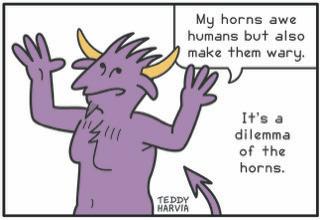
(12) TEDDY HARVIA CARTOON. Yes, this seems pretty disturbing…
Since 1978, every new group of NASA astronauts has included women and usually reflected a multiplicity of races and ethnicities.
That is not simply by chance. NASA’s process for selecting its astronauts is not entirely gender- and race-blind. With so many outstanding applicants, choosing a diversified, highly qualified group of candidates has been achievable, said Duane Ross, who worked as manager of NASA’s astronaut selection office from 1976 until he retired in 2014.
“You didn’t lose sight of wanting your astronaut corps to be reflective of society,” he said.
Over most of its history, NASA has risen above partisan bickering, with broad support in Congress from Republicans and Democrats, conservatives and liberals. But the makeup of its most visible employees — its astronauts — could now collide with President Trump’s crusade against programs that promote diversity, equity and inclusion — or D.E.I.
For NASA to consider race and gender at all in the choosing of astronauts appears to run counter to an executive order that Mr. Trump signed on Jan. 22. That order declares that hiring for federal jobs will “not under any circumstances consider D.E.I.-related factors, goals, policies, mandates, or requirements.”
On the same day, echoing language in a template used by agency heads across the federal government, Janet Petro, the current acting administrator, told NASA employees that D.E.I. programs “divided Americans by race, wasted taxpayer dollars, and resulted in shameful discrimination.”…
… Even during Mr. Trump’s first term, diversity and inclusion was a priority for top NASA officials. The administrator then was Jim Bridenstine, a former Republican congressman from Oklahoma, and in 2020, he added “inclusion” as the fifth core value for the space agency, joining “safety,” “integrity,” “teamwork” and “excellence.”
Under Mr. Trump, NASA also promised that the next moon landing would include a woman astronaut. Under President Biden, NASA broadened that promise to include a “person of color,” although not necessarily for the first Artemis program landing.
The embrace of inclusion was also evident last March when NASA issued a call for new astronauts. April Jordan, the current manager of the astronaut selection office, spoke about wanting to choose a group that was reflective of American society….
[Thanks to John King Tarpinian, Chris Barkley, Cat Eldridge, SF Concatenation’s Jonathan Cowie, Steven French, Kathy Sullivan, Teddy Harvia, Mike Kennedy, and Andrew Porter for some of these stories. Title credit belongs to File 770 contributing editor of the day Andrew (not Werdna).]
(1) TWO BIDS FOR BRITISH EASTERCON. Many times British Eastercon bids have been put together at the last minute, but the committees interested in running the 2026 and 2027 editions are giving fans plenty of advance notice.
2026. The 2026 Eastercon will be held in Birmingham and named Iridescence if this bid is successful. The committee is led by chair Phil Dyson, joined by Phil Nanson, Caroline Mersey, Virginia Preston, James “JT” Turner, and James Shields.
2027. A bid to hold Eastercon in Glasgow is being advanced at the moment by an unidentified “group of fans — some old hands, some newcomers. Mainly Scottish (but not exclusively).” They also haven’t picked a hotel yet. But they do have a webpage, so, hey! (You used to be able to run a WHOIS search to help unravel these mysteries. Folks are too clever now.)
(2) 2025 GRAMMY NOMINEES. The traditional huge list of Grammy Award nominees was released by the Recording Academy® on November 8. The winners will be revealed in a televised ceremony on February 2, 2025. Click here to see all the nominees. You may spot more works of genre interest – please drop a comment with your additions. Meanwhile, here are the ones I recognized.
Best Song Written for Visual Media
“Can’t Catch Me Now” [From The Hunger Games: The Ballad of Songbirds & Snakes] — Daniel Nigro & Olivia Rodrigo, songwriters (OliviaRodrigo)
Best Opera Recording
Moravec: The Shining – Gerard Schwarz, conductor; Tristan Hallett, Kelly Kaduce & Edward Parks; Blanton Alspaugh, producer (Kansas City Symphony; Lyric Opera of Kansas City Chorus)
Best Score Soundtrack For Visual Media (Includes Film And Television)
Dune: Part Two — Hans Zimmer, composer
Best Score Soundtrack for Video Games and Other Interactive Media
Avatar: Frontiers of Pandora — Pinar Toprak, composer
God of War Ragnarök: Valhalla — Bear McCreary, composer
Marvel’s Spider-Man 2 — John Paesano, composer
Star Wars Outlaws — Wilbert Roget, II, composer
Wizardry: Proving Grounds of the Mad Overlord — Winifred Phillips, composer
(3) SLF 2024 GULLIVER GRANT. The Speculative Literature Foundation is accepting applications for the 2024 Gulliver Travel Grant through November 30, 2024. For more information and to apply, visit speculativeliterature.org/grants.
Since 2004, the Gulliver Travel Grant has been awarded annually to assist writers of speculative literature in their non-academic research. These funds are used to cover airfare, lodging, and other travel expenses. Travel may be domestic or international. Grants may be used for travel to take place at any point in the following year. Grant applications are open to all: you do not need to be a member of SLF to apply for or receive a grant.
…So keen is Stephenson’s anticipatory knack, he’s been hired at companies like Blue Origin and Magic Leap just to sit around and think—working at the latter, an augmented reality startup, his title was “Chief Futurist.” It’s therefore surprising that, twenty pages into his latest excursion (then fifty, then seventy), the speculative takes a backseat to history.
The novel, Polostan, is a detective story set mainly in the 1930s, in a slew of cities and rural outposts scattered across the US and USSR. Unlike Stephenson’s previous opuses, which resemble multiple books sandwiched into gigantic tomes—Cryptonomicon and Reamde both clock in at over 1,000 pages—this one is slim, about a third of that size, and boasts a correspondingly streamlined plot….
… Polostan, the first novel in a cycle entitled Bomb Light, features a succession of increasingly intimidating nuclear brainiacs, up to and including the physicist Niels Bohr, whose appearance produces a classic Stephenson cramming session: Chadwich, Joliot, Curie, the discovery of the neutron. “The chain of reasoning,” Stephenson writes, “though long, wasn’t that difficult to follow.” (If you say so!)…
… Stephenson’s scientific narrative shines in a meeting of upper-echelon Russian secret police. It’s the winter of 1934, and they’ve called in some young experts to brief them on atomic physics outside of a labor camp in frigid Magnitogorsk, an industrial town 1,000 miles east of Moscow. “We live in this intermediate layer of medium-sized nuclei that are stable enough to form complicated molecules that support life. Bellow us, massive nuclei are decaying in a hellish sea of lava. Above us, light nuclei are combining to make starlight…”…
In contention: The Diagram Prize for Oddest Book Title of the Year 2024
Boston’s Oldest Buildings and Where to Find Them In this updated edition of Boston’s Oldest Buildings and Where to Find Them, the city’s archaeologist takes you on a whirlwind tour of Beantown, including the delights of the Lemuel Clap House.
Hell-Bent for Leather: Sex and Sexuality in the Weird Western The mass media discussed in Hell-Bent for Leather: Sex and Sexuality in the Weird Western includes “The Texas Chain Saw Massacre”, “BioShock Infinite” and A A Carr’s erotic vampire/monster slayer western Eye Killers.
How to Dungeon Master Parenting Shelly Mazzanoble invites mums and dads to “level up” their child-rearing in How to Dungeon Master Parenting, arguing lessons learned from “Dungeons & Dragons” can help them “win at their most challenging role yet”.
Killing the Buddha on the Appalachian Trail John Turner wrestles with the elements, self-doubt and ageing while he hikes the nearly 2,200-mile path from Georgia to Maine in Killing the Buddha on the Appalachian Trail.
Looking through the Speculum: Examining the Women’s Health Movement Judith Houck’s Looking through the Speculum: Examining the Women’s Health Movement is an “eye-opening” examination of the struggles and successes of “bringing feminist dreams into clinical spaces”.
The Philosopher Fish: Sturgeon, Caviar, and the Geography of Desire “A wild upstream adventure”, raved the New York Post about The Philosopher Fish: Sturgeon, Caviar, and the Geography of Desire—a “high-stakes cocktail of business, crime… and the dilemmas of conservation”.
Respondents from across the industry earned more on average in 2023 than in 2022. The median compensation, which includes base salary plus bonuses and commissions, rose 7.3% over 2022, to $75,000. That increase could be due in part to the success unions and other employee groups had in getting major New York publishers to raise entry-level pay beginning in 2022. Indeed, the share of respondents earning less than $50,000 per year fell to 12% in 2023, from 17% in 2022….
AI Rising
This year’s survey found a huge jump in the percentage of employees who said their companies are using AI: 53%, compared to 23% in 2022. But like everyone else, publishing employees are uneasy about the new technology. Only 25% of survey respondents believe AI will have a positive impact on their jobs, while 40% believe it will have a negative impact. Respondents were even more concerned about how AI will affect the industry in general: only 13% said they believe AI will change publishing for the better, while 56% think the technology will make it worse…
(7) PLAINTIFF WHIFFS AGAINST OPENAI IN COPYRIGHT ACTION. [Item by Francis Hamit.] The Federal Bench hates copyright cases because of their complexity. AI is copyright poison. “Will AI Copyright Claims Keep Standing After New Ruling?” asks Copyright Lately.
…After TransUnion [v. Ramirez, in 2021], legal experts warned that this break from precedent could have sweeping effects, particularly for statutes that provide for statutory damages without proof of actual harm—like the Copyright Act. For copyright claims involving AI, TransUnion could also make it significantly harder for copyright owners to bring claims against AI companies for using their creative works in training data—at least without specific examples of infringing output.
That scenario began to unfold last week, as TransUnion played a starring role in the dismissal of Raw Story Media v. OpenAI (read here). Southern District of New York Judge Colleen McMahon ruled that the plaintiffs failed to show any concrete harm caused by OpenAI’s alleged removal of copyright management information from their articles, which they claim were then used to train ChatGPT’s language model. If Judge McMahon’s reasoning is adopted—or even extended—by other courts, AI-related copyright claims could find themselves on shaky ground, facing stricter standing requirements across a broader range of cases.
Raw Story Media v. OpenAI
In the Raw StoryMedia case, two digital news organizations, Raw Story and AlterNet, claimed that OpenAI violated the Digital Millennium Copyright Act (DMCA) by using their copyrighted articles—stripped of copyright management information (CMI), such as author names and copyright notices—to train ChatGPT. The plaintiffs argued that this violated section 1202(b) of the DMCA, which prohibits the removal or alteration of CMI when the party knows that doing so will facilitate future infringement.
But Judge Colleen McMahon dismissed the case, finding that the plaintiffs failed to allege a “concrete injury-in-fact”—a requirement for Article III standing, which is a threshold question in every federal case…
… The Raw Story Media ruling, with its reliance on TransUnion, raises significant questions about the future of copyright law in the context of AI. If other courts follow Judge McMahon’s lead, copyright owners may find it increasingly difficult to bring cases involving AI training data, particularly if they can’t show concrete harm from the outset.
For now, copyright holders may need to rethink their approach to AI-related claims. Gathering clear evidence of actual harm—such as instances where AI models produce outputs that closely mirror expressive elements from the original copyrighted material—may be essential. In any event, plaintiffs will need to show a real-world impact from the AI’s use of their work or risk seeing their claims fall short.
(8) SFF ON LEARNEDLEAGUE: SCIENCE OF SCIENCE FICTION AND ST:TNG.[Item by David Goldfarb.] The final week of the current “off-season” in LearnedLeague saw two SFF-related One-Day Special quizzes.
Science of Science Fiction 2 had 979 players; I got 10 right and came in 32nd. (Never having read any Alastair Reynolds hurt me.)
Star Trek: The Next Generation had 1412 players; I got 10 right and came in 632nd(!). (Evidently LL players [or LLamas, as we sometimes call ourselves] really remember this show.)
Course Dates: March 10, 2025, to November 17, 2025
Whether you’ve outlined extensively or are navigating by instinct, Clarion West’s nine-month virtual workshop is designed to guide you from conception to completion of your novel.
Led by author and Six-Week Workshop instructor Samit Basu, with the support of the Clarion West team, this program is built around finding your unique process.
(10) TEDDY HARVIA CARTOON.
(11) TODAY’S BIRTHDAY.
[Written by Paul Weimer.]
Born November 11, 1922 — Kurt Vonnegut. (Died 2007.)
By Paul Weimer: My first encounter with Kurt Vonnegut was not actually through his work, but through a movie. Not the movie of Slaughterhouse Five, his best known (an adaptation of perhaps his best novel), although that would come later. No, it came, in all places, in the Rodney Dangerfield movie Back To School. In that movie, Dangerfield, a successful businessman who doesn’t have a college degree, goes to college in order to inspire his son, who is not doing well at the university. But Dangerfield’s character figures he can buy his way to a grade. So, when he needs to do a paper on the work of Kurt Vonnegut…he hires Kurt Vonnegut, who shows up in a cameo in the movie. Dangerfield’s tactic backfires, when his professor tells him “whoever wrote this doesn’t know the first thing about Kurt Vonnegut”
Kurt Vonnegut
Friends, I didn’t know who Kurt Vonnegut was at the time. My high school had not taught him, and I had missed him in my still growing education into SF. But, if you know me by now, I had to know who he was. And so I read Slaughterhouse Five, and Breakfast of Champions, and a variety of other things by him. His biting and unrelenting humor has stayed with me ever since, and “So it goes” is part of my vocabulary.
Speaking of which, funny thing, when I got around to reading Pournelle and Niven’s Inferno, I was shocked and surprised to find that Vonnegut had a particularly prominent place in hell. I think that the reason they put him there as they did (Vonnegut was still alive when they wrote Inferno) is because Vonnegut (like, say, Margaret Atwood or Joyce Carol Oates) vociferously and vocally denied he wrote science fiction, despite all evidence to the contrary.
I am certain that Vonnegut wrote science fiction, but to put him in hell for not saying so…badly done, indeed. But…so it goes.
…But can we just say how relieved we are that the new look at Marvel’s Thunderbolts*—dropped this afternoon at D23 Brazil—finally, kinda, addresses that stupid asterisk in the title? Marvel added the mark to the movie’s name a few months back, and it’s been irritating the hell out of us; from the trailer, it’s apparently just intended as a joke, denoting the black ops super-team’s overall rejection of the goofy name slapped on them by enthusiastic member Red Guardian. So that’s a relief….
Ethan Hunt is back in action, and his latest mission officially has a name: Mission Impossible — The Final Reckoning.
The first trailer for the eighth film in the massively successful spy franchise dropped Monday. With it came the new title, new characters, and a look at more insane stunts by star Tom Cruise in Ethan’s latest mission.
As Ethan hangs from planes and explores submarines, he’s told that “the fate of every living soul is your responsibility,” and that there are consequences for the fact that he refuses to sacrifice those he loves. But as Ethan says, “I need you to trust me … one last time.”
Wicked movie merchandising turned into a nightmare for Mattel over the weekend as news broke that a web address listed on the packaging for character dolls took consumers to an adult pornographic site.
The toy company apologized later Sunday…. “We deeply regret this unfortunate error and are taking immediate action to remedy this. Parents are advised that the misprinted, incorrect website is not appropriate for children. Consumers who already have the product are advised to discard the product packaging or obscure the link and may contact Mattel Customer Service for further information.”
By Sunday afternoon, the entire Mattel-manufactured doll collection had been pulled at Target, and the products with the incorrect website address were being taken off the shelves at other retailers.
But others hope this mistake has only added value in the eyes of discriminating collectors:
…The character dolls being sold with the erroneous address include Grande’s Glinda and Erivo’s Elphaba. The products with misprinted websites have already popped up on eBay for $100 to $800. (The dolls retail for $24.99 to $39.99.)…
ON A RURAL ROAD IN Western Australia, tucked back next to a driveway, there is a traditional London police call box. If you watched the television series Doctor Who, you might suspect that it’s bigger on the inside. This a full-size replica of the TARDIS, the time and space travel machine hidden inside a call box. This one is electrified, with lights and a working control panel. Be careful of the button labeled, “Don’t press this.”
The replica TARDIS is the work of Narrogin local Rob Shepherd, who originally built it as a bus shelter for his daughter. But the distinctive blue call box took on a life of its own and has become something of a pilgrimage site for fans of the show.
Shepherd used plans for a 1947 London police box to design the bus shelter, which went up in 2018. In the years that it has been up on the roadside, the TARDIS has drawn visitors not just from Australia, but all over the world. Shepherd and his family check the guest book inside every time they catch the bus to see where their ever-growing list of visitors have come from…
[Thanks to Teddy Harvia, Mike Kennedy, Andrew Porter, David Langford, Francis Hamit, David Goldfarb, John King Tarpinian, Chris Barkley, Cat Eldridge, SF Concatenation’s Jonathan Cowie, Steven French, and Kathy Sullivan for some of these stories. Title credit belongs to File 770 contributing editor of the day Andrew (Not Werdna) who may know what the title means.]
(1) EDITORIAL PRIVILEGE? Beneath Ceaseless Skies editor Scott Andrews has posted the text of his GoH speech given at World Fantasy 2024 on October 20. His message is: “Not Paying Editors Limits Range of Editorial Voices”.
… one way many indie zines afford all that [they publish] on a shoestring budget is that the editors take no pay.
I take no pay for editing BCS. I’ve put 25 hours or more a week into BCS, for 16 years. (Other than six First Readers, I do everything else: reading pass-ups, developmental editing, line-editing, producing the podcast, maintaining the website, posting social media. I clearly have delegation issues.)
If I was to be paid $10 an hour, 50 weeks a year: in order to fund that, BCS would have to more than double our current support, from Patreon patrons and donations and ebook sales, or cut half our fiction. Plus the time and hassle of doing that additional fundraising, which is considerable and exhausting.
I can afford not taking pay. But that approach of not paying editors means that many editors of indie zines in our field are people of financial privilege. And in our world, financial privilege often correlates with other privileges. So I think this practice of not paying editors of indie zines is limiting the range of editorial voices our field has.
Since I started BCS, our field has broadened vastly in the range of author voices: identities, backgrounds, areas of the world; languages. I believe we need to broaden the range of editorial voices too. To me, figuring out how to pay editors is a key step toward that.
I admit, I don’t have any answers. I’m not a business person. And I’ve got all I can handle just running BCS.
But I call this issue to your attention today because I think we need talk about it. We need ideas….
(2) BOOK AT BEDTIME. [Item by SF Concatenation’s Jonathan Cowie.] The Ministry of Time by Kaliane Bradley (Sceptre – Hodder & Stoughton, £22, hrdbk, ISBN 978-1-399-72634-4) has been made in the past couple of week’s BBC Radio 4’s (formerly the BBC Home Service) Book at Bedtime.
In the near future, a disaffected civil servant is offered a lucrative job in a mysterious new government ministry gathering ‘expats’ from across history to test the limits of time-travel. Her role is to work as a ‘bridge’: living with, assisting and monitoring the expat known as ‘1847’ – Commander Graham Gore. As far as history is concerned, Commander Gore died on Sir John Franklin’s doomed expedition to the Arctic, so he’s a little disoriented to find himself alive and surrounded by outlandish concepts such as the ‘washing machine’, ‘Spotify’ and ‘the collapse of the British Empire’. With an appetite for discovery and a seven-a-day cigarette habit, he soon adjusts; and during a long, sultry summer he and his bridge move from awkwardness to genuine friendship, to something more. But as the true shape of the project that brought them together begins to emerge, Gore and the bridge are forced to confront their past choices and imagined futures. Can love triumph over the structures and histories that have shaped them? And how do you defy history when history is living in your house..?
The BBC’s forthcoming TV adaptation (as opposed to the episodic audio book) of this novel has attracted a claim of plagiarism by those who made the Spanish TV series El Ministerio del Tiempo [The Ministry of Time].
Irrespective of plagiarism claims (time travel is a fairly common, if not standard, SF trope and the commonality of title could be happenstance – the book has its differences) the BBC has the rights to make a TV mini-series, so it is likely they used the copyright permission for this to also make an episodic audio adaptation. Each episode is 15 minutes long so with 10 episodes that’s 150 minutes (or two-and-a-half hours in old money) of audio book.
(3) DEATH IS SUPER BAD. “I’m So Sick of the Death of Superman” declares Charlie Jane Anders at Happy Dancing. The latest iteration prompted her to go back and look at the first comic book death. Which wasn’t great either.
…There’s a funeral, and eventually four imposter Supermen show up — everybody can kind of tell they’re imposters, but they hang around for ages. At last, Superman comes back to life, but now he’s wearing a black version of his famous uniform, plus he now has a mullet.
That’s it, that’s the whole story.
How does Superman come back to life? I honestly can’t say. I realized several years ago that I couldn’t remember how Superman was resurrected in what’s now packaged as The Death and Rebirth of Superman, so I went back and reread the original comics to find out. And now, once again, I can’t remember, because it’s that memorable. I know that Superman meets his human dad, Pa Kent, in the afterlife, and Pa Kent talks to him about why it’s generally a good thing to not be dead. I know there’s some more Kryptonian bullshit. But beyond that, it’s a bit of a blur….
(4) OCTOTHORPE. In episode 121 of the Octothorpe podcast, “All About the Vibes”, John Coxon, Alison Scott, and Liz Batty discuss Grass by Sheri S. Tepper, which was a finalist for the Hugo Award in 1990.
This is Alison’s pick for John and Liz to read, and we go into some of the themes of the book and whether or not female authors are as well-remembered as men (spoiler: no).
As a cult series of 20th-century children’s books, the Moomins have sold up to 30m copies worldwide. Now, extensive humorous notes that their Finnish creator, Tove Jansson, wrote on each of her lovable trolls with hippopotamus snouts are to be published for the first time, 25 years after her death.
Eighty-nine handwritten pages that cast new light on the “small, friendly and adventurous” creatures with fur “like velvet”, have been rediscovered among hundreds of thousands of items in her sprawling archive.
James Zambra, her great-nephew and a director of Moomin Characters, which manages her legacy, said: “This was actually in one of her notebooks. It’s fantastic. Getting Tove’s own thoughts on the personality traits of the characters is fascinating.”…
A former researcher at OpenAI has spoken out against the company’s use of copyrighted data in a detailed, publicly posted analysis, reported on further by the NYT (which is suing OpenAI for copyright infringement). Suchir Balaji left OpenAI in protest “because he no longer wanted to contribute to technologies that he believed would bring society more harm than benefit.”
Early versions of the company’s technology were treated as research projects, which meant employees felt free to train them on any data without worrying about permissions and usage, Balaji told the Times. But as ChatGPT-4 became a commercial product, OpenAI failed to meet the rules of fair use, he said. According to Balaji, ChatGPT’s outputs aren’t significantly different from its inputs — which are copied in whole — and the outputs directly compete with the copyrighted work that it used for training.
Further, according to Balaji, “As A.I. technologies replace existing internet services, they are generating false and sometimes completely made-up information — what researchers call ‘hallucinations.’ The internet, he said, is changing for the worse.”…
While generative models rarely produce outputs that are substantially similar to any of their training inputs, the process of training a generative model involves making copies of copyrighted data. If these copies are unauthorized, this could potentially be considered copyright infringement, depending on whether or not the specific use of the model qualifies as “fair use”. Because fair use is determined on a case-by-case basis, no broad statement can be made about when generative AI qualifies for fair use. Instead, I’ll provide a specific analysis for ChatGPT’s use of its training data, but the same basic template will also apply for many other generative AI products….
Frank Miller: American Genius documents the unique journey of an unparalleled American artist. The film explores the near half-century career of the legendary comic book artist and writer. Made for his fans following a near death experience, the documentary delves into Miller’s radical and defining influence on art, storytelling and culture.
(8) TODAY’S BIRTHDAY.
[Written by Paul Weimer.]
Born October 24, 1952 — David Weber, 72
By Paul Weimer: Sometimes the subtext is the text. A lot of space opera has the subtext of being naval adventures in space, ranging from the original Star Trek on to the present day. It is no surprise, then, that David Weber decided to cut straight to the source and have actual naval style military adventures in the stars, with Honor Harrington. His books follow the rise of Harrington in a manner that Hornblower and O’Brian could recognize, and appreciate.
David Weber
With all of the side books and ancillary books in the series, the amount of Harrington stories Weber has produced is staggering, but it is undeniably a gem of an idea he can and has taken advantage of for all it’s worth. I’ve not read all of them, but enough to get a good sampling.
What I like even more is Weber’s Armageddon Reef series. The Safehold books take place on a colony planet where humans have fled after a genocidal attack, and have been forcibly reduced in technology in order to evade detection. So we have an alien planet, humans on it, and a lack of space flight. And so Weber adds 18-19th century style naval combat and technology to the mix.
These books, I feel, have to be an even more explicit loveletter to Hornblower and company. The conflict between technology and religion and the problems of separation of chruch and state do elevate these books, I feel, to a question that we face today. While Weber’s novels might be dismissed as just being fun naval and space adventures, there is that undercurrent and layer of engaging with societal questions that make them very worthy of attention.
(10) WHAT IF? MICKEY & FRIENDS AS THE FANTASTIC FOUR. Mickey & Friends will put a spin on classic Marvel covers in 2025 with new Disney What If? Fantastic Four homage variant covers.
Continuing the “What If?” theme, Mickey, Minnie, Goofy, Donald, and more take over as Mister Fantastic, Invisible Woman, Human Torch, and the Thing to recreate the team’s most memorable adventures.
Check out the first two covers, on sale January and February, that pay homage to Silver Age issues: Stan Lee and Jack Kirby’s Fantastic Four #3 and #51. For more information, visit Marvel.com.
A rare carbon typescript of Antoine de Saint-Exupéry’s Le Petit Prince featuring extensive handwritten corrections by the author is going up for sale. It is one of only three known copies and marks the first time a typescript of the classic story has been offered for public sale.
The artefact features what is believed to be the first written appearance of the famous lines: “On ne voit bien qu’avec le cœur. L’essentiel est invisible pour les yeux,” translated to mean: “It is only with the heart that one can see rightly. What is essential is invisible to the eye.”…
… The typescript is priced at $1.25m. It will be showcased at Abu Dhabi Art, an annual art fair taking place at the end of November.
‘Have you seen Schinkel Pavillon’s H.R. Giger show?’ has been the question of the month in Berlin. In fact, the exhibition pairs the late Swiss artist with the South Korean sculptor Mire Lee, a detail that has mostly footnoted ensuing conversations. Although it’s hardly a surprise. An obvious novelty factor accompanies this appearance of Giger’s sculptures, paintings, drawings, and prints which – due to their creator’s work on the Alien film franchise (1979–2017) – fundamentally impacted society’s collective imagination of the far-flung other. But interesting questions also arise from this hagiographic netherworld. Namely, whether the show participates in a meaningful conversation – about our erotic and paranoid relationship to the unknown, say – or just satisfies current nostalgic tastes, if not contemporary art’s populist drift.
With her best work having as much guts as Giger’s aliens, many of Lee’s sculptures are abject biomechanical masses, made from concrete, silicon and steel, and sometimes veined with ooze-pumping tubes. From beyond the grave, Giger has contributed Necroconom (Alien II) (1990) – a life-size sculpture of the infamous alien Xenomorph, who crawled on knees and fore-talons, as much like a purring pole dancer as a menacing hunter, its exoskeleton made from sexy black polyester….
…More affecting in its provocation of bodily and existential tremors is Lee’s Untitled (2021), a small conflagration of metallic and silicon cables, bound to a motor, which churns slowly in a spot-lit pool of its own broken refuse, on the floor of an eerie basement room, dark and tiled like an abandoned shower. Simultaneously invoking a disembodied machine component or body part, the piece harks back to classic existential concerns: the feeling of crawling through life, forever breaking apart, suspended between humanity and technology, and wondering why we even bother. Less effective were a number of Lee’s larger works, which gestured towards sensational corporeal impact, without quite delivering: The Liars (2021), a foreboding hanging mass made from towels, chains, fabric and silicon, suggested a horrific meat locker, without being all that horrific, while its companion piece, Carriers: Offsprings (2021), finds slime pulsing through masses of hanging tangled transparent tubes, like entrails simulated in a theme-park haunted house….
‘HR Giger and Mire Lee’, 2021, exhibition view, Schinkel Pavilion, Berlin
(14) COSMIC BANGERS. [Item by SF Concatenation’s Jonathan Cowie.] An astrometric analysis of Gaia data identified two waves of massive runaway stars that have been dynamically ejected from the young cluster R136 in the Large Magellanic Cloud.
Researchers used data from the European Gaia Space Telescope to discover 55 high-speed stars launched from the young star cluster R136 in the Large Magellanic Cloud, a satellite galaxy of the Milky Way. The young cluster R136 has launched as many as a third of its most massive stars in the last few million years, at speeds above 100,000 km/hr. Those stars travel up to 1,000 light years from their birthplace before exploding as supernovas at their end of life, producing a neutron star or black hole.
“The Wizard of Oz” works on another level as an adult. Welcome to MsMojo, and today we’re counting down our picks for the wonderful, wizardly, and weird things about “The Wizard of Oz” that might have grabbed their broomsticks and flown over our heads when we were kids.
[Thanks to Teddy Harvia, Mike Kennedy, Andrew Porter, John King Tarpinian, Chris Barkley, Cat Eldridge, SF Concatenation’s Jonathan Cowie, Steven French, and Kathy Sullivan for some of these stories. Title credit belongs to File 770 contributing editor of the day Jon Meltzer.]
(0) TODAY’S TITLE INSPIRATION. Daniel says he found retroactive inspiration in the fact that the group Them which performed “G-L-O-R-I-A” included Van Morrison.
(1) WEIRD NATURE. “The author has no problem embracing the inscrutable and uncanny; it’s what fuels his fiction” says Publishers Weekly: “Jeff VanderMeer Journeys into the Unknown”.
…The fantastical petri dish of Area X springs largely from VanderMeer’s experiences with nature and wild spaces. His parents were Peace Corps volunteers in Fiji when he was a boy. “It was pretty much what you’d expect from a tropical paradise,” he says. He would marvel at the eels and frogs at the local botanical gardens, and his father, an entomologist, would take him out to see the rhinoceros beetles on the region’s outer islands. He learned at an early age to experience a certain awe of the natural world. But he also suffered from serious asthma attacks and allergies.
“There was this weird contrast between things being so beautiful and also sometimes feeling very physically miserable,” he says. “That was a juxtaposition that I think comes through in the work, where you have really beautiful things, and then things that are disturbing or unsettling at the same time.”…
The ISS is almost a time capsule, hearkening back to the end of the Cold War. It now looks likely that Russia will pull out – or be ejected – from the mission before its projected end date of 2030.
Viewed from the ISS, no borders are visible, and the crew joke comfortably about their national differences. However, their lives are nevertheless dictated by strict and sometimes petty rules governing, for example, which toilet and which exercise equipment to use. These regulations are just one more banal reality of life on the ISS, like muscle atrophy, blocked sinuses or packing up waste to go in the next resupply craft….
…Harvey manages to convey that these details are quotidian. But she also imbues them with beauty. During one conversation in Orbital, a character sheds four tears. He and a crew mate then chase down each floating water droplet because loose liquids must be avoided. It’s a small moment that says so much with few words.
Orbital has been shortlisted for both the 2024 Booker Prize (winner to be announced on 12 November) and the 2024 Ursula K Le Guin Prize for Fiction (the winner of which will be announced on 21 October). The recognition reflects the book’s combination of literary prose and unusual globe-spanning (indeed, beyond global) perspective. Harvey’s writing has been compared to Virginia Woolf – a comparison that is well warranted. And yet Orbital is as accessible and educational as the best of popular science. It’s a feat almost as astonishing as the existence of the ISS….
To quote Heath Ledger’s version of the clown prince of crime, maybe some wag should be scrawling “Why so serious?” on glass-fronted offices at Warner Bros Discovery this week, as executives there contemplate the box-office implosion of Joker: Folie à Deux. A catastrophic $37.7m opening weekend, the largest second-weekend drop for a DC film (81%), a worldwide take currently standing at a piddling $165m … how has the studio gone from the 2019 original, a billion-grosser that was then the highest earning R-rated film, to this?
If nothing else, the Joker is proving true to his reputation as an agent of chaos. But he is also the most beloved of comic-book villains from a storied franchise; a draw almost on par with Batman himself, making the disaster all the more unthinkable. With bubonic word of mouth, Joker: Folie à Deux is now projected to lose $125m-200m, depending on whose budget estimate you believe. If it’s the $300m figure being generally touted for production and marketing, then this is clearly what has hobbled the film; it would leave it needing as much as $475m to break even. Risky reinventions of hallowed pop-cultural icons are a lot more feasible on the first film’s sensible $60m budget.
… But chastising the fanbase so openly is tantamount to box office self-harm (probably why the director refused to test-screen Joker: Folie à Deux). The impunity of a $300m budget seems to have led Phillips to mistake this for an auteur film, and shooting during a period of regime change at both Warner and DC reportedly allowed him to operate with weak oversight. According to Variety, he refused to liaise with new DC heads James Gunn and Peter Safran, saying: “With all due respect to them, this is kind of a Warner Bros movie.” But he also pushed back on new Warner president David Zaslav’s suggestions for lowering the budget, including moving the shoot to London rather than Los Angeles….
The Channel Island fox is pure California: an animal unique to the coastal islands in the southern part of the state, whose habitat, once threatened to the point of extinction, is now thriving due to conservation. Fuzzy, the playful Channel Island fox depicted at right, exemplifies the spirit of California and joins us on our expedition to LAcon V in 2026 as our official convention mascot.
Artist Teddy Harvia has captured Fuzzy’s likeness so elegantly, yet so playfully, through many illustrations yet to be revealed by LAcon V. Fuzzy will join us throughout the next two years on all our adventures, all hand-drawn by Teddy.
Fuzzy has been named in honor of our friend and colleague, Marilyn “Fuzzy Pink” Niven, a long-time participant in Southern California and American science fiction fandom and the wife of celebrated author Larry Niven. Fuzzy Pink Niven passed away in December 2023, leaving behind a legacy of friendship and service to fandom that can never be replaced. We could think of no greater tribute to her than to bring her spirit along with us on our adventure, and we are very grateful to Larry for his blessing….
(7) TODAY’S BIRTHDAY.
[Written by John Hertz, Laura Molesworth and Mike Glyer.]
Born October 18, 1924 — Voltaire Molesworth. (Died 1964.) Vol Molesworth was an Australian fan historian and small press publisher. In 1939 he co-founded the Futurian Society of Sydney – which suffered endless keruffles, like so many fan groups — and started the fanzine Luna. The next year he also published Cosmos.
Being a diabetic, Vol (as he was known) was ineligible for service in World War II but during these years he gained his wide experience in all aspects of journalism. He also wrote fiction. By the time he was 20 Vol had written a number of short novels published in paperback, the most widely known being his science fiction novel The Stratosphere Patrol.
He led a revival of the Sydney Futurians in 1947, becoming one of the leading Australian fans in the 1950s. He played a major role in the three Australian Natcons held in Sydney during the ’50s. He founded and operated the Futurian Press.
Molesworth wrote A History of Australian Science Fiction Fandom 1935-1963 and the earlier An Outline History of Australian Fandom I.
Outside of fandom, he was a mathematician and amateur radio operator and managed the University of New South Wales’ radio station. He was married to Laura Molesworth.
(8) MEMORY LANE.
[Written by Cat Eldridge.]
Anniversary — Farscape: The Peacekeeper Wars (2005)
Once upon a time, a beloved SF series got cancelled, and yes there is absolutely nothing unusual in that happening, it happens more often than it should. What is extremely unusual is that it got a second chance to have a proper ending in the Farscape: The Peacekeeper Wars, seventeen years ago.
So let’s tell the tale of how that happened. Farscape arrived here twenty-three ago when Deep Space Nine was just wrapping up and Voyager was well into its seven-year-run. It started fine and ratings were strong until the fourth season and that, combined with regime change here in the States on who was picking up the tab for the two million dollars per episode led an abrupt end.
Fans being fans weren’t going to let things end that way, nor should we. (Yes, I loved the show. Deeply, unreservedly. I think it was one of the best series ever made, if not the best.) A massive campaign was undertaken with of course emails, letters, phone calls, and phone calls pleading with the network to reverse the cancellation.
Even Bill Amend who created the Fox Trot series had his Jason Fox character direct his ire at SciFi and demand that they change their mind.
Well, they did, sort of. A fifth season didn’t happen after all. What did happen in some ways I think was even better though I know that isn’t a popular opinion among those who wanted a full season.
What we got was the two episode, one hundred-and eighty-minute Farscape: The Peacekeeper Wars which I thought splendidly wrapped things up. Every single storyline that wasn’t dealt with during the series was during this film.
SPOLER ALERT HERE.
We got a baby too. Yes, our Peacekeeper gives birth in a fountain in the middle of a firefight, insists she’s married while in labor, carries her baby unscathed through a battle. I assume that the baby was a puppet from the Henson labs. It was terribly cute.
END OF SPOILERS
I’ve watched it at least a half dozen times, probably more, in the last fifteen years. The Suck Fairy in her steel toed boots is obviously scared of those Aussie actors (and the non-Aussie one as well) as she slinks away to harass someone else.
Just looked at Rotten Tomatoes — not at all surprisingly, it carries a ninety-two percent rating among audience reviewers there. It’s streaming at Amazon Prime and Peacock. .
(9) COMICS SECTION.
Off the Mark offers some old celebrity head shots.
Bizarro says in another reality this guy is delusional.
The New York City Department of Transportation announced it is selling a limited number of “Stan Lee Way” commemorative street signs through the Department of Citywide Administrative Services’ CityStore. The master comic book writer grew up in the Bronx, attending DeWitt Clinton High School.
“A cultural icon, Stan Lee, has gifted the world with stories that captivate, inspire, and make us believe in the heart of a hero,” said NYC DCAS Commissioner Louis A. Molina. “With this sign release, you have a chance to gift yourself or the superhero in your life a piece of history.”
In 2021, the city co-named a portion of University Avenue between Brandt Place and West 176th Street where he lived, “Stan Lee Way”. The Bronx native revolutionized the comic book world by developing complex characters with relatable flaws and layered plot lines.
The Penguin star and executive producer Colin Farrell was joined on Thursday at New York Comic Con for a mid-season discussion by showrunner and fellow EP Lauren LeFranc, as well as co-stars Cristin Milioti, Rhenzy Feliz, Deirdre O’Connell, Michael Kelly, and Clancy Brown, where they debuted two sneak peaks for the crowd for episode five, before going in-depth on what’s motivating the characters.
In the first clip, Oz (Farrell) and Victor (Feliz) share a sentimental moment where they discuss their relationship loyalty, while Oz’s car burns in the background. “It’s you and me now, kid until the end,” Oz says, before he and his henchman make a surprise visit to rough up Sal’s (Brown) son, before paying him and his wife a visit in prison to set up an exchange…
Robots are in exile and Millie Bobby Brown is on the road to revenge in Netflix’s star-studded sci-fi adventure, set in the apparently “retro” ’90s (fml).
Based on Simon Stålenhag’s graphic novel and directed by the MCU’s Anthony and Joe Russo, The Electric State sees Brown in the lead as Michelle, a teen without a family who meets a robot called Cosmo. But surprise, Cosmo is controlled by a human — her long lost brother no less! He’s across the country somewhere, and there’s sinister circumstances afoot, so Michelle and Cosmo hit the road to find him….
[Thanks to John King Tarpinian, Chris Barkley, Cat Eldridge, SF Concatenation’s Jonathan Cowie, Steven French, Kathy Sullivan, Teddy Harvia, Mike Kennedy, and Andrew Porter for some of these stories. Title credit belongs to File 770 contributing editor of the day Daniel Dern.]
(1) UNCANNY DELUGED WITH AI SUBMISSIONS. Michael Damian Thomas of Uncanny Magazine announced on October 10 that the volume of AI submissions has caused a delay in their responses to writers.
Then he later followed up with these additional thoughts:
Some quick notes. 1- We don't use AI detectors. 2- We'll only ban a submitter if we were positive of AI use. 3- We have no plan to ever permanently close unsolicited submissions. The plan is to just take longer processing submissions. Not our favorite, but that's where we're at. https://t.co/mYn58sVsX2
Since the Uncanny AI thing went viral, here are some of my thoughts.
1- There are plenty of people out there desperate to be published or to remain publishing. "Shortcuts" are going to get used. Ask any teacher/professor about plagiarism and current AI use for academic writing.
3- The only negative effect for Uncanny is longer submission processing time. (It's very unlikely we'd ever get fooled by an AI story.) It's not optimal, but unfortunately writers will have to get used to waiting for decisions a bit longer like we did back in ye olde SASE days
The research for Deeper Cut: Lovecraft, Miniter, Stoker: the Dracula Revision required an examination of the history of the Dracula manuscript and an evaluation of the textual variations in order to evaluate whether there was any place in the timeline for Edith Miniter, as Lovecraft alleged, and to judge Bram Stoker’s involvement with changes to the text before and after publication.
One of the most notable developments in Dracula studies in recent years has been the discovery of and translation into English of the 1899 Swedish translation Mörkrets Makter (translated into English as Powers ofDarkness), which was serialized in in the newspaper Dagen, and 1901 Icelandic edition Makt Myrkanna (also translated into English as Powers of Darkness) serialized in the newspaper Fjallkonan. What has become apparent, however, is that there were also numerous Dracula serializations in English-language newspapers in the period 1899-1928. Thanks to the digitization of old newspaper archives and online subscription services, these newspaper serials, which have received rather scanty attention, are more accessible today than they were previously. Enough that a survey of the extant texts is warranted….
… There may well be additional newspaper serializations of Dracula besides these; these are just the serials available via newspapers.com as of the time of this writing. Links will be to the full pages, as clips tend to come out illegible….
(3) JOY DAVIDMAN AT THE LONDON CIRCLE. Rob Hansen has assembled excerpts of fannish memoirs about “C.S. Lewis & The London Circle” at Fiawol.org. A great deal of it is about Joy Davidman’s attendance at pub meetings of the London fan group.
[SAM YOUD, who wrote as “John Christopher”] …Joy herself I got to know quite well. We drank bitter together and argued endlessly through those Thursday evenings. Joy never stopped arguing, and we derived much mutual pleasure from the exercise.
She had endured a cruelly-hard childhood, involving a range of diseases that included curvature of the spine, exaggerated insulin secretion resulting in excessive appetite and a weight problem, and Grave’s disease – hyperthyroidism. For the last she was treated by a doctor who required her to wear a radium collar around her neck, weekly for a year. It appeared to cure the condition, but one can speculate on the cost in later life. I did not know any of this before reading AND GOD CAME IN, her biography by Lyle Dorsett, published in 1983. Nor did she talk about her achievements as an award-winning poet, her authorship of two well-regarded novels, or her stint in Hollywood as a screenwriter. Perhaps she did not want to belittle our petty triumphs in sales to Astounding Stories or Galaxy or New Worlds….
A Japanese anti-nuclear weapons group made up of survivors of the atomic bombings in Japan during World War II has won the 2024 Nobel Peace Prize.
The Norwegian Nobel Committee said it has awarded the Japanese organization Nihon Hidankyo “for its efforts to achieve a world free of nuclear weapons and for demonstrating through witness testimony that nuclear weapons must never be used again,” sending a message to countries that are considering acquiring or threatening to use them.
Committee Chair Jørgen Watne Frydnes said Nihon Hidankyo, made up of survivors of the August 1945 nuclear bombings of Hiroshima and Nakasaki by the United States, has been instrumental in the global movement that has kept nuclear weapons from being used in conflict for 80 years….
… At a press conference in Hiroshima, Nihon Hidankyo’s co-chair, Toshiyuki Mimaki, 81, held back tears and pinched his cheeks when the award was announced. “I can’t believe it’s real” he told reporters.
Mimaki is a Hiroshima survivor and said the award helped recognize the group’s work. “It would be a great force to appeal to the world that the abolition of nuclear weapons can be achieved,” he said.
He said the idea that nuclear weapons bring peace to the world is wrong.
“It has been said that because of nuclear weapons, the world maintains peace. But nuclear weapons can be used by terrorists,” he said. “For example, if Russia uses them against Ukraine, Israel against Gaza, it won’t end there. Politicians should know these things.”…
…Around the world, Indigenous communities have passed rich storytelling traditions from one generation to the next from time immemorial. Many of the stories have been lost in the upheaval and destruction of the colonial era. Selfless heroes and bold tricksters alike have been forgotten, or faded to a mere wisp of collective memory. But the monsters, ah, the monsters. Ferocious, fanged, skulking, slithering, they seem to have endured better than most. These beings still haunt—and hunt—from Australia to Brazil, Lake Victoria to Lake Winnebago. Here are some of the most memorable ancient terrors from Indigenous lore that still send chills down our spines.
Few monsters from Indigenous folklore can boast of making it in Hollywood. There’s Krampus, a modern amalgamation of deeply ancient Central European traditions, and the wendigo, which first terrorized the Algonquin, Ojibwe, and other Anishinaabe peoples around the North American Great Lakes. We’ll leave it to you to decide whether the 2021 movie Antlers does justice to the wendigo’s ferocity, but we’re betting the wendigo doesn’t care. It’s too busy looking for its next victim. A potent symbol of human greed, the emaciated creature is insatiably hungry and appears in the lean and desperate season of winter. In the 19th century, some documented regional cases of cannibalism and other unspeakable acts were chalked up to individuals “going wendigo.”
(6) FANTASY STUDY. Adam Roberts, winner of the John W. Campbell Memorial Award for Jack Glass, a three-time BSFA Award winner, and Professor in Nineteenth Century Literature and Culture at Royal Holloway, University of London, UK, will have a nonfiction book Fantasy: A Short History out in April 2025 from Skylight Books.
One of the most popular genres of modern times, fantasy literature has as rich a cultural and literary heritage as the magical worlds that so enrapture its readers. In this book, a concise history of the genre, Adam Roberts traces the central forms and influences on fantasy through the centuries to arrive at our understanding of the fantastic today.
Pinning the evolution of fantasy on three key moments – the 19th-century resurgence of interest in Arthurian legend, the rise of Christian allegory, and a post-Ossian, post-Grimm emergence of a Norse, Germanic and Old English mythic identity – Roberts explores how the logic of ‘the fantastical’ feeds through into the sets and trappings of modern fantasy. Tracking the creation of heroic and high fantasy subgenres through antiquarian tradition, through C. S. Lewis and J. R. R. Tolkien and into the post-Tolkien boom in genre fantasy writing, the book brings the manifestation of the fantastic beyond literature into art, music, film and TV, video games and other cultural productions such as fandoms. From Tennyson and Wagner, through Robert Graves, David Jones, Samuel Delany, Dungeons and Dragons, Terry Pratchett and Robin Hobb, to the Game of Thrones, Skyrim, The Witcher and The Lord of the Rings media franchises, the book digs into the global dissemination and diversity of 21st-century fantasy. Accessible and dynamic, wide-ranging but comprehensive, this is a crash-course in context for the most imaginative form of storytelling….
(7) TEDDY HARVIA CARTOON.
(8) MEMORY LANE.
[Written by Paul Weimer.]
Anniversary: Star Trek’s “Mudd’s Women” (1966 on this date)
By Paul Weimer: Harry Mudd is, for all being a reprobate, cheat, con man, and sneak, is one of the iconic characters of all of Star Trek. In a supposedly glorious Federation, it is heartwarming in a way to see a character as mercilessly mercenary as Harry Mudd come on screen.
“Mudd’s Women” is his first appearance. (he would be in one more TOS episode, an animated episode and surprisingly, also on Discovery (before they go to the future).
“Mudd’s Women” itself is a con man scheme involving a drug to make women appear more beautiful, and Mudd trying to marry them off to settlers while on the drug, and reap the profits. It shows the early “Wagon Train in Space” roots of Star Trek to the fullest, because with just some changes, this could easily be an episode of Bonanza or another Western. And if you look at Mudd’s getup (and that hat), you can totally see it. And Kirk’s clever use of a placebo in the denouement is a positive message that beauty drugs, in the end, pale to self-confidence and real inner beauty.
So it was no surprise when from Santa Rosa County in the panhandle of Florida this past month there came familiar news. A parent, discovering their child was reading something they found problematic, approached a school board and asked that Fahrenheit 451 be removed from the curriculum.
“Filth,” that parent called Bradbury’s work, as she pressed for it to be removed from an eighth grade reading list. The concerned mom leading the banning effort didn’t see its prophetic relevance. All she saw was a vulgarity, the word “bastard,” which she felt was inappropriate for her 13-year-old daughter. “I’m just trying to keep my little girl a little girl,” she said.
This kind of book-banning effort isn’t unusual, but this one was a gut punch. Why? Because the parent organizing the banning effort suggested that Bradbury’s work should be replaced with something more acceptable to her.
Among her suggestions for more “suitable” material: my own dystopian novel, When the English Fall.
I cannot imagine receiving a more troubling and heartbreaking endorsement.
Sure, my Amish protagonist and narrator doesn’t use vulgarity in the face of the world’s collapse. Because he’s Amish. Old Order Mennonites don’t tend to swear like sailors. But my story contains its fair share of death and murder and human horror, at least as graphic as anything you’ll find in Bradbury.
The mother bringing the complaint was concerned at the violence in the book, and worried that the book wasn’t “safe,” and suggested that kids might read about murder and violence and become murderous and violent themselves. As a pastor, I preach the Bible every Sunday, and teach it in classes. My gracious, I can’t imagine a less “safe” book than the Bible. Try reading Genesis sometime. That’s a rough, rough book. My Adult Ed class has been discovering this last month as we’ve been reading it together. Murder? Rape? Betrayal? Incest? Ray Bradbury’s got nothing on the Word of God….
…Musk might see Starship as an ark for all God’s creatures, but environmentalists tell a different story. As Starship prototypes have begun flying from SpaceX’s launch pad in Boca Chica, Texas, they say the company has shown little regard for the wildlife Musk has said he wants to protect.
Now, a review of state and federal records by NPR, including some obtained through a freedom of information request, shows how SpaceX has sometimes ignored environmental regulations as it rushed to fulfill its founder’s vision. With each of its launches, records show, the company discharged tens of thousands of gallons of what regulators classify as industrial wastewater into the surrounding environment.
In response to the discharges of water from the pad, both the Environmental Protection Agency and the Texas Commission on Environmental Quality (TCEQ) have determined that SpaceX has violated the Clean Water Act. Both agencies levied fines totaling more than $150,000 against the company in September….
In one of the most dramatic, high-risk space flights to date, SpaceX launched a gargantuan Super Heavy-Starship rocket on an unpiloted test flight Sunday and then used giant “mechazilla” mechanical arms on the pad gantry to pluck the descending first stage out of the sky in an unprecedented feat of engineering.
The Starship upper stage, meanwhile, looped around the planet and re-entered the atmosphere over the Indian Ocean as planned, enduring temperatures nearing 3,000 degrees as it descended to a controlled, on-target splashdown.
The spacecraft came through the hellish heat of re-entry in relatively good condition, protected by improved heat-shield tiles and beefed-up steering fins that worked as needed while engulfed in a fireball of atmospheric friction.
But the jaw-dropping first stage capture back at the launch pad, using pincer-like arms more familiarly known as chopsticks, was the clear highlight of the giant rocket’s fifth test flight.
Snagging the descending 23-story-tall Super Heavy booster with the mechazilla arms represented an unprecedented milestone in SpaceX’s drive to develop fully reusable, quickly re-launchable rockets, a technological tour de force unmatched in the history of earlier space programs relying on expendable, throw-away rockets….
The world’s biggest anime piracy site, Aniwatch, has recently rebranded itself following a huge rise in infamy.
The popular site “Aniwatch” has changed its domain name to “HiAnime” this week. Users attempting to access Aniwatch received the message: “Aniwatch is being rebranded to HiAnime. You will be redirected to the new HiAnime website in 10 seconds. Or you can also click here to go to HiAnime now.” According to Similarweb, “Aniwatch” is the #1 most accessed anime piracy site worldwide with 136.2 million visitors in January 2024. It’s also 16th overall in the “Streaming and Online TV” category. Aniwatch does not provide an official explanation for the rebranding.
A new report by Torrent Freak adds that a recent ‘dynamic+’ site blocking order in India may have motivated this. This refers to a court-ordered instruction to Internet Service Providers (ISPs) to block access to a website, with the theory proving especially likely given that India is Aniwatch’s biggest user base…
(14) VIDEOS OF YESTERDAY. [Item by Mike Kennedy.] Last night’s Saturday Night Live had several items that could be considered anything from genre adjacent to vaguely kind of sort of adjacent to genre adjacent. It depends on how you look at it. And how hard you squint.
This one is definitely horror. But not supernatural horror or anything else that’s really SF-adjacent. More like serial murderer horror. Although, the fantasy talking furniture, bookcases, etc. DO lend more credibility as genre related. I think it’s extremely well-made, considering they (presumably) had less than a week to put it together. “My Best Friend’s House”.
Oh, this one is absolutely solidly genre IMO. You just have to watch it all the way to the end to see why. “The Hotel Detective”.
[Thanks to Steven French, Kathy Sullivan, Teddy Harvia, Paul Weimer, Lise Andreasen, Mike Kennedy, Andrew Porter, John King Tarpinian, Chris Barkley, Cat Eldridge, and SF Concatenation’s Jonathan Cowie for some of these stories. Title credit belongs to File 770 contributing editor of the day Lis Carey.]
(1) SFRA 2025 CONFERENCE AND CFP. The Science Fiction Research Association has announced the theme and Call for Papers for the SFRA 2025 Conference. The event will be held July 30-August 3, 2025 at the University of Rochester in New York state, hosted by the Susan B. Anthony Institute: The program for Gender, Women’s and Sexuality Studies.
The theme will be: “’Trans People are (in) the Future’: Queer and Trans Futurity in Science Fiction”. Submission deadline November 15, 2024.
The tagline for this year’s conference is adapted from an art exhibit by Alisha Wormsley in which her art pieces assert that “there are black people in the future,” as a way to insist that unrelenting antiblackness will not steal the future from black people. Given the perpetual violence trans people are subject to, Wormsley’s insistence on black futurity resonates powerfully in trans contexts as well. Science fiction/Speculative Fiction writers, from Rivers Solomon to Kai Ashanti Wilson to Charlie Jane Anders, are all producing work that imagines trans and queer futurity in powerfully capacious ways, rejecting figurative and literal attempts at erasing trans and queer lives. This year’s conference focuses on issues related to trans and queer themes, though we encourage papers and panel proposals in all areas relevant to science fiction studies.
Full information about the topic is at the link.
(2) OMEGA SCI-FI PROJECT OFFERS WORKSHOPS. The Omega Sci-Fi Project invites L.A. high schools and students to participate in this season’s short science fiction story writing program, both through creative writing workshops and student story submissions.
To schedule a free science fiction creative writing and editing workshop follow this Calendly link: Select a Date & Time
Submissions for their 2024-2025 awards — The Tomorrow Prize and The Green Feather Award — will open on September 4 and run through February 14. Learn about the updated guidelines or submit an entry through their website.
The program’s culminating event is traditionally held at Vroman’s bookstore and where celebrity actors and authors reading selected student works.
… Perhaps in no acceptance speech was that more clear than in Emily Tesh’s, who won the Hugo Award for Best Novel for her science fiction book Some Desperate Glory. Tesh’s speech closed out the night, and after some initial joking about pranking the audience with Bilbo’s birthday speech from The Fellowship of the Rings and vanishing, she buckled down and went straight for the heartstrings. I’ve transposed a good deal of what Tesh had to say about Some Desperate Glory below, so that perhaps you might be as moved reading her words as I was hearing them:
“Here is my hope for this book… I hope this book disappears. I hope it joins the honorable, very honorable ranks of past Hugo winners, which spoke to a particular community at a particular time and not to all of history. And I hope for that disappearance because no one sets out to write a science fiction dystopia wanting to be proved right. And Some Desperate Glory is a book which was inspired by some of the worst of what is happening in the world today”….
Lionsgate is recalling its latest trailer for Francis Ford Coppola‘s epic “Megalopolis,” which featured a littany of fabricated quotes from famous film critics.
“Lionsgate is immediately recalling our trailer for ‘Megalopolis,’” a Lionsgate spokesperson said in a statement provided to Variety. “We offer our sincere apologies to the critics involved and to Francis Ford Coppola and American Zoetrope for this inexcusable error in our vetting process. We screwed up. We are sorry.”…
…In quotes attributed to their reviews of “The Godfather,” the trailer cites The New Yorker’s Pauline Kael as calling it “diminished by its artsiness,” and Village Voice’s Andrew Sarris as criticizing the “sloppy self-indulgent movie.” Other quotes from critics such as Roger Ebert, John Simon, Stanley Kauffmann, Vincent Canby and Rex Reed similarly flash across the screen, offering harsh critiques of Coppola’s work on masterpieces such as “Apocalypse Now.” The idea being these movies stood the test of times — their initial reactions, not so much. “Megalopolis,” which premiered at Cannes, was dismissed by many critics as indulgent and muddled. The new trailer aims to position Coppola’s latest film, as a work of art that will age well, much like its predecessors from the famed director….
One of the critics cited had this to say:
…Variety‘s Owen Gleiberman was incorrectly cited as calling the 1992 film “Bram Stoker’s Dracula” “a beautiful mess” and highlighting its “absurdity” when he reviewed the film for Entertainment Weekly, where he worked at the time of its release.
“Even if you’re one of those people who don’t like critics, we hardly deserve to have words put in our mouths. Then again, the trivial scandal of all this is that the whole ‘Megalopolis’ trailer is built on a false narrative,” Gleiberman said of the trailer’s falsified quotes. “Critics loved ‘The Godfather.’ And though ‘Apocalypse Now’ was divisive, it received a lot of crucial critical support. As far as me calling ‘Bram Stoker’s Dracula’ ‘a beautiful mess,’ I only wish I’d said that! Regarding that film, it now sounds kind.”…
Do you want to read Marvel Comics, but don’t know where to start learning about the original comic versions of the characters and stories that have now become household names thanks to the MCU? The new book Marvel Comics for Dummies has you covered. And yes, that’s “Dummies” meant very affectionately, as is the signature of the Dummies series of books that have offered accessible primers for nearly every topic under the sun.
That now includes Marvel Comics, with the aforementioned Marvel Comics for Dummies book kicking off a series of Marvel related books in the Dummies line, with Captain America for Dummies soon to follow….
…The Marvel for Dummies line will include six titles, with future installments featuring explainers on the Fantastic Four, the Avengers, Spider-Man, and the Marvel Cinematic Universe (X-Men lore seems to have been too dense for even the experts to attempt to condense into one book).
(7) APEX NEWS. Apex Book Company today announced the acquisition of a new novella by Jason Sanford entitled “We Who Hunt Alexanders”.
In this fast-paced story, a neurodivergent monster named Amelia confronts both her mother’s expectations for her life and a gothic city where religious extremists threaten everyone who disagrees with them.
(8) WHILE ONE WAS BANNED, ANOTHER WAS CELEBRATED. Ersatz Culture made a wry comment on X.com:
And just in case anyone thinks I am unfairly picking on Joe Yao – well, the evidence shows that he and Dave McCarty were both heavily involved in the Hugo stats that were published. pic.twitter.com/uGtgb4nvW9
(9) M. J. ENGH (1933-2024). Author M. J. Engh, a SFWA Author Emeritus, died July 11. The SFWA Blog paid tribute: “In Memoriam: M. J. Engh”.
M. J. Engh (26 January 1933 – 11 July 2024), also writing as Jane Beauclerk and Mary Jane Engh, was a librarian, scholar, teacher, editor and writer. She wrote short fiction, non-fiction, and speculative novels, including 1976’s Arslan, later released as A Wind from Bukhara. Engh was honored by SFWA in 2009 with the title of Author Emeritus.
Engh wrote four speculative fiction books, from 1976’s Arslan to 1993’s Rainbow Man. Arslan achieved its success as a primarily underground work, one that dealt directly with the methods of dictators and warlords, including the use of morality and charisma. Engh believed sci-fi writers had a responsibility not to make violence and destruction less horrific, and used the reactions to her novel to note the disconnect of those same readers when dealing with equivalent real-world harm. She also wrote to all-ages audiences, in particular with her work The House in the Snow, illustrated by Leslie W. Bowman. She believed in speaking plainly to children, who she found able to deal with reality and better able to process new ideas than adults….
(10) TODAY’S BIRTHDAY.
[Written by Cat Eldridge.]
August 21, 1967 – Carrie-Anne Moss, 57. Tonight we are looking at Carrie-Anne Moss who most of you will first of think as Trinity in the Matrix franchise, but she has had a much longer genre and genre-adjacent career.
Let’s start with her first role with on Dark Justice, one of the series that made up Crime After Prime Time on CBS. Yes, that was how it was graphically presented in the promos which were brilliantly bright and noisy. The show was about a judge, well two judges in the end, that when a case against them became a vigilante at night.
She was Tara McDonald, an assistant to the first Judge, Judge Nicholas Marshall. He was played by Ramy Zada, a Spaniard, as the series was shot in Spain before the Olympics forced it to be moved to Los Angeles for its two final years.
Next up for her was Liz Teel in Matrix. No, not that Matrix. This one had Nick Mancuso as Steven Matrix, a hitman who is killed during a job and sent to a version of Purgatory called The City In-Between. She owned a gym with him, and she, no surprise, is interested in being lovers with him. Scriptwriters are so predictable.
Next up is, I think genre adjacent at least, which her role in the F/X: The Series based on the F/X film. She was Lucinda ”Luce” Scott, a struggling actress brought in by the crew to act as a body double or ringer whenever one was needed. The series came off as another version of Leverage.
We’ve now reached that Matrix where she played Trinity, a human freed by Morpheus, a crewmember of the Nebuchadnezzar, and later would be Neo’s lover. It would become a true franchise with four live films and an animated anthology with her in all of them.
What else was she involved in? Well, a role that upset the fanboys to no end was her role on Jessica Jones as Jeri Hogarth as in the Marvel Universe, gasp, that is a male role. She also played the character in the Daredevil, Defenders and Iron Fist series.
A series I didn’t know existed was Humans about AIs in human form. It was based on the Swedish Real Humans series. She was Athena Morrow, an AI researcher based in San Francisco who has been invited to reverse engineer the consciousness program.
Finally, well at least for me, she was Master Indara on The Acolyte. I am most decidedly not going to discuss anything about her story here. The series — which was cancelled after a short first season — sounds fascinating.
Today is the opening day of Gamescom, the Cologne expo that is now the biggest event in the video game calendar. This year, I am not among the 300,000-odd crowd descending on Germany, but I did watch the two-hour livestreamed opening-night broadcast yesterday – so you don’t have to. Here is all of the most interesting news, arranged by theme because I am deeply bored of writing straightforward lists of games and trailers.
News that will annoy Xbox fanboys the most There was a new trailer for Indiana Jones and the Great Circle, Bethesda and MachineGames’s new first-person adventure, in which longtime video game actor Troy Baker seems charmingly thrilled to be playing Indiana Jones. It’ll be out on Xbox and PC on 9 December – but it was also announced that it will be coming to PlayStation 5 in spring 2025. Earlier this year, Xbox boss Phil Spencer went to great lengths to reassure Xbox fans that Indiana Jones would not be a multiplatform game, so I’m interested to see how this goes down….
…One actor amongst them is so iconic that he replaced Johnny Depp in the Fantastic Beasts franchise during the infamous defamation trial. We are talking about Danish actor Mads Mikkelsen.
Known for portraying the role of a young Hannibal Lecter in the TV show Hannibal and Gellert Grindelwald in the Fantastic Beasts franchise, Mikkelsen is truly a fascinating villainous actor. As per a report, the actor was in talks with Marvel Studios for the role of Doctor Doom.
However, Marvel Studios allegedly decided to play it safe and hired (or rather re-hired) Downey Jr. for “New mask. Same task”. Sure enough, people were happy to see Downey Jr. return….
Kahhori, the new Marvel hero who debuted in the MCU’s What If…? animated streaming series as one of the first MCU characters with no direct ties to comics, is now coming to the core Marvel Universe in her own comic as part of the Marvel’s Voices line. And it seems that, in what may be a first, the version of Kahhori who will make her debut in comics later this year is not an alternate version of Kahhori created specifically for comics or a Variant of some kind – it’s apparently the exact same character from the MCU.
At least, that’s how Marvel’s official press release for the Kahhori: Reshaper of Worlds one-shot makes it sound. Here’s Marvel’s official description, which by all indications seems to say that Kahhori will be making the jump straight from the MCU to comics, while leaving just enough ambiguity to make the passage slightly less than definitive:
“The Mohawk warrior Kahhori fell into Sky World and into our hearts from her first appearance fighting invaders to her home. She’s already helped save all of reality from a demented Doctor Strange and secured peace in her own world… So what NOW? Award-winning storyteller Ryan Little launches Kahhori into the 616! Chasing a threat out of Sky World, she lands in the fiery streets of Hell’s Kitchen! But culture shock’s gonna be the least of her problems as her strange adversary tears through NYC. Featuring exciting guest stars and the comics debuts of some extraordinary creators, Marvel’s Voices brings you an extra-special anthology celebrating Indigenous heritage and one of the most exciting characters to emerge from the MCU!”
Almost 50 years after “The Rocky Horror Picture Show” debuted, Tim Curry is gearing up for another spooky role.
The veteran actor will return to the big screen as a character in the horror film “Stream,” which is opening Wednesday in select theaters. It will be his first feature film role since the 2010 comedy “Burke & Hare,” even though he has worked on many animated projects as a voice actor since then. He also appeared in the 2016 television film remake of “The Rocky Horror Picture Show” on Fox.
Beyond his “Rocky Horror” role of Dr. Frank-N-Furter, Curry earned his genre bonafides with his performance as Pennywise in the TV miniseries “It,” as well as roles in films like “Legend,” “Clue” and “Scary Movie 2.”…
[Thanks to Teddy Harvia, Mike Kennedy, Andrew Porter, John King Tarpinian, Chris Barkley, Cat Eldridge, SF Concatenation’s Jonathan Cowie, Steven French, and Kathy Sullivan for some of these stories. Title credit belongs to File 770 contributing editor of the day Patrick Morris Miller.]
(1) GRRM AND THE GHOSTS OF GLASGOW. George R.R. Martin told Not a Blog readers that he will be at Glasgow 2024 and has tried to get on program, however several of his proposals did not even get a reply from the committee. “On the Road Again”.
Glasgow has hosted worldcons twice before, and we were at both of those and had a great time. We are hoping this will be as good.
Anyway… I will be in Glasgow, attending the con, but whether you’ll see me, I don’t know. I am not on any programming. It is not for lack of trying, though. I wrote the con’s programming chair back in January, and again in February, asking for his phone number so we could discuss the details. No phone number was forthcoming, alas, just a form letter with a link to an application and a warning that while I was welcome to apply, I could not be guaranteed a place on the programme.
I did not give up there, however. Several months later, when I learned how many of my Wild Cards writers would be at the con (about a dozen, all told), I wrote again and offered to organize a Wild Cards event for them. (We have done Wild Cards events at a dozen past worldcons, everything from traditional panels to trivia contests to cage matches and the like), and they have always drawn a big crowd. I got no reply to that one. A month or so after that, I tried again. Howard Waldrop died in January, and I thought it would be nice to do a memorial panel honoring the man and his work. Several other friends of Howard will also be at Glasgow, and said they would be delighted to be part of such a panel. Alas, no reply to that one either.
As regular readers of my Not A Blog know, I have also been producing a series of short films based on some of Howard’s classic short stories. NIGHT OF THE COOTERS was the first done, and won prizes in half a dozen film fests. MARY-MARGARET ROAD GRADER is hitting the festival circuit this year, and has already won its first prize. THE UGLY CHICKENS, adapted by Michael Cassutt from Howard’s Nebula-winning short, and starring fan favorite Felicia Day, will follow this year. Just saw the final cut, directed by Mark Raso, and it’s just lovely. The films are not in theatres yet, but I offered to screen them in Glasgow, as part of the film programme (if there is one) or that proposed Waldrop Memorial Panel. No response to that offer either.
So… yes, I will be at Glasgow. I will check out the art show, as I always do, maybe attend some bid parties, and I will be wandering the dealer’s room (the huckster’s room, as us old timers call it). The rest of the time I guess I may hang out in the bar, drinking with friends both old and new, toasting Howard and Gardner and all the other friends we lost.
…One of the main events at Worldcon are the Hugo Awards, given out to sci-fi and fantasy authors, filmmakers and creators. That year, the award ceremony was virtual because of the coronavirus pandemic, and Martin was the host. As he puts it in his blog post, “things did not work out well.”
That’s putting it mildly. To make a long story short, Martin was accused on social media and elsewhere of erasing the accomplishments of authors of color, glorifying authors and editors with regressive beliefs, mispronouncing lots of the names on the ballot, making off-color jokes, taking way too long to give his remarks, and generally doing a bad job as host.
The backlash was so bad that the con chairs issued an apology. Martin defended himself by saying he was trying delve into the history of the Hugos and make people laugh, although obviously the approach didn’t work. My read on that situation was that it was a bad match of host and audience. A lot of the acceptance speeches from authors were about the importance of social justice in sci-fi and fantasy, and these people did not want to hear George R.R. Martin talk for hours about long-dead authors with problematic records, let alone endure it for the full length of the three-and-a-half-hour ceremony….
I’m sure that’s part of it. But my personal opinion is a bigger reason was that GRRM devoted a chunk of time during his pre-recorded 2020 Hugo Awards presentation, assisted by Robert Silverberg, glorifying John W. Campbell Jr. This was in the aftermath of Jeanette Ng’s 2019 acceptance speech for the John W. Campbell Award for Best New Writer which heavily criticized Campbell and called him a fascist (see “Storm Over Campbell Award”), a speech that in fact won the 2020 Best Related Work Hugo Award.
I’ve noticed that a lot of beginning writers either view these problems as “a sign I shouldn’t be doing this” or a big personality failing. Well, since I have been doing this since some of you were born, I’m here to tell you that’s not true at all. Everyone has these issues starting out. They are absolutely bog standard, and they smooth out as you practice and learn, and sometimes when you try this “one easy trick.” So in no particular order, here are issues that plague newbies…
One of them is:
I can start stories, but I lose interest and it all dies within a few paragraphs.Or at best halfway through.
Completely normal. That’s because the idea in your head is beautiful and multi-colored and amazing.
But each decision you make limits the choices you can make, so it makes the story less exciting in your brain.
This is a “in your brain” problem. It’s not real. If you push past it, eventually it will stop telling you the story is dead. Better. Once the story is done, you won’t be able to find the place it “died.”
More than 500 authors and book industry professionals have signed an open letter calling on Waterstones to reverse a decision to dismiss an employee who said she would tear up and throw away books written by a gender-critical author.
Figures including Chocolat author Joanne Harris, writer and podcaster Dorian Lynskey, and author and culture journalist Jason Okundaye have backed Tilly Fitzgerald, who posts book-related content and reviews under the username TillyLovesBooks on social media. Fitzgerald was sacked after responding to a post on X by author Christina Dalcher, which appeared to endorse a publishing network for those “concerned about the impact of gender ideology” on the sector. Fitzgerald wrote: “Ooh, I’ll enjoy tearing up your books and popping them in the bin today. Thanks for the heads up.”
Fitzgerald, who had worked for Waterstones as a bookseller since August 2023, explained in a video posted on 8 July that Waterstones had sacked her over her social media activity. “I’ve just been sacked from the only job I’ve ever loved,” she said.
“I told [Dalcher] on Twitter that I was going to throw away her books after I found out that she was a bigot”, Fitzgerald added. “She tagged Waterstones and they have decided to fire me for my social media usage. It’s the first mistake I’ve ever made, I’ve been nothing but an exemplary employee there”.
A spokesperson from Waterstones said Fitzgerald was dismissed “on the grounds of contravening Waterstones policies” and that the decision “has nothing to do with transgender rights”.
“We are an inclusive employer and follow due process in HR matters,” the spokesperson told the Guardian. “For obvious reasons we are unable to comment on the specifics of individual cases.”
Fitzgerald told the Guardian: “My intention responding to Dalcher was only to let her know that I would no longer be supporting her books in my personal capacity as a reviewer.”…
(4) STARSHIP FONZIE REPORTS UPDATE REGARDING KARL KLINGER’S STOLEN BICYCLE. [Item by Eric Hildeman.] Follow-up to the news item regarding steampunk enthusiast Karl Klinger’s stolen bicycle: He’s about to get TWO penny farthings!
A man named Rolly, who is a great guy by all accounts, saw the story about Karl’s bike theft on the news and contacted him to offer Karl his own penny farthing bicycle, which was built in 1979. Last Sunday, Karl procured the bike from Rolly, “for a steal.” (The exact dollar figure wasn’t revealed.) Apparently, Rolly can no longer ride his bike, for whatever reason, and he wanted it to go to a good home. I think we can all agree it certainly has! So, while Karl’s new bike is currently being constructed, he now already has another one!
Rolly apparently modified this bike to go much faster than a normal penny farthing would, which Karl seems to appreciate.
(6) SHELLEY DUVALL (1949-2024). Actress Shelley Duvall died July 11 in her sleep of complications from diabetes at her home in Texas. Just looking at her top genre work, she played Jack Nicholson’s wife Wendy Torrance in The Shining (1980), Olive Oyl in Popeye (1980), Pansy in funny scenes with Michael Palin in Terry Gilliam’s Time Bandits (1981); and Steve Martin’s supportive pal Dixie in Roxanne (1987).
Her TV work included appearances on episodes of The Twilight Zone reboot, and Ray Bradbury Theater.
…Roger Ebert wrote in 1980 that Duvall “looks and sounds like almost nobody else … and has possibly played more really different kinds of characters than almost any other young actress of the 1970s.
“In all of her roles, there is an openness about her, as if somehow nothing has come between her open face and our eyes — no camera, dialogue, makeup, method of acting — and she is just spontaneously being the character.”…
By Paul Weimer: I missed reading a swath of children’s literature because I was always aiming and hoping to read “adult books”. I got annoyed once, while in the hospital, that the playroom only had “baby books” (e.g. Golden readers). As soon as I could contrive to get a library card to get me into the adult section instead of the children’s section, I did. And I mainly read the non fiction books in the children’s section until I could get into the Golden Country of the Adult section. So some of the basics of children’s literature, I frankly only know from cultural osmosis.
E. B. White and his dog, Minnie.
E.B. White is an exception to that, in two particular novels: Charlotte’s Web and Stuart Little.
The first, Charlotte’s Web. Well, you know the story of Wilbur, the pig, saved from death by the clever titular character’s webbing and messages. I came across this story first in the animated movie from the 70’s, and went on to find it in the library and read the original. I enjoyed it even more than the animated movie, which is pretty faithful to the book I found, although it IS a musical, which I will just say was a *choice*. (They aren’t even really good songs, to be honest). Still, the movie and the book were for me what the Lion King was for a generation later, introducing the “cycle of life” (but Charlotte’s Web is a little more gentle about it)
After I read Charlotte’s Web, I then read Stuart Little, since it was sitting right there in the library next to Charlotte’s Web and I was curious. (I also briefly had the wrong idea it was set in the same universe). Still, I was charmed by the idea of the diminutive small Stuart Little being fearless and adventurous, wanting to see the world no matter what. Did Stuart Little help kindle in me my curiosity and desire to see places (and decades later, want to photograph them). Maybe, it’s certainly a working theory. Unlike Charlotte’s Web, I don’t particularly care for the late 90’s movie. I vastly prefer the book (maybe because I read the book first).
Oh, there is one adult book of White’s I’ve read, long ago for AP English: Strunk and White’s The Manual of Style.
THE CLOUDS SEEMED TO BE conspiring against Jimo Pereira last summer. The university student from Buenos Aires spent much of her time curled up in a sleeping bag on the grounds of Eichsfelder Hütte, a hostel deep in Germany’s rugged Harz Mountains. Night after chilly night she’d be out in the open field with her project partner, trying to stay warm. Every so often one of them would get up to check their telescope, but the clouds stubbornly barred their view. Then one night, finally, they saw stars.
For hours, the pair took turns checking the alignment of their telescope and camera every 20 minutes that one clear night. They came away not with an Instagram-worthy time-lapse photo, but with data on two distant stars orbiting each other in what’s known as an eclipsing binary system. The two were not scientists, however. At least, not professionally—not yet. They were participants in one of the world’s most unusual summer camps: One devoted to studying the cosmos in constant motion overhead as the camp itself travels around the globe.
This traveling camp is the International Astronomical Youth Camp, an annual three-week program for 16- to 24-year-old lovers of astronomy that’s held at a different location each year. It’s been running every summer (and the occasional winter) since 1969, and has taken place in 15 different countries so far. In August, Pereira will join more than 60 other campers and 10 volunteers from more than 20 countries for her third camp, this time among the crags of Vogtland in eastern Germany, near the Czech border.’
The director, known for his muscular and high-revving big-screen action franchises such as Bad Boys and Transformers, is in talks to direct Barbaric, an acerbic fantasy series based on the best-selling Vault Comics title.
Netflix has picked up the bold-faced series package, which it will develop with A+E Studios.
Sam Claflin and Patrick Stewart are attached to star in the series, which will be written and exec produced by Sheldon Turner, known for his feature credits such as Up in the Air and X-Men: First Class….
Launched in 2021 and created by writer Michael Moreci and artist Nathan Gooden, Vault’s Barbaric featured a talking demonic axe and Owen, a barbarian looking for redemption.
Claflin is attached to star as Owen while Stewart will provide the voice of the demonic axe….
(11) JUST HOW MANY OF THESE THINGS ARE THERE? “The Ending of Every Jaws Movie, Ranked” — SYFY Wire thinks you deserve to know their opinion. See the results at the link.
When you think about death in the Jaws movies, you’re probably thinking about the hapless beachgoers who are devoured by a giant, bloodthirsty great white shark — while John Williams’ iconic theme plays, of course. But, all four Jaws movies end with another death: that of the shark.
In Jaws (1975), Jaws 2 (1978), Jaws 3-D (1983), and Jaws: The Revenge (1987), some member of the Brody family is, after much struggle, able to kill the Carcharodon carcharias in spectacular fashion, making it safe to get back in the water (for now, at least). Some of these kills are exciting, iconic climaxes that rank up there with the best endings in blockbuster film history. Other endings have, let’s say, jumped the shark.
With it being July, and with all four movies currently streaming on Peacock, we thought it was a good time to rank the shark deaths to determine which Jaws was the best at saying “fin.”…
“They don’t need water to kill!” Wild Eye Releasing has debuted a trailer for a B-movie sci-fi comedy called Space Sharks, the latest from filmmaker Dustin Ferguson. This has already been dumped on VOD and can be watched now, if anyone wants to give it a go? …
[Thanks to Chris Barkley, Cat Eldridge, SF Concatenation’s Jonathan Cowie, Eric Hildeman, Steven French, Teddy Harvia, Kathy Sullivan, Mike Kennedy, Andrew Porter, and John King Tarpinian for some of these stories. Title credit belongs to File 770 contributing editor of the day Maytree.]