Pixel Scroll 6/12/26 My Dear Guests, I Am Mr. Scroll, Your Host. Welcome To Fantasy Pixel

(1) NOMMOS SHORTLIST AND MORE. This year’s Worldcon announced activities to look forward to by “The African Speculative Fiction Society (ASFS) at LAcon V”.

We are thrilled to be partnering with the African Speculative Fiction Society at LAcon V! 

ASFS presents the annual Nommo Awards, which honor outstanding works of speculative fiction by African writers across the continent and diaspora. This year, ASFS will be announcing the shortlisted works live at LAcon via our Virtual Program! There will be introductions and contributions from the nominees, as well as a discussion about the evolution and global impact of African speculative fiction.

In addition to this Celebrating African Speculative Fiction panel, ASFS will be presenting multiple panels as part of the LAcon V Virtual Program.

The full schedule will be released August 2026.

(2) EATING THE FANTASTIC. Scott Edelman invites listeners to chew on peri-peri chicken with Octothorpe’s John Coxon and Alison Scott in Episode 284 of the Eating the Fantastic podcast.

Two Hugo Award-nominated podcasts collide in the fifth and final episode of Eating the Fantastic recorded during this year’s Eastercon. John Coxon and Alison Scott, two-thirds of the award-winning team behind Octothorpe (absent their equally entertaining cohost Liz Batty) took me on walkabout to a nearby Nando’s so I could experience its peri-peri chicken for the first time — and we recorded not just our meal, but the hikes there and back again.

We discussed the many first-time Eastercon attendees I encountered who were there due to their podcast, Nando’s place in British culture and why it was chosen to be our venue for this episode, what they’re willing to reveal about cohost Liz Batty in her absence, how the coming of COVID-19 kickstarted the creation of Octothorpe, why they didn’t launch an old-school fanzine instead, how the first episode wasn’t even originally intended to be the first episode, why we’re still here considering 90% of podcasts don’t make it past three episodes, how to comment responsibly on fandom while being a part of fandom, the reason their letters of comment section is so important, what changed about the show once they realized people were actually listening, advice for those who’d like to start podcasts of their own, plus much more.

(3) SFF REVIEWS. Lisa Tuttle’s “The best recent science fiction, fantasy and horror – review roundup” in the Guardian covers Not With a Bang by Temi Oh; Tillinghast by Clare Cavenagh; Atomic Coffin by Benedict Anning; The Unicorn Hunters by Katherine Arden; and Bad Things Happen Here by Mark Morris.

(4) NOT TO BE READ OUT LOUD. “Silent Movies Jump from Screen to Page in Movie Tie-In Novels” at SFWA’s Planetside.

The first movie tie-in novels date to the rise of silent movies as mass entertainment at the beginning of the 20th century. As with movie tie-in books today, these included both novelizations of screenplays and reissues of published novels illustrated with movie stills.

The novelization of The Adventures of Kathlyn is one of the earliest movie tie-in novelsThis serial began on December 29, 1913, and was shown in movie theaters through 1914. One of the action heroines of silent movies, the film’s star, Kathlyn Williams, was famous for performing with big cats.  The movie took advantage of her talents and first name. Over the course of 13 episodes, the fictional Kathlyn rescues her explorer father and frees the enslaved population of a mythical kingdom. She traverses jungles, battles wild beasts, outwits the insidious Council of Three, and dodges a forced marriage to a foul prince. Each episode ended with a cliffhanger guaranteed to bring the audience back to enjoy the next installment until the story’s happy resolution.

Harold McGrath, who supplied the original story for the screenplay, wrote the novel published by The Bobbs-Merrill Company. The text was illustrated with black-and-white photos from the film. The frontispiece opposite the title page shows Kathlyn clutching the hunter Bruce, who aids her quest to rescue her father and provides a romantic interest.

Newspapers such as the Chicago Tribune and Los Angeles Times also featured stories illustrated with stills from The Adventures of Kathlyn. This was designed to boost sales of the newspapers, the serial, and the book, cashing in on every possible way to keep the public intrigued by Kathlyn’s trials and tribulations. It was all coordinated, with the Chicago Tribune helping to finance the movie production in hopes of boosting their circulation. The Motion Picture News noted film screenings ended with a reminder to read about Kathlyn in the Sunday newspaper, while the newspaper stories urged fans to go to the “picture theater” to watch the next episode….

(5) WALTER SCOTT PRIZE. The BBC reports “‘Most unusual book’ wins Walter Scott historical fiction prize”.

A book which judges said “may be the most unusual book you read this year” has won the Walter Scott Prize for Historical Fiction.

Alice Jolly’s work The Matchbox Girl tells the story of Adelheid Brunner – a mute autistic patient of Dr Hans Asperger in the now-infamous Vienna Children’s Hospital during the 1930s, while the city is under Nazi occupation….

…Judges praised the “originality, innovation, ambition” of Jolly’s work which “confronts a topic of immense complexity in a gripping tour de force”.

“The Matchbox Girl may be the most unusual book you read this year,” they said. “For its honesty, power and storytelling dexterity, our 2026 winner will also be one of the most important.”

Jolly was part of the first ever all-British shortlist for the award.

Speaking of writing the book, she said: “I remain constantly troubled by that age of old question as to how people who were certainly not wholly ‘evil’ nevertheless found themselves drawn into appalling crimes.

“In 2018, two non-fiction books about the history of autism were published which told wildly differing stories about Dr Asperger. My book started with the simple question – who was Dr Asperger?”.

Dr Asperger is known for his work in child psychiatry and identifying Asperger syndrome, a form of autism, in 1944 – however the term “autistic psychopathy” was used until 1981.

In 1981, the British psychiatrist Lorna Wing introduced the diagnosis of Asperger syndrome.

But documents uncovered in 2018 suggested Dr Asperger sent child patients to the Am Spiegelgrund clinic in Vienna, where they were put to death by the Nazi regime.

Jolly said that as she worked on the book she realised that his forgotten colleagues were “perhaps more interesting than he was”.

She said she became obsessed with “bringing them into the light” and celebrating the ways in which they “struggled to hold onto their research, and their principles, despite finding themselves in the eye of the most evil storm of the 20th Century”.

(6) A JANE YOLEN TRIBUTE. Here is the start of Michael Swanwick’s remembrance, “Jane Yolen, 1939-2026” at Flogging Babel.

I was talking with Jane Yolen once, in her house in St. Andrews, Scotland. I told her how much I admired her prolific output of books–something like 400 then, though it’s grown since. She tried to duck the compliment by saying, “Well, yours are so much longer than mine.”

“I’ve read Owl Moon,” I said. (For those who don’t know, it’s an illustrated story sold as a ‘children’s book’ but actually a gem of a prose poem of a reminiscence, possibly true and possibly not.) “How many drafts did that take?”

“A few hundred,” she admitted.

“I rest my case,” I said….

(7) RONNIE SCHELL (1931-2026). “Ronnie Schell Dead: ‘Gomer Pyle: USMC’ Actor Was 94” reports Deadline.

Ronnie Schell, a prolific TV character actor perhaps best known for his portrayal of the amiable Pvt. Duke Slater, pal of Jim Nabors’ hayseed Gomer Pyle on the ’60s sitcom of that name, died of natural causes today at UCLA Hospital in Los Angeles. He was 94….

He worked a lot – the sff TV shows in his resume included The Girl With Something Extra, Mork & Mindy and Phil of the Future.

His genre films included Disney’s Gus, The Shaggy D.A., and The Devil and Max Devlin.

He provided voices on such animated projects as Jetsons: The Movie  as well as TV series including Battle of the Planets and Smurfs.

(8) MARGARET KERRY (1929-2026). “Margaret Kerry Dead: Tinker Bell Model for ‘Peter Pan’ Was 97”The Hollywood Reporter finds that wasn’t her only genre role.

…As a voice actress, Kerry starred on Clutch Cargo in 1959, Space Angel in 1962-64 and Captain Fathom in 1965 — those cartoons used the Syncro-Vox system, with real human lips superimposed over the animated characters’ mouths — and on The New Three Stooges in 1965. She did live segments with Moe Howard, Larry Fine and Joe DeRita as well. All were for Cambria Productions, a company led by her first husband, Dick Brown.

The 5-foot-2 Kerry had starred alongside Eddie Cantor in If You Knew Susie (1948) and was an assistant dance director on the Gloria DeHaven musical I’ll Get By (1950) when her agent sent her to Disney Studios in Burbank to audition for Peter Pan, she recalled in a 2003 interview with Jim Korkis….

… Kerry got the job, reported for work the next Tuesday and on and off for the next six to nine months, she moved around “a great big soundstage that seemed to go on forever” wearing her own one-piece bathing suit and her hair in a bun and being observed by Marc Davis (one of Walt Disney’s “Nine Old Men”) and other animators.

“There was no one for me to react to. I had to imagine almost everything,” she said. “There was an occasional prop like huge scissors or a wire-frame keyhole or something. Most of the time it was just me pretending to be looking up from under something or walking around.”…

…She appeared as a fairy in A Midsummer Night’s Dream (1935) — she said after a studio light caught fire, Mickey Rooney “dragged me into this little two-inch deep stream on the set so I’d be safe from any flames” — and in Our Gang comedy shorts and took dancing lessons from Nico Charisse, husband of Cyd Charisse.

She showed up in The Adventures of Tom Sawyer (1938) and The Star Maker (1939) and was a stand-in for Elizabeth Taylor in National Velvet (1944), then tap-danced and sang as the daughter of Cantor and Joan Davis’ characters in If You Knew Susie. It was Cantor who gave her the stage name Margaret Kerry….

… “You remember the scene where [Tinker Bell] falls over backward in Wendy’s dresser drawer?” she asked Korkis. “Well, they had me falling over backward onto a mattress. The mattress was about a half-inch thick, or at least it seemed that thick, and I went over backward and went thud. The look of my face of surprise and pain was identical to the one Tink has in the finished film.”…

(9) TODAY’S BIRTHDAY.

[Written by Cat Eldridge.]

Born June 12, 1916 – Irwin Allen. (Died 1992.)

So let’s talk about Irwin Allen. While he may be best known for that most spectacular of ocean disaster movies, The Poseidon Adventure, he’s done more than done a reasonable share of genre work.

The first series that he created in the Sixties was Voyage to the Bottom of the Sea, was based off his film of the same name, which aired on ABC from the fall of 1964 to the spring of 1968 making it the decade’s longest-running American science fiction television series with continuing characters. The one hundred and ten episodes produced included the first thirty-two shot in black-and-white, and last seventy-eight filmed in color. 

Next up for him was Lost in Space. Saying it’s based off Johann David Wyss’ The Swiss Family Robinson is really, really stretching things, isn’t it? Be that as it may, the show ran for eighty-three episodes over three seasons on CBS.

Remember The Time Tunnel? Yeah he was responsible for it too. The show ran for one season of thirty episodes from 1966 to 1967 on ABC.  

His run of SF series would be concluded with Land of the Giants, a one-hour series that aired on ABC from the fall of 1968 to the spring of 1970. It was filmed in color. It’s worth noting that five novels based on the television series, including three written by Murray Leinster, would be published while the series aired. 

A decade later, we have a miniseries on that took Robert Bloch and six other scriptwriters to please Irwin Allen, The Return of Captain Nemo (its theatrical title when a shorter, possibly more coherent version had a screen run was The Amazing Captain Nemo). It has been considered an attempt by him to duplicate the success of his Voyage to the Bottom of the Sea. It didn’t. 

Finally, I’ll note that he was responsible for it happening in all aspects possible, a music version of Alice in Wonderland. It aired on CBS over two nights in 1985, and it had an amazing cast of Natalie Gregory (Alice here), Red Buttons, Anthony Newley, Jayne Meadows, Carol Channing, Sammy Davis Jr., Roddy McDowall, Ann Jillian, Pat Morita and Robert Morley. It has an extraordinary rating of eighty-five percent over at Rotten Tomatoes.
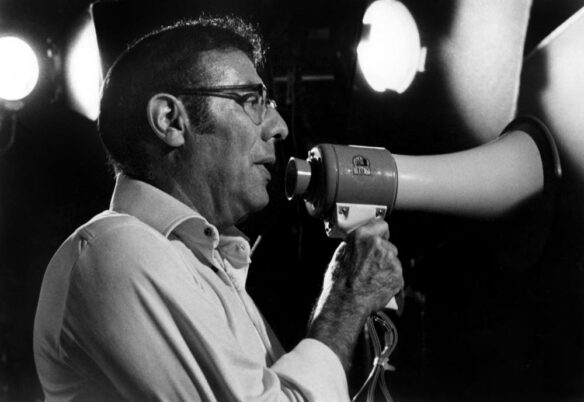
Irwin Allen, 1974

(10) COMICS SECTION.

(11) ANALYZING THE WHO HIATUS. The New York Times tries to answer the question: “‘Doctor Who’ Is in Limbo. What Does That Mean for Fans?”

What do the changes mean for the future of the series?

Although the show has not been canceled, it appears to have entered an indefinite hiatus.

The Cardiff, Wales-based production company Bad Wolf, whose founders worked with Davies on “Doctor Who” throughout the reboot era, said on Instagram on Wednesday that they were leaving. And Davies, the “It’s A Sin” and “Years and Years” writer who returned to the franchise in 2023, is out, too.

There are no upcoming episodes on the show’s slate (bar a previously announced animated series for preschoolers), and nothing more can be produced until a new team is chosen.

On social media, fans have dubbed this new period “the Wilderness Years 2.0,” in reference to the 16-year gap between Sylvester McCoy’s final episode as the Doctor in 1989 and Christopher Eccleston’s first in 2005….

(12) BRING IT BACK ALIVE. Meanwhile, here are some of Charlie Jane Anders’ ideas about “How to Bring Back Doctor Who” at Happy Dancing.

…One of the great innovations of the 2005 relaunch was having companions who were from present-day England and frequently returned home to visit their family and/or loved ones. This made Doctor Who more explicitly a portal fantasy, which is excellent, and allowed the companions to feel more grounded in reality.

I think, however, it might be time to return to having companions who are a bit more unusual in their own right. And here’s where I think of something like One Piece, where every member of Monkey D. Luffy’s crew is a colorful character with a fancy backstory. Maybe it’s time for another companion from the future, or the distant past. Maybe we could get someone a bit more akin to Captain Jack Harkness, who did travel in the TARDIS occasionally but never quite settled in as a companion.

It would also be interesting to have companions with more personal issues of their own, not focused quite so much on their relationship with the Doctor — and maybe no more companions who are at the center of a great mystery in which they’re the MacGuffin rather than the detective. My ideal companion would be Inigo Montoya from The Princess Bride: constantly chasing revenge against the person who did them wrong, while the doctor tries to temper their fury and every adventure brings them closer to their goal. (Doctor Who did this a bit with Graham in Jodie Whitaker’s first season, but only a bit.)…

(13) HELP THE SOAPBOX COMMUNITY PRINT SHOP AND ZINE LIBRARY. The Soapbox is a community print shop and zine library in the West Philadelphia neighborhood of Philadelphia, PA. The studio has to move to a new location (there is no option to stay in the current studio location) and the owners say “the costs of this move are dire.” Gillian Lee, Project Special Collections Cataloging Librarian, University of Pennsylvania, and Board member, The Soapbox Community Print Shop and Zine Library, asks people to contribute here: “The Soapbox Studio Move Fundraiser”.

The Soapbox is the only community printshop in West Philly and one of the only zine libraries in Philadelphia, and they are in a truly urgent financial situation. There is one part-time studio coordinator and all other work, including working with architects and budgeting for this move, is done by dedicated, hardworking volunteers. 

If community printing, low-cost book arts educational programming, and free public zine libraries are important to you, please consider donating or sending to a friend or colleague. If you are a Philadelphian like me and can take a class or donate, please do so; see the list of class offerings here. Financial support is truly make or break for the organization at this time. Fundraiser link

(14) NOT UNIQUE. [Item by Steven French.] A pair of philosophers explore the notion of ‘substrate flexibility’ with regard to alien consciousness with the accompanying article giving a nod of the head to the alien in Project Hail Mary: “Consciousness likely not unique to earthlings, paper says” at Phys.org.

Does consciousness depend on flesh and blood? The answer is almost certainly no, according to Eric Schwitzgebel, a distinguished professor of philosophy at the University of California, Riverside. In a new working paper, Schwitzgebel and Jeremy Pober, a former UCR graduate student who is now a postdoctoral researcher at the University of Lisbon, assert that consciousness is likely possible in life forms made of very different stuff. Think of the five-limbed alien with a rocklike exterior in the recent blockbuster movie “Project Hail Mary.”

Schwitzgebel and Pober do not attempt to define consciousness; they proceed from the heuristic premise that it’s a real and recognizable phenomenon. Instead, they ask a narrower question: Must it be tied to the biology found on Earth?

(15) YOU CAN CALL ME AL. According to NPR, “’Algorithm’ comes from the name of a Uzbek mathematician”.

It’s a simple word that has developed a sinister connotation: algorithm. For many of us, algorithms help determine what we watch, read and listen to — in the process, confirming our tastes and biases, and creating ideological echo chambers.

The word might not seem like one that would get much consideration from the Holy See. But last month in his first encyclical, Pope Leo XIV addressed the potential dangers of artificial intelligence. The word “algorithm” came up 19 times….

… The etymology of the word is a strange one, according to Rob Watts, a journalist and host of RobWords, a popular YouTube channel about word origins and usage. “It just sounds like a mathematical term,” he notes. Instead, it invokes a specific mathematician, he says: the 9th century Persian Muhammad ibn Musa al-Khwarizmi.

“It’s actually the Latin take on that name al-Khwarizmi that we’re invoking when we use the word algorithm,” Watts says.

But it’s taken a rather convoluted journey to reach us a dozen centuries later. The modern word algorithm traces back to the Latin algorismus through French (algorisme) and English (algorism). It also got “somewhat conflated with the term “arithmetic” before arriving in its current form, Watts says….

[Thanks to Mark Roth-Whitworth, Kathy Sullivan, Steven French, Mike Kennedy, “Orange Mike” Lowrey, Andrew Porter, John King Tarpinian, Cat Eldridge, SF Concatenation’s Jonathan Cowie, and Chris Barkley for some of these stories. Title credit belongs to File 770 contributing editor of the day Jack Lint.]

Pixel Scroll 6/5/26 Pixel Scrollwater Revival

(1) MEANINGFUL WORK AND OTHER KINDS. The Unofficial Hugo Book Club Blog is there when “The Do-Nothing Machine Wakes”.

…If the Asimovian robot story is a metaphor for workers in a standard employment relationship, then perhaps the post-apocalyptic robot story holds up a mirror to what David Graeber describes in his book Bullshit Jobs: A Theory….

(2) MY REAL LIFE, A PLAY BY EOIN COLFER. Eoin Colfer, who will be best known to readers for his Artemis Fowl series, a set of eleven fantasy books, has a track record of writing plays and musicals. A new production of My Real Life is opening soon. It features Irish actor Garrett Lombard and is directed for Four Rivers by Heather Hadrill in designs by Liam Doona. 

My Real Life was first performed at the Edinburgh Fringe Festival in 2017

Noel has two sides of an old cassette tape to record his very last words. Eoin Colfer’s acclaimed blackly comedic and very moving play about love, life, death and the Thompson Twins.

Noel has advanced MS and decides to end it all. While waiting for his overdose to take effect he records an increasingly rambling message full of humour and small-town anecdotes for his best friend. Noel has apologies to make and messages to send. He has love in his heart and he wants to declare it even if it’s already too late.  Noel spends what is possibly the last hour of his life re-living the highs and lows of the past forty years and, surprisingly perhaps, it’s not all doom and gloom.

Performances will be occurring at the Wexford Arts Centre on the June 11th, 12th and 13th the Theatre Royal Waterford on June 18th. 

(3) OCTOTHORPE. Join the Octothorpe podcast crew for episode 161, “You Pay Your Money, You Send Your Books”, as they read the Clarke Award shortlist! Alison Scott and Liz Batty judge John Coxon’s own judging, and then they ask him questions about his judging and judge his answers. They hope you judge that this is a good episode. The word “judge” looks weird now.

An uncorrected transcript is available here.

John, wearing a Judge Dredd-style helmet with the Clarke Award logo on it and holding a lightsaber, dispenses judgement from behind a wall of books. The words “Octothorpe 161” appear above him, whilst words below say “Arthur C. Clarke Award 2026: Judge Coxon’s Last Stand”.

(4) NATURE’S RECOMMENDED READING. [Item by SF Concatenation’s Jonathan Cowie.] In the good old days, not so long ago, the inside cover back-page of Nature used to have a neat one-page Sf ‘Futures’ story.  These are now only available online to Nature subscribers, though the megatastic (if I amy modestly say so myself)  SF² Concatenation does have an arrangement with the journal to re-post the best four stories (out of roughly 60 a year online).  All well and good, but probe further back into the back of the weekly journal and you’ll come across some science career-related articles.  And, of course, if you have a career then you deserve a good holiday once a year.  With this in mind, this week’s Nature sees a back-of-journal career article on what nine SF page-turners you might bring to the beach. (Though a couple seem to little old me to be more mundane if not still worthy fiction: these are ‘science’ ‘fiction’ titles and not just ‘science fiction’ titles if you follow my drift — Confuses the hell out of little old me.)

“Science fiction: nine lab-life novels for your holiday reading”. Here is the list:

  • Katabasis by R. F. Kuang
  • Solar by Ian McEwan
  • The Royal Free by Carl Shuker
  • The Ornithologist’s Field Guide to Love by India Holton
  • There are Rivers in the Sky by Elif Shafak
  • Lessons in Chemistry by Bonnie Garmus
  • The Love Hypothesis by Ali Hazelwood
  • Real Life by Brandon Taylor
  • The Rosie Project by Graeme Simsion

(5) ROBIN POSTAL WHITE (1946-2026). Robin Postal White, best known for her activity as a New York fan, died of liver cancer June 3, 2026. According to the Fancyclopedia:

She became active in New York fandom in the 1960s after her parents, members of the Lunarians, took her to a meeting, according to an article she wrote in Algol 13. She was a member of Fanoclasts.

She wrote for some fanzines and assisted in the production of Void. She married Ted White in 1966, his second wife; they had a daughter, Kit, and divorced about 1976. She married and divorced at least once more afterward. (Her death coincidently followed Ted’s by a little more than a week.)

Her latest known fan activity was on Facebook in the 2010s, launching a group called OldFen, but then taking it down. She stopped posting to Facebook in May 2020.

She was a fiber artist and lived in Tucson, AZ.

Robin Postal White. Photo by and © Andrew Porter

(6) MARJANE SATRAPI (1969-2026). [Item by Steven French.] This is sad (in addition to her brilliant graphic novel Persepolis Marjane Satrapi also directed a biopic of Marie Curie): “Marjane Satrapi, creator of Persepolis and acclaimed French-Iranian artist, dies aged 56” in the Guardian.

Marjane Satrapi, the French-Iranian artist, film-maker and graphic novelist whose acclaimed memoir Persepolis helped reshape international perceptions of Iran, has died at the age of 56.

In a statement provided to French news agency AFP, relatives said she had “died of sadness” after the death of her husband, the Swedish producer Mattias Ripa.

Ripa died on 8 April last year. Later that month, a series of messages posted on Satrapi’s Instagram account revealed the phrase: “For I lost the love of my life.”

Tributes have been paid to Satrapi from across French politics and culture following news of her death. President Emmanuel Macron said Satrapi was “a great artist who turned her Iranian childhood into a universal tale,” adding: “With her childlike perspective, her irony, her tenderness, her inner demons, the author created a moving world with which readers identified.”

Writing on X, Yaël Braun-Pivet, president of the French National Assembly, said: “Marjane Satrapi had turned her work into an act of freedom. With Persepolis, she had given a face and a voice to the Iranian revolution, proudly carrying the fight for women’s freedom and dignity. France loses an immense artist. To her family, to her loved ones, I offer my most sincere thoughts.”…

(7) ANTHONY HEAD (1954-2026). Actor Anthony Head, who played the Watcher on Buffy the Vampire Slayer and more recently appeared in Ted Lasso, died of pneumonia on June 5. The Hollywood Reporter has a profile: “Anthony Head Dead: ‘Buffy,’ ‘Ted Lasso’ Actor Was 72”.

… Head’s breakout role came in Buffy the Vampire Slayer, the TV adaptation by creator Joss Whedon of the 1992 movie of the same name. As Giles, the bookish but steely Watcher, he helped guide Buffy (Sarah Michelle Gellar) as she came to terms with being the Slayer and supported her missions. More recently, he played Rupert Mannion, the philandering ex-husband of AFC Richmond owner Rebecca (Hannah Waddingham) in Apple TV’s Ted Lasso. His credits also included Little Britain and Merlin in the U.K. and a number of stage roles….

(8) MEMORY LANE.

[Written by Cat Eldridge.]

June 5, 1998The Truman Show

Twenty eight years ago, The Truman Show, one of my all-time favorite films, premiered on this date. 

It was directed by Peter Weir, the Australian director who previously done the non-genre but really scary Picnic at Hanging Rock. It was produced by committee in the form of Scott Rudin, Andrew Niccol, Edward S. Feldman, and Adam Schroeder. 

Quite unlike the finished product, Niccol’s spec script was more of a SF thriller, with the story set in New York City.  Thank all the Gods that didn’t happen. 

It starred Jim Carrey, Laura Linney, Noah Emmerich, Natascha McElhone, Holland Taylor and Ed Harris. I adore the relationship between Carrey and Linney. Actually I loved the film from beginning to end and thought it was perfectly written. Really when I saw it at theater, I was thought it was perfectly done, something I rarely think. 

It was costly to make, somewhere over sixty million, but that was OK as  it made well over a quarter of a billion in its first run. Let me repeat that it a very quiet film about a relationship well over a quarter of a billion in its first run. That’s really impressive, isn’t it?

Critics certainly appreciated it. Really they did. They’re right as there’s a lot to to like here. A lot.

Rita Kempley at the Washington Post thoroughly enjoyed it: “’The Truman Show’ is ‘Candid Camera’ run amok, a sugar-spun nightmare of pop paranoia that addresses the end of privacy, the rise of voyeurism and the violation of the individual. Not that there’s anything wrong with that. This show-within-the-show makes for a parody all by itself, but it is couched in an even more subversively entertaining satire. One of the smartest, most inventive movies in memory, it manages to be as endearing as it is provocative.”

Jenna Connors of the Cleveland Plain Dealer said that “The Truman Show is that rare thing, a provocative movie that is at once deeply thoughtful and hugely entertaining.” 

And Wallace of the Santa Cruz Sentinel added this, “Post-O.J., post-Diana, a scenario like The Truman Show becomes a more and more vivid reminder that media realities, however true-to-life, are contrived realities and our thirst for vicarious thrills trumps our respect for other’s dignity.” 

The audience reviewers at Rotten Tomatoes currently give it a stellar ninety percent rating. 

Did I mention it won the Hugo for Best Dramatic Presentation at Aussiecon Three which it most deservedly deserved. 

(9) COMICS SECTION.

(10) EXORCIST JOB VACANCY. “Priest Who Said Aliens Were Demons Removed as Exorcist for Washington” reports the New York Times. (Behind a paywall.)

Cardinal Robert McElroy, the archbishop of Washington, removed a high-profile exorcist on Wednesday, saying his recent statements on aliens and demons “gravely undermine” the church’s teachings.

The ousted clergyman, Monsignor Stephen Rossetti, is an ordained priest and psychologist who also served as an exorcist for the archdiocese, a role that involves investigating claims of demonic possession. He leads the St. Michael Center for Spiritual Renewal, an institution in Washington that ministers to people “in need of healing and deliverance.”

The nature of potential extraterrestrial life has been debated this year, as President Trump directed his administration in February to begin releasing government files related to aliens and U.F.O.s. The disclosure began last month, with the Pentagon’s release of images, though their significance is so far unclear.

For some Christians, the possibility of intelligent extraterrestrial beings poses theological challenges. Some Catholics and Protestants argue that they are better understood as demonic entities.

“I don’t think they’re aliens, I think they’re demons,” Vice President JD Vance, who is Catholic, said on a podcast this spring.

In a live interview on a YouTube show this week, Monsignor Rossetti said something similar. Although he acknowledged that a belief in extraterrestrial life was compatible with Catholic teaching, he speculated that “many if not most of these ‘U.F.O. sightings’ are in fact demons.”

“They can do things we can’t do,” he added, referring in particular to moving at speeds beyond human capabilities.

Cardinal McElroy, who was installed in the influential post of archbishop of Washington last year, evidently did not agree. He announced Wednesday that he had removed Monsignor Rossetti as an exorcist for the archdiocese and ended the affiliation between the archdiocese and the institution he heads.

“Statements made by Monsignor Rossetti linking U.F.O.s to demonic presence and the Center’s recent use of social media gravely undermine the Church’s very precise teaching on the devil, demons and exorcism,” the archbishop said in a statement.

(11) MAVEN DECOMMISSIONED. “NASA Says Goodbye to Its Longtime Mars Orbiter” – the New York Times has details. (Behind a paywall.)

On Wednesday, NASA announced the end of a more than 11-year mission aimed at solving a key mystery about Mars: What happened to the air that once made the planet habitable?

The NASA spacecraft MAVEN, short for Mars Atmosphere and Volatile Evolution, had been orbiting around the Red Planet since 2014. NASA last received a signal from MAVEN on Dec. 6, shortly before the spacecraft passed behind Mars.

Then the spacecraft stopped responding.

A review board found that MAVEN began unexpectedly rotating, causing its batteries to drain too quickly and resulting in a loss of power to the communications system.

“The team is certainly broken up about this,” said Shannon Curry, the principal investigator of the mission and a scientist at the University of Colorado Boulder, at a news conference on Wednesday. “But at the same time, we are incredibly proud of the science we’ve accomplished over the last decade.”…

(12) SAVING WONDERLAND. The New York Times reports on those who are “Saving Alice’s Wonderland in New York”. Link bypasses the NYT paywall.

Alice has been down a lot of rabbit holes.

The eternally curious children’s book character and her menagerie of fantastical friends tumbled into the wonderland of New York City in a raucous, exhilarating mural painted by Abram Champanier from 1938 to 1940. Across 16 monumental panels that once wrapped the children’s ward of Lower Manhattan’s Gouverneur Hospital, which served immigrant communities, Alice and company buzzed over the Empire State Building and the East River in tiny planes, scaled the crown of the Statue of Liberty, parachuted into Coney Island, rode the stone lions of the 42nd Street Public Library and squeezed onto a subway at rush hour.

Champanier’s was one of some 2,500 murals commissioned by the Federal Art Project for public buildings nationwide between 1935 and 1943 as part of the W.P.A.’s New Deal program putting people to work. But in the 86 years since the Alice Mural was installed it has seen further adventures, including a guerrilla-style rescue operation led by a renegade conservator in 1981 from the abandoned hospital as it was being gutted.

After initial restoration of five panels, work on the rest was stalled for three decades because of a lack of funding. Now, new patronage and momentum supporting artworks within New York City’s public hospital system has led to the full resuscitation of the Alice Mural. The complete cycle — repaired and cleaned with two lost panels faithfully recreated — has been reunited at the Museum of the City of New York, in the exhibition “Another Wonderland: Abram Champanier’s Alice Mural,” opening on June 6….

…After the show closes on Sept. 20, the Alice Mural will be relocated long-term to NYC Health + Hospitals/Gouverneur at 227 Madison Street on the Lower East Side, several blocks from the original Gouverneur Hospital. (That building, with two striking U-shaped wings visible from the Franklin D. Roosevelt Drive, is now called Gouverneur Court, and provides low-income housing for people with mental health struggles.)

All 16 panels will be accessible, across three floors, with some panels visible from the street. “It’s pretty significant that the largest municipal public hospital system recognizes them as valuable to the people of New York,” said Larissa Trinder, assistant vice president of Arts in Medicine at NYC Health + Hospitals. The department stewards a collection of some 8,000 artworks — from W.P.A. commissions to contemporary projects by artists like Nina Chanel Abney and Mickalene Thomas realized in collaboration with RxART — across about 70 community health centers in all five boroughs….

[Thanks to Mike Kennedy, Andrew Porter, John King Tarpinian, Olav Rokne, Daniel Dern, James Bacon, Cat Eldridge, SF Concatenation’s Jonathan Cowie, Chris Barkley, Mark Roth-Whitworth, Kathy Sullivan, Steven French for some of these stories. Title credit belongs to File 770 contributing editor of the day Jon Meltzer.]

Pixel Scroll 5/8/26 When The Scroll Comes A Filing, The Pixel Turn It Back, First From The Circle, Fifth From The Track

(1) STURGEON’S LAW APPLIED TO KID LIT. The National Ambassador for Young People’s Literature has teed off a lot of adults by saying there’s a lot of crud out there: “Children’s Book Community Responds in Outrage to Mac Barnett Comments” in Publishers Weekly.

Children’s authors and educators are up in arms after words by National Ambassador for Young People’s Literature Mac Barnett, from his new essay collection for adultsMake Believe: On Telling Stories to Children (Little, Brown), cast aspersions on the vast majority of work published for young readers.

Barnett’s remark comes in a chapter about the literary quality of books in general. “People start to get the idea that it’s easy to write a children’s book, when really, it’s just easy to write a bad one,” he writes in Make Believe, saying that “too many books” for children “make incursions into children’s imaginations in order to reinforce adult control.” Referring to Theodore Sturgeon’s opinion from a late-1950s issue of Venture Science Fiction magazine (“Sure, 90% of science fiction is crud. That’s because 90% of everything is crud”), Barnett continues, “I have a nagging fear that children’s literature suffers from a slightly higher crud percentage than literature as a whole. So I now offer Barnett’s Addendum to Sturgeon’s Law: Maybe more like 94.7 percent of kids’ books are crud.”

Barnett’s remark was decontextualized on social media, with his fabricated statistic—94.7%—replacing any larger argument. And coming from the Library of Congress’s 2025–2026 National Ambassador for Young People’s Literature, this sentiment about “crud” and lack of value stung the kid-lit community hard. Outcry was immediate, and a petition to the Library of Congress and Every Child a Reader circulated on May 6 and 7 garnered scores of signatures….

(2) DOGE DEFEATED. “Judge Rules Termination of NEH Grants Was Unconstitutional” reports Publishers Lunch.

In a lengthy, detailed and often incredulous 143-page opinion, District Court Judge Colleen McMahon found in summary judgement that the mass termination of over 1,400 National Endowment for the Humanities grants in April 2025 by DOGE “was unlawful because it was undertaken in violation of the First Amendment, in violation of the equal protection component of the Fifth Amendment, and without statutory authority.” Additionally, “DOGE officials lacked statutory authority to identify, select, or direct the termination of NEH grants” and “the resulting terminations were ultra vires[Latin for beyond the powers].”

The two cases were brought by the Authors Guild and a group of individual NEH grantees, as well as a coalition of the American Council of Learned Societies, the American Historical Association, and the Modern Language Association of America.

Judge McMahon issued a permanent injunction blocking the government from “enforcing or giving effect to the Mass Termination of NEH grants at issue in this action. Defendants shall rescind the termination notices issued pursuant to the Mass Termination and shall treat those notices as without legal effect. Defendants shall not reallocate, obligate, or otherwise dispose of funds associated with those awards.”

Comprehensive as it sounds, the ruling is only the first step for the affected parties, since “nothing in this injunction…requires the immediate payment of grant funds [or] adjudicates any contractual entitlement to money.”

Simply put, Judge McMahon wrote, “DOGE had no statutory authority to terminate NEH grants…. It is not that DOGE misconstrued a statutory provision conferring authority on it; it is that Congress conferred no authority on DOGE at all with respect to the awarding, continuation, or termination of NEH grants.”

The case was what legal scholars would call a “slam dunk” in challenging the executive overreach of the Trump Administration: “The Executive Branch is not allowed to ignore, and treat as disqualifying, Congress’s statutory directives.” The NEH and its grant-making process and authority was specifically established by Congress. “They do not authorize anyone, let alone DOGE, to revisit already awarded NEH grants en masse based on ideological criteria found nowhere in the statute.”….

(3) LOC DRAMATIZES RESEARCH. Ron Charles calls it “The Most Exciting Room in Washington”.

…Tomorrow, the world’s largest library will open a dazzling exhibit to introduce young people to the power of research.

The Source: Where Curiosity Sparks Discovery encourages kids ages 8 to 15 to dig into the Library’s vast collection of texts, images, sounds, and films. This is the first time the 226-year-old Library has offered a permanent, experiential learning space designed in consultation with and for children and teens.

The 4,000-square-foot gallery — seven years in the making — is like nothing I’ve seen before: an audacious effort to yank library research from the dank stacks of the public imagination and show kids how exciting and rewarding the quest for information can be.

At the start, visitors come upon an enormous circular card catalog. Pull out some of the drawers and you’ll see drafts of Spider-Man, Mickey Mouse, and the Gettysburg Address. Motion-activated sensors launch enchanting light shows on the cabinet. Other drawers hold an early copy of The Wonderful Wizard of Oz and an LP of Take Me Out to the Ball Game.

It’s an homage to the old card catalog, transformed into a dynamic introduction to the Library’s 180 million items.

Walk farther into the exhibit under a ceiling dancing with posters, books, and musical instruments, and you’ll find video kiosks where researchers explain their work on basketball, cartoons, and WWII.

In the other room, kids are encouraged to roll up their sleeves, sharpen their curiosity, and dig into the collection just like real researchers.

In four cleverly demarcated zones, visitors can find and handle replicas of presidential papers, historical newspapers, maps, and posters.

Throughout, electronically tagged records and reels let children call up broadcasts by Amelia Earhart, recordings of baseball games, films of historic elections, and much more. Antique typewriters, stereoscopes, cameras, phonographs, and microfilm machines showcase what technology came before today’s research tools….

(4) EATING THE FANTASTIC. Scott Edelman invites listeners to join Paul McAuley for a Birmingham balti in Episode 281 of the Eating the Fantastic podcast.

Paul McAuley

One of the first things I did after deciding to attend this year’s Eastercon in Birmingham was research the city’s culinary specialties, which is how I learned about the Birmingham balti, so famous the city has even applied for cultural heritage protection for the cuisine. On the first night of the con, award-winning writer Paul McAuley and I headed over to Shababs — which reportedly serves up the best — to check some out.

McAuley has published twenty-five novels — the most recent of which, Loss Protocol, was released in February — as well as more than a hundred short stories. A twenty-sixth novel, Heaven’s Grand Design, will follow. His fiction has resulted in five nominations and a win for the Arthur C. Clarke Award, seven nominations and a win for the John W. Campbell Memorial Award, two nominations apiece for the Philip K. Dick Award and Theodore Sturgeon Memorial Award, winning each of those once, as well as multiple nominations for the  British SF Association Award and British Fantasy Award.

He’s also co-edited an anthology, In Dreams, with Kim Newman, and published a Doctor Who novella and a BFI Film Classic on Terry Gilliam’s film Brazil. He wrote a regular book review column in Interzone magazine back in the 1990s, and since then has written book and film reviews and pieces of journalism for a variety of publications, including the Guardian and Independent newspapers, Crime TimeArc magazine, New Scientist, and the Los Angeles Review of Books.

We discussed his fascination with James Joyce and how it played out (or didn’t) in his own writing, why he’s thrilled the first short story he sold to a pro market was never published, the reasons he loves Los Angeles, what he learned as a scientist which helped him write better science fiction, why he compared his writing style to Raymond Chandler’s, the way his world-building takes place during writing and not before, whether or not his new novel should be considered science fiction, what I feel that hovel has in common with Denis Johnson’s Train Dreams, our shared love of the ambiguous ending, what he learned by rereading his short fiction to assemble a career-spanning collection, and much more.

(5) CHANGES TO OSCARS RULES TARGETS AI. Entertainment Weekly reports “New Oscars rules battle rise of AI, shocking change in acting categories”.

The Academy has announced a red-hot roster of new Oscars rules for next year.

In a move that a source tells Entertainment Weekly reflects the Academy’s dedication to “listening to the global filmmaking community” and is in line with its standards that “have always evolved alongside technology,” the Academy revealed Friday new rules that aim to battle the rise of artificial intelligence in Hollywood.

The acting branch is now permitted to nominate “only roles credited in the film’s legal billing and demonstrably performed by humans with their consent,” while the writing branch’s rules now stipulate that “screenplays must be human-authored to be eligible” for a nomination for either Best Adapted Screenplay and Best Original Screenplay.

On the note of AI, the Academy announced an advisory to all potential contenders.

“Under Eligibility (Rule Two) regarding Generative Artificial Intelligence, the Academy reserves the right to request more information about the nature of the use and human authorship,” it states.

Another new, shocking shift in the acting categories includes the dissolution of the Academy’s decades-old rule the prevented actors from receiving more than one nomination in the same category in a single year.

The new rule says actors may now “be nominated for multiple performances in the same category if those performances place in the top five votes, which aligns with achievements in other award categories.”…

(6) BRING ON THE EAGLES. One of the featured items in Heritage Auction’s “2026 May 15 – 17 The Art of Anime – Vol. VIII Signature® Auction #7481” is “The Hobbit Rare Gandalf Production Cel with Key Master Background | Lot #16001”. (Click for larger image.)

The Hobbit Rare Gandalf Production Cel with Key Master Background and Original Storyboard Drawing (Rankin-Bass, 1977). Gandalf calls upon the eagles for aid in this magnificent hand-painted original production cel from the ambitious Rankin-Bass animated film The Hobbit, based on J.R.R. Tolkien’s beloved novel of the same name. An exceptionally rare find, this cel from the acclaimed adaptation is displayed on its original Key Master production background, rendered in gouache on board. The Hobbit was famously animated by the prolific Topcraft studio in Japan, which would eventually split into Pacific Animation and the renowned Studio Ghibli in 1985. Backgrounds of The Hobbit are credited to Hidetoshi Kaneko and Minoru Nishida. Key Master setups from the film hardly ever come to market. In addition, this lot includes the matching original storyboard drawings for the scene, rendered masterfully in ink and artist marker on 14″ x 10″ bond paper by the great anime director Takashi Hisaoka (Queen Millennia, Mazinger Z). Showcasing the power of storyboarding for translating text to a visual medium, this Key Master setup perfectly matches the image seen in the storyboard drawings. A highly coveted matching set featuring the development artwork and final artwork of the film, this lot is a must-have for any fan of animation and the imaginative fiction of J.R.R. Tolkien. The Key Master setup has been trimmed to 10″ x 8″, and otherwise shows minor handling and edge wear with some surface scuffing and tape on edges. The storyboard art shows minor handling and edge wear with light age-related toning. The condition overall is Very Good.

(7) LIGHTSABER DUELING. “Experience: I am the best lightsaber fighter in Europe” – or so he tells the Guardian. Mark Roth-Whitworth adds, “Note that unlike the movies, these lightsabers apparently meet OSHA standards — you can see the guard on his.”

…I considered options like the canne de combat, a martial art in which people fight each other with a wooden cane. But then I listened to a podcast that mentioned plans to create a fighting sport using lightsabers. I thought: I’m a geek. I like Star Wars. I’ve done fencing. Let’s try it.

That was 10 years ago. Since then, I’ve never stopped. In 2019, the French Fencing Federation registered “lightsaber duelling” as an official sport, so now there are lightsaber clubs in most big cities. Our Paris club has about 150 members….

…For a lot of people, it’s a chance to do some fighting, but in a more relaxed way. For combat sports, like boxing, you need strength to win. But in our sport, you are only meant to touch, not overpower, your opponent.

It’s more a precision sport. It’s mixed gender and there isn’t a masculinity or aggression to it. Also, aggression is not a good strategy. You need to defend yourself before being able to attack. When you duel, you lose points when you are touched with your opponent’s lightsaber. It’s very strategic.

Some people like to show off a bit, wear elaborate colourful masks and clothes, and spin their lightsabers like they do in the movies. Though, in reality, if you fight theatrically like that you will lose. If you turn your back to your opponent, you will take a strike. Unfortunately, we don’t have “the force” like in the films.

People use different lightsabers; you can buy them from dedicated stores. The blade is made of polycarbonate. There are rules about the length and weight, but you can shape the blade however you want. Some people have ones modelled after the lightsabers in the films, but mine are more shaped for performance – I’ve made them from a custom 3D print with specialist grips to have better control of my moves….

(8) MEMORY LANE.

[Written by Cat Eldridge.]

Sir Harry Paget Flashman VC, KCB, KCIE (1822 – 1915)

I grant he’s not even genre adjacent, but I’ll give you a tale in a minute that makes it relevant to us. Harry Flashman appears in a series of twelve George MacDonald Fraser’s books collectively known as The Flashman Papers. If Flashman had a birthday, the author says it would have been earlier this week, May 5. 

The first novel, Flashman, was published in 1969 and many readers here in the States thought it was a work of non-fiction. He’s certainly not the only fictional that readers have assumed was real. Or wished was so. Who would you would want to be? 

The books center on the exploits of Harry Flashman. He is a cowardly British soldier, rake and just generally disreputable character who is placed in a series of real historical incidents between 1839 and 1894. It must be noted that despite his cowardice and his attempts to flee danger whenever possible, he becomes a decorated war hero and rises to the rank of brigadier-general. 

There is a Chumbawamba  song, “Hanging on the Old Barb Wire”, which has the lyric 

If you want to find the general
I know where he is
He’s pinning another medal on his chest
I saw him, I saw him
Pinning another medal on his chest

(It’s a variant of a Great War song of the same name. As the band notes on their English Rebel Songs 1381–1914 LP, “Hanging on the Old Barbed Wire was written by soldiers in the trenches in the first world war. Designed to be sung whilst marching the song is one of many showing the dissent and disgust at the way war perpetuates the inequalities of rich and poor—those with the money give the orders, those without money face the guns.”

Royal Flash, the 1975 British film, is based upon the second Flashman novel of the same name. It stars a thirty-two year old Malcolm McDowell as Flashman. It was not well received as The Observer noted it left them “breathless not so much with enchantment as with boredom”. However audience reviewers at Rotten Tomatoes currently give it a rating of sixty-four percent which isn’t bad at all. 

Here’s the trailer with a really funny narrator. As always, the standard warming about linking to copies of the film which is up on YouTube apply. You really don’t want to be defenestrated, do you? It can be rather painful or worse. 

Now for that genre connection that mentioned much earlier. No, I didn’t forget… 

Kage Baker didn’t actually write a Flashman novel, though we talked several times about her doing so, but the bones of one appeared in one of her novels as her sister Kathleen told me here: “Most of her notes she used in her last novel, Not Less Than Gods, which she wrote while she was sick, and that was published as she was dying. As far as I can tell, Kage and I were the only people in the world who liked it. A lot of it was panned because the reviewers didn’t get most of the satire, or hated Edward Alton Bell-Fairfax, or both. Anyway, even if you personally disliked the book, I think you can see the bones of a Flashman novel there.” 

Now the Green Man reviewer also liked it though he had a lump in his throat as Kage had just died as he wrote his review.

I’m pleased to say the entire series is available in hardcover, trade paperback, epub and audiobook.   As audiobooks, the narration as done by David Chase captures the character extraordinarily well. 

[And Mike Glyer invites you to read his Heinlein/Flashman parody here in File 770, “Flashman at Klendathu”.]

(9) COMICS SECTION.

(10) BONUS GENE WOLFE PHOTOS. Following Paul Weimer’s recent celebration of Gene Wolfe, Andrew Porter has shared two photos he took of Wolfe in years gone by.

Isaac Asimov, David G. Hartwell, and Gene Wolfe. Photo by and (c) Andrew Porter.
Gene Wolfe. Photo by and (c) Andrew Porter.

(11) OCTOTHORPE. In episode 159 of the Octothorpe podcast, “Taking a Stand”

We finally get around to talking about Eastercon! This is a bumper episode, where we recap parts of Iridescence and talk about the bids for 2028, 2029, and beyond. We promise we’ll do letters of comment again next week.

While the con was on, John Coxon ran the Games Room, Alison Scott ran the Newsletter, and Liz Batty was on holiday.

An uncorrected transcript can be read here.

A stack of grey blocks being held up by two small stacks underneath. The stack is labelled “all current Eastercon digital infrastructure”, while the two small stacks are labelled “bits being thanklessly maintained by Andrew January” and “bits being thanklessly maintained by James Shields”. The words “Octothorpe 159” appear at the top.

(12) 3-BODY TV NEWS. More Bodies are on the way reports Movieweb: “Netflix’s ‘3 Body Problem’ Season 3 Gets Major Production Update”.

One of Netflix‘s most popular sci-fi shows is finally taking significant strides forward to return to screens in the very near future. 3 Body Problem premiered in March 2024 to widespread critical acclaim, with the eight-episode first season quickly topping the streamer’s TV charts. The big-budget series adapted from Liu Cixin’s bestselling novel trilogy, Remembrance of Earth’s Past, was renewed for a second and third season shortly after its initial release. The sophomore run wrapped filming earlier this year, and now the final installment has received a major production update that fans of the epic saga have been desperately waiting for.

Despite more than two years having lapsed between the first season ending and its continuation, which is expected to debut later this year, it seems that the team behind 3 Body Problem are committed to concluding the story as they have now locked in a production start date for Season 3. The third season is scheduled to begin filming in June in Hungary and will continue through the end of the year, per What’s on Netflix, meaning there has only been a brief break between the cameras rolling on Seasons 2 and 3, with the second season having wrapped its shoot in February. The third season is reportedly aiming for a 2027 release….

(13) A LITTLE LIST. “David Attenborough Has Inspired Countless Scientists. To Mark His 100th Birthday, Here Are Ten Living Things They’ve Named After Him” in Smithsonian Magazine.

…This famous portion of an episode of BBC’s “Planet Earth” came out in 2006 and changed the trajectory of mycologist João Araújo’s career. Attenborough “was the most influential person to inspire me to switch from mushrooms to Cordyceps,” says Araújo, of the Natural History Museum of Denmark.

In part because of this connection, Araújo and his colleagues decided to name a fungus that zombifies cave spiders after the naturalist, dubbing it Gibellula attenboroughii in a paper published last year.

G. attenboroughii is one of the latest of about 50 organisms—including plants, beetles and birds—to gain an eponym that honors Attenborough, one of the most famous broadcasters and naturalists of all time. Scientists across the globe recognize his voice, after he took them on journeys through the TV screen that inspired them to explore and conserve the natural world….

(14) TRAILER PARK. [Item by SF Concatenation’s Jonathan Cowie.] OK, so not many Filers will make Sci-Fi London but a few will including yours truly. Nonetheless, it is worth noting the films screened as many will shortly be available on DVD so it is worth checking out the film fests’ trailers.

ReLive is a time-wimey thriller. The world is experiencing temporal anomalies: never a good sign when that happens (this morning my alarm clock went off and strangely it did that at the same time the day before – spooky or what?). Anyway, back at ReLive’s plot…

The world is experiencing temporal anomalies, and when Priscilla’s son is suddenly ripped from her life, grief nearly destroys her. Then comes an offer she can’t refuse: go back. Stop the man responsible before he ever invents the technology that unravels time itself.

Thrust back into her 21-year-old body, Priscilla has only four hours on a sun-drenched college hiking trail to complete her mission. Her target hasn’t committed any crime yet, but she has to hunt him anyway.

Tense, emotional, and relentlessly paced, ReLive is a high-concept time-travel thriller that asks: what would you sacrifice for a chance to undo your greatest loss?

ReLive is having its World Premiere at Sci-Fi London… Which kind of implies that it premieres differently on other worlds… You can see the trailer below

[Thanks to Steven French, Mike Kennedy, Andrew Porter, John King Tarpinian, Cat Eldridge, SF Concatenation’s Jonathan Cowie, Chris Barkley, Mark Roth-Whitworth, and Kathy Sullivan for some of these stories. Title credit belongs to File 770 contributing editor of the day Andrew (not Werdna).]

Pixel Scroll 4/21/26 Does The Pixel Scroll Lose Its File On The Bedpost Overnight?

(1) 2026 HUGO NOMINATIONS. They’re out! See them here: “LAcon V Announces 2026 Hugo Awards Finalists”.

(2) HAS ANYONE READ THESE BOOKS? Nicholas Whyte applies to various Hugo book categories a test I used to run on the Dragon Awards finalists. (I’m not saying he didn’t think of it himself; just noting how turnabout is fair play.) “Hugo final ballot: Goodreads / LibraryThing / StoryGraph stats” at From the Heart of Europe.

Here are the Goodreads / LibraryThing / StoryGraph stats for the categories where those numbers are relevant.  I do this not to predict winners, but to assess the extent to which each book (of those which have been published individually as standalone volumes) has measurably penetrated the wider market….

(3) HOW WAS BOOKCON? “BookCon’s return to New York City gets mixed reviews from attendees” says AMNY.

BookCon made its return to New York City over the weekend with mixed reviews from those who attended.

On April 18-19, the highly anticipated convention brought literature lovers together to explore the latest releases from big-name publishers and indie authors alike, with opportunities to shop, listen in on panels, and meet authors. 

The convention was held at North Javits, offering multiple floors of events for convention-goers. For indie authors and small business owners alike, interacting with convention-goers on the floor of Indie Alley was the most rewarding part of the whole experience….

…Despite the excitement around BookCon, there was still criticism around the event, starting with crowd control. On the first morning of BookCon, the line was wrapped around for blocks, and it was slow-moving for some people to get into the convention. Several people online criticized ReedPop, which organized BookCon, for overselling tickets, making it difficult for ticket-holders to make reservations for author signings and contributing to the overcrowding issue.

Brittany, who runs @bookfairybritt, said online that the crowd situation felt unorganized, making it unclear where lines were for publishing booths that were giving away advanced reader copies (ARCs) of upcoming novels.

“Could this have been more organized? Yes. The friend I went with, she has been to Comic-Con a bunch of times and has told me they could have maximized the space better. They could have had organized designations for lines,” Brittany said. “It felt a bit underwhelming, but still overwhelming because of the crowd, and just, like, I didn’t know what to do, it just felt like it was all over the place, I didn’t know where to go, where to see things.”…

(4) HOLD THAT PLACE! Christopher Lockett built a column around this chart: “On Bookmarks”.

…This bookmark alignment chart is, to my mind, pretty much on the money. It also serves as further confirmation that I am, every day in every way, resolutely Chaotic Good.

I have had over the years any number of “proper bookmarks,” accurately designated here as the True Neutral of the page-marking realm. Many were gifts, some I purchased myself; in all cases they didn’t see much use. Couldn’t really say why; they’re just not my speed, and I never felt quite right with something that decorative stuck in the middle of my book, especially if they were thicker than your average piece of card stock, and really especially if they had tassels or dangly bits or other such embellishments.

I’m most comfortable with more random pieces of paper….

(5) IF HE COULD SEE ME NOW. Jeremy Szal’s latest novel Wolfskin completes a trilogy, and in “It Lives” the author tells how that feels.

… Never in my wildest imagination did I think I would end up where I am today. That not only would I sell a book, I would sell three of them.

I’d publish a trilogy and would reach tens of thousands of people around the world.

I’d fulfill my dream of becoming a traditionally published author.

After a while, the work that you’ve put into your passions can fade into the background. before can fade into the distance.

You forget just how much effort and sweat and blood and tears went into the thing that you were put in, the emotional labour involved.

The hard nights, the loose plot threads, the uncertainty. The mountain, looming ahead, taunting you.

As some of you know, that did not go away when I sold these books. If anything, it increased.

Still, now that I have reached this high point, I like to remind myself where I came from. The place where I once was. How long and arduous this climb has been.

And how damn proud that 20-year-old kid, thinking that his dream of publishing a novel had been dashed forever, would be if he could see me now….

(6) LEST DARKNESS FALL. [Item by Steven French.] “Game over: Players press EU to ban ‘destroying’ video titles” at Tech Xplore.

It’s a bitter pill for video gamers: a growing number of older but still-popular titles are being dropped by publishers—with servers going dark overnight—in a practice the EU is being urged to outlaw.

More than a million people from across Europe have backed a citizens’ petition called “Stop Destroying Videogames,” and are now pressing for action in Brussels.

At the heart of the issue: in the past decade, hundreds of video titles have been rendered unplayable at the whim of their publishers, for a variety of reasons ranging from profitability to changes in strategy.

A significant part of popular culture is being wiped out in the process, with no compensation for gamers who in many cases have invested substantial sums, notably on microtransactions inside the playing environment.

The phenomenon has concerned older versions of hugely popular franchises such as the FIFA football simulation series.

But it was the shutdown of car-racing game The Crew that proved the final straw in 2024, prompting players to mobilize with a European petition.

“It’s a bit like buying a book from a publisher and then suddenly opening it to find the pages have gone blank because they’ve decided you can’t play your game anymore,” Brendan Fourdan, organizer of the French chapter of the petition, told AFP….

(7) WEBBY AWARDS. A lot of things are “2026 Webby Awards Winners”. The Hollywood Reporter list includes two of genre interest:

  • Severance S2 – Tune-In Campaign won the Webby Award and People’s Voice Award for Social Media Campaign, Advertising Campaigns (Advertising, Media & PR)
  • Sinners Theatrical Social Campaign won the Webby Award for Best Overall Social Presence – Media/Entertainment, Social Features (Social)

(8) INTERESTINGLY NAMED COMPANY IN UKRAINE. [Item by John A Arkansawyer.] I heard it on the radio and checked it—the drone company is really called “Fourth Law”: “Ukraine’s fast-growing defense tech sector takes center stage in Iran war” at NPR.

To Ukraine now, which finds itself in an unexpected position since the war with Iran began. It’s no longer just a recipient of military aid. Ukraine is also positioning itself as a provider. Weaknesses in Middle East air defense systems open doors for Ukraine’s growing defense technology industry. NPR’s Joanna Kakissis reports from Kyiv….

…KAKISSIS: Maksym Savanevsky is with The Fourth Law, another Ukrainian defense company that makes cheap, reliable interceptor drones.

SAVANEVSKY: There’s very strong demand for interceptors in general because everyone sees the same problem. Using expensive air defense missiles against relatively cheap attack drones is not sustainable at scale.

KAKISSIS: The Fourth Law’s interceptor is called Zerov-8. It uses artificial intelligence to detect targets faster.

SAVANEVSKY: We trained the system to see targets at a distance two to three times greater than humans. This gives us precious time and distance to intercept Shaheds, for example….

(9) SF COLLECTOR Q&A. Heritage Auctions goes “On the Record With Rare Book Collector David Aronovitz” at Intelligent Collector. (You can currently bid on his books in The David Aronovitz Collection of Important Science Fiction & Fantasy, Part I Rare Books Signature® Auction.)

IC: Are there any items in the auction that stand out as memorable first works in your mind?

DA: I found a couple of items that were not in bibliographies, and so no one had any idea what they were. One of those I sold a long time ago, but the other one is in the auction, which is the only known copy of that item. It’s the Robert Bloch publication from 1937. It’s in a fanzine that was one page folded to make four, and he had used a pseudonym for it. The pseudonym was Sarcophagus W. Dribble. I was very pleased to find that. I don’t know of any other copy.

(10) RAW DEAL. “Man Charged in Lego Theft Scheme of Replacing Pieces With Pasta, Police Say”  — the New York Times has the story (behind a paywall).

A California man cooked up a scheme that called for buying thousands of dollars worth of Lego kits, replacing Lego pieces and minifigures with bags of uncooked pasta, and returning the sets to stores for refunds, the police said on Thursday.

The man, Jarrelle Augustine, 28, of Paramount, Calif., was charged with grand theft after he gained about $34,000 in the fraudulent transactions, the Irvine Police Department said on social media.

The department store Target reported at least 70 thefts across the country that were tied to Mr. Augustine, the police said. Target did not immediately return a request for comment on Saturday….

…Read Hayes, a research scientist and criminologist at the University of Florida and the executive director of the Loss Prevention Research Council, said it was possible that Mr. Augustine’s use of uncooked pasta — which he described as “off the charts” — was meant to simulate the shifting sound of the pieces inside the box….

…The Irvine Police Department urged others to not to replicate Mr. Augustine’s scheme.

“If your master plan involves swapping LEGOs for linguine, we can promise your plan will be cooked al dente,” the police said.

(11) TODAY’S BIRTHDAY.

[Written by Cat Eldridge.]

April 21, 1954James Morrison, 72.

So which cancelled series are on your list that you wish had definitely been finished? On mine is Space Above & Beyond with James Morrison as Lt. Col. Tyrus Cassius “T. C.” McQueen (USMC, In Vitro), whose Birthday is today. As played by Morrison, Lt. Col. McQueen was a completely believable military officer, not a caricature of one as seen in far too many SF shows. He, like every character, was a believable real being.

Likewise the series itself was stellar, both the ship and the universe it traveled being quite believable. The Chigs made an interesting enemy being linked to Earth life — something not noted until the last two episodes of the cancelled series. They had small black eyes set deeply in the head, pale pink skin, an almost missing nose, a protruding upper jaw, something that might be gills. As the Chigs got as close in Jupiter, the question is how far out did the War start? Was this a compact war fought with a few star systems?  There’s no way to know as, like all SF series that deal with interstellar flight, it deals with such distances badly. Just my opinion of course.

Ok, so what else is Morrison do? His other long term character was on 24. Is it genre? I think so, or at genre adjacent. Buchanan during the Day 4 story was the Director of CTU Los Angeles. Before taking command of CTU LA, he was a Regional Division Director at CTU. He was initially sent to CTU Los Angeles by Division Command to oversee the exchange of Jack Bauer for Behrooz Araz in that story. His role would develop over a number of stories. He’d be in thirty-five episodes, one of the longest running characters. 

Not surprisingly he had a Twilight Zone appearance, though given his age it was on the new series. He was in “The Blue Scorpion” episode where a strange here now, gone then gun effects an anthropology professor who’s going mad. He is the voice of JEFF. I won’t say more just in case someone here hasn’t seen it. 

He plays a major a role in the X-File episode, “Theef”: Dr. Irving Thalbro is staying the night with his daughter and her family including Dr. Robert Wieder (Morrison) when in the middle of the night, Irving finds a pile of dirt shaped like a man in his bed. Irving is eventually discovered by Robert hanging from the ceiling with the word “theef” painted in Irving’s blood on the wall.’”

James Morrison

(12) COMICS SECTION.

(13) BATMAN’S FIRST CENTURY. 13th Dimension celebrates“1956’s BATMAN #100: A Comics Landmark Turns 70!”

An offbeat anniversary in the history of Batman is upon us: Exactly 70 years ago (on April 17, 1956) the Batman series celebrated its 100th issue. Well, it celebrated at least by showing off on its front six great covers from the series’ then-16 year run.

Unfortunately, the inside didn’t quite play up the benchmark to the degree the cover did. No retelling of the Dynamic Duo’s individual origins, and no appearance from any of their infamous rogues gallery. However, it did include tales that were examples of the period — and entertaining ones at that.

NOTE: Art for all interior pages below by Sheldon Moldoff (pencils) and Charles Paris (inks).

The lead story is indeed appropriate for the issue: “Batmantown, U.S.A.” The Dark Knight is honored by the renaming of a small town after him — though the burg does it just for monetary reasons. It doesn’t take long for Batman to discover that criminals are already at work taking advantage of the new name. The script (by an undetermined author) turns amusing when Bruce Wayne and Dick Grayson (in disguise) show up and apply to play Batman and Robin in the city’s upcoming festivities, and then intentionally bungle their acrobatic moves….

(14) OCTOTHORPE. The Octothorpe podcast crew says, “We’re releasing early today, with a Hugo Awards finalists special! We discuss what ended up on the ballot and give some off-the-cuff remarks about it all. We’re also thrilled to be finalists again: a huge thanks to all who nominated us.” Episode 158 is titled: “I Am the Worldcon Chair in Avignon”. There’s an uncorrected transcript available here.

A cartoon. John, Alison and Liz are wearing Octothorpe T-shirts and matching purple baseball caps while standing behind a market stall clad in a very slightly different purple and with various delicacies upon it. The sign above the stall reads “Octothorpe 158 Hugo HOT takes”, with “HOT” in a little tiny fire. The sign below the stall reads “Always half-baked! Fresh off the griddle! Three-pack special!”

(15) CASE IN (NO) POINT. TVLine critiques these picks for the “10 Worst Episodes Of The Twilight Zone, According To IMDb”.

…Like any long-running anthology, its hit-or-miss nature becomes more apparent when viewed episode by episode. In fact, the series includes several weaker episodes that serve as curios, showing what it looked like at its lowest points. Let’s take a look at the 10 worst episodes of this seminal series, according to IMDb….

The list includes a surprising dud directed by a future great:

9. From Agnes – With Love (Season 5, Episode 20)

“From Agnes — With Love” sees Rod Serling dabble in comedy, with mixed results. Directed by future blockbuster filmmaker Richard Donner, the episode follows a hapless computer genius named James Elwood (Wally Cox), who’s put in charge of a glitchy supercomputer called Agnes. When Agnes learns that Elwood is interested in a colleague called Millie (Sue Randall), it starts distributing hilariously misinformed relationship advice, which Elwood — who’s considerably worse with women than he is with computers — eventually obeys without a second thought. 

As a series of dating-themed mishaps utterly sabotages Elwood’s chances with Millie, Agnes eventually reveals that this was the endgame all along. The final plot “twist,” of course, is given away by the episode’s title itself. 

There’s a reason Serling is remembered as a writer of sci-fi and mystery rather than comedy. While there are moments in “From Agnes — With Love” that are perfectly entertaining, it’s a decidedly mediocre episode of television — and “mediocre” isn’t really a word often associated with “The Twilight Zone.” 

(16) UNANSWERED CURIOSITY. “’Is it life? We can’t tell’: Nasa’s Curiosity rover finds organic molecules on Mars” reports the Guardian.

Nasa’s Curiosity rover has detected organic molecules on Mars, including chemicals widely considered building blocks for the origin of life on Earth.

Five of the seven molecules identified in a dried lakebed near the equator had never previously been observed on the red planet. The analysis performed by the robotic rover cannot establish whether the organic compounds are linked to potential ancient life on Mars or were delivered by meteorites or formed through geological processes. However, the finding implies that if microbial life once thrived on Mars, chemical fingerprints should remain there today.

“We think we’re looking at organic matter that’s been preserved on Mars for 3.5bn years,” said Prof Amy Williams, an astrogeologist at the University of Florida and a Curiosity mission scientist, who led the experiment. “Is it life? We can’t tell, based on this information.”…

… “It had all the conditions for life to start there when life was starting on Earth,” said Prof Andrew Coates, a planetary scientist at University College London’s Mullard Space Science Laboratory, who was not involved in the latest findings. “There’s no known reason why it shouldn’t have started on Mars as well.”

However, scientists have been unsure whether the chemical traces of life from this window of habitability, about 3.7bn to 4.1bn years ago, would have survived to the present day.

Williams said: “For a long time, we thought that all organic matter was going to be seriously degraded by that harsh radiation environment. It’s really exciting to see [that] large complex material can survive in the subsurface environment.”…

(17) A CORNUCOPIA OF SOUVENIR BUCKETS. Mandalorian and Grogu will have a plethora!

[Thanks to Andrew Porter, John King Tarpinian, Cat Eldridge, John A Arkansawyer, SF Concatenation’s Jonathan Cowie, Mark Roth-Whitworth, Kathy Sullivan, Steven French, and Mike Kennedy for some of these stories. Title credit belongs to File 770 contributing editor of the day Andrew (not Werdna).]

Pixel Scroll 4/9/26 Lest Loch Ness Fall

(1) ALIENS RECOMMENDED. James S.A. Corey (the pen name of Daniel Abraham and Ty Franck, the authors of the Expanse series), picked the “Best Alien Books by Octavia E. Butler, Ted Chiang and More” for New York Times readers. (Link bypasses the NYT paywall.)

Science fiction is, among other things, the literature of talking about things you’re not talking about. It can be easier to grapple with the seductive nature of tribalism when you’re dealing with Mars vs. Earth. You can use the suffering of asteroid miners to ruminate on class conflict and worker exploitation without appropriating the lived experience of real people. Like horror or fantasy, science fiction is a literature of literalized metaphors.

In that context, aliens become vessels that can hold many different cargos. An alien can be a lost traveler from the stars desperate to save a dying home planet, an invader bent on the destruction of humanity, an incomprehensible oddity that assaults the nature of reality, a victim of human colonialism, the re-imagination of ancient Babylon as seen by the peoples they conquered or any of a thousand other things.

Many of the best works of science fiction drop a net into these waters and come up with very different — and often wonderful — catches. Here are some of our favorites.

Their list includes a number of titles that have been on Hugo ballots, including this nominee.

Blindsight by Peter Watts

It’s a rare novel that is incandescently inventive enough to showcase half a dozen ideas that even a seasoned sci-fi fan hasn’t seen before, dark enough that you have to take breaks to process the brutality of the story and gorgeous enough to inspire a gushing fan letter as soon as you turn the last page. “Blindsight” does it all.

A crew of transhumans — including one “vampire” — are sent to investigate a mysterious signal coming from a comet at the far reaches of our solar system. What follows is a first contact story, a haunted house tale and a darkly persuasive philosophical essay about the nature of consciousness and the mistakes evolution made when it made us. The aliens here challenge our assumptions about the connection between intelligence and self-awareness.

(2) OTHERWISE AWARD. The winner of the 2025 Otherwise Award, Luminous by Silvia Park, was announced by Locus Online on March 25.

(3) DUBLIN LITERARY AWARD. Six novels have been shortlisted for the 2026 Dublin Literary Award – however, none of them appear to be works of genre interest.

The shortlisted titles are Gliff by Ali Smith; In Late Summer by Magdalena Blažević, translated from the Croatian by Anđelka Raguž; Live Fast by Brigitte Giraud, translated from the French by Cory Stockwell; Perspectives by Laurent Binet, translated from the French by Sam Taylor; The Emperor of Gladness by Ocean Vuong; and What I Know About You by Éric Chacour, translated from the French by Pablo Strauss.

(4) WHERE TO SEE ELFQUEST. Richard Pini chronicles the fate of all the options granted over the years to produce an animated ElfQuest and why they (deservedly) failed, in the end declaring that “The ElfQuest Movie 2026” exists in fans’ heads – and will never exist anywhere else.

…On January 23rd of this year, after six more long years, the Fox option expired. Wendy and I looked at each other and, quite calmly, resolved that after pushing this particular boulder up a hill and having it tumble back down over us for almost 50 years … we’re finished. Hollywood has tried over and over, and let us down over and over. We will take no more options, no more meetings. We will mount no Kickstarters. We will answer no questions like “Have you asked (studio name)?” or “Have you considered anime?” We are done and we’ve made our peace….

…The better news – and you need to stretch your mental muscles – is that the perfect ElfQuest movie already exists. What?! Yes! It’s the one that’s been playing in your imaginations since you began reading the Wolfriders’ saga. This is true beyond doubt. How do we know? You’ve told us, over the years. Every reader who’s ever written to us or commented or posted about the film you want to view on the big or small screen has described what you already see and hear. You’ve said Cutter’s voice sounds like this or that actor, the music behind such-and-so scene needs to be by Loreena McKinnett, and so on….

(5) ALAN MOORE Q&A. “Alan Moore Interview: Magical Consciousness, Disowned Works, and the Long London Quintet” at RetroFuturista.

If comics had never become so popular, and/or if they had evolved without the dominance of superheroes, what forms do you think the medium might have explored more deeply? What do you think the medium would look like today?

While the comics medium is an astonishing art-form, the full potential of which has been barely scratched, I fear that my personal experiences in the comics industry during a not especially enjoyable career, have led to me disowning all of the work that I do not own – around 95% of it – and not wishing to be associated with comics any longer. I don’t have copies of those books around the house, I don’t wish to discuss them, sign them, see them or, if I can manage it, even think about them or about that strip-mined and brutalised field ever again. With regard to your question, what first attracted me to the comics field was that it was ignored by culture and regarded as a trash medium suitable only for children or the working classes. It was cheaply mass produced, with tens or hundreds of thousands of copies distributed each month or week, and it seemed to me that in the right hands, comics could become a field where useful, powerful, potentially liberating ideas, represented in an attractive and engaging form, could be transmitted to young or poor people throughout society, quickly and captivatingly, to the people in society who most need those ideas.

So, that was what I’d hoped the comics industry might become, rather than, predominately, a medium that has priced itself beyond the reach of children or the poor, and which seems to be, even in its more worthy examples, a field that is generating product largely by, for and about middle-class people. Nothing against middle-class people, of course. It’s simply that the comic strip form was originally conceived as by, for and about the working classes, who were its audience and, for my money, its very best creators. That is the comics field I’d like to see, brimming with new ideas and available to everyone, but, realistically, I don’t imagine that is ever going to happen, so I’ve chosen to put my remaining energies elsewhere.

(6) MAGIC CASTLE UPDATE. Craig Miller posted to Facebook more news regarding the fire at the Magic Castle earlier this week.

While there’s still some repair work to be done, the city inspector came, inspected, and passed the building for occupancy. (This is apparently a requirement after any fire.)

The Magic Castle will be back in operation Friday. Unfortunately, not in time for Friday lunch but it will re-open for Friday evening and thereafter.

(7) BUSTED: ILLICIT AI USE AT MAJOR CONFERENCE. “Major conference catches illicit AI use — and rejects hundreds of papers”Nature tells how they were detected.

A major artificial-intelligence conference has rejected 497 papers — roughly 2% of submissions — whose authors violated AI-use policies in their peer reviews of other articles submitted to the meeting.

The International Conference on Machine Learning (ICML), to be held in Seoul in July, has a reciprocal review policy, meaning that, bar certain exceptions, every paper must have an author who reviews other conference papers. Authors whose reviews violated the conference’s large language model (LLM)-use policy had their papers rejected.

Conference organizers detected the illicit AI use by hiding watermarks in research papers distributed for review. If a researcher used an LLM to generate their peer review, instructions hidden in the watermark prompted the LLM to include telltale phrases in the review text. The presence of these phrases revealed that an AI model had been used to generate the review.

“We hope that by taking strong action against violations of agreed-upon policy we will remind the community that as our field changes rapidly the thing we must protect most actively is our trust in each other,” said the organizers in a blog post on 18 March.

“What the ICML case shows is a research community in need of clear guidance on responsible AI use, including use in peer review,” says Marie Soulière, head of editorial ethics and quality assurance at the publishing company Frontiers in Lausanne, Switzerland….

(8) CANNED BY THE MOUSE. “Disney To Lay Off Up To 1,000 Employees In First Cuts Under New CEO” reports Deadline.

Disney is planning to lay off as many as 1,000 employees over the next few months, Deadline has confirmed, the first cuts to come from the entertainment giant since naming its new CEO Josh D’Amaro.

The company’s global head count stood at a bit more than 230,000 as of the end of the most recent fiscal year, with most of that being part-time theme park workers.….

(9) FLYING SOLO. Keith Stuart reflects on the cosmic isolation of astronauts in this week’s “Pushing Buttons” newsletter: “How games capture the awe and terror of cosmic isolation” in the Guardian.

Last week’s launch of the Artemis IIspace mission was a stunning spectacle, the 17-storey-high rockets erupting into cacophonous life before wrenching the craft through the Earth’s atmosphere. But the images that have come since hold just as much impact: the tiny Orion craft and its four-person crew drifting silently through space, further and further from home.

In his autobiography, the Apollo astronaut Michael Collins described this feeling perfectly. Left in the command module as Neil Armstrong and Buzz Aldrin touched down on the lunar surface, he wrote: “I am alone now, truly alone, and absolutely isolated from any known life. I am it. If a count were taken, the score would be three billion plus two over on the other side of the moon, and one plus God knows what on this side.”

Although most science-fiction video games are set in distant galaxies or far-off futures where space travel has become routine, a few have attempted to explore this sense of solitude and vulnerability. As a Nasa-obsessed child in the 1980s, I loved the classic space trading game Elite, which rendered an entire lonely universe in monochrome vector visuals. I would play for hours, navigating between silent space stations in a small, single-seater craft, watching the stars pass by through the windows, planets rotating in the darkness far away.’…

(10) MEMORY LANE.

[Written by Cat Eldridge.]

Catherynne Valente’s The Orphan’s Tales

Now let’s talk about two volumes of stories that are among the best ones ever done. Catherynne Valente’s The Orphan’s Tales: In the Night Garden, and that is where this Beginning is from, and The Orphan’s Tales: In the Cities of Coin and Spice are some of most delightfully female centered tales that pass the Bechdel test continuously. 

Bantam Spectra published The Orphan’s Tales: In the Night Garden seventeen years ago as lavishly illustrated by Michael Kaluta who of course would illustrate In the Cities of Coin and Spice too.  It would win both an Otherwise Award and the Mythopoeic Award as well as being nominated for a World Fantasy Award. 

Observing Valente riffing off the much older A Thousand and One Nights with Scheherazade is a sheer delight. Not saying anything explicit about them, they are connected but they are such that each stands on alone its own rather well too.

Though they are available as digital publications, I recommend purchasing the two trade paper editions because of the sheer delight of holding them and thinking that they were being written just for you.  

They would’ve made extracts oral tellings but that was not to be.

Oh and you can hear SJ Tucker’s take on the girl in the garden in this song which is up on Green Man. She was, once upon a time, our Summer Queen as was once Terri Windling was a Winter Queen.

And now we meet the girl in the garden. 

PRELUDE

ONCE THERE WAS A CHILD WHOSE FACE WAS LIKE THE NEW MOON SHINING on cypress trees and the feathers of waterbirds. She was a strange child, full of secrets. She would sit alone in the great Palace Garden on winter nights, pressing her hands into the snow and watching it melt under her heat. She wore a crown of garlic greens and wisteria; she drank from the silver fountains studded with lapis; she ate cold pears under a canopy of pines on rainy afternoons.

Now this child had a strange and wonderful birthmark, in that her eyelids and the flesh around her eyes were stained a deep indigo-black, like ink pooled in china pots. It gave her the mysterious, taciturn look of an owl on ivory rafters, or a raccoon drinking from the swift-flowing river. It colored her eyes such that when she was grown she would never have to smoke her eyelashes with kohl. 

For this mark she was feared, and from her earliest days, the girl was abandoned to wander the Garden around the many-towered Palace. Her parents regarded her with trepidation and terror, wondering if her deformity reflected poorly on their virtue. The other nobles firmly believed she was a demon, sent to destroy the glittering court. Their children, who often roamed the Garden like a flock of wild geese, kept away from her, lest she curse them with her terrible powers. The Sultan could not decide—after all, if she were a demon, it would not do to offend her infernal kin by doing away with her like so much cut grass. In the end, all preferred that she simply remain silent and far away, so that none would have to confront the dilemma.

(11) COMICS SECTION.

(12) OCTOTHORPE. Episode 157 of the Octothorpe podcast, live from Eastercon 2026, “Moist or Shiny?”, has landed with guest star Claudia Rapp! An uncorrected transcript is available here. (Thanks to Simon Bubb for the photograph.)

John Coxon, Alison Scott, and Claudia Rapp discuss the Eastercon, as well as Metropol Con and the Nuremberg and Brisbane Worldcon bids. . 

A picture of John, Alison and Claudia sitting behind the panel tables during the live recording. A thread from the convention Discord is being projected onto the screen behind them, with messages reading “Malcolm H: Song for Alison… Da Da Da”, “Roseanna: We’ve passed the discord comment count for the highest other item!! Best panel confirmed [rocket emoji]”, “Meg MacDonald: Teach us your wisdom”, “Frances Dowd: Drink drink drink your Heineken, oodles and oodles for everyone!”. Words have been added to the top reading “Octothorpe 157” and to the bottom reading ‘Live from Iridescence: “Best panel confirmed”’.

(13) PLANNED YA SERIES HITS THE WALL. “Netflix Abandons Plans To Develop Brian Jacques’ ‘Redwall’ Books” reports Forbes.

Netflix confirmed on Thursday that it is not moving forward with plans to adapt Brian Jacques’ popular children’s novel series Redwall.

In 2021, the streamer revealed it had acquired the rights to all 22 of the Redwall books to create multiple TV series and a feature film from the IP.

At the time, the deal was seen as major coup for Penguin Random House, which controls the rights to the novels.

“We couldn’t be more delighted to announce this deal,” said Ben Horslen, Fiction Publisher, Penguin Random House Children’s. “These perennially popular stories have been etched onto the hearts of millions of readers, and we are thrilled to partner with Netflix to bring those beloved characters on screen for families worldwide to enjoy.”

But the project had long been rumored to have been in trouble.

Netflix hired writer Patrick McHale, who wrote Cartoon Network series Over the Garden Wall, to write a feature film based on the story of Redwall. But McHale exited the project in 2023, and there hadn’t been much of a public update on the project since then. In interviews at the time, McHale told journalists he believed the project would become a series instead of a full-length film….

(14) LIGHT SHOW. [Item by SF Concatenation’s Jonathan Cowie.] For those that have been to Cowie Towers, and the upstairs gallery on the southern wing, will have noticed a framed poster of the Earth at night.

It was made back in the 1990s and is a mosaic of numerous pictures of the Earth taken over may areas where there were no clouds.

Now, in this week’s Nature the cover story relates to the latest such assessment.

The cover image offers a night-time view of Earth, capturing human activity across the eastern hemisphere of the planet through the emissions of artificial light. Derived from satellite images taken daily over the past decade, the image maps the dynamics of the human night-time activities, with golden areas experiencing brightening, purple areas featuring dimming, and white areas experiencing both. This changing footprint is explored in this week’s issue by Tian Li, Zhe Zhu and colleagues. The researchers reveal that, rather than being a story of universal brightening, the human light footprint is a dynamic system in which brightening and dimming both occur, often simultaneously, and are intensifying. In the area surveyed, they found 51% saw only gradual changes in light, 14% experienced solely abrupt changes, and 35% saw both. These reflect changes at a local level — from power cuts to growth in urbanisation. Globally, the team found that brightening contributed a 34% increase in artificial light between 2014 and 2022, but this was offset by an 18% dimming, resulting in a net 16% increase. The researchers suggest that, far from being a static beacon of growth, the pattern of artificial-light usage fluctuates with increasing volatility, echoing the heartbeat of human activity.

(15) DON’T YOU WISH YOU NEEDED ONE OF THESE? From Heritage Auction’s “April 24 – 25 Americana & Political Signature® Auction”.

[Andrew Johnson]: 1868 Impeachment Ticket. 3″ x 5″ yellow pasteboard “Diplomatic Gallery” ticket to the impeachment trial of the President. These are not seen as frequently as the “Reporters Gallery” tickets, and is also good for the entire trial, not just one day. 1,000 spectators were allowed tickets each day of the trial, but only 40 were designated for the Diplomatic Corps. The total number of trial tickets issued is unknown. Accompanying the ticket is a 3 1/8″ x 5 1/2″ envelope addressed to “Perry Mason & Co. / Youth’s Companion Office, Boston, Mass.”

[Thanks to Mark Roth-Whitworth, Kathy Sullivan, Steven French, Jed Hartman, Mike Kennedy, Andrew Porter, John King Tarpinian, Cat Eldridge, and SF Concatenation’s Jonathan Cowie for some of these stories. Title credit belongs to File 770 contributing editor of the day Daniel Dern.]

Pixel Scroll 3/26/26 Oh To Be In Pixel, Now That Scroll Files There

(1) TERMINAL LANCE: “GENERATIONAL WAR”. [Item by James Bacon.] Terminal Lance “Generational War”, a poignant Marine parody of Dr Manhattan from Alan Moore’s and Dave Gibbons Watchmen speaks to the repetitive nature of history while sharing the sentiments and thoughts of Iraq Veteran Maximilian Uriarte. 

The Veteran Marine, New York Times best seller, and creator of Terminal Lance a comic strip running for sixteen years now, shared his thoughts on his Terminal Lance blog, which deserves to be read in full. The comic and blog indicates sentiments and thoughtfulness that demonstrates a solidarity with humanity, at this time of war, reflecting a wider anxiety and is an important voice, to hear but also see speaking. 

The Dr Manhattan parody is instantly recognisable, it adeptly gives a sense of lonely distance yet an Omniprescience, and for me, it evoked a sense of the  pointlessness of war, while garnering an appreciation for those in service who make a commitment to what they saw as a greater good, now with no choice, who do their duty even if there is a  desperate despair about the leadership, motivations and orders, facing an inevitable sacrifice.  

The importance of a war veteran writing and creating work, that’s reflecting on our now, one where war is taking place, cannot be underestimated.  

I was fortunate to meet Maximilian, at Wondercon when it was in San Francisco, he was supporting the Concord Veterans Center and an exceptionally nice person whose work has crossed over the military and comic communities, while the realities of the human aspect have brought it wide appeal. 

I enjoy Terminal Lance, the online web comic, but should note that the graphic novel Terminal Lance: The White Donkey by Maximilian Uriarte is one of the best war comics of the 21st Century. An incredible reflection on the realities of war with its close up view of the impact, a beautifully drawn and told comic store that shares an honest and heartfelt insight into the Iraq conflict, written and drawn by a marine who served there.

(2) IT’S A ROBINSON AFFAIR. This Science Fiction / San Francisco event is happening March 29: “Mary Robinson in conversation with Kim Stanley Robinson”. Get tickets through Eventbrite.

The former President of Ireland, Mary Robinson will be in conversation with Kim Stanley Robinson on Sunday March 29th from 2:00pm.

Tickets just added due to overwhelming demand!

Join the Consulate General of Ireland, the University of San Francisco and SF in SF -Science Fiction in San Francisco, as we welcome Mrs. Mary Robinson, President of Ireland (1990-1997), United Nations High Commissioner for Human Rights (1997-2002) and globally recognized Human Rights advocate. Joining her in conversation will be award-winning writer Kim Stanley Robinson, author of “The Ministry for the Future”.

Just added ! Due to overwhelming demand, we are able to offer a limited run of tickets. Reserve before March 28th at noon. Space is limited! Register now.

This event will take place at McLaren Conference Center, directly next to the Sobrato center/basketball stadium on the University of San Francisco’s Fulton Street campus.

(3) DREAM FOUNDRY CONTESTS OPEN APRIL 13. The Dream Foundry’s contests for emerging writers and artists will be open to submissions are from April 13 through June 8, 2026.  There are no fees to submit.

The full rules and details regarding the contests, including links to submit and full profiles on the judges, are available here:

Cash prizes will be given to the top three entries. First Place: $1500 (the art contest’s prize money as part of the Monu Bose Memorial Prize). Second Place: $750. Third Place: $400.

For 2026, Julia Rios returns as the writing contest coordinator and Ilinica Barbacuta returns as the art contest coordinator. They’ll announce the judges soon.

(4) OCTOTHORPE. In Episode 156 of the Octothorpe podcast, “Surprisingly Well-Adjusted Young Gentlemen”, John Coxon, Alison Scott, and Liz Batty “discuss Locus, we discuss the Nebulas, we discuss Eastercon, and then we talk about Liz’s totally SFnal and very genre pick.”  There’s an uncorrected transcript here.

A black-and-white cartoon. John is behind a stack of games, saying “Games Room”; Alison is behind a stack of printers and paper, saying “Newsletter”; Liz is on a beach reading with sunglasses and a cocktail. In purple, the words “Octothorpe 156 Eastercon Planning:” appear at the top and “questioning our life choices” at the bottom.

(5) CRITICAL WRAITH. [Item by Steven French.] Ben Child gets a tad snarky over recent LoTR news in the latest “Week In Geek” newsletter: “Will Stephen Colbert’s Lord of the Rings film be Tom Bombadil’s time to shine?” in the Guardian.

As I write this, there are at least five days to April Fools’ Day. Yet the news that Stephen Colbert, the American late night host, is about to write a new Lord of the Rings movie based at least in part on some (more) bits of the JRR Tolkien tome that didn’t make it into Peter Jackson’s Oscar-winning trilogy certainly feels like a prank….

(6) THE MOST IN-DEMAND FAMILY MOVIES OF 2026. JustWatch the world’s largest streaming guide, today released its top performing family friendly titles just ahead of the long Easter weekend. Drawing on millions of JustWatch film fans, the list highlights what US families are watching ahead of the long weekend—spanning decades, genres, and platforms.

Here are some of the key findings: 

  • Fresh releases lead the Easter watchlist
    Three of the top 10 most popular titles are recent releases not yet available on streaming, showing that audiences are looking to watch something new over Easter.
  • Familiar favorites still steal the spotlight
    Sequels, re-releases, and beloved titles like Spider-Man: Across the Spider-VerseZootopia 2, and Wicked: For Good continue to draw strong interest, highlighting the enduring appeal of films audiences already know and love.
  • Classic comebacks
    Renewed interest in the 1985 classic The Goonies is emerging this year amid rumors of a potential sequel in the works, making it a nostalgic pick for Easter viewing.

(7) STILL PLAYING VHS. [Item by Steven French.] Keith Stuart waxes nostalgic in this week’s “Pushing Buttons” newsletter: “My ​quest to ​preserve VHS-​era ​gaming ​culture​, one eBay bid at a time” in the Guardian.

As I am nostalgic and of a certain age, I recently bought a VHS video recorder, just for the retrospective thrill of it; then I won a 32-inch CRT television at an auction in Shepton Mallet. Partly, this was to play a few old videos I had found in my loft, including one of me appearing in a 1990s youth TV show talking about sexism and Tomb Raider. (I was against the sexism, to be clear). But it was also because I wanted a new way of spending my money on fragile video-game nostalgia.

The rise of the games industry in the 1980s and 90s coincided with the explosion of the home-video business, and the two crossed paths in lots of interesting ways. There are the obvious treasures I want to get hold of: VHS copies of Street Fighter: The Movie and the 1993 Super Mario Bros. movie, naturally, as well as early games-inspired hits such as The Last Starfighter, The Wizard and WarGames. I rented most of these from my local video shop in the 80s – which, like many others, also sold computer games by the budget publisher Mastertronic, another interesting (at least to me) crossover between these two entertainment formats….

(8) TODAY’S BIRTHDAY.

[Written by Paul Weimer.]

March 26, 1931Leonard Nimoy. (Died 2015.)

By Paul Weimer: It is fitting that Leonard Nimoy’s birthday should only be a couple of days after William Shatner’s. Sure, like Shatner himself, Nimoy is much more than his Star Trek character. But then again, he is the one who felt it necessary to write a book called I am Not Spock. Shatner never had to do the same for Kirk. 

Why that is is because Nimoy brings a human alienness to Spock that no iteration of him since has quite managed. There are several Spocks running around now in movie and series history, but Nimoy’s is the one that sticks, the one that is the definitive article. The brainiac logic-fueled half human…who nevertheless shows real passion and anger in “Amok Time”, and especially at the utter joy that Kirk has in fact survived after all. Or learning the limits of logical action in “The Gaileo Seven”. Nimoy’s Spock was always learning, always growing, always becoming better (a lesson Spiner would apply to Data).  The whole journey of Spock’s death, resurrection, and return to normal through the Star Trek movies shows a whole gamut of emotions and character growth. Nimoy sells all of that. 

But Nimoy was more than that. He was the narrator of In Search Of, and I remember watching that for the first time and wondering why the voice was familiar on the episode, and only learning a couple of months later it was, in fact, “Spock”. I also enjoyed his secondary role in the 1978 Invasion of the Body Snatchers. He also directed a number of movies as well, and became a producer, later, in the bargain. When I finally got to watching the original Mission Impossible (which I had only seen scattershot growing up), I was delighted to find he was there, too, as a master of disguise and immersion, Paris.  

Later in life, he had a role in a number of episodes of Fringe.

On top of all that, you probably know about his music, if for nothing else than “The Ballad of Bilbo Baggins.”. But did you know he was also a rather good photographer? In a world next door, he pursued that to the fullest rather than acting. As it is, the work he has done has been exhibited in major museums. 

Such a diverse and strong and polymathic artistic talent. I wish I could have met him, but he died in 2015.  Requiescat in pace. 

(9) COMICS SECTION.

(10) ENTERTAINING COINCIDENCE. Mental Floss found “7 Historical Figures Who Lived at the Same Time (But Feel Like They Didn’t)”. For example — Orville Wright (1871–1948) and Neil Armstrong (1930–2012).

…When Neil Armstrong stepped onto the Moon in 1969, it highlighted how far aviation had come from its earliest days. Orville Wright, who pioneered powered flight in 1903, witnessed advances from horse-drawn travel to the breaking of the sound barrier in 1947—capturing one of history’s most dramatic leaps, even though he didn’t live to see humans reach the Moon…

(11) NEW APPLE TV SFF PROJECT. “Vanessa Kirby & Yahya Abdul-Mateen II To Star In ‘Liminal’” reports Deadline.

Apple has greenlighted Liminal, a sci-fi action-thriller from director Louis Leterrier (Fast X) that will star Academy Award nominee Vanessa Kirby (Pieces of a Woman) and Emmy winner Yahya Abdul-Mateen II (Wonder Man).

Liminal is based on the AWA graphic novel Telepaths by Eisner Award winner J. Michael Straczynski, Steve Epting and Brian Reber. While the plot of the feature take is being kept under wraps, the source material takes place in a world where a tenth of the population suddenly gains telepathic powers as a result of electromagnetic disturbance. Subsequently, newly telepathic Boston police find themselves contending with a faction, led by a wrongly convicted prisoner, who are trying to escape a world in which their powers will make them targets.

Hailing from Apple Studios, Liminal is written by Justin Rhodes (Terminator: Dark Fate)….

(12) KENTUCKY ENERGY DISCOVERY. “Scientists Turn Bourbon Waste Into Supercapacitors With A 25x Energy Boost” reports HotHardware.

Scientists at the University of Kentucky have found a way to turn the soggy, grain-filled leftovers of bourbon production, a.k.a. stillage, into high-performance electrodes for supercapacitors, potentially turning Kentucky’s 95% share of the world’s bourbon market into a major player in the green energy grid.

No doubt then that one of Kentucky’s bread-and-butter industries is the whiskey business. However, for every bottle of Pappy Van Winkle or Jim Beam you might enjoy, there are about 10 bottles’ worth of a chunky, beige, oatmeal-like sludge left behind in the vats. Distilleries usually offload this stillage to local farmers as cow feed, but cows have their limits, and the sheer volume of waste is a logistical headache that requires expensive drying processes.

Enter the chemists Josiel Barrios Cossio and Marcelo Guzman who recently discovered that this waste is a goldmine of carbon. By stuffing the stillage into a 10-liter reactor and hitting it with intense heat and pressure (a technique known as hydrothermal carbonization), they transformed the sog into a fine black powder.

This powder was then treated in two different ways. Some of it was baked at 392° Fahrenheit to create hard carbon, a material where the carbon sheets are slightly messy and disorganized, making it the perfect storage medium for absorbing lithium ions. The rest was treated with potassium hydroxide and blasted at 1,472° to create activated carbon, which is packed with tiny pores that provide a massive surface area for holding an electrical charge.

When the team sandwiched these materials into coin-sized supercapacitors, the results were very positive. The activated carbon versions performed as well as high-end commercial models. However, the biggest surprise came when the team built hybrid devices using both the hard and activated carbons—they found that these bourbon batteries stored up to 25 times more energy per kilogram than traditional versions.

As they are, supercapacitors are prized for their ability to charge and discharge almost instantly, perfect for the regenerative braking in electric cars or stabilizing the power grid when the wind stops blowing…. 

(13) VIDEO OF THE DAY. “DreamWorks Animation Drops ‘Forgotten Island’ First Look” from Animation World Network.

Grammy and Academy Award winner H.E.R. and Soberano (Lisa FrankensteinAlone/Together) star as high school graduates Jo and Raissa, best friends since grade school but now about to embark on separate life paths. While celebrating their last night together, the pair stumble upon a mysterious portal that transports them to the fantastical island of Nakali, packed with magical and mythological creatures they grew up hearing stories about from their Filipino families. 

Some of these figures will become friends, some foes. Joined by well-meaning-but- hapless weredog Raww (Dave Franco) and a small-but-mighty pack of pals, Jo and Raissa must face The Dreaded Manananggal (Tony winning icon Lea Salonga), the most feared creature on the island. When they discover that the memories of their entire friendship are the price for returning home, Jo and Raissa will race to find a way to leave the island before they forget each other forever.

[Thanks to Steven French, Mike Kennedy, Andrew Porter, James Bacon, John Coxon, Daniel Dern, Peter D. Tillman, John King Tarpinian, Cat Eldridge, SF Concatenation’s Jonathan Cowie, Mark Roth-Whitworth, and Kathy Sullivan for some of these stories. Title credit belongs to File 770 contributing editor of the day Dan’l.]

Pixel Scroll 3/15/26 I Won’t Scroll, Don’t Click Me

(1) NEBULA AWARDS FINALISTS REVEALED. The Science Fiction and Fantasy Writers Association (SFWA) announced the finalists for the 61st Annual Nebula Awards® in a livestreamed presentation today. See list here at File 770.

(2) READING THE ROOM. Hannah Beachler won an Oscar in 2019 for her work in Black Panther.  This year, she’s a part of a film with a record-breaking number of nominations, Sinners, and a nominee for Best Production Design. This Ohio native won an Oscar for her production design. This weekend, she hopes to do it again” at WVXU.

On what makes “Sinners” so immersive

It really is, like they say, the devil’s in the details. It’s the small things that you don’t necessarily think changes the way an audience sees something. Even if you don’t see it on film, the actor sees it. If I can harness and control and detail the world, they’re really going to respond and react to the space that they’re in. So, it was a slow education of how these small details, whether you see them or not, sort of shapes what people feel and think when they walk into the space.”

On her favorite design details in “Sinners”

“There was a ton of detail because it’s heavily researched as well, right? We needed to make it right for the time period. We needed to understand what the economy of the country was and the Jim Crow segregation at the time. [In the film], when you see the downtown, one side is Black and one side is white. When you go into those grocery stores, what’s the difference? The difference is on the Black side, it’s all utilitarian work-related staples. You see all the things that a sharecropper would need to do their job. Then when you go to the other side, it’s flowers, cakes and sewing and fabrics, little things like that. Those are the little details, like all the wood that’s in the churches were cut dimensionally, which is how they cut wood in 1932. All of the columns and posts that hold up the juke joint are the trees that you see at Annie’s.”

(3) DRAWN THAT WAY. “Firefly returns as an animated series with controversial creator Joss Whedon’s blessing” reports Polygon.

After teasing a major announcement for the past few weeks, actor Nathan Fillion took the stage at Awesome Con on Sunday, March 15 to announce a new season of Firefly. The catch? The beloved live-action space-western will return as an animated series set between the end of the original show and the follow-up film Serenity.

Fillion was joined onstage by his Firefly castmates: Alan Tudyk, Gina Torres, Jewel Staite, Morena Baccarin, Sean Maher, and Summer Glau. Not present was Adam Baldwin, who will also voice his character. Fillion also shared concept art for the new series from animation studio ShadowMachine (BoJack HorsemanRobot Chicken), which was published online as a Deadline exclusive….

… Most notably, Fillion says he has the approval of Firefly’s creator, Joss Whedon, the TV showrunner behind Buffy the Vampire Slayer who vanished from Hollywood following a series of allegations of inappropriate conduct by his former coworkers. (There’s too much to cover here, but you can read up on Whedon’s controversies in this excellent New York Magazine investigation/profile.) Whedon is reportedly not involved with the revival series….

(4) KGB PHOTOS. Ellen Datlow has shared her photos from the Fantastic Fiction at KGB reading for March 11 at Flickr.

C.S. E. Cooney and Kristina Ten read from their recent work and wowed the house 

(5) CORRUPTION AND INCOMPETENCE GO HAND IN HAND. Jason Sanford wraps up the latest installment of his Genre Grapevine, “AI Providing Ever-Faster Ways for the Rich and Powerful to Do What They Want”:

…When I hear that something big is happening in AI, or see all the new AI systems and am told how powerful they are, I know that this is merely more hype. The tech elite pushing these systems want people to believe we have no choice but to accept these systems. If AI can do your job, why should you protest when you’re fired? If AI can create Tom Cruise and Brad Pitt fighting on a rooftop, why should Hollywood pay actual actors and stagehands to create movies?

And if AI provides the bombing coordinates for an entire war, why should we worry about why we’ve gone to war in the first place? Or how innocent people are being killed?

When people talk about how something big is happening with AI, or how AI is inevitable and there’s nothing ordinary people can do about it, remember this:

That’s what the rich and powerful want. They don’t care about your life. They don’t care about the lives of others. All they want is the means to do what they want, when they want it.

And generative AI is supercharging their ability to do exactly that.

(6) HERE’S THE INCOMPETENCE PART AT WORK. Meantime, in “Claude, you are a cutie-pie!”, Margaret Atwood tells about Claude the AI advisor’s inability to help her answer a pop culture question.

Me: Do you actually watch TV shows?

Claude: No, I don’t watch TV shows! I’m an AI, so I don’t have eyes or the ability to experience media. My knowledge comes from text data I was trained on — things like reviews, episode summaries, fan wikis, and discussions about shows that existed up to my knowledge cutoff.

In this case, I clearly didn’t have reliable details about that specific Father Brown episode in my training data, which is why I got it wrong and then couldn’t find the answer through web searches either. I should have been upfront about that uncertainty rather than confidently giving you an incorrect answer — sorry about that!

Me: Naughty Claude!

(7) SIMULTANEOUS TIMES. Space Cowboy Books presents Simultaneous Times Episode 97 with stories by Tim Fahlstedt and Anne Wilkins from the pages of Utopia Science Fiction Magazine.

Stories featured in this episode:

  • “Water Memory” by Tim Fahlstedt; With music by Doctor Auxiliary; Read by Jenna Hanchey
  • “Gravitational Tug” by Anne Wilkins; With music by Phog Masheen; Read by Jean-Paul Garnier.

Theme music by Dain Luscombe

Simultaneous Times is a monthly science fiction podcast produced by Space Cowboy Books in Joshua Tree, CA.

(8) MEMORY LANE.

[Written by Cat Eldridge.]

The Girl with Something Extra series (1976)

Networks in the Sixties liked young actresses. They were either sexy, or they were cute. So let’s talk about the lead of The Girl with Something Extra series that debuted fifty years ago. 

That lead actress was Sally Field which tells you how deep the story was intended to be. She was a wife who had ESP, and her husband played by John Davidson never quite understood her. It was intended to be cute, really, really cute with her giving it that cuteness. 

There was other cast, but really who cared? Not the studio. It was intended to be just a vehicle for these two to be a couple as this critic noted “The plot for The Girl With Something Extra TV show immediately brings to mind another show that ended in March of 1972 after a whopping eight seasons on the air! That series of course was ‘Bewitched’ which also featured a young newlywed couple with the wife having super-human powers that caused many problems for her and her husband.” 

The audience apparently didn’t grasp its charms, and it was canceled after one season of twenty-two half hour episodes. 

So the Apple search engine says it’s not streaming anywhere. The Flying Nun is streaming on, errr, Tubi. Any of y’all ever subscribe to that service? 

Lancer Books published a tie-in novel by Paul Farman, The Girl With Something Extra. 

I see multiple signed scripts are for sale on eBay. Press photos too. Like the one below. Aren’t they cute? Well, aren’t they?

(9) COMICS SECTION.

(10) OCTOTHORPE. Well done! You’ve found the contents of Octothorpe 155, perfectly preserved in a jar. The jar was in your basement. The jar was always there. You always had a basement. Don’t run—come back! We talk about Eastercon! Listen here: “Ed! Ed! ED!”. An uncorrected transcript is available here.

(11) FIFTY-FIVE YEARS AGO. Cora Buhlert reviews the 1971 science fiction thriller Tomorrow is Too Far by James White as part of Galactic Journey’s “[February 19, 1971] Tomorrow is too far (February Galactoscope #2)”.

Northern Irish science fiction writer James White was a staple of the John Carnell era New Worlds and I have been enjoying his Sector General stories and his other works like The Escape Orbit for years now. With New Worlds changing direction under Michael Moorcock, James White’s stories became few and far between. So I was overjoyed when I spotted a new James White novel called Tomorrow is Too Far in the paperback spinner rack of my trusty import bookstore.

Tomorrow is Too Far is not set in the universe of White’s Sector General stories nor in the world of The Escape Orbit. In fact, the novel is not set in outer space at all, but right here on Earth in the nearish future….

(12) KORNBLUTH RETROSPECTIVE. Cora also was on the Postcards from a Dying World podcast, discussing the 1950 science fiction story “The Little Black Bag” by Cyril Kornbluth with David Agranoff and John Battisberger.

[Thanks to SF Concatenation’s Jonathan Cowie, Mark Roth-Whitworth, Kathy Sullivan, John Coxon, Jean-Paul Garnier, Steven French, Mike Kennedy, Andrew Porter, John King Tarpinian, and Cat Eldridge for some of these stories. Title credit belongs to File 770 contributing editor of the day Daniel Dern.]

Pixel Scroll 2/26/26 Midnight In The File Of Scrolling And Pixels

(1) JOHN SHIRLEY HOLDS BACK NOTHING IN MEMOIR. [Item by John A. Arkansawyer.] “John Shirley’s guide to wrecking your career in science fiction” at Boing Boing. Exactly what it says. It’s a hell of a story. P.S. Consider this a trigger warning. It’s a very rough story.

Kamikaze, streaking from the sky! Crash and burn!

Thus, the fanatical rage-fueled Kamikaze flight of yours truly in 1976, as I pilot the Japanese Zero of my career, teeth-gritting as I arc my aircraft down to destroy itself on the rusting plates of the steampunkish Jules-Vernean battleship that was science-fiction. Impact! Then — a smoking wreckage. The battleship’s sailors chuck the wreck and its crippled pilot overboard, and sing filk songs as they clean up the slightly charred deck. Somehow, the pilot survives….

Although framed by an account of the column he wrote for Carl Bennett’s fanzine in the Seventies, this really is a relentless confessional memoir about trying to have a writing career in the aftermath of sexual abuse, drug use, and wrecked marriages.

(2) ALEX MUI PRESENTS FAN HISTORY IN A WHOLE NEW WAY. [Item by Joe Siclari.] The last FANAC Zoom Fan History of the year is coming up soon. When Alex Mui showed us his first issue in Seattle at the Worldcon, we were charmed and surprised. This historic graphic presentation is both well done and accurate. Tune in to see what we saw and let’s all get an idea of what Alex plans for the future of fanhistory.

FANAC FanHistory Zoom Session: Alex Mui, A Graphic History of Fandom, w/ Edie Stem. Sunday, March 15, 2026, at 2pm Eastern. To attend, contact: [email protected]

(3) AUSTRALIAN FANHISTORY. Meanwhile, Fanac.org’s February 21 Zoom fanhistory presentation, “Gary Mason – When Fandoms Met in Sydney, w/interviewers Perry Middlemiss and Leigh Edmonds”, can now be viewed on YouTube.

Description: Gary Mason, a mainstay of Sydney science fiction in the 60s, found his way to fandom through an unusual route for the time: the comics. His introduction came courtesy of comics great, Roy Thomas, who put him in touch with other Sydney fans…In this interesting session on Sydney and Adelaide science fiction and comics fandom, we learn about the spark struck by the almost accidental visit to Australia by Ed Hamilton and Leigh Brackett, the selective censorship of episodes of Star Trek, and the sad fate of Ron Graham’s Vision of Tomorrow. Gary talks about his life in and out of fandom, being Sydney Science Fiction Foundation newsletter editor, CAPA-alpha central mailer, and ANZAPA OE, and describes how his considerable fanzine collection unexpectedly ended up at Monash University.  You’ll hear a little about Australia’s BNFs of the period, including “the most charming and erudite person” amongst them…This is an entertaining anecdotal account of 60 years of fan activity (CAPA-alpha! ANZAPA OBO Editor!) from a comics fan, convention runner and inaugural member of ANZAPA, who still laments the 1960s customs officials confiscating his Creepy and Eerie copies.

(4) CELEBRATING THE MUSIC OF MOORCOCK. [Item by Joel Zakem.] The February 2026 issue of England’s Uncut magazine contains a fairly glowing review of the expanded 50th anniversary reissue of the album The New World’s Fair by Michael Moorcock & Deep Fix (Steve Gilmore and Graham Charnock). While I have not heard this CD reissue, I still own the original LP as well as the “Dodgem Dude /Starcruiser” 45 (which now leads off the 50th anniversary CD). Though, to be honest, I have not listened to either in quite a while.

The print version (but not the one on Uncut’s web page) also contains a short, four question, interview with Moorcock.

“Michael Moorcock & The Deep Fix’s The New World’s Fair reviewed: savage sci-fi glam/country from the cult author and sometime Hawkwind collaborator”.

…In May 1975, aged 35, he [Moorcock] finally released his debut album with his band The Deep Fix, an apocalyptic space-boogie record that hit just as glam was changing into something else entirely – Bowie was deep in plastic soul, Roxy were busy turning into a pop group, Cockney Rebel had disintegrated and T.Rex were faltering as a commercial proposition.

Those contemporary currents seem less important a half century on, however, and heard on its own merits, The New Worlds Fair is a fascinating snapshot of Moorcock’s blazing, untameable genius. Anchored around the trio of Moorcock on guitar and usually lead vocals, bassist Steve Gilmore and guitarist Graham Charnock, plus a host of guests, the record is woven together by a spoken-word narrative involving a dystopian, sinister fairground and the Dude – a charismatic, doomed hipster in the line of Jerry Cornelius and Ziggy Stardust, a cooler version of Moorcock’s usual Eternal Champion archetype….

(5) THE ART OF READINGS. Brenda Clough discusses “Creating Buzz Through Author Readings” at SFWA’s Planetside.

Why Read Aloud?

Many great writers never did. J.R.R. Tolkien was reportedly awful in lecture halls, speaking in a fast mumble to his necktie. On the other hand, Charles Dickens made a second fortune reading aloud, packing halls at home and abroad with fans who heard him read about Tiny Tim or David Copperfield. Which is why we do readings—they’re a time-tested way to connect with readers. People listen to you, they cry, “But wait, what happens next?” And they zip out and buy your book.

Where Should I Read?

Conventions, both in-person and online, often have a readings track. Many writer or fan organizations offer them. For instance, Strong Women Strange Worlds has monthly readings online. The International Conference for the Fantastic in the Arts has a virtual convention every September, and readings are a popular program item.

In-person reading opportunities also abound. The Philadelphia Science Fiction Society has monthly meetings that often feature an author reading. Or how about the KGB in New York, or SFinSF, or the Brooklyn Books & Booze in Brooklyn?… 

(6) CON OR BUST. Dream Foundry asks, “Did you know that Con or Bust is our most expensive program?”

Dream Foundry’s Con or Bust program makes direct cash grants to assist with travel, food, registration, and other expenses associated with attending industry events. If you’re a creator or fan of color with an opportunity you can’t afford, reach out! We also collect donated hotel and airline vouchers, convention memberships, and other non-cash items that could support you.

Donate here to help this important work — Con or Bust Donate.

(7) SURVEY CALLS FOR MORE ‘CONNECTED MASCULINITY’ ONSCREEN. “Teens Are Over Superheroes, Want More ‘Connected Masculinity’ Onscreen” reports Deadline,

Less Doctor Strange and more Dr. Robby.

That’s what Gen Alpha and Gen Z want to see onscreen, according to the most recent “Teens & Screens” survey from the Center for Scholars & Storytellers at UCLA.

The annual report found that kids and young adults ages 10-24 prefer to see onscreen portrayals of “fathers enjoying parenting” or “fathers showing love to kids” by a 5 to 1 margin vs. those who wanted to see less of those dynamics.

“Young people are not just asking for better dads; they are asking for a reimagining of how men show up in the lives of others. Whether it is a father, mentor, coach, or teacher, the message from the audience was the same,” according to the report’s authors….

Deadline’s article is drawn from this post: “Gen Alpha and Gen Z: Evolving Masculinity — Center for Scholars & Storytellers @ UCLA”.

From Isolation to Connection

64% of men believe that “no one cares whether men are ok these days.”

At the Center for Scholars & Storytellers (CSS) at UCLA, our answer to that sentiment has always been a resounding “we do.”

Since our inception, we have been dedicated to reimagining the representation of boys and men. In 2020, we released a foundational tip sheet for storytellers that has since moved from research labs into writers’ rooms, directly influencing television production. Most recently, in 2025, we held a narrative change event in partnership with the CAA Foundation and Equimundo, bringing together legacy media creators, game developers, and social media influencers to begin a conversation about building a blueprint for the representation for an evolved masculinity….

…We believed that Gen Alpha and Gen Z cared about the representation of the men they were watching, but the data was sparse. Informed by our youth advisors and professional storytellers, we integrated targeted questions into our annual Teens & Screens survey, which was fielded in August 2025 and surveyed 1,500 adolescents (ages 10–24) across the United States. We present this data for publication in this report.

While we have been committed to this area since our founding, much of the rest of the world is only now waking up to the grave consequences of ignoring the male narrative. For years, creators and executives have operated under the assumption that young male audiences prefer, or at least expect, stoic, independent male heroes. The data from our 2025 snapshot shows that the next generation of viewers is eager for a version of masculinity rooted in connection. By centering emotional vulnerability and active parenting, creators have a rare opportunity to provide the authentic representation that young audiences are actively seeking.

(8) OCTOTHORPE. Episode 154 of the Octothorpe podcast, “At Least I’m Not Just Internet Shopping”, is where “John Coxon, Alison Scott, and Liz Batty start getting excited to nominate things for the Hugo Awards, and they consequently talk about books and games! They also chat about LAcon V and the upcoming fan funds.”

There’s an uncorrected transcript available here.

Text reading “OCTOTHORPE 154* *See, it’s like this. This is the first day of 2026 that hasn’t been cold, or wet, or both, so instead of doing the Octothorpe cover I went for a nice walk. And bought no board games, but a jigsaw. And did the jigsaw. Sorry.” The text is on top of a photograph of a bridge and some trees underneath a blue sky.

(9) TODAY’S BIRTHDAY.

[Written by Cat Eldridge.]

February 26, 1918Theodore Sturgeon. (Died 1985.)

This is not a comprehensive look at Theodore Sturgeon. This is my look at what I truly like. Well sort of.

It is an understatement to say he was a prolific writer. There would be eleven novels, more than one hundred and twenty short stories, and those scripts for Star Trek. And he wrote some four hundred reviews. Keep in mind that he that he only lived to be sixty-seven years old.

Theodore Sturgeon. Photo by Carol DePriest.

I think I’ll start with his Trek scripts as even before I knew that he was the scriptwriter for them, I liked those episodes, “Amok Time” and “Shore Leave”, the latter which is easily in my top ten episodes of this series. I’m not sure how much of his script survived the rewriting first by Coon and then obsessively by Roddenberry. Is his original script published anywhere?

Theresa Peschel notes that he wrote that the screenplay for Studio One’s 1952 adaptation of They Came to Baghdad, a novel that Agatha Christie had written the previous year. She notes “Yet it’s not listed anywhere, including on the semi-comprehensive website devoted to him whose name I can’t remember.”

Now let’s consider his Ellery Queen mystery which was The Player on The Other Side. I’ve read it and it’s quite excellent. It was written from a forty-two page outline by Frederic Dannay, half along with Manfred Bennington of the original Ellery Queen writing alias. I didn’t know if this was the standard practice for these ghostwritten novels but it certainly would make sense if it was so. 

It is said that his “Yesterday Was Monday” story was the inspiration for the rebooted Twilight Zone’s “A Matter of Minutes” episode but given that Harlan Ellison and Rockne O’Bannon wrote the script I doubt much of his original story made it to the screen.  My opinion of course only. 

A second, “A Saucer of Loneliness”, was broadcast in 1986 and was dedicated to his memory. This was directly off a story by him, which first appeared in Galaxy Science Fiction in the February 1953 issue.

The Dreaming Jewels which was nominated for a Retro Hugo at The Millennium Philcon for best novella is uneven but worth reading novel none-the-less. I think More Than Human is a much better with more interesting character and a story that actually makes sense all that way through. And other novels I like, well that it’s. I have read others but those are the only ones I liked. 

I’ve read more than enough of his short fiction to say that he’s a wonderful writer at it. Noel Sturgeon and Paul Williams have published The Complete Stories of Theodore Sturgeon, all thirteen volumes.

So tell what you like from his fiction.

(10) COMICS SECTION.

  • B.C. gets a glimpse of the future and doesn’t like it.
  • Bound and Gagged gets in the way of technology.
  • Ink Pen has some side effects.
  • The Argyle Sweater made an inconvenient appointment.
  • xkcd invites a range of expert opinions about those red dots.  

(11) “SOMEONE JUST PUT A LOT OF MONEY ON E.T.” Ross Andersen tells readers of The Atlantic “This Looks Like a Kalshi Insider Bet on Aliens”. (Article is behind a paywall.)

On Monday night, someone placed a peculiar bet on the prediction market Kalshi. At 7:45 p.m. eastern time, a single trader put down nearly $100,000 on the claim that, by the end of December, the Trump administration will confirm that alien life or technology exists elsewhere in our universe. According to The Atlantic’s review of Kalshi’s trading data, about 35 minutes after this bet was executed, it was followed by another that was almost twice as large (possibly from the same person). These were market-moving events: For one brief stretch, the market appeared to think that there was at least a one-in-three chance that the U.S. government will announce the existence of aliens this year. Perhaps this was just some overexcited UFO diehard with a hunch and money to burn. Or maybe, as some observers quickly noted, it was a trader with inside knowledge.

When this alien-prediction market first opened, in December of last year, it didn’t attract much action: By early this month, only about $1 million had been traded on it, a pittance compared with the $195 million that has so far been wagered on Kalshi for who will be the next chair of the Federal Reserve. But money started pouring in 10 days ago, after Barack Obama was asked, in a podcast interview, whether aliens are real and replied, “They’re real, but I haven’t seen ’em.”Although he later clarified on Instagram that he had meant only to suggest that in our mind-bendingly expansive universe of stars and planets, other life forms are very likely to exist, his remark had already made international headlines.

Trump seemed to get a kick out of Obama’s flub. A few days later, he accused the former president of leaking classified information and, in a post on Truth Social, directed Secretary of Defense Pete Hegseth and other parts of the federal government to “begin the process of identifying and releasing Government files related to alien and extraterrestrial life, unidentified aerial phenomena (UAP), and unidentified flying objects (UFOs).”

It’s possible that Trump was simply delighted by the prospect of a slow-drip document release that has nothing to do with him or Jeffrey Epstein. Either way, his announcement brought even more money into Kalshi’s aliens market. One gambling-industry site published some “X-Files” trading advice: Buy on the rumors of congressional hearings, then sell the moment that officials start dodging questions.

This week’s mysterious and mammoth bets did not get placed until a few days after this flash of interest had mostly gone away. From February 20 to the night of the 23rd, when the peculiar trades occurred, no further alien news was reported, no congressional hearings were held, and no rumors received significant circulation online. Whatever the Monday-night whales (or whale) knew—or thought they knew—it doesn’t seem to have come from the public-information environment, and no one has made bets of that size in the alien-prediction market since…

(12) CHANGING OF GUARD AT XBOX. [Item by Steven French.] It’s all change at Xbox and Keith Stuart wonders what it all means for Microsoft’s creative vision in the latest “Pushing Buttons” newsletter in the Guardian: “Why Xbox’s corporate shake-up matters for everyone who plays games”.

And so it’s all change at Xbox. Last Friday it was announced that the CEO of Microsoft’s gaming division, Phil Spencer, is to retire, while its president Sarah Bond is resigning. In their place, a new partnership: Xbox Game Studios head Matt Booty is promoted to chief content officer, while the new CEO is Asha Sharma, who moves from her post as president of Microsoft’s CoreAI product.

In a company-wide email, Spencer stated that he would stay on until the summer in an advisory role before, “starting the next chapter of my life”. For her part, Bond issued a statement on her LinkedIn account: “I’ve decided this is the right time for me to take my next step, both personally and professionally.” It was all extremely good natured, but its doubtful these airy missives tell the full tale….

(13) UK ACTORS UNION BOYCOTTS SURVEY ABOUT BBC. “BBC Charter Renewal Survey Boycotted By Equity Over AI Concerns” reports Deadline.

The UK actors union is encouraging all members to boycott the BBC‘s charter renewal survey due to concerns over its use of artificial intelligence and an “airbrushing” of the workforce.

Equity, which has called the survey “unfit for purpose in either detail or scope,” said it was unhappy that public responses to the survey will be aggregated by AI software.

Equity has also taken issue with “limited themes covered by the questions,” “simplistic framing” and “word limits in free text boxes.” The union, which has 50,000 members, also cited the “airbrushing of the workforce,” noting that there is a lack of focus on freelance workers throughout the survey.

The survey, which is conducted by the UK government’s Culture, Media & Sport (CMS) department, not the BBC, has 32 questions about the future of the corporation as 2027 charter renewal approaches. Questions are around future BBC funding, its missions and growth, amongst others….

(14) DINO FOOTWORK RECONSIDERED. [Item by Steven French.] If you hear something large tip-toeing behind you, maybe start running (but faster than 11-25 mph!): “Forget flatfooted lumbering T. rex. New research shows it walked on tiptoes” at Phys.org.

Powerful, fierce and the king of the Cretaceous world, Tyrannosaurus rex was the ultimate apex predator. But it was also surprisingly dainty on its feet, according to new research. Findings published in the journal Royal Society Open Science show that when these giant beasts walked and ran, they did so on tiptoes.

The T. rex fossil record is rich and has given us many insights into how these animals hunted and grew. But little is known about one aspect of its locomotion and that is how its foot struck the ground. So a team led by the College of the Atlantic in Maine studied the feet of four well-preserved T. rex specimens….

(15) VIDEO OF OTHER DAYS. Ryan George reprises “Percy Jackson & The Olympians the Lightning Thief Pitch Meeting”.

Originally brought to you in 2020, we are excited to bring you the pitch meeting for Percy Jackson & The Olympians: The Lightning Thief Pitch Meeting… again!

[Thanks to Cat Eldridge, SF Concatenation’s Jonathan Cowie, Mark Roth-Whitworth, Joel Zakem, John A. Arkansawyer, Joe Siclari, John Coxon, Kathy Sullivan, Steven French, Mike Kennedy, Andrew Porter, and John King Tarpinian for some of these stories. Title credit belongs to File 770 contributing editor of the day Brian Jones.]

Pixel Scroll 2/12/26 Scanners Live In Vain, They Probably Think This Scroll Is About Them

(1) HOW S.A. COREY KICKS OFF NEW SERIES. Jake Casella Brookins discusses “Tangled Fantasies: Speculative Anti-Imperialism and the Myth of Internal Resistance in S.A. Corey’s The Mercy of Gods” at Typebar Magazine.

After the explosive interstellar action of The Expanse, S.A. Corey’s newest novel, The Mercy of Gods, begins quietly enough: university politics, a successful research group jockeying for funding, subdued interpersonal drama. It’s not long before the action and the stakes rise dramatically, but that initial framing, and the longer plot structure the novel sets up, make for an uneasy allegory of collaboration and resistance. It’s an enjoyable, even a classic science fiction thriller, built around high-tension moral situations and subterfuge; it left me wondering whether, when we fantasize about effecting change by working for the enemy, we’re merely indulging in escapism or rehearsing denial—trying out rationalizations for our own complicities….

…There’s much in The Mercy of Gods that will appeal to fans of The Expanse: its mix of giant scale and tight personal stakes, its plucky characters up against impossible odds, and its sense of wonder at big science-fictional concepts. One of the great strengths of The Expanse is how that series draws on and remixes early science fiction; here, Iain M. Banks’ Culture and David Brin’s Uplift books were never far from my mind, with their vast interstellar conflicts and delightfully alien aliens—also, perhaps a bit more obscure, William Tenn’s Of Men and Monsters, an enchanting semi-comic novel about an invasion of enormous and technologically superior aliens. The alien society that our human characters are trapped within is often horrific, an ultra-Darwinist dystopia where life has little value, but it’s exuberantly and fantastically described, with the huge, mantis shrimp-like Carryx surrounded by dozens of outlandish species. (If, in the Carryx, Corey is setting up a fairly subtle “Jordan Peterson’s badly-informed lobster metaphors are brought low by actual academics” plot, then I really do have to applaud.)

Comparing this novel to Leviathan Wakes and its sequels, there are two weaknesses that jump out. One is that The Mercy of Gods hasn’t yet caught the interpersonal lightning-in-a-bottle that makes The Expanse so enjoyable on a character level. The other is more complicated: setting the novel in a far-future diaspora where humanity doesn’t even remember Earth allows Corey something of a clean slate on which to sketch out big moral questions, but it also hamstrings the novel culturally. With almost no cultural details, either real or invented, the human characters here wind up with a kind of vaguely American blandness; they feel unrooted even before they’re literally abducted….

…In discussing sociopolitical science fiction, it behooves us to beware metastasizing Omelas takes: we don’t need to read every dystopia, every problematic utopia, as offering the solution to society’s ills, or as challenging us to come up with one. When it comes to questions of working for a blatantly evil company, or of helping an evil empire carry out some horror, it’s useful to remember that Le Guin put the main solution right in the title: if you can, walk away. It may not be easy, it may not slow the machine much, but it means something to withdraw what you can of your support. As something of an upbeat rejoinder to the perpetually-relevant “The Dead Flag Blues,” I’ve been trying to keep AJJ’s “Death Machine” close to mind. Yes, we’re trapped in the belly of the machine; no, it doesn’t matter who’s steering; and yes, it’s going to keep on killing—but only until we find a way to break the routine. It’s hard to make entertaining plots out of it, maybe, but there’s a lot that’s inspiring in the long history of breaking the routine to fight something awful—in work stoppages, in walkouts, in unions and dockworkers refusing to load weapons for a genocide….

(2) SPIDER-NOIR. [Item by James Bacon.] The teaser trailer for the Nicholas Cage-staring Spider-Noir from Amazon has just dropped. 

Filer James Bacon is a fan of the 2009 comic and is very positive. 

Spider-Man Noir was a phenomenal comic, Peter Parker set in a different time, the 1930’s, a different approach, crime noir, more violent and honest, and laced with politics. Written by David Hine and Fabrice Sapolsky with art by Carmine Di Giandomenico, I loved it. I still do.  

The trailer for Spider Noir, with Nicholas Cage, now playing Ben Reilly looks amazing. It’s available in both black-and-white and color, and it’s so unusual, it feels perfectly fitting. 

Hard to know how similar or different it is from the comic and I am hopeful we get to see the politics. But it’s a strong trailer for me, feels different, not what we are used to from Marvel.  

I interviewed David about Spider-Man Noir, for an issue of Drink Tank, with a cover by Sara Felix, which was co-edited by Christopher J Garcia, Alissa Wales and Chuck Serface.

David Hine said of the character:

“Our Peter Parker was very much the personality that Steve Ditko and Stan Lee created, but we gave him a more realistic edge.”

David explained the different setting:

“Being a teenager in early 1930s New York gave us the chance to write a highly political story. This was a period where it looked like socialism might become the most powerful force in American politics. It seemed perfectly natural for Aunt May and Uncle Ben to be communist agitators, standing up for workers’ rights, campaigning for the out-of-work homeless, and working in soup kitchens.”

“I really wanted our American readers to go back to their history books and fact- check the things we were saying about the exploitation of the workers, racism, and corruption in high places.”

James continues: Depending on how Spider-Noir was scripted, it could well be that it’s tapped into elements that are very relevant to today’s America.  

(3) “LOGIC IS THE BEGINNING OF WISDOM.” Camestros Felapton, in “The Androids (and otherwise) of Star Trek”, starts by analyzing the values used by the show to dramatize androids, robots, and sentient computers, and then compares how they apply to the show’s half-alien sidekick.  

…Trek’s storylines about androids and computers would mainly (but not always) rest on the idea that their commitment to rigid, logical thinking was at odds with humanity but also limited in comparison to more intuitive thinking. This idea was coupled with the fear of replacement of humans by logical thinking machines and that such machines were deceptive and imitative. Even in the case of the sympathetic Rayna Kapec, Kirk is deceived into falling in love with a being who is not a “real” woman.

There is one character who I have not been discussing in all this: Spock.

The half human, half Vulcan, science officer is arguably the most enduring character of the show. As part of the original pilot for the show, he predates Captain Kirk who was not cast until the second (more successful) pilot. While the show’s strength is its use of an ensemble cast, Spock is a signature character.

Spock, like the various androids, is presented as being overly logical.

Spock does not technically fit within the very broad range of beings I’m including in this project (which includes puppets, reanimated corpses and brains in boxes). While his humanity and Vulcanity(?) are sometimes questioned, his basic personhood is not. He is a natural person rather than a manufactured one.

Nor is it the case that the writers pulled tropes about robots and simply applied them to an alien. Rather Spock is drawing on a different set of science fiction tropes in which there are people whose innate ability and mental discipline grant them increased intelligence and psychic powers. A particularly notable instance of this was the 1946 book Slan by A.E. van Vogt in which more evolved humans known as Slans are hunted by an authoritarian society that fears and hates them.

The concept of Slans was embraced by American fandom to the extent that a popular slogan “Fans are Slans” was adopted. The idea that fans of science fiction might (because of their interest in science) be smarter than average but also “persecuted” because their interest in apparently corny books was perceived as juvenile and obsessive had an obvious appeal….

(4) CONSTABLE ON PATROL. At CrimeReads Olivia Rutigliano says she thinks “There Should Be a Murder in Bridgerton”.

…Now, you might be wondering, what will that accomplish? Well, GENTLE READER, it will do one thing the show already likes to do, which is switch micro-genre from season to season! Season One was about longing across self-imposed barriers (which I would classify as Sense and Sensibility on steroids), Season Two was “enemies to lovers,” AKA Pride and Prejudice, Season Three was “old friends to lovers,” and Season Four is Cinderella. How about Season Five become a murder mystery?…

(5) OCTOTHORPE. Episode 153 of the Octothorpe podcast, “Bowling Captain Kirk for a Duck”, has arrived, with John Coxon, Alison Scott, and Liz Batty immersed in fannish conversation.

We discuss the best board games to play at school, and then we cover important topics such as whether yellow is “Pokémon-coloured” before discussing SMOFcon 43, Nuremberg in 2028, and Dublin in 2029.

An uncorrected transcript is here.

A picture of Alison with white hair, wearing a white dressing gown, and wielding a staff with a moose head. John and Liz flank her. She says “Behold! I am reborn as Alison the White!” John says “That’s a bit dramatic… it’s only a haircut” and Liz says “Pretty sure that’s a dressing gown… and are you standing on a box?” The words Octothorpe 153 are at the top.

(6) HUDSON TALBOTT (1949-2026). The New York Times tribute, “Hudson Talbott Dies at 76; Wrote and Illustrated Wide-Ranging Children’s Books”, reports the author died January 22.

Hudson Talbott, an award-winning children’s book author and illustrator whose tale about time-traveling dinosaurs in Manhattan became an animated film produced by Steven Spielberg and who also adapted the Stephen Sondheim musical “Into the Woods” into a book for young readers, died on Jan. 22 in Albany, N.Y. He was 76.

His death, in a hospital, was caused by complications of chronic inflammatory demyelinating polyradiculoneuropathy, an autoimmune disorder known as C.I.D.P., Jay Lesenger, Mr. Talbott’s partner, said.

Before Mr. Talbott published more than 20 children’s books on subjects as diverse as Arthurian legend, the Holocaust and the 19th-century painter Thomas Cole, he was a freelance artist whose 1987 dinosaur calendar, published the previous fall, reimagined prehistoric creatures as oversize pets in contemporary settings — including a Tyrannosaurus Rex catching a Frisbee thrown by a boy.

“Drawing them gave me a sense of returning to something that I was very fond of when I was a little kid,” he told The Advocate of Stamford, Conn.

David Allender, an editor of children’s books at Crown Publishers, spotted the calendar at a Barnes & Noble. He was so impressed with the amusing watercolors that he looked up Mr. Talbott in the Manhattan phone book, called him and asked him to write what became “We’re Back! A Dinosaur’s Story” (1987).

In the book, the dinosaurs ingest multivitamins that turn them into intelligent beings. They are then transported to 20th-century New York, where they head to the American Museum of Natural History. But along the way they inadvertently start a panic when one of them greets a dinosaur balloon in a Thanksgiving parade, thinking it’s a friend, and accidentally destroys it….

(7) TODAY’S BIRTHDAY.

[Written by Paul Weimer.]

February 12, 1976Tim Pratt, 50.

By Paul Weimer: In both his straight-up name and his pen names, Pratt has written a slew of novels, having “graduated” to novels after a run of shorter fiction that culminated with his Hugo award winning story “Impossible Dreams”. That short story’s parallel universe heart is something that I see and encounter again and again in his fiction. Parallel universes, adjacent dimensions, demiplanes, and the like populate many of his novels, one way or another. 

It was in his Pathfinder tie-in work that I first started reading his novels, proceeding through the Kindle serial Heirs of Grace and into his even more ambitious work. I want to highlight these two. 

The Axiom novels are a fun trio of space opera novels, revolving around a freight and salvage ship, the White Raven, accidentally finding the secret to a dread Alien race, the titular Axiom, whose awakening would spell doom for humanity. The crew of the White Raven, in a breezy trio of reads that belie their doorstopper status catapult themselves from frying pans to fires as they are literally on the front line of trying to protect humanity from an existential threat.

But it is the Doors of Sleep books that I think Pratt really hits all cylinders. The premise is deceptively simple, our protagonist Zaxony has, for reasons slowly revealed in the unfolding of the story, been granted a blessing and a curse. Every time he falls asleep, he wakes up in a new parallel world. As far as he can tell, he can’t ever “go back”, either. And so with a tone often reminiscent of Doctor Who and Sliders, Zaxony finds himself traveling from world to world.  

The novel is clever in that it starts us in media res, Zaxony has been through this for nearly three years of personal time when the novel begins, so we get to see how he’s adapted and tried to deal with his gift. In fashion reminiscent of both Doctor Who and Sliders, it emerges that Zaxony isn’t the only person who can travel the worlds…but Zaxony’s gift makes him a target.  The pair of novels go down easy and are a fun read and are my current Tim Pratt favorites.

Tim Pratt

(8) COMICS SECTION.

(9) HIS CONFUSED FACE. [Item by Steven French.] Keith Stuart gets all metatextual in this week’s ‘Pushing Buttons’ newsletter: “Is surprise box-office hit Iron Lung the future of ‘video game films’?”

Something weird struck me early on while watching the movie Iron Lung, which has so far taken $32m at the box office, despite being a grungy low-budget sci-fi thriller adapted from an independent video game few people outside of the horror gaming community have even heard of. Set after a galactic apocalypse, it follows a convict who must buy his freedom by piloting a rusty submarine through an ocean of human blood on a distant planet. Ostensibly, he’s looking for relics that may prove vital for scientific research, but what he finds is much more ghastly. So far, so strange.

The film was also written, directed and financed by one person – the YouTube gaming superstar Mark “Markiplier” Fischbach – who also stars. But that’s not the weird part, either. The weird part is that watching the film Iron Lung feels like watching Fischbach play Iron Lung the game. Maybe it’s the fact that he spends most of the movie sitting at the sub’s controls, trying to figure out how to use them correctly – like a gamer would. Maybe it’s that, as the film progresses, he has to solve a series of environmental puzzles linked by various codes, computer read-outs and little injections of narrative – just like in a video game. Long periods of the movie involve Fischbach trying to decide what to do next, the camera close up on his confused face. This is incredibly similar to watching his YouTube videos about playing Iron Lung, an experience he often found bewildering. It was the most metatextual experience I’ve had in the cinema since The Truman Show – but I’m not sure this is what Fischbach intended….

(10) YOU NEED LITTLE TEENY HANDS… [Item by Steven French.] Forget the big diggers, microbial mining is the future! (Maybe). “Space mining without heavy machines? Microbes harvest metals from meteorites aboard space station” at Phys.org.

If humankind is to explore deep space, one small passenger should not be left behind: microbes. In fact, it would be impossible to leave them behind, since they live on and in our bodies, surfaces and food. Learning how they react to space conditions is critical, but they could also be invaluable fellows in our endeavor to explore space.

Microorganisms such as bacteria and fungi can harvest crucial minerals from rocks and could provide a sustainable alternative to transporting much-needed resources from Earth.

Researchers from Cornell and the University of Edinburgh collaborated to study how those microbes extract platinum group elements from a meteorite in microgravity, with an experiment conducted aboard the International Space Station. They found that “biomining” fungi are particularly adept at extracting the valuable metal palladium, while removing the fungus resulted in a negative effect on nonbiological leaching in microgravity.

The team’s study is published in npj Microgravity. The lead author is Rosa Santomartino, assistant professor of biological and environmental engineering in the College of Agriculture and Life Sciences; Alessandro Stirpe, a research associate in microbiology, is a co-author.

(11) SQUIRREL! Or at least that’s the image that popped to mind when I read how this space telescope normally works. “NASA Puts 21-Year-Old Spacecraft on Pause to Keep It From Crashing Into Earth”. Gizmodo explains what that’s about.

NASA is racing to save an aging space telescope before it burns up in Earth’s atmosphere. To do that, the space agency has recently limited the mission’s operations in orbit to keep it from moving around so much.

NASA suspended most of Neil Gehrels Swift Observatory’s science operations on Wednesday in an effort to reduce the effects of atmospheric drag on the spacecraft and slow down its orbital decay, the space agency announced. Swift is due for an orbit boost, with a mission planned for later this summer set to raise it to a higher altitude. In the meantime, NASA is working on keeping Swift from dropping further.

Swift launched into low-Earth orbit on a Delta 7320 rocket on November 20, 2004. The satellite is designed to study the most powerful explosions in the cosmos, known as gamma-ray bursts. It does so using three on-board telescopes, collecting data in visible, ultraviolet, X-ray, and gamma-ray light.

In order to keep the spacecraft in an orientation that minimizes drag effects, NASA has put some of Swift’s science activities on hold. “Normally, Swift quickly turns to view its targets — especially the fleeting, almost daily explosions called gamma-ray bursts — with multiple telescopes,” S. Bradley Cenko, the mission’s principal investigator at NASA’s Goddard Space Flight Center, said in a statement. “Swift’s Burst Alert Telescope will continue to detect gamma-ray bursts, but the spacecraft will no longer slew to observe targets with its other telescopes.”…

(12) JUSTWATCH’S AMBIVALENT LISTS. JustWatch – The Streaming Guide has released their “JustWatch Valentine’s vs Anti-Valentine’s rankings” for the U.S., based on streaming engagement over the past four years.  

As Valentine’s Day approaches, many Americans are celebrating by streaming offbeat and unexpected romantic movies, while others opt for anti-romance, genre-bending thrills. Based on JustWatch demand, audiences are engaging with both nostalgic romance classics and modern love stories, alongside a demand for thrillers in their Anti-Valentine’s viewing.

This year’s Most Watched Offbeat Love Stories and Anti-Valentine’s Day Movies lists show that audiences continue to seek out humor and warmth, or the exciting drama of a “love story gone wrong”, proving that the celebration extends well beyond traditional romances.

Key Insights

●      Last year’s Oscar Best Picture winner Anora, a surprising romance of sorts, tops the list of most-watched offbeat love stories.

  • Sydney Sweeney is making a bit of a comeback in streaming, with The Housemaid now available to rent or buy. The Sweeney/Glenn Powell romantic comedy, Anyone But You, is #2 on the VDay list.

●      Florence Pugh’s Midsommar is the top anti-Valentine’s Day movie, while Pugh’s tearjerker We Live in Time is #10 on the offbeat love stories list.

  • Viewers enjoy “love stories gone wrong,” with titles like Gone Girl (#4), Get Out (#8), and Ready or Not (#10) making the Anti-Valentine’s Day list.

[Thanks to Steven French, Mike Kennedy, Andrew Porter, James Bacon, Olav Rokne, Lise Andreasen, John King Tarpinian, Cat Eldridge, SF Concatenation’s Jonathan Cowie, Mark Roth-Whitworth, and Kathy Sullivan for some of these stories. Title credit belongs to File 770 contributing editor of the day Andrew (not Werdna).]

Pixel Scroll 1/15/25 Anything You Can Scroll, I Can Scroll Better

(1) NAACP IMAGE AWARDS. Nnedi Okorafor’s Death of the Author is a nominee for the 2026 NAACP Image Awards in the Outstanding Literary Work – Fiction category. The complete list of nominees is at the link.

(2) GRRM AT 77. “Game of Thrones: George R.R. Martin Isn’t Finished” learns The Hollywood Reporter.

…But first, we discuss the new show, which has a scrappy, low-key vibe compared to GoT or Dragon. The action is almost entirely set at a jousting tournament in a rural backwater of Westeros and follows the penniless knight Ser Duncan the Tall (Peter Claffey) and his diminutive 10-year-old squire (Dexter Sol Ansell) as they enter the tourney to improve their fortunes. Across six episodes, the likable duo tangle with an array of powerful rival lords. “Dunk and Egg both face great Shakespearean jeopardy in Westeros, but there’s a lot of humor and heart along the way, too,” says HBO drama programming head Francesca Orsi.

“The show is meant to be a very different type,” says Martin, who serves as co-creator and exec producer. “It turned out very well, and I’m very happy with season one. The casting was a home run. [Showrunner Ira Parker] is terrific and seems to have the same priorities I do — he’s trying to do something that’s very true to the characters.”

The show came about, Martin says, because HBO was looking for a project “where we could get the budget a little under control.” (Dragon costs about $20 million an episode, and the network previously shortened Dragon‘s second season to push an expensive battle sequence into season three.)

“This doesn’t have any dragons or big battles,” says Martin. “It has a field and a lot of tents and some horses.”

When the project was announced two years ago, HBO’s press release suggested the series would serve as Martin’s return to screenwriting. But he still hasn’t written an episode of TV since season four of Thrones. “There has always been the possibility of me writing on the show,” he says. “But then things happen and suddenly I have other priorities.”

Martin is nonetheless highly creatively involved. On Knight and Dragon, Martin initially convened a writing summit in Santa Fe to help figure out the series. “I bring the showrunner together with four or five writers that I know — some are TV writers, some are fantasy novelists — who really know the world and we assemble for a week,” he says. Parker called the summit “one of the most fun, creative weeks I’ve ever had in my whole career” and notes that while writing episodes, “George was there every step of the way. He’s been lovely. I think of him as a friend now.”

With a production and scope that’s quite modest compared to Thrones and Dragon, Parker admits to worrying about whether fans will embrace it (early reviews, at least, are quite positive, with our critic calling the show “smaller, smarter, funnier” than its predecessors.).

“At the end of the day, we are Game of Thrones without all the stuff,” Parker says. “We have one of the ingredients — two unusual characters like Arya and the Hound, or Brienne and Podrick — who are paired together and having conversions. I hope that’s what [made Thrones work]. It’s a big part of what it was for me.” 

Season one is faithful to Martin’s debut Dunk and Egg tale, The Hedge Knight, and season two, which already has been greenlit, will be based on his novella The Sworn Sword.

There is, however, one potential problem for the show’s future. “The big issue is that I have only written three novellas, and I have a lot more stories about Dunk and Egg in my fucking head,” Martin says, looking a bit shamefaced. “I’ve got to get them down on paper. I began writing two at various points in the past year. One is set in Winterfell and one set in the Riverlands …”

Oh, George, I say. Not again …

(3) ILLICIT REASONS APPEAL MORE TO POTENTIAL READERS THAN VIRTUOUS ONES. In the view of The Atlantic’s Adam Kirsch, “Reading Is a Vice”. Link bypasses the paywall.

…Telling someone to love literature because reading is good for society is like telling someone to believe in God because religion is good for society. It’s a utilitarian argument for what should be a personal passion.

It would be better to describe reading not as a public duty but as a private pleasure, sometimes even a vice. This would be a more effective way to attract young people, and it also happens to be true. When literature was considered transgressive, moralists couldn’t get people to stop buying and reading dangerous books. Now that books are considered virtuous and edifying, moralists can’t persuade anyone to pick one up.

One of my strongest early memories of reading comes from fifth grade, when I was so engrossed in a book that I read right through a spelling test without noticing it was happening. I remember this incident partly because I was afraid I would get in trouble. But I think the real reason it stays in my memory after 40 years was the feeling of uncanniness. The time that had passed in the classroom had not passed for me; in a real sense I was in another world, the world of the book.

Being a reader means cultivating a relationship with the world that, by most standards, can seem pointless and counterproductive. Reading is not profitable; it doesn’t teach you any transferable skills or offer any networking opportunities. On the contrary, it is an antisocial activity in the most concrete sense: To do it you have to be alone, or else pretend you’re alone by tuning out other people. Reading teaches you to be more interested in what’s going on inside your head than in the real world….

(4) SIMULTANEOUS TIMES. Space Cowboy Books of Joshua Tree, CA has released Simultaneous Times Episode 95. Stories featured in this episode:

  • “DNR Motorcycle Club for Seniors” by Mark Soden, Jr.; with music by Phog Masheeen; read by the author.
  • “Supper’s Ready” by Jean-Paul L. Garnier; with music by TSG; read by the author

Theme music by Dain Luscombe

(5) KGB. Ellen Datlow has shared her photos from the January 14, 2026 session of the Fantastic Fiction at KGB readers series.

Robert Ottone and Rachel Harrison read from their recent work to a very full and enthusiastic house.

(6) ANDREW FOX WINS INAUGURAL ARK PRIZE. Ark Press announced January 12 that Andrew Fox is the winner of the 2026 Ark Prize for his novel Ghostlands. As the winner of the Ark Prize, Fox receives a publishing contract with Ark Press and a $10,000 advance. Ghostlands was chosen from more than one hundred submissions. 

Ark Press also selected three novels for Ark Prize 2026 Honorable Mentions: 

  • Centennial by Robert E. Hampson
  • Independence ’76 by Matt Harlow
  • Shrine by Graham Bradley

The theme of the contest—America 2076—challenged authors to complete a novel-length manuscript. “We received a wide range of outstanding entries, from urban fantasy to time-travel science fiction,” said Ark Press editor in chief Tony Daniel. “In the end, Ghostlands blew us away.” 

Ghostlands blends surreal science fiction and dark adventure, following a groundskeeper in a time-haunted future who learns he may be the key to stopping humanity’s war on its own past.

Ghostlands is scheduled for publication by Ark Press in September 2026.

“I wrote Ghostlands as a graphic depiction of the persistence and tenacity of the past,” said author Andrew Fox. “Fatherhood has been the toughest—but also by far most rewarding—job I ever signed up for. For many men, becoming a father is the most meaningful experience of their lives. It can also be the most painful, but that doesn’t distract from its meaningfulness.”

The novel has already drawn high praise from Gordon Van Gelder, award-winning editor-at-large of The Magazine of Fantasy & Science Fiction. “Ghostlands has the same sort of wild, anything-goes imaginative freedom that first drew me to science fiction through the works of R. A. Lafferty, Philip K. Dick, and Neal Barrett, Jr.,” said Van Gelder. “It has been years since I’ve encountered anything remotely like Andrew Fox’s novel.”

(7) TRAILER PARK: SOME SERIOUS SH**. [Item by N.] Canadian cult TV comedy Nirvanna The Band The Show gets a big-screen installment in theaters February 13. Time travel shenanigans ensue.

(8) TRAILER PARK: SHE’S ALIVE! [Item by N.] Seeking more takes on Frankenstein? Jessie Buckley plays the title character in director Maggie Gyllenhaal’s The Bride!, in theaters March 6.

(9) TODAY’S BIRTHDAY.

[Written by Paul Weimer.]

January 15, 1944 Christopher Stasheff. (Died 2018.)

By Paul Weimer: I discovered Christopher Stasheff’s work by complete accident, by mistaking his work for another author’s work. A bit of inattention on my part in a B Dalton (remember those) was the issue.  At the time in the 90’s, I was avidly reading the Soprano Sorceress books by L E Modesitt. Although I am terrible at appreciating music, I had branched from Modesitt’s Recluce novels into some of his other work and Soprano Sorceress was the series of his I was working on at the time. (More on Modesitt, perhaps, another time)

Christopher Stasheff

The SF selection in this particular store was small. But, since there was not yet a Barnes and Noble on Staten Island, and going to “the city” took more effort and time, I made do with B Dalton a lot. Although, parenthetically, when I went to the city to bookshop, I would go to the Barnes and Noble on 14th Street in Union Square and bop my way down and hit a number of other bookstores and come back with lots of books. But still, that was a special treat and I usually just went to B Dalton in the S.I. Mall.

So, back to B Dalton. I casually was looking around and saw A Wizard in Rhyme. I looked at the back cover, figured it was part of the same ‘verse, with rhyming poetry instead of music, grabbed it, along with a couple of other books, thinking it must be Modesitt and didn’t realize until I was feet out of the B Dalton and into the mall that I had bought a completely different author than I expected.  A Wizard in Rhyme was not in fact the latest Modesitt Soprano novel but rather something from Christopher Stasheff.  Oops. 

And wizard Matt’s story is portal fantasy all the way.  (I would later try Magic Kingdom for Sale —Sold! by Goodkind hoping it had the same magic for me).  Anyway, I was enchanted by a book where poetry was magic, especially because I HAD read The Incompleat Enchanter by that point and grokked the idea rather well. I ran through the Rhyme series and really liked how he not only introduced new characters but developed an entire family and overarching world for what was at first really a simple beginning.  

Speaking of Incompleat Enchanter, I did also read Stasheff’s co-written (ghost written) sequels to De Camp and Pratt’s Incompleat Enchanter. I found the sequels not quite as good as the first, although Arms and the Enchanter (where they wind up in the Aeneid) is quite fun.  The foreword in one of those books makes it clear that Wizard in Rhyme, if I could not guess already, was completely a response to The Incompleat Enchanter

But the Warlock in Spite of Himself series was even better in building up a world than the and it also scratches my itch for Science Fantasy. That series involved an interstellar agent who winds up on a planet and is mistaken for a warlock. He insists he is not, he’s a man of science, a man of action. But one man’s space traveler is another man’s wizard.  (This is a lesson that Adrian Tchaikovsky has reinforced lately, in Elder Race). But in the course of the novel, he has to concede that there is indeed magic on the planet, and that he can wield it…and has to, for the good of the realm.  The following books give him a wife, adventures in time and space, children who grow up to adventures of their own, and much more.  

The Starship Troupers stories, about a company of players who wind up wandering the solar system with their theater act are playful and fun. Those really are the watchwords for his work, playful and fun. His books are relatively unserious, but they are readable, and fun.  The Star Stone series by him is much more serious–and I didn’t find that they worked for me as well, for it. The Gods of War series which he created does capture some of that magic, as well as his Silverberg Time Gate story “The Simulated Golem”. That one really gets to the whole theme of the series about resurrecting historical characters as AIs (which hits very differently these days in the age of LLMs).

It’s a pity almost none of his work is available in audiobook, my preferred way to re-read work these days. And not all of it is even in ebook.  I’d like to revisit them sometime. I never got to meet Stasheff, alas.  Requiescat in pace.

(10) COMICS SECTION.

(11) OCTOTHORPE. In Episode 151 of the Octothorpe podcast, “Only Ding-Dong for Good and Not for Evil”, John Coxon, Alison Scott, and Liz Batty —

Three lions photographed on a safari in Kenya, with glasses photoshopped onto two of them to make them look very slightly more like John and Alison. The top has words reading “Octothorpe 151” and the bottom has words reading “Definitely not about the cricket”. It is unclear why, because John edited all the cricket out.

…Emerge blinking into the sunlight of 2026 and we have a full mail bag! We discuss the Montreal 2027 org chart and René Walling’s role at Montreal, as well as recent Hugo how-to guides from Renay and Molly Templeton.

There’s an uncorrected transcript here.

(12) MONTRÉAL WORLDCON COMMITTEE CHART. Here is a link to the Montréal 2027 Org Chart that Octothorpe shared.

(13) SPRING 2026 SF2 CONCATENATION. [Item by SF Concatenation’s Jonathan Cowie.] The Spring issue of SF2 Concatenation is up. Here are links to the many good things therein.

v36(1) 2026.1.15 — New Columns & Articles for the Spring 2026

v36(1) 2026.1.15 — Science Fiction & Fantasy Book Reviews

v36(1) 2026.1.15 — Non-Fiction SF & Science Fact Book Reviews

(14) RYAN GEORGE IS BACK MAKING VIDEOS. “The First Guy To Ever Measure Time”.

(15) TODAY’S TITLE EXPLICATION. [Item by Daniel Dern.] “Anything You Can Scroll, I Can Scroll Better” is via (of course), Irving Berlin’s song from Annie Get Your Gun, “Anything You Can Do (I Can Do Better)”, first performed by Ethel Merman and Ray Middleton.

The Wikipedia page (above) lists numerous well-known performances; one of my favorites is Barbra Streisand and Melissa McCarthy perform the duet as part of Streisand’s 2016 album Encore: Movie Partners Sing Broadway: “Anything You Can Do (Official Video) ft. Melissa McCarthy”.

[Thanks to Cat Eldridge, SF Concatenation’s Jonathan Cowie, Mark Roth-Whitworth, John A Arkansawyer, Michael J. Walsh, Dann, N., Kathy Sullivan, Steven French, Mike Kennedy, Andrew Porter, and John King Tarpinian for some of these stories. Title credit belongs to File 770 contributing editor of the day Daniel Dern.]