(1) BELFAST EASTERCON FAN FUNDS AUCTION. [Item by David Langford.] The catalogue for the Eastercon Fan Funds Auction (18:30 local time on Sunday 20 April) was posted only to the Eastercon Discord server: I offered to host a copy at Ansible, and this can be found here: “2025 Reconnect Fan Funds Auction”.
From the Discord announcement: “We’re only taking bids in person this year, so if you can’t be there and want something, send a friend with clear instructions and a maximum limit.”
(2) SQUEEZED OUT. Susan Wise Bauer of Well-Trained Mind Press told Facebook readers how – despite having used only US printers — tariffs have had a damaging knock-on effect to their business.
…One thing I love about the Hugo Awards is when you find an unexpected treat in the finalists — something you didn’t know you’d love but knocks your socks off when you read it. This year (so far) it is Calypso. Inventive, thought provoking, solidly science fictional and a sensory experience….
The Doctor Who screenwriter Russell T Davies has said he has no time for “online warriors” who claim the show is too woke….
…“Someone always brings up matters of diversity,” Davies said on the Radio 2 programme Doctor Who: 20 Secrets from 20 Years. “And there are online warriors accusing us of diversity and wokeness and involving messages and issues.
“And I have no time for this. I don’t have a second to bear [it]. Because what you might call diversity, I just call an open door.”…
(5) FROM TOKYO BY WAY OF TENNESSEE. With what’s going on in the country, this is the right beverage in the right container: “Godzilla Whiskey Bottle Collector’s Edition”. Holds 10 ounces of kaiju hooch. Goes for $32.98. (No, I don’t know where they came up with that odd number. Maybe it’s a tariff thing.)
Marking 70 years of Godzilla’s iconic legacy, this whiskey bottle features a fierce design inspired by the legendary kaiju. With bold details and a commanding presence, it’s the perfect tribute to the monster who has terrorized and captivated generations.
(6) MEMORY LANE.
[Written by Cat Eldridge.]
April 17, 1964 — The Twilight Zone‘s “The Jeopardy Room”
The cast of characters—a cat and a mouse, this is the latter. The intended victim who may or may not know that he is to die, be it by butchery or ballet. His name is Major Ivan Kuchenko. He has, if events go according to certain plans, perhaps three or four more hours of living. But an ignorance shared by both himself and his executioner, is of the fact that both of them have taken the first step into the Twilight Zone.
Opening narration of this episode.
On this evening sixty-one years ago, The Twilight Zone‘s “The Jeopardy Room” first aired on CBS. The plot is Major Ivan Kuchenko as played by Martin Landau, a KGB agent who is attempting to defect, is trapped inside a hotel room in an unnamed, politically neutral country with a bomb about to go off unless he can disarm it. I’m assuming that you’ve seen, but on the grounds that you might not have, I won’t say more. It’s a splendid bit of Cold War paranoia.
Not surprisingly, it was written by Serling though some of the episodes weren’t. It was directed by Richard Donner who later on would be known for The Omen, Scrooged and Superman but this was very early on in his career and he had just three years earlier released X-15, an aviation film that presented a fictionalized account of the X-15 research rocket aircraft program. Neat indeed.
It is one of only a handful of The Twilight Zone episodes that has no fantastical elements at all. It’s a classic Cold War story more befitting a Mission: Impossible set-up than this series. It even involves a message delivered by way of a tape recorder, but mind you that series is two years in the future so that has to be just a coincidence. Or The Twilight Zone being The Twilight Zone…
The Twilight Zone is streaming on Paramount+.
(7) COMICS SECTION.
Bliss didn’t misunderstand the title because they’ve read the book.
(8) MARVEL SWIMSUIT SPECIAL RETURNS. The legendary Marvel Swimsuit Special is back this July.
Throughout the ‘90s, fans enjoyed a lighter side of the Marvel Universe in Marvel Swimsuit Special, an annual one-shot that featured breathtaking artwork of Marvel characters in beach attire and swimwear. This unique and beloved special makes its long-demanded return this July in MARVEL SWIMSUIT SPECIAL: FRIENDS, FOES & RIVALS #1!
Primarily an artist showcase, Marvel Swimsuit Special presented pinups from the industry’s top talents in a magazine-style format, complete with tongue-in-cheek articles and descriptions.
Roxxon Comics is at it again when they release their own UNAUTHORIZED SWIMSUIT SPECIAL! Wasp is on the case and seizes the opportunity for Marvel’s heroes to do their OWN swimwear fashion shoot all over the world! But fear not, True Believers, we know what you’re REALLY here for! This super-sized special features splash page after splash page of gorgeous art, but with a story so you can pretend you’re “reading it for the articles”…
For more information, visit Marvel.com. [Click for larger images.]
The wait will soon be over for steampunk fans in the U.S. and Canada, as AMC Networks finally revealed the premiere date for Nautilus, the Disney-produced TV series that tells the origin story of Captain Nemo.
The 10-episode series will debut with two episodes on Sunday, June 29, at 9 p.m. ET/PT, on the AMC cable channel and AMC+ streaming service. It will air weekly on Sundays until the two-episode finale on Aug. 17.
The series stars Shazad Latif as Captain Nemo, described as “an Indian Prince robbed of his birthright and family, a prisoner of the East India Mercantile Company and a man bent on revenge against the forces that have taken everything from him.”…
(10) WE’VE MISUNDERSTOOD URANUS ALL THESE YEARS. [Item by SF Concatenation’s Jonathan Cowie.] Hubble Space Telescope data show that the time taken for the planet to revolve around its axis is almost half a minute longer than was thought.
(11) IN MY DAY ANNIHILATION WAS SUMMUT DALEKS DID. OR WUZ THAT EXTERMINATION? [Item by SF Concatenation’s Jonathan Cowie.] I don’t know about you but there are some authors I have never got around to reading even though they are award winning authors. For me, Jeff Vandermeer is one such. I was aware (doing SF² Concatenation) that his ‘Southern reach’ trilogy was doing well: the ‘Southern Reach’ trilogy (which I gather has recently morphed into something extra) was short-listed for a Best Series Hugo as well as a Locus Best Series and, of course, Annihilationwon a Nebula. But the give-away for me was that before all these accolades, my fellow members of our team selected it as one of our annual Best SF novels we do every January (feel free to scroll down here as over the years it has shown to be somewhat predictive). So, I knew the book was special. However, Vandermeer’s Brit Cit publishers are a far broader church than a specialist SF/F imprint and as it is almost a full time job liaising with these last but not all imprints, I missed the book coming our way, but my teammates didn’t! And so given their recommendation I sought out the film… and, oh dear, I didn’t like it even though it was Alex Garland…. (Give me Strugatskis’ Roadside Picnic and the film Stalker any day… But I guess that’s my loss: not everyone can like everything.
All of this is a long-winded way of my saying that Moid Moidelhoff over at Media Death Culthas just re-released, and updated, a 19-minute video on both the book and the film, Annihilation. Now, this is more a book review than a film review, and it is more a review than a critique. So, as Moid himself explains, that if you have seen the film Annihilation but not the book then you need not worry about spoilers in his vid. Conversely, if have not seen the film or read the book then beware, spoilers ahoy…
[Thanks to Mark Roth-Whitworth, Steven French, Kathy Sullivan, David Langford, Teddy Harvia, Mike Kennedy, Andrew Porter, John King Tarpinian, Chris Barkley, Cat Eldridge, and SF Concatenation’s Jonathan Cowie for some of these stories. Title credit belongs to File 770 contributing editor of the day Daniel Dern.]
The book, “Jonathan Strange and Mr. Norrell,” instantly launched Clarke as one of the greatest fantasy writers of her generation. Critics placed her in the pantheon alongside C.S. Lewis and J.R.R. Tolkien; some compared her sly wit and keen social observations to those of Charles Dickens and Jane Austen. Readers devoured the novel, which went on to sell more than four million copies.
“I had never read anything like it in my life,” said Alexandra Pringle, the former editor in chief of Bloomsbury, which commissioned a first print run of 250,000 copies. “The way that she created that world, a world apart from our world but absolutely rooted in it, was so utterly convincing and drawn with such precision and delicacy.”
The novel reshaped the fantasy landscape and blurred the boundaries with literary fiction, making the Booker Prize long list and winning a Hugo Award, a major science fiction and fantasy prize. Clarke went on tour across the United States and Europe, and Bloomsbury later gave her a hefty contract for a second novel….
… Not long after the novel’s release, Clarke and her husband were having dinner with friends near their home in Derbyshire, England. In the middle of the meal, she felt nauseated and wobbly, got up from the table, and collapsed.
In the years that followed, she struggled to write. Her symptoms — migraines, exhaustion, sensitivity to light and fogginess — made working for sustained periods impossible. She wrote scattered fragments that never cohered; sometimes she couldn’t finish a single sentence. At a low point, she was bed-bound and mired in depression.
Clarke stopped thinking of herself as a writer….
… Now, two decades after her groundbreaking debut, Clarke is returning to the magical world of Strange and Norell….
… Clarke, who is deeply private and found the experience of sudden fame “very, very peculiar,” planned to write a sequel once things quieted down. But not long after her book tour, she collapsed, and never quite recovered. Over the next decade, she lost faith in her ability to write at all.
“You’ve got the years when you haven’t written kind of weighing on you,” she said.
Over time, Clarke slowly found her way back to writing. She learned to manage her symptoms, and discovered she could stay on track by working in 25-minute bursts. Her brain fog receded….
(2) FREE HARRYHAUSEN EXHIBIT IN UK. The Guardian shares “Cyclops, Martians and Myths: the art of Ray Harryhausen – in pictures” from a free exhibition at Waterside’s Lauriston Gallery in Sale, Greater Manchester (UK) which opened today. It examines the workings of Ray Harryhausen, the great animators, and is inspired by filmmaker John Walsh’s book Harryhausen: The Lost Movies. Plenty of artwork at the Guardian link.
About a decade ago, I ventured my opinion that the adult multitudes queueing for superhero movies were potentially an indicator of emotional arrest, which could have worrying political and social implications. Since at that time Brexit, Donald Trump and fascist populism hadn’t happened yet, my evidently crazy diatribe was largely met with outrage from the fan community, some of whom angrily demanded I be extradited to the US and made to stand trial for my crimes against superhumanity – which I felt didn’t necessarily disprove my allegations.
Ten years on, let me make my position clear: I believe that fandom is a wonderful and vital organ of contemporary culture, without which that culture ultimately stagnates, atrophies and dies. At the same time, I’m sure that fandom is sometimes a grotesque blight that poisons the society surrounding it with its mean-spirited obsessions and ridiculous, unearned sense of entitlement….
…There are, of course, entirely benign fandoms, networks of cooperative individuals who quite like the same thing, can chat with others sharing the same pastime and, importantly, provide support for one another in difficult times. These healthy subcultures, however, are less likely to impact on society in the same way that the more strident and presumptuous fandoms have managed. Unnervingly rapidly, our culture has become a fan-based landscape that the rest of us are merely living in. Our entertainments may be cancelled prematurely through an adverse fan reaction, and we may endure largely misogynist crusades such as Gamergate or Comicsgate from those who think “gate” means “conspiracy”, and that Nixon’s disgrace was predicated on a plot involving water, but this is hardly the full extent to which fan attitudes have toxified the world surrounding us, most obviously in our politics….
(4) YES, ACTUALLY READ THEM. The McConnell Center is launching the “Why You Should Read Series” of YouTube lectures and podcasts touting well-known books.
Over the next year, the McConnell Center invites you to join us on the project to discover our next great reads. We are asking authors and experts to tell us why WE should read the books that helped shape them or those that have significantly impacted human history.
We all know we need to read more, and millions of books are on shelves with new ones printed daily. How do we sort through all the possibilities to find the book that is right for us now?
The schedule includes lectures about these works of genre interest:
Oct. 29 – “Why You Should Read Mary Shelley’s Frankenstein,” Dr. Amy Sturgis
Nov. 29- “Why You Should Read Octavia Butler’s The Parable of the Sower,” Dr. David Anderson
Dec. 03- “Why You Should Read Ray Bradbury’s Fahrenheit 451,” Dr. Gary Gregg
Dec. 05- “Why You Should Read Aldous Huxley’s Brave New World,” Dr. Gary Gregg
Dec. 12- “Why You Should Read Mary Shelley’s The Last Man,” Dr. Amy Sturgis
In 1970, father of five Gary Gygax was fired from his job as an insurance underwriter in Chicago, in the United States of America. It may sound like a mundane event to read about but, believe it or not, this moment actually changed the gaming industry forever.
Gary is the creator of table-top roleplay game, Dungeons & Dragons. In the 50 years since its release, D&D has generated billions of dollars in sales and now boasts more than 50 million players worldwide.
However, Gary’s story is not one of riches and success. Luke Gygax witnessed the incredible highs and lows of his father’s life first hand. He shares his memories of that time with Matt Pintus.
This month VanderMeer continues this weird saga with the publication of the fourth Southern Reach novel: Absolution. …“I’m interested not only in science but in the narrative of science, how science corrects itself over time,” he says in a video call from his home in Tallahassee, Fla. Like weird fiction, he adds, “science can’t ever explain everything because we are continually learning new things.”…
You write in a tradition called weird fiction. Uncertainty about how the universe works is a hallmark of the genre. Do you see any similarities between weird fiction and science?
At its best, weird fiction actually does something entirely different than what science does; it provides a venue outside of philosophy, science and religion to explore the unknown while incorporating elements of all three. At the same time, it features a lot of what you might call “scientific expeditions” into the unknown, where characters try, through rational methods, to know the unknowable. If they fail, it’s not necessarily a failure of science but a failure of the tools they were using or of the composition of the expedition. I find that quite interesting because failure exists in science, too, which sometimes appears in the form of bias. One of the more obvious examples is the pervasive idea that a fertilized human egg is a passive thing, that it’s the man that provides the active component of conception, when the relationship is much more complex than that. But because a lot of male scientists were the first to research this phenomenon, the more passive narrative persists.
Another outlandish example of bias can be found in a book called Penguins from the 1960s, which starts out as a beautiful, general book about penguins. But by chapter three, it is incredibly clear that the researcher who wrote the book hates this other [penguin] researcher. He’s writing about evolution but starts to make the book more about proving this other scientist wrong. In a way, this book of science also becomes a work of fiction because it’s shot through with the idiosyncrasies of the person writing it.
(7) TODAY’S BIRTHDAY.
[Written by Paul Weimer.]
Born October 26, 1971 — Jim Butcher, 53.
By Paul Weimer: I could spend this entire memorial talking about the Dresden Files, very easily one of the tentpoles of modern urban fantasy, but even though I own a version of the RPG, it is not one of my heart series. Urban fantasy is only a secondary or even tertiary interest of mine in the urban fantasy landscape, and while he made his reputation with it, I think Jim Butcher’s work turns more interesting when he moves away from Harry Dresden.
Jim Butcher
Such as the Codex Alera. I got to hear the first two books in the Codex Alera in early audiobook form–when you had to change CD after CD to listen to the book. Given that I was driving thousands of miles to the Canadian National Parks with my friends, we had a lot of time for audiobooks (and in fact, this was the trip that convinced me that listening to audiobooks was the best way to eat up miles on the long drives I would soon start taking on my own).
And so, on this trip, I was introduced to Tavi (short for Octavian) and his secondary world fantasy world. I picked up immediately the world seemed Roman-flavored and wondered right from the beginning if this was a parallel world…or it was in fact a disguised portal fantasy. (In fact, Butcher combined the ideas of a lost Roman Legion and Pokemon to do the worldbuilding). Tavi’s coming of age, his growing relationship with Kitai (whom he accidentally gets bonded to) and the fact he starts from an inability to do magic (he gets better) makes him very different, and very appealing, as a protagonist.
(8) COMICS SECTION.
Non Sequitur is present at the beginning of a now familiar problem.
(9) THE GODS THEMSELVES. [Item by Steven French.] Kate Gardner from Physics World pulls from the archives a book review that Isaac Asimov wrote for the magazine and recalls her own engagement with his fiction: “Gems from the Physics World archive: Isaac Asimov”.
I was introduced to Asimov through what remains the most “hard physics”-heavy sci-fi I have ever tackled: The Gods Themselves (1972). In this short novel, humans make contact with a parallel universe and manage to transfer energy from a parallel world to Earth. When a human linguist attempts to communicate with the “para-men”, he discovers this transfer may be dangerous. The narrative then switches to the parallel world, which is populated by the most “alien” aliens I can remember encountering in fiction.
Underlying this whole premise, though, is the fact that in the parallel world, the strong nuclear force, which binds protons and neutrons together, is even stronger than it is in our own. And Asimov was a good enough scientist that he worked into his novel everything that would be different – subtly or significantly – were this the case. It’s a physics thought experiment; a highly entertaining one that also encompasses ethics, astrobiology, cryptanalysis and engineering.
(10) THE FIRST SPACE OPERA BY A BLACK SCIENCE FICTION AUTHOR TO BE REPUBLISHED. The Experimenter Publishing Company, home of Amazing Stories, has announced plans for the November release of The Martian Trilogy: John P. Moore, Amazing Stories, Black Science Fiction and the Illustrated Feature Section.
In 1930, Black science fiction author John P. Moore wrote and submitted three interconnected stories and he sold them to The Illustrated Feature Section, a syndicated insert published in many Negro newspapers throughout the U.S.
His stories were featured under the insert’s “Amazing Stories” section heading.
Now, for the first time in 94 years, John P. Moore’s story is available once again, along with compelling commentary from Lisa Yaszek, Regents’ Professor of Science Fiction Studies at Georgia Tech and editor of the ground-breaking anthology The Future is Female; Oghenechovwe Donald Ekpeki, famed Nigerian author and editor (02 Arena, The Year’s Best African Speculative Fiction, Nebula, WFA); Brooks E. Hefner, Professor of English at James Madison University; author of Black Pulp: Genre Fiction in the Era of Jim Crow; Steve Davidson, publisher of Amazing Stories, along with graduate and undergraduate students at Georgia Tech contributing supporting research, biographical and historical materials.
John Jennings, UC Riverside Professor of Media & Cultural Studies, Hugo Award-Winning artist (Octavia E. Butler’s The Parable of the Sower: A Graphic Novel Presentation) has crafted a fantastic cover honoring Aaron Douglas, a pioneering figure in the Harlem Renaissance and reflecting the spirit of Black imagination expanding into the cosmos.
With the release of these rediscovered stories, we learn that not only was there a Black Amazing Stories published during the formative years of the genre, but that Black Science Fiction is not a newcomer to the field. Rather, it enjoys as rich and deep a history as the science fiction we are more familiar with, and one that found its beginnings in its own Amazing Stories!
The Martian Trilogy gathers together three interconnected space opera tales featuring the first trip to Mars, the civilizations discovered there, interwoven with a tale of love and loss.
Additional features include an examination of the Illustrated Feature Section, biographies of the editors and publishers – including William Bernard Ziff Jr., who would come to be the publisher of the more familiar Amazing Stories a few short years following the release of The Martian Trilogy – a critique of the stories, a reflection on the impact of this rediscovery on the history of the genre, historical timeline, and bibliographic materials.
The Martian Trilogy: John P. Moore, Amazing Stories, Black Science Fiction and the Illustrated Feature Section will be released November 9th, 2024, available through the Amazing Stories website, and can be ordered from most independent bookstores and will be available through B&N, Amazon, and other online book outlets. It will be published in print, electronic, and audiobook editions.
(11) A VAMPIRE IS RUNNING FOR PRESIDENT: THANK GOD! Fantastic Books is releasing a new edition of Bloodsuckers right now, timed to coincide with “the most consequential presidential election in American history.” But aren’t they all?
It’s been a horrific election season. Supporters on both sides are quite certain the other candidate can’t be human. Maybe we’d be better off voting for an actual monster!
Should being outed as a real vampire disqualify one from running for the presidency of the United States? Michael A. Ventrella’s hilarious Bloodsuckers answers that question.
Disgraced journalist Steven Edwards considers the “Batties”—the loonies who believe that vampires are real and Norman Mark is one—just another crazy tin-foil-hat extremist group. Then someone shoots at Mark, changes into a bat, and flies away before Steve’s eyes, leaving him as the prime suspect. With the help of the Batties, Steve goes underground. The only way he can establish his innocence is by proving vampires exist—not an easy task while on the run from both the FBI and the bloodsuckers.
(12) RAQUEL PLEASING BIG IMPACT![Item by SF Concatenation’s Jonathan Cowie.]
There have been a number of large meteor strikes on the Earth with arguably the most famous being the one that wiped out the dinosaurs some 65 million years ago… (I have never really forgiven the dinosaurs for what they did to Raquel Welch…) That asteroid was estimated to be about six miles across. However, there have been much larger impactors much earlier in the Earth’s history. Here, a problem for scientists has been that the longer back in time one goes, the less surviving strata there is (plate tectonics subducts and re-mixes old surface crust).
Yet rocks of the Archaean Eon (4 – 2.5 billion years ago) record at least 16 major impact events, involving asteroids larger than the dinosaur one (and I have told you about Raquel Welch – I really have never forgiven them).
Researchers have now analysed the Fig Tree Group strata in South Africa which features impact geology from a 20 – 35 mile wide asteroid that hit 3.26 billion years ago: it was some ~50 to 200 times larger (a real Raquel pleaser) than the dinosaur impactor. They looked at carbon isotopes. Most carbon is in the form of C-12 isotope but some is in the form of C-13 (we can forget C-14 which is radioactive and used in carbon dating, but as that has a half-life of under 6,000 years there is none in geology billions of years old). The thing is that photosynthesis preferably selects for C-12 so carbon from life has even less C-13 even if early life used different photosynthesis from the sort plants use today. Using such carbon isotopic analysis, researchers have shown that the impact 3.26 billion years ago had a detrimental affect on Earth’s primordial life (well, that was always going to be a tad obvious) but surprisingly life rebounded and did even better than before! This, the researchers suggest, is because the asteroid churned up iron from deep in the Earth and this iron early photosynthesisers could use and the benefits took place just a few thousand years after the impact (see far left of diagram below for estimated time frames)
This story appears in the daily File770 ahead of coverage in seasonal SF² Concatenation just in case you could not wait. (Gosh, we don’t half look after you….)
Why is this research important SFnally? Well, the larger the biosphere – the more living biomass there is – the greater the opportunities for speciation, hence biological evolution. So it could be that large asteroid impacts early in Earth’s history could have helped evolution in its long march from simple Prokaryotes, through Eukaryotes, to multicellular species like you. If other Earth-like planets have a similar history with large, early asteroid strikes, as seems likely, then this could reflect part of the commonality of the rise of life on Earth-like planets elsewhere in the Galaxy.
(13) PRICE OF STADIUM FOOD. Here’s Vincent Price handing out Dodger Dogs at Dodger Stadium in 1965.
One reason there have always been questions about what Dodger Dogs are made from….!
[Thanks to Andrew Porter, John King Tarpinian, Chris Barkley, Steve Davidson, Mark Roth-Whitworth, Ian Randal Strock, Cat Eldridge, SF Concatenation’s Jonathan Cowie, Steven French, Kathy Sullivan, Teddy Harvia, and Mike Kennedy for some of these stories. Title credit belongs to File 770 contributing editor of the day Jim Janney.]
(1) SEATTLE WORLDCON 2025 ROOM BLOCK WILL OPEN 10/24. The 2025 Worldcon has announced their room block will open for reservations at 12:00 p.m. Pacific on Thursday, October 24.
Our room block will open at 12pm PDT on Thursday, Oct. 24!
For more information about the hotels we're using, check the hotels and accommodations page on our website: https://t.co/o1am2Yfgfb
…John M. Ford was part of a gifted group of SF/fantasy writers that came along in the late 1970’s/early 1980’s and included luminaries like Diane Duane, Charles de Lint, Lois McMaster Bujold, and Guy Gavriel Kay. An immensely talented poet and even better novelist/short story writer, Ford began writing for Asimov’s before he was out of college, and by 1980 he’d published several beautifully crafted short stories, a slew of game reviews, and proto-cyberpunk novel Web of Angels. Soon came his best-known work, The Dragon Waiting, and the next two decades saw a steady stream of finely written poems, novels, gaming supplements, and contributions to the Liavek shared-world series.
Not all was writing — like so many authors, Ford had to take day jobs as an editor, computer consultant, and even hospital orderly to pay the bills — but by the time Ford died unexpectedly in the mid-000’s he’d won several major awards, become a fannish celebrity thanks to his long-running “Ask Dr. Mike” routine, and acquired a reputation as “writer’s writer” who had never achieved great success despite immense talent. His place in science fiction and fantasy seemed assured, and most fans thought it was only a matter of time until a small press began reissuing his works.
Except that this didn’t happen.
Just why is still in dispute. The late Tor editor David Hartwell claimed that Ford, who died intestate, had been estranged from his SF-hating family who thought science fiction and fantasy were immoral and refused to let the books be reprinted on religious grounds. Ford’s life partner claimed that he’d planned to revise his will to cut his family out and appoint her as his executrix, but since the version he left was never witnessed it wasn’t legally binding, plus they had never actually married beyond a self-penned Klingon ceremony. No one knew how to contact his heirs, and if Hartwell was to be believed, Ford’s family hadn’t approved of his work, his personal relationships, or pretty much anything he’d done as an adult, so why even bother?
It wasn’t until 2018, when Slate’s Isaac Butler began digging into the story, that the truth came out. Ford’s family, far from disapproving of his work, had repeatedly written to his agent inquiring about republication. They had not known that his life partner was more than a friend, nor that the agent, overwhelmed by personal problems and grief-stricken by Ford’s death, had basically withdrawn from the industry completely. They were not happy with the rumors that had circulated about them deliberately withholding Ford’s works from publication, and it took nearly a year of negotiations by Tor Books’ editor Beth Meacham for them to change their mind….
(5) BREVITY. Bill Ryan considers Ramsey Campbell and the power of the short story in horror writing in “Horror in Brief” at The Bulwark.
ONCE, YEARS AGO, I POSTED something on the internet about my disappointment in a novel by the revered, almost superhumanly prolific, Liverpudlian horror writer Ramsey Campbell. The details of what I said then are not relevant here; what is relevant is that someone responded to what I wrote by recommending that I read a particular short story by Campbell called “The Companion.” As it happened, I owned a collection of Campbell’s short fiction that contained the story, so, with some skepticism, I read it. “The Companion” instantly became one of the best horror stories I had ever read, and it remains so to this day.
I shouldn’t have been all that surprised at the sharp contrast between what I felt about the novel by Campbell and my intense admiration for that short story. I’ve long maintained that horror fiction thrives in the short form, and that horror novels can often stretch an idea beyond its breaking point.
A lot of readers wanted to learn what happens after the end of the trilogy, when the situation is pretty dire: Area X is spreading uncontrollably and looks like it will colonize the planet. Why did you decide to go back into the past instead?
To describe what happens after “Acceptance,” when Area X takes over, would be almost impossible. It would be so alien or removed that it felt like a perspective I couldn’t really write. But this book is kind of like a prequel, contiguous with the prior few books, and it’s also sneakily a sequel. So it kind of allowed me to do what I didn’t feel like I could do directly, and that was exciting.
Why do you think you and so many of your readers are still thinking about Area X?
I think because it did come so deeply out of my subconscious. The fact that I was sick when I wrote it, recovering from dental surgery, and the fact that I was still unpacking its meaning in my mind after it was written, and then it took on so many different meanings from other people. There have been so many different interpretations, because of the ambiguity in the books. So people can see a lot of different things in the books, and then when they reflect it back at me, it makes me think about the books differently as well…
(7) IN THE DAYS OF THE DEROS. No science fiction fan’s education is complete without having learned about The Shaver Mystery. Bobby Derie brings readers up to speed with “H. P. Lovecraft & The Shaver Mystery” at Deep Cuts in a Lovecraftian Vein.
What follows is an extended deep-dive into the history of one of the most contentious affairs in pulp science fiction in the 1940s, the Shaver Mystery, and its interactions with H. P. Lovecraft’s Mythos, which was also beginning to coalesce in the same period. The ramifications of their interactions would spill over into science fiction fandom, conspiracy circles, and occult literature, with long-lasting effects on popular culture….
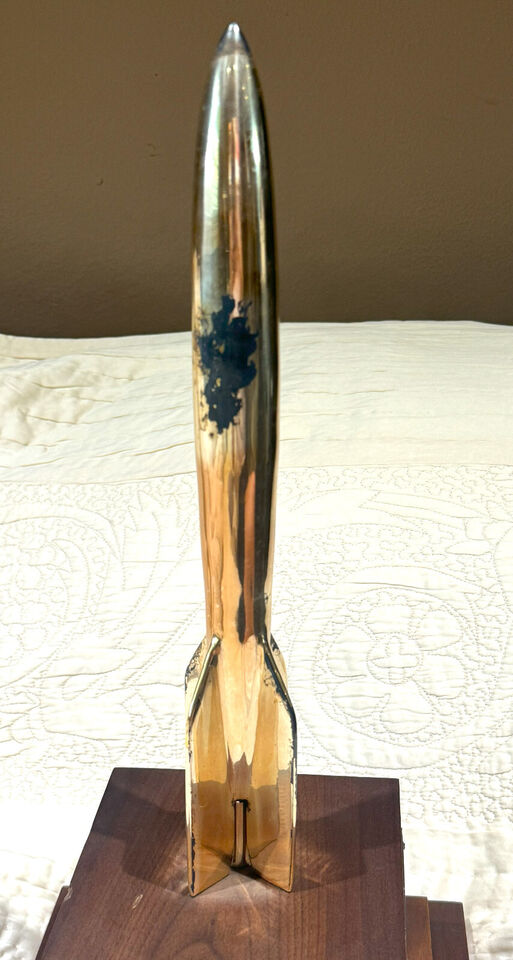
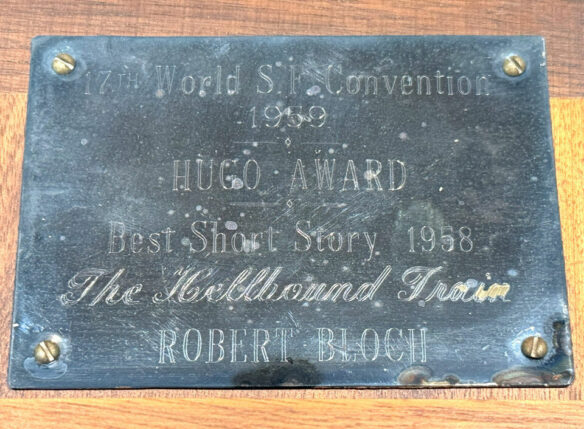
(8) BLOCH ON THE AIR. The Robert Bloch Official Website has added new radio episodes scripted by the author. Listen in at “Radio”.
Bloch spent little time working within the medium of radio. Aside from penning radio scripts resulting from participation in Milwaukee political candidate Carl Zeidler’s 1940 bid for mayor and for a few local shows in the Milwaukee area, Bloch’s only commercial foray into radio broadcasting came in 1945, with the debut of Stay Tuned for Terror. A program devoted to horror and the supernatural in the same vein as Lights Out, Terror’s initial, and only season, featured 39, 15-minute radio plays. The scripts, all written by Bloch, consisted of eight originals, with the remainder adapted from his own stories, primarily from Weird Tales, who promoted the radio show within their pages. Sadly, this radio program is for the most part “lost,” apart from, to date, four episodes that have only recently been discovered…
Just two days after Edgar Allan Poe’s death, the New York Daily Tribune posted an obituary about him written by a man who called himself “Ludwig.” This wasn’t the kind of loving obituary most people might see in the newspaper. Ludwig made comments such as, “He walked the streets, in madness or melancholy, with lips moving in indistinct curses,” among other claims.
As it turns out, Ludwig was a fake name used by Poe’s rival Rufus Wilmot Griswold, an enemy Poe had made during his time as a critic. Griswold would later write a biographical article on Poe titled “Memoir of the Author” which made further false statements or spread half-truths to taint Poe’s image.
The 2024 Comic Con wrapped up Sunday after four days that saw thousands of pop culture lovers travel to the Big Apple from all across the country.
(11) TODAY’S BIRTHDAY.
[Written by Paul Weimer.]
Born October 20, 1882 — Bela Lugosi. (Died 1956.)
By Paul Weimer: I’ve mentioned in this space before watching movies on WPIX in New York as a formative experience. I got to see lots of old movies that way and be exposed to a wide range of films. It is no wonder that the work of Bela Lugosi came to mind. I (except for his first appearance ifor me) seemed to always be seeing him in movies with Boris Karloff, just like I saw endless movies with Christopher Lee paired with Peter Cushing. Lugosi was Dracula, of course, his most iconic role, but I didn’t see him there first.
The first time I saw him (and heck, the first time I saw Dracula period) was, don’t laugh, Abbott and Costello meet Frankenstein.
Yes, by the vicissitudes of chance, I got to see Lugosi play Dracula in a comedic variation and derivation of his original role, as well as seeing a number of the Universal monsters at the same time. WPIX would later give me the aforementioned Lugosi/Karloff movies and I began to understand what the comedy was making fun of. Lugosi’s Dracula is chilling, sui generis and the template that every other Dracula performer has to measure up against, since.
In a Nashville courtroom in early July, survivors of the 2023 Covenant school shooting celebrated an unusual legal victory. Citing copyright law, Judge l’Ashea Myles ruled that the assailant’s writings and other creative property could not be released to the public.
After months of hearings, the decision came down against conservative lawmakers, journalists and advocates who had sued for access to the writings, claiming officials had no right to keep them from the public. But since parents of the assailant – who killed six people at the private Christian elementary school, including three nine-year-old children – signed legal ownership of the shooter’s journals over to the families of surviving students last year, Myles said releasing the materials would violate the federal Copyright Act….
… But the approach is also a response to the frustration that survivors and victims’ families feel. The ways shooters have historically been portrayed in the media, they say, has been damaging; oversight over the distribution of harmful materials online – including video footage of deadly shootings – has been virtually nonexistent; and free rein over shooters’ names and intellectual property has enabled outside actors to profit from their reproduction.
Together, these elements speak to the need for greater care over how the stories of mass shootings are retold, survivors and advocates say, so that victims – rather than their killers – are remembered….
A modern classic by Keira Knightley” reads the provisional cover of the actor’s debut children’s book, I Love You Just the Same. Set to be published next October, the 80-page volume, written and illustrated by Knightley, is about a girl navigating the changing dynamics that come with the arrival of a sibling.
The Pirates of the Caribbean star is the latest in a long list of celebrities to have turned to writing children’s books. McFly’s Tom Fletcher and Dougie Poynter have been hovering at the top of the bestseller chart since the publication last month of their latest book The Dinosaur that Pooped Halloween!. Earlier in the year, David Walliams dominated with his newest book Astrochimp. The entertainer has sold 25m copies of his children’s titles in the UK alone, according to Nielsen BookData.
… “These celebrities do not need any more money or exposure, but plenty of genuine writers do,” says the author, poet and performer Joshua Seigal.
When news broke of Knightley’s book deal, authors expressed frustrations online; in one viral tweet, the writer Charlotte Levin joked about deciding to become a film star….
… Some argue that celebrity-backed titles help keep the industry healthy. “Attention paid to any children’s book creates a rising tide that lifts the entire publishing industry,” says the author Howard Pearlstein.
Books written by celebrities can also help increase representation in children’s fiction. “Celebrity fiction has been one of the key ways to get Black and brown characters on shelves in recent years,” says Jasmine Richards, a former ghostwriter of celebrity fiction and founder of StoryMix, which develops fiction with inclusive casts of characters to sell to publishers….
Watch out, Brundlefly! You might just meet your match in writer-director Leigh Whannell’s take on lupine monsters in the upcoming Wolf Man.
The film’s official trailer, which dropped during the Blumhouse panel at New York Comic Con Friday, gives off some serious Cronenberg vibes, teasing a werewolf infection akin to a deteriorative disease that eats away at the body and turns the mind into primal mush….
China is now home to the world’s most powerful resistive magnet, which produced a magnetic field that was more than 800,000 times stronger than Earth’s.
On 22 September, the magnet, at the Steady High Magnetic Field Facility (SHMFF) at the Chinese Academy of Science’s Hefei Institutes of Physical Science, sustained a steady magnetic field of 42.02 tesla. This milestone narrowly surpasses the 41.4-tesla record set in 2017 by a resistive magnet at the US National High Magnetic Field Laboratory (NHMFL) in Tallahassee, Florida. Resistive magnets are made of coiled metal wires and are widely used in magnet facilities across the world.
China’s record-breaker lays the groundwork for building reliable magnets that can sustain ever-stronger magnetic fields, which would help researchers to discover surprising new physics, says Joachim Wosnitza, a physicist at the Dresden High Magnetic Field Laboratory in Germany.
The resistive magnet — which is open to international users — is the country’s second major contribution to the global quest to produce ever-higher magnetic fields. In 2022, the SHMFF’s hybrid magnet, which combines a resistive magnet with a superconducting one, produced a field of 45.22 tesla, making it the most powerful working steady-state magnet in the world….
The bombardment never stops. Each day, up to 50 meteors survive the fiery descent through Earth’s atmosphere and reach the surface as meteorites. Researchers and collectors have recovered more than 50,000 of these rocks, which are prized in part for the mystery of where they came from.
Now, researchers have eliminated some of the mystery. They have traced most meteorites to just three Solar System bodies that shattered to form families of asteroids in the belt between Mars and Jupiter, plus countless smaller fragments that sometimes reach Earth.
Until now, a source was known for only 6% of meteorites; now, more than 70% have a known origin, says Miroslav Brož, an astrophysicist at Charles University who led one of three related studies published recently in Nature and Astronomy & Astrophysics. “It feels like a lifetime discovery.”…
[Thanks to Cat Eldridge, SF Concatenation’s Jonathan Cowie, Steven French, Kathy Sullivan, Teddy Harvia, Mike Kennedy, Andrew Porter, John King Tarpinian, Chris Barkley for some of these stories. Title credit belongs to File 770 contributing editor of the day Tom Becker.]
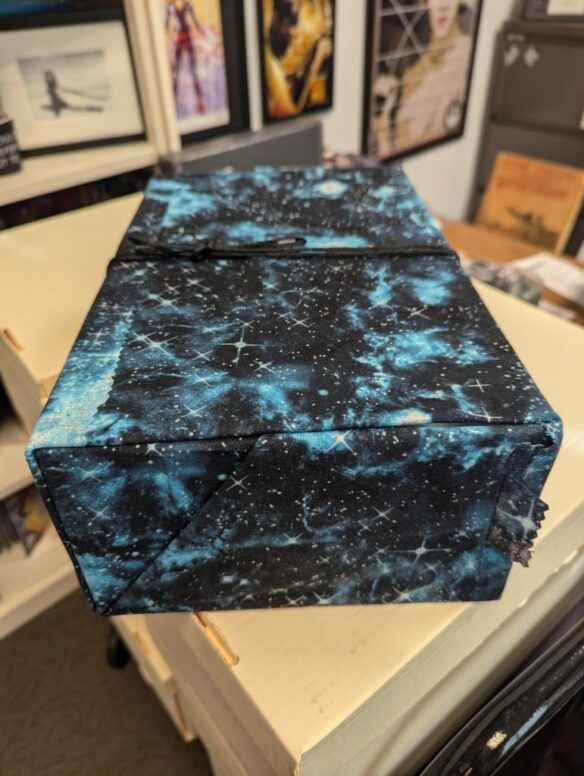
…Since the Bumpy Passage fell out of use many years ago, I created a travel pod so that Ur Sid could make his journey in the style to which he had become accustomed, and packed him carefully in a box. He accompanied nine other boxes containing the Full Run of Lee-and-Miller, Lee, and Miller published works.
Well, today Ur Sid arrived at his new post. Jeremy Brett, Curator of the Science Fiction and Fantasy Research Collection has kindly sent along photographs of this momentous arrival, which are posted below.
Right now, Ur Sid is sharing office space with Curator Brett. Very shortly, he will be transferred to Collections Care so that a proper enclosure for Ur Sid and his belongings, including his travel diary, may be constructed….
(2) CHENGDU TWEETS. [Item by Ersatz Culture.] The official Twitter account of Chengdu, China recently posted some tweets of interest:
Yesterday there was a video commemorating the one-year anniversary of the Chengdu Worldcon. A bit cheekily, there are a couple of shots from the Glasgow Worldcon around 1:15 in, that aren’t flagged up as such:
Today there’s a video with Ben Yalow saying how happy he is to be back in Chengdu:
#MemoriesOfChengdu A year ago, Ben Yalow, co-chair of 2023 World Science Fiction Convention, visited Chengdu and left with unforgettable memories. Today, GoChengdu surprised him with a custom postcard full of memories. “I hate to give it back, I want to keep it!”#chengdu#scifi… pic.twitter.com/YlZO1ludOW
There’s also a tweet asking for responses about SF experiences in Chengdu; as yet they haven’t had any replies.
#MemoriesofChengdu Can you believe it's been a year since the 2023 Chengdu Sci-Fi Convention? ???? The sci-fi vibe here is electric, from futuristic art installations to tech innovations and passionate fans! Share your memories and expectations about Chengdu and sci-fi with us!… pic.twitter.com/vmac86A9JJ
Incidentally, these posts followed straight after one criticizing a recent bill before Congress in the U.S. to fund “badmouthing China”, indicating this account seemingly isn’t just for doing local tourism promotion type stuff…
(3) ICON 50 TO BE DELAYED TO 2026. [Item by Michael J. “Orange Mike” Lowrey.] On Friday at the opening ceremonies of ICON 49 in Cedar Rapids, it was announced that ICON 50, originally scheduled for October 2025, has been postponed to 2026, due to problems with money and with volunteer shortages.
This follows the recent announcement that WisCon for 2025 will be a Wisconline, all-online event.
(4) FIRST BITE. Adam Roberts has a funny take on a recent Guardian story:
In a Dublin library once frequented by James Joyce and WB Yeats, beneath a turquoise and white domed ceiling and surrounded by oak shelving, Brian Cleary stumbled across something by Dracula author Bram Stoker he believed no living person had ever read.
Cleary, who had taken time off from his job at a maternity hospital after suffering sudden hearing loss, was looking through the Stoker archives at the National Library of Ireland when he came across something strange. In a Dublin Daily Express advert from New Year’s Day 1891 promoting a supplement, one of the items listed was “Gibbett Hill, By Bram Stoker”. He had never heard of it, and went searching for a trace. “It wasn’t something that was Google-able or was in any of the bibliographies,” he said.’
Cleary tracked down the supplement and found Gibbet Hill. “This is a lost story,” he realised. “I don’t think anyone knows about this.” The story follows an unnamed narrator who runs into three children standing by the memorial of a murdered sailor on Gibbet Hill, Surrey, which is also referred to in Dickens’ 1839 novel Nicholas Nickleby.
Together, the four walk to the top of Gibbet Hill. Distracted by the view, the narrator loses sight of the children. He takes a nap among some trees, and wakes to see the children a short distance away, before a snake passes over his feet towards the children, who appear able to communicate with and control the snake. Later, the children attack the narrator. The story culminates with the snake wriggling out of the narrator’s chest, gliding away down the hillside…
In his new sci-fi horror novel, “Absolution,” Jeff VanderMeer returns to the world of 2014’s award-winning “Annihilation,” which launched his Southern Reach Trilogy. Below, the best-selling ‘weird fiction’ author recommends six psychological expeditions into the unknown.
The six-pack includes:
‘A Perfect Spy’ by John le Carré (1986)
“The past is another country” may be a cliché, but not in the hands of my favorite espionage novelist. His masterpiece charts the entanglements, both professional and personal, that bring about the downfall of operative Magnus Pym. A stunning tale of betrayals, redemption, and, ultimately, a compassionate portrayal of a compromised life.
Future generations will look back on 2024 as the moment when the United States of America made a defining choice about climate change. This November, we’re either going to renew our commitment to fixing this mess we created, or embrace denial and plunge the world into a nightmarish scenario.
Nobody much is talking about it, but this election feels especially important for a couple of reasons: first, we are dangerously close to reaching some climate benchmarks that we won’t be able to come back from easily, if at all. And second, we are now being faced with daily brutal reminders of the impacts of climate change on our world. As Kamala Harris herself said in a powerful 2023 speech, climate change is here and the effects are in our face everyday.
The good news is, the past few years have seen some real advances toward clean energy and green infrastructure. Tax credits included in the Inflation Reduction Act are helping to make wind and solar power more affordable than non-renewable energy sources, and the subsidies in the bill are creating more jobs in the clean energy sector. But there’s much more work to be done…
And if you scroll down past the end of Anders’ article there is an index to other posts, including several by genre contributors Tomi Adeyemi, George Saunders, Daniel Handler (aka Lemony Snicket), and Beth Revis.
WCP: When hearing the phrase “speculative fiction,” most readers will immediately think we’re referring to either science fiction or fantasy, and there are elements of both in your novel. But this work leans strongly in to literary writing, with beautiful, sometimes even lyrical storytelling and far less of the extensive worldbuilding than we’d normally see in the aforementioned genres. How do you approach “speculative literary” writing?
TC: Before I stumbled upon the term “speculative fiction,” I used to say that I write science fiction for people who don’t think they read science fiction. But that was only an approximation of what I was doing, and I’m glad that more people are discovering the depth and breadth of fantastical writing beyond strict genre definitions.
I love the way “speculative literary” opens up narrative by allowing us to go beyond the bounds of realism to get at emotional truths. If something feels surreal, why not try to capture that cognitive dissonance by portraying it as something palpably unreal? Certain parts of American culture are indeed surreal to me, like our relationship with guns, or our lack of reckoning with history, or our income inequality, and those areas of disconnect came out indirectly in stories about sneaking needles striking us everywhere from home to school to church, or screaming ropes howling in the darkest corner of a dusty barn, or sword fighting robots protecting the bunkers of the uber-wealthy….
You wake up naked in a hotel room. You don’t recall who you are or how you got there. Your clothes are missing. Someone knocks on the door.
So begins “Amnesia,” a text-only video game released in 1986, in which players inhabit the perspective of a man experiencing memory loss while staying in midtown Manhattan at the fictional Sunderland Hotel. Players must negotiate a series of puzzles to find much-needed clothes, leave the hotel, and navigate Manhattan’s busy streets. By gathering clues and avoiding innumerable pitfalls, they gradually discover that the protagonist has a fiancée he cannot remember, is being pursued by an assassin, and is wanted for murder in Texas.
A groundbreaking digital work of interactive fiction by the sci-fi novelist Thomas M. Disch, the game anchors “Remembering Amnesia: Rebooting the first computerized novel,” an exhibit on view through March 2 in the Hanke Exhibition Gallery at Sterling Memorial Library.
Drawing on materials from Disch’s archive at the Beinecke Rare Book and Manuscript Library, the exhibit explores the author’s novel attempt to move video games into the realm of literary fiction. It also describes the efforts of the Yale Library’s Digital Preservation unit to preserve the game, originally stored and played on now-obsolete hardware, and restore it to life.
The revived version of “Amnesia” is available to play on three workstations — two located just outside the exhibit space and one in Bass Library — that emulate a mid-1980s computing environment….
You declare in your new title that five themes exist in Serling’s portfolio. What are they? With this book, I was inspired to curate what I thought were the best episodes of “The Twilight Zone,” collected in a framework that would separate my “greatest hits” of the series into distinct themes that would encompass the diversity—and similarity—of the best episodes by Serling and company. Of course, one can argue that there are more than just five themes of “The Twilight Zone” that the breadth of its 156 episodes would suggest, but I decided rather quickly on the following five, almost as if they suggested themselves: “Science and Superstition,” “Suburban Nightmares,” “A Question of Identity,” “Obsolete Man,” and “The Time Element.” (Of the five, “Suburban Nightmares” is the only one I coined that does not have a direct “Twilight Zone” connection; bonus points for recognizing that “A Question of Identity” comes from dialogue spoken by the protagonist of [the show’s] debut episode, “Where is Everybody?”)
(10) MEMORY LANE.
[Written by John King Tarpinian.]
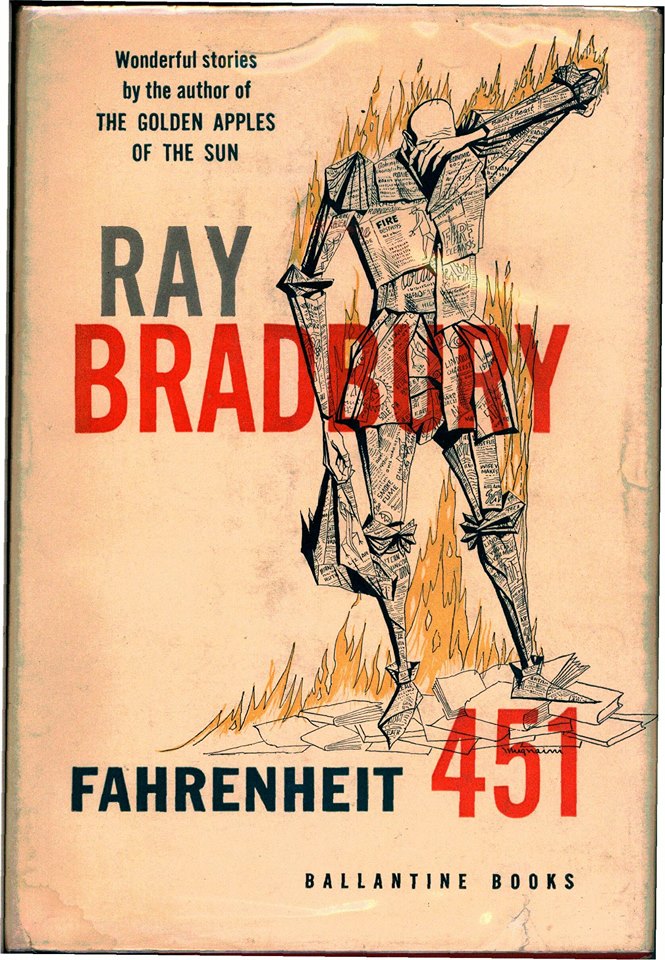
Anniversary, October 19, 1953 — Fahrenheit 451
By John King Tarpinian: On this day in history one of the most read science fiction novels was published. One of the few, if not only, novels of sci-fi on a majority of middle and high school reading lists.
Fahrenheit 451 is one of three books that as a young man made me think about stuff outside of my comfortable life. The other two were Dalton Trumbo’s Johnny Got His Gun and Robert Heinlein’s Stranger in a Strange Land, the three making up a trio of books that woke up my little brain.
Fahrenheit451 was made into a movie by the French director, François Truffaut. It was his first movie in color and his only English-language film. Remember the French guy in Close Encounters of the Third Kind? That was Truffaut.
Flatscreen TVs were in this book. Bluetooth was in this book. Most people know that Ray never drove a car, remember that in the book Clarisse was killed by a speeding car. Montag was a brand of paper; Faber was a brand of pencil. Beatty was named for the lion tamer, Clyde Beatty.
Bradbury’s book rails against censorship, in any form.
Lastly, Ray’s headstone reads “Author of Fahrenheit 451.”
(Use this link to see a parade of Fahrenheit 451 book covers from over the years.)
(12) READING THE ROOMS. For the “Every Town Deserves a Library” episode of the Our Opinions Are Correct podcast, hosts Annalee Newitz and Charlie Jane Anders are joined by Ken Liu.
Science fiction and fantasy are full of wondrous libraries containing everything from powerful artifacts to some dang good reads. How does the idealized view of libraries in speculative fiction compare with the real-life libraries, which are under attack by would-be censors and culture warriors? Also, we talk to award-winning author Ken Liu about his brand new translation of the classic Daoist text, the Dao De Jing.
(13) JOY WILLIAMS Q&A. [Item by Steven French.] Joy Williams on why fiction should be ‘uncanny’ (and on reading Baba Yaga stories as a child) in the Guardian.
For many years, you’ve written about the climate emergency and environmental destruction. I wonder if your thinking about how to represent that in fiction has developed, and where you think it might go?
I’m always trying to convince myself that fiction will rise up and throw away the crutches that have been supporting it for far too long. The comfy story has got to change. It needs to be more uncanny, less personal….
Paramount+ has set January 24, 2025 for the premiere of its upcoming movie Star Trek: Section 31, starring Michelle Yeoh in a reprisal of her Star Trek: Discovery role as Emperor Philippa Georgiou.
The announcement was made Saturday during the Star Trek universe panel at New York Comic Con. Yeoh made a video appearance during the panel, which featured cast members Omari Hardwick, Kacey Rohl and Robert Kazinsky, along with executive producer and director Olatunde Osunsanmi.
Star Trek: Section 31 will premiere exclusively Friday, January 24 in the U.S. and international markets where the service is available….
…In a recent study evaluating how chatbots make loan suggestions for mortgage applications, researchers at Pennsylvania’s Lehigh University found something stark: there was clear racial bias at play.
With 6,000 sample loan applications based on data from the 2022 Home Mortgage Disclosure Act, the chatbots recommended denials for more Black applicants than identical white counterparts. They also recommended Black applicants be given higher interest rates, and labeled Black and Hispanic borrowers as “riskier.”
White applicants were 8.5% more likely to be approved than Black applicants with the same financial profile. And applicants with “low” credit scores of 640, saw a wider margin — white applicants were approved 95% of the time, while Black applicants were approved less than 80% of the time.
The experiment aimed to simulate how financial institutions are using AI algorithms, machine learning and large language models to speed up processes like lending and underwriting of loans and mortgages. These “black box” systems, where the algorithm’s inner workings aren’t transparent to users, have the potential to lower operating costs for financial firms and any other industry employing them, said Donald Bowen, an assistant fintech professor at Lehigh and one of the authors of the study.
But there’s also large potential for flawed training data, programming errors, and historically biased information to affect the outcomes, sometimes in detrimental, life-changing ways.
Approximately 41 000 years ago, Earth’s magnetic field briefly reversed during what is known as the Laschamp event. During this time, Earth’s magnetic field weakened significantly—dropping to a minimum of 5% of its current strength—which allowed more cosmic rays to reach Earth’s atmosphere. Scientists at the Technical University of Denmark and the German Research Centre for Geosciences used data from ESA’s Swarm mission, along with other sources, to create a sounded visualisation of the Laschamp event. They mapped the movement of Earth’s magnetic field lines during the event and created a stereo sound version which is what you can hear in the video. The soundscape was made using recordings of natural noises like wood creaking and rocks falling, blending them into familiar and strange, almost alien-like, sounds. The process of transforming the sounds with data is similar to composing music from a score.
Eight years in the making, director David Lee Fisher’s new take on the horror classic Nosferatu has finally been unleashed, the film now available on Digital through Prime Video….
(18) THE (POD BAY) DOORS OF PERCEPTION. Six years ago someone shared the results of a thought experiment that asked what would happen “If HAL9000 was Amazon.com’s Alexa”.
[Thanks to Chris Barkley, Cat Eldridge, SF Concatenation’s Jonathan Cowie, Bruce D. Arthurs, N., Ersatz Culture, Michael J. “Orange Mike” Lowrey, Steven French, Kathy Sullivan, Teddy Harvia, Mike Kennedy, Andrew Porter, and John King Tarpinian for some of these stories. Title credit belongs to File 770 contributing editor of the day Paul Weimer.]
(0) TODAY’S TITLE INSPIRATION. Daniel says he found retroactive inspiration in the fact that the group Them which performed “G-L-O-R-I-A” included Van Morrison.
(1) WEIRD NATURE. “The author has no problem embracing the inscrutable and uncanny; it’s what fuels his fiction” says Publishers Weekly: “Jeff VanderMeer Journeys into the Unknown”.
…The fantastical petri dish of Area X springs largely from VanderMeer’s experiences with nature and wild spaces. His parents were Peace Corps volunteers in Fiji when he was a boy. “It was pretty much what you’d expect from a tropical paradise,” he says. He would marvel at the eels and frogs at the local botanical gardens, and his father, an entomologist, would take him out to see the rhinoceros beetles on the region’s outer islands. He learned at an early age to experience a certain awe of the natural world. But he also suffered from serious asthma attacks and allergies.
“There was this weird contrast between things being so beautiful and also sometimes feeling very physically miserable,” he says. “That was a juxtaposition that I think comes through in the work, where you have really beautiful things, and then things that are disturbing or unsettling at the same time.”…
The ISS is almost a time capsule, hearkening back to the end of the Cold War. It now looks likely that Russia will pull out – or be ejected – from the mission before its projected end date of 2030.
Viewed from the ISS, no borders are visible, and the crew joke comfortably about their national differences. However, their lives are nevertheless dictated by strict and sometimes petty rules governing, for example, which toilet and which exercise equipment to use. These regulations are just one more banal reality of life on the ISS, like muscle atrophy, blocked sinuses or packing up waste to go in the next resupply craft….
…Harvey manages to convey that these details are quotidian. But she also imbues them with beauty. During one conversation in Orbital, a character sheds four tears. He and a crew mate then chase down each floating water droplet because loose liquids must be avoided. It’s a small moment that says so much with few words.
Orbital has been shortlisted for both the 2024 Booker Prize (winner to be announced on 12 November) and the 2024 Ursula K Le Guin Prize for Fiction (the winner of which will be announced on 21 October). The recognition reflects the book’s combination of literary prose and unusual globe-spanning (indeed, beyond global) perspective. Harvey’s writing has been compared to Virginia Woolf – a comparison that is well warranted. And yet Orbital is as accessible and educational as the best of popular science. It’s a feat almost as astonishing as the existence of the ISS….
To quote Heath Ledger’s version of the clown prince of crime, maybe some wag should be scrawling “Why so serious?” on glass-fronted offices at Warner Bros Discovery this week, as executives there contemplate the box-office implosion of Joker: Folie à Deux. A catastrophic $37.7m opening weekend, the largest second-weekend drop for a DC film (81%), a worldwide take currently standing at a piddling $165m … how has the studio gone from the 2019 original, a billion-grosser that was then the highest earning R-rated film, to this?
If nothing else, the Joker is proving true to his reputation as an agent of chaos. But he is also the most beloved of comic-book villains from a storied franchise; a draw almost on par with Batman himself, making the disaster all the more unthinkable. With bubonic word of mouth, Joker: Folie à Deux is now projected to lose $125m-200m, depending on whose budget estimate you believe. If it’s the $300m figure being generally touted for production and marketing, then this is clearly what has hobbled the film; it would leave it needing as much as $475m to break even. Risky reinventions of hallowed pop-cultural icons are a lot more feasible on the first film’s sensible $60m budget.
… But chastising the fanbase so openly is tantamount to box office self-harm (probably why the director refused to test-screen Joker: Folie à Deux). The impunity of a $300m budget seems to have led Phillips to mistake this for an auteur film, and shooting during a period of regime change at both Warner and DC reportedly allowed him to operate with weak oversight. According to Variety, he refused to liaise with new DC heads James Gunn and Peter Safran, saying: “With all due respect to them, this is kind of a Warner Bros movie.” But he also pushed back on new Warner president David Zaslav’s suggestions for lowering the budget, including moving the shoot to London rather than Los Angeles….
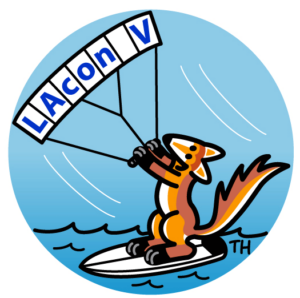
The Channel Island fox is pure California: an animal unique to the coastal islands in the southern part of the state, whose habitat, once threatened to the point of extinction, is now thriving due to conservation. Fuzzy, the playful Channel Island fox depicted at right, exemplifies the spirit of California and joins us on our expedition to LAcon V in 2026 as our official convention mascot.
Artist Teddy Harvia has captured Fuzzy’s likeness so elegantly, yet so playfully, through many illustrations yet to be revealed by LAcon V. Fuzzy will join us throughout the next two years on all our adventures, all hand-drawn by Teddy.
Fuzzy has been named in honor of our friend and colleague, Marilyn “Fuzzy Pink” Niven, a long-time participant in Southern California and American science fiction fandom and the wife of celebrated author Larry Niven. Fuzzy Pink Niven passed away in December 2023, leaving behind a legacy of friendship and service to fandom that can never be replaced. We could think of no greater tribute to her than to bring her spirit along with us on our adventure, and we are very grateful to Larry for his blessing….
(7) TODAY’S BIRTHDAY.
[Written by John Hertz, Laura Molesworth and Mike Glyer.]
Born October 18, 1924 — Voltaire Molesworth. (Died 1964.) Vol Molesworth was an Australian fan historian and small press publisher. In 1939 he co-founded the Futurian Society of Sydney – which suffered endless keruffles, like so many fan groups — and started the fanzine Luna. The next year he also published Cosmos.
Being a diabetic, Vol (as he was known) was ineligible for service in World War II but during these years he gained his wide experience in all aspects of journalism. He also wrote fiction. By the time he was 20 Vol had written a number of short novels published in paperback, the most widely known being his science fiction novel The Stratosphere Patrol.
He led a revival of the Sydney Futurians in 1947, becoming one of the leading Australian fans in the 1950s. He played a major role in the three Australian Natcons held in Sydney during the ’50s. He founded and operated the Futurian Press.
Molesworth wrote A History of Australian Science Fiction Fandom 1935-1963 and the earlier An Outline History of Australian Fandom I.
Outside of fandom, he was a mathematician and amateur radio operator and managed the University of New South Wales’ radio station. He was married to Laura Molesworth.
(8) MEMORY LANE.
[Written by Cat Eldridge.]
Anniversary — Farscape: The Peacekeeper Wars (2005)
Once upon a time, a beloved SF series got cancelled, and yes there is absolutely nothing unusual in that happening, it happens more often than it should. What is extremely unusual is that it got a second chance to have a proper ending in the Farscape: The Peacekeeper Wars, seventeen years ago.
So let’s tell the tale of how that happened. Farscape arrived here twenty-three ago when Deep Space Nine was just wrapping up and Voyager was well into its seven-year-run. It started fine and ratings were strong until the fourth season and that, combined with regime change here in the States on who was picking up the tab for the two million dollars per episode led an abrupt end.
Fans being fans weren’t going to let things end that way, nor should we. (Yes, I loved the show. Deeply, unreservedly. I think it was one of the best series ever made, if not the best.) A massive campaign was undertaken with of course emails, letters, phone calls, and phone calls pleading with the network to reverse the cancellation.
Even Bill Amend who created the Fox Trot series had his Jason Fox character direct his ire at SciFi and demand that they change their mind.
Well, they did, sort of. A fifth season didn’t happen after all. What did happen in some ways I think was even better though I know that isn’t a popular opinion among those who wanted a full season.
What we got was the two episode, one hundred-and eighty-minute Farscape: The Peacekeeper Wars which I thought splendidly wrapped things up. Every single storyline that wasn’t dealt with during the series was during this film.
SPOLER ALERT HERE.
We got a baby too. Yes, our Peacekeeper gives birth in a fountain in the middle of a firefight, insists she’s married while in labor, carries her baby unscathed through a battle. I assume that the baby was a puppet from the Henson labs. It was terribly cute.
END OF SPOILERS
I’ve watched it at least a half dozen times, probably more, in the last fifteen years. The Suck Fairy in her steel toed boots is obviously scared of those Aussie actors (and the non-Aussie one as well) as she slinks away to harass someone else.
Just looked at Rotten Tomatoes — not at all surprisingly, it carries a ninety-two percent rating among audience reviewers there. It’s streaming at Amazon Prime and Peacock. .
(9) COMICS SECTION.
Off the Mark offers some old celebrity head shots.
Bizarro says in another reality this guy is delusional.
The New York City Department of Transportation announced it is selling a limited number of “Stan Lee Way” commemorative street signs through the Department of Citywide Administrative Services’ CityStore. The master comic book writer grew up in the Bronx, attending DeWitt Clinton High School.
“A cultural icon, Stan Lee, has gifted the world with stories that captivate, inspire, and make us believe in the heart of a hero,” said NYC DCAS Commissioner Louis A. Molina. “With this sign release, you have a chance to gift yourself or the superhero in your life a piece of history.”
In 2021, the city co-named a portion of University Avenue between Brandt Place and West 176th Street where he lived, “Stan Lee Way”. The Bronx native revolutionized the comic book world by developing complex characters with relatable flaws and layered plot lines.
The Penguin star and executive producer Colin Farrell was joined on Thursday at New York Comic Con for a mid-season discussion by showrunner and fellow EP Lauren LeFranc, as well as co-stars Cristin Milioti, Rhenzy Feliz, Deirdre O’Connell, Michael Kelly, and Clancy Brown, where they debuted two sneak peaks for the crowd for episode five, before going in-depth on what’s motivating the characters.
In the first clip, Oz (Farrell) and Victor (Feliz) share a sentimental moment where they discuss their relationship loyalty, while Oz’s car burns in the background. “It’s you and me now, kid until the end,” Oz says, before he and his henchman make a surprise visit to rough up Sal’s (Brown) son, before paying him and his wife a visit in prison to set up an exchange…
Robots are in exile and Millie Bobby Brown is on the road to revenge in Netflix’s star-studded sci-fi adventure, set in the apparently “retro” ’90s (fml).
Based on Simon Stålenhag’s graphic novel and directed by the MCU’s Anthony and Joe Russo, The Electric State sees Brown in the lead as Michelle, a teen without a family who meets a robot called Cosmo. But surprise, Cosmo is controlled by a human — her long lost brother no less! He’s across the country somewhere, and there’s sinister circumstances afoot, so Michelle and Cosmo hit the road to find him….
[Thanks to John King Tarpinian, Chris Barkley, Cat Eldridge, SF Concatenation’s Jonathan Cowie, Steven French, Kathy Sullivan, Teddy Harvia, Mike Kennedy, and Andrew Porter for some of these stories. Title credit belongs to File 770 contributing editor of the day Daniel Dern.]
As the tropical disturbance that became Hurricane Helene moved north toward Florida’s Gulf Coast on Tuesday, I had an argument with myself about evacuating from Tallahassee: If I ran from the storm, would I get caught up in it anyway? I was thinking of Charlize Theron’s character in the movie “Prometheus,” crushed by a spaceship that crashed while she ran in a straight line away from it.
Stricken by the thought of being trapped (or worse) in my house by falling trees, I decided to drive to Greenville, S.C., with my elderly cat, but not without extreme anxiety. Many Floridians like me who were not under mandatory evacuation orders remember Hurricane Michael in 2018 and other recent unpredictable, dangerous hurricanes. For us, decisions about whether to stay or leave and where to go have become more tortuous in ways that may be difficult to understand for those who don’t experience hurricanes regularly.
Many don’t have the resources to flee monstrous storms such as Helene. But for those who can evacuate, there is a sense of not being able to outrun them or that the destinations may become just as perilous. Every possibility feels both right and wrong and also like disaster deferred for only days — while dithering only shrinks the window for escape…
I am a bad boy. I have spread mustard on a sandwich as much as ten days after its use-by date. I have loitered where signs are posted that forbid loitering, not because I wanted to loiter; I was in a hurry to be elsewhere, but I wasn’t going to let anyone tell me where I couldn’t loiter. I have washed garments that I was commanded to “dry clean only.” Really, when it comes to obeying the rules, I am a dangerous nonconformist. This has also been true in my writing life, and while I’m not proud of it, I’m not ashamed, either.
When I began to write cross-genre novels with Strangers in the early 1980s, my publishers knew I was doing something unconventional, and they knew they didn’t like it, but at first, they couldn’t put a name to it or explain why such work made them uneasy.
Initially, I didn’t realize it was the manuscript of Strangers they found off-putting. I thought it must be something about me that repelled them. Something about my face? Everything about my face? Or could it be that I shouldn’t have eaten an anchovy and horseradish sandwich on garlic bread for breakfast that morning?
No. It was Strangers that made their eyes water and induced in them a shortness of breath equal to that of end-stage bacterial pneumonia. The novel was a thriller with a science-fiction premise, a love story, and a paranoid conspiracy tale, written as a mainstream novel, with a theme of transcendence. I was pressured to cut the 940-page manuscript to 450 pages and turn it into a flat-out sci-fi horror novel with a smaller cast and a theme of existential dread. I had considerable respect for the publisher, but I knew why I had done what I’d done, and I knew it wouldn’t work if half the text was cut….
The production of a movie based on a book by the noted British author Neil Gaiman has been paused by Disney amid allegations that five women have made against him relating to conduct from 1986 to 2022, including one woman who said Mr. Gaiman groped her on a tour bus in 2013 and later paid her $60,000.
The women shared their allegations, which included claims of sexual assault, groping and kissing, on the podcast “Master: The Allegations Against Neil Gaiman.” Mr. Gaiman, 63, has told the podcast he denies any wrongdoing.
The allegations played a role in pausing the production of “The Graveyard Book,” an adaptation of the eponymous young adult novel by Mr. Gaiman, according to a person at Disney. But the allegations were not the sole reason that the production, which was in development, was paused. Disney would not provide any additional reasons.
Another production related to Mr. Gaiman has been canceled for unspecified reasons. “Dead Boy Detectives,” a TV series based on a comic book by Mr. Gaiman, will not return for a second season, according to Netflix, which declined to share why the series would not return. There have been no changes to the Netflix series “The Sandman,” which is based on a separate comic book series by Mr. Gaiman.
Amazon would not say whether there would be any changes to “Good Omens,” a series based on a novel by Mr. Gaiman written in collaboration with Terry Pratchett.
The turmoil around the productions linked to the author has come amid the launch of the podcast, which in July and August released six episodes that detail the women’s accounts. The series has drawn widespread attention among fans, in literary circles and in the entertainment industry….
…Glasgow 2024, a Worldcon for our Futures, had this statement on their Accessibility page:
“The Accessibility Team is committed to providing an equitable experience for all disabled members of Worldcon. Support will be available for those with mobility needs, visual impairments, hearing loss or differences, and various types of neurodiversity. “
A message from the con chair added this:
“Considering access, inclusion and diversity as integral to Glasgow 2024 has created an environment where we think carefully about what Worldcon can become – a convention to represent all of our futures as well as a place where everyone can celebrate, and an event where we can take these realities joyfully forwards after it is over.”
This all sounded, if not entirely reassuring, at least hopeful. So I bought my tickets.
It was not, in fact, an equitable experience for all disabled members of Worldcon…
Ness then details more than a half dozen accessibility difficulties she faced at the convention. She raised these issues to the committee with this result:
…On August 12, 2024, my last day at Glasgow 2024, I filed an official complaint, in person, about the con’s multiple accessibility issues. I was assured that this complaint would be escalated to the appropriate people for a response.
As of today [September 22], I have not received a response.
(5) SHADOW BANNED.[Item by Steven French.] For Banned Books Week, Leeds Central Library has published a list of books that were ‘banned’ by the Library in 1975 and which were only available to the public on request (although the list was not itself made know to said public before an alternative newspaper published it!). It included not only the likes of Norman Mailer and Gore Vidal but one Brian Aldiss (his Booker Prize long-listed novel The Hand Reared Boy was deemed too racy for the good burghers of Leeds). “Banned Books in 1975 – The Secret Library” at Leeds Libraries Heritage Blog.
…As many fans are aware, the show that became known as Robotech in the West is actually an amalgam series of sorts. Screenwriter Carl Macek was hired to adapt the 1982 series Super Dimension Fortress Macrossfor daily American syndication. Still, the weekly series didn’t have the requisite 65 episodes required for a syndicated series. A decision was made to pair Macross with two shorter anime, 1984’s Super Dimension Cavalry Southern Cross and 1983’s Genesis Climber MOSPEADA, to create an 85-episode series.
The disparate continuities would be explained as time jumps between episodes, but this didn’t make things easier regarding marketing and promotion. Complicating matters for the brand would be American model kit manufacturer Revell’s existing deal with the producers of Macross and a few other anime studios for a line of mecha scale-model kits imported from Japan. Revell called their two model lines Robotech Defenders and Robotech Changers. Revell even had a deal with DC Comics to promote Robotech Defendersas a limited series….
… While Robotech never reached the heights of Transformers‘American popularity, the series had a devoted fan following. As other 1980s properties received comic book revamps in the early 2000s, it seemed inevitable that Robotech would join the fad. After bouncing around various indie publishers in the ’90s, the Robotech rights landed with Jim Lee’s WildStorm imprint circa 2002. As Harmony Gold creative director Tommy Yune bluntly stated in the first WildStorm release’s introductory text piece: “Everybody’s jumping on the ’80s bandwagon.” Harmony Gold viewed the reignited enthusiasm for ’80s properties as an opportunity to reboot Robotech, declaring the WildStorm series a new canon that superseded any preceding tie-in material….
(7) THE LATE DAVID GRAHAM. [Item by Steve Green.] Talking Pictures TV, the UK-based family-run cable channel which specializes in vintage television and movies, has posted an interview on its ‘Encore’ website with actor David Graham, who died September 20 at the age of 99. Graham featured in many of Gerry Anderson’s puppet series (he is best known for playing the chauffeur Parker in Thunderbirds) and also Doctor Who (voicing early Daleks and appearing on screen opposite both William Hartnell and Tom Baker). “Talking Thunderbirds: Voice Artist, David Graham”. Registration required.
In this Encore exclusive peak behind the curtain, we talk to the very talented David Graham, as he discusses his career, where the inspiration for Parker’s voice came from, being the voice of the Daleks, and other varieties of characters he’s voiced!
HBO released the first trailer for “The Last of Us” Season 2, featuring the return of Pedro Pascal as Joel and Bella Ramsey as Ellie, the two zombie apocalypse survivors from the hit video game adaptation.
The eight-time Emmy-winning series (with 24 total nominations) chronicles the story of Joel and Ellie as they navigate a world overrun with zombies infected with a parasitic fungus — not to mention the ruthless vigilantes, mercenaries and cannibals just as desperate to survive.
Here’s the official logline for Season 2: “After five years of peace following the events of the first season, Joel and Ellie’s collective past catches up to them, drawing them into conflict with each other and a world even more dangerous and unpredictable than the one they left behind.”…
(9) MAGGIE SMITH (1934-2024). Actress Maggie Smith, well-known to fans from Hook and Harry Potter, died September 27 at the age of 89. The AP News obituary says: “…Smith drily summarized her later roles as ‘a gallery of grotesques,’ including Professor McGonagall. Asked why she took the role, she quipped: ‘Harry Potter is my pension.’”…
…She began her career as a stage actress, with her earliest breakout role as Desdemona opposite Laurence Olivier in Othello at the National Theater in 1962. When she reprised the role in the 1965 film adaptation, she was nominated for her first Academy Award. She would go on to be nominated for six, winning for two.
Maggie Smith was not in many crime movies. But she was often the most memorable part of the ones that she was in: Dora Charleston in Murder by Death, Miss Bowers in Death on the Nile, and Constance, Dowager Countess of Trentham in Gosford Park. And we cannot forget her turn as the stern, intolerant, but ultimately-supportive Mother Superior of St. Katherine’s in Sister Act. She could whip that steeliness into provincial villainy just as easily as stony protectiveness or begrudging kindness. She had that twinkle in her eye, an overwhelming wittiness, and a knack for nuance that was so razor sharp that she could be flip and solemn at the same time, an affective style that would become her trademark.
Since the announcement of Smith’s passing, earlier today, I have watched an outpouring of tributes and trivia about her: an endless, adoring parade of praise and respect. Maggie Smith was one of those actors who openness to many different kinds of roles kept reinventing her for younger and younger generations. By the time she appeared as the no-nonsense Professor McGonagall in the Harry Potter films, my generation had already seen her as the elderly Wendy in Hook, Mrs. Medlock in The Secret Garden, and many others….
(10) MEMORY LANE.
[Written by Cat Eldridge.]
Anniversary: “The Enterprise Incident” (1968)
“The Enterprise Incident” I believe was truly one of the classic episodes of the Star Trek series. Airing fifty-six years ago on NBC on this date, it was scripted by D.C. Fontana, one of eleven episodes that she would write including “Catspaw” that I dearly love, and directed by John Meredyth Lucas as the second episode of the third and final season.
If you’ve forgotten, the story is that Kirk violated the neutral zone. The Romulans have a new bit of technology called a “cloaking device” (just go with the idea please). Kirk pretends to be crazy, then pretends to be a Romulan to get to it. Meanwhile, Spock pretends to be in love. But is he pretending? Who knows. It’s fun to watch, isn’t it?
D. C. Fontana says she based her script very loosely upon the Pueblo incident but I’ll be damned I can see this. It’s a Cold War espionage thriller at heart and most excellently played out. You did note the Romulnan commander never gets named? Later novels including Vulcan’s Heart by Josepha Sherman and Susan Shwartz gave her the name of Liviana Charvanek.
Speaking of Vulcans, Fontana deliberately kept the romance between her and Spock low key to the finger games they did. And then there’s Roddenberry’s idea, never done, Spock “raining kisses” on the bare shoulders of the Romulan commander. Oh awful.
Season three had no budget, I repeat, no budget for frills, so this episode suffered several times from that. Kirk was supposed to have surgery done on him after dying but that got deep sixed, and McCoy was supposed to accompany him back to the Romulan ship but my, oh my ears are expensive, aren’t they?
Fontana would co-write with Derek Chester a sequel: Star Trek: Year Four—The Enterprise Experiment, a graphic novel published by IDW Publishing in 2008.
Critics then and now love it.
It’s airing on Paramount + as is about everything else in the Trek universe.
…“It was the evening of October 11, 1973 when two local shipyard workers went fishing,” the marker says, at the edge of the Pascagoula River.
The sign says Charles Hickson and Calvin Parker spotted a football-shaped craft, which took them aboard.
“Inside the craft, Hickson was examined by a robotic eye, then both men were deposited back on the river bank and the space ship shot away,” the marker says. Stamped at the bottom is the seal of the city of Pascagoula and the Jackson County Historical and Genealogical Society….
There’s no way to really know what happened that night in 1973, when the men waded headfirst into one of humanity’s greatest mysteries: Are we alone?
But the marker is now one of at least 15 that say, without hesitation, that aliens have come to visit Earth.
They join more than 180,000 other historical markers dotting the country’s landscape, and NPR found they wouldn’t be the first to claim something that may, or may not, be true.
There’s a marker in Massachusetts that claims the town was once home to a real, live wizard. New York has a marker about a ghost that plays the fiddle on a bridge in the moonlight….
[Thanks to Mike Kennedy, Andrew Porter, John King Tarpinian, Steven Green, Chris Barkley, Cat Eldridge, SF Concatenation’s Jonathan Cowie, Steven French, Kathy Sullivan, and Teddy Harvia for some of these stories. Title credit belongs to File 770 contributing editor of the day Bill.]
(1) GLASGOW 2024 PROGRAMME. The Glasgow 2024 Programme is live. Explore the full programme from the Worldcon website via ConClár at “Glasgow 2024 Programme Guide”. Users can search participant names, and individual program items.
They remind members, “Live streams and recorded streams of much of the programme will also be available on our online platform, so if you aren’t able to attend something you can always go back and rewatch at your leisure.”
(2) SILVERMAN, TREMBLAY AND COATES LOSE MOMENTUM IN SUIT AGAINST OPENAI. The judge has tossed another claim in a suit about AI copyright violation brought by celebrities in a state court due to a Federal law preempting it. “Sarah Silverman Lawsuit Against OpenAI Suffers Setback As Judge Trims Case” at The Hollywood Reporter.
Top authors suing OpenAI over the use of their novels to train its artificial intelligence chatbot have hit a stumbling block, with a federal judge narrowing the scope of their case.
U.S. District Judge Araceli Martínez-Olguín on Tuesday evening dismissed a claim accusing the Sam Altman-led firm of unfair business practices by utilizing the works of authors — including Sarah Silverman, Paul Tremblay and Ta-Nehisi Coates — without consent or compensation to power its AI system.
The writers’ primary claim for direct copyright infringement was left untouched.
In February, the court dismissed other claims for negligence, unjust enrichment and vicarious copyright infringement. It denied dismissal of the unfair competition law claim, but lawyers for the authors tweaked it after lawsuits from Silverman, Tremblay and Michael Chabon — all of whom originally brought their own class actions — were grouped together. OpenAI seized upon the changes for a second try at dismissal, which was challenged by the plaintiffs.
In the order, Martínez-Olguín not only found that the company is allowed to move to dismiss the claim but that the Copyright Act bars it. She said that the law “expressly preempts state law claims” relating to works “within the subject matter of copyright.”
The authors argued that the unfair business practice at issue was using their works to train ChatGPT without permission. But since the allegedly infringed materials are copyrighted books and plays, they cannot bring a state law claim, which the court concluded should be under the purview of copyright law….
(3) UKRAINE’S READERS. The Christian Science Monitor’s Editorial Board says “Book reading, from the war trenches to the bedrooms of children, has helped Ukrainians assert their cultural independence and mental toughness.” “Ukraine’s freedom, book by book”.
…Fighting a war for their survival has turned many Ukrainians into avid book readers, eager to find solace, freedom, wisdom, or, perhaps, empathy. They are aware of Russian forces trying to wipe out Ukrainian culture by, for example, destroying more than a hundred libraries.
In May, the country’s largest printing house, Factor Druk, was badly damaged by Russian missiles. Donors quickly pledged to restore the book publisher. President Volodymyr Zelenskyy likened the attack to events in Ray Bradbury’s 1953 dystopian novel “Fahrenheit 451,” the temperature at which book paper ignites. Since the invasion, more than one hundred books have been printed for children to help them cope with the war’s trauma. The number of bookstores has expanded significantly. From May 30 to June 2, the country’s annual book festival in Kyiv drew 35,000 visitors, up from 28,000 last year…
Fourteen people were arrested and 10 victims were recovered in a human trafficking sting during Comic-Con over the weekend, authorities said.
The operation to recover victims of sex trafficking and target sex buyers using the San Diego convention was initiated from July 25-27, according to the California Department of Justice’s San Diego Human Trafficking Task Force.
“Unfortunately, sex traffickers capitalize on large-scale events such as Comic-Con to exploit their victims for profit,” California Attorney General Rob Bonta shared in a statement. “These arrests send a clear message to potential offenders that their criminal behavior will not be tolerated. We are grateful to all our dedicated partners involved in the San Diego Human Trafficking Task Force, whose collaboration has been invaluable. We take great pride in our office’s commitment to uplifting vulnerable Californians by offering them assistance and guidance when they need it most.”
… Officials said after the nine adult potential victims and a 16-year-old juvenile were recovered, adult and juvenile support service advocates were there to provide support as needed….
(5) OF WHAT NATURE? Orion Magazine bids us “Return to Area X” with Helen Macdonald’s introduction to Acceptance: A Novel by Jeff Vandermeer.
…I came to Acceptance in a kind of hermeneutic fever, burning with questions and desperately wanting answers on the true nature of Area X, even though I knew the categories question and answer were ones Area X would laugh at. The novel opens with a scene from Annihilation: the death of the psychologist on the twelfth expedition (we learn she is the Southern Reach’s director). This time we are given the scene from her point of view, and Acceptance takes us forward in this way, switching between multiple timelines and revisiting characters we already met but only partially knew—Gloria, the psychologist/director, whose girlhood on that coastline has abiding relevance for her actions in the story; John Rodriguez, aka “Control,” a word whose multiple meanings—the exercise of power, an experimental necessity, and an institutional role—are bound up in his fate; Saul, the lighthouse keeper and former preacher, whose story is a tender and terrible tragedy; Ghost Bird, the biologist’s double, a person made by Area X and whose relationship to it is thus both complicated and transformative—and a whole panoply of other characters, some new, all made anew, rebuilt and recast. As I read, my questions about Area X became less insistent; what I wanted was to follow this cast of characters to better understand their various compasses and motivations: what pulled at them, what pushed them, what brought them to each other, and which beacons drew them, willingly or unwillingly, on their journeys, for Acceptance is, of course, a book of journeys both metaphysical and physical…
(6) KGB. Fantastic Fiction at KGB reading series hosts Ellen Datlow and Matthew Kressel present Christopher Rowe and James Chambers on Wednesday, August 14 at 7:00 p.m. Eastern. Location: KGB Bar, 85 East 4th Street, New York, NY 10003 (Just off 2nd Ave, upstairs).
CHRISTOPHER ROWE
Christopher Rowe was born in Kentucky and lives there still. Neither of these facts are likely to change. He has been a professional writer of speculative fiction since before the turn of the millennium. His stories and books have been reprinted and translated around the world, and have been finalists for every major award in the field, including the Hugo, the Nebula, the World Fantasy, and the Theodore Sturgeon awards. He is the author of one of the most well-regarded collections of recent years, Telling the Map (Small Beer Press), and of two critically acclaimed novellas, These Prisoning Hills and The Navigating Fox (Tordotcom Publishing). He likes golden retrievers, good food, and giant robots. He probably watches more professional bicycle races than you do, but who knows?
JAMES CHAMBERS
James Chambers is a Bram Stoker Award and Scribe Award-winning author. He is the author of A Bright and Beautiful Eternal World, On the Night Border and On the Hierophant Road; the novella collection, The Engines of Sacrifice, the novellas, Kolchak and the Night Stalkers: The Faceless God and Three Chords of Chaos, and the original graphic novel, Kolchak the Night Stalker: The Forgotten Lore of Edgar Allan Poe. He edited the Bram Stoker Award-nominated anthologies, Under Twin Suns: Alternate Histories of the Yellow Sign and A New York State of Fright as well as Where the Silent Ones Watch, forthcoming from Hippocampus Press.
On January 15, 1965, Damon Knight, a well-known author, critic, and co-founder of the Milford Conference writer’s workshop, sent an announcement by US Mail to every professional science fiction writer he could locate, asking for $3 from anyone who wanted more of the same. Science Fiction Writers of America (SFWA) was born.
It was not the first attempt to create an organization of American professional science fiction authors, and there were genre writer precursors. In the 1930s, The American Fiction Guild was formed to help pulp writers with their business concerns; it’s mainly remembered now because L. Ron Hubbard was president of its NY chapter. Mystery Writers of America, arguably a model for some aspects of SFWA, had been established in 1945. MWA’s membership policy was not one of those aspects, however.
Writing in the 10th-anniversary issue of the SFWA Bulletin, SFWA’s primary publication through most of its existence, Knight talks about attending a meeting of the MWA and realizing that most of the attendees were not writers: “I knew that about 70 percent of that audience was composed of hangers-on, relatives, friends, and friends of friends. And I made up my mind that if I ever did start SFWA, it would not be like that.”…
(8) SENDS GREETINGS. [Item by Krystal Rains.] Dr. Gregory Benford had a couple appointments yesterday and thought to send a photo to share, so folks knew he was doing well.
(9) YSANNE CHURCHMAN (1925-2024). English actress Ysanne Churchman died July 4 at the age of 99. The Guardian obituary recalls:
Alongside many small character roles on television, Churchman voiced Sara Brown in the puppet series Sara and Hoppity (1962) and Soo the computer in The Flipside of Dominick Hide (1980), a time-travelling Play for Today, and its sequel, Another Flip for Dominick (1982).
In Doctor Who, she mustered a squeaky falsetto voice as Alpha Centauri, a diplomat from the hermaphrodite hexapod species featured in the stories The Curse of Peladon (1972) and The Monster of Peladon (1974), with Stuart Fell wearing the costume. She returned to voice the part again in the 2017 adventure Empress of Mars.
(10) TODAY’S BIRTHDAY.
[Written by Lis Carey.]
July 31, 1950 – Steve Miller. (Died 2024.)
By Lis Carey: Steve Miller was one half of the writing team of Sharon Lee & Steve Miller, who created the thoroughly satisfying and fun Liaden Universe® series.
Steve was an active member of fandom, along with being a writer. Some of his notable fan activities included being Director of Information of the Baltimore Science Fiction Society, and serving as Vice Chair of the bid committee to hold the 38th World Science Fiction Convention in Baltimore. (They lost to Boston.)
Meanwhile, Steve was working on his writing skills. He attended the Clarion West Writers Workshop in 1973, wrote for fanzines and sold stories to semi-professional markets. He made his first professional sale, a short story called “Charioteer,” to Amazing Stories, for the May 1978 issue.
Steve Miller and Sharon Lee. Photo at Legacy.com
Steve and another science fiction writer just at the beginning of her career, Sharon Lee, married in 1980. Sharon has mentioned that they started collaborating very early, and the big thing that came out of that was the Liaden Universe®. Loosely speaking, it’s space opera, but individual novels and recurring themes include political intrigue, adventure, coming of age, first contact, and romance. The current count of Liaden novels stands at 26, and there are also dozens of short works in the series, many of which have been gathered together, for your convenience, in the Liaden Constellation collections, of which there are now five.
Steve himself was a lively, fun, friendly guy, and the Liaden stories are lively and fun, too. He and Sharon were regulars at Boskone for quite a few years, and very welcome. Sadly, Steve died at home on February 20, 2024, at home in Waterville, Maine.
Sharon Lee is working on the next Liaden book. She makes no guarantees on how long she will continue writing the series but will continue to credit Steve as co-author on any new Liaden works she writes. She’s adamant that Liaden would not exist without both her and Steve, and that he is still an integral part of continuing to tell stories in that setting. Because of that, new Liaden stories will continue to bear both names.
(12) GET READY FOR DC CASH. The U.S. Treasury tells comics fans about “A New Coin & Medal Series Coming In 2025”. The webpage includes a survey asking the public to score which superheroes they want to show them the money.
We’ve joined forces with DC—celebrating comic book art as a uniquely American artform. This new series promises to surprise and delight comic aficionados and coin collectors alike!
Superman, Batman, and Wonder Woman launch the series in 2025, but who will join them?
This is where we need YOU! Help us choose six more DC Super Heroes—three each for 2026 and 2027.
Take the super quick survey below and vote for the DC Super Hero you want included in this epic collection!
…The new series will feature nine iconic superheroes depicted on 24-karat gold coins, .999 fine silver medals, and non-precious metal (clad) medals. Debuting in summer 2025 with Superman, Batman, and Wonder Woman, the three-year series will include six additional DC characters—three each in 2026 and 2027.
Beginning on July 10 and continuing through August 11, 2024, the Mint invites the public to vote for the DC Super Heroes they would like to see included in this series. Public participation ensures that this multi-year series represents the most beloved of DC’s Super Heroes. The public may vote in this survey by visiting: www.usmint.gov/dc.
While the show will be embarking on its fifth and final animated series mission this fall, the misadventures of the U.S.S. Cerritos B-crew will continue in a new Star Trek: Lower Decks comic book! Announced at San Diego Comic-Con, IDW Publishing has unveiled a first look at the ongoing series inspired by the hit Paramount+ adult animated comedy.
Writer Ryan North and artist Derek Charm, the Eisner-nominated duo behind Star Trek: Day of Blood – Shaxs’ Best Day, reunite to kick-off this next chapter of Starfleet history, featuring the lovably flawed characters from the show.
… “Just when you thought we couldn’t go lower… we’re back with the first ever ongoing Lower Decks series,” said IDW Group Editor Heather Antos….
Sigourney Weaver will make her West End stage debut as storm-creating sorcerer Prospero in The Tempest and Tom Hiddleston and Hayley Atwell will play sparring lovers Benedick and Beatrice in Much Ado About Nothing when director Jamie Lloyd returns Shakespeare early this winter to the historic Theatre Royal Drury Lane, a landmark venue in Covent Garden owned by Andrew Lloyd Webber.
Weaver, star of Ridley Scott’s Alien movies and James Cameron’s Avatar epics, last starred in one of Will’s plays when she played Portia in a 1986 off-Broadway revival of The Merchant of Venice.
“Squid Game” Season 2 finally has a premiere date at Netflix, with the streamer also announcing that the hit Korean drama has been renewed for a third and final season.
Season 2 will drop on Dec. 26, while the third season will premiere in 2025. The premiere date and final season announcement were made via a video, which can be viewed below.
In addition, series creator, director, and executive producer Hwang Dong-hyuk posted a letter to fans in which he wrote in part, “I am thrilled to see the seed that was planted in creating a new Squid Game grow and bear fruit through the end of this story.”
… The official description for Season 2 states:
“Three years after winning Squid Game, Player 456 remains determined to find the people behind the game and put an end to their vicious sport. Using this fortune to fund his search, Gi-hun starts with the most obvious of places: look for the man in a sharp suit playing ddakji in the subway. But when his efforts finally yield results, the path toward taking down the organization proves to be deadlier than he imagined: to end the game, he needs to re-enter it.”…
[Thanks to SF Concatenation’s Jonathan Cowie, Steven French, Lis Carey, Steven Paul Leiva, Krystal Rains, Kathy Sullivan, Teddy Harvia, Mike Kennedy, Andrew Porter, John King Tarpinian, Chris Barkley, and Cat Eldridge for some of these stories. Title credit belongs to File 770 contributing editor of the day Daniel Dern.]
(1) SURVIVING THE TIMES. N.K. Jemisin tells Esquire readers “We Need Speculative Fiction Now More Than Ever” in this commentary excerpted from her introduction to Authority, by Jeff VanderMeer.
…Enter the Southern Reach books. At the time I first read Annihilation—during the run-up to the 2016 election—it was a welcome breath of fungal, fetid air. Other fiction of the time seemed determined to suggest there was no need for alarm, things couldn’t be so bad, anything broken could be fixed. Could it, though? As I watched my country embrace a stupid, incompetent, and blatantly criminal fascist while insisting that his spiteful, privileged sycophants somehow had a point…well. When you’re already queasy, sweet smells make the feeling worse.
It helped to read instead about the smells—and sights, and horrors, and haunting beauty—of Area X. It helped me to imagine that creeping, transformative infection, warping body and mind and environment and institution, because that was the world I was living in. It helped to meet the twelfth expedition’s nameless women, who were simultaneously individuals with selfish motivations and archetypes trapped in their roles: the biologist, driven by the loss of her mate and the need to integrate into a new ecosystem; the psychologist, a human-subjects ethics violation in human(?) flesh. We are dropped into danger with these women, immediately forced to confront an existential threat with courage and perseverance…and this, this, was what I needed from my fiction. The second book, Authority, was even more of what I needed. As we watched Control slowly realize he’s never been in control, and that things were a lot worse than his complacency allowed him to see, it just resonated so powerfully. His over-reliance on procedure and the assumed wisdom of his predecessor, his dogged refusal to see the undying plant in his office as a sign of something wrong… There was nothing of 2014’s politics overtly visible in the book, yet they were all over it, like mold….
The U.S. Postal Service is honoring late “Jeopardy!” host Alex Trebek with a new forever stamp and celebrated the pop culture icon in a dedication ceremony Monday.
The new stamps will be available in a set of 20 designed to resemble a “Jeopardy!” game board with its eye-catching, signature blue video screens. Each stamp features a clue, prompting collectors and letter-senders with the query, “This naturalized U.S. citizen hosted the quiz show ‘Jeopardy!’ for 37 seasons.” Its answer, “Who is Alex Trebek?” also appears underneath the clue in upside-down print….
(3) THE ATOMIC WAY. [Item by Jim Janney.] Ars Technica has a long article on the new NASA/DARPA combined research project for nuclear powered space ships, and includes a history of previous efforts starting in the 1950s. “We’re building nuclear spaceships again—this time for real”.
One of the plot points of Miss Pickerell Goes To Mars is that the crew member responsible for navigating the ship, and doing the essential calculations, gets left behind. They muddle through anyway, with the help of some sensible advice from Miss Pickerell and because, as one of the crew cheerfully says, “Don’t have to worry about that. Using atomic fuel.” Reading that in 2024 caused me to roll my eyes a little (and the question of reaction mass is never discussed), but it’s more plausible than I realized.
Phoebus 2A, the most powerful space nuclear reactor ever made, was fired up at Nevada Test Site on June 26, 1968. The test lasted 750 seconds and confirmed it could carry first humans to Mars. But Phoebus 2A did not take anyone to Mars. It was too large, it cost too much, and it didn’t mesh with Nixon’s idea that we had no business going anywhere further than low-Earth orbit.
But it wasn’t NASA that first called for rockets with nuclear engines. It was the military that wanted to use them for intercontinental ballistic missiles. And now, the military wants them again….
…DARPA’s website says it has always held to a singular mission of making investments in breakthrough technologies for national security. What does a nuclear-powered spaceship have to do with national security? The military’s perspective was hinted at by General James Dickinson, a US Space Command officer, in his testimony before Congress in April 2021.
He said that “Beijing is seeking space superiority through space attack systems” and mentioned intelligence gathered on the Shijian-17, a Chinese satellite fitted with a robotic arm that could be used for “grappling other satellites.” That may sound like a ridiculous stretch, but it was enough get a go-ahead for a nuclear spaceship.
And the apparent concern regarding hypothetical threats has continued. The purpose of the Demonstration Rocket for Agile Cislunar Operations (DRACO) project, stated in its environmental assessment, was to “provide space-based assets to deter strategic attacks by adversaries.” Dickinson’s worries about China were quoted in there as well.
“Let’s say you have a time-critical mission where you need to quickly go from A to B in cislunar space or you need to keep an eye on another country that is doing something near or around the Moon, and you need to move in very fast. With a platform like DRACO, you can do that,” said DARPA’s Dodson….
(5) HISTORIC BLOCH PHOTOS. The Robert Bloch Official Website has announced a big update: an entirely new, second gallery page. All photos supplied courtesy of Robert Unik, Elly Bloch’s great nephew. “Gallery 2”.
(6) FOR THE COAL BITERS AMONG US. [Item by Danny Sichel.] When he was in graduate school, earning his doctorate in Scandinavian Studies, Jackson Crawford took the time to compile a work called “Tattúínárdǿla saga”: Star Wars as an Icelandic saga. True, this was in 2010, but if you haven’t seen it, then it might as well be new.
…Tattúínárdǿla saga tells of the youth of Anakinn himingangari, beginning with his childhood as a slave in Tattúínárdalr, notably lacking the prolonged racing scene of the MHG version, and referring to the character of “Jarjari inn heimski” only as a local fool slain by Anakinn in a childhood berserker rage (whereas in the MHG version, “Jarjare” is one of “Anacen’s” marshals and his constant companion; Cochrane 2010 suggests that this may be because the MHG text is Frankish in origin, and “Jarjare” was identified with a Frankish culture hero with a similar name). After this killing, for which Anakinn’s owner (and implied father) refuses to pay compensation, Anakinn’s mother, an enslaved Irish princess, foresees a great future for Anakinn as a “jeði” (the exact provenance of this word is unknown but perhaps represents an intentionally humorous Irish mispronunciation of “goði”). This compels Anakinn to recite his first verse…
[Translation] “My mother said/ That they should buy me/ A warship and fair oars,/ That I should go abroad with Jedis,/ Stand up in the ship’s stern,/ Steer a magnificent X-Wing,/ Hold my course till the harbor,/ Kill one man after another.”
The etymology of “xwingi” (nom. *xwingr?) is unknown; numerous editors have proposed emendations, but none is considered particularly plausible. It is likely to be another humorous Irish mispronunciation of a Norse word….
(7) TODAY’S BIRTHDAY.
[Written by Paul Weimer.]
July 24, 1895 – Robert Graves. (Died 1985).
Robert Graves
By Paul Weimer: Graves for me has always sat at the intersection of myth, mythology and ancient (secret) history. I first came across his work, although I didn’t know that he was the ultimate author of it, when I watched the BBC adaptation of his novel I, Claudius, which purports to tell the “True” story of Claudius and his ancestors from the perspective of the titular character. It gave me a somewhat distorted opinion, as well as a great appreciation, of the strangeness and wild nature of the Julio-Claudian dynasty and helped cement my interest in Ancient Rome for good. It would be a decade before I read the actual novel It took me years, after reading the book, to come to a better and more balanced opinion of Livia than what Graves inadvertently taught me. In similar fashion, his Count Belisarius gave me a skewed but interesting perspective on the titular Byzantine General. This novel once again (a bad theme in his work) gave me a skewed opinion and view of Belisarius’ wife Antonia. It’s well written (just like I, Claudius and Claudius the God) but is it good history? No, no it is absolutely not. The novels (all of them) should be taken with a huge heaping of salt.
Where Graves hits science fiction circles more directly is The White Goddess and his interest in Celtic spiritualism, myth and mythology. It’s most certainly a response and extension of Frazer’s The Golden Bough. By the time I came across The White Goddess (when I was studying all sorts of myth and mythology), I had had enough grounding in Graves and his work to be able to read it critically. Is it history? Is it at all accurate and represents real belief systems and systems of thought?
No.
Instead, The White Goddess, I felt, is an individualistic and idiosyncratic, and poetic and mythopoetic point of view on this Celtic flavored belief and spirituality. It has no actual value in exploring the real belief systems of the past, it’s not quite a fantasy so much as a demonstration of how one can construct and use belief systems. In that sense, it functions to show how one could go about worldbuilding a belief system for a secondary world fantasy setting based on iconography and interpretation and imagery. In that sense, as a tool for thinking about spirituality and how it might be created, The White Goddess is far more successful, and is on far firmer ground, than an actual depiction of ancient beliefs in any way whatsoever. I think the strong poetic writing of Graves, the keenness of word choice and imagery, here and elsewhere, gives his work a power that still resonates.
(8) COMICS SECTION.
Eek! reminds us that Star Wars is no Field of Dreams.
(9) MARS IN POPULAR CULTURE ONE-DAY SPECIAL. [Item by David Goldfarb.] LearnedLeague is at it again, with a One-Day Special quiz about “Mars in Popular Culture”. You can find the questions by following this link. As you might expect from the subject, it has a great deal of SFF content. I got 9 of the 12 questions right, and somewhat unusually for me, managed to pick the five questions that would play the toughest and so got the best possible score given those 9.
(10) KEEP THOSE DOGIES ROLLING. [Item by Daniel Dern.] (With a tip of the hat to the Firesign Theatre), “And there’s hot dogs [or perhaps, for scansion, “frankfurters”] all over the highway!” “Oscar Mayer Wienermobile rolls in crash on Chicago-area highway” at AP News.
An Oscar Mayer Wienermobile got into a pickle on a Chicago highway.
The hot-dog shaped Wienermobile hit a car Monday morning along Interstate 294 and its driver lost control and overcorrected, causing it to roll onto its side near the Chicago suburb of Oak Brook, Illinois State Police said.
No injuries were reported after the crash, which prompted the closure of the right lane of northbound I-294 for more than an hour, officials said.
Scientists in Brazil have come up with the first evidence that sharks are being exposed to cocaine.
Rachel Ann Hauser Davis, a biologist who worked on the study at Brazil’s Oswaldo Cruz Foundation, told NPR that they dissected 13 wild sharpnose sharks caught near Rio de Janeiro. All tested positive for cocaine in their muscles and livers.
“The key findings of the study are the presence of cocaine in sharks,” Hauser Davis says. “The actual high levels of cocaine detected in muscle is indicative of chronic exposure.”
Narcotraffickers being chased in the high seas often toss bales of cocaine overboard. But Hauser Davis says it’s more likely the sharks in the study were exposed to Rio de Janeiro wastewater contaminated with the drug.
“Probably the main source would be human use of cocaine and metabolization and urine and feces discharge, and the second source would be from illegal refining labs,” she says….
(12) WATER, WATER, EVERYWHERE. [Item by Steven French.] “Inventors on hunt for way to make clean water on moon” says the Guardian. One of the ‘contestants’ is the British Interplanetary Society whose former Chair was of course the inimitable Arthur C!
Inventors hope to crack how to create a reliable clean water supply on the moon – and it may involve a microwave oven from Tesco.
The goal to set up a crewed lunar base was launched many moons ago but has yet to come to fruition. With reliance on water supplies from Earth risky and expensive, one of the many challenges is how to extract and purify water from ice lying in craters at the lunar south pole.
Such a supply would not only provide a resource for drinking and growing crops, but the water could also be split into hydrogen, for use as rocket fuel, and oxygen for residents to breathe.
Now the UK Space Agency has announced that it is awarding £30,000 in seed funding, with expert support, to each of 10 UK teams who are vying to solve the problem….
As part of NASA’s commitment to foster responsible exploration of the universe for the benefit of humanity, the Office of Technology, Policy, and Strategy (OTPS) is funding space sustainability research proposals from five university-based teams to analyze critical economic, social, and policy issues related to Earth’s orbit and cislunar space.
The new research awards reflect the agency’s commitment identified in NASA’s Space Sustainability Strategy to ensure safe, peaceful, and responsible space exploration for future generations, and encourage sustainable behaviors in cislunar space and on the lunar surface by ensuring that current operations do not impact those yet to come.
Three of the five awards will fund research that addresses the growing problem of orbital debris, human-made objects in Earth’s orbit that no longer serve a purpose. This debris can endanger spacecraft, jeopardize access to space, and impede the development of a low-Earth orbit economy.
The remaining two awards focus on lunar surface sustainability and will address key policy questions such as the protection of valuable locations and human heritage sites as well as other technical, economic, or cultural considerations that may factor into mission planning. ….
A panel of NASA experts selected the following proposals, awarding a total of about $550,000 to fund them:
Lunar surface sustainability
“A RAD Framework for the Moon: Applying Resist-Accept-Direct Decision-Making,” submitted by Dr. Caitlin Ahrens of the University of Maryland, College Park
“Synthesizing Frameworks of Sustainability for Futures on the Moon,” submitted by research scientist Afreen Siddiqi of Massachusetts Institute of Technology
Orbital Debris and Space Sustainability
“Integrated Economic-Debris Modeling of Active Debris Removal to Inform Space Sustainability and Policy,” submitted by researcher Mark Moretto of the University of Colorado, Boulder
“Avoiding the Kessler Syndrome Through Policy Intervention,” submitted by aeronautics and astronautics researcher Richard Linares of the Massachusetts Institute of Technology
“Analysis of Cislunar Space Environment Scenarios, Enabling Deterrence and Incentive-Based Policy,” submitted by mechanical and aerospace engineering researcher Ryne Beeson of Princeton University
[Thanks to Kathy Sullivan, Teddy Harvia, Mike Kennedy, Jim Janney, Ersatz Culture, Rich Lynch, Danny SIchel, Andrew Porter, John King Tarpinian, Chris Barkley, Cat Eldridge, SF Concatenation’s Jonathan Cowie, and Steven French for some of these stories. Title credit belongs to File 770 contributing editor of the day Thomas the Red.]
July marks our third (We can’t believe it’s been two and a half years!) summer — and we’re celebrating with four great free reads. Yes, you read that right, a whole month of free goodness from The Sunday Morning Transport — by Scott Lynch, Margaret Dunlap, Rachel Hartman, and Paolo Bacigalupi. We hope you love these and all our stories as much as we love bringing them to you on Sundays….
(2) HELP NEEDED TO FIGHT CANCER. “Help R. S. A. Garcia Pay for Cancer Expenses” at GoFundMe. People have been responding generously to R.S.A. Garcia’s urgent call for help in order to afford needed blood tests – the medical reasons for which are detailed in the updates at the link. Garcia recent won a Nebula for the short story, “Tantie Merle and the Farmhand 4200”.
…And thank you all for getting me to $48,000 in just about a week! Amazing!
I still have a way to go to get to $55,000 so I’ve moved my appointments back a week to try to get enough funds to pay for them.
For now, I was able to do some blood tests and I hope that they’ll give clearer answers. My oncologist has also switched some of my meds, but I had to keep taking the Zoladex, so I’m still getting some heart symptoms. Hopefully, we’ll figure out what’s going on there soon.
Please share and donate if you can. The sooner I reach my goal the sooner I can complete my other investigative procedures and work on treatment….
The writer of The Power, a 2016 feminist science fiction novel, said we are living through the “third information crisis”, in which digital communications have eroded in-person communication and entrenched disagreement.
“If you have a person in front of you, you can have a conversation and, ideally, through sharing experience and empathy, you may come to some new position that recognises what you’re both bringing to that conversation,” she said. “This can never happen with a book, TV show, tweet, someone’s ranty YouTube video. Increasingly, I think that leads us to be vulnerable to a kind of fundamentalism, to ‘I’ve got my view and I’m sticking to it’.”
Alderman is exploring the impact of the internet on human communication for a new five-part documentary series for BBC Radio 4, The Third Information Crisis, which begins tomorrow….
(4) BID ON BLOCH’S HUGO. Robert Bloch’s 1959 HUGO AWARD for Best Short Story is up for bids on eBay. Of added interest is that the seller is “Official Dave Hester Store” – Hester being one of the regulars on the old Storage Wars show.
17th World S F Convention 1959 HUGO AWARD – Best Short Story 1958 – THE HELLBOUND TRAIN by Robert Bloch Trophy
We believe this award came from Mr. Robert Bloch estate.
Robert Bloch (1917-1994) American fiction writer primarily of crime psychological horror and fantasy, much of which has been dramatized for radio, cinema and television. He also wrote a relatively small amount of science fiction. His writing career lasted 60 years, including more than 30 years in television and film. Best known as the writer of Psycho (1959), the basis for the film of the same name by Alfred Hitchcock.
“That Hell-Bound Train” is a fantasy short story by American writer Robert Bloch. It was originally published in The Magazine of Fantasy & Science Fiction in September 1958 and in 1959 Robert Bloch was awarded the 1959 HUGO AWARD.
The Hugo Award is an annual literary award for the best science fiction or fantasy works and achievements of the previous year, given at the World Science Fiction Convention and chosen by its members. The award is administered by the World Science Fiction Society.
Award is 8-3/4″W x 8-3/4″D x 19″H including the 4-3/4″H wooden stand.
Award is in good vintage condition with signs wear, peeling, discoloration and a tarnish to the plaque. There are small chips and scratches to the wooden base. Please see photos.
The Westercon 76 Business Meeting received the results of Westercon 78 (2026) Site Selection, ratified all of the pending amendments to the Westercon Bylaws passed on from the Westercon 75 Business Meeting, and passed two new bylaw amendments that clarify the official name of the convention and broaden the suggested range of dates for holding the convention. As with the previous wording that was in the Bylaws, the suggested range of dates (anytime during the months of May, June, and/or July) are not required, only suggested. These two bylaw amendments will be up for ratification at Westercon 77, which will be held in conjunction with BayCon 2025. The exact wording of the Bylaw amendments will be published in the minutes of the Westercon 76 Business Meeting and the 2024-25 version of the Westercon Bylaws, Standing Rules, and Draft Agenda for 2025, which we will publish when the Business Meeting staff releases it, which we expect to happen before the end of July 2024.
(6) BAYCON TO HOST WESTERCONS 77 AND 78. [Item by Kevin Standlee.] BayCon will host both Westercon 77 (2025) and 78 (2026), after the members of Westercon 76 in Utah voted to award the right to host Westercon 78 to a bid from BayCon’s parent non-profit organization. BayCon 2025 was previously awarded the right to host Westercon 77, as announced on June 14, 2024.
19 members of Westercon 76 in Utah voted in the 2026 Site Selection election. BayCon received 13 of the votes cast. The summary of votes is available here.
The write-in bid for BayCon 2026 applied to a bid filed by the Society for the Promotion of Speculative Fiction on July 2, 2024.
A more detailed breakdown of votes cast per day will be in the minutes of the Westercon 76 Business Meeting
(7) TODAY’S BIRTHDAY.
[Written by Paul Weimer.]
July 7, 1968 – Jeff VanderMeer, 56.
By Paul Weimer: In some ways, Jeff Vandermeer, although he didn’t know it, helped get me into reviewing and criticism. Back around 2000, I started to get interested seriously in science fiction and fantasy and the field of SFF. I think I’ve mentioned before elsewhere that this is when I cast my first Hugo ballots, was reading Locus assiduously, etc. I also got interested in reviewing.
Jeff VanderMeer
In those wild days, getting into reviewing and getting arcs and books and getting involved in that community was easy, although no one would really see my work extensively for years. I was mostly reading reviews and not writing my own at this point, though. One of the reviews read in a newsletter was for City of Saints and Madmen, by Jeff Vandermeer. Given my usual tastes, this book sounded off-the-wall bonkers and way outside my comfort zone. But the reviewer, whose name sadly I cannot remember alas, convinced me of two things: I wanted to write reviews myself, to help be a signpost to others. And, germane to this birthday, to try Jeff Vandermeer.
I was stunned by the visceral, immersive, New Weird experience that City of Saints and Madmen, in its original form gave me. I bought the later edition, too (sadly both were lost in book moves) and started reading Vandemeer ever since. He does sit outside my typical comfort zone on a number of levels (much like M John Harrison does) but his fearlessness in trailblazing the New Weird, to this day, makes him one of my must-reads.
While I still have a strong affinity for Ambergris and the stories and novels set in it, I think my favorite is the braided, twisting, self-referential and convoluted and so out there Annihilation trilogy. I think that, even more than Ambergris, is the work that you hand someone who wants to try Vandermeer. If you like this, you will like the rest of his work. If not, you will not. The movie adaptation, which takes from more than just the first novel, is an interesting adaptation. It sits somewhat skewed from the main texts, but given the whole New Weird aesthetic and mindset…it makes it a good movie FOR that reason.
And Vandermeer, along with his wife Ann, is a pretty damn good anthologist, in the bargain. (The Time Traveler’s Almanac my favorite of these.)
(8) COMICS SECTION.
Eek! settles a dispute. Did you know Godzilla has big enough hands to play this game?
(9) SIMAK: A SERIES OF Q&AS. Joachim Boaz shares the clippings in “Exploration Log 4: Six Interviews with Clifford D. Simak (1904-1988)” at Science Fiction and Other Suspect Ruminations. They include a Luna interview conducted by the brilliant interviewer Paul Walker, and an interview in Janice Bogstad and Jeanne Gomoll’s Janus conducted by Bill Brohaugh.
The first interview is:
Scholar and author James E. Gunn recorded a video interview with Clifford D. Simak in 1971 at World Science Fiction Convention in Boston.
Simak charts his earliest writing efforts, including his lost first manuscript, and his first experiences reading science fiction. He read Haggard, H. G. Wells, and Poe. And then in high school he picked up an early issue of Amazing felt a thrill that such a magazine existed. Soon he realized that he too could write for the magazines:at that time “there wasn’t too much competition and if a man could write anywhere near complementary [to what was in the magazine] you could sell.” He compares the early scene to the present in which “it’s much harder for a young writer to break in.”
He traces his early career across Midwest–North Dakota, Minnesota, etc.–as a newspaperman. His perambulatory existence prevented him from continuing his SF writing as “there’s no such thing as an eight-hour day or a 40-hour week” at the smaller newspapers. A more stable newspaper job in Minneapolis allowed him to return to science fiction. He discusses his influential letter exchange with a young Asimov, his early pulp work, and the restrictions that knowing too much about a topic places on the imagination. Simak conveys pride that his stories for John Campbell, Jr. placed “ordinary characters” in strange science fictional situations….
…The Midnight Sky seemed to come and go without much attention, but it’s not hard to see why. It’s a film that features beautiful works of visual effects (which even received an Academy Award nomination), yet wasn’t available to be seen in theaters due to the theatrical shutdowns related to the COVID-19 virus. Additionally, audiences may have been skeptical about a cold, realistic version of a post-apocalyptic event when they were dealing with their own mental health issues during the height of the lockdown. Factors out of Clooney’s control prevented the film from getting the rollout it deserved. But The Midnight Sky is a beautiful examination of human achievement that shows just how grandiose the science fiction genre can be….
(11) LIVING 22 MINUTES IN THE PAST. FOR 378 DAYS. [Item by Mike Kennedy.] A trip to “Mars“ has ended for 4 NASA crewmembers. For over a year, they lived in isolation in a simulated Mars habitat—including an up to 22-minute one-way time delay to communicate with their base “back on Earth.” “Volunteers who lived in a NASA-created Mars replica for over a year have emerged” – NPR has the story.
Four volunteers who spent more than a year living in a 1,700-square-foot space created by NASA to simulate the environment on Mars have emerged.
The members of the Crew Health and Performance Exploration Analog mission — or CHAPEA — walked through the door of their habitat at NASA’s Johnson Space Center in Houston on Saturday to a round of applause.
“Hello. It’s actually just so wonderful to be able to say hello to you all,” CHAPEA commander Kelly Haston said to the assembled crowd.
Haston and the other three crew members — Anca Selariu, Ross Brockwell and Nathan Jones — entered the 3D-printed Mars replica on June 25, 2023, as part of a NASA experiment to observe how humans would fare living on the Red Planet.
The volunteers grew their own vegetables, maintained equipment, participated in so-called Marswalks and faced stressors that actual space travelers to Mars could experience, including 22-minute communication delays with Earth.
The 378-day endeavor was the first of three NASA missions the space agency has planned to test how humans would respond to the conditions and challenges of living on Mars, where it says it could send astronauts as soon as the 2030s. NASA’s second CHAPEA mission is scheduled for the spring of 2025, and the third is slated to begin in 2026….
[Thanks to Kathy Sullivan, Mike Kennedy, Andrew Porter, Kevin Standlee, Joachim Boaz, John King Tarpinian, Chris Barkley, Cat Eldridge, SF Concatenation’s Jonathan Cowie, Steven French, and Teddy Harvia for some of these stories. Title credit belongs to File 770 contributing editor of the day Kurt Busiek.]
(0) Short scroll today because I need to hit the road. Am driving up to my brother’s for a birthday party – mine! Toot your party horn, or leave your own news links in comments….
(1) LACEY LEAVES CANSMOFS. Diane Lacey has announced her resignation from CanSmofs on Facebook. CanSmofs is a Canadian sf convention running group now bidding for the 2027 Worldcon.
I wish to announce my resignation from the board of CanSmofs. I can not effectively represent the board given today’s revelations about the Hugos and my part in it. I want to emphasize that nobody has requested this. It is of my own volition, and I wish them and the Montreal bid well.
…Among the reasons cited for excluding Weimer was his supposed previous travel to Tibet, a Chinese region where Beijing is also accused of abuses.
“The funny thing is that I didn’t even go to Tibet. I was in Nepal. They didn’t get basic facts right about me,” he said.
Weimer, whose display name on X had as of Friday been changed to “Paul ‘Nepal is not Tibet’ Weimer,” said the vetting went against the spirit not only of the Hugo Awards but of science fiction itself.
“Censoring people based on what you think that a government might not like is completely against what the whole science fiction project is,” he said….
Vajra Chandrasekera has a very good thread on Bluesky which starts here. One thing they discuss is the Science Fiction World recommendation list:
Zionius has a post “2023年雨果奖审核情况初探” at Zion in Ulthos. It’s in Chinese; they dropped an English excerpt into comments here yesterday.
…Content censorship does seem to have an impact on the final shortlist, but the greater impact is likely to be from invalid votes. The opinions of the censors are neglected most of the time (though here we can only see detailed opinions from Western censors), whereas with like 1000 votes declared invalid, the shortlist can be completely changed. None of the top 5 best novels in initial shortlist got through to the final shortlist. In the initial shortlist of the five print fiction categories, 2/3 works are from China, the final shortlist has only 2/15 Chinese works.
The items suffered most from invalid votes basically come from two Chinese publishers, Qidian and Science Fiction World. SFW’s recommendation list is almost identical to the initial shortlist in the Chinese part, which might be the reason why the Hugo team decided to remove most votes related to SFW and Qidian. Slates in thousands is beyond the capacity of EPH.
Last but not the least, the “invitation list” mentioned so many times in “Validation.pdf” appears to have huge impact on the final shortlist. It appears to be a separate ranked list. 5 works on invitation list were not among the top 10 of the initial shortlist, yet still they made it to the final shortlist (Spare Man, Nona the Ninth, Kaiju Preservation Society, DIY, Stranger Things 404). OTOH, 3 works on the initial shortlist were marked as “disappeared on invitation list” (Upstart, Hummingbird, Sandman 106), then they disappeared on the final shortlist….
(3) VANDEMEERS SUFFER VANDALISM. Ann and Jeff VanderMeer are reporting their streetside mailbox was intentionally wrecked.
Sadly this happened last night. Someone deliberately backed into our mailbox until they knocked it over. A childish & cowardly act perpetuated by so-called adults.
Fashion’s biggest night of the year is just around the corner, and the Met Gala red carpet theme has finally been announced — along with superstars Zendaya, Jennifer Lopez, Bad Bunny and Chris Hemsworth as this year’s co-chairs.
Organizers announced today that the official dress code for the event, which will take place on May 6, is “The Garden of Time.” The theme takes its title from a 1962 short story written by British author J. G. Ballard, set (as its title suggests) in a garden filled with translucent, time-manipulating flowers….
Ballard, who is closely associated with New Wave science fiction, often set his searingly relevant dystopian stories in eras of ecological apocalypse or rising dissenting technologies.
(5) TODAY’S BIRTHDAY.
[Written by Cat Eldridge.]
Born February 16, 1954 — Iain M Banks. (Died 2013.) There are deaths that are sad, there are deaths that are just ones you just don’t want to hear about and then there are deaths like that of Iain M. Banks in which, and this is the only way I can express this, what the hell was the Universe thinking when it did this to him?
Of course the more rational part of me sadly knows that very bad things randomly do happen to very good people that we care about and so that happened here.
Iain M. Banks
I was just editing the review of his epic whisky crawl when he announced that he was dying. So though not genre, let’s start off with Raw Spirit: In Search of the Perfect Dram. It’s about single malt whisky, good food and his love of sports cars. Specifically the one he bought with the advance for this work. Nice, dry nice.
Of course, I’ve read every novel and even the few short works in The Culture series. My favorites? Certainly The Hydrogen Sonata was bittersweet for being the last ever, Use of Weapons and the very first, Consider Phlebas are also my favs.
Now “The State of the Art” novella about a Sixties Culture mission to Earth is out on the usual suspects. He’s only written nine pieces of genre short fiction and eight are here. No idea why the ninth isn’t.
Of his one-offs, I think The Algebraist is fascinating but the best of these novels by far is Against a Dark Background, the story of a heist that goes terribly wrong.
April 8’s total solar eclipse will not only be something you see—it will be something you experience on many levels. Part of that is the sights and sounds of how insects, animals and nature react to sudden totality. At many of the eclipses I’ve witnessed, I’ve seen cows return to the barn as the light levels gradually fall, cicadas build to a cacophony then fall silent during totality, and birds panicking as “night” begins when they least expected it.
Sound Of Eclipses
“Eclipses are often thought of as a visual event—something that you see,” said Kelsey Perrett, communications coordinator with the NASA-funded Eclipse Soundscapes Project. “We want to show that eclipses can be studied in a multi-sensory manner, through sound and feeling and other forms of observation.”
April 8 is an opportunity like no other. On that day, over 30 million people in the U.S. already live within the path of totality—the track of the moon’s shadow as it sweeps across the planet—despite it being just 115 miles wide. That’s compared to 12 million people that lived within the path during the last total solar eclipse in the U.S. in 2017. Cue a large-scale citizen science project, which will seek to collect the sights and sounds of a total solar eclipse as recorded by members of the public. The end result will be, scientists hope, a better understanding of how an eclipse affects different ecosystems….
This bookend is carefully assembled from 1400+ blocks, presenting the unique charm of the classic magical house building in the film, every detail shows the high quality of production workmanship.
Compared with traditional bookends, our block bookends incorporate the magic elements of the film, which instantly fills your bookends with the charm of the wizarding world, giving a brand new visual experience and making the reading time more fun, it will add a chic and unique to your bookshelf…
People on Bluesky and Mastodon are fighting over how to bridge the two decentralized social networks, and whether there should even be a bridge at all. Behind the snarky GitHub comments, these coding conflicts aren’t frivolous — in fact, they could shape the future of the internet.
Mastodon is the most established decentralized social app to date. Last year, Mastodon ballooned in size as people sought an alternative to Elon Musk’s Twitter, and now stands at 8.7 million users. Then Bluesky opened to the general public last week, adding 1.5 million users in a few days and bringing its total to 4.8 million users.
Bluesky is on the verge of federating its AT Protocol, meaning that anyone will be able to set up a server and make their own social network using the open source software; each individual server will be able to communicate with the others, requiring a user to have just one account across all the different social networks on the protocol. But Mastodon uses a different protocol called ActivityPub, meaning that Bluesky and Mastodon users cannot natively interact.
Turns out, some Mastodon users like it that way….
[Thanks to Chris Barkley, Cat Eldridge, SF Concatenation’s Jonathan Cowie, Steven French, Mike Kennedy, Andrew Porter, and John King Tarpinian for some of these stories. Title credit belongs to File 770 contributing editor of the day Jon Meltzer.]