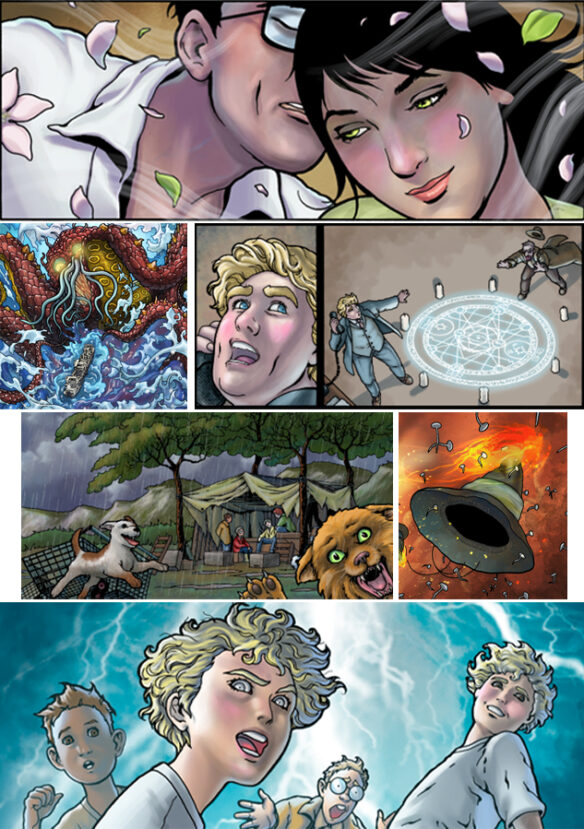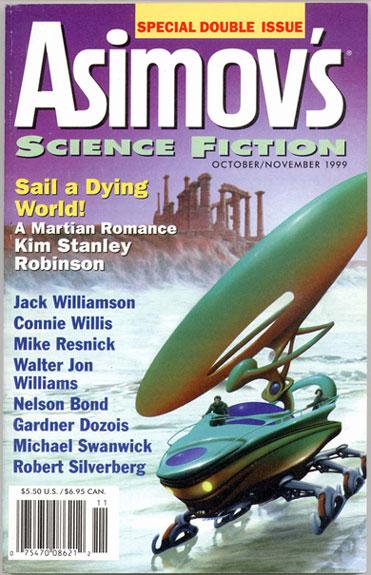
(1) ONE PROZINE CHASTIZES ANOTHER ABOUT AI ART. Jason Sanford posted a thread about AI art in SF/F magazines prompted by a post by the editor of Interzone taking Asimov’s to task for using what appears to be AI art on its cover. Thread starts here on Bluesky. (Note: Anthony Ha questions whether the cover is AI art. It came from Shutterstock, and was so credited; Ha analyzes the issue further at the link.)


(2) HORROR, PLEASE. Author and librarian Taylor Hunsberger tells Publishes Weekly that “Horror Offers Young Readers Safe Spaces in Scary Times”.
….As a children’s librarian, I constantly have kids asking me for scary stories. There is proof of the popularity of the genre for all ages, yet the genre is not typically seen as a legitimate form of reading for kids. Guardians may view the material as inappropriate because their ideas of the genre stem from their understanding of what horror looks like for adults. For quite some time, horror for kids was seen as too pulpy or not serious enough for younger readers, leading to major backlash during the ’80s and ’90s. This is the same trend we see now in the censorship and book bans throughout the United States. Horror is a genre that gets kids interested in reading, and they should be allowed access to these books just like any other type of censored material.
There’s a wide range of horror for children. Sometimes young readers are looking for a series such as Goosebumps, but sometimes a kid may just want a picture book that features a vampire. They come to recognize these characters such as Frankenstein or Dracula through popular media, which may intrigue them and make them seek out something similar in a new book.
Before working as a public librarian, I conducted research on children’s horror literature for my final graduate project. For this project I analyzed the content of a variety of books in the New York City public library systems, reading all of them and taking note of their unique characteristics. I found a trend that I was not at all expecting: children’s horror is a genre all unto its own. While horror for adults and teens was primarily created for the purposes of instilling fear into its audiences, children’s horror was doing something different. And in this difference, it was presenting opportunities for social and emotional learning for young children.
The primary difference I began to find within these books was that some stories included a monster as a protagonist rather than as a threat to the main character. This was especially true in picture books, early readers, and bridge book titles. The monster in the story was a stand-in for the reader, and the plot typically involved overcoming an obstacle—a journey that is familiar in all children’s literature…
(3) PAY RAISE FOR POETS. The Science Fiction & Fantasy Poetry Association raising its contributor rates.
As of Star*Line 48.3 (July 2025):
- Poets are paid $0.05/word with a $5 minimum per poem.
- Pay for reviews has increased to $5.
- Articles have increased to $0.03/word.
- Cover art is $20, and interior art is $6.
As of issue 57 of Eye to the Telescope (July 2025):
- Poets are paid $0.05/word with a $5 minimum per poem.
(4) OVERCOMING CON ENTROPY. Randee Dawn tells us “Why most SFF cons need fixing, and how CONvergence can show the way”.
…There’s a lot of withering going on in East Coast-based cons, which is where I have spent most of my time. They’re frequent, they’re regular, and there are a lot of them, particularly in the Northeast. I have loved nearly every time I’ve gone to one — I just dig being in a hermetic environment (that is, the hotel) with a bunch of fellow book/genre nerds doing our best to nerd out on what we love, check out others’ creative output, meet like-minded folk, and have a safe space to be our weird selves. I love how these places are miles ahead of the rest of the country in being inclusive, safe spaces (though not without some significant stumbles). I also love that they are run almost entirely, or often entirely, by volunteers who do it for the love of it. It’s a job that eats your life for months on end, and doesn’t always come with a lot of public reward, either.
What’s fascinating, though, is when you go to a different part of the country and see just how things might be different — or better….
…I’ve just finished my second CONvergence convention in Minneapolis, Minnesota, and once again I am blown away by the scope, the depth, the organization and the overall forward thinking of this particular con. Here are some thoughts I had while at CONvergence that I think other con runners might find useful when facing the big issues of budgets, attendance, relevance, and the like….
Problem: Con attendance is shrinking, or the demographics are not sustainable.
Thoughts: One challenge for any con is ensuring it doesn’t turn into rooms of gray-hairs. Experts with experience are invaluable, but new blood is needed for any system to continue. While some cons I attend feature tracks designed for children, at CONVergence I moderated two panels (I was on ten total) where a young person was a panelist.
Now, this isn’t unique: I’ve heard of cons where they’ll do a middle-grade books panel, for example, and include young folks. But these were big concept panels, and these young people were about 14-15. In a savvy move, they were a fifth person on a panel of four, so the panel wasn’t going to live or die based on their participation. But it’s such a simple add-on if done right.
How to do it right? Vet the young person, of course. Make sure they’re mature enough to handle it, and that they won’t resort to scrolling on their phone if things get dull. Tell the moderator that there will be a young person on the panel so at least some questions can be tailored to the young person’s level, and level of expertise.
Some cons do have kid tracks but for two of the ten panels I was on or moderated at CONvergence, they did something I hadn’t seen before: We had a young person panelist with the adults. By young, I’d say these kids were maybe 14-15. Obviously, this isn’t unique — sometimes a con will do a MG panel and include kids of that age — and obviously this isn’t for all kids. But it does help get them engaged on a top level and hopefully enthused (and experienced) for future cons. One thing that helps if this is something you or any con wants to do is to ensure moderators know there will be a young person participant, so some of the questions can be tailored in their direction.
I can hear some adults grousing that they’ve been shut out of panels already for various reasons; that they’re not getting to participate because of (ahem) inclusivity. But if you want the thing to survive, you need to include the next generation. This should include articulate, informed young people.
This doesn’t mean the young person should just show up and sit there: Their parent/s should be involved enough to ensure they’re prepared to participate. They need to come with things to say. But there are so many bright, enthusiastic young people out there that this feels like a natural evolution — just one that needs some careful handling. Kid gloves, if you will….
(5) IT’S A SIGN. “Sinners Makes History With New Viewing Option for Streaming Debut on Max” – CBR.com has the story.
After its theatrical success, Ryan Coogler’s hit film Sinners is now streaming on Max. This also makes history by offering a new viewing option that’s never been done for a streaming release.
Per Warner Bros. Discovery, Sinners has two viewing options available on Max: the theatrical cut and the Black American Sign Language (BASL) version. It’s the first time that a streaming service has exclusively debuted a film interpreted in BASL. WBD has described BASL as a “distinct dialect of American Sign Language (ASL) with its own dynamic history and unique grammar, signing space, rhythm, facial expressions, and cultural nuances.”…
(6) A VERY LEAP YEAR. A Deep Look by Dave Hook returns to 1949 for “’The Thirty-First of February’, Nelson S. Bond, 1949 Gnome Press”.
The Short: I just read a Nelson S. Bond collection, The Thirty-First of February, 1949 Gnome Press. My favorite of the 13 stories included is “The Monster from Nowhere“, a science fiction short story, Fantastic Adventures July 1939, rated 3.9/5, or “Great”. My overall average rating is 3.67, or “Very good”. It’s a mix of fantasy and science fiction, with a number of great stories including one you could argue over whether it is genre or not, and one story that fell into “Okay”. Recommended….
(7) FIXED THAT FOR YA. Gizmodo tells us, “People Hated the ‘Squid Game’ Ending, so They’re Using AI to Make New Ones”.
Pissing people off with your series finale is practically a rite of passage for beloved TV shows at this point. Just ask fans of The Sopranos, or Dexter, or Game of Thrones. And if you’re feeling butt hurt by your favorite TV show’s subpar ending, you may be tempted to imagine a whole new one—an ending where Tony gets whacked, or survives some kind of epic John Wick-style shootout, or, I don’t know, assembles all the Infinity Stones and becomes the supreme ruler of mobsters across the universe. Or better yet, if you live in 2025, you can simply just generate a whole new ending with a few words and the click of a button.
In case you haven’t been paying attention, Squid Game finally dropped its third and final season, and the reaction to the series finale has been… mixed. For several reasons (one being I haven’t watched the finale myself), I won’t tell you what happens in the end, but it’s clear that things go off the rails and not to every fan’s satisfaction. In yesteryear, that would mean we’re relegated to bitching about the outcome to our friends or on Reddit, or to our poor therapists, but now we have video generators like Google’s slop machine, Veo 3, and people are obviously taking full advantage….
(8) TERRY GILLIAM Q&A. “Terry Gilliam ‘Brazil’ 40th Anniversary Interview” at Deadline.
DEADLINE: There are a lot of major films having big anniversaries this year. When you look back now, how does it feel to realize it’s been 40 years since Brazil?
TERRY GILLIAM: Well, that’s the thing that’s always interesting. I mean, it doesn’t feel that long ago for me because it was such an intense period, not the making of the film, the fighting to get the film released as we made it — that was very intense and interesting. I kind of look back at that time and think, “Wow, it was almost good fun to have that fight with Universal.” I was just so determined that they were not going to change the movie. As a result of it, I was for a while, inundated by other filmmakers who were thinking that I had changed the rules. There was a little opening for a few weeks, and then it closed again. And it’s either you have to decide whether you want a career or you want to make your movie the way you want to make it. Simple….
DEADLINE: Is there a way to maneuver to get your stories across?
GILLIAM: As an independent, they say you’ve got to keep your budget at around $10 million or below $10 million, it seems to me, if you’re going to go anywhere, and my ideas tend to need more. Quixote was $20 million, and I finally got it made. But not because of the system, because of a fairy godmother who came up with the last bit of money. I don’t know how to make films as cheaply anymore because my ideas have become invariably bigger. I’m kind of caught in this trap between independent film budgets and studio budgets. That’s what is my mistake in life….
(9) TODAY’S BIRTHDAY.
[Written by Paul Weimer.]
July 7, 1919 — Jon Pertwee. (Died 1996.)
By Paul Weimer: The Third Doctor.
My first encounter with him was in the episode “The Five Doctors”. I had seen the Tom Baker serials, and PBS had gamely gone on to the Peter Davidson serials. Among those was the 25th anniversary special, featured the recast 1st Doctor (Richard Hurndall), Patrick Troughton, and of course, Jon Pertwee. So this episode was my first exposure to all three doctors before Tom Baker. I loved the car (Doctor Who driving a car, what a notion!) and filed away Pertwee for the future.
Eventually the PBS station went back to the beginning with a couple of episodes of the original 1st Doctor William Hartnell, and Troughton, before settling in on the Pertwee run. And here I could see the radical change in concept for the Doctor: A Doctor who was mostly stuck on Earth or returned to Earth. Sure, most Doctors visit the Earth time and again, but the idea of a Doctor that stays on Earth in the same time period, rarely does (or even can) use the Tardis, and seemed like a science hero–this was strange and unusual stuff.
I particularly liked Pertwee and the Third Doctor’s interactions, not just with UNIT (and I finally understood why people liked the Brigadier so much) but with Delgado’s The Master. The Master-Doctor relationship begins and is possibly at its best for the entire Old Doctor run. The Master of Baker, Davidson, Baker and McCoy is, frankly, a pale shadow of the one in these episodes. And I think it’s the chemistry for lack of a better word that Pertwee had with Delgado that really makes this possible.
My favorite Pertwee episode is a tough nut to crack. Inferno, with the alternate world? “Planet of the Spiders”, with absurd chase scenes? Maybe “Frontier in Space”, because it was an episode that really brought home to me that the Doctor had great adventures we never got to see (just how he became a noble in the Draconian Empire is something I’ve always wondered about!) .
If you didn’t like this birthday remembrance, I am sure you can simply fix it by reversing the polarity of the neutron flow!

(10) COMICS SECTION.
- xkcd investigates the first murder.
- Saturday Morning Breakfast Cereal finds the multiverse delivers unexpected results to St. Peter’s doorstep.
- The Argyle Sweater uses a big light.
- Tom Gauld knows how to turn a phrase:
(11) HE’S NO DUMMY. “Strength, Speed, and Super-Ventriloquism? The Strange Evolution of Superman’s Powers” is traced by IGN.
We’ve all heard the spiel about Superman before. He’s faster than a speeding bullet, more powerful than a locomotive, and able to leap tall buildings in a single bound. In short, he’s one of the most powerful fictional characters ever conceived, able to break the laws of physics and bend time itself with impunity.
That said, Superman’s powers are nothing if not evolving. They’ve ebbed and flowed a lot over the decades, with the character evolving from super-strong defender of the downtrodden to all-powerful, godlike superhero to the more well-rounded character he is today. The only constant with Superman is his inconsistency…
…Beyond strength and speed, DC creators added all manner of entirely new powers to the roster. Superman first displayed his Super-Breath during this period, allowing him to freeze enemies in ice or survive in the cold vacuum of space. He developed a genius-level intellect and perfect memory. And that’s to say nothing of the many bizarre and ridiculous powers that would often crop up for a single issue or two and never be mentioned again. That includes Super-Ventriloquism, Super-Hypnotism, and the downright incredible ability to shoot a miniature Superman clone from the palm of his hand. Whatever DC’s writers and artists could imagine, Superman could accomplish….
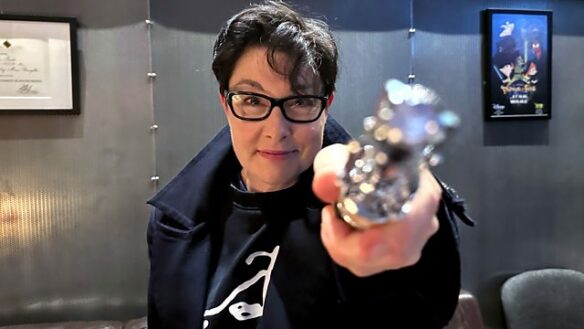
(12) FAVORABLE DIAGNOSIS. “The Wand Company Star Trek Tricorder review – My landing party set is now complete” enthuses The Gadgeteer. The product was designed using 3D scans of “the last known hero prop”.
The Wand Company has done it again! In 2014, they released a Star Trek Phaser replica worthy of any TV or movie production. In 2016, they released an almost perfect version of the Communicator. Then, a few years later, in 2020. The Wand Company announces it is finally making every Star Trek fan’s fantasy come true by completing the 3-piece away team set for grown-up children with adult money. However, a little global pandemic in 2020 happened. Then numerous production and design setbacks, and finally, the trade war of 2025. Well, I am happy to say it is finally here. The Wand Company’s Star Trek Tricorder. And it is fabulous.
- Tricorder with Shoulder Strap
- 8 Data Discs
- Magnetic Display Stand
- Protective Carrying Case
- Lower Compartment Partitions
- USB-C charging cable
- Instructions


… Also in the upper compartment is the moirè disc. This swirling piece of psychedelic imagery harkens back to the age when Star Trek first came out. The swirling pattern is also part of the original Communicator design, which was also designed by the same person who designed the Tricorder….

(13) A SPIDER SAT DOWN BESIDE HER. [Item by Steven French.] If any Filers happen to be flying to Seoul, they might want to check this out in the airport: “Gentle Monster” at Atlas Obscura. Photo gallery at the link.
Korea is known for its horror movies and eerie writings, and almost as an homage to this genre, these spider twins spread an eerie charm across Incheon airport.
The statues take the shape of a pair of strange oily spiders, which seem to be rolling balls of dirt around. Their lumpy exterior is reminiscent of some kind of Lovecraftian horror. The spiders are specifically designed to evoke a primal fear, which they do excellently, as both adults and children alike often pass them in a wide loop.
The piece is made by a company of the same name that creates art pieces throughout the world and sells designer sunglasses.
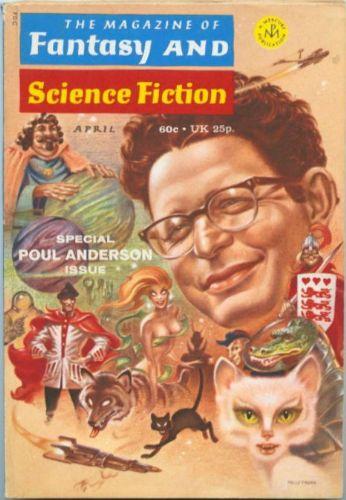
(14) A VAST GALLERY OF PULP COVERS, The “Pulp Covers” blog posts excellent scans of old pulp magazine covers – several each day apparently.
(15) YOU ARE HERE. [Item by Mark Roth-Whitworth.] What we’ll need when we get going out there: “New Horizons images enable first test of interstellar navigation” reports New Scientist.
As it hurtles out of our solar system, NASA’s New Horizons spacecraft is so far from Earth that the stars in the Milky Way appear in markedly different positions compared with our own view. Astronomers have now used this change in perspective to work out the probe’s position in the galaxy, in the first ever example of interstellar navigation.
New Horizons was launched in 2006, initially to study Pluto, but it has since travelled way beyond this point, ploughing on through the Kuiper belt, a vast, wide band of rocks and dust billions of miles from the sun. It is now speeding at tens of thousands of kilometres per hour.
When gazing at the night sky from Earth, the stars are so far away that they don’t appear to change positions when viewed from different locations, unless you have a powerful telescope. But from New Horizons’ viewpoint, there is a significant change in star positions due to the parallax effect. This was demonstrated in 2020 when the probe beamed back pictures of two nearby stars, Proxima Centauri and Wolf 359, to Earth.
Now, Tod Lauer at the US National Optical-Infrared Astronomy Research Laboratory in Arizona and his colleagues have used this effect to work out the position of New Horizons. They did it by comparing the probe’s photos of Proxima Centauri and Wolf 359 with measurements from the Gaia space telescope, which has produced the most detailed map of stars in our Milky Way.
“We have a good enough three-dimensional map of the galaxy around us that you can find out where you are,” says Lauer. “It’s a remarkable accuracy, with your own camera [on board a spacecraft].”…
(16) VIDEO OF THE DAY. In How It Should Have Ended Superman wants to know “Where’s the Dog?”.
[Thanks to Steven French, Kathy Sullivan, Teddy Harvia, Mike Kennedy, Andrew Porter, John King Tarpinian, Chris Barkley, Cat Eldridge, SF Concatenation’s Jonathan Cowie, and Mark Roth-Whitworth for some of these stories. Title credit belongs to File 770 contributing editor of the day Cat Eldridge.]