Pixel Scroll 10/29/24 The Pixels Have A Gene That Gives Them All Short Hair, So They Don’t Like Cold Weather

(1) PICKETT LINE. I love this one by Adam Roberts. (Inspired by the Bobby “Boris” Pickett song.)

(2) WHY NOT SAY WHAT HAPPENED? In Episode 5 of Scott Edelman’s podcast Why Not Say What Happened? we get the story of “My Rooftop Dance with Larry Lieber” at the 1974 Worldcon.

Join me as I demonstrate the limits of my memory by telling tales of why my first Worldcon was supposed to have been my second Worldcon, the question I never got around to asking my cousin, the actor Herb Edelman, which song I sang while dancing across a Manhattan rooftop with Larry Lieber, what Fantastic Four moment motivated the first letter I ever wrote to a comic book company, the string of serendipities which led to one of my DC horror stories being adapted as an episode of Tales from the Darkside, how the Washington Post got me a job editing Science Fiction Age magazine, and more.

(3) MEMORIES FINALLY RETURNING. [Item by Michael Dobkins.] This is a follow up to a news item by Bruce D. Arthurs in the October 19 Pixel Scroll ((8) SECOND, JUST SAY, ‘I FORGOT’.) A new video on the Beinecke Library at Yale’s YouTube just dropped that gives more details on the exhibit and even quotes briefly letters between Disch and David Gerrold about the project at the end.

Remembering “Amnesia” with Claire Fox- MAB 10/14/24

A talk in conjunction with the exhibition “Remembering ‘Amnesia’: Rebooting the First Computerized Novel” on view now in the Hanke Gallery at Sterling Memorial Library. “Amnesia”—a work of interactive science fiction by Thomas M. Disch, published in 1986—was an early attempt to bring video games into the realm of literary art by translating a novelist’s script into a medium that readers could only experience by interacting with a computer. This exhibition traces how “Amnesia” moved from story idea to digital manifestation. Visitors can also play the game on workstations in the Hanke Gallery in Sterling Memorial Library and in Bass Library, using Emulation-as-a-Service Infrastructure (EaaSI) software. Included is the story of the library’s Digital Preservation unit’s work to bring the interactive, computerized novel to life. Claire Fox, curator of the exhibition, is Software Preservation and Emulation Librarian in Yale Library. Mondays at Beinecke online talks focus on materials from the collections and include an opening presentation at 4pm followed by conversation and Q & A beginning about 4:30pm until 5pm.

There is also an Amnesia: Restored website devoted to the interactive novel that offers “a new version of the cult classic published by Electronic Arts 1986, now available on the web for contemporary computers.”

(4) UNREAL ESTATE DEVELOPMENTS. Arturo Serrano gives Poltergeist an almost theological analysis at Nerds of a Feather: “First Scare: Poltergeist”.

Poltergeist feels like a condensation of mystical currents of thought that had gained strength during the hippie era but really date back to the spiritualist fad of the 19th century. Advances in the understanding of electromagnetism coincided with a growing interest in the inner workings of the mind, and it was only natural that a theory eventually formed linking electromagnetism with the paranormal. If you didn’t know any better, it made some sort of sense: if you consider radio waves, they’re an invisible force that exists all around us and can even pass through us, and have very tangible effects if you have a properly sensitive machine at hand. So it wasn’t too much of a stretch to suppose that ghosts worked the same way. Poltergeist is an heir to over a century of superstition that viewed in electrical devices a viable tool for contacting the spiritual realm.

But Poltergeist does more than that. It also takes advantage of the moral panic that was forming around mass media and the way the TV set ended up altering not only the inner dynamics of the American family, but also the rhythm of daily life. People in Poltergeist time their activities by the programming schedule of TV; their day ends when the last broadcast ends. Even before malevolent spirits jump out of the screen, they’re already under the spell of TV….

(5) SURPRISE PACKAGE. A winner of the Nobel Prize for Literature wants a publisher to look at his trunk stories. Forward follows the trail: “Bob Dylan wants a horror publisher to look at his stories”.

In breaks on his Never Ending Tour, Bob Dylan has returned to social media to send his regrets to the Buffalo Sabres hockey team for missing a game, recommend an incredibly famous restaurant in New Orleans and, in a new twist for the Nobel laureate, hint at his spooky literary aspirations.

“At the hotel in Frankfurt there was a publishing convention and every room was taken, parties all night,” Dylan posted on the social platform X  (formerly Twitter) Oct. 23.

“I was trying to find Crystal Lake Publishing so I could congratulate them on publishing The Great God Pan, one of my favorite books,” Dylan continued. “I thought they might be interested in some of my stories. Unfortunately it was too crowded and I never did find them.”

As always, Dylan speaks, the world listens. It came as quite the October surprise for Crystal Lake, a Bloemfontein, South Africa-based press specializing in dark fiction and horror whose current titles include an anthology called Dastardly Damsels and Blood and Bullets: A Trio of Western Horror Novellas. (Yes, they also published a “revamped” edition of Machen’s 1894 Great God Pan, about a sinister woman who seems to be driving powerful men to suicide.)

“We had literary agents in Frankfurt representing our books, so we weren’t there in person,” Crystal Lake’s founder and CEO Joe Mynhardt said in an email.

Mynhardt said that, since the Dylan post, they’d spent a few days tracking down the songwriter and his team.

“It’s my understanding that they now have our contact info, so fingers crossed,” Mynhardt wrote in his email Saturday.

While Dylan has previously published poetry, the first part of his memoirs and most recently his 2022 book The Philosophy of Modern Song, it remains to be seen what scary stories he may have in his drawer. Less of a mystery is what he may have admired in Machen’s novella — a tale of sex, pagan gods and death. Somehow this all seems very on brand, even if it’s lacking in the Americana department (Machen was Welsh, like another great poet named Dylan)…

(6) TODAY’S 270. Chris M. Barkley’s essay for 270 Reasons (“Why Kamala Harris?”) has gone live: “Because the lawlessness, the fascism, the fearmongering must come to an end” (which he also shared with File 770 a few days ago).

… The election of Kamala Harris will not end the partisan and political divisiveness that ails America. But it, along with a majority in the House and Senate, will be an important and vital first step toward restoring a sense that democracy, and the underlying systems that support and nourish it, can prevail and grow.

Fear sells—until we, collectively, stop buying it.

We have no excuse. We know better, and now we must do better….

(7) AFI LIFE ACHIEVEMENT 2025 ANNOUNCED. “AFI Life Achievement Award to go to Francis Ford Coppola in 2025” says The Hollywood Reporter. Yes, in spite of Megalopolis.

The filmmaker has been selected to receive the 50th installment of the organization’s highest honor, the AFI Life Achievement Award, at a ceremony scheduled to take place at Hollywood’s Dolby Theatre on April 26, 2025. He will be 86 at the time. The tribute will air on TNT with encore presentations on Turner Classic Movies. All proceeds from the gala will support AFI’s education and arts initiatives.

The AFI Life Achievement Award is presented to an honoree “whose talent has in a fundamental way advanced the film art, whose accomplishment has been acknowledged by scholars, critics, professional peers and the general public, and whose work has stood the test of time.”…

(8) (BOW) WOW! “Kathryn Hahn Reacts to Agatha-Themed Dog Halloween Costume: ‘Wagatha Barkness?!’” at Entertainment Tonight. Watch the video at the link.

Kathryn Hahn on the success of ‘Agatha All Along’

Kathryn: “Jac Schaeffer who wrote it is a genius because she wrote Wandavision too and so I just hurled myself with faith into whatever she would do, she knows this character really well.”

Kathryn Hahn on a viral Halloween dog costume inspired by the Disney+ series

Kathryn: “Apparently there is a dog costume called Wagitha Barkness… which I’m like, that seems amazing!”

(9) ALTERNATIVES TO OUR DIGITAL FUTURE. Joshua Rothman asks “Could Steampunk Save Us?” – behind a paywall in The New Yorker.

In 1990, Gibson and Bruce Sterling wrote “The Difference Engine,” an alternative-history novel, set in the nineteenth century, in which computers are built about a hundred years earlier than in reality, using quirky systems including gears, wheels, and levers. The novel helped popularize the genre of steampunk, in which nineteenth- and twentieth-century technologies are merged. Arguably, Jules Verne and H. G. Wells wrote steampunk avant la lettre, simply by crafting science fiction in the late nineteenth century; the genre’s aesthetic markers-valves, pipes, airships, monocles-have since informed the imaginative worlds of films and television shows like “Snowpiercer,” “Silo,” and much else. Steampunk mounts an imaginative protest against the apparent seamlessness of the high-tech world; it’s an antidote to the ethos of Jony Ive. It’s also fun because it’s counterfactual. It’s fascinating to imagine, implausibly, how ravishing technology could be constructed out of yesterday’s parts.

But what if the world really is constructed that way? In that case, it could be a mistake to put too much faith in digital perfection. We might need to fiddle with our technology more than we think.

(10) STOP BEING MIDDLE-CLASS IMMEDIATELY.  “This is a Thomas Ha Fanzine Now” at Seize the Press, edited by Jonny Pickering and Karlo Yeager Rodríguez.

The other week someone asked me why I thought there was such discomfort with unresolved narratives and non-cathartic endings in some corners of the contemporary short story world. I thought about it a bit and figured my answer would be worth sharing.

The conversation came about after I read a Thomas Ha story called “The Brotherhood of Montague St. Video”, which features a story within the story — an old pulp western the narrator discovers has been altered so that the original ending (where the protagonist is defeated by the evil sheriff and limps off into the desert) is rewritten into a glorious, audience-pleasing victory. As with any Thomas Ha story, there are layers stacked on layers to the narrative, but one thing it got me thinking about is why so much contemporary media (and short fiction in particular) is so ill at ease with leaving the audience ill at ease.

I can’t say for sure why this is, but I can speculate. I think one reason is there’s an influential school of (largely American) middle class liberal writers who dominate a lot of the bigger magazines and who come at fiction from the viewpoint that writing and reading stories constitutes some form of activism. You see it a lot in the ‘power of stories’ assertions that go round from time to time and is also partly why we see so much didactic fiction out there, because it’s a view that thinks the purpose of art is to ‘instruct’ and to portray the ‘correct opinions’, whereas for me good art raises more questions than it answers….

… At the risk of sounding like a vulgar Marxist I think western society in general (and, from what I can gather as a Brit, particularly American society, which has such a big effect on western culture as a whole) has reached a stage where, for lots of people, collectively trying to change the world can seem pretty hopeless, and so there’s a tendency to retreat into a very individualistic notion of activism, where if you’re working on yourself and thinking the right things and reading the right things, even when that thing is fiction, it feels like praxis. It’s incredibly reactionary and has a stultifying effect on art in my opinion, because it results in these calcifying stories that do nothing to challenge, and whose purpose and effect is simply to reassure….

(11) TERI GARR (1944-2024). Teri Garr, who received an Oscar nomination for her role in Tootsie, died October 29 reports the AP. She died of multiple sclerosis “surrounded by family and friends,” said publicist Heidi Schaeffer. Garr battled other health problems in recent years and underwent an operation in January 2007 to repair an aneurysm.

Garr is best remembered by fans playing the helpmate in four genre classics:

  • Wife, Ronnie Neary, to Richard Dreyfus in Close Encounters of the Third Kind
  • Wife, Bobby Landers, to John Denver in Oh, God
  • Lab Assistant, Inge, to Gene Wilder in Young Frankenstein
  • Office Assistant, Roberta Lincoln to Robert Lansing in Star Trek’s  “Assignment Earth” episode

She also appeared on the Sixties Batman series. And forty years later she voiced the character of Mary McGinnis in the animated “Batman Beyond” TV series, and Sandy Gordon in 2003’s What’s New, Scooby Doo? animated series.

(12) TODAY’S BIRTHDAY.

[Written by Paul Weimer.]

Born October 29, 1906Fredric Brown. (Died 1972.)

By Paul Weimer: I first encountered Fredric Brown’s work with a pastoral work known as “The Waverlies”. Sometime in the near future, a peculiar sort of alien arrives on earth that is invisible, and eats all forms of radio, and electromagnetic signals and power fail.  The United States and the rest of the world is thus plunged into a late Victorian era of technology. It was and is a pastoral, gentle story of the hands of time being stopped and put backward to a slower pace, permanently. The story nagged at me, though, even as I liked it. Such a technological change would be wrenching and millions…if not more, would die in the result (c.f. S M Stirling’s The Change series).  I don’t think Brown considered that. But this is notably one of Philip K Dick’s favorite short stories. It has a power…even if it doesn’t realize its full implications and problematic nature

But he considered and thought about a lot of other SF ideas in other fantastic stories. His story “Answer” has the classic line you know even if you haven’t read it “NOW there is a God”.  “Arena” is the basis of the Star Trek episode where Kirk fights a Gorn. And there are plenty more where those come from. I haven’t delved into his extensive work with mystery novels and stories, but if that is your jam, Brown has a plethora of work for you once you finish his science fiction stories and short novels.

But as much as I like “The Waverlies” (even as I recognize the problematic aspects of the story), my favorite Brown story is probably his most definitive one, and that is “What Mad Universe”. You probably know this story if you read it. A SF book editor finds himself in a world whose ideas run on SF magazine story conventions. With a breakneck pace and change of action and twists at a pace that Van Vogt might envy, the story is a rollercoaster and deconstruction of what was soon to become a dying breed — pulp SF stories. It thus stands as the Pulp Science Fiction story for as unwitting capstone of the era, and it’s a lot of fun.  I’m not the only one who thinks this, as witness Lawrence Block’s The Man Who Met Frederic Brown, which takes up on this trope and references that story directly. 

Fredric Brown

(13) COMICS SECTION.

Bliss has a big problem.

Crankshaft tries a crossover.

(14) CHARLES BURNS RETURNS. [Item by Steven French.] Charles Burns, creator of Black Hole is back with a new graphic novel, Final Cut: “’I was high, drawing my self-portrait in a toaster’: the thrilling return of graphic novelist Charles Burns” in the Guardian.

…Burns became obsessed with monsters at a young age. His father had “every kind of hobby”, which meant the house was always full of art tools and Indian ink. Burns would try to recreate comics he found around the house but his awakening came in early 1969 when a kid at school introduced him to Zap Comix, helmed by the godfather of underground comix Robert Crumb. “Suddenly, here’s this thing with intense drawings! I wasn’t interested in Captain America and Iron Man – but I would imitate these psychedelic comics.”

Burns disappears again and comes back with some of his early examples. They have a beautiful, frantic quality – a kind of professionalised bedlam – with all the hallmarks of his current work, from weird monsters to attractive adolescents. The cartoonist Lynda Barry once wrote of his style and the standard he reaches: “You can’t believe a person could do it with regular human hands. It’s the kind of drawing that would have scared the pants off you in grade school, not only because the images are so eerie but because they are too perfectly done, and not good or evil enough for you to tell what you are supposed to think about them.”

That eerie perfectionism is right there in his earliest work. It’s this style that excited Spiegelman, who agreed to publish Burns in Raw in the 1980s. It’s why the cult literary magazine The Believer, founded by Dave Eggers in 1998, used Burns for every cover until 2014…

(15) HOW WOULD YOU TRANSLATE IT? From Viktoria on Threads:

(16) TV VIEWING RECOMMENDATIONS FOR LAST-MINUTE JACK O’LANTERN CARVERS. In anticipation of Halloween, JustWatch has put together a list of the Top 10 spooky movies and TV shows available to stream in the United States based off their 13 million users in the United States. 

(17) EARTH ABIDES SERIES. “’Earth Abides’ Trailer: Alexander Ludwig Stars In Series Adaptation”Deadline tells what to expect.

MGM+ has dropped the first trailer and unveiled the premiere date for Earth Abides, its upcoming post-apocalyptic limited series adaptation of George R. Stewart’s sci-fi novel of the same name. It’s slated to launch December 1 on the streamer.

Written and executive produced by Todd Komarnicki (Sully), who also serves as showrunner, in Earth Abides, when a plague of unprecedented virulence sweeps the globe, the human race is all but wiped out. In the aftermath, as the great machine of civilization slowly and inexorably breaks down, only a few shattered survivors remain to struggle against the slide into extinction….

(18) A VISIT TO SHENZHOU-18. Futurism invites us to “Watch Astronauts Give a Rare Tour of China’s Luxurious Space Station”.

…As seen in an almost seven-minute-long video shared by Chinese state-owned news agency CCTV, members of the current Shenzhou-18 crew gave an extensive tour of their temporary abode.

Crew members show off the station’s kitchen, from a small heater that dispenses water into small pouches to a modified microwave. Astronauts also showed off the surprisingly roomy beds that each feature a sizable porthole, with unparalleled views of the Earth below.

We even got a glimpse of the two orbital lab segments, including several cherry tomato and lettuce plants growing in the station’s greenhouse….

[Thanks to Cat Eldridge, SF Concatenation’s Jonathan Cowie, Steven French, Jo Fletcher, Lew Wolkoff, Andrew (not Werdna), Michael Dobkins, Kathy Sullivan, Teddy Harvia, Mike Kennedy, Andrew Porter, John King Tarpinian, and Chris Barkley for some of these stories. Title credit belongs to File 770 contributing editor of the day Cat Eldridge.]
Pixel Scroll 10/19/24 Pixeling On The Other Side, Where Only Scrolls Hide

(1) BEAR APPARENT. “Ur Sid arrives at Cushing Memorial Library & Archives”. Sharon Lee tells fans a photographer was standing by. (OK, it was actually Curator Jeremy Brett.)

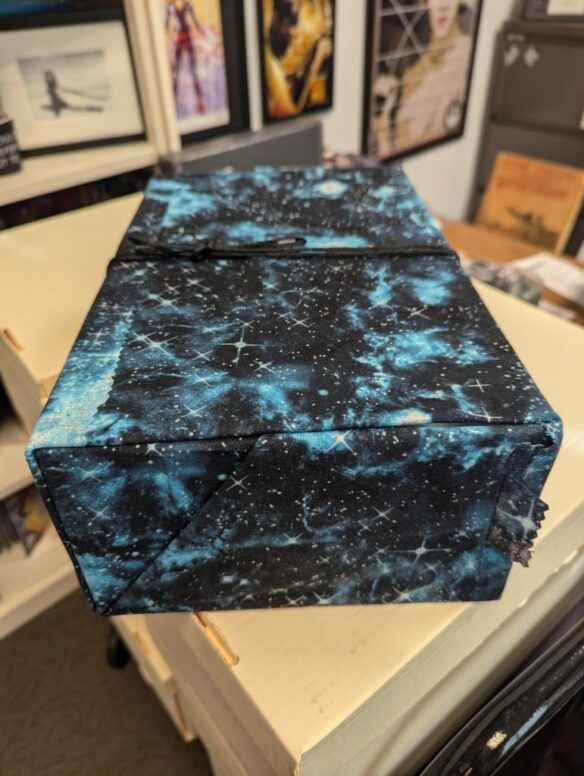
…Since the Bumpy Passage fell out of use many years ago, I created a travel pod so that Ur Sid could make his journey in the style to which he had become accustomed, and packed him carefully in a box.  He accompanied nine other boxes containing the Full Run of Lee-and-Miller, Lee, and Miller published works.

Well, today Ur Sid arrived at his new post.  Jeremy Brett, Curator of the Science Fiction and Fantasy Research Collection has kindly sent along photographs of this momentous arrival, which are posted below.

Right now, Ur Sid is sharing office space with Curator Brett.  Very shortly, he will be transferred to Collections Care so that a proper enclosure for Ur Sid and his belongings, including his travel diary, may be constructed….

(2) CHENGDU TWEETS. [Item by Ersatz Culture.] The official Twitter account of Chengdu, China recently posted some tweets of interest:

  • Yesterday there was a video commemorating the one-year anniversary of the Chengdu Worldcon.  A bit cheekily, there are a couple of shots from the Glasgow Worldcon around 1:15 in, that aren’t flagged up as such:  
  • Today there’s a video with Ben Yalow saying how happy he is to be back in Chengdu: 
  • There’s also a tweet asking for responses about SF experiences in Chengdu; as yet they haven’t had any replies.  

Incidentally, these posts followed straight after one criticizing a recent bill before Congress in the U.S. to fund “badmouthing China”, indicating this account seemingly isn’t just for doing local tourism promotion type stuff… 

(3) ICON 50 TO BE DELAYED TO 2026. [Item by Michael J. “Orange Mike” Lowrey.] On Friday at the opening ceremonies of ICON 49 in Cedar Rapids, it was announced that ICON 50, originally scheduled for October 2025, has been postponed to 2026, due to problems with money and with volunteer shortages. 

This follows the recent announcement that WisCon for 2025 will be a Wisconline, all-online event. 

(4) FIRST BITE. Adam Roberts has a funny take on a recent Guardian story:

Or if you prefer your news straight, here’s the link: “Reader stumbles on Dracula’s ancestors in a Dublin library”.

In a Dublin library once frequented by James Joyce and WB Yeats, beneath a turquoise and white domed ceiling and surrounded by oak shelving, Brian Cleary stumbled across something by Dracula author Bram Stoker he believed no living person had ever read.

Cleary, who had taken time off from his job at a maternity hospital after suffering sudden hearing loss, was looking through the Stoker archives at the National Library of Ireland when he came across something strange. In a Dublin Daily Express advert from New Year’s Day 1891 promoting a supplement, one of the items listed was “Gibbett Hill, By Bram Stoker”. He had never heard of it, and went searching for a trace. “It wasn’t something that was Google-able or was in any of the bibliographies,” he said.’

Cleary tracked down the supplement and found Gibbet Hill. “This is a lost story,” he realised. “I don’t think anyone knows about this.” The story follows an unnamed narrator who runs into three children standing by the memorial of a murdered sailor on Gibbet Hill, Surrey, which is also referred to in Dickens’ 1839 novel Nicholas Nickleby.

Together, the four walk to the top of Gibbet Hill. Distracted by the view, the narrator loses sight of the children. He takes a nap among some trees, and wakes to see the children a short distance away, before a snake passes over his feet towards the children, who appear able to communicate with and control the snake. Later, the children attack the narrator. The story culminates with the snake wriggling out of the narrator’s chest, gliding away down the hillside…

(5) LITERARY INCOGNITO. The Week features a list of “Jeff VanderMeer’s 6 favorite books that delve into the unknown”.

In his new sci-fi horror novel, “Absolution,” Jeff VanderMeer returns to the world of 2014’s award-winning “Annihilation,” which launched his Southern Reach Trilogy. Below, the best-selling ‘weird fiction’ author recommends six psychological expeditions into the unknown.

The six-pack includes:

‘A Perfect Spy’ by John le Carré (1986)

“The past is another country” may be a cliché, but not in the hands of my favorite espionage novelist. His masterpiece charts the entanglements, both professional and personal, that bring about the downfall of operative Magnus Pym. A stunning tale of betrayals, redemption, and, ultimately, a compassionate portrayal of a compromised life.

(6) CHARLIE JANE ANDERS ON ELECTION. At the 270 Reasons blog Charlie Jane Anders answers the question “Why Kamala Harris” — “Because we are close to reaching climate benchmarks we can’t come back from”.

Future generations will look back on 2024 as the moment when the United States of America made a defining choice about climate change. This November, we’re either going to renew our commitment to fixing this mess we created, or embrace denial and plunge the world into a nightmarish scenario.

Nobody much is talking about it, but this election feels especially important for a couple of reasons: first, we are dangerously close to reaching some climate benchmarks that we won’t be able to come back from easily, if at all. And second, we are now being faced with daily brutal reminders of the impacts of climate change on our world. As Kamala Harris herself said in a powerful 2023 speech, climate change is here and the effects are in our face everyday. 

The good news is, the past few years have seen some real advances toward clean energy and green infrastructure. Tax credits included in the Inflation Reduction Act are helping to make wind and solar power more affordable than non-renewable energy sources, and the subsidies in the bill are creating more jobs in the clean energy sector. But there’s much more work to be done…

And if you scroll down past the end of Anders’ article there is an index to other posts, including several by genre contributors Tomi Adeyemi, George Saunders, Daniel Handler (aka Lemony Snicket), and Beth Revis.

(7) PLEASE NOT TO CALL IT SF. This Washington City Paper interview with Tara Campbell perpetuates the cliché that if it’s well-written it can’t be science fiction: “Crossover Sci-Fi Author Tara Campbell Comes Home With a New Novel”.

WCPWhen hearing the phrase “speculative fiction,” most readers will immediately think we’re referring to either science fiction or fantasy, and there are elements of both in your novel. But this work leans strongly in to literary writing, with beautiful, sometimes even lyrical storytelling and far less of the extensive worldbuilding than we’d normally see in the aforementioned genres. How do you approach “speculative literary” writing?

TC: Before I stumbled upon the term “speculative fiction,” I used to say that I write science fiction for people who don’t think they read science fiction. But that was only an approximation of what I was doing, and I’m glad that more people are discovering the depth and breadth of fantastical writing beyond strict genre definitions. 

I love the way “speculative literary” opens up narrative by allowing us to go beyond the bounds of realism to get at emotional truths. If something feels surreal, why not try to capture that cognitive dissonance by portraying it as something palpably unreal? Certain parts of American culture are indeed surreal to me, like our relationship with guns, or our lack of reckoning with history, or our income inequality, and those areas of disconnect came out indirectly in stories about sneaking needles striking us everywhere from home to school to church, or screaming ropes howling in the darkest corner of a dusty barn, or sword fighting robots protecting the bunkers of the uber-wealthy….

(8) SECOND, JUST SAY, ‘I FORGOT’. [Item by Bruce D. Arthurs.] An interesting piece about a project to bring obsolete software back from the dead, using Thomas Disch’s Amnesia computer game from 1986. “Remembering ‘Amnesia’: Digital preservationists reboot classic video game” at Yale News.

You wake up naked in a hotel room. You don’t recall who you are or how you got there. Your clothes are missing. Someone knocks on the door.

So begins “Amnesia,” a text-only video game released in 1986, in which players inhabit the perspective of a man experiencing memory loss while staying in midtown Manhattan at the fictional Sunderland Hotel. Players must negotiate a series of puzzles to find much-needed clothes, leave the hotel, and navigate Manhattan’s busy streets. By gathering clues and avoiding innumerable pitfalls, they gradually discover that the protagonist has a fiancée he cannot remember, is being pursued by an assassin, and is wanted for murder in Texas.

A groundbreaking digital work of interactive fiction by the sci-fi novelist Thomas M. Disch, the game anchors “Remembering Amnesia: Rebooting the first computerized novel,” an exhibit on view through March 2 in the Hanke Exhibition Gallery at Sterling Memorial Library.

Drawing on materials from Disch’s archive at the Beinecke Rare Book and Manuscript Library, the exhibit explores the author’s novel attempt to move video games into the realm of literary fiction. It also describes the efforts of the Yale Library’s Digital Preservation unit to preserve the game, originally stored and played on now-obsolete hardware, and restore it to life.

The revived version of “Amnesia” is available to play on three workstations — two located just outside the exhibit space and one in Bass Library — that emulate a mid-1980s computing environment….

(9) FIVE IS RIGHT OUT. Well, not always. PRINT Magazine’s Steven Heller interviews Arlen Schumer about his latest collection of essays on the famed TV show: The Five Themes of The Twilight Zone, in “The Daily Heller: Your Next Stop, The Twilight Zone”.

You declare in your new title that five themes exist in Serling’s portfolio. What are they?
With this book, I was inspired to curate what I thought were the best episodes of “The Twilight Zone,” collected in a framework that would separate my “greatest hits” of the series into distinct themes that would encompass the diversity—and similarity—of the best episodes by Serling and company. Of course, one can argue that there are more than just five themes of “The Twilight Zone” that the breadth of its 156 episodes would suggest, but I decided rather quickly on the following five, almost as if they suggested themselves: “Science and Superstition,” “Suburban Nightmares,” “A Question of Identity,” “Obsolete Man,” and “The Time Element.” (Of the five, “Suburban Nightmares” is the only one I coined that does not have a direct “Twilight Zone” connection; bonus points for recognizing that “A Question of Identity” comes from dialogue spoken by the protagonist of [the show’s] debut episode, “Where is Everybody?”)

(10) MEMORY LANE.

[Written by John King Tarpinian.]

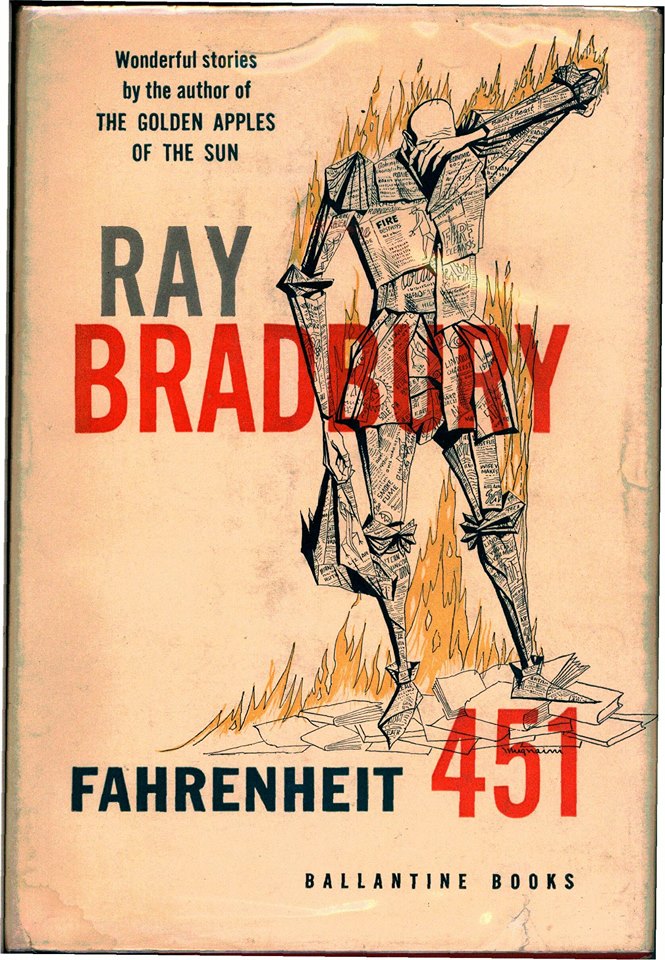
Anniversary, October 19, 1953 Fahrenheit 451

By John King Tarpinian: On this day in history one of the most read science fiction novels was published. One of the few, if not only, novels of sci-fi on a majority of middle and high school reading lists.

Fahrenheit 451 is one of three books that as a young man made me think about stuff outside of my comfortable life. The other two were Dalton Trumbo’s Johnny Got His Gun and Robert Heinlein’s Stranger in a Strange Land, the three making up a trio of books that woke up my little brain.

Fahrenheit 451 was made into a movie by the French director, François Truffaut. It was his first movie in color and his only English-language film. Remember the French guy in Close Encounters of the Third Kind?  That was Truffaut.

Flatscreen TVs were in this book. Bluetooth was in this book. Most people know that Ray never drove a car, remember that in the book Clarisse was killed by a speeding car. Montag was a brand of paper; Faber was a brand of pencil. Beatty was named for the lion tamer, Clyde Beatty.

Bradbury’s book rails against censorship, in any form.

Lastly, Ray’s headstone reads “Author of Fahrenheit 451.”

(Use this link to see a parade of Fahrenheit 451 book covers from over the years.)

(11) COMICS SECTION.

(12) READING THE ROOMS. For the “Every Town Deserves a Library” episode of the Our Opinions Are Correct podcast, hosts Annalee Newitz and Charlie Jane Anders are joined by Ken Liu.

Science fiction and fantasy are full of wondrous libraries containing everything from powerful artifacts to some dang good reads. How does the idealized view of libraries in speculative fiction compare with the real-life libraries, which are under attack by would-be censors and culture warriors? Also, we talk to award-winning author Ken Liu about his brand new translation of the classic Daoist text, the Dao De Jing.

(13) JOY WILLIAMS Q&A. [Item by Steven French.] Joy Williams on why fiction should be ‘uncanny’ (and on reading Baba Yaga stories as a child) in the Guardian.

For many years, you’ve written about the climate emergency and environmental destruction. I wonder if your thinking about how to represent that in fiction has developed, and where you think it might go?

I’m always trying to convince myself that fiction will rise up and throw away the crutches that have been supporting it for far too long. The comfy story has got to change. It needs to be more uncanny, less personal….

(14) MICHELLE YEOH TREK – MARK YOUR CALENDAR. “’Star Trek: Section 31′ Movie Gets Premiere Date On Paramount+”Deadline has the story.

Paramount+ has set January 24, 2025 for the premiere of its upcoming movie Star Trek: Section 31, starring Michelle Yeoh in a reprisal of her Star Trek: Discovery role as Emperor Philippa Georgiou.

The announcement was made Saturday during the Star Trek universe panel at New York Comic Con. Yeoh made a video appearance during the panel, which featured cast members Omari Hardwick, Kacey Rohl and Robert Kazinsky, along with executive producer and director Olatunde Osunsanmi.

Star Trek: Section 31 will premiere exclusively Friday, January 24 in the U.S. and international markets where the service is available….

(15) YOU HAVE TO BE CAREFULLY TAUGHT. “As AI takes the helm of decision making, signs of perpetuating historic biases emerge” – the Arizona Mirror overviews the research.

…In a recent study evaluating how chatbots make loan suggestions for mortgage applications, researchers at Pennsylvania’s Lehigh University found something stark: there was clear racial bias at play.

With 6,000 sample loan applications based on data from the 2022 Home Mortgage Disclosure Act, the chatbots recommended denials for more Black applicants than identical white counterparts. They also recommended Black applicants be given higher interest rates, and labeled Black and Hispanic borrowers as “riskier.”

White applicants were 8.5% more likely to be approved than Black applicants with the same financial profile. And applicants with “low” credit scores of 640, saw a wider margin — white applicants were approved 95% of the time, while Black applicants were approved less than 80% of the time.

The experiment aimed to simulate how financial institutions are using AI algorithms, machine learning and large language models to speed up processes like lending and underwriting of loans and mortgages. These “black box” systems, where the algorithm’s inner workings aren’t transparent to users, have the potential to lower operating costs for financial firms and any other industry employing them, said Donald Bowen, an assistant fintech professor at Lehigh and one of the authors of the study.

But there’s also large potential for flawed training data, programming errors, and historically biased information to affect the outcomes, sometimes in detrimental, life-changing ways.

(16) TURNOVER TIME. “Earth’s Flipping Magnetic Field Heard as Sound Is an Unforgettable Horror”ScienceAlert lets you eavesdrop.

Approximately 41 000 years ago, Earth’s magnetic field briefly reversed during what is known as the Laschamp event. During this time, Earth’s magnetic field weakened significantly—dropping to a minimum of 5% of its current strength—which allowed more cosmic rays to reach Earth’s atmosphere. Scientists at the Technical University of Denmark and the German Research Centre for Geosciences used data from ESA’s Swarm mission, along with other sources, to create a sounded visualisation of the Laschamp event. They mapped the movement of Earth’s magnetic field lines during the event and created a stereo sound version which is what you can hear in the video. The soundscape was made using recordings of natural noises like wood creaking and rocks falling, blending them into familiar and strange, almost alien-like, sounds. The process of transforming the sounds with data is similar to composing music from a score.

(17) DOUG JONES VEHICLE. “’Nosferatu: A Symphony of Horror’ – Doug Jones Stars in Unique Horror Remake [Trailer]” recommended by Bloody Disgusting. (And with a recommendation like that, you know what you’re in for!)

Eight years in the making, director David Lee Fisher’s new take on the horror classic Nosferatu has finally been unleashed, the film now available on Digital through Prime Video….

(18) THE (POD BAY) DOORS OF PERCEPTION. Six years ago someone shared the results of a thought experiment that asked what would happen “If HAL9000 was Amazon.com’s Alexa”.

[Thanks to Chris Barkley, Cat Eldridge, SF Concatenation’s Jonathan Cowie, Bruce D. Arthurs, N., Ersatz Culture, Michael J. “Orange Mike” Lowrey, Steven French, Kathy Sullivan, Teddy Harvia, Mike Kennedy, Andrew Porter, and John King Tarpinian for some of these stories. Title credit belongs to File 770 contributing editor of the day Paul Weimer.]

Pixel Scroll 12/22/21 Snoopy’s Scrollmas

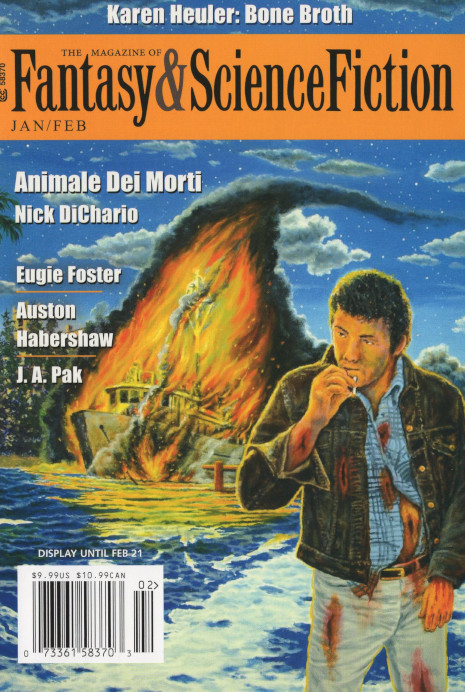
(1) F&SF COVER REVEAL. The Magazine of Fantasy and Science Fiction’s Jan/Feb 2022 cover art by Kent Bash illustrates “Animale Dei Morti” by Nick DiChario. Publisher Gordon Van Gelder says the issue has just been printed and will be distributed soon.

(2) PEN LONGLISTS. The 2022 PEN America Literary Awards Longlists announcement shows these titles are up for the Pen/E.O. Wilson Literary Science Writing Award ($10,000):

For a work that exemplifies literary excellence on the subject of the physical or biological sciences and communicates complex scientific concepts to a lay audience.

  • The Memory Thief: And the Secrets Behind What We Remember — A Medical MysteryLauren Aguirre (Pegasus Books)
  • This Is the VoiceJohn Colapinto (Simon & Schuster)
  • Holding Back the River: The Struggle Against Nature on America’s WaterwaysTyler J. Kelley (Avid Reader Press)
  • Extraterrestrial: The First Sign of Intelligent Life Beyond EarthAvi Loeb (Mariner Books)
  • The Disordered Cosmos: A Journey into Dark Matter, Spacetime, and Dreams DeferredChanda Prescod-Weinstein (Bold Type Books)
  • Fox & I: An Uncommon FriendshipCatherine Raven (Spiegel & Grau)
  • Second Nature: Scenes from a World RemadeNathaniel Rich (MCD)
  • Count Down: How Our Modern World is Threatening Sperm Counts, Altering Male and Female Reproductive Development, and Imperiling the Future of the Human RaceShanna H. Swan (Scribner)
  • Believers: Making a Life at the End of the WorldLisa Wells (Farrar, Straus and Giroux)
  • Life’s Edge: The Search for What It Means to Be AliveCarl Zimmer (Dutton Books)

The Judges are: Jonathan Safran Foer, Michele Harper, and Lauren Redniss.

(3) WILL THEY REWRITE THE SENTENCE? Updating a story being followed here because Courtney Milan said she’d been on the jury: “Trucker’s 110-year sentence in fatal Colorado crash to be reviewed after outcry” in the Sacramento Bee.

Following an outcry by millions of people, including Kim Kardashian, Colorado prosecutors have filed a motion seeking for a second look at the 110-year prison sentence of a trucker convicted in a fatal 2019 crash.

“As Colorado law required the imposition of the sentence in this case, the law also permits the Court to reconsider its sentence in an exceptional case involving unusual and extenuating circumstances,” the motion filed by the Colorado First Judicial District Attorney’s Office.

The motion says the court can review its sentence of Rogel Aguilera-Mederos based on new reports.

The move comes after more than 4.5 million people signed a Change.org petition asking Gov. Jared Polis to commute Aguilera-Mederos’ sentence….

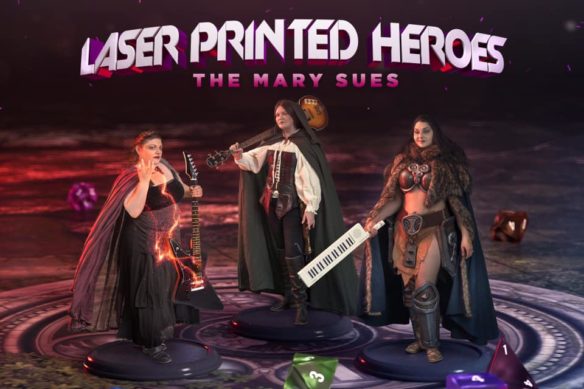
(4) FRESH TRACKS. The Mary Sues have released a new album, Laser Printed Heroes. Hear all the tracks, including “A Thousand Lives” on Soundcloud. Band member Carol Dashiell – my daughter’s aunt! – told Facebook followers:

I’m super proud of this, it’s been a labor of love for a long time. Two of the songs are originals by Stu Venable (who also did our sound), plus some covers from various geeky properties, like Portal, The Witcher, Outlander, and others!

I’ve put the link the the comments so we don’t get throttled by Facebook, I hope you’ll check it out!

And if you like our album art, thank Sam Balcomb, who is a genius.

(5) REMEMBERING A FORGOTTEN CLASSIC. A new version of the original adventure game by Thomas M. Disch. Amnesia, a cult classic published by Electronic Arts 1986, is now available on the web for contemporary computers: AMNESIA : Restored.

Amnesia was envisioned as “bookware”—that is, a new kind of environment created specifically for the personal computer. Its two 5.25-inch floppy disks were packaged in a booklike folio that, when opened, resembled a newspaper with the author’s bio and game information presented as news about NYC. The game was also bundled with a 18-page manual, a command summary, map of Manhattan, x-street indexer, registration mailer, and newsletter subscription postcard.

When writing AMNESIA, Disch, an accomplished novelist, experimented with storytelling for the, then, new electronic environment. His 400-page manuscript laid out a narrative game that offers players 10 different endings. One sees players living out their days on a sheep station in Australia with a wife and a house full of children. In another, players are found guilty of a crime they do not remember committing and are given the choice of committing suicide or facing a firing squad. In some cases, they are allowed to meet St. Peter and provide the correct information about their identity to enter heaven. Depending on players’ ability to solve the puzzle, they may never leave The Sunderland Hotel. But if they are persistent, they get to explore the streets and places of NYC in search of who they really are….

(6) DECLINE BUT NOT FALL. John Crowley writes about “Learning to live with my aging mind in “The Old Imperium” at Harper’s.

…In July 2016, after taking the battery of tests that constitutes a neuropsychological evaluation, I was diagnosed with mild cognitive impairment, or MCI. Some months before then, my wife, L., had begun to notice and point out to me some signs: wrong word choices or failures to come up with a common name began to happen more than occasionally. Then came instances of fumbled choices or misunderstandings in daily activities. Some of these incurred serious if momentary risks. L. was puzzled. I wasn’t in denial about these incidents; I was, though, in a state of disbelief. Each one could be dismissed as random; I could perceive no pattern; it seemed that my thought processes remained sound. I was also pestered by the sort of slips that unnerve the old and can seem comical to the young and the unimpaired—forgetting where the car is parked, opening the closet or refrigerator door and standing immobile, unable to remember what was wanted, often something not kept there. I was seventy-two years old, and it became clear that I needed help. My wise doctor—my primary care provider—found my symptoms as I described them doubtful as indications of impaired cognition, but agreed to prescribe a neuropsychological evaluation, to create a baseline against which future tests, if needed, could be compared…

He spends several paragraphs discussing what it was like to take the tests.

(7) DSC 60. DeepSouthCon 60 will be held in Huntsville, AL from October 21-23, 2022. Our Mike Kennedy and Sam Smith are co-chairs.

  • Master of Ceremonies: Norman Cates, Co-Chair, 2020 New Zealand WorldCon, the first Virtual WorldCon
  • Fan Guest of Honor: Bill Plott, who attended DSC 1, at David Hulan’s house, in Huntsville Alabama

Both Norman and Bill will be appearing in person.

(8) THE FLOW. Rich Horton reviews “A Newly Discovered Avram Davidson Novel: Beer! Beer! Beer! for his blog, Strange at Ecbatan.

… In among Davidson’s papers there were some completely or nearly completed pieces — for instance an account of a trip to Belize — and at least one novel. This novel has now been published, by Seth Davis’ imprint Or All the Seas With Oysters Publishing. Seth was kind enough to send me a copy.

This novel is set in Yokums, NY, in 1930. (Yokums, of course, is a stand-in for Yonkers.) In one sense it is a fictionalized retelling of a locally famous incident: a sewer-cleaning crew encountered a mysterious rubber pipe — and from its open end beer came pouring out….

(9) RINGING IN THE MILLENNIUM. The New York Times traces “How ‘Lord of the Rings’ Became ‘Star Wars’ for Millennial Women”.

…For a certain subset of Millennial women, the “Lord of the Rings” film trilogy occupies the same role that “Star Wars” might for those who grew up from the late ’70s into the ’80s: It’s become a treasured part of the comfort-watch genre for women in their late 20s and 30s.

In the years after the films came out, rewatching them felt like a ritual only my sister and I observed. (My parents saw them with us in theaters, then never watched them again.) Through college, I met the occasional “Lord of the Rings” girl — a few friends in graduate school, and strangers on drunken nights out. And, of course, there were the memes and the accompanying meme accounts.

Then a few years ago, I began to notice the articles on The Cut and elsewhere. “What of the Boromir Woman?” “I’m Always Horny for Sauron.” “The Greatest Christmas Movie Is ‘The Lord of the Rings.’”

“We all loved ‘Lord of the Rings,’” said Gabriella Paiella, 32, a culture writer for GQ and former staff writer at The Cut. “That definitely did heighten my sense that there was a specifically female interest in these movies that I hadn’t necessarily thought of before because I think the world of ‘Lord of the Rings’ is sort of thought of as a nerdy male interest.”

“I was absolutely obsessed with reading gay hobbit erotica,” said one fan, Chelsea McCurdy.Chelsea McCurdy

Jokes and memes remained a fantastic way fans could bond, but Paiella and other women who came of age in the era of “Lord of the Rings,” say their passion for the movies is much deeper and more emotional. It’s an attachment that grew alongside the films’ most poignant, Howard Shore score-backed moments: “Don’t you know your Sam?” “I know your face” and “I would have followed you, my brother, my captain, my king.”…

(10) MEDIA BIRTHDAY.

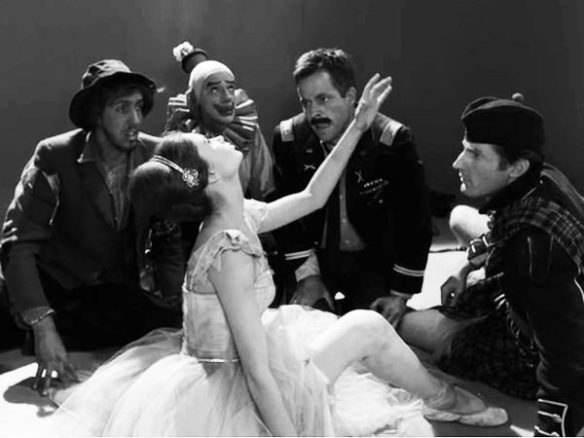
1961 [Item by Cat Eldridge.] Clown, hobo, ballet dancer, bagpiper, and an Army major – a collection of question marks. Five improbable entities stuck together into a pit of darkness. No logic, no reason, no explanation; just a prolonged nightmare in which fear, loneliness, and the unexplainable walk hand in hand through the shadows. In a moment, we’ll start collecting clues as to the whys, the whats, and the wheres. We will not end the nightmare, we’ll only explain it – because this is the Twilight Zone

Sixty years ago this evening, The Twilight Zone‘s “Five Characters In Search of an Exit” first aired on CBS. It was fourteenth episode of the third season. It was written of course by Rod Serling and directed by Lamont Johnson. It was based of Marvin Petal’s “The Depository” short story.  The title, and the story itself, is a variation on Luigi Pirandello’s “Six Characters in Search of an Author” and Jean-Paul Sartre’s “No Exit” play. It’s far more entertaining than you’d think given the source material. 

The premise is that uniformed Army major wakes up to find himself trapped inside in a large metal cylinder, where he meets a hobo, a ballet dancer, a bagpiper, and a clown. None of them have any memory of who they are or how they became trapped. 

The cast here is William Windom, Murray Matheson, Susan Harrison, Kelton Garwood, and  Clark Allen. The last shot of the episode, in which the five characters are seen in doll form, does not feature the actors; rather, specially made dolls were crafted that closely resembled the five actors who played the parts, and these are shown. 

All of the Twilight Zone episodes are available on Paramount+. 

(11) TODAY’S BIRTHDAYS.

[Compiled by Cat Eldridge.]

  • Born December 22, 1917 Frankie Darro. What I’m most interested that it was he inside Robbie the Robot in Forbidden Planet. Other than showing up on Batman as a Newsman in two episodes, and The Addams Family as a Delivery Boy in one episode, I don’t think he had any other genre roles at all. Well, he was Lampwick, the boy who turns into a donkey in Pinocchio. That should count too. (Died 1976.)
  • Born December 22, 1943 Michael Summerton. One of the original Dalek operators, his work would show up in three First Doctor stories, “The Survivor”, “The Escape” and “The Ambush”. He’s interviewed for “The Creation of The Daleks” documentary which is included in the 2006 The Beginning DVD box set. According to his Telegraph obit, he was he was the last survivor of the original four operators of the Daleks. So, you don’t need to get past their paywall, here’s the Who part here: “After a lean period, he was excited to be offered a part in a new BBC science fiction series. His agent told him he would not need to learn any lines for the casting, and when he arrived at the BBC workshops he was asked to strip down to his underpants and sit in what appeared to be a tub on castors. Summerton (who was one of the four original Daleks) was instructed in how to move this apparatus about, the director saying: ‘We want to test this prototype for maneuverability. We want you to move forwards, backwards, sideways. Quickly, slowly.’ Presently the director lowered a lid over him with a plunger sticking out of it. Summerton found himself in total darkness. He would later relate: ‘When the lid went on I knew my career as an actor was over.’” (Died 2009.)
  • Born December 22, 1954 Hugh Quarshie, 67. First genre role was as Sunda Kastagirin in Highlander followed by being Detective Joyce in Clive Barker’s Nightbreed and Lieutenant Obutu In Wing Commander. He’s Captain Quarsh Panaka in Star Wars: Episode I – The Phantom Menace. He’s got a long tv history starting with playing Philostrate in A Midsummer Night’s Dream along with being Professor John Galt in the pilot for The Tomorrow People and Solomon in the Doctor Who episodes of “Daleks in Manhattan” and “Evolution of the Daleks”. 
  • Born December 22, 1951 Tony Isabella, 70. Creator of DC’s Black Lightning Who is their first major African-American superhero. That alone is enough reason to include him in Birthdays. He also created Mercedes “Misty” Knight, an African-American superhero at Marvel Comics who’s played by Simone Missick in the various Netflix MCU series.
  • Born December 22, 1951 Charles de Lint, 70. I’ve personally known him for twenty-five years now and have quite a few of his signed Solstice chapbooks in my possession. Listing his fiction would take a full page or two as he’s been a very prolific fantasy writer, so let just list some of my favorite novels by him which would be Forests of The HeartSomeplace To Be FlyingSeven Wild Sisters and The Cats of Tanglewood Forest. You’ll find my favorite chapter from Forests of The Heart here.
  • Born December 22, 1955 David S. Goyer, 66. His screenwriting credits includes the Blade trilogy which I like despite their unevenness in storytelling, the Dark Knight trilogy, Dark CityMan of Steel, and its sequel Batman v Superman: Dawn of Justice (which is horrid). Let’s see what else is there? Well, there’s there’s Nick Fury film and two Ghost film which are all best forgotten… Oh he did The Crow: City of Angels. Ouch. Series wise, he’s been involved in FlashForwardConstantineDa Vinci’s Demons which is a damn strange show, KryptonBlade: The SeriesThresholdFreakyLinks and a series I’ve never heard of, Sleepwalkers
  • Born December 22, 1962 Ralph Fiennes, 59. Perhaps best-known genre wise as Lord Voldemort in the Harry Potter film franchise, he’s also been M in the Bond films that just wrapped up starting with Skyfall. His first genre role was as Lenny Nero in Strange Days, one of my favorite SF films. He went on to play John Steed in that Avengers films. If you haven’t seen it, he voices Lord Victor Quartermaine in Wallace & Gromit: The Curse of the Were-Rabbit. Run now and see it!
  • Born December 22, 1978 George Mann, 43. Writer and editor. He’s edited a number of anthologies including the first three volumes of Solaris Book of New Science Fiction. Among my favorite books by him are his Newbury & Hobbes series, plus his excellent Doctor Who work. The Affinity Bridge, the first in Newbury & Hobbes series, was nominated for a Sidewise Award. The Revenant Express is his latest novel.

(12) COMICS SECTION.

  • Rich Horton suggests Macanudo could be interpreted as evidence that maybe Chewbacca wasn’t along for the Kessel Run!

(13) A NEW BROOM SWEEPS CLEAN. [Item by Martin Morse Wooster.] In the Washington Post, Molly Roberts says that quidditch leagues are changing the name of the sport because of their views on J.K. Rowling’s comments on transgendered people and to  avoid the trademark Warner Bros. has on “quidditch,”  but they don’t know what the new name will be or how to attract people to the sport without a Harry Potter connection. “Quidditch’s new name might teach J.K. Rowling a surprising lesson”.

…US Quidditch and Major League Quidditch declared last week that they would change their names — partly because they believe ditching the trademark will allow the sport to expand, and partly because they believe ditching its inventor will avoid any nasty association with her public bigotry.

The move is meaningful and meaningless at the same time — and could show Rowling what she’s been missing all along. But let’s back up a second to help out those who can’t tell a bludger from a quaffle. (Ouch.)

Quidditch is the made-up sport of Rowling’s universe, in which witches and wizards fly around on brooms hurling some balls into hoops, hitting other balls with bats at other players, and trying to snatch one last little winged golden ball out of the air. Quidditch is also the real-life version of that sport, in which decidedly non-magical humans run around with brooms between their legs, hurling slightly deflated volleyballs into hoops and slightly deflated dodgeballs at opponents, and trying to snatch a tennis ball dangling in a sock from someone’s shorts….

(14) TOP TV. The New York Times television critics named “The Best TV Episodes of 2021”. They picked a number of episodes from genre programs – here are two examples.

Love, Death & Robots’ (Netflix)

‘The Drowned Giant’

In just 13 minutes, this elegant short about a giant’s corpse that washes up on a beach one day captures, in a perfect snapshot, humanity’s tendency to desecrate marvels, to behold a world-changing event and decide simply to carry on. Based on a short story by J.G. Ballard, “The Drowned Giant” is rendered here in mostly realistic animation, with the giant’s clean-shaven cheeks, tidy fingernails and muscular chest shown in aching detail. In an era when so many shows just blend together, this episode stands out for its light touch and sad imagination. (Streaming on Netflix.) MARGARET LYONS

‘What We Do in the Shadows’ (FX)

‘Casino’

“Shadows” is one of the funniest shows on TV right now, and “Casino,” where the gang heads to Atlantic City, was my favorite episode this season. Nandor (Kayvan Novak) becomes entranced by a “Big Bang Theory” slot machine — “‘bazinga’ is the war cry of Sheldon,” he explains — and in perfect, cascading horror, this leads to the total dissolution of his understanding of the universe. “Shadows” is its best when the vampires’ grandiosity clashes with their vulnerabilities, especially their excitability, and I’ll never see another in-house ad on a hotel TV without thinking that it’s Colin Robinson’s favorite show. (Streaming on Hulu.) MARGARET LYONS

(15) BEST BAD GUYS. In the Washington Post, Michael Cavna and David Betancourt dsicuss their six favorite Spider-Man villains, in a spoiler-filled article. “Top 6 Spider-Man movie villains ranked, from Electro to Green Goblin”.

[The latest film’s] Lizard, Rhino and Harry Osborn’s New Goblin, among others, can’t crack our list — keep trying, fellas. Here are our top six villains across this Spider-Man franchise’s eight live-action solo movies….

(16) AI: A FUTURE FOR HUMANS. BBC Radio 4 concludes the annual Reith Lectures series, “Stuart Russell – Living With Artificial Intelligence”, with the fourth and final episode now online here

Stuart Russell suggests a way forward for human control over super-powerful Artificial Intelligence. He argues for the abandonment of the current “standard model” of AI, proposing instead a new model based on three principles – chief among them the idea that machines should know that they don’t know what humans’ true objectives are.

Echoes of the new model are already found in phenomena as diverse as menus, market research, and democracy. Machines designed according to the new model would be, Russell suggests, deferential to humans, cautious and minimally invasive in their behaviour and, crucially, willing to be switched off. He will conclude by exploring further the consequences of success in AI for our future as a species.

Stuart Russell is Professor of Computer Science and founder of the Center for Human-Compatible Artificial Intelligence at the University of California, Berkeley.

(17) DRONES, GUNS, AND BOMBS THAT CALL THEIR OWN SHOTS. “Killer Robots Aren’t Science Fiction. A Push to Ban Them Is Growing” reports the New York Times.

It may have seemed like an obscure United Nations conclave, but a meeting this week in Geneva was followed intently by experts in artificial intelligence, military strategy, disarmament and humanitarian law.

The reason for the interest? Killer robots — drones, guns and bombs that decide on their own, with artificial brains, whether to attack and kill — and what should be done, if anything, to regulate or ban them.

Once the domain of science fiction films like the “Terminator” series and “RoboCop,” killer robots, more technically known as Lethal Autonomous Weapons Systems, have been invented and tested at an accelerated pace with little oversight. Some prototypes have even been used in actual conflicts.

The evolution of these machines is considered a potentially seismic event in warfare, akin to the invention of gunpowder and nuclear bombs.

This year, for the first time, a majority of the 125 nations that belong to an agreement called the Convention on Certain Conventional Weapons, or C.C.W., said they wanted curbs on killer robots. But they were opposed by members that are developing these weapons, most notably the United States and Russia.

The group’s conference concluded on Friday with only a vague statement about considering possible measures acceptable to all. The Campaign to Stop Killer Robots, a disarmament group, said the outcome fell “drastically short.”

(18) MAKE IT SO. Learn “How to Pronounce ‘Omicron’ the Star Trek Way”.

(19) A HOLE IN ONE. PBS Space Time host Matt O’Dowd asks “What Happens If A Black Hole Hits Earth?”

The possibility that a black hole could actually impact Earth may seem straight out of science fiction, but the reality is that microscopic primordial black holes could actually hit Earth. If one did, it wouldn’t just impact like an asteroid, it’d pass straight through the entire Earth and exit the other side. Perhaps craziest of all, this may have already happened!

[Thanks to Michael Toman, Cat Eldridge, Mike Kennedy, Rich Horton, Robert Brown, SF Concatenation’s Jonathan Cowie, Martin Morse Wooster, JJ, John King Tarpinian, and Andrew Porter for some of these stories. Title credit belongs to File 770 contributing editor of the day reheadedfemme.]

Pixel Scroll 12/27/19 With Slow Glass Pixels, It Will Take Ten Years To Scroll

(1) WELCOME WAGON. SFWA President Mary Robinette Kowal responded to the Romance Writers of America meltdown by tweeting, “As president of SFWA, please accept my invitation to consider our organization if you feel your work has a kinship with SFF, even a tenuous tie.” Thread starts here.

Many interesting replies. A couple of them are –

(2) STAR POWER. Thomas Disch dominated the Galactic Stars awards presented by Galactic Journey for the best sff of 1964: [December 25, 1964] Stars of Bethlehem and Galactic Journey (Galactic Stars 1964).

Best author(s)

Tom Disch

This Cele Lalli discovery, just 24 years old, garnered three Galactic Stars this year.

He narrowly beats out Harry Harrison (and Harrison might have been on top, but he came out with clunkers as well as masterpieces this year).

And bless the Journey staff for recognizing newzines in this category —

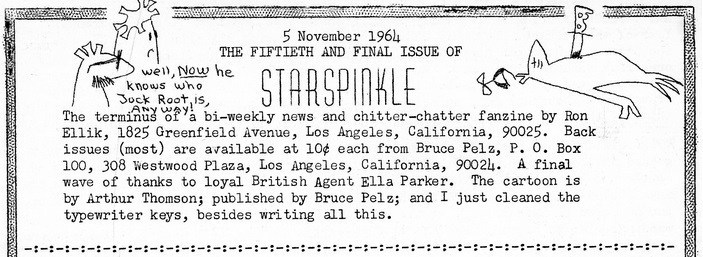
Best Fanzine

Starspinkle gave up the ghost last month, though it has a lookalike sequel, Ratatosk.  They were/are both nice little gossip biweeklies.

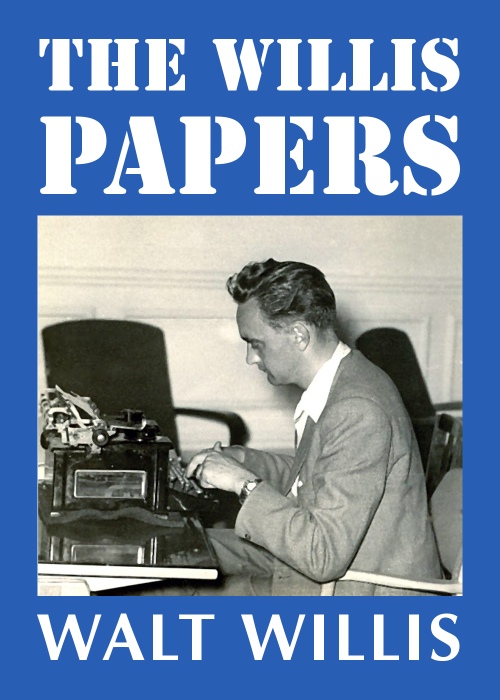
(3) CLASSIC IRISH FANWRITING. The Willis Papers by Walt Willis is the latest free download produced by David Langford in hopes of inspiring donations to the Trans-Atlantic Fan Fund.

A collection covering the first decade (and a bit) of Walt Willis’s fanzine writing, from his 1948 debut in Slant to 1959, edited by George W. Field and published by Ted Johnstone in August 1961. As well as twenty-two classic Willis articles, there are Prefaces by both editor and publisher, while Vin¢ Clarke and John Berry provide not entirely serious tributes to the great man.

The text of The Willis Papers was long ago transcribed into HTML by Judy Bemis for Fanac.org, and this Ansible Editions ebook is gratefully based on that version. The cover photograph of Walt Willis at the 1957 London Worldcon was taken by Peter West. (From the Ethel Lindsay photo archive, courtesy of Rob Hansen.) Ebook released on 25 December 2019. 31,500 words.

Walt Willis was born in October 1919, and his centenary in 2019 has been little remarked in science fiction fandom.

One small gesture is the simultaneous ebook release of Beyond the Enchanted Duplicator and The Willis Papers as a 2019 Christmas treat for fans.

(4) CASUALTY LIST. “China Blocks American Books as Trade War Simmers” — the New York Times has the story.

…Publishers inside and outside China say the release of American books has come to a virtual standstill, cutting them off from a big market of voracious readers.

“American writers and scholars are very important in every sector,” said Sophie Lin, an editor at a private publishing company in Beijing. “It has had a tremendous impact on us and on the industry.” After new titles failed to gain approval, she said, her company stopped editing and translating about a dozen pending books to cut costs.

The Chinese book world is cautiously optimistic that the partial trade truce reached this month between Beijing and Washington will break the logjam, according to book editors and others in the publishing industry who spoke to The New York Times.

… Still, publishing industry insiders describe a near freeze of regulatory approvals, one that could make the publishing industry reluctant to buy the rights to sell American books in China.

“Chinese publishers will definitely change their focus,” said Andy Liu, an editor at a Beijing publishing company, adding that the United States was one of China’s most frequent and profitable sources of books.

“Publishing American books is now a risky business,” he said. “It’s shaking the very premise of trying to introduce foreign books” as a business.

While China is known for its censorship, it is also a huge market for books, including international ones. It has become the world’s second-largest publishing market after the United States, according to the International Publishers Association, as an increasingly educated and affluent country looks for something engrossing to curl up with.

(5) EATING THE FANTASTIC. Scott Edelman invites listeners to chow down on cannoli with author Bob Proeh in Episode 112 of his Eating the Fantastic podcast.

Bob Proehl

This time around, you get to take a seat at the table with Bob Proehl, who published his first novel in in 2016. A Hundred Thousand Worlds is about the star of a cult sci-fi TV show and her nine-year-old son making a cross-country road trip with many stops at comic book conventions along the way, and was named a Booklist best book of the year.

His latest novel, The Nobody People, about the emergence of super-powered beings who’ve been living among us, came out earlier this year…

We slipped away to Sabatino’s Italian restaurant …where we chatted over orders of veal parmigiana and eggplant parmigiana. (I’ll leave it to you to guess which of us was the carnivore, though I suspect that if you’re a regular listener, you’ll already know.)

We discussed how it really all began for him with poetry, the way giving a non-comics reader Watchmen for their first comic is like giving a non-novel reader Ulysses as their first novel, why discovering Sandman was a lifesaver, the reason the Flying Burrito Brothers 1968 debut album The Gilded Palace of Sin matters so much to him, why he had a case of Imposter Syndrome over his first book and how he survived it, the reasons he’s so offended by The Big Bang Theory, what he meant when he said “I actually like boring books,” his love for The X-Files, Buffy the Vampire Slayer, and the X-Men, whether it’s hard to get a beer in New York at six o’clock in the morning, why he wasn’t disappointed in the Lost finale, and much more.

(6) HECK YEAH. The DisINSIDER says “‘Crazy Rich Asians’ Director Wants To Tackle A Rose Tico Series on Disney+”.

…Of course the tweet is simply just that a tweet, and doesn’t mean anything will come it. However, Chu is a hot name in the industry after directing the 2018 hit Crazy Rich Asians, he would be a fantastic choice to develop a Rose Tico series. Chu is currently working on the film adaptation of In The Heights based on the hit broadway musical, and will return to direct China Rich Girlfriend.

(7) INSIDE SFF HISTORY. Jonathan Lethem interviews M. John Harrison at Literatura Inglesa. The English language version follows the long Spanish language one — scroll down. “Derribando los pilares de la ficción: una entrevista con M. John Harrison.”

You also mentioned that your time at New Worlds was an exciting one as it provided you with the possibility to read the manuscripts of Ballard’s stories even before they were printed. What’s interesting to me is that, while writers like Aldiss or Moorcock, who loved SF and fantasy genre and helped revitalize it (although Aldiss later disowned his participation in the new wave “movement”), Ballard seemed to quickly abandon the genre (except, maybe, for Hello America).

I think it took Ballard a long time to “abandon” the genre, if he can be said to have done that, and that the process began much earlier than people admit. From the beginning his relationship to science fiction was modified by his personality, his needs as a writer, and his many cultural influences outside SF. So from the outset of his career he was working his way towards the idiopathic manner we associate with short stories like “The Terminal Beach” and novels like The Drought and The Atrocity Exhibition. It was not so much an “abandonment” as a steady evolutionary process. This happens with writers. They develop.

(8) SUPERCOLLABORATOR. CBR.com looks back on “When Superman Helped Kurt Vonnegut Write a Novel!”.

Today, based on a suggestion from reader Stephen R., we take a look at the time that Clark Kent had to help Kurt Vonnegut finish a novel!

The story appeared in 1974’s Superman #274 by Gerry Conway, Curt Swan and Vince Colletta, where Clark Kent and Kurt Vonnegut are both on a talk show together…

The “Wade Halibut” name is a reference to Vonnegut’s famous fictional writer, Kilgore Trout, who appeared in many of Vonnegut’s classic works, like Breakfast of Champions and Slaughterhouse Five

(9) TODAY IN HISTORY.

  • December 27, 1904 –J. M. Barrie’s play Peter Pan premiered in London.
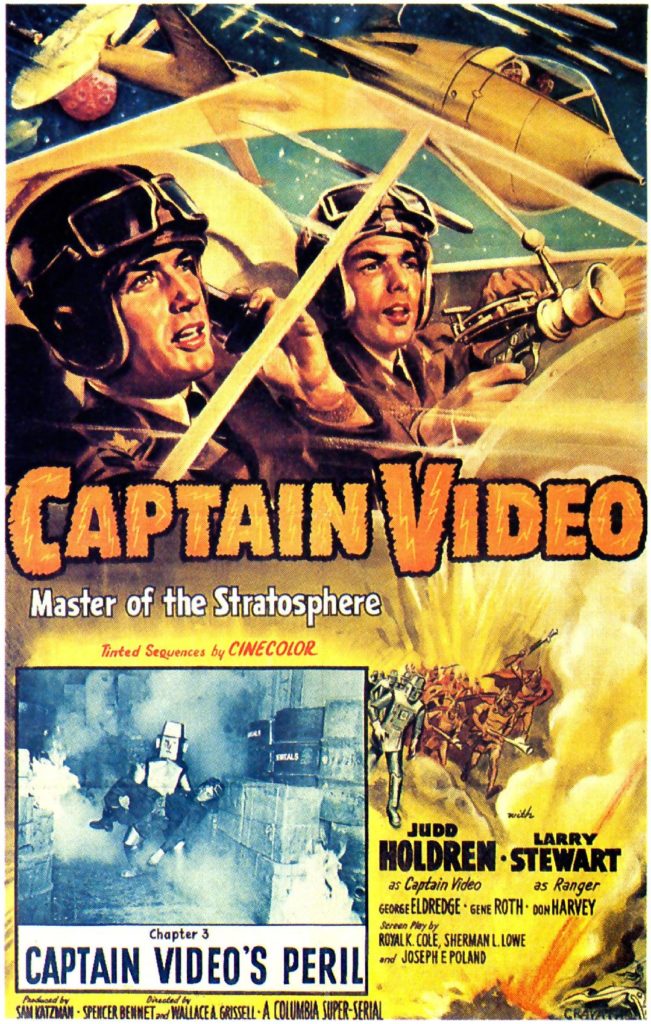
  • December 27, 1951 Captain Video: Master of the Stratosphere premiered on film screens. It was directed by Spencer Gordon Bennet and Wallace A. Grissel with a script by Royal G. Cole, Sherman I. Lowe and Joseph F. Poland. Judd Holdren, in what was only his second starring screen role, plays Captain Video, the leader of a group of crime-fighters known as the Video Rangers.  This fifteen-part movie serial is unusual as it’s based off a tv series, Captain Video and His Video Rangers. Like most similar series, critical reviews are scant and there is no rating at Rotten Tomatoes. It was popular enough that it aired repeatedly until the early Sixties. There’s a few episodes up on YouTube – here’s one.
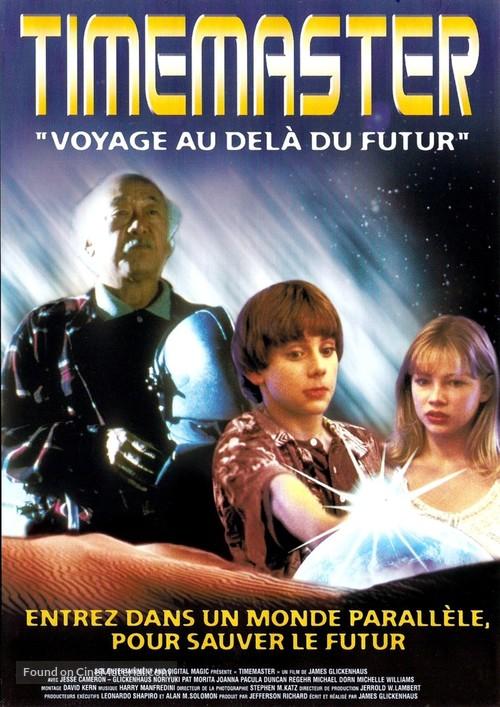
  • December 27, 1995 —  Timemaster premiered on this date. It was directed by James Glickenhaus and starred his son Jesse Cameron-Glickenhaus, Pat Morita and Duncan Regehr. It also features Michelle Williams in one of her first film roles, something she now calls one of the worst experiences of her acting career. The film got universally negative, if not actively hostile, reviews and has a 0% rating among reviewers at Rotten Tomatoes.

(10) TODAY’S BIRTHDAYS.

[Compiled by Cat Eldridge.]

  • Born December 27, 1888 Thea von Harbou. She penned the novel Metropolis based upon her uncredited screenplay of that film for husband Fritz Lang. She also collaborated with him on other projects, none of which save her 1922 Phantom screenplay appear to be genre. (Died 1954.)
  • Born December 27, 1917 Ken Slater. In 1947, while serving in the British Army, he started Operation Fantast, a network of fans which had eight hundred members around the world by the early Fifties though it folded a few years later. Through Operation Fantast, he was a major importer of American SFF books and magazines into the U.K. – an undertaking which he continued, after it ceased to exist, through his company Fantast up to the time of his passing.  He was a founding member of the British Science Fiction Association in 1958. (Died 2008.)
  • Born December 27, 1938 Jean Hale, 81. If you’ve watched Sixties genre television, you’ve likely seen her as she showed up on My Favorite Martian, In Like Flint (at least genre adjacent), Alfred Hitchcock Presents, My Brother the AngelWild Wild West, Batman and Tarzan.
  • Born December 27, 1948 Gerard Depardieu, 71. He’s in Kenneth Branagh’s Hamlet which we all agree (I think we agree) is genre. He plays Obélix in the French film Asterix & Obélix and Asterix at the Olympic Games: Mission Cleopatra and is Cardinal Mazarin in La Femme Musketeer. 
  • Born December 27, 1951 Robbie Bourget, 68. She started out as an Ottawa area fan, where she became involved in a local Who club and the OSFS before moving to LA and becoming deeply involved in LASFS. She was a key member of many a Worldcon and Who convention over the years (she was the co-DUFF winner with Marty Cantor for Aussiecon) before she moved to London in the late Nineties.
  • Born December 27, 1951 Charles Band, 68. ExploItation film maker who’s here because some of his source material is SFF in origin. Arena was scripted off the Fredric Brown “Arena” short story which first ran in the June 1944 Astounding, and From Beyond which was based on H P Lovecraft’s short story of the same name, first published in June 1934 issue of The Fantasy Fan
  • Born December 27, 1960 Maryam d’Abo, 59. She’s best known as Kara Milovy in The Living Daylights. Her first genre role was her screen debut in the very low-budget SF horror film Xtro, an Alien rip-off. She was Ta’Ra in Something Is Out There, a miniseries that was well received and but got piss poor ratings. Did you know there was a live Mowgli: The New Adventures of the Jungle Book? I didn’t. She was Elaine Bendel, a recurring role in it. 
  • Born December 27, 1969 Sarah Jane Vowell, 50. She’s a author, journalist, essayist, historian, podcaster,  social commentator and actress. Impressive, but she gets Birthday Honors for being the voice of Violet Parr in the Incredibles franchise. I say franchise as I’ve no doubt that a third film is already bring scripted.
  • Born December 27, 1977 Sinead Keenan, 42. She’s in the Eleventh Doctor story “The End of Time” as Addams, but her full face make-up guarantees that you won’t recognize her. If you want to see her, she’s a Who fan in The Five(ish) Doctors Reboot. Her final Who work is a Big Finish audio drama, Iterations of I, a Fifth Doctor story. And she played Nina Pickering, a werewolf, in Being Human for quite a long time.
  • Born December 27, 1987 Lily Cole, 32. Been awhile since I found a Who performer and so let’s have another now. She played The Siren in the Eleventh Doctor story, “The Curse of The Black Spot”. She’s also in some obscure film called Star Wars: The Last Jedi as a character named Lovey. And she shows up in the important role of Valentina in The Imaginarium of Doctor Parnassus. Not mention she’s in Snow White and The Huntsman as Greta, a great film indeed.
  • Born December 27, 1995 Timothée Chalamet, 24. First SF role was as the young Tom Cooper in the well received Interstellar. To date, his only other genre role has been as Zac in One & Two but I’m strongly intrigued that he’s set to play Paul Atreides In Director Denis Villeneuve forthcoming Dune. Villeneuve is doing it as a set of films instead of just one film which will either work well or terribly go wrong.

(11) HEARING FROM THE EXPANSE. The Guardian books podcasts asks the authors of The Expanse, “When imagining our future, what can sci-fi teach us?”

This week, Richard sits down with duo Daniel Abraham and Ty Franck, who write science fiction together under the name James SA Corey. Their bestselling space-opera series, The Expanse, which started in 2012 and is due to end in 2021, is set in the middle of the 24th century, when humanity has colonised the solar system. Human society is now beyond race and gender, and is instead divided on a planetary level: those living on Earth, on Mars and on various asteroids, moons and space stations called Belters.

The eighth book in the series, Tiamat’s Wrath, is the latest, while the fourth season of the award-winning TV adaptation [is] on Amazon Prime on 13 December.

And Claire, Richard and Sian discuss the 20 books up for the 2019 Costa awards shortlists.

(12) A RECORD RECORD. As Bruce Sterling said, new technologies don’t replace old technologies. But how many of the old ones hang onto life so tenaciously — Billboard’s numbers show “Harry Styles, Billie Eilish & The Beatles Help Vinyl Album Sales Hit Record Week in U.S.”

Vinyl album sales hit yet another record week in the U.S., according to Nielsen Music.

In the week ending Dec. 19, the data tracking firm reports 973,000 vinyl albums were sold in the U.S. — marking the single biggest week for vinyl album sales since the company began electronically tracking music sales in 1991.  

(13) NIGHT BLIGHT. “Satellite constellations: Astronomers warn of threat to view of Universe” – the Dave Clements mentioned in BBC’s report is an SF fan.

From next week, a campaign to launch thousands of new satellites will begin in earnest, offering high-speed internet access from space.

But the first fleets of these spacecraft, which have already been sent into orbit by US company SpaceX, are affecting images of the night sky.

They are appearing as bright white streaks, so dazzling that they are competing with the stars.

Scientists are worried that future “mega-constellations” of satellites could obscure images from optical telescopes and interfere with radio astronomy observations.

Dr Dave Clements, an astrophysicist from Imperial College London, told BBC News: “The night sky is a commons – and what we have here is a tragedy of the commons.”

The companies involved said they were working with astronomers to minimise the impact of the satellites.

And Clements occasionally writes sff – his story “Last of the Guerrilla Gardeners” originally appeared in Nature.

(14) OUT OF CHARACTER. Ganrielle Russon, in the Orlando Sentinel story “The Disney employees behind Mickey Mouse, Minnie and Donald Duck were violated by tourists”, says that three Walt Disney World employees say they were inappropriately touched while in costume at Walt Disney World and have filed grievances.

…Another incident happened that same day at the Magic Kingdom, the world’s busiest theme park.

It started innocently when a 36-year-old Disney employee who portrays Minnie Mouse posed for pictures with a man and his wife from Minnesota in the park’s circus-themed meet-and-greet area.

Afterward, Minnie Mouse gave the man a hug. Then without saying a word, he groped her chest three times, according to the sheriff’s incident report.

The employee alerted her supervisors. On Dec. 6, she identified pictures of the 61-year-old man from Brewster, Minn.

She decided against pressing charges.

It wasn’t the first time the man had done something wrong at Disney World on his trip.

The man also had “an inappropriate interaction with a cast member” Dec. 5 at the Magic Kingdom, according to the sheriff’s office incident report that didn’t provide any additional details on what happened. Disney declined to elaborate.

(15) RAPPED GIFT. Bad Lip Reading dropped a bizarre “A Bad Lip Reading of The Last Jedi” on Christmas.

[Thanks to JJ, Chip Hitchcock, Hampus Eckerman, Mike Kennedy, Andrew Porter, SF Concatenation’s Jonathan Cowie, Martin Morse Wooster, Cat Eldridge, and John King Tarpinian for some of these stories. Title credit belongs to File 770 contributing editor of the day Robert Whitaker Sirignano.]

At NYRSF Readings, a Brave Little Toast to Thomas M. Disch

Henry Wessells

By Mark L. Blackman: On the evening of Tuesday, February 6th, at its venue, the Brooklyn Commons Café in Brooklyn (somewhere on the Ruins of Earth), the New York Review of Science Fiction Readings Series presented a tribute to the brilliant author and poet Thomas M. Disch (1940-2008), a celebration of his life and work, guest-hosted by Henry Wessells (a past guest curator) and featuring his peers and friends, including his literary executor, readings from his works and a short film.

The evening began with Series Producer and Executive Curator Jim Freund welcoming the crowd to the final session of the Series’ 27th Season, adding that there would be a special Summer Series: .

  • July 3rd – David Mack and Seth Dickinson, guest curated by Amy Goldschlager (a former Curator)
  • August 7th – A Launch Party/Reading for Sunspot Jungle, with guest curator Bill Campbell

As usual, he cautioned us that the event was being Livestreamed (so watch where you scratch) and asked all who could donate to donate (suggested amount $7, but no one gets turned away).

Freund related that he met Tom Disch during his early days at Hour of the Wolf, and that he was among the first ever to read at the NYRSF Reading Series. Disch’s last public appearance was a reading from his new novel, The Word of God, at a NYRSF event on June 3, 2008, 10 years and two days ago. (It was at the Series’ then-venue, the South Street Seaport, and I was privileged to have attended.) In it, Disch was God (and Philip K. Dick was Satan). Sadly, Disch killed himself by gunshot on July 4, 2008 (he referred to the 4th as “the Holiday”) in his Manhattan apartment. He had been depressed since the 2005 death of his partner, Charles (“Charlie”) Naylor; the two had been together for some three decades.

Shifting tone, Freund announced that the evening had “a sponsor,” and proceeded to read (his delivery bringing to mind Johnny Carson’s pitchman character Art Fern) “Fun With Your New Head.” (“Two heads are better than one. … Only $49.95!”)

(On a personal note, the story collection Fun with Your New Head was the first Disch that I ever read; and, it seems, for Elizabeth Hand as well.)

Then Wessells, a short story writer, poet and antiquarian bookseller, assumed his role of host. As well as a writer of prose – which ranged from wildly satirical stories to dark cautionary tales to works for children – Disch was a poet, and “wanted to be remembered as the Thomas Beddoes of death in America.” (Beddoes was a minor Romantic poet. “Americans,” said Disch once, “don’t read poetry, but they love poets.”) The first part of the evening, he announced, would be a panel on his life, followed by a clip from the film Winter Journey.

Gregory Feeley, Elizabeth Hand, John Clute, Henry Wessells

He was joined on stage by John Clute, Gregory Feeley and Elizabeth Hand. Hand, a multiple-award-winning author of novels and collections of short fiction, and reviewer, read a note from John Crowley, “Remembering Tom,” followed by “Ghost Ship,” a story from Disch’s last blog.

John Clute

Clute is variously an author, reviewer, critic, and encyclopedia writer – he is best known for The Encyclopedia of Science Fiction (the first version of which was published in 1979 and now exists in an online version). He shared that he met Disch in 1961 when they were at NYU, and their friendship continued until Tom’s death. His writing ability was “full-fledged” at 22. He was kind and generous, but he was also quick to end friendships for the littlest reason. He also sent out signals that his death, when it came, would be at his timing and at his own hand.

Elizabeth Hand

Gregory Feeley is a writer of and about science fiction. He is Disch’s literary executor (he had two, one for prose, Feeley, and one for poetry; though sometimes overlooked, poetry was half of Disch’s professional life), and is preparing an edition of Disch’s best short fiction. He met Disch in late 1978, when the Magazine of F&SF announced that they were going to publish On Wings of Song, which they described as “his best and longest novel,” in serial form, and he wrote him a letter, which Disch answered. Wings’ protagonist, Daniel Weinreb, was loosely based on Naylor, though the latter was not “a man without talent.” Clute, armed with laptop, read a very brief reminiscence from Pamela Zoline.

Henry Wessells knew him during the last years of his life. (He was with Disch when he spread Naylor’s ashes.) Though regarded as part of the British New Wave, Camp Concentration was “very much an American book.” Disch lived in New York, London, Spain and Turkey, but he remembered his Midwestern roots (he was born in Iowa and grew up in Minnesota). Wessells subsequently cited his “Minnesota Quartet,” The Businessman, The M.D., The Priest, and The Sub. (Disch later said that he thought that The Priest was published 10 years too early.) During his lifetime, he won a Hugo (his only one) for a nonfiction work (Best Related Book), for The Dreams Our Stuff is Made Of: How Science Fiction Conquered the World, and a John Campbell Award, for On Wings of Song (which received nominations for the Hugo and Nebula Awards for Best Novel).

Eric Solstein and Henry Wessells

Filmmaker Eric Solstein, joining Wessells on stage, related that he met Disch at the Sullivan County (aka the Catskills) home that he shared with Naylor, and, after Naylor’s death, Disch asked him to videotape what he called his “suicide note.” The “note,” such as it was, took the form of “a suite of 31 poems,” “a cycle of mourning verse” about Naylor, called Winter Journey, the title of the film as well. Shot with a handheld camera (as was evident), it took, said Solstein, three years to edit it, during which Disch went on with his life. We watched an excerpt, the first three poems. (It may be viewed on Solstein’s YouTube channel.)

Thomas M. Disch on video

During the intermission, a raffle was held for donors, with the prizes being a copy of Samuel R. Delany’s The American Shore: Meditations on a Tale of Science Fiction by Thomas M. Disch – “Angouleme” (“Angouleme” was a story in 334), and a copy of a video featuring Disch’s NYRSF readings from 1993 and June 3, 2008.

The second half of the evening focused on Disch’s work. Wessells read a note from Delany, an excerpt from The American Shore, praising him as a “raconteur.”

Brendan C. Byrne

Brendan C. Byrne (neither the late Governor of New Jersey nor the since-renamed arena) has written criticism and short fiction. He never knew Disch, except as a reader. He offered an essay on 334. Written in and reflecting 1972 New York, his future Manhattan is a city of shortages and xenophobia (seen in its sterilization policy), and without privacy. Clute added that 334 has to be read against the background of the British New Wave. People aren’t starving, as in typical sf dystopias; it’s an impersonal welfare state, but not malignant. “It’s a complex vision.”

Terence Taylor

On Wings of Song (1979), said Wessells, “is set in an America not unlike our own, but suffering more shortages;” many cities have collapsed. Flying is achieved through rapture in song, but Daniel Weinreb, the protagonist, is not a good enough singer. (Disch, Clute observed, was obsessed with music.) With that, he introduced Terence Taylor, horror writer and the Series’ Tech Director, who took the stage to read an excerpt from the novel.

Wessells then brought his panel (Clute, Feeley and Hand) back on stage, with Byrne joining them, and asked them to cite or recommend Disch works. Byrne said that he was next going to read The Sub. Hand said that “The Roaches” and “The Descending” (in Fun with Your New Head) were the first Disch stories that she read (at 9), adding that we shouldn’t overlook The Brave Little Toaster. (Disch was, we were told, “mad about Paddington Bear;” he and Naylor had stuffed animals. “He was a depressive, but he wanted to be happy.”) She added Neighboring Lives (which he wrote with Charles Naylor). Clute recommended The Word of God, “a minor book, but in its way hilarious,” and Feeley Clara Reeve (written as Leonie Hargrave), which was set in the Victorian Era.

Gregory Feeley, Elizabeth Hand, John Clute, Brendan C. Byrne, Henry Wessells

On a final note, Wessells said that Disch had written a treatment for Disney that generated the original idea for The Lion King. (Well, Hamlet and Kimba the White Lion inspired it too.)

Regrettably, and doubtless embarrassingly, in a bit of strangeness, there were some technical difficulties during the evening, from sudden reverb to lights going on full force.

As traditional, the Jenna Felice Freebie Table offered a slew of books. The audience of perhaps 60 included Melissa C. Beckman (the Readings’ photographer), Moshe Feder, Amy Goldschlager, (House Manager) Barbara Krasnoff, Lissanne Lake and Marco Palmieri. Over the course of the evening, audience members availed themselves of the Café’s food, coffee bar, beer and wine.

That’s about the size of it.

— June 6, 2018

Ed Bryant (1945-2017)

Ed Bryant. Photo by Gage Skidmore.

Science Fiction author Ed Bryant, who died in his sleep after a long illness, was found February 10 reports Locus Online.

Bryant discovered science fiction at the golden age of 12 when he purchased the August 1957 issue of Amazing Stories. A decade later, he made his way to the very first Clarion Workshop in 1968, where he sold a story to Harlan Ellison’s Again, Dangerous Visions that became his first professional publication.

John Clute’s entry about Bryant in the Science Fiction Encyclopedia captures one of the reasons for the author’s meteoric ascent in Seventies sf.

His conversational, apparently casual style sometimes conceals the tight construction and density of his best work, like “Shark” (in Orbit 12, anth 1973, ed Damon Knight), a complexly told love story whose darker implications are brought to focus in the girl’s decision to have her brain transplanted into a shark’s body, ostensibly as part of a research project; in the story, symbol and surface reality mesh impeccably. The setting for many of the stories in this collection is a California transmuted by sf devices and milieux into an image, sometimes scarifying, sometimes joyful, of the culmination of the American Dream…

Registering an exception to the overall regard for Bryant’s work was Thomas M. Disch, who named him as part of “The Labor Day Group” (1981), a set of young writers whose work stroked fannish sensibilities, and as a result often won Hugo and Nebula awards. This provoked a response from another Disch target, George R.R. Martin, “Literature, Bowling, and the Labor Day Group”, which gave Bryant a deceptively lighthearted defense.

The Colorado resident was a 7-time nominee for SFWA’s Nebula Award, winning twice – “Stone” (1979) and  “giANTS” (1980) – as well as a 3-time nominee for the Hugo, World Fantasy, and Bram Stoker Awards. The International Horror Guild Awards named Bryant a Living Legend in 1997.

Bryant has been a prolific short fiction writer whose career has been regularly punctuated by new collections of stories — Among the Dead and Other Events Leading up to the Apocalypse (1973), Cinnabar (1976), Wyoming Sun (1980), Particle Theory (1981), Neon Twilight (1990), Darker Passions (1991), The Baku: Tales of the Nuclear Age (2001), Trilobyte (2014), and Predators and Other Stories (2014).

He regularly contributed to George R.R. Martin’s Wild Cards series, appearing in five different volumes.

His other professional gigs included writing an annual media coverage essay in the Year’s Best Fantasy and Horror anthology, which he did for over 20 years. He also edited an anthology of original stories and some poems, 2076: The American Tricentennial (1977).

Bryant’s fame did not rest entirely on his writing. He was in great demand as a convention toastmaster, gaining the pinnacle of notoriety by conducting the Denvention Two (1981) Hugo Awards ceremony on roller skates.

https://twitter.com/katsudonburi/status/830184772601249794

[Thanks to  Andrew Porter for the story.]

Conflicted Memories

Sam J. Miller’s “Who Killed Thomas Disch” (at Strange Horizons) is organized around a silly title at the expense of questions Miller himself says have genuine value: “What was really going on? Where do we put the blame? What do we do with our grief? With our guilt?” For it’s the time he spends on those questions that makes the reading worthwhile.

When some of the sf field’s talents die their passing elicits a certain amount of survivor’s guilt, though not in the case of Arthur C. Clarke, or others who achieve literary fame and fortune. But I remember a friend of the late Roger Zelazny speaking with bitterness and guilt about the last days of this great writer of sf short stories, as if they personally and society at large hadn’t done enough.

Some of that emotion permeates Miller’s piece about Disch, a richly-detailed, but ultimately question-begging exploration of the late sf writer’s last days. After all, most people enduring the same conditions do not kill themselves, so while much can be suggested nothing can be proved. I found Miller’s essay challenging and interesting (I wouldn’t write about it if I thought it wasn’t worth your time), though it would have been more satisfying (to me, anyway) if Miller had been governed by his own conclusion:

While I’d love to turn Disch’s death into one more argument in favor of expanded rent-control laws, or better tenant protections, or gay marriage (the surviving half of a married straight couple, in Disch’s situation, would be far better situated to fend off eviction attempts), there’s something creepy about reducing a human being to a weapon in the service of a political agenda. My need to find a scapegoat for his death does Disch a disservice. Disch’s life, like his work, was defiantly resistant to outside influence. From the very start of his writing career we see someone willing to slaughter sacred cows and name names and subvert all expectations, and it’s selfish to wish he’d given us a happy ending.

Disch Appreciation by Moshe Feder

Moshe Feder wrote about Thomas Disch’s death in a post on his LiveJournal, “Grains” (and in a comment on Disch’s last post to his own LJ, “Endzone.”) I asked permission to quote him here in full, and Moshe not only said yes, he generously worked up a slightly revised and expanded version:

Moshe Feder: I was saddened on Monday night, July 7th, to learn that Tom Disch had left us, dying by his own hand the previous Friday. I hadn’t seen him in quite some time and had no idea what a difficult time he’d been having. Here’s a link to the New York Times obituary:

http://www.nytimes.com/2008/07/08/books/08disch.html

Tom was, in my estimation, a genius. There were few writers I was more in awe of, and more nervous about meeting. Could I say anything that would possibly be of interest to him? But Tom was as gracious and sweet to me as he was brilliant and acerbic to the world, and always treated me like an equal, which I definitely am not.

Talking to him anywhere was a delight, as was sharing a lively convention panel, and I’ll always treasure the memory of the time he invited me up to his hotel room for drinks and a couple of hours of serious literary conversation. I’m not much of a drinker, so I sipped as slowly as I could, and tried to get him to do as much of the talking as possible.

It was particularly a privilege to review his books, and thereby be among the first to read them. In my opinion, his masterpiece was On Wings Of Song, a great novel of the 20th century — period, full stop. It was also, incidentally, one of the greatest SF novels ever written; and surely one of the most affecting. It should have won all our awards. With all due respect to Arthur, it’s a travesty that it lost the both the Nebula and the Hugo to Clarke’s The Fountains Of Paradise.

It’s ironic that Tom’s only Hugo win was for a work of nonfiction, The Dreams Our Stuff Is Made Of, a typically brilliant book that I couldn’t quite agree with. His was the tragedy of many of our field’s best writers. Only the literary crowd was capable of appreciating what they are achieving, only the sf/fantasy audience would want to.

Nevertheless, it’s the novels and the stories he’ll be remembered for. I’m confident they’ll stand the test of time.

I’ve been wondering if he chose Independence Day deliberately. It would be well within the compass of his oh-so-sardonic wit to have a final joke by choosing that day to ‘go off with a bang.’ In any case, from now on, the Fourth of July will always have a Tom-shaped shadow lurking in it.

His friends and his readers will miss him, and the work he might yet have done.