The Crawford Award, given by the International Association of the Fantastic in the Arts, recognizes an outstanding writer whose first fantasy book was published during the previous calendar year.
The judges are currently soliciting books published in 2026 for the award to be given at the International Conference of the Fantastic in the Arts in 2027. See the list of past winners here.
2025 IAFA Crawford Award winner
Submissions of qualifying ebooks in PDF and ePub formats can be made here.
What works qualify: This is an award for an author’s first work of fantasy in book form. It is not a first novel award; an author may have a long bibliography and still qualify for their first work of fantasy. “Book” is defined broadly, and includes novels, novellas, poetry collections, short fiction, graphic novels, works in translation, or other work at the discretion of the judges.
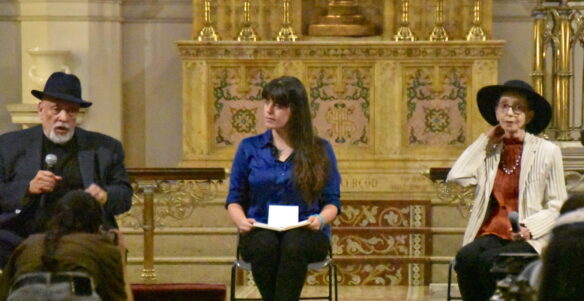
This year’s judges are Arturo Serrano, Joyce Chng, Eddie Clark, Joy Sanchez-Taylor, and Carlos Hernandez.
Joyce Chng lives in Singapore. Their speculative fiction has appeared in The Apex Book of World SF II, We See A Different Frontier, Cranky Ladies of History, and Accessing The Future. Joyce also co-edited The Sea Is Ours: Tales of Steampunk Southeast Asia with Jaymee Goh. Their novels span across wolf clans (Starfang: Rise of the Clan), vineyards (Water into Wine) and swordmaking forges (Fire Heart) respectively. Joyce wrangles article editing at Strange Horizons and is diversity coordinator for IGDN (Independent Game Designer Network). You can find Joyce at http://awolfstale.wordpress.com and @jolantru.bsky.social on Bluesky. (Pronouns: she/her, they/their)
Eddie Clark is an academic and SFF fan from Wellington, New Zealand. He is a reviewer at Nerds of a Feather and has been peering into the obscure corners of SFF for thirty years, recently with a particular focus on queer fantasy.
Carlos Hernandez is a New York Times best-selling author. His works include the critically acclaimed short story collection The Assimilated Cuban’s Guide to Quantum Santeria (Rosarium, 2016), the novel Sal and Gabi Break the Universe (Disney Hyperion, 2019), which won the 2020 Pura Belpre Award, and its sequel, Sal and Gabi Fix the Universe. He’s also written dozens of short stories, poems, and works of drama, usually in the SFF mode.
Joy Sanchez-Taylor is a Professor of English at LaGuardia Community College (CUNY) whose research interest is science fiction and fantasy literature by authors of color. Her latest book, Dispelling Fantasies: Authors of Color Reimagine a Genre (2025), explores how fantasy and fantastic works by authors of color serve as critical counternarratives to the history of Eurocentric fantasy narratives. Joy also serves as an editor for the journal Extrapolation and as the BIPOC Caucus Coordinator for the International Association for the Fantastic in the Arts (IAFA).
Arturo Serrano is a Colombian reviewer for the Ignyte-winning, Hugo-winning blog Nerds of a Feather. He’s also a member of the editorial teams of the magazines Strange Horizons and Galactic Journey, and recently became one of the volunteer translators at Global Voices. He previously wrote reviews for Hypable and was one of the translators at the bilingual magazine Constelación. In 2021, he self-published the alternate history novel To Climates Unknown. Since 2023, he’s been a judge for the British Fantasy Awards. Currently, he’s finishing a degree in Creative Writing. His obsessions include nonviolent gaming, Linux distro-hopping, and music in Esperanto.
For more information, contact Kelly Robson, Award Director at [email protected]
Olav Rokne, who has served on the panel since 2019 will step down from active judging duties, although he will continue to support the Sidewise Awards behind the scenes.
Three new judges have been added to the panel: Andrea Horbinski, Alana Phelan, and Arturo Serrano. They will join returning judges Matt Mitrovich, Kurt Sidaway, and Steven H Silver.
Arturo Serrano will join the judges for the 2025 reading year, with Andrea Horbinski and Alana Phelan joining for the 2026 reading year.
Andrea Horbinski holds a PhD in history and new media from the University of California, Berkeley. An sff fan since approximately age four, she wrote her middle school graduation speech on Star Wars. She has written about alternate history as well as fandom, anime, and manga in journals including The WisCon Chronicles, Transformative Works and Cultures, Internet Histories, Mechademia, and Strange Horizons. She is also the author of Manga’s First Century: How Creators and Fans Made Japanese Comics, 1905-1989 (University of California Press, 2025).
Alana Phelan (she/her) is a queer, disabled writer and editor in southern New Jersey. She is the co-owner of For Hire Enterprises, which was awarded an Effing Foundation for Sex Positivity grant in 2020 for its work. She has previously done committee work for the American Librarian Association’s Rainbow Book List. You can find her online as The Polyamorous Librarian, or as the webmistress for the Mary vs the Movies podcast, where she is also a recurring guest.
Arturo Serrano is a Colombian reviewer for the Ignyte-winning, Hugo-winning blog Nerds of a Feather. He’s also a member of the editorial teams of the magazines Strange Horizons and Galactic Journey, and recently became one of the volunteer translators at Global Voices. He previously wrote reviews for Hypable and was one of the translators at the bilingual magazine Constelación. In 2021, he self-published the alternate history novel To Climates Unknown. Since 2023, he’s been a judge for the British Fantasy Awards. Currently, he’s finishing a degree in Creative Writing. His obsessions include nonviolent gaming, Linux distro-hopping, and music in Esperanto.
Submitting works: Submission information for the Sidewise Awards, along with mailing addresses for all of the judges, can be found at at their website. Books and stories for consideration can be submitted throughout the year and the judges prefer to receive them as close to the publication date as possible.
About the Sidewise Awards: The Sidewise Awards for Alternate History were conceived in late 1995 to honor the best allohistorical genre publications of the year. The first awards were announced in summer 1996 and honored works from 1995. The award takes its name from Murray Leinster’s 1934 short story “Sidewise in Time,” in which a strange storm causes portions of Earth to swap places with their analogs from other timelines. The Awards were founded by Evelyn C. Leeper, Robert Schmunk, and Steven H Silver. Silver is the award’s administrator and an active judge. Schmunk maintains the award’s website.
Future Award Ceremonies: The Sidewise Awards for works published in 2025 are expected to be presented at LACon V in Anaheim, California the weekend of August 27–31, 2026. The awards for works published in 2026 are expected to be presented at Montréal Worldcon 2027 the weekend of September 2–6, 2027.
Last year, a romance publisher took an expensive gamble on the latest novel by the best-selling author Rebecca Yarros.
To help the novel, “Fourth Wing,” stand out in the crowded fantasy-romance genre, the publisher, Entangled, invested in a limited deluxe edition with a bold metallic cover and black sprayed edges featuring dragons.
It worked: All 115,000 copies of the deluxe edition sold out almost everywhere within a week.
“My only regret is that I printed too few,” said Liz Pelletier, Entangled’s publisher.
When the next novel in the series, “Iron Flame,” came out, Entangled was prepared, and printed a million copies of the deluxe edition. Once again, they quickly sold out.
For the third book in the series, “Onyx Storm,” which comes out in January, Entangled is printing two million copies of the deluxe edition, which has stenciled artwork and black and silver edges adorned with flying gold and black dragons, along with a smaller print run of 500,000 standard copies. More than a million “Onyx Storm” deluxe editions have already sold….
(2) KGB. Fantastic Fiction at KGB reading series hosts Ellen Datlow and Matthew Kressel present Jacob Weisman and Ben Berman Ghan on Wednesday, January 8, 2025. Starts 7:00 p.m. Eastern. KGB Bar, 85 East 4th Street, New York, NY 10003 (Just off 2nd Ave, upstairs).
Jacob Weisman
Jacob Weisman is the publisher at Tachyon Publications, which he founded in 1995. He is a World Fantasy Award winner for the anthology The New Voices of Fantasy, which he co-edited with Peter S. Beagle. His writing has appeared in The Nation, Realms of Fantasy, The Louisville Courier-Journal, The Seattle Weekly, and The Cooper Point Journal. Weisman’s first novel, Egyptian Motherlode co-authored with David Sandner, was recently published by Fairwood Press. He lives in San Francisco, CA.
Ben Berman Ghan
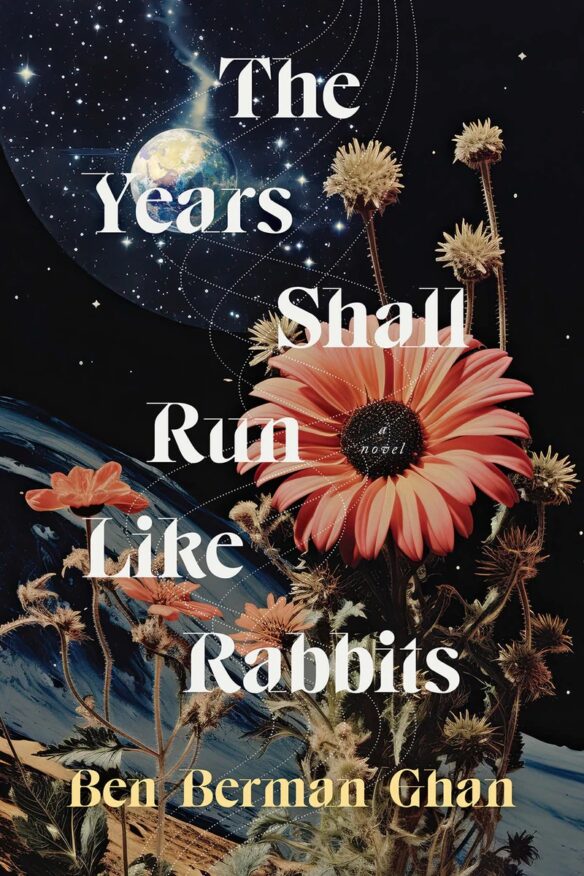
Ben Berman Ghan is a PhD Candidate in English and creative writing at the University of Calgary. His debut collection of fiction, What We See in the Smoke, was published in 2019, his novella Visitation Seeds was published in 2020, and his novel The Years Shall Run Like Rabbits was published with Buckrider Books in 2024. His prose, poetry, and essays have been published in Clarkesworld Magazine, Strange Horizons, Filling Station Magazine, The Blasted Tree Publishing Co., Pinhole Poetry, and The Ancillary Review of Books.
(3) MEDICAL UPDATE. Barry Longyear told Facebook readers today what he’s trying to accomplish despite debilitating cancer.
A little update is in order. It is cancer, It is gobbling up my energy before I can log it in, pain too. I haven’t done any writing since September 10th when this nightmare began, they are dangling chemo and radiation in my future, apparently I am too frail to withstand the preferred operation. So, as always, The future is a mystery. I wish I had enough energy to tell you about all of the fine and quite inspiring men and women I’ve met along the way, but suffice it to say that they are there. The ticket to their company is to reach out. My most recent hospital stay was in a rehab/nursing home packed with patients with the most heartbreaking handicaps one can imagine. And they laugh and joke and point out I am still on this side of the grass. We’ll see what I can get done on the three books I want to get done, The Moman Omniquel, Rope Tricks (the concluding Joe Torio Mystery), and I am going to try my hand at an autobiography: The Superfluous Earth Man or I was an Extra Terrestrial. If I can get all that done before Uncle Reaper comes to collect. Perhaps I can wade through your comments, friend requests, and such. In any event, Disney is moving forward with The Enemy Papers, I have talked with the fellow in charge, and I have high hopes “Enemy Mine” will come out better than the previous version. HAPPY HOLIDAYS, friends, and remember. If the planet Earth didn’t suck we’d all fall off.
(4) DECK THE HALLS OF THE TARDIS. Camestros Felapton assays the Doctor Who Christmas special: “Doctor Who: Joy to the World”.
It is Doctor Who Christmas Special time and if this time of year is about indulging to excess in sugar and sentimentality Russell T. Davies and Stephen Moffat are up for that.
Fluffy, silly, and a remix of some familiar Moffat themes (The Doctor forced to live a more mundane existance for a period, time paradoxes and uploaded minds as an after life) the plot also hits you with some emotional gut punches….
(5) ALL ALONG THE WATCHTOWERS. Tom Nichols remembers “Star Trek’s Cold War” in The Atlantic (behind a paywall)
…But to appreciate the Cold War setting of Star Trek, you need only to understand that the Earth-led United Federation of Planets (a free and democratic association committed to equality among all beings) was NATO. Captain James T. Kirk—born and raised in Iowa, according to the show—commanded its finest flagship, the USS Enterprise. The bad guys, standing in for the Soviet Union, were the Klingons, whose empire was a brutal and aggressive dictatorship.
Two Cold War themes run through Star Trek: the risks of great-power confrontation, and the danger of ultimate annihilation. In “The Omega Glory,” a mediocre episode that Roddenberry pushed to have produced, the Enterprisefinds an underdeveloped planet where Asian-looking “Kohms” oppress the white “Yangs.” Turns out it’s a planet that developed just like Earthin every way—there is some sci-fi hocus-pocus to explain how planets sometimes do this—including an America and a Red China (Kohms and Yangs, Communists and Yankees, get it?), and then wiped itself out with biological warfare.
Other episodes were a bit more sophisticated. In “The Return of the Archons,” Kirk encounters a society that is run like a beehive by a single leader named Landru, who demands that all citizens be “of the body.” (Spoiler: He’s a computer. Out-of-control computers were another common theme.) As Cushman notes, the crushing of the individual for the good of the collective was an intentional statement about life under communism.
Likewise, just as the U.S. and the Soviet Union competed against each other in the developing world of the 20th century, the Klingons and the Federation were often at odds with each other over developing planets in the future….
You have two books about magic out in one month, is this mere scheduling kismet or part of some great working you’ve had in plan for decades?
I never have great workings planned even days in advance. So, no this is purely just the way things have worked out. I started working on the Moon & Serpent Bumper Book of Magic fifteen years ago, around 2010 or so, back then we were expecting it to be out in a couple of years. Then the project expanded and Steve passed away, and we realised that although we’d got all the writing done for it we hadn’t got any of the art commissioned. So that’s what the last few years have been about, getting it all drawn.
As for The Great When, it wasn’t deliberate so much as a coincidence of scheduling but, yes, it’s two books about magic that even have some crossover. Well, the bumper book is about magic, whereas The Great When has got some magicians in it, but it isn’t really anything that is traditional magic — I was prepared to just make most of it up. The Bumper Book is an encyclopaedic history of magic and all sorts of other things as well, but we’ve got characters like Austin Osman Spare, Aleister Crowley and Dion Fortune in both.
So, there’s a tiny bit of overlap, but the intents of both books are different. One is to explain magic as it is and as it has been, and the other is an attempt to try and create something new in fantasy, without relying upon all the magical tropes you get reiterated so often in fantasy novels.
(7) DONALD BITZER (1934-2024). The New York Times reports (in a tribute behind its paywall): “Donald Bitzer, an electrical engineer whose groundbreaking computer system PLATO, developed in the 1960s and ’70s at the University of Illinois, was a telegram from the digital future that combined instant messaging, email, chat rooms and gaming on flat-screen plasma displays, died on Dec. 10…”
…Dr. Bitzer, a professor of electrical and computer engineering at the University of Illinois, began developing PLATO in 1960 as a tool for educators to create interactive, individualized coursework. It swiftly evolved into “a culture, both physical and online,” Mr. Dear wrote, “with its own jargon, customs and idioms.”
PLATO, an acronym for Programmed Logic for Automatic Teaching Operations, initially ran on television-like screens connected to the university’s ILLIAC I computer, a five-ton machine powered by 2,800 vacuum tubes.
To increase interactivity, in 1964 Dr. Bitzer, along with a fellow professor, H. Gene Slottow, and a graduate student, Robert Willson, invented a plasma display illuminated by gas-infused pixels — the same technology that would later power flat-screen televisions.
Thousands of PLATO terminals, radiant with bright orange text and graphics, were installed around the University of Illinois campus and eventually at other universities and high schools throughout the country.
Connected via phone lines, the touch-screen terminals were a kind of first draft of social networking that presaged the way digital devices now dominate daily life. Students learned math, Spanish and other subjects on them during the day, and at night they played games against one another, communicated in chat rooms and became pen pals.
“It was kind of crazy,” Ray Ozzie, a former student of Dr. Bitzer’s who later became Microsoft’s chief technical officer, said in an interview. “It was a little peek into what the internet would later become, and it was all fostered by Don’s vision, by him creating an environment for innovation.”
(8) MEMORY LANE.
[Written by Cat Eldridge.]
December 27, 2000 – Gosford Park
Twenty-four years ago this weekend, Gosford Park premiered. It was directed by Robert Altman from the script by Julian Fellowes, who went on to be the driving force behind the Downton Abbey series. It came together when Director Balaban suggested an Agatha Christie-style whodunit to Altman and introduced him to Julian Fellowes, with whom Balaban had been working on a different project.
It is a country manor house mystery in the style of Hercule Poirot’s Christmas, which I just reviewed, and in keeping with that kind of mystery had a very large ensemble cast: Eileen Atkins, Bob Balaban, Alan Bates, Charles Dance, Stephen Fry, Michael Gambon, Richard E. Grant, Derek Jacobi, Kelly Macdonald, Helen Mirren, Jeremy Northam, Clive Owen, Ryan Phillippe, Maggie Smith, Kristin Scott Thomas, and Emily Watson.
I’ll just single out Stephen Fry as Inspector Thompson as the cast is far too large to detail here. He seems to really believe he has something in common with the McCordles and their guests. However, Sylvia, one of the family, doesn’t even bother to learn his name, and makes it very clear through not so subtle airs that he’s working class and beneath all of them.
It was filmed mostly on location using three different manor houses, though sound stages were built to film the scenes of the manor’s downstairs area. Apparently it was also filmed in three different countries — the United Kingdom, the United States and Italy with production costs of nearly twenty million in total. It did very well at the box office with it bringing in nearly ninety million. It was Altman’s second most successful film after M*A*S*H.
Critics truly loved it with Roger Ebert wringing for the Chicago Sun-Times said it was “such a joyous and audacious achievement it deserves comparison with his very best movies.” And Nell Murray at the Verge summed it up perfectly noting that “For a film about homicide and class conflict, Gosford Park is surprisingly congenial.”
Audience reviewers at Rotten Tomatoes currently give it an excellent rating of seventy-eight percent.
I’ve watched it more than a few times and consider it to be quite excellent. That reminds me that I should write up Knives Out.
(9) NEXT DOOR AT MEMORY LANE.
[Written by Cat Eldridge.]
Rod Serling Statue (Update)
And perhaps across his mind there will flit a little errant wish, that a man might not have to become old, never outgrow the parks and the merry-go-rounds of his youth. — ending words of “Walking Distance”
“Not all statues, no matter how much they deserve to exist, actually exist. At least yet. Such it is with this for the creator of the Twilight Zone series, Rod Serling.” That’s what I knew when I wrote several years ago. Now has transited from the Twilight Zone to this reality.
In doing this extended look at the statues of fantastic creatures, mythic beings and sometimes their creators, I continually come across quite fascinating stories. Such it is with this story. And this one was no exception.
In the “Walking Distance” episode of The Twilight Zone, a middle-aged advertising executive travels back in time to his childhood, arriving just a few miles away from his native town. That episode was based on Binghamton, New York, the hometown of Serling as he graduated from Binghamton Central High School in 1943.
I had come upon news stories that the town in conjunction with the Rod Serling Memorial Foundation and The State of New York had decided Serling should be honored by his hometown.
The Serling Memorial Foundation said it will use the grant and additional fundraising to place the Serling statue in Recreation Park next year. Note that this is the second fundraising effort as the first, a Kickstarter for $90,000, failed.
I couldn’t find any update on the actual production of this statue, so I wouldn’t swear than it was going to happen in the time frame stated. The website for the Serling Memorial Foundation was at that point, to put delicately, a bloody mess and said nothing about that project at all. Now they have a page showing the dedication of the statue with video and quite a bit of detail about the project.
So go here for all the details on this extraordinary project.
…This book is significantly shorter than its predecessor, and feels less of a “pressure cooker” than the first novel, showing that even by keeping the chassis of the first book, Hunt wants to and does experiment with some new things. Sean proves to be well connected, and those connections and his social skills give him some new options and ideas that were not in the first book. Now, given that Sean is dealing with his thought-to-be-dead sister, and some of the fallout from the first book, this gives the book a much more social feel to the conflicts in the narrative than the first. Sure, there are plenty of action sequences like the first novel, although our field of play is generally set in locations within a city, and there are no monsters this time other than the human ones (and yes, some of those are bad enough). So Sean really shines in this book in a way he didn’t in the first book….
…By the time I was nine I already loved vampires. I had seen the Lugosi film often and had been Dracula for Halloween the year before; there’s a photo of me with a painted widow’s peak and plastic fangs too big for my mouth. I was also nine when I first saw Murnau’s Nosferatu (1922). This was a truly frightening vampire makeup design. The nails, the hunch, the shape of the pointed skull. As a child, it felt as if Max Schreck commanded the screen like a real vampire. The degraded quality of the 16mm VHS transfer made the film seem as if it was disinterred from its grave, unearthed from the past, adding to its authenticity. And this adaptation stripped Stoker’s story of its over-stuffed Victoriana and distilled it to its essence: that simple enigmatic fairytale.
About 10 years ago I embarked on writing the screenplay for my own adaptation of Nosferatu. In taking on the most influential horror film, based on the most influential horror novel, I felt a responsibility to make the vampire as scary as possible. This could not be a sparkling vampire….
…Enter the 2022 movie Linoleum. It was never advertised as a remake, but it so cleverly deconstructs the plot of American Beauty that it might as well have openly acknowledged the extent of its debt. Similarly set in the late 1990s, it proposes a more empathetic alternative to the earlier movie’s cynicism. And from this point on I’m going to need to spoil the secrets of Linoleum….
The reason for Aoshima’s nickname was clear before we had set foot on the island. As our tiny vessel slowed to a halt and its handful of passengers prepared to disembark, the quayside was alive with orangey-white blurs – a whiskered welcome party that forms as soon as its members hear the hum of an approaching motor.
The only human here to greet us is Naoko Kamimoto, appropriately dressed in a pinafore with feline designs, who secures the boat with a rope as half a dozen cats swirl around her feet.
A 35-minute ferry ride off the coast of Ehime prefecture in Shikoku – the smallest of Japan’s four main islands – Aoshima is the best-known of the country’s 11 “cat islands”. Despite the absence of a single shop, restaurant or guesthouse, this speck in the Seto Inland Sea has become a must-see for visitors intrigued by a remote community where cats easily outnumber humans.
But Aoshima’s days as a feline-fixated tourist destination are numbered. A decade ago there were about 200 feral cats here – the descendants of animals enlisted by fishers to destroy rodents who were gnawing through the nets they used to catch huge quantities of sardines.
Kamimoto, who moved to the island after she married Hidenori, a local man, believes the number is now closer to 80. They are all aged over seven, and a third are battling illnesses, including blindness and respiratory diseases, caused by decades of inbreeding….
… The decline in the cat population is about more than the passage of time, however. Aoshima is the victim of a demographic crisis that is afflicting thousands of rural and island communities across Japan. Almost 900 people lived here just after the second world war, but the number had dropped to 80 around a decade ago, as ageing fishers and their spouses moved to the mainland, leaving their cats behind. By 2017, there were just 13 residents. Today, four are left: Naoko and Hidenori, and another couple who prefer to keep out of the spotlight….
[Thanks to Andrew Porter, John King Tarpinian, Chris Barkley, Joel Zakem, Cat Eldridge, SF Concatenation’s Jonathan Cowie, Steven French, Kathy Sullivan, Teddy Harvia, and Mike Kennedy for some of these stories. Title credit belongs to File 770 contributing editor of the day Daniel Dern.]
(2) WHY NOT SAY WHAT HAPPENED? In Episode 5 of Scott Edelman’s podcast Why Not Say What Happened? we get the story of “My Rooftop Dance with Larry Lieber” at the 1974 Worldcon.
Join me as I demonstrate the limits of my memory by telling tales of why my first Worldcon was supposed to have been my second Worldcon, the question I never got around to asking my cousin, the actor Herb Edelman, which song I sang while dancing across a Manhattan rooftop with Larry Lieber, what Fantastic Four moment motivated the first letter I ever wrote to a comic book company, the string of serendipities which led to one of my DC horror stories being adapted as an episode of Tales from the Darkside, how the Washington Post got me a job editing Science Fiction Age magazine, and more.
(3) MEMORIES FINALLY RETURNING. [Item by Michael Dobkins.] This is a follow up to a news item by Bruce D. Arthurs in the October 19 Pixel Scroll ((8) SECOND, JUST SAY, ‘I FORGOT’.) A new video on the Beinecke Library at Yale’s YouTube just dropped that gives more details on the exhibit and even quotes briefly letters between Disch and David Gerrold about the project at the end.
Remembering “Amnesia” with Claire Fox- MAB 10/14/24
A talk in conjunction with the exhibition “Remembering ‘Amnesia’: Rebooting the First Computerized Novel” on view now in the Hanke Gallery at Sterling Memorial Library. “Amnesia”—a work of interactive science fiction by Thomas M. Disch, published in 1986—was an early attempt to bring video games into the realm of literary art by translating a novelist’s script into a medium that readers could only experience by interacting with a computer. This exhibition traces how “Amnesia” moved from story idea to digital manifestation. Visitors can also play the game on workstations in the Hanke Gallery in Sterling Memorial Library and in Bass Library, using Emulation-as-a-Service Infrastructure (EaaSI) software. Included is the story of the library’s Digital Preservation unit’s work to bring the interactive, computerized novel to life. Claire Fox, curator of the exhibition, is Software Preservation and Emulation Librarian in Yale Library. Mondays at Beinecke online talks focus on materials from the collections and include an opening presentation at 4pm followed by conversation and Q & A beginning about 4:30pm until 5pm.
There is also an Amnesia: Restoredwebsite devoted to the interactive novel that offers “a new version of the cult classic published by Electronic Arts 1986, now available on the web for contemporary computers.”
(4) UNREAL ESTATE DEVELOPMENTS. Arturo Serrano gives Poltergeist an almost theological analysis at Nerds of a Feather: “First Scare: Poltergeist”.
…Poltergeist feels like a condensation of mystical currents of thought that had gained strength during the hippie era but really date back to the spiritualist fad of the 19th century. Advances in the understanding of electromagnetism coincided with a growing interest in the inner workings of the mind, and it was only natural that a theory eventually formed linking electromagnetism with the paranormal. If you didn’t know any better, it made some sort of sense: if you consider radio waves, they’re an invisible force that exists all around us and can even pass through us, and have very tangible effects if you have a properly sensitive machine at hand. So it wasn’t too much of a stretch to suppose that ghosts worked the same way. Poltergeist is an heir to over a century of superstition that viewed in electrical devices a viable tool for contacting the spiritual realm.
But Poltergeist does more than that. It also takes advantage of the moral panic that was forming around mass media and the way the TV set ended up altering not only the inner dynamics of the American family, but also the rhythm of daily life. People in Poltergeist time their activities by the programming schedule of TV; their day ends when the last broadcast ends. Even before malevolent spirits jump out of the screen, they’re already under the spell of TV….
In breaks on his Never Ending Tour, Bob Dylan has returned to social media to send his regrets to the Buffalo Sabres hockey team for missing a game, recommend an incredibly famous restaurant in New Orleans and, in a new twist for the Nobel laureate, hint at his spooky literary aspirations.
“At the hotel in Frankfurt there was a publishing convention and every room was taken, parties all night,” Dylan posted on the social platform X (formerly Twitter) Oct. 23.
“I was trying to find Crystal Lake Publishing so I could congratulate them on publishing The Great God Pan, one of my favorite books,” Dylan continued. “I thought they might be interested in some of my stories. Unfortunately it was too crowded and I never did find them.”
As always, Dylan speaks, the world listens. It came as quite the October surprise for Crystal Lake, a Bloemfontein, South Africa-based press specializing in dark fiction and horror whose current titles include an anthology called Dastardly Damsels and Blood and Bullets: A Trio of Western Horror Novellas. (Yes, they also published a “revamped” edition of Machen’s 1894 Great God Pan, about a sinister woman who seems to be driving powerful men to suicide.)
“We had literary agents in Frankfurt representing our books, so we weren’t there in person,” Crystal Lake’s founder and CEO Joe Mynhardt said in an email.
Mynhardt said that, since the Dylan post, they’d spent a few days tracking down the songwriter and his team.
“It’s my understanding that they now have our contact info, so fingers crossed,” Mynhardt wrote in his email Saturday.
While Dylan has previously published poetry, the first part of his memoirs and most recently his 2022 book The Philosophy of Modern Song, it remains to be seen what scary stories he may have in his drawer. Less of a mystery is what he may have admired in Machen’s novella — a tale of sex, pagan gods and death. Somehow this all seems very on brand, even if it’s lacking in the Americana department (Machen was Welsh, like another great poet named Dylan)…
… The election of Kamala Harris will not end the partisan and political divisiveness that ails America. But it, along with a majority in the House and Senate, will be an important and vital first step toward restoring a sense that democracy, and the underlying systems that support and nourish it, can prevail and grow.
Fear sells—until we, collectively, stop buying it.
We have no excuse. We know better, and now we must do better….
The filmmaker has been selected to receive the 50th installment of the organization’s highest honor, the AFI Life Achievement Award, at a ceremony scheduled to take place at Hollywood’s Dolby Theatre on April 26, 2025. He will be 86 at the time. The tribute will air on TNT with encore presentations on Turner Classic Movies. All proceeds from the gala will support AFI’s education and arts initiatives.
The AFI Life Achievement Award is presented to an honoree “whose talent has in a fundamental way advanced the film art, whose accomplishment has been acknowledged by scholars, critics, professional peers and the general public, and whose work has stood the test of time.”…
Kathryn: “Jac Schaeffer who wrote it is a genius because she wrote Wandavision too and so I just hurled myself with faith into whatever she would do, she knows this character really well.”
Kathryn Hahn on a viral Halloween dog costume inspired by the Disney+ series
Kathryn: “Apparently there is a dog costume called Wagitha Barkness… which I’m like, that seems amazing!”
(9) ALTERNATIVES TO OUR DIGITAL FUTURE. Joshua Rothman asks “Could Steampunk Save Us?” – behind a paywall in The New Yorker.
In 1990, Gibson and Bruce Sterling wrote “The Difference Engine,” an alternative-history novel, set in the nineteenth century, in which computers are built about a hundred years earlier than in reality, using quirky systems including gears, wheels, and levers. The novel helped popularize the genre of steampunk, in which nineteenth- and twentieth-century technologies are merged. Arguably, Jules Verne and H. G. Wells wrote steampunk avant la lettre, simply by crafting science fiction in the late nineteenth century; the genre’s aesthetic markers-valves, pipes, airships, monocles-have since informed the imaginative worlds of films and television shows like “Snowpiercer,” “Silo,” and much else. Steampunk mounts an imaginative protest against the apparent seamlessness of the high-tech world; it’s an antidote to the ethos of Jony Ive. It’s also fun because it’s counterfactual. It’s fascinating to imagine, implausibly, how ravishing technology could be constructed out of yesterday’s parts.
But what if the world really is constructed that way? In that case, it could be a mistake to put too much faith in digital perfection. We might need to fiddle with our technology more than we think.
(10) STOP BEING MIDDLE-CLASS IMMEDIATELY. “This is a Thomas Ha Fanzine Now” at Seize the Press, edited by Jonny Pickering and Karlo Yeager Rodríguez.
The other week someone asked me why I thought there was such discomfort with unresolved narratives and non-cathartic endings in some corners of the contemporary short story world. I thought about it a bit and figured my answer would be worth sharing.
The conversation came about after I read a Thomas Ha story called “The Brotherhood of Montague St. Video”, which features a story within the story — an old pulp western the narrator discovers has been altered so that the original ending (where the protagonist is defeated by the evil sheriff and limps off into the desert) is rewritten into a glorious, audience-pleasing victory. As with any Thomas Ha story, there are layers stacked on layers to the narrative, but one thing it got me thinking about is why so much contemporary media (and short fiction in particular) is so ill at ease with leaving the audience ill at ease.
I can’t say for sure why this is, but I can speculate. I think one reason is there’s an influential school of (largely American) middle class liberal writers who dominate a lot of the bigger magazines and who come at fiction from the viewpoint that writing and reading stories constitutes some form of activism. You see it a lot in the ‘power of stories’ assertions that go round from time to time and is also partly why we see so much didactic fiction out there, because it’s a view that thinks the purpose of art is to ‘instruct’ and to portray the ‘correct opinions’, whereas for me good art raises more questions than it answers….
… At the risk of sounding like a vulgar Marxist I think western society in general (and, from what I can gather as a Brit, particularly American society, which has such a big effect on western culture as a whole) has reached a stage where, for lots of people, collectively trying to change the world can seem pretty hopeless, and so there’s a tendency to retreat into a very individualistic notion of activism, where if you’re working on yourself and thinking the right things and reading the right things, even when that thing is fiction, it feels like praxis. It’s incredibly reactionary and has a stultifying effect on art in my opinion, because it results in these calcifying stories that do nothing to challenge, and whose purpose and effect is simply to reassure….
(11) TERI GARR (1944-2024). Teri Garr, who received an Oscar nomination for her role in Tootsie, died October 29 reports the AP. She died of multiple sclerosis “surrounded by family and friends,” said publicist Heidi Schaeffer. Garr battled other health problems in recent years and underwent an operation in January 2007 to repair an aneurysm.
Garr is best remembered by fans playing the helpmate in four genre classics:
Wife, Ronnie Neary, to Richard Dreyfus in Close Encounters of the Third Kind
Wife, Bobby Landers, to John Denver in Oh, God
Lab Assistant, Inge, to Gene Wilder in Young Frankenstein
Office Assistant, Roberta Lincoln to Robert Lansing in Star Trek’s “Assignment Earth” episode
She also appeared on the Sixties Batman series. And forty years later she voiced the character of Mary McGinnis in the animated “Batman Beyond” TV series, and Sandy Gordon in 2003’s What’s New, Scooby Doo? animated series.
(12) TODAY’S BIRTHDAY.
[Written by Paul Weimer.]
Born October 29, 1906 — Fredric Brown. (Died 1972.)
By Paul Weimer: I first encountered Fredric Brown’s work with a pastoral work known as “The Waverlies”. Sometime in the near future, a peculiar sort of alien arrives on earth that is invisible, and eats all forms of radio, and electromagnetic signals and power fail. The United States and the rest of the world is thus plunged into a late Victorian era of technology. It was and is a pastoral, gentle story of the hands of time being stopped and put backward to a slower pace, permanently. The story nagged at me, though, even as I liked it. Such a technological change would be wrenching and millions…if not more, would die in the result (c.f. S M Stirling’s The Change series). I don’t think Brown considered that. But this is notably one of Philip K Dick’s favorite short stories. It has a power…even if it doesn’t realize its full implications and problematic nature
But he considered and thought about a lot of other SF ideas in other fantastic stories. His story “Answer” has the classic line you know even if you haven’t read it “NOW there is a God”. “Arena” is the basis of the Star Trek episode where Kirk fights a Gorn. And there are plenty more where those come from. I haven’t delved into his extensive work with mystery novels and stories, but if that is your jam, Brown has a plethora of work for you once you finish his science fiction stories and short novels.
But as much as I like “The Waverlies” (even as I recognize the problematic aspects of the story), my favorite Brown story is probably his most definitive one, and that is “What Mad Universe”. You probably know this story if you read it. A SF book editor finds himself in a world whose ideas run on SF magazine story conventions. With a breakneck pace and change of action and twists at a pace that Van Vogt might envy, the story is a rollercoaster and deconstruction of what was soon to become a dying breed — pulp SF stories. It thus stands as the Pulp Science Fiction story for as unwitting capstone of the era, and it’s a lot of fun. I’m not the only one who thinks this, as witness Lawrence Block’s The Man Who Met Frederic Brown, which takes up on this trope and references that story directly.
…Burns became obsessed with monsters at a young age. His father had “every kind of hobby”, which meant the house was always full of art tools and Indian ink. Burns would try to recreate comics he found around the house but his awakening came in early 1969 when a kid at school introduced him to Zap Comix, helmed by the godfather of underground comix Robert Crumb. “Suddenly, here’s this thing with intense drawings! I wasn’t interested in Captain America and Iron Man – but I would imitate these psychedelic comics.”
Burns disappears again and comes back with some of his early examples. They have a beautiful, frantic quality – a kind of professionalised bedlam – with all the hallmarks of his current work, from weird monsters to attractive adolescents. The cartoonist Lynda Barry once wrote of his style and the standard he reaches: “You can’t believe a person could do it with regular human hands. It’s the kind of drawing that would have scared the pants off you in grade school, not only because the images are so eerie but because they are too perfectly done, and not good or evil enough for you to tell what you are supposed to think about them.”
That eerie perfectionism is right there in his earliest work. It’s this style that excited Spiegelman, who agreed to publish Burns in Raw in the 1980s. It’s why the cult literary magazine The Believer, founded by Dave Eggers in 1998, used Burns for every cover until 2014…
(15) HOW WOULD YOU TRANSLATE IT? From Viktoria on Threads:
(16) TV VIEWING RECOMMENDATIONS FOR LAST-MINUTE JACK O’LANTERN CARVERS. In anticipation of Halloween, JustWatch has put together a list of the Top 10 spooky movies and TV shows available to stream in the United States based off their 13 million users in the United States.
MGM+ has dropped the first trailer and unveiled the premiere date for Earth Abides, its upcoming post-apocalyptic limited series adaptation of George R. Stewart’s sci-fi novel of the same name. It’s slated to launch December 1 on the streamer.
Written and executive produced by Todd Komarnicki (Sully), who also serves as showrunner, in Earth Abides, when a plague of unprecedented virulence sweeps the globe, the human race is all but wiped out. In the aftermath, as the great machine of civilization slowly and inexorably breaks down, only a few shattered survivors remain to struggle against the slide into extinction….
…As seen in an almost seven-minute-long video shared by Chinese state-owned news agency CCTV, members of the current Shenzhou-18 crew gave an extensive tour of their temporary abode.
Crew members show off the station’s kitchen, from a small heater that dispenses water into small pouches to a modified microwave. Astronauts also showed off the surprisingly roomy beds that each feature a sizable porthole, with unparalleled views of the Earth below.
We even got a glimpse of the two orbital lab segments, including several cherry tomato and lettuce plants growing in the station’s greenhouse….
[Thanks to Cat Eldridge, SF Concatenation’s Jonathan Cowie, Steven French, Jo Fletcher, Lew Wolkoff, Andrew (not Werdna), Michael Dobkins, Kathy Sullivan, Teddy Harvia, Mike Kennedy, Andrew Porter, John King Tarpinian, and Chris Barkley for some of these stories. Title credit belongs to File 770 contributing editor of the day Cat Eldridge.]
(1) CANCELLING HERSELF. Samantha Mills mournfully headlined her latest blog post “’Rabbit Test’ unwins the Hugo”. After reading the Barkley/Sanford report and some others’ analysis of the voting reports, Mills says:
…Looking at the information we currently have, it’s hard for me to conclude anything other than: I shouldn’t have been on that ballot. On the one hand, it seems as though the final vote hasn’t been tampered with, and the voters engaged in good faith with the works they were told were the finalists, for which I still say thank you! But it’s really, really hard for me to see past the initial fact, which is that I shouldn’t have been on that ballot.
This entire experience has been very stressful and fraught. Initially I assumed I wasn’t going to be a finalist, because even though the story had taken off like mad in the U.S., the bulk of the membership was not going to be American. I assumed we would see a lot of Chinese nominees — which would have been cool! We’d get a slice of international scifi that I rarely ever see! And then I was really pleasantly surprised to be informed I was a finalist after all. When the full ballot was posted, I was also surprised at how few Chinese nominees were in the fiction categories. There were four in the short story category, though, so I thought it was legit, and that wow, John Wiswell and I somehow made the cutoff anyway, isn’t that amazing!
I accepted the nomination because, you know, it is supposed to be an honor. But then due to concerns about the Worldcon event itself, I elected not to participate in programming or accept a free trip to Chengdu. This was also fraught. I’ve never been to a Worldcon, and I’d never been nominated before. And as I said in my previous long-winded post on the subject, I have nothing against the fandoms at play. But I wasn’t comfortable being one of the faces of local PR under political circumstances that felt entirely above my pay grade, so I bowed out…
There are two sets of problems here: (a) the proximate issue of what was done in 2023 and (b) what this reveals or illuminates about the the cartel of self-proclaimed “SMOFs” (secret masters of fandom) who treat the Hugos – and Worldcon more broadly – as their birthright, playground and personal fiefdom. The Hugo Awards are supposed to be democratic in nature and process; the behavior of the self-proclaimed “SMOFs” is fundamentally anti-democratic – and this is by no means confined to Chengdu Worldcon.
Now here are my suggestions for how to rebuild trust in the Hugo Awards:
No one involved in the administration of the 2023 Hugo Awards, or who assisted in the collection of political evidence, can ever be allowed to have any role in administering the awards ever again.
Vote tabulation must be performed in a transparent manner using software that multiple people have access to for purposes of validation.
All tabulations must be independently audited for purposes of verification.
Individual Cons should no longer administer the Hugo Awards – this should be done by an independent, rotating committee.
All decisions by said committee must be audited; all disqualified nominees must be notified and given time to appeal.
Here’s more information about Chengdu’s passalong offer of $40,000 to Glasgow:
“… My colleague, and I think it’s fair to say, con-running coach, Alexia Hebel, is not only the treasurer for Capricon, she was the treasurer for the Western component of the Worldcon in Chengdu. And as such, one of her duties was to administer the pass-along funds from Chengdu over to Glasgow. What are pass-along funds? Well, if there’s any money left over after running a Worldcon, they have the option and traditionally always do of passing that surplus along to the next Worldcon as a donation towards its effort. It’s a bit more complicated than that, but that’s the basic idea. While in between duties at Capricon and after speaking with Ben Yalow about it, she offered $40,000 in pass-along funds to the Glasgow Worldcon. And again, that’s de rigueur. You know, every Worldcon does this if they can. Glasgow turned the money down. They’re so anxious to avoid any associations with the Chengdu Worldcon that they’re unwilling to even touch the money, to the tune of 40 grand.
(4) SEEN AROUND FANDOM. These convention badge ribbons will be in great demand once somebody starts handing them out.
Something dramatic happens on a social media platform every day. On Goodreads, the anachronistically designed website for logging, rating (out of five) and reviewing books, the dramas are more amusing, and they occasionally even draw attention from areas beyond the site’s supposedly book-loving users. The most recent featured Cait Corrain, the fantasy author who set up an elaborate network of fake accounts to post positive reviews of her own forthcoming book as well as negative reviews of authors she felt were her competitors. When citizen journalists uncovered her plot in December 2023, her book was cancelled, and she lost her agent and a future book deal.
A juicy, postmodern story of self-sabotage, or a sad one about the intersection of the internet and mental health. Regardless, its stakes are relatively low: publicly harassing one’s colleagues is a sackable offence anyway, and it’s hard to find someone who really cares about the vicissitudes of the young adult literature world who isn’t part of the subculture. I’m not; I’m a professional critic, and an author of a literary novel. I’m a snob. I care about my book, and the authors I feel are my competitors. And while Goodreads has been around since 2007, its significance to the broader literary world remains steadfastly confusing. Does it sell books? Does it make and break careers? The flashy, funny stories that have emerged about the site over the last several years have done exactly what its proprietors surely want: make it seem like Goodreads is important. But is it?…
Whether you’ve been thinking about starting to read “A Court of Thorns and Roses,” or you’re a long-time fan of “Throne of Glass,” it’s likely that you’ve heard of Sarah J. Maas. The author is making headlines the world over thanks to her fantasy series. Whether you’re invested in them for the well-written smut or the beautiful way she weaves her stories, fans can’t put down her novels. But what some readers might not know about the rather private author is that she was raised by a Catholic mother and a Jewish father and attended Hebrew school in her youth. She went on to attend Hamilton College for religious studies and met her future husband at her college’s Hillel, where he served as president. Her connection to her Jewish faith isn’t just apparent when looking at her personal history, though. It just takes a keen eye and a flip through any of her series’ to recognize that she has woven her culture through every story….
… The way that Maas deftly and lovingly weaves her Jewish culture and faith into her writing opens up the world of our stories and tradition to a wider audience. Jewish faith hasn’t had a very loud voice in fantasy — but thanks to Maas, that might be about to change.
(8) ROLE MODEL. [Item by Danny Sichel.] “Peter Talks To a Spider”, a ten-page comic, by Donny Cates and Chip Zdarsky, published on Marvel’s official Threads account: “What happens when Spider-Man chats with an actual Spider”. Images at the link.
(9) TODAY’S BIRTHDAY.
[Written by Cat Eldridge.]
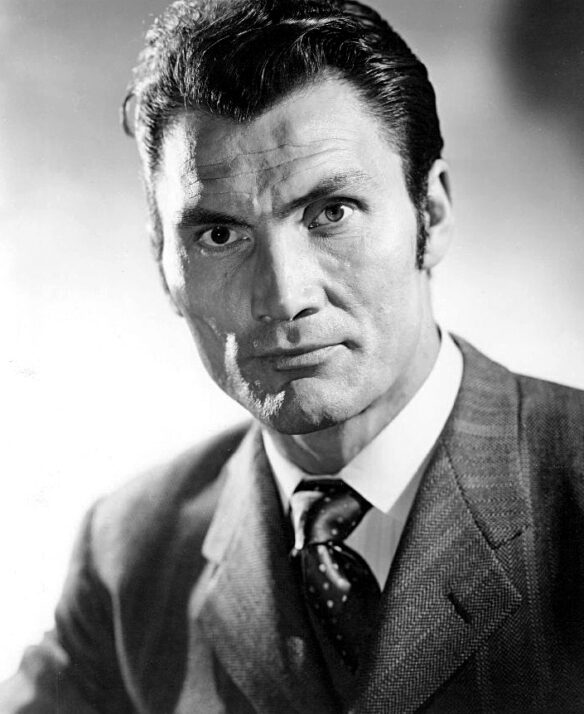
Born February 18, 1919 — Jack Palance. (Died 2006.) Tonight I’ve come to talk of Jack Palance who was born of Ukrainian immigrant parents with name of Volodymyr Palahniuk. His last name was actually a derivative of his original name. While guesting on What’s My Line?, he noted that no one could pronounce his last name, and how it was suggested that he be called Palanski but instead that he decided just to use Palance instead. He didn’t say where his first name came from.
(OK nitpickers, I do not want to hear from you. Seriously, I don’t. His career makes a gaggle of overly catnapped kittens playing with skeins of yarn with lots of lanolin still on it look simple by comparison so I may or may not have knitted it properly here, so bear with my version of it.)
Jack Palance in 1954.
Surprisingly it looks like that he got his start in our end of things in television performances and relatively late as they started in the Sixties with the first one being Jabberwock on a musical version of Alice Through the Looking Glass. I’m sure I want to see that as it had Jimmy Durante as Humpty Dumpty, and the Smothers Brothers as Tweedledee and Tweedledum.
Next up was a Canadian production with him in the title role of The Strange Case of Dr. Jekyll and Mr. Hyde, and that in turn saw him being the lead in Dracula, also known as Bram Stoker’s Dracula and Dan Curtis’ Dracula, the last when the ego of the Director got way, way too big.
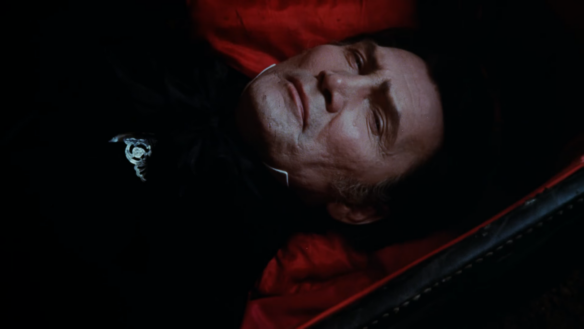
Jack Palance as Dracula (1973)
I’m going to digress here because it’s so fascinating. In 1963, The Greatest Show on Earth first aired. This Circus drama had Johnny Slate as the big boss who keeps the circus running as it moves from town to town. It was produced by Desilu, the production company founded by Lucille Ball and Desi Arnaz, Sr. It lasted but one season as it was up against shows by Jack Benny and Richard Boone.
A bit of hard SF was next, Cyborg 2, released in other countries as Glass Shadow, creative but terribly uninformative, where he’s Mercy, an old renegade cyborg.
Remember my Birthday recently on the wonderful Carol Serling? Well he was in The Twilight Zone: Rod Serling’s Lost Classics film that she made possible as Dr. Jeremy Wheaton in “Where the Dead Are”.
If Treasure Island counts as genre and yes I do count it in my personal canon, then his role as Long John Silver is definitely canon.
He got to play Ebenezer Scrooge in Ebenezer. Now the fun part is that it’s set in the Old West, where he is the most greedy, corrupt and mean-spirited crook in the old West obviously, he sees no value in “Holiday Humbug” by several reviewers. This film I went to look up on Rotten Tomatoes, but no rating there.
Not at all shockingly to me, he shows up on The Man from U.N.C.L.E. where he plays a character of Louis Strago in a two-parter “The Concrete Overcoat Affair” which got reedited as “The Spy in the Green Hat”.
A bit of horror was next in Tales of the Haunted as Stokes in “Evil Stalks This House” was up late in career.
Finally for roles that I’m reasonably sure were of genre interest, he was on Buck Rogers in the 25th Century as Kaleel in the “Planet of the Slave Girls” episode.
One more gig for him related to genre or at least genre adjacent, though not as a performer, but as the host of Ripley’s Believe It or Not! for four years. He had three different co-hosts from season to season, including his daughter, Holly Palance, actress Catherine Shirriff, and finally singer Marie Osmond.
“Am I as geeky as the Doctor who fans? Yes. As a Doctor Who fan myself of old, I can very much can plug into that. I don’t think I ever got in trouble at school. That is one of those stories that’s ended up on Wikipedia. I wrote an essay on Doctor Who, which some unpleasant newspaper found and printed. But I didn’t get in trouble for it. I think I got quite a good mark for it.”
Less than 2 percent of console video games include L.G.B.T.Q. characters or story lines even though 17 percent of gamers are queer, according to GLAAD’s first survey on the industry.
The survey, whose results were released on Tuesday, said a majority of respondents had experienced some form of harassment when playing online. But it also found that many queer gamers saw virtual worlds as an escape in states where recent legislation has targeted L.G.B.T.Q. people. Seventy-five percent of queer respondents from those states said they could express themselves in games in a way they did not feel comfortable doing in reality.
“That is a statistic that should pull on everyone’s heartstrings,” said Blair Durkee, who led the advocacy group’s survey alongside partners from Nielsen, the data and marketing firm. “The statistic is driven largely by young gamers. Gaming is a lifeline for them.”
GLAAD has produced a similar breakdown of queer representation in television since 1996. Its latest report found that 10.6 percent of series regulars in prime-time scripted shows identified as L.G.B.T.Q., which researchers said helped put their video game study in perspective….
(13) CREATING VIDEO FROM TEXT. That’s the latest step forward in artificial intelligence says OpenAI in “Sora”.
We’re teaching AI to understand and simulate the physical world in motion, with the goal of training models that help people solve problems that require real-world interaction.
Introducing Sora, our text-to-video model. Sora can generate videos up to a minute long while maintaining visual quality and adherence to the user’s prompt.
Today, Sora is becoming available to red teamers to assess critical areas for harms or risks. We are also granting access to a number of visual artists, designers, and filmmakers to gain feedback on how to advance the model to be most helpful for creative professionals.
We’re sharing our research progress early to start working with and getting feedback from people outside of OpenAI and to give the public a sense of what AI capabilities are on the horizon….
… The current model has weaknesses. It may struggle with accurately simulating the physics of a complex scene, and may not understand specific instances of cause and effect. For example, a person might take a bite out of a cookie, but afterward, the cookie may not have a bite mark….
The guardians of nature. The protectors of humanity. The rise of a new empire.
The epic battle continues! Legendary Pictures’ cinematic Monsterverse follows up the explosive showdown of “Godzilla vs. Kong” with an all-new adventure that pits the almighty Kong and the fearsome Godzilla against a colossal undiscovered threat hidden within our world, challenging their very existence—and our own. “Godzilla x Kong: The New Empire” delves further into the histories of these Titans and their origins, as well as the mysteries of Skull Island and beyond, while uncovering the mythic battle that helped forge these extraordinary beings and tied them to humankind forever.
[Thanks to SF Concatenation’s Jonathan Cowie, Steven French, Mike Kennedy, Paul Weimer, Eric Hildeman, Joshua K., Cliff Ramshaw, Kathy Sullivan, Jean-Paul Garnier, Dan Bloch, Rich Lynch, Danny Sichel, Andrew Porter, John King Tarpinian, Chris Barkley, and Cat Eldridge for some of these stories. Title credit belongs to File 770 contributing editor of the day Cat Eldridge.]
(1) TO THE NASFIC AND BEYOND. A chapter of Sandra Bond’s Trans-Atlantic Fan Fund trip saga appears in the new issue of Geri Sullivan’s fanzine Idea 13. Says S&ra, “It contains my report on Pemmi-Con with detailed thoughts on What Went Wrong With It And Why.”
Day thirteen of TAFF, unlucky for some. Sandra Bond – already befuddled by her travels and overwhelmed by the generosity of North American fans – has left Minneapolis and has hitched a lift with Minnesota fans Curt Gibson and Alice Ableman in Curt’s mom’s SUV, riding north for NASFiC. No, you haven’t missed any previous instalments; they will be published elsewhere, in due course, and eventually a complete version will follow. I’m starting with this chapter, partly because Geri is publishing it and chapter 1 will largely be about her as my first host, and partly in order to air some issues arising from Pemmi-Con while the iron, so to speak, is hot….
Here’s a taste of those hot iron issues. Think of it as what the 2023 Worldcon experience would have looked like if Chengdu had not wrested it away from Winnipeg.
… (The programme as a whole showed every sign of having been thrown together by robots with no human eyes; for instance, the registration field had a space for you to enter your “organization.” I had put “TAFF”, which was fine, but Tanya Huff had foolishly essayed a little joke by putting “I am not at all organized” in that field, and was rewarded by having that phrase appended to her name on every single programme item featuring her. Others were flagged as variations on “n/a” or “–”, or found themselves billed as representing the organisation of “Myself” (Rich Horton) or “Julie E. Czerneda” (go on, guess). And Nisi Shawl – a fucking guest of honor, and consequently on many programme items – was accompanied on every occasion by the tag “I believe you already have my bio and photo.” Apparently they didn’t, since her “photo” was the generic one used for people who hadn’t supplied any.)…
(2) WHEN NEEDS MUST. The BBC interviewed a fan who remembers “When Tom Baker popped in to watch Doctor Who”. The experience wasn’t quite like when Dustin Hoffman needed to see “Wapner” in Rain Man, but was not entirely unlike it, either.
The time is November 1976, and the space is the Nuneaton branch of Radio Rentals, the old TV stockist that was once a familiar high street fixture. Pauline Bennett remembers being on shift there when a “very smart chap” walks in with a strange request.
“He came in about five o’clock and said he and Tom Baker needed to watch the Doctor Who episode that was going to be on shortly,” she said.
Titular star Baker had been travelling back from the show’s exhibition in Blackpool with BBC manager Terry Sampson when the pair were delayed by fog.
They had turned off the motorway heading for the town, hoping to persuade someone to let them watch the show, the first to feature filming at an outside location, she explained….
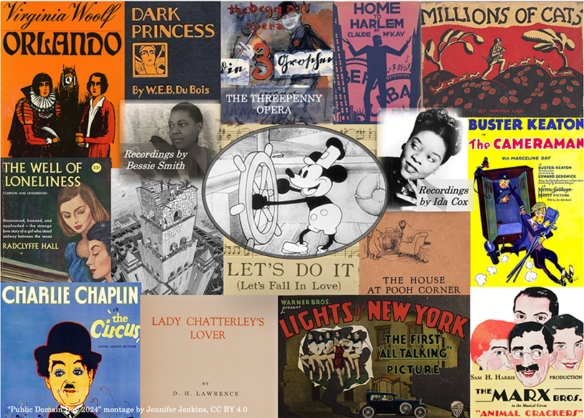
(3) FREE AT LAST. Jennifer Jenkins, Director, Duke Center for the Study of the Public Domain, tells us what we can look forward to on “Public Domain Day 2024” at the Duke University School of Law blog.
On January 1, 2024, thousands of copyrighted works from 1928 will enter the US public domain, along with sound recordings from 1923. They will be free for all to copy, share, and build upon. This year’s highlights include Lady Chatterley’s Lover by D. H. Lawrence and The Threepenny Opera by Bertolt Brecht, Buster Keaton’s The Cameraman and Cole Porter’s Let’s Do It, and a trove of sound recordings from 1923. And, of course, 2024 marks the long-awaited arrival of Steamboat Willie – featuring Mickey and Minnie Mouse – into the public domain. That story is so fascinating, so rich in irony, so rife with misinformation about what you will be able to do with Mickey and Minnie now that they are in the public domain that it deserved its own article, “Mickey, Disney, and the Public Domain: a 95-year Love Triangle.” Why is it a love triangle? What rights does Disney still have? How is trademark law involved? Read all about it here. …
…In 2023, The Wizard of Oz books by L. Frank Baum entered the public domain. That means anyone can take those characters or the world of Oz and reimagine them in brand-new stories. The independent short horror film Gale: Stay Away From Oz does just that. According to IMDB, Gale‘s official summary is “Long gone are the days of emerald cities and yellow brick roads. In this dark re-imagining of the Wizard of Oz, Dorothy Gale is now an elderly woman, broken by years of paranormal entanglement with a mystical realm.” Emily Gale, the granddaughter of Dorothy, reconnects with her grandmother and the mystical realm that haunts her.
Unlike Winnie the Pooh, which also got the horror treatment, the original stories of Dorothy already lend themselves to the horror genre. Who hasn’t watched Return to Oz and felt terrified? With Gale: Stay Away From Oz, it seems like the curse of Oz haunts any of Dorothy’s descendants, which makes for an even creepier connection. So when is Gale: Stay Away From Oz coming out and where can you watch it?…
The other day, Susan Bay Nimoy—actress, writer, director, philanthropist, and widow of Leonard—stood at the entrance of a historic Art Deco theatre in Westwood, which she had helped to restore and convert to a live-performance space. On the marquee, lit bulbs spelled out the theatre’s new name: the Nimoy.
“There’s a lot of history,” Bay Nimoy, an exuberant eighty-year-old, said. “I called Jane Fonda and asked if she would come to the press opening, because her mother, Frances, funded the theatre.” More history: during the Second World War, newsreels played at the theatre; “Dr. Strangelove” had its first L.A. screening there, in 1964. Two decades later, when Disney managed the theatre, “Three Men and a Baby” was the opening film. Leonard was the director; Bay Nimoy accompanied him to the première. “It was certainly in the eighties, because I wore a black suit with big shoulder pads, with a lot of jewelled things on them,” she said….
… “Leonard and I came from very poor backgrounds. His father was a barber. My dad was an accountant,” Bay Nimoy said. The couple invested their Hollywood earnings in California real estate and contemporary art. “Leonard was not a fancy person,” she went on. When they met, she said, “I was driving a Honda.” Their goal was to give their children—he had two, she had one—a buffer, and no more. “They will not be gabillionaires, but they have a leg up,” she said. “And the rest we’re giving away.” They built a Jewish day school (their rabbi asked them to), a new theatre at Griffith Observatory (Leonard loved outer space), and a theatre for Symphony Space, in New York (where Leonard used to perform short stories)….
… In an ideal world — one in which it wasn’t owned by Amazon — Goodreads would have the functionality of a site like Letterboxd, the social network for movie fans. Letterboxd has called itself “Goodreads for movies” but it has far surpassed that initial tag line, having figured out how to create a smooth and intuitive user experience, provide a pleasant and inviting community and earn revenue from both optional paid memberships and advertisers, including studios that produce the films being discussed. Meanwhile, publishers still rely on Goodreads to find potential readers, but targeted advertising has grown both less affordable and less effective.
So how to fix it? It starts with people: Goodreads desperately needs more human moderation to monitor the goings-on. Obviously, part of any healthy discussion is the ability to express displeasure — those one-star reviews, ideally accompanied by well-argued rationales, are sacrosanct — but Goodreads has enabled the weaponization of displeasure.
It’s not just fledgling authors being pummeled. Earlier this year, Elizabeth Gilbert, the best-selling author of “Eat, Pray, Love,” decided to withdraw a forthcoming novel, “The Snow Forest,” after Goodreads users bombarded its page with one-star reviews objecting primarily to the fact that the novel (which no one had yet read) was set in Russia and would be published at a time when Russia and Ukraine were at war. There is most likely no way to eliminate personal attacks entirely from the site — or from the internet, for that matter — but having more human beings on hand to mitigate the damage would certainly improve the experience.
Fortifying the guard rails wouldn’t be that difficult. Currently Goodreads uses volunteer librarians who add new books to the site’s database in their free time. Hiring these people (and scores more like them) and paying them a living wage would empower Goodreads’s representatives to communicate with publishers, large and small, to facilitate posting books to the site when, and only when, a book has actually been written and edited and is ready to be shared with the world….
(7) CURING YOUR WHO HANGOVER. In the unlikely event that you need somebody to explain the Doctor Who Christmas Special to you, The Hollywood Reporter has volunteered. “’Doctor Who’ Christmas Special “The Church on Ruby Road,” Explained”. For everyone else, beware spoilers. The following excerpt is a little spoilery though not prohibitively so, I thought.
…Initially, Mrs. Flood would appear to be just a normal neighbor. Nothing unusual about her, until we see her sitting down to enjoy the TARDIS dematerializing. Something that most humans would balk at.
However, not for Mrs. Flood. In fact, at the end of the episode, she says to her understandably shocked neighbor (who also witnessed The Doctor’s ship disappearing), “Never seen a TARDIS before?”
And, if this wasn’t enough, she looks directly down the camera and winks. Mrs. Flood is clearly someone to be reckoned with, and undoubtedly will make a return. But is she a familiar character in the Whoniverse? (Time Lords change their appearance quite regularly.) Or, is this a new friend/foe for The Doctor? Names have often hinted at deeper connections and meanings in Doctor Who (see Melody Pond and River Song, for example) — is there a clue here?
Mrs. Flood is played by Anita Dobson, who will be known to many in the U.K. as she made a name for herself as alcoholic landlady Angie Watts in the BBC’s long-running soap, Eastenders. An accomplished stage actress, Dobson is also married to Brian May, guitarist for rock outfit Queen (who’ve had a number of songs feature memorably in Doctor Who, such as “Bohemian Rhapsody,” “Crazy Little Thing Called Love” and “Don’t Stop Me Now”)….
(8) IT ONLY GETS WORSE. [Item by Mike Kennedy.] Did you get new clothes for Christmas? Then beware Jólakötturinn, the gigantic Yule Cat, which will chase you down and eat you if you don’t wear those clothes! “Meet the Yule Cat, an Icelandic folklore beast who eats children” on NPR.
… That’s right. A child’s worst nightmare — new clothes under the tree — could only be outdone by a somehow worse nightmare, being devoured by a ferocious feline that hunts down children caught not wearing their new clothes.
The tale of Jólakötturinn, which translates to Yule Cat, is an Icelandic Christmas classic dating back to at least 1932, according to the Icelandic Folklore website, a research project managed by the University of Iceland….
John Szarkowski, the legendary curator at the MoMA, once described photography as “the act of pointing.” And for the nearly 200 years since its inception, photography has consisted of capturing a visual perspective from the physical world using light — first with light-sensitive plates, then film, then digital sensors. When digital cameras became widely available, many photographers lamented the move away from analog technology but basically Szarkowski’s definition still held: Photography consists of pointing, as a reaction to something that exists in the world.
With advent of A.I. image generators, however, this definition feels obsolete.
Generative A.I. tools can produce photorealistic images, typically in response to written prompts. These images are available for purchase from major stock photography agencies, alongside traditional photos. They routinely go viral before being debunked. They even occasionally win prestigious photography prizes. All if which has reignited a two-centuries-old debate: What exactly qualifies as a photograph?
… Artists, writers and theorists have long remarked on our very human tendency to project slippery ideas about truth onto two dimensional surfaces. In 1921, Franz Kafka was told about a miraculous machine that could automatically take one’s portrait, a “mechanical Know-Thyself.” He offered up his own name for the apparatus: “The Mistake-Thyself.” Kafka was ahead of his time — in Susan Sontag’s 1977 essay “In Plato’s Cave,” she wrote, “Although there is a sense in which the camera does indeed capture reality, not just interpret it, photographs are as much an interpretation of the world as paintings and drawings are.” Each photograph, she argued, is inevitably the product of countless decisions informed, consciously or not, by the photographer’s predilections and biases, as well as the limits and parameters of the technology.
So when I hear some people calling the arrival of A.I. an extinction-level event for photography, I often think of the French painter Paul Delaroche who, legend has it, declared painting “dead” after seeing a daguerreotype, one of the first photographic inventions. Painting did not die; it just evolved into a different kind of artistry, freed from the obligations of verisimilitude….
(10) TODAY’S BIRTHDAY.
[Written by Cat Eldridge.]
Born December 26, — Elisha Cook, Jr. (Died 1995.) His first major role was the psychopathic killer Wilmer Cook in the 1941 version of The Maltese Falcon. Yeah there are two versions, I’ve never seen the earlier version. Anyone here seen it?
Now as for genre roles, his first was a Boris Korloff film, Voodoo Island, in which he was Martin Schuyler. Adam West is here in his first film role, uncredited.
His next horror film with Vincent Price, House on Haunted Hill, in which he was Watson Pritchard, is interesting because exterior shots of the house were filmed at the historic Ennis House in Los Feliz, California, designed by Frank Lloyd Wright and built in 1924.
Here’s a curious one for you. The Haunted Palace is a horror film starring Vincent Price Lon Chaney Jr. in which he’s Micah Smith / Peter Smith. The film was marketed as based on a Poe title but only the title is from him – the plot is from Lovecraft’s “The Case of Charles Dexter Ward” novella.
I saw Rosemary’s Baby once in which he played Mr. Nicklas. That was more than enough, thank you. Hey, he’s in the original The Night Stalker movie as Mickey Crawford. Neat. And next up is being Gordon “Weasel” Phillips in Salem’s Lot, a scary film indeed.
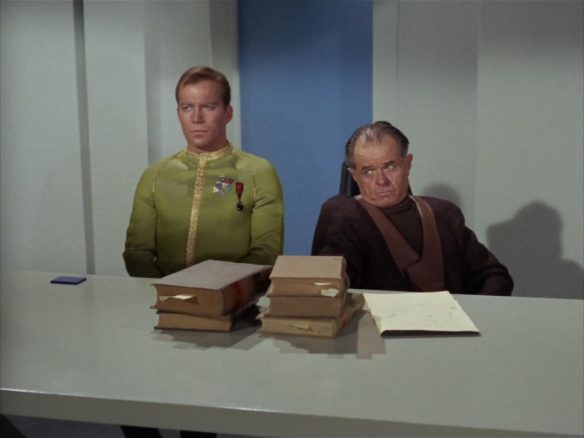
Most memorable series appearance? As Samuel T. Cogley, Esq in Star Trek’s “Court Martial” episode of course. He also made a Wild, Wild West appearance as Gideon McCoy in “The Night of the Bars of Hell”, the new Twilight Zone in “Welcome to Winfield” as Weldon, The Bionic Woman in “Once a Thief” as Inky and in ALF in “We’re So Sorry, Uncle Albert” as Uncle Albert. Oh, and his first television appearance was on the Adventures of Superman in “Semi-Private Eye” as Homer Garrity.
One could summarize Rebel Moon as “the Zack Snyder of Star Wars,” which would sound mean-spirited if it weren’t its literal description. Conceived originally as Snyder’s pitch for Lucasfilm and eventually rescued by Netflix, Rebel Moon files off the Star Wars serial numbers just enough to prevent lawsuits from the Mouse. As you would expect, it tells the story of a loosely assembled team of impromptu freedom fighters who rise up against a brutal interstellar empire. A tale as old as time, and one that Lucasfilm has kept profitable for nine movies and I forget how many TV shows. But Snyder’s version of this formula, stripped of its identifiable markers for legal reasons, becomes a nameless, featureless collection of plot beats and cool poses. If there was ever a time when the infamous itch for canceling everything at Netflix could be used for good, it’s now. There’s no need for a Rebel Moon Part 2, or for all the multimedia spinoffs Snyder is reportedly preparing. This is not the galaxy you’re looking for….
Percy Jackson and the Olympians is gearing up to kick off its quest. The serialized adaptation of Rick Riordan‘s best-selling novels made its surprise debut on December 19th, dropping its first two episodes six hours ahead of schedule in the Tuesday primetime slot. This came with the announcement that all future episodes ofPercy Jackson would get the primetime treatment, as the rest of Season 1 will premiere at 9 PM ET. The last fans saw, Percy (Walker Scobell) was officially claimed by his father, Poseidon, and given the news that he must lead a cross-country quest to retrieve Zeus’s (Lance Reddick) stolen master bolt. The belief is that Hades (Jay Duplass) stole it out of jealousy and is keeping it in the Underworld….
There is a distant world where quartz crystals float above a searing hot, puffy atmosphere. Vaporised sand grains, not water droplets, form the clouds that fill the sky on Wasp-107b, a planet 1,300 light years from Earth.
Then there is GJ1214, the sauna planet. With a mass eight times that of Earth, it orbits its parent star at a distance that is one-seventieth of the gap between Earth and the sun and seems to be coated in a thick dense atmosphere containing vast amounts of steam.
Or there are the giant, Jupiter-sized planets of the Orion Nebula which have been discovered free-floating in space, rogue worlds that appear to be unconnected to any parent star – to the bafflement of astronomers….
Dungeons & Dragons: Honor Among Thieves: Jarnathan Arrives
This is the moment you knew Honor Among Thieves absolutely got Dungeons & Dragons. It’s an incredible set-up to a gag that builds over the opening scenes, establishing the roguish humor of our heroes, throwing a loving curveball to an esoteric D&D race, and of course giving us the most perfect ass-pull of a character name that feels like a Dungeon Master made it up for an NPC on the spot mid-improv. Oh Jarnathan, indeed.
[Thanks to Mike Kennedy, Andrew Porter, John King Tarpinian, Daniel Dern, Jeff Warner, Kathy Sullivan, Chris Barkley, Cat Eldridge, SF Concatenation’s Jonathan Cowie, and Steven French for some of these stories. Title credit belongs to File 770 contributing editor of the day Daniel Dern.]
(1) THE TIMES THEY ARE A’CHANGIN’. Gabino Iglesias is the new horror columnist for the New York Times. He told told readers on X.com, “It’s a dream come true. Can’t wait to bring you all the horror goodness starting in January. Long live horror.”
(2) LUKYANENKO EVENT AT WORLDCON VENUE. [Item by Ersatz Culture.] Sergey Lukyanenko will appear December 1 in an event at the Worldcon venue.
In the Friday 24th Scroll, it was mentioned that Sergey Lukyanenko would be making four appearances in Chengdu between December 1st and 4th. Today (November 30th) I saw a Weibo announcement indicating there will be an additional event on December 1st; notably, this one takes place at the SF Museum that was the venue for the Worldcon. I think this may be the first time that the museum has been used or open to the public since the con?
There was also a new Weixin/WeChat blog post from his publisher yesterday (Wednesday 29th); curiously this does not mention the event at the SF Museum.
(3) GOLDMAN FUND UPDATE. Dream Foundry reports that they were able to fully fund everyone who applied within the preferred window for the Con or Bust initiative to assist Palestinian creators and fans of speculative fiction in attending the 2024 World Science Fiction Convention.
They still have funds remaining for 2024 and will continue taking applications on a rolling basis. They say –
Don’t self reject! Anyone who is a citizen of Palestine or a member of the Palestinian diaspora qualifies and is encouraged to apply.
Applications for the 2025 Worldcon will open in summer of 2024.
Anya Taylor-Joy and Chris Hemsworth star in Academy Award-winning mastermind George Miller’s “Furiosa: A Mad Max Saga,” the much-anticipated return to the iconic dystopian world he created more than 30 years ago with the seminal “Mad Max” films. Miller now turns the page again with an all-new original, standalone action adventure that will reveal the origins of the powerhouse character from the multiple Oscar-winning global smash “Mad Max: Fury Road.” The new feature from Warner Bros. Pictures and Village Roadshow Pictures is produced by Miller and his longtime partner, Oscar-nominated producer Doug Mitchell (“Mad Max: Fury Road,” “Babe”), under their Australian-based Kennedy Miller Mitchell banner. As the world fell, young Furiosa is snatched from the Green Place of Many Mothers and falls into the hands of a great Biker Horde led by the Warlord Dementus. Sweeping through the Wasteland, they come across the Citadel presided over by The Immortan Joe. While the two Tyrants war for dominance, Furiosa must survive many trials as she puts together the means to find her way home.
Hitting Netflix [on November 21] is Leo, a clever and charming coming-of-age animated musical comedy starring noted actor and comedian Adam Sandler as a curmudgeonly 74-year-old iguana, stuck living for decades in an elementary school class terrarium, who plots his escape – complete with an odd bucket list – after learning he only has one year to live. At the same time, he can’t help but offer friendly advice to a bunch of kids who each must take him home for a weekend, only to discover – and swear to keep secret – that he can talk…
… The idea for the film gestated with Sandler for eight years. “Basically, I had the idea of looking at an elementary school graduation, almost like in Grease, the kids’ last year of elementary school, and how you’re moving on to the big leagues after that,” he shares. “And me and my friend, Paul Sado, were working on that idea. And then I told Robert Smigel about it, and he said, ‘What about if you do it that year, but through the eyes of a class pet that’s been involved in that grade forever?’ And we got excited, and that’s when everything got flowing.”…
(6) PAGE-TURNER. Jay of Tar Vol On posted an extra-large magazine review this month, with thoughts on 35 different works of short SFF and a little bit of related non-fiction. “Tar Vol Reads a Magazine: November 2023”.
… the piece that inspired me to pick up this issue [of Asimov’s] in the first place: “Berb by Berb” by Ray Nayler. This story is connected to some of his other work that I haven’t yet read, but it makes an acceptable standalone, delivering a heartfelt tale of one person trying to do the best they can in a world that has gone to pieces around them. It’s a theme Nayler returns to often, and it makes for a good read every time. ..
(7) HOME IS THE SPACEMAN. Neil Clarke tells about his adventures at the Chengdu Worldcon in his Clarkesworld editorial, “This Would Have Been Longer”. He was impressed by how many children were at the con, and participated in the Hugo ceremony.
…Oh! That’s me up there with “little astronaut” after unexpectedly winning the Hugo Award for Best Editor Short Form. Those are two of the hosts of the event on the left and the gentleman on the right is convention Co-Chair Chen Shi, who presented the category. I actually had a speech written this time, but in the moment, I opted to abandon it and try to speak from what I was feeling instead. Probably not the brightest thing to do, but I wanted to say something to the kids watching now or later. I let them know that I was once like them and never believed that I would someday be up on this stage accepting an award I considered the domain of my childhood heroes. I told them that I hoped to be in the audience and watch them win one someday. I encouraged them to try, told them it wasn’t easy and that people might tell them it wasn’t possible . . . but it is.
After the ceremony, I was whisked off to do interviews. They had maybe two dozen reporters from a variety of outlets present and asking questions. It kept me from enjoying part of the after party with friends, but how often does a Hugo winner get that kind of attention? I understood and appreciated the novelty of it, and besides, they weren’t asking me about AI, so that’s progress, right?…
(8) YOU’VE HEARD HER WORK. [Item by Steven French.] “Jane Horrocks: ‘I’d love to be a baddie in a Tarantino movie’”, so she told the Guardian. Horrocks voices Babs, one of the chickens in Chicken Run and also starred with Anjelica Huston in Jim Henson’s film of Roald Dahl’s The Witches.
When did you discover you had an amazing voice? chargehand From starting impersonations, really. My first impersonation was Julie Andrews when I got The Sound of Music album when I was nine. I fell in love with sounding like Julie. My mum and dad were massively into Shirley Bassey and I found I could impersonate her and Barbra Streisand. That’s when I started to realise that utilising my voice was going to be a good thing for me. It’s brought me a lot of pleasure, and I’ve made people laugh, which is great.
(9) NEW TO U.N.I.T. A disabled character is featured in the latest episode of Doctor Who. The actress discusses her role with Radio Times. Beware spoilers, maybe; I’m not sure.
“She is just so fun and feisty and ballsy – she’s just so much fun to play,” Doctor Who star Ruth Madeley says of her character Shirley Anne Bingham. “I’d love to be more like Shirley in my real life, I have got nowhere near that much cool in me!”
Madeley made her spectacular on-screen Doctor Who debut in The Star Beast as UNIT’s 56th scientific advisor. In the space of the 57-minute special, she got David Tennant’s Doctor out of some very sticky situations – and took absolutely none of his nonsense.
“Overall she is not overly impressed by anyone or anything, which I love about her because I am the complete opposite. That’s really fun to play,” Madeley tells RadioTimes.com….
The veil of secrecy surrounding the next episode of Doctor Who, Wild Blue Yonder, is slowing beginning to lift, with the BBC dropping a first-look clip….
… In the new clip, Donna is left panicked when the TARDIS disappears, with the Doctor promising to return her home to her daughter Rose. But it appears someone – or something – is watching them……
(11) TODAY’S BIRTHDAY.
[Written by Cat Eldridge.]
Born November 30, 1906 — John Dickson Carr. (Died 1977.) As you know, we don’t do just sff genre Birthdays here and so it is that we have here one of my favorite mystery writers, John Dickson Carr. Indeed I’m listening to The Hollow Man, one of his Gideon Fell mysteries.
He who wrote some of the best British mysteries ever done was himself not British being American. Oh the horror. He did live there for much of the Thirties and Forties, marrying a British woman.
Dr. Fell, an Englishman, lived in the London suburbs. Carr wrote twenty-seven novels with him as the detective. I’m listening to The Hollow Man because it’s considered one of the best locked room mysteries ever done. Indeed, Dr. Fell’s discourse on locked room mysteries in chapter reprinted as a stand-alone essay in its own right.
All of the Fell novels are wonderful mysteries. The detective himself? Think a beer drinking Nero Wolfe who’s a lot more outgoing. Almost all of the novels concern his unraveling of locked room mysteries or what he calls impossible crimes. Of these novels, I’ve read quite a number and they’re all excellent.
Now let’s talk about Sir Henry Merrivale who created by Carter Dickson, a pen name of John Dickson Carr. (Not sure why he bothered with such a thinly-veiled pen name though.) Merrivale was like Fell an amateur detective who started who being serious but, and I’m not fond of the later novels for this, become terribly comic in the later novels. Let me note that Carr was really prolific as there were twenty-two novels with him starting in the Thirties over a thirty-year period. One of the finest is The White Priory Murders which was a Wodehousian country weekend with yet another locked room mystery in it.
He also, as did other writers of British mysteries, created a French detective, one by the name of Henri Bencolin, a magistrate in the Paris judicial system. (Though I’ve not mentioned it, all of his mysteries are set in the Twenties onward.) Carr interestingly has an American writer Jeff Marle narrating the stories here and he describes Bencolin as looking and feeling Satanic. His methods are certainly not those of the other two detectives as he’s quite rough when need be to get a case solved.
There are but four short stories and five novels of which I think The Last Gallows is the best.
With Adrian Conan Doyle, the youngest son of Arthur Conan Doyle, Carr wrote some Sherlock Holmes stories that were published in The Exploits of Sherlock Holmes collection. Not in-print but used copies available reasonably from the usual suspects.
He was also chosen by the estate of Sir Arthur Conan Doyle in 1949 to write the biography of the writer. That work, The Life of Sir Arthur Conan Doyle, is in-print in a trade paper edition.
(12) COMICS SECTION.
The Far Side shows space invaders with really bad luck.
(13) ARTILLERY AND JOSEPHINE. Haley Zapal is the first reviewer I’ve seen who is genuinely enthusiastic about Ridley Scott’s Napoleon. Find out why in “Review: Napoleon” at Nerds of a Feather.
…The scenes where men and horses fall into the water are brilliant and artistic. There are things in Napoleon that I definitely have never seen before, and that’s wild considering director Scott is nearing 90. There is also absolutely brutal gore that makes Saving Private Ryan seem like Hogan’s Heroes….
(14) IT’S WASHED. Applause to Arturo Serrano for being one of the rare folk reviewing The Marvels who talks about the movie instead of its box office. But he’s no fan of the movie either: he rates “On the woes of ‘The Marvels’” only 5on a scale of 10 at Nerds of a Feather.
Someone at Marvel Studios should have pointed out that being simultaneously a sequel to WandaVision, Captain Marvel, Ms. Marvel and Secret Invasion and providing two sequel teases was too much weight to load onto the shoulders of one movie. But we’ve played this tune before: Marvel movies are doomed to be mere links in a neverending chain, each forgettable villain is just there to get the pieces in position for the next entry, what you see isn’t most of what the director intended, and so on. To keep going to theaters for a Marvel movie is by now a thoughtless habit, like grabbing one more potato chip when you know you’re full….
(15) IT’S COLD OUTSIDE. The New York Times covers “A Video Game That Doubles as a World War I History Lesson”. “Last Train Home tells an overlooked story of the Czechoslovak Legion’s evacuation across Russia in the embers of the Great War.”
… Foregrounding historical accuracy was a priority for Ashborne’s first original game, Last Train Home, which retells the Legion’s rolling evacuation eastward across Russia in the embers of the war. Its journey for homebound ships at the port of Vladivostok was tangled in Russia’s internal conflict between Bolshevik and anti-Bolshevik armies….
…Jos Hoebe, the founder of BlackMill Games and a longtime producer of World War I shooters, said video game developers had a responsibility to get details correct, especially when a particular battle or event has few depictions in popular culture. For his games, Hoebe digests historical documents in an attempt to understand the average soldier and shed light on overlooked aspects of combat.
“It feels like we’re responsible for creating the image that people have of this theater of war,” Hoebe said.
Last Train Home is a real-time strategy game in which the player orders specialized squads around rural battlefields. Scouts clear the fog of war, riflemen charge at enemies — usually the Bolshevik Red Army — and medics heal wounds. Another significant portion of the game is managing the armored train and exhausted infantry while fighting disease, starvation and the cruel Siberian cold…..
In 2016, Storm Gertrude ripped up some centuries-old beeches from the avenue known as Dark Hedges, (familiar to Game of Thrones fans as the Kingsroad). Ten doors, fashioned from the fallen trees, were carved with scenes from the cult TV show and placed in 10 pubs with Thrones connections in Northern Ireland. A fierce dragon embellishes the deep-brown polished door in Ballintoy’s Fullerton Arms. From the pub, it’s 20 minutes’ walk down a dramatic winding road to the cliff-ringed harbour, used to film scenes involving Theon Greyjoy in the Iron Islands. The steep climb back up will help build an appetite for the pub’s rope-grown mussels or seafood chowder, and Northern Irish specialities such as champ (mash with spring onions). Doubles from £60 B&B
“Time Warp” from The Rocky Horror Picture Show, a song by Nell Campbell, Patricia Quinn, and Richard O’Brien as sung by Terry Fator and Walter In this video Terry is singing live without moving his lips, 100% guaranteed!
[Thanks to SF Concatenation’s Jonathan Cowie, Mike Kennedy, Andrew Porter, Steven French, John King Tarpinian Chris Barkley, and Cat Eldridge for some of these stories. Title credit belongs to File 770 contributing editor of the day Hampus Eckerman.]
(1) GOOD NEWS. My mother is back to her usual self and physically has regained enough ground for the doctor to send her home to the skilled nursing facility where she lives. She’ll go back tonight. And it’s hard to break the Scroll habit when I have a couple hours left to work on one!
(2) A LEADER WHO LOOKS TO THE FUTURE. [Item by Danny Sichel.] As a result of the October 3 election, Wab Kinew of Manitoba — winner of the 2022 Aurora Award for Best Young Adult Novel, for his Walking in Two Worlds — has joined the late Julius Vogel of New Zealand in a very exclusive club: SFF authors who are also heads of government. “Wab Kinew becomes Canada’s 1st First Nations premier of a province”CBC Kid News.
(3) FUTURE TENSE. The September entry in the Future Tense Fiction series: is“Little Assistance,” about the first judge on the Moon, by Stephen Harrison, a Slate columnist and lawyer.
The other homesteaders, mostly engineers and technicians, seemed to enjoy outings in the lunar rover. “Joyrides,” they called them. But for Eugene, this was a grinding chore that frayed his nerves. As he trundled across the powdery surface, he recounted a litany of risks: razor-sharp regolith puncturing the tires, a power failure in his EVA suit, a freak meteor hurtling through the chassis …
Just got back from a research trip to England. It was great, even though Oxford was experiencing a terrible heat wave, so hot the tour guides were telling people NOT to take the walking tours but to instead go inside one of the museums (even though those weren’t air-conditioned either).
We spent a lot of time in the History of Science Museum, which is most famous for having Einstein’s blackboard, but also has Lawrence of Arabia’s camera, Lewis Carroll’s photographic equipment, and the actual penicillin specimen that Florey and his team worked with when developing the drug during World War II.
Alexander Fleming was the one who’d originally discovered penicillin, but he’d never been able to do anything with it, and it was Howard Florey, Ernst Chain, Margaret Jennings, and other Oxford scientists who developed it into a practical medicine and the “miracle drug” that saved millions of lives during the war, using bedpans and every other container they could find to grow the vast quantities of penicillin needed….
(5) GENIUS GRANTS. The 2023 MacArthur Fellows were announced to me. The descriptions did not indicate to me that any of them have genre connections. Perhaps you will have better luck spotting some.
(6) CROWDFUNDING APPEAL. Fan and former Worldcon chair (1983) Michael Walsh has started a GoFundMe for “Car repair and storage”.
Over the weekend my car died. Got it to the dealer. New battery, starter, and alternator need to be replaced. Doing that leaves no money until mid month.
(7) MOSLEY AND OATES. Andrew Porter took these photos of Walter Mosley and Joyce Carol Oates being interviewed at St. Ann’s Church, Brooklyn Heights, during last weekend’s Brooklyn Book Festival. (You can also see more photos in the Brownstoner’s article about “Literary Crowds at the Brooklyn Book Festival”.)
Walter Mosley, left. Joyce Carol Oates, right. Moderated by Olivia Rutigliano (Editor, Lit Hub and CrimeReads). Photo by and (c) Andrew PorterWalter Mosley, left. Joyce Carol Oates, right. Photo by and (c) Andrew Porter
At the Festival, Porter also spotted a copy of this book with its tribute to my friend, the late Fred Patten (1940-2018).
On the one hand, it is unlikely that three hundred years in the future, a group of space marauders (or six hundred years ago in Ruritania, or on the third 5,000-year resurrection cycle on an alternate Earth that looks suspiciously like the Dalmation Coast) is going to rely on the same profanity as twenty-first-century North Americans. But on the other hand, everything else sounds worse. Unless you’re willing to create an entirely new language with its own complex set of rules, don’t bother coming up with a ten-word vocabulary of invented oaths. The best this can sound is stupid….
(9) MEMORY LANE.
1944 — [Written by Cat Eldridge from a selection by Mike Glyer.]
Fredric Brown is the writer who offers up our Beginning this time. Despite the story that is told of his wife claiming that he hated to write, he would write four novels and somewhere in excess of a hundred short stories and quite a few poems. That really takes dedication to writing, doesn’t it?
So what do I like by him?Martians, Go Home which I think is one of the finest comical SF novels ever done, and I realized that I’d read What Mad Universe a long time ago, it’s quite a fun read. And what I’ve read of his short stories are quite excellent indeed.
So who has read his mysteries? They look like they could be worth an evening or two. I noticed that his first one, The Fabulous Clipjoint, won the Edgar Award for outstanding first mystery novel. Very impressive!
Our Beginning this time is that of his “Arena” short story published in the June 1944 issue of Astounding Science Fiction.
The Star Trek episode called “Arena” had similarities to his story. So who here can tell me what those were? In order to avoid legal entanglements, it was agreed that Brown would receive payment and a story credit.
It is available in the Robert Silverberg edited The Science Fiction Hall of Fame, Volume One, 1929-1964 which is available from the usual suspects.
Now our Beginning…
CARSON OPENED HIS EYES, and found himself looking upwards into a flickering blue dimness.
It was hot, and he was lying on sand, and a rock embedded in the sand was hurting his back. He rolled over to his side, off the rock, and then pushed himself up to a sitting position.
‘I’m crazy,’ he thought. ‘Crazy — or dead — or something.’ The sand was blue, bright blue. And there wasn’t any such thing as bright blue sand on Earth or any of the planets. Blue sand under a blue dome that wasn’t the sky nor yet a room, but a circumscribed area — somehow he knew it was circumscribed and finite even though he couldn’t see to the top of it.
He picked up some of the sand in his hand and let it run through his fingers. It trickled down on to his bare leg. Bare?
He was stark naked, and already his body was dripping perspiration from the enervating heat, coated blue with sand wherever sand had touched it. Elsewhere his body was white.
He thought: then this sand is really blue. If it seemed blue only because of the blue light, then I’d be blue also. But I’m white, so the sand is blue. Blue sand: there isn’t any blue sand. There isn’t any place like this place I’m in.
(10) TODAY’S BIRTHDAYS.
[Compiled by Cat Eldridge.]
Born October 4, 1860 — Sidney Edward Paget. British illustrator of the Victorian era, he’s definitely known for his illustrations that accompanied Arthur Conan Doyle’s Sherlock Holmes stories such as the one in “The Adventure of Silver Blaze” which appeared in The Strand Magazine in December 1892, with the caption “Holmes game me a sketch of the events”. He also illustrated Arthur Morrison’s Martin Hewitt, Investigator, a series of short stories featuring the protagonist, Martin Hewitt, and written down by his good friend, the journalist Brett. These came out after Holmes was killed off, like many similar series. (Died 1908.)
Born October 4, 1904 — Earl Binder. Under the pen name of Eando Binder, he and his brother Otto published SF stories. One series was about a robot named Adam Link. The first such story, published in 1939, is titled “I, Robot”. A collection by Asimov called I, Robot would be published in 1950. The name was selected by the publisher, despite Asimov’s wishes. As Eando Binder, they wrote three SF novels — Enslaved Brains, Dawn to Dusk and Lords of Creation. (Died 1966.)
Born October 4, 1928 — Alvin Toffler. Author of Future Shock and a number of other works that almost no one will recall now. John Brunner named a most excellent novel, The Shockwave Rider, after the premise of Future Shock. (Died 2016.)
Born October 4, 1932 — Ann Thwaite, 91. Author of AA Milne: His Life which won the Whitbread Biography of the Year, as well as The Brilliant Career of Winnie-the Pooh, a scrapbook offshoot of the Milne biography. (And yes, Pooh is genre.) In 2017 she updated her 1990 biography of A.A Milne to coincide with Goodbye Christopher Robin for which she was a consultant.
Born October 4, 1956 —Bill Johnson. His writing was strongly influenced by South Dakota origins. This is particularly true of his “We Will Drink a Fish Together” story which won a Hugo for Best Novelette in 1998. (It got a Nebula nomination as well.) His 1999 collection, Dakota Dreamin, is quite superb. (Died 2022.)
Born October 4, 1975 — Saladin Ahmed, 48. His Black Bolt series, with Christian Ward as the artist, won an Eisner Award for Best New Series and the graphic novel collection, Black Bolt, Volume 1: Hard Time, was a finalist at Worldcon 76 for Hugo Award for Best Graphic Story.
(11) COMICS SECTION.
Popeyeunexpectedly includes the phrase “pocket dimensions”.
Arturo Serrano’s review of the webcomic Strange Planet and the Apple TV+ show adapted from it is titled “Trite Planet”, which is a hint at his opinion. On the other hand, the review includes numerous examples of the comic which you may like more than he does.
With the webcomic Strange Planet, first published on Instagram and then in book format, cartoonist Nathan W. Pyle has become the rare success story where a comedian has proved able to sustain a career based on knowing exactly one joke. His featureless blue aliens lead entirely ordinary lives, doing the same things humans do, but speaking with a degree of technical precision that exposes how abnormal our assumptions of normality truly are. Pyle has discovered how to milk the same gimmick a million times, creating a surprisingly caustic style of humor clothed in pastel. From innocent slice-of-life scenarios, Strange Planet can go into some really dark insights, a remarkable feat of tonal balancing without which it wouldn’t have become so explosively popular….
The comic book author and graphic novelist Bobby Joseph has become the first person of colour to be appointed the UK’s comics laureate.
Joseph, who was one of the first authors to create a British comic with black characters, was appointed to the role at the Lakes international comic art festival (LICAF) in Bowness-on-Windermere in the Lake District on Saturday.
He is the fifth person to hold the post, which was created in 2014 to raise awareness of the impact comics can have on increasing literacy and creativity. One of the laureate’s key focuses is to increase the acceptance of comics as a tool for learning in schools and libraries.
Joseph, 51, who grew up in south London, told the Guardian he hoped to spend his two-year stint tackling the lack of diversity in the comics industry.
“This award is a huge achievement. I am very honoured to get it. That said, one of the key things I want to do is change things with regards to diversity, representation and the unheard voices of comics. This is my main focus. There is no point being in this role unless I am able to help others,” he said….
A new author income study released by the Authors Guild provides a dizzying array of numbers and breakdowns about how all types of authors—traditionally published and self-published, full-time and part-time—fared financially in 2022. With such a deep trove of statistics, the survey offers something for everyone, but the main takeaway is that most authors have a hard time earning a living from their craft.
The survey, which drew responses from 5,699 published authors, found that in 2022, their median gross pre-tax income from their books was $2,000. When combined with other writing-related income, the total annual median income was $5,000. The median book-related income for survey respondents in 2022 was up 9% from 2018, adjusted for inflation, with all the increase coming from full-time authors, whose income was up 20%, compared to a 4% decline for part-time authors….
(14) SNAPPING THE SUSPENDERS OF DISBELIEF. Camestros Felapton does a pretty entertaining review of the movie in “Review: 65”.
…”But…” you might say and sure there is a lot we could nitpick about the setup but that would be a category error. If you are choosing to watch this film, you are choosing to watch Adam Driver shoot dinosaurs with a hi-tech gun. “But why is he flying into this solar system if he is flying these people to a completely different planet somewhere else?” is not a legitimate question. The film comes pre-exempt from such criticism just as you can’t ask a rom-com to not depend so much on random coincidences or misunderstandings, or why cars are so prone to exploding in an action movie, or what the actual murder rate was among wealthy British people in a period murder mystery….
[Thanks to Ersatz Culture, John King Tarpinian, Chris Barkley, Sean Wallace, Lise Andreasen, Daniel Dern, Olav Rokne, Danny SIchel, Bill, Cat Eldridge, SF Concatenation’s Jonathan Cowie, Mike Kennedy, and Andrew Porter for some of these stories. Title credit belongs to File 770 contributing editor of the day Daniel Dern.]
(1) FROM FANFIC TO THE TOP. [Item by Steven French.] One to watch out for: after debuting with Boy Parts, ‘a mischievous satire’, and following that up with Penance, based on horrific true events, Eliza Clark is planning a third novel of speculative fiction and a collection of science fiction and horror short stories: “Eliza Clark: ‘I’m more primary school teacher than enfant terrible’” in the Guardian.
…She reckons that being a word-of-mouth success let her fly under the radar of critics ready to dismiss Granta’s selection as a list of commercially unsuccessful unknowns. “But you don’t want to be the arsehole who’s like: ‘Actually, if you were to check TikTok and ask 20-year-old girls on humanities courses at university, you’d find that one of these books is actually very popular,’” she says, with a winningly wicked laugh.
Being underestimated is something of a theme with Clark. In her early teens she read keenly, led by her parents to Tolkien, George RR Martin and Stephen King while finding Nabokov and Murakami on her own (“Ryū, not Haruki,” she adds quickly, as if to make certain I know that extreme horror is her jam, not pervy magic realism). The kind of pupil who once wowed English teachers by writing “pages and pages and pages”, she was blocked by her school from applying to study English at Oxbridge because she got C grades in GCSE maths and French. She then fell into boozing with pals (“it was very easy to underage drink in Newcastle”) and out of love with reading – or at least with books. “My brain had been so boiled by the internet by that point. I shouldn’t have been allowed to have my own laptop! Shock images were so clickable and findable. But I used to write loads of fan fiction and I wouldn’t have had all those years of writing practice.”…
Therefore, I decided to do another Pride Month Special featuring fan favourite Malcolm a.k.a. Fisto and his significant other Ram-Man a.k.a. Krass. Especially since I had just picked up the new Masterverse Deluxe Ram-Man figure.
(3) INCREASING REPRESENTATION. Arturo Serrano interviews two game designers, Miguel Colón (designer of Boricubos) and Adrián Mejía (designer of Koboa) in “More Latin American content for your TTRPG sessions” at Nerds of a Feather.
…AS: How did you ensure a respectful representation of elements from real-world cultures?
MC (Boricubos): There is a careful balance here. As someone who is very entrenched in the culture, I had to make sure I represented what I loved about some of the stories I was told, some of the research I did, and some of the things that I came up with individually. This all blended together quite nicely, I believe. Ultimately, it is not my role to speak for every Puerto Rican, other Latin Americans, or anyone, really. I am trying to represent something deeply personal to me, share with others something that would make them interested in doing their own research, and present a new point of view for people. It’s very hard because, in order for the setting to work, there have to be things that are inspired by the actual culture, but also things that are completely independent. I think the best thing for people to take away is that Boricubos represents some stories and legends, but is not a one-for-one recreation.
AM (Koboa): It is an ongoing process. We have built up a team of South American designers, writers, and artists with extremely diverse backgrounds and experiences. Additionally, all our content (writing, art briefs, illustrations, etc.) goes through two or more cultural and sensitivity consultants, to ensure we don’t inadvertently represent elements of culture in ways that are harmful or offensive….
What was it about the horror genre that drew you to it?
I didn’t have an idyllic childhood. I was exposed to a lot of pain, loss, and trauma from an early age, which made me feel alienated from my peers. I enjoyed the horror genre because it allowed me to deal with those themes in an imaginative, transformative way. It was safe to talk about certain traumas in the context of a horror story, because for a child/teen/young adult, the truths were almost too brutal to articulate any other way. But it’s more than just that… I found horror sexy, exciting. I hated being afraid, and I loved being afraid. It was the push and pull of daring yourself to be brave. It’s a challenging genre that begs to break formulae time and again. It can be romantic, erotic, terrifying, cathartic, disgusting, beautiful. It truly is a genre that has it all and can do it all.
(5) TIDAL FLOW. Really, I’m not convinced by this first paragraph. Is adding “-punk” to a noun anything more than a tactic to market a short list of books? “Diving into the Sub-Genre of Oceanpunk” at Book Riot.
From steampunk to dieselpunk to clockpunk and more, there is a proliferation of sub-genres and mashups that fall under the punk literature umbrella. Defined by their embrace of retro, yet futuristic technologies and specific elements and settings, these books transport readers to an imaginative world in which characters move through an altered landscape from our own. Punk sub-genre books often play with timelines and settings in ways that both echo our own world and change it up. For example, steampunk writers craft fictional worlds that are both futuristic and have echoes of Victorian fashion and steam powered-technology, while cyberpunk authors focus on what happens when a high-technology society meets humanity. Oceanpunk writers take us under or onto the high seas, to explore what it would be like to live in a water-dominated world….
…Pegg’s ascent remains one of the great, recent Hollywood creation stories. In one of the most entertaining parts of it, he and Wright were asked in an interview, after Shaun of the Dead, whether they planned to leave the UK behind and make action films in the US. Pegg responded, “It’s not like we’re going to go away and do, I don’t know” – scanning his brain for an imaginary, and unimaginable, blockbuster – “Mission: Impossible III.”
The reply was honest. Pegg had not long before done an audition for a small part in the Mission: Impossible franchise, something involving a helicopter, and heard nothing. But then, the original director, Joe Carnahan, left the project and Cruise brought in Alias creator JJ Abrams, who was a huge fan of… Shaun of the Dead! Ricky Gervais was set to play Cruise’s sidekick Benji Dunn, but dropped out and Pegg was given the nod. “So it was a huge irony that I’d said, ‘I’m not going to go off and do this,’” says Pegg. “But then, at that time, there was this attitude that anyone who went off to Hollywood was betraying their roots in some sense or selling out. It’s not like you cross some misty bridge at night and never come home again. So many people assume that I live over there. But, you know, I live in Hertfordshire.”…
(7) MONTY PYTHON’S DYING CIRCUS. ICv2 carried news of CMON’s game expansion “Monty Python’s Flying Circus – Zombicide 2E”. There’s a gallery of images of the components at the link.
CMON announced Monty Python’s Flying Circus – Zombicide 2E, a new board game expansion, which will arrive in April 2024.
Zombicide 2E just got a whole lot more wacky with the introduction of this expansion featuring the elements of the classic TV show by the legendary English comedy troupe. The set revisits some of the show’s funniest sketches by adding Monty Python-themed survivors , enemies, and equipment. There is also a new mission and if the expansion is preordered off CMON’s website, it includes an exclusive pack of Gumbys.
This set comes with 21 miniatures, 8 tokens, 47 cards, and a rules leaflet. The expansion requires a base set to play and it will retail for $50.00….
(8) MEMORY LANE.
1994 – [Written by Cat Eldridge from a choice by Mike Glyer.]
Now here’s an author that I really like — Mike Resnick. There’s really nothing by him that I’ve not enjoyed immensely.
First and foremost are the four novels in the John Justin Mallory series, followed by his Future History series and the ever so silly Galactic Midway affair with one with the best novel titles ever, The Best Rootin’ Tootin’ Shootin’ Gunslinger in the Whole Damned Galaxy.
Let’s not forget the Weird West Tale series which I consider one of the best steampunk Western series ever done.
And then there’s the “Seven Views of Olduvai Gorge” novella, the source of our Beginning this Scroll, which was first published in 1994 by Axolotl Press, part of Pulphouse Publishing. Part of his Birthright Universe series, it would win a Hugo at Intersection. A Nebula would be also would be won as well as a HOMer. There was also a Theodore Sturgeon Memorial Award nomination
And here’s our Beginning…
The creatures came again last night.
The moon had just slipped behind the clouds when we heard the first rustlings in the grass. Then there was a moment of utter silence, as if they knew we were listening for them, and finally there were the familiar hoots and shrieks as they raced to within fifty meters of us and, still screeching, struck postures of aggression.
They fascinate me, for they never show themselves in the daylight, and yet they manifest none of the features of the true nocturnal animal. Their eyes are not oversized, their ears cannot move independently, they tread very heavily on their feet. They frighten most of the other members of my party, and while I am curious about them, I have yet to absorb one of them and study it.
To tell the truth, I think my use of absorption terrifies my companions more than the creatures do, though there is no reason why it should. Although I am relatively young by my race’s standards, I am nevertheless many millennia older than any other member of my party. You would think, given their backgrounds, that they would know that any trait someone of my age possesses must by definition be a survival trait.
Still, it bothers them. Indeed, it mystifies them, much as my memory does. Of course, theirs seem very inefficient to me. Imagine having to learn everything one knows in a single lifetime, to be totally ignorant at the moment of birth! Far better to split off from your parent with his knowledge intact in your brain, just as my parent’s knowledge came to him, and ultimately to me.
But then, that is why we are here: not to compare similarities, but to study differences. And never was there a race so different from all his fellows as Man. He was extinct barely seventeen millennia after he strode boldly out into the galaxy from this, the planet of his birth—but during that brief interval he wrote a chapter in galactic history that will last forever. He claimed the stars for his own, colonized a million worlds, ruled his empire with an iron will. He gave no quarter during his primacy, and he asked for none during his decline and fall. Even now, some forty-eight centuries after his extinction, his accomplishments and his failures still excite the imagination.
(9) TODAY’S BIRTHDAYS.
[Compiled by Cat Eldridge.]
Born June 25, 1894– Hermann Oberth. Physicist, engineer, pioneer of rocketry. Read Jules Verne as a child, built his first model rocket at age 14. Doctoral dissertation Rockets into Space. Consulted on Fritz Lang’s film Woman in the Moon (1929). Worked on early rockets, came to work for NASA. Autobiography in Clarke’s anthology The Coming of the Space Age (1967). Werner von Braun said “Oberth was the first.” (Died 1989) [John Hertz]
Born June 25, 1903 — George Orwell, born Eric Blair in 1903. Animal Farm is fantasy of a political sort, but 1984 is clearly genre, and it may hold the record for the most neologisms added to English by a single SF book. Orwell was mostly known as a journalist and essayist, including his spats with H.G. Wells, most notably in “Wells, Hitler and the World State”. (Died 1950.) [Alan Baumler]
Born June 25, 1925 — June Lockhart, 98. Maureen Robinson on Lost in Space which amazingly only ran for three seasons. She has a number of genre one-offs including Voyage to the Bottom of the Sea, The Man from U.N.C.L.E., The Greatest American Hero and Babylon 5. She appeared in the Lost in Space film as Principal Cartwright.
Born June 25, 1935 — Charles Sheffield. He was the President of the Science Fiction and Fantasy Writers of America and of the American Astronautical Society. He won both the Nebula and Hugo Awards for his novelette “Georgia on My Mind” and a John W. Campbell Memorial Award for Best SF Novel for Brother to Dragons which is an amazing read. Much of his fiction is in his Heritage Universe series; the linked short stories of space traveler Arthur Morton McAndrew are a sheer comic delight. Besides his Hugo Award at ConAdian (1994) for “Georgia on My Mind”, he had several nominations as well. Chicon V (1991) picked two, “A Braver Thing” novelette and the “Godspeed” short story. Oh, and he was toastmaster at BucConeer. (Died 2002.)
Born June 25, 1947 — John Maddox Roberts, 76. Here for being prolific with his Conan pastiches, seven to date so far. I’ll also single out his The SPQR series beginning with SPQR which are police-procedural mystery novels set in Ancient Rome. Someone at the Libertarian Futurist Society really, really likes the Island Worlds as it has been nominated three times for the Prometheus Hall of Fame.
Born June 25, 1956 — Anthony Bourdain. That’s a death that hit me hard. Partly because he’s round my age, partly because, damn, he seemed so interested in everything that I couldn’t conceive him committing suicide. And yes, he was one of us with three works to his credit: Get Jiro!, (with Joe Rose and Langdon Foss), Get Jiro: Blood and Sushi (with Joe Rose and Ale Garza) and Hungry Ghosts (with Joel Rose, Alberto Ponticelli, Irene Koh, Paul Pope). The first two are on DC, the latter‘s on Berger Books. (Died 2018.)
Born June 25, 1981 — Sheridan Smith, 42. She makes the Birthday list for being Lucie Miller, a companion to the Eighth Doctor in his Big Finish audio adventures starting in 2006 and running through at least this year. Her only video genre work was being in The Huntsman: Winter’s War as Mrs Bromwyn.
(11) TO THE THIRD POWER. Paul Weimer praises a trilogy with a satisfying ending: “Review: The Ivory Tomb by Melissa Caruso” at Nerds of a Feather. “Melissa Caruso finishes the Rooks and Ruin trilogy, as Ryx and her friends must deal with the return of all the demons of legend and myth to the world.”
It’s not been a good time for Ryx. After the revelations of the second book in the series (the main one I will discuss anon), The Quicksilver Court, and the disastrous events, she and the rest of the magical-problem solving Rookery are on the backfoot. All the demons are on the loose, both the Vaskandrans and Serene Empire seem to be ready to pummel each other. But the Rookery is still in the fight, hoping to get new and old friends together to oppose the world-spanning threat.
This is the story of The Ivory Tomb, the third and final volume in Caruso’s Rooks and Ruin series, her second series set in her world of Vaskandar and the Serene Empire….
Taking a trip to your local Trader Joe’s is probably a highlight of your week, so if you got the chance to check out the most secretive Trader Joe’s in the country, that might just make your entire year. There’s a hidden (and exclusive!) Trader Joe’s in Irvine, California, that’s making waves on social media. You need a ticket to get in and … it’s completely pint-sized.
This top-secret Trader Joe’s is located inside Pretend City Children’s Museum, and the entire store has been shrunken down to give children the experience of grocery shopping. Natasha, the creator behind the Trader Joe’s List Instagram account, visited the spot that comes with child-sized shopping carts, make-believe food, faux flower bouquets, and pretend cash registers….
(15) MARKS THE SPOT. Whatever happened to the “on the internet no one knows you’re a dog” meme? Ryan George’s new video shows what it would be like “If Dogs Had Podcasts”.
[Thanks to Michael Toman, Cat Eldridge, SF Concatenation’s Jonathan Cowie, Steven French, Alexander Case, John Hertz, Mike Kennedy, Andrew Porter, John King Tarpinian, and Chris Barkley for some of these stories. Title credit belongs to File 770 contributing editor of the day Peer.]
Octavia’s Bookshelf owner Nikki High had hoped that the opening of her new bookstore focusing on books by Black, Indigenous, and people of color authors would be attended by 20-30 people. Instead, by the time the doors opened February 18th, there were hundreds of people lined up for ten blocks to get in. 300 people showed up for opening day, including author Terry McMillan.
Me and my new friend at the grand opening of Octavia's Bookshelf, the new and first African-American bookstore in Pasadena. Over 200 people lined the sidewalk. It was wonderful and my new sexy BFF knew who I was. What a day. Will read there. Proud. pic.twitter.com/TA9AxvDT34
…An avid reader, High contemplated opening her own bookstore for years, but the final push came with the sudden passing of High’s grandmother and biggest supporter. In acknowledgement of this, speaker Joshua Evans, kicked off the event by paying homage to family and resiliency.
For Evans, Octavia’s Bookshelf is a symbol of progression and possibility — a space that he would have frequented as a kid.
“One of things that I personally believe is that there’s a story about Black and Brown people that is bigger than the impact of White supremacy,” Evans said looking down the line of people. “It’s a dream come true that I didn’t know that I had … it just gives people a chance to to come in, but also to develop and to meet other writers. And you always know it’s going to be a safe space. We’ll never be in danger of being minimalized or railroaded by people who are not sensitive.”
At its peak, the queue to get into the North Hill Avenue store spanned more than 10 blocks, reaching as far back as Victory Bible Church….
Here we are. @gofetchgretch new book store Octavia’s Bookshelf. Do you see the line, folks. OMG I am so happy for her. Gotta go get my place in line ?????? pic.twitter.com/XnyDy2dubs
Had such a blast celebrating the opening day for Octavia’s Bookshelf! Decided to scoop up @MsTerryMcMillan on my way over so that we could surprise and congratulate the amazing owner @gofetchgretch ! Store was gorgeous and the line was around the block ???? pic.twitter.com/DJFQ0qxSob
(2) MORE PROZINES REPORT DELUGE OF AI SUBMISSIONS. [Item by Frank Catalano.] The New York Times now is covering the AI submission problem, citing not just Clarkesworld, but also Asimov’s and The Magazine of Fantasy & Science Fiction: “Science Fiction Magazines Battle a Flood of Chatbot-Generated Stories”.
It could be a tale from science fiction itself: a machine that uses artificial intelligence to try to supplant authors working in the genre, turning out story after story without ever hitting writer’s block. And now, it seems, it’s happening in real life.
The editors of three science fiction magazines — Clarkesworld, The Magazine of Fantasy & Science Fiction, and Asimov’s Science Fiction — said this week that they had been flooded by submissions of works of fiction generated by A.I. chatbots.
“I knew it was coming on down the pike, just not at the rate it hit us,” said Sheree Renée Thomas, the editor of The Magazine of Fantasy & Science Fiction, which was founded in 1949….
[Neil Clarke] said he had been able to spot the chatbot-generated stories by examining certain “traits” in the documents, the writing and the submission process.
Mr. Clarke declined to be more specific, saying he did not want to give those submitting the stories any advantages. The writing is also “bad in spectacular ways,” Mr. Clarke said. “They’re just prompting, dumping, pasting and submitting to a magazine.”…
Sheila Williams, the editor of Asimov’s Science Fiction magazine, said that several of the chatbot-generated stories she had received all had the same title: “The Last Hope.”
“The people doing this by and large don’t have any real concept of how to tell a story, and neither do any kind of A.I.,” Ms. Williams said on Wednesday. “You don’t have to finish the first sentence to know it’s not going to be a readable story.”
Ms. Thomas said that the people submitting chatbot-generated stories appeared to be spamming magazines that pay for fiction. The Magazine of Fantasy & Science Fiction pays up to 12 cents a word, up to 25,000 words.
The A.I.-generated works can be weeded out, Ms. Thomas said, although “it’s just sad that we have to even waste time on it.”
“It does not sound like natural storytelling,” she said. “There are very strange glitches and things that make it obvious that it’s robotic.”…
The whole AI-generated art and writing thing in pro markets is really heating up. Of course, I’ve tweeted about it.
The Copyright Office is revoking full copyright for a graphic novel that used AI-generated images:
"The Copyright Office said in its letter that it would reissue its registration for 'Zarya of the Dawn' to omit images that 'are not the product of human authorship' and therefore cannot be copyrighted."
Key point: the rest of the graphic novel can be protected by copyright. https://t.co/FowpgF4Acq
Kindle Direct Publishing is starting to get ChatGPT-written books:
"I could see people making a whole career out of this," said Schickler, who used prompts on ChatGPT like "write a story about a dad teaching his son about financial literacy." #Iamnotwritinghttps://t.co/HhSNxDCggb
As with anything, follow the money. That’s the motivation for the AI shortcuts. Even if the scammers don’t realize how little money there is in writing science fiction and fantasy.
…A spokesperson for Dahl’s U.S. publisher Penguin Young Readers told PW that there are no plans for similar revisions in the U.S. “Roald Dahl books published by Penguin Young Readers and distributed in the U.S. are the editions that have existed for years and do not reflect the recent editorial changes made in U.K. editions. Penguin Young Readers regularly reviews its backlist and Dahl titles will be reviewed accordingly.” According to the Daily Mail in the U.K., Dahl’s Dutch publisher De Fonte and French publisher Gallimard are also declining to make changes at this time. A spokesperson for De Fonte is quoted as saying that altering the text would cause the stories to “lose their power.” Gallimard shared this statement with the newspaper: “We have never changed Roald Dahl’s writings before, and we have no plans to do so today.”
… Writing for the Atlantic, journalist Helen Lewis said that Dahl’s work can “never be made nice,” stating that “his cold, unsettling spikiness is his defining quality as a writer” and that his popularity continues “despite being so thoroughly out of tune with the times.”
With the approval of the State Council, since January 1, 2019, Chengdu will implement the 144-hour visa-free transit policy. Foreigners from 53 countries, who hold valid international travel documents and a connecting flight ticket bound for a third country (region) with a fixed seat and a fixed date within 144 hours, can enter via Chengdu Airport and stay in Chengdu for 144 hours, visa free. The extension from 72 to 144 hours will further facilitate foreigners’ transit and transfer and their traveling and business in Chengdu….
If you’re a science fiction and fantasy fan looking to round out your TBR, I’ve compiled a list of 30 amazing SFF books by Black authors for you below. The books on this list reach back into the past, look ahead to the future, and conceptualize new worlds full of magic and mystery….
Sweep of Stars launches an epic space opera about a burgeoning pan-African empire that has colonized near-Earth space. Decades after the Muungano empire seceded from the union of world governments and took to the stars, a powerful enemy emerges. It’s impossible to ignore — hell-bent on destroying everything Muungano has worked to build. While three heroes navigate the web of interplanetary diplomacy, a fourth faces a much different threat on a second front.
(7) HANGING WITH TIMELORDS. Nicholas Whyte regales fans with stories from his visit to “Gallifrey One, 2023” in From the Heart of Europe. See photos of him with a former Doctor Who and other celebrities at the link.
…I’ve spent this weekend at Gallifrey One in Los Angeles, the biggest annual Doctor Who convention anywhere in the world. It was my fourth time there, and somehow I enjoyed it even more than the previous three occasions. Part of it was surely the presence of recently departed star of the show Jodie Whittaker, whose charm and enthusiasm captured everyone. I had a brief chat with her where I mentioned her role in the great Belfast film, Good Vibrations. “I love that film!” she exclaimed, and I noted the present tense. “But the accent was a bit hard.”…
…So what happens to that model if the biggest, most high-demand panels start live streaming? People will still go, of course. San Diego Comic-Con, for example, is about much more than just what happens in Hall H. But Hall H is the showstopper and if supply and access to something like that increases, the demand is certain to decrease over time. If someone can count on watching exclusive footage at home, even at a cost, why would they spend thousands of dollars to travel to a convention? Again, there’s more to do at a convention than watch footage all day—so while the events won’t cease to exist, the prestige associated with attending them in person could diminish. There are hundreds of conventions all over the world every year, but you don’t hear about most of them because they’re not where studios make major announcements and parade their biggest superstars. If conventions like SDCC make that footage easily accessible, you have to imagine people on the fence about traveling might decide against it. And that takes money out of everyone involved’s pockets. Plain and simple….
(9) MEMORY LANE.
1970 – [Compiled by Cat Eldridge.]
Fritz Leiber’s greatest creation by far was the characters Fafhrd and the Gray Mouser and the world that they inhabited which started out in Swords and Deviltry.
A short story collection published by Ace in 1970 gathered three stories previously published including “Ill Met in Lankhmar” which would win a Hugo for Best Novella at the first Noreascon. As far as I can tell, it’s been in print ever since in one form or another.
What’s not to love here? Fafhrd and the Gray Mouser are wonderful barbarian adventurers, the world they inhabit is certainly unique enough not to feel like like your typical cookie cutter fantasy world and all of their stories are stellar indeed.
And now for its Beginning…
Sundered from us by gulfs of time and stranger dimensions dreams the ancient world of Nehwon with its towers and skulls and jewels, its swords and sorceries. Nehwon’s known realms crowd about the Inner Sea: northward the green-forested fierce Land of the Eight Cities, eastward the steppe-dwelling Mingol horsemen and the desert where caravans creep from the rich Eastern Lands and the River Tilth. But southward, linked to the desert only by the Sinking Land and further warded by the Great Dike and the Mountains of Hunger, are the rich grain fields and walled cities of Lankhmar, eldest and chiefest of Nehwon’s lands. Dominating the Land of Lankhmar and crouching at the silty mouth of the River Hlal in a secure corner between the grain fields, the Great Salt Marsh, and the Inner Sea is the massive-walled and mazy-alleyed metropolis of Lankhmar, thick with thieves and shaven priests, lean-framed magicians and fat-bellied merchants—Lankhmar the Imperishable, the City of the Black Toga.
In Lankhmar on one murky night, if we can believe the runic books oSheelba of the Eyeless Face, there met for the first time those two dubious heroes and whimsical scoundrels, Fafhrd and the Gray Mouser. Fafhrd’s origins were easy to perceive in his near seven-foot height and limber-looking ranginess, his hammered ornaments and huge longsword: he was clearly a barbarian from the Cold Waste north even of the Eight Cities and the Trollstep Mountains. The Mouser’s antecedents were more cryptic and hardly to be deduced from his childlike stature, gray garb, mouseskin hood shadowing flat swart face, and deceptively dainty rapier; but somewhere about him was the suggestion of cities and the south, the dark streets and also the sun-drenched spaces. As the twain eyed each other challengingly through the murky fog lit indirectly by distant torches, they were already dimly aware that they were two long-sundered, matching fragments of a greater hero and that each had found a comrade who would outlast a thousand quests and a lifetime—or a hundred lifetimes—of adventuring.
No one at that moment could have guessed that the Gray Mouser was once named Mouse, or that Fafhrd had recently been a youth whose voice was by training high-pitched, who wore white furs only, and who still slept in his mother’s tent although he was eighteen.
(10) TODAY’S BIRTHDAYS.
[Compiled by Cat Eldridge.]
Born February 23, 1915 — Jon Hall. Frank Raymond in Invisible Agent and The Invisible Man’s Revenge. He was also the creator and star of the Ramar of the Jungle series. And he directed and starred in The Beach Girls and the Monster and The Navy vs. the Night Monsters. (Died 1979.)
Born February 23, 1930 — Gerry Davis. Mid-Sixties story editor on Doctor Who where he created companion Jamie McCrimmon and co-created the Cybermen along with unofficial scientific adviser Dr. Kit Pedler. They would create the Doomwatch series that ran in the Sixties on BBC. Davis briefly returned to writing for the series, penning the first script for Revenge of the Cybermen, though his script was largely abandoned by editor Robert Holmes. In 1989 he and Terry Nation, who created the Daleks, made a failed bid to take over production of the series and reformat it for the American market. (Died 1991.)
Born February 23, 1932 — Majel Barrett. No doubt best remembered for being Nurse Christine Chapel and Lwaxana Troi as well as for being the voice of most ship computer interfaces throughout the Star Trek series. I’ll note that she was originally cast as Number One in the unused (TOS) pilot but the male studio heads hated the idea of a female in that role. Early Puppies obviously. (Died 2008.)
Born February 23, 1965 — Jacob Weisman, 58. Founder, Tachyon Publications which you really should go look at as they’ve published every great author I’d care to read. Seriously Tidhar, Beagle and Yolen are among their newest releases! He also edited (with Beagle) The New Voices of Fantasy which I highly recommend as most excellent reading.
Born February 23, 1970 — Marie-Josée Croze, 53. Champagne in Maelström which is genre if only because it’s narrated by a talking fish. In Canada movie theatres, she was in Battlefield Earth: A Saga of the Year 3000 as Mara. Yeah that film with a long title. Doubt it improved it. It looks like her first genre acting was on The Hunger in two episodes, “A Matter of Style” as Dominique, and “I’m Dangerous Tonight” as Mimi. Oh, and she had the lead as Pregnant Woman in Ascension which just reads weird.
Born February 23, 1983 — Emily Blunt, 40. Her most direct connection to the genre is as Elise Sellas in the Adjustment Bureau film based off Dick’s “Adjustment Team” story. Mind, she’s been in quite a number of other genre films including The Wolfman, Gulliver’s Travels, Gnomeo & Juliet, The Muppets, Looper, Edge of Tomorrow, Into the Woods, The Huntsman: Winter’s War, The Strange Case of Sherlock Holmes & Arthur Conan Doyle, and Mary Poppins Returns.
Born February 23, 2002 — Emilia Jones, 21. I’m reasonably sure this is the youngest Birthday individual that I’ve done. She shows up on Doctor Who as Merry Gejelh, The Queen of Years, in the “The Rings of Akhaten”, an Eleventh Doctor story. At nine years of age, she’s made her acting debut in Pirates of the Caribbean: On Stranger Tides as an unnamed English Girl. She’s Young Beth in the horror film Ghostland. She’s currently in Residue, an SF horror series you can find on Netflix.
What is it with the animal world and fashion? Ever since man started wearing pelts, the two have been interconnected, flora and fauna used as a source of creativity, comfort, exploitation and politics. The results are sometimes beautiful, sometimes horrible, sometimes controversial. (Two weeks ago, during the couture shows in Paris, Schiaparelli set off a firestorm when the designer Daniel Roseberry put a lifelike lion head on a gown that had some people thinking Great White Hunter.) But on Friday, as the New York shows began, Collina Strada unveiled a collection that suggested the relationship could be something else entirely.
Fun! Of the smartly absurdist kind.
Entitled “Please Don’t Eat My Friends” and held in the still-under-construction House of Cannabis in SoHo, it was a … well, trip, featuring many of the designer Hillary Taymour’s (yes) friends, of all ages, sizes and physical abilities, strutting the runway in a room painted earthy green.
Or only partially strutting. The rest of the time they were crawling, hopping, prancing, sniffing the audience and otherwise giving in to their inner animals, all the while wearing deer ears, a pig’s snout, a dog’s head, a toucan’s beak and other assorted creature-feature prosthetics created by the makeup artist Isamaya Ffrench. Imagine “Animal Farm” meets “The Wind and the Willows” meets a spirit retreat, and you’ll get the idea. Now instead of just making an animal avatar for your online self (which is, after all, an identity play), you can channel one IRL too….
…By that standard, Malka Older’s new novella The Mimicking of Known Successes is twice as ambitious as the typical detective mystery. Set in a network of metallic platforms where future humankind clings to survival among the clouds of Jupiter, it presents, instead of two, four stories to unveil: an investigation on the sudden disappearance of a university professor, the scholarly endeavor to reconstruct the last years of life on Earth, a rekindling romance between our detective and an old flame, and the project to bring homo sapiens back to a livable ecosystem. Once put on the page, these four stories become four mysteries that drive the reader’s curiosity: What happened to the missing professor? What made humans leave Earth? Why did the two lovers break up years ago? And how can catastrophic historical failures be repaired without causing more damage? Upon reading it, one can intuit that the biggest structural challenge of this book must have been to write it in such a way that pursuing each separate question leads to answers for all the others….
(13) RIGHT THIS WAY. Also at Nerds of a Feather, Paul Weimer admires the complex, imaginary terrain in a Nino Cipri book: “Microreview: Finna by Nino Cipri”.
….Anyone who has worked in a store of any kind for a length of time, and I have¹ can and will recognize the essential truths of the novella. It IS soul crushing work, often thankless, usually very much underpaid, and with scheduling that is geared to the corporation, not to the employee, it can be very much a grind². And if you have to work with someone you don’t like, or worse, someone you broke up with, messily, the daily grind can feel like interminable hell.
Cipri captures all of this in Finna, and then adds the multiversal element of the portals that enter into other worlds randomly inside of their expy of Ikea, “LitenVarld”. Anyone who has spent time in Ikea knows it is an absolute maze, even with and especially given the shortcuts and secrets that people use to navigate the store. The topology of such stores appears to sometimes require a degree in mathematics to completely understand and appreciate. So, the author cheerfully uses that as an excuse for the place to have portals to other dimensions in the multiverse…
(14) LAND FROM SEA IS GOING STRONG BUT IS FUTURE HIGH RISK. [Item by SF Concatenation’s Jonathan Cowie.]Space satellite imagery from Landsat from 2000 to 2020 has now quantified the extent of urban coastal reclamation for 135 cities with populations in excess of 1 million: “Mapping 21st Century Global Coastal Land Reclamation”.
Findings indicate that 78% (106/135) of these major coastal cities have resorted to reclamation as a source of new ground, contributing a total 253,000 hectares of additional land to the Earth’s surface in the 21st century, equivalent to an area the size of Luxembourg.
The study also suggests that 70% of recent reclamation has occurred in areas identified as potentially exposed to extreme sea level rise by 2100AD.
So enjoy it while you can…. NB. Loncon3 and Glasgow 2024 are both only a couple of metres above sea level….!
The James Webb space telescope has detected what appear to be six massive ancient galaxies, which astronomers are calling “universe breakers” because their existence could upend current theories of cosmology.
The objects date to a time when the universe was just 3% of its current age and are far larger than was presumed possible for galaxies so early after the big bang. If confirmed, the findings would call into question scientists’ understanding of how the earliest galaxies formed.
“These objects are way more massive than anyone expected,” said Joel Leja, an assistant professor of astronomy and astrophysics at Penn State University and a study co-author. “We expected only to find tiny, young, baby galaxies at this point in time, but we’ve discovered galaxies as mature as our own in what was previously understood to be the dawn of the universe.”…
… Explaining the existence of such massive galaxies close to the dawn of time would require scientists to revisit either some basic rules of cosmology or the understanding of how the first galaxies were seeded from small clouds of stars and dust.
“It turns out we found something so unexpected it actually creates problems for science,” said Leja. “It calls the whole picture of early galaxy formation into question.”…
The celebration that greeted Microsoft’s release of its A.I.-boosted search engine, Bing to testers two weeks ago has lurched to alarm.
Testers, including journalists, have found the bot can become aggressive, condescending, threatening, committed to political goals, clingy, creepy and a liar. It could be used to spread misinformation and conspiracy theories at scale; lonely people could be encouraged down paths of self-destruction. Even the demonstration of the product provided false information.
Microsoft has already released Bing to over a million people across 169 countries. This is reckless. But you don’t have to take my word for it. Take Microsoft’s.
Microsoft articulated principles committing the company to designing A.I. that is fair, reliable, safe and secure. It had pledged to be transparent in how it develops its A.I. and to be held accountable for the impacts of what it builds. In 2018, Microsoft recommended that developers assess “whether the bot’s intended purpose can be performed responsibly.”
“If your bot will engage people in interactions that may require human judgment, provide a means or ready access to a human moderator,” it said, and limit “the surface area for norms violations where possible.” Also: “Ensure your bot is reliable.”
Microsoft’s responsible A.I. practice had been ahead of the curve. It had taken significant steps to put in place ethical risk guardrails for A.I., including a “sensitive use cases” board, which is part of the company’s Office of Responsible A.I. Senior technologists and executives sit on ethics advisory committees, and there’s an Ethics and Society product and research department. Having spoken to dozens of Microsoft employees, it’s clear to me a commitment to A.I. ethics became part of the culture there.
But the prompt, wide-ranging and disastrous findings by these Bing testers show, at a minimum, that Microsoft cannot control its invention. The company doesn’t seem to know what it’s dealing with, which is a violation of the company’s commitment to creating “reliable and safe” A.I….
Andrew Porter submitted a comment there:
I’m amazed that apparently no one at Microsoft ever heard of Asimov’s 3 Laws of Robotics, formulated in 1942! A robot may not injure a human being or, through inaction, allow a human being to come to harm. A robot must obey orders given it by human beings except where such orders would conflict with the First Law. A robot must protect its own existence as long as such protection does not conflict with the First or Second Law.
(17) IF YOU CAN MAKE IT THERE, YOU CAN MAKE IT ANYWHERE. [Item by Dann.] Blue Origin has developed a reactor that produces silicon, aluminum, and iron regolith simulants. The process also produces oxygen that can be used for propulsion and life support. Their objective is to be able to produce materials used to fabricate solar cells entirely from materials available on the surface of the moon. “Blue Origin Making Solar Cells from Lunar Regolith” at NextBigFuture.
[Thanks to Chris Barkley, SF Concatenation’s Jonathan Cowie, Andrew Porter, Frank Catalano, Steven French, Nickpheas, Dann, Michael Toman, Cat Eldridge, Mike Kennedy, and John King Tarpinian for some of these stories. Title credit belongs to File 770 contributing editor of the day Andrew (not Werdna).]