Pixel Scroll 5/31/26 Pixel On My Scrollward Son, There’ll Be Files When You Are Done

(1) CON OR BUST BESET BY BOGUS APPLICATIONS. The Dream Foundry told newsletter readers today that its Con or Bust project, which makes cash grants to creators or fans of color to help them attend industry events, has been plagued with fake applicants.

After receiving a substantial number of fraudulent applications (from fake identities, to fake events, and in one case impersonating a person who did not actually apply) we’ve had to implement tighter vetting procedures as part of our application review process. This is slowing down the review process, and in some cases, undermining our ability to make grants on the timeline we’ve previously operated on. It has also made the process more cumbersome for applicants. We regret the delays and inconvenience, but we also take our responsibility to be stewards of the resources donated to us for this program very seriously.

In the coming months as we develop consistent procedures to streamline our new verification requirements you’ll see some significant changes to the Con or Bust application itself, as well as the process and communication around application reviews. In the meantime it’s going to be extremely helpful if you apply as early as possible for a grant, especially if you don’t have a social security number and passport or US-based ID. When we’re confident we have a grasp of what our new timelines and process looks like, we’ll be updating the website to reflect that information, too.

(2) FUTURE OF ELLISON COLLECTIONS? Chris Barkley asked Harlan Ellison literary executor J. Michael Straczynski about the prospects for Ellison’s short story collections being reissued.

(3) LGBTQ+ PUBLISHING UPDATE. Danika Ellis tells BookRiot readers “Queer Books and Authors are at a Breaking Point”.

I’ve noticed a trend in the news stories coming out about queer books and authors: it’s clear that five years of unrelenting and escalating censorship has brought us to a breaking point. It’s not sustainable for authors, librarians, and teachers to endure years of anti-LGBTQ abuse. It’s becoming harder to get queer books published, harder to sell queer books, and harder to make a living doing it—especially when it comes to queer kidlit and YA. For queer authors of color and other multiply marginalized people, the pressure is even more intense. There’s no sign of this slowing down, either: a national “Don’t Say Trans” bill just passed the House. The fight for queer books badly needs reinforcements.

School Library Journal published an article called “Are LGBTQIA+ Voices Being Pushed Out of Kid Lit?” that includes interviews with authors and agents describing how publishers have stopped acquiring “diverse” books or dramatically reduced their numbers.

For queer books that have already been published, sales have cratered. Small publishers focusing on diverse books have seen their sales to libraries and schools drop by 50%. Jason Low, co-owner of the publisher Lee & Low Books, said, “Our salespeople have told us that books that feature a rainbow on the cover, even if the rainbow has nothing to do with a Pride flag, are being omitted from orders.”

Children’s book authors often depend on school visits for a good portion of their income, and writers of queer books have reported that those invites have dried up almost entirely. Adib Khorram, who writes award-winning queer YA novels, reported that his royalties dropped by 70% amidst increased censorship of queer books, and other queer authors have seen their titles go out of print after 10+ years of success….

… Author and LGBTQ Reads creator Dahlia Adler notes that publishers are stepping back from queer books because of the risk of bans. She’s been tracking queer book deal announcements in Publishers Weekly for many years, and they’ve been declining. Even when queer books are acquired, the language used in the announcements is often coded, obscuring the queer representation. Adler sees this chilling effect of publishers hiding the queer content in books as a result of the Trump administration….

(4) FUTURE TENSE. This month’s Future Tense Fiction story: “Golden Rule” by Monica Byrne explores a future with a criminal justice system based on an “eye for an eye” retributive logic, and invites us to ponder what kinds of values and outcomes our current justice system is optimized for, the fundamental aims of criminal punishment, as well as the ethical and logistical difficulties of establishing an alternative system. 

There is a response essay by attorney Randy McDonald, “The Purpose of Punishment”.

…Eighteenth-century philosopher Jeremy Bentham, for instance, wrote that all punishment is inherently evil, and should only be applied to exclude a greater evil. The purpose of punishment is thus to increase total happiness throughout the polity by preventing future crime, rather than to exact vengeance for past offenses.

Today, criminal law is based on the idea that there are effectively four “purposes” of punishment: to remove some people who cannot conform to the law (incapacitation); to reform those who are able to be productive and law-abiding members of society (rehabilitation); to dissuade others from violating the law (deterrence); and, of course, retribution. Supporters of America’s modern, supposedly enlightened criminal justice system like to think it focuses on rehabilitation over retribution. (In Arizona, where I practice, the organization that administers prisons has just rebranded itself as the Arizona Department of Corrections, Rehabilitation, and Reentry, a title that I decline to use because I don’t think that it actually does those last two things.)

With this background, it is no surprise that “Golden Rule” is provocative. It presents a world in which society has shed the “myth” that the purpose of criminal punishment is rehabilitative instead of purely retributive….

(5) REFERENCE DIRECTOR! The Wrap calls out “10 Classic Film References in The Mandalorian and Grogu”.

In 1977, George Lucas took practically every movie he loved and shoved them all into a single motion picture. The blockbuster “Star Wars” not only referenced classic, art house and cult cinema, it also found the unexpected connective tissue between seemingly disparate works of art. “Star Wars” was full of direct shout-outs to sci-fi serials like “Flash Gordon,” World War II epics like “The Dam Busters,” samurai movies like “The Hidden Fortress,” and experimental Canadian short films like “21-87.”

Every “Star Wars” project since has, to one extent or another, followed suit, and Jon Favreau’s “The Mandalorian and Grogu” is no exception. The latest trip to a galaxy far, far away is full of direct and indirect references to classic movies, new and old, including Oscar-winners, blockbusters, notorious but influential duds, and ultraviolent action adventures. And since it’s “Star Wars,” we wouldn’t have it any other way.

Here’s one of the references they spotted:

‘Chef’ (2014)

After directing two “Iron Man” movies and the big budget box office dud “Cowboys and Aliens,” Jon Favreau returned to his indie roots with “Chef,” a film about another promising artist who burned out and went back to his indie roots. It’s arguably Favreau’s best film, an honest and self-reflective film about creative inspiration and sharing what you love with your family, and the food truck Favreau’s protagonist drives appears to have been the inspiration for the food truck run by the alien snitch Hugo Durant in “The Mandalorian and Grogu.” In “Chef” the signature dish is a Cubano, in Favreau’s latest it’s a similar sandwich called a “flat meat fry.” As a nice little bonus, both “Chef” and Favreau’s new “Star Wars” movie are also about a father and son bonding while on the job. Aw, that’s kinda nice.

(6) PEAK NOVELLA. A Deep Look by Dave Hook asks “Is the Golden Age of the Novella Over?” Here’s Dave Hook’s short take. The long analysis is at the link.

The Short: I continue to think that the novella (17,500 to 40,000 words) is the perfect story length for speculative fiction, and I’m not the only one. Looking at one aspect of how healthy and popular the novella format is, I looked at ISFDB at how many novella titles were published each year from 1800 to 2025. Although the number of novella titles published has declined substantially from the peak in 2016 and 2017, there are still more novellas being published then every year before 2008. The importance of novellas in speculative fiction is reflected by the four major awards that include a novella category every year, the Hugo, Nebula, Locus, and World Fantasy Awards. Is the Golden Age of the novella over? I hope not, but it’s too early for me to tell.

(7) THE ENVELOPE, PLEASE. Mike Allen relates his experience of winning the 2026 Webster Award at Ravencon: “TRAIL OF SHADOWS … wins the Webster Award, what???”

Last month, my Weird Haunted Appalachia novel Trail of Shadows won the Webster Award. This fact still shocks me, in the best possible way. I was there at the ceremony, but did not at all expect my name to be the one inside the envelope. (And I for sure did not win the popular vote. In fact, my fellow nominee Dennis M. Myers won that, and received a trophy of his own, which was also awesome.)

Most wonderful for me: Bud was a friend and confidant, which gave this event the feel of a touching reunion. Bud and I first connected when I recruited his side-splittingly funny short story “The Slithery Dee” for my first-ever anthology project, New Dominions, and that connection grew into a friendship….

(8) MEMORY LANE.

[Written by Paul Weimer.]

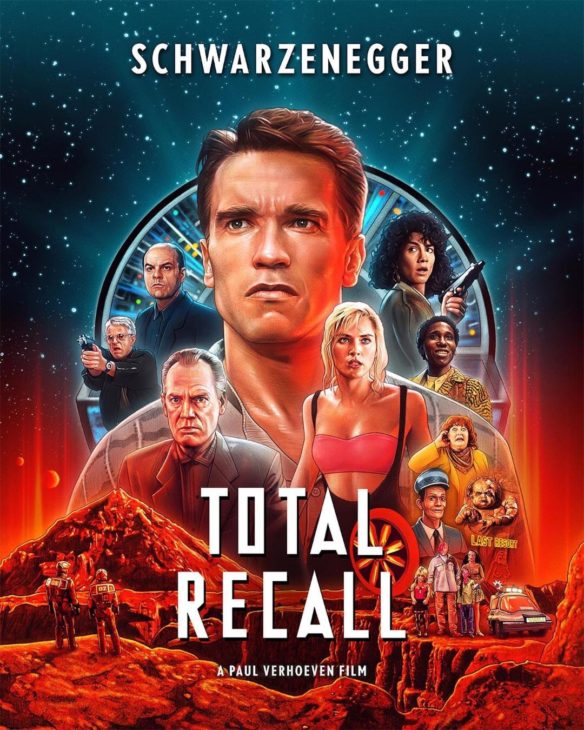
May 31, 1990Total Recall

By Paul Weimer: “Get your ass to Mars”.

Sure, I think as social satire The Running Man is probably better science fiction as a movie. But as a vehicle for 1980’s SF for Schwarzenegger that wasn’t Terminator, I think you can’t do better than one of my favorites, Total Recall.  The excitement of a movie “based on a story by Philip K. Dick” (which I subsequently read and was confused by how little it actually had to do with it.) 

But the movie is a corker from start to finish and so much of the movie is imprinted in my brain to this day. The movie’s insistence on keeping it very ambiguous, right to the end, if Quaid was dreaming or not , charmed me. I argued with my brother over this, who thought the “sweat drop” scene with Dr. Edgemar proved it was all real. I disagreed, and pointed out things like “Bluesky on Mars” being the name of his program, and how Melina resembled the woman programmed for his vacation. And if you listen to the commentary, Paul Verhoeven directed the movie with the point of view that it was all a dream, and Schwarzenegger acted with the point of view that it was reality. It makes for an interesting tension on screen and it works. 

There are lots of little details that happen in the background.  The change in geopolitical setup to a North-South Cold War. The Tokyo Samurai are trying to go for a fifth and deciding win in the World Series (so now the American Baseball leagues have teams in Japan…and the World Series is a best of nine affair). The movie is visually rich and generous like that, showing a lived in world that you can believe is real. Two worlds to be precise, both Earth and Mars. And the brutalist architecture pattern works for this authoritarian future. 

And of course the movie is hideously violent. The body count is high. 

The movie remains ever relevant with its critiques of colonialism, and authoritarianism. We are meant to side with the Free Mars movement, and maybe not until Cox’s Cohagen decides to kill everyone by asphyxiation does he really go from a tyrannical colonial figure who is vaguely understandable, to a true and undeniable monster that is irredeemable. But that steady revelation of just how horrible he can be starts with him looking sympathetic at first, and then unfurling his true nature and the extent of what he has done, and is willing to do.  It’s a dive into authoritarian and colonialist mindsets, and in this day and age, even more relevant than ever.

And the movie follows through on the implications of its technology with the character beats. When Richter is told that Quaid/Hauser won’t remember anything, he just has to punch him hard, because of all what he’s put Richter through at this point. It’s a character beat that makes sense given the tech.  And we have Chekov’s guns all over the place, which all fire, which propel us to the final confrontation. Sure, the “Ten second terraforming method of Mars” is bonkers and would not work. The movie doesn’t explain that there are more steps to the breathable atmosphere than melting the ice to get oxygen. I don’t care. 

I read the novelization, done by Piers Anthony, because “I wanted to know more”.  And I wish I hadn’t. I had not yet discovered how terrible Anthony was as a writer, but the novel’s insistence at each and every chance to say “yes this is real” over and over, was disappointing. Even at the end, when Quaid points out to Melina that she looks like the woman from Rekall, she casually says she used to do modeling for them. The book was determined to squash any ambiguity, and it was a major turn off. It did more solidly explain the terraforming, though and how it would work.

But the movie remains solid. Don’t bother with the remake. Watch the original.  Don’t let me down, buddy, I’m counting on you.
(9) COMICS SECTION.

(10) CLASSIC, NOT DUD. Two Ars Technica writers are “Reassessing 1986’s SpaceCamp”.

…The loss of Challenger in January 1986—carrying educator Christa McAuliffe, who would have been the first private citizen in space—put the kibosh on all of that. The shuttle, while fantastically advanced, would never be the vehicle to help humankind slip all of our surly bonds, so to speak. Even operating at its most frantic peak in 1985 just before Challenger’s loss, the shuttle hardware managed a maximum of nine flights in one calendar year; for most of the 1990s, it performed at five or six flights per year. Civilians in space—to say nothing of Big Bird—would have to wait.

And into that post-Challenger disillusioned summer of 1986, Hollywood brought us SpaceCamp. It had all the right ingredients: A stacked cast with a solid leading duo (Kate Capshaw and Tom Skerritt), tons of real NASA location footage, and a big, brassy score by none other than John Williams. The film was completed before the Challenger disaster, leaving 20th Century Fox with something of a nightmarish choice on their hands—to shelve the film and lose millions, or send it to theaters and risk a PR disaster.

For better or for worse, Fox chose to release the film, which ultimately made about $9.6 million on a reported $25 million budget. Ouch. Audiences, it seemed, weren’t really interested in watching a bunch of kids in peril on a space shuttle. Today, on the rare occasions SpaceCamp comes up in film discussions at all—usually among geeks of a certain age who encountered it when they were younger—it’s often spoken of with derision. Kids! Robots! Thermal curtain failures! Preposterous!

But is it really a bad movie? It’s not currently available for streaming, but this is exactly the kind of scenario that physical media is made for. And so, with the movie’s 40th anniversary looming, Senior Space Editor Eric Berger and I [Lee Hutchinson] grabbed the DVD and watched our way through it—and this is what we thought….

Here’s an excerpt from their dialog:

Eric: What is striking to me is that, despite the movie’s poor timing, it has had a long shelf life. It only came out four years after the actual Space Camp opened in Huntsville, and I’ve spoken with more than one space enthusiast who watched the movie and then signed up for a week in Alabama. In its own way I think the film helped to fuel interest in the space program at a time, the late 1980s and 1990s, when quite frankly there was just not that much exciting happening in human spaceflight. The movie also correctly anticipates NASA having a large space station in orbit, called Daedalus, nearly a decade and a half before one exists. Man, I’ve got to tell you I could not get over the station’s truss design. There was so much metal for no apparent purpose, other than serving the plot I suppose.

(11) SPEAK FOR YOURSELF, CHATBOT. Mark Roth-Whitworth asks “What do you know about AI/chatbots, *really*?” The post transcribes several statements by different chatbots about themselves and their nature.

(12) CASTING CALL. [Item by Steven French.] Ben Child offers an interesting sliding door speculation in the Guardian’s “Week in Geek”: “Nicolas Cage as the Green Goblin? It will always be one of Hollywood’s great might-have-beens”.

There are numerous sliding doors moments in Hollywood that, had they actually happened, would have fractured the space-time continuum like a DeLorean hitting potholes at 88mph. Tom Selleck as Indiana Jones, Eric Stoltz as Marty McFly, Sean Connery as Gandalf, Bill Murray as a distinctly sardonic Batman. And yet, if there has ever been a more deliciously unhinged alternate timeline than Nicolas Cage as the Green Goblin/Norman Osborn in Sam Raimi’s Spider-Man from 2002, it has probably already been confiscated by the time police for crimes against narrative stability….

(13) SUPER SENSES. [Item by SF Concatenation’s Jonathan Cowie.] In SF we have as tropes out of the ordinary senses, be it spidey-sense, telepathy, precognition, etc.  But in the real world there are unusual senses too, including how do birds navigate?

This is the topic for this week’s Science journal’s cover story…

How animals sense Earth’s magnetic field is one of biology’s enduring mysteries. Researchers have now identified superparamagnetic macrophages in the livers of rock pigeons (Columba livia) to be crucial for magnetic sensing. The finding uncovers an unexpected role for immune cells in sensory perception and may fundamentally change our understanding of animal navigation. See pages 919 and 985.

[Thanks to SF Concatenation’s Jonathan Cowie, Chris Barkley, Mark Roth-Whitworth, Joey Eschrich, Paul Weimer, Mike Allen, Kathy Sullivan, Steven French, Mike Kennedy, Andrew Porter, John King Tarpinian, and Cat Eldridge for some of these stories. Title credit belongs to File 770 contributing editor of the day Kevin Lighton.]

Barkley — So Glad You (Didn’t) Ask #106, A Column of Unsolicited Opinions

The Mandalorian and Grogu, A (Non-Spoilery) Film Review

By Chris M. Barkley:

The Mandalorian and Grogu (***, 132 minutes) with Pedro Pascal, Jeremy Allen White, Brenden Wayne (Pascal stunt double), Lateef Crowder (Pascal stunt double), Jonny Coyne, Sigourney Weaver and Martin Scorsese, Written by Jon Favreau, Dave Filoni and Noah Kloor, Directed by Jon Favreau. 

Bechdel Test: Passes.


Every year since 1977, the month of May has had a special place in my heart. It was then that I first saw Star Wars (or, Episode 4 as it’s been known since 1979) and its original sequels in 1980 and 1983.

And, on May 22nd of this year, for the first time since 2019, a Star Wars film has opened in theaters worldwide.

In the week since its release, has been quartered, sliced and diced by many film reviewers and critics, some of them praising composer Ludwig Göransson’s score, various and cleverly placed canon callbacks to other revered entries in the series and Martin Scorsese’s insanely memorable cameo. On the downside, others have complained about the plot and the pacing of the story, the visual effects, action sequences and, most notably, for not advancing or expanding the overall Star Wars universe.

Martin Scorsese as Hugo Durant, an Ardennian shopkeeper (and reluctantly paid informant)

As the film begins, the Mandalorian bounty hunter Din Djarin (Pedro Pascal, AKA Mando) and his adopted child, Din Grogu are in the employ of the New Republic, chasing down former Imperial officers who are terrorizing and economically extorting systems in the Outer Rim.

When one target, Janu Coin (Jonny Coin) escapes capture (in spectacular fashion) by the duo, their boss, Colonel Ward (Sigourney Weaver) of the Adelphi Rangers, gives them a related assignment. Information that could lead to Coin’s capture is being provided by the deceased gangster Jabba the Hutt’s twin children, who want the New Republic to rescue their older sibling, Rotta (voiced by Jeremy Allen White) in return.     

Mando reluctantly accepts the assignment (along with a replacement for his beloved Razor Crest) but when he and Grogu finally encounter Rotta on Shakari, he informs them that he has no interest in being rescued; he is quite happy being an adored gladiator for the crime syndicate running the crimelords’ arena games. 

Betrayed by Rotta, Mando and Grogu find that their troubles are just starting as they are caught in a deepening web of despotic enemies and vicious monsters who are out to put them out of business, permanently!   

I was nineteen years old when I first saw Star Wars. I was not exactly a child but I grew up in the 1960’s and had grown up reading middle grade science fiction and fantasy, watching Star Trek, The Outer Limits, foreign sff films, movie serials, Marvel, DC, Charlton and Dell comics.

Star Trek introduced me to the concept of faster than light travel but until the folks at Industrial Light and Magic showed the Millennium Falcon jumping into hyperspace for the first time on a widescreen with a Dolby Sound system turned up to eleven did I, and A LOT of fellow sff fans, actually fully FEEL it for the first time.

The Mandalorian and Grogu is feeling the critical wrath of a lot of older fans who feel as though the story is not meeting their expectations of epic storytelling, just as the prequel and sequel trilogies did. 

As someone who has seen nearly EVERY iteration of Star Wars over the decades, I tend to take a very long view on how I perceive and appreciate the series.

First of all, I take George Lucas at his word when he stated, emphatically, these films were mainly created for kids. 

Kids, not adults.

When I first saw the prequel and sequel trilogy films, I thought then that young children and those being born back then might have a different and more tempered, less subjective view on how they were experiencing them than adults were. And, from what I have observed anecdotally, this has been borne out.

My own preference was for a fourth season of the series, which Favreau reportedly had already written. But the braintrust at Lucasfilm decided that having The Mandalorian headline Star Wars returning to movie theaters was their best move, strategically speaking. And only time (and the box office grosses) will tell whether or not they made the right move or not.  

I firmly believe that kids from the ages of 5-10, who have seen The Mandalorian (including my two youngest grandchildren, 4 year old Bowie and five year old Navia) or The Clone Wars, Rebels for that matter, on Disney+ are going to LOVE this movie. 

Pascal and his stunt doubles, Brenden Wayne and Lateef Crowder, are a delight to watch, Grogu is as cute and resourceful as ever and Embo (a deep cut character from Clone Wars) is a fascinating bounty hunter for a new generation of fans to fixate on, as they did Boba Fett before him.     

Grogu and Anzellans

And tell me, who doesn’t want to see Sigorney Weaver in the cockpit of an X-Wing blowing stuff up?  

Kids don’t know or care about past canon, story structure, plot armor, or any other nickpicking the nattering adults are clutching their pearls about.

This film was made for them (despite the PG-13 rating, which was probably a marketing move).

Jon Favreau and LucasFilm President Dave Filoni have this figured out. And the adults in the room should just chill out and let the kids enjoy themselves.


All Photos copyrighted by Lucasfilm Limited and Walt Disney.

Pixel Scroll 3/22/26 I Don’t Think That Scroll Title Means What You Think It Does

(1) SPACE:1999.  In The Telegraph. Samira Ahmed, a BBC  newsreader and journalist (Front Row, News Watch, etc), remembers when “Space: 1999 was Britain’s answer to Star Trek – until it wasn’t”.

The show was a second attempt by Gerry Anderson and Sylvia Anderson, Thunderbirds husband-and-wife creators, to break away from Supermarionation puppetry into adult human drama, following the cancellation of their first live-action series, UFO, after just one season. With the high-gloss production values of its main backer, ITC Entertainment’s Lew Grade, who gave us The Prisoner and The Avengers, when it began shooting in 1973, Space: 1999 was the most expensive British TV show ever made.

Well, yes, actually.

It can be hard to explain to people who didn’t grow up watching Space: 1999 just what a seminal experience it was. Originally broadcast in the UK between 1975 and 1977, it had a captivating mixture of futuristic design, beautiful planetary skyscapes by future Oscar-winning special effects designer Brian Johnson, and existential, often philosophical, horror….

…Only two series were shot, and they differed wildly. Arguing about which is better is like debating whether the Sean Connery or Roger Moore Bond films are superior. We all know, really – but you’ve got to admit there was some great fun in The Spy Who Loved Me and Moonraker. So it is with Space: 1999 series two, which comes to Rewind TV this week. Although I showed up to Celebrity Mastermind in a borrowed season one costume (as awkwardly form-hugging as I’d feared) to prove my gravitas, as a child it was series two that fuelled my games, where we turned our fold-out sofa beds into little Eagle command module cockpits and climbed inside for adventure, and I took on the role of Maya – alien princess with exotic eyebrows and metamorphic powers.

Space: 1999 was a kind of follow-up to UFO (set in 1980), which featured humans on the moon manning an early-warning station for alien attack. For the new show, this was reimagined as a quasi-military and scientific research station, now called Moonbase Alpha. The opening episode saw the moon hurled out of Earth’s orbit by a nuclear explosion (memo to Elon Musk: storing nuclear waste up there is not a great idea), with the 300 or so Alphans sent hurtling uncontrollably across space, looking for a new planet to call home, but mostly encountering hostile aliens.

Made with the American market in mind, real-life Hollywood couple Martin Landau and Barbara Bain, fresh from Mission: Impossible, led the cast as Commander Koenig and Chief Medical Officer Dr Helena Russell. But despite strong storylines, exquisite production values, and an impressively diverse crew, series one wasn’t picked up by a major US network, causing panic at ITC Entertainment. It was widely felt to be too dark, although if we’re really honest, its leading couple lacked charisma….

(2) LAST WORD ON TYPOS. [Item by Lew Wolkoff.] Here’s the story of a typo gone wrong that I learned in an English Lit class in college that I thought you might appreciate..

 “Why is a raven like a writing desk,” one of the characters in Alice’s Adventures in Wonderland asks. Lewis Carroll wrote the scene with no intention of answering the question. In point of fact, he had no answer. Finally, after years of badgering by his fans, he produced this answer:

 “Because it can produce a few notes, tho they are very flat; and it is nevar put with the wrong end in front!”.

 The word “nevar” is “put with the wrong end in front.” Written backward, it in r-a-v-e-n. It’s a deliberate typo by Carroll. And it didn’t appear in print as planned because the proofreader caught and corrected it!.

(3) CHRIS BARKLEY MEDICAL UPDATE. Chris says, “Two days removed from cataract and glaucoma surgery… Here’s Today’s ‘PROOF OF LIFE’ Photo.”

Chris Barkley after surgery.

(4) ONE FELLOW’S BALLOT. If you’re interested in what’s on Rich Horton’s Hugo ballot, he’s happy to tell you: “The Good Stuff: 2025” at Strange at Ecbatan.

… I read a dozen or more SF/F novels this year, and I feel very good about my nomination list — noting that I read several more that I’d have been happy to nominate! In other categories I’m to a great extent nominating favorites. Even so, for short fiction Editor — how in the world have neither Jonathan Strahan nor Scott Andrews won a Hugo!! Seriously!…

(5) BOW WOW LAW. The New York Times reports “Vogue Is Suing a Dog Fashion Magazine. Guess What It’s Called.” (Behind a paywall.) And it sells only a hundred copies an issue. Guess what that sales figure reminds me of.

A recent cover of Dogue, a canine fashion magazine, featured an Italian greyhound wearing an evening gown, an opera glove on each paw. Several pages in, a nattily dressed labradoodle showed off a collection of trench coats.

Readers find this sort of thing charming. The media company Condé Nast does not.

In December, Condé Nast filed a lawsuit in federal court arguing that Dogue had infringed on its trademark for Vogue, the human-centric fashion magazine published since 1892.

Lawyers for the company wrote in their complaint that Dogue’s logo was “obviously intended” to confuse customers by suggesting a relationship between the magazines. The continued publication of Dogue was a blow to Vogue’s reputation, they added, and was “likely to damage Condé Nast irreparably.”

Now, the typically harmonious world of dog fashion is gearing up for a legal showdown that Olga Portnaya, the creator and editor in chief of Dogue, believes is about far more than who gets to photograph a vizsla in a turtleneck.

“Art and culture have always evolved through reinterpretation and dialogue,” Ms. Portnaya, a graphic designer and photographer who started Dogue in 2019, said in an interview. “For me, this is a larger fight: I’m not just fighting for my own work and our community, but for other independent creators.”

She said she was astonished that Condé Nast was so interested in confronting her magazine, a one-woman editorial operation that sells fewer than 100 copies per issue. The complaint demands that Ms. Portnaya pay Condé Nast unspecified damages and deliver all copies of Dogue to the company “for destruction.”…

… In a complaint filed in federal court, lawyers for Condé Nast claimed that Dogue’s logo was “obviously intended” to confuse customers by suggesting a relationship between the magazine and Vogue.

The magazine is offered free online and sold at a single newsstand in Beverly Hills, Calif. Each issue features a four-legged cover star beneath serif text that reads “Dogue,” placed roughly where the Vogue mark appears on Condé Nast’s magazine. Between spreads of canine couture, readers might encounter an interview with the actor Kevin Costner about his English Labrador, Bobby, who enjoys eating carrots. (Ms. Portnaya writes most of the magazine’s articles under the byline Oli Port.)…

(6) TODAY’S BIRTHDAY.

[Written by Paul Weimer.]

March 22, 1931William Shatner, 95.

By Paul Weimer: William Shatner. The face that launched a hundred soap operas. 

I find it interesting that like B5 would find out thirty years later, Star Trek’s first shot at a crew and a leading man, Jeffrey Hunter, wasn’t quite what a viewing public particularly wanted in a leading man of a space opera SF series. Poor Michael O’Hare and Jeffrey Hunter both weren’t quite right to be the full-on leading actors for such a series. 

But like Bruce Boxleitner three decades later, William Shatner proved to be.  I mean, sure, lots of Spock fans out there, McCoy fans, and other characters. And the whole “trio” of Kirk-Spock-McCoy has been documented to enormous detail. But it is William Shatner’s complex Captain Kirk, who was more cerebral and outwitting of his opponents than you remember, more nuanced, more interesting than the flanderized stereotype that has been parodied to the moon and back ever made him out to be. Sure, his diction and acting were, charitably melodramatic, but that is a feature, not a bug that got him through the series, and seven movies. 

Outside of genre space, he did shows like T J Hooker, and Rescue 911, and Boston Legal (although the fourth wall breaking Boston Legal might actually BE a genre show. I leave the comments to decide that). He’s done music (oddly, that doesn’t make him unique among the TOS crew). He was the voice of Priceline.com in its early days on the Internet. He co-wrote the TekWar novels. He breeds horses. (Wonder why he is horse riding in Star Trek Generations? Now you know.) 

You might think that “Nightmare at 30,000 Feet” would be my favorite non-Star-Trek genre performance Shatner has done. And you would be almost right. It is a classic in paranoia, perception, fear, and it does show that his acting style does have range, and ability and even with his unusual cadence, it can work in a situation like this. The episode itself is a masterpiece and Shatner’s performance is a big part of that.

But I like “Nick of Time” a bit more. It’s a more hopeful and positive story, as we see Shatner as part of a married couple who wind up briefly in thrall to a fortune telling machine that seems to tell the future — but really just makes people dependent on its easy, cryptic answers. The utter triumph of the episode as Shatner and his wife break free of their dependency is enough to make you cheer…until you see the coda, and see a couple who have not been so fortunate, or possessing as much fortitude as Shatner’s Don S. Carter and Patricia Breslin’s Pat Carter finally manage to show.

And Shatner has been to space.

Get a life? William Shatner, in and out of Star Trek, certainly has.

Shatner on horseback

(7) MEMORY LANE.

[Written by Cat Eldridge.]

March 22, 1995 – Sliders

Thirty-one years ago on FOX, the Sliders series first aired this evening. Created by Tracy Tormé and Robert K. Weiss, it would air on that network for three years before moving to Sci Fi for another two years. As a consequence of that it was first produced in Vancouver before being finally being so done in Los Angeles. 

Befitting a cross-time series,  it had an expansive cast led by the brothers of Jerry and Charlie  O’Connell along with Cleavant Derricks, Sabrina Lloyd, John Rhys-Davies, Kari Wuhrer, Robert Floyd and Tembi Locke with Derricks being the only cast member to stay with the series throughout its entire run.

There has also been gossip among Martin fans that this series was inspired by George R.R. Martin’s 1992 ABC pilot Doorways but everyone involved said that it was not.

So how was the reception at the time? Not good. The Los Angeles Time was typical when it said “Now comes ‘Sliders,’ a banal bore of a mishmash adventure series starring Jerry O’Connell as a genius grad student named Quinn Mallory, who discovers a way to visit parallel Earths by whooshing himself through a space portal known as a ‘wormhole.’ It beats studying.”  

(8) COMICS SECTION.

(9) DOCTOR WHO. [Item by Steven French.] A heart-warming piece on how David Tennant’s Dr Who helped the writer connect with her autistic son: “I was struggling to understand my autistic son – until we watched an episode of Doctor Who” in the Guardian.

The film Elf is a no-go in our house. My son interprets it as the psychological horror story of a man who is telling the truth but is constantly disbelieved. He loves The Traitors and rewatches entire series of it – knowing who the traitors are gives him an autonomy and comfort watching the game. Any other kind of conflict on screen and he’ll leave the room or wind it forward. I tried to explain that there are no stories without conflict. It made no difference.

My son is autistic and has ADHD – what’s sometimes referred to as AuDHD. We’ve always called him “fizzy”. He’s often the noisiest person in a room but hates too much noise. He’s incredibly sociable and wants so desperately to be part of the fun but finds the fun stressful. I had never seen anyone like him represented on screen.

And then I put on Doctor Who. It was a punt – my son was eight and he liked science. We went in at the David Tennant era – beginning with the episode The Christmas Invasion, where the Doctor doesn’t wake up till a third of the way through the episode. Suddenly there, standing in his pyjamas with a big boyish grin, was Tennant, describing a frightening alien with a weapon as a “big fella”. My son grinned back at the screen. When Tennant’s Doctor arrives properly, he barely stops talking or moving. He’s sword-fighting, then joking, then forgiving – and then he kills the baddy with a satsuma. All while repeating certain phrases to himself. My son laughed in recognition (he often repeats phrases to himself). He turned to me, eyes wide.

“He’s like me!” he said.

“You mean funny? Yes, you are very funny, luv.”

“No,” he insisted. “He’s fizzy. Like me.”…

(10) PROJECT HAIL MARY. [Item by SF Concatenation’s Jonathan Cowie.] Now, there are two reasons I read book reviews (well three, as I also HTML code some for SF² Concatenation).  First, I check book reviews out for titles I am considering reading. Secondly, once I have read a book, I like to see how others found it and whether or not I missed something.  With old, or even recent, best-selling SF novels, I suspect that most Filers will not check out book reviews for the first reason, but might well do for the second. And so we come to Andy Weir’s 2021 novel Project Hail Mary (my own old review at the link).  Arguably, this novel is now worth re-visiting given that the cinematic adaptation directed by Phil Lord and Christopher Miller, staring Ryan Gosling, is now just out on general release across the Cursed Earth, the former US Mega-Cities and over here in Brit Cit and Cal Hab, as well as EuroCit and elsewhere on planet Earth (but not the rest of the Galaxy)…

And so we come to England’s, Midlands-based Moid Moidelhoff who took down the archive of his Media Death Cult YouTube Channel a few years ago, but occasionally he re-visits some of these early episodes. Because the film is just out, he just re-posted from his archive from half a decade ago (how time flies) his own, reasonably spoiler-free, review of the novel.

(11) VIDEO OF THE DAY. [Item by Mike Kennedy.] The Internet is a, um, magical, um, well, not exactly a place per se. But it turns out, you can try to become magical for real using that, um, let’s just call it a place. Ryan George tells how “I Enrolled in Wizard School (Online)”.

I did not receive an owl. Not a snowy owl, not a budget owl, not even a morally questionable burrowing owl. So instead of attending wizard school the traditional way, I enrolled in an online course that promised to help me reclaim my magic. In this video, I take a real wizarding course on the internet, learn about alchemy, magical staffs, chakras, telepathy, and the importance of keeping your wand clean, and attempt to determine whether I am now legally considered a wizard. If you enjoy watching a grown man take online wizard classes very seriously, welcome.

[Thanks to Cat Eldridge, SF Concatenation’s Jonathan Cowie, Mark Roth-Whitworth, Lew Wolkoff, Jo Fletcher, Kathy Sullivan, Steven French, Mike Kennedy, Andrew Porter, and John King Tarpinian for some of these stories. Title credit belongs to File 770 contributing editor of the day Daniel Dern.]

Barkley — So Glad You (Didn’t) Ask #105, A Column of Unsolicited Opinions

A Celebration of Jacquelyn Montenaro (And the Three Poems I am Nominating on My 2026 Hugo Award Nomination Ballot) 

By Chris M. Barkley:

(WARNING: The following column contains themes and imagery of death and suicide.)

Since the beginning of the year I had been planning to write a lengthy column of what I have been up to since the arrival of my 2023 Hugo Award but unfortunately, life was insistent on getting in the way many, MANY times since then, of which I will elaborate on towards the finale.

In the meantime, I must tell you that this particular column was inspired by my filling out the Best Poem category on my 2026 Hugo Award Nomination Ballot.

I missed out on nominating on the inaugural launch of the Best Poetry category last year because I am not looped into the world of sff poetry, something I will try to get better at in the future.

But, in a fortuitous stroke of good luck, I was given a copy of Jacquelyn Montenaro’s “Death.exe Has Stopped Responding” when I attended the annual Starbase Indy Star Trek convention this past November. 

As I wrote in my convention report (link) last November:

And there’s plenty more of that in this slim but potent volume in which Ms. Montenaro seeks to keep the encroaching feeling of loneliness, depression, and suicidal thoughts from consuming the reader. I will also note that several of these works should be seriously considered for a Hugo Awards in the Best Poetry category because they’re THAT GOOD. 

And here we are. Since the deadline for nominations is coming up soon (March 28) and I am under some constraints on my time this coming week, I would be remiss if I did not call your attention to these three outstanding poems for your consideration.  [Reprinted with permission.]


SUMMONING

I chalk the circle,
Burn the herbs,
Cut the vein just enough
To mean it.

The air folds in on itself,
A mouth opening –
And there he is:
horns polished,
fangs dripping,
eyes like collapsed stars.

“Take me,” I say.
“I’ve been marinating in misery for years,
a feast already seasoned.
Devour me whole.”

He sniffs,
wrinkles his nose.
“Too bitter,” he mutters.
“Too much ash in your soul.”
Like I’m leftovers
Not worth reheating.

I beg, bargain
Offer scraps of my sanity,
the wreckage of my days.
But he only shrugs,
wipes his claws on my rug,
and vanishes.

The circle molders.
I sit in the smoke
not holy, 
not damned
just rejected.
Even Hell
doesn’t want me.

So I sigh,
bandage the cut,
and go to bed.
Alive again
but only out of necessity. 


THE STARS

She almost slips beneath the weight,
Sinking into the gravity of her own undoing.
But the night is merciless with beauty,
pours galaxies into her eyes,
reminds her how small she is,
And how precious that smallness might be.

Constellations lean down,
call her by name in languages older than fire.
Their voices are cold and luminous,
arriving late
light delayed by millenia
yet faithful enough to arrive at all. 

And she wonders:
if they traveled so far
endured silence, storms of dust,
the endless stretch of nothing
just to be seen,
just to pierce her window for a breath of a second
the least she could do
is lift her chin,
let them catch her daze.

The longer she looks, the more she feels tethered,
a thread of light tying her
to every burning sun,
to sailors lost at sea,
to children making wishes
on falling embers.

Her chest aches with gravity.
she could collapse,
become her own black hole,
but still
a stubborn ember inside her refuses.Because even the faintest star
is a kind of rebellion.

So she lingers,
not because life feels lighter,
but because the cosmos has conspired
to keep her here,
a fragile star herself
burning in defiance
of the void.


COSMIC HORROR

She thought the dark was empty,
A hollow wide enough
To cradle her bones.

She thought the end was gentle,
A door that swung quietly open,
A silence without teeth.

She leaned into the void,
But the void leaned back.
It’s eye opened
And she understood:
She was not free to go.


All poems Copyright 2025 by Jacquelyn Montenaro

Jacquelyn Montenaro

I would be the first to tell you that I have not critiqued anyone’s poetry before and I am not likely to do so again anytime in the near future.

What I can tell you is that as someone who does not read poetry on a regular basis, these three poems moved me to tears.

Because I, too, at several critical points in my life, have been on the brink of desperation and despair. I have stared into the abyss and was drawn back by the light of the many friendships and the loves I have treasured over the past seven decades of my life.  

Jacquelyn Montenaro has freely admitted that these death themed poems emerged from her own personal experience, which at times was quite dark and harrowing. This collection is a result of her walking a long road of healing and recovery. If her future endeavors are as brilliant as this collection, I think she has a very bright future ahead of her.

And, needless to say, if you need emotional support (or know someone who does), reach out to the National Suicide Prevention Lifeline Hotline by dialing 988 on your phone or online at: 988 Lifeline.

Jacquelyn Montenaro’s “Death.exe Has Stopped Responding” can be purchased via her website: https://linktr.ee/TinyAnarchyFairyDesign


And now for the other news: this coming Thursday, March 19th and on March 30th, I will be undergoing cataracts and glaucoma surgery on both eyes.

My surgeon, Dr. Peter Chen, has told me that they caught this before it developed into something more complicated and I should make a full recovery in a month or so.

Needless to say there will be service and supply chain delays regarding this column for the next several weeks. 

In the meantime, PLEASE fill out your Hugo Award Nomination ballots by the deadline and take care of yourselves. 

Because no matter how healthy you THINK you are, sooner or later your body’s Check Engine light will start blinking, especially when you least expect it…

++ All Photos by Chris M. Barkley

Cats Sleep on SFF: The Martian Trilogy

Chris Barkley submits —

For Everyone’s Consideration and just in time for Black History Month AND the opening of the 2026 Hugo Award Nomination Season, our cat, Nova, posing with The Martian Trilogy by John P. Moore. 

This volume, which chronicles the re-discovery and a critical analysis of the 1930 serialized newspaper novel, may well be the very first space opera written by an African-African author. 

I should also point out that the copy of The Martian Trilogy shown here is the ONLY one (so far) in this solar system that is signed by the author of the Introduction of this esteemed volume, namely, myself.


Photos of your felines (or whatever you’ve got!) resting on genre works are welcome. Send to mikeglyer (at) cs (dot) com

Never Mind the News – File 770’s Best Feature Articles of 2025

Was the year too heavy, deep, and real? Yes, but it was also rich in creativity, humor, and shared adventures. It’s a gift and privilege for me to be continually allowed to publish so many entertaining posts. Thanks to all of you who contributed!


COLUMNS

CHRIS BARKLEY

Chris Barkley with his 2023 Hugo. Photo by Juli Marr.

MICHAEL SWANWICK

Let’s celebrate The Universe Box‘s February 3rd release by Tachyon Press! I have opened the universe box that is my life, and will be sharing a piece of it every Monday.


FEATURES

STEVE VERTLIEB

Ray and Diana Harryhausen with Steve Vertlieb in 1990.

TERESA PESCHEL

Teresa with the owner of Vortex Books, Brian Keene

JAMES BACON

TAMMY COXEN

DARIN BRISKMAN AND BRUCE FARR

CORA BUHLERT

ERIN UNDERWOOD

INGVAR

OLAV ROKNE

DANIEL DERN

GARY WESTFAHL

LEE WEINSTEIN

ARENDSE LUND

CHRIS BARKLEY

Left to Right: Meredith Lyons, Shawntelle Madison, Andrea Hairston, Mary Robinette Kowal

CAT ELDRIDGE

  • What’s Your Favorite Tolkien? – “Yes, It’s the Birthday of J.R.R. Tolkien. So I asked a lot of folks that I knew what their favorite works by him were.”

ERSATZ CULTURE

ARTHUR LIU & FENG ZHANG

ROB THORNTON

DANN TODD

JOHN HERTZ

DENISE DUTTON

JUSTIN T. O’CONOR SLOANE

RICH LYNCH

On the road to the centerline

BRICK BARRIENTOS

BEN JASON

DAVE DOERING

PÁDRAIG Ó MÉALÓID

IAN RANDAL STROCK

MIKE GLYER


BOOK REVIEWS

PAUL WEIMER

WARNER HOLME

LIS CAREY

MICHAELE JORDAN

GARY WHITEHOUSE

JOHN HERTZ

DANIEL DERN

CAT ELDRIDGE

VALENTIN D. IVANOV

JENNIFER STEVENSON

JONATHAN COWIE

GREY WALKER


MOVIE AND TV REVIEWS

JONATHAN COWIE

GARY WHITEHOUSE

STEVE VERTLIEB

DANIEL DERN

N.

CHARON DUNN

MIRANDA BARRIENTOS

JAMES BACON


TOY REVIEWS

FOLKMANIS

FUNKO POP


CATS SLEEP ON SFF


OBITUARIES

[Date of publication]


Pixel Scroll 1/1/26 Sorry, Wrong Number Of The Beast

(1) TREK ACTORS BEAM DOWN FOR NEW YEAR’S PARADE. TrekMovie.com has detailed coverage of Paramount’s “Star Trek 60” themed Rose Parade float: “See George Takei And Rebecca Romijn Lead Star Trek Float For Rainy Rose Parade”.

The 60th anniversary year of Star Trek kicked off on a rainy New Years Day in Pasadena, California with the 2026 Rose Parade. Star Trek had a special “Star Trek 60” float full of references and celebrities. We have video of the parade and some behind the scenes too.

It was raining a bit for the 137th Rose Parade, but fans still braved the weather to see the annual tradition which for 2026 included a special float from the final frontier. To celebrate the 60th anniversary of the franchise, Paramount beamed in George Takei (Sulu from The Original Series), Rebecca Romijn (Una, Strange New Worlds), Tig Notaro (Jett Reno, Discovery and Starfleet Academy), and Karim Diané (Jay-Den Kraag, Starfleet Academy). The celebrities needed umbrellas, but were in good spirits as they toured the parade route on Thursday morning.

The theme of the elaborate float was “Space for everybody.” And the design was full of little Star Trek details, with the original U.S.S. Enterprise rising above an array of planets.

Other features included the iconic Vasquez Rocks feature in many episodes (and films), transporter pods, the USS Athena rising above San Francisco, from Starfleet Academy….

And Tom Galloway observed, “It seems the transporters were ‘working’, using a pair of identical twins to make it appear someone was teleporting from one to the other.”

The following video should jump directly to the 42-minute mark, which is when the Trek float rolls by.

(2) IMAGINING 2026. Nicholas Whyte charts what sff said this year holds in store:  “Life in 2026, according to science fiction: Mars, dystopia and devastation” at From the Heart of Europe.

2026 is surprisingly sparse for this project. There are small parts of two very well known novels set in this year; there is the framing narrative of a forgotten radio play; there is a very small part of a deservedly obscure film; there are two video games from the 1990s; there is also a very famous film based on a novel which is generally described as set in 2026; and there are three classic short stories by Ray Bradbury. You’ve probably read or seen several of these….

… Last but definitely not least, the three last stories of Ray Bradbury’s classic 1951 collection The Martian Chronicles are set in this coming year. “April 2026: The Long Years”, originally published in 1948, sees a rescue party finding a lost astronaut and his family, and realising that all is not as it seems. I’ll save the next story to the end, as it is set on Earth rather than Mars. But the final story, “October 2026: The Million Year Picnic”, originally published in 1946, is the one where one of the few surviving humans on Mars takes his wife and three sons to a canal to show them the Martians….

(3) THE HUGO VICTORY TOUR CONTINUES. [Item by Chris Barkley.] Chris Barkley’s 2023 Hugo Award for Best Fan Writer made an appearance at the annual New Year’s Brunch of the Cincinnati Fantasy Group at the residence of Becca Levin and Guy Allen earlier today.

Placed as a centerpiece of the massive food- fest, the Hugo Award was given all of the pomp and circumstance due to this prestigious and internationally known literary award.

The Nebula, Booker, Pulitzer and Nobel Prize awards had no comment at the press deadline…

Chris Barkley’s Hugo at CFG brunch. Photo by CFG member Joel Zakem.

(4) 2025 PARENT OF THE YEAR. Cora Buhlert has posted the companion piece to yesterday’s Darth Vader Parenthood Award for Outstandingly Horrible Fictional Parents – “The 2025 Jonathan and Martha Kent Fictional Parent of the Year Award”. Slight spoiler.

…Reed and Sue Richards would certainly have been worthy winners of the 2025 Jonathan and Martha Kent Fictional Parent of the Year Award. And indeed, they were the front runners for quite some time. However, we don’t actually see all that much Reed and Sue being parents rather than fighting Galactus. Besides, we also don’t want to confuse Grogu by giving the award to yet another father figure played by Pedro Pascal who just happens to look like Grogu’s Dad….

Learn the name of the winner at the link – and read the heartwarming acceptance speech, worthy of a Parent of the Year.

(5) SPACE COWBOY BOOKS IS TURNING 10. Space Cowboy Books has been in business for a decade. They’re throwing a party!

Space Cowboy Books 10 Year Anniversary Celebration

Friday January 23rd 4-6pm

61871 29 Palms Hwy. Joshua Tree, CA 92252

Come celebrate this milestone with Joshua Tree’s independent bookstore, featuring live music from The Kearns Family & Phog Masheeen, with snacks by Epicurean Fling, and 10% off store-wide. This event is free to attend.

Since opening our doors in January of 2016, Space Cowboy Books has published forty-nine books, musical audiobooks, and chapbooks, plus fifty fanzines, hosted hundreds of in-person and online events, produced ninety-four episodes of Simultaneous Times podcast, won a multitude of awards (Laureate, Bram Stoker, Elgin, +), launched Electronic Brain magazine, provided annual scholarships for Clarion West and Odyssey Writing Workshops, given away thousands of kid’s books, donated hundreds of books to prisons, and generally proliferated the love of literature and all things science fiction. Here’s to ten more years!

RSVP here at Eventbrite.com

For press inquiries and photo requests contact Jean-Paul L. Garnier [email protected]

(6) GUESSING WHAT THE PARTIES WILL RECEIVE FROM THE ANTHROPIC SETTLEMENT. The Authors Alliance has shared their “Back-of-the-Envelope Math on What Payouts We May See in the Bartz v. Anthropic Settlement”.

…The following reviews some recent developments on the settlement funds, claims, and potential payouts (sprinkled with, frankly, a little bit of speculation). 

How much will the lawyers make? 

On December 3, the class counsel filed a formal request with the court, accompanied by numerous supporting documents, for their share of the settlement. The total request amounts to $318,999,422, or about 21.26% of the total $1.5 billion settlement. The request breaks down as follows: 

  • $300 million in attorneys’ fees 
  • $1,969,421.75 in litigation costs (expert witnesses, travel, legal research costs, etc.)
  • $17,030,000.00 in future litigation contingency funds held aside for use as they are incurred 

The request also formalized a request for a fee to the three named authors who served as class plaintiffs, at $50,000 each ($150,000 total). 

$1.5 billion is a large pot of money from which to draw attorneys’ fees, and as Judge Alsup has expressed through the settlement process, there is some concern that the settlement could attract “hangers on” with so much money at stake. It remains to be seen if the court will approve this request. 

The $64,935/hr question? 

Earlier this week Anthropic objected to the proposal, pointing out that the split of attorneys’ fees ($300 million) contemplated $225 million going to class counsel, while the remaining $75 million would be split among three other non-class counsel that have purported to act as “publishers coordination counsel” and “authors coordination counsel” (it remains unclear to me why authors needed separate coordinating counsel since the lead plaintiffs are authors themselves and class counsel already has this responsibility). As Anthropic points out, these firms seemingly contributed little to resolving the litigation – one firm, for example, billed only 231 hours and is requesting a $15 million dollar payout ($64,935 an hour! Good work if you can get it)….

How much to rightsholders? 

Assuming the attorneys’ fees will come out to something close to the request above, that would leave about $1.18 billion to be allocated among class members. Given how the settlement is structured, this would largely be money split between authors (the original class as identified in the original complaint) and publishers and other rightsholders. Assuming further that the payout would be divided equally among all 482,460 works in the suit (an assumption that may be faulty, as explained below), $1.18 billion divided by the 482,460 works yields a payout of approximately $2,445.80 per work…

How much to publishers? 

One of the most dramatic turns in this litigation was when the class was dramatically broadened by the court by certifying a class that includes not just authors but all rightsholders that own a reproduction right in the works on the works list. This has meant that the suit is now one that includes both authors and publishers. So how much of the settlement is likely to be paid to publishers?…  

…That said, for at least the larger publishers I think we can at least get a rough sense of the scale of expected claims that some of the larger publishers might make, as well as some idea of what that might mean in terms of payouts to them from the settlement.  

To determine a potential payout figure, I multiply $1,223 per book by the number of works associated with each publisher searched (recall that for non-education works, the settlement sets a 50/50 default split between publisher and author, so this assumes half the $2,445.80 payout per book….

Conclusion

We still don’t know quite a bit about how the money will flow in this settlement, but a few things are becoming clearer. First, the lawyers stand to do very well—potentially earning around $6,500 per hour if the court approves something close to their requested $300 million in fees. Second, major publishers are likely to claim tens of millions of dollars from the settlement, with some of the largest potentially receiving payouts in the $20-30 million range. Third, and most importantly for the authors who this suit was ostensibly designed to benefit, individual author payouts could vary wildly depending on participation rates—from over $20,000 per work if claim rates stay low, down to around $1,200-$2,400 per work if participation approaches the full class….

(7) AI MAGIC! Draft One and Code Four write police reports based on bodycam footage.” The Park Record tells how that’s going in “Heber City Police Department test-pilots AI software”.

Heber City Police Chief Parker Sever appeared before the City Council in late October and informed them an officer had shape-shifted into a frog.

At least, that’s what he heard from his son-in-law, who works for the West Jordan Police Department. That department had recently implemented artificial intelligence software that generates police reports using body camera footage. The details aren’t always 100% accurate — which is why officers review them.

“I read the report, and I’m like, ‘Man, this really looks like an officer wrote it,’” Sever recalled. “But when it got to one part, it said, ‘And then the officer turned into a frog, and a magic book appeared and began granting wishes.’ … It was because they had, like, ‘Harry Potter’ on in the background. So it picked up the noise from the TV and added it to the report.”…

Appropos of nothing, West Jordan is where Larry Correia used to live.

(8) WHEN YOUR PHONE CROSSES THE U.S. BORDER. The New York Times reports “Phone Searches at the Border Are Up. How to Protect Your Privacy.” (Article is behind a paywall.) “Customs agents have broad authority to search the electronic devices of travelers entering and leaving the U.S.”

When U.S. border agents turned away a French scientist in March after searching his phone, the French authorities cried foul, blaming messages commenting on President Trump’s policies for the decision. U.S. officials denied that politics had played a role, but the incident left some travelers with an urgent question: Are such searches even legal?

The short answer is yes. U.S. Customs and Border Protection agents have broad authority to look through travelers’ phones, laptops and other electronic devices under an exception to the Fourth Amendment’s protections against warrantless searches.

C.B.P. conducted 55,318 searches of electronic devices at ports of entry in fiscal year 2025, according to the agency. That’s up from the previous two years, though the number represents only about 0.01 percent of the nearly 420 million travelers who entered or exited the country by air, land and sea in fiscal year 2025, according to the agency.

“These searches are conducted to detect digital contraband, terrorism-related content and information relevant to visitor admissibility, all of which play a critical role in national security,” Jessica Turner, a C.B.P. spokeswoman, said in a statement.

That may be true, but an increasing number of travelers report being questioned about legally protected online speech when crossing the border….

… Do I Have to Unlock My Device?

Agents can demand access to any traveler’s electronics at a port of entry for any reason. If you’re a U.S. citizen or a lawful permanent resident, such as a green card holder, they’re required to let you enter the country even if you refuse to unlock your device. But agents can still seize your device and hold on to it for five days, or longer at a supervisor’s discretion, said Kabbas Azhar, an Equal Justice Works fellow at the Electronic Privacy Information Center, a nonprofit research and advocacy group.

Deciding whether to unlock your device is “a very personal” choice that may depend on what information you’re carrying, said Nate Wessler, the deputy director of the Speech, Privacy and Technology Project at the American Civil Liberties Union. If you’re a doctor whose phone holds private information about patients, for example, or a journalist with confidential sources, you may be less willing to enter your passcode for a C.B.P. officer.

“People have to weigh the practical implications,” Mr. Wessler said. “Would they rather try to protect their privacy but lose use of their phone for potentially weeks or months, or end up giving the password and making it easier for the government to search?”

During a basic search, an officer looks through the device by hand. But in rare cases, agents can perform an advanced, or forensic, search, during which they copy a device’s contents onto a government computer for further analysis. A forensic search may even be able to unearth some files that a device’s owner had deleted, Mr. Wessler said….

… C.B.P.’s authority to search devices applies to travelers both entering and exiting the United States. But an overwhelming majority of searches happen when travelers are arriving in the country, said Jake Laperruque, the deputy director of the Security and Surveillance Project at the Center for Democracy and Technology, a nonprofit that supports digital free expression.

Officers looking through a device will often check for evidence that could point to criminal activity, including images or messages related to narcotics or child pornography, Mr. Laperruque said. But they could also find content that raises questions about legal activities, such as attending a political protest, or those that fall in a gray area, such as communicating with doctors who provide services that are banned in certain states…..

(9) CASHING IN. [Item by Steven French.] Lanre Bakare in the Guardian considers the worldwide rise of anime: “Demon Slayer economics: how the anime juggernaut became a saviour”.

An animated drama featuring hordes of carnivorous fiends might not sound like classic box office fodder, but that’s exactly what Demon Slayer: Kimetsu no Yaiba Infinity Castle proved to be in September.

The film set new records for anime – Japanese animated films and series – making more than $70m (£52m) on its opening weekend in the US and £535m so far globally. To put that in context, Ghost in the Shell – an anime classic released in 1995– made about £2m worldwide.

In that 30-year period, anime has gone from an underground phenomenon to a saviour during one of the worst autumn box office slumps in recent memory. So how did we get here?….

(10) MEMORY LANE.

[Written by Cat Eldridge.]

Brave New World series (1980)

In March 1980, a Brave New World series premiered on NBC. (It would show on BBC as well.) It consisted of two ninety-minute parts shown over two nights, with commercials of course. 

Brave New World (1980) home video box art.

It was adapted from Aldous Huxley’s novel by Robert E. Thompson and Doran William Cannon, and was directed by Burt Brinckerhoff.  The network was greatly appalled at its length, being four hours long, so it was cut down to three hours before being televised. I don’t know if there’s a director’s cut in existence here in the States, but the BBC edition is four hours long. 

It starred Kristoffer Tabori, Julie Cobb and Budd Cort. I did see it and I will agree with the reviewer that said “This mini-series adaptation of Aldous Huxley’s Brave New World is faithful to the source material and offers a chilling look at the dystopia he created.”  

It would be adapted three more times since, one with Leonard Nimoy as one of the actors, that being the 1998 version. The latest version is the extended one of Sky’s nine-part series which had lots of female nudity. That apparently is a side-effect of Soma — it makes you want strip your clothes off. 

It has a forty-six percent rating among audience reviewers at Rotten Tomatoes.  Not great, not bad. 

It is not legally up on YouTube, so please don’t link to it. We will just need to remove your comment. (BBC did allow it to be posted but has rescinded that now.) 

(11) COMICS SECTION.

Happy New Year, everyone!This is a @theguardian.com books cartoon from a few years ago.

Tom Gauld (@tomgauld.bsky.social) 2026-01-01T10:53:12.985Z

(12) DECORATING, DINING, AND DRIVING. Cora Buhlert caught readers up on how she spent “Christmas 2025”. And along the way manages to work in a remarkable amount of German culture and history. Like things I never knew about Friedrich II of Prussia and potatoes.

…I wound up visiting a whopping four different Christmas markets (Bremen, Oldenburg, Vechta and Emden) during the advent season. They were all lovely in their own way and Vechta’s Christmas market has drown a lot since I last visited it back in 2013, when it was literally just three stalls, a carousel and a beautiful nativity scene. Nowdays, Vechta’s Christmas market has two carousels, a lot more market stalls and even an ice skating rink. They also still have the biggest and prettiest nativity in the entire region….

(13) THIS MONTH’S SCREEN SCARES. [Item by Chris Barkley.] Variety points out “Horror Movies to Watch: January 2026 Has ‘Primate,’ Sam Raimi & More”. Because nothing says Happy New Year like SCARING all of that happiness and good cheer out of you…

“Primate” (In theaters Jan. 9 via Paramount Pictures) — This lean and nasty-looking thriller concerns a family whose normally loving and docile pet chimpanzee becomes out of control when he’s bitten and gets rabies while dad is out of town. Johannes Roberts’ film doesn’t take itself too seriously, and the titular antagonist is a performance from an actor versus CGI, which gives it some serious gravitas for a killer animal flick….

(14) VIDEO OF THE DAY. “CBS Network – 60 Minutes – ‘Backstage at The Muppets’ (1979)”.

Here’s a remarkable behind-the-scenes look at Jim Henson’s Muppet empire, and more particularly the making of The Muppet Show – in this segment from the long-running 60 Minutes news magazine as aired over the CBS Network, reported by Morley Safer (and produced by John Tiffin). This piece originally aired on Sunday, March 11th 1979 – and I believe the video presented here is the original airing. There were also two encore showings: Sunday, June 10th 1979 & Sunday, August 24th 1980. Lastly, it was run one more time on Sunday, May 27th 1990, in a memorial tribute to Jim Henson after his untimely passing.

[Thanks to Mark Roth-Whitworth, Kathy Sullivan, Steven French, Joel Zakem, Nicholas Whyte, Cora Buhlert, Andrew (not Werdna), Mike Kennedy, Andrew Porter, John King Tarpinian, Cat Eldridge, and SF Concatenation’s Jonathan Cowie for some of these stories. Title credit belongs to File 770 contributing editor of the day Daniel Dern.]

Pixel Scroll 12/21/25 Pixel’s Guide To The Scroll

(1) THREE BRITISH SHOPPING DAYS ‘TIL CHRISTMAS. [Item by SF Concatenation’s Jonathan Cowie.] There are still three shopping days till Christmas!  So, if you are stuck for a last-minute present for a friend, or even life partner of the moment, then why not check out the current books on the British SF scene. SF² Concatenation’s current seasonal news page has forthcoming science fiction, forthcoming fantasy, and forthcoming Non-Fiction SF & Popular Science Books from a number of British Isles publishing houses, but these are also available in major genre bookshops near you.

Currently, the site’s home page sports an historic picture of some of the team’s staff having a Christmas dinner. Yes, ghosts of Christmas past.

The site’s own latest post is a rather nifty, if we say so ourselves, short story about the end of the world – ‘Customer reviews for Mystery Gadget 1.0, sorted in chronological order‘ from Alex Shvartsman. (This is the second story Alex has had in SF² Concatenation’s run of the Best of the science journal Nature’s ‘Futures’ short stories. SF² Concatenation’s gets to select just four stories a year from the 60 or so published on the Nature journal website.)  Purely coincidently, this one may well appeal to fans of a certain, recent SF series that seems to have taken the streaming charts by storm.

An end-of-the-world story should give you some additional Christmas cheer to help you through the festive season….  Ho, ho, ho.

Next year it is back to form. The site plans to post early in January the team’s annual ‘Best Science Fiction books and films.  This is just a bit of fun and in no way should be considered a slate for anything. However, past choices do seem to indicate that it has some sort of form (scroll down here).

Turkey and mince pies to the fore. Let’s tread boldly…

(2) WRITER’S EMERGENCY HOME REPAIR GOFUNDME. This is from Alma Alexander, a fantasy writer living in Bellingham, WA, who is a friend of the Vanguard group in Seattle (Suzle and Jerry Kauman, John Berry and Eileen Gunn, Astrid Bear, Ulrika & Hal O’Brien, etc,). In a later email, she says she has two quotes for the repair work, $25,000 and $28,000. She’ll be grateful for any help.  “Fundraiser by Alma Alexander: emergency repair to keep home safe for me and 2 beloved cats” at GoFundMe.

My house sits on a steep slope, with a retaining wall serving to support a flat surface upon which my house is built. The wall is failing. It needs an emergency repair/replacement to keep my house, myself, and two beloved cats safe. Please help…

Repair quote (with necessary stabilizing work for the deck which rests on the area just above the retaining wall) is MORE than $25000 – but I can scrape together the rest if I can get at least some assistance… insurance has told me that I was covered for lots of things “but not for this” (ain’t that always the case…) and I need to get this work done and I simply don’t have that kind of money lying around. I hate to ask this – but as a writer (whose income can be iffy and random), and as a widow who lives on very limited fixed income I and these two beloved blameless cats whose only mistake in this life might have been to cast their lot in with mine desperately need your help…

(3) AND HUGO MAKES THREE. [Item and photo by Jason Sanford.] Chris M. Barkley has been spotted out and about in Cincinnati, exposing his much-delayed Hugo Award for Best Fan Writer to life in the big city and trying to make up for lost time together. Chris is pictured with his partner Juli Marr.

(4) SIGOURNEY WEAVER INTERVIEW. “Sci-fi classic Galaxy Quest had Alan Rickman scenes cut ‘at the last minute’ before release” at Digital Spy. The article is based on a Vanity Fair interview video – Sigourney Weaver’s Galaxy Quest comments start just before the 18-minute mark.

Sigourney Weaver has called for the release of a director’s cut of the 1999 science-fiction comedy classic Galaxy Quest, after revealing that a lot of scenes were cut very shortly before its release.

The film features an ensemble cast including Weaver, Alan Rickman, Tony Shalhoub and Tim Allen, playing actors of a once-popular cult TV series, who are abducted by aliens that believe their outer-space adventures are real….

…”I wish they would put out a director’s cut of the movie because at the last minute Dreamworks decided to release the movie with some of the more sophisticated scenes cut that Alan was in, because it needed a kids’ movie to go up against Stuart Little,” she said.

Weaver also said that she couldn’t understand “why they don’t put out the movie again with more of his very very good strange and wonderful scenes”.

(5) HIT WITH AN ‘R’ IN IT. The Guardian analyzes “How Sinners became the most culturally important film of 2025”.

It was the film that was supposed to destroy Hollywood: a vampire horror about life and times in the Jim Crow south peopled by a majority Black cast, and shot on Imax 70mm. Ryan Coogler, the acclaimed director who rose to prominence steering Marvel’s colossal Black Panther franchise, was thought to be out of his depth for trying to midwife a script he himself said he cobbled together in two months. Warner Bros, the studio fronting the film’s near $100m budget, was supposedly out of its mind for not only throwing that much money behind the project, but further agreeing to singularly favorable authorship deal terms that gave him control over the film’ final cut and full rights over the film after 25 years. Hollywood machers were convinced the film would never make money and that Warner Bros’ big gamble “could be the end of the studio system”. But Sinners never let that cynicism in.

Sinners landed in theaters on Easter weekend and delivered its own miracle resurrection, racing to a $368m gate on the way to becoming the highest grossing original film in the past 15 years, and the 10th-highest domestic-grossing R-rated film of all time. (That’s right: higher than Terminator 2 and the Hangovers.)…

(6) NOTHING OF VALUE WAS LOST. “Lucasfilm wins bid to throw out UK lawsuit over ‘resurrection’ of ‘Star Wars’ character” at GMA News Online.

Disney unit Lucasfilm on Thursday won its bid to throw out a London lawsuit over the use of the likeness of a long-dead actor in a Star Wars spinoff movie.

Peter Cushing, who died in 1994, was “resurrected” as Death Star commander Grand Moff Tarkin for the 2016 film “Rogue One: A Star Wars Story” using visual effects and another actor.

He had appeared in the original 1977 “Star Wars” film, created by George Lucas, which became one of the most successful film franchises of all time.

The movies have collected more than $5 billion in global ticket sales since the release of the first installment in 1977, and spinoffs are still being produced.

Cushing had signed a deal with British company Tyburn Film Productions in 1993 to appear in a television film, an agreement Tyburn’s lawyers said gave it “the right to be the first to ‘resurrect’ Mr Cushing by way of visual effects”.

Tyburn claimed it had lost around 250,000 pounds ($333,725) and sued Lucasfilm and fellow Disney subsidiary Lunak Heavy Industries at London’s High Court for alleged unjust enrichment at its expense.

Lucasfilm and Lunak, however, said the case was hopeless and unsuccessfully tried to have the case thrown out twice. But the Court of Appeal ruled in their favor on Thursday.

Judge Sue Carr said that “it is impossible to identify anything at all that belonged to Tyburn which can be said to have been transferred” to Lucasfilm or Lunak, meaning the case could not continue…

(7) AN ADAPTATION KING LIKED. “Stephen King: Why I Hugged Rob Reiner After Watching ‘Stand by Me’” in the New York Times. (Behind a paywall.)

…I think I saw “Stand by Me” in the fall of 1985. Back then it was still called “The Body,” which was the name of my novella, on which Rob’s film was based. I think he showed it to me in a room at the Beverly Hills Hotel with a rock ’n’ roll band thudding away somewhere in the distance. That band was pure ’80s. The movie allowed me entry to another, more innocent, time: 1959.

I’m pretty sure Rob was wearing a checked short-sleeved shirt and khaki pants, as if he’d just come from the golf course. (For all I knew, he had.) The only thing I’m absolutely sure of is that he hovered until the movie was going and then left the room. Later he told me he couldn’t bear to see my reaction if I didn’t like it. I was an audience of one, sitting in a high-backed chair filched from one of the hotel’s meeting rooms.

I was surprised by how deeply affected I was by its 89 minutes. I’ve written a lot of fiction, but “The Body” remains the only nakedly autobiographical story I’ve ever done. Those kids were my friends. We never walked down a railroad track to see a dead body, but we got up to other stuff. The story was about my reality as I had lived it on the dirt roads of southern Maine. There really was a junkyard dog, although his name wasn’t Chopper. There really was a kid who went swimming and came out covered with leeches in surprising areas, but it wasn’t Gordie Lachance; it was me.

And there really was a kid who was accused of stealing milk money, although his name wasn’t Chris Chambers. He did borrow — we won’t call it stealing — his mom’s Bel Air. With me riding shotgun, he drove it 90 miles per hour down Route 9 in our backcountry hometown. We were 11.

What I’m saying is that in Rob’s hands, it all rang true. The funny parts were really funny (including the barf-o-rama) and the dramatic parts hit me where I lived, or where I did live back in the days when John F. Kennedy was president and gas was a quarter a gallon.

I had felt just that torn between the writing life and the lives of my friends, who were living for the moment and not going anywhere in particular, except maybe Vietnam. I chose writing, but it was a near thing.

When the movie was over, I thanked Rob and surprised the hell out of myself by giving him a hug. I’m not ordinarily a hugging man, and I don’t think he was used to getting them. He stiffened, muttered something about being glad I liked it, and we both stepped away….

(8) HEADED MY WAY. “’Frankenstein’ Netflix Exhibit Moves To Los Angeles”Deadline tells where to find it.

In another move showing the growing awards momentum of Guillermo del Toro‘s acclaimed movie Frankensteinthe stunning exhibition “Frankenstein: Crafting a Tale Eternal” will be coming from its run in London straight to Los Angeles from January 5-11 at the NYA Studios West in Hollywood, and just in time for Oscar nomination voting….

… David Fincher, George Lucas and Mellody Hobson are scheduled to host and moderate a screening with the filmmaking team on opening night of the L.A. exhibit, with additional programming to come.

The immersive exhibition will celebrate del Toro’s visionary storytelling and the craftsmanship of the Frankenstein team. Diving into his elaborate filmmaking process, it will showcase a collection of props, artwork, costumes and Tiffany & Co. jewelry featured in the film and rare books curated by the firm Peter Harrington to honor author Mary Shelley’s legacy….

(9) IS THAT EIGHT REINDEER OR EIGHT TENTACLES? A holiday greeting from the Edmonton in 2030 Worldcon bid.

A slightly better less-error-filled holiday poem for your reading pleasure.

???????????? (Edmonton) In 2030 (@edmontonin2030.bsky.social) 2025-12-22T00:34:06.998Z

(10) IT’S NOT WHAT YOU THINK. We fell for this clickbait so you don’t have to: “Doctor Who locks in date for Alex Kingston’s River Song comeback (winteriscoming.net) at Winter Is Coming.

Alex Kingston’s River Song is officially coming back to Doctor Who in 2026. The franchise icon has penned a book called Doctor Who: Stormcage: A River Song Adventure. Kingston has written the story as a choose-your-own-adventure, giving the reader a chance to read the book more than once and experience it differently. The hardcover edition is set to hit shelves on February 12, 2026. It’ll also be available as an ebook from the same date….

(11) MEMORY LANE.

[Written by Cat Eldridge.]

December 21A Solstice Story

We all tell stories and Jennifer Stevenson tells a great one in “Solstice” which Grey Walker reviews for us: “The reader somehow senses that everything Dawn sees, each action she takes, even her name, has a deeper significance. She’s not just playing for a great party, she’s playing to keep a shrinking, fading man alive on the longest night. And if it’s an over-the-top, splendid bash that keeps the sun alive for another year, well, human beings believed that for a very long time. Maybe this story will help us remember some of what we’ve forgotten.”

You can hear the author splendidly reading “Solstice” here. You can read the story thisaway.  If you can find a copy, it was originally published in Ellen Kushner, Delia Sherman and Donald G. Keller’s The Horns of Elfland.

(12) COMICS SECTION.

“The last-minute christmas rush at the bookshop.” – my latest cartoon for @theguardian.com books

Tom Gauld (@tomgauld.bsky.social) 2025-12-21T16:02:43.885Z

(13) STRANGER THINGS ON STAGE. “Jamie Campbell Bower talks ‘Stranger Things’ Broadway debut, season 5 (exclusive)” at Entertainment Weekly.

“Something very, very special has happened here tonight,” Louis McCartney, who stars as Henry Creel in Broadway’s Stranger Things: The First Shadow, told the audience after his performance Friday night at New York City’s Marquis Theater.

That was because Jamie Campbell Bower, who portrays Henry/Vecna/One on the Netflix streaming hit, surprised the packed house by reprising his TV role in the play’s final scene.

The stage prequel chronicles Henry’s younger years before he became Vecna, but its ending jumps forward in time. On most nights, McCartney plays the character all the way through to that sequence. So when it was Bower who slowly turned toward the audience instead, the crowd erupted in raucous, continuous applause…

(14) RARE DISCOVERY. “Unseen Tennessee Williams radio play published in literary magazine” – the Guardian has details.

As one of the 20th century’s most successful playwrights, Tennessee Williams penned popular works at the very pinnacle of US theater, including A Streetcar Named Desire and Cat on a Hot Tin Roof.

Years before his almost unparalleled Broadway triumphs, however, the aspiring writer then known simply as Tom wrote a series of short radio plays as he struggled to find a breakthrough. One is The Strangers, a supernatural tale offering glimpses into the accomplished wordsmith that Williams would become, and published for the first time this week in the literary magazine Strand.

It is a “significant find” according to scholars of Williams’s early days and upbringing in Missouri.

“The play incorporates all the theatrical elements of early radio horror,” said Andrew Gulli, the publication’s managing editor.

“A storm, howling wind, shadows, a house perched over the sea, flickering candles, mysterious footsteps on the stairs, spectral beings … as well as early hints of the themes and devices Williams would return to in his most famous later works: isolation, fear, the shades of gray between imagination and reality, and a house haunted by memory and the private terrors of those who inhabit it.”

The Strangers never made it to Broadway, and is believed to have enjoyed only a single performance on a rural radio station in Iowa as part of a short-lived series called Little Theater of the Air in 1938….

(15) SPACE CITRUS. “NASA Webb Telescope Discovers Lemon-Shaped Planet, the ‘Stretchiest’ Ever Seen” reports the New York Times. (Link bypasses the paywall.) As a bonus, the article quotes Mythopoeic Society member Emily Rauscher.

Earth isn’t a perfect sphere. The rotation of our planet causes it to bulge ever so slightly at the equator, making it about 0.3 percent wider there than from pole to pole.

But that’s nothing compared with PSR J2322-2650b, an object the mass of Jupiter studied recently by the James Webb Space Telescope. This planet’s equatorial diameter is about 38 percent wider than its polar diameter, giving the world the odd appearance of a lemon, and a very strange atmosphere.

“It’s the stretchiest planet that we’ve confirmed the stretchiness of,” said Michael Zhang, an exoplanet scientist at the University of Chicago and the lead author of a paper describing the planet published Tuesday in The Astrophysical Journal Letters….

… Its carbon atmosphere might give it “clouds made out of graphite,” Dr. Zhang said, and diamonds at its core. Bands of storms would trace the world’s lemon-like exterior in the shape of a W, while it most likely has a red color because of dust and soot-like particles formed by the carbon.

“It’s a wacky, weird thing,” said Emily Rauscher, a theoretical astrophysicist at the University of Michigan, who was not involved in the paper. “It’s not formed in a way like any normal planet.”…

[Thanks to Chris Barkley, Cat Eldridge, SF Concatenation’s Jonathan Cowie, Olav Rokne, Jerry Kaufman, Jason Sanford, Mark Roth-Whitworth, Kathy Sullivan, Steven French, Mike Kennedy, Andrew Porter, and John King Tarpinian for some of these stories. Title credit belongs to File 770 contributing editor of the day Cat Eldridge.]

The Panda Has Landed — Barkley’s 2023 Hugo Finally Arrives

Chris Barkley with his 2023 Hugo. Photo by Juli Marr.

Chris Barkley’s 2023 Hugo Award trophy was delivered today by UPS. Chris says the Hugo trophy is in “Pristine!” condition.

Thus ends Barkley’s two-year wait to get the Best Fanwriter trophy (or else a replacement) he won at the Chengdu Worldcon in 2023, which the committee promised to ship to the him in the US.

The awards were sent to Hugo Administrator Dave McCarty. However, as McCarty told Barkley in February 2024, all of the display cases and some of the awards were damaged in transit from China, including Barkley’s. McCarty told him he could either have the award the next day, or McCarty could have it repaired and restored. Barkley decided to go with the repairs. When he still hadn’t received it a year later, he filed suit in Cook County (IL) Small Claims Court against Dave McCarty for $3,000 over the non-delivery of the award. After several hearings earlier this year, the court said it was going to schedule a trial.

Coincidentally, around then the Development Center for Chengdu Worldcon, Inc. (DCFCW), the U.S. nonprofit corporation created to handle the Chengdu Worldcon’s western financial affairs, whose officers include president Colette Fozard, Chengdu Worldcon committee co-chair Ben Yalow and vice-chair Wang (Tina) Yating, announced on October 26 they were terminating Dave McCarty as Hugo Administrator and taking over his responsibility to make the long-overdue deliveries of replacement Hugo Awards trophies to the unknown number of overseas winners who accepted the Worldcon’s offer to have them shipped home. But in fact, a week later they yielded to McCarty’s request for more time to send out the awards. They gave him until November 1. Nothing happened, and again DCFCW said they had taken over the job. Meanwhile, Chris Barkley moved to dismiss his small claims suit.

But DCFCW’s next action was to agree to yet another request from McCarty to wait and let him send out the awards.

This time he actually sent some out (at least Barkley’s). Then he departed for Stockholm to attend this year’s Smofcon.

DCFCW President Colette Fozard made this statement about the arrangements on December 4:

DCFCW has become aware that Dave McCarty has begun shipping 2023 Hugo Awards to the winners who had not received them. We are alerting the respective winners for whom we have contact information that, as we see the shipping receipts that are being sent to Chengdu Worldcon co-chair Ben Yalow, their awards are in transit to them. Mr. McCarty taking these steps was always going to be the fastest resolution to the 2023 Hugo Winners receiving their awards. We are pausing our outreach efforts during this time, to monitor these activities and ensure the winners’ satisfaction with this resolution. We remain available to assist any 2023 Hugo Award winner as needed.

It’s not the Wells Fargo wagon, but it is a-comin’ down Chris Barkley’s street….

A File 770 Special Convention Report: Starbase Indy 2025, Part Two

By Chris M. Barkley:

The mission of The Starbase is to provide inspirational content and activities relating to Star Trek, STEM, and humanitarianism to aid in creating a future that is inclusive and diverse. We host a yearly gathering place to connect creators and explorers to the community with fun and enriching experiences for all.

The Mission Statement of Starbase Indianapolis 

Starbase Indy consuite Airlock Warning

In all of my decades in fandom, I must say that some of the most satisfactory experiences have come from attending smaller sff conventions. And this past weekend’s StarBase Indy was no exception.

Because, in my humble opinion, something that is designed to be bigger, brighter and louder, isn’t always better for me, or other fans for that matter.

I was delighted when I went to my first convention, Midwestcon 27, in June of 1976, that it was relatively small (for a relaxacon with no programming) of several hundred people. I was positively shocked by the number of people and the size of programming options a year later when I attended my first Worldcon in Miami Beach.

That’s not to say that there is anything wrong with DragonCon, Comic-Cons and other various commercially run for profit, if you’re into that sort of thing. 

But the burning question these days is how will sff fandom survive? Will smaller cons give way to just a series of glitzy, monied, regional mega-cons with signing booths, supermarket sized dealer rooms whose doors close each day at 6pm?

Starbase Indy started out as a media oriented convention that booked various actors and creative talent from the Star Trek fanverse. But after going into the red and several SBI members running things having financial problems on more than a few occasions to pay con bills, they had to scale back.

What Starbase Indy did to survive was to scale down the budget and evolve into a smaller, family friendly oriented convention built by loyal and local fans, who applied a generous amount of love and devotion.

Because the true heart of sff fandom, no matter what genre or interest being celebrated, is based on love and devotion of its fans. And that’s how fandom will survive.

And for such a small convention of less than 500 people, the tracks of programming were quite exceptional. For example:

Zeitgeist and Media

L-R, Franklin Oliver, Keith DiCandido, Lisa Meece (Moderator)

Zeitgeist means the spirit of the age. Is the culture and climate of an age reflective of the media of that time, or does media drive the zeitgeist? We talk a lot about the technology Star Trek has introduced to people – but it has also introduced intellectual and political ideas. What difference does that make?

Fiction as Commentary on Social Issues

Our current society sometimes feels like a timebomb of dissent and anger. Instead of (or maybe in addition to) going to a protest and carrying a sign, some authors reveal their feelings through their writing, be it prose or poetry. What have you read or what have you written that takes a stand? Does it make a difference?

IDIC VS DEI

Star Trek fans have been familiar with the idea of Infinite Diversity in Infinite Combinations for years. Let’s discuss how IDIC is like Diversity, Equity, and Inclusion. Is it the same thing? Are there differences? Perennial favorite Dr. Ann Burton will lead this conversation.

Think Like a Starfleet Engineer: Fast Decisions, Safe Systems, Real-Life Wins

A high-energy, funny, and practical talk that turns Star Trek themes into tools you can use tomorrow. Drawing on frontline experience as a Marine with 1st Light Armored Recon during the Iraq invasion, plus years in mechatronic engineering, AI development, and custom fabrication, I translate ideas from my philosophy into a Starfleet-style playbook for better decisions under pressure—at work, at home, and in the maker lab. Zero jargon. Big stories. Memorable frameworks. (Hosted by Charles Thomas)

The Neurodivergent Cosplayer

Interested in cosplay, but not sure how it will work with your neurospicy brain? Come listen to a cosplayer who has experience with both. (Hosted by DangerAngel)

Interactive Robotics

Come and play with Kids Explore Robotics, a hands-on robotics activity that allows you to explore by building, designing, and using robots of all kinds. (Hosted by Vinod Agrawal)

Drink With A Scientist

Come to the hotel bar and ask the scientists in attendance your questions. (Hosted by Rufus Cochran)

The complete listing of Starbase Indy’s 2025 programming schedule can be found here.

I haven’t been to a Star Trek convention in a few decades but I found it refreshing to attend a variety of panels not directly related to any particular franchise show. 

Of course, I leaped at the opportunity to participate in two of the 109 panels offered this past weekend.

Bringing Writing to the Screen 

Bringing Writing To the Screen panel (Photo by Juli Marr)

Featuring (from l-r) Da’Rell Miller, myself, James Bradford Huston, Demetrius Witherspoon, we all recounted our creative methods and experiences writing for film and television. I was featured because I am not only a film and television reviewer, I am also hard at work on a (super-secret, double probation) spec screenplay that will debut on File770.com in three parts in 2026. 

Adventures in Fandom

Featuring (l-r) Starfleet Admiral Joe Campbell, Moxie Ann Magnus, myself and podcast host Lisa Meece were in conversation for a Starbase Indy podcast in which I discussed how I used a Harlan Ellison anecdote to avoid trouble at Chicon 2000, incurred the wrath of JK Rowling (2005) and my ongoing lack of a Hugo Award. (A link to this and other StarBase Indy 2025 podcasts will be made available here in the near future.) 

In case no one has noticed lately, I am (still) only one person. As small as Starbase Indy is, I could not go to all of the panels, podcast recordings and events. Also, Juli and i decided to leave the convention early Saturday evening because of the Winter Storm Warning for the Central Indiana/Ohio Valley area. 

But, I did make the rounds and met some very interesting attendees.

Jean Davis of Holland, Michigan and her muse Laya of Eggs, travel to conventions together. Ms. Davis not only writes children’s books (about chickens, of course) she also writes sf and horror as well.

Novelist Ross Carley is the author of several sf mystery novels including a series featuring hacker/private investigator Wolf Ruger and most recently, two novels in the Cybercode Chronicles, The Three-Legged Assassin (2022) and The Pro Bono Assassin (2024). Carley resides in Oak Landen, Indiana and Florida.

Ross Carley

Demetrius Witherspoon is the creator, writer, director, producer of the award winning Submerge Universe series. His resume includes five films— Submerge: Echo 51, available on Amazon Prime, Tubi and the animated pilot Submerge: Krag Conquest on YouTube, as well as comic books, novels, board games, and apparel. DV Entertainment Pictures

Novelist Jeffrey Lee was born in Indianapolis in 1994. He has stated that his love for Star Wars, Harry Potter and the Percy Jackson series were his major influences in his decision to become a storyteller. His most recent novel is The Beat of Broken Wings.

Jeffrey Lee

Jacquelyn Montenaro is a poet. Reaper’s HR Complaint, the very first poem in her just published collection, Death.exe Has Stopped goes as follows:

Death knocks.
I don’t answer.
He files paperwork.
“Client refuses to cooperate.”
Guess I’m unkillable
File that under: still here. 

And there’s plenty more of that in this slim but potent volume in which Ms. Montenaro seeks to keep the encroaching feeling of loneliness, depression, and suicidal thoughts from consuming the reader. I will also note that several of these works should be seriously considered for a Hugo Awards in the Best Poetry category because they’re THAT GOOD. She lives with her family in Indianapolis.  

BT. Littell may be an IT worker by day but he writes heroic fantasy by night. So far he has written three novels and a short story collection including Land of Madness, Downfall, Road to Ruin, and The Tales of Drendil, all inspired by his love of the works of Robert Jordan, C.S. Lewis and J.R.R. Tolkien. He resides in Columbus, Ohio but professes he does not follow the exploits of the Ohio State football team.

Bradley McCribben is neurodivergent writer whose works involve complex emotions and relationships set against elaborate fantasy and science fiction settings. His previous book, Countless Roads is a collection of short stories that was published last year. His most recent novel, Starborn Descendants, was published by Sheltering Tree Earth this past August.  He, his wife Jackie and their children, Tyler and Sailor, live in Indianapolis.

James Bradford Huston’s Linkedin description is as follows: “Worked in childcare, non-profit, and film industry sectors for the last 20 years. Lots of experience, flexible, creative, and fun to work  with.” A prolific writer, producer and director of short films and television ads, Mr. Huston was attending SBI to promote the final screening of his newest short film, Winter of Empires, before it begins streaming on December 4th. He also bears more than a passing resemblance to Seth Rogen, but I’m quite sure he’s aware of that…

Keith Robert Andreassi DeCandido is well known to readers of File 770. His credits as a writer and editor of sf, fantasy, comics, movie and tv tie-in novelizations, podcasts, reviews, columns and as musician are just TOO DAMN NUMEROUS to summarize here. Needless to say it was a great pleasure to see him at SBI and I hope he had a fabulous time.

Juli and I met cos-player David Whitehead at the hotel bar. He was picking up a to-go order in his splendid Starfleet uniform and it seemed, at the time, mandatory that we photograph him for this report. Mr Whitehead is from Atlanta, Georgia and has attended Dragoncon many times. This past weekend marked his first visit to Starbase Indy and he readily assured us that it will not be his last. 

David Whitehead

“If man is to survive, he will have learned to take a delight in the essential differences between men and between cultures. He will learn that differences in ideas and attitudes are a delight, part of life’s exciting variety, not something to fear.”

  • Gene Roddenberry 

If you would like to donate to the Starbase Indy directly, you can use the QR code below or visit their website at: https://www.starbaseindy.org/ (SBI donation QR code attached below)


Photos of various display tables. Click for larger image.