(1) SIMON & SCHUSTER SUES NELSON DEMILLE ESTATE. Simon & Schuster wants back $1.275 million of advances paid to the late Nelson DeMille – but his heirs, his son and daughter, say those particular advances were never paid.
Publishers Lunch’s summary,“Simon & Schuster Sues Nelson DeMille Estate” , says:
Simon & Schuster is suing the estate of mystery writer Nelson DeMille for $1.275 million in New York Surrogate Court over a novel he never finished. S&S contends in their Nassau County filing that the DeMille estate owes the publisher a $635,000 advance paid on the acceptance and delivery of an outline for his third book, EXPLORERS CLUB, which he had not completed when he died in 2024. They also seek one third of the initial signing advance of $1.92 million paid to DeMille when he signed a $15.3 million three-book deal in 2014.
And DNyuz’ article “Simon & Schuster seeks $1.275 million from famed mystery writer Nelson DeMille’s estate” adds:
…A month after DeMille died, Simon & Schuster sent a letter to his son and occasional co-author Alex DeMille seeking reimbursement. No payment was made and by July, Simon & Schuster filed a claim against the author’s estate in Nassau County Surrogate Court.
But in a plot twist, DeMille’s children contend the publishing house and the author amended the agreement more than once over the years — and that the company never paid those particular advances to their dad.
The payments in question “were never made to DeMille and remained unearned as of his passing,” they wrote in an Oct. 6 Nassau Surrogate Court filing.
“Put another way, there is nothing to ‘claw-back.’”
But on Oct. 7, Simon & Schuster filed a lawsuit in Manhattan Supreme Court against Alex DeMille and his sister, Lauren DeMille, who are co-executors of their father’s estate seeking repayment….
(2) PERRY RHODAN EIC KLAUS N. FRICK GETS LIFETIME AWARD. [Item by Cora Buhlert.] Two weekends ago, the annual BuchmesseCon a.k.a. BuCon took place in Dreieichmear Frankfurt on Main to coincide with the Franfurt book fair. The con gave a lifetime achievement award to Klaus N. Frick, editor-in-chief of the Perry Rhodan series. The award was presented by SFF writer Bernd Ropker a.k.a. Robert Corvus, who is one of the current Perry Rhodan writers. Here is a report on the official Perry Rhodan website: “Auszeichnung für den PERRY RHODAN-Chefredakteur”. A machine-translated excerpt follows:

The laudatory speech was given by author Bernd Robker, who has published numerous novels within the PERRY RHODAN universe under the pseudonym Robert Corvus .
We quote from the laudatory speech:
“There was a boy sitting in the black forest, listening to noisy music and dreaming of the stars.”
‘I am appalled!’
This is how the honoree began his feedback on a book concept that a colleague and I had timidly dared to present to him. Other examples of lovingly strict guidance that I recall included: “Please understand that we can’t work like this!” or “This is too pulp-fiction-like!”
This is the kind of thing you write when you’re responsible for the biggest science fiction series in the world.
Klaus N. Frick’s job is comparable to that of a juggler who constantly keeps a dozen balls in the air. To keep the flagship of German-language fantasy on course, he works with the parent publisher, production company, licensing partners, and distributor, and also with professional delicate souls like myself.
But he not only directs professionals, he also consistently promotes young talent – it is important to him to continually introduce newcomers to the writing and drawing profession to the largest audience that science fiction reaches in Germany….
And here is a post on Klaus N. Frick’s personal blog: “ENPUNKT-Tagebuch: Ein Preis für das Lebenswerk”. Also machine-translated:
…The laudatory speech was given by the author Bernd Robker, with whom I’ve collaborated for years, and I was genuinely moved to tears. Afterwards, I stammered a few words, because I was so pleased, and praised the event, which I had attended with great pleasure several times before. Later,
I joked a bit: You usually only get lifetime achievement awards when you’ve finished your work, i.e., when you’re slowly retiring. But I don’t plan on doing that yet…
(3) A CREATOR CONSIDERS AI ART WITHOUT HOSTILITY. Ken Liu “explores what early cinema and Chinese poetry can teach us about AI’s potential as a new artistic medium” in “The cinematograph, the ‘noematograph,’ and the future of AI art” at Big Think.(Published in April 2025.)
…AI as a promising medium for human artists may sound like an oxymoron. Indeed, surveying the reportage reveals a spate of failed attempts by AI to unseat humans, AI-generated product images that defy the laws of physics, and outright frauds. If AI truly is an emerging medium for artists, these are not auspicious beginnings.
Was the birth of cinema any more promising? On that December [1895] night, the inventors of the cinematograph, a pair of rather aptly named brothers, Auguste and Louis Lumière (along with their father, Antoine), showed their dark basement room audience a program of ten motion pictures. Shot on 35-mm film at 16 frames per second, the hand-cranked movies were each just under a minute in length (or about 17 meters, if you substitute space for time).
For the most part, these are scenes of everyday life captured with a fixed camera in one unbroken shot: working women in long dresses exiting a factory alongside the occasional dog, bicyclist, or carriage; serious men in hats walking off a boat, smoking and carrying canes and cameras;3 a baby held up by her father (one of the Lumière brothers) terrorizing goldfish in a bowl; bathers frolicking next to the sea, diving into the waves and emerging in an endless circle like some Escher drawing come to life; a horse-drawn bus rattling through the street.
There is no editing, no special effects, no “art” as we’ve come to expect. With only these Lumière reels to go on, could any member of the audience that night have imagined The Godfather, Ran, Fight Club, Memento, Breaking Bad, Fargo, Vine, TikTok? Could any of them have foreseen that one day, telling stories through moving images would become by far the biggest component of our collective artistic and cultural output (whether your preferred metric is influence, number of consumers, or money)?
No, of course not. The beginning of a medium offers few clues as to what it will evolve into. Tim Berners-Lee couldn’t have foreseen in 1989 that his invention would one day host Pump.fun, ChatGPT, and YouTube. Likewise, the Lumières, who viewed their invention as a “scientific curiosity” and wanted to reserve it for scientific uses, refused to sell their combination camera-projector to anyone, not even to Georges Méliès, who offered them 10,000 francs….
… Even in the primitive single shot of La Sortie de l’Usine Lumière à Lyon, one could already glimpse the magic of playing with actuality, the tiny seed that would eventually grow into the magnificent, towering sequoia of cinema. (And, of course, a stage magician like Méliès, who was already used to playing with actualities in his own medium, would see that potential before others.)
What is the equivalent of that seed in AI art?
I don’t have any certain answers, and I doubt anyone else does either. This is why I’m writing an essay….
Incidentally, Liu will be giving a talk about this subject in Singapore next week.

(4) YALOW IN CHINA NEWS. Item by Ersatz Culture.] The Tianwen Awards wasn’t the only recent event in Chengdu that Ben Yalow was invited to. This Chengdu Weekly Watch’s first item is about a “Digital Culture” conference that took place in the same venue that hosted an event attended by various Westerners last month (i.e. not the SF Museum Worldcon venue that also hosted Tianwen.) In this video at 1:06, Yalow can be seen sitting in the audience in what looks like the front row. I’ve not yet come across any other coverage, so I don’t know if he spoke.
(5) ZEROES AND ONES MAKE A BOOK. Agent Richard Curtis invites everyone to read (or listen to) a sample from his forthcoming book Digital Inc. – accessible at the link.
This coming January, Rivertowns Books will publish Digital Inc., my account of the transformation of the book industry from print to e-books. I was present at the creation, and so were [many of] you. It’s the first book to recount in detail the struggles of publishers to embrace a new business and creative paradigm after five hundred years of dedication to print on paper. The upheaval changed not just books but the people who write, read and publish them. It’s a story that has never been told, and one with continuing relevance, as new technological forces like AI continue to upend our business.
Digital Inc. blends a thoroughly researched history with an account of how I and a team of hotshots built an electronic book company from scratch and turned it into a multimillion dollar company in the vanguard of the digital transformation, pioneering innovations that stil shape the book business today.
(6) EKPEKI ANNOUNCES DEBUT NOVEL. Oghenechovwe Donald Ekpeki’s debut novel Birth of Orisha has been acquired by Shahid Mahmud, publisher of Caezik SF & Fantasy, imprint of Arc Manor Publishers, with Lezli Robyn editing. Ekpeki told Facebook readers:
It’s the first book in the trilogy, The Orisha Cycle. It’s set in the far future where nuclear war has wiped out nearly all life in Africa, and the environment and survivors in Ile-Ife are altered by the power of the place, developing powers to survive. The subgenre is #Afropantheology, which I coined, and a bunch else. And it’s an expansion of my Ife-iyoku short story and novella which won the Otherwise & Nommo awards and was nominated for the Nebula, Sturgeon, BSFA awards, etc.

(7) TODAY’S BIRTHDAY.
[Written by Paul Weimer.]
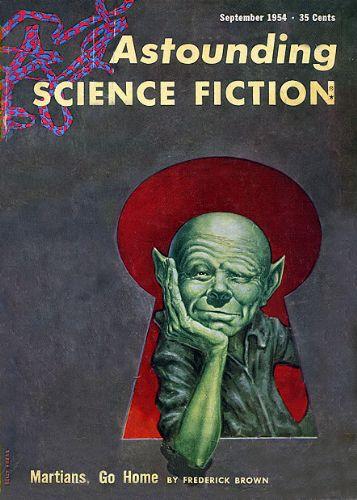
October 29, 1906 — Fredric Brown. (Died 1972.)
By Paul Weimer: I first encountered Fredric Brown’s work with a pastoral work known as “The Waverlies”. Sometime in the near future, a peculiar sort of alien arrives on earth that is invisible, and eats all forms of radio, and electromagnetic signals and power fails. The United States and the rest of the world is thus plunged into a late Victorian era of technology. It was and is a pastoral, gentle story of the hands of time being stopped and put backward to a slower pace, permanently. The story nagged at me, though, even as I liked it. Such a technological change would be wrenching and millions…if not more, would die in the result (c.f. S M Stirling’s The Change series). I don’t think Brown considered that. But this is notably one of Philip K Dick’s favorite short stories. It has a power…even if it doesn’t realize its full implications and problematic nature.

But he considered and thought about a lot of other SF ideas in other fantastic stories. His story “Answer” has the classic line you know even if you haven’t read it “NOW there is a God”. “Arena” is the basis of the Star Trek episode where Kirk fights a Gorn. And there are plenty more where those come from. I haven’t delved into his extensive work with mystery novels and stories, but if that is your jam, Brown has a plethora of work for you once you finish his science fiction stories and short novels.
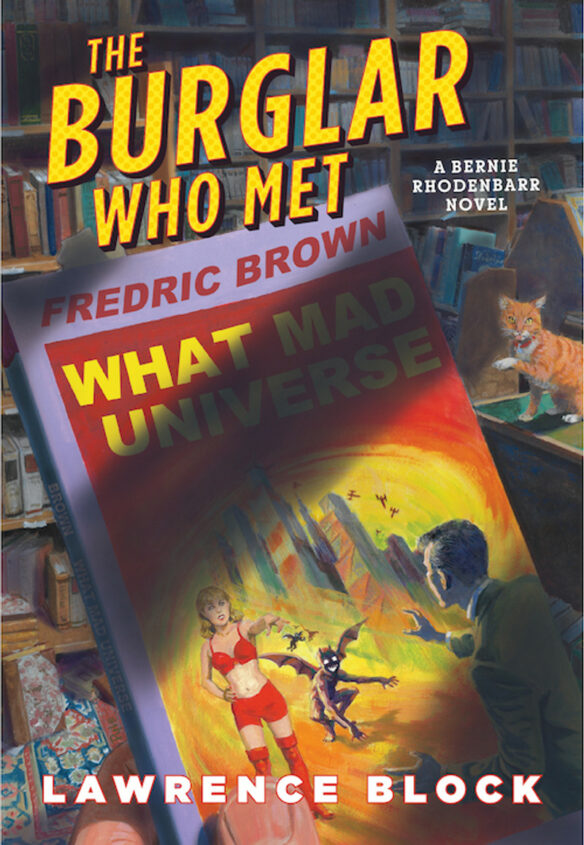
But as much as I like “The Waverlies” (even as I recognize the problematic aspects of the story), my favorite Brown story is probably his most definitive one, and that is “What Mad Universe”. You probably know this story if you read it. A SF book editor finds himself in a world whose ideas run on SF magazine story conventions. With a breakneck pace and change of action and twists at a pace that Van Vogt might envy, the story is a rollercoaster and deconstruction of what was soon to become a dying breed — pulp SF stories. It thus stands as the Pulp Science Fiction story for as unwitting capstone of the era, and it’s a lot of fun. I’m not the only one who thinks this, as witness Lawrence Block’s The Man Who Met Frederic Brown, which takes up on this trope and references that story directly.
(8) COMICS SECTION.
- Frank and Ernest launches a dino fashion craze.
- Off the Mark features monstrous love language.
- Shoe is overwritten.
- Strange Brew links universes.
(9) GRRM COMPARISON FEATURES IN LATEST OPENAI SUIT RULING. “Authors’ Class Action Lawsuit Against OpenAI Moves Ahead” reports Publishers Weekly.
Authors scored another victory in their fight to protect their work from AI scraping when a New York federal judge denied OpenAI’s request to dismiss authors’ claims that text generated by OpenAI’s ChatGPT infringes their copyrights. The suit, now in the Southern District of New York, consolidates lawsuits from a number of authors, as well as the Authors Guild, that were filed in different courts.
In his October 28 decision, U.S. District Judge Sidney Stein ruled that the authors may be able to prove the text ChatGPT produces is similar enough to their work to violate their book copyrights. In issuing his ruling, Judge Stein compared George R.R. Martin’s Game of Thrones to summaries of the book created by ChatGPT. The judge wrote that a “discerning observer could easily conclude that this detailed summary is substantially similar to Martin’s original work because the summary conveys the overall tone and feel of the original work by parroting the plot, characters, and themes of the original.”
Moreover, Judge Stein wrote, “a more discerning observer could properly conclude that outlines for potential sequels to plaintiffs’ works that were generated in response to prompts to ChatGPT are substantially similar to plaintiffs’ original works.”
These examples, Judge Stein found, are “sufficient to defeat OpenAI’s motion to dismiss” the plaintiffs’ argument that no “reasonable jury” would find that the summaries are “substantially similar” to plaintiffs’ works….
… While Judge Stein’s ruling is an important win, he made clear his decision does not consider the fair use question, noting “Nothing in this opinion is intended to suggest a view on whether the allegedly infringing outputs are protected as fair uses of the original works.” Authors and publishers are hoping to stop AI companies from copying their material in part by arguing that ingesting huge quantities of material is not protected by the fair use doctrine, which permits copying that leads to a transformative product….
And The Hollywood Reporter puts it this way: “George R.R. Martin Is Carving Up OpenAI In Court, So Far”.
It’s been around three years since the first AI copyright lawsuit was filed. The state of play is still unclear, but winners and losers in certain cases are emerging.
So far, one of the losers appears to be OpenAI in a lawsuit from book authors, who have steadily been building a formidable case that may force the tech giant’s hand in forking over a big settlement ahead of trial. Earlier this week, a federal court advanced two new theories of infringement against the Sam Altman-led firm. As it stands, the authors, who include George R.R. Martin, have several outs to winning the case…
… In total, the plaintiffs are advancing three different arguments: The first is that the training of AI models on copyrighted books constitutes infringement, a common theory that most creators brought when the first wave of lawsuits were filed; the other relates to a newer argument over the practice of pirating books from shadow libraries that weren’t used for training; and the last is that answers generated by ChatGPT are substantially similar to the books they’re trained on….
(10) PLAYING TO THE CROWD. [Item by Steven French.] In this week’s “Pushing Buttons” newsletter Keza MacDonakd describes how playing a game can become a performance: “No half-assed performance: how playing with a live crowd turns video games into performance art” in the Guardian.
This weekend, I spent more than eight hours in a theatre playing a video game about donkeys, reincarnation and organised labour with about 70 other people. Political, unpredictable and replete with ass puns, Asses.Masses is, on the one hand, a fairly rudimentary-looking video game made by Canadian artists Patrick Blenkarn and Milton Lim with a small team of collaborators. But the setting – in a theatre, surrounded by others, everybody shouting advice and opinions and working together on puzzles – transforms it into a piece of collective performance art….
(11) TINY BUBBLES. “Scientists Find 6-Million-Year-Old Air Trapped in Earth’s Oldest Known Ice” reports Gizmodo.
…For a paper published on October 28 in Proceedings of the National Academy of Sciences, the Center for Oldest Ice Exploration, or COLDEX, describes the enigmatic composition of a 6-million-year-old ice core collected from the Allan Hills, a family of frigid hills in southeastern Antarctica. By carefully studying the composition of tiny air bubbles, permafrost, and other frozen deposits inside, the researchers derived an impressive reconstruction of Earth’s atmosphere from millions of years into the past….
… The newest core is almost two times older than the previously oldest discontinuous ice core on record, dated at about 2.7 million years old, according to the paper….
… Once they collected the cores, the team took detailed measurements of the isotopes of argon for the trapped air bubbles inside the samples. This allowed the researchers to pin down the age of each sample. They also used laser spectroscopy to identify different oxygen isotopes in the meltwater, which revealed that the area corresponding to today’s Allan Hills experienced a gradual, long-term decrease in temperatures of about 22 degrees F (12 degrees C)….
(12) VIDEO OF THE DAY. “How Fantastic Four Should Have Ended”.
Can the Fantastic Four stop Galactus or will they be nom nommed away? Multiple alternate endings written by the fans and animated by HISHE.
[Thanks to SF Concatenation’s Jonathan Cowie, Mark Roth-Whitworth, Steven French, Anne Marble, Ersatz Culture, Cora Buhlert, Kathy Sullivan, Mike Kennedy, Andrew Porter, John King Tarpinian, Chris Barkley, and Cat Eldridge for some of these stories. Title credit belongs to File 770 contributing editor of the day Dan’l.]