(1) KEEP WATCHING THE SKIES! John Scalzi now has his name on a celestial body: “A Minor Planet, a Major Thrill” at Whatever.
Our solar system has eight major planets, nine if you believe that Pluto Was Wronged. It also has literally thousands of minor planets, which are also colloquially known as asteroids, many of which reside in the “asteroid belt” between Jupiter and Mars. I learned some time ago that the International Astronomical Union, through its Working Group on Small Bodies Nomenclature, will give some of these minor planets, usually designated by number, an actual name. What kinds of names? Sometimes of geographical locations, sometimes of observatories, sometimes of fictional characters like Spock or Sherlock Holmes, sometimes of scientists (or their family members), and sometimes, just sometimes, they’re named after science fiction authors.
Like minor planet 52692 (1998 FO8), henceforth to be known as “Johnscalzi”…
Incidentally, Mary Robinette Kowal received this honor, too.
Also cool: The name of the asteroid that’s in the catalogue next to mine. We geeked out about it on the phone just now. We’re Space Potato Pals!
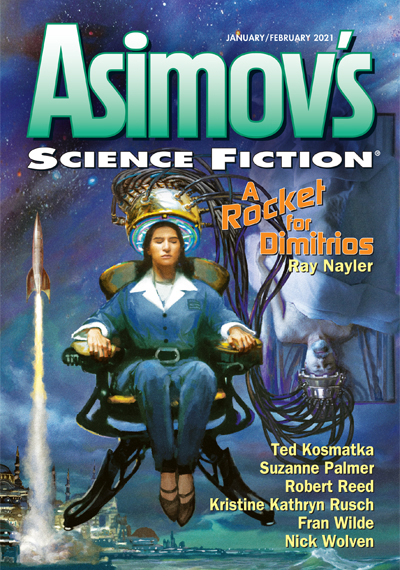
(2) SHEILA WILLIAMS MEDICAL UPDATE. Must Reads Books today announced “After Sheila Williams Hospitalization, Emily Hockaday Named Asimov’s Interim Editor” – see details in File 770’s post.

(3) FAAN AWARDS VOTING BEGINS. Nic Farey has opened voting for the 2026 Fanzine Activity Achievement Awards (FAAn Awards). Rules, eligibility lists, and the ballot are contained in Incompleat Register 2025, available from eFanzines. (There’s also a gallery of the past year’s fanzine covers here at eFanzines.com.)
Ballots should be received by 23:59 (Pacific) on Saturday, February 14.
The awards are sponsored by the current Corflu, which for 2026 is Corflu Pickled in Santa Rosa, CA, and the results will be announced at the banquet on Sunday March 1.
Farey reminds people, “You do NOT have to be a member of Corflu or anything else for that matter. Voting is open to anyone with an interest in fanzines.”
(4) LASFS FEATURED IN PBS PROGRAM. “Nathan Masters returns as host uncovering Southern California’s connections to the history of car racing, origins of science fiction, evolution of the true crime genre and the region’s colorful flora from wildflowers to jacarandas.”
Here’s the link to watch “Sci-Fi Origins” on Lost LA.
Boldly go into the heart of science fiction storytelling and discover its deep roots in Los Angeles. From UC Riverside’s vast sci-fi collection to author Octavia Butler’s Pasadena, host Nathan Masters explores how Southern California became a launchpad for stories that imagine new worlds—and reflect our own hopes and fears.
At the 7-minute mark Masters meets with long-time LASFSians Matthew B. Tepper, Charles Lee Jackson II, Beverly Warren, and Nick Smith.
(5) OHIO SFF MUSEUM GAINS FUNDING. In Warren, Ohio a “Sci-fi Museum Project Gets $2.3M Grant” reports Business Journal Daily. Its core exhibits will be props from Hollywood sff movies.
The project to create the Museum of Science Fiction & Fantasy Arts downtown has received a major grant of $2.3 million.
The funding is from the Ohio Department of Natural Resources Division of Mineral Resources Management.
The museum will be located in a now vacant 14,000-square-foot building at 410 Main St. and will be owned and operated by the Trumbull County Historical Society.
Meghan Reed, director of the historical society, was excited about the grant, which was announced Thursday morning.
“It’s definitely a catalyst to hopefully larger funding to get us to the first phase of construction,” she said.
The historical society hopes to complete design and development work this year and break ground by the end of the year or early in 2027, she said….
…The museum will be opened in stages. “The goal is to open the first two floors first,” Reed said. “We’ll see how the fundraising goes.”
The historical society will need to match the funding it received Thursday to have enough to launch the project, Reed said.
It is awaiting a decision in early spring on another large grant it is seeking. “We applied for an Appalachian Regional Commission Power Initiative grant for $2 million,” Reed said.
The historical society also expects to raise money through naming rights opportunities at the museum, she said.
The centerpiece of the museum will be a collection of props that appeared in major sci-fi movies that were made by Warren native John Zabrucky through his California company, Modern Props.
Zabrucky donated his collection with a goal of creating a museum.
The collection includes items that appeared in “Blade Runner,” “Ghostbusters,” “Men in Black,” most “Star Trek” movies and many other feature films.
(6) DON’T BE OBLIVIOUS. Kemi Cole discusses what’s “Beyond the Beauty: A Research Guide for Responsible SFF Worldbuilding” at SFWA’s Planetside.
When millions watched the serene lake scenes in Black Panther, they were seeing Lake Bunyonyi in southwestern Uganda, the aerial backdrop for Marvel’s utopian African nation. What they didn’t know was that this same lake conceals one of East Africa’s darkest histories: Punishment Island (Akampene), where the Bakiga people abandoned pregnant, unmarried girls to die of hunger or drowning well into the 20th century.
This disconnect between Wakanda’s technological paradise and Lake Bunyonyi’s suppressed history of femicide reveals a critical problem in how speculative fiction approaches cultural borrowing. As SFF writers increasingly draw from real-world cultures and geographies to build compelling fictional worlds, the question becomes: How do we research responsibly without perpetuating erasure or exploitation?
Having witnessed how global productions borrow our landscapes for aspirational fiction while remaining oblivious to embedded historical pain, I’ve developed research methodologies that SFF writers can immediately apply to create richer, more authentic stories that honor rather than appropriate their source cultures.
Access Oral Histories Beyond Standard Searches
Your first internet search will give you tourism websites and Wikipedia entries. Stop there, and you’ll miss the stories that matter most.
Real cultural research starts with identifying cultural centers, local museums, and community organizations in your research region. Then contact them directly and explain your project. Many have staff who can connect you with community historians or oral tradition keepers. University anthropology departments often maintain relationships with community scholars who rarely appear in mainstream sources.
When approaching these conversations, lead with transparency. Explain that you’re creating fiction inspired by the region and want to ensure accuracy and cultural sensitivity. Ask questions like “What stories about this place do you think are important for outsiders to understand?” or “How do local people talk about this history differently from what’s written online?”…
(7) BAD BUZZ IN THE WEBCOMICS SCENE. [Item by N.] The Hiveworks Artist Guild, a union comprised of past and present webcomics creators for the publisher Hiveworks, has released a statement alleging severe mismanagement that took place in the company (alongside tips on how to support the artists): “The Hiveworks Guild Statement on Hiveworks Comics” at Cartoonist Cooperative.
In light of Hiveworks’ shift to downsizing as a company and shuttering its publishing service, and in solidarity with the members of the guild at Slipshine, we, the Hiveworks Artist Guild, are stepping forward to publicly introduce ourselves and outline the work and time we have invested in this company’s betterment.
The Hiveworks Artist Guild consists of around 100 past and present Hiveworks webcomic creators. We first came together to share information, and upon learning “it wasn’t just me,” we began to request better treatment from Hiveworks. We did not want to involve the public in the beginning, as well-meaning onlookers might stop supporting the artists who still relied on Hiveworks’ services.
Unfortunately, our attempt at handling matters privately over the past three years was unsuccessful. Hiveworks has failed to provide its advertised services, has bled talent and downsized dramatically, and has revealed a massive $340,000 worth of debt that the Guild became aware of in early 2025.
We now feel it is imperative to put on record our history with Hiveworks – both to stand as proof of what we have tried to accomplish, and also serve as a warning to those who may consider associating professionally with Xellette Velamist or Isabelle Melançon….
…At its best, Hiveworks worked as it was meant to – the process made publishing webcomics fantastically easy, taking the brunt of the trickier parts of web publishing off artists by managing the process in bulk. A connected hub of high-quality, individually vetted stories, all with their own personally designed website – on paper, it was a dream come true.
But at its worst, Hiveworks’ process became a checklist of tasks that had to be done in a very particular way, leading them to be done very slowly, or not done at all. Staff members often had day jobs and other non-Hiveworks related obligations, leading them to communicate poorly with artists and with each other. This led to long and obscurely defined “queues,” favoritism in doled-out services due to popularity/earning power/personal friendships, uncomfortable power imbalances between staff and clients, delayed payouts (especially when ad revenue as a whole tanked after the pandemic), and at its absolute worst, the misappropriated funneling of funds from recent projects into older, incomplete projects….
(8) CHILLING EFFECT. The Hill finds that “Donald Trump’s return chills market for LGBTQ books”.
President Trump’s return to office has fueled the grassroots forces that have driven a spike in LGBTQ book bans in recent years, creating a notable chill in the market for queer stories, according to authors and others in the publishing industry.
The effect has been most keenly felt within children’s book publishing, where editors and authors describe lower sales numbers amid book bans, as well as the administration’s targeting of diversity, equity and inclusion (DEI) and pre-occupation with “radical indoctrination” in K-12 schools.
“This is the first year in like a decade that I’ve had [rejection] responses from editors specifically citing that it’s difficult to place queer books in stores, and they’re being selective about acquiring queer stories,” said Rebecca Podos, a senior literary agent at Neighborhood Literary and young adult and adult novelist.
Industry professionals and authors fear that this atmosphere may continue throughout Trump’s presidency, resulting in less queer novels reaching readers in the coming years.
“[Publishers] are going to invest in books that are safely going to go on shelves, that are not going to get banned, that are not going to have this kind of controversy,” Dahlia Adler, a young adult novelist and the creator of the website LGBTQ Reads, which promotes queer literature for all age groups, said. “I just feel like they’re stepping back.”…
(9) TODAY’S BIRTHDAY.
[Written by Cat Eldridge.]
January 12, 1980 — Kameron Hurley, 46.
I listened just after it came out to Kameron Hurley’s space opera The Stars are Legion. A most excellent story indeed. It was nominated for a Campbell Memorial Award, a well deserved nomination indeed.
Her time travel novel which I also listened to, The Light Brigade, is one the best works in that sub-genre I’ve encountered. It was nominated for a Hugo at CoNZealand.
Her first novel is the start of her matriarchal Islam culture Bel Dame Apocrypha biopunk trilogy. Her term, not mine. Sounds interesting, but unfortunately is not available as an audiowork.
The Worldbreaker trilogy which begins with The Mirror Empire I find delightful with its merging of hard SF underpinned by magic in a space opera setting. Now that shouldn’t work, should it? Really it shouldn’t, but it magnificently does.
So let’s talk about her non-fiction. The Geek Feminist Revolution which garnered a BFA is a collection of previously published blog posts and new essays written for here. One of the first, “We Have Always Fought: Challenging the ‘Women, Cattle and Slaves’ Narrative” got a Hugo for Best Related Work at Loncon 3, and she also won a Hugo for Best Fan Writer.
Her exemplary short stories have been collected so far infour collectionswith Meet in The Future being nominated for an Otherwise Award.
Of course, everything she’s written is available from the usual suspects and much from your favorite epub and audiobook sources as well.
(10) COMICS SECTION.
- Saturday Morning Breakfast Cereal reimagines a peaceful ending for the Trojan Wars.
- Carpe Diem recalls Tarzan in therapy.
- Dinosaur Comics tells a low-cost ghost story.
- Mother Goose and Grimm warn you can become what you eat.
- MythTickle shows there’s always a critic.
- Rubes gets a delivery.
- Tom Gauld teases a much-criticized behavior.
(11) OVERCOMING PAIN. [Item by Steven French.] Keza MacDonald learns how to work through excruciating pain playing the video game Hollow Knight: Silksong: “Four months and 40 hours later: my epic battle with 2025’s most difficult video game” in the Guardian.
…There is an underlying narrative of overcoming the odds – of suffering and redemption – in almost all video games, but especially the difficult ones. And I love the difficult ones. Video games imbue suffering with meaning: you try and fail, try and fail, until you succeed. Perhaps, I thought, playing Silksong during a period of real-life suffering and disability might help me look at it differently….
(12) ROLLING, ROLLING, ROLLING. The Artemis II test flight is nearing – soon the launch system will be moved into position. “Final Steps Underway for NASA’s First Crewed Artemis Moon Mission”
As NASA moves closer to launch of the Artemis II test flight, the agency soon will roll its SLS (Space Launch System) rocket and Orion spacecraft to the launch pad for the first time at the agency’s Kennedy Space Center in Florida to begin final integration, testing, and launch rehearsals.
NASA is targeting no earlier than Saturday, Jan. 17, to begin the multi-hour trek from the Vehicle Assembly Building to Launch Pad 39B. The four-mile journey on the crawler-transporter-2 will take up to 12 hours. Teams are working around the clock to close out all tasks ahead of rollout. However, this target date is subject to change if additional time is needed for technical preparations or weather….
…As with all new developments of complex systems, engineers have been troubleshooting several items in recent days and weeks. During final checkouts before rollout, technicians found a cable involved in the flight termination system was bent out of specifications. Teams are replacing it and will test the new cable over the weekend. Additionally, a valve associated with Orion’s hatch pressurization exhibited issues leading up to a Dec. 20 countdown demonstration test. On Jan. 5, the team successfully replaced and tested it. Engineers also worked to resolve leaky ground support hardware required to load gaseous oxygen into Orion for breathing air.
Once the integrated rocket and spacecraft reach the launch pad, NASA will immediately begin a long checklist of launch pad preparations, including connecting ground support equipment such as electrical lines, fuel environmental control system ducts, and cryogenic propellant feeds. Teams will power up all integrated systems at the pad for the first time to ensure flight hardware components are functioning properly with each other, the mobile launcher, and ground infrastructure systems….
(13) THE SANDMAN: DENOUEMENT. [Item by N.] Video essayist James Woodall takes a look at the Netflix adaptation of The Sandman to see where it stumbled in adapting the comic (note that this video contains no defense of Gaiman in any way) in “Why Netflix’s ‘The Sandman’ Failed”.
(14) VIDEO OF THE DAY. Joseph’s Machines shows how “I made a Wallace & Gromit contraption in real life!”. The linked headline starts at the 7:30 mark where the demo begins. Below, he embedded video starts at the beginning and documents the construction process.
[Thanks to Mike Kennedy, Andrew Porter, John King Tarpinian, N., Cat Eldridge, SF Concatenation’s Jonathan Cowie, Mark Roth-Whitworth, Kathy Sullivan, and Steven French for some of these stories. Title credit belongs to File 770 contributing editor of the day Steve “White Rabbit” Davidson.]