Pixel Scroll 5/6/26 The Nice Thing About Pixels Is You Never Have To Take Them To A Veterinarian. Why That Is So We Will Not Discuss

(1) 2026 HUGO VOTING BEGINS. LAcon V announced today that online voting for the 2026 Hugo Awards has opened. Members also have the option of using a paper ballot. The deadline for voting is August 8, 2026 at noon PDT.

(2) LACON V RELEASES HUGO VOTER PACKET. File 770 answers the question, “What’s In the 2026 Hugo Voter Packet?”.

On May 6, the 2026 Hugo Awards voter packet became available for download by WSFS Members of the LAcon V Worldcon. The packet is an electronic collection which helps voters become better informed about the works and creators on the ballot. Works which are included have been made available through the generosity of finalists and their publishers.

The Hugo Voter Packet will be available for download until the voting deadline Voting will close on August 8, 2026 at noon Pacific….

(3) EUROPEAN FAN FUND WINNER. Hephaestion Christopoulos is the winner of the European Fan Fund 2026. The Greek fan will take part in Metropolcon (Eurocon 2026) in Berlin, Germany, later this year. The EFF administrator has yet to release the voting statistics.

Hephaestion was born in 1982 in Athens. He spent part of the first years of his life in Nigeria; sadly, he doesn’t really remember much from there. He holds a diploma in Naval Architecture and Marine Engineering, a pregraduate degree in English Language and Literature, as well as a postgraduate degree in Translation. After working for a few years as an engineer, he decided he hates the job, and now he is a full-time translator and editor. In his free time he reads, writes, listens to music, and plays bass with his band, Pray for Decadence. His third book, a short story collection, was released in December 2025 from Hestia, the oldest and one of the most venerable publishing houses when it comes to Greek literature. He also has some stray stories and books in other languages flying around. Most of his work lies somewhere in the interstices between speculative and literary fiction. He lives in Athens with his wise wife (much wiser than him), their five-year-old daughter, and two cats. He is currently the vice-chairman of the Science Fiction Club of Athens (alef.org.gr). You can contact him via his website, terrible things – Ηφαιστίων Χριστόπουλος — he does not update it as frequently as he should, but he keeps saying he will do so.

(4) WEIGHING GAMES. Camestros Felapton has interesting ideas about how to rank games when voting for awards: “Hugo 26: Citizen Sleeper versus Dispatch”.

…Part of the issue is that games, to me, have some unattached dimensions. For example, in a film, there can be a lot going on: acting, plot, direction, cinematography, effects, setting and music. This year in the BDP Long Form category, Sinners has a lot going on with all of those, but they all combine very nicely to make a coherent whole.

A game, though…a game has to be a game. It can have many things, but also none of them other than being a game. A pack of cards can be a whole bunch of games, and so can a pair of dice. However, games can have music, a plot, and even acting….

(5) SHELFIES.  Shelfies, edited by Lavie Tidhar and Jared Shurin, “Takes a unique peek each week into one of our contributors’ weird and wonderful bookshelves.” A recent entry was Shelfies #86: Dan Abnett.

Dan Abnett has written more than sixty novels, and too many comics to count (though, according to a recent survey, he is the 12th most prolific writer in the American comic industry of all time, so someone counted). He is especially celebrated for his NYT best-selling Warhammer 40,000 novels, which have been translated into dozens of languages. 

In comics, he writes for the UK’s 2000AD, where he created popular series such as Sinister Dexter, Lawless, The Out and Brink. He writes for DC Comics, Marvel, Dark Horse, Boom! Studios and many other publishers around the world, and his run on The Guardians of the Galaxy for Marvel formed the inspiration for the blockbuster movies. He also writes extensively for the games industry.  

Dan lives and works in Maidstone, Kent, in the UK.

(6) FACE THEFT? “Indigenous actor sues James Cameron for ‘stealing’ her facial features for Avatar character” reports the Guardian.

James Cameron and the Walt Disney Company are facing a lawsuit that claims the director based a key character in the Avatar franchise on a teenage actor without her permission.

The suit, filed by actor Q’orianka Kilcher, alleges that Cameron “extracted her facial features” and “directed his design team” to base the key Avatar character Neytiri on her appearance after seeing her in an LA Times advert for Terrence Malick’s 2005 film The New World. In the film Kilcher, who is Native Peruvian, played Pocahontas among a cast that also included Colin Farrell and Christian Bale.

A release about the lawsuit says that “one of Hollywood’s most powerful film-makers exploited a young Indigenous girl’s biometric identity and cultural heritage to create a record-breaking film franchise – without credit or compensation to her – through a series of deliberate, non-expressive commercial acts”.

The lawsuit describes the multibillion-dollar grossing Avatar series as a franchise that “presented itself as sympathetic to Indigenous struggles, all while silently exploiting a real Indigenous youth behind the scenes”. The character of Neytiri is played in the Avatar films by Zoe Saldaña….

(7) LEARNING TO READ. [Item by Steven French.] Something that some of us have known for many years now! “Does your child only read graphic novels? That’s OK—it’s helping them build literacy skills” at Phys.org.

Some parents worry if their children only read graphic novels—or even mostly read them. A common question goes something like: how do I get my child to read something other than comics or graphic novels? But the answer might be: you don’t have to.

Graphic novel series such as HeartstopperThe Babysitters Club and Amulet fly off school library shelves. And original graphic novels such as Art Spiegelman’s Holocaust-themed Maus and To This Day, based on Shane Koyczan’s spoken-word poem, are staples of many high-school classrooms.

Rather than hindering or holding back reading skills, reading graphic novels can actually help develop them.

Reading is many things—from breaking the code to understand what you read, to reading for enjoyment and getting “hooked” by a narrative. Debates about the best way to teach reading have been going on for over 80 years. They’ve recently gained strong focus with the ability of science to examine brain function.

Research shows reading graphic novels leads to improved reading and comprehension skills for all students. And studies demonstrate that children and teenagers who read graphic novels have improved, more positive attitudes toward reading. They are more likely than children who don’t read comics and graphic novels to think of themselves as good readers….

(8) ABOLISH THE HARDBACK. Larry Ryan tells readers of the Guardian this is – “The hill I will die on: Heavy, awkward and incredibly expensive – we don’t need hardback books”.

… The simple fact is that hardbacks are too expensive, and when you know that a cheaper version of the book will arrive in a vaguely defined nine- to 13-month period, it’s easy to just postpone purchasing it. Yet this seems like an unnecessary pause for everyone involved. Given how difficult it is for any piece of culture, let alone books, to get more than fleeting attention, it seems baffling that publishers first offer up the least accessible version. Especially in an era when the cost of producing new books increases and sales struggle. Plus, by the time the lesser-heralded paperback edition arrives, there is a good chance I’ll have just forgotten about it.

My bigger problem, though, is that hardbacks are too cumbersome. They’re hard to travel with, be it on a commute, on holiday or anywhere else; they’re bulky in a bag and they certainly won’t slip easily into a jacket pocket. They’re also awkward to read, especially anything more than 300 or so pages. Taking on a hefty hardback while standing on the tube holding on to a railing with one hand is an obvious irritant. Some years back I impulse-bought the newly released hardback edition of Thomas Pynchon’s novel Against the Day: that sucker is 1,085 pages long – it felt as if I was lugging a small child around for weeks….

(9) TED TURNER (1938-2026). “Ted Turner, Creator of CNN and the 24-Hour News Cycle, Dies at 87”. Here’s an excerpt from the New York Times profile.

Ted Turner, the media mogul who cut a brash and vivid figure on the American scene of the late 20th century by dominating the cable television industry, creating the 24-hour news cycle with CNN, and extending his restless reach into professional sports, environmentalism and philanthropy, died on Wednesday at his home near Tallahassee, Fla. He was 87.

Mr. Turner’s signature creation was CNN — the Cable News Network — which revolutionized television news in 1980 by presenting it all hours of the day and eventually inspiring other media operations to follow suit. 

As a spinoff of CNN, Mr. Turner created the channel CNN Headline News and CNN International. He founded the cable and satellite sports and entertainment “superstation” that became known as TBS and spawned a sister channel, TNT, both of which continue to reach millions of homes.

In 1985, he bought for $1.5 billion the MGM studio’s library of films and nine years later created the cable franchise Turner Classic Movies, or TCM. He made a similar purchase of Hanna-Barbera cartoons and, relying on them, created the Cartoon Network in 1992. 

By 1989, his fortune had doubled to $5 billion. CNN and CNN Headline News reached more than 50 million households worldwide. His MGM film library, which included “The Wizard of Oz” and “Citizen Kane,” evolved into a lucrative investment after all, drawing millions of new viewers to Turner Network Television, or TNT, and then Turner Classic Movies.

Mr. Turner added to his empire in 1991 by purchasing, for $320 million, Hanna-Barbera Productions, whose library included such characters as the Flintstones, the Jetsons and Yogi Bear. A year later, he introduced the Cartoon Network, a 24-hour all-cartoon channel that proved immensely popular. And in 1993, he acquired the film production companies New Line Cinema and Castle Rock…

(10) TODAY’S BIRTHDAY.

[Written by Paul Weimer.]

May 6, 1969Annalee Newitz, 57.

By Paul Weimer: I first encountered Annalee Newitz’ nonfiction, first, as a columnist, as a nonfiction writer, as a podcaster with their partner Charlie Jane Anders. Four Lost Cities is an amazingly researched book looking at the rise and fall of four cities and what we can learn about the challenges they faced. I learned an amazing amount I never know about, for example, Angkor Wat. I think it is their strongest work and if you asked me “what one book of theirs should I read?”, Four Lost Cities is the one I’d put into your hands.

Annalee Newitz

Scatter, Adapt, and Remember: How Humans Will Survive a Mass Extinction was a surprisingly hopeful book, given its title and content. 

Although they have been writing fiction, too for a while, I finally got into their fiction with The Future of Another Timeline, with rival powers fighting for control of a timeline just catnip for me. Given the political changes lately in the United States, it feels even more relevant than it once did. And once again, I learned a lot about some historical events I hadn’t even heard of, thanks to the jumping around the timeline by the protagonists. But even with that, the changes to the timeline are not shown in some grand manner, but how they affect people. People matter to Newitz’s work. 

Newitz’ work is bright, well researched, deep, and thought provoking, with a mind like an engineer and the language and diction of an English professor. I am pretty sure that as good as Future was, I prefer Newitz’ nonfiction more, but I am primed for whatever they decide to turn their prodigious powers on, next. (In the meantime, of course, there is always Our Opinions are Correct). 

[Note: ISFDB and the Science Fiction Encyclopedia say Newitz’ birthday is today, Wikipedia says tomorrow. Happy birthday whichever is the case!)

(11) COMICS SECTION.

(12) BLADE RUNNER COMIC TRAILER. From Titan Comics: Blade Runner: Tokyo Nexus: To Lose is To Win #1 Official Trailer.

Discovering that Mead and Stix are still alive, their old commanding officer, Uldren sets out to kill them before they can reveal his treachery. The data he stole from Tyrell has enabled the Cheshire Corporation to create bootleg Replicants with the same kill signature as Stix. Meanwhile, still dealing with the fallout from the Yakuza civil war Stix and Mead find themselves fighting for survival against Rumika, A Blade Runner sent by Tyrell to destroy Cheshire and all those connected with it.

(13) BEEN THERE, BUT HAVEN’T DONE THAT! Would you expect House Beautiful to be recommending “The 22 Most Haunted Hotels in the U.S. to Visit This October—If You Dare”?

By nature, hotels are transitory spaces—places where people check in, stay a few nights, and move on. But legend has it that certain hotels are inhabited by ghostly guests who never leave. Some spirits are said to be trapped due to tragic events that claimed their lives on-site; others linger from the property’s past lives as military hospitals or graveyards. And a few simply can’t bear to part with a place they once loved. Given how much life—and occasionally death—unfolds within hotel walls, and the sheer number of people passing through, it’s no surprise that hotels rank among the most haunted buildings in the country….

Number six is the place where I attended Forry Ackerman’s 70th birthday party.

6. Millennium Biltmore Hotel, Los Angeles

Nestled in the heart of Downtown Los Angeles, the Millenium Biltmore Hotel is one of the most iconic Hollywood haunts. Until the mid-20th century, the Biltmore was considered L.A.’s most elegant hotel and was a popular destination for young Hollywood hopefuls, including murder victim Elizabeth Short, better known as the Black Dahlia.

The Bilmore was potentially the last place Short was seen alive on January 9, 1947. The employees confirmed that they observed her alone and saw her get up and leave as if she were signaled by someone outside around 10:00 PM. Her mutilated remains were discovered miles south of the hotel in an abandoned lot on January 15, 1947, and the gruesome case remains unsolved. In the decades since, Elizabeth’s ghost has frequently been spotted in the Biltmore. Guests report a pale woman with dark hair wearing a sheer black or gray, 1940s-style dress. She’s usually seen entering or leaving rooms on the 10th or 11th floors or wandering the halls.

Several Trip Advisor commenters have also reported cases of paranormal activity, from one guest waking up with a figure hovering over her in the middle of the night, to a couple claiming to hear voices with 1940s Transatlantic accents in the room over, which was empty at the time. But here’s the thing, they were not speaking modern-day English, and countless bartenders have reported things like apparitions passing behind them on a daily basis. Whether it’s Elizabeth’s ghosts or someone else’s spirit haunting the Biltmore, we will never know for sure.

(14) VIDEO OF THE DAY. “Pawn Star Wars – Boba Fett Tries to Pawn Han Solo in Carbonite”.

[Thanks to Mark Roth-Whitworth, Kathy Sullivan, Steven French, Mike Kennedy, Andrew Porter, John King Tarpinian, Cat Eldridge, SF Concatenation’s Jonathan Cowie, and Chris Barkley for some of these stories. Title credit belongs to File 770 contributing editor of the day Cat Eldridge.]

Canadian Stamps Celebrate Graphic Novelists

Canada Post (CNW Group/Canada Post)

Canada Post has unveiled the second in a two-part series celebrating Canadian graphic novelists.

Canada has produced several prominent graphic novelists, and this stamp issue shines a light on six influential Canadian creators: Kate Beaton, Jimmy Beaulieu, Guy Delisle, Julie Doucet, Bryan Lee O’Malley, and Michael Nicoll Yahgulanaas. These individuals have not only risen to prominence in their field but their works each showcase a diverse and unique approach to storytelling that resonates with readers.

Each graphic novelist worked with Canada Post to create original drawings, exclusively for this stamp issue, featuring the main characters from one of their most celebrated works depicted reading the novels in which they appear.

The art and brief bios of the graphic novelists follow the jump.

Continue reading

Ten “Graphic Story” Recommendations from the Journey Planet Team

The team at Journey Planet had a busy 2024, and continues to be busy, but found time this week to read comics. And as we approach the imminent Hugo Nomination Deadline some of the co-editors — David Ferguson, Helena Nash and James Bacon — offer ten recommendations which cover quite the variety of “Graphic Stories”. 


Uncanny Valley by Tony Fleecs and Dave Wachter, Boom! Studios.

Recommended by  Helena Nash

This is a really nice little self-contained series about twelve-year old Oliver Peet, who’s just a bit different from his classmates. For instance, jumping from a bridge doesn’t leave a scratch on him, but he does leave a distinctly boy-shaped hole in the ground, not to mention those little birds that briefly circle around his dazed head. Soon, Oliver is on the run from weird-looking talking crows and other cartoonish menaces, and only his estranged grandfather, two-foot tall cowpoke Pecos Pete can save him.

Cards on the table; I love ‘real world meets cartoons’ stories, from Who Framed Roger Rabbit? to Cool World, to Animal Man’s Coyote Gospel to The Banana Splits in Hocus Pocus Park, so Uncanny Valley is right up my street. What hooked me in was Dave Wachter’s eye-catching art, which come in two flavours: delicately painted real-world people and locations in soft realistic tones and shades, and lovely bold flat primary colours for the cartoon creatures invading our world in search of Oliver. The contrast of the cartoon art really pings off the page.

 I like seeing Oliver discover the toon-powers he’s inherited from Pete, but it’s the mystery surrounding his birth and the nature of the cartoonish archvillain that’s after him that has kept me reading this series. Issue #6 is a particular delight, as writer Fleecs makes inventive use of a well-known 96-year old cartoon character – now in the public domain – to guide us through Uncanny Valley’s backstory, which felt to me like it could have come from a lost issue of DIE, only with less murky artwork.


Monstress Volume 9: The Possessed By Marjorie Liu and Sana Takeda

Reccomended by James Bacon

The Hugo winning fan favourite series Monstress released its ninth volume last year, reprinting issues  #49 to #54 as the series enters its tenth year in ongoing publication. We see a return to older characters in this arc, in a sense, and back to the Known World as Maika Halfwolf along with Kippa and Ren return from the prison-planet of the Old Gods, Golga. A year is a long time, and much has occurred, and we see the Lord Doctor, succeeding in gaining attachment to the monstrum, but failing to connect with Zinn.

Maika, Kipp and Ren are the shining beacon of hope, in a horrific world that has been built, developed for us, that shows the darkness of war and violence, and we see the importance of relationships, comradeship, and how friendships deepend and develop, through a process of reflection and learning and how important empathy is, against the crushing evil, the heavy hand of oppression, and the darkness and horrific impact and effects of brutality and betrayal. The best stories often contain the internal conflict of the person themselves as well as with those who are closest, as well as against the larger evil, which permeates and corrupts.

It is such a compelling read, I am continually astounded by the subtlety of the change in direction, complexities managed and shared and also the incredible beauty of the art, it is so rich and impressive and offers so much to the reader complementing exquisitely the story. Monstress continually feels both well-paced and placed, but here the story leans into something that is important though, the importance of strength through adversity and collective strength, the importance of those around you, and right now, it feels so very timely.


Death Strikes: The Emperor of Atlantis by Dave Maass and Patrick Lay; Based on Der Kaiser von Atlantis, by Peter Kien and Viktor Ullman

Recommended by James Bacon

At first look, one might think that adapting an Opera Der Kaiser von Atlantis, created by Peter Kien and Viktor Ullman, two Jewish artists, in Terezan concentration camp in 1943 might not be of genre interest, but Kien and Ullman created an incredibly fantastical piece of dystopia, folding in mythic and even undead elements and yet it is poignant and pointed.

Atlantis still exists in this world and is a technologically advanced super power, the land of “Blood and Technology” and the brutal Emperor Overall, who is cruel, and uses propaganda, has soldiers fighting in war after war, but he has devised a war to end all wars to rid the land of criminals, everyone, men, women and children, must now fight against one another a “final holy war” that will end with the “eradication of evil in our lands” and so “Our old Friend Death, our flag bearer will raise his sword in Salute to our great future.”

It is utterly insane sounding and yet it is inspired and demonstrates the ability of artists to divine and see not just what is around them, in a given moment, but threatens us all, and it is a thoughtful work to read at this time.

Who will they come for next, well, everyone. 

Except, Death is not having any of it. We see a skeletal form in Uniform, like a jaded veteran soldier and he goes in strike!  This, even when people are killed, they do not die, creating a horrific situation. Within this, we do have “the spirit of life” and we have to discover whether love can save humanity. An early panel explains much:

It is a wonderful comic, but it is astonishing that work has been saved from the horrors of the Holocaust. The comic includes designs from the original opera as well as additional material. The fact it was created inside a Concentration Camp, never performed, shows us how important art is and can be, that eighty years later, it can speak strongly. The endless war, and the total control of power, is frightening, and so the comedic aspect of Death going on Strike is an amazing twist, quite inspired and there is a sense of relevance to the story as we consider those in power who make bloody minded decisions, that decimate.

An incredible comic.


Conan the Barbarian by Jim Zub, Roberto de la Torre and others, Titan Comics

Reccomended by Helena Nash

If, like me, you were a fan of Marvel’s Conan comics back in the 70s and 80s, with writer Roy Thomas and artist John Buscema at the peak of their story-telling powers, then you might want to give Titan Comics’ take on the sullen-eyed Cimmerian a go. Writer ‘Grim’ Jim Zub clearly knows his Conan, weaving together elements from both Robert E Howard’s source material and Roy Thomas’ classic interpretation, frequently favouring the Lovecraftian end of the swords & sorcery pool, which is fine with me.

He introduces a new recurring character — Brissa, a valiant Pictish ranger — which nicely reclaims the Picts from their depiction as primitive savages in “Beyond the Black River”. And, excitingly for this fan, Zub draws on minor characters from Howard’s back catalogue far beyond the Hyborian Age. To say any more about the comic’s “Black Stone” saga would be a spoiler, but I was particularly excited to meet (once more) a certain tower inhabitant.

 The real draw for me though is artist Roberto de la Torre. I can only assume that he has very purposefully modeled his pencil style on John Buscema, and that is just fine with me. Or maybe he was cloned from one of Buscema’s cells? I don’t know. I just love every spare, bold stroke of his brush.


Ultimate Spider-Man Vol. 1: Married With Children By  Jonathan Hickman, Marco Checchetto and David Messina.

Reccomended by James Bacon

No one expected Ultimate Spider-Man to be so good, and it was, Issue #1 was just such a good start, introducing us to a 35 year old Peter Parker married to Mary Jane Watson, with two kids and an excellent position in the Daily Bugle. So we have a more mature Peter, who now at this stage, gets his powers.

The comic went to seven printings as demand for it was unbelievable, the concept is not all that far removed, but it undoes all the history we know, or may be familiar with after decades of Spider-Man permeating culture. It was such a fresh and new start and everything is delightfully different, yet familiar and then pleasing as we see Peter meet pals Harry Osborne and Gwen Stacey, Uncle Ben being a pal with  J. Jonah Jameson. The villainous side is also different, we have a larger greater threat, deeper and more layered.

It is perfect for anyone who has never been a Spider-Man reader, and would like to enjoy the comics, while also being a really interesting take, which is respectful of the history, but not slavish to any constraints, and allows for really fascinating interpersonal development as we see Spider-Man in this new start, while for experienced readers it offers something fresh and different, re-energised and pleasing.


Self-Esteem and the End of the World by Luke Healy

Recomended by David Ferguson and James Bacon

This comic is an incredible human insight into the imaginative world of comic artist Luke Healy, it is desperately sad and also brilliantly funny, at times it feels tragic, but in the smallest of human ways. Anxiety, self worth, our purpose and focus as one being the centre of everything all seems to come together in this comic. Self help features, the human drive to develop, and the inability of the world to accept.

Luke is a comic artist, and like so many, he feels the value of himself in what he does, his career, it is what he builds his self esteem around, and when this not only starts to crumble, but falls apart because a pandemic, and then logistics issues, it results in a mental dissonance and upset, that unsettles the fragile equilibrium that existed for him, as he resorts to working in the heavily capitalistic high productivity world of a call centre. Soul destroying stuff. 

The story is set somewhat in the future, and so climate makes an impact on matters, and this only adds to the doomed feeling and even when he gets a break, it seems that the world is plotting against him, while the mundane every day things, small human thoughts and matters continue to occur.

Empathy and understanding for Healy are worn thin by the story, one feels on purpose as we come to understand if one stops to look away from the page that the ongoing incessant capitalistic drive all around us, the machinery that is now life makes us wonder if is the master of his own destiny, that by doing – something – anything –  different it  would help him, better him, and such is the erosion of understanding of humans, let alone any appreciation of the human affliction of anxiety that can inadvertently impact anyone.

In the finest of Irish story telling traditions, Self-Esteem and the End of the World is brilliantly bleak, a story that is quietly grim as it acutely looks at human frailty, while also considering the wider world, which in itself is a depressing thought, but also unnervingly funny.


Thundercats: Omens by Drew Moss, Declan Shalvey and Stephen Mooney

Recommended by David Ferguson and James Bacon

The Thundercats cartoon debuted in 1985 and with four seasons there were over 100 episodes of this popular cartoon that saw children running around broom raised in hand shouting “Thundercats Ho!”

It was a fun TV series as we see cat like humanoids escaping Thundera, and there was a fascinating introduction, first we meet Panthro, Chetara, Tigra Wily Kit and Wily Cat and then  with the older Jagga introducing the sword of omens to Liono which contains the eye of Thundera which is “Alive” and has “eye beyond sight”. We also meet Snarf. We see that the sword will serve Liono as hereditary lord of the Thundercats. For these people escaping the dying Thundera are the nobles and as such Jagga presents them with personal weapons to them.  The ThunderCats and their fleeing people are attacked en route by their mortal enemies, the Mutants of Plun-Darr and they destroy the other pilgrim ships which are unarmed and attack and board the flagship, but  are defeated by Liono as the Sword of Omens comes alive in his hands.

The comic takes us on the same journey, we see the escape, and Jagga’s sacrifice, and also the grown up, yet immature Liono and the Flagship which acts as a base on their new home Third Earth but there are aspects that receive brief mention allowing a wonderful mix of action and depth space to flower. The challenges facing Liono, his feelings, his inexperience as they must fight against the mutants, but also we see new aspects in the first issue, there are new courses being charted, so we see that there are connections that previously were not known, and also we see that  Sword of Omens is not impervious! As the story continues, we have a totally new adventure, exciting, full of action, and offering a level of depth that really works well, and the first five comics form this story, collected in Volume 1.  

The passion from Declan, Drew and Stephen is clear and one feels that this is very much so something they both enjoyed and were delighted to give fans, the art is really nicely done, and the attention to detail demonstrates a real care but the energy and excitement comes through the pages.


Dreadnoughts The March of Progress by Michael Owen Carroll, John Higgins and Sally Hurst

Recommended by James Bacon

Dreadnoughts is set in the world of Judge Dredd, set in the future from now, not very far, the 2030’s  telling the history of how America went from a place with Police and a Judicial system to “Judges” with the power administer justice instantaneously, enforcers, investigators as well as  judge, jury, sentencer and even executioner.

The concept of Judge Dredd was at its core was to demonstrate forty-eight years ago, the risks of facsism and a dystopian world where democracy was no more, it had a political aspect to it and it has confronted the challenges of Democracy and rights, in very inventive ways over the years, but Dreadnoughts just leans into asking readers hard questions, presenting stories that feel relevant and are so timely.

There is a patience and thoughtful approach, this is the second volume following on from Dreadnoughts Breaking Ground, which was a brilliant start, here we continue, and there is something horribly fascinating as we see the development of the dystopian aspect, as we are presented with two stories in this volume. All in the name of progress, we see the oppressiveness and flaws, how democracy could be challenged and of course, that is very poignant at this time and yet it keeps its focus, tells individual stories.

We follow Judge Veranda Glover in Boulder, Colorado there is a subtly to the view of the near future, how do people get to the eventual place of an allegedly benevolent fascism that is brutal, one that is course littered with corruption and here we see that journey although it is gentle, allowing the reader to reflect and consider Glover’s actions and the world she is in as we move forward.  It is interesting to see how protests and riots are portrayed and there are layers to what is going on, although adding criminal elements allows us to follow Glover on a procedural while not ignoring the broader situation.

There is also a standalone story “Nothing to fear” which is a very different pace and setting as we see a smaller situation, with Judge Beckett entering a small town in Wyoming and we see how much disruption it causes to the quiet and settled corruption and criminality that works under the calm surface. There is the classic “Marshall” coming to the Western town sense about it all and it is full of action without the loss of the broader sense of power shift and concern over the future.

Dreadnoughts continues to fascinating and brilliantly build a near future removing much of the fantastic from the Judge Dredd world, over 100 years away and we are left with much more personal and human, even familiar situations, that are then powerful in their portrayal and one can feel a  connection to the now.  Fear is such a lever as well as a powerful emotion that creates energy and empowers those who set out top abuse trust and it is a tool that can be used to implement a demise of democracy.

Everytime I read Dreadnoughts, and the stories are continuing in the pages of the Judge Dredd Megazine, I feel it is exciting and fresh, but also of the moment, or perhaps I think about particular current events that resonate in reflection. It is one of those comics that captures the imagination and thoughts easily.


The Silent Scream by Ash Redburn, Cinecrypt.

Recommended by Helena Nash

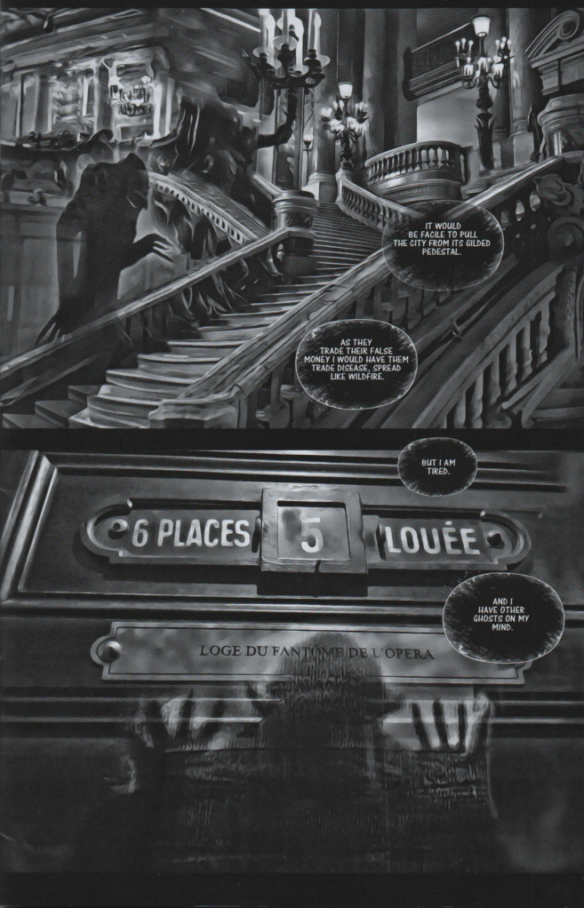
I came across this short one-off comic at a weird fiction convention last year. It was the cover that drew me in; beautifully rendered monochrome headshots of three giants of silent horror movies: Max Schreck as Count Orlok (Nosferatu, 1922), Lon Chaney as Erik (The Phantom of the Opera, 1925) and Conrad Veidt as Cesare (The Cabinet of Doctor Caligari, 1920).

The story begins at the Paris opera house, with an iconic gaunt silhouette creeping up the ornate stairs to a private box, where a familiar masked figure is taking in the evening’s performance on stage. The two old monsters meet, exchange pleasantries and make a deal of sorts, which involves a vial of blood and the somnambulist Cesare.

So far, so League of Extraordinary Gentlemen, but where The Silent Scream differs from Moore and O’Neill’s series is Ash Redburn’s art, which faithfully evokes the black & white imagery of those old 1920s horror films. It’s almost like one of those old magazine photostories, but rather than just pasting word balloons onto some screen-captured stills, here the artwork remixes and blends its visual source material, creating a truly original monster mash. The writing too does justice to its origins but takes the result in new directions. After all, what would the Phantom and Nosferatu talk about?


The Legend  of Luther Arkwright by Bryan Talbot

Recommended by James Bacon

It is incredible that Luther Arkwright stories written and drawn by the versatile Bryan Talbot began in 1978, and now we have the latest story to consider, The Legend of Luther Arkwright. The artwork continues to be beautiful, and richly drawn and complements the story perfectly.

Set in the science fictional multiverse that allows for some very subtle and some really cleverly in your face visions, extrapolating on current trends and concerns, there is an incisiveness to Talbot’s work, where pages are filled with visual treats and threats, as we journey with the psychically powered Arkwright as he navigates a selection of parallels that have already diverged from our own, and we see the potential hellscapes that we might ask ourselves, if we are lucky to have avoided, while contemplating what might have been. There are many storytelling devices deployed with the comic, which immerse the reader into the story. 

Arkwright is of course, in an existential battle, one that is full of action and quickly paced, and it weaves excitingly, as the reader is never sure footed about where it will lead, and whether there is some conjuring story telling trick ahead, as Talbot manages the adventure.

There are thoughtful moments, times when we see development and learn of characters and there is at this stage also pause to reflect back over “history” and for those who have read The Adventures of Luther Arkwright and Heart of Empire there is a continuity and continuation that is satisfying, yet this is a tale that can stand alone.

It is so much a story of this instance,  even as we see parallels which are removed from our reality, they speak to the reader, gives a sense of possible place, and  while the original adventures reflected on a war within Britain while being relevant to the world in 1978, the story published now features the media and leans heavier into the political fight, and one feels the issues absolutely resonate with the now, of this actual moment in 2025. It is frightening that a work which was started some years past can yet be eerily so painfully evocative and touching here and now.

Pixel Scroll 3/12/25 The Shire My Destination

(1) BOOK BANNING NEWS, [Item by Bruce D. Arthurs.] Malinda Lo’s Last Night At The Telegraph Club is one of a number of books being considered for a statewide ban in South Carolina. Lo wrote the review committee an excellent letter defending her book and others like it. “Telegraph Club Considered for Possible Statewide Ban in South Carolina”.

… The parent who challenged LNATTC and other books in Beaufort County and at the state level is Elizabeth Szalai. She had a 5% success rate in Beaufort County, but she has had a 100% success rate at the state level so far.

Szalai’s complaint claims that LNATTC “contains explicit sexual activities in violation of Regulation 43-170 specifically touching of breast and masterbation [sic].” The complaint includes excerpts of scenes from LNATTC stripped of their context. Indeed, the context of the entire novel is irrelevant to Regulation 43-170.

I am not optimistic that LNATTC will survive this challenge in South Carolina, but it’s still possible….

…I’ve written to South Carolina’s Instructional Materials Review Committee to support my book and to ask them to uphold our First Amendment rights. My letter is below:


Dear members of the Instructional Materials Review Committee of the South Carolina Department of Education:

My name is Malinda Lo, and I’m the author of several critically acclaimed and bestselling young adult novels, including Last Night at the Telegraph Club, which is currently under review by your committee. I’m writing to you not only as the author of this book, but as a concerned American citizen who believes strongly in our First Amendment.

Last Night at the Telegraph Club was the winner of the 2021 National Book Award for Young People’s Literature, the Stonewall Book Award, the Asian Pacific American Award for Literature, the Kids’ Choice Awards Teen Book of the Year, and over over two dozen more honors and awards. It is a coming-of-age novel about a Chinese American girl discovering her identity as a lesbian in 1950s San Francisco. I am a Chinese American lesbian myself, and when I was a teen growing up in the 1980s and ’90s, I often felt alone and confused. I didn’t have access to books like this that would have helped me to better understand who I was. That’s why I write books about LGBTQ+ and Asian American characters. I’m writing the books I needed as a teen.

Since Telegraph Club was published, many LGBTQ+ and Asian American readers have contacted me to tell me how much this book meant to them. Seeing yourself in a book can be a transformative and empowering experience. One reader wrote to tell me, “Your books helped me love and accept myself.” A Chinese American reader wrote, “I feel so seen. Perhaps a little bit too seen, as I am on the verge of tears.” A teen from Nashville told me, “it means a lot to see people like me in literature, written by people like me.”

I’m an immigrant who came to the United States with my family from China when I was a child, and we settled in Boulder, Colorado. I grew up knowing that we came here to escape the oppression of the Chinese Communist government, which does not allow freedom of expression or the freedom to read. This is why I’ve always valued our First Amendment rights. The possibility that my book could be banned across the entire state of South Carolina alarms me because censorship goes directly against the ideals of our country.

I urge you to trust the judgement of your local teachers and librarians, who selected my book — and many others — for their school libraries based on their professional judgement and training. While not every book is for every reader, every reader deserves the freedom to choose what they wish to read, not to have those rights taken away from them by the state. I hope you will take this opportunity to support our fundamental rights and freedoms as Americans.

Thank you for your consideration.

Sincerely,
Malinda Lo


The hearing is Thursday, March 13….

(2) GREG BEAR’S PAPERS TO SDSU. Astrid Bear updated readers of the late Greg Bear’s Facebook page:

My major task and accomplishment last year was sorting, boxing, and shipping Greg’s papers to his alma mater, San Diego State University, where they are held in the library’s Special Collections. There are 60+ boxes of journals, notes, manuscripts, and letters, plus a lot of his original artwork. It’s truly a treasure, a deep dive into his creative process and the breadth and depth of his thinking and interests. But here’s the thing about archived papers — for students and researchers to have meaningful access, there needs to be a catalogue of what’s there, called a finding aid, and the items need to be stored using archival standards, such as acid-free boxes. So, I’ve made a donation of $5,000 to help fund those efforts, and am asking you to help match that. A total of $10,000 will go a long way to make the archive accessible.

SDSU is having their major annual fundraising effort right now, so there’s a spiffy website interface for making donations. Link will be in the comments. If you are able to donate even a little bit, that will help meet the $10,000 goal. My match money is already there, just waiting to partner with yours.

“The link in the comments should take you my fundraising page. Scroll down to Matches and Challanges to find Library: $5K Match to the Special Collections Support Fund, and you’ll see my name there. Click on Contribute and it will take you to the page to enter your info. The designation should already be filled in, Library Special Collections Fund. If it’s not, go up a bit to the drop-down menu titled, “There are 6 matches and/or challenges running!” and select “Just for Library Special Collections Fund.”

“Thank you so much for considering this. SDSU and its libraries meant a lot to Greg, as did having his archives be available and studied long into the future.”

Here’s the link to the fundraiser: University Library · GiveCampus (sdsu.edu)

(3) PROZINE OWNERSHIP TRANSITION PLANS. Locus Online has extensive “Details on the New Owners of Analog, Asimov’s, and F&SF”, including statements from P.L. Stevens, publisher, of new owner Must Read Books Publishing, sellers Penny Publications and Gordon Van Gelder (F&SF), as well as Analog editor Trevor Quachri and Asimov’s editor Sheila Williams.

All editorial staff from the magazines have been retained in the acquisitions….

The parent company will take over sponsorship of the Astounding Award for Best New Writer, the Black Orchid Novella Award (with The Wolfe Pack), the Dell Award for Undergraduate Excellence in Science Fiction and Fantasy Writing, Asimov’s Readers Awards, AnLab Awards, The Analog Award for Emerging Black Authors, and Ellery Queen Readers Awards, among others.

(4) WHY YES, HOW DID YOU KNOW? Times have changed. People who’d had a few drinks and would want to avoid coming home smelling like the bar might chew a few Sen-Sen before they walked through the door. Today? To make sure they come home smelling that way – well, at least like they’ve had too much Butterbeer – Orly offers this line of Harry Potter-inspired cosmetics. “Ultimate Harry Potter™ Butterbeer™ Experience” at Orly Beauty.

Infused with the iconic BUTTERBEER™ scent from the Harry Potter™ film series, this collection features all four products from the BUTTERBEER™ collection. From a whimsical Iridescent Topper to a Quick Dry Nail Spray to Nourishing Cuticle Oil and Hydrating Cuticle Froth, your nail care routine is about to become your favorite experience.

(5) HALF-CENTURY OF ROCKY HORROR. “Strange Journey: The Story of Rocky Horror’ Review: Sweet Doc Tribute” at The Hollywood Reporter.

Watching Linus O’Brien’s Strange Journey: The Story of Rocky Horror, a new documentary launching out of SXSW, my most frequently thought was that — actual quality of the film notwithstanding — it’s an absolute blessing to be getting this examination of the Rocky Horror phenomenon at this particular moment in time.

Released tied to the 50th anniversary of the Rocky Horror Picture Show film, Strange Journey benefits to no small degree from the presence of O’Brien, son of The Rocky Horror Show creator Richard O’Brien — which means access to archives and memories and presumably easier facilitation of conversations with an astonishing assortment of people associated with the property at every level.

Richard O’Brien is 82; director Jim Sharman is 79; star Tim Curry is 78; Lou Adler, who brought the stage show from London to Los Angeles and then produced the movie, is 91. All are present in the documentary, as are musical director Richard Hartley, costumer Sue Blane, and stars including Susan Sarandon, Barry Bostwick, Patricia Quinn and even Peter Hinwood, who played Rocky and hasn’t acted since the ’70s. The time to get all of these people together, on camera, to discuss all things Rocky and share their stories is not infinite and, as a result, fans will find plenty to cherish in Strange Journey….

(6) COMICS ATTRACTING YOUNG READERS. [Item by Steven French.] This perhaps comes as no surprise to the parents among us: “’Something magical is happening’: sales boom for children’s comics creating young readers of the future” in the Guardian.

The best route to learning to love words in print could well be pictures. This, at least, is the hope of the publishing industry this spring, as it welcomes news that sales of children’s comics and graphic novels have reached an all-time peak of almost £20m in Britain.

While publishers and editors are celebrating this boom for its own sake, the popularity of these titles is also being hailed as a good omen for novels, ahead of the London Book Fair at Olympia this week. “Over the last decade we’ve seen a significant rise in sales of graphic novels for both the adult and children’s markets,” said Philip Stone, media analyst at NielsenIQ BookData, as he revealed details of the latest trends, hits and flops this weekend.

“Superhero books have been a reliably big feature, probably boosted by all the screen superhero movies. A lot of manga series are doing very well again, and this may also be linked to screen versions. What we really need now is some deep-dive research into the impact of graphic and comic fiction as a gateway for young people into reading. We certainly suspect it’s true.”…

(7) GENE WINFIELD (1927-2025). Custom car creator Gene Winfield died March 4 at the age of 97 reports Deadline.

Gene Winfield, a pioneering legend in the hot-rod world who created custom cars for numerous films and TV shows including Blade Runner, the original Star Trek series, RoboCop, Get Smart! and many others, has died. He was 97.

Winfield’s …. most famous creations include the iconic Galileo shuttlecraft and the Jupiter 8 for Star Trek [seen in the episode “Bread and Circuses”]and the “spinners” for Blade Runner, which was nominated for the Special Effects Oscar. He also built the Catmobile for TV’s Batman and gadget cars for Get Smart! and The Man from U.N.C.L.E.

His futuristic vehicles are seen in Back to the Future II, the original RoboCopThe Last Starfighter, Woody Allen’s Sleeper and others. Winfield’s cars also are seen in the Dirty Harry sequel Magnum Force, Bewitched, Ironside, TV’s Mission: Impossible and more….

(8) MEMORY LANE.

[Written by Cat Eldridge.]

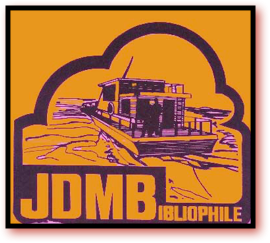
JDM Bibliophile zine

JDM Bibliophile (1965–2004). This one is for John D. Macdonald completists.

John D. MacDonald became the subject of a fan magazine in March 1965 when Len and June Moffatt of Downey, California first published the JDM Bibliophile (JDMB), devoted to his work. MacDonald starting writing for pulp magazines in 1946 during their waning days.

JDMB, a mimeographed magazine at the time, was described in its initial issue as a “non-profit amateur journal devoted to the readers of John D. MacDonald and related matters.” A goal was to obtain complete bibliographic information on all of MacDonald’s writings, and this was partly achieved with The JDM Master Checklist, published in 1969 by the Moffatts. 

They had help from many people, including MacDonald himself. Though he kept good records, he, like most authors, didn’t have complete publishing data on his own work. Especially helpful to the Moffatts were William J. Clark and another couple, Walter and Jean Shine of Florida. 

The Shines published an updated version of the Checklist in 1980, adding illustrations, a biographical sketch, and a listing of articles and reviews of MacDonald. JDMB offered news and reviews of MacDonald’s writings and their adaptation to various media. There were also contributions from MacDonald, including reminiscences and commentary. The Moffatts contributed a column (“& Everything”), as did the Shines (“The Shine Section”). Other JDM fans sent articles, letters, and parodies. One issue, #25 in 1979, included the Shines’ “Confidential Report, a Private Investigators’ File on Travis McGee,” describing information gleaned from the McGee canon about his past, interests, cases, and associates. MacDonald once said of Walter Shine, “He knows more about Travis than I do.” 

After the Moffatts had published twenty-two issues of JDMB, it was transferred in 1979 to the University of South Florida in Tampa, with Professor Edgar Hirshberg as editor. It continued until 1999. One final issue, #65, was published as a memorial to Hirshberg who had died in June 2002. It was edited by Valerie Lawson. On February 21, 1987, about a hundred McGee fans gathered at his “address,” Slip F-18 at the Bahia Mar Marina in Fort Lauderdale, Florida, where McGee kept his houseboat The Busted Flush. The mayor of Fort Lauderdale unveiled a plaque honoring McGee.

Amazon has scattered back issues available. 

So this cover for one of them done by an unknown USF student. If is not considered a close representation of The Busted Flush. For that, you should see the second image which is from The Busted Flush fan site as it “is a rendering of the boat, which MacDonald felt was very close to what he had in mind, but, as he always said about the boat and Travis McGee, he did not want to be exact about either.  Let the reader fill in the gaps.” 

(9) COMICS SECTION.

(10) SHELVES OF DREAMS. “If You Build It, Comic Book Fans Will Come” contends Publishers Weekly.

Periodical comics made the leap from convenience store spinner racks to trade paperback collections at bookstore chains in the 1980s. And while the transition did present some initial challenges to booksellers—in those early days, it wasn’t uncommon to see superhero titles shelved next to Garfield in the “humor section”—the move proved both lucrative and permanent. Today, comics can be found wherever books are sold, with big-box retailers devoting considerable real estate to graphic novels. How do smaller specialty shops compete?

“Community is essential to the business,” says Jenn Haines, owner of The Dragon, an Eisner Spirit of Retailing Award–winning shop in Guelph, Ontario. “Generally, people who read comics have found themselves not quite fitting in.” But fans can find community, she adds, by browsing the shelves.

According to the latest ICv2 industry report, of the $1.87 billion in comics and graphic novel sales in 2023, 61% are from book channels, while 36% are via the direct market, which comprises approximately 3,000 specialty comics retailers. Indications are that specialty shops’ share rose in 2024, which was “a pretty good year in comic stores,” reports Milton Griepp, president of ICv2, which did not release full figures by press time.

According to Haines, her store’s annual sales have been generally consistent over the past five years. The Dragon’s overall 2024 sales, which includes games and toys, were up 3% over 2023, with sales of comics and graphic novels increasing 5%….

(11) UPSTAIRS, DOWNSTAIRS. Conor Dougherty analyzes “How ‘Silo’ and ‘Paradise’ Envision Housing After the Apocalypse” in the New York Times (behind a paywall).

Paradise” is a TV show on Hulu about a postapocalyptic society that lives underground in a suburb. “Silo” is a TV show on Apple TV+ about a postapocalyptic society that lives underground in an apartment tower.

Both are propelled by mysteries. Both feature curious heroes. Both have shifty leaders who lie, blackmail and murder to keep their secrets hidden and their denizens in line.

The shows have much in common, in other words.

But somehow they find opposing answers to a question that seems increasingly relevant in a warming world: If the planet goes to hell and humanity heads to a bunker, what sort of neighborhood will we build inside it? A spacious holdout that tries to approximate a comfortable standard of living, or a cramped locker that saves more lives but leaves the survivors miserable?

By imagining wildly different landscapes in response to the same end-of-the-world conceit, the shows use cinematic extremes to show how civilization and class divisions are constructed through the apportionment of space. People like to live around other people right up to the moment they feel their neighborhood has been overrun by others, at which point the hunger for togetherness becomes an impulse to exclude.

A good amount of today’s housing politics fall within these parameters, whether it’s a proposal to build apartments in a suburb or a plan to cover farms with a new city. The fact that this debate now extends to fictional bunkers has me convinced that in the aftermath of global calamity, people will be at some dystopian City Council meeting arguing about zoning….

(12) WHEN BUSINESS IS BOOMING AND THAT’S NOT GOOD. [Item by Mark Roth-Whitworth.] I don’t want to just link to an X-twit post, so… Sounds like they should *not* have launched that last one, given this. My take is that Elon was hurting, the attacks by the public on him, and on Tesla, and he said “launch”. As reported on Slashdot: “Anonymous Sources: Starship Needs a Major Rebuild After Two Consecutive Failures”.

According to information at this tweet from anonymous sources, parts of Starship will likely require a major redesign due to the spacecraft’s break-up shortly after stage separation on its last two test flights. These are the key take-aways, most of which focus on the redesign of the first version of Starship (V1) to create the V2 that flew unsuccessfully on those flights…

(13) BUSY SKIES. “Saturn Gains 128 New Moons, Bringing Its Total to 274” – the New York Times is counting.

Astronomers say they have discovered more than 100 new moons around Saturn, possibly the result of cosmic smashups that left debris in the planet’s orbit as recently as 100 million years ago.

The gas giant planets of our solar system have many moons, which are defined as objects that orbit around planets or other bodies that are not stars. Jupiter has 95 known moons, Uranus 28, and Neptune 16. The 128 in the latest haul around Saturn bring its total to 274.

“It’s the largest batch of new moons,” said Mike Alexandersen at the Harvard-Smithsonian Center for Astrophysics, an author of a paper announcing the discovery that will be published in the days ahead in Research Notes of the American Astronomical Society.

Many of these moons are rocks only a few miles across — small compared with our moon, which is 2,159 miles across. But as long as they have trackable orbits around their parent body, the scientists who catalog objects in the solar system consider them to be moons. That is the responsibility of the International Astronomical Union, which ratified the 128 new moons of Saturn on Tuesday….

… The current naming scheme for moons on Saturn is based on characters from Norse and other mythology.

“Maybe at some point they’ll have to expand the naming scheme further,” Dr. Alexandersen said….

(14) LANDING IN THE FINAL FRONTIER. “Saucer-like ‘Winnebago’ space capsule lands in Australia — marking 1st for commercial space industry” reports Live Science.

A saucer-like space capsule touched down in the Australian outback last month, marking the first time a commercial spacecraft has landed Down Under.

Varda Space Industries’ Winnebago-2 (W-2) space capsule reentered Earth’s atmosphere and dropped down in South Australia on Feb. 28. In doing so, W-2 also set a world first by becoming the first commercial spacecraft to return to a commercial spaceport, according to a statement released by the Australian Space Agency.The successful return of W-2 was a “landmark moment for the Australian space sector,” Australian Space Agency representatives wrote in the statement.

The company behind W-2, Varda, is an American startup based in California. W-2 originally left Earth from California on a SpaceX Falcon 9 rocket on Jan. 14 as part of the Transporter-12 rideshare mission — the Transporter carries satellites from various customers into space. W-2 then spent 45 days in orbit, carrying payloads from the U.S. Air Force and NASA before dropping down to the Koonibba Test Range, run by Australian aerospace company Southern Launch….

(15) BEAST GAMES PITCH MEETING. [Item by Mike Kennedy.] Beast Games was apparently inspired in part by how much the host (famed YouTuber Mr. Beast) enjoys Squid Games. But there’s also apparently zero to very little about the actual games played on BGs that is inspired by games on SGs. Also, no killing the contestants. Not that I’ve ever watched either show (or anything by Mr. Beast), nor would I care to.

[Thanks to Andrew Porter, John King Tarpinian, Chris Barkley, Daniel Dern, Bruce D. Arthurs, Cat Eldridge, SF Concatenation’s Jonathan Cowie, Mark Roth-Whitworth, Steven French, Kathy Sullivan, Teddy Harvia, and Mike Kennedy for some of these stories. Title credit belongs to File 770 contributing editor of the day Daniel “Good, Bester, Best!” Dern.]

Pixel Scroll 12/7/24 Get Your Scrolls Here, Just A Pixel Each

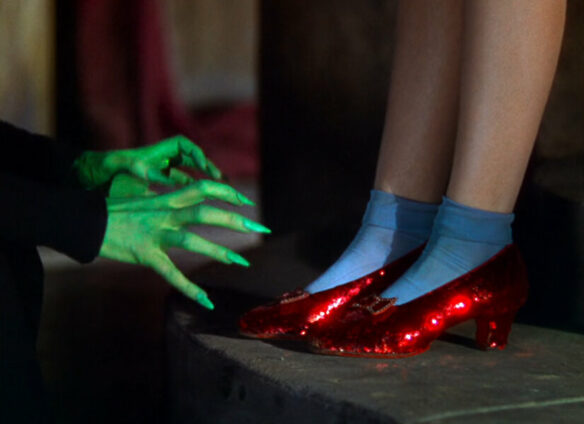
(1) THEY FOLLOWED THE YELLOW BRICK ROAD. The Hollywood Reporter listens to the gavel bang when the “Ruby Slippers from ‘The Wizard of Oz’ Sell for a Record $28 million”. (The Wicked Witch’s hat sold, too.)

A pair of the ruby slippers worn by Judy Garland in 1939’s The Wizard of Oz fetched an all-time auction record for entertainment memorabilia when they sold on Saturday afternoon for $28 million. The sale was handled by Dallas-based Heritage Auctions. With the buyer’s premium, the total is $32.5 million, and the buyer currently remains anonymous.

Auctioneer Mike Sadler announced at the podium at the conclusion of the lot’s bidding that the slippers had far surpassed the previous auction record of $5.52 million for the white halter dress designed by William Travilla and worn by Marilyn Monroe in 1955’s The Seven Year Itch. That costume also was sold at Heritage in 2011 and was part of the famed collection of Debbie Reynolds….

… Three other pairs of ruby slippers are known to exist. One pair resides in the National Museum of American History at the Smithsonian Institution in Washington, D.C., while in 2012 Leonardo DiCaprio and Steven Spielberg led a consortium of buyers to purchase a pair of ruby slippers, for a reported $2 million, to reside in the permanent collection of the Academy Museum of Motion Picture Arts & Sciences. A third pair is believed to be owned by a private collector….

… Also sold on Saturday: a witch’s hat worn by Margaret Hamilton, who played the Wicked Witch of the West in the Victor Fleming-directed film based on the beloved L. Frank Baum story. The black pointed hat, which was screen-matched to Hamilton’s first scene as the Wicked Witch in the film, sold for $2.93 million with buyer’s premium….

(2) THOSE GREAT EXPECTATIONS. Works in Progress presents “The world of tomorrow”, where Virginia Postrel asks, “When the future arrived, it felt… ordinary. What happened to the glamour of tomorrow?”

… In the twentieth-century, ‘the future’ was a glamorous concept.

Joan Kron, a journalist and filmmaker born in 1928, recalls sitting on the floor as a little girl, cutting out pictures of ever more streamlined cars from newspaper ads. ‘I was fascinated with car design, these modern cars’, she says. ‘Industrial design was very much on our minds. It wasn’t just to look at. It was bringing us the future.’

Young Joan lived a short train ride from the famous 1939 New York World’s Fair, whose theme was The World of Tomorrow. She went again and again, never missing the Futurama exhibit. There, visitors zoomed across the imagined landscape of America in 1960, with smoothly flowing divided highways, skyscraper cities, high-tech farms, and charming suburbs. ‘This 1960 drama of highway and transportation progress’, the announcer proclaimed, ‘is but a symbol of future progress in every activity made possible by constant striving toward new and better horizons.’

‘All I wanted to do,’ Kron says, ‘was go into the World of Tomorrow.’ She wasn’t alone. Anticipating a bright future was a defining characteristic of the era, especially in the United States.

When Disneyland opened in 1955, Tomorrowland embodied the promise of progress. A plaque at the entrance announced ‘a vista into a world of wondrous ideas, signifying man’s achievements . . . a step into the future, with predictions of constructive things to come.’

Back then, the Year 2000 and the Twenty-first-century were glamorous destinations….

(3) YOU’RE FROM THE SIXTIES! Dwell analyzes “How ‘Star Trek’ Helped Make Midcentury-Modern the Signature Sci-Fi Aesthetic”.

When Star Trek first premiered in the mid-1960s, it was meant to portray a far-off future, with Captain James T. Kirk and Mr. Spock traversing the universe 300 years hence. While the sci-fi television series has come to be recognized for many things in the decades since, like having the first Black female leading character on network TV, a king’s ransom of spin-offs, and an extremely dedicated global fan base, another major aspect of its legacy is its space-age-inspired visual identity that helped shape the intersection of midcentury modernism and what consumers see as “futuristic design,” even now.

While the show’s aesthetic choices were partially practical—its Warren Platner arm chairs and Stemlite lamps were the types of pieces set designers could snag from Los Angeles–area stores that looked more futuristic than grandma’s old divan—they also presented a sleek, nontraditional look that encapsulated the spirit of technological innovation and utopian vision that characterized midcentury modernism. By using something like Eero Saarinen’s 1950s Tulip chair (or, more accurately, a Maurice Burke–designed knockoff, which was more cost-effective at the time, and which the Star Trek crew then modified) the set designers could convey an alien future without having to create pieces from scratch….

(4) EATING THE FANTASTIC. Scott Edelman invites listeners to share scallops with R. S. A. Garcia in Episode 242 of the Eating the Fantastic podcast.

Garcia won both the Nebula Award and the Theodore Sturgeon Memorial Award for her short story “Tantie Merle and the Farmhand 4200,” published in Uncanny, and was a Nebula finalist the previous year as well for her novella “Bishop’s Opening,” which appeared in Clarkesworld. She is also the winner of the MIFRE Media Award, and a Sturgeon, Locus, Ignyte and Eugie Foster Award finalist. Her short fiction has appeared in venues such as Escape PodStrange Horizons, and Internazionale Magazine, as well as a number of anthologies, including the The Best of World SFThe Best Science Fiction of the Year, and The Apex Book of World SF

R.S.A. Garcia

Her Amazon bestselling science fiction mystery, Lex Talionis, received a starred review from Publishers Weekly and the Silver Medal for Best Scifi/Fantasy/Horror Ebook from the Independent Publishers Awards. Her sci-fantasy duology, beginning with The Nightward, was published by Harper Voyager US in October, plus The Unbearable Taste of Fruit and Wine will be out next Valentine’s Day from Android Press.

We discussed how the idea for her Nebula-winning short story caused her to leap up and walk out of a writing workshop, how editor Ellen Datlow’s advice changed her life, why writing is a verb, not an adjective, the way she decides whether or not to rise to the occasion of a themed anthology invite, her convoluted journey in finding an agent to negotiate her first novel sale even though there was already an offer on the table, why there are some rejections you should be grateful for, how Sigourney Weaver’s role in Alien inspired the sorts of stories she wanted to tell, the Easter eggs in her fiction only a Trinidadian would get, how and why she’s a complete pantser, the importance of community as well as the danger of it disappearing, her hope that readers get even more from her fiction upon rereading,  and much more.

(5) SHARPER THAN A SERPENT’S TOOTH. “Replica Harry Potter swords recalled for breaking weapons law” reports BBC.

Replicas of a sword featured in the Harry Potter film franchise have been recalled in Japan for violating the country’s strict weapons law.

The full-sized replicas of Godric Gryffindor’s sword – which measure 86cm (34 inches) and are affixed to a wooden display plaque – were sold by Warner Bros. Studio Japan LLC from May 2023 to late April of this year.

But it was only in November that authorities told the company those pieces were sharp enough to be categorised as an actual sword.

More than 350 replicas of Godric Gryffindor’s sword were sold, reports add, with each one going for 30,000 yen ($200; £158).

The sword was sold at the Warner Bros. Studio Tour Tokyo: The Making of Harry Potter, which opened in 2023 in Tokyo. It is billed as the first such studio tour in Asia and the largest indoor Harry Potter attraction in the world.

Warner Bros. Studios Japan LLC has published a recall notice for the sword on its site, citing “a distribution issue in Japan” and requesting people who bought it to get in contact for “necessary action including logistics and refund”….

(6) GRAPHIC NOVEL ROUNDUP. [Item by Steven French.] Some genre related riches here! “The best graphic novels of 2024” in the Guardian. The list includes:

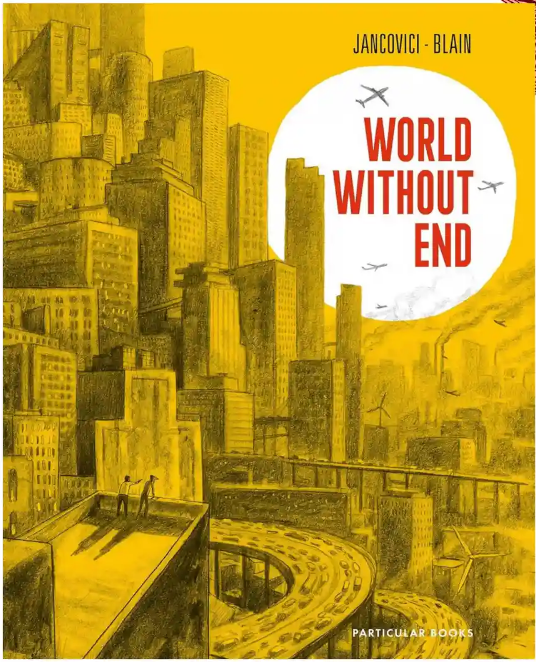
…One of the year’s most talked-about releases, World Without End (translated by Edward Gauvin, Particular), outsold Astérix in its native France. Artist Christophe Blain walks us through climate expert Jean-Marc Jancovici’s urgent explanation of economic progress, sustainability and global warming in a book that’s statistics-packed but – thanks to Blain’s deceptively jaunty, eye-opening visuals – brilliantly accessible….

(7) TEN BEST SFF BOOKS OF YEAR. New York Times columnist Amal El-Mohtar names “The Best Science Fiction and Fantasy Books of 2024” (gift link bypasses paywall).

Of the many great books I read this year, the following 10 have stayed with me, undergirded my thoughts as I go about my days and provoked excellent, chewy conversations about craft and pleasure, empire and resistance. While I’m a little haunted by the violence publishers seem to be doing to the very concept of a series — claiming sequels are stand-alones, while insufficiently supporting and labeling the parts of actual series — I hope you find something to enjoy among these fantastic works.

This list begins with –

The Book of Love By Kelly Link

“The Book of Love” is a landmark, the kind of fantasy novel that has its own gravity and distorts the genre terrain around it. Set in a small town called Lovesend, it tells the story of teenagers who return from the dead and must compete to remain alive by completing magical tasks. A tender tribute to romance novels, fairy villains and fairy lovers, “The Book of Love” does justice to its name.

(8) SEASON INNIE, SEASON OUTIE. Apple TV+ has dropped the Severance — Season 2 Official Trailer. Season 2 premieres January 17.

In Severance, Mark Scout (Adam Scott) leads a team at Lumon Industries, whose employees have undergone a severance procedure, which surgically divides their memories between their work and personal lives. This daring experiment in “work-life balance” is called into question as Mark finds himself at the center of an unraveling mystery that will force him to confront the true nature of his work… and of himself. In season two, Mark and his friends learn the dire consequences of trifling with the severance barrier, leading them further down a path of woe.

(9) TODAY’S BIRTHDAY.

[Written by Cora Buhlert.]

Born December 7, 1915Leigh Brackett. (Died 1978.)

By Cora Buhlert: I first became aware of Leigh Brackett via her contribution to the screenplay for The Empire Strikes Back, during a time when I sought out everything that anybody involved with Star Wars had ever done or been influenced by. That way, I found some very good works, some not so good ones and some which were frankly baffling. Leigh Brackett definitely belongs to the first category.

According to interviews later in life, Leigh Brackett discovered her love of both science fiction and writing in 1923 at the age of eight, when she read The Gods of Mars by Edgar Rice Burroughs. The novel blew her mind and set her on the path to becoming a science fiction writer. It’s probably no accident that so many of her stories would be set on a Mars that was not that far removed from Burroughs’ Barsoom. Meanwhile, the foundation for Leigh Brackett’s later career as a screenwriter were laid during her time at a private girls’ high school, where she penned plays for the theatre group.

Ray Bradbury and Leigh Brackett. Photo by Len Moffatt.

In 1939, Leigh Brackett joined the Los Angeles Science Fiction Society and befriended such current and future luminaries as Robert A. Heinlein, Ray Bradbury, Henry Kuttner and C.L. Moore. Kuttner and Moore not only supported her fledgling career, but also introduced her to Edmond Hamilton, who was eleven years her senior and already a pulp science fiction veteran. The two started dating and married in 1946. Ray Bradbury was the best man. 

Leigh Brackett broke into the science fiction magazines with “Martian Quest”, which appeared in the February 1940 issue of Astounding Science Fiction. Two more stories for Astounding followed in 1940 and 1942, but Leigh Brackett did not get along with John W. Campbell (neither did Edmond Hamilton) and so took her talent to magazines that were more suited to the type of adventure packed planetary romance that Brackett excelled at. Planet Stories published some of her best-known stories, but her work also appeared in Startling StoriesThrilling Wonder StoriesAmazing StoriesWeird Tales and other magazines of the era. By the late 1940s, Leigh Brackett was known as “the Queen of Space Opera”.

Most of her stories were set in a version of our solar system that never was, where Mars was a dying desert world littered with ancient ruins, Venus was a mist-shrouded tropical ocean world, Mercury was a tidally locked hellhole and Earth was hellbent on colonizing the rest of the solar system. Leigh Brackett’s work belies claims that the science fiction of the golden age was exclusively white, male, racist and colonialist. Brackett’s protagonists were often outsiders – drifters, outlaws, drug addicts – and several of them, most notably Eric John Stark, were not white. The women were alien temptresses or interplanetary Girl Fridays, but always formidable. Her takes on Mars and Venus were dripping with atmosphere and often melancholic and particularly her early stories were often critical of colonialism and imperialism and how they impact the indigenous population. In her 1944 novel Shadow Over Mars, the evil corporation that operates slave mines on Mars is called the Terran Exploitation Company, a rare case of truth in advertising.

Leigh Brackett’s science fiction often has a certain noir sensibility and so it’s no surprise that she also started writing hardboiled crime fiction. Her 1944 crime novel No Good From a Corpse brought her to the attention of Howard Hawks who hired her to co-write the screenplay for The Big Sleep, kickstarting her screenwriting career which led to penning the scripts for such cinematic classics as Rio BravoEl DoradoHatari and The Long Goodbye. Her screenplay draft for The Empire Strikes Back was very much the capstone of Leigh Brackett’s career both as a science fiction and screenwriter – especially since her work influenced both Star Wars and Indiana Jones – and it’s only fitting that the movie is dedicated to her memory. It also won her a posthumous Hugo Award, her first, even though she was nominated as early as 1956 for her post-apocalyptic novel The Long Tomorrow as the first ever female Hugo finalist along with her friend C.L. Moore.

Leigh Brackett was one of the most important science fiction writers of the golden age. But the fact that the majority of her stories appeared in what were considered second tier magazines (they weren’t, but that’s a story for another day) is also why her stories was less reprinted and remembered than they should have been. By the time, I became interested in her work in the late 1980s, all of it was out of print and I had to hunt down yellowing paperbacks in used bookstores. As a result, the first thing by Leigh Brackett that I actually read – though I had seen several of the movies for which she wrote screenplays – was the Skaith Trilogy from the mid 1970s, where Leigh Brackett revisited her most famous character Eric John Stark and sent him to a distant dying star, since the Mars and Venus he’d roamed in the 1940s had long since been debunked by the Mariner space probes. The novels were good enough that I wanted to read more, but not as good as her stories from the 1940s.

In many ways, Leigh Brackett was a victim of bad timing. The planetary adventures on which she’d built her career fell out of fashion by the 1950s and her markets died off one by one. L. Sprague De Camp considered hiring her to write new Conan adventures, but went with Lin Carter instead (Oh, what might have been). And Leigh Brackett died too young, aged only 62, to take advantage of the space opera resurgence in the wake of Star Wars. But she will forever remain the Queen of Space Opera.

Leigh Brackett in High School performance.

(10) COMICS SECTION.

(11) THIS JOB IS NOT THAT F#%$! EASY. Invincible Season 3 arrives February 6 on Prime Video — first three episodes that day, then weekly through March 13.

Based on Robert Kirkman’s award-winning comic book series, Invincible follows 19-year-old Mark Grayson, as he inherits his father’s superpowers and sets out to become Earth’s greatest defender, only to discover the job is more challenging than he could have ever imagined. Everything changes as Mark is forced to face his past, and his future, while discovering how much further he’ll need to go to protect the people he loves.

(12) FRANKENSTEIN IS THE PEN’S NAME. LeBoeuf Pens will be happy to sell you The Mary Shelley Frankenstein Limited Edition Fountain Pen for the monstrous price of $225.

But if money is no object for you, immediately order this most elaborate Montegrappa Universal Monsters Fountain Pen – Frankenstein (Limited Edition) — $6200 from Atlas Stationers. Did you ever see such a desk set? Talk about impressive!

(13) EARLY BIG MEALS. [Item by SF Concatenation’s Jonathan Cowie.] The cover story in this week’s Science Advances journal relates to ancient N. American diets. Although it has long been recognised that the Clovis peoples of North America (13,000 to12,000 years ago) hunted consumed megafauna such as the mammoth, controversy continued about whether they specialised in these species or if they had a broader diet. Using stable isotopic analysis of the remains of the 18-month-old Anzick-1 child researchers reconstructed his mother’s diet and found that mammoth was the largest contributor to it, followed by elk and bison. They then compared her diet with those of carnivores from the region and found that it was closest to that of the now-extinct scimitar-toothed cat, which specialized in hunting mammoths. The researchers suggest that this focus on mammoth procurement facilitated the rapid spread of Clovis culture.

Research here: “Mammoth featured heavily in Western Clovis diet”.

(14) SINGULAR SENSATION. “Technological Singularity in 7 Years?”SCIFI.radio doesn’t see it happening.

… WHAT IS THE SINGULARITY ANYWAY?

The Singularity is a theoretical point in the future when technological growth becomes uncontrollable and irreversible, resulting in profound changes to human civilization. Often associated with advancements in artificial intelligence (AI), the Singularity is marked by the emergence of super-intelligent systems capable of surpassing human intellectual capacity in virtually every domain.

WHAT WOULD CHANGE IF THE SINGULARITY HAPPENED?

  • Exponential Growth of Technology: Rapid technological advancements, particularly in AI, biotechnology, and nanotechnology, lead to innovations that accelerate progress in unprecedented ways.
  • Artificial General Intelligence (AGI): The development of AI systems with cognitive abilities on par with or exceeding human intelligence, enabling them to perform any intellectual task a human can do—and potentially far better.
  • Automation and Transformation: Profound shifts in economies, work, and daily life as automation and AI take over increasingly complex tasks, rendering many traditional human roles obsolete.
  • Integration with Technology: Potential merging of human biology with technology (e.g., brain-computer interfaces) to enhance physical and cognitive abilities, challenging the definition of what it means to be human.

NOW YOU KNOW THE OUTCOME. DO WE LOOK CLOSE TO YOU?

We are a civilization at war with itself, battling against runaway corporate capitalism, failed democracies, strong-man authoritarian governments springing up all over the planet, three to nine military conflicts of varying degrees taking place all over the planet, runaway climate change effects, microplastics in every ocean and now in the wind raining down on populated areas, diseases that were almost annihilated are running rampant again, deforestation, over-fishing, and climate migration taking place on every continent.

Does this look like a world able to usher in the development of a world-transforming technological breakthrough just as liable to destroy humanity as it is to save it?

(15) IT AIN’T ME BABE. “New York woman blames Star Trek license plates for tens of thousands of dollars in accidental tickets”CBS New York has the story.

A Long Island retiree says she’s getting traffic tickets from all over the country.

But the thing is, she stopped driving four years ago.

So how could this be happening?

Beda Koorey’s love of Star Trek may be at the root of it all

“These came yesterday from Chicago, speeding tickets. They are $100 each,” Beda Koorey said.

Back in 2020, the Huntington resident surrendered her license plates, sold her car, and stopped driving.

“I don’t have a car. I don’t drive. Those plates were turned in,” the 76-year-old said.

Yet, many walks to her mailbox bring the retiree unwanted surprises.

“They are persistent and they keep sending me tickets,” Koorey said.

Her old custom plates honored Star Trek and had the same number as the Starship Enterprise — NCC-1701.

However, for $15 on Amazon and eBay, some Trekkies have been easily replacing their real plates with the same novelty plates — and getting away with it.

Their accrued tickets from all over the country are being mailed to Koorey.

“Red light, speeding, parking, school zone,” she said, describing the types of tickets she receives.

She also gets hit with E-ZPass tolls.

“I got a phone call from Ohio, a police chief looking for plates because they were involved in a robbery,” Koorey said….

(16) KRUGMAN RETIRES FROM NYT. [Item by Scott Edelman.] Paul Krugman announced his retirement from the New York Times, which caused me to remember I recorded his talk at the 2009 Montreal Worldcon, where he discussed how Asimov’s Foundation Trilogy got him into comics, Charlie Stross, and a bunch of other topics related to us.

(17) THE PDF FILES. Mark Barsotti continues his interview with Paul Di Filippo in this fourth installment: “WRITER PAUL Di FILIPPO ~ ‘I hate talking about myself.’”

[Thanks to Teddy Harvia, Mike Kennedy, Andrew Porter, N., Mark Barsotti, John King Tarpinian, Chris Barkley, Cat Eldridge, SF Concatenation’s Jonathan Cowie, Steven French, and Kathy Sullivan for some of these stories. Title credit belongs to File 770 contributing editor of the day Cat Eldridge.]
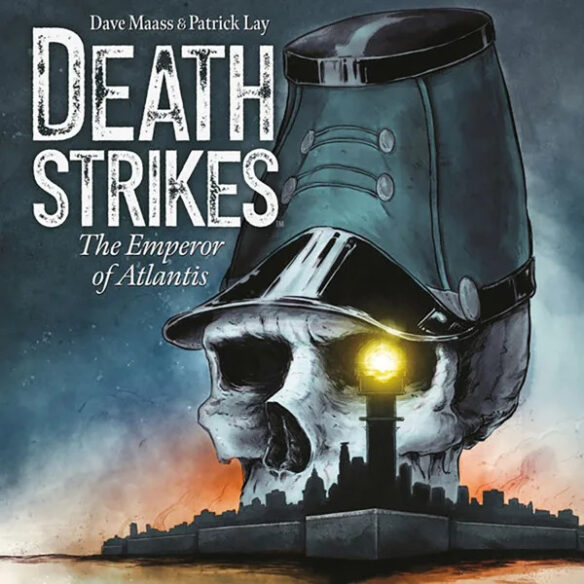
Pixel Scroll 4/11/23 Starship Tribbles! Ad Astra Per Felix Flattus!

(1) UKRANIAN BRADBURY TRANSLATOR MOURNED. [Item by Susan de Guardiola.] It’s being reported that Ukrainian researcher/editor/translator/”culturologist” Yevhen Gulevich (Gulevych), who, among other things, was the translator of Ray Bradbury’s Something Wicked This Way Comes, was killed fighting at Bakhmut in Ukraine. 

His death is covered in Daily Kos’ news roundup “Ukraine Update: If the leaked documents are real, then they’re a good sign for Ukraine”. More detail:

Gulevich was a critical figure in detailing the history of Ukrainian art, explaining the origins of Ukrainian culture, and in mapping that history onto modern Ukraine. He was the editor of a Ukrainian magazine and frequently in demand for his skill at translating books written in other languages into Ukrainian while preserving the emotion and beauty of language. Among others, he translated Ray Bradbury’s “Something Wicked This Way Comes” so that it can be read by generations of Ukrainians the way it has been read and enjoyed by generations of Americans. Gulevich died on Bakhmut. He probably died all the way back at the end of December, but his body could not be found, and his fellow soldiers maintained some level of hope that he was still out there until he was finally declared dead last month. “

The image at the top of that article is from his funeral (”A guard of honor for Yevhen Gulevich at Garrison Church, Lviv, Ukraine. April 10, 2023”) and you’ll see another picture from it if you scroll down to the quote.

(2) TOLKIEN AND WHITE SUPREMACY. Robin A. Reid has posted “Why White Supremacy No Longer Provides Cover for White Academia”, which she presented at the Roundtable on Racisms and Tolkien, Tolkien Studies Area, PCA/ACA 2023.

 …As I discussed yesterday in the roundtable on adaptations of Tolkien, the backlash against Amazon’s Rings of Powers series is part of the ongoing “culture war” effort by contemporary fascists, many who love Tolkien’s work. They are creating “a new front . . . in a decades’-long, international, far-right, culture war. The people waging it aren’t just fighting to keep Tolkien’s imaginary world white and manly and straight. They’re fighting to restore that white-supremacist system in the real world, too” (Craig Franson, personal communication). Yesterday I focused on the question of what fandom, or more specifically, what progressive fans might do. Today, I focus on the question of what white academics can do….

…Too many of the articles on race and Tolkien dismiss racist readers as atypical, as ignorant, as reading the Legendarium badly, and, by extension, dismiss the question of structural/systemic racisms in Tolkien’s legendarium as unimportant to the field of Tolkien scholarship….

(3) JEREMY RENNER ON JIMMY KIMMEL. [Item by Mike Kennedy.] The “Live!“ in the name of Jimmy Kimmel’s show may never have been more relevant than it was Monday night. Jeremy Renner made his first talkshow appearance following his January 1st accident that saw him basically crushed by a multi-ton snowplow.

Renner was there nominally to promote his new Disney+ show “Rennervations,” but it’s certain that his fans were cheered by his ability to walk to the interview chair using nothing more than a cane.

(4) SEE PICARD FINALE IN THEATERS. “’Star Trek: Picard’ Season 3 Finale Gets Special IMAX Screenings” reports Collider. Requests for free tickets open April 12 at 1:00 Eastern.

It’s time to boldly go back to the big screen! The final two episodes of Star Trek: Picard Season 3 are getting a one-night-only theatrical release in select IMAX theaters on April 19 followed by a pre-taped Q&A with the cast of the hit series. Participating cities include Atlanta, Chicago, Dallas, Los Angeles, New York, Orlando, Phoenix, San Francisco, Seattle, and Washington DC. What’s even better is that tickets for the event are free, and they’ll be available on Wednesday, April 12 at 1 PM ET.

(5) GUGGENHEIM. The 2023 Guggenheim Fellows were announced April 5, 171 fellows from 48 fields. Jacqueline Woodson, who has done much genre work, was one of the people named as fellows in the Fiction category.

Fiction 

Lucy Corin, Writer, Berkeley, California; Professor of English, University of California, Davis 

Kali Fajardo-Anstine, Writer, Arvada, Colorado; Endowed Chair in Creative Writing, Texas State University 

James Hannaham, Writer, Brooklyn, New York; Professor, Writing Department, Pratt Institute 

Jac JemcWriter, San Diego, California; Associate Teaching Professor, University of California, San Diego 

Don Lee, Writer, Baltimore, Maryland; Professor, Director of MFA Program in Creative Writing, Temple University 

Rebecca Lee, Writer, Wilmington, North Carolina; Associate Professor, Department of Creative Writing, University of North Carolina Wilmington 

Héctor Tobar, Writer, Los Angeles, California; Professor, University of California, Irvine 

Jacqueline Woodson, Writer, Brooklyn, New York 

(6) RONDO VOTING. Steve Vertlieb reminds us that April 23 is the last day for the public to vote for the Rondo Awards, “fandom’s only classic horror awards”, and he’d be thrilled if you voted for the nominee who interviewed him for the magazine We Belong Dead.

Cinema Retro is looking for votes, too: “Cinema Retro And Mark Mawston Nominated For This Year’s Rondo Awards”.

…Also, Cinema Retro contributor Mark Mawston, who recently brought CR readers a rare, exclusive interview with actor John Leyton, has been singled out for a nomination in the category of Best Interview. This time, the subject of his work is the life and career of noted writer, film, and film music historian, Steve Vertlieb, who reflects on his interactions with a “Who’s Who” of film legends from over the decades. The superb 12-page interview appeared in issue #31 of the popular British horror magazine “We Belong Dead”. Mark is known professionally as “The Rock and Roll Photographer To The Stars” (having photographed such music luminaries at Sir Paul McCartney, Sir Elton John, Eric Clapton, Yoko Ono, and Brian Wilson)….

Click here for the ballot and instructions on how to send in your vote.

(7) BOOK REVIEW. I am the Law: How Judge Dredd Predicted Our Future launched a few weeks ago. Jonathan Cowie has a review in the forthcoming seasonal edition of SF2 Concatenation and tweeted an advance post.

Even if you do not know of Judge Dredd but have an interest in policing and legality, then this is a fascinating introduction into twentieth and early twenty-first century trends, that, if they continue, lead to a worrying future…

For SF fans, this book is an exemplar of science fiction’s value to society and how the genre can, on occasion, seem to predict the future. In this case the seeming predictions – note the plural, for there are many – are unnervingly spot on and so if Judge Dredd is some sort of quasi-reflection of our future, then it is an unsettling one, and one at which we should rail against

Judge Dredd should come with a health warning when given to kids.

If perchance you have never heard of Judge Dredd (is there anyone in the western world under the age of 50 who hasn’t?), then he is a comic-strip character from the British weekly 2000AD as well as, now, the titular character of the monthly Judge Dredd Megazine. He is a 22nd century law enforcer of Mega-City 1: Mega-City 1 being effectively the amalgamation of former 20th century cities along the US’s eastern seaboard. Life in Mega-City-1, though futuristic, is harsh. Only a few Mega-Cities survived the early 21st century nuclear war and much of the middle of America (less protected by anti-missile shields) became a wasteland called the ‘Cursed Earth’. Meanwhile, the ocean off the city is now the polluted Black Atlantic.

Life in Mega-City 1 is also harsh for its citizens because the high automated future and advanced robotics have made many redundant and the majority are simply unemployed living on ‘welf’ (welfare benefits). Crime is rife as is the discontent and those who regret the loss of democracy. And then there are the threats from the technology used itself as well as external ones from other Mega-Cities both from within the former continental N. America and beyond.

So, to keep law and order, policemen are now both police, jury and judge who enforce the law and decide on guilt and punishment. These enforcers are the Judges.

This book is jam-packed with so many instances of where the strip has seemingly predicted the future that this review can but give you the barest of tasters….

The full review is here.

(8) MEMORY LANE.

1961[Compiled by Cat Eldridge.]

A work of Keith Laumer’s that I think doesn’t get as much appreciation as it deserves is where the Beginning comes from for the tonight’s Scroll. 

Worlds of The Imperium is the novel in question. It first appeared in Fantastic Stories of the Imagination in the February, March and April 1961 issues. The following year it was published by Ace Books as an Ace Double with Seven from the Stars by Marion Zimmer Bradley. Five years later, Dennis Dobson publishers would give it a handsome hardcover edition. 

I don’t consider it giving to be give y’all spoilers to note that Laumer wrote three sequels to this novel —The Other Side of TimeAssignment in Nowhere and Zone Yellow.

I consider it one of the better cross-time novels that I’ve read and I’ve read a lot of them in over the last fifty years. The antagonist is interesting, the worlds thought out to be more than the cookie cutter alternative ones we so often get and the story here moves along at a rather admirable  pace. With ale too. 

So here’s our Beginning… 

I STOPPED in front of a shop with a small wooden sign which hung from a wrought-iron spear projecting from the weathered stone wall. On it the word Antikvariat was lettered in spidery gold against dull black, and it creaked as it swung in the night wind. Below it a metal grating covered a dusty window with a display of yellowed etchings, woodcuts, and lithographs, and a faded mezzotint. Some of the buildings in the pictures looked familiar, but here they stood in open fields, or perched on hills overlooking a harbor crowded with sails. The ladies in the pictures wore great bell-like skirts and bonnets with ribbons, and carried tiny parasols, while dainty-footed horses pranced before carriages in the background.

It wasn’t the prints that interested me though, or even the heavy gilt 

frame embracing a tarnished mirror at one side; it was the man whose reflection I studied in the yellowed glass, a dark man wearing a tightly-belted grey trench-coat that was six inches too long. He stood with his hands thrust deep in his pockets and stared into a darkened window fifty feet from me. 

He had been following me all day. 

At first I thought it was coincidence when I noticed the man on the bus from Bromma, then studying theatre announcements in the hotel lobby while I registered, and half an hour later sitting three tables away sipping coffee while I ate a hearty dinner.

I had discarded that theory a long time ago. Five hours had passed and he was still with me as I walked through the Old Town, medieval Stockholm still preserved on an island in the middle of the city. I had walked past shabby windows crammed with copper pots, ornate silver, dueling pistols, and worn cavalry sabres; very quaint in the afternoon sun, but grim reminders of a ruder day of violence after midnight. Over the echo of my footsteps in the silent narrow streets the other steps came quietly behind, hurrying when I hurried, stopping when I stopped. Now the man stared into the dark window and waited, the next move was up to me. I was lost. Twenty years is a long time to remember the tortuous turnings of the streets of the Old Town. I took my guide book from my pocket and turned to the map in the back. My fingers were clumsy. 

I craned my neck up at the stone tablet set in the corner of the building; it was barely legible: Master-Samuelsgatan. I found the name on the folding map and saw that it ran for three short blocks, ending at Gamla Storgatan; a dead end. In the dim light it was difficult to see the fine detail on the map; I twisted the book around and got a clearer view; there appeared to be another tiny street, marked with crosslines, and labeled Guldsmedstrappan. I tried to remember my Swedish; trappan meant stair. The Goldsmith’s Stairs, running from Master Samuelsgatan to Hundgatan, another tiny street. It seemed to lead to the lighted area near the palace; it looked like my only route out. I dropped the book back into my pocket and moved off casually toward the stairs of the Goldsmith. I hoped there was no gate across the entrance.

My shadow waited a moment, then followed. Slowly as I was ambling, I gained a little on him. He seemed in no hurry at all. I passed more tiny shops, with ironbound doors and worn stone sills, and then saw that the next doorway was an open arch with littered granite steps ascending abruptly. I paused idly, then turned in. Once past the portal, I bounded up the steps at top speed. Six leaps, eight, and I was at the top and darting to the left toward a deep doorway. There was just a chance I’d cleared the top of the stair before the dark man had reached the bottom. I stood and listened. I heard the scrape of shoes, then heavy breathing from the direction of the stairs a few feet away. I waited, breathing with my mouth wide open, trying not to pant audibly. After a moment the steps moved away. The proper move for my silent companion would be to cast about quickly for my hiding place, on the assumption that I had concealed myself close by. He would be back this way soon.

(9) TODAY’S BIRTHDAYS.

[Compiled by Cat Eldridge.]

  • Born April 11, 1867 William Wallace Cook. Newspaper reporter and pulp writer who wrote four novels (The Fiction FactoryA Round Trip to the Year 2000, or A Flight Through Time, Cast Away at the Pole and Adrift in the Unknown, or Adventures in a Queer Realm) which were serialized in Argosy in the early part of the last century. Clute at EoSF says he was “was a crude writer, but is of interest for his attempts to combine adventure plots and Satire.” (Died 1933.)
  • Born April 11, 1892 — William M. Timlin. Author of The Ship that Sailed to Mars, a remarkable work that has 48 pages of text and 48 color plates. It has become a classic of fantasy literature. You can view the book here. (Died 1943.)
  • Born April 11, 1920 Peter O’Donnell. Best remembered as the creator of Modesty Blaise of which EoSF says that her “agility and supple strength are sufficiently exceptional for her to be understood as a Superhero”.  He also wrote the screenplay of The Vengeance of She based on H. Rider Haggard’s Ayesha: The Return of She novel. (Died 2010.)
  • Born April 11, 1941 Gene Szafran. He did cover art for genre books published by Bantam and Ballantine during the Sixties to the Eighties, including a series of Signet paperbacks of Robert A. Heinlein’s work including Farnham’s Freehold, The Green Hills of Earth, and Methusaleh’s Children. His art would garner him a 1972 Locus Award.  (Died 2011.)
  • Born April 11, 1949 Melanie Tem. She was the wife of genre author Steve Rasnic Tem. A prolific writer of both novels and short stories, she considered herself a dark fantasy writer, not a horror writer. Bryant, King and Simmonds all praised her writing. If I had to make a recommendation, I’d say start with Blood MoonWitch-Light (co-written with Nancy Holder) and Daughters done with her husband. ”The Man on the Ceiling” won her a World Fantasy Award.  She died of cancer which recurred after she’d been in remission. (Died 2015.)
  • Born April 11, 1955 Julie Czerneda, 68. She won the Prix Aurora Award for her Company of Others novel. She’d also receive one for Short Form in English for her “Left Foot on A Blind Man” Story, both of these early in her career.  She has a long running series, The Clan Chronicles which is as sprawling as anything Martin conceived.
  • Born April 11, 1963 Gregory Keyes, 60. Best known for The Age of Unreason tetralogy, a steampunk and magical affair featuring Benjamin Franklin and Isaac Newton. He also wrote The Psi Corps Trilogy and has done a lot of other media tie-in fiction including Pacific RimStar WarsPlanet of The ApesIndependence Day and Pacific Rim

(10) COMICS SECTION.

  • Eek! shows a notoriously fannish circle of hell.
  • The Far Side shows the cow’s real motivation for jumping the moon.
  • The Far Side wonders, “What did people use for fuel before the dinosaurs died?”

(11) GRAPHIC NOVELS MARKET ANALYZED. [Item by Dann.] In “Tilting at Windmills #295: Looking at NPD BookScan 2022” at ComicsBeat, Brian Hibbs does an annual assessment of graphic novels sold via bookstores.  His data does not include direct market sales nor does it include digital sales; only physical books sold via a bookstore (including Amazon).  The quick takes from his 2022 report that I found:

  • Scholastic is the king of physical book sales via bookstores with 40% of sales by western* publishers. (* Publishers from western nations – not publishers of western-themed graphic novels, natch)
  • The largest bookstore market is middle school/junior high-aged kids.  Dav Pilkey rules the roost with 8 of the top 20 titles.
  • Manga is the next largest sub-market with Viz Media being the most significant publisher at 60% of all manga sales.
  • Of the traditional “superhero” publishers, DC does a good job at #6 among western publishers with 20 titles in the top 750 and Marvel is struggling with only one title in the top 750.  DC’s success seems to be largely driven by what is being adapted for TV plus their youth-oriented titles.  Scholastic’s licenses of Marvel properties beat all of the Marvel-published titles.  Together, Marvel and DC comprise 10% of the market sold via bookstores.

Though Hibbs says, “But this seems paltry when you see that at least four other publishers licensed to publish Marvel characters … beat every single comic Marvel itself published, except for one: ‘Moon Knight by Lemire & Smallwood’, with 17k.”

The data is based on NPD BookScan and does not include sales via/to libraries, schools, specialty stores (like comic book stores), book clubs, and fairs.  There are other data issues arising from how publishers apply BISAC codes to their products.  For example, the novel Bloody Crown of Conan appeared on the list for many years while Dork Diaries comes and goes.  Brian has to get the data for The Complete Persepolis and Maus manually pulled for inclusion in his dataset.  He makes it clear that there are known unknowns with respect to his dataset.

The Daily Cartoonist has done its own overview of Hibbs’ work in “2022 Book Scan Graphic Books Report”.

(12) CELEBRATING ADDITIONS TO THE COLLECTION. For sff scholars at the New York City College of Technology, CUNY, “Pandemic Donations Moving Day” arrived at the end of February. The Science Fiction at City Tech blog has the story.

On Tuesday, Feb. 28, 2023, Professor and Collections Management Librarian Wanett Clyde and English Department Professor Jason Ellis moved donated materials acquired during the first phase of the pandemic into the City Tech Science Fiction Collection’s space in the Archives and Special Collections of the Ursula C. Schwerin Library.

During the pandemic, we received a lot of new material for the City Tech Science Fiction Collection, including magazines, novels, collections, academic journals, and monographs. These materials were donated by Charlie Seelig (~20 boxes of EVERYTHING), Analog Science Fiction and Fact (~4 boxes of magazines from their old office space), City Tech Professor Lucas Bernard (2 boxes of material that belonged to his father Kenneth Bernard, the experimental playwright and English professor), and Emeritus Professor of English at Texas A&M University-Corpus Christi and former president of the Science Fiction Research Association David Mead (1 box of Jack Vance materials), The Special Collections and Archives in the City Tech Library unfortunately were unable to open enough shelf space for these materials, so Wanett and Jason stored everything in their offices–with most of it being in Jason’s office (see below)…..

(13) FINISHED PROJECT. EV Grieve, in “This is the way”, has a photo of the completed Mandalorian-themed art on a building in New York’s East Village. See it at the link.

Here’s a follow-up to last week’s post and a look at the final “Mandalorian“-related mural by local artist-illustrator Rich Miller on the NE corner of Seventh Street and Avenue C. 

(14) THE MARVELS TRAILER. Captain Marvel, Ms. Marvel and Monica Rambeau return in Marvel Studios’ The Marvels, only in theaters November 10.

(15) VIDEO OF THE DAY. SpaceX has released a “Starship Mission to Mars” video.

[Thanks to Andrew Porter, John King Tarpinian, Chris Barkley, Susan de Guardiola, Steve Vertlieb, Lise Andreasen, SF Concatenation’s Jonathan Cowie, Michael Toman, Cat Eldridge, Mike Kennedy for some of these stories. Title credit belongs to File 770 contributing editor of the day Daniel Dern.]

Pixel Scroll 12/30/22 Please State The Nature Of Your Pixel Emergency

(1) EATING THE FANTASTIC. Scott Edelman invites listeners to take a seat at the table in Little Italy with Al Milgrom in Episode 188 of his Eating the Fantastic podcast.

Al Milgrom

Al Milgrom was the artist for my ’70s run on Captain Marvel, and therefore the co-creator of Dr. Minn-Erva, portrayed by Gemma Chan in the Captain Marvel movie. But Al’s so much more than Captain Marvel.

He edited The Incredible Hulk, drew The Avengers, and both wrote and drew Spectacular Spider-Man. During his early days in comics, he lived in the same Queens apartment building as Howard Chaykin, Walter Simonson, and Bernie Wrightson. His career at Marvel lasted far longer than mine, for he was the inker of X-Factor for eight years (1989–1997) and edited Marvel Fanfare for its full 10-year run (1982–1992). But his impact wasn’t limited to Marvel, as over at DC, he co-created Firestorm with previous guest of the podcast Gerry Conway. He also worked at nearly every existing comics company during his career, including Archie, Dark Horse, Image, Star Reach, Warren, and more.

We discussed our time working together on ’70s Captain Marvel, how he responded when Gerry Conway asked him to provide cover sketches for Jack Kirby, his memories of meeting Jim Starlin in middle school (and what Joe Orlando said about the duo when they brought their portfolios up to DC Comics), what he learned working as a backgrounder for the legendary Murphy Anderson, the day Marie Severin and Roy Thomas sent him on a wild motorcycle ride to track down Rick Buckler, how the artists on Marvel’s softball team always played better than the writers, why (and how) he works best under pressure, how he became a triple threat writer/artist/editor, the conflicting advice Joe Orlando gave him about his DC Comics covers, what not to talk about with Steve Ditko, how Jim Shooter got him to edit at Marvel, and much more.

(2) 1960 TAFF TRIP REPORT. TAFF Baedeker by Don Ford is the latest addition to the Trans-Atlantic Fan Fund’s library of free downloads. And if you enjoy the book, a donation to TAFF is a fine way to express your appreciation.

Don Ford (1921-1965) was the founding US administrator of the TransAtlantic Fan Fund and also won the 1960 eastbound race held in 1959, with rival candidates Terry Carr – a later winner in 1965 – and Bjo Trimble. He attended the 1960 Eastercon in London, played tourist and visited UK fans in London, Cheltenham and Liverpool, and made a side trip to Paris. His trip report TAFF Baedeker was published promptly in two sections, 1960 and 1961. It includes sidelight contributions from several British fans who gave their own accounts of the TAFF winner’s adventures: Norman Ashfield, Ken Bulmer, Ted Carnell, Bill Gray, Roberta Gray (née Wild), Eric Jones, Ella Parker, John Roles and Norman Shorrock.

Ansible Editions ebook officially released at the TAFF site on 1 January 2023. Cover artwork by Arthur Thomson (Atom) from section two (1961) of the original report, reflecting the fact that Don Ford was not only an enthusiastic cameraman but conspicuously tall at six and a half feet. 34,000 words with introduction and notes.

(3) FUTURE TENSE. The December 2022 entry in the Future Tense Fiction series, published on December 24m is “A Lion Roars in Longyearbyen,” a story by Margrét Helgadóttir about a holiday parade, a hunter, a zoo full of lab-grown animals, and a missing lion.

Electricity was rationed at night in Longyearbyen, yet a few lights blinked stubbornly over the empty streets. Automated trash collectors alternated from side to side. One of them paused, as if sensing the tall man’s presence, then buzzed on, sucking up glittering confetti from the frozen ground….

It was published along with a response essay, “Extinction, de-extinction, and the dawn of the synthetic age” by environmental philosopher Christopher Preston.

…Environmental philosophers coined the term “biotic artifact” four decades ago. At the time, it referred to the sheep and cattle whose carefully manufactured temperaments, plump haunches, and passivity in the company of humans made them suitable objects for commodification. Upon earning the label “domestic,” they simultaneously became subjects of greater care and objects of diminished dignity compared with their wild counterparts.

Biotic artifacts were popular from the start. Wild animals suffered in the face of a hundred centuries of growth in domestic livestock. Today, 96 percent of mammalian biomass is humans and domesticated animals. This means 24 times the weight of all the lions, whales, and musk-ox combined are creatures who spend their lives in pens, fields, factories, and other manufactured spaces. The remaining 4 percent of wild, mammalian life accrues rarity value by default….

(4) SITZMARKS. Like in the game of musical chairs, some of the thrones are being removed: “George R. R. Martin Says Future ‘Game of Thrones’ Projects Have Been ‘Impacted’ by HBO Max Changes”Variety has the story.

Even future “Game of Thrones” spinoffs may not be safe from the ongoing changes at HBO Max, according to George R. R. Martin.

In a blog post on Wednesday, the author wrote that some of his planned shows in the “Game of Thrones” universe have been “shelved” at the streamer. After HBO parent company WarnerMedia merged with Discovery in April, HBO Max’s content slate has been growing thinner to cut costs, contributing to the cancellation of shows like “Love Life,” “Minx” and “FBoy Island.”

Though “Game of Thrones” prequel “House of the Dragon” had the biggest season finale HBO has seen since that of the original series and has been renewed for Season 2, Martin wrote that other projects in development aren’t as set in stone.

“Some of those are moving faster than others, as is always the case with development,” Martin wrote. “None have been greenlit yet, though we are hoping… maybe soon. A couple have been shelved, but I would not agree that they are dead. You can take something off the shelf as easily as you can put it on the shelf. All the changes at HBO Max have impacted us, certainly.”

While Martin did not specify which projects have been shelved, there are at least six projects that have been reported to be in development, including prequel series “Tales of Dunk and Egg,” the Princess Nymeria-centered “10,000 Ships” and a Jon Snow spinoff in which Kit Harington is attached to star….

(5) ZINE DIGITAL PRESERVATION. The Fanac.org Fan History project closed the year with this report on Facebook.

This is most likely our last update of the year. We have over 19,450 fanzines digitally archived and approx 23,000 publications total. Our APA Mailing view is growing as we go back and annotate our fanzine index pages, with 924 fanzines so far shown in their FAPA mailings (in context, sort of). Fancyclopedia is growing, the YouTube channel has topped 150K views, and the fannish community is continuing to provide scans and information to make the Fan History project better. Thank you all! Happy New Year.

(6) YEAR-END RECOMMENDATIONS. Fans of comics and graphic novels can make sure they caught ‘em all by consulting the New York Public Library Best New Comics of 2022 for Adults list and the American Library Association Best Graphic Novels for Adults Reading List – 2022 Nominations.

(7) READYING THE WELCOME MAT. BBC Radio 4’s nonfiction program about prospects for ”First Contact” is available for online listening or downloading.

For thousands of years we have gazed up at the stars and wondered: is anybody out there? The idea of meeting aliens has been the inspiration for countless books and films; for art and music. But today, thinking about meeting life on, or from, other planets is no longer dismissed as pure make-believe – it’s the focus of political consideration and cutting-edge space science. Farrah Jarral presents the story of the fantasy and the reality of preparing for first contact with extra-terrestrials.

(8) CHRISTOPHER TUCKER (1941-2022). Christopher Tucker, the makeup artist who created John Hurt’s prosthetics for The Elephant Man and Michael Crawford’s mask in The Phantom of the Opera, died December 14. The Guardian noted many other genre credits as well,

Tucker received official recognition from the UK film world when Bafta made its first presentation of a best makeup award in 1983. The honour went to him, along with Sarah Monzani and Michèle Burke, for their work on the 1981 Canadian-French film La Guerre du Feu (Quest for Fire), a prehistoric fantasy. It included making dentures to snap on over the actors’ own teeth. “Primitive man’s teeth were rather different to modern teeth,” Tucker observed.

…He received other Bafta nominations, for best makeup and best special visual effects, for the 1984 gothic horror film The Company of Wolves. His tasks included transforming the actor Stephen Rea into a wolf as he clutches his face and rips off his own skin – a deliberately laboured and bitingly realistic scene with muscles expanding and contracting – as well as creating wolves bursting out of the mouths of characters.

….[He] designed the face of the obese bon vivant Mr Creosote, one of the characters played by Terry Jones in the 1983 Monty Python film The Meaning of Life. He also made masks for David Niven in Old Dracula (1974), Gregory Peck and Laurence Olivier in The Boys from Brazil (1978), Angela Lansbury in The Company of Wolves, and Daryl Hannah in High Spirits (1988).

Tucker was on the team that brought to life the Mos Eisley cantina bar scene, featuring various alien races, early in the first Star Wars film (1977, later retitled Star Wars: Episode IV – A New Hope). The humanoid Ponda Baba and a giant praying mantis were his creations….

(9) TODAY’S BIRTHDAYS.

[Compiled by Cat Eldridge.]
  • Born December 30, 1865 Rudyard Kipling. Yea, Kipling. I didn’t do him last year and he’s written enough of a genre nature such as the Just So Stories for Little Children stories like “How the Camel Got Hump“ and “The Cat that Walked By Himself“ being wonderful stories with a soupçon of the fantastic in them that I should’ve of done so. Or there’s always The Jungle Book, which run to far more stories than I thought. Yes, he was an unapologetic Empire-loving writer who expressed that more than once but he was a great writer. (Died 1936.)
  • Born December 30, 1922 Jane Langton. Author of the Hall Family Chronicles series which is definitely SFF in nature having both fantasy and SF elements in these charming tales for children. The eight books herein are mostly not from the usual suspects though Kindle has the final novel but the Homer Kelly mysteries which both Fantastic Fiction and ISFDB list as genre or genre-adjacent are partially available. (Died 2018.)
  • Born December 30, 1945 Concetta Tomei, 77. Was Dominique, co-proprietor of Big Time TV along with Blank Reg, on the Max Headroom series which I loved. She had guest appearances on Star Trek: Voyager as Minister Odala in the “Distant Origin” episode as well was in the Deep Impact film.
  • Born December 30, 1950 Lewis Shiner, 72. Damn, his Deserted Cities of the Heart novel was frelling brilliant! And if you’ve not read his Wild Cards fiction, do so now. He also co-wrote with Bob Wayne the eight-issue Time Masters series starring Rip Hunter which I see is on the DC Universe app. Yea! Anyone that’s read the Private Eye Action As You Like It collection of PI stories I see listed on Kindle with Joe Lansdale?  It looks interesting. 
  • Born December 30, 1951 Avedon Carol, 71. She was the 1983 winner of the Trans-Atlantic Fan Fund to Albacon II in Glasgow, and she was GOH at Wiscon II along with Connie Willis and Samuel R. Delany. She has been nominated for three Hugos as Best Fan Writer. She’s been involved in thirty apas and fanzines according to Fancyclopedia 3.
  • Born December 30, 1952 Somtow Sucharitkul, 70. AKA S. P. Somtow. A Thai-American musical composer. He’s also a science fiction, fantasy, and horror author writing in English. He’s been nominated for two Hugos, first at Chicon IV for his short story, “Absent Thee from Felicity Awhile…” and second at ConStellation for his “Aquila” novellette.  He did win a World FantasyAward for “The Bird Catcher“ novella.
  • Born December 30, 1959 Douglas Anderson, 63. The Annotated Hobbit, for which he won the Mythopoeic Award, is one of my favorite popcorn readings. I’m also fond of his Tales Before Narnia: The Roots of Modern Fantasy and Science Fiction which has a lot of great short fiction it, and I recommend his blog Tolkien and Fantasy as it’s one of the better ones on fantasy literature out there. Today he’s talking about Clark Ashton Smith.
  • Born December 30, 1971 Eugie Foster. She was nominated for a Hugo at Aussiecon 4 for one of the most wonderfully titled novelettes I’ve ever heard of, “Sinner, Baker, Fabulist, Priest; Red Mask, Black Mask, Gentleman, Beast”. It won a Nebula and was nominated for a BSFA as well. I’ve not read it, who here has read it? She was managing editor for Tangent Online and The Fix.  She was also a director for Dragon Con and edited their onsite newsletter, the Daily Dragon. (Died 2014.)
  • Born December 30, 1976 Rhianna Pratchett, 46. Daughter of Terry who now runs the intellectual property concerns of her father. She herself is a video game writer including the recent Tomb Raider reboot. For her father, she’s overseen and been involved several years back in The Shepherd’s Crown, the last Discworld novel, to print. She was also with Simon Allen the writer of The Watch, the Beeb’s Ankh-Morpork City Watch series. She’s a co-director of Narrativia Limited, a production company which holds exclusive multimedia and merchandising rights to her father’s works following his death. They, of course, helped develop the Good Omens series on Amazon.

(10) A WRITER LOOKS AT HIS PROSE IN THE MIRROR. “Outside the Human Aquarium: Clark Ashton Smith on Art and Life” at Douglas Anderson’s Tolkien and Fantasy blog includes this self-analysis from a 1932 letter by Clark Ashton Smith:

…To the best of my belief, the style in which I write is a perfectly natural mode of utterance for me, and is not affected. My approach to literature is primarily artistic, poetic, esthetic, and for this reason I like the full-hued and somewhat rhythmic type of prose. For many years, I wrote only verse (I have published three volumes of it); and I have always had a prejudice in favor of what is called “the grand manner.” I have also made many paintings and drawings, of a fantastic type; and this pictorial trend has probably influenced my story-writing too. Perhaps, in some case, it has led me to an overuse of adjectives in the effort to achieve a full and vivid vizualization, or rendering of atmosphere….

(11) OSCAR ANTICIPATION. [Item by Mike Kennedy.] The Hollywood Reporter writer Scott Feinberg handicaps upcoming Oscar nominations in each category by grouping films/auteurs/actors/works into three categories: Frontrunners, Major Threats, and Possibilities. “Feinberg Forecast: Last Snapshot of the Oscar Race Before the New Year”.

One of the few categories where genre performances are running strong is —

*BEST SUPPORTING ACTRESS*

Frontrunners
Angela Bassett (Black Panther: Wakanda Forever)
Dolly de Leon (Triangle of Sadness)
Jamie Lee Curtis (Everything Everywhere All at Once)
Stephanie Hsu (Everything Everywhere All at Once)
Janelle Monáe (Glass Onion: A Knives Out Mystery)

(12) LO, NO NOTE TO FOLLOW SO. From Variety we learned that “‘Solo 2’ Is Entirely Fan-Driven, Because a Sequel Is Not a ‘Lucasfilm Priority,’ Says Ron Howard”.

Ron Howard’s “Star Wars” prequel movie “Solo” was supposed to launch a new sector of storytelling for the long-running franchise. Young iterations of Han Solo (Alden Ehrenreich) and Lando Calrissian (Donald Glover) were introduced and intended for sequels and spinoffs, while the 2018 film also revealed that Darth Maul was still alive. None of these plot threads have continued as “Solo” bombed at the box office with just $392 million worldwide, barely making a profit for Disney.

Speaking to NME in a recent interview, Howard said that any talks of a “Solo” sequel are coming only from fans and not Lucasfilm itself. In other words, “Solo 2” is still dead.

…Howard added, “But there’s some great characters launched, and the folks from Lucasfilm love the fans and really do listen so I would never say never — but I’m not aware of any concrete plans right now to extend the story or deal with that particular set of characters.”…

(13) NYCON 3 SITE MEETS FATE. [Item by Andrew Porter.] Building being torn down is the Hotel Pennsylvania, formerly the Statler-Hilton, site of 1967 World SF Convention, many Star Trek, SF, comics conventions, even a Nebula banquet. “Demolition Progresses for 1,200-Foot PENN15 at 15 Penn Plaza in Midtown, Manhattan” at New York YIMBY.

…Since our last update in June, the entirety of Hotel Pennsylvania has been enshrouded in scaffolding and the first floors have begun to be razed from the top of the structure. This upper section had a lighter stone façade with columns, window pediments, and a thick ornate cornice stretching across the roof parapet. The LED advertising boards on the corners of the Seventh Avenue elevation remain uncovered and operating as work progresses above. Demolition is expected to finish by July 2023, as noted on the construction board….

(14) TAKING DR WHO FOR GRANITE. NPR explains, “Zircon is the best timekeeper for understanding Earth’s past”.

The oldest known Earth stuff that remains on the surface of our planet is a mineral that’s been called the “Time Lord” because it’s so incredibly good at keeping geologic time.

The mineral is zircon, and scientists have found bits of it that formed 4.37 billion years ago, not too long after the proto-Earth’s epic collision with a Mars-sized object that spawned our moon.

Tiny crystals of zircon can look like sand, or useless crud. But don’t be fooled. With a radioactive tick-tock that marks the passing of billions of years, these small but mighty minerals offer us a peek into the Earth’s early development.

…In the Jack Hills region of western Australia, for example, there’s rock that formed from a beach 3 billion years ago. The oldest zircons ever discovered came from this rock.

Ackerson once found a zircon that’s 4.32 billion years old. Zircons that old “are extremely, extremely, extremely rare, and they’re the only windows we have into the earliest Earth,” he says.

These days, to know a zircon’s exact age, scientists can zap it with a laser like the one at a geochronology lab at Penn State University….

(15) VIDEO OF THE DAY. Turner Movie Channel’s in memoriam reel “TCM Remembers 2022” includes many genre figures including Nichelle Nichols, Douglas Trumbull and Robbie Coltrane.

[Thanks to John King Tarpinian, Chris Barkley, Andrew Porter, Daniel Dern, Joey Eschrich, Dariensync, SF Concatenation’s Jonathan Cowie, Michael Toman, Cat Eldridge, and Mike Kennedy for some of these stories. Title credit belongs to File 770 contributing editor of the day Paul Weimer.]

Pixel Scroll 12/22/22 Although It’s Been Said Many Times, Many Ways, Scrolling Pixels To You

(1) PHILADELPHIA READ’EM. On January 18, 2023 the Galactic Philadelphia Literary Salon, curated by Lawrence M. Schoen and Sally Wiener Grotta, will host Oghenechovwe Donald Ekpeki and C.S.E. Cooney as they read from their latest work, and “converse with them and other guests in an informal and engaging salon-style conversation.” This will be an in-person event at The Rosenbach Museum & Library – full details and registration cost at the link.

(2) KINDRED FOR TV. NPR’s program The 1A tells how “Octavia Butler’s ‘Kindred’ is being discovered by new readers, and now viewers”. At the link, listen to a conversation with Branden Jacobs-Jenkins, Kindred’s executive producer and writer.  

Imagine suddenly being pulled back in time, without warning or explanation. Where is the place you’d least like to go? 

In the 1979 novel “Kindred,” author Octavia Butler sent her main character – a Black woman – back to the antebellum south of the 1800s.  Dana lands amongst her ancestors, who were owned as slaves.  

The sci-fi book is a modern classic – a cornerstone of afro-futurism that made waves in a genre dominated by white men. “Kindred” is still being discovered by new readers today – and by viewers.  

Branden Jacobs-Jenkins adapted “Kindred” into a new FX series of the same name on Hulu, which premiered Dec. 13. Jacobs-Jenkins is a talented writer in his own right, having received the 2014 Obie Award for Best New American Play for “Appropriate” and “An Octoroon.”

He’s also a two-time Pulitzer Prize finalist for Drama, and was the recipient of a MacArthur “Genius Grant.” His previous TV production credits include the 2019 HBO series “Watchmen” and the Prime Video sci-fi series “Outer Range.”

(3) IN A WORLD WHERE. According to Gizmodo, “Court Case Ruling Could Make ‘Deceptive’ Trailers Legally Actionable”.

When two fans of Ana de Armas rented Yesterday after seeing de Armas in the trailer, only to realize at the end of the movie that her part had been cut, they were so unhappy that they went to court over it. And won. In a rather bizarre Free Speech case, a federal judge has ruled in favor of movie-goers over the protests of Universal Studios, saying that studios cannot release “deceptive movie trailers.”

The two de Armas fans, Conor Woulfe and Peter Michael Rosza, each paid $3.99 to rent Yesterdayan alternate-history speculative film about the disappearance of The Beatles, on Amazon Prime. de Armas’ part was cut after filmgoers responded that they didn’t enjoy the fact that the main character’s love interest (played by Lily James) had competition in the form of de Armas’ character. Woulfe and Rosza are seeking “at least $5 million as representatives of a class of movie customers,” according to Variety….

(4) OCTOTHORPE. Episode 73 of the Octothorpe podcast is “A Magic Cave Full of Games”. Listen at the link.

John Coxon is going to Sweden, Alison Scott is going to Australia, and Liz Batty isn’t moving back to Europe. We discuss Smofcon, Eurocon, Mastodon, and bacon lardons. (The last one is a lie.) We also chat about the Fan Funds and do picks (which don’t rhyme).

(5) HEAR FROM KEN MACLEOD. [Item by SF Concatenation’s Jonathan Cowie.] Moid over at Media Death Cult has just interviewed Ken MacLeod

But we over at SF2 Concatenation have Ken’s science heroes… “SF author and zoologist Ken MacLeod cites the scientists and engineers born in the 20th Century who have influenced him.”

 I’m not really a scientist who became a science fiction writer. I’m a science fiction reader who tried to become a scientist, because science fiction made science cool. At school my progress in mathematics hit a brick wall at calculus, and in physics at electronics. So at university I chose biology — then the least mathematical of the sciences — and specialised in Zoology….

(6) WOOSTER MEMORIES. In “Martin Morse Wooster’s Front Row Seat” Reason’s Thomas W. Hazlett delivers an affectionate farewell.

… Martin devoured entire libraries as after-dinner mints, emerging ever more curious about what great work of history, politics, biography, economics, sports, or science fiction (pardon me, “S.F.”) to hoist next. He cherished baseball, exhibits, museums, stage plays, conventions, the science of beer making, free market capitalism, and the United States. He was bogged down neither by car payments nor dependents. He lived richly on a tidy budget, zipped about on public transport, viewed every parade, and devoured each spectacle. When he paid for a movie, he would always—his sister, Ann-Sargent Wooster, informs me—insist on sitting front row…. 

On the epic fall of the Soviet bloc, Wooster wrote frequently. In a 1989 Reason column introduced by Irving Kristol’s observation that “In Washington, people don’t read enough magazines,” it was game on. 

“This may be true in Washington,” noted Martin, “but out here in Silver Spring, we read magazines by the truckload… Once each day, the factory whistles blow, the police officers stop traffic, and the double-wide tractor trailers lumber chez Wooster with the day’s reading matter.”…

(7) CHRIS BOUCHER (1943-2022). Writer and script editor Chris Boucher, who contributed milestone moments to Doctor Who and Blake’s 7, died December 11. The Guardian paid tribute.

… Having quickly made his mark on Doctor Who in 1977, he was recruited the following year as script editor of Blake’s 7, Terry Nation’s series about a gang of outlaws fighting against a corrupt Federation in the future. Responsible for commissioning and then polishing the scripts, Boucher capitalised on the bristling dynamic between the central characters, highlighted by his gift for caustic dialogue, and exploited the programme’s morally grey areas to give it dramatic complexity.

Among the scripts he wrote himself was the shocking 1981 finale, in which he killed off the whole cast, in a manner emblematic of the show’s flawed protagonists, dour outlook and uncompromising tone….

…Braden’s Week (1968), Dave Allen at Large (1971) and That’s Life (1973) used his material, and he secured himself an agent who pitched him to Doctor Who. He was well versed in science-fiction literature, so his first contribution, The Face of Evil (1977), had a bold concept: a misprogrammed spaceship computer thinks it is God, and so embarks on an exercise in eugenics involving its stranded crew. The story (originally entitled The Day God Went Mad: a tad strong for the BBC) also introduced a new companion for Tom Baker’s Doctor: instinctive, intelligent tribal warrior Leela (Louise Jameson) and contains one of Boucher’s great lines: “The very powerful and the very stupid have one thing in common, they don’t alter their views to fit the facts, they alter the facts to fit their views.”

Boucher was immediately hired to write the very next story, The Robots of Death. A fusion of Agatha Christie, Isaac Asimov and Frank Herbert, it became more than a sum of its parts thanks to Boucher’s sardonic exchanges (“You’re a classic example of the inverse ratio between the size of the mouth and the size of the brain”), well-drawn characters, world-building through dialogue and hard sci-fi concepts. Augmented by a strong cast, excellent direction and striking art deco design, the story is still regarded as among Doctor Who’s very best. Image of the Fendahl (1977) is a spooky synthesis of modern technology and ancient horror with some shocking moments and amusing characters (“You must think my head zips up at the back,” says one)….

(8) MEMORY LANE.

2000 [By Cat Eldridge.]
Ready for a really happy story? Well we have one for you.

It starts out because J.M. Barrie, author of Peter Pan; or, the Boy Who Wouldn’t Grow Up or Peter and Wendy,  lived near the hospital, and was well known for donations to charity as he lived rather simply. He is listed as first donating to the hospital in 1908, and became more familiar with the hospital’s work after he hired a personal secretary, Lady Cynthia Asqueth, whose father was the chairman of the hospital board. 

However when the hospital had asked Barrie to help with a fundraising campaign in 1929 by making a generous donation in order to purchase a vacated lot, he declined. That’s not the end of the story as two months later he announced that he would give the copyright of Peter Pan to the hospital. Of course the hospital was rather grateful to say the least. 

(These arrangements should have expired in 1987, fifty years after the death of Sir James Barrie. But special measures were made in the Copyright Designs & Patents Act (1988), so that a single exception was made for the ongoing benefit of the hospital.) 

A year after Great Ormond Street Hospital was given the rights to Peter and Wendy, Barrie asked the hospital to stage it in a ward for the sick children. The production was considered a wonderful affair by all involved and has become a tradition that still continues today. 

There are many Peter Pan tributes within the children’s wing including a cafe and stained windows, some of which we will return to at another time, but today a bronze statue of Peter Pan and Tinker Bell outside the hospital entrance is what were interested in.

A statue of Peter Pan stands at the entrance to the hospital, blowing fairy dust at all visitors, young and old. It was sculpted by Diarmund O’Connor and was unveiled by Lord Callaghan on July 14, 2000. Tinkerbell, who is actually a separate statue, was added to Peter’s uplifted arm in 2005. Tinkerbell is officially London’s smallest statue.

The combined statue bears this inscription:

Peter Pan

In grateful memory of Sir James Barrie (1860 – 1937) for his gift to Great Ormond Street Hospital for Children and in warm appreciation of the exceptional support of Audrey and James Callaghan.

The Tinker Bell statue once it was carefully attached to the Peter Pan was unveiled by the Countess of Wessex on September 29th, 2005. Although a later addition, it was part of the original conception back in 1999 when Peter was commissioned, but dropped at the time as being too ambitious. It is a credit to Peter’s popularity that the issue was redressed.

Why such a simple addition was considered too ambitious is a mystery. She is a rather simple sculpture after all. Here’s Tinkerbell by herself.

I don’t usually give you two versions of a statue but it’s rare that we get to see the clay version of it. So here is that version in the sculptor’s studio.

And here’s the final bronze state as it is in the garden outside the Hospital. 

(9) TODAY’S BIRTHDAYS.

[Compiled by Cat Eldridge.]

  • Born December 22, 1917 Frankie Darro. What I’m most interested that it was he inside Robbie the Robot in Forbidden Planet. (He did not do the voice you heard on film, that was done by Marvin Miller who in-studio replaced what was done originally.) Other than showing up on Batman as a Newsman in two episodes, and The Addams Family as a Delivery Boy in one episode, I don’t think he had any other genre roles at all. Well, he was Lampwick, the boy who turns into a donkey in Pinocchio. That should count too. (Died 1976.)
  • Born December 22, 1944 Michael Summerton. One of the original Dalek operators, his work would show up in three First Doctor stories, “The Survivor”, “The Escape” and “The Ambush”. He’s interviewed for “The Creation of The Daleks” documentary which is included in the 2006 The Beginning DVD box set. According to his Telegraph obit, he was the last survivor of the original four operators of the Daleks. So, you don’t need to get past their paywall, here’s the Who part here: “After a lean period, he was excited to be offered a part in a new BBC science fiction series. His agent told him he would not need to learn any lines for the casting, and when he arrived at the BBC workshops he was asked to strip down to his underpants and sit in what appeared to be a tub on castors. Summerton (who was one of the four original Daleks) was instructed in how to move this apparatus about, the director saying: ‘We want to test this prototype for maneuverability. We want you to move forwards, backwards, sideways. Quickly, slowly.’ Presently the director lowered a lid over him with a plunger sticking out of it. Summerton found himself in total darkness. He would later relate: ‘When the lid went on I knew my career as an actor was over.’” (Died 2009.)
  • Born December 22, 1951 Tony Isabella, 71. Creator of DC’s Black Lightning, who is their first major African-American superhero. That alone is enough reason to him in Birthdays. He also created Mercedes “Misty” Knight, an African-American superhero at Marvel Comics who’s played by Simone Missick in the various Netflix MCU series. 
  • Born December 22, 1951 Charles de Lint, 71. I’ve personally known him for some twenty-five years now and have quite a few of his signed Solstice chapbooks in my possession. Listing his fiction would take a full page or two as he’s been a very prolific fantasy writer so let just list some of my favorite novels by him which would be Forests of The HeartSomeplace To Be FlyingSeven Wild Sisters and The Cats of Tanglewood Forest. You’ll find my favorite chapter from Forests of The Heart here.
  • Born December 22, 1962 Ralph Fiennes, 60. Perhaps best-known genre wise as Lord Voldemort in the Harry Potter film franchise, he’s also been M in the Bond films that just wrapped up and started with Skyfall. His first genre role was as Lenny Nero in Strange Days, one of my favorite SF films. He went on to play John Steed in that Avengers films. If you haven’t seen it, he voices Lord Victor Quartermaine in Wallace & Gromit: The Curse of the Were-Rabbit. Run now and see it!
  • Born December 22, 1965 David S. Goyer, 57. His screenwriting credits include the Blade trilogy which I like despite their unevenness in storytelling, the Dark Knight trilogy, Dark CityMan of Steel, and its sequel Batman v Superman: Dawn of Justice (which is horrid). Let’s see what else is there? Well there’s there’s a Nick Fury film and two Ghost film which are all best forgotten… Oh, he did The Crow: City of Angels. Ouch. Series wise, he’s been involved in FlashForwardConstantineDa Vinci’s Demons which is a damn strange show, KryptonBlade: The SeriesThresholdFreakyLinks and a series I’ve never heard of, Sleepwalkers
  • Born December 22, 1978 George Mann, 44. Author of the Newbury & Hobbes Investigations, a steampunk series set in a alternative Victorian England that I’ve read and enthusiastically recommend. He’s also got two Holmesian novels on Titan Books that I need to request for reviewing, Sherlock Holmes: The Will of the Dead and Sherlock Holmes: The Spirit Box. And yes I see that  he’s written a lot more  fiction than I’ve read by him so do tell me what else is worth reading  by him. 

(10) COMICS SECTION.

  • Bizarro has the surly version of a childrens’ book hero.

(11) COPYRIGHT OFFICE REVOKES DECISION. “AI-Created Comic Has Been Deemed Ineligible for Copyright Protection” reports CBR.com.

The United States Copyright Office (USCO) reversed an earlier decision to grant a copyright to a comic book that was created using “A.I. art,” and announced that the copyright protection on the comic book will be revoked, stating that copyrighted works must be created by humans to gain official copyright protection.

In September, Kris Kashtanova announced that they had received a U.S. copyright on his comic book, Zarya of the Dawn, a comic book inspired by their late grandmother that she created with the text-to-image engine Midjourney. Kashtanova referred to herself as a “prompt engineer” and explained at the time that she went to get the copyright so that she could “make a case that we do own copyright when we make something using AI.”…

(12) TOP GRAPHIC NOVELS OF 2022. “Beaton’s ‘Ducks’ Tops PW’s 2022 Graphic Novel Critics Poll” proclaims Publishers Weekly.

Kate Beaton’s widely acclaimed debut graphic memoir Ducks: Two Years in the Oil Sands (Drawn & Quarterly) has topped PW’s annual Graphic Novel Critics Poll for best work of the year by a significant margin, receiving nine votes from PW’s panel of 15 critics. This is Beaton’s second time winning the poll; she won in 2011 for Hark A Vagrant.

Beaton’s adroitly told personal narrative is a bracing exposé of the sexism and misogyny women face working in the nearly all-male oil fields, as well as a plaintive and incisive critique of the industry’s destructive impact on the environment. Nevertheless, Beaton’s personal story is balanced with humor and rich with canny, wry vignettes of her crusty work colleagues, rendered along with breathtaking depictions of the desolate landscape of the oil fields. One of very few women working in the male-dominated work force, Beaton tracks the two years she spent working various jobs (such as handing out wrenches at a tool crib) in Northern Canada’s remote oil fields, while depicting the lives of her co-workers—all of them separated from family and home lives….

…Indie publishers secured top positions overall in this year’s poll, with second place a tie between two titles that received four votes each: Keeping Two by Jordan Crane (Fantagraphics) and the graphic memoir The Third Person by Emma Grove (Drawn & Quarterly).

(13) THE BLUES. “Don’t give up, never surrender,” is not everyone’s motto. “Edie Falco Assumed Avatar 2 Flopped After Filming Part 4 Years Ago” is what People heard.

Edie Falco didn’t realize when her appearance in Avatar: The Way of Water would be hitting movie theaters.

The 59-year-old actress shot her scenes four years ago and just assumed the movie had been released and potentially flopped since she hadn’t heard anything, she admitted while visiting The View on Friday.

The second Avatar, the one that’s coming out, I think I shot four years ago,” she shared at The View roundtable. “And then I’ve been busy, and doing stuff, and somebody mentioned Avatar, and I thought, ‘Oh, I guess it came out and didn’t do very well,’ cause I didn’t hear anything.”

The actress continued: “And then somebody recently said, ‘Avatar is coming out.’ “

“Oh, it hasn’t come out yet?” she remembered asking, getting laughs from the audience. “I haven’t seen the new one, so I’m excited.”

Talking more about the film, in which she plays one of the few human characters, the Nurse Jackie actress admitted she was a little disappointed when she found out who she’d be playing.

“Well, I wanted to be blue,” she said, laughing. “I was excited – I was going to be blue and very tall… I didn’t get either of those things.”

(14) BEST PICTURES. [Item by SF Concatenation’s Jonathan Cowie.] Today’s Nature has open access loads of James Webb pics: “JWST’s best images: spectacular stars and spiralling galaxies” (example attached of Neptune).

Also open access best science pics of the year: “The best science images of 2022”. Example attached of an insect turned into a zombie by fungus. And the Tonga volcanic explosion from space

(15) REST IN DUST. “NASA’s InSight Mission Dies After 4 Years of Listening for Marsquakes” – the New York Times has the “obituary”.

…For months, mission managers have been expecting this as dust accumulated on the lander’s solar panels, blocking the sunlight the stationary spacecraft needs to generate power.

InSight, which arrived on the surface of Mars more than four years ago to measure the red planet’s seismological shaking, was last in touch on Dec. 15. But nothing was heard during the last two communication attempts, and NASA announced on Wednesday that it was unlikely for it ever to hear from InSight again.

“I feel sad, but I also feel pretty good,” said Bruce Banerdt, the mission’s principal investigator at NASA’s Jet Propulsion Laboratory, in an interview. “We’ve been expecting this to come to an end for some time.”

He added, “I think that it’s been a great run.”

InSight — the name is a compression of the mission’s full name, Interior Exploration Using Seismic Investigations, Geodesy and Heat Transport — was a diversion from NASA’s better known rover missions, focusing on the mysteries of Mars’s deep interior instead of searching for signs of water and possible extinct life on the red planet…. 

[Thanks to Cat Eldridge, Mike Kennedy, John King Tarpinian, Hampus Eckerman, Daniel Dern, SG Concatenation’s Jonathan Cowie, Chris Barkley, Andrew Porter, and Michael Toman for some of these stories. Title credit belongs to File 770 contributing editor of the day Anna Nimmhaus.]

Pixel Scroll 10/9/22 In A Scroll In The File, There Ticked A Pixel

Illo by Joe Pearson

(1) CASE DISMISSED. Nerd & Tie’s Trae Dorn finally came out on top: “Ryan Kopf’s Second Lawsuit Against Us Has Been Finally Dismissed”. (See more details in 2016 post “Ryan Kopf Sues Blogger Trae Dorn”.)

Since 2016 Nerd & Tie, former Nerd & Tie contributor Pher Sturz, and I have been defending a defamation lawsuit brought against us by AnimeCon.org convention owner Ryan Kopf in the state of Illinois. It’s been a long road, and a lot has happened — but we’re happy to say that the Illinois lawsuit (like his Iowa lawsuit before it) has been dismissed.

This time around, it was dismissed for failure to prosecute.

We want to thank everyone who stood by us these six years, and helped raise our voice in the convention community. A lot has changed in the half dozen years of this lawsuit, but we hope to continue our commitment to the con scene at large. We stand by the articles we published that were named in the suit, and twice now we’ve stood up for ourselves and won….

(2) NYPL RECOMMENDED COMICS. [Item by Cathy Green.] The New York Public Library has put together a list of the 50 best comics for adults published in 2022.  There’s quite a few on the list that I think would be Hugo eligible in the graphic novel category. “Best New Comics of 2022 for Adults”.

(3) TOM GAULD INTERVIEW. In Print Magazine, Steven Heller interviews the cartoonist: “Tom Gauld’s ‘The First of the Mohicans’ and Many, Many More Paeans to Books and Authors”.

Do you have a professional, scholarly or simply personal relationship to books?
It started out as a purely personal interest in reading but, because these cartoons appear every week in the “Books” section of The Guardian newspaper, it’s become a somewhat professional thing, too. I think without the weekly commission I’d still make some cartoons about books, but probably not on a weekly basis.

Why are librarians the target of your acerbic yet sympathetic humor?
My parents were big library users and drove me and my brother from our house in the countryside in Scotland to the local library every week, and that’s where I discovered many amazing authors, so I’ve always had a soft spot for libraries and librarians. In the UK our dismal government has been closing libraries and I wanted to make a cartoon supporting librarians. It seemed too insipid and obvious to make a cartoon which just said “libraries are good,” so I did the opposite and made a cartoon about dangerous librarians rising up and taking over the world. That’s where the title for the book comes from.

(4) A WRITER’S CAREER BEGINS. Samuel R. Delany posted a long autobiographical comment on Facebook earlier this week which begins:

From the outside, often I look like the writer of a single novel—a strange, semi-fantasy that can have many readings, which—after a couple of years, when the publisher had published another—*Trouble on Triton* as well—they considered it enough of a success to rope in almost all my earlier books, including half-a-dozen of the seven that had already been published; as well, they bought the rights of the two most interesting (Hogg and Equinox, which there was no chance of their publishing); they even subsidized me through three-quarters of my next major project, Return to Nevèrÿon, before finally deciding I was incorrigible, and turned me over to the university system, in which I had been dabbling my toes since ’75, to begin 35+ years as a professor of (first) comparative literature and (second) English and (third) creative writing, at four universities. (One was a repeat.)…

(5) READ TWO TABLETS AND CALL ME IN THE MORNING. “Ecocide, toxic masculinity, fear of death, and more: the Epic of Gilgamesh’s themes could be transcribed from yesterday’s newspaper,” argues Robert Macfarlane in “A Fireball from the Sands” behind a paywall at The New York Review of Books.

…That the Epic of Gilgamesh exists at all is close to a miracle, and has much to do with the bibliophilia of the last great Assyrian king, Ashurbanipal (reigned 669–627 BCE), as well as the curatorial talents of desert sand. Partial versions of Gilgamesh are found in multiple languages, including an older Sumerian cycle of five (probably freestanding) stories that date back in written form to circa 2100 BCE; an Old Babylonian version from circa 1750 BCE; and the twelve-tablet Standard Babylonian version, which provides the main basis of all modern translations of Gilgamesh and is thought to have been edited between circa 1200 and 1000 BCE.

The best-preserved tablets bearing the Standard Babylonian version were recovered in the mid-nineteenth century from the buried ruins of the Library of Ashurbanipal at Nineveh (now Kouyunjik in northern Iraq). A cultured despot, Ashurbanipal used the might of his empire to create the greatest library of the age. He ordered the regional centers of Mesopotamia to send him copies of significant texts in their holdings, he plundered the repositories of the cities defeated by his armies, and he hired scholars and scribes to make copies of Babylonian sources on fine clay, and in many cases to stamp those copies with a colophon recording his ownership….

(6) THE BREAKFAST BAR IS OPEN. A CNN opinion piece speculates about “A Martian menu that could transform how we eat on Earth”.

…Lunch takes place in the main cafeteria where every inch of spare space is filled with greenery, because a core design principle on Mars is to ensure that every photon of solar energy is used to grow plants. On the menu is a leafy salad tossed with plant-based protein cubes and seasoned with salty seaweed flakes, accompanied by a milkshake.

The salad greens are grown in hydroponic solutions under LED lights that are timed to ensure each plant gets the right wavelength of light, at the right intensity, and at the right moment to optimize growth. Most of these plants are cultivated underground, safe from radiation, in an atmosphere enriched with carbon dioxide (plants generally do better when carbon dioxide levels are a bit higher than is comfortable for humans).

The seaweed is grown in the tanks along with the algae that went into the breakfast bar…

(7) MEMORY LANE.  

1990 [By Cat Eldridge.] Thirty-two years ago in syndication in the States, the She-Wolf of London series first aired on this date possibly in your market. This series should not be confuse with the horror film that aired forty-five years earlier starting June Lockhart.
Our series was created by Tom McLoughlin and Mick Garris. The former’s apparent, and I do mean apparent, claim to fame is directing Friday the 13th Part VI: Jason Lives and One Dark Night. Really? The latter on the other sharpened claw has worked a lot with Spielberg, is the creator of the Showtime Masters of Horror series, has an Edgar for an episode he wrote for the Spielberg’s Amazing Stories series… Shall I stop? Seriously he’s really great.

SPOILERS NOW. THEY HAVE TEETH. THEY BITE, REALLY. 

It starred Kate Hodge as the really sexy American graduate student Randi Wallace who travelled to London Britain to study mythology with Prof. Ian Matheson and gets bitten one night on a British moor and turns into a werewolf. 

Together they attempt to solve supernatural cases — a headless horseman, the spirit of Guy Fawkes, another werewolf and other creatures that are sort of convincingly presented. 

Eventually, their search takes them from London to Los Angeles, when they move back to Randi’s original home and Ian becomes host of an appalling down market TV talk show focusing on psychic phenomena. 

NO MORE TEETH FOR NOW

The move to the States represents the really, really weird spilt in the series. There was one season with the first fourteen episodes being filmed in a London studio mostly and aired under the She-Wolf of London name, and a second season of six episodes was filmed in Los Angeles and aired under the name of, and may I say yuck, Love and Curses.

Some sources, well wiki, say the series contained female nudity which would have been extremely unusual for the time. I cannot confirm this. 

Episodes of the series ran on Sci-Fi for a short time following its cancellation. For these airings, the Love and Curses episodes were retitled She-Wolf of London. For once, Sci-Fi did something smart.

The series was originally on the Hollywood Premiere Network which would become UPN. 

(8) TODAY’S BIRTHDAYS.

[Compiled by Cat Eldridge and JJ.]

  • Born October 9, 1890 Harlan Thompson. Screenwriter, Lyricist, Stage and Screen Director and Producer. After an early career co-writing scripts and lyrics for Broadway musicals, he turned his talents to Hollywood, creating films and musicals which starred names such as Cary Grant, Bob Hope, Mae West, and W.C. Fields. His genre connection is his credit for the official novelization in 1972 of the movie Silent Running. The Encyclopaedia of Science Fiction notes that “The novel quietly patches some plot holes in the film’s script.” (Died 1966.)
  • Born October 9, 1900 Harry Bates. Writer, Editor, and Member of First Fandom. Editor from 1930 to 1933 the new pulp magazines Astounding Stories of Super-Science (which later became Astounding Stories, then Analogand Strange Tales of Mystery and Terror. His Retro Hugo finalist novelette “Farewell to the Master” was the source of the classic science fiction film The Day the Earth Stood Still. He wrote a number of other stories under his own name and under various pseudonyms. In 1976 he was inducted into the First Fandom Hall of Fame. (Died 1981.)
  • Born October 9, 1949 Jim Starlin, 73. Comics artist and illustrator. If you’ve seen Guardians of the Galaxy, you’ve seen the characters Thanos and Drax the Destroyer which he created. He would also work for DC and other companies over the years. Starlin and Bernie Wrightson produced Heroes for Hope, a 1985 one-shot designed to raise money for African famine relief and recovery. Genre writers such as Stephen King, George R. R. Martin, Harlan Ellison, and Edward Bryant would contribute to this undertaking. He’s written a number of genre novels co-written with his wife Daina Graziunas. 
  • Born October 9, 1948 Ciaran Carson. Northern Ireland-born poet and novelist who is here, genre wise at least, for his translation of the early Irish epic Táin Bó Cúailnge, which he called simply The Táin. I’m also going to single him out for penning the finest book ever written on Irish traditional music, Last Night’s Fun: About Time, Food and Music. It’s every bit as interesting as Iain Banks’ Raw Spirit: In Search of the Perfect Dram is. With Irish music added in. (Died 2018.)
  • Born October 9, 1953 Barbara March. She played the Klingon Lursa a total of five times. First on Next Generation in in two part “Redemption”, followed by “Firstborn” and then on Deep Space Nine in “Past Prologue”, and finally in the Generations film. Cancer took her far too young. Though she did no other genre acting, she played Titania in A Midsummer Night’s Dream on the stage and renown for being Lady Macbeth. She wrote a horror novel, The Copper People.(Died 2019.)
  • Born October 9, 1954 Scott Bakula, 68. Lead in two great SF series, Sam Beckett on the first Quantum Leap and Captain Jonathan Archer on Enterprise. He also starred as Nolan Wood who discovers the alien conspiracy in the remake of The Invaders. Though definitely not genre or even genre adjacent, he was Dwayne Pride on the recently cancelled if greatly accent challenged NCIS: New Orleans.
  • Born October 9, 1956 Robert Reed, 66. Extremely prolific short story writer with at least two hundred tales so far. And a number of novels as well such as the superb Marrow series. He won a Hugo at Nippon 2007 for his “A Billion Eves” novella. And he was nominated for the Astounding Award for Best New Writer as well.
  • Born October 9, 1961 Matt Wagner, 61. The Grendel Tales and Batman / Grendel are very good as is Grendel vs. The Shadow. His run on Madame Xanadu was amazing too. Oh, and I’d suggest both issues of House of Mystery Halloween Annual that he did for some appropriate Halloween reading. And let’s not forget his long run on the Sandman Mystery Theatre

(9) COMICS SECTION.

  • Off the Mark did something unexpected – thought of a funny new zombie joke!

(10) CHILD’S GARDEN OF BATMAN. [Item by Chris Barkley.] I think Alan Moore should have a Snickers bar AND a nap… “Infantile Love For Batman Can Be Precursor To Fascism, Says Alan Moore” in a Guardian interview reported by Deadline.

…He said:

“I said round about 2011 that I thought that it had serious and worrying implications for the future if millions of adults were queueing up to see Batman movies. Because that kind of infantilisation – that urge towards simpler times, simpler realities – that can very often be a precursor to fascism.”

And he pointed out the time of Donald Trump’s election in 2016 coincided with superhero movies moving to the top of the worldwide box office.

Moore told the Guardian:

“Hundreds of thousands of adults [are] lining up to see characters and situations that had been created to entertain the 12-year-old boys – and it was always boys – of 50 years ago. I didn’t really think that superheroes were adult fare. I think that this was a misunderstanding born of what happened in the 1980s – to which I must put my hand up to a considerable share of the blame, though it was not intentional – when things like Watchmen were first appearing. There were an awful lot of headlines saying ‘Comics Have Grown Up’.

“I tend to think that, no, comics hadn’t grown up. There were a few titles that were more adult than people were used to. But the majority of comics titles were pretty much the same as they’d ever been. It wasn’t comics growing up. I think it was more comics meeting the emotional age of the audience coming the other way.”

(11) DRAWN THAT WAY. John Coulthart casts an admiring eye on old prozine illustrations in “Emshwiller illustrates Bester”.

… Before publication in book form, the story was serialised in four parts in Galaxy magazine, from October 1956 to January 1957; Ed “Emsh” Emshwiller illustrated each instalment as well as the cover of the debut issue. I’ve said before that one of the great benefits of being able to browse old magazines online is having the opportunity to turn up neglected illustrations like these. Bester’s novel has long been regarded as a genre classic—Michael Moorcock and William Gibson both refer to it as a favourite—but its print editions haven’t generated many memorable covers. Here we have Emshwiller illustrating the entire story, and doing an excellent job, yet his drawings have been buried for years….

(12) PULLMAN SERIES CONTINUES. HBO dropped this trailer for season 3 of His Dark Materials on Friday.

(13) PICARD SEASON 3. The Star Trek: Picard Teaser Trailer was shown at New York Comic Con 2022.

Get a closer look at Star Trek: Picard Season 3 in an all-new teaser that premiered at the Star Trek Universe panel at New York Comic Con 2022. Patrick Stewart, Jonathan Frakes, Brent Spiner, LeVar Burton, Gates McFadden, Marina Sirtis, and Michael Dorn of Star Trek: The Next Generation all return for one final high stakes mission.

[Thanks to Chris Barkley, Michael Toman, Cat Eldridge, Cathy Green, Trae Dorn, Steven French, Mike Kennedy, Martin Morse Wooster, JJ, John King Tarpinian, and Andrew Porter for some of these stories. Title credit belongs to File 770 contributing editor of the day Kip Williams.]

Pixel Scroll 7/15/21 This Pixel Will Self-Destruct In Five Parsecs

(1) SUMMER READING. In “Meet the Authors of Summer’s Biggest Sci-Fi and Fantasy Adventures” Goodreads features Q&As with Shelley Parker-Chan, Nghi Vo, Matt Bell, Tasha Suri, Becky Chambers, Cassandra Khaw, T.J. Klune, and Cadwell Turnbull.

Cadwell Turnbull, author of No Gods, No Monsters

GR: What was the most challenging part of writing this book?

CT:  Balancing all the narrative elements. I’m very interested in narratives where individuals and groups of people converge around significant events for very different reasons. I wanted the novel to honor individual and collective action where each person is important. That was hard to do. The other challenge was the cosmology underpinning the story, which requires a few conceptual leaps to make sense. I didn’t want to do too much too fast and undercut the emotional weight of those leaps. I also didn’t want to undermine the very real and very important personal conflicts of the characters with god-level madness. Add to that my love of subtlety and subtext and the writing process became a tug-of-war between all these disparate goals. But I did my very best. Luckily I have two more books in the series to tease out every layer.

(2) BARBARA NEELY REMEMBERED. Mystery Writers of America has established the Barbara Neely Scholarship in honor of the late author, a trailblazing Black crime novelist who was named a Grand Master by MWA in late 2019. “She was named a Grand Master not only for the high quality of the work she produced during her career, but also for being an inspiration to an entire generation of crime writers of color.”

Two scholarships of $2000 each per year will be awarded: “One for an aspiring Black writer who has yet to publish in the crime or mystery field, and another for Black authors who have already published in crime or mystery.”

Applications are being taken from July 1 through September 30. The applications will be reviewed by the Barbara Neely Scholarship committee, including Black crime writers, and the winner will be announced in the late fall. The application form is here

Applicants must be Black, American citizens, and age 18 or older. They must submit a brief biography, competed application form, and 300-500-word statement on their interest in the mystery genre and in general terms (class, conference, equipment, etc.) how they would use the scholarship funds. Prior membership in MWA is not required.

The Barbara Neely Scholarship will be awarded on the basis of writing ability, interest in the crime/mystery genre, and likely benefit from the scholarship funds and MWA membership. 

(3) JUICY IS BETTER. There’s a Kickstarter to fund Juicy Ghosts by Rudy Rucker, the author’s twenty-fourth novel. People have contributed $5,302 of its $7,000 goal with 27 days to go. Rucker tells how the project began:

 Juicy Ghosts is about politics, telepathy, and immortality. I started it in 2019, as a reaction to Donald Trump’s repeated remarks that he planned to be a three-term president. That pushed me over the edge.

I started with a short story called “Juicy Ghosts.” Rebels bring down an insane, evil President who’s stolen an election. They sting him with a lethally tweaked wasp, erase the online backup of his mind, and explode his clone. Too much? It’s hard to stop, when you’re having this much fun! Over the next two years, my story grew into a novel. I had to write it. I had to stand and be counted.

So, yes, Juicy Ghosts is a tale of political struggle—but it’s more than that. It’s hip and literary, with romance and tragedy. Plus gnarly science, and lots of funny scenes. I used a loose, say-anything style. The point-of-view characters are outsiders and slackers. The majority of them are women, and they give the tale a grounded tone.

We’ll see commercial telepathy, or teep, before long. And we’ll want a channel that’s richer than text and images. Users might transmit templates for the neurochemicals that are affecting their current mood. Your friends feel your pheromones! In Juicy Ghosts, people do this with gossip molecules, which are nano-assemblers  with tiny antennas.

I’ve been writing about digital immortality since my early cyberpunk novel Software. The idea is to represent a soul by a digital program and a data-base, calling the construct a lifebox. But in Juicy Ghosts  a lifebox needs to be linked to a physical body.  It’s not enough to be a ghost—you want to be a juicy ghost. The linked body might be an insect or an animal or a biotweaked bot—but high-end users will have tank-grown clones.

Lifeboxes and clones will be expensive, so most people will settle for free lifebox storage provided by tech giants. The catch is that if you accept this free service, you’re obligated to do gig-work for the company—as a bodyguard, a chauffeur, a maid, of a factory worker. Typical of our times!

I like happy endings. I’d rather laugh than cry.  My characters destroy the evil President’s political party, topple the pay-to-play immortality racket, and provide everyone with free lifeboxes and physical bodies. Ta-da!

(4) LET IT GO. Lightspeed Magazine shines its “Author Spotlight” on Rachel Swirsky whose story “Innocent Bird” is in the magazine’s July issue.

[Swirsky:] … I actually initially went into submission with a version of this that was 1,000 words shorter. After getting a couple of very kind rejections, I let it lie for a while, and the next time I looked at it, I felt like the story had a reserved quality to it that didn’t seem appropriate. My graduate training—along with a lot of other aspects of contemporary aesthetics—strongly veers toward keeping emotions subtextual in this very discreet fashion. I went back into the story to let the heartbreak go straight onto the page. Shoko is a teenager; she’s full of these big emotions. She doesn’t express them to other people which only means she’s constantly inflated with love and distress and confusion and uncertainty about her future that she has no escape valve from. I think she tries to distance herself from that internally to some extent—there are moments when she underplays what she’s feeling—but she shouldn’t be written like a middle-aged literary professor wrestling with a midlife crisis….

(5) ROBOCREATORS. “Automated art: threat or menace?” asks James Davis Nicoll. SFF authors’ answer the question in these “Five SF Stories About Automated Art” at Tor.com.

“The Darfsteller” by Walter M. Miller (1955)

Thanks to advances in the field of robotic acting, Ryan Thornier, former star, is now Ryan Thornier, underpaid theatre janitor. True, there are many occupations not yet automated to which the old man could apply his thespian talents—salesman, politician, general—but these are beneath the former star. Only stage acting will do. But his desire to shine onstage cannot erase the fact that robotic mannikins programmed with recorded personality matrices deliver the same services as living actors, but are much cheaper and more reliable.

Ryan is very stubborn. Given even the smallest hope of reclaiming his lost place on stage, he will leap to take advantage of the opportunity…regardless of consequences.

(6) PERFORMATIVE REFORM. Radio Times, not surprisingly given their heavy coverage of The Doctor, favors the Doctor/Missy/Master arcs in this analysis: “What Loki got wrong – and Doctor Who got right”.

… A few times over the course of Loki, viewers had compared it to Doctor Who, mainly because of its general time-travel premise (what are the officious TVA except Time Lords with a dental plan?) and especially after episode three saw Loki and Sylvie (Sophia Di Martino) trapped on a dying world. In fact, many commented that Loki did ‘Doctor Who’ better than Doctor Who itself, thanks to a higher budget and bigger stars. (Though did Loki have a sonic screwdriver? I think not. Case closed.)

And I actually think Loki could learn something from Doctor Who, more specifically, from a storyline that saw an iconic villain try to change their ways with mixed success….

(7) CLEAR CHANNEL. Here’s a post about the new book its author was trying to draw attention to in that sabotaged Reddit AMA: “The Big Idea: Nicole Kornher-Stace” at Whatever.

NICOLE KORNHER-STACE:

Since approximately five minutes after I started publishing, my mom has been telling me I should write a kids’ book. For a while I was…skeptical. Many of the kind things people have said about my work involve it being dark but ultimately hopeful but before that just. so dark. And many of my rejections have been for being “too dark.” None of which really felt super compatible with, y’know, a children’s book.

It’s not that I thought it was a bad idea, it just felt like an idea that was beyond my skillset or ability to even really conceptualize. So on the back burner it sat for a long time, along with a whole bunch of other stuff I’d talked myself out of writing for various reasons. (Thanks, impostor syndrome. You’re the best.)

And then I had a baby. And then my baby grew up into a kid. And just like that I had an audience to write a kids’ book for. And everything kind of came together from there….

(8) DISABLED PARTICIPANTS SOUGHT. Mission: AstroAccess has put out “A Call For Disabled Explorers to Experience Zero Gravity.” Any disabled adult living in the U.S. can apply – see full guidelines and view the application here. The deadline to apply is August 15.

Outer space is not just humanity’s future: it’s a call to rethink life on Earth right now.

In zero gravity, what is standing up? What is lying down? What does it mean to be unable to walk if no one there is walking? How does that shift our understanding of disability?

We are excited to announce the launch of Mission: AstroAccess, a program bringing a diverse group of disabled space enthusiasts on a historic ZERO-G parabolic flight! Participants will complete targeted tasks during the program’s flight to help answer basic questions about how disabled people can live and work in outer space. Mission: AstroAccess’ crew of disabled volunteers will take flight on October 17th, 2021, as the first step in a progression towards increasing diversity in space and the greater STEM field. 

…Mission: AstroAccess serves an additional purpose—while traditional physical barriers are lifted in space, accidents resulting in some form of disability are inevitable during extended missions in space’s dangerous environment. We are dedicated to advancing disability inclusion in space exploration, not just for the benefit of marginalized communities, but for the benefit of all humankind. The tasks conducted during this program will help inform accessible design to make extended space travel safer for everyone.

(9) A GENRE SUCCESS STORY. “Print Book Sales Soar in Year’s First Half”Publishers Weekly ran the numbers, which show graphic novel sales blew up.

…The big story in adult fiction was the strength of the graphic novel format. Unit sales soared 178.5% in the first half of the year, rising to 16.2 million copies sold, making graphic novels the second-largest adult fiction subcategory. Graphic novels made up nearly 20% of adult fiction unit sales in the first six months of 2021, compared to 9.3% last year.

Viz Media was one of the big beneficiaries of the graphic novel boom. Kohei Horikoshi’s My Hero Academia, Vol. 26 was the top adult graphic novel in the first half of the year, selling more than 90,000 copies. Other volumes in the Academia line also sold well, including volume two (about 82,000 copies sold) and volume one (81,000 copies). Demon Slayer: Kimetsu No Taiba, Vol. 1 by Koyoharu Gotouge, also published by Viz, sold more than 82,000 copies. A title published by a company other than Viz, Attack on Titan, Vol. 1 by Hajime Isayama, published by Kodansha, sold nearly 88,000 copies….

(10) SID ALTUS (1949-2021). Detroit fan Sid Altus died July 13, his daughter Shana announced on Facebook. Sid was a member of the Detroit in ’82 Worldcon bid. He worked on AutoClave and ConFusion. He and Alex Berman co-founded a small press, Phantasia Press, which published high-end limited editions of hardcover sf aimed at the collectors’ market. Fancyclopedia 3 has more about his history.

(11) MEMORY LANE.

  • 1997 – Twenty-four years ago this week, the Roar series premiered on Fox. It would last but thirteen episodes, five of which initially would go unaired. This sort of Celtic fantasy had Heath Ledger in the lead role, his first genre undertaking. The series also starred Vera Farmiga, Lisa Zane, John Saint Ryan, and Sebastian Roché. The show was created by Shaun Cassidy after the success of of  Hercules: The Legendary Journeys and Xena: Warrior Princess but it truly bombed. It certainly didn’t help that the series was in the same time slot as Buffy the Vampire Slayer. Two novels, Roar: A Novel, a prequel, and Roar: The Cauldron, would later be written.

(12) TODAY’S BIRTHDAYS.

[Compiled by Cat Eldridge.]

  • Born July 15, 1931 Clive Cussler. Pulp author with definite genre leanings. If I had to pick his best novels, I’d say that would be Night Probe and Raise the Titantic, possibly also Vixen 03. His National Underwater and Marine Agency, a private maritime archaeological group, has found several important wrecks including the Manassas, the first ironclad of the Civil War. (Died 2020.)
  • Born July 15, 1944 Jan-Michael Vincent. First Lieutenant Jake Tanner in the film version of Roger Zelazny’s Damnation Alley. Is it worth seeing? Commander in Alienator and Dr. Ron Shepherd in, and yes, this is the name, Xtro II: The Second Encounter. Not to mention Zepp in Jurassic Women.  As Airwolf counts as genre, he was helicopter pilot and aviator Stringfellow Hawke in it. (Died 2019.)
  • Born July 15, 1947 T. E. D. Klein, 74. Horror writer with two awards to his name, one a BFA for The Ceremonies novel, another a World Fantasy Award for his “Nadelman’s God” novella. He was editor of the Twilight Zone Magazine in the mid Eighties and the Night Cry zine for several around that time.
  • Born July 15, 1957 Forest Whitaker, 64. His best known genre roles are Rogue One: A Star Wars Story as Saw Gerrera and in The Black Panther as Zuri. He’s had other genre appearances including Major Collins in Body Snatchers, Nate Pope in Phenomenon, Ker in Battlefield Earth for which he was nominated for a Golden Raspberry Award for Worst Supporting Actor, Ira in Where the Wild Things Are, Jake Freivald In Repo Men (anyone see this?) and he was Host of Twilight Zone.
  • Born July 15, 1963 Brigitte Nielsen, 58. Red Sonja! What’d a way to launch your film career. Mind you her next genre roles were 976-Evil II and Galaxis… Oh well… She starred as the Black Witch in the Nineties Italian film series Fantaghiro, and played the Amazon Queen in the Danish Ronal the Barbarian
  • Born July 15, 1967 Christopher Golden, 54. Where to start? The Veil trilogy was most excellent as was The Hidden Cities series co-authored with Tim Lebbon. The Menagerie series co-authored with Thomas E. Sniegoski annoyed me because it never got concluded. Straight On ‘Til Morning is one damn scary novel. His short stories are most excellent thus it’s most fitting his recent The Twisted Book of Shadows collection won a Shirley Jackson Award. 
  • Born July 15, 1951 Jesse Ventura, 70. He’s actually been in far more genre films that I thought. His first film was Abraxas, Guardian of the Universe which audience reviewers at Rotten Tomatoes give a rating of nineteen percent. After that, he’s been in PredatorRunning ManDemolition Man and Batman & Robin

(13) COMICS SECTION.

  • The Far Side has a strange Martian/Wizard of Oz mashup. At least that’s what I think it is.
  • Frank and Ernest meet some innovative cave people.

(14) HIS CUP RUNNETH OVER. At Black Gate, Aaron Starr’s “Long and Winding” is the amusing saga about writing a doorstop-sized novel.

January 12th

Dear Diary,
After Justine’s third encounter with the forces pursuing her, I realized that what this sword-and-sorcery novel needs is some more swords! But Justine has given no hint of any sort of background with weapons. I’ll need to introduce a wise mentor, to teach her the ways of cold steel. Someone grizzled and worldly, cynical and a touch sarcastic.

That’s it! Dear diary, you’re a genius! Her mentor will be her spirit animal! This will kill two birds with one stone, which, I might point out, rules out a bird as her spirit animal, doesn’t it? Tee-hee! Seriously, what sort of animal embodies these qualities? A raccoon springs to mind. They seem sufficiently grizzled and worldly, and are no doubt cynical. But might I be playing into harmful stereotypes? I’ll have to think about that some more.

Later: I have visited the cafe next door, to allow myself a fresh perspective. As I drank a fortifying mug of pressed-almond choco-caf with double-frothed soy, I struck up a conversation with a man who just happens to be a city planner. He confirmed my instincts regarding raccoon-kind, and assured me that, if any urban mammals were to take up arms, they would certainly be among the first to do so….

(15) REINCARNATED IN FANTASYLAND. The tropes come thick and fast in Petréa Mitchell’s “Anime roundup 7/15/2021: Work in Progress” at Amazing Stories.

In this week’s viewing: More summer premieres! More terrible light-novel-based summer premieres! Also a couple of fighting shows….

(16) YOU NEED LITTLE TEENY EYES. The Criterion Collection will bring out The Incredible Shrinking Man (1957) on October 19.

…Existentialism goes pop in this benchmark of atomic-age science fiction, a superlative adaptation of a novel by the legendary Richard Matheson that has awed and unnerved generations of viewers with the question, What is humanity’s place amid the infinity of the universe? Six months after being exposed to a mysterious radiation cloud, suburban everyman Scott Carey (Grant Williams) finds himself becoming smaller . . . and smaller . . . and smaller—until he’s left to fend for himself in a world in which ordinary cats, mousetraps, and spiders pose a mortal threat, all while grappling with a diminishing sense of himself…. 

(17) CONSISTENCY. Nothing hits the spot in Schmigadoon like a big bowl of good old corn pudding! Here’s another introductory clip from the forthcoming musical series. Available tomorrow on AppleTV+. View on YouTube. (The stinkers won’t let it be embedded here!)

The six-part series follows a couple (Strong, Key) who stumble on a magical town that lives in a 1940s musical. From there, the pair have to try and find true love.

(18) JEOPARDY! Andrew Porter found another show in touch with Broadway – tonight’s episode of Jeopardy. A contestant had trouble with this. Though they really shouldn’t have.

Category: Broadway Musicals by Setting

Answer: Mushnik’s Skid Row Florists

Wrong question: What is ‘The Little Barber Shop of Horrors?”

Right question: What is ‘Little Shop of Horrors?”

(19) DICK GRAYSON & CO. Titans Season 3 begins airing on HBO Max on August 12.

Titans follows young heroes from across the DC Universe as they come of age and find where they belong. In season three, circumstances draw our heroes to Gotham City, where they will reunite with old friends and face new threats.

(20) BLINDED BY THE LIGHT. Experience the world in Vampire Reality. What We Do in the Shadows returns Sept 2 on FX.

A look into the daily (or rather, nightly) lives of four vampires who have “lived” together for hundreds and hundreds of years in Staten Island.

(21) HOOKED UP. “Tapping Into the Brain to Help a Paralyzed Man Speak” reports The New York Times.

He has not been able to speak since 2003, when he was paralyzed at age 20 by a severe stroke after a terrible car crash.

Now, in a scientific milestone, researchers have tapped into the speech areas of his brain — allowing him to produce comprehensible words and sentences simply by trying to say them. When the man, known by his nickname, Pancho, tries to speak, electrodes implanted in his brain transmit signals to a computer that displays his intended words on the screen.

His first recognizable sentence, researchers said, was, “My family is outside.”

The achievement, published on Wednesday in the New England Journal of Medicine, could eventually help many patients with conditions that steal their ability to talk.

“This is farther than we’ve ever imagined we could go,” said Melanie Fried-Oken, a professor of neurology and pediatrics at Oregon Health & Science University, who was not involved in the project.

Three years ago, when Pancho, now 38, agreed to work with neuroscience researchers, they were unsure if his brain had even retained the mechanisms for speech.

“That part of his brain might have been dormant, and we just didn’t know if it would ever really wake up in order for him to speak again,” said Dr. Edward Chang, chairman of neurological surgery at University of California, San Francisco, who led the research.

The team implanted a rectangular sheet of 128 electrodes, designed to detect signals from speech-related sensory and motor processes linked to the mouth, lips, jaw, tongue and larynx. In 50 sessions over 81 weeks, they connected the implant to a computer by a cable attached to a port in Pancho’s head, and asked him to try to say words from a list of 50 common ones he helped suggest, including “hungry,” “music” and “computer.”…

(22) VIDEO OF THE DAY. Stephen Colbert on Tuesday night’s The Late Show: “Welcome back to the cool green hills of Earth,” he said to Sir Richard Branson.

Sir Richard Branson sits down with Stephen after returning from his historic trip to the edge of space, and has some advice for the next billionaire headed to orbit.

[Thanks to Cat Eldridge, Mike Kennedy, Andrew Porter, N., Martin Morse Wooster, JJ, Michael Toman, and John King Tarpinian for some of these stories. Title credit belongs to contributing editor of the day Jayn.]