Pixel Scroll 6/9/26 MacScroll: Is This A Pixel Which I See Before Me?

(1) THOMAS Q&A. Sheree Renée Thomas was interviewed about her new book Ring Shout on Saturn by WREG’s Live at 9:00 program: “Award-Winning Author On New Book Exploring Black Culture’s Future”. Video at the link.

(2) AUTHORS’ OWN STORES. The Brooklyn Eagle published “A guide to the bookstores owned by your favorite authors” – a list of authors which includes Emma Straub, Judy Blume, and George R.R. Martin.

(3) SCIENCE THRILLERS. “Cristina LePort on Turning Medical Advances into Page-Turning Suspense” at CrimeReads.

Medical advances have always fueled storytelling, but in today’s world—where science routinely crosses lines that once felt absolute—they have become one of the most powerful engines of narrative tension. Among these advances, cryonics stands apart. It doesn’t just push boundaries; it challenges the most fundamental one: death itself.

Traditionally, death is a fixed point, a boundary that cannot be crossed. Medicine has steadily eroded that certainty through resuscitation, organ transplantation and life support. Cryonics goes further. It proposes that what we call “death” may not be final, only temporary—an interruption waiting for technology to catch up. Bodies are cooled. Cellular decay is slowed. Time is, in a sense, interrupted.

Cryonics contains all the ingredients of a gripping story: high stakes, cutting-edge technology, moral ambiguity. If death is no longer final, then every decision surrounding it becomes unstable. Is the person gone, or waiting? Can identity be preserved? And the ultimate question: who decides who deserves another chance? These are not abstract philosophical puzzles. They are plot devices with teeth.

Most genres have to manufacture stakes. Medical stories begin with the highest possible ones. Life and death are already on the table. Medicine deals in outcomes that are final, and that finality gives every scene weight.

Now introduce an advance—something new, unproven, powerful—and the stakes sharpen. The question is no longer just “Will the patient survive?” but “Should this even be attempted?” That shift—from survival to judgment—is where suspense deepens. At the edge of the possible. The conflict is no longer just clinical—it is moral and emotional. The science is not decorative—it drives the plot with built-In stakes: life, death, and judgment….

(4) FAMED SMALL PRESS COMING TO END. “Subterranean Press to Close” reports Locus.

After a long career of publishing gorgeous limited editions, collections, art books, and novellas, publisher Bill Schafer has shared the news that Subterranean Press will be permanently closing in the coming years. Subterranean intends to continue publishing work through the end of 2027, “which may bleed into 2028 as we wrap things up.”…

From their website: Based in Burton, Michigan, Subterranean Press has been putting out approximately 45 titles each year….

(5) ANATOMY OF A POP CULTURE CON. [Item by Bruce D. Arthurs.] AZCentral.com, the online version of The Arizona Republic newspaper, has an article up with an overview of the Phoenix Fan Fusion convention’s growth from a one-day event with less than 500 attendees to it’s current multi-day event with 100,000+ attendees. Includes a big picture gallery of cosplayers over the years. “How Phoenix Fan Fusion evolved into a pop culture giant”. (Paywalled, but reloading several times brought up a “continue without supporting” option.)

There once was a time when Phoenix Fan Fusion wasn’t as it is today.

In fact, when the first ever event took place in June 2002, it was called the Phoenix Cactus Comicon, and it was a single-day convention that was held at the Best Western in Ahwatukee.

Back in those days, Fan Fusion featured a few local creators and exhibitors and mainly focused on comic books, science fiction and fantasy along with film and television. Over the years, this annual event has expanded greatly, moving from a Best Western to the Glendale Civic Center, then to the Mesa Convention Center in 2006 where it ran for two days for the first time. In 2010, Fan Fusion finally found its way to its present-day home: the Phoenix Convention Center.

In addition to expanding yearly attendance, Fan Fusion also continued to expand to other parts of pop culture like anime, manga, toys and collectible card games along with video games, horror, fantasy and sci-fi novels, and beyond….

(6) ABOUT THE NEW KRITZER NOVEL. Cory Doctorow leads today’s installment of Pluralistic with a review of “Naomi Kritzer’s ‘Obstetrix’ (09 Jun 2026)”.

Naomi Kritzer’s Obstetrix is a new, tense thriller in the mode of Atwood’s Handmaid’s Tale and Alderman’s The Power; it’s a beautifully turned, claustrophobic horror novel about an obstetrician who’s been kidnapped by a Christian cult obsessed with fertility…

…All that is in the first few pages, which leaves plenty of room for an expertly spun second act in which we get Kritzer’s trademark interpersonal work, where carefully chosen and smartly wrought small details flesh out a picture of the complex dynamics of life inside a “high-demand” cult, from the way that members are manipulated into policing each other’s compliance to the internal processes that keep members cowed even when they’re unobserved by others. It’s a brilliant work of sociological speculation and the engine that drives it is a series of maneuvers and gambits whereby Dr Liz hopes to make her way to safety….

(7) DR. BATYA WEINBAUM (1952-2026). Feminist scholar Dr. Batya Weinbaum died June 8. She founded the Femspec Journal, an interdisciplinary journal of feminist sf and f. She published 17 books as well as over 500 articles, essays, poems, reviews, and pieces of short fiction in various publications

(8) JOHN A. LENT. (1936-2026). John A. Lent, pioneering comics scholar, died May 16, as a result of injuries sustained in a fall at his home. He was 89 years old. The Comics Journal has published a profile: “Remembering comics scholar John A. Lent, 1936-2026”.

For a generation of scholars and researchers engaged in comics studies, John Lent was a powerful, almost mythic figure. Indeed, the International Comics Arts Forum named its prize for best graduate student paper after him. The short line biography of John is, frankly, astonishing: he taught at the college and university level in the United States, Canada, Malaysia, the Philippines, and China from 1961 to 2011, but spent most of his career at Temple University in Philadelphia. He authored or edited an astounding 91 books about comics, animation, political cartoons, cinema, and other forms of mass communication. Perhaps most impressively, he edited and published the International Journal of Comic Art for twenty-seven years.

John’s accomplishment with IJOCA may be difficult for non-scholars to comprehend because it is challenging even for professional scholars to fully grasp it. In the late 1990s, following the shuttering of the original version of the scholarly journal Inks, John recognized that there were no extant venues for English-language comics scholarship and so he simply bootstrapped a new one into existence….

(9) HE UPDATED HUCK FINN AND TOM SAWYER. The New York Times memorialized “Alan Gribben, Twain Scholar Who Excised Slur From ‘Huck Finn,’ Dies at 84”.

Alan Gribben, a Mark Twain scholar who replaced a racial slur with the word “slave” in revised editions of “The Adventures of Tom Sawyer” and “Adventures of Huckleberry Finn,” igniting an international furor about sanitizing works of literature, died on May 9 at his home in Montgomery, Ala. He was 84.

The cause was pancreatic cancer, his wife, Irene Wong, said.

Renowned by Twain biographers for his decades-long effort to catalog everything that Mr. Twain had read and scribbled notes on, Professor Gribben became an academic outcast in 2011 almost immediately after Publishers Weekly reported on his plan to excise the slur “nigger” from forthcoming editions of the author’s most famous novels.

Professor Gribben, the editor of the Mark Twain Journal and a professor of English at Auburn University at Montgomery, in Alabama, wanted to provide an alternative to schools that had stopped teaching the original texts because of the slur, which appears more than 200 times in “Huck Finn.”

In response, the literary establishment shrieked like the whistle on a steamboat chugging down the Mississippi River….

… Professor Gribben mounted a vigorous defense. Writing in Publishers Weekly, he traced the idea to his time on a lecture series about Mr. Twain’s books. After the events, educators would complain to him about being unable to teach “Tom Sawyer” or “Huck Finn.”

“My aim,” he wrote, “became the rescue of these two novels for students, parents and teachers who have found the works, merely owing to one repugnant racial slur, disturbing to read in our integrated public schools.”

NewSouth Books, an independent publisher, issued the revised novels in 2011. Within five years, more than 20,000 copies had been sold.

Last year, in collaboration with Ms. Wong, Professor Gribben revised both books again, going beyond cutting the slur to render some of the dialect in more contemporary vernacular….

(10) TODAY’S BIRTHDAY.

[Written by Paul Weimer.]

June 9, 1930Lin Carter. (Died 1988.)

Lin Carter. Photo by and (c) Andrew Porter.

By Paul Weimer: First of all, how cool is it that he was tuckerized in a Isaac Asimov mystery novel? Yep, he is Mario Gonzalo of the Black Widowers. I may not be a major mystery reader, but I appreciate someone who can rise to the Doctor’s attention and get immortalized thereby. And he was a longtime fellow and acolyte of L Sprague de Camp, in the bargain.  So Lin Carter’s credentials both in fandom and in the SFF field in general come from deep and abiding roots.

The Wizard of Lemuria, in the tradition of De Camp, would be the first Lin Carter work I read, an old garish paperback I found in a used bookstore. I understand there was a whole series of these, but none of them came on my radar that they existed for decades thereafter.

I read some of his stories, here and there, as they wound up in collections that I read. And of course some of the De Camp Conan stuff he worked on. He was a master of pastiches, too, from Lovecraft to Howard to Dunsany. 

But Carter’s impact on me was not so much as his own work, but his editorial work on the Ballantine Adult Fantasy series. I fell into these after reading Zelazny and Tolkien (his own works early in the line) in the early 80’s. Ballantine under Carter was possibly the first publisher whose work I followed. And thanks to Carter I read Gormenghast, and A Voyage to Arcturus, and Eddison, and perhaps best of all, The Last Unicorn.  (or maybe The Broken Sword by Poul Anderson. Or maybe Katherine Kurtz. Or maybe…You get the picture.  My early exposure to fantasy outside of Tolkien and Zelazny was shaped by Carter. Perhaps his work and line gave me an “earlier perspective” on fantasy, pushing me more into authors like Anderson for a while before I exploded into mid 80’s power fantasy. 

Carter’s influence as an editor, anthologist might outshine his own work, but his essentialness in helping shape the minds of me and many other fantasy readers who read Tolkien and were looking for more had an impact on the field for decades.  

It is said that his eyes were bigger than his belly, as he would often announce works that he would ultimately not write, particularly in sword and sorcery, both in fiction and in nonfiction. It is a shame. I would have liked to read them, too.

Happy Birthday.

(11) TODAY’S OTHER BIRTHDAY.

[Written by Paul Weimer.]

June 9, 1925Keith Laumer. (Died 1993.)

By Paul Weimer: Keith Laumer’s Retief novels, about the adventures of a rather forward thinking and two-fisted diplomat, made the first and strongest impression to me of Laumer’s work, and it is here that I will begin my discussion of it. I think it might also be the closest thing he has to his own heart, because he was a diplomat in the foreign service. He knew the archetypes and kinds of characters on both sides of the political fence, and that all goes into the blender of Retief. And who can resist a two-fisted active diplomat out among the stars?  (I think of him as a first cousin to Poul Anderson’s Flandry.)

I also modeled one of my favorite PCs on him, Diplomat Ingrey Wererathe, who was indeed the most competent person in the Embassy, and that got him into all sorts of adventures and trouble. (The head Ambassador was too interested in political climbing to care– I suspect the GM knew who I was modeling Ingrey on and had read the Retief stories too). 

Besides the best diplomat in science fiction (sorry, Bren Cameron, I take Retief over you when the chips are down), Laumer is next best known for the intelligent robot tanks, the Bolos. Since I came to the Bolos after first encountering the board game OGRE, my inward conception of the Bolos is much more dark and menacing than they actually are in practice. But, nowadays, with the rise of LLMs and other not-AI AIs, and the big rise of drone technology, the Bolos seem more possible than ever before (so do OGREs come to think).

And if that wasn’t enough, Laumer also did a parallel Earths time patrol series, the Worlds of the Imperium. Once again in a parallel with Anderson, his Imperium is based on a potent and powerful Scandinavian polity. And it is the fun “body double across parallel Earths” story that might seem old hat now…but Laumer paved the way with it in Worlds of the Imperium.

Keith Laumer

(12) COMICS SECTION.

(13) THE FATE OF THE UNMODERNIZED BOOK. [Item by Andrew Porter.] Tyrell McAllister made this ironic comment on a New York Times article about updating older books. (Turns out, he’s a math professor at the University of Wyoming.)

Tyrrell McAllister. Wyoming • May 27

Failure to modernize explains why an obscure British series called “The Chronicles of Narnia” failed to catch on. Even one of the titles from this quickly forgotten series, “The Lion, the Witch and the Wardrobe”, makes reference to an item of furniture found in few households today. Moreover, this book begins with the bombing of London, a historical event that modern children cannot be expected to recognize or to be capable of imagining. Later references in the text to a kind of foodstuff called “Turkish delight” can only be bewildering and alienating to today’s readers. A competent modernization protocol would surely have replaced “Turkish delight” with Snickers bars or something like that. This would certainly make the story more immersive for the contemporary market.

(14) WHO’S TO BLAME FOR ‘NEMESIS’? “’He Was A F—ing Editor’: Jonathan Frakes, Brent Spiner And Ron Perlman Skewer ‘Star Trek: Nemesis’ Director” at TrekMovie.com.

2003’s Star Trek: Nemesis was the fourth feature film for the Star Trek: The Next Generation crew and their final big screen voyage. Deemed a bomb by Paramount and panned by critics and fans, the movie was the last one in the Trek film franchise until it got rebooted six years later by J.J. Abrams with Chris Pine and crew. There are multiple reasons for the failures of Nemesis, but many involved in the project point to director Stuart Baird as a primary villain. The latest bit of Baird-bashing comes from Jonathan Frakes (who had directed the previous two Star Trek movies) and Brent Spiner on their new podcast Dropping Names with special guest (and Nemesis co-star) Ron Perlman.

Brent Spiner and Jonathan Frakes have insisted from the jump that their podcast, Dropping Names with Brent and Jonny, is not a Star Trek podcast — but it is at least an interesting coincidence that so far, outside of Seth MacFarlane, the guests with Trek ties that they’ve had on all worked on Star Trek: Nemesis. Their first guest was LeVar Burton, Geordi LaForge himself. Then they had John Logan, the movie’s screenwriter. Most recently, they caught up with Ron Perlman, who played the Reman viceroy in the movie. In their conversation, Perlman joined other members of the cast who say director Stuart Baird, an acclaimed Hollywood editor by that point, was ill-fitted to direct the pivotal and ultimately disappointing final film in the TNG saga.

Perlman said the cast observed Baird “had no people skills whatsoever” and believed he was only there because he had saved some major Paramount projects over the years. “He was not a director, he was a f—ing editor that the studio owed a favor to,” Perlman said. “Because he saved a lot of their turkeys. They would bring him in when they had a turkey, and he would recut it and turn it watchable. So he was a very talented editor, but he was not a director… He’s not a filmmaker. [It’s] that attitude, like, ‘anybody can do this, you know, let’s just give it to that guy.’”…

(15) SECRETS OF A MASTER. Highly recommended – Tadao Tomomatsu’s latest “training video” on Facebook.

(16) THOSE LITTLE STINKERS! BBC Science Focus Magazine tells “The (not so cute) reason your cat loves sitting on your laptop”.

…The real attraction of your laptop to cats? Its scent. Or, to be more precise: the scent you regularly deposit there.

“You won’t be able to sniff it, but a cat can smell you all over the keyboard,” says Sands.

“Cats are scent machines from the end of the tail to the tip of their nose. Their world is about scent – their eyesight’s developed for night-time hunting, meaning their sense of smell is really important at other times.”

However, while it’s possible your cat may sit on your computer as they enjoy this scent, another explanation is far more likely, according to Sands.

“It’s more probable your cat wants to deposit its own scent and supplant yours. It’s all about ownership – by doing this, your cat is effectively saying ‘I own you!’

“People always think cats rubbing themselves against you or things you touch are expressing love. But actually, cats are very possessive individuals. For them, the more they can brush past you and deposit your scent, the better!”…

[Thanks to Cat Eldridge, SF Concatenation’s Jonathan Cowie, Chris Barkley, Paul Weimer, Bruce D. Arthurs, Steve Green, Mark Roth-Whitworth, Kathy Sullivan, Steven French, Mike Kennedy, Andrew Porter, John King Tarpinian for some of these stories. Title credit belongs to File 770 contributing editor of the day John Hertz.]

Schedule Set for Classics of Science Fiction with John Hertz at Seattle Worldcon

By John Hertz: We’ll discuss three books at this year’s World Science Fiction Convention in Seattle, Washington.

We’ll meet next to Bombo’s restaurant in the Summit Convention Center (1st floor) — dates and times below.

Come to as many as you like. You’ll be welcome to join in.

So far we’re still with “A classic is a work that survives its own time. After the currents which might have sustained it have changed, it remains, and is seen to be worthwhile for itself.” If you have a better definition, bring it.

Each of our three is famous in a different way. Each may be more interesting now than when first published. Have you read them? Have you re-read them?

FRIDAY 1:00 P.M.

Edmond Hamilton, The Star Kings (1947)

Things crashingly happen, or when we expect them, don’t. Revelations prove inevitable once we’ve caught our breath. Around the time of writing Eleanor Roosevelt said, “No one can make you feel inferior without your consent”; our hero doesn’t. Never mind the vacuum tubes and the man-woman relations two thousand centuries in the future; see how well the author understood event and story.

SATURDAY 11:00 A.M.

Robert A. Heinlein, Between Planets (1951)

How individually each of these books deals with the problems of science fiction: imagining something, perceiving how characters we could understand (not necessarily like us) manage it, letting us know what’s going on, achieving that in telling a story. ”Us” is, first, the original audience; in a classic, more. What of the Chapter Ill security officer, and Bankfield, and Phipps? Extra credit for Josephus and ”I just work here.”

SUNDAY 1:00 P.M.

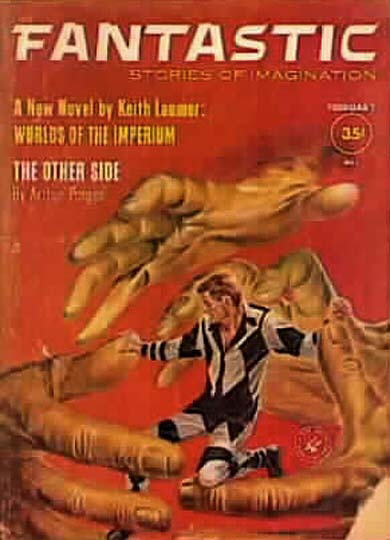
Keith Laumer, Worlds of the lmperium (1961)

In this action-adventure story from the satirist who brought us Retief, “worlds” is right (rhymes with “Blight”); they’re alternatives, high tech here, low there; the characters are involved with their own concerns; the narrator, who is one and none of them, and we, note the differences. Luckily for us this Gaston has no Alphonse; he is more noble than comical.

Classics of Science Fiction at the 2025 Worldcon

By John Hertz: This year’s World Science Fiction Convention (the 83rd Worldcon, gosh) will be held August 13-17 at the Sheraton Grand Hotel and the Convention Center Summit Building in Seattle, Washington.

No response from the concommittee to my offer of leading SF Classics discussions, I suppose because the concom is so busy scrambling they can hardly breathe. Let’s do some anyway.

We’ll meet in the hotel lobby — say, 1:00 p.m. Look for details at the con.

Here are three books you might find worthy. Two were scheduled for Westercon 77 + BayCon, but didn’t happen; I’ve added one more.

Come to as many as you like. You’ll be welcome to join in.

I’m still with “A classic is a work that survives its own time. After the currents which might have sustained it have changed, it remains, and is seen to be worthwhile for itself.” If you have a better definition, bring it.

Each of our three is famous in a different way. Each may be more interesting now than when first published. Have you read them? Have you re-read them?

Edmond Hamilton, The Star Kings (1947)

Things crashingly happen, or when we expect them, don’t. Revelations prove inevitable once we’ve caught our breath. Around the time of writing Eleanor Roosevelt said, “No one can make you feel inferior without your consent”; our hero doesn’t. Never mind the vacuum tubes and the man-woman relations two thousand centuries in the future; see how well the author understood event and story.

Robert A. Heinlein, Between Planets (1951)

How individually each of these books deals with the problems of science fiction: imagining something, perceiving how characters we could understand (not necessarily like us) manage it, letting us know what’s going on, achieving that in telling a story. ”Us” is, first, the original audience; in a classic, more. What of the Chapter Ill security officer, and Bankfield, and Phipps? Extra credit for Josephus and ”I just work here.”

Keith Laumer, Worlds of the lmperium (1961)

In this action-adventure story from the satirist who brought us Retief, “worlds” is right (rhymes with “Blight”); they’re alternatives, high tech here, low there; the characters are involved with their own concerns; the narrator, who is one and none of them, and we, note the differences. Luckily for us this Gaston has no Alphonse; he is more noble than comical.

Classics of Science Fiction at Westercon 77 & BayCon

By John Hertz: This year Westercon LXXVII will be combined with BayCon (July 4-7; Santa Clara, CA, Marriott Hotel; see Baycon.org). We’ll discuss three Classics of SF, one discussion each. Come to as many as you like. You’ll be welcome to join in.

Our operating definition is “A classic is a work that survives its own time. After the currents which might have sustained it have changed, it remains, and is seen to be worthwhile for itself.” If you have a better definition, bring it.

Each of our three is famous in a different way. Each may be more interesting now than when first published. Have you read them? Have you re-read them?

Nelson Bond, Exiles of Time (1940)

About halfway in, I recognized a similarity to A Connecticut Yankee on King Arthur’s Court (on which my note is here): we know what the outcome must be, how will the author get us there? If you aren’t acquainted with Blue Book, looking it up wouldn’t hurt; understanding whom Brother Bond was writing for makes Exiles all the more amazing. Oh, and the Epilogue-!

Robert A. Heinlein, Between Planets (1951)

How individually each of these books deals with the problems of science fiction: imagining something, perceiving how characters we could understand (not necessarily like us) manage it, letting us know what’s going on, achieving that in telling a story. “Us” is, first, the original audience; in a classic, more. What of the Chapter Ill security officer, and Bankfield, and Phipps? Extra credit for Josephus and “I just work here.”

Keith Laumer, Worlds of the Imperium (1961)

In this action-adventure story from the satirist who brought us Retief, “worlds” is right (rhymes with “Blight”); they’re alternatives, high tech here, low there; the characters are involved with their own concerns; the narrator, who is one and none of them, and we, note the differences. Luckily for us this Gaston has no Alphonse; he is more noble than comical.

Pixel Scroll 6/9/25 The File And Scroll Of Pixelary Moon

(1) TONY AWARDS. Last night’s Tony Awards 2025 featured 14 winners of genre interest, if you can believe that! Maybe Happy Ending, about two helper-bots, was acclaimed Best Musical.

(2) IGNYTE AWARDS. The 2025 Ignyte Awards shortlist was released today. Public voting on the awards is open until August 15 at 11:59 p.m. Eastern.

(3) SHIRLEY JACKSON NOMINEES. The 2024 Shirley Jackson Awards nominees have been posted. The juried award is given for outstanding achievement in the literature of psychological suspense, horror, and the dark fantastic. The winners will be presented in-person on July 19 at Readercon 34,

(4) THERE’S H.L. GOLD IN THEM THAR HILLS. Joachim Boaz launches a marathon Galaxy magazine reread in “Magazine Review: Galaxy Science Fiction, ed. H. L. Gold (October 1950) (Simak, Sturgeon, MacLean, Matheson, Leiber, Brown, Asimov)” at Science Fiction and Other Suspect Ruminations.

Preliminary Note: I plan on reading all 116 issues of the influential, and iconic, SF magazine Galaxy under H. L. Gold’s editorship (October 1950-October 1961) in chronological order. How long this project will take or how seriously/systematically I will take it are complete unknowns. I am a reader of whim. I will choose whether to reread certain stories that I’ve previously covered. Serialized novels will only be reviewed after I complete the entire work and posted as separate reviews. Why Galaxy, you might ask?

First, I can’t escape the pull of 1950s science fiction focused on social commentary and soft science. Second, I am obsessed with 50s American politics during a time of affluence, the rise of TV and mass culture, and the looming terror of the Cold War. Third, there are a legion of well-known 50s authors I’ve yet to address in any substantial manner on the site who appeared behinds its illustrious covers. Fourth, H. L. Gold was interested in all different types of stories.

As SF Encyclopedia explainsGalaxy was an “immediate success” in part because “Astounding was at this time following John W Campbell Jr’s new-found obsession with Dianetics and was otherwise more oriented towards technology.” Gold’s interests, on the other hand, “were comparatively free-ranging: he was interested in psychology, sociology and satire and other humor, and the magazine reflected this.”…

(5) MOURNING BECOMES ELECTRIC. “AI Signals The Death Of The Author” writes David J. Gunkle at NOEMA. But it doesn’t bother him.

…I hold a different view. LLMs may well signal the end of the author, but this isn’t a loss to be lamented. In fact, these machines can be liberating: They free both writers and readers from the authoritarian control and influence of this thing we call the “author.”…

….[This] understanding of an author is not some kind of universal truth that has existed from the beginning of time. Rather, it is a modern conception. The “author” as we now know it comes from somewhere in the not-so-distant past; it has a history. 

The French literary critic Roland Barthes, in his 1967 essay “The Death of The Author,” traced the roots of this now-commonplace idea to the modern period in Europe, beginning around the mid-16th century. Before then, people did of course write texts — but the idea of vesting responsibility and authority in a singular person was not common practice. In fact, many of the great and influential works of literature — the folklore, myth and religious scripture that we still read today — have circulated in human culture without needing or assigning them to an author. 

The modern period, however, spawned a number of related intellectual and cultural developments in Europe that centered around what Michel Foucault later called a “privileged moment of individualization in the history of ideas.” In rejecting subservience to the papacy, the Protestant Reformation of the 16th century birthed an individualized faith. Then, in the following century, philosopher René Descartes built his rationalist philosophy on the statement “I think, therefore I am,” making all knowledge dependent on the certainty of self-conscious thought. Accompanying these innovations was the concept of personal property as an individual right, ensured and protected by the state.

The concept of the author, as both Barthes and Foucault demonstrate, emerges from the confluence of these historically important innovations. But this does not mean that the author as the locus of literary authority is just a subject for theory — it also evolved to be a practical matter of law. In 18th-century England and its breakaway North American colonies, the author became the responsible party in a new kind of property law: copyright. The idea of an author being the legitimate owner of a literary work was first introduced in London not out of some idealistic dedication to the concept of artistic integrity, but in response to an earlier technological disruption that permitted the free circulation and proliferation of textual documents: the printing press. 

(6) TRUTH UNDER ATTACK. “Former Librarian of Congress Carla Hayden Speaks Out on CBS”. Hayden appeared on CBS Sunday Morning.

…Following Hayden’s dismissal, White House press secretary Karoline Leavitt said in a May 9 press conference that she had been dismissed because “we felt she did not fit the needs of the American people. There were quite concerning things she had done at the Library of Congress in the pursuit of DEI and putting inappropriate books in the library for children.” Leavitt did not elaborate on either accusation, nor did she acknowledge that perusal of the collections at the library of Congress is available only to visitors aged 16 or older, and must be done entirely on premises.

“When I heard those comments, I was concerned that there might not have been as much of an awareness of what the Library of Congress does,” Hayden said. In a voiceover, Costa explained to CBS viewers, “The library’s primary function is to fulfill research requests from members of Congress. It is not a lending library for the general public.”

Outcry over Hayden’s removal has been fierce, and Costa observed that information specialists with a reputation for being “quiet types” are “being loud” about the assault on libraries. “They’re being loud,” Hayden confirmed, “and it’s so humbling to have that outpouring of support.”…

(7) THE TRUE FAKE STORY. The Wall Street Journal uncovers “The Pentagon Disinformation That Fueled America’s UFO Mythology”. (Behind a paywall.)

A tiny Pentagon office had spent months investigating conspiracy theories about secret Washington UFO programs when it uncovered a shocking truth: At least one of those theories had been fueled by the Pentagon itself. 

The congressionally ordered probe took investigators back to the 1980s, when an Air Force colonel visited a bar near Area 51, a top-secret site in the Nevada desert. He gave the owner photos of what might be flying saucers. The photos went up on the walls, and into the local lore went the idea that the U.S. military was secretly testing recovered alien technology.

But the colonel was on a mission—of disinformation. The photos were doctored, the now-retired officer confessed to the Pentagon investigators in 2023. The whole exercise was a ruse to protect what was really going on at Area 51: The Air Force was using the site to develop top-secret stealth fighters, viewed as a critical edge against the Soviet Union. Military leaders were worried that the programs might get exposed if locals somehow glimpsed a test flight of, say, the F-117 stealth fighter, an aircraft that truly did look out of this world. Better that they believe it came from Andromeda.

This episode, reported now for the first time, was just one of a series of discoveries the Pentagon team made as it investigated decades of claims that Washington was hiding what it knew about extraterrestrial life. That effort culminated in a report, released last year by the Defense Department, that found allegations of a government coverup to be baseless.

In fact, a Wall Street Journal investigation reveals, the report itself amounted to a coverup—but not in the way the UFO conspiracy industry would have people believe. The public disclosure left out the truth behind some of the foundational myths about UFOs: The Pentagon itself sometimes deliberately fanned the flames, in what amounted to the U.S. government targeting its own citizens with disinformation.

At the same time, the very nature of Pentagon operations—an opaque bureaucracy that kept secret programs embedded within secret programs, cloaked in cover stories—created fertile ground for the myths to spread….

(8) THE SHORT AND LONG OF IT. A Deep Look by Dave Hook devotes a post to “’John Carstairs: Space Detective’, Frank Belknap Long, 1949 Frederick Fell”.

The Short: I read the Frank Belknap Long collection John Carstairs: Space Detective, 1949 Frederick Fell, for my project of reading 1949 SFF. Frank Belknap Long has written some wonderful science fiction, but it’s not in this collection. My overall average rating for the five stories included is 3.15/5, or “Good”, which is one of the lowest ratings for a collection I have read and finished. Not recommended unless you are really, really interested in a detective who uses exotic, off planet botany to catch crooks…

(9) OCTOTHORPE. In episode 136 of the Octothorpe podcast, “When Do You Not Want to Talk About Games?”, John Coxon, Alison Scott, and Liz Batty, “finally have time to discuss Eastercon 2025 (Reconnect in Belfast) in more detail, and then we also discuss Seattle 2025, particularly the consultative votes.” An uncorrected transcript is available here.

Liz, depicted as the Incredible Hulk, comes across a table on which lie many items of food (sketched in black and white) including John (a sausage roll) and Alison (an almond croissant), rendered in colour. The words “Octothorpe 136” appear at the top and “You won't like Liz when she's hangry” appear at the bottom.

(10) MATTIE BRAHEN OBITUARY. Author and singer-songwriter Mattie Brahen died June 9. Her husband, Darrell Schweitzer, made the announcement on Facebook.

Her first published story, “The Gift”, appeared in Marion Zimmer Bradley’s Fantasy Magazine in 1994. Over the years it was followed by a dozen other short stories, and three novels, Claiming Her (2003), Reforming Hell (2009), and Baby Boy Blue (2010).  

Brahen and Schweitzer also gained fame as convention book dealers, among those interviewed in Forbes magazine’s 2014 article “Dealing In Science Fiction Classics At Readercon”.

She is survived by Darrell and her son, Brian.

(11) TODAY’S BIRTHDAY.

[Written by Paul Weimer.]

June 9, 1925Keith Laumer. (Died 1993.)

By Paul Weimer: Keith Laumer’s Retief novels, about the adventures of a rather forward thinking and two-fisted diplomat, made the first and strongest impression to me of Laumer’s work, and it is here that I will begin my discussion of it. I think it might also be the closest thing he has to his own heart, because he was a diplomat in the foreign service. He knew the archetypes and kinds of characters on both sides of the political fence, and that all goes into the blender of Retief. And who can resist a two-fisted active diplomat out among the stars?  (I think of him as a first cousin to Poul Anderson’s Flandry.)

I also modeled one of my favorite PCs on him, Diplomat Ingrey Wererathe, who was indeed the most competent person in the Embassy, and that got him into all sorts of adventures and trouble. (The head Ambassador was too interested in political climbing to care– I suspect the GM knew who I was modeling Ingrey on and had read the Retief stories too). 

Besides the best diplomat in science fiction (sorry, Bren Cameron, I take Retief over you when the chips are down), Laumer is next best known for the intelligent robot tanks, the Bolos. Since I came to the bolos after first encountering the board game OGRE, my inward conception of the Bolos is much more dark and menacing than they actually are in practice. But, nowadays, with the rise of LLMs and other not-AI AIs, and the big rise of drone technology, the Bolos seem more possible than ever before (so do OGREs come to think).

And if that wasn’t enough, Laumer also did a parallel Earths time patrol series, the Worlds of the Imperium. Once again in a parallel with Anderson, his Imperium is based on a potent and powerful Scandinavian polity. And it is the fun “body double across parallel Earths” story that might seem old hat now…but Laumer paved the way with it in Worlds of the Imperium.

Keith Laumer

(12) COMICS SECTION.

(13) IN THE TIME BETWEEN BEATNIKS AND HIPPIES. Jeet Heer reviews Dan Nadel’s biography of Robert Crumb in “Cartoon Liberation | Robert Crumb and His Times” for the Southwest Review.

The cartoonist Robert Crumb was born in 1943, which he once observed was “the bloodiest year in the history of mankind.” Crumb was making no idle connection. Violence was Crumb’s birthright—both geopolitical carnage and more tawdry but still traumatic domestic abuse. This violence has marked his work and is one of the sources of its discomforting power, its ability to offend and shock even as it speaks to pervasive (if often taboo) human experiences and emotions. As Dan Nadel makes clear in his new biography, Crumb: A Cartoonist’s Life (2025), Crumb survived intense familial pain but has never been entirely free of the patterns of maltreatment that were implanted in him so early, which he triumphantly grappled with in his art but sometimes sadly replicated in his life….

(14) ROBOPOP. [Item by Lew Wolkoff.] Wait Wait…Don’t Tell Me! is a comedy news quiz on National Public Radio. Comedian Peter Sagal asks a three-person comedian panel, a celebrity guest, and call-in listeners questions about the week’s news. At the end of the show, the three panels are asks to forecast a future news item, giving funny answers. Here’s how part of this week’s show ended.

Sagal: Panel what will be this year’s hot summer read?

Adam Burke: Since AI will be doing all the reading, the big hit will be the Isaac Asimov classic, “You, Robot.”  

You can hear the full show at NPR.org. 

(15) WHEN KRYPTON WAS KANCELLED. “10 million dollars for 6 minutes of film down the drain: One of the most expensive deleted scenes in cinema is in this DC film” at 3DVF.

When Warner Bros. decided to cut a six-minute sequence from Superman Returns, they threw away one of the most expensive deleted scenes in movie history. The dark Krypton exploration sequence cost a staggering $10 million to produce, only to end up on the cutting room floor because executives deemed it too grim for the film’s overall tone….

… Inside the lost Krypton sequence

What exactly made this deleted scene so expensive? Singer originally crafted a completely different opening for the film – one that would have taken audiences on a chilling journey to Superman’s destroyed home planet.

A haunting exploration of Krypton’s remains

The sequence follows Clark Kent as he explores the remnants of Krypton, his birth planet. Picture this: no dialogue, just atmospheric storytelling as our hero walks through the desolate landscape of his origins. The scene was designed to be visually stunning but emotionally heavy, setting a much darker tone than what Warner Bros. ultimately wanted for their Superman revival….

(16) OMEGA MAN, THE NEXT GENERATION. Popular Science answers the question “In a world without people, how fast would NYC fall apart? Here’s the timeline.”

…Imagine the ceaseless cacophony of New York City suddenly stopped. No sirens wailed. No cars zoomed. No subways rumbled beneath sidewalks. All eight million New Yorkers disappeared overnight.

Now, imagine what would happen next….

By Year 50: A One-of-a-Kind Ecosystem

In the decades since humans abandoned New York, a “novel ecosystem” would emerge, says Tredici. “It’s not going to look like anything that’s ever existed anywhere in the world.”

Tredici points to Detroit as a case study. Today, crabapple trees—tough ornamentals native to the Central Asian mountains—blanket Detroit. “They actually will spread all over,” says Tredici, and after 50 years without humans, Central and Riverside Park’s crabapple trees would grow among a young forest full of London planetrees, honeylocusts, pin oaks, and Norway maples (the last three being common New York street trees). Nightshade vines and poison ivy would creep up buildings, and mosses and resilient weeds would cover the higher reaches of exposed windy skyscrapers….

(17) REMEMBERING ROBBY. In 2017, Bonhams auctioned the original Robby the Robot suit and Jeep from Forbidden Planet. It sold for over $5.3 million.

The New Atlas article tells a lot of details about the design and operation of the famed movie robot: “The original Robby the Robot goes up for auction”.

…But Robby was more than a suit. He included seven war-surplus electric motors to power his mechanical “scanners” and “brain,” plus a “mouth” made of blue neon tubes run by a 40,000 Volt power source run via a cable out of the robot’s heel or onboard batteries.Sitting so close to so much voltage was just one example of how hard Robby was on the actor inside him. Though Robby stands over six feet tall, the actor had to be very short to look out through the “mouth” with his face blacked up with matte black makeup to prevent being seen by the camera. The weight of the three parts of the robot were carried on a flying harness on the actor’s shoulders and a special frame was built to allow him to rest between takes. Even then, Robby could only walk on a completely flat surface with actor unable to see his feet and after a near tumble, the actor Frankie Darrow had to be replaced by Frank Carpenter because he was too shaken up to continue.Another important factor in Robby’s success is that he was designed to be portable, breaking down into three parts and placed in specially designed crates along with his effects control panel. After Forbidden Planet opened, Robby attended the premiere at Grauman’s Chinese Theater and then toured the country on a promotional tour. After that, Robby starred in the feature The Invisible Boy before embarking on a decades-long career, appearing in television programs like The Thin ManThe Twilight ZoneColumbo, Lost in Space, and The Addams Family, as well as various films, science fiction conventions, and charitable events up to this day.

Unfortunately, MGM didn’t take very good care of Robby and the prop was in poor shape when he and his car were sold to Jim Brucker in 1970 for display at Movie World/Cars of the Stars. In 1979, Robby was bought by filmmaker and special effect designer Bill Malone, who had already built a full scale reproduction of the robot from the original blueprints. Using his expertise, Malone restored the badly deteriorated bot, including casting new rubber hands and Perspex dome, which had rotted and yellowed respectively.

(18) SUNDAY IN THE PARK WITH SPOCK. CBS Sunday Morning reaches into the archives to share: “The final frontier of ‘Star Trek’? Outdoor theater”.

In 2012, the beloved original sci-fi series, which explored strange new worlds, arrived at a particularly strange one: Portland, Oregon, where summer theater in the park audiences welcomed a live performance of a classic “Star Trek” episode. Correspondent Lee Cowan went behind the scenes of a production going boldly where no theater project had gone before, in a “Sunday Morning” story that originally aired Aug. 12, 2012.

[Thanks to Mike Kennedy, Andrew Porter, John King Tarpinian, Joachim Boaz, Lew Wolkoff, Joyce Scrivner, Lise Andreasen, Chris Barkley, Cat Eldridge, SF Concatenation’s Jonathan Cowie, Mark Roth-Whitworth, Steven French, Kathy Sullivan, and Teddy Harvia for some of these stories. Title credit belongs to File 770 contributing editor of the day Jayn.]

Pixel Scroll 9/13/23 Scroll Your Pixels Well

(1) LE GUIN ON HER ILLEGAL ABORTION IN 1950. Arwen Curry told Worlds of Ursula K. Le Guin Kickstarter backers that a “New Ursula K. Le Guin short film series starts today on LitHub!”

The Journey That Matters, a series of six short films about Ursula K. Le Guin’s life and work that will be serialized on Literary Hub, based on outtakes from the feature documentary you all helped me to create. Spending time with Ursula meant having access to her warm, wise perceptions about all kinds of questions in literature and life. With these little films, I hope to share some more of that abundance.

It starts today with “What it Was Like,” in which Ursula reads her powerful essay about the illegal abortion she had as a senior at Radcliffe in 1950, which she credits with allowing her to pursue her career as a writer and to build her family. It’s a chilling reminder of what we’ve lost since Roe fell — and how women’s success and happiness is predicated on our bodily autonomy….

See the first video in the series on Literary Hub: “Ursula K. Le Guin on Her Illegal Abortion in 1950” introduced by Elisabeth Le Guin and Caroline Le Guin:

As young women growing up under the protection of Roe, we never really talked with our mother about her abortion. Elisabeth [Le Guin] learned that it had occurred when she went through several abortions of her own in the 1980s; but what we know about the story of Ursula’s necessarily different experience comes to us through her written words, as it does to you.  “The Princess” was her keynote address to NARAL Pro-Choice America in 1982 when Roe was not even a decade old, and this piece, “What It Was Like,” was a talk for Oregon’s NARAL chapter in 2004. These stories are public statements, performances of Ursula’s own life material as a means to inspire and transform. The second of them, which you are about to hear, is also a rather extraordinary public love letter to her own family.

This is a hard essay to read or listen to, and it’s meant to be. Clearly, it was hard to write; watching Ursula in her 80s read her own words aloud, more than a decade after she wrote them, the emotion is palpable—and that shy little shrug at the end, that letting go. For us, it’s hard to watch. It’s a hard thing to think about your mother having an abortion, and an illegal one at that—to do so takes you to an exquisitely painful, vulnerable place, imagining what she went through: the shame, the grief, the sense of loss she must have experienced, the lingering, corrosive doubt. A hard thought exercise, but necessary to fully honor the fact that she could later choose to carry you to term, bring you into the world, into her world, to love and mother you the way she wanted to mother….

(2) NEW SFWA PROGRAM SEEKS INTERNS. The Science Fiction and Fantasy Writers Association (SFWA) received a grant from the National Endowment of the Arts (NEA) to support a new program they’re launching: Publishing Taught Me. This program will be shepherded by Nisi Shawl, an accomplished and multiple award-winning author, editor, instructor, and Kate Wilhelm Solstice Award recipient. It will take place over the coming year. And the press release adds that “Publishing Taught Me Launches with an Intern Search”.

…Publishing Taught Me will produce an online essay series, to be collated into an anthology, and a symposium aimed at promoting diversity, equity, and inclusion in the science fiction, fantasy, and horror genres. This will be done by inviting publishing professionals of color to describe their journeys and to provide advice and motivation to writers entering the field via their essays and participation in a Publishing Taught Me symposium. These goals will be accomplished with the support of two paid interns, who will serve as assistant editors for the essay series, symposium, and resultant anthology.

As managing editor for the project, Shawl will oversee the operational aspects of putting together an online essay series and anthology, and will work with SFWA staff to coordinate and execute their publication and the associated events. They will also provide mentorship to the two assistant editor interns, who should be early in their professional publishing careers.

We are now recruiting for the assistant editor internship positions for this program. Interested individuals must be at least at 18 years of age, and should have at least three months previous editing experience, preferably within the science fiction, fantasy, and horror genres, and a firsthand knowledge of the challenges facing people of color in the current publishing environment. Familiarity with Google Docs, Zoom, WordPress, and Canva is a plus.

Responsibilities include soliciting and editing project essays, overseeing contributor agreement completion, assisting with arranging the essays within the final publication, helping to establish and supporting project participant communication protocols, and preparing marketing materials for the project. The term “editing” includes developmental editing, line editing, and copyediting.

The editorial assistants’ work on the project begins November 1, 2023 and will be completed in November 2024. Hours worked will vary from week to week, but the anticipated time commitment will be up to 50 hours per month per person. A flat $2,000 stipend will be provided to each intern for their participation in the program.

If you are interested in applying, please complete the application here by September 30, 2023. We encourage you to share this opportunity with anyone who qualifies and would benefit from learning about the science fiction, fantasy, and horror publishing industry as they fill this important role.

…This program will deliver invaluable insight into our industry that will benefit current and future genre storytellers, and we’re excited to bring it into existence. For questions about Publishing Taught Me, please contact [email protected]

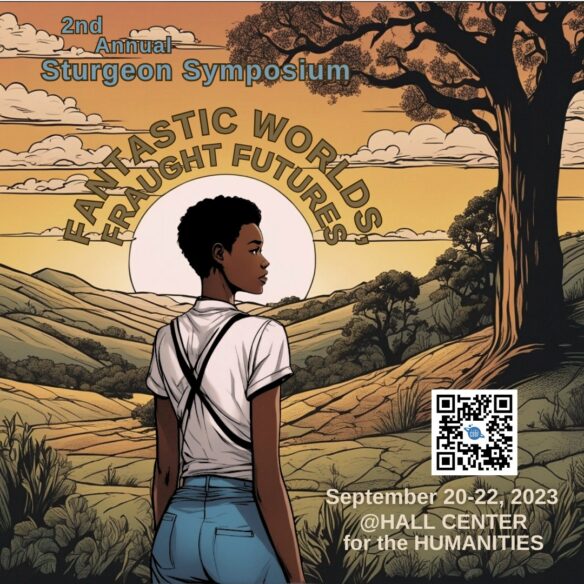
(3) STURGEON SYMPOSIUM NEXT WEEK. Katie Conrad, Interim Director of the Gunn Center for the Study of Science Fiction shared the schedule for the Second Annual Sturgeon Symposium being held at the University of Kansas from September 20-22. Full details at the link.  

The Symposium theme this year, “Fantastic Worlds, Fraught Futures,” was inspired by this year’s KU Common Book, Octavia Butler’s Parable of the Sower. The festivities start Tuesday night (9/19) with a co-sponsored Feminist Futures Forum, and continue through Friday (9/20-9/22) with a three-day academic conference open to all and events including a zine workshop (Wednesday afternoon), an open-to-all young adult creative writing workshop with YA author L.L. McKinney (Thursday afternoon), the reception and presentation of the annual Sturgeon Award with a reading by author Samantha Mills (Thursday evening), a closing reception in the gallery with the KU Common Work of Art (Friday afternoon), and a free showing of the movie The Host (Friday evening).  

(4) WHAT LIES IN STORE FOR SIMON & SCHUSTER? The Atlantic warns about the potential consequences of KKR’s purchase of Simon & Schuster in “Private Equity Comes for Book Publishing”.

Earlier this year, the Department of Justice blocked Penguin Random House, owned by the German media giant Bertelsmann, from acquiring Simon & Schuster. The big five publishers—HarperCollins, Penguin Random House, Hachette, Macmillan, and Simon & Schuster—already control about 80 percent of the book market. The literary class was relieved.

Less than a year later, the private-equity firm Kohlberg Kravis Roberts announced that it would buy Simon & Schuster. Because the firm doesn’t already own a competing publisher, the deal is unlikely to trigger another antitrust probe. But KKR, infamous as Wall Street’s “barbarians at the gate” since the 1980s, may leave Simon & Schuster employees and authors yearning for a third choice beyond a multinational conglomerate or a powerful financial firm.

“It may be a stay of execution, but we should all be worried about how things will look at Simon & Schuster in five years,” says Ellen Adler, the publisher at the New Press, a nonprofit focused on public-interest books….

…In their recent book about private equity, These Are the Plunderers, Gretchen Morgenson and Joshua Rosner recount maddening stories about KKR: how it bankrupted Toys “R” Us; gouged residents of Bayonne, New Jersey, for water and sewage; and, very recently, ran a vital provider of emergency services into the ground. If KKR’s latest deal follows a similar trajectory, Morgenson and Rosner might have a harder time documenting it. Their publisher is Simon & Schuster….

(5) DAYTON LITERARY PEACE PRIZE 2023. Noah Hawley’s Anthem is a work of genre interest among the six fiction finalists for the 2023 Dayton Literary Peace Prize. Given for both fiction and nonfiction, the prize honors writers whose work uses the power of literature to foster peace, social justice, and global understanding. Each winner receives a $10,000 cash prize.

2023 Dayton Literary Peace Prize Finalists

Anthem by Noah Hawley (Grand Central Publishing)

Something grave is happening to teenagers across America. Recovering from his sister’s tragic passing, Simon breaks out of a treatment facility to join a man called “The Prophet” on a quest as urgent as it is enigmatic. Their journey becomes a rescue mission when they set off to save a woman being held captive by a man who goes by “The Wizard” in this freewheeling adventure that finds unquenchable light in the dark corners of society.

Didn’t Nobody Give a Shit What Happened to Carlotta by James Hannaham (Little, Brown and Company)

A trans woman, Carlotta Mercedes, reenters life on the outside after more than twenty years in a men’s prison. Set over the course of a whirlwind Fourth of July weekend, Didn’t Nobody Give a Shit What Happened to Carlotta follows her struggles to reconcile with the son she left behind, to reunite with a family reluctant to accept her true identity, and to avoid anything that might send her back to lockup.

Horse by Geraldine Brooks (Viking)

A discarded painting in a junk pile, a skeleton in an attic, and the greatest racehorse in American history: from these strands, a Pulitzer Prize winner braids a sweeping story of spirit, obsession, and injustice across American history. Based on the remarkable true story of the record-breaking thoroughbred Lexington, Horse is a novel of art and science, love and obsession, and our unfinished reckoning with racism.

Mecca by Susan Straight (Farrar, Straus and Giroux)

From the National Book Award finalist Susan Straight, Mecca is a stunning epic tracing the intertwined lives of native Californians fighting for life and land. The author crafts an unforgettable American epic, examining race, history, family, and destiny. With sensitivity, furor, and a cinematic scope that captures California in all its injustice, history, and glory, she tells a story of the American West through the eyes of the people who built it—and continue to sustain it.

The Immortal King Rao by Vauhini Vara (W. W. Norton & Company)

In an Indian village in the 1950s, a precocious child is born into a family of Dalit coconut farmers. King Rao will grow up to be the world’s most accomplished tech CEO and lead a global corporate government. King’s daughter, Athena, must reckon with his legacy—literally, for he has given her access to his memories. The Immortal King Rao obliterates the boundaries between literary and speculative fiction, the historical and the dystopian, to confront our age of technological capitalism.

The Light Pirate by Lily Brooks-Dalton (Grand Central Publishing)

As devastating weather patterns wreak gradual havoc on Florida’s infrastructure, a powerful hurricane approaches a small town on the southeastern coast. Wanda, named for the terrible storm she was born into, grows up in a landscape abandoned by civilization. Moving from childhood to adulthood, Wanda loses family, gains community, and ultimately, seeks adventure, love, and purpose in a place remade by nature.

(6) ONLINE EVENT WILL DRAW ATTENTION TO HUMAN RIGHTS ABUSES AGAINST UYGHURS. “World Uyghur Congress announces #WritersSupportUyghurs campaign to coincide with World Science Fiction Convention (WorldCon) in Chengdu, China”. The complete press release is at the link.

The World Uyghur Congress will host an online panel discussion featuring several award-winning and bestselling authors on Tuesday, October 17th, 2023. The date, one day before the opening of the Worldcon science fiction convention in Chengdu, China, was selected deliberately in order to draw attention to ongoing human rights abuses against the Uyghurs in East Turkistan. The United States, along with 11 parliaments and senates around the world and the independent Uyghur Tribunal have officially recognized the abuses as a genocide and a crime against humanity. 

This marks the first year that Worldcon, the largest science fiction convention and the bestower of the prestigious Hugo Awards, will be hosted in China. The decision to hold the event in China has prompted concern from a wide range of science fiction fans, journalists, and authors, many of whom have called for a boycott. Making matters worse, the organization has invited Liu Cixin and Sergei Lukyanenko to attend as “guests of honor.” Both writers have been outspoken in favor of genocidal policies, with Liu saying that the genocidal policies are a justifiable form of “economic development” and Lukyanenko calling for Ukrainian children to be drowned

“The Chinese government wants to use Worldcon as a sort of Potemkin Village in order to showcase how futuristic and technologically advanced the country has become,” said Andrew Gillsmith, author of the bestselling novel Our Lady of the Artilects and organizer of the #WritersSupportUyghurs campaign. “Meanwhile, they are interning people in concentration camps, forcibly separating children from their families, conscripting Uyghurs into slave labour schemes, and implementing the most comprehensive and technologically sophisticated surveillance regime in history. Science fiction writers and fans have a longstanding tradition of standing for human rights. This is in the spirit of that tradition.”

The event in October will broadcast live worldwide and is expected to last 90 minutes….

“We are grateful for this support from the science fiction and literary communities,” said Dolkun Isa, President of the World Uyghur Congress. “Our goal is not to disrupt Worldcon but to ensure that coverage of the event includes the facts about an ongoing genocide being perpetrated by the host country.”… 

(7) ALAN MOORE NOW SENDING HIS DC ROYALTIES TO BLM. Variety reports “Alan Moore Donates Film and TV Money to Black Lives Matter”.

Alan Moore, the comic book visionary best known for writing such revered works as “Watchmen,” “V for Vendetta” and “Batman: The Killing Joke,” revealed to The Telegraph that he is longer accepting royalty checks from DC Comics for films and television series based on his works. He’s asked the company to instead reroute these checks to Black Lives Matter.

The Telegraph asked Moore if reports were true about him taking all of the money he makes from film and TV series and dividing it among the writers and other creatives, to which the writer answered: “I no longer wish it to even be shared with them. I don’t really feel, with the recent films, that they have stood by what I assumed were their original principles. So I asked for DC Comics to send all of the money from any future TV series or films to Black Lives Matter.”…

(8) SPACE:1999 SPACECRAFT GETS DOCUMENTARY. “’Space: 1999′ documentary to focus on the iconic Eagle spacecraft” at Space.com.

A Kickstarter campaign has been launched to raise funds for a dedicated documentary focusing specifically on the design and development of the iconic Eagle transport spacecraft from the epic 70s sci-fi TV show “Space: 1999.” The documentary feature is called “The Eagle Has Landed” and will showcase never-before-seen archival footage. It’s set to be released in time for the 50th Anniversary of “Space: 1999” in 2025. 

“‘Space: 1999’ appeared on TV a few short years after the world watched Neil Armstrong take the first steps on the moon. The show’s unforgettable Eagle inspired a generation to envision a future in space and is still doing so decades later. The question we explore is why?” said writer, director Jeffrey Morris and founder FutureDude Entertainment, the production company behind the project….

The Kickstarter link is here: “The Eagle Has Landed – Sci-Fi Documentary by Jeffrey Morris”. The appeal has raised $27,000 of the $500,000 goal on the first day.

…The Eagle Has Landed explores a passionate and ongoing nostalgia for a future that never happened. This intriguing feature-length documentary follows Jeffrey Morris—a Minnesota-based filmmaker and lifelong science-fiction aficionado—as he examines the fascinating connections between art, science, culture, and the iconic Eagle spacecraft. …

(9) MEMORY LANE.

1964 [Written by Cat Eldridge from a choice by Mike Glyer.]

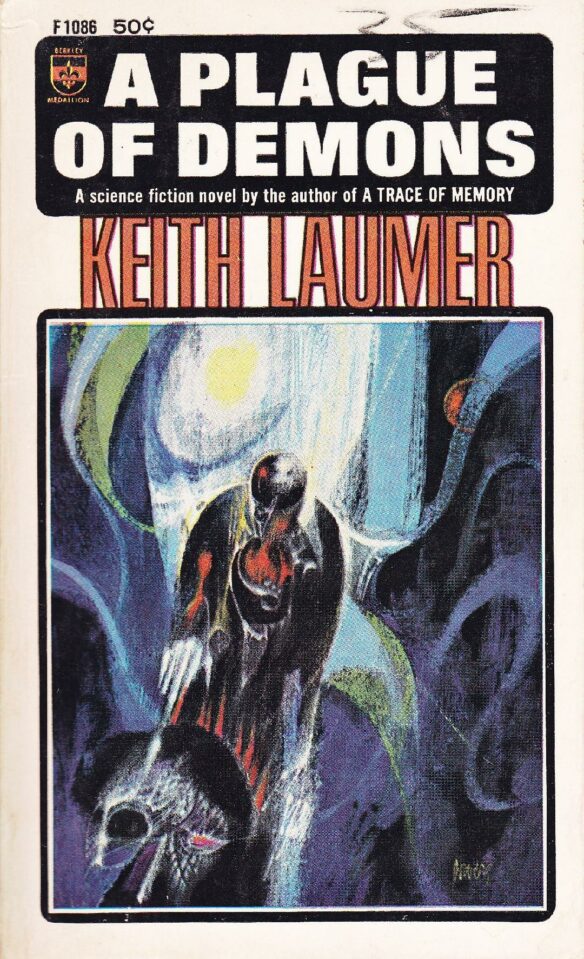
So let’s talk about the publishing of Keith Laumer’s A Plague of Demons which is our Beginning this time as it’s fascinating.  Especially when it got entangled with Baen Books later on.

It first was published in If in the November and December 1964 issues as The Hounds of Hells. This is not the later version known as A Plague of Demons but a shorter version.  

It got its first book publication as a paperback from Berkley Medallion the next year. The cover illustration is by Richard Powers. 

Penguin, Paperback Library and then Warner Paperback Library (yes Warner bought Paperback Library), then Warner Books (such for Paperback Library) and finally Pocket Books before we get to Baen Books.

And there’s Baen Books. They did three paperback editions of it and then printed it as part of A Plague of Demons and Other Stories which collected a lot of his shorter fiction, mostly novelettes. It was then offered up as part of the Baen Free Library. ISFDB says it was included as part of The 1634: The Baltic War Disk and The 1635: The Eastern Front CD-ROMs. 

Now let’s not overlook as you see in a few moments that A Plague of Demons is a most amazing novel. I’ve only included the first paragraph but it’s all you need as it’s most excellent. 

So here is it. Do enjoy it.

It was ten minutes past high noon when I paid off my helicab, ducked under the air blast from the caged high-speed rotors as they whined back to speed, and looked around at the sun-scalded, dust-white, mob-noisy bazaar of the trucial camp-city of Tamboula, Republic of Free Algeria. Merchants’ stalls were a slash of garish fabrics, the pastels of heaped fruit, the glitter of oriental gold thread and beadwork, the glint of polished Japanese lenses and finely-machined Swiss chromalloy, the subtle gleam of hand-rubbed wood, the brittle complexity of Hong Kong plastic – islands in the tide of humanity that elbowed, sauntered, bargained with shrill voices and waving hands, or stood idly in patches of black shadow under rigged awnings all across the wide square. I made my way through the press, shouted at by hucksters, solicited by whining beggars and tattooed drabs, jostled by UN Security Police escorting officials of a dozen nations.

(10) TODAY’S BIRTHDAYS.

[Compiled by Cat Eldridge.]

  • Born September 13, 1931 — Elizabeth Marshall Thomas, 92. An American author. Anthropologist, author of both fiction and non-fiction books on animal behavior, Paleolithic life, and the !Kung Bushmen of the Kalahari Desert. She was written three works of fiction two genre, Reindeer Moon and The Animal Wife and one, Certain Poor Shepherds: A Christmas Tale, a Christmas story, a folk tale and therefore at least genre adjacent. 
  • Born September 13, 1933 Warren Murphy. Ok, I’ll admit that I’m most likely stretching the definition of genre just a bit by including him as he’s best known for writing along with Richard Sapir the pulp Destroyer series that ran to some seventy novels and was (making it possibly genre) the basis of Remo Williams: The Adventure Begins.  He did a number of other series that were more definitely genre. (Died 2015.)
  • Born September 13, 1947 Mike Grell, 76. He’s best known for his work on books such as Green Lantern/Green ArrowThe Warlord, and Jon Sable FreelanceThe Warlord featuring Travis Morgan is a hollow Earth adventure series set in Skartaris which is a homage to Jules Verne as Grell points out “the name comes from the mountain peak Scartaris that points the way to the passage to the earth’s core in Journey to the Center of the Earth. It would be adapted by Matt Wayne for Justice League Unlimited’s “Chaos at the Earth’s Core”. 
  • Born September 13, 1960 Bob Eggleton, 63. He’s has been honored with the Hugo Award for Best Professional Artist eight times! He was guest of honor at Chicon 2000. There’s a reasonably up to date look at his artwork, Primal Darkness: The Gothic & Horror Art of Bob Eggleton which he put together in 2010 and was published by Cartouche Press.
  • Born September 13, 1961 Tom Holt, 62. Assuming you like comical fantasy, I’d recommend both Faust Among Equals and Who Afraid of Beowulf? as being well worth time. If you madly, deeply into Wagner, you’ll love Expecting Someone Taller; if not, skip it. His only two Awards are a pair of World Fantasy Awards, both for novellas, “A Small Price to Pay for Birdsong” and “Let’s Maps to Others”. And yes, I know that he also publishes under the K. J. Parker name as well but I won’t go into the works he publishes here. 
  • Born September 13, 1974 Fiona Avery, 49. Comic book and genre series scriptwriter. While being a reference editor on the final season of Babylon 5, she wrote “The Well of Forever” and “Patterns of the Soul” as well as two that were not produced, “Value Judgements” and “Tried and True”. After work on the Crusade series ended, she turned to comic book writing, working for Marvel and Top Cow with three spin-offs of J. Michael Straczynski’s Rising Stars being another place where her scripts were used. She created the Marvel character Anya Sofia Corazon later named Spider-girl. She did work on Tomb RaiderSpider-ManX-Men and Witchblade as well. 

(11) COMICS SECTION.

(12) CHENGDU WORLDCON NEWS. A three-part news release primarily devoted to a name for the Chengdu Worldcon mascot and its slogan – “Meet The Future! Slogan and Mascot’s Name for 2023 Chengdu Worldcon Announced” – included this segment publicizing some of the guests and programs, from which Sergey Lukianenko’s name is conspicuously absent.

…This year, the Committee has invited famous sci-fi activists such as Ben Yalow and Dave McCarty, as well as sci-fi litterateurs such as Robert Sawyer and Liu Cixin to bring a sci-fi literature feast to sci-fi fans. Meanwhile, Richard Taylor, the founder of Weta Workshop founder, who has won five Oscars for Best Visual Effects, and prominent figures in the Chinese sci-fi industry such as directors Guo Fan and Yang Lei, will attend the convention. They will engage in in-depth discussions on topics related to the fusion and development of science and technology innovation, culture, cultural tourism, and cultural creativity.

According to Liang Xiaolan, the full-time chairman of the 2023 Chengdu Worldcon and the vice president of the Chengdu Science Fiction Association, the convention will hold about 260 themed salons and parties, which are divided into eight categories: Science Fiction and Literature, Science Fiction and Art, Science Fiction and Film and TV, Science Fiction and Games (Animation), Science Fiction and Academics, Science Fiction and Technology, Science Fiction and Future, and Science Fiction and Industry. “For example, in the Science Fiction and literature section, there will be salons like Liu Cixin’s ‘A Sci-fi Reunion After 10 Years’, and Robert Sawyer’s ‘The Past, Present, and Future of Science Fiction’; In the Science Fiction and Technology section, we will discuss ‘How Far Are We From Space Travel?’ In the Science Fiction and Film and TV section, there will be a ’Sci-fi Film Special Effects Summit’; In the Science Fiction and Art section, there will be a ‘Three-Body Themed Concert’; In the Science Fiction and Games section, we will release the International Sci-fi Gaming Ranking,” Liang said….

(13) NANCY AND ZIPPY. “Bill Griffith on Love, Loss and the Lives of Ernie Bushmiller and Diane Noomin” at the Comics Journal – “Long and moving,” says Andrew Porter.

There are scenes in both Three Rocks and The Buildings are Barking that converge for me. Toward the end of the Diane book, there’s a haunting scene where she appears to you on a sort of “ghost ferry,” and she’s beckoning to you, in a dream sequence, to come join her. It’s very powerful, very sad, very beautifully rendered, and it’s heartbreaking. And toward the end of Three Rocks you have Ernie—toward the end of his life—snoozing on his chair, and Nancy, in another dream sequence, is in some ways doing the same thing to Ernie. Calling on him to follow her.

So that’s me recognizing that parallel– or, under the reality that we’re all experiencing together, there is another reality. It’s just there. It’s there to find. Or create. In that dream sequence in Three Rocks, the conceit is that Nancy is doing this. I’m not doing this. Ernie is not. Nancy is doing this. So, I am saying something that I have said throughout the book, which is that Nancy is a powerful figure. She both represents and controls the world she is in. And Ernie’s world as well. Some people thought she was a child that Ernie and Abbie never had. That’s a little sentimentalized, but possible. And before that dream sequence, I’ve used Nancy in these transitional sections throughout the book where Nancy is taking you from the previous chapter, in effect, to the next chapter. Once again, it’s Nancy, physically, the drawing. Yes, I’m writing it, but it’s Nancy [who is doing it].

In the dream sequence, she’s just pure Nancy. To me, because there’s no writing going on until the very end. It came out of a conversation I had with [Nancy collector and producer/writer for The Simpsons] Tom Gammill, and I’ve also heard the same thing from Mark [Newgarden]. That Ernie would always say that he’s looking for “the perfect gag.” There’s always a more perfect gag that he can’t quite find. The most perfect gag ever. [Laughs] Which I think is a little bit… romanticizing. Either people who heard Ernie say it, or they themselves, romanticized it. It seems a little bit like false humility. In other words, “I’m not all that funny, I’m still looking for the perfect gag. If I ever find it, I’ll let you know.” It’s like a way of deflecting, that he’s a great cartoonist or a funny guy….

(14) BEAMS CHOICE. “The Influence of Star Trek and Science Fiction on Real Science” at Smithsonian Magazine, an excerpt from Reality Ahead of Schedule: How Science Fiction Inspires Science Fact

…To trace the roots of Star Trek’s replicator, it is necessary to understand that it is essentially a repurposed form of the transporter—the teleportation or matter transmission device that “beams” the crew between starship and planet surface. According to legend, the transporter was invented only because the original series lacked the budget to film special, effect-heavy scenes of planetary landing shuttles, but Star Trek did not invent the concept of matter transmission. Its first appearance in science fiction dates back at least as far as 1877, in Edward Page Mitchell’s story “The Man Without a Body,” which prefigures George Langelaan’s much better-known 1957 story “The Fly,” by having a scientist experience a teleportation mishap when his batteries die while he is only partway through a transmission, so that only his head rematerializes.

The replicator uses the same basic principle as the transporter, in which the atomic structure of a physical object is scanned and the information is used to reconstruct the object at the “receiving” end through energy-matter conversion. In practice, all transporters are replicators and matter “transmission” is a misnomer, because matter itself is not transmitted, only information. Every time Captain Kirk steps out of the transporter having “beamed up” from a planet’s surface, it is, in fact, a copy of him—the original has been disintegrated during the initial phase of the operation.

This was precisely the mechanism of teleportation explored in one of the earliest stories on this theme. In Guillaume Apollinaire’s 1910 story “Remote Projection,” an inventor finds that his teleporter is actually a replicator and ends up with 841 identical copies of himself scattered around the world. This idea anticipated the well-known Teletransporter philosophy thought experiment by British philosopher Derek Parfit, which explored questions of continuity of identity. If a transporter is actually a replicator, is the Captain Kirk that steps off the transporter pad the same as the one that was “beamed up” from the planet? If the planet-side Kirk is not disintegrated in the process, and survives the process, which of the two Kirks is the “real” one? Star Trek TNG explored this precise scenario as an ongoing story line, after an episode (“Second Chances,” 1993) featuring a transporter malfunction that results in two copies of the character Will Riker—one who materializes on board his ship and the other who is stranded on a planet. The planet-side copy eventually chooses to be known as Tom Riker….

(15) BID ARAGORN REMEMBER. Far Out Magazine counts this as “The movie with the largest battle scene of all time”.

…However, the formula for creating monumental battle scenes saw a paradigm shift as we moved into the digital age. It was no longer just about recruiting an army of extras and meticulously planning every combat move. Instead, the magic started happening in the digital realm, thanks to pioneering technology developed by New Zealand-based Weta Digital.

Enter Peter Jackson’s acclaimed Lord of the Rings trilogy, released from 2001 to 2003. With the assistance of Weta Digital’s specialised crowd-simulation software, the movies shattered all previous records by featuring battles with an unprecedented 200,000 characters. The program, sensibly named Massive, fused digital animation with early artificial intelligence to govern individual character interactions, creating a spectacle of unparalleled scale and complexity.

What sets Massive apart is its innovative use of AI, allowing each digitally-created soldier to act and react in ways that mimic real-life human behaviour – not just this, but to do it ‘independently’. By allowing the program to govern the movements, animators were spared from tailoring the movements of each of the 200,000 figures. This leap in technology generated battle scenes that were vast in scale and eerily realistic. The technology altered the very foundations of what directors considered possible, raising the bar for epic cinema to an entirely new level….

(16) A SIGNATURE OF LIFE? Mashable reports an intriguing James Webb Space Telescope discovery: “Webb finds a molecule made by microbial life in another world”.

While the James Webb Space Telescope observed the atmosphere of an alien world 120 light-years away, it picked up hints of a substance only made by living things — at least, that is, on Earth.

This molecule, known as dimethyl sulfide, is primarily produced by phytoplankton, microscopic plant-like organisms in salty seas as well as freshwater.

The detection by Webb, a powerful infrared telescope in space run by NASA and the European and Canadian space agencies, is part of a new investigation into K2-18 b, an exoplanet almost nine times Earth’s mass in the constellation Leo. The study also found an abundance of carbon-bearing molecules, such as methane and carbon dioxide. This discovery bolsters previous work suggesting the distant world has a hydrogen-rich atmosphere hanging over an ocean.

Such planets believed to exist in the universe are called Hycean, combining the words “hydrogen” and “ocean.”

“This (dimethyl sulfide) molecule is unique to life on Earth: There is no other way this molecule is produced on Earth,” said astronomer Nikku Madhusudhan in a University of Cambridge video. “So it has been predicted to be a very good biosignature in exoplanets and habitable exoplanets, including Hycean worlds.”…

(17) VIDEO OF THE DAY. The new miniseries of Star Trek: Very Short Treks continues with “Holiday Party” about a “blooper reel” that’s mostly not actually funny, which is the point.

It’s a First Contact Day celebration and Spock is in charge of the entertainment.

[Thanks to Mike Kennedy, Andrew Porter, Daniel Dern, JJ, Lise Andreasen, Mark Roth-Whitroth, Andrew Gillsmith, Ersatz Culture, John King Tarpinian, Chris Barkley, Cat Eldridge, SF Concatenation’s Jonathan Cowie for some of these stories. Title credit belongs to File 770 contributing editor of the day Lou.]

Pixel Scroll 4/11/23 Starship Tribbles! Ad Astra Per Felix Flattus!

(1) UKRANIAN BRADBURY TRANSLATOR MOURNED. [Item by Susan de Guardiola.] It’s being reported that Ukrainian researcher/editor/translator/”culturologist” Yevhen Gulevich (Gulevych), who, among other things, was the translator of Ray Bradbury’s Something Wicked This Way Comes, was killed fighting at Bakhmut in Ukraine. 

His death is covered in Daily Kos’ news roundup “Ukraine Update: If the leaked documents are real, then they’re a good sign for Ukraine”. More detail:

Gulevich was a critical figure in detailing the history of Ukrainian art, explaining the origins of Ukrainian culture, and in mapping that history onto modern Ukraine. He was the editor of a Ukrainian magazine and frequently in demand for his skill at translating books written in other languages into Ukrainian while preserving the emotion and beauty of language. Among others, he translated Ray Bradbury’s “Something Wicked This Way Comes” so that it can be read by generations of Ukrainians the way it has been read and enjoyed by generations of Americans. Gulevich died on Bakhmut. He probably died all the way back at the end of December, but his body could not be found, and his fellow soldiers maintained some level of hope that he was still out there until he was finally declared dead last month. “

The image at the top of that article is from his funeral (”A guard of honor for Yevhen Gulevich at Garrison Church, Lviv, Ukraine. April 10, 2023”) and you’ll see another picture from it if you scroll down to the quote.

(2) TOLKIEN AND WHITE SUPREMACY. Robin A. Reid has posted “Why White Supremacy No Longer Provides Cover for White Academia”, which she presented at the Roundtable on Racisms and Tolkien, Tolkien Studies Area, PCA/ACA 2023.

 …As I discussed yesterday in the roundtable on adaptations of Tolkien, the backlash against Amazon’s Rings of Powers series is part of the ongoing “culture war” effort by contemporary fascists, many who love Tolkien’s work. They are creating “a new front . . . in a decades’-long, international, far-right, culture war. The people waging it aren’t just fighting to keep Tolkien’s imaginary world white and manly and straight. They’re fighting to restore that white-supremacist system in the real world, too” (Craig Franson, personal communication). Yesterday I focused on the question of what fandom, or more specifically, what progressive fans might do. Today, I focus on the question of what white academics can do….

…Too many of the articles on race and Tolkien dismiss racist readers as atypical, as ignorant, as reading the Legendarium badly, and, by extension, dismiss the question of structural/systemic racisms in Tolkien’s legendarium as unimportant to the field of Tolkien scholarship….

(3) JEREMY RENNER ON JIMMY KIMMEL. [Item by Mike Kennedy.] The “Live!“ in the name of Jimmy Kimmel’s show may never have been more relevant than it was Monday night. Jeremy Renner made his first talkshow appearance following his January 1st accident that saw him basically crushed by a multi-ton snowplow.

Renner was there nominally to promote his new Disney+ show “Rennervations,” but it’s certain that his fans were cheered by his ability to walk to the interview chair using nothing more than a cane.

(4) SEE PICARD FINALE IN THEATERS. “’Star Trek: Picard’ Season 3 Finale Gets Special IMAX Screenings” reports Collider. Requests for free tickets open April 12 at 1:00 Eastern.

It’s time to boldly go back to the big screen! The final two episodes of Star Trek: Picard Season 3 are getting a one-night-only theatrical release in select IMAX theaters on April 19 followed by a pre-taped Q&A with the cast of the hit series. Participating cities include Atlanta, Chicago, Dallas, Los Angeles, New York, Orlando, Phoenix, San Francisco, Seattle, and Washington DC. What’s even better is that tickets for the event are free, and they’ll be available on Wednesday, April 12 at 1 PM ET.

(5) GUGGENHEIM. The 2023 Guggenheim Fellows were announced April 5, 171 fellows from 48 fields. Jacqueline Woodson, who has done much genre work, was one of the people named as fellows in the Fiction category.

Fiction 

Lucy Corin, Writer, Berkeley, California; Professor of English, University of California, Davis 

Kali Fajardo-Anstine, Writer, Arvada, Colorado; Endowed Chair in Creative Writing, Texas State University 

James Hannaham, Writer, Brooklyn, New York; Professor, Writing Department, Pratt Institute 

Jac JemcWriter, San Diego, California; Associate Teaching Professor, University of California, San Diego 

Don Lee, Writer, Baltimore, Maryland; Professor, Director of MFA Program in Creative Writing, Temple University 

Rebecca Lee, Writer, Wilmington, North Carolina; Associate Professor, Department of Creative Writing, University of North Carolina Wilmington 

Héctor Tobar, Writer, Los Angeles, California; Professor, University of California, Irvine 

Jacqueline Woodson, Writer, Brooklyn, New York 

(6) RONDO VOTING. Steve Vertlieb reminds us that April 23 is the last day for the public to vote for the Rondo Awards, “fandom’s only classic horror awards”, and he’d be thrilled if you voted for the nominee who interviewed him for the magazine We Belong Dead.

Cinema Retro is looking for votes, too: “Cinema Retro And Mark Mawston Nominated For This Year’s Rondo Awards”.

…Also, Cinema Retro contributor Mark Mawston, who recently brought CR readers a rare, exclusive interview with actor John Leyton, has been singled out for a nomination in the category of Best Interview. This time, the subject of his work is the life and career of noted writer, film, and film music historian, Steve Vertlieb, who reflects on his interactions with a “Who’s Who” of film legends from over the decades. The superb 12-page interview appeared in issue #31 of the popular British horror magazine “We Belong Dead”. Mark is known professionally as “The Rock and Roll Photographer To The Stars” (having photographed such music luminaries at Sir Paul McCartney, Sir Elton John, Eric Clapton, Yoko Ono, and Brian Wilson)….

Click here for the ballot and instructions on how to send in your vote.

(7) BOOK REVIEW. I am the Law: How Judge Dredd Predicted Our Future launched a few weeks ago. Jonathan Cowie has a review in the forthcoming seasonal edition of SF2 Concatenation and tweeted an advance post.

Even if you do not know of Judge Dredd but have an interest in policing and legality, then this is a fascinating introduction into twentieth and early twenty-first century trends, that, if they continue, lead to a worrying future…

For SF fans, this book is an exemplar of science fiction’s value to society and how the genre can, on occasion, seem to predict the future. In this case the seeming predictions – note the plural, for there are many – are unnervingly spot on and so if Judge Dredd is some sort of quasi-reflection of our future, then it is an unsettling one, and one at which we should rail against

Judge Dredd should come with a health warning when given to kids.

If perchance you have never heard of Judge Dredd (is there anyone in the western world under the age of 50 who hasn’t?), then he is a comic-strip character from the British weekly 2000AD as well as, now, the titular character of the monthly Judge Dredd Megazine. He is a 22nd century law enforcer of Mega-City 1: Mega-City 1 being effectively the amalgamation of former 20th century cities along the US’s eastern seaboard. Life in Mega-City-1, though futuristic, is harsh. Only a few Mega-Cities survived the early 21st century nuclear war and much of the middle of America (less protected by anti-missile shields) became a wasteland called the ‘Cursed Earth’. Meanwhile, the ocean off the city is now the polluted Black Atlantic.

Life in Mega-City 1 is also harsh for its citizens because the high automated future and advanced robotics have made many redundant and the majority are simply unemployed living on ‘welf’ (welfare benefits). Crime is rife as is the discontent and those who regret the loss of democracy. And then there are the threats from the technology used itself as well as external ones from other Mega-Cities both from within the former continental N. America and beyond.

So, to keep law and order, policemen are now both police, jury and judge who enforce the law and decide on guilt and punishment. These enforcers are the Judges.

This book is jam-packed with so many instances of where the strip has seemingly predicted the future that this review can but give you the barest of tasters….

The full review is here.

(8) MEMORY LANE.

1961[Compiled by Cat Eldridge.]

A work of Keith Laumer’s that I think doesn’t get as much appreciation as it deserves is where the Beginning comes from for the tonight’s Scroll. 

Worlds of The Imperium is the novel in question. It first appeared in Fantastic Stories of the Imagination in the February, March and April 1961 issues. The following year it was published by Ace Books as an Ace Double with Seven from the Stars by Marion Zimmer Bradley. Five years later, Dennis Dobson publishers would give it a handsome hardcover edition. 

I don’t consider it giving to be give y’all spoilers to note that Laumer wrote three sequels to this novel —The Other Side of TimeAssignment in Nowhere and Zone Yellow.

I consider it one of the better cross-time novels that I’ve read and I’ve read a lot of them in over the last fifty years. The antagonist is interesting, the worlds thought out to be more than the cookie cutter alternative ones we so often get and the story here moves along at a rather admirable  pace. With ale too. 

So here’s our Beginning… 

I STOPPED in front of a shop with a small wooden sign which hung from a wrought-iron spear projecting from the weathered stone wall. On it the word Antikvariat was lettered in spidery gold against dull black, and it creaked as it swung in the night wind. Below it a metal grating covered a dusty window with a display of yellowed etchings, woodcuts, and lithographs, and a faded mezzotint. Some of the buildings in the pictures looked familiar, but here they stood in open fields, or perched on hills overlooking a harbor crowded with sails. The ladies in the pictures wore great bell-like skirts and bonnets with ribbons, and carried tiny parasols, while dainty-footed horses pranced before carriages in the background.

It wasn’t the prints that interested me though, or even the heavy gilt 

frame embracing a tarnished mirror at one side; it was the man whose reflection I studied in the yellowed glass, a dark man wearing a tightly-belted grey trench-coat that was six inches too long. He stood with his hands thrust deep in his pockets and stared into a darkened window fifty feet from me. 

He had been following me all day. 

At first I thought it was coincidence when I noticed the man on the bus from Bromma, then studying theatre announcements in the hotel lobby while I registered, and half an hour later sitting three tables away sipping coffee while I ate a hearty dinner.

I had discarded that theory a long time ago. Five hours had passed and he was still with me as I walked through the Old Town, medieval Stockholm still preserved on an island in the middle of the city. I had walked past shabby windows crammed with copper pots, ornate silver, dueling pistols, and worn cavalry sabres; very quaint in the afternoon sun, but grim reminders of a ruder day of violence after midnight. Over the echo of my footsteps in the silent narrow streets the other steps came quietly behind, hurrying when I hurried, stopping when I stopped. Now the man stared into the dark window and waited, the next move was up to me. I was lost. Twenty years is a long time to remember the tortuous turnings of the streets of the Old Town. I took my guide book from my pocket and turned to the map in the back. My fingers were clumsy. 

I craned my neck up at the stone tablet set in the corner of the building; it was barely legible: Master-Samuelsgatan. I found the name on the folding map and saw that it ran for three short blocks, ending at Gamla Storgatan; a dead end. In the dim light it was difficult to see the fine detail on the map; I twisted the book around and got a clearer view; there appeared to be another tiny street, marked with crosslines, and labeled Guldsmedstrappan. I tried to remember my Swedish; trappan meant stair. The Goldsmith’s Stairs, running from Master Samuelsgatan to Hundgatan, another tiny street. It seemed to lead to the lighted area near the palace; it looked like my only route out. I dropped the book back into my pocket and moved off casually toward the stairs of the Goldsmith. I hoped there was no gate across the entrance.

My shadow waited a moment, then followed. Slowly as I was ambling, I gained a little on him. He seemed in no hurry at all. I passed more tiny shops, with ironbound doors and worn stone sills, and then saw that the next doorway was an open arch with littered granite steps ascending abruptly. I paused idly, then turned in. Once past the portal, I bounded up the steps at top speed. Six leaps, eight, and I was at the top and darting to the left toward a deep doorway. There was just a chance I’d cleared the top of the stair before the dark man had reached the bottom. I stood and listened. I heard the scrape of shoes, then heavy breathing from the direction of the stairs a few feet away. I waited, breathing with my mouth wide open, trying not to pant audibly. After a moment the steps moved away. The proper move for my silent companion would be to cast about quickly for my hiding place, on the assumption that I had concealed myself close by. He would be back this way soon.

(9) TODAY’S BIRTHDAYS.

[Compiled by Cat Eldridge.]

  • Born April 11, 1867 William Wallace Cook. Newspaper reporter and pulp writer who wrote four novels (The Fiction FactoryA Round Trip to the Year 2000, or A Flight Through Time, Cast Away at the Pole and Adrift in the Unknown, or Adventures in a Queer Realm) which were serialized in Argosy in the early part of the last century. Clute at EoSF says he was “was a crude writer, but is of interest for his attempts to combine adventure plots and Satire.” (Died 1933.)
  • Born April 11, 1892 — William M. Timlin. Author of The Ship that Sailed to Mars, a remarkable work that has 48 pages of text and 48 color plates. It has become a classic of fantasy literature. You can view the book here. (Died 1943.)
  • Born April 11, 1920 Peter O’Donnell. Best remembered as the creator of Modesty Blaise of which EoSF says that her “agility and supple strength are sufficiently exceptional for her to be understood as a Superhero”.  He also wrote the screenplay of The Vengeance of She based on H. Rider Haggard’s Ayesha: The Return of She novel. (Died 2010.)
  • Born April 11, 1941 Gene Szafran. He did cover art for genre books published by Bantam and Ballantine during the Sixties to the Eighties, including a series of Signet paperbacks of Robert A. Heinlein’s work including Farnham’s Freehold, The Green Hills of Earth, and Methusaleh’s Children. His art would garner him a 1972 Locus Award.  (Died 2011.)
  • Born April 11, 1949 Melanie Tem. She was the wife of genre author Steve Rasnic Tem. A prolific writer of both novels and short stories, she considered herself a dark fantasy writer, not a horror writer. Bryant, King and Simmonds all praised her writing. If I had to make a recommendation, I’d say start with Blood MoonWitch-Light (co-written with Nancy Holder) and Daughters done with her husband. ”The Man on the Ceiling” won her a World Fantasy Award.  She died of cancer which recurred after she’d been in remission. (Died 2015.)
  • Born April 11, 1955 Julie Czerneda, 68. She won the Prix Aurora Award for her Company of Others novel. She’d also receive one for Short Form in English for her “Left Foot on A Blind Man” Story, both of these early in her career.  She has a long running series, The Clan Chronicles which is as sprawling as anything Martin conceived.
  • Born April 11, 1963 Gregory Keyes, 60. Best known for The Age of Unreason tetralogy, a steampunk and magical affair featuring Benjamin Franklin and Isaac Newton. He also wrote The Psi Corps Trilogy and has done a lot of other media tie-in fiction including Pacific RimStar WarsPlanet of The ApesIndependence Day and Pacific Rim

(10) COMICS SECTION.

  • Eek! shows a notoriously fannish circle of hell.
  • The Far Side shows the cow’s real motivation for jumping the moon.
  • The Far Side wonders, “What did people use for fuel before the dinosaurs died?”

(11) GRAPHIC NOVELS MARKET ANALYZED. [Item by Dann.] In “Tilting at Windmills #295: Looking at NPD BookScan 2022” at ComicsBeat, Brian Hibbs does an annual assessment of graphic novels sold via bookstores.  His data does not include direct market sales nor does it include digital sales; only physical books sold via a bookstore (including Amazon).  The quick takes from his 2022 report that I found:

  • Scholastic is the king of physical book sales via bookstores with 40% of sales by western* publishers. (* Publishers from western nations – not publishers of western-themed graphic novels, natch)
  • The largest bookstore market is middle school/junior high-aged kids.  Dav Pilkey rules the roost with 8 of the top 20 titles.
  • Manga is the next largest sub-market with Viz Media being the most significant publisher at 60% of all manga sales.
  • Of the traditional “superhero” publishers, DC does a good job at #6 among western publishers with 20 titles in the top 750 and Marvel is struggling with only one title in the top 750.  DC’s success seems to be largely driven by what is being adapted for TV plus their youth-oriented titles.  Scholastic’s licenses of Marvel properties beat all of the Marvel-published titles.  Together, Marvel and DC comprise 10% of the market sold via bookstores.

Though Hibbs says, “But this seems paltry when you see that at least four other publishers licensed to publish Marvel characters … beat every single comic Marvel itself published, except for one: ‘Moon Knight by Lemire & Smallwood’, with 17k.”

The data is based on NPD BookScan and does not include sales via/to libraries, schools, specialty stores (like comic book stores), book clubs, and fairs.  There are other data issues arising from how publishers apply BISAC codes to their products.  For example, the novel Bloody Crown of Conan appeared on the list for many years while Dork Diaries comes and goes.  Brian has to get the data for The Complete Persepolis and Maus manually pulled for inclusion in his dataset.  He makes it clear that there are known unknowns with respect to his dataset.

The Daily Cartoonist has done its own overview of Hibbs’ work in “2022 Book Scan Graphic Books Report”.

(12) CELEBRATING ADDITIONS TO THE COLLECTION. For sff scholars at the New York City College of Technology, CUNY, “Pandemic Donations Moving Day” arrived at the end of February. The Science Fiction at City Tech blog has the story.

On Tuesday, Feb. 28, 2023, Professor and Collections Management Librarian Wanett Clyde and English Department Professor Jason Ellis moved donated materials acquired during the first phase of the pandemic into the City Tech Science Fiction Collection’s space in the Archives and Special Collections of the Ursula C. Schwerin Library.

During the pandemic, we received a lot of new material for the City Tech Science Fiction Collection, including magazines, novels, collections, academic journals, and monographs. These materials were donated by Charlie Seelig (~20 boxes of EVERYTHING), Analog Science Fiction and Fact (~4 boxes of magazines from their old office space), City Tech Professor Lucas Bernard (2 boxes of material that belonged to his father Kenneth Bernard, the experimental playwright and English professor), and Emeritus Professor of English at Texas A&M University-Corpus Christi and former president of the Science Fiction Research Association David Mead (1 box of Jack Vance materials), The Special Collections and Archives in the City Tech Library unfortunately were unable to open enough shelf space for these materials, so Wanett and Jason stored everything in their offices–with most of it being in Jason’s office (see below)…..

(13) FINISHED PROJECT. EV Grieve, in “This is the way”, has a photo of the completed Mandalorian-themed art on a building in New York’s East Village. See it at the link.

Here’s a follow-up to last week’s post and a look at the final “Mandalorian“-related mural by local artist-illustrator Rich Miller on the NE corner of Seventh Street and Avenue C. 

(14) THE MARVELS TRAILER. Captain Marvel, Ms. Marvel and Monica Rambeau return in Marvel Studios’ The Marvels, only in theaters November 10.

(15) VIDEO OF THE DAY. SpaceX has released a “Starship Mission to Mars” video.

[Thanks to Andrew Porter, John King Tarpinian, Chris Barkley, Susan de Guardiola, Steve Vertlieb, Lise Andreasen, SF Concatenation’s Jonathan Cowie, Michael Toman, Cat Eldridge, Mike Kennedy for some of these stories. Title credit belongs to File 770 contributing editor of the day Daniel Dern.]

Right- and Left-Handed Compliments

When a fan wants to compliment a writer he must speak in terms that will sound like praise to the hearer.

A couple of years ago there was a particular Hugo-nominated novel I enjoyed quite a bit. Several things about it reminded me of Keith Laumer’s The Glory Game both in its strengths — the pitting of an individual against governments, the vivid military action, a hero conflicted about human intentions toward alien communities — and in the paradoxical way its galloping pace would suddenly halt for the delivery of an expository lump.

Well, I knew this was not the sort of comparison that would sit well with an author whose achievements were then being compared to Heinlein’s, so I kept it to myself. But understand that during the years Laumer was an active writer I enjoyed and admired pretty much everything he wrote. I still find his short story “Long Remembered Thunder” as hauntingly mythic as ever. Even “A Relic of War,” the anthropomorphic story about an AI fighting machine, hooks readers into caring about a vast, dangerous weapon system. So coming from me, a favorable comparison between anyone and Laumer is a sincere compliment.

Laumer’s dramatic stories tended to be rather Raymond Chandleresque in style. By comparison, his humorous stories and satires were delivered in the universal voice of male prozine writers of the 1960s (anyone from Randall Garrett to Mack Reynolds or Christopher Anvil). And in the years following his recovery from a stroke, he produced a lot of satirical stories featuring the galactic diplomat Retief, not something calculated to heighten critics’ sensitivity to the best of his work (whose opinion he didn’t care about, though I’m always happy when someone takes notice of his fiction.)  

It’s easiest to draw people’s attention to writers who won scads of awards. Laumer isn’t one of them. He received a handful of Nebula and Hugo nominations writing during an era when a lot of excellent short fiction appeared. Once a Hugo voter wrote Ellison, Zelazny, Le Guin and Larry Niven on his or her nominating ballot, there were a lot of names still vying for the final spot.

At least among fans of military sf Laumer is far from forgotten. I’m happy new fans have discovered Laumer through their enjoyment of Elizabeth Bear’s “Tideline”, another sentimental adventure involving an abandoned AI warrior.

Since the writer I wanted to compliment obviously appreciates stories of that kind, maybe I should have trusted him to understand what I meant  (however nice it is to hear one’s name uttered in the same breath as Heinlein’s.)