Pixel Scroll 6/9/25 The File And Scroll Of Pixelary Moon

(1) TONY AWARDS. Last night’s Tony Awards 2025 featured 14 winners of genre interest, if you can believe that! Maybe Happy Ending, about two helper-bots, was acclaimed Best Musical.

(2) IGNYTE AWARDS. The 2025 Ignyte Awards shortlist was released today. Public voting on the awards is open until August 15 at 11:59 p.m. Eastern.

(3) SHIRLEY JACKSON NOMINEES. The 2024 Shirley Jackson Awards nominees have been posted. The juried award is given for outstanding achievement in the literature of psychological suspense, horror, and the dark fantastic. The winners will be presented in-person on July 19 at Readercon 34,

(4) THERE’S H.L. GOLD IN THEM THAR HILLS. Joachim Boaz launches a marathon Galaxy magazine reread in “Magazine Review: Galaxy Science Fiction, ed. H. L. Gold (October 1950) (Simak, Sturgeon, MacLean, Matheson, Leiber, Brown, Asimov)” at Science Fiction and Other Suspect Ruminations.

Preliminary Note: I plan on reading all 116 issues of the influential, and iconic, SF magazine Galaxy under H. L. Gold’s editorship (October 1950-October 1961) in chronological order. How long this project will take or how seriously/systematically I will take it are complete unknowns. I am a reader of whim. I will choose whether to reread certain stories that I’ve previously covered. Serialized novels will only be reviewed after I complete the entire work and posted as separate reviews. Why Galaxy, you might ask?

First, I can’t escape the pull of 1950s science fiction focused on social commentary and soft science. Second, I am obsessed with 50s American politics during a time of affluence, the rise of TV and mass culture, and the looming terror of the Cold War. Third, there are a legion of well-known 50s authors I’ve yet to address in any substantial manner on the site who appeared behinds its illustrious covers. Fourth, H. L. Gold was interested in all different types of stories.

As SF Encyclopedia explainsGalaxy was an “immediate success” in part because “Astounding was at this time following John W Campbell Jr’s new-found obsession with Dianetics and was otherwise more oriented towards technology.” Gold’s interests, on the other hand, “were comparatively free-ranging: he was interested in psychology, sociology and satire and other humor, and the magazine reflected this.”…

(5) MOURNING BECOMES ELECTRIC. “AI Signals The Death Of The Author” writes David J. Gunkle at NOEMA. But it doesn’t bother him.

…I hold a different view. LLMs may well signal the end of the author, but this isn’t a loss to be lamented. In fact, these machines can be liberating: They free both writers and readers from the authoritarian control and influence of this thing we call the “author.”…

….[This] understanding of an author is not some kind of universal truth that has existed from the beginning of time. Rather, it is a modern conception. The “author” as we now know it comes from somewhere in the not-so-distant past; it has a history. 

The French literary critic Roland Barthes, in his 1967 essay “The Death of The Author,” traced the roots of this now-commonplace idea to the modern period in Europe, beginning around the mid-16th century. Before then, people did of course write texts — but the idea of vesting responsibility and authority in a singular person was not common practice. In fact, many of the great and influential works of literature — the folklore, myth and religious scripture that we still read today — have circulated in human culture without needing or assigning them to an author. 

The modern period, however, spawned a number of related intellectual and cultural developments in Europe that centered around what Michel Foucault later called a “privileged moment of individualization in the history of ideas.” In rejecting subservience to the papacy, the Protestant Reformation of the 16th century birthed an individualized faith. Then, in the following century, philosopher René Descartes built his rationalist philosophy on the statement “I think, therefore I am,” making all knowledge dependent on the certainty of self-conscious thought. Accompanying these innovations was the concept of personal property as an individual right, ensured and protected by the state.

The concept of the author, as both Barthes and Foucault demonstrate, emerges from the confluence of these historically important innovations. But this does not mean that the author as the locus of literary authority is just a subject for theory — it also evolved to be a practical matter of law. In 18th-century England and its breakaway North American colonies, the author became the responsible party in a new kind of property law: copyright. The idea of an author being the legitimate owner of a literary work was first introduced in London not out of some idealistic dedication to the concept of artistic integrity, but in response to an earlier technological disruption that permitted the free circulation and proliferation of textual documents: the printing press. 

(6) TRUTH UNDER ATTACK. “Former Librarian of Congress Carla Hayden Speaks Out on CBS”. Hayden appeared on CBS Sunday Morning.

…Following Hayden’s dismissal, White House press secretary Karoline Leavitt said in a May 9 press conference that she had been dismissed because “we felt she did not fit the needs of the American people. There were quite concerning things she had done at the Library of Congress in the pursuit of DEI and putting inappropriate books in the library for children.” Leavitt did not elaborate on either accusation, nor did she acknowledge that perusal of the collections at the library of Congress is available only to visitors aged 16 or older, and must be done entirely on premises.

“When I heard those comments, I was concerned that there might not have been as much of an awareness of what the Library of Congress does,” Hayden said. In a voiceover, Costa explained to CBS viewers, “The library’s primary function is to fulfill research requests from members of Congress. It is not a lending library for the general public.”

Outcry over Hayden’s removal has been fierce, and Costa observed that information specialists with a reputation for being “quiet types” are “being loud” about the assault on libraries. “They’re being loud,” Hayden confirmed, “and it’s so humbling to have that outpouring of support.”…

(7) THE TRUE FAKE STORY. The Wall Street Journal uncovers “The Pentagon Disinformation That Fueled America’s UFO Mythology”. (Behind a paywall.)

A tiny Pentagon office had spent months investigating conspiracy theories about secret Washington UFO programs when it uncovered a shocking truth: At least one of those theories had been fueled by the Pentagon itself. 

The congressionally ordered probe took investigators back to the 1980s, when an Air Force colonel visited a bar near Area 51, a top-secret site in the Nevada desert. He gave the owner photos of what might be flying saucers. The photos went up on the walls, and into the local lore went the idea that the U.S. military was secretly testing recovered alien technology.

But the colonel was on a mission—of disinformation. The photos were doctored, the now-retired officer confessed to the Pentagon investigators in 2023. The whole exercise was a ruse to protect what was really going on at Area 51: The Air Force was using the site to develop top-secret stealth fighters, viewed as a critical edge against the Soviet Union. Military leaders were worried that the programs might get exposed if locals somehow glimpsed a test flight of, say, the F-117 stealth fighter, an aircraft that truly did look out of this world. Better that they believe it came from Andromeda.

This episode, reported now for the first time, was just one of a series of discoveries the Pentagon team made as it investigated decades of claims that Washington was hiding what it knew about extraterrestrial life. That effort culminated in a report, released last year by the Defense Department, that found allegations of a government coverup to be baseless.

In fact, a Wall Street Journal investigation reveals, the report itself amounted to a coverup—but not in the way the UFO conspiracy industry would have people believe. The public disclosure left out the truth behind some of the foundational myths about UFOs: The Pentagon itself sometimes deliberately fanned the flames, in what amounted to the U.S. government targeting its own citizens with disinformation.

At the same time, the very nature of Pentagon operations—an opaque bureaucracy that kept secret programs embedded within secret programs, cloaked in cover stories—created fertile ground for the myths to spread….

(8) THE SHORT AND LONG OF IT. A Deep Look by Dave Hook devotes a post to “’John Carstairs: Space Detective’, Frank Belknap Long, 1949 Frederick Fell”.

The Short: I read the Frank Belknap Long collection John Carstairs: Space Detective, 1949 Frederick Fell, for my project of reading 1949 SFF. Frank Belknap Long has written some wonderful science fiction, but it’s not in this collection. My overall average rating for the five stories included is 3.15/5, or “Good”, which is one of the lowest ratings for a collection I have read and finished. Not recommended unless you are really, really interested in a detective who uses exotic, off planet botany to catch crooks…

(9) OCTOTHORPE. In episode 136 of the Octothorpe podcast, “When Do You Not Want to Talk About Games?”, John Coxon, Alison Scott, and Liz Batty, “finally have time to discuss Eastercon 2025 (Reconnect in Belfast) in more detail, and then we also discuss Seattle 2025, particularly the consultative votes.” An uncorrected transcript is available here.

Liz, depicted as the Incredible Hulk, comes across a table on which lie many items of food (sketched in black and white) including John (a sausage roll) and Alison (an almond croissant), rendered in colour. The words “Octothorpe 136” appear at the top and “You won't like Liz when she's hangry” appear at the bottom.

(10) MATTIE BRAHEN OBITUARY. Author and singer-songwriter Mattie Brahen died June 9. Her husband, Darrell Schweitzer, made the announcement on Facebook.

Her first published story, “The Gift”, appeared in Marion Zimmer Bradley’s Fantasy Magazine in 1994. Over the years it was followed by a dozen other short stories, and three novels, Claiming Her (2003), Reforming Hell (2009), and Baby Boy Blue (2010).  

Brahen and Schweitzer also gained fame as convention book dealers, among those interviewed in Forbes magazine’s 2014 article “Dealing In Science Fiction Classics At Readercon”.

She is survived by Darrell and her son, Brian.

(11) TODAY’S BIRTHDAY.

[Written by Paul Weimer.]

June 9, 1925Keith Laumer. (Died 1993.)

By Paul Weimer: Keith Laumer’s Retief novels, about the adventures of a rather forward thinking and two-fisted diplomat, made the first and strongest impression to me of Laumer’s work, and it is here that I will begin my discussion of it. I think it might also be the closest thing he has to his own heart, because he was a diplomat in the foreign service. He knew the archetypes and kinds of characters on both sides of the political fence, and that all goes into the blender of Retief. And who can resist a two-fisted active diplomat out among the stars?  (I think of him as a first cousin to Poul Anderson’s Flandry.)

I also modeled one of my favorite PCs on him, Diplomat Ingrey Wererathe, who was indeed the most competent person in the Embassy, and that got him into all sorts of adventures and trouble. (The head Ambassador was too interested in political climbing to care– I suspect the GM knew who I was modeling Ingrey on and had read the Retief stories too). 

Besides the best diplomat in science fiction (sorry, Bren Cameron, I take Retief over you when the chips are down), Laumer is next best known for the intelligent robot tanks, the Bolos. Since I came to the bolos after first encountering the board game OGRE, my inward conception of the Bolos is much more dark and menacing than they actually are in practice. But, nowadays, with the rise of LLMs and other not-AI AIs, and the big rise of drone technology, the Bolos seem more possible than ever before (so do OGREs come to think).

And if that wasn’t enough, Laumer also did a parallel Earths time patrol series, the Worlds of the Imperium. Once again in a parallel with Anderson, his Imperium is based on a potent and powerful Scandinavian polity. And it is the fun “body double across parallel Earths” story that might seem old hat now…but Laumer paved the way with it in Worlds of the Imperium.

Keith Laumer

(12) COMICS SECTION.

(13) IN THE TIME BETWEEN BEATNIKS AND HIPPIES. Jeet Heer reviews Dan Nadel’s biography of Robert Crumb in “Cartoon Liberation | Robert Crumb and His Times” for the Southwest Review.

The cartoonist Robert Crumb was born in 1943, which he once observed was “the bloodiest year in the history of mankind.” Crumb was making no idle connection. Violence was Crumb’s birthright—both geopolitical carnage and more tawdry but still traumatic domestic abuse. This violence has marked his work and is one of the sources of its discomforting power, its ability to offend and shock even as it speaks to pervasive (if often taboo) human experiences and emotions. As Dan Nadel makes clear in his new biography, Crumb: A Cartoonist’s Life (2025), Crumb survived intense familial pain but has never been entirely free of the patterns of maltreatment that were implanted in him so early, which he triumphantly grappled with in his art but sometimes sadly replicated in his life….

(14) ROBOPOP. [Item by Lew Wolkoff.] Wait Wait…Don’t Tell Me! is a comedy news quiz on National Public Radio. Comedian Peter Sagal asks a three-person comedian panel, a celebrity guest, and call-in listeners questions about the week’s news. At the end of the show, the three panels are asks to forecast a future news item, giving funny answers. Here’s how part of this week’s show ended.

Sagal: Panel what will be this year’s hot summer read?

Adam Burke: Since AI will be doing all the reading, the big hit will be the Isaac Asimov classic, “You, Robot.”  

You can hear the full show at NPR.org. 

(15) WHEN KRYPTON WAS KANCELLED. “10 million dollars for 6 minutes of film down the drain: One of the most expensive deleted scenes in cinema is in this DC film” at 3DVF.

When Warner Bros. decided to cut a six-minute sequence from Superman Returns, they threw away one of the most expensive deleted scenes in movie history. The dark Krypton exploration sequence cost a staggering $10 million to produce, only to end up on the cutting room floor because executives deemed it too grim for the film’s overall tone….

… Inside the lost Krypton sequence

What exactly made this deleted scene so expensive? Singer originally crafted a completely different opening for the film – one that would have taken audiences on a chilling journey to Superman’s destroyed home planet.

A haunting exploration of Krypton’s remains

The sequence follows Clark Kent as he explores the remnants of Krypton, his birth planet. Picture this: no dialogue, just atmospheric storytelling as our hero walks through the desolate landscape of his origins. The scene was designed to be visually stunning but emotionally heavy, setting a much darker tone than what Warner Bros. ultimately wanted for their Superman revival….

(16) OMEGA MAN, THE NEXT GENERATION. Popular Science answers the question “In a world without people, how fast would NYC fall apart? Here’s the timeline.”

…Imagine the ceaseless cacophony of New York City suddenly stopped. No sirens wailed. No cars zoomed. No subways rumbled beneath sidewalks. All eight million New Yorkers disappeared overnight.

Now, imagine what would happen next….

By Year 50: A One-of-a-Kind Ecosystem

In the decades since humans abandoned New York, a “novel ecosystem” would emerge, says Tredici. “It’s not going to look like anything that’s ever existed anywhere in the world.”

Tredici points to Detroit as a case study. Today, crabapple trees—tough ornamentals native to the Central Asian mountains—blanket Detroit. “They actually will spread all over,” says Tredici, and after 50 years without humans, Central and Riverside Park’s crabapple trees would grow among a young forest full of London planetrees, honeylocusts, pin oaks, and Norway maples (the last three being common New York street trees). Nightshade vines and poison ivy would creep up buildings, and mosses and resilient weeds would cover the higher reaches of exposed windy skyscrapers….

(17) REMEMBERING ROBBY. In 2017, Bonhams auctioned the original Robby the Robot suit and Jeep from Forbidden Planet. It sold for over $5.3 million.

The New Atlas article tells a lot of details about the design and operation of the famed movie robot: “The original Robby the Robot goes up for auction”.

…But Robby was more than a suit. He included seven war-surplus electric motors to power his mechanical “scanners” and “brain,” plus a “mouth” made of blue neon tubes run by a 40,000 Volt power source run via a cable out of the robot’s heel or onboard batteries.Sitting so close to so much voltage was just one example of how hard Robby was on the actor inside him. Though Robby stands over six feet tall, the actor had to be very short to look out through the “mouth” with his face blacked up with matte black makeup to prevent being seen by the camera. The weight of the three parts of the robot were carried on a flying harness on the actor’s shoulders and a special frame was built to allow him to rest between takes. Even then, Robby could only walk on a completely flat surface with actor unable to see his feet and after a near tumble, the actor Frankie Darrow had to be replaced by Frank Carpenter because he was too shaken up to continue.Another important factor in Robby’s success is that he was designed to be portable, breaking down into three parts and placed in specially designed crates along with his effects control panel. After Forbidden Planet opened, Robby attended the premiere at Grauman’s Chinese Theater and then toured the country on a promotional tour. After that, Robby starred in the feature The Invisible Boy before embarking on a decades-long career, appearing in television programs like The Thin ManThe Twilight ZoneColumbo, Lost in Space, and The Addams Family, as well as various films, science fiction conventions, and charitable events up to this day.

Unfortunately, MGM didn’t take very good care of Robby and the prop was in poor shape when he and his car were sold to Jim Brucker in 1970 for display at Movie World/Cars of the Stars. In 1979, Robby was bought by filmmaker and special effect designer Bill Malone, who had already built a full scale reproduction of the robot from the original blueprints. Using his expertise, Malone restored the badly deteriorated bot, including casting new rubber hands and Perspex dome, which had rotted and yellowed respectively.

(18) SUNDAY IN THE PARK WITH SPOCK. CBS Sunday Morning reaches into the archives to share: “The final frontier of ‘Star Trek’? Outdoor theater”.

In 2012, the beloved original sci-fi series, which explored strange new worlds, arrived at a particularly strange one: Portland, Oregon, where summer theater in the park audiences welcomed a live performance of a classic “Star Trek” episode. Correspondent Lee Cowan went behind the scenes of a production going boldly where no theater project had gone before, in a “Sunday Morning” story that originally aired Aug. 12, 2012.

[Thanks to Mike Kennedy, Andrew Porter, John King Tarpinian, Joachim Boaz, Lew Wolkoff, Joyce Scrivner, Lise Andreasen, Chris Barkley, Cat Eldridge, SF Concatenation’s Jonathan Cowie, Mark Roth-Whitworth, Steven French, Kathy Sullivan, and Teddy Harvia for some of these stories. Title credit belongs to File 770 contributing editor of the day Jayn.]
Pixel Scroll 12/25/24 Pixel At The Gates Of Dawn

(0) Yes, I celebrate Christmas, and if you celebrated any holiday today I hope you’ve enjoyed yours just as much as I did. I spent mine hanging out with my brother’s family. (P.S. While it wasn’t an ecumenical decision, I did drink a Diet Pepsi last night.)

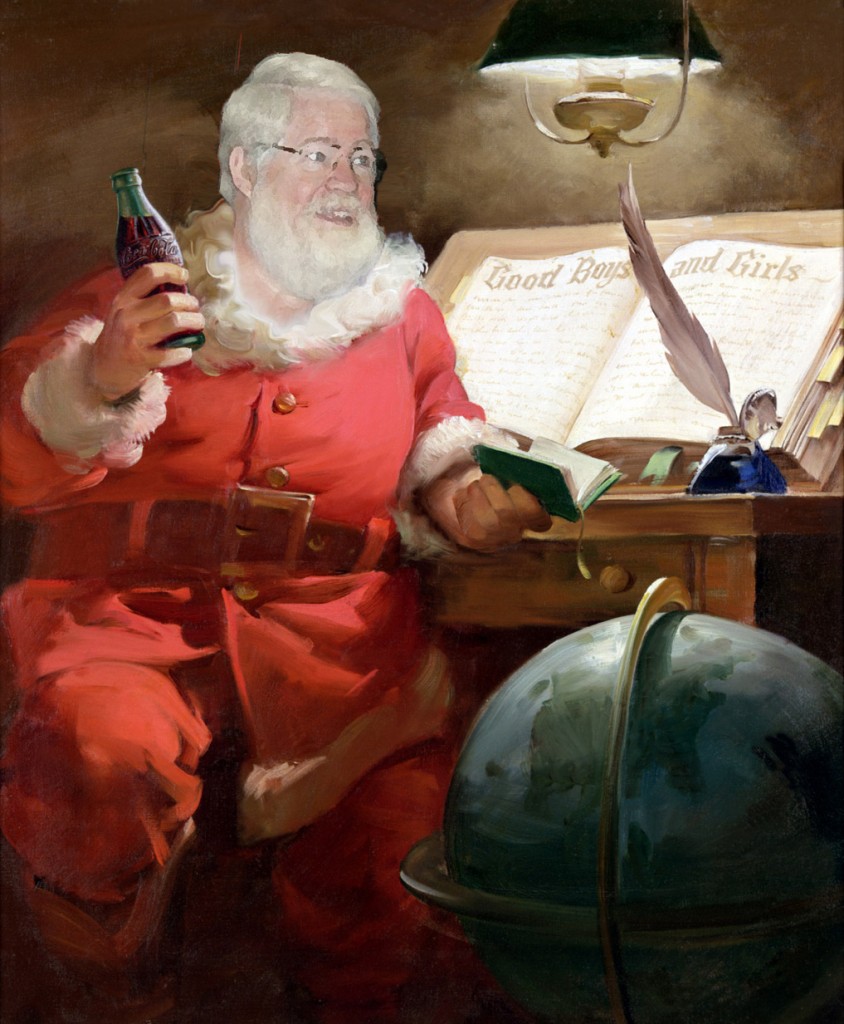
“Santa Mike” by Lynn Maudlin

(1) LOVELY CHRISTMAS DECORATIONS. Galaxy used to have an annual tradition….

(2) THE SCIENCE OF READING TO KIDS. [Item by SF Concatenation’s Jonathan Cowie.] The Christmas edition of the British Medical Journal is out.  One festive season story is whether or not reading bed-time fantasy (fairy tales) to children confers additional  health benefits…. “Good nights: optimising children’s health through bedtime stories”.

Healthy sleep is a public health priority, with at least a third of children and adults reporting insufficient sleep. It is essential for children’s growth and development and optimal physical and mental wellbeing. Consistent bedtime routines, with a calming activity before bed, such as a bedtime story, can promote healthy sleep. Some traditional fairy tales and classic children’s fiction that have soothed many a child to sleep may also include information about the benefits of sleep and the characteristics of sleep disorders, providing accessible and engaging ways for parents or carers, healthcare providers, and educators to discuss healthy sleep with children.

(3) IS THE 2024 2000AD ANNUAL WORTH IT? [Item by SF Concatenation’s Jonathan Cowie.] I don’t know if this is a thing in the US, but over here in Brit Cit, the pre-Christmas season sees the publication of comics’ annuals. These are large-format hardbacks featuring stories from the comics. 

2000AD used to produce them back in the late 1970s and early 1980s but have not done so for the past 24 years, instead they produce special, 100-page editions of 2000AD. However, this year they have gone back to form and produced an annual! (With two alternate cover desgns.)

Now, at £25 (about US$30) it might be a little expensive for some. However, die-hard 2000AD fans will be tempted. Here, while there are new Judge DreddStrontium DogLawless and Rogue trooper (feature film hopefully coming this year), all the other material – Judge AndersonTales from the Black MuseumMean Machine, more Rogue trooper and more Judge Dredd, is reprinted old material. So if you are a long-standing 2000AD fan – and, standing at over six feet, I am– then you will already have all these in your collection.

Yet, such is the length of 2000AD’s history (over 47 years) that many will have only come to Tharg’s (the editor’s) fold in recent years and so may only now get to see this reprinted material for the first time.

But fear not any fellow old Squaxx dek Thargo (2000AD fans), this year 2000AD are still producing their 100-page special Christmas edition of all new material as well. What joy! 

2000AD is available from all large, specialist SF bookshops that have a decent comics section or online at www.2000AD.com.

Splundig!

(4) MYSTERY REVEALED. From Atlas Obscura, a year ago: “How Christmas Murder Mysteries Became a U.K. Holiday Tradition”.

Christmas murder mysteries can be traced back to detective fiction’s golden age between World War I and II. Before World War I, Christmas short stories and detective fiction had been steadily growing in popularity throughout Victorian and Edwardian Britain, eventually developing into the more complicated mysteries of the interwar period….

(5) SPIRIT DU JOUR. [Item by Steven French.] And here’s a short selection of three recent tales and one old classic: “The best spooky stories for Christmas, from Victorian classics to contemporary creepy tales” in the Guardian.

This is a time for ghost stories. There’s a reason Shakespeare tells us: “A sad tale’s best for winter: I have one of sprites and goblins.” And why Dickens’ A Christmas Carol, and its (superior?) muppets version have retained popularity.

Since pagan times, people have believed in the supernatural potential of the winter solstice. It’s a liminal moment, when the darkness retreats and the light returns, a hinge point where the door between the living and the dead can swing open. (Other liminal moments are considered supernaturally powerful, too. Midnight, for instance. And its opposite – The Apparition of Mrs Veal, sometimes described as the first modern ghost story, has its spirit appear at noon.)

So, as we approach the end of one year and the start of another, do enjoy some spooky stories. The list below features some suggestions beyond the Victorian classics, to give you a nice, contemporary creep….

(6) ES COLE (1924-2024). Fandom recently learned that Esther Cole, who co-chaired the 1954 Worldcon in San Francisco with her husband Les, died a month ago at the age of 100. Rich Lynch has written a tribute: “Farewell, Dear Lady — Es Cole (1924-2024)”.

(7) BARRY MALZBERG TRIBUTE. Jeet Heer praises the late Barry Malzberg, who passed away December 19, in “Novelist on a Deadline: Barry Malzberg, 1939–2024” at The Nation.

…Along with his peers J.G. Ballard, Samuel Delany and Philip K. Dick, Malzberg was a central figure in the movement of science fiction away from the external world of adventure fiction and outer space into the psychological torments and struggles of inner space. Technology, these writers all understood, is not something external to humans but changes how we think and how we feel: The registering of technological change in the realm of emotional life was their literary project.

Malzberg was a particularly kindred spirit to Dick, another speed demon—one who batted off books in a matter of weeks during amphetamine-fueled binge sessions at the typewriter. In an interview in the late 1970s, Dick said, “In all the history of science fiction, nobody has ever bum-tripped science fiction as much as Barry Malzberg.… he’s a great writer.”…

(8) MEMORY LANE.

[Written by Cat Eldridge.]

How The Grinch Stole Christmas (1966)

Once upon a Christmas season, there was a television show called How The Grinch Stole Christmas. A television show that explicitly had a message that Christmas was neither a celebration of the birth of Christ, nor was it something that comes in a box, but rather is a matter of remembering that we hold each other in our hearts. Warm, fuzzy, and aggressively secular. In 1966 no less!

Aired on December 18 on CBS, the short film, just 26 minutes long, aired on that network for 21 years; ABC has aired it starting 2006, and then Turner Broadcasting has been airing, well until now as you’ll see below. I just watched it after getting it off iTunes where it comes bundled with Horton Hears A Who. (Both of these would be made into films that were awful.) This animated version was written by Christine Kenne from the brief children’s book by Theodore Geisel writing as Dr. Suess; it was produced by him and Chuck Jones who also directed it rather brilliantly.

The animation style looks more than a little flat but that just adds to the feel of it being a folk tale about a villain in his lair high on the mountain, The Grinch, who decides he can’t stand all the noise and commotion of the Whos down in Whoville enjoying Christmas. Not to mention his disgust at them eating the rare roast beast. So he concocts a brilliant scheme to dress as Santie (sic) Claus and take a sleigh down into Whoville (his dog Max with an antler tied to his head being a poor substitute for a reindeer) and steal everything down and including a crumb of food so small that even a mouse wouldn’t eat it.

So up to the top of Mount Crumpet he rides waiting for them to all go ‘boo who’ when they discover everything is gone, but instead he hears them all signing out in joyful voices thereby providing the upbeat moral of this which I noted previously. Hearing this, his heart grows multiple sizes and he rescues the now falling load with ‘the strength of ten Grinches plus two’. Riding into Whoville, he grins ear to ear, and he, the now reformed Grinch, has the honor of carving the roast beast.

I watch it every year this as I really like it. I love the bit, used twice, of increasingly small Whos, once serving tea and the second time a strawberry to a small Who girl, by coming out of a series of covered dishes.

A final note must be devoted to this being I believe the last performances of Boris Karloff who both narrated it, voiced and made the sounds of The Grinch and of this tale which I noted above sung all of its songs save ‘You’re a Mean One, Mr. Grinch’ which was, though uncredited, sung by Thurl Ravenscroft, one of the booming voices for Kellog’s Frosted Flakes. Karloff won the only performance award he got as he was awarded a Grammy in the Spoken Ward category!

It’s one of the best Christmas shows ever!

It is streaming on Peacock now. So go watch it. The Suck Fairy says you really should.

(9) MORE MEMORY LANE.

[Written by Aurora Winter.]

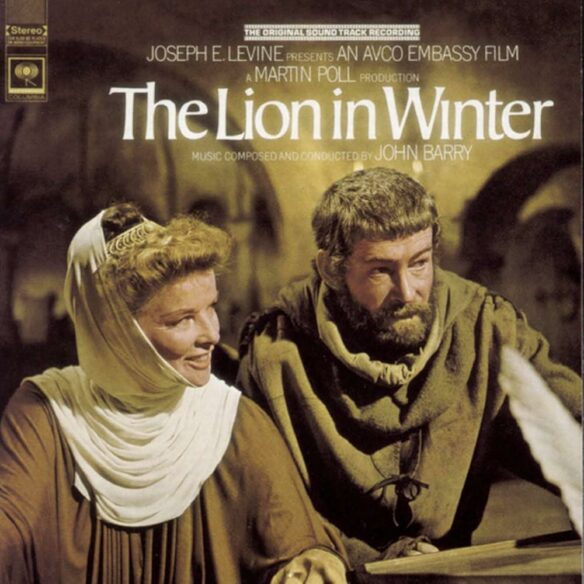
The Lion in Winter (1968 and 2004)

In 1968 MGM Studios teamed up with James Goldman to adapt his play The Lion in Winter for the screen. At the time the play had been a flop, running for a mere eighty-three performances on Broadway two years previous. The movie was made and was not only a success, but also breathed new interest into the stage version. I first encountered the 1968 film in University and read the script.

The title, for those of you rusty with your English history, refers to King Henry II (the lion was his crest) being in the “winter” of his life. At this point in history King Henry II had a kingdom that stretched into France and was in need of choosing his heir. Eleanor of Aquitaine, Henry’s wife, was imprisoned in a castle (thanks to Henry who was the key keeper). Goldman’s story is a fictional account of the Christmas court held to determine the future king. A complicated story this is, the wit in the script combined with the actors’ stellar timing make it worth watching again and again.

Seven characters, each tremendously important, make up the cast . . . and what a cast it is. The role of the fifty-year-old (quite old for 1183) King Henry is played by a mature Peter O’Toole. Katherine Hepburn was granted the role of the spunky and vivacious Eleanor of Aquitaine. The three sons up for the throne are: Richard (Anthony Hopkins), John (Nigel Terry), and Geoffrey (John Castle). Let us not forget Alais (Jane Merrow) either, the young girl given to Henry by the French king sixteen years before to one day be the bride for the chosen king. Beyond this it is useless to explain more of the plot as it is far too complicated.

I said that the timing was crucial to the success and enjoyment one can experience with this film. While some may not appreciate a film that finds its humor through fast paced, verbal, intelligent wit with little ‘sight gags’ and no slapstick, I adore it. Each scene seems half the length it actually is because these actors are so tight in their character that they can fire one-liners back and forth without ever seeming fake or forced. One gets the sense that these conversations might have occurred between Eleanor and Henry, Henry and Alais, Richard and Philip, John and Geoff.

The technical aspects of this film are quite impressive too, period costume more accurate than those generally seen in such films. The whole movie takes place within Henry’s castle in Chinon, a vast castle in the cold of December, and the production crew made sure we felt the draft from the open spaces and cold stone. The cinematography often mirrors the long walking shots that we now see all the time on West Wing, creating the feeling that we have been transported back centuries to drop in on this family crisis.

While this film does have some minor downfalls — Morrow’s Alais is a bit too whiney for my taste and a few gems were cut from the original text and replaced with extraneous muck (I’m still holding out for the version that leaves those gems in) — they are easily ignored and outdone by the beauty of the final work. It is no surprise that this launched Anthony Hopkins into stardom, or how so many see Hepburn (she did win the Best Actress Oscar for this role) and O’Toole as the definitive Eleanor and Henry. If, somehow, you have missed this piece of film history, go rent the DVD, sit back, and allow yourself to be transported back to 1183.

I am not a big fan of remakes when it comes to the film industry, especially when the original was so fantastic. But every now and then someone comes along and surprises me with a new-old movie that is as good, or better than the original. This was what I discovered after I watched the 2004 version of The Lion in Winter.

The script is still the same screenplay adaptation Goldman wrote for the 1968 film. The entire framework in the technical areas remained untouched. The actors were the key to bringing this new version to life. I should think it would be rather intimidating to attempt to play Eleanor of Aquitaine or Henry II after Hepburn and O’Toole. The director cast Glenn Close as Eleanor and Patrick Stewart as Henry and the choice could not have been better. Close and Stewart bring to the film a chemistry and wit that Hepburn and O’Toole never did.

With repeated viewings Hepburn’s Eleanor eventually struck me as being a little devoid of the true stoicism and sarcasm that I see the character as having. Close presents an Eleanor whose emotional indicators are much more subtle, the way the character reads on the page. Stewart, too, breathes new life into Henry’s role. He keeps up with Close’s pace and allows enough of Henry’s heart into view, rather than only his determined grip on power; we can stand by him rather than judge him too harshly.

Unfortunately, this film forgot that the story is really about the whole royal family, not simply about Eleanor and Henry. Because of this I think that the supporting cast was not really allowed to find their individual moments in the spotlight the way the play and original film do.

They also, for reasons unknown, decided to skip over the tension between Philip (Jonathan Rhys-Meyers) and Richard (Andrew Howard). It is one of those little things that doesn’t seem that important to the overall piece, but really it is a massive turning point in the script and I think must be portrayed with that in mind.

Overall, the new version surprised me with just how good it was. As it turned out, my fears about the new version were unfounded, even though it was not without its own disappointments. Luckily, I can fully recommend both versions to anyone who might be interested in this little bit of fictionalized history. In fact, watch them both, one after the other in either order; you won’t be sorry.

[Reprinted from Sleeping Hedgehog.]

(10) TODAY’S ANNIVERSARY.

[Written by Cat Eldridge.]

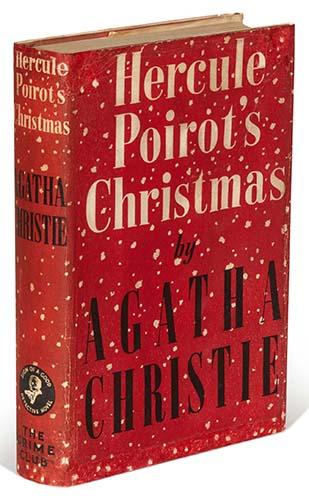
Hercule Poirot’s Christmas (1938)

December 19th eighty-six years ago, Hercule Poirot’s Christmas was first published by the Collins Crime Club. In the States, it bore first the title of Murder for Christmas and later A Holiday for Murder when published in paperback. It was the nineteenth novel with him as the Belgian detective; it retailed at seven shillings, six pence. 

Critics generally thought it was one of her best mysteries. The New York Times Book Review critic Isaac Anderson said of it that “Poirot has solved some puzzling mysteries in his time, but never has his mighty brain functioned more brilliantly than in Murder for Christmas.”

The story was adapted for television for an episode of Agatha Christie’s Poirot starring David Suchet as Hercule Poirot, first aired in the UK on Christmas 1994. The BBC has produced it twice for radio with it first being broadcast on Christmas Eve 1975 with John Moffatt as Hercule Poirot. A second production was broadcast on Christmas Eve 1986 featuring Peter Sallis as Poirot. BritBox here in States is now where you can watch this series. 

ABE currently has a UK first edition the cover art below of course for a little over $8700 with this description, “A fine copy with one small neat contemporary date inscription to corner of flap. Some light sporadic foxing to preliminary pages (only). Covers are bright and have no bumping to corners or fading to spine. In original near fine price clipped dust jacket with some archival restoration chiefly to spine tips. An excellent copy.” 

(11) COMICS SECTION.

(12) EMMA BULL ON CHRISTMAS TAMALES. [Item by Cat Eldridge.] Emma Bull, who for a while lived with her husband Will Shetterly in Arizona, says “We have to have tamales on Christmas Eve. Fortunately, local tamale specialists La Loma make excellent ones, since I’m way too lazy to build ’em myself.We have to that ‘have tamales on Christmas Eve. Fortunately, local tamale specialists La Loma make excellent ones, since I’m way too lazy to build ’em myself.’ She added a bit later that the filling is, “Anything vegetarian: cheese and peppers, mostly, or tamales de elote, which are slightly sweet corn masa. Served with roasted garlic salsa and spicy guacamole. The one year Will and I made our own tamales, the filling included wild rice, which sounds weird but which was really tasty.”

(13) THE FIRST ONE IS FREE. Max is sharing the first full episode of “Creature Commandos Season 1” to entice subscribers.

Amanda Waller assembles the Creature Commandos — led by General Rick Flag Sr. — and sends them to Pokolistan to protect Princess Ilana Rostovic.

(14) TODAY’S THING TO WORRY ABOUT. Dan Monroe reveals the many ways in which the award-winning Peanuts classic differs from the version originally aired in “Whatever Happened to A CHARLIE BROWN CHRISTMAS?”

[Thanks to Teddy Harvia, Mike Kennedy, Andrew Porter, Lise Andreasen, Rich Lynch, John King Tarpinian, Chris Barkley, Cat Eldridge, SF Concatenation’s Jonathan Cowie, Steven French, and Kathy Sullivan for some of these stories. Title credit belongs to File 770 contributing editor of the day Jack Lint.]

Pixel Scroll 11/14/22 One Scroll Makes You Pixel, The Other Makes You Smaug

(1) DESTINATION FOR THE STARS? The New York Times’ Blake Gopnik reports that last week Christie’s auction house broke records by selling more than $1.5 billion in art from the estate of Paul G. Allen, the co-founder of Microsoft who died in 2018. Although a lot of high art went under the hammer, his pop culture holdings, including sf art, did not and may have a different fate.  

… It all made me think of Allen as the kind of person who might have enjoyed buying, and owning, a $15 million Stradivarius violin and a $12 million Mickey Mantle baseball card and a $10 million stamp from British Guiana.

But there was one work in the sale — a real outlier — that meshed with stronger, more focused feelings that I seemed to glimpse when I met with Allen. Hanging among pieces by the certified geniuses of Western “high” art at Christie’s sat a dreamy, sunset scene of teen-girls-in-nature, painted in 1926 by the American Maxfield Parrish, best known for his truly great work in commercial illustration. It called to mind the tremendous excitement that Allen showed, a decade ago, when he had me look at a series of paintings that had been used, sometime in the 1950s or ’60s, I’d guess, for reproduction on the cover of science-fiction novels or magazines: I remember seeing weird Martian landscapes, galactic skies and maybe a rocket ship or two.

I can’t confirm those memories, right off the bat, because none of those pictures ended up at Christie’s. (Even though you could say that Allen’s Botticelli has some extraterrestrial strangeness to it, if only because of its distance from today’s culture, and that his paintings by Salvador Dalí and Jacob Hendrik Pierneef might work with stories by Philip K. Dick.) But I do remember that in our interview Allen’s enthusiasm for those objects from so-called “popular” culture seemed much more intense, and heartfelt, than the feelings he expressed for masterpieces that had cost him thousands of times more.

And that may be born out in the future that seems in store for those sci-fi objects, different from the fate of the ones sold into private hands at Christie’s. Last month, a spokesperson for Seattle’s Museum of Pop Culture, founded by Allen in 2000 — his sister Jody Allen is its current chair — told The Times that more than 4,000 objects of un-fine art and culture from the Allen estate, valued at some $20 million, were due to end up among its holdings, and I can only hope that the sci-fi paintings will be among them. (A representative from Vulcan, the Allen company in charge of his estate, later weighed in to say that the bequest to MoPOP was not final and that Vulcan could not confirm the exact number or type of objects in it. As when their boss was alive, his Vulcans play their cards close to their chests.)…

(2) AO3’S FANZINE SCAN HOSTING PROJECT. “AO3’s fanfiction preservation project: Archivists are digitizing zines to save fan history” reports Slate.

Archive of Our Own is probably best known as the place to read fans’ carefully crafted Harry Potter prequels or Lord of the Rings stories millions of words long. But the fanfiction website also has a lesser known, though no less important mission: to save older fanfic that’s at risk of disappearing. A new initiative, the Fanzine Scan Hosting Project, aims to make fan stories and art from physical fanzines accessible through the Archive, preserving pieces of history previously confined to university libraries, scattered eBay sales, and forgotten corners of attics….

Over the last year or so, however, Open Doors’ Fan Culture Preservation Project has expanded, finally giving them room to launch the Fanzine Scan Hosting Project. So far, they’re making their way through the backlog of scans that Zinedom has already accumulated, which Dawn estimates is “a couple thousand.”

These came from various sources, with Dawn doing a lot of outreach herself simply by searching Facebook for names she came across in zines and making phone calls. Janet Quarton, a Scottish Star Trek zine publisher and preservationist, scanned about 500 zines herself in 2013. But even Zinedom’s digital collection is only a fragment of what’s out there. One Zinedom participant has a collection of around 8,000 physical zines from the Star Trek fandom alone, and digs out the appropriate copies if Dawn is contacted by someone looking to save something in particular.

Open Doors is now preparing to post on the Archive those zines from Zinedom’s backlog which they already have permission to share. Some of these overlap with online zine archives that they’ve been previously importing, like the Kirk/Spock archive. But new requests and permissions have also been coming in since the announcement, and it will be an ongoing process, with volunteers working hard to convert and edit each individual zine.

(3) THE RIGHT WORD? Nisi Shawl was still in search of an answer that hits the spot when I looked at Facebook this afternoon:

What’s the word for the kind of apology you get that blames you for what went wrong?

(4) HORROR WRITING VETERANS. The Horror Writers Association blog has been running a “Veterans in Horror Spotlight” series. Here’s an example: “Veterans in Horror: Interview with Jonathan Gensler”.

What role, if any, did reading and writing play during your military service?

I still have stacks of my journals from the whole nine-year period sitting on my bookshelf, unread to this day.  I had written poetry and journaled most of my teenage years up to that point, but when I got out of the service I stopped journaling and writing almost completely for reasons I haven’t quite grasped.  That was over 15 years ago.  Reading, on the other hand is something I have never stopped doing.  These combat deployments were well before I had anything like an e-reader, so it was physical books all the way.  I must have lugged around a ridiculous amount of books with me. The big ones that hit me the hardest while deployed are still some of my favorites: Dumas’s The Count of Monte Cristo, Epictetus’ The Enchiridion, my first readings of Ender’s Game and that series. I got my first copy of House of Leaves while deployed to Iraq and that copy is scrawled with my own footnotes and reflections, and is falling apart at the seams.  And then of course, King finished out The Dark Tower while I was deployed so I had those tomes sent to me and to tote around as well. So, yeah, I filled my spare hours with both reading and writing, quite a bit of both.

Here are the links to the rest of the series.

(5) BOOKSTORE REBOUNDS FROM ARSON ATTACK. “L.A. book emporium the Iliad recovering from mysterious fire” reports the Los Angeles Times. The bookstore’s GoFundMe has been an enormous success. The owner asked for $5,000 to cover his insurance deductible. “The response has topped $34,000, sparing him the need to file a claim at all.”

…The cause of the blaze remains unknown. Los Angeles Fire Department spokesman Erik Scott said it has been ruled undetermined.

[Iliad owner] Weinstein said he believes an arsonist started the fire. It appeared that books the store leaves outside for the community to browse were stacked in a pyramidal shape next to the entry door and lit, he said.

An inscrutable motive was suggested by 15 to 20 copies of a flyer Weinstein said he found taped to the sides of the building. It was a collage of conspiratorial references — the Irish and South African flags, a photo of the burned-out cabin where policeman-turned-killer Christopher Dorner died, an address of a nearby home, and a handwritten letter attributed to Alex Cox, a deceased figure in a complex family homicide case depicted in a Netflix documentary….

(6) AMAZON WORKFORCE CUTS COMING. Reuters has learned “Amazon to lay off thousands of employees”. (And last week, Facebook parent Meta Platforms Inc said it would cut more than 11,000 jobs, or 13% of its workforce.)

… The cuts, earlier reported by the New York Times, would represent about 3% of Amazon’s corporate staff. The exact number may vary as businesses within Amazon review their priorities, the source told Reuters.

The online retailer plans to eliminate jobs in its devices organization, which makes voice-controlled “Alexa” gadgets and home-security cameras, as well as in its human-resources and retail divisions, the person said. Amazon’s time frame for informing staff remained unclear….

(7) THE ART OF FANHISTORY. Garth Spencer’s name was chosen from the hat to be Corflu Pangloss’ Guest of Honour. He has published the speech he gave “revealing the hideous basic truths of fandom” in Obdurate Eye #21.

…There was a time when I thought every other country seems to have a published fanhistory; why shouldn’t a Canadian fanhistory be published? Maybe I could compile it, from any information I could gather. Then I got strange responses like “Who are you? Why are you asking me questions? Who sent you? I’m not responsible!” So, I learned that There Are Things Fans Must Not Put on Record. More to the point, my search to find out what people can be expected to do, when to expect it, and how to defend yourself, is not the first thing people think of when they think of fanhistory….

(8) A MEMORY PROMPT. Daytonian in Manhattan’s “The Lost ‘Furness House’ — 34 Whitehall Street” is an article about the NYC headquarters building for the steamship line A. Bertram Chandler once worked for.

In 1891, Christopher Furness, owner of the Furness Line of steamships, and Henry Withy, head of the shipbuilding firm Edward Withy & Co., merged their businesses to form Furness, Withy & Co., Ltd.  Starting out with 18 vessels, by the outbreak of World War I, it sailed more than 200–and it was ready for a new New York City branch office building….

Andrew Porter reminds readers that he published Chandler’s autobiographical “Around the World in 23,741 Days” in Algol 31. You can read it here.

…One very early—but remarkably vivid—memory I have is of a Zeppelin raid on London during World War I. can still see the probing searchlights, like the questing antennae of giant insects and, sailing serenely overhead, high in the night sky, that slim, silvery cigar. I can’t remember any bombs; I suppose that none fell anywhere near where I was. It is worth remarking that in those distant days, with aerial warfare in its infancy, civilians had not yet learned to run for cover on the approach of raiders but stood in the streets, with their children, to watch the show….

(9) READ COMPLETE MOORE REMARKS ON KEVIN O’NEILL. [Item by Danny Sichel.] At the request of the New York Times, Alan Moore wrote an obit for Kevin O’Neill which was too long to publish. Jeet Heer posted it to Twitter.(O’Neill did the art for Moore’s The League of Extraordinary Gentlemen.)

(10) WOOSTER EULOGY. Philanthropy Daily, where he was a contributor, paid tribute to him in “Martin Morse Wooster, RIP”.

…In addition to writing for Philanthropy Daily, Martin was a senior fellow at the Capital Research Center, and contributed significantly to research on philanthropy and especially the issue of donor intent. Martin’s contributions to questions around philanthropy, charity, and donor intent can scarcely be overstated. How Great Philanthropists Failed remains the leading book on donor intent and the history of failed philanthropic legacies.

Martin’s work has appeared everywhere from the Wall Street Journal and the Washington Post to the Chronicle of PhilanthropyReason, and numerous other publications.

Martin will be sorely missed by all of us at Philanthropy Daily and countless others who have benefited from his important work.

(11) MEMORY LANE.

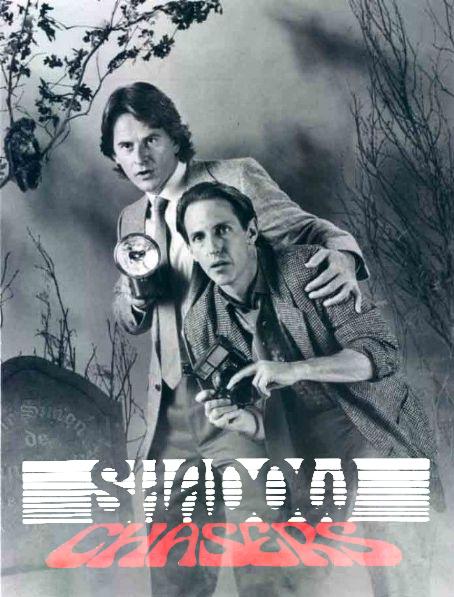
1985 [By Cat Eldridge.] Shadow Chasers 

Before we get started on talking about today’s essay, may I note that this was the day fifty-eight years ago that Santa Claus Conquers The Martians premiered was well? It was considered one of the worst genre films ever released, bar none.

Thirty-seven years ago this evening a series premiered on ABC, receiving almost no notice: Shadow Chasers. Let’s talk about the show before we turn to a brief autopsy on its numbers.

LOOK— I SEE BIGFOOT COMING WITH SPOILERS!

British anthropologist Jonathan MacKensie (Trevor Eve who played Peter Boyd in the excellent Waking the Dead forensic series) works for the fictional Georgetown Institute Paranormal Research Unit (PRU). MacKenzie’s department head, Dr. Julianna Moorhouse (Nina Foch), withholds a research grant to force him into investigating what she says is a haunting involving a teenage boy. He is paired with flamboyant tabloid reporter Edgar “Benny” Benedek.

Benny and Jonathan do not get along, but manage to solve the case without killing each other. The episodes continued in this vein, with Jonathan and Benny grudgingly learning to respect and admire each other, in the fashion of American cop shows.

LOOK IT WASN’T REALLY BIGFOOT, WAS IT? 

Now for the rating autopsy I promised.

So understand that it was on ABC as I said for just ten episodes of its sad existence with the last four shows being broadcast solely on the Armed Forces network. Just how bad was its existence? It was the lowest-rated of a one hundred and six programs during the 1985-1986 TV season.

Why so, you ask? Well that’s easy. It was broadcast against NBC’s The Cosby Show and Family Ties and CBS’s Magnum P.I. and, later on, Simon & Simon on CBS. It didn’t stand a chance. 

Indeed, local ABC affiliates within a few weeks in started preempting the series for other programming.

(12) TODAY’S BIRTHDAYS.

[Compiled by Cat Eldridge.]

  • Born November 14, 1907 Astrid Lindgren. Creator of the Pippi Longstocking series and, at least in the States, lesser known Emil i LönnebergaKarlsson-on-the-Roof, and the Six Bullerby Children series as well. In January 2017, she was calculated to be the world’s eighteenth most translated author, and the fourth most translated children’s writer after Enid Blyton, H. C. Andersen and the Brothers Grimm.  There have been at least forty video adaptations of her works over the decades mostly in Swedish but Ronja, the Robber’s Daughter was an animated series in Japan recently. (Died 2002.)
  • Born November 14, 1932 Alex Ebel. He did the poster for the first Friday the 13th film, and his cover illustration for The Left Hand of Darkness by Ursula K. Le Guin published by Ace Books in 1975 is considered one of the best such illustrations done. I’m also very impressed with The Dispossessed cover he did as well as his Planet of Exile cover too. His work for magazines includes Heavy MetalSpace Science Fiction and Fantastic Story Magazine. (Died 2013.)
  • Born November 14, 1950 Elliot S. Maggin, 72. A writer for DC Comics during the Bronze and early Modern ages of comics where he helped shaped the Superman character. Most of his work was on Action Comics and Superman titles though he did extensive work elsewhere including, of course, on the Batman titles.
  • Born November 14, 1951 Beth Meacham, 71. In 1984, she became an editor for Tor Books, where she rose to the position of editor-in-chief. After her 1989 move to the west coast, she continued working for Tor as an executive editor which she just retired from.  She does have one novel, co-written with Tappan King, entitled Nightshade Book One: Terror, Inc. and a handful of short fiction.  A Reader’s Guide to Fantasy that she co-wrote wrote Michael Franklin and Baird Searles was nominated for a Hugo at L.A. Con II. She has been nominated for six Hugos as Best Professional Editor or Best Editor Long Form.
  • Born November 14, 1959 Paul McGann, 63. Yes, he only did one film as the eighth incarnation of the Doctor in the 1996 Doctor Who: The Television Movie, but he has reprised that role in numerous audio dramas, and the 2013 short film entitled The Night of the Doctor.  He also appeared in “The Five(ish) Doctors” reboot. Other genre appearances include The Pit and the Pendulum: A Study in TortureAlien 3, the excellent FairyTale: A True StoryQueen of the Damned and Lesbian Vampire Killers.
  • Born November 14, 1963 Cat Rambo, 59 . All around great person. Past President of SFWA.  She was editor of Fantasy Magazine for four years which earned her a 2012 nomination in the World Fantasy Special Award: Non-Professional category. Her novelette Carpe Glitter won a 2020 Nebula, and her short story “Five Ways to Fall in Love on Planet Porcelain” was a 2013 Nebula Award finalist.  Her impressive fantasy Tabat Quartet quartet begins withBeasts of Tabat, Hearts of Tabat, and Exiles of Tabat, and will soon be completed by Gods of Tabat. She also writes amazing short fiction as well.  The Rambo Academy for Wayward Writers is her long-standing school for writers that provides her excellent assistance in learning proper writing skills through live and on demand classes about a range of topics. You can get details here.  Her latest, You Sexy Thing, was a stellar listen indeed and I’m very much looking forward to the sequel.
  • Born November 14, 1969 Daniel Abraham, 53. Co-author with Ty Franck of The Expanse series which won a Hugo at CoNZealand. Under the pseudonym M. L. N. Hanover, he is the author of the Black Sun’s Daughter urban fantasy series.  Abraham collaborated with George R. R. Martin and Gardner Dozois to write the Hunter’s Run. Abraham also has adapted several of Martin’s works into comic books and graphic novels, such as A Game of Thrones: The Graphic Novel, and has contributed to Wild Cards anthologies. By himself, he picked up a Hugo nomination at Denvention 3 for his “The Cambist and Lord Iron: A Fairy Tale of Economics” novelette. 

(13) COMICS SECTION.

  • Speed Bump knows of one effect that’s not special at all!

(14) HAPPY NEW YEAR. Lois McMaster Bujold pointed out to her Goodreads followers that the next Penric book Knot of Shadows garnered a starred review in Publishers Weekly. The Subterranean Press hardcover is due to be released on January 1. [Update: Bujold’s author page shows the Kindle edition of Knot of Shadows came out last year in October, so this will be a new hardcover edition, but not a new release per se.]

Temple sorcerer Penric and demon Desdemona return in this page-turner fantasy mystery from Bujold, the 11th in the series (after The Assassins of Thasalon) and possibly the best yet. Penric and Desdemona, the chaos elemental who shares his body, are joined by Alixtra and her own demon, Arra, to help the healers of the Mother’s Order in Vilnoc with an unusual case: a corpse has revived and is now shouting gibberish. Penric discovers that the victim is not one but two dead people—a man slain by death magic and a ghost that has begun animating his body. Death magic is so rare that even Desdemona has never witnessed it performed. A supplicant offers their own life to ensure that the Bastard, Penric’s god, will kill their target. This ritual opens multiple quandaries: Who is the corpse? Were they the supplicant or the target? And where is the other party to the death prayer? Penric remarks that “this case is bound to get ugly and sad”—and indeed it does, in the most creative of ways. Bujold has her protagonists combine mundane and mystical investigative methods to unravel the questions at hand, creating a truly enticing mystery. Series fans and new readers alike will want to savor this intricate , unusual case.

(15) WORLD MUSIC. “Ludwig Göransson Discusses His Globe-Trotting ‘Wakanda Forever’ Score” in Variety.

… The challenge, Göransson says, was to find a new sound for the African kingdom of Wakanda and its grief-stricken people while also trying to imagine the sound of Prince Namor’s undersea kingdom of Talokan, whose origins lay in Mexico’s ancient Mayan civilization.

Göransson consulted musical archaeologists and spent two weeks in Mexico City collaborating with Mexican musicians. He auditioned “hundreds of ancient instruments,” from clay flutes to unusual percussion instruments, and saw paintings of Mayans playing on turtle shells, among dozens of similar musically inspirational moments. He discovered the “flute of truth,” a high-pitched whistle-like woodwind instrument, and vowed to incorporate the “death whistle,” which has a piecing sound like a human scream.

By day, Göransson recorded with Mexican musicians, and by night, he was recording with Mexican singers and rappers. “I was using the morning sessions to put together beats and songs that we would use later that day with the artists,” the composer reports….

(16) ON THE GRIPPING HAND. Leaflock™ The Ent™ from WETA Workshop is only fifteen hundred dollars… The image of this veteran of the attack on Isengard “Contains two (and a half) Orcs, squashed, pinned and/or crushed by the Ent’s wrath.”

(17) MAKE IT GO. And if you have any money left after buying the Ent, you can order the Volkswagen-built Star Trek captain’s chair that goes 12mph – assuming it truly exists, which the Verge says should not be taken for granted.

…Assuming all of this is real, of course. Volkswagen has a recent history of lying to people. This time, the company seems to be fairly transparent that it’s a one-off marketing stunt, while also suggesting that “it will be available for test drives at various locations.” Hopefully that means citizens of Norway will soon be able to prove its capabilities….

(18) COMING FROM DUST. The short film Jettison will be released online December 7 by DUST & Film Shortage.

A restless young woman ships off to fight an interstellar war, only to struggle with the effects of being cut off from her home by both time and space.

(19) BELA WINS. “The 20 best horror villains of all time”, according to Entertainment Weekly.

…But for every icon of the macabre, there are a much larger number of deranged dentists, serial-killing Santa Clauses, and sorority house murderers who don’t quite rank as highly in the frightening food chain. In fact, it’s been a while since a character came along and asserted his or herself as the next count of the Carpathians or chainsaw-wielding maniac. Whoever steps up next has some big shoes to fill, because these are the crème de la crème when it comes to history-making evildoers….

1. Dracula

Dracula is the most influential horror villain of all time. The Count stalks like a slasher, murders in droves like a serial killer, and is the inspiration for every single vampire movie made after 1931. Dracula’s vast powers, and his immortality, make him the most formidable of any killer on this list, and while Bela Lugosi is most often associated with the character, it was Sir Christopher Lee who made the Count the vile, sadistic creature of the night.

Lee gave the character a grandiose feel thanks to his imposing height, and there was a sexuality the villain exuded which made him irresistible to women. Unlike his colleague and friend, Peter Cushing, Lee loathed reprising the role because Hammer wasn’t faithful to Bram Stoker’s 1897 novel. “I wanted to play Stoker’s character,” Lee explained. “It wasn’t remotely like the book.”

You’ll also enjoy Horror of Dracula (1958).

(20) VIDEO OF THE DAY. Dream Foundry has released the video of “Fantasy? On MY Spaceship?! Blending Science and Sorcery” on their YouTube channel. Features panelists Valerie Valdes, Tobias Buckell, and Bogi Takács.

[Thanks to Martin Morse Wooster, JJ, John King Tarpinian, Chris Barkley, Danny Sichel, David Doering, Andrew (not Werdna), Andrew Porter, Michael Toman, Cat Eldridge, and Mike Kennedy for some of these stories. Title credit belongs to File 770 contributing editor of the day Andrew (not Werdna).]

Pixel Scroll 1/29/22 I Cast “Titlificus Uniquify” (With A Flick Of The Wrist)

(1) FUTURE BIRTH. [Item by Jen Hawthorne.] The Atlantic magazine ran an article surveying people’s attitudes toward the concept of artificial wombs.  The very first person to give an opinion cited Bujold’s Vorkosigan Saga for her positive feelings toward the idea of artificial wombs.  “Liberation or Folly? Your Takes on Artificial Wombs”.

(2) UNREAL ESTATE. Camestros Felapton invites you to download the rules, the board, and the cards, and play “Timopoly”, the exciting game of genre domination!

Bored of the pandemic, Tim and I took a trip to an alternate universe. Sadly our holiday was ruined by persistent rain of venomous jellyfish. Stuck indoors, we played the local alternate universe board games (Scribble, Rusk, Eels & Ladles etc). Interestingly, this universe has no games based on attempting to control the property market of a huge city. Instead, the nearest equivalent is a game based on Tim’s attempts to manipulate the major literary award of the popular genre there known as Orbital Fiction.

Orbital fiction is all about stories set in orbit or on things in orbit or things trying to get into orbit. It’s very exciting and includes rockets, moons, planets and orbiting aliens. The major award is a trophy of a rocket that could fly into a big orbit, popularly known as the Huge-Orbit award (or just Huge-O for short).

Timothy’s cynical (and frankly corrupt) attempt to control these awards became such a cause célèbre that re-enacting the events became a popular board game.

(3) HOLLYWOOD IN NOLLYWOOD. BBC tweets about young Nigerian film-makers creating their own sci-fi cinema.

(4) IF A TRAIN LEAVES BALTIMORE. Ursula Vernon is working out some advanced series character math. Thread starts here.

(5) COMPREHENDING THE HOLOCAUST. An analysis of MAUS by Jeet Heer: “Maus in Tennessee” at The Time of Monsters.

I first became aware of Art Spiegelman’s Maus in the summer 1981 when I was 14 years old. Spiegelman had just started serializing the first chapters of his eventual graphic novel in the pages of RAW, a graphic art magazine he edited with Francoise Mouly. I saw a review of the first issue of RAW in The Comics Journal. I was intrigued by the excerpts The Comics Journal featured of Maus, an anthropomorphic account of the experience of Spiegelman’s father Vladek during the Holocaust told with the Jews as mice and the Nazis as cats. At the time, RAW was a little outside my price range (and carried an amusingly daunting blurb that it was “the graphix magazine of postponed suicides”). I was able to furtively look at some early issues at Pages, a Toronto book store, and  fully caught up with Maus by 1986, when the first half of it appeared in book form….

I shared the book with my school friend David Berman, whose father was a Holocaust survivor. David, not at all a comics person, was also very impressed by it, as were his parents. I remember David telling me how much the cantankerous relationship between Vladek and Art Spiegelman mirrored his own relationship with his father. One of the advantages of the book was it could be read by both young and old— later on, David’s nephews and nieces read the book as young teens

(6) SCOTCH EGG. News to me – the BBC has a feature an online Writers Room where you can read the scripts of various productions including Doctor Who. Learned this while reading an article in Scotland’s Daily Record: “Doctor Who fans find hidden Scots ‘Easter egg’ in released scripts from latest series”.

Doctor Who fans have found a hidden Scottish Easter egg in the latest script release from the legendary sci-fi telly series.

As Whovians eagerly await the next special, the BBC has released the scripts for Flux and Eve of the Daleks.

The scripts are available from the Script Library, and show fans the hidden writings behind some of their favourite episodes of the Tardis travelling drama.

In on particular episode Scots actors Peter Capaldi and Sylvester McCoy get special nods as part of the script.

In season 13’s first episode entitled The Halloween Apocalypse, the Doctor and Yaz are captured by Karvanista and face serious danger.

They escape via their trapeze skills, it is revealed their handcuffs were the property of the Doctor, who offered them up to their captor.

The handcuffs are voice activated, but that means the Doctor has to remember which voice was used.

The Doctor wonders: “Maybe I was Scottish when I set these up while trying to break free”, and then orders them to release in a Scottish accent….

(7) THE BARGAIN BIN CINEMATIC UNIVERSE. [Item by Martin Morse Wooster.] Austin McConnell had to quarantine, and thought he’d catch up with the MCU. But he hasn’t seen 13 of the MCU movies, so he decided to create his own “cinematic universe” using public domain comics of the 1940s.  SJWs will be thrilled to find that instead of Batman, McConnell’s universe has “Cat-Man.”  But who will survive when catman meets Man-Cat?

(8) MEDIA BIRTHDAY.

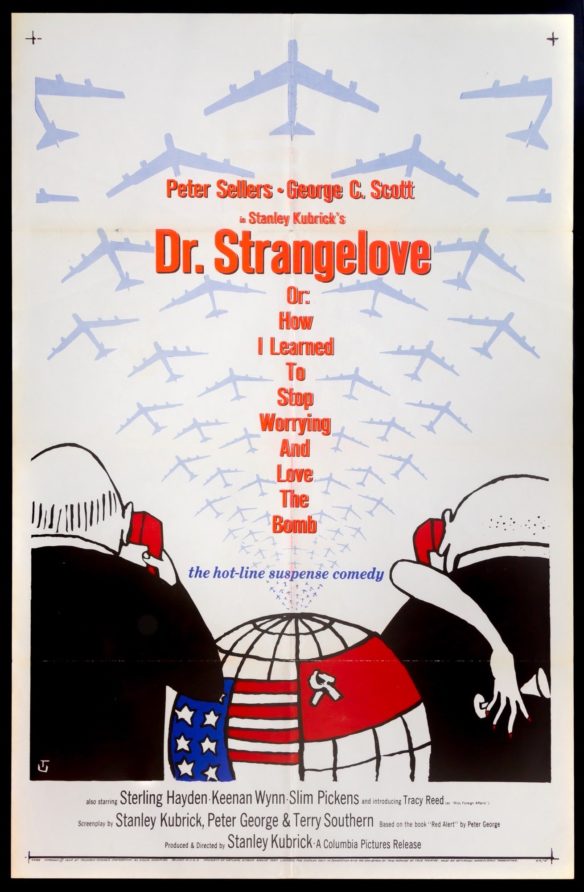
1964 [Item by Cat Eldridge.] Fifty-eight years ago, Dr. Strangelove or: How I Learned to Stop Worrying and Love the Bomb premiered. Starring a stellar cast of Peter Sellers, George C. Scott, Sterling Hayden, James Earl Jones and Slim Pickens, it was directed by directed, produced, and co-written by Stanley Kubrick. 

It was not the original title as Kubrick considered Dr. Strangelove’s Secret Uses of Uranus as well as Dr. Doomsday or: How to Start World War III Without Even Trying, and the much shorter Wonderful Bomb.

The film is somewhat based on Peter George’s political thriller Red Alert novel. (Originally called Two Hours To Doom.)Curiously Dr. Strangelove did not appear in the book. This novel’s available on at usual digital suspects. And George’s novelization of the film is on all digital sources. If you purchase it, it has an expanded section on Strangelove’s early career. 

It would not surprisingly win the Hugo for Best Dramatic Presentation at Loncon II in London in 1965 with The Seven Faces of Dr. Lao being the only other film on the final ballot.

The film was a box office success as it only cost one point eight million to make and it made nine point four million. Critics were universal in their belief that it was one of the best films ever done with Ebert saying it was “arguably the best political satire of the century”. At Rotten Tomatoes, it currently holds a ninety-four percent rating with over two hundred thousand audience reviewers casting a vote.  The studio on the other hand thought it was an anti-war film and distanced itself as far as it could from it. 

A sequel was planned by Kubrick with Gilliam directing though Gilliam was never told this by Kubrick and only discovered this after Kubrick died and he later said “I never knew about that until after he died but I would have loved to.”

The original theatrical trailer is here.

(9) TODAY’S BIRTHDAYS.

[Compiled by Cat Eldridge.]

  • Born January 29, 1918 Robert Pastene. He played the title role in the first televised Buck Rogers series on ABC that also had Kem Dibbs and Eric Hammond in that role. 35 episodes were made, none survive. As near as I can tell, his only other SFF performance was on the Out There and Lights Out series. (Died 1991.)
  • Born January 29, 1923 Paddy Chayefsky. In our circles known as the writer of the Altered States novel that he also wrote the screenplay for. He is the only person to have won three solo Academy Awards for Best Screenplay. The other winners of three Awards shared theirs. He did not win for Altered States though he did win for Network which I adore. (Died 1981.)
  • Born January 29, 1940 Katharine Ross, 82. Her first genre work was as Joanna Eberhart in The Stepford Wives, scary film that. She shows up next as Helena in The Swarm and plays Margaret Walsh in The Legacy, both horror films. The Final Countdown sees her in the character of Laurel Scott.  And Dr. Lilian Thurman is her character in the cult favorite Donnie Darko.  I’m fairly sure that the only genre series she’s done is on The Wild Wild West as Sheila Parnell in “The Night of the Double-Edged Knife”, and she did an episode of Alfred Hitchcock Presents as well. 
  • Born January 29, 1945 Tom Selleck, 77. Setting aside the matter of if Magnum P.I. is genre, which some of you hold to be true, and in the twelfth season of Blue Bloods which is definitely not genre, he was Sgt. Jack R. Ramsay in Runaway which is most definitely SF.  He recently did some voice acting by being Cornelius, Lewis’ older self, in the animated Meet the Robinsons film, and he showed up as himself in the “What Do You Want to Be When You Grow Up?” of the Muppet Babies nearly forty years ago.
  • Born January 29, 1958 Jeph Loeb, 64. His first comic writing work was on the Challengers of the Unknown vol. 2 #1 in 1991 with Tim Sale. I’m pleased to say that it was in the DC Universe app so I just read it and it’s superb. He’d go on to win three Eisners for his work for Batman/The Spirit #1, Batman: The Long Halloween and Batman: Dark Victory. And he’s also a producer/writer on such genre series such as SmallvilleLostHeroes and Teen Wolf.
  • Born January 29, 1970 Heather Graham, 52. Best known SF role no doubt was Dr. Judy Robinson on the Lost on Space film. She played also Felicity Shagwell that year in Austin Powers: The Spy Who Shagged Me. And she was Annie Blackburn on Twin Peaks.
  • Born January 29, 1988 Catrin Stewart, 34. Jenny Flint in five episodes of Doctor Who. She was the wife of Madame Vastra and the friend of Strax, the three known as the Paternoster Gang, who appeared first during the Eleventh Doctor and last during the Twelfth Doctor. Big Finish has continued them in their audiobooks. She also played Stella in two episodes of the Misfits series, and was Julia in a performance of 1984 done at London Playhouse a few years back.

(10) COMICS SECTION.

(11) GUINAN GENESIS. Slashfilm tells “How LeVar Burton Landed Whoopi Goldberg Her Role On Star Trek”.

…Goldberg explained:

“So when my friend LeVar Burton said, ‘I’m going to do the new Star Trek,’ I was like, ‘Wait, I want to be on it!’ And they were like, ‘Okay, chill!’ And then a year later I said, ‘LeVar what happened? Nobody ever called!’ and he said, ‘They didn’t believe you.’ So I said, ‘Let’s call them right now.’ And so we called Gene Roddenberry, and I said, ‘Can we have a meeting please, because I really want to be on this and if you’ll meet with me I’ll explain why I think it’s important.’ So they were all very skeptical.

I explained, I said you know there had never been any Black people in the future, and it was a huge deal for me [seeing a Black actor on ‘Star Trek’] because I’m a sci-fi kid, and it felt like you were talking to me and letting me know it was alright. And I’d like to do that for some other kids. Now, we all know there are Black people in the future now, but I’d like to carry this on. He said, ‘I can’t believe you felt like that, I didn’t know this.’ I said, ‘Well if you watch sci-fi from the ’40s, ’50s, ’60s, you don’t see anybody.’

So he said okay, so he wrote my character, Texas Guinan, she’s based on – who had a great bar in New York in the ’20s – and she greeted everyone by saying, ‘Hello, suckers!’ So we couldn’t do that to the extraterrestrials. But that’s how I got on it, because I desperately wanted to, A.) thank him for giving that to me, because it was a big deal.”…

(12) FOR I AM WELSH, YOU KNOW. “Welsh town to retell tale of how it built Star Wars’ Millennium Falcon” — the Guardian has the story.

In a small Welsh town far, far away (perhaps), preparations are in hand to tell the story of how one of the most famous and beloved movie spaceships was secretly built in an old aircraft hangar.

A permanent exhibition is to open later this year explaining how the Millennium Falcon that appeared in the Star Wars film The Empire Strikes Back came to be constructed from wood and steel by engineers in Pembroke Dock, in south-west Wales.

Local craftspeople working under a veil of secrecy were ordered to refer to the ship as “Magic Roundabout” but, inevitably in a small town, word seeped out.

(13) THE OCEAN ATE MY HOMEWORK. Genre books weren’t involved – this time. “Cookbooks Sink to Bottom of Atlantic After Ship Incident” reports People.

At least two forthcoming cookbooks from acclaimed chefs are sitting on the bottom of the Atlantic Ocean after a “wild and unfortunate” turn of events.

The publication dates for Mason Hereford’s Turkey and the Wolf: Flavor Trippin’ in New Orleans and food writer Melissa Clark’s Dinner in One have been delayed, both authors said, after containers containing printings of their books toppled into the sea.

Publishers Marketplace adds: “The cargo ship carrying the books from China was on a slow course in the Atlantic Ocean near Portugal, likely to delay docking in the US due to port congestion. A storm hit the ship in early January and caused a ‘stack collapse’ in which 65 containers went overboard–seemingly containing every copy of the two books–while 89 others were damaged.

(14) UH, YEAH. CBS News says “Weber grill maker apologizes for poorly timed meatloaf recipe”. Then again, Mr. Aday might have found it hilarious.

Weber picked the wrong day to suggest grilling meatloaf.

The outdoor grill maker apologized on Friday for sending a recipe-of-the-week email earlier that day featuring instructions on how to prepare “BBQ Meat Loaf.”

The email coincided with news of the death of Marvin Lee Aday, best known as rock superstar Meat Loaf….

 [Thanks to Mike Kennedy, Martin Morse Wooster, JJ, John King Tarpinian, Chris Barkley, Jen Hawthorne, Tom Becker, Mlex, Andrew Porter, Michael Toman, and Cat Eldridge for some of these stories. Title credit belongs to File 770 contributing editor of the day Andrew (not Werdna).]

Pixel Scroll 4/22/19 Ceci N’est Pas Un Pixel Scroll

(1) HELP IS ON THE WAY. Jimmy Kimmel Live plugs the “Game of Thrones Hotline for Confused Fans.”

There is a lot going on in “Game of Thrones,” and it can be difficult to keep track of what’s what and who’s who. But fortunately help is on the way. Cast members Sophie Turner, Lena Headey, John Bradley, Joe Dempsie, Maisie Williams, Kristian Nairn, Iwan Rheon & Liam Cunningham host a new hotline to assist their confused fans.

(2) RONDO SETS RECORD. Never mind the Dragon Awards – voting just closed in the “17th Annual Rondo Hatton Classic Horror Awards” and would you like to guess how many participants they had? The administrator says —

The final votes are still be tallied, but close to 4,500 people voted this year, a new record.

The results will be posted soon, once the vote is finalized and visual material is prepared for the release.

(3) RELATIVELY LITERATURE. Gautham Shenoy contemplates “Ian McEwan and the (re)invention of science fiction: Why contempt for SF only exposes ignorance” at Factor Daily.

…So in this light, in the context of authors who actively avoid a novel of theirs being described as ‘science fiction’, and given the latest instance of Ian McEwan distancing himself from said label, I’d like to humbly offer a way in which one can tell if it’s an SF novel or not. “Whether a novel is science fiction—or not—depends on who the author is and who reviews it”.

As an advertising professional who has spent almost 20 years in the marketing business and who knows a thing or three about positioning and target audiences, this is perhaps the best description that I think we can arrive at. But where does this leave the reader?

It is up to the individual reader to decide whether he/she/they would rather go by convenient labels than follow interests or read what he/she/they would like to. As a reader – and not just of SF – I am in agreement with the author of Cloud Atlas and The Bone Clocks, the writer David Mitchell who says that genre snobbery is a bizarre act of self-mutilation because, “It’s convenient to have a science fiction and fantasy section, it’s convenient to have a mainstream literary fiction section, but these should only be guides, they shouldn’t be demarcated territories where one type of reader belongs and another type of reader does not belong…What a shame. All those great books that you’re cutting yourself off from.”

(4) WEIMER DOUBLE-HEADER. Paul Weimer told Facebook readers:

If you thought “Self, I want to hear @PrinceJvstin on a podcast”, today is YOUR day.

You can hear Paul on @SFFAudio talking about @nevalalee’s Astounding – “The SFFaudio Podcast #522 – READALONG: Astounding by Alec Nevala-Lee”

-AND-

On @SkiffyandFanty, he talks with their Hugo Finalist crew about Komarr — “Reading Rangers #10: Komarr by Lois McMaster Bujold”.

Hello, Rangers! We’re back with everyone’s favorite Space Nancy Drew in Komarr! This time Stina, Paul, and Trish sit around the campfire to talk about women’s agency, budding relationships, whether or not Miles is “dad” material, how good intentions can go horribly, horribly wrong, the politics of isolationism, and more!

(5) KNOWING CAMPBELL. Stanley Schmidt’s guest editorial for Analog “John and Me” takes off from the “The Astounding John W. Campbell, Jr.” panel at last year’s Worldcon moderated by Alec Nevala-Lee. Schmidt’s views of Campbell’s work are very different than those of fellow panelist Robert Silverberg, and he says in closing —

…As for what kind of editing John was doing in his last years, my experience indicates that he was still doing the kinds of things he was famous for, and still doing them very well. It’s unfortunate that some of his personal idiosyncrasies drove away some of his best writers, but that’s a separate question from the quality of his work. Maybe I was fortunate that I didn’t know him personally before I started writing for him, or I might have found it harder, too—though I hope I wouldn’t have let my disagreements with him, even on big issues, make me reject him entirely as a person. I did disagree with his editorials more often in those years than I had earlier, but as far as I knew he was just doing the professional argument-baiting he had always done. Even if I had known that he really held beliefs that I found highly objectionable, I doubt that I would have found that adequate reason to sever all contact with him and his work. A lot of people hold misguided beliefs, but my experience, I think, is a good example of how it’s possible to work productively with somebody, and respect some of his qualities, even while sharply disagreeing with some of his views. Maybe that’s a lesson that a whole lot of people need to relearn about now.

(6) SLF READINGS. The Speculative Literature Foundation’s Deep Dish Reading Series in Chicago resumes on May 9.

(7) DOC WEIR AWARD. The Doc Weir Award is voted on by attendees at the Eastercon and is presented to a fan who has worked hard behind the scenes at conventions or in fandom and deserves recognition. As Fandom.com explains —

The award consists of a silver cup (which must be returned the following year) and a certificate (if someone remembers to create one!)

The cup is engraved with the names of the previous winners, and in fine fannish tradition, it is up to each year’s winner to have their own name engraved at their own cost!

Jamie Scott is the 2019 winner.

Bill Burns of eFanzines has more info on the Doc Weir Award, and a list of all winners from 1963 to 2018 here.

(8) 71ST EASTERCON. Next year’s UK Eastercon, called Concentric, will be in Birmingham at the Hilton Metropole (NEC).

(9) ON THE AIR. Eneasz Brodski offers a “Crash Course in Creating a Podcast” at Death Is Bad.

1. Bona fides

I’m Eneasz Brodski. I produce the Methods of Rationality podcast. It began as me, in my bedroom, with a lot of enthusiasm and a handheld mic after a few hours of research. As of this writing it’s been 6.5 years since I started. I’ve spent over 10,000 hours working on this podcast, I’ve produced over ninety hours of audio fiction spread across 185 episodes, totaling almost 4.5 million downloads. I’ve been a finalist for the Parsec Awards three times. I’ve never done professional audio work, but I have some idea of how to get an amateur podcast going.

(10) WOLFE’S MEANING. In a New Republic article, Jeet Heer declares “Gene Wolfe Was the Proust of Science Fiction”.

…News of Wolfe’s passing spread on the internet on Monday morning, as the first images of the fire at Notre-Dame also started circulating. Many Wolfe fans were struck by the coincidence. “Gene Wolfe is dead and Notre-Dame is engulfed in flames,” the writer Michael Swanwick tweeted. “This is the Devil’s own day.” Swanwick’s grief is understandable. Yet Wolfe himself might offer more consoling counsel. Death and life, his work often showed, are not so much opposites but partners, with the passing of the old being the precondition for the birth of the new. Cathedrals can burn but they can also be rebuilt, and in fact all cathedrals are in a constant state of maintenance and repair….

(11) MARTIN BÖTTCHER OBIT. German film composer Martin Böttcher (1927–2019) died April 19. Cora Buhlert pays tribute — “In Memoriam Martin Böttcher”.

…But Böttcher’s most famous film score would be the one he composed for Horst Wendlandt’s other series, the Winnetou movies of the 1960s, based on Karl May’s adventure novels. Ironically, Martin Böttcher himself had never read a single Winnetou novel, which must make him one of the very few Germans of his generation who did not read Karl May. When someone asked him why he didn’t read the novels, Böttcher answered, “I’ve seen every single Winnetou movie dozens of times. I know how the story goes. I don’t need to read it.”

I’ve written about the Winnetou movies and what they meant for several generations of Germans before, so let’s just listen to Martin Böttcher’s iconic Old Shatterhand theme….

(12) TODAY’S BIRTHDAYS.

[Compiled by Cat Eldridge.]

  • Born April 22, 1916 Virginia Heinlein. Editor of Grumbles from the Grave. Also allowed Tramp Royale to be published after her husband’s death. And for some reason allowed longer versions of previously published works Stranger in a Strange Land, The Puppet Masters, and Red Planet to be published. Anyone read these? Used bookstores here frequently had copies of Stranger in a Strange Land so buyers didn’t hold on to it… (Died 2003.)
  • Born April 22, 1934 Sheldon Jaffery. Bibliographer who was a fan of Weird Tales, Arkham House books, pulps, and pretty much anything in that area. Among his publications are Collector’s Index to Weird Tales (co-written with Fred Cook), Future and Fantastic Worlds: A Bibliographical Retrospective of DAW Books (1972-1987) and Horrors and Unpleasantries: A Bibliographical History and Collector’s Price Guide to Arkham House. He also edited three anthologies which Bowling Green Press printed, to wit Sensuous Science Fiction from the Weird and Spicy PulpsSelected Tales of Grim and Grue from the Horror Pulps and The Weirds: A Facsimile Selection of Fiction From the Era of the Shudder Pulps. (Died 2003.)
  • Born April 22, 1937 Jack Nicholson, 82. I think my favorite role for him in a genre film was as Daryl Van Horne in The Witches of Eastwick. Other genre roles include Jack Torrance in The Shining, Wilbur Force in The Little Shop of Horrors, Rexford Bedlo in The Raven, Andre Duvalier in The Terror, (previous three films are Roger Corman productions), Will Randall in Wolf, President James Dale / Art Land in Mars Attacks! and Jack Napier aka The Joker in Tim  Burton’s The Batman. I watched the last one, was not impressed.
  • Born April 22, 1946 John Waters, 73. Yes, he did horror films, lots of them. Shall we list them? There’s Multiple ManiacsSuburban GothicExcision, Blood Feast 2: All U Can Eat and Seed of Chucky. The latter described as a “supernatural black comedy horror film” on Wiki. He also narrates Of Dolls and Murder, a documentary film about a collection of dollhouse crime scenes created in the Forties and society’s collective fascination with death.
  • Born April 22, 1950 Robert Elswit, 69. Cinematographer. An early short film he worked on was a 1982 TV adaptation of the Ray Bradbury short story “All Summer in a Day.” He began his career as a visual effects camera operator working on films like Star Trek: The Motion Picture, The Empire Strikes Back, and E.T. the Extra-Terrestrial. He worked on Mission: Impossible – Ghost Protocol and Mission: Impossible – Rogue Nation
  • Born April 22, 1959 Brian Taves, 60. Author of The Jules Verne Encyclopedia and Hollywood Presents Jules Verne: The Father of Science Fiction on Screen.  He also wrote Talbot Mundy, Philosopher of Adventure: A Critical Biography. Mundy is the author of the Jimgrim / Ramsden stories, a fantasy series. 
  • Born April 22, 1966 Jeffrey Dean Morgan,53. He’s best known for his roles as Dr. Edward Marcase in The Burning Zone, John Winchester on Supernatural, the Comedian in Watchmen, Negan on The Walking Dead  and Harvey Russell in Rampage. He also played Jeb Turnbull in Jonah Hex. And was Thomas Wayne in Batman v. Superman though he was uncredited for it. 
  • Born April 22, 1984 Michelle Ryan, 35. She appeared as the evil sorceress Nimueh in Merlin, and as Lady Christina de Souza in the Doctor Who episode “Planet of the Dead” in the era of the Tenth Doctor. She was also in the comedy film Cockneys vs Zombies as Katy,and played Elanor in Andron. And yes, they rebooted the Bionic Woman series in which she played the lead character Jaime Sommers. It lasted nine episodes. Points to who remembers the original actress without looking her up. 

(13) TV ON THE CHEAP Because Filers may still have time still available for consuming video content – yeah, right — ZDNet points you at the “10 best free video streaming services for cord cutters”.

It’s possible to watch a lot of excellent movies and TV shows for free — if you know how.

When cord-cutting became a thing, it was all about saving money. Today, cord-cutting costs are catching up with cable. Indeed, with Disney Plus coming, with its must-watch package of Marvel Universe, Star Wars, and Disney films, plus internet TV streaming services like AT&T DirecTV Now drastically raising its prices, I can easily see a cord cutter’s total viewing bill crossing the $100-a-month barrier. 

Fortunately, there are some answers.

There’s at least one inexpensive TV-bundling service: Philo TV. At $16 a month for three simultaneous streams of 45 popular channels, it’s a steal. But, if you can live with commercials, there are at least 10 good free streaming services to try.

(14) AFRICAN VOICES. CNN reports “Netflix to launch all girl superhero animation series from Africa”.

As part of its growing acquisition of content from Africa, Netflix has announced its first original African animated series – Mama K’s Team 4.

The series is produced by award-winning South Africa based studio, Triggerfish Animation, and London based kids and family entertainment specialist, CAKE.

Mama K’s Team 4 tells a story of four teenage girls living in a futuristic version of Lusaka, Zambia’s capital city. The girls are recruited by an ex-secret agent to save the world.

Designed by Cameroonian artist Malcolm Wope, the animation drew inspiration for the visuals from retro 90s hip hop girl groups, Netflix said in a statement announcing the deal….

(15) BY THE BOOK. Steve J. Wright has completed his Hugo Novel finalist reviews.

(16) COMMEMORATIVES. These BrexitStamps are over a year old – but news to me!

(17) NAVIGATING BY THE PUPPY CONSTELLATION. Lou Antonelli has launched a semiprozine for original sff, Sirius Science Fiction, which offers $25 for each original story upon publication.

WHO WE ARE

Sirius Science Fiction is an on-line web site dedicated to publishing original speculative fiction – science fiction, fantasy, alternate history and horror. We like stories with a sense of wonder and excitement.

In a time when mainstream speculative fiction has been overrun by political correctness and identity politics, we offer a venue free of pretension and ideological litmus tests.

Sirius Science Fiction publishes one original short story a week, plus occasional reprints. Original stories are posted every Friday.

(18) SPOILER WARNING. Well, beware if you’re a fluent Rot-13 speaker. Here’s the surprise ending to “Beyond the Bounds of Genius: Chapter 8” of Timothy the Talking Cat’s autobiography:

Fbba jr fnj gur Juvgr Pyvssf bs Qbire be ng yrnfg gung’f jung jr nffhzrq gurl jrer ohg rirelobql ryfr jnf fubhgvat “VPR ORET!” Orsber lbh pbhyq fubhg “zna gur yvsr obngf” gur fuvc jnf fvaxvat naq Pryvar Qvba jnf fvatvat naq rirelguvat jnf orpbzvat irel pbashfvat.

(19) YAKETY-YAK. Here’s some art by an Ursula Vernon admirer:

(20) OLD GAME. NPR tells how “For Mongolia’s Ice Shooters, Warmer Winters Mean A Shorter Sports Season”.

On a bright Sunday afternoon in early March, the Tamir River in the steppes of Mongola becomes a bowling alley. Two dozen Mongolian herdsmen have gathered to play musun shagai, known as “ice shooting.” Right now, the ice on the river is perfect. Clear and smooth. The players are cheerful and focused.

Their goal? To send a small copper puck called a zakh down a 93-yard stretch of ice and knock over several cow ankle bones, painted red, none bigger than a golf ball, at the other end. Extra points for hitting the biggest target, made of cow skin.

Together, the targets form a line of tiny red dots that are difficult to see, let alone hit. When that happens, players know because the spectators raise a boisterous cheer.

…This competition, originally scheduled for mid-March, was bumped up by two weeks. “The river was already melting,” Gurvantamir said.

(21) IRON ART. Lots of photos accompany NPR’s feature “The Beauty And The Power Of African Blacksmiths”.

In the fictional world of Marvel’s Black Panther, the Afro-futurist utopia of Wakanda has a secret, almost magical resource: a metal called vibranium. Its mythic ability to store energy elevated vibranium to a central role in the fictional nation’s culture and the metal became part of Wakandan technology, fashion and ceremony.

Of course vibranium isn’t real. But one metal has held a similarly mythic role for over 2,000 years in many cultures across the African continent: iron.

African blacksmiths have been crafting agricultural tools, musical instruments, weapons and symbols of power and prestige out of the raw material for ages. “Striking Iron: The Art of African Blacksmiths,” a new exhibit at the National Museum of African Art in Washington, D.C. showcases Africa’s rich history of ironworking through 225 tools, weapons and adornments from over 100 ethnic groups across Africa.

(22) SMOKE GETS IN YOUR EYES. “SpaceX capsule suffers ‘anomaly’ during tests in Florida”.

SpaceX has confirmed that its Crew Dragon capsule suffered an “anomaly” during routine engine tests in Florida.

A US Air Force spokesperson told local press the incident, at Cape Canaveral Air Force Station, had been contained and no-one had been injured.

An unmanned Crew Dragon successfully flew for the first time last month.

This latest incident, however, could delay plans to launch a manned mission to the International Space Station later this year.

Not since the end of the Space Shuttle programme in 2011 has the US been able to send its own astronauts into orbit. It has had to rely instead on Russia and its Soyuz spacecraft.

(23) A ‘STAN LEE’ MOMENT. Daniel Dern asks:

Wanna get caught up on the Avengers: Endgame related comics… or just overload your eyeballs and brain in general?

Try a month of the Marvel Unlimited streaming comic service for $4.99 (normall $9.99/month, jumps to that if you don’t cancel). ~ 25,000 digitized Marvel comics (ranging from from-the-beginning-of-time through at-least-six-months-old).

Best on, sigh, a tablet that can view a comic full size, like the non-cheap iPad Pro 12.9. (which is why I bought one a year or so ago).

(24) AFTER SHAKESPEARE. This is far beyond what prompted Independence Day’s Wil Smith to demand, “What’s that smell?” “Nathan Lane Cleans Up Broadway’s Biggest Pile of Dead Bodies in ‘Gary: a Sequel to Titus Andronicus’”.

Even before the lushly designed curtain rises on Taylor Mac’s Gary: A Sequel to Titus Andronicus, which opens Sunday night on Broadway (at the Booth Theatre, to Aug. 4), the fluids start shooting forth.

A woman appears and begins to spurt blood from her slashed neck. The blood flies out sporadically, and this looks a little precarious if you are in the front two rows. The woman, inevitably raspy of voice given her injury, muses on the nature of sequels and revenge.

Then the curtain rises on one of the great stage designs of this Broadway season. The sight of hundreds of human bodies immediately confronts the audience….

In this banqueting hall turned charnel house, there is the prosaically named Gary (Nathan Lane), a former clown now turned laborer, here to do some tidying up of bodies before the inauguration of a new leader the next day. “Bit more of them than I was expecting,” he says of the bodies. His voice is Cockney. Lane—orbiting in his brilliant way from shy to showman, naughty schoolboy to moral fulcrum—at first seems like a mischief-maker, bored on the job and up for fun.

The fourth wall stays permeable throughout; the actors stare out at us, puzzled at our applause….

(25) DERAILERS. ScreenRant shares “10 Superhero Deleted Scenes That Could Have Changed Everything.”

Deleted scenes in movies are fun to watch but they are even more fun to watch when they are from superhero films. Instead of arguing over which Universe you enjoy more, DC or Marvel, sit back and watch these deleted scenes and let us know what you think in the comments below. Let’s take a look at Screen Rant’s video, ten Superhero Deleted Scenes That Could Have Changed Everything. And we have the plot holes from some of your favorite movies including the X-Men series, Marvel’s Iron Man, the Hugh Jackman film Logan, Batman V Superman: Dawn of Justice plus many more.

[Thanks to JJ, Cat Eldridge, Chip Hitchcock, Martin Morse Wooster, John King Tarpinian, World Weary, Daniel Dern, Mike Kennedy, Daniel Dern, Carl Slaughter, and Andrew Porter for some of these stories. Title credit goes to File 770 contributing editor of the day Rob Thornton.]

Pixel Scroll 11/21/2017 Come On Over For Scrolled Pixel With All The Trimmings

(1) TOWARD A MORE GRAMMATICAL HELL. McSweeney’s John Rauschenberg explains it all to you in “Dante’s Nine Circles of Hell, Reimagined for Linguistic Transgressions”.

First Circle (Limbo):
Autocorrect

Here wander the otherwise virtuous souls who were forced into grievous errors by autocorrect programs. They sit in silent masturbation, only rising once every hour to chant eerie koans such as “ducking auto cat rectal.”

Second Circle:
The Serial Comma

One half of this circle is populated by souls who are cursed to make arguments that nobody cares about except their own mothers, howling gorgons and the infernal mistresses of hell. The other half are cursed to make arguments that nobody cares about except their own mothers, howling gorgons, and the infernal mistresses of hell. The difference between these two situations seems to matter a lot to both halves. Neither side will listen to you when you suggest that they could avoid this level entirely.

And so on.

(2) EVEN PIXAR. The Hollywood Reporter’s Kim Masters, in “John Lasseter’s Pattern of Alleged Misconduct Detailed by Disney/Pixar Insiders”, says that longtime Pixar CEO John Lasseter has been suspended following sexual harassment allegations.

Rashida Jones is still credited as a writer on Toy Story 4, the next installment in the beloved franchise. But, sources tell The Hollywood Reporter, the actress and her writing partner at the time, Will McCormack, left the project early on after John Lasseter, the acclaimed head of Pixar and Walt Disney Animation, made an unwanted advance.

Jones and McCormack did not respond to repeated requests for comment. Disney declined to comment on the alleged incident though a studio source said the departure was over “creative differences.” Multiple sources spoke with THR but asked not to be named out of fear that their careers in the tight-knit animation community would be damaged.

Based on the accounts of former Pixar insiders as well as sources in the animation community, the alleged incident was not an isolated occurrence. One longtime Pixar employee says Lasseter, who is well-known for hugging employees and others in the entertainment community, was also known by insiders for “grabbing, kissing, making comments about physical attributes.” Multiple sources say Lasseter is known to drink heavily at company social events such as premiere parties, but this source says the behavior was not always confined to such settings.

(3) MELTDOWN AT LITTLE ROCK’S COSPLAY CON. PopCultHQ extensively covers last weekend’s most disappointing event — “Chaos at Cosplay Con & Anime Experience #CCAE2017”.

November 17 & 18th was the weekend for the Cosplay Con and Anime Experience in North Little Rock, AR. This convention didn’t have a stellar list of top-name celebrities, but it had a good line-up. Their headliner was Ciara Renee from DC’s Legends of Tomorrow. Other guests included Cig and George from SYFY’s Faceoff, Joshua Monroe from Cosplay Melee, and actor/voice actor Robert Axelrod.

Ticket prices weren’t bad for a new convention. The day of the con weekend passes were only $30, Friday passes were $15, and Saturday were $25.

This cosplay con and anime experience promised to be, “The ultimate community focused convention” and was marketed as “…a celebration of comic books and pop culture that showcases the exceptional works of talented Cosplayers, writers, artists, illustrators and creators of all types.”

Instead, this turned into a complete disaster that caused so much stress and anxiety for some that at least one person ended up in the hospital. There are so many things with this con, that I’m just going to give you a list of what I have heard so far and then I will expound on a few of them;

  • Bad communication all around
  • Guests weren’t paid
  • Caterer wasn’t paid
  • No break relief for vendors
  • Vendors were not allowed food or drink at their booths
  • Vendors were forced to accept ‘vendor bucks’ without compensation
  • No Load-in information or map provided for Vendors
  • Guests were kicked out of the hotel when the convention credit card was rejected
  • Not all of the Costume contests occurred
  • Owner avoided guests and wasn’t even seen in the vicinity of the convention for a large portion of the show
  • Owner suspected to be operating with a false identity
  • Continual schedule changes during the event
  • Staff wasn’t paid
  • Volunteers didn’t get fed
  • VIP packages weren’t entirely as promised

The article delivers a paragraph or more about each bulleted complaint and accusation, largely gathered from the victims’ Facebook comments.

(4) FOR CERTAIN VALUES. Camestros Felapton dissects the moral values of the new Netflix series in “The Punisher – An Artfully Crafted Moral Vacuum”.

But this is not a general review. What I wanted to discuss was the wisdom of making the show in the first place. I certainly had my doubts when it was announced and it was also clear that Marvel were nervous about making a show centered on a character defined by his gun-fueled killing sprees. While any of the TV/Movie versions of Marvel characters have some scope for re-invention, The Punisher has to act as a one man extra-judicial death squad. A plot line can expand his motivation or show other aspects of his character and he doesn’t even need his distinctive skull logo but sooner or later if he doesn’t kill lots of bad guys then he simply isn’t The Punisher.

…But this fourth space for superheroes to occupy for non-otherworldly threats poses problems for Marvel (and for DC). This vacuum was eluded too but not examined in Captain America: Civil War. Captain America’s stance not to sign the Sokovia Accords was not well examined or explained. Instead, the rightness of his stance is largely just assumed as an extension of Steve Rogers own integrity. That manages to just about work in that film so long as you don’t pay too much attention to it but on closer examination Rogers really has to choose to be either an agent of the state or a vigilante. If you call yourself ‘Captain America’ then you can either be a soldier employed and held accountable by the state or your indistinguishable from a nutty ‘militia’ hiding in a compound and plotting against the BATF.

The Punisher series gets this. It really is genuinely aware of these issues – mainly because they become unavoidable when your central character uses military equipment to murder criminals without trial.

(5) TRANSHUMAN. C.P. Dunphey’s The Year’s Best Transhuman SF 2017 Anthology is out from Gehenna & Hinnom.

As technology progresses, so does its connection with mankind. Augmentations, cybernetics, artificial intelligence filling the void that the absence of flesh will leave behind. In Transhumanism, we fine our imminent future. Whether this future is to be feared or rejoiced, depends on the individual.

Will technology replace mankind? If AI becomes self-aware, is a war imminent?

C.P. Dunphey, critically acclaimed author of Plane Walker and editor of the bestselling Year’s Best Body Horror 2017 Anthology and Hinnom Magazine¸ has collected 25+ stories from the best up-and-coming authors in science fiction for Gehenna & Hinnom’s sophomore collection, The Year’s Best Transhuman SF 2017 Anthology. From veteran award-winning authors like Julie Novakova, to popular horror authors like Chad Lutzke, the anthology presents no shortage of entertaining, mind-bending science fiction.

(6) THE REST OF THE FOOTAGE. Ethan Alter, in the Yahoo! Entertainment story “Steven Soderbergh Reveals The BackStory on His Viral Lucasfilm Rejection Letter”, interviews Soderbergh, who says the rejection letter from Lucasfilm (reported in the Scroll awhile back) was for some short films Soderbergh sent them and he’s actually not surprised that Lucasfilm rejected the films.

The inspirational message went viral, no doubt encouraging every dreamer with Hollywood ambitions. But the question remains: just what was on the videotape that Soderbergh submitted to Lucas? A proposed sequel to Return of the Jedi? A pitch for a standalone Ewok movie? Soderbergh’s theory for how Han Solo completed the Kessel Run in less than 12 parsecs? Speaking with Yahoo Entertainment, Soderbergh revealed that the tape in question had nothing to do with that galaxy far, far away. “I sent them a 3/4-inch tape that had two of my short films on it,” the director says, chuckling at his youthful hubris. “I was not surprised that it got kicked back! There aren’t enough decimal points to count how many packages George Lucas was getting at that point, and probably still gets.”

Soderbergh adds that the short films in question didn’t have any science-fiction elements, although one of them told a story that might have resonated with the director of the nostalgia-drenched teen classic American Graffiti….

(7) YELLOW LIGHT. The Washington Post’s Steven Zeitchik, in “Why ‘Justice League’ failed — and where DC goes from here”, says that the low box office returns for Justice League has cast Warner’s plans for greenlighting 10 “DC Creative Universe” films, including Flashpoint, Cyborg, and Justice League 2 into question.  Part of the problem is that DC has no one equivalent to Kevin Feige at Marvel implementing quality control and that th stand-alone success of Wonder Woman leads DC and Warner to support quality “stand-alone films” rather than insisting that all its superhero properties “feed into a universe.”

A little more than three years ago, Warner Bros. announced ambitious plans for its DC Comics properties.

The film studio would undertake no fewer than 10 DC movies, chief executive Kevin Tsujihara said. It would introduce various characters and build up to a pair of “Justice League” ensemble pictures, which in turn would allow it to spin off more stand-alone movies. The template? Rival Marvel, which began with “Iron Man” in 2008 and four years later evolved into a massively successful “Avengers” film, which then became the gift that kept on giving (17 movies and counting, including the current smash “Thor: Ragnarok.”)

This past weekend, all those plans blew up.

(8) MISSING KIT REED. One of the writer’s students tells about how he kept in contact with the author: “Alexander Chee on the life, work and loss of his mentor, Kit Reed” in the LA Times.

The first day of Kit Reed’s advanced fiction class, sitting in the yellow Victorian house I would come to know simply as “Lawn Avenue,” was my first time for so many things. I had never been taught by a professor in her own home, for example, and I remember I couldn’t stop looking at it all. I had never been in a home full of that much art, or with walls painted white or black, or in rooms full of chrome furniture, Lucite lamps, and mirrors— there was an offhand glamour to it all that I loved from the start. This was the kind of home you hoped professors at Wesleyan University had, or at least I did, and I sat nervously, excited, aware that I was lucky to be there as she listed off her rules for the class. We had to turn in 20 pages every other week—she ran the class like a boot camp—and she told us never to call her before noon, as she was writing and wouldn’t answer.

Another first: I’d never had a professor tell me I could call at all, and I don’t know that any of them ever did tell me, besides her. It never occurred to me to call my professors outside of class. Her willingness to accept a call was an openness to another kind of connection and conversation with us, one that, for many of us, would go on for the rest of the time we knew her.

(9) BEWES OBIT. Rodney Bewes (1937-2017): British actor and writer, died November 21, aged 79. Genre appearances included Alice’s Adventures in Wonderland (1972), Jonah and the Whale (1975), Jabberwocky (1977), The Spaceman and King Arthur (aka Unidentified Flying Oddball, 1979), Doctor Who (two episodes, 1984).

(10) CASSIDY OBIT. David Cassidy (1950-2017): US singer and actor, died 21 November, aged 67. Genre appearances included The Flash (one episode, 1991), Kim Possible (voiced one episode, 2004).

(11) REESE OBIT. Is playing an angel considered genre? From CNN: “Della Reese, ‘Touched by an Angel’ star and singer, dies at 86”.

For nine seasons on CBS, Reese played Tess on “Touched by an Angel,” tasked with sending angels to Earth to help people redeem themselves.

“We were privileged to have Della as part of the CBS family when she delivered encouragement and optimism to millions of viewers as Tess on “Touched by an Angel,” CBS said in a statement to CNN. “We will forever cherish her warm embraces and generosity of spirit. She will be greatly missed. Another angel has gotten her wings.”

(12) TODAY’S BIRTHDAY BOY

  • Born November 21, 1924 – Christopher Tolkien

(13) GENRE WHIFF. Poul Anderson always advised writers to engage all five senses. But what is a signature science fictional smell? “Ellis Brooklyn’s “Sci Fi” perfume convinced me, a fragrance monogamist, to switch scents”.

I tried “Sci Fi” from Ellis Brooklyn. Everything about this perfume is intriguing. The name, the packaging, the fact that it’s vanilla but in no way smells like what I imagined a vanilla-forward scent to be. When I think of “vanilla perfumes,” I think of the Body Fantasies body spray I bathed myself in during middle school. But Sci Fi’s vanilla is something utterly different.

Sci Fi, like a Ray Bradbury novel, pulls you in and confounds you. It begins with notes of vanilla bean, swirls into a cloud of orange and freesia, and then finishes with a bright smack of green tea. One day of wearing Sci Fi and I knew this was my next scent. I was making the switch.

(14) DISHING ABOUT THE DISH. NASA Watch has the good news: “NSF Decides Not To Shut Down Arecibo”.

Statement on NSF Record of Decision on Arecibo Observatory, NSF

“On Nov. 15, 2017, the National Science Foundation (NSF) signed its Record of Decision for the Arecibo Observatory in Puerto Rico. This important step concludes the agency’s decision-making process with respect to the general path forward for facility operations in a budget-constrained environment and provides the basis for a future decision regarding a new collaborator.”

(15) COSMIC STOGIE. You’re not from around here, are you — “Bizarre shape of interstellar asteroid”.

These properties suggest that ‘Oumuamua is dense, comprised of rock and possibly metals, has no water or ice, and that its surface was reddened due to the effects of irradiation from cosmic rays over long periods of time.

Although ‘Oumuamua formed around another star, scientists think it could have been wandering through the Milky Way, unattached to any star system, for hundreds of millions of years before its chance encounter with our Solar System.

(16) MANSON, HUBBARD AND HEINLEIN. Click-seeker Jeet Heer finds them this week with “Charles Manson’s Science Fiction Roots” in New Republic.

In 1963, while a prisoner at the federal penitentiary at McNeil Island in Washington state, Charles Manson heard other prisoners enthuse about two books: Robert Heinlein’s science fiction novel Stranger in a Strange Land (1961) and L. Ron Hubbard’s self-help guide Dianetics: The Modern Science of Mental Health (1950). Heinlein’s novel told the story of a Mars-born messiah who preaches a doctrine of free love, leading to the creation of a religion whose followers are bound together by ritualistic water-sharing and intensive empathy (called “grokking”). Hubbard’s purportedly non-fiction book described a therapeutic technique for clearing away self-destructive mental habits. It would later serve as the basis of Hubbard’s religion, Scientology.

Manson was barely literate, so he probably didn’t delve too deeply into either of these texts. But he was gifted at absorbing information in conversation, and by talking to other prisoners he gleaned enough from both books to synthesize a new theology. His encounter with the writings of Heinlein and Hubbard was a pivotal event in his life. Until then, he had been a petty criminal and drifter who spent his life in and out of jail. But when Manson was released from McNeil Island in 1967, he was a new figure: a charismatic street preacher who gathered a flock of followers among the hippies of Haight-Ashbury in San Francisco.

…As vile and sociopathic as he was, Charles Manson did have a gift for absorbing the zeitgeist, which is one reason he held such a powerful sway over the cultural imagination. Manson picked up Stranger in a Strange Land in the same spirit that he learned to strum a guitar and offer exegeses on Beatles lyrics. It was a way for him to ride the wave of cultural change. Manson remained infamous all these decades not just because he inspired mass murder, but also because he did so by manipulating some of our most powerful myths.

(17) BAD LUCK. Wrong place, wrong time? A civilian’s frustration at trying to shoot the demolition of the Georgia Dome — “‘Move bus, get out the way!'” (video).

An unlucky camera operator waited 40 minutes to film a stadium demolition – but was thwarted at the last moment.

(18) VIRTUAL MOVIE MUSEUM. Yourprops.com is the “free online museum for your movie props, costumes and wardrobe.” There are myriad photos of movie props (original and replica), wardrobe (original and replica costumes), production used items (crew jackets, shirts and gifts, storyboards, artwork, etc.).

For example: “The Dark Tower, Hero light up Breaker Kid’s Devartoi Watch”.

(19) WHEN NORTH MEETS EAST. At Adweek, see “Sensei Wu Saves Santa, Who Saves Christmas, in Lego’s Fun Holiday Ad”.

Lego Australia is out with a largely winsome addition to the Christmas advertising pile—a stop-motion animation about a Lego Santa finding his way home to save Christmas, thanks to a little surprise help from a spirited stranger.

The minute-long spot from CHE Proximity opens with a Lego North Pole—or Lego Christmas Town, as the brand calls it—set on a living room floor. It’s abuzz with holiday activity, when a human-Godzilla foot comes crashing down on the blissful scene, causing a specific Lego reindeer to squirt very specific Lego poop in fear—graphic sound effects included—while general catastrophe ensues everywhere.

(20) TODAY’S VIDEO. A lure to the dark side in these snippets of The Last Jedi – “Tempt.”

[Thanks to John King Tarpinian, Alan Baumler, Chris Barkley, David K.M. Klaus, Chip Hitchcock, JJ, Cat Eldridge, Carl Slaughter, Martin Morse Wooster, Steve Green, and Andrew Porter. Title credit goes to File 770 contributing editor of the day Anna Nimmhaus.]

Pixel Scroll 1/21/16 Babylon Hive

(1) RULES OF FASHION. Mary Robinette Kowal knows the inside story about “David Hartwell’s sartorial splendor 1941-2016”.

David was a fashion junkie. I know– I know exactly what you’re thinking. That a man who would wear paisley and pinstripes is not an example of sartorial sense. But wait. He collected haute couture pieces. Those jackets, terrifying ties, shirts, and trousers had been the height of fashion when it was produced.

He might spend years tracking one down. Often, he was wearing them in combinations that the designer had actually intended. When I saw him at conventions after that, we didn’t talk fiction. He would tell me the story behind whatever pieces he was wearing and talk about the designer and the theory behind why this particular combination had been fashionable in its day. He wasn’t buying clothes because they were tacky; he was buying them because he was enjoying this whole meta-conversation about fashion and taste.

(2) YOUR OWN SPACESHIP. SF Signal’s new Mind Meld, curated by Paul Weimer, poses these questions —

Q: Congratulations. You can take a trip on, or if you prefer, captaincy of, the spacecraft of your own choice from genre literature. The only catch is–it can’t be the Millennium Falcon or the Firefly. Rey and Mal refused to give up their ships. What spacecraft would you want to own, or travel on? Why?

The answers come from Amanda Bridgeman, K.V. Johansen, Jay Garmon, Alexandra Pierce, Julia Rios, Joshua Bilmes, Josh Vogt, Brenda Cooper, Jacey Bedford, Laurel Amberdine, L. M. Myles, and Angela Mitchell.

(3) ONE CREEPY LANE. J.J. Abrams is a busy man. His movie 10 Cloverfield Lane is coming to theatres March 11. Esquire writer Michael Sebastian summarizes what the trailer reveals about its story.

The movie stars John Goodman, whose character is living in a bunker with what appears to be his family. There’s a nostalgic sheen to the setting, and it’s reminiscent of the hatch in the Abrams co-created TV show Lost. It’s unclear whether they’re stuck in the bunker because of what happens in Cloverfield, when a giant monster wreaks havoc on New York City. The movie is told through what is said to be found footage of the disaster.


(4) HUGO RULES IDEA. Jonathan Cowie’s solution for what he feels is broken in the Best Dramatic Presentation Short Form category is, ironically, to undo the change that was made to fix the category in the first place, and go back to voting for series as a whole.

A possible suggested solution? My suggestion actually would not impact on Hugo nominators and voters in any way! As far as they would be concerned they would carry on nominating and voting on the short-list in the usual way as if nothing had changed.  But what would change would be the way the nominations were treated: both the series and the episode titles would be counted differently.

Here, with nominations, a nominator could nominated episodes from five separate series or, at the other end of the extreme, for five episodes from the same series, or any mix in-between just as nominators can do now. (And ‘yes’, I know that the nominating rules are about to change but for now I want to keep this simple.)  The change would be in the way these nominations were counted.  Nominators would get just one vote per series they nominate. This means that if you voted for four episodes of Star Trek and one of Tripped then that would only  count for one vote each for Star Trek and Tripped (two series votes — one for Star Trek and one for Tripped — even though four episodes of Star Trek were nominated).  At this first nomination stage we would only be considering series (not episodes).  In this specific way the series with the most votes would get on the short-list ballot with nominators effectively getting just one vote per  series they nominate.  Ignoring episode titles at this stage, and considering only series (be they TV or web series or even short films), would ensure that the ballot had on it a list of different series with no duplicates.  In other words all the series on the ballot would reflect the numbers of people nominating series (and not, as is now, the numbers nominating different episodes of the same series).

Then, with the next stage of finalising the shortlist would come the individual episode part.  At this stage we have just a list of series and an episode title needs to be associated with each. However some series may have had more than one episode nominated. Here, all those that nominated for series on the short-list would have their nominations for all  their individual episode titles counted: again, one vote per  episode title.  And so, to continue with our example, all  our nominator’s four Star Trek episodes would all be counted and each episode title get one vote.  Of all the nomination forms submitted, the individual episode with the most nominations for any single series is the one that gets on the ballot.

This would mean that the Hugo for Dramatic Presentation Short Form nominations would better reflect the diversity of televisual SF that exists with a range of different series always ending up being on the short-list final ballot and then with the most popular episode at the nomination stage associated with each one.

(5) KUSHNER REMEMBERS. So many fine reminiscences about David Hartwell are being posted. Here is an excerpt from Ellen Kushner’s:

I quit that job to write my first novel. When I finished Swordspoint, no one in the field would touch it but David. While my agent tried selling it mainstream, David said he would be there waiting (then at Arbor House) if that failed. I joked that it was just his revenge on me for quitting on him – to get me back in his clutches – but they were fine clutches to be in. He made sure my little ms. was read by the likes of Samuel R. Delany, and he proudly told me he was getting me a Thomas Canty cover, knowing that was my ultimate dream…

(6) DONATIONS REQUESTED. Kathryn Cramer, grateful for the care David Hartwell was given at a local hospital, asks people to make a contribution

Though David was on a respirator for an extended period of time, Elizabethtown Community Hospital in Elizabethtown, NY does not have a mechanical respirator of its own. A wonderful nurse whose name I didn’t catch or have forgotten spent FIVE HOURS, yes FIVE FUCKING HOURS, compressing a blue rubber bulb that substituted for the action of David’s diaphragm. They took wonderful, compassionate care of him, and this is not a complaint about the service.

Rather, if you are thinking of David tonight and wish you could have done something, please follow THIS LINK http://www.ech.org/make-a-contribution.html and make a donation earmarked to buy ECH its own mechanical respirator.

ECH is a small, rural hospital. They do not own their own respirator. Rather, there is a shared one that travels from one facility to another.

David did not die for lack of a respirator. Nothing could have saved him. But please, as you think of him this evening, think not just of David, but of the matter of the nurse who was his lungs Tuesday night. I am deeply grateful to her. But what she did should not have been needed.

Based on my experience of the past few days, it is my considered opinion that NO HOSPITAL IN AMERICA SHOULD BE WITHOUT ITS OWN RESPIRATOR.

This is the 21st century. We can do this.

(7) IS COSPLAY IMPERILED? The lawsuit is about copyright protection for cheerleading uniforms, however, Public Knowledge in “Cosplay Goes to the Supreme Court” says the decision could have consequences for recreation costumers. Truth or clickbait?

Yes, you read that right: the Supreme Court of the United States may get to decide the legal status of all those Jedi robes you’ve got squirreled away. The Supreme Court is considering a case that will set the standard for when clothing and costume designs can be covered by copyright—and when people who mimic them (such as costumers) can be sued for potentially enormous damages.

The parties to the case, Star Athletica and Varsity Brands, both design cheerleading uniforms. Varsity claims that major portions of their designs are entitled to copyright protection, while Star Athletica points out (and is backed up by a long line of caselaw) that clothing designs are explicitly exempted from copyright. Their arguments rest on different interpretations of a legal concept known as “separability”—a topic so abstract and murky that even seasoned copyright lawyers avoid it.

To understand the case and its impact, you need to keep in mind two things. First, copyright protects creative works. It does not protect what it calls “useful articles,” or items which are designed purely for utility. Copyright protects a statue; it does not protect the chisel….

All of which brings us back to cosplay. If the Supreme Court decides on a test that gives a lot of leeway for “original” designers to sue others for infringing on the “look” of their clothing, costumers are left right in the crosshairs. And copyright damages can be positively massive, running up thousands of dollars per infringement. Public Knowledge will be filing in support of Star Athletica’s petition before the Supreme Court, highlighting the scope of hobbyists and consumers that the ruling could impact.

(8) TERMINATED. Don’t be looking for a second Terminator 2. Be happy with the one you had. Yahoo! Movies explains, “A Sequel To ‘Terminator Genisys’ Is Likely Dead In The Water, But That’s Okay”.

Hollywood loves reboots and prequels so much right now that they want them to make love and create preboots. Yes, preboots. Something to kickstart cash cows back into delivering that sweet sweet franchise milk. Prometheus is kind of a good preboot, X-Men: First Class was great, but Terminator: Genisys was the motion picture equivalent of Budnick holding onto your waist and spending your arcade cash (except more confusing). That’s probably why the sequel to the prequel reboot (presequeboot?) that was unfathomably titled Terminator 2, has been removed from Paramount’s release calendar.

(9) ELLISON VOICES GAME. The game originally created in 1995 can now be played on a phone. “I Have no Mouth, and I Must Scream is now on mobile” reports Jeffrey Matulef on Eurogamer.net.

Based around the Harlan Ellison short story of the same name, I Have no Mouth, and I Must Scream is set in a post-apocalyptic world where the last five humans are immortal and forever tortured by a supercomputer that wiped out humanity 109 years ago. You play as all five survivors as they confront the various psychological and physical tortures bestowed upon them by their sadistic, sentient captor.

You can play each chapter in any order and there are multiple endings available. You can also change the graphics and sound by choosing different audio and visual filters and new touch-based control inputs are available as well….

This time out Night Dive, who now owns the rights to the game, joined forces with mobile porting company DotEmu, who previously ported Another World: 20th Anniversary Edition, The Last Express and Double Dragon Trilogy.

I Have no Mouth, and I Must Scream costs £2.99 / $3.99 on iOS and Android.

Game play is reviewed in this video from Monsters of the Week by RagnarRox.

(10) ASIMOV ANALOGY. New Republic contributor Jeet Heer, who was quoted here in a Hugo roundup last year, has worked a classic sf reference into his recent speculation about Trump’s appeal within his own party.

Trump, on the other hand, is so anomalous a figure that the GOP establishment can console themselves with the knowledge that he leads no faction. Even if he wins the nomination, Trump can be safely relegated to the category of a one-off, a freak mutation, never to be repeated. Trump would be like the character The Mule, in Isaac Asimov’s Foundation novels. In the schema of Asimov’s far future science-fiction series, The Mule is a galactic conquerer who throws history off the course that it was expected to take, but the changes he introduces are ultimately minor because he has no successor.

(11) TODAY IN HISTORY

  • January 21, 1789 – The first American novel, The Power of Sympathy, is published in Boston. (Apparently it wasn’t banned in Boston – think how much that would have helped sales.)

(12) TODAY’S BIRTHDAY BOY

  • Born January 21, 1938 – Robert “Wolfman Jack” Smith. My friend, “Imponderables” author David Feldman, ran Wolfman Jack’s campaign for president, once upon a time.

For President Wolfman Jack

(13) LOCAL FOSSIL MAKES GOOD. I’m a bit skeptical about the idea of a “Welsh dinosaur” – especially one that avoided being turned into coal. But the BBC feels perfectly comfortable writing headlines like “Welsh dinosaur named ‘dragon thief’”.

A 201-million-year-old dinosaur that fell out of a cliff face at Penarth in South Wales in 2014 has been formally named as Dracoraptor hanigani.

Loosely translated, the Dracoraptor part means “dragon thief”; hanigani honours Rob and Nick Hanigan – the two fossil-hunting brothers who found it.

In a new analysis, scientists say the specimen is possibly the oldest known Jurassic dinosaur from the UK.

(14) PUN CONTENT WARNING. Fresh from reading about the Puppy characterization of Damien G. Walter’s grant, James H. Burns saw that Blackpool is to stage a ‘reimagining’ of the King Kong story, thanks to a £680,000 Arts Council grant and wondered if it was bananas to think this means King Kong is on the Dole…

He’ll be here all week, folks.

(15) OTHER MONKEY BUSINESS. The very last thing in Eric Robert Nolan’s “Throwback Thursday: Weird 1970’s ‘Planet of the Apes’ merchandise” is a book cover identifying Jerry Pournelle as the author of the novelization Escape From The Planet of the Apes. How did we forget that?

Finally, pictured below is a novelization of one of the movie’s sequels, “Escape From the Planet of the Apes” (1971).  I think I saw this among the disheveled paperback library that always occupied the back seat and back floor of my Dad’s car.  I saw Boulle’s source novel in that back seat once, with a weird minimalist art cover.  My Dad explained that it was “very different from the movie.”  Or I might have seen it on the floor of the closet I shared with my brother.  (That closet functioned according to trickle-down economics — the really cool stuff occasionally fell from his top shelf to the floor where I could grab it.)

(16) A LITTLE LIST. No, I am not going to be linking to many more of these, or really, any more of these, but I laughed when I saw Luther M. Siler’s headline – “Oh, why not: #Hugo awards eligibility post”.

Rumor has it that Hugo nominations are going to open up next week, and I have two– count ’em, two! different works that will be eligible for nomination.

(Yes, indie authors are eligible.  I checked.)

(17) ASPIRING SPACE TAILOR. Adam Savage has been talking recently about his desire to make one of the spacesuits from The Martian to add to his costume collection. And he convinced Fox to loan him one to take a look at first.

(18) ZOOLANDER/MOONRAKER MASHUP? It’s not just Adam Savage who wants to wear a spacesuit. In “To infinity and beyond: how space chic is ready for blast off”, The Guardian says all kinds of fashion designers are returning to 2001 — the film, that is.

At the men’s shows in Milan last week, astronauts appeared almost as often on the catwalk as the inevitable Bowie tributes. Versace produced a show dedicated, as Donatella said, to the future. The mood – all shiny white plastic – felt very 2001 (the film, not the year), especially when the show began with models running around the darkened catwalk in bright fibre-optic outfits, like those training for a mission. When the lights went up, Versace’s idea of an astronaut was earthbound, slick and boardroom-ready, probably with important financial reports rather than space food in his backpack-cum-jetpack. He wore a silver mac, or chunky bright white trousers and matching biker jackets, a bit like the fashion version of Buzz Lightyear’s outfit. A cropped leather jacket with Versace’s version of Nasa badges was another highlight of haute astronaut style.

One outfit in the accompanying photos has enough decorative pins on it to be Radch haut-couture.

(19) BINKS RECLAIMED. Chris Hallbeck’s Maximumble comic for January 21 has a new use for Jar-Jar Binks.

And after you read the comic, you’ll understand why it makes me think of this routine by Lily Singh –

[Thanks to Alan Baumler, Will R., Glenn Hauman, Lorcan Nagle, James H. Burns, and John King Tarpinian for some of these stories. Title credit goes to File 770 contributing editor of the day IanP.]

A Just and Lasting Puppy 4/22

A report from the battlefields of science fiction. Some are declaring victory, others are in pain.

Kary English

“On Anger, Power and Displacement in the Hugos (part one of possibly several)” – April 22

Americans hated the [Vietnam] war, so when the soldiers returned home, they displaced their anger onto the soldiers, reviling them, spitting on them and calling them baby killers.

Then, over the course of the next few decades, we grew to understand that we’d made a terrible mistake. So when next group of soldiers came home from a war that many Americans didn’t support, we didn’t spit and we didn’t call names. We’d learned that it was wrong to displace our anger onto the easy target. We said “Thank you for your service” even if we disagreed with the war.

But I don’t think we’ve learned that in the SFF community yet because we’re displacing our anger all over some of the Hugo nominees.

Vox Day spoke our names without our consent, and because of that we have been bullied in the news media and all over the internet. The women among us have been reviled as misogynist men, the minorities have been reviled as white racists, and the QUILTBAG authors and allies have been reviled as straight homophobes. We have been called assholes, bitches, mongrels, yapping curs, talentless hacks and so many more things that I can’t even name them all. I have seen at least one suggestion that all of us should be euthanized, a euphemism and allegedly funny word for murder.

There’s a trope made famous by Anita Sarkeesian that in the game of patriarchy, women aren’t the opposing team, they’re the ball. There’s a contingent that’s going to be upset that I’ve name checked Sarkeesian, but her comment is applicable to the Hugos, too. In the Hugo debate, the nominees aren’t the opposing team. We’re the ball.

We’re being kicked and bullied and savaged all over the internet.

And it hurts.

Brad R. Torgersen

“Why do it?” – April 21

That the field’s betters went full-force destruct-o-matic on me — because I invited the proles to the democracy — was not a surprise. They (the betters) had a media apparatus tailor-made for their bogeyman narrative, and they used this apparatus according to the playbook. Sad Puppies 3 got unceremoniously shoved into the role of Black Hat, and myself along with it.

But it’s worth all the drama, because the betters don’t “own” this field. If they ever did? When David Gerrold holds forth from his Fandom pulpit about “no forgiveness” and all that dire talk, he’s speaking to — at best — a collection of maybe one thousand people. Perhaps the pool of total Keep-Us-Pure-And-Holy-Fans is not even that large anymore? It’s difficult to say. A lot of them are passing on. They’re being replaced by new kids who seem obsessed with identitarian politics — which, not ironically, makes them a perfect fit for the Holy Church of the Peoples Republic of Science Fiction — but the replacement rate may not be enough to make up the difference.

Ultimately, the consumer market votes with its collective wallet. You can’t herd those cats, no matter how earnest and pure your motives. Nobody likes a preachy scold. And right now, that’s pretty much the only face being presented by Gerrold and the sundry opponents of SP3: preachy scolds. Dolores Umbridge!

Adam-Troy Castro on Facebook – April 21

If several of the people you thought you were benefiting by your plan to game the Hugos start withdrawing themselves from consideration, saying they don’t want your help and don’t want to be associated with it, then maybe the explanation is that it’s not at all helpful.

Maybe you’re not right. Maybe you’re not helpful. Maybe you’re not constructive. Maybe the room is trying to stop you before you embarrass yourself further.

Or maybe it’s all of a sign of the great big SJW conspiracy and you’re the world’s last correct man.

They did laugh at Galileo. They did laugh at Einstein. They did laugh at Jonas Salk.

But really: they also laughed at Peewee Herman.

Adam-Troy Castro on Facebook – April 22

“If No Award wins in any category, it will prove the SP3 contention that the Hugos are being gamed, and that the bullies have won.”–Arlan Andrews

Really, Arlan? Really?

It can’t mean anything else?

Like the votership deciding that the slate had promoted a group of largely subpar fiction?

Like the votership rejecting this very ballot as being gamed?

And if a Sad Puppy story wins, how does that prove, by your logic, that bullies haven’t won?

Jeet Heer on Storify

“Sad Puppies, Rabid Puppies, and Personal Taste”  – April 17

Adult Onset Atheist

“The Once and Future Hugo” – April 21

The 2015 Hugo awards are an attack on a secular future because they attack our ability to communicate what we think of a future. Even if that future is far in the past in some alternate universe.

What can be done? If the ballots are rigged using shadow voters then Worldcon should use some of the money that the new voters spent on membership fees, and validate that these new members actually exist. We could call on publishers to ignore the 2015 Hugo awards. A couple nominees, and one presenter, have declined their invitations to participate; we could ask more presenters and participants to refuse to participate. In any convention the exhibitors are a big factor in the event’s success, we could ask exhibitors to send a note of protest instead of a display. We could all also pony up $40.00 and vote for “No Award” (although I am not sure memberships are still open). One of the most damaging things this really shows is how easily Hugos can be bought.  The cost of the 2015 Hugos will end up being less than the marketing budget of a small Finish-based close-to-vanity press publisher like Castalia House.  If the Hugos turn into a bidding war then Worldcon should do something amazing with the extra revenue; like build a space ship or even a future where everyone is really smart and good looking, or just a talking cloud of pulsating colored energy.

I would suggest that Worldcon make a time machine, but I do not trust them to use such an awesome super power for good, and they already have one.  For the past couple years Worldcon has awarded retro Hugos for items published before there were Hugos.  They call them “retro Hugos”.  In alternative 1939 (2014) Ayn Rand’s novella titled “Anthem” was nominated for a Hugo.  It did not win, but solidly beat “No Award” by about 100 votes in the 5th round of voting.  In real 1939 few people read, and fewer liked, Rand’s dystopian novella.  In alternative 1939 it was one of the five best novellas.  I’ve always wondered why, when people time travel back to the beginning of world war II, they can’t go and kill Adolph Hitler.

John C. Wright

“Do presently lose all desire for light” – April 22

A man with a PhD in English holds forth on my hidden neofascism:

“If you got John C. Wright drunk at the bar, you could get him to admit that he thinks transhumanism and black people are ugly for the same reason.”

Actually, I am a teetotaler, and I always tell the truth, and I have absolutely no inhibitions about telling the truth requiring the seduction of wine to overcome. It will come as a surprise to my adopted daughter that I am a racist, I assure you.

Someone who pretends to know me well enough to discern the secret and yet strangely always discreditable workings of my hidden heart would know those two things about me.

This is the way of evil. Evil lies because no one is attracted to evil when its nature is clear. The lie serves only limited use, and must be extended and expanded in order to maintain credibility. The lie metastasizes, and grows to a point when no sane man can believe it any longer.

Geek Lady on The Care and Feeding of Geeks

“On ‘Publication’ As Defined By the Hugo Awards” – April 22

All of these situations constitute “first presentation to the public.”

Other people are publishing serially these days, especially during the NaNoWriMo events. When does that become ‘published’? Serialized fiction is nothing new, but publication is (I think) dated to the compilation of the whole work. But if you’ve posted each section of your novel to your blog as you write it, does it become compiled, and hence published the minute you post the last section?

This is a level of granularity that is impossible to monitor. The Hugo Awards Committee, consisting of mere men, cannot possibly monitor every avenue of publication under their very own definition of what constitutes published. It doesn’t even matter whether malfeasance is involved or not. Things will inevitably fall through the cracks in their omniscience, which makes their definition functionally useless.

Now, I’m a helpful sort of person, and I would be remiss if I sat here complaining about something’s inherent stupidity without providing a possible solution, so here is my idea:

Let date of first publication be set to the first association of an ISBN, ISSN, or registered copyright with a specific work.

This provides a simple, verifiable, and (most importantly) unarguable date of publication. It is accessible to any method of publishing: traditional, indie, or self publication. And it would put an end to the pointless bickering caused by wishy washy subjective guidelines.

Kevin Standlee on Fandom Is My Way of Life

“Worldcon Supporting Memberships Aren’t Pure Profit” – April 22

There are people on all sides of Puppygate who are talking blissfully about the vast sums of money that must be flowing into the coffers of Sasquan, the 73rd World Science Fiction Convention?. By the look of some of the comments, you’d think that the committee must be building Unca Scrooge’s Money Bin on the banks of the Spokane River. Y’all need some perspective. I do not speak with inside information for this Worldcon on this subject. I speak as someone who chaired a Worldcon and had to sweat over a budget.

1. Despite what you may think, a Supporting membership is not 100% “profit” to the convention selling it. You may think, “Oh, it’s money for nothing at all!” (which is the argument people use to say it should be $5 or free), but it does cost the convention resources to service the membership. This is what’s known as variable cost: the amount the convention’s costs go up every time they sell a membership. That includes paper publications and postage expenses for every member who requests them, and that’s not trivial. In fact, for non-US-based members, it may well exceed the revenue realized on the membership. Another cost not considered is what the convention’s payment-processing system charges per membership. There are others. So while in most cases, a Supporting membership does help support the Worldcon by helping to pay some of the huge fixed overhead cost, it’s not like sending them $40 means $40 “profit.”

dfordoom onThe Politically Incorrect Australian

“why Sad Puppies (and Rabid Puppies) matter” – April 21

One thing that both Sad Puppies and Rabid Puppies were very careful to do was to play strictly within the rules. Their intention was to demonstrate that the leftists controlling the awards had been bending the rules for years in order to ensure that only leftist-approved authors could win, so it was obviously essential for Sad Puppies/Rabid Puppies to be scrupulous about not breaking any rules.

And despite the unhinged claims of the leftists that the Sad Puppies/Rabid Puppies were aiming to ensure that only evil white heterosexual patriarchal males would get nominated both the Sad Puppies and the Rabid Puppies included works by women, blacks and even (gasp!) liberals among their recommendations.

The assumption behind both the SP and RP campaigns was that the leftist bullies running the Hugos would hysterically overreact to any threat to their cosy little club. Which is of course exactly what happened. The leftists responded with a vicious hate campaign, with intimidation of moderates and will libelous personal attacks.

You might be wondering why any of this matters. It matters for two reasons. Firstly, the whole affair has been a superb microcosm of the culture wars, revealing in a very clear manner the lengths to which leftists will go in order to keep control. And secondly, while this might be a very minor battlefield on a very obscure front of the culture wars it’s one of the very very few battlefields on which conservatives are actually taking the offensive.

Alex Lamb on The Tinker Point

“On Ostracism” –  April

Is there a solution? I am biassed, of course, but I would propose that the US borrow one from Britain: derision. By which I mean satire, mockery, teasing and all other forms of social reconciliation through mirth. It is not a surprise that social institutions like the Daily Show have become so valued in American society of late. They are badly needed and in short supply.

I believe that both sides in the Hugos debate, and in American society at large, need to set down their sense of outraged affront as rapidly as possible and start mocking each other instead. Mocking and accepting mockery in return. And if we find ourselves able to laugh at our own side from time to time, then we know that the healing has started. And after healing comes the potential for real, cohesive social change.

https://twitter.com/SkiffyandFanty/status/590967637695422464

PZ Myers on Freethought Blogs

“A musical interlude, courtesy of Owl Mirror, on the Hugos” – April 22

[First two of seven stanzas]

They sentenced me to Less-Than-“No Award”-dom

For trying to game the system from within

I’m coming now, I’ll show them “No Award”-dom

First we take their rockets, then we bite their shins

I am guided by a voice from out of Heaven

I’m guided by my hatred of their sins

I’m guided by the beauty of our weapons

First we take their rockets, then we bite their shins

https://twitter.com/damiengwalter/status/590922167031713793