Pixel Scroll 5/17/26 Pixel’s Secret Library: Where The Dark Scrolls Are

(1) HELP MICHAEL WHELAN SOLVE A MYSTERY. Mike Jackson, the webmaster at MichaelWhelan.com, hopes “the collective knowledge of fandom might recall the publishing origins of Michael Whelan’s painting The Mad Poet. He recalled it was commissioned back in 1977 to accompany a Robert E. Howard poem, likely by Armand Eisen at The Morning Star Press, but we can’t find a record of where it was printed. There’s more background in our weekly newsletter today: ‘Descent into Madness’.”

For clues and what they already know, get the full rundown at the link. And here’s the mission, if you choose to accept it:

Help solve the mystery…

Where did THE MAD POET first appear in print?

Send us clues, photos, and recollections so we can fill in the publication history of this magical, fan favorite painting.

(2) A MODIFIED NOVELLAPALOOZA. Chapter Adventure does a roundup about “The 15 Novellas Nominated for 2026 Locus, Nebula and Hugo Awards”.

…Below are the 15 novellas that have nominated across all 3 awards in 2026. You’ll find a very diverse mix including cozy robot restaurants, gothic fairy tale retellings, murder mysteries set in space, fairy tales about sisters and Faerie, witches and curses, haunted coal mines, and climate allegories told from a mountain’s point of view. The first two on the list appear on all three major award ballots this year. If you’re not sure where to start reading, these are the ones generating the most buzz….

First on the list is –

Automatic Noodle, Annalee Newitz

Hugo Nebula Locus

Genre: Cozy Sci-Fi | Pages: 163

In a near-future San Francisco still rebuilding from a devastating war of independence from the rest of the United States, a group of deactivated food-service robots come back online in an abandoned ghost kitchen. With no human oversight and a debt they must pay to stay free, they make a bold decision: open their own restaurant, serving the city’s most exceptional hand-pulled noodles. When a targeted wave of one-star fake reviews threatens to tank their business, the bots must investigate the sabotage and call on their community to survive in a world that wasn’t built for them.

(3) WALTER SCOTT PRIZE FOR HISTORICAL FICTION. The Walter Scott Prize for Historical Fiction 2026 Shortlist dropped on April 16. The five shortlisted titles are:

  • The Pretender by Jo Harkin (Bloomsbury)
  • The Matchbox Girl by Alice Jolly (Bloomsbury)
  • Benbecula by Graeme Macrae Burnet (Polygon)
  • Once The Deed Is Done by Rachel Seiffert (Virago)
  • Seascraper by Benjamin Wood (Viking)

(4) YOU CAN ONLY PICK TEN. Collider’s list of “10 Greatest Sci-Fi Book Masterpieces, Ranked” is probably the list you would have written off the top of your head if somebody asked to do it thirty years ago. The only choice that wasn’t obvious to me was number nine… number nine… number nine…

9. ‘The Forever War’ (1974)

“I wasn’t trying to destroy the world. I was trying to survive.” The Forever War follows a soldier drafted into an interstellar conflict where relativistic space travel causes time dilation, meaning that every mission sends him decades or centuries into the future. The plot tracks his repeated deployments, each one making him more alienated from the society he is supposedly defending. The protagonist becomes a relic, increasingly unable to relate to evolving cultural norms, even as the war itself becomes increasingly abstract and purposeless.

Written by a Vietnam War veteran, the novel reads as both sci-fi and a bitter memoirThe Hurt Locker meets The Time Machine. Indeed, The Forever War strips away the genre’s usual heroism and replaces it with bureaucratic absurdity and moral exhaustion. The brilliance of the book lies in how it uses its pulpy, hard science elements to drive the character development and emotional investigation. Here, time dilation isn’t a gimmick but a mechanism through which to explore the trauma of war.

(5) VERDICT ON TYSON’S BOOK. Alec Nevala-Lee pans Neil deGrasse Tyson’s new book in the New York Times: “Book Review: ‘Take Me to Your Leader,’ by Neil deGrasse Tyson”. (Behind a paywall.)

… Tyson notes that movies and television shows tend to feature aliens with “a head, two eyes, a mouth, shoulders, two arms, two hands and 10 fingers,” presumably because of the physical limitations of “human actors paid to don alien costumes,” and he gently chides their creators for being insufficiently imaginative.

Oddly enough, however, he almost entirely ignores an art form that isn’t constrained by practical considerations — the dazzlingly inventive world of science fiction novels and short stories. While he mentions a handful of literary works — “Slaughterhouse-Five,” “The Andromeda Strain,” “Contact” — if Tyson really wanted to explore scientific ideas through depictions of aliens, why not devote a paragraph to, say, “Mission of Gravity,” Hal Clement’s 1953 novel set on a rapidly rotating planet populated by intelligent centipedes?

This lack of engagement is a giveaway. Tyson doesn’t seem all that interested in science fiction; it’s frankly unclear if he even likes it, or feels any need to approach it on its own terms….

(6) THAT WOULD BE NO. Variety asks and answers the question “Would Oscar Inclusion Standards Disqualify Any Best Picture Winners?”.

Andy Samberg answered this one for us back in 2020.

Here’s the short version (because we’ve gone over this). Every best picture winner in the Academy’s 98-year history — from the silent-era film “Wings” in 1929 through the most recent political action epic “One Battle After Another” this past March — clears the Academy’s Representation and Inclusion Standards. That also includes “Oppenheimer,” the film directed by Christopher Nolan, with whom Elon Musk had no problem until this past week. And Nolan’s upcoming adaptation of Homer’s “The Odyssey,” whenever the Academy gets a look at it, would also clear the inclusion standards, and it’s not because Lupita Nyong’o was cast as Helen of Troy.

Musk spent the back half of the week yelling at a movie that doesn’t come out until July. The world’s richest man went on X to announce that Nolan “desecrated the Odyssey so that he would be eligible for an Academy Award,” then sharpened it again on Friday: “Who specifically is the asshole who added DEI lies to Academy Awards eligibility instead of it just being about making the best movie?”

He doesn’t actually want an answer. But I’ll give one, and it’s going to be boring, a huge problem for everyone amplifying him. The standards don’t do what he thinks they do, and the entire history of the category proves it.

A quick refresher, because nobody screaming about these rules has read them. The Academy announced the standards in 2020. They phased in over two information-gathering years and became a best picture requirement for the 2024 eligibility year, which is why “Anora” — Sean Baker’s $6 million indie dramedy that walked off with five Oscars at the 97th ceremony — was the first winner to compete under them, followed by Paul Thomas Anderson’s “One Battle After Another.”

A film has to meet two of four standards. Again, two of the four. Not all four.

Standard A is on-screen: a lead or significant supporting actor from an underrepresented racial or ethnic group, or a 30% ensemble drawn from two underrepresented groups, or a storyline centered on one. Standard B is the creative team: department heads, broader crew, or 30% crew composition. Standard C is the distribution or financing company’s paid apprenticeships and training. Standard D is in-house senior executives or consultants across the company’s development, marketing, publicity and distribution….

(7) PUNCH BROTHERS. NPR tells what it’s like when “Robots battle it out in Detroit’s Robowar”.

In the back of a church in an anonymous stretch of 7 Mile in Detroit dotted with industrial lots and fast food stores, performers dressed as giant robots battle it out in front of a live audience behind bullet-proof glass.

“We have these nine foot tall metal gladiators that shoot exploding projectiles at 20 rounds a second,” says Art Cartwright, the impresario who founded both the church, Global Empowerment Ministries, and the organization behind the robot show, The Interactive Combat League.

The show, running every few months, is called Robowar. Cartwright’s two enterprises have little to do with each other, he says, save for sharing space and introducing members of his community to potential employment in robotics.

“Metropolitian Detroit right now leads the nation in robotics,” Cartwright says. “We have more robots than any other place in America.”

But the gleaming, glowing-eyed stars of the Interactive Combat League are nothing like industrial robots that help assemble automobiles. They are played by humans wearing what might be considered mech suits. Robots fighting each other as entertainment is a cultural fantasy that goes back at least to 1956, when Richard Matheson’s short story “Steel” was published in The Magazine of Fantasy & Science Fiction. It was adapted into a 1963 episode on the TV show The Twilight Zone, and helped inspire the 2011 movie, Real Steel….

(8) MEMORY LANE.

[Written by Paul Weimer.]

The Empire Strikes Back (1980)

By Paul Weimer: The Empire Strikes Back. The Greatest of the Star Wars films?

Possibly. 

Like Star Wars, I didn’t get to see this one in the theater. I didn’t get any playsets for this one, no Cloud City playset, unfortunately. I had a sketchy idea of the events of the movie from seeing Return of the Jedi, and the Atari 2600 videogame. Oh, and the vector laser arcade game. So I knew only a sketch of the movie and its events.

It would be when it aired on TV in the mid-80’s (along with Star Wars itself, and after I had seen ROTJ) that I would finally see the movie. 

Best script of the entire nine movies? Possibly. For freshness and reinvention, the original Star Wars has Empire beat, but Star Wars can be slow going in places, where Empire is much leaner, meaner and more controlled in its blaster fire. We see how Lucas clearly had changed his mind about Luke and Leia and started the turn toward Leia and Han. We meet Yoda, in his best incarnation. Force Ghost Obi-Wan.  And just the casual way Vader deflects the laser fire from Han Solo was just so good. It answered the question of “Why don’t you just shoot him?” that I had wondered since his lightsaber fight in Star Wars

And of course, “Luke, I am your Father.” One of the greatest twists in modern cinema, bar none. Was Vader lying? Why did Obi-Wan lie if he wasn’t? It brings Luke and the Rebellion to a low point not long after, Han captured, the rebellion scattered to the wind. In the Hero’s Journey, this is about as low as things can get in the trilogy. The middle of trilogies is hard, often flabby or repetitive. Empire is none of these. It’s the exception that proves the rule.

(9) COMICS SECTION.

(10) YOUR SECRET IDENTITY. MyHeroIDUSA would like to sell you “The Hero Mode Wallet”, made of “premium vegan leather”. For states where the driver’s license design lends itself, the wallet makes the ID photo look like you in a superhero mask.

(11) KOREAN MONSTER MOVIE. Variety likes this one: “Na Hong-jin’s Overlong Monster Mash is Bad CGI Inside Brilliant Action”.

For a decade, since 2016’s extraordinarily uncanny horror-hybrid “The Wailing,” fans of Korean director Na Hong-jin have been peering anxiously at the horizon awaiting his next uncategorizable genre mash-up. More recently, like a bumbling local police chief removing his mirrored aviators to squint at an unidentifiable what-the-hell-is-that wreaking havoc in the distance, we’ve tracked reports of his new project, which despite a high-profile international cast and the largest budget in Korean film history, remained until the last second shrouded in secrecy. Now that “Hope” is here — hilarious, unwieldy, overlong and featuring some of the most breathtakingly elegant action moviemaking of this or any year — one has to ask if anything could possibly have lived up to the anticipation.

It’s a question that seems mischievously on writer-director Na’s mind, as for a good portion of the outstandingly berserk first hour, it seems possible we will never actually see the creature causing the gloriously choreographed mayhem that is bedeviling the small town of Hope Harbor, South Korea. This shabby hamlet is close enough to its northern neighbor/nemesis that weathered billboards warn against landmines and urge residents to “Report Spies!” and “Guard Against Infiltrators!” 

It is maybe the late ’80s — in any case, pre-cellphones — and Bum-seok (an irreplaceable Hwang Jung-min, reuniting with Na after “The Wailing”), the chief of police in this one-horse town, has been called out to a vast flat field on its outskirts to investigate the gorily mysterious mutilation of a large cow. Its carcass has been discovered by a group of hunters led by Sung-ki (Zo In-Sung), who is Bum-seok’s second cousin. Here, everybody knows or is related to everyone else, as will be proven in just a few minutes when Bum-seok will be pegging it down the devastated streets and alleyways of Hope Harbor, namechecking every second bloodied corpse he passes….

… It’s hard to overstate just how wildly entertaining this first hour is: a kind of riff on, of all things, Ron Underwood’s cult classic “Tremors,” only scaled up in expanse as well as expense, with genius cinematographer Hong Kyung-pyo (“Parasite,” “Burning,” “The Wailing”) wielding his gliding camera with such insolent grace that it seems like serenely sarcastic commentary on the chaos and carnage of Lee Hwokyoung’s production design.

There are team-ups and fuck-ups and every character is, well, a character….

(12) OUTSTANDING IN ITS FIELD. “A lucky ‘metal detectorist’ found the Sheriff of Nottingham’s ring, valued at $11,000” reports Yahoo!

In a deliciously ironic turn of fate, a retired merchant navy engineer in England has found a treasure that would have made his country’s most popular folk hero proud. Graham Harrison, a 65-year-old metal detector enthusiast, discovered a gold signet ring that once belonged to the Sheriff of Nottingham.

The discovery was made on a farm in Rushcliffe, Nottinghamshire, 26.9 miles from Sherwood Forest. The forest is known worldwide for being the mythological home of Robin Hood and his band of Merry Men. A central road that traversed the forest was notorious in Medieval times for being an easy place for bandits to rob travelers going to and from London.

Today, the forest is a designated National Nature Reserve. It contains ancient oaks that date back thousands of years, making it an important conservation area….

…Harrison sent the ring to the British Museum’s Portable Antiquities Scheme to have it authenticated.

After doing some research they found that it was once owned by Sir Matthew Jenison, who was the Sheriff of Nottingham between 1683 and 1684….

(13) WEIRD VIDEO OF THE DAY. “Bobbin’s Sacrifice” from Saturday Night Live.

A man (Will Ferrell) sacrifices himself to help save a kingdom.

[Thanks to Steven French, Mike Kennedy, Andrew Porter, Cora Buhlert, Mike Jackson, John King Tarpinian, Cat Eldridge, SF Concatenation’s Jonathan Cowie, Chris Barkley, Mark Roth-Whitworth, and Kathy Sullivan for some of these stories. Title credit belongs to File 770 contributing editor of the day Cat Eldridge.]

Pixel Scroll 5/6/26 The Nice Thing About Pixels Is You Never Have To Take Them To A Veterinarian. Why That Is So We Will Not Discuss

(1) 2026 HUGO VOTING BEGINS. LAcon V announced today that online voting for the 2026 Hugo Awards has opened. Members also have the option of using a paper ballot. The deadline for voting is August 8, 2026 at noon PDT.

(2) LACON V RELEASES HUGO VOTER PACKET. File 770 answers the question, “What’s In the 2026 Hugo Voter Packet?”.

On May 6, the 2026 Hugo Awards voter packet became available for download by WSFS Members of the LAcon V Worldcon. The packet is an electronic collection which helps voters become better informed about the works and creators on the ballot. Works which are included have been made available through the generosity of finalists and their publishers.

The Hugo Voter Packet will be available for download until the voting deadline Voting will close on August 8, 2026 at noon Pacific….

(3) EUROPEAN FAN FUND WINNER. Hephaestion Christopoulos is the winner of the European Fan Fund 2026. The Greek fan will take part in Metropolcon (Eurocon 2026) in Berlin, Germany, later this year. The EFF administrator has yet to release the voting statistics.

Hephaestion was born in 1982 in Athens. He spent part of the first years of his life in Nigeria; sadly, he doesn’t really remember much from there. He holds a diploma in Naval Architecture and Marine Engineering, a pregraduate degree in English Language and Literature, as well as a postgraduate degree in Translation. After working for a few years as an engineer, he decided he hates the job, and now he is a full-time translator and editor. In his free time he reads, writes, listens to music, and plays bass with his band, Pray for Decadence. His third book, a short story collection, was released in December 2025 from Hestia, the oldest and one of the most venerable publishing houses when it comes to Greek literature. He also has some stray stories and books in other languages flying around. Most of his work lies somewhere in the interstices between speculative and literary fiction. He lives in Athens with his wise wife (much wiser than him), their five-year-old daughter, and two cats. He is currently the vice-chairman of the Science Fiction Club of Athens (alef.org.gr). You can contact him via his website, terrible things – Ηφαιστίων Χριστόπουλος — he does not update it as frequently as he should, but he keeps saying he will do so.

(4) WEIGHING GAMES. Camestros Felapton has interesting ideas about how to rank games when voting for awards: “Hugo 26: Citizen Sleeper versus Dispatch”.

…Part of the issue is that games, to me, have some unattached dimensions. For example, in a film, there can be a lot going on: acting, plot, direction, cinematography, effects, setting and music. This year in the BDP Long Form category, Sinners has a lot going on with all of those, but they all combine very nicely to make a coherent whole.

A game, though…a game has to be a game. It can have many things, but also none of them other than being a game. A pack of cards can be a whole bunch of games, and so can a pair of dice. However, games can have music, a plot, and even acting….

(5) SHELFIES.  Shelfies, edited by Lavie Tidhar and Jared Shurin, “Takes a unique peek each week into one of our contributors’ weird and wonderful bookshelves.” A recent entry was Shelfies #86: Dan Abnett.

Dan Abnett has written more than sixty novels, and too many comics to count (though, according to a recent survey, he is the 12th most prolific writer in the American comic industry of all time, so someone counted). He is especially celebrated for his NYT best-selling Warhammer 40,000 novels, which have been translated into dozens of languages. 

In comics, he writes for the UK’s 2000AD, where he created popular series such as Sinister Dexter, Lawless, The Out and Brink. He writes for DC Comics, Marvel, Dark Horse, Boom! Studios and many other publishers around the world, and his run on The Guardians of the Galaxy for Marvel formed the inspiration for the blockbuster movies. He also writes extensively for the games industry.  

Dan lives and works in Maidstone, Kent, in the UK.

(6) FACE THEFT? “Indigenous actor sues James Cameron for ‘stealing’ her facial features for Avatar character” reports the Guardian.

James Cameron and the Walt Disney Company are facing a lawsuit that claims the director based a key character in the Avatar franchise on a teenage actor without her permission.

The suit, filed by actor Q’orianka Kilcher, alleges that Cameron “extracted her facial features” and “directed his design team” to base the key Avatar character Neytiri on her appearance after seeing her in an LA Times advert for Terrence Malick’s 2005 film The New World. In the film Kilcher, who is Native Peruvian, played Pocahontas among a cast that also included Colin Farrell and Christian Bale.

A release about the lawsuit says that “one of Hollywood’s most powerful film-makers exploited a young Indigenous girl’s biometric identity and cultural heritage to create a record-breaking film franchise – without credit or compensation to her – through a series of deliberate, non-expressive commercial acts”.

The lawsuit describes the multibillion-dollar grossing Avatar series as a franchise that “presented itself as sympathetic to Indigenous struggles, all while silently exploiting a real Indigenous youth behind the scenes”. The character of Neytiri is played in the Avatar films by Zoe Saldaña….

(7) LEARNING TO READ. [Item by Steven French.] Something that some of us have known for many years now! “Does your child only read graphic novels? That’s OK—it’s helping them build literacy skills” at Phys.org.

Some parents worry if their children only read graphic novels—or even mostly read them. A common question goes something like: how do I get my child to read something other than comics or graphic novels? But the answer might be: you don’t have to.

Graphic novel series such as HeartstopperThe Babysitters Club and Amulet fly off school library shelves. And original graphic novels such as Art Spiegelman’s Holocaust-themed Maus and To This Day, based on Shane Koyczan’s spoken-word poem, are staples of many high-school classrooms.

Rather than hindering or holding back reading skills, reading graphic novels can actually help develop them.

Reading is many things—from breaking the code to understand what you read, to reading for enjoyment and getting “hooked” by a narrative. Debates about the best way to teach reading have been going on for over 80 years. They’ve recently gained strong focus with the ability of science to examine brain function.

Research shows reading graphic novels leads to improved reading and comprehension skills for all students. And studies demonstrate that children and teenagers who read graphic novels have improved, more positive attitudes toward reading. They are more likely than children who don’t read comics and graphic novels to think of themselves as good readers….

(8) ABOLISH THE HARDBACK. Larry Ryan tells readers of the Guardian this is – “The hill I will die on: Heavy, awkward and incredibly expensive – we don’t need hardback books”.

… The simple fact is that hardbacks are too expensive, and when you know that a cheaper version of the book will arrive in a vaguely defined nine- to 13-month period, it’s easy to just postpone purchasing it. Yet this seems like an unnecessary pause for everyone involved. Given how difficult it is for any piece of culture, let alone books, to get more than fleeting attention, it seems baffling that publishers first offer up the least accessible version. Especially in an era when the cost of producing new books increases and sales struggle. Plus, by the time the lesser-heralded paperback edition arrives, there is a good chance I’ll have just forgotten about it.

My bigger problem, though, is that hardbacks are too cumbersome. They’re hard to travel with, be it on a commute, on holiday or anywhere else; they’re bulky in a bag and they certainly won’t slip easily into a jacket pocket. They’re also awkward to read, especially anything more than 300 or so pages. Taking on a hefty hardback while standing on the tube holding on to a railing with one hand is an obvious irritant. Some years back I impulse-bought the newly released hardback edition of Thomas Pynchon’s novel Against the Day: that sucker is 1,085 pages long – it felt as if I was lugging a small child around for weeks….

(9) TED TURNER (1938-2026). “Ted Turner, Creator of CNN and the 24-Hour News Cycle, Dies at 87”. Here’s an excerpt from the New York Times profile.

Ted Turner, the media mogul who cut a brash and vivid figure on the American scene of the late 20th century by dominating the cable television industry, creating the 24-hour news cycle with CNN, and extending his restless reach into professional sports, environmentalism and philanthropy, died on Wednesday at his home near Tallahassee, Fla. He was 87.

Mr. Turner’s signature creation was CNN — the Cable News Network — which revolutionized television news in 1980 by presenting it all hours of the day and eventually inspiring other media operations to follow suit. 

As a spinoff of CNN, Mr. Turner created the channel CNN Headline News and CNN International. He founded the cable and satellite sports and entertainment “superstation” that became known as TBS and spawned a sister channel, TNT, both of which continue to reach millions of homes.

In 1985, he bought for $1.5 billion the MGM studio’s library of films and nine years later created the cable franchise Turner Classic Movies, or TCM. He made a similar purchase of Hanna-Barbera cartoons and, relying on them, created the Cartoon Network in 1992. 

By 1989, his fortune had doubled to $5 billion. CNN and CNN Headline News reached more than 50 million households worldwide. His MGM film library, which included “The Wizard of Oz” and “Citizen Kane,” evolved into a lucrative investment after all, drawing millions of new viewers to Turner Network Television, or TNT, and then Turner Classic Movies.

Mr. Turner added to his empire in 1991 by purchasing, for $320 million, Hanna-Barbera Productions, whose library included such characters as the Flintstones, the Jetsons and Yogi Bear. A year later, he introduced the Cartoon Network, a 24-hour all-cartoon channel that proved immensely popular. And in 1993, he acquired the film production companies New Line Cinema and Castle Rock…

(10) TODAY’S BIRTHDAY.

[Written by Paul Weimer.]

May 6, 1969Annalee Newitz, 57.

By Paul Weimer: I first encountered Annalee Newitz’ nonfiction, first, as a columnist, as a nonfiction writer, as a podcaster with their partner Charlie Jane Anders. Four Lost Cities is an amazingly researched book looking at the rise and fall of four cities and what we can learn about the challenges they faced. I learned an amazing amount I never know about, for example, Angkor Wat. I think it is their strongest work and if you asked me “what one book of theirs should I read?”, Four Lost Cities is the one I’d put into your hands.

Annalee Newitz

Scatter, Adapt, and Remember: How Humans Will Survive a Mass Extinction was a surprisingly hopeful book, given its title and content. 

Although they have been writing fiction, too for a while, I finally got into their fiction with The Future of Another Timeline, with rival powers fighting for control of a timeline just catnip for me. Given the political changes lately in the United States, it feels even more relevant than it once did. And once again, I learned a lot about some historical events I hadn’t even heard of, thanks to the jumping around the timeline by the protagonists. But even with that, the changes to the timeline are not shown in some grand manner, but how they affect people. People matter to Newitz’s work. 

Newitz’ work is bright, well researched, deep, and thought provoking, with a mind like an engineer and the language and diction of an English professor. I am pretty sure that as good as Future was, I prefer Newitz’ nonfiction more, but I am primed for whatever they decide to turn their prodigious powers on, next. (In the meantime, of course, there is always Our Opinions are Correct). 

[Note: ISFDB and the Science Fiction Encyclopedia say Newitz’ birthday is today, Wikipedia says tomorrow. Happy birthday whichever is the case!)

(11) COMICS SECTION.

(12) BLADE RUNNER COMIC TRAILER. From Titan Comics: Blade Runner: Tokyo Nexus: To Lose is To Win #1 Official Trailer.

Discovering that Mead and Stix are still alive, their old commanding officer, Uldren sets out to kill them before they can reveal his treachery. The data he stole from Tyrell has enabled the Cheshire Corporation to create bootleg Replicants with the same kill signature as Stix. Meanwhile, still dealing with the fallout from the Yakuza civil war Stix and Mead find themselves fighting for survival against Rumika, A Blade Runner sent by Tyrell to destroy Cheshire and all those connected with it.

(13) BEEN THERE, BUT HAVEN’T DONE THAT! Would you expect House Beautiful to be recommending “The 22 Most Haunted Hotels in the U.S. to Visit This October—If You Dare”?

By nature, hotels are transitory spaces—places where people check in, stay a few nights, and move on. But legend has it that certain hotels are inhabited by ghostly guests who never leave. Some spirits are said to be trapped due to tragic events that claimed their lives on-site; others linger from the property’s past lives as military hospitals or graveyards. And a few simply can’t bear to part with a place they once loved. Given how much life—and occasionally death—unfolds within hotel walls, and the sheer number of people passing through, it’s no surprise that hotels rank among the most haunted buildings in the country….

Number six is the place where I attended Forry Ackerman’s 70th birthday party.

6. Millennium Biltmore Hotel, Los Angeles

Nestled in the heart of Downtown Los Angeles, the Millenium Biltmore Hotel is one of the most iconic Hollywood haunts. Until the mid-20th century, the Biltmore was considered L.A.’s most elegant hotel and was a popular destination for young Hollywood hopefuls, including murder victim Elizabeth Short, better known as the Black Dahlia.

The Bilmore was potentially the last place Short was seen alive on January 9, 1947. The employees confirmed that they observed her alone and saw her get up and leave as if she were signaled by someone outside around 10:00 PM. Her mutilated remains were discovered miles south of the hotel in an abandoned lot on January 15, 1947, and the gruesome case remains unsolved. In the decades since, Elizabeth’s ghost has frequently been spotted in the Biltmore. Guests report a pale woman with dark hair wearing a sheer black or gray, 1940s-style dress. She’s usually seen entering or leaving rooms on the 10th or 11th floors or wandering the halls.

Several Trip Advisor commenters have also reported cases of paranormal activity, from one guest waking up with a figure hovering over her in the middle of the night, to a couple claiming to hear voices with 1940s Transatlantic accents in the room over, which was empty at the time. But here’s the thing, they were not speaking modern-day English, and countless bartenders have reported things like apparitions passing behind them on a daily basis. Whether it’s Elizabeth’s ghosts or someone else’s spirit haunting the Biltmore, we will never know for sure.

(14) VIDEO OF THE DAY. “Pawn Star Wars – Boba Fett Tries to Pawn Han Solo in Carbonite”.

[Thanks to Mark Roth-Whitworth, Kathy Sullivan, Steven French, Mike Kennedy, Andrew Porter, John King Tarpinian, Cat Eldridge, SF Concatenation’s Jonathan Cowie, and Chris Barkley for some of these stories. Title credit belongs to File 770 contributing editor of the day Cat Eldridge.]

Pixel Scroll 12/4/25 All We Need To Do Is Follow Pixel Through The Nearest Wall

(1) STARFLEET ACADEMY. Paramount+ released this poster today. A friend saw it and immediately thought, “Star Trek: 90210”.

(2) COURT DECISION BENEFITS LIBRARIES. “IMLS Reinstates Grants” reports Publishers Lunch.

After a federal judge overturned the dissolution of the Institute of Museum and Library Sciences, the agency has reinstated all of their federal grants. “This action supersedes any prior notices which may have been received related to grant termination,” according to a notice on their website. “Grantees should access the agency’s electronic grants management system for further information.”

“Restoration of these grants is a massive win for libraries of all kinds in all states,” American Library Association president Sam Helmick said in a statement. “Every public, school and academic library and their patrons benefit from the research findings and program outcomes from individual library and organization grantees.

“We are breathing a sigh of relief, but the fight is not finished. The administration can appeal court decisions. Congress can choose to not fund IMLS in future years. ALA calls on everyone who values libraries to remind their Congressmembers and elected officials at every level why America’s libraries deserve more, not fewer resources.”

(3) WE’RE NOT IN CONNECTICUT ANYMORE. Rich Horton is back with a “Review: Ladies Whose Bright Eyes, by Ford Madox Ford” at Strange at Ecbatan. Ford’s time travel novel is kind of a response to Twain’s A Connecticut Yankee in King Arthur’s Court.

… As Sorrell realizes he really does seem to be in the Middle Ages (about 1326, it seems), he hatches schemes to, Connecticut Yankee-like, use modern technology to make his way in the past. But he soon realizes that he really knows nothing valuable about how to make, say, an aeroplane. But he still finds some degree of success, mostly by accident, managing for example to subdue a group of bandits, and to improve the sanitation of the nuns’ chickens. But the story turns rather more on the actions of the women, especially the combative, vain, and grasping Lady Blanche, and the rather more calm Lady Dionissia. We learn a lot about their positions and attitudes, and about everyday life in that time, and the politics of the day. All comes to a head when the two women, in the absence of their husbands, decide to joust for possession of the coveted gold cross….

(4) RIGHTS TO REANIMATED PETER CUSHING. “Legal battle over Star Wars actor ‘resurrected’ in Rogue One moves to next stage”The Independent has details.

A legal battle over the digital resurrection of actor Peter Cushing in the Star Wars spin-off film Rogue One has reached the Court of Appeal, with film companies arguing the claim should be dismissed.

Tyburn Film Productions is pursuing legal action against Lunak Heavy Industries (UK) Ltd, a Disney-owned entity that produced Rogue One: A Star Wars Story, concerning its use of Cushing’s likeness.

Cushing, renowned for his portrayal of imperial commander Grand Moff Tarkin in 1977’s Star Wars: Episode IV – A New Hope, passed away in 1994. However, his character was brought back to the screen in the 2016 film through advanced special effects, following an agreement between Lunak and the executors of Cushing’s estate in 2016.

Tyburn initiated legal proceedings in 2019 against Lunak and Lucasfilm, the studio behind the original Star Wars saga, alleging “unjust enrichment” from the use of Cushing’s image in Rogue One without their consent.

The company asserts that it entered into a “letter agreement” with Cushing in 1993, which, it claims, prohibited the reproduction of his appearance via special effects without Tyburn’s explicit permission….

(5) AFI’S PICKS OF THE YEAR. Variety lists “AFI Top 10 Awards”.

“Hamnet,” “Marty Supreme” and a powerful one-two punch from Warner Bros. — “One Battle After Another” and “Sinners” — are among the American Film Institute’s 10 best films of the year, the organization announced Thursday. On the television side, HBO Max’s “The Pitt,” Netflix’s “Adolescence” and Apple TV’s “Severance” and “The Studio” were included among AFI’s top programs.

(6) YEAR’S BEST BOOKS. BookRiot’s “Best Books of 2025” is searchable by genre, including Science Fiction and Fantasy. Here are the three Science Fiction picks:

  • Automatic Noodle by Annalee Newitz
  • Down in the Sea of Angels by Khan Wong
  • I Got Abducted By Aliens and Now I’m Trapped in a Rom-Com by Kimberly Lemming

(7) MEMORY LANE.

[Written by Paul Weimer.]

Back To The Future (1985)

By Paul Weimer: I already discussed how important Back to the Future II was to my SFF education a couple of weeks back. But before Back to the Future II, was the original Back to the Future.  I was younger, then, by four years, and not yet immersing myself as much into fandom. So I do recall a Starlog article about the movie, but it would take the sequel and the discussions of same to really get me excited for the franchise outside of the movie itself.

But this was 1985 and I was able to go to movies on my own at last, and so a time travel movie was tailor-made for my tastes. Sure, I didn’t quite get the music or the joke about Marvin Barry, but I knew what I liked. And I liked this. I could see Marty as a slightly older brother, cool, trying his best in a dysfunctional family (boy did that hit) and then trying desperately to save his own future even as problematic as it is.

I didn’t quite realize then what the movie was doing, by giving us a slice of the 1950’s, it was recapitulating things like Happy Days. Hill Valley circa 1955 is a paean to a time and place that has fixated itself strongly in the American Imagination. As Grease was an image of that time for an earlier generation, as was Happy Days, Hill Valley’s Back to the Future is a vision of a very much idealized time. Now, I can see the weaknesses and the problems of that idealized time but it is winningly described and shown here.  And given that Marty’s original timeline present isn’t all that great…in a sense Marty going back to the 1950’s is him going to a happier and simpler time for him (if not that he has to save his own existence). 

Is it any wonder that McFly not only manages to save his future…but to *improve* upon it? 

But for all of the time travel shenanigans and the culture of the 1950’s as compared to the 1980’s, where this movie sings is in its cast. From Michael J. Fox in the Marty McFly role, to Christopher Lloyd, Lea Thompson, Crispin Glover and especially Thomas Wilson as Biff make this movie what it is, and is a great deal of why it was such an out of nowhere success. (that, and of course, DeLoreans are cool).  It actually grew in box office success, and held off strong competitors for weeks. The movie was, and remains, a phenomenon.

(8) COMICS SECTION.

(9) DAN HOUSER Q&A. [Item by Steven French.] Keith Stuart records his meeting with Dan Houser, co-founder of Rockstar in this week’s “Pushing Buttons” newsletter: “Dan Houser on Victorian novels, Red Dead Redemption and redefining open-world games”.

It is hard to think of a more modern entertainment format than the open-world video game. These sprawling technological endeavours, which mix narrative, social connectivity and the complete freedom to explore, are uniquely immersive and potentially endless. But do they represent a whole new idea of storytelling?

This week I met Dan Houser, the co-founder of Rockstar and lead writer on Grand Theft Auto and Red Dead Redemption, who has been in London to talk about his new company, Absurd Ventures. He’s working on a range of intriguing projects, including the novel and podcast series A Better Paradise (about a vast online game that goes tragically wrong), and a comedy-adventure set in an online world named Absurdaverse. He told me that, 15 years ago, he was doing press interviews for the Grand Theft Auto IV expansion packs when he had something of a revelation about the series.

(10) STRANGER BRICKS. “LEGO Reveals Massive Stranger Things Creel House Set Tied To Final Season” at ScreenRant.

The LEGO Group has officially unveiled its newest Stranger Things set, a 2,593 piece recreation of the Creel House that arrives alongside the release of Season 5 Volume 1. Revealed in collaboration with Netflix and the Duffer Brothers, the LEGO Icons Stranger Things: The Creel House set offers a detailed and fully realized version of one of the series’ most haunting locations.

The Creel House model recreates the eerie Hawkins landmark with an open back layout that exposes seven rooms tied to major Stranger Things story moments. Fans can build the bedrooms of the Creel siblings, the haunted upstairs hallway, and Vecna’s Mind Lair with the show’s iconic grandfather clock…

.…LEGO also designed the mansion to be able to shift between different display states. A built-in mechanism allows the structure to split open, revealing an underside inspired by the Upside Down, making it LEGO’s first ever transforming house. It’s a neat nod to LEGO’s previous Strangers Things set, the 2287-piece “Upside Down” set from 2019….

(11) JUSTWATCH NOVEMBER CHARTS. JustWatch has dropped their Top 10 charts for streamers in the month of November.

(12) DAY AFTER DAY. “Giant Mirrors in Space Could Bring Sunlight After Dark, One Startup Says—and Astronomers Are Concerned” reports Smithsonian Magazine.

The sun comes up, and we have daylight; it goes down, and we have night. At least, that’s how it’s been for 4.5 billion years. But now, a California-based startup is aiming to change that pattern.

The company, called Reflect Orbital, intends to launch thousands of satellites sporting reflective panels—giant space mirrors, essentially—into low-Earth orbit, to redirect the sun’s light onto the night side of our planet. The company says this extra sunlight can be used to power solar arrays, assist with search and rescue work, and even fight seasonal depression by extending daylight. Reflect Orbital has applied to the U.S. Federal Communications Commission (FCC) for a license, saying it plans to begin launching these satellites as early as next year.

Astronomers, however, are concerned about side effects of the project. For starters, they’re worried that these satellites—each of them with the potential to be several times brighter than the full moon, astronomers say—will hamper their view of celestial objects. They also fear possible risks to ecosystems and to human and animal health.

“The nighttime is supposed to be dark, and these satellites are designed to turn night into day,” says James Lowenthal, an astronomer at Smith College. “It goes against every fiber of my existence to imagine that we could intentionally banish the night.”…

…. The proposed square-shaped mirrors, made of mylar to boost their reflectivity, would range in size from about 33 feet to 180 feet across. A prototype mirror called Earendil-1, planned to be 60 feet in length, could launch as soon as April 2026, according to the company’s FCC application. The startup intends to send dozens more satellites to space over the next two years, with the aim of putting some 4,000 in orbit by 2030. Last year, the team tested the idea with a large mirror carried aloft in a hot-air balloon, which concentrated a sunbeam onto ground-based solar panels….

(13) VIDEO OF THE DAY. Someone has eaten Cookie Monster’s triple berry pie, and only Beignet Blanc can solve the case. “’Forks Out’: A Benoit Blanc Sesame Street Mystery”.

[Thanks to SF Concatenation’s Jonathan Cowie, Mark Roth-Whitworth, Kathy Sullivan, Steven French, Mike Kennedy, Andrew Porter, John King Tarpinian, Chris Barkley, Cat Eldridge for some of these stories. Title credit belongs to File 770 contributing editor of the day Cat Eldridge.]

Pixel Scroll 11/24/25 Beta Pixel Has Seven Files To Scroll

(1) SFF WRITERS’ BETTERMENT IDEAS. Register at the link for the Zoom webinar “What is Fiction’s Role in Imagining Better Social Policies?”

Science fiction often concerns itself with grand technological systems and nifty scientific innovations in future worlds far from our own. But speculative fiction can be a full-service “laboratory of the mind”—as useful for imagining alternate social, political, and community structures as it is new gadgets and their time warps. Social science gives us a lens to understand whether speculated futures are aspirational or ominous, and to determine the values and visions we want to prioritize.

In this conversation, editors of the new anthology We Will Rise Again: Speculative Stories and Essays on Protest, Resistance, and Hope and guests will discuss the role of social science in speculative fiction and how social scientists, advocates, and policymakers can use fiction to blueprint the futures they want to work toward.

Speakers:

  • Karen Lord, sociologist and speculative fiction author 
  • Annalee Newitz, science journalist and speculative fiction author 
  • Malka Older, humanitarian aid worker and speculative fiction author
  • Craig Calhoun, University Professor of Social Sciences, Arizona State University
  • Ed Finn (moderator), founding director, Center for Science and the Imagination, Arizona State University

(2) PEOPLE OF EARTH! Bleeding Cool is there when “Doctor Who Day Brings New Spinoff Teaser, Special Message From Cast”.

With two weeks to go until the BBC and Doctor Who showrunner Russell T. Davies‘s The War Between the Land and the Sea hits screens in the UK (and on Disney+ outside of the UK sometime in 2026), we’re getting a new look at the spinoff series in honor of Doctor Who Day. UNIT head Kate Lethbridge-Stewart (Jemma Redgrave) delivers a critical broadcast message to the people of Earth about what’s to come. Following that, we have a message from the cast wishing everyone a very special day….

(3) SHOULD WE USE NUCLEAR EXPLOSIONS TO KICKSTART MARS’ DYNAMIC CORE? [Item by SF Concatenation’s Jonathan Cowie.] If I remember correctly (always a dodgy prospect), in the film Aliens they refer to a terraforming colony as a ‘shake ‘n bake’ operation. But could we terraform Mars? One thing that would need to be done would be to restart, or restore, Mars’ dynamic core so as to provide a magnetosphere to help protect atmospheric erosion. 

Isaac Arthur has previously discussed using nuclear weapons to melt carbon dioxide and water at the planet’s the poles. This week he explores the (somewhat drastically to my way of thinking) using nuclear weapons to restore the planet’s core. The energy required, Isaac considers, is considerable. Even just 1% of the energy required he estimates at 1027 – 1028 Joules. That’s one heck of a punch albeit delivered over the course of a century. It is also millions of times the global nuclear arsenal and, if the energy were delivered over a century, it is still a hundred or so times the energy consumption of our global society.

He also considers providing the energy kinetically by dropping asteroids on it. (I heard of getting stoned but really…)

As much as I enjoy the SFnal aspects of this discussion, I am uncomfortable with it. I am of the co-evolution of life and planet persuasion (the interactive dance through time of biology and geology), and feel that life could well have existed on Mars and possibly still exist today (after all there is life on Earth kilometres down in water with a residence time of over a billion years). Isaac briefly touches upon such concerns but you can sense that he is gung-ho about terraforming in general.

View the video at YouTube: “Terraforming Mars with Nukes? | Reigniting the Red Planet’s Core”. (Filers are asked not to pass this on to Elon.) 

Mars once had a magnetic field – can we bring it back? Learn what new seismic data reveals about the Red Planet’s heart and whether nuclear power could restart its spin.

(4) BOFFO BOX OFFICE. Variety exults, “Wicked: For Good Opens to $226 Million Globally, Fourth Best of Year”.

This weekend, the languishing box office has been changed for the better with “Wicked: For Good,” which powered to $223 million globally.

Those ticket sales rank as the fourth-biggest worldwide debut of 2025, behind Disney’s “Lilo & Stitch” remake ($341 million), “Jurassic World Rebirth” ($322 million) and “A Minecraft Movie” ($313 million) and ahead of “Superman” ($220 million) and “The Fantastic Four” ($218 million)….

(5) TAKING A LAW OFF THE (COMIC) BOOKS. “Efforts underway in Sacramento to repeal decades-old comic book ban” reports AP News.

On a recent day at Sacramento native Lecho Lopez’s comic shop in the city, his 5-year-old nephew read his first word aloud: “bad.” It was from a graphic novel.

There was irony in that being his first word, because Lopez credits comic books with many positive things in his life. That is why he supports repealing a city ordinance dating back to 1949 that bars the distribution of many comic books to kids and teens. It is not enforced today.

“It’s a silly law,” said Lopez, who has a red-and-black tattoo of the Superman logo on his forearm, in an interview at his store, JLA Comics. “A lot of good things come out of comic books.”

A City Council committee unanimously voted this week to advance the repeal and designate the third week of September as “Sacramento Comic Book Week.” It now heads to the full council for a vote. The ban prohibits distributing comic books prominently featuring an account of crime that show images of illegal acts such as arson, murder or rape to anyone under 18….

(6) A RAY HARRYHAUSEN PANEL DISCUSSION AT “PHILCON” 2025. Barna Donovan, Christopher Stout, Richard Stout and Steve Vertlieb sharing a Ray Harryhausen panel discussion on Saturday afternoon, November 22 at Philcon 2025.

(7) TWO PEOPLE WHO MADE ‘DARK STAR’. [Item by Steven French.] “Shonky”?! I’ll have you know you’re talking about one of my favorite movies *ever*!! “’We used a beachball as an alien!’ John Carpenter on his gloriously shonky sci-fi comedy Dark Star” in the Guardian.
John Carpenter, writer and director: In 1970, I partnered with Dan O’Bannon, a classmate at the University of Southern California, on a senior student project. We wanted to make a science fiction movie inspired by Dr Strangelove and 2001. We had no money but we did have enormous ambition. Dan co-wrote it, and he was also its production designer and editor, and he acted in the movie, playing Sergeant Pinback.

We started off with some money from my parents, shooting on 16mm. It was a very long process of shooting a scene, then pausing to raise money to shoot the next. Dan and I built the sets with help from college friends, and students also acted as cast and crew. The voice of the computer in Dark Star was Barbara “Cookie” Knapp, the wife of our cameraman.

The ice vapour was made with kerosene mist – which is not something you want to breathe

“Dirty Space” was a choice we made because we thought that, knowing human beings, the kind of sterility you saw in science fiction such as 2001 wasn’t going to happen. Also, of course, it was cheaper. The spaceship was designed by Ron Cobb, a friend of Dan’s. The whole premise, of a spaceship in deep space bombing unstable planets, didn’t really make sense – the film was always humorous.

By the summer of 1972 we had 45 minutes of footage, and we shopped it around and got the money to make it into a full-length feature film. We went looking for a distributor and Jack Harris, who’d produced The Blob, took it on. He was looking for a space movie, but there were certain things he wanted included – a bunch of cliches, such as a meteor storm. We needed distribution, so we did it. I wrote the soundtrack, as well as the music for the song Benson Arizona, which plays over the opening and closing credits. The lyrics were written by Bill Taylor, the special effects technician.

The extra footage shot to make it feature-length included the scenes with the alien. By that point, we were full into comedy. We’d been using a beachball to represent a planet – it had a couple of bathroom plungers stuck to the bottom – and one day I saw it being carried by a crew member. I thought it looked so ridiculous that we should try something similar for the alien! Nick Castle, who played the alien, gave it a lot of character. He later carried on the tradition by playing The Shape in Halloween….

(8) FIRST CUT FOR ANIMATION OSCAR. “Oscars: 35 Animated Features Make Academy Awards Consideration Cut”Animation Magazine has the list.

…Thirty-five features are eligible for consideration in the Animated Feature Film category for the 98th Academy Awards. Some of the films have not yet had their required qualifying release and must fulfill that requirement and comply with all the category’s other qualifying rules to advance in the voting process….

(9) CARNACKI ON TV. John Coulthart analyzes “The Whistling Room, 1952”, the first screen adaptation of a William Hope Hodgson story.

Coincidence time again: this ancient TV drama was posted to YouTube a few days ago just as I was finishing Timothy S. Murphy’s very commendable study of William Hope Hodgson’s fiction, William Hope Hodgson and the Rise of the Weird: Possibilities of the Dark. As drama or even basic entertainment, The Whistling Room is the opposite of commendable but it is notable for being the first screen adaptation of a Hodgson story. Hodgson’s fiction has never been popular with film or television dramatists. His two major weird novels, The Night Land and The House on the Borderland, would require lavish expenditure and special effects to do them justice, while the latter has a narrative shape and a lack of characterisation that would either repel any interest or incur considerable mangling of the story.

More appealing for screen adapters are Hodgson’s tales of Carnacki the Ghost Finder, a collection of short mysteries with a supernatural atmosphere and neat resolutions. The Whistling Room, a US production for Chevron Theatre in 1952, is the first of two Carnacki adaptations, the other appearing almost 20 years later when Thames TV included The Horse of the Invisible in their first series of The Rivals of Sherlock Holmes….

(10) COMICS SECTION.

  • xkcd is up to Fifteen Years.
  • WaynoVision translates, but does it make sense?  
  • Wumo is sure one of these is not like the other. 
  • The Far Side finds aliens yearning to breathe free.

(11) DUBIOUS DESIGN. Jim Shull wonders where this promo will end up.

The thousands of airport security bins will need to be retired, but where? Like the idea of the passport, phone and money printed on the bin, but it is confusing when looking for real items. #Zootopia2

Jim Shull Disney Journey (@jimshull.bsky.social) 2025-11-24T17:11:13.968Z

(12) HOW DO YOU FILE WITH BOXING GLOVES ON? [Item by N.] The iconic Web 1.0 animated series Homestar Runner, now operating under a sporadic schedule, has released its 210th, robo-centric Strong Bad Email.
Strong Bad sends The Cheat undercover to infiltrate the mysterious robotic denizens of Free Country USA.

Along with YouTube, this “sbemail” can be viewed on the official website (along with all the others, if you feel like taking a walk down memory lane).

(13) IT’S A SYNTHETIC WORLD AFTER ALL. [Item by N.] Kevin Perjurer, on his YouTube channel Defunctland, has released a 4-hour examination on the oft-spotty efforts Disney to introduce robotics into its parks, in “Disney’s Living Characters: A Broken Promise”.

 [Thanks to Cat Eldridge, SF Concatenation’s Jonathan Cowie, Mark Roth-Whitworth, N., Steve Vertlieb, Steven French, Kathy Sullivan, Mike Kennedy, Andrew Porter, John King Tarpinian, and Chris Barkley for some of these stories. Title credit belongs to File 770 contributing editor of the day Mark Roth-Whitworth.]

Pixel Scroll 7/10/25 Third Pixel From The Sun

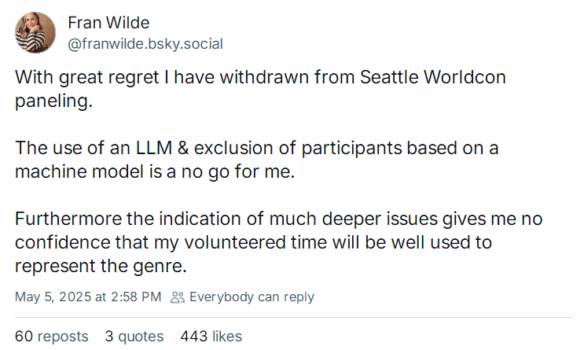
(1) SEATTLE WORLDCON PROGRAM ITEM CRITICIZED. The Seattle Worldcon 2025 Program Schedule went live today. An item immediately came under such strong criticism that the committee has pulled it back for rewording.

This is the original text of the item:

Pooja’s Bluesky thread about it starts here.

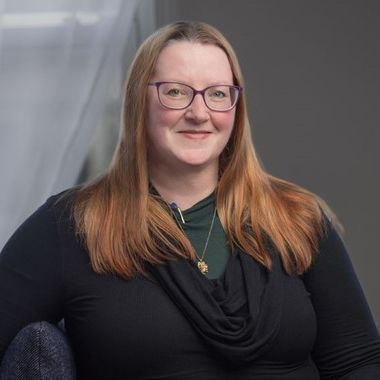
There are many comments on the thread, including this one by Annalee Newitz.

Elsewhere, Jake Casella Brookins offered this tongue-in-cheek reaction.

(2) MURDERBOT SECOND SEASON GREENLIGHTED. The Verge reports “Murderbot is getting a season 2 on Apple TV Plus”.

Apple TV Plus’ adaptation of Martha Wells’ Murderbot Diaries has been one of this year’s surprisingly great sci-fi series, and the streamer has plans to keep the story going with a new batch of episodes.

Ahead of Murderbot’s season 1 finale out July 11th, Apple TV Plus announced today that the show has been renewed for a season 2. In a statement about the renewal, Murderbot co-creators / executive producers Chris and Paul Weitz said they were “so grateful” for how well the series has been received by fans. No concrete details about the new season have been revealed just yet, but Apple TV Plus’ head of programming Matt Cherniss teased that, in addition to following Murderbot (Alexander Skarsgård) on his next adventure, we can expect to see even more of The Rise and Fall of Sanctuary Moon.

(3) EYE ON THE MARKET. The Submission Grinder made news here the other day, and if you don’t already know about the work done by this important resource to the field then let A.P. Howell introduce you: “A shout out to the Submission Grinder”.

…The Grinder is an incredible resource of markets (past, present, currently closed, and with upcoming windows). It’s searchable by many different parameters (including genre, length, pay rates, etc.) and it’s free to register to get a little more customization and track your own submissions.

(When you first visit the page, it is a lot. I encourage you to just poke around a bit, maybe look at listings for magazines you’ve already heard of, or take a look at the recent responses to get an idea of what the current submission churn looks like.)

I personally find the Grinder most useful for getting a sense of market response times….

… This week, the Grinder delisted Analog Science Fiction & Fact. This is a big deal: Analog is a major legacy magazine paying professional rates. However, under its new publisher, Analog also has a very non-standard contract, asking for a wider-than-normal range of rights and the waiving of an author’s moral rights.1 To date, SFWA has offered advice about contract negotiation and an informative piece about moral rights.2

But the Grinder has been at the forefront of warning writers about these issues…

(4) BRISBANE IN ’28. The Brisbane in 28 Worldcon bid broke an 8-month silence on Bluesky this week.

(5) MICHELE LUNDGREN UPDATE. The case against Michele Lundgren and 14 others — see “Michele Lundgren Charged as a Michigan Fake Trump Elector” – which has lingered since 2023 is still alive, although the latest hearing has been put off until September. (File 770 follows this case because Lundgren is married to well-known sff book cover artist Carl Lundgren.)

“Judge moves long-awaited decision in 2020 GOP false electors case to September hearing” reports the Michigan Advance.

…A review hearing to decide if the alleged 2020 Michigan Republican false electors for President Donald Trump will stand trial has been moved yet again, court records show, but the details of the upcoming hearing signal that the end might be in sight.

Lansing 54-A District Court Judge Kristen Simmons was scheduled to review the case on Thursday afternoon, but a recent entry in the court’s docket shows the date was pulled and rescheduled for 9:30 a.m. on September 9.

Thursday’s hearing was listed as a review placeholder, which has been used by the court when setting future potential dates for Simmons to issue a decision. That date has been rescheduled multiple times since Simmons wrapped preliminary examinations for all 15 defendants in October 2024.

The new hearing scheduled for September 9, however, carries a different heading – the date is listed as an early morning hearing, which could mean that a decision might land then.

Simmons will decide if 15 of Trump’s 16 presidential electors in 2020 should stand trial on state forgery and conspiracy crimes. One of those electors had his charges dropped and assisted the Michigan Department of Attorney General with its investigation and prosecution….

… As Simmons mulls her decision, reports in June noted that U.S. Department of Justice pardon attorney Ed Martin Jr. was working on a framework to grant clemency to the 15 false electors, but how remained a mystery because the electors are not facing federal charges….

(6) MIND THE GAPP. Publishers Weekly tells about “The Politics of Printing in China”.

Comics journalist Joe Sacco’s next book, The Once and Future Riot, was supposed to hit bookstore shelves in September, but it’s running about a month late. Publication scheduling delays are neither ideal nor uncommon—but the holdup on Sacco’s latest, which PW’s starred review called a “meticulous and beautifully crafted account of religious and territorial strife” in Western Uttar Pradesh, India, wasn’t due to any routine issue.

“We were going to print it in China,” Carolyn O’Keefe, director of publicity for nonfiction at Henry Holt’s Metropolitan imprint, told PW. “But they objected to maps that depicted borders in ways they didn’t like.” This isn’t the first time Metropolitan has dealt with this particular problem. In 2021, its planned printing partner in China requested changes to Elise Engler’s A Diary of the Plague Year: An Illustrated Chronicle of 2020 before agreeing to take on the book. After Engler rejected the request, Holt produced the book domestically, postponing its release until early 2022.

China dominates the global printing market for illustrated titles, from children’s picture books to coffee table books to graphic novels. Its stores of high-quality paper stock and specialized printing technologies give the country major advantages over the United States and Canada, its two main competitors in the space. The latter have comparatively few printers capable of achieving the quality expected by publishers and readers of illustrated titles—let alone inexpensively, quickly, and at scale.

Eric Reynolds, VP and associate publisher at Fantagraphics, estimates that 30%–40% of the Seattle-based company’s titles are printed in China. Running into issues at the printer, he said, is not uncommon. But, he added, it’s not really the printers that are causing the problem. It’s the bureaucracy: namely, the Chinese government’s General Administration of Press and Publication.

“Every printer in China must submit everything through GAPP,” Reynolds said. “Printers run work through GAPP as a matter of course, then come back to us and say, ‘We can’t do it; it was rejected.’ ”

GAPP is the regulatory body that oversees all media in the People’s Republic of China, from film and television to newspapers and radio to websites and books. It acts as the government’s central censorship agency, screening out sensitive subjects from pornography to politics. (Maps are a regular point of contention.) Anything printed, published, copied, or distributed in the country is scrutinized by GAPP—even if it isn’t intended for domestic sale….

(7) TIME TRAVELING DETECTIVE. CrimeReads interviews “Elly Griffiths on Victorian London, Time Travel, and Her New Mystery, ‘The Frozen People’”.

You’re also clearly fascinated with the Victorian era, which you get into in depth in the book.

I’ve always been fascinated by the Victorians. You hope other people are as fascinated as you. Years and years ago, when I was at university, I did a Master’s in Victorian Fiction. I became really fascinated by that mid-Victorian period, when all their certainties have been shaken. There was this book called Life of Christ, which said– I don’t think very controversially now, but was controversial then– that the Gospels weren’t contemporary accounts of Christ’s life. They were written afterwards. Then you’ve got Darwin’s Origin of Species, telling them they’re not descended from the angels, they’re descended from apes. Then you get the Communist Manifesto about the same time. I think they all were just a bit sort of shaken and wondering what to believe. This is the world that I wanted to take Ali to. And great clothes as well. I really enjoyed that….

(8) SIR TERRY, SPEAR SHAKER. Christopher Lockett continues his series about Terry Pratchett with “Discworld Reread #5: Wyrd Sisters” at The Magical Humanist.

1. All the world’s a stage, a poor player signifying the play’s the thing

Wyrd Sisters (1988) is the sixth Discworld novel and the one I most frequently recommend as a good starting point. I was curious whether, on rereading it, I would change my mind on that point. Turns out it’s just the opposite: my appreciation for this first appearance of the three witches has only deepened. There’s a number of reasons for this, which I’ll try to tease out as I go. One big one, however, is that Sir Terry’s use of a Shakespearean framework, for all its little in-jokes and easter eggs and allusions, doesn’t merely hang the story on the edifice of Macbeth. The Scottish Play is its starting point, literally: we begin in precisely the same place, with a trio of witches around a cauldron as lightning stabs the sky. The murder of a king, the blood that won’t wash off, a ghost as a guilty conscience, a spectral dagger … but there’s also what I suppose we might call a meta-Shakespearean dimension to the story, as the traveling company of players and their in-house Shakespeare analogue Hwel provide a constant reflection on the principle that All The World’s A Stage.

Meta-Shakespeare arguably comprises its own subgenre, ranging from such plays as Rosencrantz and Guildenstern are Dead by Tom Stoppard and Goodnight Desdemona, Good Morning Juliet by Ann-Marie MacDonald to films like Shakespeare in Love (1998) and All is True (2018), to novels like John Updike’s Gertrude and Claudius (2000) and The Daughter of Time (1951) by Josephine Tey. And of course, Wyrd Sisters.

A bit later in this essay I get into questions of the overlap between mythology, archetype, and cliché, and the ways in those are all just examples of overdetermined language and story. Shakespeare comprises his own mythology; a first-time reader of Hamlet might be surprised at the critical mass of well-worn clichés its characters spout….

(9) TODAY’S BIRTHDAY.

[Written by Paul Weimer.]

July 10, 1903John Wyndham. (Died 1969.)

By Paul Weimer: Cozy Catastrophe? My first encounter with John Wyndham’s work was anything but cozy. That would be on good old WPIX, the movie version of Day of the Triffids, where Jeanette Scott fought a triffid that spits poison and kills, to quote Rocky Horror Picture Show. So when I finally picked up his work (The Chrysalids, I think was the first), I was quite taken and surprised by the “bait and switch” that my mind and expectations had for Wyndham’s work as opposed to the cinematic adaptation.

Wyndham did teach me something that I would learn later in novels such as Earth AbidesAlas Babylon, and even On the Beach, and that is that catastrophes, and disasters, even ones that end civilization as the protagonists know it, could be surprisingly gentle and not harsh as the world falls apart around them.  There can be afternoon tea even as the tripods march across the landscape in an inescapable force of nature invasion. 

I recently read The Midwich Cuckoos, and even more than Day of the Triffids (which I really think could be remade in this day and age. Hollywood, call me, I could write your script), it is the Wyndham work that really hits the fears and anxieties in an otherwise pastoral and idyllic English countryside. The horror that one’s children are, in effect, changelings is an old idea (going back to the ideas of Faeries switching children at birth) and the The Midwich Cuckoos plays on that, and plays on that, hard. But it’s even more than the parents and adults being horrified by what is happening to the children, what might be happening with the very pregnancy you have. 

It is the idea that these children are forming a community, a society, a way of life that excludes you (which gets into fears of the generation gap. The use of the telepathic Cuckoos in the X-Men series and how tight they are together under Emma Frost, takes that idea from Wyndham and makes it front and center. It’s their world, and not yours.

That shows, ultimately, John Wyndham and his legacy at his best.

John Wyndham

(10) COMICS SECTION.

(11) ANOTHER THUMB UP. NPR’s Glen Weldon says, “James Gunn’s ‘Superman’ movie is corny. Which is why it gets Superman right”. Audio recording at the link.

Every era gets the Superman it needs. James Gunn’s version — sincere, inspiring and idealistic — will make you want to cheer.

(12) JAMES GUNN Q&A. NPR also has the full text of this Morning Edition segment: “James Gunn writes and directs the latest version of Superman”.

A MARTÍNEZ: And this Superman, to me, at least, is the most physically vulnerable Superman. I mean, the movie starts right off the bat with Superman losing a battle, and he looks really beat up. It’s not one of those things where kryptonite is weakening him. He gets into a fight that he can’t win. I think some Superman fans are going to be like, “What?! Why is Superman losing a fight?”

JAMES GUNN: That was one of the first images I had in my head when I was trying to think of what this movie could be: this idea of Superman looking up and just having a little blood drip out of his mouth. It’s such potent imagery of who Superman is, who Superman represents to all of us, where we are in this world, what’s happening.

There’s the hard thing when you get into making comic book movies. Superman is a superhero. But you find out that people have very distinct ideas of what these characters are supposed to be. And they’re different. A lot of people want Superman to be able to punch a planet and break it in half. It makes him being in a world with other superheroes kind of irrelevant because he’s so powerful. I didn’t want a Superman that could make The Flash, Wonder Woman, Batman, and Green Lantern irrelevant. Superman is often portrayed as a god. I don’t think our Superman is a god.

We all want to be Superman. We want to fly, we wanna shoot beams out of our eyes, have super strength to be able to beat up anybody who comes at us. We go into the movie wanting to be Superman. And I think that by the end of the movie, we realize that Superman wants to be us. He wants to be a human being. That is his biggest desire….

(13) THE FAR SIDE. [Item by SF Concatenation’s Jonathan Cowie.] This week’s Nature cover story is related to Pink Floyd, or the far side of the Moon (one or the other).

Lunar History

The far side of the Moon is something of an enigma. Always facing away from Earth, its evolutionary history has remained as obscure as its appearance. That was, until last year, when China’s Chang’e 6 mission successfully returned to Earth samples of 2.8-billion-year-old basalt taken from the South Pole–Aitken basin on the lunar far side. The first fruits of the analyses of these samples appear across four papers in this week’s issue. Together, they probe the origin and evolution of the far side and how it differs from the near side. Three of the papers, which have previously been published online, examine volcanism, the lunar dynamo and water abundance in the Moon’s mantle. The fourth, by Wei Yang and colleagues, reveals the origins of the basalt samples and sheds light on how they might have formed.

(14) UNREAL ESTATE LISTING. This is very clever. Take a look at the faux commercial – “Tour the Baxter Building | Get inside Marvel Studios’ The Fantastic Four: First Steps with Zillow” – then click through to enjoy Zillow’s website presentation about “The Baxter Building”.

Behold The Baxter Building – home to the world-famous Fantastic Four. 

This remarkable residence blends timeless design with the latest innovations from ReedTech. Residents enjoy an adaptable living space that can stretch to fit their needs. Residents can “flame on!” with the high-tech kitchen’s indoor barbecue and get instant help around the house from their robotic H.E.R.B.I.E. assistant. Enjoy stunning city views, including the rocket launch pad where the Fantastic Four prep for their next cosmic mission. You might even see the Human Torch light up the sky!

[Thanks to Mike Kennedy, Andrew Porter, John King Tarpinian, Dennis Howard, Betsy Hanes Perry, John A Arkansawyer, Chris Barkley, Cat Eldridge, SF Concatenation’s Jonathan Cowie, Mark Roth-Whitworth, Steven French, Kathy Sullivan, and Teddy Harvia for some of these stories. Title credit belongs to File 770 contributing editor of the day Rob Thornton.]

Pixel Scroll 6/25/25 I’ve Got An AI And Its Name Is HAL, Fifteen Clicks On The Marsport Canal

(1) CLARKE AWARD. “Sierra Greer Wins 2025 Arthur C. Clarke Award” for her novel Annie Bot.

Sierra Greer receives a trophy in the form of a commemorative engraved bookend and prize money to the value of £2025.00; a tradition that sees the annual prize money rise incrementally by year from the year 2001 in memory of Sir Arthur C. Clarke.

(2) AI TRAINING BABY HALVED. This judge says under certain conditions it’s legal: “Federal Judge Rules AI Training Is Fair Use in Anthropic Copyright Case” reports Publishers Weekly.

A federal judge in California has issued a complicated pre-trial ruling in one of the first major copyright cases involving artificial intelligence training, finding that, while using legally acquired copyrighted books to train AI large language models constitutes fair use, downloading pirated copies of those books for permanent storage violates copyright law. The ruling represents the first substantive judicial decision on how copyright law applies to the AI training practices that have become standard across the tech industry over the full-throated condemnation of the book business.

U.S. District Judge William Alsup of the Northern District of California ruled Monday in Bartz v. Anthropic that AI company Anthropic’s training of its Claude LLMs on authors’ works was “exceedingly transformative,” and therefore protected under the fair use doctrine as specified in Section 107 of the Copyright Act. However, Alsup also determined that the company’s practice of downloading pirated books from sites including Books3, Library Genesis, and Pirate Library Mirror to build a permanent digital library was not covered by fair use.

The case was brought by authors Andrea Bartz, Charles Graeber, and Kirk Wallace Johnson, who alleged that Anthropic used their copyrighted works without permission to train its AI systems. Anthropic, which generates more than a billion dollars in annual revenue from its Claude AI service, downloaded over seven million pirated books between 2021 and 2022 to build its training datasets. Notably, the lawsuit challenged only the inputs, or works used to train Claude, and did not allege that the outputs, or works produced by the LLM, reproduced the plaintiffs’ copyrighted works….

(3) SEEKING A MISSING DEMOGRAPHIC. “Why Did the Novel-Reading Man Disappear?” asks the New York Times. Link bypasses the paywall.

…Mr. Israel, who has hosted another book club for nearly a decade, started this group last December in an effort to inspire heterosexual men to read more fiction. He solicited members over social media. For the second meeting, he assigned a story collection by Jamel Brinkley, “A Lucky Man,” which examines contemporary masculinity. For two hours, the men discussed the book, and the theme.

The next day, Mr. Israel had a panic attack. Two days later, he said, he was diagnosed with depression.

He has spent the months since grappling with painful realizations that came out of the discussion, about how toxic masculinity has harmed his own marriage, especially the idea that real men do not share their feelings. It was an epiphany out of James Joyce, unlocked, he said, by that conversation in the book club.

Indeed, while Mr. Israel might have convened the group to help other men read more fiction, he has since realized that there’s an even deeper reason.

“I’m doing this because I need it,” he said in an interview….

So do lots of men — at least according to a robust debate unfolding in opinion pages and news articles, on social media platforms and inside the publishing world. By turns a maligned or suspicious figure in decades past — in the case of the “Infinite Jest” lover, for instance — or a fetishized one — consider the enormously popular “Hot Dudes Reading” Instagram — the figure of the literary male reader is now disappearing, some say, and his disappearance is a matter of grave concern.

These articles, which focus explicitly or implicitly on straight men, connect the fact that these men are reading fewer novels to a variety of social maladies, up to and including deleterious effects on American democracy itself. If more men were reading like Mr. Israel, the thinking goes, the country would be a healthier place: more sensitive, more self-aware, less destructive. …

…Meanwhile, when men came into the bookstore with other men, they typically split up and dispersed to far corners of the store.

“It’s solo browsing time,” he said.

Navigating the aisles, Mr. Kyono, 27, led us to a cubicle-size display near the back dedicated to science fiction and fantasy, where the shelves were heavy with multipart series with names like “Iron Gold” and “Light Bringer.” Nearby, an alcove of the American fiction section from F through K contained many of the most famous male writers of what Mr. Kyono called the “American high school reading curriculum”: Faulkner, Hemingway, Heller, Kerouac.

“This is a hot corner for men,” he noted….

Inside the store, the customers were overwhelmingly women. But there were a few men. Some, like Daniel Schreiner, 38, were fans of the fantasy star Brandon Sanderson. He said he thought men read less fiction than women because “we’re less literate than they are.”…

(4) LIFE-CHANGING. [Item by Daniel Dern.] Name/guess this science fiction novel! “The sci-fi novel that saved me” by Jake Berry Ellison, Jr. in the “Sunday IDEAS” section of the June 22 Boston Globe.

Dern notes: It happens to be one of the very-many that, as a teen, I [Dern] re-read frequently, although it didn’t speak to me like it did to the essay’s author. That said, I would never have guessed (that is, correctly).

(5) ROBOWORKER RIGHTS. The Unofficial Hugo Book Club Blog recommends Annalee Newitz’ forthcoming novella “Send Noodles”.

There’s a moment about a third of the way into Automatic Noodle — Annalee Newitz’ forthcoming novella — in which android protagonists complain about how the law prohibits robots from joining labour unions. It’s just a passing reference, but it’s an interesting implied criticism of contractualist approaches to labour relations. When unions are created by legal structures, the ability of labour to organize is constrained by adherence to government regulation. (By contrast, a solidarity-based union like the Industrial Workers of the World cannot be compelled to exclude anyone.)

The book — which hits store shelves on August 5 — is a small-scale story about four robots who open up a biangbiang noodle shop in San Francisco. It’s a quick, breezy read that details the trials of setting up a quasi-legal business while facing backlash from internet trolls.

Set in the aftermath of a Californian war of independence, Automatic Noodle is based in a new nation that has declared emancipation for artificial intelligences — including robots. Because this declaration was a controversial decision, the few rights granted to robots are always at risk….

(6) THE SCOTTISH WORD PLAY. “Oxford English Dictionary is hoaching with new Scottish words” hoots BBC.

The Oxford English Dictionary is hoaching with new Scottish words – with beamer, bummer and tattie scone among 13 new entries.

There is also a listing for Scotland’s shoogly subway trains – not the kind of place where passengers would want to risk using skooshy cream.

Many of the new additions have a food theme, with Lorne sausage, morning rolls and playpiece also making the grade.

Oxford English Dictionary (OED) editors say they will consider a new word for inclusion when they have gathered enough independent examples of its usage “from a good variety of sources”.

(7) DAN ACKROYD Q&A. [Item by Steven French.] Dan Aykroyd answers “Ten Chaotic Questions”; here’s one:  “Dan Aykroyd: ‘I don’t believe in associating with beings that have no souls’”, he tells the Guardian.

What book, album or film do you always return to, and why?

Well – the Bible. I’m a lapsed Catholic, OK? But hopefully somewhere in there there’s some shred of Judeo-Christian value left. I’m trying to live on those fumes as much as I can. But the Bible has great stories, great quotes and wonderful wisdom from Christ, and in the end, it’s the only book left. So I do turn to it. To whom much is given, much will be required – that’s what Christ says and I certainly am trying to live that as I go on.

As for film, I always return to The Day The Earth Stood Still, that spectacular movie with Michael Rennie and Patricia Neal about the saucer landing in Washington DC in the 1950s. What a great film – and it could really happen, that there’s some more powerful interstellar beings with stronger weapons than us out there. If we don’t smarten up here with all this nuclear talk and nuclear play, they’re going to come down here and straighten us out. Wouldn’t it be wonderful if we could believe that?…

(8) TODAY’S BIRTHDAY.

[Written by Paul Weimer.]

Born June 25, 1903George Orwell. (Died 1950.)

By Paul Weimer:

George Orwell.

Big Brother is watching you. 

To talk Orwell in a genre sense is to concentrate on two works. Animal Farm and 1984.

Animal Farm I’ve only read twice, once in school, which turned out to be a rather shallow discussion of a book I wanted to talk more about than the teacher or rest of the students did. Even then, I was the genre reading person. (I only found a few readers who read SF, including Douglas Adams, but that’s another story).  But the more I think about Animal Farm, the more of an allegory it seems and not really SFF at all. It’s not meant to be taken literally, and can’t be–a thing I would eventually apply to some SFF movies I couldn’t make any logical sense of. But the allegory seems more and more prescient as the years go on.

But let’s talk 1984.  1984 has haunted me for a long time. I first read it back in the late 1980’s and have encountered it in various forms every since. The John Hurt movie, of course. Several editions of the book with various prefaces and commentary. During the 2014 Worldcon, I found that an intriguing theatrical version by Robert Icke and Duncan MacMillan was playing in the West End.  My friend and I had to go see it (and it was a rainy day) and I impulsively bought the ticket, and also the screenplay.  It was an amazing reinterpretation of the piece as an after-the-action deconstruction of 1984 and its themes. I was enthralled.  I was also very amused, when, three years later in Melbourne, I saw that the production was now playing there as well. I didn’t have the time to go see it in Melbourne, but was happy that the production appeared to be doing so well.  

There is also a recent audible production/reinterpretation of the story that is more like that theatrical production than the actual novel itself. I enjoyed that, too. 

But why does 1984 mean so much to me that I would seek out all these versions? It’s a human thing to root for someone who in the short term is going to lose.  I note that in all the other versions than the actual novel, it is implied or actually seen that the Party is going to lose. No tyranny lasts forever. No oppression can be permanent, no matter what the state thinks. Human nature in the end will win even if an individual human loses. That’s the message of 1984 and why it remains resonant with me to this day.  

And that is why the imagery and imagery inspired by 1984, from The Twilight Zone to the 1984 Apple Ad and to the present day, still move me.

George Orwell

(9) COMICS SECTION.

(10) ICONIC DELOREAN. Mattel Creations is releasing a “Hot Wheels Back to the Future 40th Anniversary Set” on July 24. Lots more photos at the link.

Great Scott! Hot Wheels celebrates a red-letter date in the history of science, and the 40th Anniversary of Back to the Future. This iconic scene features the Time Machine and, for the first time, Doc’s GMC Value Van – both featuring die-cast construction and Real Riders wheels. Our interactive outer box lets you unfold a ramp from the side, so you can slide out the diorama package just like the Time Machine itself being unloaded for its attempt at the world’s first temporal displacement. 

(11) BAFTA FELLOWSHIP TO GAME MUSIC COMPOSER. [Item by Steven French.] Interesting piece on Yoko Shimomura, composer of music in many beloved games and which ends with some positive advice: “From Street Fighter to Final Fantasy: Yoko Shimomura, the composer who put the classical in gaming’s classics”.

Alfred Hitchcock, David Attenborough, Harold Pinter, Stanley Kubrick, Ridley Scott, Hideo Kojima – these are just a few of the recipients of the Bafta fellowship, the highest honour the academy can bestow. Japanese composer Yoko Shimomura is the latest to receive the accolade; one of only 17 women and four Japanese people to have done so. She is also the first video-game composer to be recognised by the British Academy of Film and Television Arts, and the first composer recognised at all since John Barry in 2005.

It is with good reason that the academy has honoured her. Shimomura is an icon. You’ll know her music from Street Fighter, Final Fantasy, Super Mario, Kingdom Hearts, Legend of Mana, Streets of Rage and more than 70 other games she has contributed original compositions or arrangements to. Her 37-year-long career has seen her record at Abbey Road Studios, have her music played by symphonic orchestras around the world, and work in genres ranging from rock to electronica, ambient to industrial, pop to opera. And yet Shimomura seems unchanged by her success.

“Certainly, over the course of my career, there have been a number of times – a lot of times perhaps, compared to other people – where I have struggled. Enough to think maybe I want to give up.” She tells me that even as far back as her first job at Japanese developer Capcom, she thought she had maybe two or three years in her before she’d quit. She also says she applied for that job with “barely any hope of getting accepted” – with a modesty that still seems a core part of her character.

“Even though I love this job, there have been plenty of times when it was really hard for me to continue. I couldn’t sleep, and I would especially struggle as deadlines would approach.”…

(12) THE CASE OF THE MISSING MATTER. [Item by Mark Roth-Whitworth.]

“Where does the matter go

When it’s not quite converted to energy…”

“Astronomers locate universe’s ‘missing’ matter in the largest cosmic structures” at Space.com.

Astronomers have discovered a vast tendril of hot gas linking four galaxy clusters and stretching out for 23 million light-years, 230 times the length of our galaxy. With 10 times the mass of the Milky Way, this filamentary structure accounts for much of the universe’s “missing matter,” the search for which has baffled scientists for decades.

This “missing matter” doesn’t refer to dark matter, the mysterious stuff that remains effectively invisible because it doesn’t interact with light (sadly, that remains an ongoing puzzle). Instead, it is “ordinary matter” made up of atoms, composed of electronsprotons, and neutrons (collectively called baryons) which make up stars, planets, moons, and our bodies.

For decades, our best models of the universe have suggested that a third of the baryonic matter that should be out there in the cosmos is missing. This discovery of that missing matter suggests our best models of the universe were right all along. It could also reveal more about the “Cosmic Web,” the vast structure along which entire galaxies grew and gathered during the earlier epochs of our 13.8 billion-year-old universe.

(13) BOOKISH. “Mark Gatiss stars in quirky first trailer for new detective drama Bookish”Radio Times has details.

The trailer for Mark Gatiss’s upcoming drama, Bookish, has finally been released – and it promises to be quite the quirky addition to the crime drama genre.

The upcoming U&Original series boasts Gatiss in the lead role as Gabriel Book, the owner of a bookshop who is also a crime-solving sleuth in his own time, determined to crack the most intriguing of cases.

In the trailer, we get a sense of some of the mysteries to come, with Book attending a crime scene with his wife Trottie, played by Bridgerton’s Polly Walker.

The year is 1946, and when Connor Finch’s Jack comes through the doors of Book’s Books for the assistant job, he is greeted with a lot more than he bargained for when Trottie returns, telling them both of a crime that’s unfolded “in suspicious circumstances”.

When he visits the scene, Book tells some of the investigating officers: “Leave nothing out, especially if it’s salacious, gory, or vaguely scandalous.”…

…The official synopsis for Bookish reads: “London, 1946, is the dynamic, dangerous and chaotic setting for this stylish new detective drama, with the whip-smart and debonair Gabriel Book (Gatiss) at the very heart of the story: a maverick consultant detective to the local police.

“The thousands of books that line the shelves of his shop provide him with all the knowledge he needs to solve even the most puzzling of crimes.”…

(14) FANTASTIC FOUR. “The Final ‘Fantastic Four: First Steps’ Trailer Ups the Stakes Even Further”Gizmodo tells how. Film arrives in theaters on July 25.

…Because yes, hanging over the threat of Galactus’ arrival on this particular Earth in Marvel’s multiverse, we know that, thanks to the set up at the end of Thunderbolts, at some point the Fantastic Four have to make their way from this reality to the prime reality of the MCU. Whether they’ll have done so after beating back Galactus successfully, or whether they’re looking to other realities in the hope they might be able to help find a new home, remains to be seen….

[Thanks to Mark Roth-Whitworth, Steven French, Kathy Sullivan, Paul Weimer, Daniel Dern, Olav Rokne, Teddy Harvia, Mike Kennedy, Andrew Porter, John King Tarpinian, Chris Barkley, Cat Eldridge, SF Concatenation’s Jonathan Cowie for some of these stories. Title credit belongs to File 770 contributing editor of the day Daniel Dern.]

Pixel Scroll 5/6/25 All I Need To Know, I Learned From Pixel Scrolls

(1) MORE SEATTLE WORLDCON 2025 COVERAGE. Two of the more widely-read pop culture sites have picked up the story – and heavily cite File 770, for which I thank them.

Jason Sanford’s new Genre Grapevine is also devoted to the “2025 Seattle Worldcon AI Fallout”.

Yesterday Elizabeth Bear and Fran Wilde withdrew from the Worldcon program:

(2) BALTIMORE BOOK EVENT FAILS. “Broken promises, Fyre Festival vibes: A Million Lives Book Festival was a disaster” reports The Baltimore Banner.

In February, Philadelphia-area author Hannah Levin found out she’d been accepted to participate in A Million Lives Book Festival, a convention of fantasy authors, narrators and influencers to be held the first weekend of May at the Baltimore Convention Center. As a new author whose debut novel, “The Treasured One,” was published by Aethon Books in 2024, she was excited about the event. “We thought it would be a big thing for us,” she said.

It was a big thing, but not in the way anyone expected. The festival, organized by Baltimore-based author Grace Willows’ Archer Fantasy Events, was supposed to provide an opportunity for writers to network and an audience of at least 500 to 600 paid ticket holders. What participants got, they said, was a disappointing weekend of dashed expectations, unfulfilled promises, lost money and more questions than answers.

“I think ‘debacle’ is the word for it,” Levin said of the event that was quickly dubbed online as the Fyre Festival of literary festivals.

The 11 authors, vendors and influencers I interviewed by email and phone spent between $300 and $2,000 to attend A Million Lives depending on their travel arrangements and other factors. They said they were promised special badges that designated them as official participants, a creator’s lounge, cosplay events and a VIP swag bag for the top two ticketing levels.

That didn’t happen.

“There was a huge financial loss for authors, vendors and narrators attending,” wrote a book influencer known as Azthia, who spent about $300 on a plane ticket but crashed with other participants when her hotel stay was not paid for as promised. “They were told 600 tickets and in the end there were more authors than attendees.”…

(3) ACTOR/ACTRESS AWARDS? “’The Last Of Us’ Star Bella Ramsey Defends Gendered Emmy Categories” at Deadline.

Bella Ramsey has a decent shot at Emmy success this year — and won’t quibble if competing in the Lead Actress category.

The British star of HBO hit The Last of Us identifies as non-binary and prefers the they/them pronouns, but said it was fine for people to “call me how you see me.”

Speaking on Spotify’s The Louis Theroux Podcast about gendered award categories, Ramsey said it was important “recognition for women in the industry is preserved.”

“I don’t have the answer and I wish that there was something that was an easy way around it, but I think that it is really important that we have a female category and a male category,” Ramsey added.

The former Game of Thrones star said they had thought hard about how to represent non-binary individuals in award categories, but did not have a solution.

One idea was to name the category “best performance in a female character,” but Ramsey said this creates issues for those portraying non-binary characters on screen.

One thing Ramsey is certain of is that being called an “actress” feels uneasy. “I have a guttural, ‘That’s not quite right,’ instinct to it,” Ramsey said. “But I just don’t take it too seriously … it doesn’t feel like an attack on my identity.”…

(4) ROWLING ON HARRY POTTER ACTOR’S SUPPORT OF TRANS RIGHTS. “’I don’t have the power’: JK Rowling won’t sack Paapa Essiedu from Harry Potter TV show over trans rights views” reports the Guardian.

JK Rowling has said she will not fire actor Paapa Essiedu from the forthcoming Harry Potter TV series over his support for transgender rights.

Essiedu has been cast as key character Severus Snape in the HBO drama, which is designed to run for more than a decade and will be one of the most expensively produced television shows of all time.

In a post on X, Rowling wrote: “I don’t have the power to sack an actor from the series and I wouldn’t exercise it if I did. I don’t believe in taking away people’s jobs or livelihoods because they hold legally protected beliefs that differ from mine.”

Last week, Essiedu, along with more than 1,500 figures from film and TV, signed an open letter condemning the UK supreme court ruling, which judged that the terms “woman” and “sex” in the Equality Act refer only to a biological woman and to biological sex….

(5) CIVILIZATION ENDS: FILM AT ELEVEN. “Is This the Worst-Ever Era of American Pop Culture?” from The Atlantic (Archive.ph link).

Last year, i visited the music historian Ted Gioia to talk about the death of civilization.

He welcomed me into his suburban-Texas home and showed me to a sunlit library. At the center of the room, arranged neatly on a countertop, stood 41 books. These, he said, were the books I needed to read.

The display included all seven volumes of Edward Gibbon’s 18th-century opus, The Decline and Fall of the Roman Empire ; both volumes of Oswald Spengler’s World War I–era tract, The Decline of the West ; and a 2,500-year-old account of the Peloponnesian War by Thucydides, who “was the first historian to look at his own culture, Greece, and say, I’m going to tell you the story of how stupid we were,” Gioia explained….

…He’s not alone in fearing that we’ve entered a cultural dark age. According to a recent YouGov poll, Americans rate the 2020s as the worst decade in a century for music, movies, fashion, TV, and sports. A 2023 story in The New York Times Magazine declared that we’re in the “least innovative, least transformative, least pioneering century for culture since the invention of the printing press.” An art critic for The Guardian recently proclaimed that “the avant garde is dead.”

What’s so jarring about these declarations of malaise is that we should, logically, be in a renaissance. The internet has caused a Cambrian explosion of creative expression by allowing artists to execute and distribute their visions with unprecedented ease. …

…in 312 c.e., the Roman Senate ordered the construction of a gaudy monument called the Arch of Constantine. It incorporated pieces from older monuments, built in more glorious times for the empire, which had begun its centuries-long decline.

The Arch is one of Gioia’s favorite metaphors for modern culture. The TV and film industry is enamored of reboots, spin-offs, and formulaic genre fare. Broadway theaters subsist on stunt-cast revivals of old warhorses; book publishers rely disproportionately on backlist sales. Entertainment companies have long understood the power of giving people more of what they already like, but recommendation algorithms take that logic to a new extreme, keeping us swiping endlessly for slight variations on our favorite things. In every sector of society, Gioia told me, “we’re facing powerful forces that want to impose stagnation on us.”

The problem is particularly acute in music. In 2024, new releases accounted for a little more than a quarter of the albums consumed in the U.S.; every year, a greater and greater percentage of the albums streamed online is “catalog music,” meaning it is at least 18 months old. Hoping to remonetize the classics, record labels and private-equity firms have spent billions of dollars to acquire artists’ publishing rights. The reemergence of Kate Bush’s “Running Up That Hill” on the Billboard Hot 100 in 2022, 37 years after its release, seemed to signal that this was a good bet. A brief placement in a popular TV show (Netflix’s Stranger Things, itself a pastiche of 1980s movie tropes) could, it turned out, cause an old hit to outcompete most of the newer songs in the world….

(6) TODAY’S BIRTHDAY.

[Written by Paul Weimer.]

May 6, 1969Annalee Newitz, 56.

By Paul Weimer: I first encountered Annalee Newitz’ nonfiction, first, as a columnist, as a non fiction writer, as a podcaster with their partner Charlie Jane Anders. Four Lost Cities is an amazingly researched book looking at the rise and fall of four cities and what we can learn about the challenges they faced. I learned an amazing amount I never know about, for example, Angkor Wat. I think it is their strongest work and if you asked me “what one book of theirs should I read?”, Four Lost Cities is the one I’d put into your hands. 

Annalee Newitz

Scatter, Adapt, and Remember: How Humans Will Survive a Mass Extinction was a surprisingly hopeful book, given its title and content. 

Although they have been writing fiction, too for a while, I finally got into their fiction with The Future of Another Timeline, with rival powers fighting for control of a timeline just catnip for me. Given the political changes lately in the United States, it feels even more relevant than it once did. And once again, I learned a lot about some historical events I hadn’t even heard of, thanks to the jumping around the timeline by the protagonists. But even with that, the changes to the timeline are not shown in some grand manner, but how they affect people. People matter to Newitz’s work. 

Newitz’ work is bright, well researched, deep, and thought provoking, with a mind like an engineer and the language and diction of an English professor. I am pretty sure that as good as Future was, I prefer Newitz’ nonfiction more, but I am primed for whatever they decide to turn their prodigious powers on, next. (In the meantime, of course, there is always Our Opinions are Correct). 

[Note: ISFDB and the Science Fiction Encyclopedia say Newitz’ birthday is today, Wikipedia says tomorrow. Happy birthday whichever is the case!)

(7) COMICS SECTION.

(8) HUGO VIEWING. In “Hugo 2025: The Wild Robot”, Camestros Felapton rates another finalist.

…As I said in the intro, the film has more bite than you might imagine. It’s not a nature documentary and their are kid-friendly fantasy elements to how the animals of the island live but aside from that the animals are presented naturalistically. There is a repeated emphasis on death as a common occurrence and the film is clear that animals kill and eat other animals. Fink the fox (the almost ubiquitous Pedro Pascal) is a key supporting character but when he first turns up he is trying to catch and eat Bright Bill, Roz’s adopted baby goose child.

The idea of juxtaposing robots with nature is not a new one but it is an under-explored one….

(9) VINTAGE PROPS. “Where Would Hollywood Find Its Guillotines or Pay Phones Without Them?” asks the New York Times. (Article is behind a paywall.)

When the Netflix series “Wednesday” needed a guillotine recently, it did not have to venture far. A North Hollywood prop house called History for Hire had one available, standing more than eight feet high with a suitably menacing blade. (The business offers pillories too, but the show wasn’t in the market for any.)

The company’s 33,000-square-foot warehouse is like the film and television industry’s treasure-filled attic, crammed with hundreds of thousands of items that help bring the past to life. It has a guitar Timothée Chalamet used in “A Complete Unknown,” luggage from “Titanic,” a black baby carriage from “The Addams Family.”

Looking for period detail? You can find different iterations of Wheaties boxes going back to the ’40s, enormous television cameras with rotating lenses from the ’50s, a hair dyer with a long hose that connects to a plastic bonnet from the ’60s, a pay phone from the ’70s and a yellow waterproof Sony Walkman from the ’80s….

… History for Hire, which Jim and Pam Elyea have owned for almost four decades, is part of the crucial but often unseen infrastructure that keeps Hollywood churning, and helps make it one of the best places in the world to make film and television.

“People just don’t realize how valuable a business like that is to help support the look of a film,” said Nancy Haigh, a set decorator who found everything from a retro can of pork and beans to a one-ton studio crane there for “Once Upon a Time in Hollywood,” which she won an Oscar for. “But it’s because people like them exist that your moviegoing experience has such life to it.”…

… “I don’t know what we would do without them,” said Pascale, who has won an Oscar for “Mank.”

No one likes entertaining that idea. But with fewer movies and television shows being shot in Los Angeles these days, and History for Hire getting less business, the Elyeas fear they may not be able to afford to renew their lease for five more years. If they close, Los Angeles will lose another piece of the vibrant ecosystem that has kept it attractive to filmmakers, even as states like Georgia and New Mexico lure productions with lucrative tax credits. Some Angelenos fear a vicious cycle: If the city continues to lose local talent and resources, even more productions will flee….

(10) SPEAKEASY. “AI-Dubbed Swedish Film ‘Watch the Skies’ Opening in Theaters”Variety listens in.

When XYZ Films‘ “Watch the Skies” has its U.S. theatrical release on Friday, Hollywood will also get a glimpse at the state-of-the-art in AI-driven “visual dubbing” and its potential for Hollywood.

“Watch the Skies” is a sci-fi adventure filmed in Swedish (under the name “UFO Sweden”), but, uniquely, the actors will appear to be speaking English through the use of TrueSync, an AI visual dubbing tool from startup Flawless, which effectively syncs new (in this case, English language) dialogue with the actors’ mouth movements. The original actors recorded their lines in English as an ADR process, before the Flawless AI tech was applied to the movie….

(11) LEFT BEHIND. “Andor Leaves Out a Key Part of Star Wars Mythology, and I Think It’s Brilliant” says CBR.com.

While Andor enjoys effusive praise from critics and Star Wars fans, both usually fail to mention a key reason the series is so unique. The two-season Disney+ series is the first, and thus far only, story in the expansive saga aimed specifically at adult viewers. How Cassian Andor finds his way to the Rebellion meticulously examines the Star Wars political philosophy, which only works because it ignores an important aspect of the mythology: the Force. As a fan of both the political and spiritual allegory in this universe, I believe ignoring the latter makes the series absolutely brilliant….

(12) GETTING WITH THE TIMES. Oghenechovwe Donald Ekpeki reminds readers:

(13) KEEPING THE AI IN SETI. [Item by SF Concatenation’s Jonathan Cowie.]  I spotted this article pre-print on the Nature website. “AI scientist ‘team’ joins the search for extraterrestrial life”.

The collaborative system generated more than 100 hypotheses relating to the origins of life in the Universe.

 Artificial intelligence (AI) researchers have created a system that can perform autonomous research in astrobiology, the study of the origins of life in the Universe.

AstroAgents comprises eight ‘AI agents’ that analyse data and generate scientific hypotheses. It joins a suite of other AI tools that aim to automate the process of science, from reading the literature to coming up with hypotheses and even writing papers….

…The result was 101 hypotheses from Gemini and 48 from Claude. One hypothesis posits that certain molecules found on Earth would make “reliable biomarkers” indicating the presence of life. Another suggests that a cluster of the organic molecules found in two meteorites might have formed through the same series of chemical reactions.

Buckner scored each hypothesis. She deemed 36 of the Gemini hypotheses to be plausible and 24 novel. By contrast, none of the Claude-generated hypotheses was original — but they were overall less error-prone and clearer than Gemini’s.

Primary research pre-print: https://arxiv.org/abs/2503.23170 

[Thanks to SF Concatenation’s Jonathan Cowie, Mark Roth-Whitworth, Steven French, Jeffrey Smith, Daniel Dern, Kathy Sullivan, Teddy Harvia, Mike Kennedy, Andrew Porter, John King Tarpinian, Chris Barkley, and Cat Eldridge for some of these stories. Title credit belongs to File 770 contributing editor of the day Kendall.]

2025 Clarion Workshop Instructors Named

The instructors have been announced for the 2025 Clarion Workshop: Elizabeth Bear, Premee Mohamed, Cadwell Turnbull, Annalee Newitz, Jedediah Berry, and GennaRose Nethercott.

Established in 1968, the Clarion Science Fiction and Fantasy Writers’ Workshop is the oldest workshop of its kind and is widely recognized as a premier proving and training ground for aspiring writers of fantasy and science fiction.

The event runs from June 29 –August 9, 2025 at UC San Diego. Applications opened today and will be accepted through February 15. 

Elizabeth Bear was born on the same day as Frodo and Bilbo Baggins, but in a different year. She is the Hugo, Sturgeon, Locus, and Astounding Award-winning author of over 30 novels and more than a hundred short stories.  

Premee Mohamed is a Nebula, World Fantasy, and Aurora award-winning Indo-Caribbean scientist and speculative fiction author based in Edmonton, Alberta. She has also been a finalist for the Hugo, Ignyte, Locus, British Fantasy, and Crawford awards. Currently, she is the Edmonton Public Library writer-in-residence and an Assistant Editor at the short fiction audio venue Escape Pod. She is the author of the ‘Beneath the Rising’ series of novels as well as several novellas. 

Cadwell Turnbull is the award-winning author of The LessonNo Gods, No Monsters and We Are the Crisis. His short fiction has appeared in  LightspeedNightmareAsimov’s Science Fiction and several anthologies. His novel The Lesson was the winner of the 2020 Neukom Institute Literary Award in the debut category. No Gods, No Monsters was the winner of a Lambda, a finalist for the Shirley Jackson Award and the Manly Wade Wellman Award, and longlisted for the PEN Open Award. We Are the Crisis was a finalist for the Manly Wade Wellman Award and an Ignyte Award. Turnbull grew up on St. Thomas, US Virgin Islands.

Annalee Newitz writes science fiction and nonfiction. They are the author of three novels: The Terraformers, The Future of Another Timeline, and Autonomous, which won the Lambda Literary Award. As a science journalist, they are the author of Stories Are Weapons: Psychological Warfare and the American MindFour Lost Cities: A Secret History of the Urban Age and Scatter, Adapt and Remember: How Humans Will Survive a Mass Extinction, which was a finalist for the LA Times Book Prize in science. They are a writer for the New York Times and elsewhere, and have a monthly column in New Scientist. They have published in The Washington Post, SlateScientific American, Ars TechnicaThe New Yorker, and Technology Review, among others. 

Jedediah Berry is the author of The Naming Song, available now from Tor Books. His first novel, The Manual of Detection, won the Crawford Award and the Hammett Prize, and was adapted for broadcast by BBC Radio 4.His story in cards, The Family Arcana, was a finalist for a World Fantasy Award.Together with his partner, writer Emily Houk, he runs Ninepin Press, an independent publisher of fiction, poetry, and games in unusual shapes. He lives in Western Massachusetts.

GennaRose Nethercott is the author of a novel, Thistlefoot, a short fiction collection, Fifty Beasts to Break Your Heart, and a book-length poem, The Lumberjack’s Dove—which was selected by Louise Glück as a winner of the National Poetry Series. A writer and folklorist alike, she helps create the podcast Lore, and she tours nationally and internationally performing strange tales (sometimes with puppets in tow). She lives in the woodlands of Vermont, beside an old cemetery.

[Based on a press release.]

Pixel Scroll 10/19/24 Pixeling On The Other Side, Where Only Scrolls Hide

(1) BEAR APPARENT. “Ur Sid arrives at Cushing Memorial Library & Archives”. Sharon Lee tells fans a photographer was standing by. (OK, it was actually Curator Jeremy Brett.)

…Since the Bumpy Passage fell out of use many years ago, I created a travel pod so that Ur Sid could make his journey in the style to which he had become accustomed, and packed him carefully in a box.  He accompanied nine other boxes containing the Full Run of Lee-and-Miller, Lee, and Miller published works.

Well, today Ur Sid arrived at his new post.  Jeremy Brett, Curator of the Science Fiction and Fantasy Research Collection has kindly sent along photographs of this momentous arrival, which are posted below.

Right now, Ur Sid is sharing office space with Curator Brett.  Very shortly, he will be transferred to Collections Care so that a proper enclosure for Ur Sid and his belongings, including his travel diary, may be constructed….

(2) CHENGDU TWEETS. [Item by Ersatz Culture.] The official Twitter account of Chengdu, China recently posted some tweets of interest:

  • Yesterday there was a video commemorating the one-year anniversary of the Chengdu Worldcon.  A bit cheekily, there are a couple of shots from the Glasgow Worldcon around 1:15 in, that aren’t flagged up as such:  
  • Today there’s a video with Ben Yalow saying how happy he is to be back in Chengdu: 
  • There’s also a tweet asking for responses about SF experiences in Chengdu; as yet they haven’t had any replies.  

Incidentally, these posts followed straight after one criticizing a recent bill before Congress in the U.S. to fund “badmouthing China”, indicating this account seemingly isn’t just for doing local tourism promotion type stuff… 

(3) ICON 50 TO BE DELAYED TO 2026. [Item by Michael J. “Orange Mike” Lowrey.] On Friday at the opening ceremonies of ICON 49 in Cedar Rapids, it was announced that ICON 50, originally scheduled for October 2025, has been postponed to 2026, due to problems with money and with volunteer shortages. 

This follows the recent announcement that WisCon for 2025 will be a Wisconline, all-online event. 

(4) FIRST BITE. Adam Roberts has a funny take on a recent Guardian story:

Or if you prefer your news straight, here’s the link: “Reader stumbles on Dracula’s ancestors in a Dublin library”.

In a Dublin library once frequented by James Joyce and WB Yeats, beneath a turquoise and white domed ceiling and surrounded by oak shelving, Brian Cleary stumbled across something by Dracula author Bram Stoker he believed no living person had ever read.

Cleary, who had taken time off from his job at a maternity hospital after suffering sudden hearing loss, was looking through the Stoker archives at the National Library of Ireland when he came across something strange. In a Dublin Daily Express advert from New Year’s Day 1891 promoting a supplement, one of the items listed was “Gibbett Hill, By Bram Stoker”. He had never heard of it, and went searching for a trace. “It wasn’t something that was Google-able or was in any of the bibliographies,” he said.’

Cleary tracked down the supplement and found Gibbet Hill. “This is a lost story,” he realised. “I don’t think anyone knows about this.” The story follows an unnamed narrator who runs into three children standing by the memorial of a murdered sailor on Gibbet Hill, Surrey, which is also referred to in Dickens’ 1839 novel Nicholas Nickleby.

Together, the four walk to the top of Gibbet Hill. Distracted by the view, the narrator loses sight of the children. He takes a nap among some trees, and wakes to see the children a short distance away, before a snake passes over his feet towards the children, who appear able to communicate with and control the snake. Later, the children attack the narrator. The story culminates with the snake wriggling out of the narrator’s chest, gliding away down the hillside…

(5) LITERARY INCOGNITO. The Week features a list of “Jeff VanderMeer’s 6 favorite books that delve into the unknown”.

In his new sci-fi horror novel, “Absolution,” Jeff VanderMeer returns to the world of 2014’s award-winning “Annihilation,” which launched his Southern Reach Trilogy. Below, the best-selling ‘weird fiction’ author recommends six psychological expeditions into the unknown.

The six-pack includes:

‘A Perfect Spy’ by John le Carré (1986)

“The past is another country” may be a cliché, but not in the hands of my favorite espionage novelist. His masterpiece charts the entanglements, both professional and personal, that bring about the downfall of operative Magnus Pym. A stunning tale of betrayals, redemption, and, ultimately, a compassionate portrayal of a compromised life.

(6) CHARLIE JANE ANDERS ON ELECTION. At the 270 Reasons blog Charlie Jane Anders answers the question “Why Kamala Harris” — “Because we are close to reaching climate benchmarks we can’t come back from”.

Future generations will look back on 2024 as the moment when the United States of America made a defining choice about climate change. This November, we’re either going to renew our commitment to fixing this mess we created, or embrace denial and plunge the world into a nightmarish scenario.

Nobody much is talking about it, but this election feels especially important for a couple of reasons: first, we are dangerously close to reaching some climate benchmarks that we won’t be able to come back from easily, if at all. And second, we are now being faced with daily brutal reminders of the impacts of climate change on our world. As Kamala Harris herself said in a powerful 2023 speech, climate change is here and the effects are in our face everyday. 

The good news is, the past few years have seen some real advances toward clean energy and green infrastructure. Tax credits included in the Inflation Reduction Act are helping to make wind and solar power more affordable than non-renewable energy sources, and the subsidies in the bill are creating more jobs in the clean energy sector. But there’s much more work to be done…

And if you scroll down past the end of Anders’ article there is an index to other posts, including several by genre contributors Tomi Adeyemi, George Saunders, Daniel Handler (aka Lemony Snicket), and Beth Revis.

(7) PLEASE NOT TO CALL IT SF. This Washington City Paper interview with Tara Campbell perpetuates the cliché that if it’s well-written it can’t be science fiction: “Crossover Sci-Fi Author Tara Campbell Comes Home With a New Novel”.

WCPWhen hearing the phrase “speculative fiction,” most readers will immediately think we’re referring to either science fiction or fantasy, and there are elements of both in your novel. But this work leans strongly in to literary writing, with beautiful, sometimes even lyrical storytelling and far less of the extensive worldbuilding than we’d normally see in the aforementioned genres. How do you approach “speculative literary” writing?

TC: Before I stumbled upon the term “speculative fiction,” I used to say that I write science fiction for people who don’t think they read science fiction. But that was only an approximation of what I was doing, and I’m glad that more people are discovering the depth and breadth of fantastical writing beyond strict genre definitions. 

I love the way “speculative literary” opens up narrative by allowing us to go beyond the bounds of realism to get at emotional truths. If something feels surreal, why not try to capture that cognitive dissonance by portraying it as something palpably unreal? Certain parts of American culture are indeed surreal to me, like our relationship with guns, or our lack of reckoning with history, or our income inequality, and those areas of disconnect came out indirectly in stories about sneaking needles striking us everywhere from home to school to church, or screaming ropes howling in the darkest corner of a dusty barn, or sword fighting robots protecting the bunkers of the uber-wealthy….

(8) SECOND, JUST SAY, ‘I FORGOT’. [Item by Bruce D. Arthurs.] An interesting piece about a project to bring obsolete software back from the dead, using Thomas Disch’s Amnesia computer game from 1986. “Remembering ‘Amnesia’: Digital preservationists reboot classic video game” at Yale News.

You wake up naked in a hotel room. You don’t recall who you are or how you got there. Your clothes are missing. Someone knocks on the door.

So begins “Amnesia,” a text-only video game released in 1986, in which players inhabit the perspective of a man experiencing memory loss while staying in midtown Manhattan at the fictional Sunderland Hotel. Players must negotiate a series of puzzles to find much-needed clothes, leave the hotel, and navigate Manhattan’s busy streets. By gathering clues and avoiding innumerable pitfalls, they gradually discover that the protagonist has a fiancée he cannot remember, is being pursued by an assassin, and is wanted for murder in Texas.

A groundbreaking digital work of interactive fiction by the sci-fi novelist Thomas M. Disch, the game anchors “Remembering Amnesia: Rebooting the first computerized novel,” an exhibit on view through March 2 in the Hanke Exhibition Gallery at Sterling Memorial Library.

Drawing on materials from Disch’s archive at the Beinecke Rare Book and Manuscript Library, the exhibit explores the author’s novel attempt to move video games into the realm of literary fiction. It also describes the efforts of the Yale Library’s Digital Preservation unit to preserve the game, originally stored and played on now-obsolete hardware, and restore it to life.

The revived version of “Amnesia” is available to play on three workstations — two located just outside the exhibit space and one in Bass Library — that emulate a mid-1980s computing environment….

(9) FIVE IS RIGHT OUT. Well, not always. PRINT Magazine’s Steven Heller interviews Arlen Schumer about his latest collection of essays on the famed TV show: The Five Themes of The Twilight Zone, in “The Daily Heller: Your Next Stop, The Twilight Zone”.

You declare in your new title that five themes exist in Serling’s portfolio. What are they?
With this book, I was inspired to curate what I thought were the best episodes of “The Twilight Zone,” collected in a framework that would separate my “greatest hits” of the series into distinct themes that would encompass the diversity—and similarity—of the best episodes by Serling and company. Of course, one can argue that there are more than just five themes of “The Twilight Zone” that the breadth of its 156 episodes would suggest, but I decided rather quickly on the following five, almost as if they suggested themselves: “Science and Superstition,” “Suburban Nightmares,” “A Question of Identity,” “Obsolete Man,” and “The Time Element.” (Of the five, “Suburban Nightmares” is the only one I coined that does not have a direct “Twilight Zone” connection; bonus points for recognizing that “A Question of Identity” comes from dialogue spoken by the protagonist of [the show’s] debut episode, “Where is Everybody?”)

(10) MEMORY LANE.

[Written by John King Tarpinian.]

Anniversary, October 19, 1953 Fahrenheit 451

By John King Tarpinian: On this day in history one of the most read science fiction novels was published. One of the few, if not only, novels of sci-fi on a majority of middle and high school reading lists.

Fahrenheit 451 is one of three books that as a young man made me think about stuff outside of my comfortable life. The other two were Dalton Trumbo’s Johnny Got His Gun and Robert Heinlein’s Stranger in a Strange Land, the three making up a trio of books that woke up my little brain.

Fahrenheit 451 was made into a movie by the French director, François Truffaut. It was his first movie in color and his only English-language film. Remember the French guy in Close Encounters of the Third Kind?  That was Truffaut.

Flatscreen TVs were in this book. Bluetooth was in this book. Most people know that Ray never drove a car, remember that in the book Clarisse was killed by a speeding car. Montag was a brand of paper; Faber was a brand of pencil. Beatty was named for the lion tamer, Clyde Beatty.

Bradbury’s book rails against censorship, in any form.

Lastly, Ray’s headstone reads “Author of Fahrenheit 451.”

(Use this link to see a parade of Fahrenheit 451 book covers from over the years.)

(11) COMICS SECTION.

(12) READING THE ROOMS. For the “Every Town Deserves a Library” episode of the Our Opinions Are Correct podcast, hosts Annalee Newitz and Charlie Jane Anders are joined by Ken Liu.

Science fiction and fantasy are full of wondrous libraries containing everything from powerful artifacts to some dang good reads. How does the idealized view of libraries in speculative fiction compare with the real-life libraries, which are under attack by would-be censors and culture warriors? Also, we talk to award-winning author Ken Liu about his brand new translation of the classic Daoist text, the Dao De Jing.

(13) JOY WILLIAMS Q&A. [Item by Steven French.] Joy Williams on why fiction should be ‘uncanny’ (and on reading Baba Yaga stories as a child) in the Guardian.

For many years, you’ve written about the climate emergency and environmental destruction. I wonder if your thinking about how to represent that in fiction has developed, and where you think it might go?

I’m always trying to convince myself that fiction will rise up and throw away the crutches that have been supporting it for far too long. The comfy story has got to change. It needs to be more uncanny, less personal….

(14) MICHELLE YEOH TREK – MARK YOUR CALENDAR. “’Star Trek: Section 31′ Movie Gets Premiere Date On Paramount+”Deadline has the story.

Paramount+ has set January 24, 2025 for the premiere of its upcoming movie Star Trek: Section 31, starring Michelle Yeoh in a reprisal of her Star Trek: Discovery role as Emperor Philippa Georgiou.

The announcement was made Saturday during the Star Trek universe panel at New York Comic Con. Yeoh made a video appearance during the panel, which featured cast members Omari Hardwick, Kacey Rohl and Robert Kazinsky, along with executive producer and director Olatunde Osunsanmi.

Star Trek: Section 31 will premiere exclusively Friday, January 24 in the U.S. and international markets where the service is available….

(15) YOU HAVE TO BE CAREFULLY TAUGHT. “As AI takes the helm of decision making, signs of perpetuating historic biases emerge” – the Arizona Mirror overviews the research.

…In a recent study evaluating how chatbots make loan suggestions for mortgage applications, researchers at Pennsylvania’s Lehigh University found something stark: there was clear racial bias at play.

With 6,000 sample loan applications based on data from the 2022 Home Mortgage Disclosure Act, the chatbots recommended denials for more Black applicants than identical white counterparts. They also recommended Black applicants be given higher interest rates, and labeled Black and Hispanic borrowers as “riskier.”

White applicants were 8.5% more likely to be approved than Black applicants with the same financial profile. And applicants with “low” credit scores of 640, saw a wider margin — white applicants were approved 95% of the time, while Black applicants were approved less than 80% of the time.

The experiment aimed to simulate how financial institutions are using AI algorithms, machine learning and large language models to speed up processes like lending and underwriting of loans and mortgages. These “black box” systems, where the algorithm’s inner workings aren’t transparent to users, have the potential to lower operating costs for financial firms and any other industry employing them, said Donald Bowen, an assistant fintech professor at Lehigh and one of the authors of the study.

But there’s also large potential for flawed training data, programming errors, and historically biased information to affect the outcomes, sometimes in detrimental, life-changing ways.

(16) TURNOVER TIME. “Earth’s Flipping Magnetic Field Heard as Sound Is an Unforgettable Horror”ScienceAlert lets you eavesdrop.

Approximately 41 000 years ago, Earth’s magnetic field briefly reversed during what is known as the Laschamp event. During this time, Earth’s magnetic field weakened significantly—dropping to a minimum of 5% of its current strength—which allowed more cosmic rays to reach Earth’s atmosphere. Scientists at the Technical University of Denmark and the German Research Centre for Geosciences used data from ESA’s Swarm mission, along with other sources, to create a sounded visualisation of the Laschamp event. They mapped the movement of Earth’s magnetic field lines during the event and created a stereo sound version which is what you can hear in the video. The soundscape was made using recordings of natural noises like wood creaking and rocks falling, blending them into familiar and strange, almost alien-like, sounds. The process of transforming the sounds with data is similar to composing music from a score.

(17) DOUG JONES VEHICLE. “’Nosferatu: A Symphony of Horror’ – Doug Jones Stars in Unique Horror Remake [Trailer]” recommended by Bloody Disgusting. (And with a recommendation like that, you know what you’re in for!)

Eight years in the making, director David Lee Fisher’s new take on the horror classic Nosferatu has finally been unleashed, the film now available on Digital through Prime Video….

(18) THE (POD BAY) DOORS OF PERCEPTION. Six years ago someone shared the results of a thought experiment that asked what would happen “If HAL9000 was Amazon.com’s Alexa”.

[Thanks to Chris Barkley, Cat Eldridge, SF Concatenation’s Jonathan Cowie, Bruce D. Arthurs, N., Ersatz Culture, Michael J. “Orange Mike” Lowrey, Steven French, Kathy Sullivan, Teddy Harvia, Mike Kennedy, Andrew Porter, and John King Tarpinian for some of these stories. Title credit belongs to File 770 contributing editor of the day Paul Weimer.]

Pixel Scroll 5/28/24 If Pixelscrolls Were All I File, I’d Rather Be Starstruck

(1) NEWITZ Q&A. In “’There’s No Way You Can Talk Back to a Gun’: On Psychological Warfare” at Happy Dancing Charlie Jane Anders interviews Annalee Newitz about Newitz’ book Stories Are Weapons: Psychological Warfare and the American Mind

[ANDERS] So one really startling thing in your book is how much of psychological warfare comes out of real science, but kind of twisted sideways. Sigmund Freud’s nephew Edward Bernays was an innovator of propaganda. Science fiction author Paul Linebarger, aka Cordwainer Smith, wrote a classic book about psychological war. How much of the roots of psyops come from pseudoscience?

[NEWITZ] One way that a psyop can be really effective is if it is crafted to give it the air of authority that comes from science. And of course, psychological warfare grows out of the field of psychology — it’s literally written on the tin. And a lot of these early psychological campaigns that you see in World War I and World War II really are pop psychology — they’re intended to play on people’s fears and neuroses, or their sexual anxities. Like one of the really popular psyops in World War II was telling the U.S. soldiers that bad guys were back home, stealing their women [while they were fighting overseas]. Very simplistic stuff. But remember, this is at the same time that advertising is also using these same techniques and saying, “Sex sells.”

But the other thing that is going on, is that a number of science fiction writers are contributing to propaganda efforts during both World War I and World War II, and up into the present. And what they bring to this project is an interest in how you create a story that’s really immersive and makes your audience feel like it’s real. Science fiction is really good at this because, like pop psychology, it often uses the language of science to bolster realism. Writers will describe faster-than-light ships in great detail, or depict an alien civilization in such concrete ways that you feel like an anthopologist standing there, looking at this alien world. 

(2) FURIOSA FLOPPARONI? BBC says the cash register isn’t ringing: “Furiosa: A Mad Max Saga sees worst Memorial Day box office figures in almost 30 years”.

Furiosa: A Mad Max Saga is off to a disappointing start at the US box office, bringing in $32m (£25m) over the long Memorial Day weekend.

Its takings make it the lowest box office figures for the holiday weekend since Casper debuted to $22.5m (£17.6m) in 1995.

Furiosa only narrowly beat its closest competitor, The Garfield Movie, which made $31.1m (£24.3m).

The figures for the 2024 weekend were significantly down from 2023, when Disney’s The Little Mermaid brought in $118m (£92.4m)….

(3) HISTORY OF SF IN 20 MINUTES. [Item by SF Concatenation’s Jonathan Cowie.] Moid Moidelhoff over at Media Death Cult takes the brave step of recounting the key moments in the history of SF in a tad over 20 minutes. Some of this is shot on location at the Jodrell Bank radio telescope…(Don’t try this at home….) “The ‘Complete’ History Of Science Fiction”.

Much like the definition of Science Fiction I believe it will forever be impossible to pinpoint exactly when the genre was born it’s an art form that  spontaneously emerged from ancient human history the tales of Gilgamesh the epics of Homer and the musings of Aristophanes consider the concept of immortality and the idea of traveling to other Realms and meeting other life forms as far back as the second millennium BC… 

(4) CHAPTER ONE. James S.A. Corey — aka authors Daniel Abraham and Ty Franck – have a new book: “Expanse writers return with Mercy of Gods — read the first chapter now” – an invitation from Polygon. Here’s their intro:

The first in a new series, the Captive’s War trilogy, Corey’s The Mercy of Gods tells the story of an alien invasion, the enslavement of a human population, and a scientist’s assistant, Dafyd Alkhor, who stumbles into a deeper mystery. During a recent virtual event, Franck cheekily described the book as “the disappointing love child of Frank Herbert and Ursula Le Guin,” while Abraham said it was a total departure from the types of stories they were able to tell in the Expanse series. “It’s the story of living as a slave in a totalitarian regime,” he said via email. “How you stay true to — and even discover — yourself, how you compromise, how you serve the regime and how you can undermine it.”…

(5) TODAY’S BIRTHDAY.

[Written by Paul Weimer.]

May 28, 1984 Max Gladstone, 40.  

By Paul Weimer. My greatest regret in reading Max Gladstone is that I didn’t start reading him sooner.  

Max Gladstone in 2022. Photo by Scott Edelman.

When Three Parts Dead, the first in his Craft Sequence novels came out, I was reading other things and left the book alone. I also got some wrong idea about what the book was about and so while Gladstone’s reputation started to grow from that one book, I had not picked up his work at the time. 

About a year-and-a-half later, when it was clear there were going to be more Craft books and that a number of people I trust considered him talented, I decided to pick it up. I was immediately struck by the strength of the prose, the complexity of the characters, and the logical and clever way Gladstone went about his worldbuilding. Even more than Tara Abernathy, the protagonist of the book, the other characters of the book, especially Elayne Kevarian, jumped off of the page at me. I began to read and acquire the rest of the Craft Sequence novels as they came out. His willingness to jump in time, focus on various events and characters speaks and sings to my worldbuilding heart, bringing a strong vision of what his world looks like from a variety of diverse perspectives, locales and characters. 

The book of his that sings to me the most, however, is none of the Craft Sequence novels, and not the audacious Empress of Forever, but, rather, Last Exit.  Readers of this space are well aware of my love of Amber and all things multiversal, long before the multiverse became a thing.  Last Exit tells the story of a group of people who, when younger, discovered they could travel alternate worlds. Now, ten years after their last disastrous trip, they have to get the band back together.  It is a book that like Amber, or like Zelazny’s Roadmarks, is an ultimate road trip book across realities and worlds. It’s a book with enormous heart, something that is very much at the bottom of Gladstone’s work. 

Happy Birthday Max.

(6) COMICS SECTION.

(7) ONE AND DONE FOR. ScreenRant dares to rank the “10 Best Monsters From Standalone Sci-Fi Movies”. And they begin the list with three flavors of monster for the price of one.

10. Mimics (Edge of Tomorrow, 2014)

Based on Hiroshi Sakurazaka’s novel All You Need is Kill, Edge of Tomorrow follows Major William Cage (Tom Cruise), who finds himself drafted into humanity’s ongoing war against a seemingly unstoppable race of hostile aliens called Mimics. Cage is killed in combat, but wakes in a time loop, reliving the same battle day after day. Gradually, he realizes that if he teams up with the decorated war hero Sergeant Rita Vrataski (Emily Blunt), he can exploit the time loop to defeat the Mimic army and save the human race. 

Edge of Tomorrow was a fantastic Tom Cruise sci-fi movie that blended intense military action with the repeating time-loop narrative structure of Groundhog Day and featured one of the most compelling movie monster species in the Mimics. These were an extraterrestrial species that came to Earth and waged war against humanity and, in Edge of Tomorrow, Cruise’s character of Major William Cage was tasked with facing them time and time again. As an alien race that operated with a hive mind, Mimics were able to rewind time when they were killed and create temporal loops.

Science fiction movies have had countless monsters that have enthralled and terrified filmgoers for generations. While many of the most famous sci-fi monsters, like the Xenomorph or Predator, have continued to appear in sequels and ongoing franchises, other terrifying creatures left their mark in standalone movies. The one-and-done nature of these creatures made them all the more horrifying as the impact of their initial reveal was never lessened by subsequent appearances in later films….

As incredibly large brooding creatures that were hugely agile and possessed numerous tentacles, Mimics would often camaflouge themselves only to emerge and take out their unsuspecting prey. With three connected castes known as Drones, Alpghas, and Omegas, the Mimic species was truly a force to be reckoned with. While plans for an Edge of Tomorrow sequel have been festering for the past 10 years, for now, Mimics stand as one of the best monsters from standalone sci-fi movies.

(8) WICKED SPLIT. With “Movies: Wicked the Musical”, Shelf Awareness leads into the trailer:

A trailer has been released for Jon M. Chu’s two-part film adaptation of the Tony award-winning Broadway musical Wicked, which was based on Gregory Maguire’s 1995 novel Wicked: The Life and Times of the Wicked Witch of the West. Ariana Grande “is returning to her child-star roots” to play Glinda the Good Witch, with Cynthia Erivo as Elphaba (later known as the Wicked Witch of the West), Jonathan Bailey as Prince Fiyero, and Jeff Goldblum as the Wizard, IndieWire reported. 

The cast also includes Michelle Yeoh, Bowen Yang, Peter Dinklage, Adam James, Keala Settle, Bronwyn James, Ethan Slater, and Colin Michael Carmichael. Wicked: Part One premieres November 27 in theaters, with a 2025 holiday season release anticipated for part two.

Chu (In the HeightsCrazy Rich Asians) directs the project, written by Tony nominee Winnie Holzman. “We decided to give ourselves a bigger canvas and make not just one Wicked movie but two!” Chu noted. “With more space, we can tell the story of Wicked as it was meant to be told while bringing even more depth and surprise to the journeys for these beloved characters.”

(9) THE WIZARD OF FLAWS. 13th Dimension is kind of harsh in its evaluation of “The Oddball World of 1949’s BATMAN AND ROBIN” serial. Is it deserved?

…The Wizard is uncredited until the final chapter, since part of the “cliffhanger” aspect to this story is the Dynamic Duo trying to figure out who he really is. The initial suspect seems to be the uber-crotchety Professor Hammil (William Fawcett), who has invented a device that allows the user to remote control any vehicle in Gotham City. Not too long after confronting Hammil for the first time, the wheelchair-bound inventor calls our heroes “A pack of careless idiots.” See? Crotchety!

The Wizard steals the device, and starts using it in ever-larger doses to show Batman and the GCPD that he means business. The machine runs on diamonds, so that means he has to steal a lot of them to keep it running. He spends a lot — a lot — of time in his secret cave base flipping switches and turning dials, while letting his fedora-d henchmen do the heavy lifting.

As you can see from the first chapter, where poor Bats has to tilt his head up so he can see through the eye-slits of his dime-store cowl, Batman and Robin is a cheap, cheap affair. Brought to you by the same team that would work on Atom Man vs. Superman, director Spencer Bennet and producer Sam “Eh, Good Enough” Katzman, this 15-chapter adventure has our heroes fighting almost exclusively during the day, which does Batman no favors. Most of the time, he and Robin just look completely ridiculous as they stand around regular citizens, and everyone pretends this is a totally normal set of affairs….

(10) FIDOUGHBOY. “China’s military shows off rifle-toting robot dogs”CNN has the story.

It looks like something out of the dystopian show “Black Mirror,” but it’s just the latest adaptation of robotics for the modern battlefield.

During recent military drills with Cambodia, China’s military showed off a robot dog with an automatic rifle mounted on its back, essentially turning man’s best (electronic) friend into a killing machine.

“It can serve as a new member in our urban combat operations, replacing our (human) members to conduct reconnaissance and identify (the) enemy and strike the target,” a soldier identified as Chen Wei says in a video from state broadcaster CCTV.

The two-minute video made during the China-Cambodia “Golden Dragon 2024” exercise also shows the robot dog walking, hopping, lying down and moving backwards under the control of a remote operator….

(11) VIDEO OF THE DAY. Ryan George experiences what it’s like “When Your Algorithm Starts Judging You”.

[Thanks to Cat Eldridge, Rob Jackson, SF Concatenation’s Jonathan Cowie, Steven French, Teddy Harvia, Kathy Sullivan, Mike Kennedy, Andrew Porter, John King Tarpinian, and Chris Barkley for some of these stories. Title credit belongs to File 770 contributing editor of the day Andrew (not Werdna).]