Pixel Scroll 3/28/26 In The Well Of Scrolls, Everyone Is A Pixel

(1) ASTERISK NEWS. SFWA’s March 27 press release “More on the Nebulas: Past, Present, and Future Conversations” included this note —

We are still waiting to hear back from Bradbury and Game finalists on award acceptance and their responses to the LLM question. Those entries are marked as provisional on the ballot.

Only one of the seven finalists originally flagged, Murderbot, has had the asterisk removed so far. The other Game Writing and five Dramatic Presentation finalists are still “provisional”.

(2) FOR THE COMPULSIVELY HONEST. Camestros Felapton offers authors who want to make their situation absolutely clear to the world a ten-level taxonomy of progressively increased use of generative AI: “Rating an absence of AI”.

….There are a bunch of other edge cases that I see people make about their work, including using AI for research but not for writing. A trickier issue is the degree to which these services are becoming embedded in web searches, web browsers and operating systems. This makes it easier for people to casually use AIs like Microsoft’s Copilot without really being aware of it.

I think it would be good if people were clear about their usage. So here is a draft of a sort of level of disclaimer/AI usage policy. This isn’t a linear scale….

… I think Levels 6 to 10 have a broad consensus of being bad. Personally, I think levels 3 and 4 are where people stumble into greater AI usage and are likely to find themselves at level 5 without really thinking about it. Level 5 is a terrible spot to sit, because it is where people who say that they don’t use AI (and sort of mean it) but ended up publishing something that does include AI…

(3) MEMORIES OF THE FUTURE. At the New Museum in New York City – “New Humans: Memories of the Future”.

New Humans explores how technological developments have inspired evolving definitions of the “human.”

New Humans: Memories of the Future will inaugurate the New Museum’s expanded building with an exploration of artists’ enduring preoccupation with what it means to be human in the face of sweeping technological changes. New Humans will trace a diagonal history of the twentieth and twenty-first centuries through the work of more than 150 international artists, writers, scientists, architects, and filmmakers, highlighting key moments when dramatic technological and social changes spurred new conceptions of humanity and new visions for its possible futures….

New Humans illuminates artists’ evolving visions of the future. The exhibition surveys the myriad shapes that humanity might take, from robots and cyborgs to haunting, seemingly alien life forms, and moves beyond the field of art by bringing together utopian architects, sci-fi filmmakers, and eccentric writers who imagine physical, virtual, and even post-human worlds….

(4) FLOCK OFF. The Sheep Detectives with Hugh Jackman comes to theaters May 8.

George Hardy, a shepherd who loves his sheep and raises them only for their wool. Every night he reads aloud a murder mystery, pretending his sheep can understand, never suspecting that not only can they understand, but they argue for hours afterwards about whodunnit. When George is found dead under mysterious circumstances, the sheep realise at once that it was a murder and think they know everything about how to go about solving it. The local cop Tim Derry, on the other hand, has never solved a serious crime in his life, so the sheep conclude they will have to solve it themselves, even if it means leaving their meadow for the first time and facing the fact that the human world isn’t as simple as it appears in books.

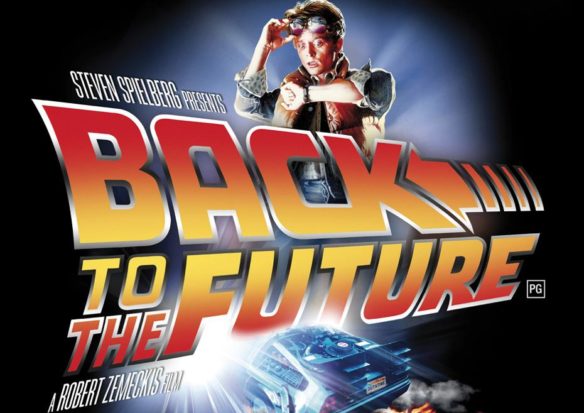
(5) JAMES TOLKAN (1931-2026). Actor James Tolan died March 26 at the age of 94. In the Back to the Future trilogy he played principal Mr. Strickland in the first and second films, and returned as the grandfather of his character for the third. The Back to the Future™ website profiled his career:

…After a short Navy career during the Korean War, and stints at three colleges, he got on a bus for New York City with $75.00 in his pocket and found a cold water flat where the rent equaled his VA check.  He went to work on the docks and enrolled with both Stella Adler and Lee Strasburg to learn the art of acting.  He spent 25 years in New York theater, from off off Broadway to the great White Way. Notably, he was a member of the original ensemble cast of “Glengarry Glen Ross.”

Tolkan did several movie roles while still based in New York City including “Prince of the City” (1981) for director Sidney Lumet, but moved his career to California and Canada in 1983 when he was cast in “War Games.” His most memorable film roles were as Mr. Strickland in “Back to the Future” (1985) for director Robert Zemeckis, and as Tom Cruises’s CO “Stinger” in “Top Gun” (1986).  He had a dual role in Woody Allen’s “Love and Death,” and appeared in numerous films and TV shows through 2011.

Tolkan is survived by his wife of 54 years, Parmelee, and three nieces in Des Moines, IA….

(6) TODAY’S BIRTHDAY.

[Written by Cat Eldridge.]

March 28, 1912A. Bertram Chandler. (Died 1984.)

A. Bertram Chandler, my favorite Australian writer.

Did you ever hear of space opera? Of course you have. Well, the universe of Chandler’s character John Grimes is such. A very good place to start is the Baen Books omnibus To The Galactic Rim which contains three novels and seven stories. If there’s a counterpart to him, it’d be I think Dominic Flandry who appeared in Anderson’s Technic History series. (My opinion, yours may differ.) Oh, and I’ve revisited both to see if the Suck Fairy had dropped by. She hadn’t. If fact she likes him a lot. Good girl. 

Connected to the Grimes stories are the Rim World works of which The Deep Reaches of Space is the prime work. The main story is set in an earlier period of the same future timeline as Grimes, a period in which ships are the magnetic Gaussjammers, recalled with some nostalgia in Grimes’ time. They don’t say what happened to them. 

But that’s hardly all that he wrote. I remember fondly The Alternate Martians, a novella that he did. A space expedition to Mars finds themselves in the worlds of H.G. Wells, Edgar Rice Burroughs and Otis Adelbert Kline. Why he chose the latter I know not as I’d never heard of him. It’s a great story well told. And fun to boot. It was first published as an Ace Double, The Alternate Martians / Empress of Outer Space. Gateway has released it as a separate epub for a mere buck ninety nine at the usual suspects. 

He wrote a reasonably large number of stand-alone-alones, so what did I like?  For a bit of nicely done horror, you can’t beat The Star Beasts — yes, I know that there’s nothing terribly original there but it’s entertaining to read; Glory Planet has a watery Venus occupied by anti-machine theocracy opposed by a high-tech city-state fascinating; and finally I liked The Coils of Time in which a scientist has created a Time Machine but now needs a guinea pig, errr, a volunteer to go back through time and see what’s there —  did it go as planned? Oh guess.

I see that he’s written but a handful of short stories, none of which I’ve read other than the ones in To The Galactic Rim. So who here has? 

He’s won five Ditmars and The Giant Killer novel was nominated for a Retro Hugo. 

All in all, I like him a lot. . Bertram Chandler, my favorite Australian writer. 

A. Bertram Chandler and Susan Wood – 1980 Norwescon – Photo by and © Andrew Porter

(7) COMICS SECTION.

(8) PUBLISHER TRIES TO DEFEND USE OF AI ART IN COMIC. Bleeding Cool’s Rich Johnston quotes the claims from The Moons on Mars press release followed by his own comment: “Daniel Peacock’s Comic, The Moons On Mars, Launches, Created With A.I.”

“This is where the saga begins — a universe of mystery, rebellion, and cosmic destiny… The Moons on Mars is built on a foundation of respect — respect for artists, respect for storytelling, and respect for the creative process. For 18 months, we actively sought to collaborate with several human artists to bring Daniel Peacock’s brilliant and profound story to life. Despite our best efforts, we were unable to secure the right artistic partnership in time. Rather than place this extraordinary narrative on indefinite hold, we were fortunate to meet and work with Wayne Jackson, whose vision and guidance helped us explore ethical, transparent, and responsible uses of AI to move the project forward. Our use of AI is not a shortcut and it is certainly not a replacement for human creativity. It is a tool — one we use with intention, accountability, and deep appreciation for the artistic community. …This is not an anti‑artist project. It is a pro‑storytelling project. It exists because we refused to let a powerful, meaningful story be lost to circumstance. AI allowed us to keep the momentum alive while continuing to honour the craft, the creators, and the community that inspires us. The Moons on Mars stands as an example of how AI can be used ethically — not to replace artists, but to empower stories, expand opportunities, and invite more people into the creative universe we are building.”

Says Johnston:

I am not sure that anyone reading this is going to buy that. Generative AI, especially such visual creation, is built on artwork scraped and stolen without permission from many thousands of artists, without credit or compensation. Vanguard Comics has given no reason why it is not the case in this issue.

(9) ARE SPACECRAFT CONTAMINATING MARS? [Item by SF Concatenation’s Jonathan Cowie.] Any transfer of life-forms from Earth to Mars would complicate searches for life on the red planet or could damage any undiscovered sensitive ecosystem. Spacecraft are prepared in cleanrooms but still carry some hardy microorganisms such as bacterial spores. Bischof  et al. modelled the survival of microorganisms on and within 14 spacecraft that reached the Mars surface. They found that ultraviolet solar radiation effectively sterilizes the exterior shell of each spacecraft inflight. Exposed surfaces of landers and rovers are similarly decontaminated within days to months after landing. However, any unheated spacecraft interiors could retain viable spores for decades.

Primary research here.

(10) DARK MATTER IS A SINGING GROUP? “Scientists Are Pretty Sure They Found a Portal to the Fifth Dimension” at Popular Mechanics.

Scientists say they can explain dark matter by positing a particle that links to a fifth dimension.

While the “warped extra dimension” (WED) is a trademark of a popular physics model first introduced in 1999, research published in The European Physical Journal C in 2021 is the first to cohesively use the theory to explain the long-lasting dark matter problem within particle physics.

Our knowledge of the physical universe relies on the idea of dark matter, which takes up the vast majority of matter in the universe. Dark matter is a kind of pinch hitter that helps scientists explain how gravity works, because a lot of features would dissolve or fall apart without an “x factor” of dark matter. Even so, dark matter doesn’t disrupt the particles we do see and “feel,” meaning it must have other special properties as well….

… The study seeks to explain the presence of dark matter using a WED model. The scientists studied fermion masses, which they believe could be communicated into the fifth dimension through portals, creating dark matter relics and “fermionic dark matter” within the fifth dimension….

(11) SCIENCE EXPERIMENT FOR FILERS. [Item by SF Concatenation’s Jonathan Cowie.] This time with chocolate. Now, there is no particular reason for you to be interested in what passes for my pedestrian life. One dimension is that I try to keep in touch with old friends lest they be lost in the mists of time or even the Twilight Zone. (An aside – by the way, Rod Serling says, ‘Hi’.)

One group are a handful of my old college mates (worryingly, now from a disturbing near half-century ago!). These are from my alma mater’s old SF group Hatfield PSIFA (now Hertfordshire University PSIFA) and in-between annual reunions we keep in contact. Because Hatfield specialised in engineering and science, it is no surprise we were all STEM students and semi-regularly e-mail each other, over this and that, especially science. And, being SF fans, often topics that tickle straddle the two: science fact and science fiction. This month’s topic is SFnal-adjacent in that it concerns whether communication faster than the speed of light is possible? At this point some Filers may well be having a Spock eyebrow moment, but not every physicist is a strict Einstein adherent. Such ardent Einstein-philes may draw upon light cones and say that FTL means you can travel back in time and so negate causality… While this is true in the broad light-cone sense, once you accept that we live in a universe where time has a one-direction arrow, then half the light-cone diagram goes. (This is ‘preferred slicing’ and is an accepted technique used in analysing things like the cosmic background radiation.) Once you have done that, it is then easy – even I can do it – to mathematically prove that you cannot go back in time using faster than light even if to observers two people travelling at different speeds see time passing at different rates: time dilation.) And so with this consideration FTL is possible without a threat to causality.

Our seasonal topic was prompted by Sabine Hossenfelder’s latest offering at her YouTube Channel where this month she has rallied against group-think physicists (that’s nearly all of them) in a 19-minute video. She is known for being outspoken but has not uttered this heresy so vehemently until now. (She fears that an AI unbounded by group-think will give physicists a clue as to FTL possibilities in the coming decade and so wants to nail her flag to the mast.) Now, my friends do find her full argument a little heavy going (especially since we lost our physicist colleague [and SF² Concatenation co-founder] Graham Connor, and I particularly find it hard work as I’m an environmental scientist [into human ecology, climate change and Earth system science] who finds calculus and high maths a tad impossible despite my legs like a gazelle and bionic blood).

However, along the way in our e-mail exchanges we often get side-tracked down intriguing, and even fun, avenues. Here, one of these may interest Filers, especially those with kids with whom they wish to nurture an interest in science… You can measure the speed of light in your kitchen using a microwave and some chocolate.  The great thing is that you can eat your results after! (Well, I am all for keeping science biological.) There is a YouTube video on this. (Thanks to Old Age PSIFAn, mega-mathematician, master real-ale brewer, squaxx dek Thargo and Chair Shoestringcon 1: Polycon John W.)  It is only three-and-a-half minutes long, so enjoy (and perhaps you may be tempted to do the experiment with your kids).

The video is below. (Remember, good science is much better than bad SF.) Let’s tread boldly…

[Thanks to Andrew Porter, John King Tarpinian, Cat Eldridge, Ersatz Culture, SF Concatenation’s Jonathan Cowie, Mark Roth-Whitworth, Kathy Sullivan, Steven French, and Mike Kennedy for some of these stories. Title credit belongs to File 770 contributing editor of the day Cat Eldridge.]

Pixel Scroll 12/4/25 All We Need To Do Is Follow Pixel Through The Nearest Wall

(1) STARFLEET ACADEMY. Paramount+ released this poster today. A friend saw it and immediately thought, “Star Trek: 90210”.

(2) COURT DECISION BENEFITS LIBRARIES. “IMLS Reinstates Grants” reports Publishers Lunch.

After a federal judge overturned the dissolution of the Institute of Museum and Library Sciences, the agency has reinstated all of their federal grants. “This action supersedes any prior notices which may have been received related to grant termination,” according to a notice on their website. “Grantees should access the agency’s electronic grants management system for further information.”

“Restoration of these grants is a massive win for libraries of all kinds in all states,” American Library Association president Sam Helmick said in a statement. “Every public, school and academic library and their patrons benefit from the research findings and program outcomes from individual library and organization grantees.

“We are breathing a sigh of relief, but the fight is not finished. The administration can appeal court decisions. Congress can choose to not fund IMLS in future years. ALA calls on everyone who values libraries to remind their Congressmembers and elected officials at every level why America’s libraries deserve more, not fewer resources.”

(3) WE’RE NOT IN CONNECTICUT ANYMORE. Rich Horton is back with a “Review: Ladies Whose Bright Eyes, by Ford Madox Ford” at Strange at Ecbatan. Ford’s time travel novel is kind of a response to Twain’s A Connecticut Yankee in King Arthur’s Court.

… As Sorrell realizes he really does seem to be in the Middle Ages (about 1326, it seems), he hatches schemes to, Connecticut Yankee-like, use modern technology to make his way in the past. But he soon realizes that he really knows nothing valuable about how to make, say, an aeroplane. But he still finds some degree of success, mostly by accident, managing for example to subdue a group of bandits, and to improve the sanitation of the nuns’ chickens. But the story turns rather more on the actions of the women, especially the combative, vain, and grasping Lady Blanche, and the rather more calm Lady Dionissia. We learn a lot about their positions and attitudes, and about everyday life in that time, and the politics of the day. All comes to a head when the two women, in the absence of their husbands, decide to joust for possession of the coveted gold cross….

(4) RIGHTS TO REANIMATED PETER CUSHING. “Legal battle over Star Wars actor ‘resurrected’ in Rogue One moves to next stage”The Independent has details.

A legal battle over the digital resurrection of actor Peter Cushing in the Star Wars spin-off film Rogue One has reached the Court of Appeal, with film companies arguing the claim should be dismissed.

Tyburn Film Productions is pursuing legal action against Lunak Heavy Industries (UK) Ltd, a Disney-owned entity that produced Rogue One: A Star Wars Story, concerning its use of Cushing’s likeness.

Cushing, renowned for his portrayal of imperial commander Grand Moff Tarkin in 1977’s Star Wars: Episode IV – A New Hope, passed away in 1994. However, his character was brought back to the screen in the 2016 film through advanced special effects, following an agreement between Lunak and the executors of Cushing’s estate in 2016.

Tyburn initiated legal proceedings in 2019 against Lunak and Lucasfilm, the studio behind the original Star Wars saga, alleging “unjust enrichment” from the use of Cushing’s image in Rogue One without their consent.

The company asserts that it entered into a “letter agreement” with Cushing in 1993, which, it claims, prohibited the reproduction of his appearance via special effects without Tyburn’s explicit permission….

(5) AFI’S PICKS OF THE YEAR. Variety lists “AFI Top 10 Awards”.

“Hamnet,” “Marty Supreme” and a powerful one-two punch from Warner Bros. — “One Battle After Another” and “Sinners” — are among the American Film Institute’s 10 best films of the year, the organization announced Thursday. On the television side, HBO Max’s “The Pitt,” Netflix’s “Adolescence” and Apple TV’s “Severance” and “The Studio” were included among AFI’s top programs.

(6) YEAR’S BEST BOOKS. BookRiot’s “Best Books of 2025” is searchable by genre, including Science Fiction and Fantasy. Here are the three Science Fiction picks:

  • Automatic Noodle by Annalee Newitz
  • Down in the Sea of Angels by Khan Wong
  • I Got Abducted By Aliens and Now I’m Trapped in a Rom-Com by Kimberly Lemming

(7) MEMORY LANE.

[Written by Paul Weimer.]

Back To The Future (1985)

By Paul Weimer: I already discussed how important Back to the Future II was to my SFF education a couple of weeks back. But before Back to the Future II, was the original Back to the Future.  I was younger, then, by four years, and not yet immersing myself as much into fandom. So I do recall a Starlog article about the movie, but it would take the sequel and the discussions of same to really get me excited for the franchise outside of the movie itself.

But this was 1985 and I was able to go to movies on my own at last, and so a time travel movie was tailor-made for my tastes. Sure, I didn’t quite get the music or the joke about Marvin Barry, but I knew what I liked. And I liked this. I could see Marty as a slightly older brother, cool, trying his best in a dysfunctional family (boy did that hit) and then trying desperately to save his own future even as problematic as it is.

I didn’t quite realize then what the movie was doing, by giving us a slice of the 1950’s, it was recapitulating things like Happy Days. Hill Valley circa 1955 is a paean to a time and place that has fixated itself strongly in the American Imagination. As Grease was an image of that time for an earlier generation, as was Happy Days, Hill Valley’s Back to the Future is a vision of a very much idealized time. Now, I can see the weaknesses and the problems of that idealized time but it is winningly described and shown here.  And given that Marty’s original timeline present isn’t all that great…in a sense Marty going back to the 1950’s is him going to a happier and simpler time for him (if not that he has to save his own existence). 

Is it any wonder that McFly not only manages to save his future…but to *improve* upon it? 

But for all of the time travel shenanigans and the culture of the 1950’s as compared to the 1980’s, where this movie sings is in its cast. From Michael J. Fox in the Marty McFly role, to Christopher Lloyd, Lea Thompson, Crispin Glover and especially Thomas Wilson as Biff make this movie what it is, and is a great deal of why it was such an out of nowhere success. (that, and of course, DeLoreans are cool).  It actually grew in box office success, and held off strong competitors for weeks. The movie was, and remains, a phenomenon.

(8) COMICS SECTION.

(9) DAN HOUSER Q&A. [Item by Steven French.] Keith Stuart records his meeting with Dan Houser, co-founder of Rockstar in this week’s “Pushing Buttons” newsletter: “Dan Houser on Victorian novels, Red Dead Redemption and redefining open-world games”.

It is hard to think of a more modern entertainment format than the open-world video game. These sprawling technological endeavours, which mix narrative, social connectivity and the complete freedom to explore, are uniquely immersive and potentially endless. But do they represent a whole new idea of storytelling?

This week I met Dan Houser, the co-founder of Rockstar and lead writer on Grand Theft Auto and Red Dead Redemption, who has been in London to talk about his new company, Absurd Ventures. He’s working on a range of intriguing projects, including the novel and podcast series A Better Paradise (about a vast online game that goes tragically wrong), and a comedy-adventure set in an online world named Absurdaverse. He told me that, 15 years ago, he was doing press interviews for the Grand Theft Auto IV expansion packs when he had something of a revelation about the series.

(10) STRANGER BRICKS. “LEGO Reveals Massive Stranger Things Creel House Set Tied To Final Season” at ScreenRant.

The LEGO Group has officially unveiled its newest Stranger Things set, a 2,593 piece recreation of the Creel House that arrives alongside the release of Season 5 Volume 1. Revealed in collaboration with Netflix and the Duffer Brothers, the LEGO Icons Stranger Things: The Creel House set offers a detailed and fully realized version of one of the series’ most haunting locations.

The Creel House model recreates the eerie Hawkins landmark with an open back layout that exposes seven rooms tied to major Stranger Things story moments. Fans can build the bedrooms of the Creel siblings, the haunted upstairs hallway, and Vecna’s Mind Lair with the show’s iconic grandfather clock…

.…LEGO also designed the mansion to be able to shift between different display states. A built-in mechanism allows the structure to split open, revealing an underside inspired by the Upside Down, making it LEGO’s first ever transforming house. It’s a neat nod to LEGO’s previous Strangers Things set, the 2287-piece “Upside Down” set from 2019….

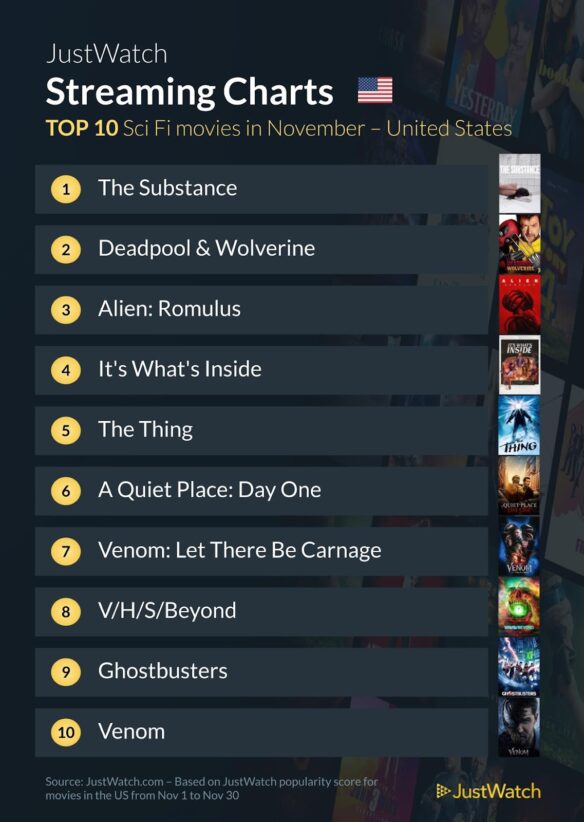
(11) JUSTWATCH NOVEMBER CHARTS. JustWatch has dropped their Top 10 charts for streamers in the month of November.

(12) DAY AFTER DAY. “Giant Mirrors in Space Could Bring Sunlight After Dark, One Startup Says—and Astronomers Are Concerned” reports Smithsonian Magazine.

The sun comes up, and we have daylight; it goes down, and we have night. At least, that’s how it’s been for 4.5 billion years. But now, a California-based startup is aiming to change that pattern.

The company, called Reflect Orbital, intends to launch thousands of satellites sporting reflective panels—giant space mirrors, essentially—into low-Earth orbit, to redirect the sun’s light onto the night side of our planet. The company says this extra sunlight can be used to power solar arrays, assist with search and rescue work, and even fight seasonal depression by extending daylight. Reflect Orbital has applied to the U.S. Federal Communications Commission (FCC) for a license, saying it plans to begin launching these satellites as early as next year.

Astronomers, however, are concerned about side effects of the project. For starters, they’re worried that these satellites—each of them with the potential to be several times brighter than the full moon, astronomers say—will hamper their view of celestial objects. They also fear possible risks to ecosystems and to human and animal health.

“The nighttime is supposed to be dark, and these satellites are designed to turn night into day,” says James Lowenthal, an astronomer at Smith College. “It goes against every fiber of my existence to imagine that we could intentionally banish the night.”…

…. The proposed square-shaped mirrors, made of mylar to boost their reflectivity, would range in size from about 33 feet to 180 feet across. A prototype mirror called Earendil-1, planned to be 60 feet in length, could launch as soon as April 2026, according to the company’s FCC application. The startup intends to send dozens more satellites to space over the next two years, with the aim of putting some 4,000 in orbit by 2030. Last year, the team tested the idea with a large mirror carried aloft in a hot-air balloon, which concentrated a sunbeam onto ground-based solar panels….

(13) VIDEO OF THE DAY. Someone has eaten Cookie Monster’s triple berry pie, and only Beignet Blanc can solve the case. “’Forks Out’: A Benoit Blanc Sesame Street Mystery”.

[Thanks to SF Concatenation’s Jonathan Cowie, Mark Roth-Whitworth, Kathy Sullivan, Steven French, Mike Kennedy, Andrew Porter, John King Tarpinian, Chris Barkley, Cat Eldridge for some of these stories. Title credit belongs to File 770 contributing editor of the day Cat Eldridge.]

Pixel Scroll 12/3/25 The Scrolling Of Pixel 49

(1) THE REASONS WHY. France 24’s English service delivers more information and insight about Angoulême festival: “Bam! Pow! Bubbles burst as Angoulême comics festival is cancelled”.

With the 2026 edition of the Angoulême International Comics Festival now officially cancelled, we take a look at what went wrong and who’s to blame. We dig into what pushed authors to massively boycott the 53rd edition of the festival, despite the economic losses for them and the southwestern French city.

(2) SILENT SERVICE. “Amazon Quietly Pulls Disastrous AI Dubs For Popular Anime After Outcry” reports Futurism.

If you watched the English-dubbed version of one of several popular anime on Amazon Prime Video lately, like “Banana Fish,” and “No Game, No Life,” you may have noticed something strange. The voices were generic, unexpressive, and at times robotic, completely disconnected from the action unfolding on screen. Some lines even sounded a little glitchy. In a word: it was a disaster.

The embarrassing English voices it turned out, were AI-generated. An entourage of actors didn’t sit down in a room somewhere recording take after take to bring these characters to life; instead the voice lines were automatically stitched together using what’s essentially glorified text-to-speech software, with predictably horrendous results.

Fans were furious. And the fallout on social media quickly became so vociferous that Amazon has now quietly pulled the AI dubs from several of the shows, including “Banana Fish.” The AI-generated Spanish dub for “Banana Fish” and “Vinland Saga,” however, are still available, Anime Corner noted….

(3) SOME HOPEFUL FUTURES. The Center for Science and the Imagination’s book Climate Imagination: Dispatches from Hopeful Futures was released December 2 by the MIT Press. It includes fiction (by authors Gu Shi, Vandana Singh, Hannah Onoguwe, Libia Brenda, and Laura Watts) along with essays and visual art.

Where can we look for hopeful climate futures, when the global picture seems dominated by inaction or backsliding? While influential nations and international bodies seem adrift, absent, or flatfooted in the face of an accelerating climate emergency, vigorous action is happening at local and regional levels, propelled by coalitions of advocates, researchers, community leaders, and everyday people.

In this conversation on the new book Climate Imagination: Dispatches from Hopeful Futures, we will talk with writers and thinkers from different regions to learn not only about hopeful climate stories and imaginaries but also local resources and efforts on the ground.

Edited by Joey Eschrich and Ed Finn of the Center for Science and the Imagination at Arizona State University, the book presents speculative fiction, essays, and artworks that explore possible futures shaped by climate action, grounded in real science and the complexities of actual physical and human geographies around the world. Contributors represent 17 different countries from Mexico, Germany, and Sri Lanka to Nigeria, China, Norway, Brazil, and more: Zeid Ra’ad Al Hussein, Jason Anderson, Claire Armitstead, Libia Brenda, Azucena Castro, Andrea Chapela, Nalini Chhetri, Alejandra Espino del Castillo, Fabio Fernandes, Ed Finn, Pippa Goldschmidt, Adeline Johns-Putra, Joseph Kunkel, Ken Liu, Manjana Milkoreit, Gabriela Damián Miravete, Benjamin Ong, Hannah Onoguwe, Chinelo Onwualu, Martha Riva Palacio, Anna Pigott, Kim Stanley Robinson, Gu Shi, Vandana Singh, Nigel Topping, Emma Törzs, Iliana Vargas, Laura Watts, Yudhanjaya Wijeratne, and Farhana Yamin.

There’s a virtual launch event for the book on Thursday, December 11 from 1:00-2:00 p.m. Eastern, featuring three contributors to the book: the SF writer, journalist, and data scientist Yudhanjaya Wijeratne; climate researcher Manjana Milkoreit; and SF writer and physicist Vandana Singh.

(4) HWA CROWN AWARDS. Historia Magazine revealed the winners of the HWA Crown Awards 2025, presented by the Historical Writers’ Association (HWA) to celebrate the best in recent historical writing, fiction and non-fiction.

The winners of the Gold Crown for fiction, the Non-fiction Crown and the Debut Crown were revealed on Wednesday, November 19, at an awards party at Crypt on the Green, a historic building in Clerkenwell.

HWA Gold Crown Award 2025

  • The Heart in Winter by Kevin Barry (Canongate Books)

HWA Non-fiction Crown Award 2025

  • Moederland by Cato Pedder (John Murray)

(5) DEEP DEPOSITS. Not to be missed is the Encyclopedia of Science Fiction’s celebration of “The Library as a Turkey That Does Not Give Thanks” by John Clute titled “Transgressive Embedment”.

… So we’re not here at the moment to thank the kind of institutional “library” after the years of plague when books, once their information “content” was abstracted into digital form, were routinely destroyed; the kind of library whose innards, like frozen elevator music, evoke the terrifying cenotaphic interior spaces Stanley Kubrick created for 2001: A Space Odyssey (1968), in order to demonstrate the denuded torpor Homo sapiens had sunk into by 2001: how desperately we needed help to mature as a species: we know the answer we gave. We can of course thank digital libraries for the abyssally fertile maps of nearly infinitve amounts of data they contain, data doors within data doors like Arabian Nightmares; but we cannot thank their makers for attempting to disable our deep intuition that in the end, after much journeying, maps are less not more. That even the profoundest of Borgesian maps can only describe more fully that which can be described. That when you misdescribe a thing in the world, the skinned torso of the Thing in the World does not become whatever. You do….

(6) S&S S.O.S. Cora Buhlert reviewed Swords of the Barbarians by Kenneth Bulmer, which she found to be “a not very good sword and sorcery novel”, for Galactic Journey: “[November 20, 1970] Year of the Cloud… and lesser lights (November Galactoscope #2)”.

… Now I happen to like sword and sorcery, and while very few authors manage to reach the heights of a Robert E. Howard, Fritz Leiber, Michael Moorcock, or C.L. Moore, even the lesser entries in the genre are at the very least entertaining. And so, when I spotted a cover (courtesy of Richard Clifton-Day) featuring a dark-haired, muscular and nearly naked barbarian with a sword squaring off against a somewhat more dressed barbarian with a red beard and horned helmet wielding a battle axe in the spinner rack of my trusty import bookstore, with a blurb promising “a sword and sorcery saga in the great tradition of Conan”, I of course took it home…

(7) U.F.FAUX. Later in November Cora returned to Galactic Journey with a review of what may well be the first found footage film ever, the 1970 UFO mockumentary The Delegation: “’[November 28, 1970] A True Fake Story: Die Delegation – eine utopische Reportage (The Delegation – a Utopian Documentary)”.

… The unaired footage looks rough and uncut. Clapperboards are visible, there are random cuts and lens flares, radio music plays in the background, the sound crackles and sometimes drops out altogether, people walk into the shot, wave at the camera and kids push in front of the camera and grin. In Washington DC, Roczinski stands outside the Pentagon and declares that the Pentagon has no official comment on UFOs. Then, he enters a car to interview a colonel of the US Air Force who notes that though the Pentagon’s official line is that there are no UFOs and no extraterrestrials, there is plenty of evidence to the contrary. The colonel also points Roczinski to a 1955 report on the UFO phenomenon by Major Donald Keyhoe who came to the conclusion that the Soviets are not responsible for the UFO sightings and an extraterrestrial origin is the only explanation. Donald Keyhoe is a real person, a former pulp writer and military officer who wrote the bestselling books The Flying Saucers Are Real and The Flying Saucer Conspiracy and co-founded the National Investigations Committee On Aerial Phenomena NICAP. Afterwards, Roczinski tries to interview the Mailers, a black couple from Washington DC who claim to have been abducted by UFOs en route to Cleveland, only to reappear a few days later in El Paso, Texas. However, the neighbours of the Mailers bodily kick Roczinski and his cameraman Gerd Hannieck out of the apartment building, complete with shaky footage….

(8) TODAY’S BIRTHDAY.

[Written by Paul Weimer.]

November 3, 1968Brendan Fraser, 57.

By Paul Weimer:

“Patience is a virtue…”

“Not right now it isn’t!”

Brendan Fraser, as Rick O’Connell in the three Mummy movies, proved that the old formula of pulp action that started in the 30’s, The Mummy, and was revived somewhat by the Indiana Jones films in the 80’s, could have a bit of new life in the late 90’s. 

Why did The Mummy succeed when The PhantomThe Shadow and other attempts at pulp action in the Nineties failed? A lot of that I give the credit to Brendan Fraser. Straight jawed handsome hero, but with humor and a modern sensibility, The Mummy’s success is in no small part thanks to him embodying the role of the central hero. 

The movies have lots of other charms, from the supporting cast (which sadly gets somewhat less sparkling as one goes from the first to the third film), and good writing (again, which slips as we go down the movies). But Fraser is the tentpole around which the film runs.  (Just consider how miscast Tom Cruise was in the recent Mummy remake and you will see what I mean–Fraser could have made hay out of that role). The alternate worlds where someone else took the O’Connell role are probably poorer for that choice.

Fraser is the kind of actor whose roles often were characters you want to be, be friends with, or get romantically entangled with. He has other genre work to his credit, too.  Although the movie is uneven, he’s fun in Bedazzled, selling his soul to Elizabeth Hurley’s devil. Looney Tunes: Back in Action requires an actor who can act with Toons…Fraser fits that bill, too. Journey to the Center of the Earth…I admit I got vertigo trying to watch that one. 

The strains of being an actor and stardom meant that Fraser took a decade off from movies, but I am delighted that he is back. He’s in a more mature, older form. I really like his work in Doom Patrol, for instance.  Robotman should be a ridiculous character, and he is, but Fraser helps sell it.  He played a villain in the never-released Batgirl movie (curse you, Warner Brothers). I’d like to someday see what he did with the role of Firefly.

And yes, I heard the news that there is going to be a new Mummy movie. For that, indeed, Patience is a Virtue. 

Brendan Fraser and family

(9) TODAY’S BIRTHDAY, TOO.

[Written  by Cat Eldridge.]

December 3, 1958Terri Windling, 67.

By Cat Eldridge: I first encountered Terri Windling’s writing through reading The Wood Wife, a truly extraordinary fantasy that deserved the Mythopoeic Award it won. (The Hole in the Wall bar in it would be borrowed by Charles de Lint with her permission for a scene in his Medicine Road novel, an excellent novel.) I like the American edition with Susan Sedona Boulet’s art much better than I do the British edition with the Brian Froud art as I feel it catches the tone of the novel. 

I would be very remiss not mention about her stellar work as the founding editor along with Ellen Datlow of what would be called The Year’s Best Fantasy and Horror after the first volume which was simply The Year’s Best Fantasy, that being noted for those of you who would doubt correct me for not noting that. The series won three World Fantasy Awards and a Stoker as well.

They also edited the most splendid Snow White, Blood Red anthologies which were stories based on traditional folk tales. Lots of very good stuff there. Like the Mythic Fiction series is well worth reading and available at usual suspects and in digital form as well.

Oh, and I want to single out The Armless Maiden and Other Tales for Childhood which took on the difficult subject of child abuse. It garnered a much warranted Otherwise nomination.

Now let’s have a beer at the Dancing Ferret as I note her creation and editing (for the most part) of the Bordertown series. I haven’t read all of it, though I did read her first three anthologies several times and love the punks as you can see here on Life on the Border, but I’ve quite a bit of it and all of the three novels written in it, Emma Bull’s Finder: A Novel: of The Borderlands, is one of my comfort works, so she gets credit for that. 

So now let’s move to an art credit for her. So have you seen the cover art for Another Way to Travel by Cats Laughing? I’ve the original pen and ink art that she did here. 

Which brings me to the Old Oak Wood series which is penned by her and illustrated by Wendy Froud. Now Wikipedia and most of the reading world thinks that it consists of three lovely works — A Midsummer Night’s Faery TaleThe Winter Child and The Faeries of Spring Cottage

But there’s a story that Terri wrote that never got published anywhere but on Green Man. It’s an Excerpt from The Old Oak Chronicles: Interviews with Famous Personages by Professor Arnel Rootmuster. It’s a charming story, so go ahead and read it.

Terri Windling

(10) COMICS SECTION.

(11) JEOPARDY! [Item by Andrew Porter.] On last night’s Jeopardy!, the category was “Pulp Fiction.” Here are 4 screenshots from the show. And no, I didn’t get all of the clues.

(12) TIME TRAVEL ANTHEM. [Item by Steven French.] A little tangential perhaps but here’s Chris Hayes on writing the song “The Power of Love” for Back to the Future: “We didn’t think Back to the Future sounded plausible – or good’: Huey Lewis and the News on The Power of Love” in the Guardian.

When I wrote it, I had no idea what was going to happen or how popular it was going to be. It ended up being an integral part of the whole Back to the Future franchise, the biggest song in our career, and gave us our first No 1, which was exciting. What’s weird about it, though, is that the song really has nothing to do with the film whatsoever. We were given a synopsis of the screenplay of the movie, and I read through the whole thing and I remember thinking to myself: “This doesn’t sound plausible or like it’s going to be good.” And boy was I wrong!

(13) THEREMIN NEWS. [Item by Dann.] The New York Times recently had a piece on the theremin.  Thought it might be of interest for obvious reasons. Although the authors didn’t cover the most obvious reason for some odd reason.  Most unreasonable of them. “The Beguiling, Misunderstood Theremin” at Archive.ph.

… Utopian visions of liberation have been entwined in the theremin’s history for as long as it has existed. The inventor of the instrument, the Russian-born engineer Leon Theremin, told The New York Times in 1927 that his “apparatus,” which he believed could produce an unprecedented range of tonal colors and sounds, “frees the composer from the despotism of the 12-note tempered piano scale, to which even violinists must adapt themselves.”

Theremin, a physicist and amateur cellist, would go on to serve time in a Siberian labor camp, spy for the Soviet government and invent an electronic security system used at Sing Sing prison in Ossining, N.Y. But first, he created his musical apparatus by accident. He was developing an electronic device for measuring the density of gases when he realized that the sounds it emitted changed when he moved his hands.

In the late 1920s, RCA began to manufacture and sell the theremin, making it the first mass-produced electronic instrument. Today, perhaps 140 original models remain. “At the time that it came out, it was promoted as being easily playable,” Chrysler said, standing in front of an original RCA theremin housed in the Metropolitan Museum of Art’s music gallery, “which of course wasn’t true.”…

(14) WHAT WOULD IT BE LIKE IF THE EARTH DID NOT HAVE ANY AXIAL TILT? [Item by SF Concatenation’s Jonathan Cowie.] Curious Cases is a BBC Radio 4 programme hosted by a scientist and comedian who has a passion for science on the side.  This week they looked at the ‘what if’ scenario of the Earth not having any axial tilt.

Because the Earth has tilt, we obviously get seasons and this in itself would mess up a lot of biology. Many multicellular terrestrial species use the seasons to govern their life cycles breeding in the seasons of plenty.

Now, this you might not think would be a big deal.  You might suppose that a non-tilted Earth would be more a mediocre place and so the absence of seasons would be no big deal.  However, researchers have modeled a non-tilted Earth and it is not good news.

A non-tilted Earth would see more expansive frozen poles as well as more expansive sub-tropical zone deserts: The Sahara would be bigger as would the central Australian desert.  The tropical forest zone would be reduced as would the comfortable temperate zones.

For those of us in Brit Cit, it would be like March all year round but with more and stronger storms due to changed weather track patterns.  Conversely, somewhere like Melbourne, Australia, would have something like 20°C days all year round.  However, Melbourne would be on the edge of the expanded Australian desert and so be far drier than today: so kiss goodbye to Australia’s Darling agricultural bread basket.

The show’s hosts and one of their guests also briefly considered that a non-tilted Earth would see the dinosaur destroying asteroid miss a land impact and hit the ocean.  This would reduce sulphate injection into the atmosphere, which cooled the Earth, and also increase water injection into the stratosphere so causing a warming effect.  The actual difference between such a non-tilted Earth strike and what actually happened depends on how the mix of these two effects played out.  However, one of the guests muses that more dinosaurs may have survived in this scenario and possible co-exist with humans today.  (Have I ever told you that I have never really forgiven the dinosaurs for what they did to Raquel Welch?) Here I was minded – and sadly they did not mention this – Harry Harrison’s mid-1980s Eden trilogy of books whose central conceit is that dinosaurs survived through to today.

Could you survive an eternal winter? Or is endless summer sun a more appealing prospect? Lots of us are grateful for the seasonal changes that shape the world around us, but this week Hannah and Dara are asking what life would look like without the axial tilt that brings each hemisphere closer and further away from the sun as the seasons change each year. Listener Andrew from Melbourne wants to know what would happen if the planet stood perfectly upright, no lean, no tilt, no seasons. But what else could happen? Is Earth’s 23-degree slant the cosmic fluke that made life possible?

To find out, Hannah and Dara explore how losing the tilt reshapes climate, ecosystems, evolution and maybe even the fate of the dinosaurs.

This was another of the series’ good editions and you can access it here.

The present day biome map of N. America. If the Earth did not have any axial tilt then the ice and tundra zones would expand as would the semi-desert of S.W. USA. The cool and warm temperate zones would contract.

[Thanks to Cat Eldridge, SF Concatenation’s Jonathan Cowie, Mark Roth-Whitworth, Cora Buhlert, Dann, Michael Burianyk, Joey Eschrich, Kathy Sullivan, Steven French, Mike Kennedy, Andrew Porter, John King Tarpinian, and Chris Barkley for some of these stories. Title credit belongs to File 770 contributing editor of the day Brian Jones.]

Pixel Scroll 11/20/25 Pixels May Safely Scroll And Shimmer In A Watchful Filer’s Sight

(1) TENTH ANNUAL CITY TECH SF SYMPOSIUM. The “10th Annual City Tech Science Fiction Symposium on Image and SF” will be held December 2. The full schedule and program participant bios are at the link.

The 10th Annual City Tech Science Fiction Symposium will take place in the City Tech Academic Building at 285 Jay Street in downtown Brooklyn, New York on Tuesday, December 2, 2025 from 9:00am to 5:00pm in Room A-105.

The event is free and open to the public. Pre-registration for this in-person event is not required. Participants and attendees who are not affiliated with the college will need to sign-in at the security desk before entering. Room A-105 is down the hallway to the right of the turnstiles on the right side (street-facing side of the building).

(2) PLURIBUS INTERVIEW. [Item by SF Concatenation’s Jonathan Cowie.] An episode of BBC Radio 4’s arts programme Front Row has just interviewed one of the creators of Breaking Bad, Vince Gilligan, on his new SF series Pluribus.  The series concerns a woman who finds that everyone else in the world has become happy.  This should be good new, but it is a nightmare… The series is quick to explain one aspect of this global change. No spoilers here, though it isn’t technology (despite my warning for years that the machines are taking over though no-one ever listens).  During the chat, along the way other SF shows get mentioned, and we also learn something of the inside scene in bringing a show to screen: for example, the ‘elevator pitch’ is explained.

The 15-minute interview commences near the show’s beginning after the introduction.  You can access it here. Pluribus airs on Apple TV.

Screenwriter Vince Gilligan is the creative mind behind the multi-award winning television dramas Breaking Bad and Better Call Saul. His latest offering is Pluribus – a post-apocalyptic science fiction tale where it’s up to the only miserable human being on Earth to save the world.

(3) PLURIBUS REVIEW. Camestros Felapton comments on the new series in “Pluribus (Apple+) – first two episodes (spoilers)”. To repeat, spoilers. But I think it’s okay to excerpt a part that only discloses what was in the show’s own advertising.

… This first episode has a lot of humour and character insights but works with a repeated ratcheting up of tension. As I said at the start, I was already aware of the premise of the show (basically, Rhea Seehorn is the one unhappy person in a world were nobody is miserable) which makes this first episode less tense. My unspoiled friend found it far more alarming as we follow Carol’s experiences as events escalate….

(4) OCTOTHORPE. In Episode 148 of the Octothorpe podcast, “I’m With Liz”, John Coxon, Alison Scott, and “stunt Liz” Emily Tesh are live from Novacon 54. They discuss the convention, what it’s like to be a Guest of Honour, parenting at cons and also whether or not John should read the Silmarillion. An uncorrected transcript is available here. 

Emily Tesh, John, and Alison stand in front of a suspiciously purple background which may indicate that the real background has been subtracted by nefarious photo editing. The words “Octothorpe 148 Live from Novacon” are overlaid.

(5) CANADIAN FANHISTORY TOUR DE FORCE. [Item by Andrew Porter.] Lots of material about Canadian and Toronto fandom and fanzines! “’Captain’ George and the Emergence of Comic Fandom During the Early Canadian Silver Age” in Comic Book Daily.

…In Canada, the emergence of comic book fanzines and conventions can be traced to the efforts of “Captain” George Henderson. Certainly, as long as there have been comic books, people have been collecting them. Yet, Henderson was the person who brought the idea of the local comic shop into the Canadian mainstream when he opened what would morph into Canada’s first comic store, the Viking Bookshop, in 1966. As part of this trajectory, Henderson would also become the first major Canadian publisher of comic fanzines (which I will return to next month).

Henderson played a significant role in bringing comic conventions to Canada too. On November 27, 1966, he organized something of a (prototype) comic convention, Com-Ex, which took place at the University of Toronto’s Hart House on November 27 and featured several of Henderson’s most valuable comics on display as part of an exhibit. Com-Ex was presented by the “Canadian Academy of Comic Book Collectors and the Hart House Library Committee.” It was intended to be an exposition where collectors and enthusiasts would display their prized comics and/or artwork and compare collections. Film critic Michael Walsh was a student at the University of Toronto at the time and was also a member of the Hart House Committee that helped present the event. He also covered the story for the university’s student newspaper (The Varsity). I recommend taking a look at Walsh’s explanation of how the event came together on his “Reeling Back” blog….

(6) KEN SMOOKLER (1929-2025). Canadian fan Ken Smookler died November 11 at the age of 96. The family obituary is here: “Kenneth Morton Smookler”. It says in part:

Kenneth Smookler photo from the family obituary.

Born in Windsor Ontario a few months before the great crash of 1929, Kenneth Morton Smookler, only child of pharmacist William Smookler and bookkeeper Ella Smookler, distinguished himself early in life: as a three-year-old he shocked the editors of Ripley’s Believe It or Not, who confirmed Ken could not only read the newspaper, but could do it upside-down! Ken kept reading for the next 93 years, and was still ordering 20 books a month from the library in his final year.

In adulthood Ken’s intelligence earned him a place in Mensa where he could share his playful wit and brilliant mind. He met Frances Ross (née Myers) in 1956, often saying he fell in love at the first sight of this young widow with two small children…. 

…From early childhood Ken was fascinated by science fiction and the far reaches it offered the mind. Over many decades he and Fran would trek to science fiction conventions, meeting Isaac Asimov, Gene Roddenberry, Joe Haldeman, Harlan Ellison and many other now legendary writers. Ken co-founded and was the first president of the Ontario Science Fiction Club (OSFiC).

As much as Ken loved science fiction, he loved his wife Frances even more. An early adopter of feminism, Ken supported Fran returning to school, even attending class with her to teach her how to take notes, and teaching himself calculus to help her pass the course. His support enabled her to become one of Ontario’s few female lawyers, cheering her on as she went before the Supreme Court. After her death in 2023, Ken said the light went out for him….

Andrew Porter remembers, “I first met Ken and his wife Fran in the mid-1960s; with Ken I worked on the bidding committee for the Toronto in 73 Worldcon bid, and he was on the committee. Here’s my photo of him in 1970 in his law office in Toronto’s Toronto-Dominion (later T-D) Bank Building.”

Ken Smookler in 1970. Photo by and (c) Andrew Porter.

(7) MEMORY LANE.

[Written by Paul Weimer.]

Back to the Future Part II (1989)

By Paul Weimer: Back to the Future, the original, was a revelation for me. Even if I am not musically inclined (for a movie that is often all about the music), the movie worked for me on a lot of levels. I was in an age and a place and a time where I could see movies in a theater, and then read about them in magazines like Starlog, anticipating and wondering what was going to happen…and then discuss them afterwards. I was still young and shy and didn’t send any letters to such magazines, but I read them all avidly.

And then came the movie itself. I’d read a bunch of time travel SF by now, and so I was delighted to see Back to the Future Part II use time travel in a way the first had not. The first movie used it as a device to move Marty to the past and comment on culture in the 1950’s and the present of the 1980s. Back to the Future Part II actually used time travel in a way that few genre movies would contemplate. Most genre movies tend toward scenarios where the time travel proves to have happened all along. History is never changed and can’t be changed. 

Back to the Future Part II changed all that, when 2015 Biff gives 1955 Biff the Almanac, and utterly changes his future.  The vision of the Biff Tannen Wins timeline is dark, horrendous and compelling. It makes Potterville from It’s a Wonderful Life look like a theme park in comparison. Back to the Future Part II is a “set things right where things went wrong”, but it was actual malice aforethought, not chance or circumstance, that Marty has to fix. 

This leads to a delightful overlapping of events in 1955 as Marty has to desperately fix the timeline…but not screw up his own future in the process. It’s a wonderfully done sequence of events, and we get a couple of extra scenes that are implied in the first movie, but never seen. It’s an attention to detail in a time travel change history movie that few have attempted, much less this well. 

It occurs to me, though, that we’ve wound up in the Biff Tannen Wins timeline after all. Sobering, but undeniable in the end. And no time machine to save us.

It also occurs to me that this movie suffers from a lack of strong female characters. After Jennifer being brought along at the end of Back to the Future, she gets knocked out first thing by Doc in Back to the Future Part IIt, in a whiplash that really doesn’t work well. The movie is even more of a young man’s adventure than the first, but with more action adventure and less sexual innuendo than the first. 

But back to the plot. After seeing the movie came the aftershocks of the movie. After all, Back to the Future Part II lives on a cliffhanger. Doc is trapped in the past, and is doomed to die. Marty needs the help of the 1955 Doc Brown…but not to go home, but to go to the past to save him.  It’s a lovely tangle of time paradoxes and foreshadowing and destiny that the second movie reveled in, and so the magazine’s endless discussions and theories on how time travel really worked, or should, gave Back to the Future Part II an afterlife for me after seeing it for the first time. Of course we take such things for granted, now, but Back to the Future II was one of my first real engagements with a movie’s afterlife. (I have a story about Star Trek II in the same vein, but we’ll save that for another day).

(8) COMICS SECTION.

(9) A THANKSGIVING TOP 10. Ahead of Thanksgiving, JustWatch pulled a 3-year lookback on U.S. viewing behavior over the holiday weekend — and some clear rewatch trends emerged, along with where each title is currently available to stream.

Key highlights:

  •  Planes, Trains and Automobiles remains the definitive Thanksgiving movie.
  •  Knives Out continues its unexpected rise as a modern holiday favorite.
  •  Nostalgia dominates: 7 of the top 10 films were released before 2010.
  •  Longstanding family staples, The Wizard of OzA Charlie Brown ThanksgivingHarry Potter, still anchor holiday comfort viewing.

Full Top 10 List:

  1. Planes, Trains and Automobiles (1987)
  2. Knives Out (2019)
  3. Wicked (2024) – Note: Cinema clickouts were included
  4. The Hunger Games (2012)
  5. A Charlie Brown Thanksgiving (1973)
  6. The Wizard of Oz (1939)
  7. Harry Potter and the Philosopher’s Stone (2001)
  8. Dutch (1991)
  9. The Last Waltz (1978)
  10. Addams Family Values (1993)

Why These Titles Top the List. Planes, Trains and Automobiles continues its reign as the definitive Thanksgiving movie, driven by both millennial nostalgia and a new generation discovering the film on streaming platforms. Its blend of slapstick comedy and heartfelt moments resonates with families navigating their own holiday travel chaos.

Knives Out stands out as the only modern title in the top three, reflecting a growing appetite for smart, comedic whodunnits during long weekend downtime. Meanwhile, Wicked and The Hunger Games highlight the popularity of fantasy blockbusters as shared viewing experiences among families with teens and young adults.

Perennial classics like A Charlie Brown Thanksgiving, The Wizard of Oz, and Harry Potter and the Philosopher’s Stone remain multigenerational traditions, drawing strong interest across both linear TV and streaming. Cult favorites including Dutch, The Last Waltz, and Addams Family Values round out the list—each with dedicated fan bases who have made Thanksgiving rewatches an annual ritual. [Based on a press release.]

(10) ATLAS AS CLOSE AS WE CAN SEE IT. “Nasa releases close-up pictures of comet flying by from another star system” in the Guardian.

Nasa released close-up pictures on Wednesday of the interstellar comet that’s making a quick one-and-done tour of the solar system.

Discovered over the summer, the comet known as 3I/Atlas is only the third confirmed object to visit our corner of the cosmos from another star. It zipped harmlessly past Mars last month.

Three Nasa spacecraft on and near the red planet zoomed in on the comet as it passed just 18m miles (29m km) away, revealing a fuzzy white blob. The European Space Agency’s two satellites around Mars also made observations.

Other Nasa spacecraft will remain on the lookout in the weeks ahead, including the James Webb space telescope. At the same time, astronomers are aiming their ground telescopes at the approaching comet, which is about 190m miles (307m km) from Earth. The Virtual Telescope Project’s Gianluca Masi zoomed in Wednesday from Italy….

(11) WHAT DO YOU THINK? [Item by SF Concatenation’s Jonathan Cowie.] This week’s issue of Nature contemplates machines reading our innermost thoughts…

Ethicists say AI-powered advances will threaten the privacy and autonomy of people who use neurotechnology.

The ability of these devices to access aspects of a person’s innermost life, including preconscious thought, raises the stakes on concerns about how to keep neural data private. It also poses ethical questions about how neurotechnologies might shape people’s thoughts and actions — especially when paired with artificial intelligence.

Meanwhile, AI is enhancing the capabilities of wearable consumer products that record signals from outside the brain. Ethicists worry that, left unregulated, these devices could give technology companies access to new and more precise data about people’s internal reactions to online and other content….

You can read the article here: “Mind-reading devices can now predict preconscious thoughts: is it time to worry?”

[Thanks to Mike Kennedy, Andrew Porter, John King Tarpinian, Jason Ellis, Chris Barkley, Cat Eldridge, SF Concatenation’s Jonathan Cowie, Mark Roth-Whitworth, Steven French, and Kathy Sullivan for some of these stories. Title credit belongs to File 770 contributing editor of the day Jim Janney.]

Pixel Scroll 8/7/25 Files Are A Burden To Others; Answers, A Pixel For Oneself

(1) SEATTLE WORLDCON 2025 PUBLICATIONS AVAILABLE. These are available to download free.

Souvenir Program Book link to PDF here

Featuring art by Guest of Honor Donato Giancola, original poetry by Poet Laureate Brandon O’Brien, fiction by Nisi Shawl, and much more, enjoy this look at Seattle Worldcon 2025!

Pocket Program link to PDF here

With maps, convention hours, policies, other important information, and panel and event schedules, this is a handy-dandy guide to attending the convention.

NOTE: This was finalized and sent to the printers on July 11, and does not reflect changes made to the schedule since then. While much is correct, please refer to Guidebook and the website schedule for the most up to date information.

Restaurant Guide link to PDF here

25 pages of restaurant recommendations throughout the greater Seattle area (and beyond), organized by neighborhood. Whether you’re looking for something walkable from the convention or have the time to venture further afield, enjoy exploring Seattle’s many culinary delights!

Menus for food outlets in the Summit building are available on our food and restaurant guide page.

(2) REMEMBERING THOSE WHO SAVED STAR TREK. Woman’s World has published an extensive profile on early Trek fanhistory: “Meet the Fans Who Saved the Original ‘Star Trek’ From Cancelation, Not Once, But Twice”.

…Yet despite these creative triumphs, ratings were never stellar. The show performed decently on Thursday nights but failed to dominate its timeslot and NBC executives were restless. Cancellation rumors circulated before the first season had even concluded, prompting Roddenberry to turn to a then-trusted friend for help: science fiction author Harlan Ellison, who would pen the early drafts of the show’s greatest triumph, “The City on the Edge of Forever.”

Ellison’s campaign began quietly. On December 1, 1966, he wrote to the Science Fiction Writers of America, rallying his colleagues to support the show. He warned that Star Trek’s cancellation “would be tragic, seeming to demonstrate that real science fiction cannot attract a mass audience. We need letters! Yours and ours, plus every science fiction fan and TV viewer we can reach through our publications and personal contacts.”…

The article taps into the memories of Devra Langsam, Jacqueline Lichtenberg, Joan Winston, and tells about Bjo Trimble’s campaign.

…Devra Langsam, who published Spockanalia, the first Star Trek fanzine, recalled how even the smallest efforts felt vital. During that first season, her cousin Debra took to the streets of Manhattan to hand out “Save Star Trek” flyers.

“My cousin picketed NBC and walked around passing out flyers in Manhattan, and people kept telling her that ‘Dr.’ Spock was a commie,” she recalls. “They were a little confused. So, we were definitely handing out flyers and buttons and NBC kept sending secretaries down, and they’d report, ‘They’re still there; there’s four of them, they’re still picketing us.’ It was only a very small number of people, but we kept handing out those flyers and buttons and writing them letters, not petitions. A petition isn’t as good—it’s a lot less effort but writing them letters is stronger.”…

…The first wave of letter-writing, modest though it was, accomplished its goal: NBC renewed Star Trek for a second season, though the show remained under constant scrutiny….

Then in season 2 —

….The show’s fate now rested entirely with its fans. Jacqueline Lichtenberg comments, “The reaction to news about the cancellation was panic. This was material to be passed down to grandchildren, not left to rot in some vault. This was a historic breakthrough, not a trivial bit of failed entertainment.”…

…And that’s when Bjo and John Trimble stepped forward to organize one of the most famous fan campaigns in television history. They recognized the stakes: without a third season, the series would not reach the magic number of episodes required for syndication—typically around 100 for a weekday rotation. In the pre-home-video era, that meant Star Trek would effectively vanish. The couple began their campaign with the simplest of tools: a mimeograph machine and a carefully crafted letter.

“We wrote up a preliminary contact letter, ran it off on our ancient little mimeograph machine and mailed it out to about 150 science-fiction fans,” the duo, extremely well known in fan circles, explain. “These fans had been especially selected because they had some further contacts, either as fanzine editors, club members or for some such reason.”

The plan followed what they called the Rule of 10: ask 10 people to write letters, have each of those 10 ask 10 more, and continue until NBC was swamped….

NBC, which normally received about 50,000 pieces of mail per year across all programming, suddenly found itself inundated with hundreds of thousands of letters for a single show. Estimates ranged from 200,000 to one million. Whatever the true figure, it was enough to cause real disruption inside the network….

…Elyse Rosenstein, an early convention organizer who passed away in 2020, remembered the scale of the mail response vividly: “Do you realize how many pieces of mail NBC eventually received on Star Trek? They were handling the mail with shovels—they didn’t know what to do with it. Their policy was to answer everything, even if it was a form letter, and a million pieces of mail is a lot of money.”…

(3) PHILOSOPHICAL GAS. [Item by Steven French.] Lisa Walters argues that the origins of science fiction lie in early modern philosophy on the Institute of Art and Ideas website: “Science fiction is philosophy” at IAI News.

…While science fiction fans watching Dune or Star Wars may not consider such activities as philosophical, the genre of science fiction can trace its origins to the discipline of philosophy.

Some of the earliest science fiction authors (who wrote sci fi before such a label existed) were well-known philosophers. The Renaissance saw the rise of what we now refer to as science fiction; philosophers such as Francis Bacon, Johannes Kepler, and Margaret Cavendish wrote fictional stories about their philosophical and scientific ideas.

Today’s distinctions between science and philosophy made less sense 350-400 years ago. Many scientists called themselves natural philosophers, a branch of philosophy broadly interested in investigating the workings of nature and the universe. In addition, the Renaissance was not only the era of the Scientific Revolution, but also it was a time when Europeans discovered that the world was much larger and more unfamiliar than was ever thought possible as they began to travel around the globe and colonize the Americas. Renaissance philosophers such as Kepler imagined a new culture and aliens that inhabited the moon. [1] Bacon also imagined a sophisticated scientific society somewhere west of Peru, and Cavendish portrayed an alien world (or parallel reality) filled with intelligent creatures with their own unique solar system. For those philosophers, what we would call science fiction today was once a way of doing philosophy….

(4) DONATIONS REQUESTED. [Item by Susan de Guardiola.] At left is Anna Medvedeva, a Ukrainian LARPer. At right is her family’s apartment building after a Russian attack on Kyiv on July 31. The building is essentially destroyed. The black door at the top of the photo is to her childhood bedroom. In front of that door was a balcony her father renovated and her mother filled with flowers.

Luckily, her family was away. They are still alive. Thirty other people were killed in this attack. Anna went to help rescue services identify the neighbors’ bodies.

Anna’s parents have lost everything – apartment, clothes, belongings, all their family photos and mementos. This trauma cannot be healed. But we can help support her family as they start over. US dollars go a LONG way in Ukraine – $500 is a month’s income there.

???????????????????????? for donations: [email protected] (account of Vlada Dumenko)

Add in the reason “gift” and this:

Для родини Анни Медведєвої
Від американського гравця в LARP

It means “For the family of Anna Medvedeva, from an American LARPer” 

(5) WITH AN ASSIST FROM MUSK. “Disney Settles Lawsuit From Gina Carano Over ‘Mandalorian’ Firing”The Hollywood Reporter has the story. The terms of the settlement were not made public.

Disney and Lucasfilm have settled a lawsuit from Gina Carano, who accused the studios of discrimination and wrongful termination over her firing from The Mandalorian.

In a statement, a Lucasfilm spokesperson said, “With this lawsuit concluded, we look forward to identifying opportunities to work together with Ms. Carano in the near future.”

“We have reached an agreement with Gina Carano to resolve the issues in her pending lawsuit against the companies,” it added. “Ms. Carano was always well respected by her directors, co-stars, and staff, and she worked hard to perfect her craft while treating her colleagues with kindness and respect.”…

Carano said in a statement that the deal is the “best outcome for all parties involved” and “my desires remain in the arts.”

Terms of the settlement, announced on Thursday, weren’t disclosed.

In a lawsuit filed last year, Carano alleged she was fired for voicing right-wing opinions on social media and sought a court order that would force Lucasfilm to recast her. Elon Musk, making good on a promise to foot the legal bill for users who claim they have been discriminated against due to their activity on his platform, helped fund the suit through X….

(6) THE BEST HARD SF FILMS OF THE PAST 25 YEARS. CBR.com gives us its list of “10 Greatest Hard Sci-Fi Movies of the 21st Century, Ranked”.

Hard science fiction refers to a subcategory of sci-fi that focuses on integrating scientific accuracy and real-world logic into its plot. Some of the greatest examples of hard sci-fi include films like 2001: A Space Odyssey (1968), Solaris (1972), and Blade Runner (1982). Hard sci-fi became a defining category for the sci-fi genre as a whole, but more often than not, fans will resort to these classic examples to explain what makes the subgenre so great.

The 21st century has added to this long list of incredible hard sci-fi films, though. Some of the best modern science fiction films turn out to be hard sci-fi….

At the top of the list —

1. An Interesting Approach to Aliens & Time Travel that Actually Makes Sense

Arrival (2016)

Arrival is one of the most inventive movies on this list because it tackles the idea of an alien invasion and the concept of time travel through unique means. Most of the films on this list focus on astronauts and space travel, but Arrival decides to forego all of that by focusing on Amy Adams’ Louise Banks, a linguist who is recruited by the United States Army to figure out a way to communicate with potentially dangerous extraterrestrials.

One of the elements that makes this film so realistic is how it explores a potential alien invasion. Plenty of people believe in the existence of aliens, and plenty don’t, but the chances of humans being the only intelligent life form in the entire universe seem pretty slim. Most alien invasion movies boil down to an action-packed conflict between humanity and aliens, but Arrival takes a more realistic approach to how the world would likely respond to this event happening. The plot takes things one step further by incorporating the philosophical idea that time is not necessarily linear.

(7) A TOUCH OF LARCENY. “NASA Approves Ted Cruz’s Plan to Move a Space Shuttle to Houston, Setting Up a Fight With the Smithsonian” reports Gizmodo.

NASA has selected a yet-to-be-named Space Shuttle to move to Houston, conceding to a long-running bid by Texas senators to house one of the iconic vehicles. If the chosen vehicle is Discovery—which it likely is—the Smithsonian, which houses the vehicle, may put up a fight.

The Trump administration included the shuttle’s relocation in the budget reconciliation bill, signed it into law on July 4, and set aside $85 million for the move and construction of a new facility in Houston. At the time, Texas Senators Ted Cruz and John Cornyn had their eyes on Space Shuttle Discovery, which has been on display at the Smithsonian’s Air and Space Museum in Virginia since 2012.

This week, a NASA spokesperson stated that the agency’s acting administrator, Sean Duffy, has identified one of the retired shuttles to be displayed at Space Center Houston, without revealing which one, according to collectSPACE. It’s not clear why the identity of the shuttle is being withheld or if NASA has received the Smithsonian’s approval to relocate Discovery….

… For Discovery to be relocated, NASA does require the Smithsonian’s blessing, since the institution acquired the shuttle from the agency and is now considered its owner. In response to the senators’ bid to relocate Discovery, the Smithsonian reasserted its ownership of the shuttle in a statement that read, “NASA transferred ‘all rights, title, interest and ownership’ of the shuttle to the Smithsonian.” The shuttle is “part of the National Air and Space Museum’s mission and core function as a research facility and the repository of the national air and space collection,” according to the statement.

Three other Shuttles are also on display in different parts of the country: Enterprise is at the Intrepid Sea, Air & Space Museum in New York; Atlantis is at the Kennedy Space Center in Florida; and Endeavour is currently being set up for display at the Samuel Oschin Air and Space Center in Los Angeles….

(8) BRADBURY IN ’44. Phil Nichols’ Bradbury 100 devotes episode 70 to “Chronological Bradbury 1944 (part 2)”.

Time for another podcast episode – another in my “Chronological Bradbury” strand, where I work through Ray Bradbury’s stories in the order they were published.

This time, we continue with the year 1944, which sees Ray publishing a string of crime stories alongside the more familiar fantasy and science fiction tales.

As you will recall from last time, there are too many stories from 1944 for me to cover in a single episode, so this is the second of three episodes for 1944.

Here are the stories in this episode, with links to the original magazine appearances where they exist….

(9) TODAY’S BIRTHDAY.

[Written by Paul Weimer.]

August 7, 1933Jerry Pournelle. (Died 2017.)

By Paul Weimer: Jerry Pournelle was the first author I wrote a fan letter to. True story.  I am, if you have met me, shy and introverted as all get out. (No, really, stop laughing. I am).  Anyway, back in the 80’s I got hooked on Pournelle. I’d read The Mote in God’s Eye, and a few of his standalone novels and stories. But it was the There Will Be War anthology series (this was before Theodore Beale and Castalia house got their paws on it) that really ramped up my interest. I think I’ve mentioned the series before, connecting me to a number of authors and author worlds in the process of reading straight up military fiction, pure grade A stuff. Those versions of the anthologies back then really were a premiere set of stories.

Jerry Pournelle

So, one day, I got it into my head to write a fan letter to Pournelle to thank him for editing the anthologies.  I didn’t get a response back from him, but I did get one from editor John F. Carr, who thanked me for my letter, and suggested I might like the War World series next. (Those are the military stories set in the Mote universe on the planet of Haven).  I didn’t quite like that series, being almost too focused on one planet, albeit in different times and locations, but I appreciated the letter back.

As time has gone on, my opinions of Pournelle’s work, unfortunately, have soured. I think it was finally The Burning City that did it for me, since the novel was very thinly disguised polemic against the government and the city of Los Angeles in particular. I knew that Pournelle was conservative, ultra conservative and as shocking as, say, the use of poison war gas in Todos Santos was, I finally had decided I had enough of Pournelle and stopped reading anything new by him.  

I do think however, that a little dated as it is now, the original The Mote in God’s Eye, which he co-wrote with Niven, is his best work, and the work that possibly has stood up the best. Oh, I was thinking of his Janissaries work not long ago when I was reading the latest from Stirling, but it is the space opera of Mote that has stood the test of time the best. And it’s explicitly Monarchy in Space, so the politics are going to skew that way, anyway. And the Moties are an interesting species, with interesting character throughout.

I kind of wish I could get a hold of the original There Will Be War volumes, without the taint of Castalia house. Alas.

(10) COMICS SECTION.

(11) PAST AND FUTURE KICKS. Syfy Wire explains “How Michael J. Fox’s Personal Nikes Ended Up in Back to the Future”.

In the early sequences of Back to the Future, when Marty McFly (Michael J. Fox) is in the Hill Valley of 1985 and even early in his trip to the Hill Valley of 1955, he’s sporting a pair of red and white low-top Nike Bruins. They’re battered and a little dirty, exactly the kind of footwear a scatter-brained teenager from the 1980s would wear around town, but they weren’t there by choice. 

According to a 2015 piece in The Wall Street Journal, the Bruins were Fox’s personal pair, and he just happened to be wearing them when he showed up for his first day of work on the film. Fox famously stepped into the production after it was already underway, replacing Eric Stoltz as Marty McFly, and in the hectic transition between stars, the wardrobe department had forgotten to select shoes for Fox. Director Robert Zemeckis suggested Fox wear his own. The only problem? The Bruins were an outdated pair Nike didn’t make anymore, and the production needed backups just in case they came apart.

“Our executive producer Frank Marshall contacted Nike and said, ‘Listen, we’re having Michael J. Fox wear these shoes,’” writer Bob Gale recalled to the Wall Street Journal. “And they said, ‘No problem, we’ll make a dozen pairs for you.’ That began our relationship with Nike. When we did Part II, we said ‘What would the future Nike shoe look like?’ Our people and their people came up with the self-tying shoe.”…

(12) TRAILER PARK. “Apple’s Most Gripping Sci-Fi Drama Just Revealed A Major Change For Season 3”Inverse introduces the trailer.

After two years, the third season of Invasion is finally coming. But this time, the show is altering one aspect of its format in a big way. Starting in Season 1, Invasion depicted the gradual infiltration of an alien species on Earth, from the point of view of various different people in different parts of the globe. And, those perspectives never really crossed over. Until now.

With the just-released trailer for Invasion Season 3, Apple TV+ is altering the format and having its self-contained character worlds collide. Here’s the new trailer for Invasion Season 3 and why it’s a game-changer for the show.

The new trailer picks up two years after the last alien invasion was seemingly repelled. But now, a team of various people who have dealt with the aliens is brought together for one last big mission. In a way, it feels like a reboot for the series, and possibly, a starting place for new fans who missed some of what came before….

(13) NUKES FOR LUNA. “Why does the US want to put nuclear reactors on the moon?”The Week answers the question.

If you want to know where the next nuclear reactor is being built, you may have to look up at the stars. Transportation Secretary and interim NASA Administrator Sean Duffy is moving forward with a plan to construct nuclear reactors on the moon in the hopes of expanding American influence in outer space. But this may be easier said than done, thanks to the government itself, as NASA is facing significant budget cuts courtesy of the Trump administration. This could make the agency’s nuclear goals difficult.

The White House claims that the nuclear reactor project “could help accelerate U.S. efforts to reach the moon and Mars — a goal that China is also pursuing,” and the “plans align with the Trump administration’s focus on crewed spaceflight,” said Politico, which first reported the news. It is “about winning the second space race,” a NASA official told the outlet. “Let’s start to deploy our technology, to move to actually make this a reality,” Duffy said in a press conference.

Nuclear technology on the moon would “transform the ability of humanity to travel and live in the solar system,” said The New York Times. A single lunar day is the equivalent of four weeks on Earth and cycles between two weeks of sunshine and two weeks of darkness. This “harsh cycle makes it difficult for a spacecraft or a moon base to survive with just solar panels and batteries,” making nuclear power an attractive option. A “reactor would be useful for long-term stays on the moon, especially during the two-week-long nights.”…

(14) THE ADHESIVE DUCK DEFICIENCY. [Item by SF Concatenation’s Jonathan Cowie.] I do not know why, but the cover story in this week’s Nature reminded me of Penny in The Big Bang Theory and her ‘soup’ tattoo

Designing adhesives that remain effective in wet environments is a formidable challenge that can even confound approaches that use artificial intelligence. In this week’s issue, Jian Ping Gong and colleagues draw inspiration from nature to develop a data-driven system that analyses adhesive protein sequences and then employs AI to create super-adhesive materials that can withstand water. The researchers mined a data set of 24,707 naturally occurring adhesive proteins to guide the design of 180 hydrogels. Using an iterative machine-learning framework, they optimised adhesion performance and identified a set of promising super-adhesive hydrogels. One of these, a hydrogel named R1-max, was synthesized and tested by gluing a rubber duck to a rock in the ocean (pictured on the cover), where it readily withstood waves and tides.

(15) “I’M READY FOR MY CLOSE-UP.” [Item by SF Concatenation’s Jonathan Cowie.] In today’s Nature US and India are poised to map the Earth from space, but will it be the last US-Indian mission for quite a while given the US retreat from science research?  The resolution in vertical movement will be detailed down to one centimeter it is reported.

In the coming days, the US$1.2-billion (£900m) satellite, called NISAR, will unfurl a 12-metre-wide circular antenna and begin bouncing radar signals off Earth. Launched from Sriharikota, India, NISAR will scan nearly all of the planet twice every 12 days, and measure vertical physical shifts on the ground that are as small as one centimetre, even through clouds and at night.

The motion of Antarctic glaciers will appear as ice rivers as per this NASA visualization.

[Thanks to Kathy Sullivan, Teddy Harvia, Mike Kennedy, Susan de Guardiola, Andrew Porter, John King Tarpinian, Chris Barkley, Cat Eldridge, SF Concatenation’s Jonathan Cowie, Mark Roth-Whitworth, and Steven French for some of these stories. Title credit belongs to File 770 contributing editor of the day Andrew (not Werdna).]

Pixel Scroll 7/3/25 That Is A Class Pixelbutter And Jam Sandwich!

(1) AUTHORS CALL ON BIG FIVE PUBLISHERS NOT TO USE AI. In an open letter released June 27 “Authors petition publishers to curtail their use of AI”NPR has the story.

Sff is well represented among the initial signers of the letter: Leigh Bardugo, Holly Black, Cassandra Clare, Lev Grossman, R.F. Kuang, Rainbow Rowell, and Chuck Wendig. More are adding themselves all the time; the complete list of signatories is here: “AI Open Letter – Google Docs”.

A group of more than 70 authors including Dennis Lehane, Gregory Maguire and Lauren Groff released an open letter on Friday about the use of AI on the literary website Lit Hub. It asked publishing houses to promise “they will never release books that were created by machines.”

Addressed to the “big five” U.S. publishers — Penguin, Random House, HarperCollins, Simon & Schuster, Hachette Book Group, and Macmillan — as well as “other publishers of America,” the letter elicited more than 1,100 signatures on its accompanying petition in less than 24 hours. Among the well-known signatories after the letter’s release are Jodi Picoult, Olivie Blake and Paul Tremblay.

The letter contains a list of direct requests to publishers concerning a wide array of ways in which AI may already — or could soon be — used in publishing. It asks them to refrain from publishing books written using AI tools built on copyrighted content without authors’ consent or compensation, to refrain from replacing publishing house employees wholly or partially with AI tools, and to only hire human audiobook narrators — among other requests.

“The writing that AI produces feels cheap because it is cheap. It feels simple because it is simple to produce. That is the whole point,” the letter states. “AI is an enormously powerful tool, here to stay, with the capacity for real societal benefits—but the replacement of art and artists isn’t one of them.”…

(2) SFWA BLOG RENAMED PLANETSIDE. The Science Fiction and Fantasy Writers Association (SFWA) has renamed its online publication Planetside: “Introducing Planetside: The Online Magazine of SFWA”.

…For nearly 30 years, The SFWA Blog has been an essential resource for speculative fiction creators. Our editorial team is excited to begin a new chapter on July 1, 2025, reintroducing our publication with a new name that better reflects who we are and where we’re headed….

…We’d also like to better communicate the sense of wonder and discovery we encounter every time we bring a new article to our readership. As such, with its new logo, Planetside: The Online Magazine of SFWA strives to represent SFWA’s mission to inform, inspire, support, and advocate for creators of speculative fiction worldwide….

(3) MORAL RIGHTS. Victoria Strauss of Writer Beware has written a post for Planetside: “Moral Rights: What Writers Need to Know”. Although SFWA doesn’t say so, it appears there is a reason for the timing of this article – see below.

In addition to various economic rights, such as the ability to license and profit from the use of their original work, the Berne Convention (the international source for copyright law) affirms creators’ moral rights.

Moral rights are intended to protect authorship, primarily by ensuring that a creator’s work is published or disseminated with their name—the right of attribution—and that the work can’t be altered or modified in ways that would be deleterious or prejudicial to the author or to the work itself—the right of integrity

…Though there are variations from country to country, in most of the 181 nations that are signatory to Berne, moral rights are recognized to apply to all copyright-protected works.

In the USA, however, there’s no general moral rights provision in copyright law. When the US became a Berne signatory in 1988, Congress decided that existing federal and state laws (such as creators’ right under copyright law to control derivative works, and the Lanham Act, which prevents false attribution) provided equivalent protection to Article 6. Later, the Copyright Act was amended to recognize moral rights only for works of visual art. For other copyright-protected works, the moral rights landscape in the USA is a “patchwork of protections”, to quote the Copyright Office’s 2019 report on moral rights, that is “generally working well and should not be changed.”

If you’re a US writer, does that mean you don’t need to be concerned about moral rights? Not exactly—because you may encounter circumstances where you’re required to give them up….

…Generally speaking, there are two main reasons why publishers and others might want to demand a waiver: they may wish to ensure that they and their affiliates and licensees don’t have to identify the author every time the work is reprinted or adapted (especially where the contract grants multiple subsidiary rights); and they may want the ability to make changes or adaptations without having to seek permission or deal with the possibility that the author might object….

David Anaxagoras says Must Reads Magazines, new owner of Analog (plus Asimov’s, and others) has included such a waiver.

(4) EATING THE FANTASTIC. Scott Edelman invites listeners to devour a seafood tower with Samantha Mills in Episode 257 of the Eating the Fantastic podcast.

Samantha Mills

Now it’s time for lunch with Samantha Mills.

Mills is a multiple award-winning author living in Southern California. Her debut science fantasy novel, The Wings Upon Her Back, came out in 2024 and won the Compton Crook Award for best SFFH debut in 2025. Her short stories have appeared in Uncanny MagazineBeneath Ceaseless SkiesStrange HorizonsEscape Pod, and other venues.

In addition to winning the Nebula, Locus, and Theodore Sturgeon Memorial awards for her short story “Rabbit Test” in 2023, Mills has also been nominated for the Pushcart Prize, made the Locus Recommended Reading List and the BSFA long list multiple times, and was included in the best-of anthologies The New Voices of Science Fiction and The Year’s Best Science Fiction & Fantasy 2023.

She graduated from the University of Santa Cruz with a B.A. in Pre- and Early Modern Literature, and received a Master’s in Information and Library Science from San Jose State University. In the other half of her life, she’s a trained archivist specializing in primary documents, with a particular focus on local historical societies. When she isn’t working, writing or taking care of children, she’s watching B-movies, binding books, and crocheting stuffed animals.

We discussed how the eighth novel she wrote became her award-winning debut novel, what she means when she says that novel was “kind of” outlined, the way fascism takes root in a society, the trickiness of writing a narrative with split timelines (and why she’s never doing it again), how being an archivist helped her write about a world where archiving matters, the secret to writing believable fight scenes, her technique for switching up writing time between novels and short stories, the early influence of Xena: Warrior Princess, how years of research resulted in her award-winning short story “Rabbit Test,” the way an early pregnancy test led to a worldwide frog apocalypse, navigating the difficulties of the modern short story market, the organizing principle of her upcoming collection, how she was able to power through her initial rejections, and much more.

(5) OCTOTHORPE. Episode 138 of the Octothorpe podcast contends it deals with “A Tedious Number of Questions About What It’s Like to Run a Games Shop”. And yet —

Octothorpe 138 is here, in which we discuss the recent changing of the Montreal in 2027 chair, before turning our sights to the Seattle in 2025 Business Meeting agenda. That’s right, listeners. It’s Bat-Liz

An uncorrected transcript is available here.

A famous photograph of Margaret Hamilton standing beside printed outputs of the code that took the Apollo spacecraft to the Moon, overlaid with the words “Octothorpe 138” and “Whizz-Fizz Agenda Time!”.

(6) A PERMANENT HUGO FOR POETRY. Brian U. Garrison, President of the Science Fiction and Fantasy Poetry Association, stumps for more specpo awards recognition in “Awards in Speculative Poetry: Ways (and Reasons) to Celebrate Excellent Writing” at Planetside.

Momentum has been building for short writing: flash, drabbles, poetry, and more. Awards provide gravity, and like spacecraft slingshotting Jupiter, gravity provides acceleration. I feel the excitement orbiting speculative poetry as I talk to poets and see poetry-curious writers sharpen their quills. The poetry world is spinning faster than Rumpelstiltskin turns straw to gold. May it be unstoppable. More excitement means more poems! More readers!

Each poem written is a skein of yarn. Each reader is woven into the universe’s deep magic. Interconnection among writers, readers, or any group of people builds cohesion. We won’t agree. And yes, declaring one “best” poem is inherently exclusive. But if we enter the journey accepting fuzzy boundaries, picking a winner is one way to see the fabric that binds us.

Watching threads become networks—watching poetry spread—readers are reminded that some poets are even alive. Poems have been written this decade. This year. Today! Annual awards are a reminder that your syllabus, to-be-read pile, and conversations can include more than just a bunch of dead white guys.

F. J. Bergmann, SFPA’s newest Grand Master, mentioned an article she once read asking speculative novelists how poetry influenced their writing. As writers gushed about their love of poetry, Bergmann was not impressed. “Every one of them cited the out-of-date warhorses they’d been assigned to read in high school or college intro to lit classes,” she said. Sure, there are a lot of excellent poems from long ago, but the proliferation of speculative poetry awards can help you find shiny new poems that are more precious than mithril. (Or to avoid the dead-white-guy reference: soul-guarding poems more potent than kenet, the dragon-fire-protective ointment imagined by Robin McKinley).

…From the World Science Fiction Society (WSFS) at Seattle Worldcon 2025, one Best Poem will win a Hugo Award. Seattle chose to add the special category, but the category will go away unless the bylaws are amended (fortunately, there is an initiative to add that amendment). Worldcon 2025 also named WSFS’s first Poet Laureate, Brandon O’Brien. I hope other conventions follow the lead!…

(7) ONCE UPON A TIME THIS WAS SUPERMAN DAY. At the World’s Fair.

(8) FIRE UP YOUR DELOREAN. The BBC’s Witness History program today celebrates the 40th anniversary of the release of “Back to the Future”.

On 3 July 1985 Back to the Future was released. The film tells the story of Marty McFly, a 17-year-old high school student, played by Michael J Fox, who is accidentally sent 30 years into the past in a time-travelling DeLorean car invented by his friend, Doc Brown. The screenplay for the genre-bending story was rejected 40 times, but it became a Hollywood blockbuster, dominating contemporary culture and bringing its leading actor worldwide fame. The film’s co-writer and producer, Bob Gale takes Josephine McDermott back to 1985, reflecting on how in the first draft of the script the time machine was a refrigerator and Einstein the dog was a chimp.

But some people behind the movie told the Guardian, “’The film wouldn’t even be made today’: the story behind Back to the Future at 40”.

…Back to the Future, released 40 years ago on Thursday, is both entirely of its time and entirely timeless. It was a box office summer smash, set a benchmark for time travel movies and was quoted by everyone from President Ronald Reagan to Avengers: Endgame. It is arguably a perfect film, without a duff note or a scene out of place, a fantastic parable as endlessly watchable as It’s a Wonderful Life or Groundhog Day….

…“If you made Back to the Future in 2025 and they went back 30 years, it would be 1995 and nothing would look that different,” [actress Lea] Thompson, 64, says by phone from a shoot in Vancouver, Canada. “The phones would be different but it wouldn’t be like the strange difference between the 80s and the 50s and how different the world was.”

Bob Gale, co-writer of the screenplay, agrees everything fell into the right place at the right time, including the central partnership between young Marty (Michael J Fox) and white-haired scientist Doc Brown (Christopher Lloyd). The 74-year-old says from Los Angeles: “Oh man, the film wouldn’t even be made today. We’d go into the studio and they’d say, what’s the deal with this relationship between Marty and Doc? They’d start interpreting paedophilia or something. There would be a lot of things they have problems with.”…

(9) BACK TO THE HUGO. Coincidentally, Back to the Future won a Hugo, as the Unofficial Hugo Book Club Blog recalls in today’s post, “1.21 Gigawatts of Pure Entertainment (Hugo Cinema 1986)”. They evaluate all of that year’s Hugo finalists, and end up giving BTTF’s wintheir stamp of approval.

… Some have suggested that modern science fiction cinema started with Star Wars, but we’d like to suggest that due to its tight pacing, quippy dialogue, and breezy writing, Back To The Future might be the first truly modern science fiction movie….

(10) MEMORY LANE.

[Written by Paul Weimer.]

WarGames film (1983)

By Paul Weimer: Back in those halcyon days of 1983, the first year I went to see movies in a theater (and how movies would stay in theaters for weeks and weeks), WarGames was one of the early movies I got to see. This was the last height of the cold war, and living in NYC, I already knew the dangers of nuclear war and that I would die in one if it happened. But the absurdity of Nuclear War was not something I grokked, until WarGames.

WarGames brings the absurdity of Nuclear War to life with its plot of David Lightman, who manages to play a game with WOPR, the sentient computer put in control of the nuclear arsenal, and nearly starts a nuclear exchange in the process…until WOPR sees the bankruptcy and utter folly of the “Game” where “the only winning move is not to play”.  

In a real way, WarGames is an answer to a movie I had seen on television–ColossusThe Forbin ProjectColossus has a sentient computer like WOPR, and like WOPR a computer designed to handle responses in the case of things like a nuclear attack.  Colossus solves the dilemma of nuclear war by (with its partner Guardian) taking control of the Earth–a 0th law answer. WOPR’s answer, and the comedic (often dark comedy) of WarGames is to simply decide not to play. 

And for its time, it was probably the most accurate view of how hacking (circa 1983) could and did work, with brute force dialing and the other tricks that Lightman used. I didn’t pick up on it, but Weird Science borrowed a couple of ideas, but instead of nuclear war, instead goes science fantasy in the creation of Lisa with the help of a supercomputer’s resources. 

The movie hits a little differently today, since, several months after the release of the movie, Stanislav Petrov saved the world from a thermonuclear exchange thanks to a computer and systems glitch that made it seem that America had launched a first strike against the USSR similar to WarGames. It has leavened and nuanced the humor of the movie, and reminds us that a nuclear annihilation thanks to stupidity and bad luck, was and is still possible, even today.

(11) COMICS SECTION.

(12) NOSTROMO SLEEPS THROUGH SEASON 1? “The Most Exciting Sci-Fi Spinoff Could Solve A Decades-Old Mystery” says Inverse. I took the bait and clicked.

The terrestrial setting of Noah Hawley’s Alien: Earth has always made it unlikely that we’d see big cameos from other characters in the franchise, like we did in 2024’s Alien: Romulus. But as we inch closer to the series’ August premiere, we’re slowly learning just how this prequel series could connect to the original Alien. The crew of the Nostromo is deep in hypersleep during Season 1, but Hawley teases that the series may still answer one of the biggest mysteries still lingering from Ridley Scott’s groundbreaking movie.

In a conversation with Vanity Fair, Noah Hawley was asked about his plans for future seasons of Alien: Earth. Season 1 is set two years before Alien, but future seasons could jump ahead. “I don’t yet know, in terms of the series from beginning to end, how much time is going to pass or where we’re going to end up,” he said. “But I do know that at a certain point, the Weyland-Yutani Corporation is going to divert the Nostromo to that planet.”

“That planet” is LV-426, where the crew fatefully recovers a xenomorph. Fans have long wondered why the ship was ordered to investigate in the first place: was the xenomorph’s presence truly just an unfortunate coincidence, or could there be more devious motivations back on Earth? “We have the opportunity to maybe see what was happening on the other side of that phone call,” Hawley said, implying the question could finally be answered….

(13) RUBIN OBSERVATORY FIRST PICTURES. [Item by SF Concatenation’s Jonathan Cowie.] “First images from world’s largest digital camera leave astronomers in awe”. Nature reports on the first images from the new Rubin Observatory in Chile… but then only gives us one picture…

Still, it is a picture with an SFnal connection… The Triffid Nebula.

The Trifid Nebula (top right) and the Lagoon Nebula, in an image made from 678 separate exposures taken at the Vera C. Rubin Observatory in Chile. Credit: NSF-DOE Vera C. Rubin Observatory

(14) THE HORROR THAT IS SPUTNIK. [Item by SF Concatenation’s Jonathan Cowie.] Now, for those that don’t follow Moid Moidelhoff over at Media Death Cult, for some reason a year ago he deleted all its archives. (Very annoying as there was some great content including two one-hour interviews with Alastair Reynolds in his writing den.)  Since then Moid has given some of his past videos new life with a re-post. The latest re-post is a video from 2021 which has only just gone up.  It is a review of the Russian SF horror Sputnik (IMDB page here).  Now, if you like SF horror, it is worth noting Sputnik as it went down big time in Russia: upon release in Russia, over one million people streamed Sputnik on More.tv, Wink and Ivi.ru, making the film the most-streamed title across those services in two years, surpassing American titles and other Russian titles. This is saying something for a film that came out in the 2020 year of CoVID lockdown. However, Sony did a less favorable job of promoting/distributing it in the west, so you would be easily forgiven even if you are seriously into SF horror in having missed it. Such fans may find Moid’s review useful… “The Alien That Lives Inside Your Arsehole – SPUTNIK”.

[Thanks to Chris Barkley, Cat Eldridge, SF Concatenation’s Jonathan Cowie, Paul Weimer, Mark Roth-Whitworth, Steven French, Kathy Sullivan, Teddy Harvia, Mike Kennedy, Andrew Porter, and John King Tarpinian for some of these stories. Title credit belongs to File 770 contributing editor of the day Ingvar.]

Pixel Scroll 2/5/25 Pixels Purr Continuously As It’s The Chord Of The Multiverse

(1) WHY NOT SAY WHAT HAPPENED? Episode 17 of Scott Edelman’s podcast Why Not Say What Happened? tells “How My Meeting Margaret Hamilton Became a Marvel Comics Contest”. Below is a photo of young Scott with the actress who formerly played the Wicked Witch but by the 1970s was hawking Maxwell House coffee.

Listen in as I look back half a century on what it was like being in the room with Len Wein and Dave Cockrum (or as much as I’m willing to admit) as they plotted Giant-Size X-Men #1, why my mid-’70s likeness still hangs on the wall at Marvel Comics HQ, my freelance income during the first six months of my life as a comics professional, the collaborative short stories my friends and I stayed awake 24 hours to write on Harlan Ellison’s 39th birthday, an article I commissioned for F.O.O.M. about collecting comics in 1975 which should make you weep 50 years later, how my meeting with Wicked Witch of the West Margaret Hamilton ended up being a Marvel Comics caption contest, and much more.

Margaret Hamilton and Scott Edelman

(2) I SOLEMNLY SWEAR I AM UP TO NO GOOD. “Goldfish Releases a New Harry Potter-Themed Butterbeer Flavor” and Food & Wine is agog. It will release in March.

Tired of having the same old snack? The you’re in luck. Goldfish has got something new for you, and it’s downright magical. 

On Tuesday, Goldfish announced that it’s partnering with Warner Bros. Discovery Global Consumer Products to “cast a delicious spell” with the launch of its limited-edition Goldfish Butterbeer Flavored Grahams, which, yes, are inspired by Harry Potter.

The new crackers, the company noted in a statement provided to Food & Wine, come with a “rich butterscotch flavor, hints of creamy vanilla, and a touch of magic in each fun-shaped bite.”…

… Goldfish Butterbeer Flavored Grahams will be hitting grocery store shelves in March for about $3.69…

(3) THE PEASANTS ARE REVOLTING. “The ‘Pokémon TCG Pocket’ Trading System Is So Bad Players Are Revolting” reports WIRED.

PLAYERS OF THE game Pokémon Trading Card Game Pocket are in revolt over its newly introduced trading system. Since its release last week, fans across RedditXYouTube, and even the game’s official site all agree: Trading in Pocket is very, very bad.

Pocket, which launched last October for iOS and Android, is a free-to-play adaptation of the physical card game that digitally streamlines card-collecting and battling. Mimicking the gotta-catch-’em-all hype that dominated the ’90s and early aughts, the game’s developers frequently drop new card sets to keep players tearing open digital packs in the hopes of getting rare Pokémon. Those cards can then be used to battle either solo against AI, or online against other players. Prior to last Wednesday, the one thing missing from the game was trading, which would allow players to swap cards and fill in their decks.

Now, players are threatening to cancel premium subscriptions—a $9.99-per-month membership with additional perks like extra items and cards—in response to the newly released feature. “Shame, it was really fun for a few months,” wrote a player in a post on Reddit where they encouraged others to cancel their subscriptions. “Now it feels gross.”…

(4) DIDN’T CANCEL, DONE ANYWAY. When a forever game is no longer forever: “I loved Pokémon Trading Card Pocket – until I didn’t” says the Guardian’s game columnist.

For months now I have been in the thrall of Pokémon Trading Card Pocket. It’s a devilishly slick blend of card-collecting and pared-down battling that has had me obediently opening the app on my phone at least twice a day since it launched. The virtual cards are beautifully done; the rare art cards especially, with their pastoral scenes of Pokémon in their natural habitats. I have spent many hours on the battles, too, honing decks and chasing win streaks to earn myself victory emblems. I got most of my friends into it, anticipating the day when its makers at DeNa would finally enable trading so I could fill the last couple of holes in my collection.

This week, on the day that the trading went live and an expansion full of pretty new cards was introduced, I quit. I made a couple of trades for the Venosaur Ex and Machamp Ex that had evaded my grasp despite opening hundreds of packs, took a screenshot of the “collection complete” screen, and I haven’t opened it since. I’m done….

(5) MOONSONGS. John Scalzi spotlights a little known challenge: “How Translation Works, Book Title Edition” at Whatever.

…The title of the Hungarian version of When the Moon Hits Your Eye is an example of this “translation, not transliteration” phenomenon. People in English-speaking countries know the title is a lyric from “That’s Amore,” a well-known standard most famously sung by Dean Martin. The title hits in a very specific way, because English-speaking folks have the context for the phrase and the song it’s embedded into. But it’s not a guarantee that the phrase hits the same way in other languages, or will have the same sense of play.

The solution Agave, my Hungarian publisher, and its translators, decided on: Change the title to Csak ​a hold az égen, which are lyrics in the 1995 song “Szállj el, kismadár,” which is the biggest hit from the biggest album of Republic, a well-known Hungarian band:

“Csak ​a hold az égen” translates to “Only the moon in the sky,” and it’s the first line of the chorus of the song — which is to say, the line everyone who is a fan of the band or the song will reflexively be able to sing. The song was a top ten hit in Hungary, and the album it was on was number one on the Hungarian charts for ten weeks….

(6) BUTLER’S COMMUNITIES. The Huntington Library has reposted andré m. carrington’s 2024 article “Octavia E. Butler in Community, Then and Now”.

…Butler herself traveled a long way, both figuratively and literally, to find community. When I teach Butler’s works in courses on science fiction and African American literature at the University of California, Riverside, I like to show my students two photographs that feature Butler in group settings. In the first, taken at a 1970 science fiction convention in Pittsburgh, Butler stands on the outer edge of a group of young writers with their mentor, the notable science fiction author Harlan Ellison, seated in front. Butler and her fellow students had just participated in a science fiction workshop at Clarion State College under Ellison’s guidance. The other students notably included Vonda McIntyre, a feminist science fiction pioneer who would become a lifelong friend to Butler; French linguist and science fiction writer Jean Mark Gawron; and Russell Bates, a Native American author from Oklahoma who would go on to write for television and film. Butler was the only Black participant in the workshop.

Years later, when Butler and author Samuel R. Delany were asked how many other Black science fiction writers there were, they responded, “We’re two-thirds.” The other forerunner was Charles Saunders, who pioneered the sword and soul subgenre, setting fantasy adventure stories in mythical settings drawn from African cultures. Having people like Delany, McIntyre, and Ellison as mentors and friends encouraged Butler to write meticulously researched, wildly imaginative, captivating novels that eventually made her the first science fiction author to win the MacArthur Foundation’s “genius grant.”

The other image I like to share with my students tells the rest of Butler’s story. In the photo above, she is by no means isolated: Her company consists of 28 Black women writers who attended a retreat convened by Essence magazine in 1988. Before the internet became the main source of news and entertainment, Essence—along with Ebony and Jet magazines—was a household name in 20th-century Black America. You couldn’t walk through a supermarket checkout line in a Black neighborhood without seeing its iconic covers. Black women have always been the target audience for Essence. Growing up, Butler saw women like herself and those far removed from her working-poor circumstances in its pages: celebrities, role models, and leaders. She saw that, as a Black woman, she could be one of them. And then, in 1988, there she was, appearing in Essence alongside economist Julianne Malveaux, playwright Ntozake Shange, and law professor Elaine Brown, former chair of the Black Panther Party.

Seeing Butler in these 1970 and 1988 photos in the company of different peers helps us understand how much we can learn from her example. She was unique, but she was never singular, the way we often think about intellectuals. She contained, as the poet Walt Whitman would have put it, “multitudes.”…

(7) THE BLACK FANTASTIC ONLINE PANEL. The Library of America will host an online event featuring Tananarive Due, Victor LaValle, Nana Kwame Adjei-Brenyah, and andré carrington, “The Black Fantastic: The New Wave of Afrofuturist Fiction Registration”, on Wednesday, February 19 from 6:00-7:00 p.m. Eastern.  RSVP at the link. Contribution to attend: $5 (can be applied toward purchase of The Black Fantastic or any other book on the LOA Web Store.)

A new wave of science fiction and fantasy by Black writers has burst onto the American literary scene in recent decades: tales of cosmic travel, vampires, and alternate timelines set in profound social and psychological orbits. Building on the legacy of titans Octavia E. Butler and Samuel R. Delany, these visionary writers root their imagination of other worlds in the multilayered realities of Black history and experience. 

Award-winning SF authors Tananarive Due, Victor LaValle, and Nana Kwame Adjei-Brenyah join andré carrington, editor of The Black Fantastic: 20 Afrofuturist Stories, for a conversation about genre, influence, and the fascinating and phantasmagoric universes conjured by these new voices on the vanguard of American fiction.  

(8) MEMORY LANE.

[Written by Paul Weimer.]

February 5, 1956Invasion of the Body Snatchers (premiered on this date)

By Paul Weimer: The original, and possibly if not the best, in a dead heat with 1978’s Invasion of the Body Snatchers.

You know the story. Duplicates of people, created from alien seed pods (hence the phrase “pod people”) start replacing their originals in a small town in California. A small group of people band together to not only survive the menace, but to learn enough to escape and tell the authorities. 

A classic, and for darned good reasons. 

But why is it a classic? Excellent performances? The movie’s cast, from Kevin McCarthy as Dr. Miles Bennell, to Diana Wynter, King Donovan and Carolyn Jones are sharp and always on. You might not recognize them as A-listers or even B-Listers from the perspective of time, except maybe Carolyn Jones, who played the original Morticia Adsams in the Addams Family TV series. But they perform their roles here, and well.  (Fun fact, the director Sam Peckinpah has a cameo). 

Excellent editing? There are scenes of terror, suspense, and horror that are very well executed by director Don Siegel. It’s been aped and copied and referenced many times, not only in sequels to the movie, but in popular media and culture. 

A stripped down and straight along plot and sequence of scenes that never lets up until the finale? The existential, political emotional horror of the whole idea of “pod people” in its original and most pure form? I saw the movie on WPIX in the late 70’s or early 80’s, and have seen it many times since. I didn’t get the political allegory one can make when I was younger…now, I see a number of potential political allegories one can read into it — anti-communism, the dangers of ultra-conformity, anti-McCarthyism. Any which way, it shows what happens to the individual, when society becomes poisoned and toxic (and doesn’t that feel relevant today). 

I do find it interesting that thanks to the framing device, this is perhaps the most optimistic and “positive” of all of the Invasion movies. Every single one, especially 1978, has gone against this grain since, making the Invasion ever darker, ever more successful, humanity ever more doomed. Is it a sign of the times and tastes in movie fans? Or tastes in studio heads? I am not sure. But the movie does end as it began with Miles in the hospital, not only telling his story but being believed, and action being taken. I understand that the prologue and epilogue were later additions. I’ve never seen the film without them, I do wonder how I’d feel about a cut of the movie with both of them removed. 

Maybe we do need an Invasion of the Body Snatchers in our own year of 2025 where people among us turn so violently and horribly against anyone who is different, where our political leaders are feckless, amoral, cowards or evil, and where it seems that research money is going into “18% Gray AI slop.”  Meeting and facing an alien invasion, an insidious and carefully planned one. (Consider the scene where our heroes overhear Grivett’s plans for the organized dissemination of the Pods) . Pluck, luck, hard work and collective action oppose the Invaders. Even without the prologue and epilogue “assuring the happy ending” there is a sense of human spirit and resilience throughout the film. 

The movie is a lean and mean 80 minutes long (barely longer than an extra length episode of a TV series season opener or finale these days). It never outstays its welcome, and in fact is probably underrated, if anything, as one of the more important movies ever made.  Have you seen it lately? 

(9) COMICS SECTION.

My latest cartoon for @newscientist.com

Tom Gauld (@tomgauld.bsky.social) 2025-02-05T14:24:12.107Z

(10) HORROR AND HOLLYWOOD ACCOUNTING. Inverse gets the filmmakers and cast to tell them “The Oral History of ‘In the Mouth of Madness,’ John Carpenter’s Misunderstood Cosmic Horror Masterpiece” (a 1995 movie).

The film’s budget was initially reported to be $15 million, but New Line kept whittling it down. In various commentaries and interviews, Carpenter has pinned the final budget at anywhere from $7-10 million, a significant reduction. Notably, the film’s original ending had to be completely reimagined.

King Carpenter: [There was] fighting with the studio, but that’s every movie. They had some weird people. They don’t trust anybody, and at the same time, I don’t trust them, so it becomes like Spy vs. Spy. [The budget] kept changing as we got closer to shooting. It would be one amount, and then they would cut $2 million out of it. You’re just going, “Why?” But it is what it is, that’s what happens, so we’d roll with it. We just figured it out, and you figure out your shooting days, and you know going in that whatever you anticipate, something in there is going to go to sh*t, and so you have to be prepared to punt on something.

Greg Nicotero: I just remember being in pre-production and we would have all the meetings at this little house in Sherman Oaks that they had on Willis Avenue, and looking at all the storyboards for the finale, the original finale where the whole town gets sucked into the book at the end. And it was a big, big deal. And for us, the designs were coming up with not only the creature, but some of the other looks. And I remember we got to that ending and it was like, “We don’t have enough money to do that.” ILM had storyboarded the whole thing, and it was all this really, really elaborate big action sequence. And I remember being at the meeting where they went, “Yeah, we’re going to rewrite the ending because we don’t have the money to do that.” And I was like, “Oh.”…

(11) OVERDUE AT THE HERCULANEUM LIBRARY. “First glimpse inside burnt scroll after 2,000 years” says BBC.

A badly burnt scroll from the Roman town of Herculaneum has been digitally “unwrapped”, providing the first look inside for 2,000 years.

The document, which looks like a lump of charcoal, was charred by the volcanic eruption of Mount Vesuvius in 79AD and is too fragile to ever be physically opened.

But now scientists have used a combination of X-ray imaging and artificial intelligence to virtually unfurl it, revealing rows and columns of text….

…Inside this huge machine, which is called a synchrotron, electrons are accelerated to almost the speed of light to produce a powerful X-ray beam that can probe the scroll without damaging it.

“It can see things on the scale of a few thousandths of a millimetre,” explained Adrian Mancuso, director of physical sciences at Diamond.

The scan is used to create a 3D reconstruction, then the layers inside the scroll – it contains about 10m of papyrus – have to be identified.

“We have to work out which layer is different from the next layer so we can unroll that digitally,” said Dr Mancuso.

After that artificial intelligence is used to detect the ink. It’s easier said than done – both the papyrus and ink are made from carbon and they’re almost indistinguishable from each other.

So the AI hunts for the tiniest signals that ink might be there, then this ink is painted on digitally, bringing the letters to light….

… Last year, a Vesuvius Challenge team managed to read about 5% of another Herculaneum scroll.

Its subject was Greek Epicurean philosophy, which teaches that fulfilment can be found through the pleasure of everyday things.

The Bodleian’s scroll is likely to be on the same subject – but the Vesuvius team is calling for more human and computing ingenuity to see if this is the case….

(12) BUCKET OF BLOOD. “The Monkey Has A Popcorn Bucket, And It Is An Absolute Must For My Stephen King Collection” says a CineBlend contributor.

…For those of you haven’t been paying attention, the titular evil in The Monkey (and what the popcorn bucket is modeled after) is an evil wind-up toy that kills a person whenever the key in its back is turned. In the Stephen King short story on which the movie is based, the cursed object is a classic cymbal-banging monkey, but the design was changed up for the film due to rights issues. Instead of clashing cymbals, it holds a pair of drumsticks and beats a snare that it holds between its legs.

The film centers on a pair of twin brothers who discover the monkey in the closest of their absconded father. After the vicious toy rips through their family like tissue paper, they are able to successfully contain it for a while, but years later, when the siblings are estranged adults, it makes a horrible return.

The popcorn bucket’s likeness to the prop in the movie is impressive… but if fans really want to go the extra mile, they’ll plan ahead and bring some red food dye with them to their screening of The Monkey to apply it to the contents before they start munching. After all, part of what makes the upcoming horror film so special is the fact that it has a good shot of going down in history as the goriest Stephen King adaptation, which is an aspect well-highlighted in the trailers and previews….

According to Nerdist: “It will only be available at AMC Theatres locations, and it comes with a large popcorn for $44.99 plus tax. The 85-ounce popcorn bucket is stylized to look just like the monkey toy that’s at the heart of the film.”

(13) IN A HOLE IN THE GROUND. “Archaeologists Unearth Rare 1,000-Year-Old Food Storage Pit in Alaska”Smithsonian has details.

On a hill of birch and spruce overlooking the Knik Arm, a narrow stretch of the Gulf of Alaska that extends northwest of Anchorage, archaeologists have unearthed a remarkably intact cache pit used by the region’s Indigenous Dene people. The discovery is offering a new perspective on the long human history of the region, as well as how to preserve and protect its legacy for generations to come.

Cache pits are like root cellars, as Elizabeth Ortiz, an archaeologist and cultural resource manager at Joint Base Elmendorf-Richardson (JBER), the military complex where the discovery was made, says in a statement.

Located along a well-known Dene trail that led north out of the modern-day Anchorage area, the pit measures about 3.5 feet deep. It was dug into well-drained soil and lined with birch bark and grass, which preserved fish, meat and berries through the harsh seasonal extremes of southeastern Alaska.

The Dene, also known as Athabaskans, include the Dena’ina and Ahtna people. In the summers, they would have stayed in the area to catch and preserve salmon and terrestrial meat, with houses and smokehouses lining the bluffs above the Cook Inlet, according to Arkeonews.

Archaeologists expected the cache pit to be a few hundred years old. However, radiocarbon testing revealed that it was actually much older.

“When we got the results back that said it was 960 years, plus or minus 30, we were shocked,” Ortiz tells Alena Naiden of KNBA, a local radio station. “[We] were jumping up and down in our cube in tears. It was very, very exciting.”

(14) VIDEO OF THE DAY. Ryan George takes us inside the Back to the Future Part II Pitch Meeting”.

[Thanks to Cat Eldridge, SF Concatenation’s Jonathan Cowie, Steven French, Kathy Sullivan, Teddy Harvia, Mike Kennedy, Andrew Porter, John King Tarpinian, and Chris Barkley for some of these stories. Title credit belongs to File 770 contributing editor of the day Cat Eldridge.]

Pixel Scroll 1/23/25 Scrolls On Fire Off The Shoulder Of Orion

(1) NATIONAL BOOK CRITICS. There seem to be only a couple works of genre interest among the 2025 National Book Critics Circle Finalists. Put the lists under your microscope, maybe you’ll find some more.

Fiction

  • Beautyland by Marie-Helene Bertino (Farrar, Straus and Giroux)

The triumphant latest from Bertino (Parakeet) offers a wryly comic critique of social conventions from the perspective of a woman who also happens to be an alien from another planet. Adina, born in 1977 Philadelphia to an indefatigable and supportive “Earth mother,” is “activated” at age four by her extraterrestrial “superiors.” Her mission is ­to “report on the human experience” to her bosses on Planet Cricket Rice. They teach her to read and write in English before she starts school, and in one of her early communiques, she expresses a precocious insight into adult psychology after a store clerk is rude to her mother (“Human beings don’t like when other humans seem happy”)…. 

Nonfiction

  • Challenger: A True Story of Heroism and Disaster on the Edge of Space by Adam Higginbotham (Avid Reader)

(2) THIS TIME. We know what Frodo said. And what Gandalf said: “All we have to decide is what to do with the time that is given us.” Here’s what Kameron Hurley says: “Adrift on the Sea of History: Hope for Realists”.

…I’ve already done that emotional work, and lost years of my life to rolling around coming to grips with the reality of where exactly I was in history. That’s not to say I didn’t have hope this year! I did! Life is chaos! We could have gone full FDR. But I was fully prepared for how wind was blowing. Even a win meant just papering bandaids over wound getting larger and larger.

I compared last 10 years to being Hodor at the door, just being crushed by weight of the mad army while horrors slipped through. Now door is open. And honestly? It was almost a relief. Because I could stop worrying about it and papering over it and just turn and face it. This is the current world.

The truth is, my grandma got up every day in Vichy France and stood in rationing lines. She found a Nazi boot with a foot still in it by the river and threw it back in because if SS found it, they’d shoot 10 people. My great-grandfather was disappeared for months by the SS and came back broken.

She would often show us the scar on her head from when an Allied and Nazi plane were shooting above her and a bullet grazed her temple and landed in the shed behind her. She kept the bullet! It was chaos and near misses and misery and death and you survived on luck. But you got up every day.

*You got up every day.* Because truth is – no matter what anyone tells you – no one has any idea what’s going to happen or who is going to make it or what world will look like in 30 years. And in meantime, all you have NOW is this one great and glorious life. You get to decide how to spend this time….

(3) ROUGHEST QUIZ EVER? The New York Times, in “When A.I. Passes This Test, Look Out” (behind a paywall) discusses “Humanity’s Last Exam”.

…For years, A.I. systems were measured by giving new models a variety of standardized benchmark tests. Many of these tests consisted of challenging, S.A.T.-caliber problems in areas like math, science and logic. Comparing the models’ scores over time served as a rough measure of A.I. progress.

But A.I. systems eventually got too good at those tests, so new, harder tests were created — often with the types of questions graduate students might encounter on their exams.

Those tests aren’t in good shape, either. New models from companies like OpenAI, Google and Anthropic have been getting high scores on many Ph.D.-level challenges, limiting those tests’ usefulness and leading to a chilling question: Are A.I. systems getting too smart for us to measure?

This week, researchers at the Center for AI Safety and Scale AI are releasing a possible answer to that question: A new evaluation, called “Humanity’s Last Exam,” that they claim is the hardest test ever administered to A.I. systems.

Humanity’s Last Exam is the brainchild of Dan Hendrycks, a well-known A.I. safety researcher and director of the Center for AI Safety. (The test’s original name, “Humanity’s Last Stand,” was discarded for being overly dramatic.)…

At the Humanity’s Last Exam website they explain further:

Benchmarks are important tools for tracking the rapid advancements in large language model (LLM) capabilities. However, benchmarks are not keeping pace in difficulty: LLMs now achieve over 90% accuracy on popular benchmarks like MMLU, limiting informed measurement of state-of-the-art LLM capabilities. In response, we introduce Humanity’s Last Exam, a multi-modal benchmark at the frontier of human knowledge, designed to be the final closed-ended academic benchmark of its kind with broad subject coverage. The dataset consists of 3,000 challenging questions across over a hundred subjects. We publicly release these questions, while maintaining a private test set of held out questions to assess model overfitting.

Humanity’s Last Exam (HLE) is a global collaborative effort, with questions from nearly 1,000 subject expert contributors affiliated with over 500 institutions across 50 countries – comprised mostly of professors, researchers, and graduate degree holders.

Here’s an example question. (Dang, the answer is right on the tip of my tongue!)

(4) SATURN HONORS ANNOUNCED. “Saturn Awards: William Shatner, ‘Back to the Future’ Receive Honors” says Variety. The awards ceremony will livestream on February 4.

William Shatner and the “Back to the Future” cast are some of the honorees that will be recognized at the 52nd Saturn Awards, which will incorporate fundraising for California wildfire relief efforts.

The awards, hosted by the Academy of Science Fiction, Fantasy & Horror Films, take place Feb. 2 at the Hilton Los Angeles/Universal City hotel. The ceremony will include QR codes that will allow both in-person attendees and viewers at home to donate. Viewers can watch the ceremony for free on ElectricNow and Roku Channel….

…Shatner, who played Captain Kirk in the “Stark Trek” franchise, will receive the Lifetime Achievement Award. “Back to the Future” will be honored for its 40th anniversary through the George Pal Memorial Award, which recognizes achievement in specific genres. Actors Christopher Lloyd and Lea Thompson, composer Alan Silvestri and writer and producer Bob Gale, will be the film’s representatives….

…The Spotlight Award, which the Academy gives to standout works, will go to the stars and team behind “Fallout.” …

(5) BIG DEALS. Without requiring a time machine to do it, Kali Wallace takes us back to 2004 in “Primer: A Film for People Who Would Use Time Travel for Day Trading” at Reactor. It’s a fascinating study of filmmaking with plenty of entertaining clips. Here’s a brief quote.

Primer is about two corporate tech bros who hate their jobs and accidentally invent a time machine. Aaron (Carruth) and Abe (David Sullivan) are working with some friends of theirs to invent a device that will make them a lot of money. They do the work in Aaron’s garage, using parts they steal from their day jobs or scavenge from cars and household appliances. What they are aiming for is a sort of superconductor-adjacent device for reducing the weight of objects, but at some point Abe notices that the machine actually creates a time loop. He tells Aaron, and the two immediately decide to use it to accomplish their original goal: making a lot of money.

There is something grimly hilarious about this and what it says about the characters. They don’t care that they don’t understand the machine they’ve built; they’re more concerned about the number of stock shares they trade while time traveling. They try very hard to ignore signs that time travel is giving them brain damage—bleeding from their ears, developing tremors so severe they can’t write—and focus instead on how they will steal their own passports to leave the country. They’ve created something strange and incredible, and they devote a lot of time and effort to working out the fiddly details of how to make the time loops work, but they have very little broader curiosity or awe about what they are doing….

(6) MEMORY LANE.

[Written by Cat Eldridge.]

January 23, 1947The Lady in The Lake film

Seventy-eight years ago today in New York City, the Lady in The Lake film opened. Based on the Raymond Chandler novel of the same name, it was the directing debut of Robert Montgomery who also played Phillip Marlowe here. The rest of the cast is Audrey Totter, Lloyd Nolan, Tom Tully, Leon Ames and Jayne Meadows. 

It was just Meadows second film.  Metro-Goldwyn-Mayer signed Jane Cotter to a movie contract in 1944 giving her this professional name. Her first film was Undercurrents, a film noir affair.

Steve Fisher, a pulp writer, who published in far too many pulps to list here but I’ll note that wrote some of The Shadow stories, wrote the screenplay. His most significant stories, however, would be published in Black Mask.

Montgomery’s desire was to recreate the first-person narrative style of the Marlowe novels. As the film is up legitimately on YouTube as part of their film series, you can judge yourself if he succeeded in that. 

So how was the reception? Well critics didn’t like it. Really they didn’t it at all. As BBC critic George Perry much later put it: “This is the only mainstream feature ever to have been shot in its entirety with the subjective camera. Which means that you, the viewer, sees everything just as the hero Philip Marlowe does. Every so often the camera pauses by a mirror and looking at you in the reflection is Robert Montgomery, who also directed, for it is he who is playing Marlowe.” And I think that’s reflected in the audience reviewers at Rotten Tomatoes who give an ambivalent rating of fifty percent. I think it’s still worthwhile as it is Marlowe after all.

He would play Marlowe once more in Robert Montgomery Presents The Big Sleep, an hour-long version of that novel that aired on September 25th, 1950.  Robert Montgomery Presents ran for eight seasons. As near as I can tell it is not up to be viewed. If you can find a copy that is in the public domain, note that provision, please give a link. 

(7) COMICS SECTION.

  • Carpe Diem is still perfecting the disguise.
  • Lio decides to help.
  • Rubes finds a bargain for Kermit.
  • Tom Gauld goes with the simpler answer.

A timely cartoon for @newscientist.bsky.social

Tom Gauld (@tomgauld.bsky.social) 2025-01-22T18:13:41.976Z

(8) MORENO-GARCIA BOOK TO TV. “Silvia Moreno-Garcia’s Novel ‘The Daughter of Doctor Moreau’ To Be Adapted For TV” – and the author will be one of the executive producers. Deadline has details.

Debra Moore Muñoz  (Mayans M.C.DMZ) is developing Silvia Moreno-Garcia ’s 2022 novel The Daughter of Doctor Moreau for television from UCP, a division of Universal Studio Group, Atomic Monster and Telemundo Studios.

The Daughter of Doctor Moreau is a retelling of the classic Island of Dr. Moreau by H. G. Wells from the perspective of his coming-of-age daughter, Carlota — a sheltered girl raised to believe her father is a genius. When the charming son of Moreau’s patron, Eduardo, arrives at their estate, he threatens to upend the long-simmering feelings between Carlota and the estate’s overseer, Montgomery Laughton, and causes Carlota to question everything she’s been told — forcing her to reckon with some dark truths about her father and his work. 

The Daughter of Doctor Moreau is a mixture of science fiction, historical fiction and drama set in lush, 19th century Yucatan, and I’m excited to see this part of Mexico come to life on the screen in all its beauty and complexity,” Moreno-Garcia shared in a statement.

The Spanish/English project is executive produced by Moreno-Garcia, Moore Muñoz, and James Wan, Michael Clear and Rob Hackett for Atomic Monster….

(9) ASIMOV ROBOT MOVIE COMING. The Milwaukee Journal-Sentinel elaborates on reports that “Oscar winner John Ridley is adapting Isaac Asimov’s ‘Caves of Steel’”.

Deadline.com reported Tuesday that Ridley, who won an Academy Award for his screenplay for 2013’s “12 Years a Slave,” is adapting Isaac Asimov’s 1954 science-fiction novel “The Caves of Steel,” with plans to direct the feature film as well for Twentieth Century Studios.

According to Deadline, Ridley wrote a recent draft of the screenplay with “Luke Cage” creator Cheo Hodari Coker.

The first novel in sci-fi master Asimov’s “Robot” series, “Caves of Steel” is set in a future world where humanity lives in huge domed cities to protect themselves from what’s in the outside world. There, a police detective reluctantly joins forces with a humanoid robot to solve the murder of a scientist who’s descended from humans who have colonized other planets — a case that reveals the clash between factions in society that resent and support robots and their role.

…Ridley’s last feature film to make it to theaters was “Needle in a Timestack,” a 2021 time-travel thriller set in a near future where people can travel to their past and alter their present. He’s also contributed to a slew of comic books and graphic novels, including “Future State: The Next Batman” and “The Other History of the DC Universe.”…

(10) ATTENTION GETTERS. History Facts is getting its clicks today by reminding us about “The Strangest Fads Throughout History”. One was “phone booth stuffing” – and those booths definitely weren’t bigger on the inside. Here’s another I haven’t thought about for a long time:

The Pet Rock

The Pet Rock seems, on its surface, like the most frivolous fad on record. This simple Mexican beach stone was sold in a box (with air holes!) that included a satirical-sounding manual with instructions on what to do if the rock “appears to be excited.” Created by California advertising professional Gary Dahl in August 1975, the rock was an instant hit as a fuss-free pet….

(11) PURSUING THE POLE. CNN tells us, “Earth’s magnetic north pole is on the move, and scientists just updated its position”. (OMG, it’s headed for Russia!. What happens when it gets there? Will the Russians keep the rest of us from using it? That and other dumb questions today on File 770…)

If you are using your smartphone to navigate, your system just got a crucial update. Scientists have released a new model tracking the position of the magnetic north pole, revealing that the pole is now closer to Siberia than it was five years ago and is continuing to drift toward Russia.

Unlike the geographic North Pole, which marks a fixed location, the magnetic north pole’s position is determined by Earth’s magnetic field, which is in constant motion. Over the past few decades, magnetic north’s movement has been unprecedented — it dramatically sped up, then in a more recent twist rapidly slowed — though scientists can’t explain the underlying cause behind the magnetic field’s unusual behavior.

Global positioning systems, including those used by planes and ships, find magnetic north using the World Magnetic Model, as it was named in 1990. Developed by the British Geological Survey and the National Oceanic and Atmospheric Administration, this model notes the established position of magnetic north and predicts future drift based on the trajectory of the past few years. To preserve the accuracy of GPS measurements, every five years researchers revise the WMM, resetting the official position of magnetic north and introducing new predictions for the next five years of drifting….

(12) FUSION RECORD. “China’s ‘artificial sun’ shatters nuclear fusion record by generating steady loop of plasma for 1,000 seconds” reports LiveScience.

Nuclear fusion offers the potential of a near-unlimited power source without greenhouse gas emissions or much nuclear waste. However, scientists have been working on this technology for more than 70 years, and it’s likely not progressing fast enough to be a practical solution to the climate crisis. Researchers expect us to have fusion power within decades, but it could take much longer.

EAST’s new record won’t immediately usher in what is dubbed the “Holy Grail” of clean power, but it is a step towards a possible future where fusion power plants generate electricity.

East is a magnetic confinement reactor, or tokamak, designed to keep the plasma continuously burning for prolonged periods. Reactors like this have never achieved ignition, which is the point at which nuclear fusion creates its own energy and sustains its own reaction, but the new record is a step towards maintaining prolonged, confined plasma loops that future reactors will need to generate electricity.

“A fusion device must achieve stable operation at high efficiency for thousands of seconds to enable the self-sustaining circulation of plasma, which is critical for the continuous power generation of future fusion plants,” Song Yuntao, director of the Institute of Plasma Physics responsible for the fusion project at the Chinese Academy of Sciences, told Chinese state media.

EAST is one of several nuclear fusion reactors worldwide, but they all currently use far more energy than they produce….

(13) WORST CASE SCENARIO. [Item by SF Concatenation’s Jonathan Cowie.] They say it is a good thing to kill two birds with one stone.  Well, back in the day there was one stone that killed countless bird ancestors, and their cousin family of species, the dinosaurs.  That was an asteroid strike some 66 million years ago, on a Tuesday, around tea time. That event used to be known as the K/T extinction with K/T being Cretaceous/Tertiary.  But then the youngsters came alone, and we had decimalisation which among other things in new money K/T became K/Pg (Cretaceous/Palaeogene) extinction… (A change in nomenclature which to my mind is as bad as Worldcon organisers failing to follow the WSFS constitution…)  Anyway, as said, that event wiped out the dinosaurs. (I don’t know if I have ever told you, but I have never really forgiven the dinosaurs for what they did to Raquel Welch…)

OK, so here’s the thing. Could you have survived the K/T (K/Pg) event?  This is the question the wonderful folk over at PBS Eons have asked.

66 million years ago, an asteroid hit our planet triggering global wildfires, an impact winter, and the end of the Age of Dinosaurs. Could you make it through the darkest days of planet Earth?

(14) TENTACLES EVERYWHERE. The Late Show with Stephen Colbert invites the President to switch to “The Cult Of Cthulhu”.

In this cult we do not answer to bureaucrats in Washington.

[Thanks to Andrew Porter, John King Tarpinian, Chris Barkley, Cat Eldridge, SF Concatenation’s Jonathan Cowie, Steven French, Kathy Sullivan, Teddy Harvia, and Mike Kennedy for some of these stories. Title credit belongs to File 770 contributing editor of the day Jon Meltzer.]

Pixel Scroll 12/4/24 To Scroll Beyond The Pixel

(1) AUDIOBOOKS OF THE YEAR. AudioFile Magazine today released its picks for the Best Of 2024 in nine categories.

File 770 partnered with them to share “AudioFile’s 2024 Best Science Fiction, Fantasy & Horror Audiobooks”.

Moira Quirk and Jefferson Mays. Photos courtesy of the narrators.

(2) INTERNET ARCHIVE LOSS FINALIZED. Time has run out for the defendant to appeal Hachette Book Group v. Internet Archive to the Supreme Court. IA will also be reimbursing some of the plaintiff’s attorney fees and costs reports Publishing Perspectives in “Copyright: Publishers Cheer Conclusion of Internet Archive Suit”.

The Association of American Publishers (AAP)  today (December 4) has announced a final resolution to the case Hachette Book Group v. Internet Archive—this because the Internet Archive declined to file a “cert petition” with the Supreme Court of the United States by a December 3 deadline.

The moment signifies a hard-won victory for publishing, and it comes at a propitious moment for the AAP team, key members of the staff of which are in Mexico. There, the AAP is a partner to CANIEM, the Mexican publishers’ organization, in producing for this week’s International Publishers’ Association (IPA) and thus providing more than 200 publishing-delegates with whom to share the news….

…As the AAP puts it today, “with this case concluded, publishers have achieved a decisive and broadly applicable victory for authors’ rights and digital markets, an outcome that was our foremost, principled objective.

“In addition, the Internet Archive is bound by a sweeping permanent injunction and must make a payment to AAP, which funded the action, the amount of which is confidential under the terms of a court-approved, negotiated consent judgment between plaintiffs and Internet Archive.

“We are, however, permitted to disclose that ‘AAP’s significant attorney’s fees and costs incurred in the action since 2020’ will be ‘substantially compensated.’”…

(3) HOW DARE THEY? The Heinlein Society got a little tetchy about challenges to its Heinlein-related content and set Facebook readers straight that their scope is practically unlimited.

It seems someone is always asking how one of our posts is Heinlein related. Actually, complaining because they don’t think it’s Heinlein related. Now seems a good time to clarify.

1. Anything relating to SF/F, books, libraries or reading is Heinlein related. I could even argue that Heinlein is the father of modern SF. He certainly legitimized it after WWII. When Heinlein started writing, SF was limited to the pulp magazines and was generally looked down upon. It certainly wasn’t considered literature. Heinlein changed that when he started selling stories to the slick magazines and had his juvenile novels published in hardcover. He was also the first SF writer to have a NY Times best seller with Stranger in a Strange Land.

2. Anything relating to Star Trek is Heinlein related. Heinlein enjoyed Star Trek. He gave his permission to air The Trouble With Tribbles when they realized how closely Tribbles resembled the Martian Flat Cats from The Rolling Stones. He had an original painting by Kelly Fries of LT Uhura / Nichelle Nichols hanging on the wall of his study. He went to Star Trek conventions to promote blood drives. (Also, see item 1)

3. Anything relating to space or space travel is Heinlein related. Heinlein wrote about space travel his entire career and deeply cared about the future of space travel. He wrote the screenplay for Destination Moon and acted as the technical advisor, the first realistic movie about a trip to the moon. Heinlein was a guest commentor with Arthur C. Clarke and Walter Cronkite during the first moon landing in 1969. After her husband’s death, Virginia Heinlein started the Heinlein Prize Trust to promote the commercialization of space.

4. Anything relating to science is Heinlein related. Heinlein graduated from the US Naval Academy as an engineer, but he always wanted to be an astronomer. He loved and promoted science in his books. He inspired a generation of youth to pursue science with his juvenile book series.

5. Anything relating to cats is Heinlein related. This one should be obvious, but Heinlein was a huge cat lover and included cats in many of his stories.

6. Anything relating to humor is Heinlein related. Heinlein was a great fan of humor in general as evidenced from the humor in his books. He was greatly influenced by Mark Twain.

I know that people will continue to complain. I suppose it’s just human nature…

(4) CALL FOR PEER REVIEWERS. The Journal of Tolkien Research, a peer-reviewed, open access, online-only journal devoted to Tolkien research is looking for peer reviewers to assist with reviewing and assessing peer-review submissions to the journal. The editor is looking for the following minimum qualifications:

  • Published at least 2 peer-reviewed articles related to Tolkien research
  • Adequate knowledge of past and current research related to Tolkien and his works
  • A master’s degree in any area (ABD or Ph.D. preferred)
  • Ability to review 9-12 articles per year
  • Ability to provide appropriate criticism, review, and suggestions for revision on a timely basis on all articles that you agree to peer review

Please send an email detailing your qualifications along with a CV (attachment or URL). Please send any questions to the founding and current editor of JTR: Dr. Brad Eden [email protected]

(5) SFF WRITER IS NERO BOOK AWARDS FINALIST. [Item by Steven French.] Novelists shortlisted for this year’s Nero awards in the U.K. include YA author Patrick Ness: “2024 Nero book awards shortlist announced to celebrate ‘extraordinary writing talent’” in the Guardian. “The awards are run by Caffè Nero, and launched after Costa Coffee abruptly ended its book prizes in June 2022. The prizes are aimed at pointing readers ‘of all ages and interests in the direction of the most outstanding books and writers of the year’”.

…Ness made the children’s fiction list for Chronicles of a Lizard Nobody, illustrated by Tim Miller. “Ness’s brio turns the school travails of a group of monitor lizards into a bonkers, yet convincing story about difference – and giant killer robots,” wrote reviewer Kitty Empire in the Observer….

…A total of 16 books were shortlisted across the four categories of fiction, debut fiction, nonfiction and children’s fiction. Winners of each category will be announced on 14 January 2025 and receive £5,000, and an overall winner of the Nero Gold prize will be revealed on 5 March and win an additional £30,000….

(6) LOSCON 51 GOHS. Next year’s Loscon guests of honor were announced at the end of last weekend’s convention.

(7) A TAKE ON RAY BRADBURY. For all those of us who are C.S. Lewis fans – by which I mean, me – here’s an interesting letter on offer from Heritage Auctions: “C. S. Lewis. Autograph letter signed”.

Responding to a request for a photograph, Lewis offers his opinions on Ray Bradbury:

“Dear M. Rutyearts / I enclose a photo; whether good or not I do not know, but it is the only one I can find. Bradbury is a writer of great distinction in my opinion. Is his style almost too delicate, too elusive, too nuancé for S[cience]. F[iction]. matter? In that respect I take him and me to be at opposite poles; he is a humbled disciple of Corot and Debussy, I an even humbler disciple of Titian and Beethoven. / With all good wishes, / Yours sincerely, C. S. Lewis.”

The same December 11 auction includes a first edition Edgar Allan Poe. Tales (1845), current bid is $2,800.

FIRST EDITION, third printing, with copyright notice in three lines and no imprints on copyright page. “Here… begins the detective story, with ‘The Murders in the Rue Morgue,’ ‘Mystery of Marie Roget,’ and primus inter pares, the character of the amateur detective who triumphs over the blundering police, in ‘The Purloined Letter.’ The earlier Tales of the Grotesque and Arabesque… contains a larger number of the Poe tales of horror, which are still the artistic standard for that school, but this volume adds ‘The Fall of the House of Usher,’ ‘The Descent into the Maelstrom,’ and ‘The Gold Bug'” (Grolier).

(8) GUMBY. The Los Angeles Breakfast Club presents “Restoring Gumby with Mauricio Alvarado” on December 11. (From 7:00 a.m.– 9:00 a.m. at 3201 Riverside Dr, Los Angeles, CA 90027).

ABOUT THE PRESENTATION: In preparation for Gumby’s 70th next year, official Gumby licensee, Mauricio Alvarado is working on preserving and screening the work of Art Clokey. Mauricio is currently scanning and restoring the original film prints in 4K, so a new generation can meet Gumby. Join the LA Breakfast Club on December 11th to learn about the history of Gumby and see some of Mauricio’s newly restored clips — exhibited publicly for the first time!

ABOUT THE SPEAKER: Mauricio Alvarado is owner of Rockin Pins and manager of the official Gumby social media channels. Thanks to the support of the new owners of ‘Gumby’, Mauricio has been actively screening and sharing the work of Art Clokey to new and old audiences across the country. Mauricio is also the co-founder of Fleischertoons, a project dedicated to locating, scanning, and distributing lost or unknown cartoons by legendary animator and filmmaker Max Fleischer.

(9) FREE READ. Sunday Morning Transport’s first story each month is free. They hope that you will subscribe to receive all the stories, and support the work of their authors. Start off December with “And You and I” by Jenna Hanchey.

(10) DEGREE OF SEPARATION? [Item by N.] “When Your Hero Is A Monster” by The Leftist Cooks is an hour-long video essay using Neil Gaiman as a framework to examine the dissonance in separating the artist from the art, tied with larger discussions of fandom and parasocial relationships. 

(11) HEAR ‘ORBITAL’. [Item by SF Concatenation’s Jonathan Cowie.] Orbital, Samantha Harvey’s Booker Prize winning novel, has been serialized on BBC Radio 4 as book of the week.  No, according to her, it is not ‘science fiction’ but ‘space realism’. Nonetheless, it is cracking hard SF…

Across 24 hours on the International Space Station, six astronauts from different nations contemplate the Earth, as continents and oceans pass beneath them. They are there to collect meteorological data, conduct scientific experiments and test the limits of the human body. But mostly they observe. Together they watch their silent blue planet, circling it sixteen times, spinning past continents and cycling through seasons, taking in glaciers and deserts, the peaks of mountains and the swells of oceans. Endless shows of spectacular beauty witnessed in a single day.

Yet although separated from the world they cannot escape its constant pull. News reaches them of the death of one astronaut’s mother, and with it comes thoughts of returning home. They look on as a typhoon gathers over an island and people they love, in awe of its magnificence and fearful of its destruction. The fragility of human life fills their conversations, their fears, their dreams. So far from Earth, they have never felt more part – or protective – of it. They begin to ask, what is life without Earth? What is Earth without humanity?

You can down load mp3 of the 15-minute episodes here… Episode 1; Episode 2; Episode 3; Episode 4; Episode 5.

(12) MEMORY LANE.

[Written by Paul Weimer.]

Anniversary: Back To The Future (1985)

I already discussed how important Back to the Future II was to my SFF education a couple of weeks back. But before Back to the Future II, was the original Back to the Future.  I was younger, then, by four years, and not yet immersing myself as much into fandom. So I do recall a Starlog article about the movie, but it would take the sequel and the discussions of same to really get me excited for the franchise outside of the movie itself.

But this was 1985 and I was able to go to movies on my own at last, and so a time travel movie was tailor-made for my tastes. Sure, I didn’t quite get the music or the joke about Marvin Barry, but I knew what I liked. And I liked this. I could see Marty as a slightly older brother, cool, trying his best in a dysfunctional family (boy did that hit) and then trying desperately to save his own future even as problematic as it is.

I didn’t quite realize then what the movie was doing, by giving us a slice of the 1950’s, it was recapitulating things like Happy Days. Hill Valley circa 1955 is a paean to a time and place that has fixated itself strongly in the American Imagination. As Grease was an image of that time for an earlier generation, as was Happy Days, Hill Valley’s Back to the Future is a vision of a very much idealized time. Now, I can see the weaknesses and the problems of that idealized time but it is winningly described and shown here.  And given that Marty’s original timeline present isn’t all that great…in a sense Marty going back to the 1950’s is him going to a happier and simpler time for him (if not that he has to save his own existence). 

Is it any wonder that McFly not only manages to save his future…but to *improve* upon it? 

But for all of the time travel shenanigans and the culture of the 1950’s as compared to the 1980’s, where this movie sings is in its cast. From Michael J. Fox in the Marty McFly role, to Christopher Lloyd, Lea Thompson, Crispin Glover and especially Thomas Wilson as Biff make this movie what it is, and is a great deal of why it was such an out of nowhere success. (that, and of course, DeLoreans are cool).  It actually grew in box office success, and held off strong competitors for weeks. The movie was, and remains, a phenomenon.

(13) STEPPING INTO HISTORY. [Item by Steven French.] Jade Cuttle talks about her love of re-enacting: “’I’m a mixed Black female historical re-enactor in a sea of men with beards’” in the Guardian.

…I can shake the shackles of gender, race and class and slip into skins different to my own. It’s a reclamation of power, though not everyone agrees. There’s always debate about the authenticity of historical TV dramas and films. Look at the uproar that greeted Ridley Scott daring to “lob a few sharks” into the Colosseum in Gladiator II, and the mixed Black female actor Caroline Henderson playing a leader in Netflix’s Vikings: Valhalla. As a mixed Black female re-enactor in a sea of men with beards, I’m not always fully authentic myself either. It’s a struggle to squeeze my afro hair beneath a coif, wimple or helmet, unless I tame the fuzzy strands into tiny plaits first. The costumes are not always made for people like me. But the groups I’m part of encourage me to explore a range of roles. We are 21st-century organisations based on modern values….

(14) COMPANIONS, VILLAINS, AND OTHERS. Valerie Estelle Frankel has put together Women in Doctor Who (McFarland):

Over the past half-century Doctor Who has defined science fiction television. The women in the series—from orphans and heroic mothers to seductresses and clever teachers—flourish in their roles yet rarely surmount them. Some companions rescue the Doctor and charm viewers with their technical brilliance, while others only scream for rescue. The villainesses dazzle with their cruelty, from the Rani to Cassandra and Missy. Covering all of the series—classic and new—along with Class, K9, Torchwood, The Sarah Jane Adventures, novels, comics and Big Finish Audio adventures, this book examines the women archetypes in Doctor Who.

(15) SCREENTIME. JustWatch has shared its Top 10 streamers for November 2024.

(16) HIGH AND DRY. [Item by Steven French.] “Did Venus ever have oceans? Scientists have an answer” reports Reuters. And the answer is … nope!

Earth is an ocean world, with water covering about 71% of its surface. Venus, our closest planetary neighbor, is sometimes called Earth’s twin based on their similar size and rocky composition. While its surface is baked and barren today, might Venus once also have been covered by oceans?

The answer is no, according to new research that inferred the water content of the planet’s interior – a key indicator for whether or not Venus once had oceans – based on the chemical composition of its atmosphere. The researchers concluded that the planet currently has a substantially dry interior that is consistent with the idea that Venus was left desiccated after the epoch early in its history when its surface was comprised of molten rock – magma – and thereafter has had a parched surface…

(17) NO, SF GOT IT RIGHT! [Item by SF Concatenation’s Jonathan Cowie.] Did you watch that video File 770 posted a couple of days ago? “Minicon 15 (1979)-History of the Future-Ted Sturgeon Clifford Simak Lester del Rey Gordon Dickson”?

Interestingly, in it they said that SF got space travel wrong and that private companies would never go to space because it was too expensive hence the provenance of Governments only…

Now, Star Trek was familiar then (1979) and the authors would know of William Shatner… but never guess he would get to space courtesy
of a private company.

Just had to share that musing….

[Thanks to SF Concatenation’s Jonathan Cowie, Steven French, Kathy Sullivan, N., Robin Anne Reid, Teddy Harvia, Mike Kennedy, Andrew Porter, John King Tarpinian, Chris Barkley, and Cat Eldridge for some of these stories. Title credit belongs to File 770 contributing editor of the day StephenfromOttawa.]

Pixel Scroll 11/20/24 The Scroll Is Good. The Pixel Is Evil

(1) JOHN WISWELL COVER LAUNCH. DAW Books has shared the cover of Wearing the Lion, the second novel from Nebula Award-winning John Wiswell, which will forever change how you understand the man behind the myth of Heracles—and Hera, the goddess reluctantly bound to him.

The cover, illustrated by Tyler Miles Lockett and art directed by Debbie Holmes, depicts one of the most famous myths surrounding the Greek warrior, the slaying of the Nemean lion, except that in this version of events, Wiswell’s Heracles chooses to reject expectations and care for the lion instead.

Wiswell is the author of the 2024 success Someone You Can Build a Nest In — “a heartwarming (and sometimes heartrending) fantasy romance between a monster and the monster hunter who loves her.”

Wearing the Lion is scheduled for release in hardcover on June 17, 2025 in the US and June 19, 2025, in the UK. It is available now for pre-order.

(2) SIGN OF A TREND? Add Muse from the Orb to the list of those who are happy Orbital won the Booker Award: “I Told You People About ORBITAL”.

…Exulting over industry awards is a rare thing for me. Familiarity with the business side of publishing imbues you with a deep, abiding cynicism when you learn just how many awards are corporate exercises, popularity contests, reflections of limited demographics with bespoke priorities to signal, or literally just purchased by the house.

Nevertheless, I’m delighted that Orbital by Samantha Harvey won the 2024 Man Booker Prize. It’s well deserved. I was impressed by this book — sometimes you dip into a novel and think, So — they DO still write ‘em like that anymore.

Orbital’s win is also a sign of continued success for the nonofficial genre of prestige-literary-speculative-fiction, whose prevalence in mainstream shortlists and awards like the Booker is no longer a fluke but a pattern. (See also: The Seven Moons of Maali Almeida [2022] and Prophet Song [2023]).…

Too late for Orbital to do it, but could a future book sweep the Hugo and the Booker Prize?

… Honestly, the biggest obstacle to a Hugo-Booker singularity would be the fans and demographics. The Hugo and Booker cater to very different groups of readers, with the Hugo and Worldcon crowd skewing very nerd/fandom and High Genre. (This year Dungeons and Dragons won Best Movie over Poor Things.) But at the same time, it seems that the SFF short fiction market is feeling increasingly literary and MFA-inflected, while literary fiction imprints seem to be giving a lot of deals to MFA grads who’ll write “fresh” literary takes on genre stuff like vampires. The amount of literary fiction editors/agents I’ve met who proudly announce they’re into “literary fiction with speculative elements” grows by the month. Are the conditions there? Is John the Baptist preparing the way in the wilderness?…

(3) SECOND-STAGE TAKEOFF. And the award gave Harvey’s book a sales boost: “Samantha Harvey’s Booker-winning Orbital tops UK bestseller list” reports the Guardian.

Samantha Harvey’s Booker-winning Orbital has rocketed to the top of the UK bestseller chart, becoming the first Booker novel to hit number one in the week of its win.

20,040 copies were sold in the UK last week across paperback and hardback editions, according to Nielsen BookData…

(4) UK EASTERCON 2027 BID. Since we last reported about the Glasgow bid for the 2027 Eastercon they’ve published the names of the bid committee. They’re still deciding on a venue.

  • Alan Fleming and David Bamford — co-chairs
  • Steve Cooper — treasurer
  • Kate Wood — secretary & timeline
  • Ila Khan — communications
  • Kirsty Wood — liaison

And we’re being assisted by Mark Meenan and Meg MacDonald in liaising with the Glasgow Convention Bureau in the search for a location.

(5) ADDING A WING TO THE HALL OF FAME. Strange at Ecbatan’s Rich Horton has some fun imagining what belongs in a hypothetical next volume of the SF Hall of Fame. As someone who has read widely, he has lots of good suggestions: “SF Hall of Fame 1989-2018” at Strange at Ecbatan.

…I have lists of “short stories” (up to approximately 10,000 words) for a rough analog to the SF HOF Volume I, and novellas (10,000 to 40,000 or so) as a rough analog to Volumes IIA and IIB. I purposely slanted the list heavily to SF and not fantasy — much as the first books were — but there is some fantasy on these lists. I stuck to the 1989-2018 timeframe. I chose 30 short stories and 22 novellas — just a bit more than the original books had. (So sue me!)…

(6) THE NEXT WAR AFTER THE WAR TO END ALL WARS. Jeremy Zenter reminds readers about “The Many Alt-Histories of World War II” at the SFWA Blog.

…Some writers have drawn from [Philip K.] Dick’s example to blend other science-fiction aesthetics with alt-history. Like Dick’s novel [The Man in the High Castle], Peter Tieyaras’s The United States of Japan involves a contraband story that imagines a world without fascism, in a US divided between Germany and Japan; only, instead of a book, a video game is the forbidden medium. The narrative priorities are different, though. This novel depicts a 1980s Japanese pop culture that rebels against the status quo, so we get more of a pulpy escapade that follows investigative tropes and uses oodles of cyberpunk technology. Tieyaras was clearly inspired by Dick, but his writing is also reminiscent of William Gibson’s Neuromancer (1984). The result is a work that honors its predecessors by creating a new world in the long shadow of genre classics….

(7) BRING ME THE HEAD OF ALBERT EINSTEIN. Andrew Porter feels yesterday’s Scroll unfairly highlighted only one lot in Christie’s “Science Fiction and Fantasy” auction, running from November 28-December 12. So he sent me this search link. It returns 49 items and not only art. There’s also two rocks from Mars (they came to the Earth on the rebound). And the head of a robot so famous Christie’s thinks it will sell for at least £100,000.

Einstein by Hanson
Robotic head, with 28 servo motors for face movements and 3 servo motors for neck movements, linked at various points with Teflon-coated nylon strings, with Hanson ‘Flubber’ covering
16in. (40.5cm.) high
created in 2005

The Einstein by Hanson robotic head, developed by Hanson Robotics in 2005: a landmark achievement in robotics and artificial intelligence.

This innovative creation blends advanced mechanics with a distinctly human-like visage modelled after the renowned physicist Albert Einstein. His likeness was constructed using Frubber, a flexible, skin-like material developed by Hanson Robotics, while various motors inside the head made it capable of performing a range of facial expressions. Indeed, with over thirty-five actuators in the head alone, the robot could mimic human facial movements with remarkable accuracy, including nuanced expressions around the eyes and mouth. The human-like facial expressiveness made Einstein by Hanson one of the first robots to evoke empathy and a sense of personality, going beyond mere mechanical functionality. This was both a hand-sculpted work of art and a work of cutting edge technological innovation, resulting in numerous patents, awards, and scientific papers on the subject of AI mechanisms for synthetic facial expressions and human-robot interactions…..

(8) CLAP A STOPPER OVER IT. “Ready to sing along at ‘Wicked’? It’s not happening in AMC movie theaters” says Yahoo! AMC isn’t telling customers,“Shut yer festering gob!” They’re saying this:

Singing is on the list of no-nos for guests in the theater, according to an advisory being shown ahead of Friday’s release of Part 1 of the expected blockbuster.

“At AMC Theatres, silence is golden,” says the 30-second advisory, which features scenes from the movie. “No talking. No texting. No singing. No wailing. No flirting. And absolutely no name-calling. Enjoy the magic of movies.”

(9) IT’S A THEORY. [Item by Steven French.] How L. Frank Baum was influenced by his feminist (and Theosophical) mother-in-law: “The Feminist Who Inspired the Witches of Oz” in Smithsonian Magazine.

The backstories of the Wicked Witch of the West and Glinda the Good are the subject of the upcoming movie Wicked, based on Gregory Maguire’s 1995 novel and Winnie Holzman and Stephen Schwartz’s 2003 stage musical. The witch, who is unnamed in The Wizard of Oz, has a name in Wicked: Elphaba, an homage to the initials of L. Frank Baum. (His first name, which he rarely used, was Lyman.) But the real-life backstory of the witches of Oz is just as fascinating. It involves a hidden hero of the 19th-century women’s rights movement and the most powerful woman in Baum’s life: his mother-in-law, Matilda Electa Joslyn Gage. 

It was likely at Gage’s urging that Baum began submitting his poems and stories to magazines. Gage even suggested putting a cyclone in a children’s story. But she was a notable figure in her own right. As one of the three principal leaders of the women’s rights movement, along with Susan B. Anthony and Elizabeth Cady Stanton, Gage was known for her radical views and confrontational approach. At the Statue of Liberty’s unveiling in 1886, she showed up on a cattle barge with a megaphone, shouting that it was “a gigantic lie, a travesty and a mockery” to portray liberty as a woman when actual American women had so few rights.

(10) MEMORY LANE.

[Written by Paul Weimer.]

Anniversary: Back to the Future II (1989)

By Paul Weimer: Back to the Future, the original, was a revelation for me. Even if I am not musically inclined (for a movie that is often all about the music), the movie worked for me on a lot of levels. I was in an age and a place and a time where I could see movies in a theater, and then read about them in magazines like Starlog, anticipating and wondering what was going to happen…and then discuss them afterwards. I was still young and shy and didn’t send any letters to such magazines, but I read them all avidly.

And then came the movie itself. I’d read a bunch of time travel SF by now, and so I was delighted to see Back to the Future II use time travel in a way the first had not. The first movie used it as a device to move Marty to the past and comment on culture in the 1950’s and the present of the 1980s. Back to the Future II actually used time travel in a way that few genre movies would contemplate. Most genre movies tend toward scenarios where the time travel proves to have happened all along. History is never changed and can’t be changed. 

Back to the Future II changed all that, when 2015 Biff gives 1955 Biff the Almanac, and utterly changes his future.  The vision of the Biff Tannen Wins timeline is dark, horrendous and compelling. It makes Potterville from It’s a Wonderful Life look like a theme park in comparison. Back to the Future II is a “set things right where things went wrong”, but it was actual malice aforethought, not chance or circumstance, that Marty has to fix. This leads to a delightful overlapping of events in 1955 as Marty has to desperately fix the timeline…but not screw up his own future in the process. It’s a wonderfully done sequence of events, and we get a couple of extra scenes that are implied in the first movie, but never seen. It’s an attention to detail in a time travel change history movie that few have attempted, much less this well. 

It occurs to me, though, that we’ve wound up in the Biff Tannen Wins timeline after all. Sobering, but undeniable in the end. And no time machine to save us.

It also occurs to me that this movie suffers from a lack of strong female characters. After Jennifer being brought along at the end of Back to the Future II, she gets knocked out first thing by Doc in Back to the Future II, in a whiplash that really doesn’t work well. The movie is even more of a young man’s adventure than the first, but with more action adventure and less sexual innuendo than the first. 

But back to the plot. After seeing the movie came the aftershocks of the movie. After all, Back to the Future II lives on a cliffhanger. Doc is trapped in the past, and is doomed to die. Marty needs the help of the 1955 Doc Brown…but not to go home, but to go to the past to save him.  It’s a lovely tangle of time paradoxes and foreshadowing and destiny that the second movie revelled in, and so the magazine’s endless discussions and theories on how time travel really worked, or should, gave Back to the Future II an afterlife for me after seeing it for the first time. Of course we take such things for granted, now, but Back to the Future II was one of my first real engagements with a movie’s afterlife. (I have a story about Star Trek II in the same vein, but we’ll save that for another day).

(11) EDITOR’S ENDNOTE. Incidentally, Back to the Future The Musical is doing a North American tour. It’s in LA for the rest of the month before moving on.

(12) COMICS SECTION.

(13) DENIS VILLENEUVE Q&A. “Director Denis Villeneuve On Shooting ‘Dune: Part Two’ In The Desert” at Deadline. “More faithful to Frank Herbert than to the book.”

DEADLINE: It’s also Zendaya’s film. Her Chani provides the moral compass and makes the romance feel real.

VILLENEUVE: Paul is the main character, but Chani is our moral compass. It’s a big difference. That’s where the movie differentiates itself from the book. In the book, she’s a believer, she’s in Paul’s shadow, but I decided to transform our character in order to bring this idea that the movie will be a cautionary tale and not a celebration of his ascension. When the first book was released, Frank Herbert said he was disappointed by the way the book was perceived by some readers who saw in Paul a hero, and saw the book as a celebration of Paul. Herbert wanted to do the opposite. He wanted to do a cautionary tale, a warning against the embrace of charismatic figures. In order to correct this perception, he wrote a second book called Dune Messiah, that made sure that his initial intentions will be more clear. And me knowing this, I made this adaptation having this knowledge. I tried my best to be, let’s say, more faithful to Frank Herbert than to the book…

(14) JUMP ONTO GALACTIC JOURNEY. Do you have any idea what riches are in store for fans at Galactic Journey? Thread starts here. Here are the first two posts.

1) Going OOC for a mo.What is Galactic Journey? It is so staggeringly big, so comprehensive, that I suspect even our fans don't know all of its facets. We review every SFF story that comes out, but did you know we’re also a TV station? A radio broadcaster? A LARP?Strap in—we're taking a ride:

Galactic Journey (@galacticjourney.bsky.social) 2024-11-20T18:22:44.024Z

2) At its heart, Galactic Journey is a blog—or to use a more period term, a ‘fanzine’—written as if its authors are fans living exactly 55 years ago. We move forward, day by day, in exact parallel with modernity. It's currently 1969; next year will be 1970.

Galactic Journey (@galacticjourney.bsky.social) 2024-11-20T18:22:44.025Z

(15) THEY’RE BAD GUYS FOR CHARITY. amNY encourages us to “Meet the Star Wars villains making a positive impact in New York City”.

In George Lucas’s Star Wars universe, the evil Galactic Empire’s iconic Stormtrooper army isn’t exactly known for doing good deeds. But, in a galaxy not so far, far away – New York City, Long Island and the Hudson Valley, to be exact – the white-armored Troopers are a much more welcome sight.

The Empire City Garrison, founded in 1999, is one of more than 80 chapters of the 501st Legion organizations worldwide. The fan-founded groups began as a means for costumes to showcase their hyperrealistic Stormtrooper replica armor, but soon expanded to include promoting broader interest in Star Wars and volunteerism. 

“We’ve raised money on behalf of the Cancer Society, the Autism Society and organizations in the Hudson Valley area. We try to rotate it around,” Chris Feehan, Empire City Garrison commanding officer, said. “If it’s a very small event, we might only have one [trooper]. It only takes one to make a difference and impact whatever that organization is.”

“They’re not selling anything; they include their own costs to be here and take time off of their lives to dress up and do the things,” said Benjamin Kline, Tenacious Toy CEO, who collaborated with the Empire Garrison at New York Comic-Con by giving a customized set of Star Wars stickers. “They’re entertaining while raising money. I think that’s a really good way to be.”

Among the 130 events they participate in a year, New York Comic-Con at Javits Center is one of the most significant. This year, they raised $9,000 in donations, primarily driven by photo opportunities….

(16) TRASH OBLITERATION. “Why can’t we just launch all of Earth’s garbage into the sun?” asks Popular Science. (Didn’t Harry Harrison’s Bill, the Galactic Hero show why this kind of thing is a bad idea in the long run?)

After seeing Elon Musk send thousands upon thousands of satellites into low-Earth orbit, it’s only natural to wonder, why can’t we launch all our junk into space, too? Or even straight into the sun? (You asked. We answered.)

Aside from the moral quandaries raised by such poor stewardship of our already disheveled solar system, Earthlings probably haven’t made a habit of beaming literal garbage into space yet because we simply can’t afford to. 

“It’s not cost-feasible at all. You require a lot of thrust and a lot of fuel to do that,” explained John L. Crassidis—a professor of mechanical and aerospace engineering at the State University of New York at Buffalo—in a call with Popular Science. Part of the challenge is that our junk can’t go just anywhere, although it certainly does so here on Earth; microplastics are literally everywhere and the Great Pacific Garbage Patch is around twice the size of Texas…. 

(17) PITCHING MORE RINGS. Ryan George takes us inside the “The Rings of Power (Season 2) Pitch Meeting”.

(18) THE RAT RACE. Steve Cutts’ 2017 cartoon “Happiness” is “The story of a rodent’s unrelenting quest for happiness and fulfillment.”

[Thanks to Teddy Harvia, Mike Kennedy, Andrew Porter, Jeffrey Smith, John King Tarpinian, Chris Barkley, Cat Eldridge, SF Concatenation’s Jonathan Cowie, Steven French, and Kathy Sullivan for some of these stories. Title credit belongs to File 770 contributing editor of the day Patrick Morris Miller.]