Pixel Scroll 11/4/2025 Can We Have Pixels For Breakfast, Filer Dear, Filer Dear?

(1) STOKERCON 2026 ADDS GOH. The Horror Writers Association (HWA) and the StokerCon® 2026 Committee today announced author Rachel Harrison as a Guest of Honor at next year’s event, taking place in Pittsburgh.

Rachel Harrison

Rachel Harrison is the author of acclaimed novels including Play Nice, So Thirsty, Black Sheep, Such Sharp Teeth, Cackle, and The Return, which was nominated for a Bram Stoker Award® for Superior Achievement in a First Novel. Her short fiction has appeared in Guernica, Electric Literature’s Recommended Reading, as an Audible Original, and in her debut collection, “Bad Dolls.” She lives in New Jersey with her husband and their cat overlord.

“We’re thrilled to welcome Rachel Harrison to our slate of Guests of Honor for StokerCon 2026 in Pittsburgh,” says Maxwell I. Gold, Executive Director of the Horror Writers Association. “Her distinctive blend of horror, feminism, and dark humor has won her a devoted readership and a critical following. She’s a powerhouse voice in contemporary horror.”

Other 2026 Guests of Honor include: Linda Addison, Ann VanderMeer, John Shirley, Billy Martin, James Tynion IV, and Rachel Harrison. Learn more about the Guests of Honor and register for the event on the Official StokerCon® website. Tickets are available via Eventbrite.

(2) KGB. Fantastic Fiction at KGB reading series hosts Ellen Datlow and Matthew Kressel present: Mary Robinette Kowal & Lara Elena Donnelly on Wednesday, November 12, 2025, 7:00 p.m. Eastern at KGB Bar, 85 East 4th Street, New York, NY 10003 (Just off 2nd Ave, upstairs).

Mary Robinette Kowal

Mary Robinette Kowal is the USA TODAY bestselling author of the Hugo, Nebula, and Locus award winning alternate history novel The Calculating Stars, the first book in the Lady Astronaut series. She’s won the Astounding Award for Best New Writer, four Hugo awards, the Nebula, and Locus awards. She has also worked as a professional puppeteer, is a member of the award-winning podcast Writing Excuses, and performs as a voice actor, recording fiction for authors including Seanan McGuire, Cory Doctorow, and Neal Stephenson. She lives in Denver with her husband Robert, their dog Guppy, and their “talking” cat Elsie.

Lara Elena Donnelly

Lara Elena Donnelly is the author of the Nebula nominated Amberlough Dossier, the contemporary thriller Base Notes, and short fiction in Strange Horizons, Escape Pod, Nightmare, and Uncanny. She has taught in the MFA program at Sarah Lawrence College, as well as the Catapult Workshop. She is a graduate of the Clarion and Alpha writers’ workshops, and has served as on-site staff at the latter, mentoring amazing teens who will someday take over the world of SFF. You can also find her at Homeward Books, where she’s one of four co-founders working to bring genre-defying literature into being.

(3) SEATTLE BOOKSTORE’S USE OF AI. [Item by Frank Catalano.] I have no horse in this game (and I am not a romance reader), but GeekWire has an interesting story on how a new romance bookstore in Seattle is using AI on the backend to help with book categorization, choosing inventory and building a customer loyalty program.

While I am generally on Team Not-AI, some of these applications may actually make sense for genre bookstores in general. If they actual prove to work as expected here: “She left tech to open a romance bookstore, and AI is helping the small business blossom” at GeekWire.

…Here are some of the ways Swoon City is tapping into AI, leveraging Coughlin and Vetoshev’s know-how:

  • To help pick the store’s inventory of 3,000 books, they used analysis based on Seattle Public Library data of the most-borrowed romance novels over the past 18 months.
  • They built a custom generative AI tool to categorize all the romance novels they bought into sub-genres so people can quickly find their favorites. For example, the book “Thirsty” would typically just be categorized under romance or maybe paranormal romance, but Swoon’s system categorizes it as paranormal romance, LGBTQ, enemies to lovers, vampire romance, romantic comedy, and urban fantasy.
  • GenAI was used to build a customer loyalty program. Vetoshev, who said he is “all in” on Anthropic, asked the AI assistant Claude to analyze some requirements they had for different programs. Claude wrote back and said, “You could go with this one, or you could just build it yourself. Here’s how.”…

(4) HANDMADE EDITION OF BUTLER BOOK. Tomorrow night The Huntington will host “Alison Saar and the Arion Press Edition of Octavia E. Butler’s ‘Kindred’”. November 5, 2025, 7:30—9:30 p.m. It’s free – register at the link.

Please join us for a talk with celebrated artist Alison Saar that explores the intersection of storytelling, bookmaking, and history. 

The event will center on Saar’s collaboration with Arion Press—the last printer in America to make books entirely by hand from comma to cover—to print a fine press edition of Octavia E. Butler’s influential novel Kindred as an artist book. 

Saar will appear in conversation with Arion’s Creative Director Blake Riley to reveal the story behind the craft of Arion’s Kindred. The evening will illuminate how the creative decisions behind the book—from the choice of materials to the typeface—amplify the powerful social themes of Butler’s masterpiece and Saar’s aesthetic vision.

The Huntington is pleased to present this event to highlight the Octavia E. Butler papers and the Library’s distinctive holdings in fine press editions and artist books. 

(5) MURDER TOURISM. Rachel Corbett tells about Sherlock Holmes creator’s interest in the Ripper in “Arthur Conan Doyle, Jack the Ripper and the Fact and Fiction of Criminal Profiling” at CrimeReads.

…Doyle was in his mid-­forties and already the knighted author of the fanatically beloved Sherlock Holmes stories when he visited the East End that rainy spring day in 1905. He met up with his companions for the tour—­an actor, a literary critic, a barrister, and a physician—­at the Bishopsgate Police Hospital. They were all members of Our Society, a secretive gentlemen’s group that had recently formed to analyze the most gripping murders of the era and the criminal minds behind them. One of its members, Samuel Ingleby Oddie, had managed to secure an exclusive walking tour around each of Jack the Ripper’s five canonical murder sites, led by detectives and the police surgeon who had performed the autopsy on the fourth victim.

Oddie, who went on to become a coroner for the city, wrote in his memoir years later that of all the murders he’d seen, the one on Dorset Street was the most horrific. “I saw the police photographs of the mass of human flesh which had once been Mary Kelly, and let it suffice for me to say that in my twenty-­seven years as a London Coroner I have seen many gruesome sights, but for sheer horror this surpasses anything I ever set eyes on.”

Our Society was popularly known as the Crimes Club and its members over the years included academics, the owner of the Daily Mail, and scores of writers, including P. G. Wodehouse and Bertram Fletcher Robinson. They gathered over dinner to discuss cases such as the serial poisoner Dr. Thomas Neill Cream; the “Brides in the Bath” killer George Joseph Smith, who drowned three of his wives; and now the infamous Jack the Ripper cold cases. They looked at crime-­scene evidence, evaluated the police work, and considered whether the laws had been correctly applied. But they also took into account something the police often did not: the killer’s psychology. Fingerprints and blood tests were not yet available during Jack’s season of terror. But by the time the club formed, its members were learning about exciting developments in forensics, as well as a new field called criminology, which explored the root causes of and responses to criminal behavior…

(6) DEL TORO EVENT IS BOON TO LA PUBLIC LIBRARY. The Library Foundation of Los Angeles says its October 3 event “Guillermo Del Toro in conversation with Ken Sanders: Frankenstein” raised a lot of money, including a big check from the director.

At our sold-out evening, Frankenstein: Guillermo del Toro in Conversation with Ken Sanders, filmmaker Guillermo del Toro helped raise $100,000 for the Los Angeles Public Library. Hosted by Netflix in partnership with Rare Books LA, the event offered an intimate look into del Toro’s creative vision, where he shared that art, like Shelley’s Frankenstein, stands out to him as a true act of creation: a reflection of humanity, empathy, and imagination.

From the stage at Netflix’s Tudum Theater, del Toro announced a personal $50,000 matching gift, doubling the night’s impact.

(7) MOTHERSHIP CONNECTION. The New York Times appreciates an impressive work in “A Public Art Rocket Ship Lands in Manhattan”. (Behind a paywall.)

On a small pedestrian oasis on 14th Street between Hudson Street and Ninth Avenue stands “The Mothership Connection,” an artwork that appears to be a funky rocket ship that’s landed in New York after roaming the African-diasporic cultural universe.

Downtown Manhattan was not a stop on its original itinerary. Its maker, Zak Ové, a 59-year-old British-Trinidadian artist who grew up in London, was commissioned in 2019 to make a work that spoke about the African diaspora for a sculpture park in Hawaii. To design it he leaned into his fascination with the mythologies of traditional masks from African antiquity and his childhood memory of seeing Parliament-Funkadelic in concert; the sculpture is named after the band’s 1975 album.

The 30-foot-tall sculpture seems simultaneously a rocket and a monumental totem for some undiscovered tribe. It has several tiers, including red and green legs angling over the bottom section, where a yellow cylinder decorated with vertical magenta bars surround undulant red flames in Perspex.

The next tiers above are varicolored squares with blue and magenta posts poking outward and above glassy mask forms and incised Haitian Vodou symbols. Above this is a multicolored body of appliquéd lights designed for vintage Cadillac cars and decorative flanges that project outward like wings. The top of the piece is a blue mask of West African origin, topped with and surrounded by a translucent red headdress.

In an interview, Ové described the work as “a mash-up.” He noted specific elements including a Mende helmet mask worn by women in healing ceremonies in Sierra Leone, the Luba masks from the Democratic Republic of Congo, Kwele masks and Vodou veve’s symbology from Haiti and from Trinidad. Not long before making the piece, he had visited Washington, D.C., he said, where he was “fascinated by Masonic architecture, so I’ve referenced things like Masonic pillars.”…

(8) PETER WATKINS (1935-2025). [Item by Steven French.] From the Guardian obituary of Peter Watkins who made the terrifying post-nuclear mockumentary The War Game: “Peter Watkins: an English film-making revolutionary from a tradition of uncompromising radicalism”.

At the beginning of the 1970s, Watkins gave us a movie that is less well known than Culloden and The War Game, but is perhaps his masterpiece. Punishment Park, from 1971, is closer to the deadpan dystopian satire that was soon to be fashionable in Hollywood, but is absolutely characteristic of Watkins. Though it is set in the US, a crisp, received-pronunciation English voice introduces what is apparently to be a BBC-style documentary. The American government is getting tough with hippies, troublemakers and radicals, and makes them choose between 20 years in jail or a few days in the mysterious new “Punishment Park”. Of course most choose the Park, not knowing what is in store, and for once Watkins’ godlike narrator loses his cool at what is happening, eventually screaming in horror and disgust, as if Ludovic Kennedy or David Attenborough had been reduced to a nervous breakdown. It is an unforgettable moment.

(9) MEMORY LANE.

[Written by Cat Eldridge.]

November 4, 1996DS9’s “Trials and Tribble-ations”

Twenty-nine years ago on this evening in most U.S. markets, DS9’s “Trials and Tribble-ations” first aired in syndication. 

A most delightful episode, it blended footage from the original “The Trouble with Tribbles” into the new episode in a manner that allowed the characters from DS9 to appear to interact with the original Trek crew. (The original Tribbles episode was nominated for a Hugo at Baycon in 1968 but lost to “The City on the Edge of Forever”. All five nominees that year were Trek episodes.) 

The story is that those meddlesome Agents from Temporal Investigations have arrived on Deep Space 9 and so Sisko is recounting how he and the crew of the Defiant traveled back in time to the 23rd century to prevent the assassination of Captain James T. Kirk during the original Enterprise’s mission to Space Station K-7.

The story was by Ira Steven Behr, Hans Beimler and Robert Hewitt Wolfe, with Ronald D. Moore and René Echevarria writing the actual script. It’s amazingly well done for that many hands being involved. 

So let’s talk about this episode. 

It would digitally insert the performers from this series into the original episode. I’m still amazed after watching a half dozen times how well they did this.  I’ve watched both shows back-to-back several times, which is well worth doing as they did a stellar job of making the DS9 characters work seamlessly in the old episode. (I know they weren’t actually there but I still think they are there as they feel like they are.) 

It was because of the complexity of these digital interactions, and many other things, the single longest shooting of any Trek episode. Just creating the footage for the fight with the Klingons in the bar would take almost a full week to shoot due to the number of separate shots involved, the complexity of staging, and other minor details.

And everyone loved that they brought Charlie Brill back to film new scenes. 

Every detail possible was attended to. The original model of station K-7 was long lost by the time this episode was being shot so the model here was created by watching the original episode over and over until they got it just right says the modeling staff. Yes, almost everything here isn’t digital. 

For their model of the Enterprise, the staff consulted sketches made for the original series and had a special set of plans made for the new model’s construction. They couldn’t use the original model in Smithsonian as the restoration over the decades had altered the way it looked. Pity that. 

I think can best have its attitude summed up in this conversation…

Sisko to Bashir: “Don’t you know anything about this period in time?” 

Bashir: I’m a doctor, not an historian.”

Dax in her red short skirt: “In the old days, operations officers wore red, command officers wore gold… (Looks at her outfit.) “And women wore less. I think I’m going to like history.” 

Paramount promoted the episode by arranging the placement of around a quarter million tribbles in subways and buses across the United States. Anyone see one of these? 

A note: In the original episode, after Kirk opens the cargo hold door and is showered in tribbles, lone tribbles continue to fall on him one by one, every minute or so, for the rest of the scene. This episode provides the explanation as to why this happens: Sisko and Dax are hiding in the cargo hold, scanning all the tribbles and then tossing them out the door. Very neat.

Deep Space Nine, like almost everything else Trek, is available on Paramount+.

(10) COMICS SECTION.

(11) THIS GORE WAS NOT A SENATOR. [Item by Steven French.] The Guardian’s Keith Stuart recalls the moral panic over Mortal Kombat: “How Mortal Kombat (and moral panic) changed the gaming world”.

On 9 December 1993, Democratic senator Joe Lieberman sat before a congressional hearing on video game violence and told attendees that the video game industry had crossed a line. The focus of his ire was Mortal Kombat, Midway’s bloody fighting game, recently released on the Sega Genesis and Super Nintendo Entertainment System after a successful run in the arcades. “Blood splatters from the contestants’ heads,” he told the room. “The game narrator instructs the player to finish his opponent. That player may choose a method of murder ranging from ripping a heart out or pulling off the head of the opponent, with spinal cord attached.”

Lieberman’s aim with the congressional hearing had been to force the US games industry into creating a formal ratings system, preventing minors from buying violent titles. He succeeded in that – the Entertainment Software Rating Board was established as a result of the hearing – but he also boosted a moral panic that had quietly begun with the launch of the Mortal Kombat arcade game in 1992. This then took on more urgency following the high-profile home console release on 13 September 1993 – a global simultaneous launch Midway named Mortal Monday. US news networks were sending reporters to arcades, interrogating teens as they enthusiastically dismembered each other’s fighters. Newspapers were interviewing alarmed child psychologists. The BBC responded by featuring the game on its late-night news magazine programme The Late Show, calling in author Will Self to play live in the studio….

(12) BLASTING OFF. Daniel Greene leads his October 28 YouTube sff news video with a poorly-researched but highly energized rant against those who gave Dave McCarty another week to deliver the 2023 Hugos: “The Greatest Display Of Incompetence I Have Ever Seen”. Here’s an example of one of the things Greene doesn’t understand. At one point he underscores his commentary with an onscreen headline “Dave even resigned in 2024!”  But what McCarty resigned from was his position as a director of Worldcon Intellectual Property, Inc. – he never resigned as Hugo Administrator of the Chengdu Worldcon. WIP administers the service marks, it does not run the awards, individual Worldcons do that.

(13) ANTIMATTER DRIVE PREDICTED. [Item by SF Concatenation’s Jonathan Cowie.] Hyper-space drives, jump drives, space-folding, wormholes, sub-space and even — unlikely as it may seem — infinite improbability drives among many others show that science fiction is not short of modes of faster-than-light transportation.  But unless we can find a hack to get around Einstein, they are all likely to remain just genre tropes.  The good news is that there are other drives than chemical rockets that physics will allow even if they will not be with us tomorrow. One such is the use of anti-matter. There are huge problems to overcome, but it could be – just could be – that one form of anti-matter drive could be with us in decades’ time!

Physicist Matt O’Dowd over at the PBS Space-Time YouTube Channel has just taken a look at this in his 20-minute video: “Why Antimatter Engines Could Launch In Your Lifetime”.

[Thanks to John King Tarpinian, Chris Barkley, Cat Eldridge, SF Concatenation’s Jonathan Cowie, Mark Roth-Whitworth, Steven French, Kathy Sullivan, Mike Kennedy. And Andrew Porter for some of these stories. Title credit belongs to File 770 contributing editor of the day Joe H.]

Pixel Scroll 10/10/25 You Are, Without Doubt, The Worst Pixel I’ve Ever Scrolled Of

(1) STOKERCON 2026 ADDS GOH. The Horror Writers Association has announced James Tynion IV is joining their slate of Guests of Honor for StokerCon 2026, taking place from June 4-7, 2026 in Pittsburgh, PA.

James Tyrion IV

Tynion, an Eisner Award-winning and New York Times bestselling writer and publisher, is best known for redefining the landscape of horror comics with genre-defining series such as “Something Is Killing the Children,” “The Nice House on the Lake,” “The Department of Truth,” and “Exquisite Corpses.”

In addition to his celebrated horror work, Tynion is known for his decade-long tenure writing Batman titles at DC Comics, where he co-created fan-favorite characters such as Punchline and Ghost-Maker. He has authored several Young Adult series, including the multiple GLAAD Media Award-nominated “Wynd,” and “The Woods,” which won the GLAAD Media Award in 2017. He resides in Brooklyn, New York, and is represented by United Talent Agency.

With the announcement of James Tynion IV, the StokerCon 2026 Guest of Honor roster now includes:

  • Linda Addison
  • Ann VanderMeer
  • John Shirley
  • Billy Martin
  • James Tynion IV

StokerCon is the premier annual gathering of horror writers, publishers, editors, and fans from around the world.

(2) F&SF NEWS. There’s a notice at Weightless Books’ page for The Magazine of Fantasy and Science Fiction that says —

New subscriptions to F&SF at Weightless have been placed on a temporary hold at the request of the publisher.

No further explanation is given.

(3) CRAIG MILLER RETURNING TO HOTH. In a manner of speaking. Craig Miller told Facebook followers  yesterday he’s been invited to return as a guest at a Norwegian Star Wars con.

Eight years ago, I was a guest at a small convention called Visit Hoth, held in Finse, Norway, the tiny community where, in early 1979, we shot the exterior scenes for the snow planet Hoth for “The Empire Strikes Back”.

I had a terrific time, meeting lots of Star Wars fans and telling stories about my years working on the first two Star Wars movies. For my talk at that convention, I put together a slide show to illustrate the stories I’d be telling. That talk and slide show actually stimulated me to finally write about those years and I used the slide show as the starting point for “Star Wars Memories”.

Between covid and other issues, Visit Hoth stopped being held. But a year or two ago, a new convention started, called “Hoth Strikes Back”, put on by other people. Still held in Finse. Still held in February.

And they’ve invited me to come back as a Guest. The convention will be this February 13-15 at the Hotel Finse 1222. That’s the hotel where the cast and crew stayed while filming “The Empire Strikes Back”. …

…I’m told there’s good skiing in Finse. I don’t ski. Any activity where the stereotype is a broken leg I’m best advised to avoid. Plus, being an L.A. boy, I’m not much of one for being out in the snow. Though, last time I was there, there were dogsleds and they’d take you for rides up the glacier. That was terrific. Unfortunately, at least so far, it doesn’t look like the dogsleds will be back. But I’m hopeful.

Though even without dogsleds, I’m looking forward to this.

(4) HOW THEY DID IT. The New York Times’ “Anatomy of a Scene” series invites readers to “Watch a Light Cycle Chase in ‘Tron: Ares’”. Video at the link. Link bypasses the paywall.

…In this sequence, Julian Dillinger (Evan Peters), who runs the tech company Dillinger Systems, has created artificial intelligence programs that can be laser printed and operate outside of the grid. But they are only able to function for 29 minutes in the real world before disintegrating. That can all change with access to the permanence code, which allows A.I. creations to exist in real-world space indefinitely.

But Julian has learned that Eve Kim (Greta Lee), the chief executive of a competitive tech company, has found the code. He dispatches his programs Ares (Jared Leto) and Athena (Jodie Turner-Smith) to chase down Eve to retrieve it.

Narrating the scene, the director Joachim Ronning said, “I put so much pressure on myself and everybody to get this right, because it’s such an iconic part of the ‘Tron’ universe.”

That involved spending a year coming up with the sequence, working with the production designer Darren Gilford on many of the elements. The filmmakers shot on the streets of Vancouver, building light cycles that they could mount cameras on for immersive effect….

(5) BUCKET LIST. Fantasy Land News covers the array of TRON: Ares popcorn buckets and snack paraphernalia being offered by different theater chains: “$74.99 Lightcycle Popcorn Bucket Leads Massive TRON: Ares Theater Collectibles Lineup”.

…Ahead of Disney’s TRON: Ares theatrical release on October 10, 2025, a massive and intricately designed line of Popcorn Buckets and collectibles has been officially revealed by major theater chains, including AMC, Regal, Cinemark, Marcus Theaters, and Alamo Drafthouse….

(6) BIG ILLUSTRATION AUCTION. [Item by Mike Kennedy.] Live proxy bidding is already under way for Heritage Auction’s “2025 November 4 Illustration Art Signature® Auction #8224” which includes works by:
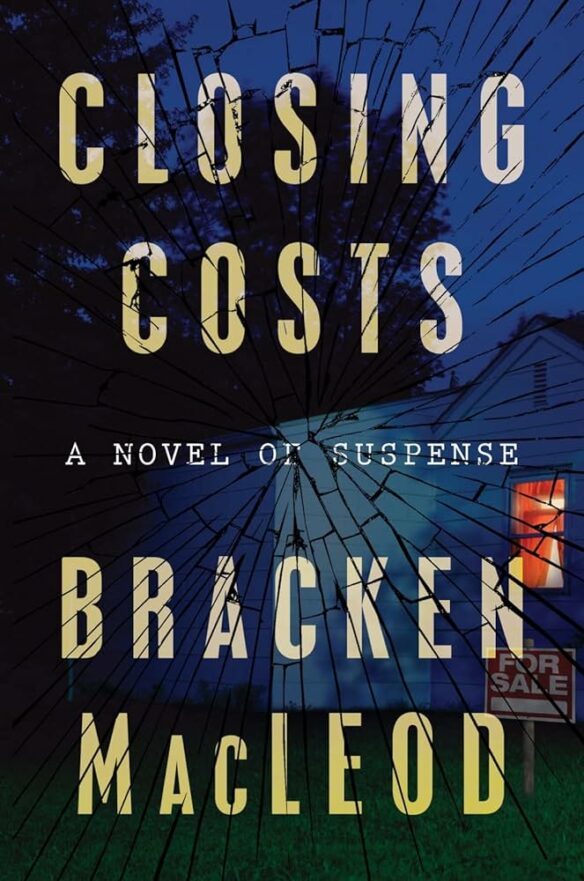
  • Chesley Bonestell
  • Frank R. Paul
  • Edmund “Emsh” Emshwiller
  • Frank Frazetta
  • Kelly Freas
  • Richard M. Powers
  • Alex Schomburg
  • Don Maitz
  • Hannes Bok
  • Rowena Morrill
  • Michael Whelan
  • Tom Kidd
  • Greg and Tim Hildebrandt
  • LeRoy Neiman
  • Charles Addams

Many more; but eventually I got tired of doing copy and paste.

The catalog cover is by Richard M. Powers. Here’s a link to the highlighted items.

(7) LEST DARKNESS FALL. “A digital dark age? The people rescuing forgotten knowledge trapped on old floppy disks”BBC tells how they’re doing it.

Some of the world’s most treasured documents can be found deep in the archives of Cambridge University Library. There are letters from Sir Isaac Newtonnotebooks belonging to Charles Darwin, rare Islamic texts and the Nash Papyrus – fragments of a sheet from 200BC containing the Ten Commandments written in Hebrew.

These rare, and often unique, manuscripts are safely stored in climate-controlled environments while staff tenderly care for them to prevent the delicate pages from crumbling and ink from flaking away.

But when the library received 113 boxes of papers and mementoes from the office of physicist Stephen Hawking, it found itself with an unusual challenge. Tucked alongside the letters, photographs and thousands of pages relating to Hawking’s work on theoretical physics, were items now not commonly seen in modern offices – floppy disks.

They were the result of Hawking’s early adoption of the personal computer, which he was able to use despite having a form of motor neurone disease known as amyotrophic lateral sclerosis, thanks to modifications and software. Locked inside these disks could be all kinds of forgotten information or previously unknown insights into the scientists’ life. The archivists’ minds boggled.

These disks are now part of a project at Cambridge University Library to rescue hidden knowledge trapped on floppy disks. The Future Nostalgia project reflects a larger trend in the information flooding into archives and libraries around the world….

… To address this challenge, the Future Nostalgia project is trying to piece together bits of ancient computer hardware to read rare and unusual floppy disks. Even when they have the hardware, the team must laboriously determine how disks were formatted so they can read them correctly. Talboom has also found herself delicately teasing mould off the flimsy surface of the magnetic disks to avoid scratching them.

“If people have kept them in garages or lofts, they can get mouldy,” she says….

(8) TRIVIAL TRIVIA. Here’s a bite of history.

(9) MEMORY LANE.

[Written by Paul Weimer.]
October 10, 1968 Barbarella

By Paul Weimer: Oh, Barbarella. 

I didn’t quite get why it was so controversial when I first saw it, it was a bowdlerized version of the already bowdlerized version Barbarella: Queen of the Galaxy. This was on a local channel in New York City in the 1980’s. I thought it was a funny but rather goofy looking SF movie, although of course Jane Fonda was something to look at.

(My father was upset at her being in the movie, something I did not understand for years until I understood her politics…and my own family’s politics, better)

I finally got to see the uncut and real version in the early 2000’s on DVD.  And then I could finally see what I was missing. Did it add a lot to the actual movie besides the visuals? No, but what visuals!  I slotted it in the same space as Woody Allen’s Sleeper, as a science fiction movie that talked about sex, and around sex, a lot. But going on the other visuals, the sets, costume design and props (including the infamous Excess Pleasure Machine) were just mind boggling in both of the versions I’ve seen.  

Too, the actual cinematography is mesmerizing, the camera knows where to linger, where to bring our attention in sometimes rather chaotic and baroque set pieces. I have not yet seen a 4k version of the film, but that is something I do very much need to see sometime, to see it at the maximum fidelity and clarity.  

Is it great cinema? No. But it is great art. 

(10) COMICS SECTION.

(11) NO, NEVER? The Verge hears Jim Lee declare “DC Comics won’t support generative AI: ‘not now, not ever’”.

DC Comics president and publisher Jim Lee said that the company “will not support AI-generated storytelling or artwork,” assuring fans that its future will remain rooted in human creativity. “Not now, not ever, as long as [SVP, general manager] Anne DePies and I are in charge,” Lee said during his panel at New York Comic Con on Wednesday, likening concerns around AI dominating future creative industries to the Millennium bug scare and NFT hype.

“People have an instinctive reaction to what feels authentic. We recoil from what feels fake. That’s why human creativity matters,” said Lee. “AI doesn’t dream. It doesn’t feel. It doesn’t make art. It aggregates it.”…

(12) THE NEAR TERM. [Item by Steven French.] A timely warning after a close shave (by a small space rock): “An asteroid recently flew closer to Earth than the ISS” reports Phys.org.

While these relatively small asteroids don’t pose any danger to the planet themselves, they do pose a threat to the increasing constellation of orbital infrastructure present, especially in low Earth orbit. An impact of one of these rocks, which likely occurs relatively frequently, could be the start of a chain reaction that leads to Kessler Syndrome or a similar dismal fate for our orbital infrastructure.


Unfortunately, we still don’t have the means to protect against these kinds of incursions into our planet’s personal space. To do so would require a massive effort with a combination of more ground-based telescopes linked up with space-based observatories specifically designed to track these small, dark, fast-moving objects. Given the current state of international cooperation and funding in space, that seems unlikely for now.

Until we get to that point, we just have to hope that, when we see a fireball in the sky, it’s not one of these asteroids taking out a piece of valuable orbital infrastructure. Or, if it is, then maybe that would provide enough impetus to the powers that be to do something about what could be an impending disaster that locks us on our world for decades.

(13) FUTURES PAST. Space.com remembers “How one scientist’s wide-eyed dream of giant space cities was crushed by reality”.

There once was a dream of cities in space — vast cylindrical habitats, self-sufficient and populated by millions who would look down on the Earth from their lofty perch.

Back in the 1970s, one serious scientist believed that by now this dream would have been a reality. That scientist was Princeton University professor of physics, Gerard K. O’Neill, and, for a few years, his dream of living in space made him a household name. He appeared on television, wrote a best-selling book and was invited to testify before the U.S. Congress about his vision for the future.

It’s all a far cry from the reality of 2025, where not many people get the chance to live in space, save for the 290 astronauts who have spent time on the International Space Station so far as well as the handful of astronauts stationed on various simple space stations such as the Russian Mir or China’s Tiangong.

O’Neill’s vision was best described in his book, “The High Frontier,” first published in 1976. In it, O’Neill explained how, as early as 1990 and as late as 2005, we would be able to build vast cities in space at the gravitationally stable L5 Lagrange point between Earth and the moon, each habitat home to several million people. The concept became so popular that a fan club even sprung up called the L5 Society, which declared as its motto: “L5 by ’95!”

One of the keys to the idea’s success was rotation to produce a centrifugal force mimicking gravity on the inside surface of a cylinder….

…So where did O’Neill’s plans all go wrong? After all, there’s nothing physically impossible about building such habitats. What made the concept so appealing to O’Neill is that it didn’t require any magic technology, just a lot of challenging engineering problems to be solved.

Nevertheless, a criticism that could be applied is O’Neill was too confident in the technology and engineering that would be required. The best that we’ve built in space so far has been the International Space Station. The kind of technologies required for something like Island Three, or even the smaller, simpler, spherical models of Island One and Island Two, are completely untested even now. With dedication and sufficient funding and resources, we could hone our skills, but it would take time. It wouldn’t be something we could rush.

A second problem was the failure of the space shuttle. When the space shuttle was first conceived, the plan was to have hundreds of launches per year, which would have created the capacity to build the infrastructure in space that would have allowed mining on the moon, or ferried millions of people into orbit. Instead, between the shuttle’s inaugural flight in 1981 and its final flight in 2011, the six shuttles managed only 135 space flights between them.

The cost of building a 20-mile-long (32-km-long) space habitat was also somewhat vague, with O’Neill estimating up to $200 billion in 1970s money, which, accounting for inflation, would be $1.1 trillion in 2025….

(14) ORPHAN OF THE SKY. The government shutdown doesn’t seem to have actually stopped this particular item of NASA’s work. “’It’s kind of surreal that it happened to us’: Rural West Texas woman witnesses NASA space junk as it lands in her neighbor’s yard” in Fortune.

When Ann Walter looked outside her rural West Texas home, she didn’t know what to make of the bulky object slowly drifting across the sky.

She was even more surprised to see what actually landed in her neighbor’s wheat field: a boxy piece of scientific equipment about the size of a sport-utility vehicle, attached to a massive parachute, adorned with NASA stickers. She called the local sheriff’s office and learned that NASA, indeed, was looking for a piece of equipment that had gone lost.

“It’s crazy, because when you’re standing on the ground and see something in the air, you don’t realize how big it is,” she said. “It was probably a 30-foot parachute. It was huge.”

Walter said she soon got a call from NASA’s Columbia Scientific Balloon Facility, which launches large unmanned, high altitude research balloons more than 20 miles into the atmosphere to conduct scientific experiments.

Officials at NASA, which is impacted by the ongoing government shutdown, did not return messages Thursday. A message left with the balloon facility also was not immediately returned.

launch schedule on the balloon facility’s website shows a series of launches from Fort Sumner, New Mexico, about 140 miles (225 kilometers) west of where the equipment landed.

Hale County Sheriff David Cochran confirmed that NASA officials called his office last week in search of the equipment.

Walter said she ultimately spoke with someone at the balloon facility who told her it had been launched a day earlier from Fort Sumner, and uses telescopes to gather information about stars, galaxies and black holes….

(15) PRODUCT LAUNCH. We didn’t get the memo about this special day! Fortunately, the rocket is something you can make anytime you want. Space.com invited readers to “Blast off with the ‘Space Gal’ Emily Calandrelli for World Space Week on Arm and Hammer’s Baking Soda Rocket Day”. (Here’s a link to the event’s dedicated website.)

…From aerospace engineer to television host to Blue Origin astronaut (and the 100th woman to reach space), Calandrelli has built her career around simplifying STEAM concepts through engaging, kid-friendly activities. The bottle rocket is one of her favorites.

“I think the fact that it is just so explosive and easy to make — those two in combination make for the perfect science experiment,” Calandrelli said….

…The hands-on experiment/rocket building activity mixes baking soda and vinegar — a classroom-classic acid-base reaction that releases carbon dioxide gas — to propel a two-liter bottle (outfitted with your design of nose cone and fins) high into the air.

[Thanks to Cat Eldridge, SF Concatenation’s Jonathan Cowie, Mark Roth-Whitworth, Steven French, Kathy Sullivan, Mike Kennedy, Andrew Porter, John King Tarpinian, and Chris Barkley for some of these stories. Title credit belongs to File 770 contributing editor of the day Andrew (not Werdna).]

Pixel Scroll 8/15/25 Bad Moon Rising, Pixels On The Prowl. Stay Inside

(1) NOT TO BE MISSED. Mark Loney photographed this Sistah Scifi Book Vending Machine in the Afrofuturism display at the Seattle Worldcon.

(2) YOU ARE THERE. Juan Sanmiguel is doing daily reports at the Rainbow War Blog: “Seattle Day 7, Seattle Worldcon 2025 Day 2”. Photos too!

…Nisi Shawl and K. Tempest Bradford had a interesting conversation about writing and the state of our culture. Despite the challenges we face there is always hope. Alexander James Adams gave a powerful concert and gave the audience behind the scenes info on the work….

(3) OCTOTHORPE. Episode 141 of the Octothorpe podcast, “A Whole Episode Without Business Meeting Content”, is hosted by John Coxon, Alison Scott, Liz Batty, and Pinocchio.

The title of this episode is a barefaced lie, as we read your letters and then dive into discussion of the Business Meeting. But fear not! We also do mention science fiction! Well, John does; Alison and Liz hadn’t read any this week.  

An uncorrected transcript is available here.

A photograph of a cocktail bar at Battersea Power Station. The words “Control Room B” are above the cocktail bar, and the words “Octothorpe 141” overlaid in similar style.

 (4) HALL OF FAME HARDWARE. Vincent Docherty, who was inducted into the First Fandom Hall of Fame during Seattle Worldcon 2025’s Opening Ceremonies, received his award plaque today and took a moment to pose for a photo.

Vincent Docherty shown with his award plaque, which arrived on August 15.

(5) STOKERCON GOHS. The Horror Writers Association’s StokerCon 2026 will be held at the Westin Pittsburgh from June 4 to June 7, 2026.

This will be StokerCon 10, a milestone for us to celebrate an occasion to look back on the history of the convention and how it has grown and flourished through the decade.  It is also a moment to think ahead and look to 2027 where we recognize 40 years of the HWA. So taking a page from our history and the years before StokerCon, we will be inviting you to join us in the same location for both 2026 and 2027 – a place that is dedicated to preserving the history of our organization and genre and welcome you back to Pittsburgh!

We are excited to embrace the theme of recognizing our history while also using the stability of one location and the planning process to explore ways to grow and change the best celebration of the genre we love.

Guests of Honor so far include:

Linda D. Addison
Ann VanderMeer
John Shirley
Billy Martin

The con will be back in Pittsburgh in 2027 at the same hotel.

(6) ASK SAPKOWSKI ANYTHING. Reddit’s r/Fantasy is collecting questions for an “Asynchronous AMA: Ask Andrzej Sapkowski Anything!” His answers will be posted September 30.

Andrzej Sapkowski is the author of the legendary Witcher book series, the worldwide sensation that inspired the hit video game and blockbuster Netflix series. For the first time ever, he’s taking questions from the fantasy readers of Reddit!

We (Andrzej’s US publisher, Orbit) will gather your questions and send them to Andrzej. Answers to select questions will be posted on September 30, the publication date for the brand-new Witcher novel Crossroads of Ravens.

Crossroads of Ravens is a new standalone novel following fantasy’s most beloved monster hunter, Geralt of Rivia, on his first steps towards becoming a legend. Before he was the White Wolf or the Butcher of Blaviken, Geralt of Rivia was simply a fresh graduate of Kaer Morhen, stepping into a world that neither understands nor welcomes his kind.

(7) SIMULTANEOUS TIMES. Space Cowboy Books of Joshua Tree, CA presents episode 90 of the Simultaneous Times podcast with Tara Campbell & Brandon Case.

Stories featured in this episode:

  • “Just Let Me Help” by Tara Campbell; with music by Phog Masheeen. Read by the Jenna Hanchey
  • “Jackpot God” by Brandon Case; with music by TSG; Read by Jean-Paul Garnier

Theme music by Dain Luscombe.

(8) CHATTACON’S DEMISE. Tennessee convention Chattacon is calling it quits after 2025: G “Goodbye. from Chattacon”.

After fifty incredible years of celebrating Science Fiction and the literary community of the Southeast in Chattanooga, it is with both deep gratitude and heavy hearts that we announce that Chattacon will not be continuing beyond 2025.

This decision was not made lightly. The board of Chattacon, together with Chattanooga Science Fiction Fans, Inc., (CSFF, Inc) has spent considerable time and reflection exploring every possible path forward. Unfortunately, the Doubletree Hotel that has served as our home for the past six years will be undergoing significant renovations and will not be available for our 2026 event.

Despite our best efforts to secure a new venue, we were unable to find an alternative location that met both our logistical and financial conditions. While we could have chosen a smaller venue, we did not want to present to you anything less than what you have come to expect from Chattacon.

We understand how much this convention has meant to our attendees, guests, volunteers, and staff—many of whom have been part of this event for literally decades. The energy, passion, and sense of belonging that all of you have brought to Chattacon are what made it truly special.

Together, we’ve created memories, built friendships, and fostered a love of speculative fiction that spans generations.

To those who have already purchased memberships for 2026 or purchased tables in the Dealer’s Room, we will be issuing full refunds over the course of the next month. We appreciate your patience as we complete this process.

In the spirit of our mission, CSFF, Inc. will be donating any remaining proceeds to charities in our community that continue to promote the joy of reading, writing, and discovery.

Although Chattacon is coming to a close, our journey together doesn’t end here. We look forward to crossing paths with many of you at other conventions and events.

Thank you for fifty extraordinary years!

(9) TODAY’S BIRTHDAY.

[Written by Lis Carey.]

August 15, 1933 Bĵo Trimble, 92.

Bĵo was born in Holdenville, Oklahoma, in 1933, discovered sf fandom in 1952. She was serving in the US Navy, at the Great Lakes Naval Station, and saw an announcement in Astounding Science Fiction about the science fiction convention that weekend in Chicago—the 10th Worldcon, the one we now call Chicon II, though at the time it had no official name. The largest Worldcon ever at the time, with 870 members, it was a great place for a smart and friendly young woman to meet people and make connections in fandom. Her new acquaintances included Robert Bloch, Willy Ley, August Derleth, and Harlan Ellison.

John and Bjo Trimble

When it was discovered that she was an artist and cartoonist, she was recruited to provide illustrations for fanzines, sealing her fate. She claims to have met her husband, John Griffin Trimble, under Forrest J Ackerman’s piano, during a particularly crowded party. He was serving in the US Air Force, and they traded Stupid Officer Stories.

But as we all know, this was mere prelude. Bĵo was active in LASFS (Los Angeles Science Fiction Society), and organized a fashion show for Solacon (the 16th Worldcon). In 1960, she started Project Art Show, which brought the first modern, organized art show at a science fiction convention to Pittcon, the 1960 Worldcon. Bĵo continued the project, bringing art shows to Worldcons and other conventions. By 1969, Project Art Show had become The International Science-Fantasy Art Exhibition (ISFAE), and she was judging and awarding prizes, as well as organizing the art shows.

But in 1968, Bĵo started turning her attention to a new fannish interest–Star Trek. Bĵo and John Trimble were active in the letter-writing campaign credited with getting the show a third season, after it was initially canceled after its second season. They also helped convince NASA to name the first of the Space Shuttles Enterprise, although that was a test vehicle never intended for space flight.

Bĵo was a major contributor to the Star Trek Concordance, containing cross-referenced details on every character, setting, event and device in every episode of the original Star Trek, and, in later editions of the book, its animated incarnation, and the Star Trek films. Originally self-published, it got a mass market publication by Ballantine Books in 1976, and an updated edition by Citadel Press in 1995. On the Good Ship Enterprise: My 15 Years with Star Trek, her memoir of her experiences in Star Trek fandom, was published in 1982.

Bĵo was a Guest of Honor at Dragon Con, which was also the 6th North American Science Fiction Convention, in 1995. Bĵo and John Trimble were Fan Guests of Honor at ConJosé, the 60th Worldcon. Bĵo, or Bĵo and John, were also honored at many Star Trek and other science fiction conventions.

 In addition, Bĵo and John Trimble were Baron and Baroness of the Society for Creative Anachronism’s Barony of the Angels, from September 2008 to January 2012. That’s at least fandom adjacent, right?

 Sadly, John died in April 2024, but Bĵo is still with us. Her contributions to fandom will remain.

NOTE: Bĵo’s daughter put out a call for birthday cards. Here’s the address:

Betty Trimble
Cal Vet Home West LA
RCFE, Room C318L, 11500 Nimitz Ave.
West Los Angeles, CA 90049 United States

(10) COMICS SECTION.

(11) HOLMES AND WATSON ON CBS. CrimeReads says “Elementary is a Masterclass in Sherlock Holmes Adaptation”.

…Much of the initial criticism leveled at Elementary centered on the accusation that the series was the United States’s cheap ploy to profit off of BBC Sherlock’s success. The latter series was rapidly gaining momentum among American audiences, but its gaps between seasons were long and unpredictable. When CBS was unable to obtain rights to the British series, Elementary was born. Sherlock fans were understandably wary, fueled by the BBC series’ creators who threatened to sue. When Lucy Liu was cast as Watson, backlash was heated and often tinged with misogyny and racism. Among some of Elementary’s critics, casting an Asian-American actress in the role of Watson was considered further evidence of the series’ attempt to proffer a superficial distinction from its British parallel. But those interpretations (many of which were lobbed before the first episode aired), turned out to be inconsistent with where the series went throughout its seven years….

… Over the course of the first season, a volatile Holmes attempts to reconstruct his life in the Big Apple. By his side is the steadfast Joan Watson. Elementary’s master stroke is its portrayal of this partnership and its striking development through the series. When we meet Watson, she’s almost as lost as Holmes: a surgeon-cum-sober companion, she doesn’t especially relish her career, but she’s committed to helping others. Although their fledgling relationship starts on rocky ground, it organically evolves into a beautifully devoted friendship. When Holmes offers Watson to train her as a detective, he proposes that she leave behind sober companionship for a partnership of equals.

Too often reduced to a gimmick, Elementary’s decision to cast a woman as Watson is instead an incisive excavation of Holmes’s canonical misogyny….

[Thanks to Mark Roth-Whitworth, Steven French, Kathy Sullivan, Lis Carey, Mark Loney, Jean-Paul Garnier, Rich Lynch, Teddy Harvia, Mike Kennedy, Andrew Porter, John King Tarpinian, Chris Barkley, Cat Eldridge, and SF Concatenation’s Jonathan Cowie for some of these stories. Title credit belongs to File 770 contributing editor of the day Cat Eldridge.]

Pixel Scroll 4/26/25 (Light) Years To You, Space Family Robinson, Earworms Love You More Than Etaoin Shrdlu

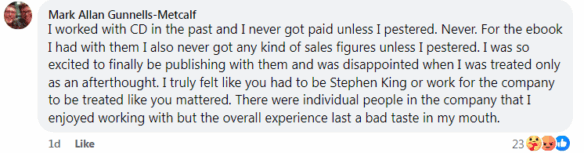
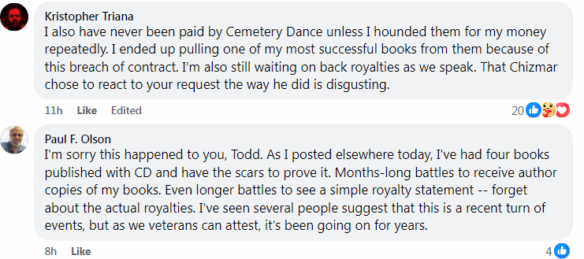
(1) CEMETERY DANCE KERFUFFLE HAS CONSEQUENCES. StokerCon today announced on Facebook a punitive action against small press Cemetery Dance in response to publisher Richard Chizmar’s exchange with an author who wrote to him seeking overdue royalties.

Due to recent information coming to light, Cemetery Dance will not be allowed to hear pitches during StokerCon. The Horror Writers Association stands up for the rights of its members, including the right to receive royalties as contracted, to have their works published as contracted, and to have its members treated with civility and respect. Cemetery Dance appears to be lacking in all of these areas.

Todd Keisling is the author whose experience at the hands of Cemetery Dance publisher Richard Chizmar led to HWA’s action. It seems he did finally get paid.

Screencaps of the exchanges were posted by Keisling in comments on Facebook after Chizmar doubled down on calling Todd a funny little man and then did a “dirty delete” of the comment.

Several authors have followed up with comments about having to dun Cemetery Dance for payment.

(2) MAURICE BROADDUS’ BOOKSHELF. Shelfies, edited by Lavie Tidhar and Jared Shurin, “Takes a unique peek each week into one of our contributors’ weird and wonderful bookshelves.” A recent entry was “Shelfies #33: Maurice Broaddus”. Photo at the link.

The why I do what I do shelf. This is the shelf of books that have inspired me or push me to do what I do. Futureland (Walter Mosley) was the first book that made me re-think my writing trajectory. When I read it, I thought to myself “we can do that?” It was the first sf book I read that had characters who looked like me, that had worldbuilding done through a different cultural lens….

(3) TOO GOOD TO BE TRUE, CHAPTER 37. Victoria Strauss introduces Denise Beck-Clark’s writeup before turning over the microphone in “Guest Post: My Twenty-Four Hour Dream” at Writer Beware.

I’ve written many scam case studies and investigations on this blog, all of which reference and/or describe writers’ direct experiences (while protecting their identities, as Writer Beware always promises to do). But when the essay below landed in my inbox this week, it presented the perfect opportunity to offer a different perspective: a writer’s own first-person description of her encounter with a scammer.

The scam in question is an extremely common one: out-of-the-blue contact from someone claiming to be a well-known film producer/famous movie director/executive with a major production company supposedly eager to turn the writer’s book into a movie. The essay details all the typical elements of this often-elaborate fraud: praise and promises carefully calibrated to manipulate the writer’s hopes and dreams (and ego), contracts and other items that lend a veneer of authenticity, even a phone call from the famous director attached to the project! But also warning signs, which this writer didn’t ignore but too many writers do–such as American movie people speaking with strong foreign accents.

Denise Beck-Clark has kindly given me permission to use her name and bio (at the bottom of the post). Hopefully her experience will help other writers recognize and avoid this type of scam. (My favorite part of the story: when the scammer recommends using Writer Beware.)…

(4) JOSH ROUNTREE Q&A. “Nuts & Bolts: Author Josh Rountree on Transitioning From Short Stories to Novels” on the Horror Writers Association blog.

Q: How is writing a novel different from writing short fiction?

A: I don’t think there’s one perfect answer for this, but in general I think short stories and novels require us to access different parts of our writer brains.

Being a short story writer, my brain is always telling me to tighten, tighten, tighten. Leave nothing in the story that’s not important to character, advancing plot, etc. You try to make every sentence you write do double duty.

When I transitioned to working on a novel, I felt that same instinct, and I had to remind myself that it’s okay to let things breath.  I can go deeper into the characters, their personal stories, and figure out who these people are on a deeper level. I still want every sentence to work hard, advancing the story and building the character, but I can be a bit more leisurely about it.

Some people are skilled at one form and not the other. I think I’m one of them. Short stories come easily to me, but novels are much more challenging.  I wrote a half dozen novels that will never see the light of day, for good reason. Books that I thought were wonderful at the time, but with hindsight I can see they’re a mess. As much as I love short story writing, I did want to prove to myself I could write a novel, but the process became discouraging with each new failure.

Finally, I decided to split the difference and see if I could write a novella.  I told myself it was really nothing more than a longer short story. I was consciously trying to trick myself, and ultimately it worked.

(5) ALEXANDER SKARSGÅRD Q&A. There are four Murderbot questions near the end: “Alexander Skarsgård: The Empire Interview” at Empire Online.

How did you approach that evolution, of portraying a machine that is becoming a bit more human?

Ironically, I found Murderbot more relatable than most characters I’ve ever played.

(6) NEW AI COPYRIGHT SUIT. “Publisher of PCMag and Mashable Sues OpenAI” reports the New York Times. (Behind a paywall.) “Ziff Davis, which owns more than 45 media properties, is accusing the tech company of infringing on the publisher’s copyrights and diluting its trademarks.”

… In a 62-page complaint filed in federal court in Delaware, where OpenAI is incorporated, Ziff Davis says the tech company has “intentionally and relentlessly reproduced exact copies and created derivatives of Ziff Davis works,” infringing on the publisher’s copyrights and diluting its trademarks. It claims that OpenAI used Ziff Davis content to train its artificial intelligence models and generate responses through its popular ChatGPT chatbot.

“OpenAI has taken each of these steps knowing that they violate Ziff Davis’s intellectual property rights and the law,” the complaint says.

The company is seeking at least hundreds of millions of dollars in its lawsuit, according to two people familiar with the matter.

A spokesman for OpenAI said in a statement that its models were “grounded in fair use,” referring to the legal standard for use of copyrighted material….

(7) COLONEL MUSTARD IN THE MOVIE THEATER WITH THE CASH REGISTER. CrimeReads says it’s time to praise this 1985 movie: “The Clues, the Clueless, and the Critics: Appreciating Clue at CrimeReads.

…[It] is this latter element of the film (the board game come to life) that all its contemporary critics found both equally vexing and ingenious. The film, written and directed by Johnathan Lynn, features three different endings. Three different outcomes to the mystery, just as is possible in the board game. There is no motive in the board game, so one must be supplied for the film to have any meaning. That is, if it strives for meaning. It doesn’t. Instead, it embraces the randomness of a shuffled card deck, offering three random endings that might satisfy the clues in the story as well as the next.

This is what Ebert in referencing in the aforementioned quote, the start of his review of the film—an element that, on its own, he found brilliant. “The way Paramount is handling its multiple endings,” he wrote, “is ingenious. They’re playing each of the endings in a third of the theaters where the movie is booked. If this were a better movie, that might mean you’d have to drive all over town and buy three tickets to see all the endings.” He concludes, though, “[w]ith ‘Clue,’ though, one ending is more than enough.”

But he was correct in finding creative merit in this aspect of Clue. Writing in 2021, the scholar Milan Terlunen noted that “Clue lays bare the inner workings of all detective stories. Clue‘s multiple endings aren’t just a clever cinematic translation of the board game’s structure — they reveal something crucial about the nature of clues in general.” He goes on to explain that the very point of “solving” a mystery is “the process of distinguishing clues from red herrings… [t]here’s always too much evidence in a detective story, which fits beautifully with the general too-muchness of Clue.”…

(8) MEMORY LANE.

[Written by Cat Eldridge.]

April 26, 2010Iron Man II

Fifteen years ago the sequel to the highly successful and quite popular Iron Man se premiered in select markets before opening nationwide on May 7. 

Titled just Iron Man 2, it was directed by Jon Favreau who had done the first film, and written by Justin Theroux, who had not done the first film (which had been written by a committee of Mark Fergus, Hawk Ostby, Art Marcum and Matt Holloway. Hey it worked, didn’t it?) The first film got nominated for a Hugo at Anticipation. 

Iron Man 2 premiered at the El Capitan Theatre, a fully restored movie palace in Hollywood. This theater and the adjacent Hollywood Masonic Temple (which are now known as the El Capitan Entertainment Centre) are owned by the Disney Company and serve as the venue for a majority of the Disney film premieres.

Although fandom is very fond of saying it did substantially worse than the first film at the box office that’s a lie as it actually did better. Iron Man did five hundred and eighty million against one hundred and forty million in costs, whereas this film took in six hundred and thirty million against the same production costs. 

So how was it received by critics at the time? Anthony Lane at the New Yorker liked it better than its competitors Spider-Man and Superman: “To find a comic-book hero who doesn’t agonize over his supergifts, and would defend his constitutional right to get a kick out of them, is frankly a relief.” 

Roger Ebert writing for the Chicago Sun-Tribune was impressed: “Iron Man 2 is a polished, high-octane sequel, not as good as the original but building once again on a quirky performance by Robert Downey Jr.”

Audience reviewers at Rotten Tomatoes currently give it a rather good seventy-two percent rating. 

It is of course streaming where all things Marvel are which is Disney+. I am going to have to subscribe, aren’t I?

(9) COMICS SECTION.

(10) ANTI-RULES. Karl K. Gallagher has done an interesting thought experiment on X:

(11) BATTLING THE BLAHS. [Item by Steven French.] The Guardian’s Luke Holland considers the declining fortunes of assorted TV ‘super-franchises’ and comes up with some radical suggestions for reviving their fortunes: “May the force be with you! How to save every tired TV superfranchise, from Star Wars to Game of Thrones”.

It’s amazing to think that, not so very long ago, people were actually excited at the prospect of a new Star Wars show. Or when it emerged that a fresh Lord of the Rings saga was, through some kind of Gandalfian wizardry, being squeezed on to the small screen, the reaction was one of giddy awe. Even the faintest whisper of another trip to Hogwarts would have set the whole internet ablaze. And now? Well, here’s a test: there’s a new Harry Potter series coming out soon. How does that make you feel? Exactly.

There’s no doubt about it – a worrying number of what used to be the world’s most untouchable franchises are in trouble. But how did they arrive at this point of terminal audience ennui? And is there any route for them back into our hearts?

(12) TATOOINE-ALIKE. “Rare exoplanet orbits twin stars in ‘Star Wars’-like twist” reports Phys.org.

Astronomers have discovered a planet that orbits at a 90-degree angle around a rare pair of strange stars—a real-life ‘twist’ on the fictional twin suns of Star Wars hero Luke Skywalker’s home planet of Tatooine.

The exoplanet, named 2M1510 (AB) b, orbits a pair of young brown dwarfs—objects bigger than gas-giant planets but too small to be proper stars. Only the second pair of eclipsing brown dwarfs known—this is the first exoplanet found on a right-angled path to the orbit of its two host stars.

An international team of researchers led by the University of Birmingham made the surprise discovery using the European Southern Observatory’s Very Large Telescope (VLT). The brown dwarfs produce eclipses of one another, as seen from Earth, making them part of an “eclipsing binary.”

Publishing their discovery in Science Advances, the researchers note that this is the first time such strong evidence for a “polar planet” orbiting a stellar pair has been collected.

Thomas Baycroft, a Ph.D. student at the University of Birmingham who led the study commented, “I’m particularly excited to be involved in detecting credible evidence that this configuration exists.’…

(13) TRAILER PARK. “Love Death + Robots Volume 4”. Extreming May 15 on Netflix.

The Emmy-winning anthology of twisted tales from strange worlds returns, with stories featuring MrBeast and the Red Hot Chili Peppers

[Thanks to SF Concatenation’s Jonathan Cowie, Mark Roth-Whitworth, Steven French, Kathy Sullivan, Teddy Harvia, Mike Kennedy, Andrew Porter, John King Tarpinian, Chris Barkley, and Cat Eldridge for some of these stories. Title credit belongs to File 770 contributing editor of the day Daniel Dern.]

Pixel Scroll 10/5/24 O Quam Tu Pixel Es

(1) GERMAN TOLKIEN SOCIETY EVENT. The twentieth seminar of the German Tolkien Society (Deutsche Tolkien Gesellschaft e.V.) will be a hybrid event. Full details at the link. “Tolkien and His Editors – Tolkien Seminar 2024”

It is not only in Aachen that the 20th Seminar of the Deutsche Tolkien Gesellschaft e.V. will take place from 11 to 13 October. You can also follow the conference worldwide via the internet from Friday at 2pm. Listeners and participants can look forward to numerous exciting lectures on this year’s theme “Tolkien and His Editors” by speakers from all over the world….

(2) THE RICHES OF HORROR WRITING? [Item by Michael J. Walsh.] Out of curiosity I looked at the Stokercon2025 hotel rates.  Oh my. $474 a night! (Or more.)

(3) RED DWARF TRIVIA. “Roll up, smegheads! It’s the ultimate Red Dwarf quiz”. The Guardian challenges the show’s fans: “From hologram destruction techniques to the very point of existence itself: how good is your knowledge of the sci-fi comedy classic?”

(4) ANSIBLE EDITIONS. [Item by David Langford.] The Frank Arnold Papers (edited by Rob Hansen), collecting the mostly unpublished essays and reviews of that old-time UK fan, came out as a TAFF ebook in 2017 with a brief introduction by Michael Moorcock. We’ve since unearthed more material, both published and unpublished, that expands the ebook by about a third to 58,000 words. That seemed to be the cue for a first ever paperback edition, which like the revised ebook was officially released October 1.

Frank Arnold was a long-time regular of the London First Thursday science-fiction pub meetings from their beginning in the 1940s until his death in 1987, and kept the famous Visitors’ Book. He had been active in British SF fandom since the very early days of the 1930s. Although he published one SF collection, a handful of articles and several book reviews, most of his nonfiction never appeared in print.

Cover photo, left to right: Ted Carnell, Ted Tubb, and Frank Arnold at the 1952 London convention. Photo from the Vince Clarke collection.

(5) CLI-FI COLLECTION. Grist’s second anthology of climate fiction short stories is being published soon. Metamorphosis: Climate Fiction for a Better Future includes 12 stories from Grist’s recent Imagine 2200: Climate Fiction for Future Ancestors short story contests. For the first time in book form, you can read these narratives of hope, abundance, solutions, and community resilience for a better future. 

Metamorphosis is available for pre-order right now at the link. It arrives in bookstores October 22.

(6) THE QUALITY OF DISTORTION IS NOT STRAINED. [Item by Steven French.] In this physics-based critique of Constellation and Dark Matter, Robert P Crease and Jennifer Carter pose a crucial question. Constellation and Dark Matter: the TV series that could change your view of quantum mechanics” at Physics World.

…So are fictional works based on quantum-travel-between-worlds just examples of “harmlessly enabling distortion” (HED, done for a good purpose)? Or should we think of them as examples of “fake artistic distortion” (FAD, done for special effects without caring how science works)? It’s an interesting question especially for philosophers, who have long worried about art having to appeal to its audience’s “sense” of reality, and its tendency to reinforce that sense despite its distortions.

In a similar way, the appeal of TV series based on many-worlds interpretations depends on how agreeably and acceptably they manipulate popular preconceptions about quantum mechanics, such as about time travel, alternate worlds, the reality of superposition, and – most of all – the illusion that the fundamental structure of the world is up to us.

But wouldn’t it be more artistic to portray a universe where quantum systems are what they are – in some cases coherent systems that can decohere, but not via thought control (as in Dark Matter)? If we did that, then artists could speculate about what it’d be like to meet and even trade places with other selves without introducing fake scientific justifications. We could then try to understand if and why we would want or benefit from such identity-swapping, on both a physical and emotional level.

That might really shatter and reconfigure what it means to be human…

(7) YOU’VE SEEN IT. Most likely. “A 400-Acre Movie Ranch Outside Los Angeles Is Listed for $35 Million” – in the New York Times (behind a paywall.)  “Sable Ranch, about 30 miles north of Hollywood, includes an Old West movie set. It has been used for productions like ‘American Horror Story’ and ‘Oppenheimer’.”

When Frank Vacek arrived at Sable Ranch in the 1970s, with its chaparral-covered hills bounded by the mountains of the Angeles National Forest, he instantly saw a California dream.

Mr. Vacek, who with his wife had fled the Nazis in Czechoslovakia three decades earlier, rewrote his fortunes by opening a successful camera shop in downtown Los Angeles in the 1950s. But 30 miles north at Sable Ranch, where cattle grazed amid oak trees, he pictured an even grander second act for his life. He bought the ranch and the property next to it and built an Old West movie set on its land, bringing Hollywood — with its gun shows, cowboys and insatiable appetite for entertainment — to his doorstep.

… In recent years, the ranch has hosted “Curb Your Enthusiasm,” “Criminal Minds” and “24.” After crews from “Fear Factor” used the ranch in 2001, they returned in 2007 to make another game show, “Wipeout,” where contestants compete in an obstacle course with large pools. So Mr. Hunt built water tanks that could each hold millions of gallons of water — an amenity that attracted Billie Eilish to the ranch in 2021, when she was scouting locations for her underwater music video for “Happier Than Ever.”

“You feel the Hollywood legacy when you’re on the property,” said Aaron Kirman of Christie’s International Real Estate Southern California, who alongside Sam Glendon of CBRE is representing Mr. Hunt in the sale…

(8) TODAY’S BIRTHDAY.

[Written by Paul Weimer.]

Born October 5, 1971 Paul Weimer, 53. Although he has a few short stories to his credit, Paul Weimer is far better known in science fiction reviewing and criticism circles. Having gotten his real start at places like The Functional Nerds and SF Signal, Paul has, and continues to write, for a number of venues and publications across the internet, from traditional fanzines to guest posts on blogs, and always, always telling people that pre-orders are love. 

Paul had a minor but notable role in the Sad and Rabid Puppies Debarkle (h/t Camestros Felapton), showing up on podcasts and blogs, trying in vain to bridge divides and see multiple viewpoints. 

In addition to writing, Paul is a member of the Hugo finalist Skiffy and Fanty podcast, and has shown up on a wide range of other SFF podcasts as a guest. He also has been playing and running TTRPGs, including Play by Email ones, for decades. 

Paul is known in SFF circles, too, as an enthusiastic amateur photographer who is likely to show up at your con with his camera in tow. At the 2024 Glasgow Worldcon, he was a member of the convention’s official Photography Team. As a DUFF Delegate in 2017, he traveled to the Australian and New Zealand Natcons in 2017, and his trip report “What I did on my Summer Vacation” holds the record for most photos in a published Fan Fund report.

After the unpleasantness of being one of the Chengdu Worldcon Ineligibles, Paul won two Hugos at the 2024 Glasgow Worldcon, for Best Fan Writer, and as part of the team of the Best Fanzine Winner, Nerds of a Feather. He also won an Ignyte award for Best Critics as part of the Nerds of a Feather team.

But he’s really just this guy, you know?

(9) COMICS SECTION.

(10) DEBATE OVERFLOW. Most of you will get it.

(11) TODAY’S THING TO STOP WORRYING ABOUT. Deadline reports “Jim Henson Company Lot On La Brea Not Being Sold To Scientology, Owners Say; “Not In Any Business Dealings With The Church,” Family Declares”.

… Despite reports in the Rupert Murdoch-owned New York Post and other outlets that the Henson family was unloading the 1917 lot originally known as the Charlie Chaplin Studios, the estate was very specific today that the lot would not be joining Scientology‘s extensive real estate portfolio any time soon

A spokesperson for the Jim Henson family said: “In regards to recent rumors about the sale of the La Brea studio lot, the Henson family is not in any business dealings with the Church of Scientology, and that organization is not in consideration as a potential buyer of the property. It is still the family’s intention to move The Jim Henson Company to a new location it can share with Jim Henson’s Creature Shop, but at this time the family is not in escrow with any buyer.”…

(12) PRACTICALLY NEIGHBORS. “Scientists find astonishing planet near to Earth” reports The Independent.

A planet has been found around the closest single star to us.

The planet orbits around Barnard’s star and has been given the name Barnard b. It could be one of a number of planets waiting to be found around that nearby sun.

It was spotted using the the European Southern Observatory’s Very Large Telescope (ESO’s VLT).

The newly-discovered planet – called Barnard b – has at least half the mass of Venus and on it a year lasts slightly more than three Earth days.

The findings also suggest there may be three more exoplanet candidates, in various orbits around the star.

(13) WALKING BACK NEGATIVE TIME. Sabine Hassenfelder demurs from what the clickbait press is saying in “Negative Time is Real, Physicists Confirm. Kind Of.” “Well first of all, this negative time has nothing to do with passage of time. It’s just a way to speak about how a bunch of photons travel through a medium and how their phases shift.”

In a new paper, a group of physicists claims to have confirmed the existence of “negative time.” I had never heard of this, but I had a look at the paper. And I think I have figured it out.

[Thanks to Teddy Harvia, Mike Kennedy, Andrew Porter, Patrick McGuire, Michael J. Walsh, Mark Roth-Whitworth, Robin Anne Reid, Dann, John King Tarpinian, Chris Barkley, Cat Eldridge, SF Concatenation’s Jonathan Cowie, Steven French, and Kathy Sullivan for some of these stories. Title credit belongs to File 770 contributing editor of the day Jim Janney.]

Joyce Carol Oates Added as StokerCon 2025 GoH

The Horror Writers Association today welcomed Joyce Carol Oates as a Guest of Honor at StokerCon 2025 in addition to Paula Guran, Tim Waggoner, Gaby Triana, Scott Edelman, and Adam Nevill.

Joyce Carol Oates

Joyce Carol Oates is the author of numerous novels and novellas, plays, short stories, essays and poetry.   She is a recipient of the National Book Award, two O. Henry Awards, the National Humanities Medal, the Jerusalem Prize, the prix Fitzgerald and the Cino Del Duca World Prize, as well as several Stoker awards, a World Fantasy Award, and the Lifetime Award of the Bilbao International Festival of Literature and Art with Humor. Among Oates’ most notable works of horror are The Corn MaidenDis Mem BerThe Doll MasterHauntedNight GauntsBlack Water, Zombie, and Butcher. Her most recent collection of mystery and suspense fiction is Flint Kill Creek (Mysterious Press).

StokerCon 2025 will be held in Stamford, CT from June 12-15, 2025.

StokerCon 2025 Adds GoHs Adam Nevill, Scott Edelman

The Horror Writers Association today announced Adam Nevill and Scott Edelman as Guests of Honor at StokerCon 2025 in addition to Paula Guran, Tim Waggoner, and Gaby Triana.

A sixth and final Guest of Honor will be announced Friday September 27.

StokerCon will be held in Stamford, CT from June 12-15, 2025.

Adam L. G. Nevill

Adam L. G. Nevill was born in Birmingham, England, in 1969 and grew up in England and New Zealand. He is an author of horror fiction. Of his novels, The Ritual, Last Days, No One Gets Out Alive and The Reddening were all winners of The August Derleth Award for Best Horror Novel. He has also published three collections of short stories, with Some Will Not Sleep winning the British Fantasy Award for Best Collection, 2017.

Imaginarium adapted The Ritual and No One Gets Out Alive into feature films and more of his work is currently in development for the screen.

 The author lives in Devon, England. More information about the author and his books is available at: www.adamlgnevill.com

Scott Edelman

Scott Edelman has published 125+ short stories in magazines such as Lightspeed, Analog, Apex, and The Twilight Zone, and in anthologies such as Why New Yorkers Smoke, Crossroads: Southern Tales of the Fantastic, and MetaHorror.

His collection of zombie fiction, What Will Come After was a finalist for the Shirley Jackson Memorial Award. His most recent collections include Tell Me Like You Done Before: and Other Stories Written on the Shoulders of Giants and Things That Never Happened, the latter of which caused Publishers Weekly to write, “his talent is undeniable.” He has been a Bram Stoker Award finalist eight times, both in the category of Short Story and Long Fiction.

He’s also the host of the Eating the Fantastic podcast, which since February 2016 has allowed listeners to eavesdrop on his meals with creators of science fiction, fantasy, horror, comics, and more.

Pixel Scroll 7/9/24 We Also Walk Cats (But Not Through Walls)

(1) FIRST LAWS OF ROBOTICS. South China Morning Post has a few details —  “China’s Laws of Robotics: Shanghai publishes first humanoid robot guidelines”.

Shanghai has published China’s first governance guidelines for humanoid robots, calling for risk controls and international collaboration, as tech giants like Tesla showed off their own automatons at the country’s largest artificial intelligence (AI) conference.

Makers of humanoid robots should guarantee that their products “do not threaten human security” and “effectively safeguard human dignity”, according to a new set of guidelines published in Shanghai during the World Artificial Intelligence Conference (WAIC) on Saturday.

They should also take measures that include setting up risk warning procedures and emergency response systems, as well as give users training on the ethical and lawful use of these machines, according to the guidelines.

The document was penned by five Shanghai-based industry organisations including the Shanghai Law Society, Shanghai Artificial Intelligence Industry Association and the National and Local Humanoid Robot Innovation Centre.

…China has made it a goal to have mass production of humanoid robots by 2025 and wants global leadership in the sector by 2027, according to a plan published by the Ministry of Industry and Information Technology (MIIT) in November last year.

By 2027, humanoid robots should become “an important new engine of economic growth” in China, the MIIT urged. Robots are expected to be popularised in industries including healthcare, home services, agriculture and logistics, according to the document….

(2) 3RD ANNUAL STURGEON SYMPOSIUM REGISTRATION. Registration is now open for the 3rd Annual Sturgeon Symposium, Oct 24-25, celebrating the groundbreaking work of author and critic Samuel R. Delany. The symposium will include a reading by the winner of the Sturgeon Award for best speculative fiction story published in 2023, scholarly panels, and appearances by Delany himself. Fee waiver available for students and others with financial need. Join us!

Register here: Sturgeon Symposium | Stars in Our Pockets: Celebrating Samuel R. Delany Tickets, Thu, Oct 24, 2024 at 9:00 AM | Eventbrite T-shirt, lunch, and Thursday reception are included with registration.

More information here, including updates to schedule: 

(3) VIRTUAL STOKERCON PANEL REPORTS. Lee Murray has put together highly informative summaries of two panels convened during the Horror Writers Association’s 2024 Virtual StokerCon event.

Trigger Warning: This article addresses issues of grief, loss, and mental health.

Moderated with compassion by Mo Moshaty, an author-producer with experience working closely with death doulas, the panel commenced with a round-robin of introductions, including the panellists’ relevant work, and also their particular interest in the topic of grief horror. 

Panelists included Mark Mathews, Clay McLeod Chapman, Nat Cassidy, Katherine (Kat) Silva, Ally Malinenko, and Laura Keating.

From the opening comments, it was clear that this was going to be a confronting and also humbling session, with panelists sharing their own experiences of trauma and grief, with their specific experiences discussed in more detail over the course of the panel. 

Moshaty kicked off the discussion by stating that grief, as a universal emotion, touches everyone in society, so it follows that we would want to represent grief in our horror literature. Mark Matthews and Nat Cassidy agreed that horror is a genre that is grounded in grief. Clay McLeod Chapman admitted to feeling inspired and intimidated to talk frankly about the topic, but also that he expected the discussion to be eye-opening and cathartic. He was especially interested in how we move through grief while also tackling it in our work….

Striking a sustainable work-life balance for the long-game in horror takes time and experience. Eric LaRocca, Christa Carmen, Ace Antonio-Hall (Nzondi), Pamela Jeffs, and EV Knight offer their insights in a panel moderated by L. E. Daniels on how to protect our bodies and minds as we navigate dark fiction.

Recently, I had the pleasure to attend the Self-Care for Horror Writers panel offered in the virtual space at StokerCon 2024. Given the close alignment of the topic to the work of the HWA Wellness Committee and our Mental Health Initiative, this panel was a must-view for me, and I wasn’t disappointed. Expertly moderated by Bram Stoker-nominee and Wellness Committee member L. E. Daniels, the discussion was wide-ranging and engaging, with speakers offering insightful gems and tried-and-true strategies for maintaining well-being. Key points are summarised in this report.   

Daniels began by asking her panelists how they have developed a sustainable work-life balance for the long game that is writing, publishing, and writers’ events….

(4) SCOTS GOTHS. [Item by Steven French.] For those who might be in the Edinburgh area in September, here’s an interesting event at the National Library of Scotland – and it’s free! “Treasures: Mary Shelley, Frankenstein, and the Scottish Gothic Tradition”, Thursday, September 5 at 17:30 at the National Library of Scotland in Edinburgh.

Hear from Dr. Emily Alder and Professor Daniel Cook, both leading experts in the field of Gothic literature, as they consider the ways in which Frankenstein and the Gothic permeate Scottish fiction to this day. Chaired by one of our foremost cultural commentators and interviewers, Dr. Alistair Braidwood.

With the recent success of the film adaptation of Alasdair Gray’s ‘Poor Things’, and the debt Gray’s novel owes to ‘Frankenstein’ and Gothic fiction, how might we consider the influence of Mary Shelley’s masterpiece on subsequent writers and their work? Where does James Hogg’s ‘Justified Sinner’, Robert Louis Stevenson’s ‘Jekyll and Hyde’, or more recent works by Muriel Spark, James Robertson, Alice Thompson, A. L. Kennedy, and Alasdair Gray fit into a Scottish Gothic tradition?

This event celebrates our new Treasures display, featuring items relating to Byron and Mary Shelley.

(5) RETRO PIXEL. [Item by SF Concatenation’s Jonathan Cowie.] Regarding the July 5 Pixel Scroll’s “(9) SCIENCE EXHIBITION IN LONDON” by Steven French, who wrote, “If anyone happens to be in London over the weekend, there’s some neat stuff going on at the Royal Society…”

Actually, it lasted the previous four weekdays too. I usually go and was, indeed, there this year wearing my climate science hat.

Jonathan Cowie at the Royal Society exhibition

At the exhibition, I am pointing to a graph of past temperatures as revealed by a 900,000 year Antarctic ice core at a particular point called the Mid-Brunhes Event before which glacials were less cold with interglacials being more cold, and after this point where – like today – glacials are colder and interglacials warmer. ‘Why is this so?’ you may well ask. Alas, we don’t know, though theories abound.

Antarctic ice core drilling continues. We are currently looking at another location where the ice hopefully has a record going back over a million years: ideally to 1.5 million years so as to cover the Mid-Pleistocene Transition which saw a major change to glacial-interglacial cycles that was possibly due to the arrival of large, long-term ice over Antarctica and substantive northern hemisphere glacial ice sheets. (At least, that’s the working hypothesis I go with.)

This year, six of us went to the Royal Society’s Summer Exhibition, including another member of the SF² Concatenation team.

If you like science – and many science fiction fans do – then this annual event is worth checking out.

If you need post-exhibition sustenance, the near-by Golden Lion pub is sufficiently off the tourist track that while it is usually busy Mondays to Fridays up until 7.45 it then quietens down. It has hand-pump beers and reasonable hot pub food but note it closes early Mon-Thurs at 10pm. On the way there, you can see typical 19th century West-End London architecture.  Some old buildings have been demolished, but the past decade or so has seen developers knock down buildings but keep the frontage walls: so the building looks the same from the outside but is completely modern inside.

The Royal Society (Britain’s Science Academy) is housed in Germany’s former London embassy up to World War II.  Its (the Society’s) President’s office today has a marble swastika in the floor (under a carpet but conserved as the swastika apparently has a heritage preservation order on it).

Keep an eye out next year in early July for another Royal Society summer exhibition. Avoid the weekend day as that is very crowded (Dublin Worldcon levels of crowding) with parents bringing children.

(6) THE INSTALLMENT PLAN. Eugen Bacon offers an intriguing alternative at Reach Your Apex: “What if you wrote your novel story-by-story, using your strength as an author of short stories?” — “For Writers: Writing the Novel – For Short Story Authors”.

…Maybe you’ve even won or been a finalist in awards with your short story, you’ve been killing it in anthologies—as in editors have you on speed dial, critics raving about your short story (you kinda hog the lot, you’re getting a bit self-conscious about it—maybe not, it’s fucking awesome). And you have a short story collection or three… But your mate, your family, maybe a literary agent… has been on your case, as in: “So where’s that novel?”

And imposter syndrome is creeping in, and you feel you gotta write that effin novel.

Or maybe you’ve written a short story you like so much, you want it as a starting point for a novel. Perhaps more characters are popping up, too many to contain in a short story. Or maybe you want to stretch the story—by timeline or theme or view point. The start is the same, the closing is the same, but the inside of the story is becoming longer. It demands more history, more world-building, a deeper look. Now you really need that novel.

But short stories are your strength. You don’t want to get entangled in a tortured story or a runaway plot. What if the short story is just what it is—the point of it could be lost in expanding it. Who wants a bloody novel? You do. What if the short story has told itself out: do you really need that novel? Yes, bloody yes, every inch of you shouts.

But you do love the energy in a short story—yes, Carver: Get in, get out. Don’t linger.   

So what if you could retain all that you love about the short story, and still write that novel? What if you could write about a moment in time, something experimental and decentralized, something flexible, economic, dynamic, mimetic, metaphoric, immediate, intense—and it’s still a novel?

This is how it happens: What if you wrote your novel story-by-story, using your strength as an author of short stories?…

(7) PIDGIN DROPPINGS.  “Preliminary Notes on the Delvish Dialect” by Bruce Sterling at Medium.

…Also, the human owners/managers of Large Language Models have extensively toned-up and tuned-down these neural network/deep learners/foundation-platforms, so that these “writers” won’t stochastically-parrot the far-too-human, offensive, belligerent, and litigous material that abounds in their Common-Crawl databases.

The upshot of this effort is a new dialect. It’s a distinct subcultural jargon or cant, the world’s first patois of nonhuman origin. This distinctive human-LLM pidgin is a high-tech, high-volume, extensively distributed, conversational, widely spoken-and-read textual output that closely resembles natural human language. Although it appears as words, it never arises from “words” — instead, it arises from the statistical relationships between “tokens” as processed by pre-trained transformers employing a neural probabilistic language model.

And we’ll be reading a whole lot of it. The effort to spread this new, nonhuman dialect is a colossal technical endeavor that ranks with the likes of nuclear power and genetically modified food. So it’s not a matter of your individual choice, that you might choose to read it or not to read it; instead, much like background radioactivity and processed flour from GMO maize, it’s already everywhere.

Technically, this brave-new-world dialect is actually a wide number of different Language-Model idiolects, which arise from different databases and different LLM training methods. Machine-translation AIs speak a thousand human languages at once. Consumer-facing chatbots speak with courtly circumlocutions. LLMs exist that are specially trained for marketing, warfare, cooking, legal boilerplate, code generation, website design. And so on….

(8) HALF PAST HUMAN… [Item by SF Concatenation’s Jonathan Cowie.] In recent years I have moved more from the current climate change issue into looking at the deep time evolution of the Earth system as well as that of life. (This is the ‘co-evolution of life and planet’ narrative in case any of you were wondering.) It is a big topic, but one of the things I have been looking at is not just where we have come from (and how) but where we are going. One instance (of a number) is that across deep-time both geology and biology have seen increasing ‘information’: each key step in deep-time evolution has seen increased information (in the geological record) and increased information processing (in the case of biology). However, we (modern humans) are now using technology, starting with using new alloys not found in nature to make ploughs which in turn helped us sustain a larger population and a non-agrarian population which could do things like science (as well as paint pretty pictures etc). And now our technology itself is processing more information.  If DNA were represented as information (and we have already coded all the sonnets of Shakespeare as DNA) then the amount of computer information we hold globally now rivals (if not exceeds – my last data point for this was over half a decade ago) the DNA in life planet-wide….

The other thing that has happened across deep time is that we have seen earlier stages of life incorporated into more advanced stages: for example prokaryotes became incorporated into eukaryotes through endosymbiosis. Which begs the question of whether we will merge with information processing technology…

Here I venture possibly ‘yes’ but not necessarily (biomedical treatments aside) with a huge load of invasive technologies embedded in our bodies like the Star Trek’s Borg.

Instead, we will increasingly interact with technology, and we can all see how our society is (in one sense sadly) increasingly digital.  We increasingly carry technology around with us (smartphones) and even wear it, for example, joggers these days can wear a watch that keeps track of their pulse.

Are we becoming more like cyborgs????

Well, you have had a taste of my musings (if you want more, you’ll have to ask for a talk at a con). But I’m a bio-/geoscientist.  The SF view of cyborgs tends to be more engineering orientated. Witness the $6 million man… we can build him faster, better… Though none of the ladies thought to tell Steve Austin that faster is not always better. But if you do want a more engineering/physics approach to the cyborg trope then it’s Isaac Arthur to the rescue…

It was, this last weekend, sci-fi Sunday over at “Science Futures with Isaac Arthur” where he looked at “Cyborg Civilizations”. Is this where we are heading? Isaac thinks that cyborgs may be a way to colonise the galaxy…

(9) TODAY’S BIRTHDAY.

[Written by Paul Weimer.]

July 9, 1944 Glen Cook, 80.

By Paul Weimer: Glen Cook is a trailblazer whose fingerprints are all over modern fantasy in two separate subgenres.

Let’s put aside some of his interesting single novels  such as Tower of Fear, which is an interesting standalone fantasy novel, and A Matter of Time, where he shows that he can do twisty time travel in a Cold War setting. 

Glen Cook in 2011. Photo by Harmonia Amanda.

First up, Glen Cook doesn’t get enough love, I think, for his Garrett PI series. I’ve seen more prominent authors take up his mantle, but Garrett is the true heir to Lord Darcy (but in a secondary fantasy world) of a private investigator doing his job on the mean streets of TunFaire. The Titular Garrett is a character out of mystery fiction (and really the novels lean more heavily into mystery than the fantasy, for all being in a city of multiple species and magic). Garrett follows a lot of tropes that readers of, say, Raymond Chandler will see right away. Garrett isn’t overly ambitious, he just wants enough to get by day by day, but trouble keeps finding him (and yes, this is hardboiled detective fiction, so the trouble includes the cops (the watch), the mob (the outfit), femme fatales) and much more. I get the sense that Cook had a hell of a lot of run writing them (a dozen or so at this point).  Great literature? No.  Entertaining? If you are a fan of the Chandler school of writing and also like SFF, get thee to a bookseller. I’ve seen the fingerprints of Garett in other characters and authors, but few really capture the idea as well as Cook does.

But it is epic fantasy where Cook really sings and really has had his influence. Even beyond some of his other fantasy series, I am referring here to The Black Company.  Grimdark before Grimdark was ever a thing, the story of a band of mercenaries who get caught up in wars to decide the fate of the world, grey protagonists in a world of black to white and all the shades, The Black Company is one of the ur-texts for writers like Abercrombie, Erikson, and their ilk. (I could see the fingerprints of The Black Company as inspiration for Adrian Tchaikovsky’s House of Open Wounds, for instance). The Black Company members are caught in intrigues between themselves and their superiors, desperately try to survive hopeless battles they are thrown in, and slowly start to learn about their own origins and history. The cast shifts and changes across the series (and sub series), but the core of the idea of an elite mercenary unit working mostly for rather disreputable and treacherous powers is one that holds up to this day. The Bridgeburners, Caul Reachey’s Men, and many others owe their existence to Croaker and his crew.

(10) COMICS SECTION.

(11) CAGE MATCH. Variety reports “Spider-Man Noir Series at Amazon, MGM+ Casts Brendan Gleeson”.

Brendan Gleeson has joined the cast of the upcoming Spider-Man Noir series at Amazon, Variety has learned from sources.

This marks one of Gleeson’s first announced project since his Academy Award and Golden Globe nominated turn in “The Banshees of Inisherin.” Gleeson will star in the series opposite previously announced series lead Nicolas Cage as well as the recently cast Lamorne Morris. The show, now titled “Spider-Noir,” was formally ordered to series in May with Cage in the lead role. As previously reported, the show will debut domestically on MGM+’s linear channel and then globally on Amazon Prime Video….

(12) OVERTIME. Futurism takes notes while “Former Astronaut Explains How the Astronauts Stranded in Space Might Be Feeling”.

NASA astronauts Suni Williams and Butch Wilmore are still stranded on the International Space Station after Boeing’s plagued Starliner spacecraft finally managed to drop them off last month.

Since then, technical issues affecting the spacecraft have delayed their return journey indefinitely, with multiple helium leaks kicking off an investigation.

Williams and Wilmore were originally meant to return on June 14 — over three weeks ago — and NASA has yet to announce when its latest attempt will be to bring them back down to Earth.

It raises an interesting question: how are Williams and Wilmore feeling about the delay? One former colleague says that the extended stay on board the orbital outpost could actually be a blessing rather than a curse.

“Well, my first reaction was it’s probably good news for the two Boeing astronauts,” retired Air Force colonel and NASA astronaut Terry Virts told NPR. “They’re, you know, they get a few bonus weeks in space. And you never know when your next space flight is going to happen, and so I’m sure the astronauts are happy to get some bonus time and space.”

Virts also argued that the rest of the station’s crew would be “happy” to get some “free labor.”…

… Virts also took the opportunity to send a message to Williams and Wilmore.

“I would just say enjoy it,” he told NPR. “And stay busy. You don’t want to, you know, just sit around. But I know these two, they’re not going to sit around. And I’m sure NASA will have plenty of work for them to do.”

(13) VIDEO OF THE DAY. [Item by SF Concatenation’s Jonathan Cowie.] Astrophysicist Dr Smethurst at Dr. Becky YouTube Channel takes a look at some of the science portrayed in the SF series Battlestar Galactica. 12-minute video below.

In this episode of Astrophysicist reacts we’re watching Battlestar Galactica season 1 episode 1 “33” to pick out the science from the fiction in this sci-fi show. We’re chatting about faster than light speed travel, special relativity including time dilation and length contraction, and Newton’s third law of motion.

[Thanks to Andrew Porter, John King Tarpinian, Chris Barkley, Mlex, Cat Eldridge, SF Concatenation’s Jonathan Cowie, Steven French, Teddy Harvia, Kathy Sullivan, and Mike Kennedy for some of these stories. Title credit belongs to File 770 contributing editor of the day Daniel Dern.]

Pixel Scroll 6/9/24 Filefjonk, Scrollmaiden, And Other Moominpixels

(1) INSTRUMENTS INSPIRED BY SFF. Guitar.com invites you to “Check out these sci-fi-inspired guitars, made with old model kits and even unused Covid tests”.

…Custom guitar brand Devil & Sons has launched a new series of sci-fi inspired guitars called Craftcasters, and their bodies are hand-constructed via the ‘kit bashing method’, where parts of old model kits, everyday items, hand cut plastic, sculpted epoxy, and yes (in this case), unused Covid tests, are pieced together to create unique artwork.

The uber-cool, spacecraft-like models were created across three years by artist and luthier Daniel Wallis, and according to him, they’ve been made using the same techniques model makers have been using for screen props since the original Star Wars and Alien films. Upon close inspection, you’ll be able to spot bits of train sets, remote controls, Warhammer models, and even old vacuum cleaner parts on their surfaces….

(2) DEFIANT PREQUEL. Abigail Nussbaum’s new blog post shares thoughts on Furiosa: A Mad Max Saga, “a film that is missing its final act, that has a great gaping hole at its center, and which is nevertheless an exhilarating and entirely satisfying action extravaganza, and worthy companion to Fury Road.” ”Furiosa: A Mad Max Saga” at Asking the Wrong Questions.

…And now of course it must be acknowledged that Furiosa does work. I won’t get into the question of whether it’s as good as Fury Road; it obviously can’t deliver the same sharp blow to the head as that movie did, and once you allow for that, the two movies are too different for a side-by-side comparison to make much sense. But it does make you feel the same exhilaration, the same joyful disbelief at the fact that someone can do this with the cinematic medium, the same pulse-pounding desire for this ride to just keep going and going, and the same profound connection to and investment in its characters. Which obviously raises the question: how?…

(3) STOKERCON GOH SUBTRACTION. One of StokerCon 2025’s announced guests of honor, Graham Masterson, has backed out due to a scheduling conflict the committee told Facebook readers today. “Whether it can be worked out or not remains to be determined,” they said.

(4) THE END IS NEAR. Ted Gioia says sci-fi will soon follow the western in “The 6 Laws of Dying Hollywood Franchises” at The Honest Broker.

…The same reliance on aging cowboys was evident at movie theaters. John Wayne was still the top western movie star until his death at age 72.

You can laugh at that, but Hollywood has pushed to even more ridiculous extremes with Harrison Ford. The studios cast him in three action franchises (Indiana JonesStar Wars, and Blade Runner) at an even older age than Wayne in his final film. (In a curious twist, this was Wayne’s little known role in Star Wars.)

This is not the sign of a healthy genre. Hollywood is now suffering at the box office, but you could have predicted it years ago, just based on its aging stars and franchises….

… How will this play out in the future? Well, let’s summarize what we learned from the rise and fall of the western genre.

  1. Genres die slowly, especially popular genres with large mass audiences. In those instances, the decline can continue for decades after a genre’s commercial peak.
  2. The final stages of decline are marked by total market saturation—reaching ridiculous levels. Far more product is churned out than even the core audience can absorb.
  3. The proliferation of merchandise aims to expand the franchise, but actually accelerates the pace of decline.
  4. During the period of decline, the average age of the core fan base gets older. Youngsters may continue to have some interest in the genre, but without the enthusiasm of the old days.
  5. Even more ominous, the box office stars start showing their age—and are far too old to lead any movement. They are hired out of desperation, because holding on to old fans is now more important than attracting new ones.
  6. As a result, everything about the genre starts to feel stale. The stories were fresher twenty years ago. The lead stars were definitely fresher twenty years ago. The only thing that isn’t stale is the movie popcorn out in the lobby—and even that’s not a sure thing.

This is obviously happening with almost every major Hollywood franchise today. We’re now almost fifty years beyond the release of Star Wars (1977)—that was long ago and in another galaxy. But even never-ending franchises eventually come to an end….

(5) VERY COOL BEANS. [Item by Danny Sichel.] Yes, it’s a few years old, but James D. McDonald posted an interesting little short story on his blog Madhouse Manor, and I felt it deserved more attention.

It’s called “The Coldest Equations Yet”, from 2017, and it’s a remix that might have made Tom Godwin smile and John W. Campbell grumble.

(6) THE REALLY BIG ONE. [Item by Jeffrey Smith.] I buy various volumes of The Best American series of short stories and essays every year, often starting them but rarely finishing them. I’ve decided to start cleaning some of them up, and am almost finished with The Best American Science and Nature Writing 2016. In her introduction, the editor said she felt the most important piece in the book was “The Really Big One” by Kathryn Schulz. (See The New Yorker version from 2015, “The Earthquake That Will Devastate the Pacific Northwest”.)

Over the last few years I’ve come to really appreciate Kathryn Schulz’s writing, reading her pieces in The New Yorker and often reprinted in these volumes. (The next of these I will finish, The Best American Travel Writing 2017, also has a piece by her.)

The article is about the potential for a massive earthquake to hit the Pacific Northwest, the fault there being more dangerous than the San Andreas. The editor lives at the southern tip of the fault, and says a) that she knows people who sold their houses and moved away after reading it, and b) the state governments are looking into developing early warning systems and strengthening infrastructure because of it.

“I simply cannot overstate the power of this piece,” the editor wrote. “When you read it, imagine you live where I live. Your life would change because of this story, just like mine did. That’s the power of great writing.”

It’s a long piece, and starts out with a lot of background information. The second half, though, is terrifying.

It was interesting to read this now in part because we recently watched a set of three Norwegian disaster movies: The Wave; The Quake; and The Burning Sea. (You have to hunt them down — they’re each on a different streaming service.) Judging by the article, the filmmakers did reasonably well with the science.

Here’s the beginning of Schulz article in The New Yorker:

When the 2011 earthquake and tsunami struck Tohoku, Japan, Chris Goldfinger was two hundred miles away, in the city of Kashiwa, at an international meeting on seismology. As the shaking started, everyone in the room began to laugh. Earthquakes are common in Japan—that one was the third of the week—and the participants were, after all, at a seismology conference. Then everyone in the room checked the time.

Seismologists know that how long an earthquake lasts is a decent proxy for its magnitude. The 1989 earthquake in Loma Prieta, California, which killed sixty-three people and caused six billion dollars’ worth of damage, lasted about fifteen seconds and had a magnitude of 6.9. A thirty-second earthquake generally has a magnitude in the mid-sevens. A minute-long quake is in the high sevens, a two-minute quake has entered the eights, and a three-minute quake is in the high eights. By four minutes, an earthquake has hit magnitude 9.0.

When Goldfinger looked at his watch, it was quarter to three. The conference was wrapping up for the day. He was thinking about sushi. The speaker at the lectern was wondering if he should carry on with his talk. The earthquake was not particularly strong. Then it ticked past the sixty-second mark, making it longer than the others that week. The shaking intensified. The seats in the conference room were small plastic desks with wheels. Goldfinger, who is tall and solidly built, thought, No way am I crouching under one of those for cover. At a minute and a half, everyone in the room got up and went outside.

It was March. There was a chill in the air, and snow flurries, but no snow on the ground. Nor, from the feel of it, was there ground on the ground. The earth snapped and popped and rippled. It was, Goldfinger thought, like driving through rocky terrain in a vehicle with no shocks, if both the vehicle and the terrain were also on a raft in high seas. The quake passed the two-minute mark. The trees, still hung with the previous autumn’s dead leaves, were making a strange rattling sound. The flagpole atop the building he and his colleagues had just vacated was whipping through an arc of forty degrees. The building itself was base-isolated, a seismic-safety technology in which the body of a structure rests on movable bearings rather than directly on its foundation. Goldfinger lurched over to take a look. The base was lurching, too, back and forth a foot at a time, digging a trench in the yard. He thought better of it, and lurched away. His watch swept past the three-minute mark and kept going.

Oh, shit, Goldfinger thought, although not in dread, at first: in amazement. For decades, seismologists had believed that Japan could not experience an earthquake stronger than magnitude 8.4. In 2005, however, at a conference in Hokudan, a Japanese geologist named Yasutaka Ikeda had argued that the nation should expect a magnitude 9.0 in the near future—with catastrophic consequences, because Japan’s famous earthquake-and-tsunami preparedness, including the height of its sea walls, was based on incorrect science. The presentation was met with polite applause and thereafter largely ignored. Now, Goldfinger realized as the shaking hit the four-minute mark, the planet was proving the Japanese Cassandra right.

For a moment, that was pretty cool: a real-time revolution in earthquake science. Almost immediately, though, it became extremely uncool, because Goldfinger and every other seismologist standing outside in Kashiwa knew what was coming. One of them pulled out a cell phone and started streaming videos from the Japanese broadcasting station NHK, shot by helicopters that had flown out to sea soon after the shaking started. Thirty minutes after Goldfinger first stepped outside, he watched the tsunami roll in, in real time, on a two-inch screen.

In the end, the magnitude-9.0 Tohoku earthquake and subsequent tsunami killed more than eighteen thousand people, devastated northeast Japan, triggered the meltdown at the Fukushima power plant, and cost an estimated two hundred and twenty billion dollars….

(7) DON’T DO THIS, DO THAT. Editor Demi Michelle Schwartz decided this was a good day to share the writing problems she runs into most often. Thread starts here. Excerpted below are the first two out of five. The second one became a subject of dispute.

(8) TODAY’S BIRTHDAY.

[Compiled by Cat Eldridge.]

Born, sort of, June 9, 1934 Donald Duck, 90. Before I get to the history of Donald Duck, let me tell you why I chose this date. 

The first ever reference to the character by name was in The Adventures of Mickey Mouse, published by David McKay Company, Philadelphia in 1931 — although the actual character wasn’t shown. On the first text page, it says, “Mickey has many friends in the old barn and the barnyard, besides Minnie Mouse. They are Henry Horse and Carolyn Cow and Patricia Pig and Donald Duck…” Not characteristic at all of what is to come, just animals in a barnyard. 

The following year, a duck with the same name made another printed appearance in Mickey Mouse Annual #3, a 128-page British hardback. This book included the poem “Mickey’s ‘Hoozoo’: Witswitch, and Wotswot”, which listed some of Mickey’s barnyard animal friends: “Donald Duck and Clara Hen, Robert Rooster, Jenny Wren…” Again, nothing to do with the Disney character.

So when do we get that character? That was really when he was made the star of the Silly Symphony strips in 1937 and his nephews Huey, Dewey, and Louie, who debuted who debuted later that year. The team who did the strip made a city sophisticate instead of, as they called him, a country bumpkin. (Never saw him as the latter.) 

“The Wise Little Hen”, officially released on June 9, 1934 was his first animated appearance. It was directed by Wilfred Jackson and of course produced by Walt Disney from a script by Otto Englander.  It is based on the fairy tale The Little Red Hen. I have not looked for videos of it on YouTube or Vimeo as the film’s copyright was renewed in 1961, so it will not enter the public domain until January 1, 2030. 

What does he look like there? Pretty much like he does today as you can see for yourself. He really hasn’t changed that much since introduced physically, just his character become more of the smart ass that I think he is. 

He would star in his own series that started in 1937 and ran for 24 years with “Donald’s Ostrich”, although two previous shorts, “Don Donald” and “Modern Inventions”, both from 1937, were later  included in this series, with “The Litterbug” being the conclusion to this series. 

Though he appeared in “The Wise Little Hen” short, the Walt Disney company officially lists the Don Donald short which was released in 1937 as his official release. No idea why. It off is still under copyright  as are allthe myriad shorts he did until Disney stopped producing his shorts in 1961. 

The one I now want to see is the second one which was released on May 29, 1937  titled “Museum of Modern Marvels” as it’s full of SF wonders including Robot Butler. 

I think I’ve prattled on long enough tonight. I do like the character a lot. I’m not a Disney fan first, being a Warner Brothers fan deep in the bone but I appreciate them. 

Editor’s Note: And courtesy of John Scalzi at Whatever we learned a new Donald Duck short dropped today: “D.I.Y. Duck”.

(9) COMICS SECTION.

(10) THAT OTHER DUCK. “Darkwing Duck Returns: Dynamite Entertainment to Reprint Every Comic Book Story” reports IGN.

Dynamite Entertainment has become the source for Disney fans who yearn for the return of some of their ’90s favorites. Gargoyles has found new life at the publisher, and now Darkwing Duck is making his comeback.

Today Dynamite announced that they’ll be launching a new Darkwing Duck comic book series with the involvement of original animated series creator/writer Tad Stones. But before that book gets off the ground, Dynamite will be rereleasing every previous Darkwing Duck comic in a trio of graphic novel compendiums…

…Dynamite is turning to Kickstarter to crowdfund the Darkwing Duck reprints. The first volume will collect the entirety of writer Amanda Deibert and artist Carlo Cid Lauro’s 2023 series. The second volume will collect Lauro and writer Roger Langridge’s miniseries Justice Ducks and writer Jeff Parker and artist Ciro Cangialosi’s miniseries Negaduck. The third volume will collect all of the pre-Dynamite Darkwing Duck comics, including stories originally published in Disney Adventures magazine.

The Darkwing Duck Kickstarter campaign is live now….

(11) FAKE NEWS. [Item by SF Concatenation’s Jonathan Cowie.] Well this is firmly genre adjacent as fake news is fiction and it is spread by technology.

No, not Big Brother, but by the people themselves.  Orwell could not have made it up. Anyway, this is the cover story of this week’s Nature.

Online misinformation is frequently highlighted as a blight that threatens to undermine the fabric of society, polarize opinions and even destabilize elections. In this week’s issue, a collection of articles probe the scourge of misinformation and try to assess the real risks. In one research paper, David Lazer and colleagues examine the effects of Twitter deplatforming 70,000 traffickers of misinformation in the wake of violent scenes at the US Capitol in January 2021. In a second paper, Wajeeha Ahmad and co-workers explore the relationship between advertising revenue and misinformation. A Comment article by Ullrich Ecker and colleagues discusses the risks posed by misinformation to democracy and elections, and an accompanying Comment article by Kiran Garimella and Simon Chauchard assesses the prevalence of AI-generated misinformation in India. Finally, David Rothschild and colleagues put the harms of misinformation into perspective, highlighting common misperceptions that exaggerate its threat and suggesting steps to improve evaluation of both the effects of misinformation and the efforts made to combat it.

(12) FUTURAMA PREVIEW. Comicbook.com is there when “Futurama Season 12 First Look Released”.

Futurama Season 12 will be launching with Hulu on July 29th, and has finally given fans the first look at what to expect from the next wave of episodes. Confirmed to have many more seasons now in the works, the first look at Season 12 showcases a tease of where the next season will go to further differentiate itself from what went down during Season 11…. 

(13) VIDEO OF THE DAY. [Item by SF Concatenation’s Jonathan Cowie.] How the generations have changed. Is it true that the new generation of fans have never heard of The Prisoner? Moid Moidelhoff at Media Death Cult has a feeling that many have not as he takes a 24-minute dive into this remarkable show (one of my personal favorites). This is shot on location in Portmeirion where the series was set…. “The Most Influential Show You’ve (Probably) Never Seen”.

[Thanks to Teddy Harvia, Kathy Sullivan, Mike Kennedy, Danny Sichel, Jeffrey Smith, Andrew Porter, John King Tarpinian, Chris Barkley, Cat Eldridge, SF Concatenation’s Jonathan Cowie, and Steven French for some of these stories. Title credit belongs to File 770 contributing editor of the day Ingvar.]

Pixel Scroll 6/3/24 Rikki Don’t Lose That Pixel, You Don’t Want To Scroll Nobody Else

(1) THE NO BODY PROBLEM. The other day File 770 linked to a report with the good news that Netflix confirmed 3 Body Problem will have a second and third season. Today, Giant Freakin’ Robot took the same story and turned it into a reason for panic: “Huge Netflix Sci-Fi Hit Gets Canceled After Season 3”. Got to get those clicks somehow!

Netflix has long had a reputation for canceling great shows right as they become mainstream hits, and it looks like that won’t be changing anytime soon. The streamer recently revealed that 3 Body Problem will be canceled after season 3.

That means that fans still have two more seasons to look forward to, but it’s not entirely clear how much of the original novels will ultimately be adapted by the show.

At first glance, the news that Netflix has canceled 3 Body Problem after season 3 comes as something of a shock.

After all, the first season was a genuine hit: it currently has a 79 percent critical rating on Rotten Tomatoes and a 78 percent audience score….

(2) KGB. Fantastic Fiction at KGB reading series hosts Ellen Datlow and Matthew Kressel present Grady Hendrix & Bracken MacLeod on Wednesday, June 12, 2024. The event begins 7:00 p.m. Eastern at the KGB Bar (85 East 4th Street, New York, NY 10003; Just off 2nd Ave, upstairs.)

Grady Hendrix

Grady Hendrix is the New York Times-bestselling author of How To Sell a Haunted HouseThe Final Girl Support GroupMy Best Friend’s Exorcism, and many more. His history of the horror paperback boom of the ’70s and ’80s, Paperbacks from Hell, won the Stoker Award for Outstanding Achievement in Nonfiction. His books have been translated into 23 languages and sold over a million copies, which means he is guaranteed a seat on the space ark when the earth becomes uninhabitable. You can learn more useless facts about him at www.gradyhendrix.com.

Bracken MacLeod

Bracken MacLeod is a Bram Stoker, Shirley Jackson, and two-time Splatterpunk Award finalist and the author of several books including Closing Costs and 13 Views of the Suicide Woods, which the New York Times Book Review called, “Superb,” though he imagines the reviewer pronouncing that, “supOIB.” Before devoting himself to full-time writing, he’s survived car crashes, a near drowning, being shot at, a parachute malfunction, and the bar exam. So far, the only incident that has resulted in persistent nightmares is the bar exam. So, please don’t mention it.

(3) PHILLY SUMMER AUTHOR EVENTS SCRATCHED. Michael Swanwick alerted Facebook fans that the summer Author Events at the Free Library of Philadelphia have been cancelled. Apparently, the entire staff quit this morning. Here’s the announcement in its totality:

Dear Friends,

The entire lineup of scheduled Author Events is cancelled. The Author Events team is no longer with the Free Library Foundation.

With sincere thanks for your support over these many years of our program, “the big, beating heart of literature in Philadelphia,” (Philadelphia Inquirer),

Andy Kahan, Laura Kovacs, Jason Freeman, and Nell Mittelstead

Reasons for their quitting have yet to be reported.

UPDATE: The Philadelpha Free Library has followed up the earlier email with another saying that despite the resignations no Author Events have been cancelled. See the complete text of that email in Todd Dashoff’s comment below.

Here is the later message:

(4) MARK YOUR CALENDAR – AND MAP. Lev Grossman will be taking to the skies on “The Bright Sword Tour”. The full schedule is at the link. The journey starts in Brooklyn and ends at the San Diego Comic-Con

The Bright Sword is coming out on July 16th. I’m going on tour to promote it.

Not in any virtual or zoomy sense, I am actually going to transport my physical corporeal cells all around the USA. And to bits of the UK as well. Any other anglophone nations want a piece of this—Canada, Australia, New Zealand—you just let me know.

I’m really, really looking forward to it. It’s an incredible privilege to be able to travel around and talk to people about books.

There are definitely aspects of it that make me nervous. Like most writers I am a poorly distributed mix of intro- and extro-vert and I’m never quite sure which of these aspects is going to be outward-facing at any given moment.

But mostly I’m just unbelievably excited. My extrovert-face actually loves talking to crowds, especially about books and King Arthur and The Bright Sword, which I have been working on for ten years, and my family got sick of me talking about it about one year into that process, so you can imagine how much stuff I’ve got pent up. I love new places, and food, I don’t mind planes, and I actively, immoderately adore hotels of all kinds….

(5) SECOND FIFTH. “55 Years Ago, Star Trek Delivered Its Worst Finale — And Accidentally Saved the Fandom” claims Inverse’s Ryan Britt. It was the last aired episode of Star Trek: The Original Series. One of Kirk’s revenge-seeking ex-girlfriends engineers a way to swap bodies with him.

…The episode also accidentally fueled an emergent fan phenomenon: slash fiction. As fanfic readers know, the concept of slash fiction, in which fans pair one character with another, derives its name from Kirk/Spock fanfic, which imagined the famous duo as lovers. In “Turnabout Intruder,” after Spock mind-melds with Janet Lester and realizes Kirk is in her body, he holds their hand, treating Kirk like his girlfriend. It’s not subtle. Supposedly, even the actors were aware the story’s gender-role-switching elements prompted all kinds of questions about Kirk and Spock’s true feelings. In a famous outtake, William Shatner jokingly reworked his line to say, “Spock, it’s always been you, you know it’s always been you. Say you love me too.”

We know this because super-fan Joan Winston got herself onto the “Turnabout Intruder” set. In the fan-made essay collection Star Trek Lives! Winston recounted the experience in great detail, including the anecdote about Shatner jokingly professing his love to Spock. By 1972, Joan Winston would become one of the key organizers of the world’s first Star Trek conventions.

In 1970, only 300 people attended the first San Diego Comic-Con. In 1972, Winston brought 3,000 people to the first Star Trek convention. By 1974, Winston’s fourth Star Trek Lives! convention attracted at least 15,000 attendees. Star Trek conventions helped create large-scale genre-themed conventions in general, which is partially why today’s geek landscape even exists. Small fantasy and sci-fi conventions existed before Star Trek, but Trek made the idea of having a big convention possible, and Joan Winston was one of the movement’s key pioneers….

(6) SOUND INVESTMENT. “U.S. Audiobook Sales Hit $2 Billion in 2024” reports Publishers Weekly.

The audiobook market in the United States continues steadily growing, with revenue increasing by 9%, to $2 billion, in 2023, according to the Audio Publishers Association, which published data from its annual sales survey today. The sales survey, conducted by Toluna Harris Interactive, incorporates data from 27 publishers, including Audible, Hachette Audio, HarperCollins, Macmillan, Penguin Random House, and Simon & Schuster, among others.

In addition, the APA has released highlights from its 2024 consumer survey, carried out by Edison Research, which showed that 52% of U.S. adults, or nearly 149 million Americans, have listened to an audiobook. The survey also found that 38% of American adults listened to an audiobook in the last year, up from 35% reported in 2023….

(7) STOKERCON 2025. The StokerCon 2025 Guests of Honor are:

  • Paula Guran
  • Graham Masterson
  • Gaby Triana
  • Tim Waggoner

(8) SMALL WONDER KICKSTARTER FUNDS.

(9) TODAY’S BIRTHDAY.

[Compiled by Cat Eldridge.]

June 3, 1964 James Purefoy, 60. James Purefoy has an interesting genre history though I’m going to start with his role in Hap and Leonard based off that series created by Joe R. Lansdale. There he was Hap Collins who was imprisoned for refusing to be drafted during the Vietnam War.  He and Leonard Pine are rather eccentric private investigators for Hap’s girlfriend Brett Sawyer. 

Remember A Knight’s Tale, a film that the Suck Fairy tells me that they don’t even have in their database. He played the dual role of Edward, the Black Prince of Wales and Sir Thomas Colville. It currently not surprisingly has a Rotten Tomatoes rating of eighty percent. It’s one of my favorite films. 

James Purefoy at San Diego Comic-Con in 2012.

Next on his genre work is Solomon Kane where he played that character. Based on the Robert E. Howard character, he made a stellar Kane. It currently has a Rotten Tomatoes rating of seventy-one percent. 

He was Kantos Kan, the Odwar, the commanding officer, of the ship Xavarian in the John Carter film. It currently has a much better rating than I was expecting at Rotten Tomatoes rating — sixty percent. Huh.

He is cast in a main role as Captain Gulliver “Gully” Troy / Captain Blighty in the second and third seasons of the Pennyworth series, the prequel to the Gotham series. I like it a lot better than the latter series. 

He’s Philippe de Clermont  in A Discovery of Witches series based off on Deborah Harkness’ All Souls Trilogy, and it’s named after the first book in the trilogy.  I read and really loved these novels. 

Almost on my list is his performance as Laurens Bancroft in the Altered Carbon series. Yes I read the Richard Morgan trilogy. I thought it was excellently well written story with great characters and a fascinating story. He’s a ruthless billionaire who cares for nothing but what he wants. 

What is finally on my list is something I never knew had been done. BBC Radio 4 as part of their Dangerous Visions series broadcast a two-part adaptation of Do Androids Dream of Electric Sheep? Off the Philip K. Dick work. It stars James Purefoy as Rick Deckard and Jessica Raine as Rachael Rosen.  No other cast is credited, a bit odd I think. 

(10) COMICS SECTION.

(11) MUSEUM STARTED WITH SALVAGED SETS CAN’T OPEN ITS DOORS. Santa Monica’s SciFi World isn’t open despite a “gala opening” on Memorial Day – the LA Times says in its story “A child porn conviction and angry ‘Star Trek’ fans: Inside the drama around a new sci-fi museum” that “The museum’s public opening is delayed indefinitely due to permitting issues with the city”. The full article is behind a paywall.

Sci-Fi World, a new “museum” that promises fans real and replica props, costumes and sets from popular films and TV shows, hosted its opening “gala” on Memorial Day in the historic former Sears building just a couple of blocks from the Santa Monica Pier.

More than a decade in the making, the museum has drawn the interest of “Star Trek” fans worldwide thanks to its genesis story: Superfan Huston Huddleston said he salvaged a replica of the bridge from “Star Trek: The Next Generation” from a discard pile outside of a Long Beach warehouse in 2011. Huddleston, known for his fanatical devotion to science fiction and horror, launched Kickstarter campaigns to restore the prop and open a museum to house it, raising nearly $163,000 in less than two years.

But now Huddleston, 54, has emerged as the nexus of questions swirling around the museum, which, despite the recent gala, did not actually open as scheduled. Some of those same sci-fi fans who were enthralled by the museum’s origin story have since learned that in 2018, Huddleston was convicted of misdemeanor possession of child pornography. He was required to serve 126 days in jail and three years of summary probation, complete 52 weeks of sex offender counseling and pay fines.

In an interview with The Times, Huddleston said he knew that any association with the museum after his conviction would be toxic for an organization that hopes to attract young fans, so he gave up control of the nonprofit and its collection of film and TV ephemera to the museum’s chief executive.

But several Sci-Fi World volunteers past and present told The Times that Huddleston remains active — if not central — in museum operations and preparations for opening. Lee Grimwade, one of the museum’s lead volunteers who quit a day before the gala, said Huddleston is “definitely 100% involved.”…

(12) AI AND SHOW BIZ. “State of Generative AI in Hollywood”Variety has a roundup. The complete report is behind a paywall.

… It further examines the advancement and potential of video generation models that have gripped the industry, including OpenAI’s Sora and Google DeepMind’s Veo, which were announced in the first half of 2024.

Yet to understand how the tech is actively being used today also requires an understanding of its limitations and challenges. VIP+ digs into the specific factors holding back gen AI implementation as tools used to make the highest production-value content. Ethical use is now central and critical to gen AI decision making for media and entertainment companies, and it is the final focus area of this report.

Research for this special report partly draws from 28 independent interviews conducted on background from February to May 2024 with leaders at generative AI tech and service providers, those in VFX and content localization networks, film and TV concept and storyboard artists, independent filmmakers experimenting with generative AI, ethical technologists and lawyers specializing in entertainment and cybersecurity….

(13) VOICE ACTOR Q&A. “Star Wars Bad Batch: Dee Bradley Baker on Voices, Clones, Show Ending” at The Hollywood Reporter.

If The Bad Batch were a live-action series, it’d most certainly be considered an ensemble show. But given that one actor voiced 22 (!) characters in the final season of the animated series, that term might not quite fit in this case. It’s a point that the voice actor himself, Dee Bradley Baker, humbly acknowledges.

The Bad Batch is a very different creative ask of an actor, to bring all of these full-fledged, full-bodied characters together in a scene as an ensemble, not as disconnected or one-offs,” says Baker. “This is an ensemble story in the same way that The Clone Wars was originally an ensemble story. It’s just in this particular ensemble, I’m most of the ensemble,” he adds, laughing.

The Disney+ series, which ended its three-season run on May 1, follows Clone Force 99, a special forces squad comprising clone solders who were enhanced with special abilities, in the aftermath of Order 66 (whereby Emperor Palpatine ordered the clones to kill all Jedi). The group is led by stellar tracker Hunter and includes the abnormally strong Wrecker, brilliant Tech and uber marksman Crosshair. The quintet is rounded out with Echo, a regular clone who, after cybernetic modifications, joined up with the Bad Batch. All five of those characters are voiced by Baker, who is an Emmy contender this awards season for his role as Crosshair….

Speaking of fans, what is the voice you get asked to do most often?

[In Wrecker’s voice] They want to hear Wrecker all the time. I always say Wrecker wrecks my voice, but I’ll talk like Wrecker anyway. [Switching to Crosshair’s voice] Also, Crosshair because he meant a lot to many of the fans. He was probably the most interesting character of all of the Bad Batch [switching back to his real voice] because Crosshair really had the arc, the transformational redemption arc, that was his story, and what started out to seem to be sort of an adversarial counter-character ends up being the character that you’re rooting for. And that is finally redeemed with that hug that he gets from Omega. It’s a really beautiful story, it’s an inspiring story, and people are really locked into that. But it’s a lot of fun [in Hunter’s voice] just to switch from character to character [in Tech’s voice] because each one is very different from the other [back to his real voice], and they’re all just different people, and they’re here within me.

[Thanks to Andrew Porter, John King Tarpinian, Chris Barkley, Cat Eldridge, SF Concatenation’s Jonathan Cowie, Steven French, Teddy Harvia, Kathy Sullivan, and Mike Kennedy for some of these stories. Title credit belongs to File 770 contributing editor of the day Steve “Steely” Green.]