Pixel Scroll 4/27/25 Pixel, If You Will, An Ordinary Man, Filing The University’s Ancient Scrolls

(1) AUTHOR’S ADDITIONAL COMMENTS ABOUT HORROR PUBLISHING GRIEVANCE. Todd Keisling posted a follow-up message on Bluesky to yesterday’s complaint about his experience with Cemetery Dance publisher Richard Chizmar. In the new post he also takes the Horror Writers Association to task.

(2) WHEN THE DEAN OF SCIENCE FICTION WAS A FRESHMAN. A Deep Look by Dave Hook asks, “Was ‘The Runaway Skyscraper’ Really the first SF story by Murray Leinster?” Hook analyzes several rival candidates and explains why they are unpersuasive before agreeing with the canonical answer.

…Finally, we come to novelette “The Runaway Skyscraper“, Argosy and Railroad Man’s Magazine, February 22, 1919, which I also believe is the first SF story by Murray Leinster.

There are some first published stories by authors that are quite stunning and can be considered classics. I wrote about this at Dave’s Favorite First Stories of Science Fiction. I believe there are varying reasons for this, including learning one’s craft at non-genre publications under other names as one common example. “The Runaway Skyscraper”, the 58th story by Murray Leinster published that I know of, is not one of those.

I am not willing to say it’s a “Great” story, or even “Very good”, but I was entertained by it and I have no regrets on reading it….

(3) WEDNESDAY ON THE CALENDAR. Entertainment Weekly says that new cast members include Steve Buscemi, Joanna Lumley, Thandie Newton, Christopher Lloyd, and Lady Gaga: “’Wednesday’ season 2: Release date, cast, plot details, and more”.

…Netflix shared an action-packed teaser trailer for season 2 that highlights Wednesday’s return to Nevermore alongside her family.

“This is the first time you’ve ever willingly returned to a school,” says Morticia. “How does it feel?”

“Like returning to the scene of a crime,” Wednesday deadpans….

Wednesday’s eight-episode second season will arrive in two installments. The first four episodes strut onto the streamer on August 6, and the last four land on September 3….

(4) MACE WINDU IS FEELING BETTER. “Samuel L. Jackson, Hayden Christensen surprise ‘Star Wars’ screening” reports Entertainment Weekly.

The Force was strong at the El Capitan Theatre in Los Angeles on Friday.

Star Wars castmates Hayden Christensen and Samuel L. Jackson surprised fans when they showed up at a special 20th-anniversary screening of Star Wars: Episode III – Revenge of the Sith.

Christensen first took the stage at the historic Hollywood cinema while wielding a red lightsaber, telling the crowd that he had “so many amazing memories of making” the final Star Wars prequel, in which Anakin Skywalker embraces the dark side as he becomes Darth Vader and aids Palpatine in his hostile takeover of the Galactic Republic.

“I see a lot of lightsabers out here,” Christensen said to the audience. “I see a lot of red lightsabers, which truth be told is my personal favorite lightsaber color.”

He was then interrupted by the voice of an unseen visitor. “Hold on, Skywalker,” Jackson said from off stage. “This party ain’t even over.”

Christensen then introduced his former costar. “Ladies and gentlemen, please welcome to the stage Mace Windu himself, Samuel L. Jackson.”

Jackson seemed thrilled by the audience’s thunderous applause. “This is so, so, so awesome,” he said. “Twenty years later, I can hardly believe that we’re still as popular — as happenin’ — as we are. I haven’t seen Hayden in a while, but so, so, so happy to come back, see him, and see all of you at the same time. Thank you all so much. We had a great time making the film down in Australia. We were hangin’ out, doin’ stuff.”…

(5) IMPERIAL Q&A. Variety quizzes the actor: “’Star Wars’ Star Ian McDiarmid on ‘Revenge of the Sith,’ Playing the Emperor”.

How carefully mapped out was Palpatine’s arc when you were first re-hired to play him in “The Phantom Menace”?

It wasn’t mapped out at all, really. When I first got the part, I had no idea what the world was that I’d be in charge of as the Emperor. So it started off as a big mystery. I had no idea that Palpatine would figure [into the story so heavily]. But by then it so happened that I was young enough to play the younger Senator. When I first met George about it, he said, “Do you know anyone who wants to play an Emperor?” I said, “I think you know the answer to that question.” And then I got the script and realized that he was more than one character, which made it even more fascinating to play — an ordinary, everyday, fairly hypocritical politician with a monster hiding inside his body…

….This is a character who can turn on emotion when needed. What reality are you playing as an actor to be able to tap into those feelings?

Well, he’s a hypocrite, plain and simple — and a very good actor. He’s a performance. He’s only interested in one thing: absolute power. It sounds objective and black and white, but it’s extraordinary. If you think of people who have absolute power or pretty damn near it, you think that’s all they want, really — wealth and to be able to run people. But also, he was a Sith from way back. Now, I don’t really know what that means, but that particular personality is completely different from everybody else. He plays the human, but he isn’t one. Palpatine embodies the dark side. He relishes it. He thinks people who don’t enjoy it or don’t allow themselves to be drawn to it are stupid….

(6) CONQUEST OF SPACE. With ideas from a Willy Ley book with art by Chesley Bonestell, “70 Years Ago, A Forgotten Sci-Fi Failure Secretly Changed The Genre Forever” remembers Inverse.

When Paramount Pictures gave producer George Pal a then-sizable $1.5 million to make Conquest of Space, his idea was to create the most realistic film about space travel yet. Released in 1955, Conquest of Space followed several other sci-fi hits — including 1951’s Destination Moon and When Worlds Collide, and Pal’s arguable masterpiece, 1953’s The War of the Worlds — that established Pal as a purveyor of the kind of sci-fi spectacle that still puts butts in theater seats today.

With Byron Haskin, his War of the Worlds director, returning to the center seat for Conquest of Space, Pal went against standard Hollywood practice and eschewed hiring expensive stars for his movie. In fact, the opening credits don’t even list a single actor; the little-known ensemble, none of which distinguished themselves here, was relegated to the end credits scroll….

…Some aspects of Conquest of Space are accurate for the era, including the length of time it would take to get to Mars, and certain scenes still make an impact (the funeral in which a crew member’s body is released into space foreshadows a similar scene in Alien 24 years later). Real-life concerns about space travel are addressed (albeit with clunky exposition), and the scenes on Mars are also fairly well-conceived in terms of what scientists knew about our closest planetary neighbor… until it snows near the end, providing the astronauts with much-needed water….

(7) BERT TANNER (1933-2024). Artist Seabourne Herbert (Bert) Tanner Jr. of Maine died March 2, 2024 reports the Duxbury Clipper. His resume included 11 covers for The Magazine of Fantasy and Science Fiction between 1965 and 1973.

…Bert’s career centered on illustration, animation and working with major New York advertising agencies doing animatics and television test commercials. His earlier career focused on science fiction illustration, comic books, aviation and textbook illustration.

He was commissioned to illustrate the then future NASA lunar landing module and was an animator for the startup children’s show “Sesame Street.” He was a long-standing member of the Society of Illustrators. Bert’s wide range of interests included Crimson Tide Football, photography, music, video, film, kites, birds, meteorology, astronomy, hiking, beach volleyball, skiing, snorkeling, current events, and an extraordinary fascination with flight, specifically World War II aviation. To say he loved art is an understatement, he adored all art. He will be remembered for his wonderful creativity, curious mind and great sense of humor. Bert was drawn to the written word and was known by many for his witty poems and limericks. ‘pop’ loved his family and will always be missed for his creative cartoon cards to mark every family occasion…

(8) MEMORY LANE.

[Written by Cat Eldridge.]

April 27, 1922Jack Klugman (Died 2012.)

Only three individuals did four or more appearances on Rod Serling’s Twilight Zone and Jack Klugman was one of them. 

Let’s discuss his appearances. He was in “A Passage for Trumpet,” “A Game of Pool”, “Death Ship” and “In Praise of Pip”. 

In “A Passage for Trumpet” he’s Joey Crown, a hopeless NYC trumpeteeer with no money, no friends, and no job prospects due to being an alcoholic. He ends in Limbo talking to an Angel. 

Next he’s Jesse Cardiff in “A Game of Pool,” where we get told the story of the best pool player living and the best pool player dead. No points for guessing which he is. 

Now this episode was remade in the eighties Twilight Zone. That version featured Esai Morales as Jesse Cardiff and Maury Chaykin as Fats Brown. This version used the original alternate ending that Johnson intended for the original version. (Nope in keeping with the File 770 policy of not having spoilers if at possible, I’m not telling you what that ending was. After all it’s only been sixty years and some of you might not have seen it yet.) 

The next episode he’s in is definitely SF and based on a Richard Matheson short story with the same title, “Death Ship”. (It was first published in Fantastic Story Magazine, March 1953.) Matheson wrote sixteen episodes of The Twilight Zone including “Nightmare at 20,000 Feet”. Only Serling wrote more. In this episode, a spaceship crew discovers a wrecked replica of their ship with their own dead bodies inside. Klugman plays the Captain Paul Ross.

The model used in this episode of the hovering spaceship is that of a C-57D Cruiser, a leftover prop from Forbidden Planet. It would also be used in the episodes “The Monsters Are Due on Maple Street” and “Third from the Sun”. The crashed ship is a model created for this episode.

The final appearance by him is in “In Praise of Pip” where his role is Max Philips,  a crooked bookie, who after learning that his soldier son has suffered a mortal wound in the Vietnam War, apparently encounters a childhood version of his son.

The Twilight Zone streams on Paramount +. 

Jack Klugman in “A Game of Pool”

(9) COMICS SECTION.

(10) ISSUES IN GAME HISTORY. “Fallout creator Tim Cain says he was ‘ordered to destroy’ his personal archive of the RPG’s development: ‘Individuals and organizations actively work against preservation’” at GamesRadar+.

With each passing year, game preservation grows more and more relevant, and you can add Fallout creator Tim Cain to the many voices calling for a more serious approach to saving video game history. Cain knows the struggle of actually preserving this stuff better than most – after all, he was ordered to destroy his own Fallout archives when he left developer Interplay.

“There’s a lot of organizations out there that demand to be the archive keeper, and then they do a terrible job at it,” Cain says in a new YouTube vlog. “They lose the assets they were in charge of keeping. This has happened multiple times in my career. When I left Fallout, I was told ‘you have to destroy everything you have,’ and I did. My entire archive. Early design notes, code for different versions, prototypes, all the GURPS code – gone.”Cain says that Interplay intended to keep an archive internally, but “they lost it. When they finally, a few years after I left, contacted me and said ‘oops, we lost it’ I thought they were trapping me into ‘we’re going to sue you if you say you have it.’ Turns out, no, they really lost it.”…

(11) SOCIAL LEARNING, BRICK BY BRICK. “What makes successful learners? How Minecraft can help us understand social learning” at Phys.org.

The ability to learn socially from one another is a defining feature of the human species. Social learning enables humans to gradually accumulate information across generations. And although we are able to build cities full of skyscrapers, send people into space, and collectively develop cures for diseases, most studies investigating social learning mechanisms focus on relatively simple, abstract tasks that bear little resemblance to real-world social learning environments.

As a result, little is known about how humans dynamically integrate asocial and social information in realistic, real-world contexts. To investigate this, an international team of scientists from the Cluster of Excellence Science of Intelligence (SCIoI), the Max Planck Institute for Human Development (MPIB), the University of Tübingen, and NYU developed a virtual foraging task programmed in the popular video game Minecraft.

In their study, published in Nature Communications, they found that adaptability (i.e. flexibly using asocial and social learning strategies, rather than fixed strategies) is the most important driver of success….

(12) HUBBLE BIRTHDAY E-BOOK IS A FREE DOWNLOAD. To celebrate Hubble’s 35th birthday (how time has flown!) NASA has released a free e-book containing some of the stunning images received over the years, and more! “Hubble’s Beautiful Universe” from NASA Science.

For 35 years, the Hubble Space Telescope has orbited above Earth’s atmosphere, teaching us more than we ever imagined we could know about our universe and place within it. In addition to Hubble’s extraordinary scientific value, its transformative views of space continue to inspire and shape how we think about the cosmos.

In celebration of this benchmark anniversary, we’re sharing a new, free, and downloadable e-book. Hubble’s Beautiful Universe takes readers on a journey through Hubble’s mission, from 1990 to today, with many of the breathtaking images of the cosmos it’s collected along the way.

This book unfolds Hubble’s long-ranging story decade by decade, highlighting each era’s contributions to astronomy. It showcases Hubble’s important “firsts” that changed the way we understand our universe, and also explains the groundbreaking scientific concepts that Hubble studies, like mysterious dark matter and our universe’s accelerating expansion.

From groundbreaking astronaut servicing missions, to record-shattering observations, to jaw-dropping peeks into the deepest reaches of space, Hubble has shown Earth a universe more beautiful and more mysterious than anyone could have understood before its launch. As the Hubble team anticipates more years of discovery ahead, Hubble’s Beautiful Universe offers an exciting overview of the first 35 years of NASA’s most prolific astronomy mission.

(13) 10 EXPECTATION DEFYING SF/F BOOKS. [Item by SF Concatenation’s Jonathan Cowie.] Book Pilled has an interesting life collecting and selling SF/F books. He is also an avid reader.  Here he reveals 10 SF/F books that defied his expectations in a 20 minute video.

[Thanks to Mark Roth-Whitworth, Steven French, Kathy Sullivan, Teddy Harvia, Mike Kennedy, Andrew Porter, John King Tarpinian, Chris Barkley, Cat Eldridge, and SF Concatenation’s Jonathan Cowie for some of these stories. Title credit belongs to File 770 contributing editor of the day Dan’l.]

Pixel Scroll 4/26/25 (Light) Years To You, Space Family Robinson, Earworms Love You More Than Etaoin Shrdlu

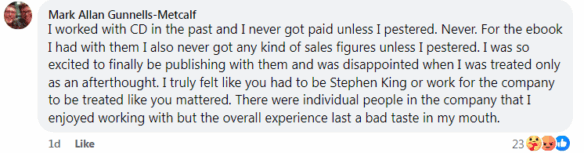
(1) CEMETERY DANCE KERFUFFLE HAS CONSEQUENCES. StokerCon today announced on Facebook a punitive action against small press Cemetery Dance in response to publisher Richard Chizmar’s exchange with an author who wrote to him seeking overdue royalties.

Due to recent information coming to light, Cemetery Dance will not be allowed to hear pitches during StokerCon. The Horror Writers Association stands up for the rights of its members, including the right to receive royalties as contracted, to have their works published as contracted, and to have its members treated with civility and respect. Cemetery Dance appears to be lacking in all of these areas.

Todd Keisling is the author whose experience at the hands of Cemetery Dance publisher Richard Chizmar led to HWA’s action. It seems he did finally get paid.

Screencaps of the exchanges were posted by Keisling in comments on Facebook after Chizmar doubled down on calling Todd a funny little man and then did a “dirty delete” of the comment.

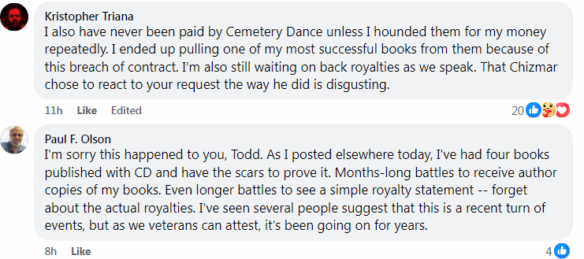
Several authors have followed up with comments about having to dun Cemetery Dance for payment.

(2) MAURICE BROADDUS’ BOOKSHELF. Shelfies, edited by Lavie Tidhar and Jared Shurin, “Takes a unique peek each week into one of our contributors’ weird and wonderful bookshelves.” A recent entry was “Shelfies #33: Maurice Broaddus”. Photo at the link.

The why I do what I do shelf. This is the shelf of books that have inspired me or push me to do what I do. Futureland (Walter Mosley) was the first book that made me re-think my writing trajectory. When I read it, I thought to myself “we can do that?” It was the first sf book I read that had characters who looked like me, that had worldbuilding done through a different cultural lens….

(3) TOO GOOD TO BE TRUE, CHAPTER 37. Victoria Strauss introduces Denise Beck-Clark’s writeup before turning over the microphone in “Guest Post: My Twenty-Four Hour Dream” at Writer Beware.

I’ve written many scam case studies and investigations on this blog, all of which reference and/or describe writers’ direct experiences (while protecting their identities, as Writer Beware always promises to do). But when the essay below landed in my inbox this week, it presented the perfect opportunity to offer a different perspective: a writer’s own first-person description of her encounter with a scammer.

The scam in question is an extremely common one: out-of-the-blue contact from someone claiming to be a well-known film producer/famous movie director/executive with a major production company supposedly eager to turn the writer’s book into a movie. The essay details all the typical elements of this often-elaborate fraud: praise and promises carefully calibrated to manipulate the writer’s hopes and dreams (and ego), contracts and other items that lend a veneer of authenticity, even a phone call from the famous director attached to the project! But also warning signs, which this writer didn’t ignore but too many writers do–such as American movie people speaking with strong foreign accents.

Denise Beck-Clark has kindly given me permission to use her name and bio (at the bottom of the post). Hopefully her experience will help other writers recognize and avoid this type of scam. (My favorite part of the story: when the scammer recommends using Writer Beware.)…

(4) JOSH ROUNTREE Q&A. “Nuts & Bolts: Author Josh Rountree on Transitioning From Short Stories to Novels” on the Horror Writers Association blog.

Q: How is writing a novel different from writing short fiction?

A: I don’t think there’s one perfect answer for this, but in general I think short stories and novels require us to access different parts of our writer brains.

Being a short story writer, my brain is always telling me to tighten, tighten, tighten. Leave nothing in the story that’s not important to character, advancing plot, etc. You try to make every sentence you write do double duty.

When I transitioned to working on a novel, I felt that same instinct, and I had to remind myself that it’s okay to let things breath.  I can go deeper into the characters, their personal stories, and figure out who these people are on a deeper level. I still want every sentence to work hard, advancing the story and building the character, but I can be a bit more leisurely about it.

Some people are skilled at one form and not the other. I think I’m one of them. Short stories come easily to me, but novels are much more challenging.  I wrote a half dozen novels that will never see the light of day, for good reason. Books that I thought were wonderful at the time, but with hindsight I can see they’re a mess. As much as I love short story writing, I did want to prove to myself I could write a novel, but the process became discouraging with each new failure.

Finally, I decided to split the difference and see if I could write a novella.  I told myself it was really nothing more than a longer short story. I was consciously trying to trick myself, and ultimately it worked.

(5) ALEXANDER SKARSGÅRD Q&A. There are four Murderbot questions near the end: “Alexander Skarsgård: The Empire Interview” at Empire Online.

How did you approach that evolution, of portraying a machine that is becoming a bit more human?

Ironically, I found Murderbot more relatable than most characters I’ve ever played.

(6) NEW AI COPYRIGHT SUIT. “Publisher of PCMag and Mashable Sues OpenAI” reports the New York Times. (Behind a paywall.) “Ziff Davis, which owns more than 45 media properties, is accusing the tech company of infringing on the publisher’s copyrights and diluting its trademarks.”

… In a 62-page complaint filed in federal court in Delaware, where OpenAI is incorporated, Ziff Davis says the tech company has “intentionally and relentlessly reproduced exact copies and created derivatives of Ziff Davis works,” infringing on the publisher’s copyrights and diluting its trademarks. It claims that OpenAI used Ziff Davis content to train its artificial intelligence models and generate responses through its popular ChatGPT chatbot.

“OpenAI has taken each of these steps knowing that they violate Ziff Davis’s intellectual property rights and the law,” the complaint says.

The company is seeking at least hundreds of millions of dollars in its lawsuit, according to two people familiar with the matter.

A spokesman for OpenAI said in a statement that its models were “grounded in fair use,” referring to the legal standard for use of copyrighted material….

(7) COLONEL MUSTARD IN THE MOVIE THEATER WITH THE CASH REGISTER. CrimeReads says it’s time to praise this 1985 movie: “The Clues, the Clueless, and the Critics: Appreciating Clue at CrimeReads.

…[It] is this latter element of the film (the board game come to life) that all its contemporary critics found both equally vexing and ingenious. The film, written and directed by Johnathan Lynn, features three different endings. Three different outcomes to the mystery, just as is possible in the board game. There is no motive in the board game, so one must be supplied for the film to have any meaning. That is, if it strives for meaning. It doesn’t. Instead, it embraces the randomness of a shuffled card deck, offering three random endings that might satisfy the clues in the story as well as the next.

This is what Ebert in referencing in the aforementioned quote, the start of his review of the film—an element that, on its own, he found brilliant. “The way Paramount is handling its multiple endings,” he wrote, “is ingenious. They’re playing each of the endings in a third of the theaters where the movie is booked. If this were a better movie, that might mean you’d have to drive all over town and buy three tickets to see all the endings.” He concludes, though, “[w]ith ‘Clue,’ though, one ending is more than enough.”

But he was correct in finding creative merit in this aspect of Clue. Writing in 2021, the scholar Milan Terlunen noted that “Clue lays bare the inner workings of all detective stories. Clue‘s multiple endings aren’t just a clever cinematic translation of the board game’s structure — they reveal something crucial about the nature of clues in general.” He goes on to explain that the very point of “solving” a mystery is “the process of distinguishing clues from red herrings… [t]here’s always too much evidence in a detective story, which fits beautifully with the general too-muchness of Clue.”…

(8) MEMORY LANE.

[Written by Cat Eldridge.]

April 26, 2010Iron Man II

Fifteen years ago the sequel to the highly successful and quite popular Iron Man se premiered in select markets before opening nationwide on May 7. 

Titled just Iron Man 2, it was directed by Jon Favreau who had done the first film, and written by Justin Theroux, who had not done the first film (which had been written by a committee of Mark Fergus, Hawk Ostby, Art Marcum and Matt Holloway. Hey it worked, didn’t it?) The first film got nominated for a Hugo at Anticipation. 

Iron Man 2 premiered at the El Capitan Theatre, a fully restored movie palace in Hollywood. This theater and the adjacent Hollywood Masonic Temple (which are now known as the El Capitan Entertainment Centre) are owned by the Disney Company and serve as the venue for a majority of the Disney film premieres.

Although fandom is very fond of saying it did substantially worse than the first film at the box office that’s a lie as it actually did better. Iron Man did five hundred and eighty million against one hundred and forty million in costs, whereas this film took in six hundred and thirty million against the same production costs. 

So how was it received by critics at the time? Anthony Lane at the New Yorker liked it better than its competitors Spider-Man and Superman: “To find a comic-book hero who doesn’t agonize over his supergifts, and would defend his constitutional right to get a kick out of them, is frankly a relief.” 

Roger Ebert writing for the Chicago Sun-Tribune was impressed: “Iron Man 2 is a polished, high-octane sequel, not as good as the original but building once again on a quirky performance by Robert Downey Jr.”

Audience reviewers at Rotten Tomatoes currently give it a rather good seventy-two percent rating. 

It is of course streaming where all things Marvel are which is Disney+. I am going to have to subscribe, aren’t I?

(9) COMICS SECTION.

(10) ANTI-RULES. Karl K. Gallagher has done an interesting thought experiment on X:

(11) BATTLING THE BLAHS. [Item by Steven French.] The Guardian’s Luke Holland considers the declining fortunes of assorted TV ‘super-franchises’ and comes up with some radical suggestions for reviving their fortunes: “May the force be with you! How to save every tired TV superfranchise, from Star Wars to Game of Thrones”.

It’s amazing to think that, not so very long ago, people were actually excited at the prospect of a new Star Wars show. Or when it emerged that a fresh Lord of the Rings saga was, through some kind of Gandalfian wizardry, being squeezed on to the small screen, the reaction was one of giddy awe. Even the faintest whisper of another trip to Hogwarts would have set the whole internet ablaze. And now? Well, here’s a test: there’s a new Harry Potter series coming out soon. How does that make you feel? Exactly.

There’s no doubt about it – a worrying number of what used to be the world’s most untouchable franchises are in trouble. But how did they arrive at this point of terminal audience ennui? And is there any route for them back into our hearts?

(12) TATOOINE-ALIKE. “Rare exoplanet orbits twin stars in ‘Star Wars’-like twist” reports Phys.org.

Astronomers have discovered a planet that orbits at a 90-degree angle around a rare pair of strange stars—a real-life ‘twist’ on the fictional twin suns of Star Wars hero Luke Skywalker’s home planet of Tatooine.

The exoplanet, named 2M1510 (AB) b, orbits a pair of young brown dwarfs—objects bigger than gas-giant planets but too small to be proper stars. Only the second pair of eclipsing brown dwarfs known—this is the first exoplanet found on a right-angled path to the orbit of its two host stars.

An international team of researchers led by the University of Birmingham made the surprise discovery using the European Southern Observatory’s Very Large Telescope (VLT). The brown dwarfs produce eclipses of one another, as seen from Earth, making them part of an “eclipsing binary.”

Publishing their discovery in Science Advances, the researchers note that this is the first time such strong evidence for a “polar planet” orbiting a stellar pair has been collected.

Thomas Baycroft, a Ph.D. student at the University of Birmingham who led the study commented, “I’m particularly excited to be involved in detecting credible evidence that this configuration exists.’…

(13) TRAILER PARK. “Love Death + Robots Volume 4”. Extreming May 15 on Netflix.

The Emmy-winning anthology of twisted tales from strange worlds returns, with stories featuring MrBeast and the Red Hot Chili Peppers

[Thanks to SF Concatenation’s Jonathan Cowie, Mark Roth-Whitworth, Steven French, Kathy Sullivan, Teddy Harvia, Mike Kennedy, Andrew Porter, John King Tarpinian, Chris Barkley, and Cat Eldridge for some of these stories. Title credit belongs to File 770 contributing editor of the day Daniel Dern.]

Pixel Scroll 8/18/24 The Golden Pixels Of The Scroll

(1) LOOK OUT FOR YOURSELF. The Horror Writers Association blog continues its “Nuts & Bolts” series with “Author Todd Keisling on Self-Advocacy for Writers”.

Nobody becomes a writer because they had childhood dreams of negotiating contracts. Like it or not, according to author Todd Keisling, it’s part of the job for authors without an agent. In this month’s edition of Nuts & Bolts, Todd talks about what authors – particularly beginners – should know about self-advocacy.

Q: What do you mean by self-advocacy, where writers are concerned?

A: I mean just that: You have to advocate for yourself. Not every writer has the luxury of an agent to review and negotiate contractual matters. I certainly didn’t, not for many years, and over time I learned from others what to watch out for, what was acceptable, and when to walk away. If a writer has no representation, it’s necessary to be their own advocate and speak up when a publisher isn’t doing what they said they would, or if a contract isn’t worded to your liking. No one else is going to speak up for you, so you have to do it yourself.

Q: What mistakes do beginning writers tend to make in that regard?

A: The biggest mistake I’ve seen (and one that I’ve made myself) is jumping into a contract as soon as it’s offered. Contracts are legally binding agreements, but many young writers are so enamored by an offer of publication that they will sign it without reading it. Another mistake is not taking the time to research the publisher, or to research the market and determine if what said publisher is offering is a standard deal or not. I’m talking about pay rates, percentages, rights, and more.

Q: What are some red flags that writers should look out for?

A: Any legal language that says the writer is financially responsible for any part of the process. That’s a huge red flag. Money flows to the writer, always.

Rights grabs are a big one. If a publisher is seeking all rights — worldwide print rights (regardless of language and region), film, audio, graphic novel — with little or no compensation, that’s a huge red flag. Especially if the publisher has no history of acting on those rights.

Term limits are another — you don’t want a publisher to own the publishing rights in perpetuity. Those terms should be spelled out in the contract. Lack of a rights reversion clause is another one I look for. A reversion clause will spell out how and when your rights revert back to you in the event the publisher files bankruptcy or goes out of business….

(2) BOMBADIL FINALLY GETS HIS 15 MINUTES OF FAME. In an Interview with actor Rory Kinnear, the Guardian reporter reveals that they haven’t read LoTR very carefully (hello, Barrowdowns?!!): “Rory Kinnear: ‘I congratulate everyone who is on the brink of baldness’”.

… Kinnear’s next appearance will be in the second season of Prime Video’s The Lord of the Rings: The Rings of Power. He’s playing Tom Bombadil, a mysterious, magical, much-beloved character from JRR Tolkien’s classic, but one never before seen on screen. Viewed by Tolkien as a personification of nature, and the oldest being in Middle-earth, Bombadil doesn’t intervene in any of the goings-on in the books. Having been around since the dawn of time, he’s above the petty notions of good and evil.

That makes him a tricky character to adapt. Neither Ralph Bakshi, director of the 1978 animated retelling of the story, nor Peter Jackson, the film-maker behind the multi-Oscar-winning Lord of the Rings trilogy, thought him worthy of inclusion in their versions. Bakshi said Bombadil “didn’t move the story along”, a view shared by Jackson. Even JD Payne, co-showrunner of The Rings of Power, told Vanity Fair that the character was “anti-dramatic … the characters kind of just go there [to Bombadil’s home] and hang out for a while, and Tom drops some knowledge on them.”

What drew Kinnear to a character so inconsequential no director ever wanted to go near him before? His partner, it turns out. Kinnear had been approached by the producers of the series in late 2022 about joining the cast. But having never read the books or seen any adaptations, he was in the dark about the significance of the character. He got off the phone and went downstairs to tell his partner, fellow actor Pandora Colin, about some character called Tom Bombadil.

“She looked at me and said: ‘You’re kidding?’” he recalls. “It’s her favourite part of the books. I usually like her taste, so I thought I’d better read them and start preparing. It was mainly from her reaction that I was interested. Inconsequential, dramatically, as Tom may be, he’s obviously left an impression on fans.”’

(3) OCTOTHORPE. Winner of the 2024 Best Fancast Hugo Octothorpe has dropped episode 116: “I’m Not Absolutely Sure I Voted”.

The live episode from Glasgow 2024 is here! We know you all expect the live episodes to be a bit less structured and organised than the recorded ones, but the three of us had had even less sleep than usual and so it’s a bit more chaotic than usual… normal service will resume in 117!

Spontaneously generated transcript here.

John, Liz and Alison (I know, listener, I know) are looking off to the right holding their Hugo Awards as people take photographs of them on the stage at the SEC Armadillo.

(4) FRESH HORROR. Gabino Iglesias, author of House of Bone and Rain, reviews three new horror books in the New York Times: Nicholas Belardes’s The Deading (Erewhon Books, 280 pp., $28); Cherie Priest’s The Drowning House (Poisoned Pen Press, 418 pp., paperback, $16.99); and Chuck Tingle’s Bury Your Gays (Tor Nightfire, 294 pp., $26.99). 

(5) FURTHER PERSPECTIVES ON NEIL GAIMAN. Maureen Ryan, a critic, journalist and contributing editor at Vanity Fair, has thoughts on Neil Gaiman, creative gods, American Gods and rotten pedestals at Burner Account.

…It sounds like some of these women approached the media before and didn’t get anyone to take on their stories. If you’ve wondered, I’ve never been approached by anyone with allegations like the ones that recently came to light. And while I would be very surprised if there is not further coverage of this matter, I know from extensive experience that these kinds of investigations take time. A lot of time.

Time, care and attention are required to do this kind of reporting properly, in ways that show compassion and consideration to the survivors, and in ways that pass muster with fact-checkers, editors and lawyers. (Legal review of my book, for example, took about a year, and some stories I’ve done have gone through several months of legal review, especially when the subject of a story has the resources to hire a lot of lawyers, spin doctors and crisis PR firms. Having to engage for months with all those hired guns is about as pleasant as you’d think.)

Because folks have asked, I am not working on any kind of Gaiman followup. In part because I have other commitments that take precedence. In part because what I have to say about these kinds of behaviors, patterns, dynamics and abuses is in my book (and in my previous decades’ worth of in-depth reporting on Hollywood).

And in part because I have already reported on Gaiman, somewhat indirectly, and I did not enjoy a significant aspect of the fallout of that experience. 

In 2018, I began hearing about massive issues affecting the TV adaptation of Gaiman’s book American Gods. The debut season’s showrunners had been fired abruptly, and the second season, according to my sources, was in deep trouble. I pitched a story to Lesley Goldberg, a friend and a longtime reporter/editor at The Hollywood Reporter — and it turned out she’d been hearing similar things, so we teamed up. As it happened, our sources didn’t overlap much, which was actually a good thing: Between us, we’d gathered a large array of people with a wide range of perspectives, all of whom were saying similar things about the acrimonious chaos behind the scenes. 

We worked really hard on that piece, and I felt — and still feel — confident of our sourcing and diligence. What we published, I believe, was not just accurate but prophetic. American Gods certainly wasn’t perfect in its first season, but it was bold, stylish, had a lot of potential and was a solid televisual interpretation of the book. Gods was a far inferior drama in Season 2, and the chaos behind the scenes apparently continued until it was finally cancelled after three seasons. At one point, the following became a running joke among myself and a couple of journalist friends: The shortest roster in Hollywood was the one listing experienced showrunners who hadn’t been asked to take over American Gods

People are allowed to react to reported pieces however they want, and the folks at or near the center of a story may well have a very different perspective than I do as a journalist. That’s all fine, and that’s not something I generally get worked up about. What I want you to understand about what follows is that I wasn’t upset by the fact that Gaiman had a reaction to that story, or that he appeared to have a reaction that didn’t align with my own impressions. What pissed me off was the nature of that reaction and how it made me feel as an experienced professional. 

After the story came out, and then when Season 2 of American Gods finally emerged months later, on social media and in interviews, Gaiman had things to say about our reporting. What pissed me off were remarks that made us sound like pesky little irritants who didn’t know what we were doing. Speaking for myself, I felt he conveyed the impression that we didn’t talk to anybody important or deeply informed or who had knowledge of the real story. (We did.)…

…When I saw Gaiman’s comments in various spheres, I felt some kind of way about this supposed champion of women being so gratingly, condescendingly dismissive of the work of two women who had, at that point, half a century’s worth of journalism experience between them. (Two queer women as well, though anyone reading the piece may not have known that.) 

After that, whenever I saw his “approachable cool guy” routine on social media, or saw him touted as an ally or feminist, I rolled my eyes pretty hard. Back when all this was going on, I thought about saying some of the above online, because for a while there, I was pretty angry about the way our work was dismissed so arrogantly. But I didn’t say anything in public, in part because I knew it might come off as sour grapes or pettiness.

An even bigger reason I stayed silent was that, after more than 30 years of acclaim, attention and adoration in comics, film, book publishing and TV, Neil Gaiman has a lot of strident defenders and superfans, and …honestly, that intimidated me. Having had other stan armies hatemob me in the past, I did not have the bandwidth to potentially endure a lot of enraged superfans coming after me….

(6) MEMORY LANE.

[Written by Cat Eldridge.]

August 18, 1950 Destination Moon.  Seventy-four years ago on this date, Destination Moon, produced by George Pal and an uncredited Walter Lantz premiered in the United Kingdom. (It premiered earlier in New York City on June 27.)

It’s based off Heinlein‘s Rocketship Galileo novel. That novel, one of his juvenile works, had been published by Charles Scribner’s Sons just three years before the film came out. Heinlein wrote in Expanded Universe that publishers initially rejected the script feeling that journeying to the Moon was “too far out”.

It was directed by Irving Pichel from the screenplay by Alford Van Ronkel, Robert Heinlein and James O’Hanlon. Heinlein was also the technical adviser. 

It starred John Archer, Warner Anderson, Erin O’Brien-Moore, Tom Powers and Dick Wesson. Oh, and an appearance by Woody Woodpecker, who helps explain how rockets work. Really, he does appear here. 

Matte paintings by Chelsey Bonestell, already known for similar artwork, was used for the lunar landscapes. These were used for the departure of the Luna from Earth; its approach to the Moon; a panorama of the lunar landscape; and the spaceship’s landing on the lunar surface.

I can’t find any production notes so I’m unable to tell you about how the SFX was done. A pity that. If anybody knows, do tell. 

Critics were mixed with Bob Thomas of the Associated Press saying, “Destination Moon is good hocus-pocus stuff about interplanetary travel” whereas Isaac Asimov meanwhile not surprisingly said in In Memory Yet Green that it was “the first intelligent science-fiction movie made.”  

Audience reviewers at Rotten Tomatoes give it a so-so 48% rating. It however did rather well at the box office returning ten times its half million-dollar production budget. 

It would be voted a Retro Hugo for Best Dramatic Presentation at the Millennium Philcon. 

It is not in the public domain, but the trailers are and here is one for you. So as always in such circumstances, do not offer up links to it. 

(7) COMICS SECTION.

(8) FICTION TAXONOMY. [Item by Steven French.] Mark Haddon on the difference between ‘literary’ and genre fiction: “Author Mark Haddon: ‘Bodies are such a good source of drama’” in the Guardian.

…One difference between what you might loosely call literary fiction and genre fiction is a kind of decorous avoidance of the overly dramatic. I always think of the sex scene in The Well of Loneliness: “And that night they were not parted.” Come on! Let’s see what happens! Or the Hilary Mantel story The Assassination of Margaret Thatcher, which pulls away at the end. In genre fiction – horror, police procedural, whatever – that’s where the story would start, isn’t it? Keep the camera running. You get to the end of Claire Keegan’s Small Things Like These and think the drama is about to start: now the real difficulties will happen; now you have a family….

(9) SHAKE AND BAKE. “Pompeii Wrecked by Earthquake at Same Time as Vesuvius Eruption, Research Shows” – an unlocked New York Times article.

…“The effects of seismicity have been speculated by past scholars, but no factual evidence has been reported before our study,” Dr. Sparice said, adding that the finding was “very exciting.”

The team focused on the Insula of the Chaste Lovers. This area encompasses several buildings, including a bakery and a house where painters were evidently interrupted by the eruption, leaving their frescoes uncolored. After excavation and careful analysis, the researchers concluded that walls in the insula had collapsed because of an earthquake.

First, they ruled out hazards such as falling debris as a primary cause of the destruction — a deposit of stones under the wall fragments in the insula suggested it did not crumble during the eruption’s initial stage. Then they compared the damage to known effects of seismic destruction — for example, on historical buildings.

The excavation also revealed a pair of skeletons covered with wall fragments in the insula. One skeleton even showed signs of having attempted to take cover. According to the researchers, bone fracture patterns and crushing injuries observed in modern earthquake victims are evidence that these unfortunate Romans were killed by a building collapse….

(10) KILLING THE MESSENGER. “’Incredibly rare’ dead sea serpent surfaces in California waters; just 1 of 20 since 1901”Yahoo! has the story.

Nothing marks the sign of impending doom like the appearance of the elusive oarfish, according to Japanese folklore. Hopefully it’s just a myth, since one was recently found floating in Southern California waters for only the 20th time in nearly 125 years.

A team of “sciencey” kayakers and snorkelers found the dead sea serpent while they were out for a swim at La Jolla Cove in San Diego over the weekend, according to Lauren Fimbres Wood, a spokesperson for the Scripps Institution of Oceanography at the University of California, San Diego.

A number of people, including the team of scientists and lifeguards, worked together to get the oarfish from the beach to a National Oceanic and Atmospheric Administration facility, Fimbres Wood told USA TODAY on Friday.

Only 20 oarfish have washed up in the state since 1901, making the sighting of the deep-sea fish “incredibly rare,” according Scripps’ in-house fish expert Ben Frable.

…The belief that the sight of an oarfish in shallow waters is an omen of an impending earthquake dates back to 17th century Japan, according to reporting by Atlas Obscura.

The fish, also know as “ryugu no tsukai,” were believed to be servants of the sea god Ryūjin, according to Japanese folklore.

It’s believed that “Ryugu no tsukai,” which translates to “messenger from the sea god’s palace,” were sent from the palace toward the surface to warn people of earthquakes, USA TODAY reported.

(11) ALL M. NIGHT LONG. NPR celebrates as “The Sixth Sense’ turns 25”.

Twenty-five years ago this month, one film and one filmmaker became synonymous with the big plot twist.

(SOUNDBITE OF FILM, “THE SIXTH SENSE”)

HALEY JOEL OSMENT: (As Cole Sear) I see dead people.

MA: Now, after all this time, if you still have not seen “The Sixth Sense,” we are not going to ruin it for you. But it’s no spoiler to say that the film became a phenomenon, and its director, M. Night Shyamalan, an overnight sensation. His career has had some ups and downs since then. He currently has a film out called “Trap.” But it was his breakthrough film that reimagined the psycho thriller….

But if you don’t mind spoilers, I offer my review “Sixth Sense and Sensibility”.

…I think everyone went to see Sixth Sense twice: the second time to admire the way they’d deceived themselves about what was happening when they saw it the first time….

(12) VIDEO OF THE DAY. “Mr. Sci-Fi” Marc Scott Zicree has posted a Space Command Rough Cut with no finished VFX, music, color correction, sound mix, etc. He’s still gathering funding:

To find out about purchasing shares in Space Command, email [email protected] — Thanks!

[Thanks to SF Concatenation’s Jonathan Cowie, Steven French, Lise Andreasen, John Coxon, Kathy Sullivan, Teddy Harvia, Mike Kennedy, Andrew Porter, John King Tarpinian, Chris Barkley, and Cat Eldridge for some of these stories. Title credit belongs to File 770 contributing editor of the day Bruce D. Arthurs.]

Samples of Social Media Reaction to Monteleone Before and After HWA Expelled Him

Author and editor Thomas F. Monteleone was expelled from the Horror Writers Association on January 31 for violating the organization’s antiharassment policies.

Here are a few examples of what appeared in social media immediately prior to that decision, and after it was announced.

BEFORE

Alan Baxter

“An open letter to the HWA regarding Thomas F. Monteleone”

… It is particularly saddening to see someone who was considered a legend in the field reveal themselves to be as racist, transphobic, and bigoted as Monteleone has. But more important than lamenting the self-immolation of one person is the direct harm those comments and actions cause to so many others.

Allowing Monteleone to remain in the organisation and to attend HWA events will be putting a large number of people directly in harm’s way. It will also show the HWA is complicit rather than active in the face of hate speech….

Todd Keisling

“An open letter to the HWA regarding author Thomas F. Monteleone”

I’m writing to add my voice to the chorus of members demanding Tom Monteleone be expelled from the organization and barred from attending all HWA events going forward. His actions on social media, and most recently his statements on the disgusting “Facebook Has AIDS” podcast, have revealed his true character to all.

Specifically, his racist, transphobic, and bigoted comments aimed at fellow HWA members, as well as whole classes of people, fly in the face of what the HWA stands for. I believe that maintaining ties with Mr. Monteleone in the organization and allowing him entry to future HWA-sanctioned events such as StokerCon will not only put fellow members in harm’s way but also invite controversy overall.

Doug Murano

https://twitter.com/muranofiction/status/1620201809842409474

Brian Keene

Brian Keene announced that the Borderlands Boot Camp, which Monteleone helped found, will be rebranded so that it does not share a name with his anthology series.

Scares That Care adamantly condemns the recent comments made on Facebook and a podcast by one of the founders of Borderlands Boot Camp. Effective immediately, Borderlands Boot Camp (which became part of the Scares That Care family of events in 2022) will be rebranded as the Scares That Care Writers Workshop.

We are also announcing that effective immediately, two (2) annual scholarships for marginalized writers (writers of color, writers from the LGBTQIA+ community, writers with disabilities, writers suffering from economic hardships, etc.) will be available yearly. While interested parties will be responsible for their travel and lodging, Scares That Care will waive the $750 tuition fee for these two individuals. Interested parties can contact board members Brian Keene ([email protected]) or Sonora Taylor ([email protected]) to inquire. Deadline for this year’s applicants is Friday, February 17th.

Respectfully,

The Scares That Care Board of Directors — Joe Ripple, Alfred Guy, Brian Keene, Jason Cherry, Sonora Taylor, Angel Hollman, Andrew Ely, and Donna Thew — and workshop organizer Mary SanGiovanni.

CAMP NECON

The Camp Necon statement does not name anyone, but it can be inferred from the timing what it’s about: “An Important Statement From Camp Necon”.

In light of recent abhorrent public statements and behaviors (on social media and via other media), we, the Camp Necon Board, feel obligated to take this opportunity to publicly state that we stand against bigotry and prejudice and are dedicated to our efforts to make Camp Necon a welcoming and safe experience for ALL attendees. We cannot be idle while friends and colleagues are deliberately maligned and their well-earned achievements mocked. It cannot stand, and we will not allow it at any space Camp Necon inhabits (be that online or in person). 

The legendary Charles L. Grant, often called “The Godfather of Camp Necon,” consistently championed new voices in horror and always insisted that, “By growing the pie, we all eat more.” It is in Charlie’s spirit and tradition that we’d like to state that by championing not just new, but diverse voices within the genre we believe we all eat BETTER. In that regard, we are moving forward with new initiatives to ensure ours is a place where all voices feel welcome and heard, in addition to taking steps to address present and future barriers to safety and inclusivity. We will continue to work to ensure ours is the kind of event that brings people together in an atmosphere of acceptance and collegiality. We hope to continue to have your support.

We understand that statements such as this may have the effect of “self-selecting” membership in our Campers’ roll. We are fine with that. If you do not feel fully aligned with what Camp Necon has become or the direction we continue to head, please follow your conscience. We have made our choice and we stand by both it and our community…. 

Tim Waggoner on Facebook.

Tom Monteleone encouraged me early in my writing career and gave me so much good advice. I thanked him in my acceptance speech when I won my first Bram Stoker Award. He published my collection A LITTLE AQUA BOOK OF MARINE TALES. He accepted two of my stories for BORDERLANDS anthologies. I asked him to write the introduction to WRITING IN THE DARK. He’s been a big supporter of me and my writing for many years. I have so many of his books on my shelves, and reading his short story “Wendigo’s Child” when I was a child myself was a formative experience for me. I used his IDIOT’S GUIDE TO WRITING A NOVEL as a textbook in my novel writing classes.

I admired him so much.

I’m sickened by the overt bigotry Tom has displayed over the last few days.

It doesn’t matter how good he’s been to me when he’s treated others so horribly. Once Tom was a role model for me in terms of artistry and professionalism. Now he’ll be a role model for what I hope never to become as a writer and member of the horror community as I grow older. I hope my mind never becomes so closed. I hope I never start to lash out from intolerance. I hope I never show such disrespect to people who I should view as colleagues. I hope I continue to build people up instead of tearing them down.

You taught me so many things over the years, Padrone. I suppose I should thank you for this final lesson. I just wish it was one I never had to learn.

AFTER

Adam Troy-Castro on Facebook:

… I said something early in this mess that may now be risky to say now.

I remember the Tom Monteleone I once knew, who I laughed with at I-Con in Long Island and at other places, with considerable fondness. I remember the Tom Monteleone who wrote (mostly) great columns about his experiences, for CEMETERY DANCE. I remember loving some of his fiction, including one novel he churned out for a subpar house that contained one of the worst sentence constructions I have ever read, and another I liked very much that existed in the “evil carnival” sub-subgenre. I harbor considerable affection for that Tom Monteleone of thirty-forty years ago, that none of this banishes. To me, the contrast with current events put that Tom Monteleone in a little memory vault. I do not apologize for feeling that way.

Alas, the Tom Monteleone of today, who ate that Tom Monteleone, was already present way back when, though his manifestations, bad as they could be, were intermittent.

I am mourning, at most, a minor but treasured acquaintance. But I still feel the loss.

That is the end of the risky part.

Understand that the Tom Monteleone I feel sorry for, today, is that one from thirty years ago. I think the one from today invited this fate, however seriously he now takes it, and I am pretty damn certain that there is no coming back from this. I am unsure whether he was still producing work, but he was certainly still an influential figure, an elder statesman, and an important editor, who in a few days of frenetic resentment set fire to his legacy. This is a tragedy, but in the Greek sense, where people suffer the fates their character calls for. This is the natural development of groundwork he laid.

What will happen to Tom Monteleone is that he will not shut up about this, and will continue to court the only audience that still cares about him, the people who share his resentments. He will become more and more fringe, a Theodore Beale of horror, a Kevin Sorbo of horror. I promise you. He will humiliate himself further and he will do it willingly…

Chuck Wendig

https://twitter.com/ChuckWendig/status/1620580945224167424

David Niall Wilson – Twitter thread starts here.

https://twitter.com/CrossroadPress/status/1620597886345170944