Pixel Scroll 2/20/26 I’ll Be Glad When You’re Scrolled, You Pixel You

(1) TREMBLAY Q&A. “The Bram Stoker– and British Fantasy Award–winning author straddles the line between absurdity and horror in Dead but Dreaming of Electric Sheep (Morrow, June), in which AI has become integrated into the body of a person in a vegetative state.” “How Math Ruins the World: PW Talks with Paul Tremblay” at Publishers Weekly.

Dead but Dreaming of Electric Sheep feels like a mash-up of Weekend at Bernie’s and Peripheral. How did you come up with the idea, and why did you want to write it now?

The nascent idea came from reading Mary Roach’s nonfiction book Stiff, which discusses the ways dead bodies are used. At one point she talks about transporting bodies via planes, and I thought, I wonder if we’ll ever get to the point where someone’s remote controlling a body. Once I had that conceit, it dovetailed with when I was first learning about large language model generative AI, when I first became part of a class action lawsuit in June of 2023 against OpenAI for copyright infringement. A lot of my anxieties of going through that experience are certainly in the book, but the rest was just following my weird brain where it went.

How did you balance the absurdity with the darker aspects of the story?

I wanted to make the sections from the gamer Julia’s POV feel absurd by making them as real as possible, really getting into the details of what it would be like to actually, physically control another body. The reader stays with Julia through training and trips to the airport. I wanted to highlight that because of how normal and everyday it seems, it’s that much more absurd. Honestly, my biggest worry about this book was, man, I hope no one can actually do this before it gets published.

(2) HARRISON FORD GOES INDIE. [Item by Daniel Dern.] On Shrinking (Season 3 Episode 4), where he plays a shrink, Harrison Ford,  announces (to his office/practice mates) that he’s back for work, by (briefly) (and unexpectedly, to us viewers) singing the Indiana Jones theme.

Note, Gizmodo asks, “Unless Paul is a musical genius, his humming that music suggests Indiana Jones exists in the Shrinking universe. And, if Indy isn’t Harrison Ford, then who is he?”

 FYI, Ford appears to be ambivalent about his relationship with this song, per clips like “Harrison Ford’s Thoughts On Indiana Jones Theme Song”.

 Lagniappe: My web search for the Shrinking video clip also turned up this brief gem: “Indiana Jones and the Quest for the Lost Shaker of Salt | Jimmy Buffet’s Outpost Tour (1991)”.

(3) HE’S CALLING IT A GOLLUM BIOPIC? Ben Child thinks “The Hunt for Gollum looks like a step too far for the endless Lord of the Rings franchise” in the Guardian.

… Tolkien wrote vast, elliptical, gorgeously expansive and detailed mythic histories in which entire wars are summarised in half a paragraph and crucial events occur off-page because the author had the good sense to know that not everything needs dramatising. Hollywood, however, has developed a horror of empty space. If a character once spent three sentences doing something, that now constitutes at least one feature film, two streaming spin-offs and a tie-in podcast. This, sadly, is the trap into which Serkis, Jackson and the rest of the once-garlanded Lord of the Rings team have fallen – and the danger is that, in trying to wring every last story from Middle-earth, the franchise may end up leaving Tolkien’s world feeling rather like Bilbo himself under the ring’s influence: thin, stretched, and scraped like butter over too much bread….

(4) KGB. Fantastic Fiction at KGB reading series hosts Ellen Datlow and Matthew Kressel present C. S. E. Cooney and Kristina Ten on March 11, 2026, 7:00 p.m. Eastern at the KGB Bar, 85 East 4th Street, New York, NY 10003 (Just off 2nd Ave, upstairs).

C. S. E. COONEY

C. S. E. Cooney is a two-time World Fantasy Award-winning author: for her novel Saint Death’s Daughter, and her collection Bone Swans, Stories. Other work includes Saint Death’s HeraldThe Twice-Drowned SaintDark Breakers, and Desdemona and the Deep. She’s a Rhysling Award-winning poet and a SAG-AFTRA voice actor, having narrated over 130 audiobooks. As singer-songwriter “Brimstone Rhine,” Cooney has produced two EPs, an album, and an SF musical. With her husband Carlos Hernandez, she co-designed the collaborative tabletop roleplaying game Negocios Infernales, out now from Outland Entertainment. Find out more at C. S. E. Cooney’s  website, her Substack newsletter, and elsewhere on social media.

KRISTINA TEN

Kristina Ten is the author of Tell Me Yours, I’ll Tell You Mine, a collection of dark, strange stories released in October from Stillhouse Press. Her writing appears in The Best American Science Fiction and FantasyWe’re Here: The Best Queer Speculative FictionThe Best Weird Fiction of the Year, and elsewhere. Along with winning the McSweeney’s Stephen Dixon Award, she has been a finalist for the Shirley Jackson Award and the Locus Award. Ten is a graduate of Clarion West Writers Workshop and the University of Colorado Boulder’s MFA program in fiction, and has received fellowships from the Ragdale Foundation and the Martha’s Vineyard Institute of Creative Writing.

(5) SNOWBOARDING IN GAME AND REALITY. [Item by Steven French.] Keith Stuart compares the Winter Olympics in Italy with some classic games in this week’s “Pushing Buttons” newsletter: ​“The ​Winter Olympics ​feel like a 90s ​snowboarding ​game​, and I’m here for it” in the Guardian.

As someone whose childhood holidays consisted of narrowboating along the Grand Union canal or wandering the harbour-side at Whitby looking for vampires, I have never been on a skiing break. The idea of plummeting down a hill on anything but a plastic sledge is totally alien to me. And yet, my wife and I have been gripped by the Winter Olympics, especially the snowboarding and freestyle skiing events. And I think I know why. Those events are really channelling the look and feel of the wintery sports sims I’ve always loved – especially those that arrived during a golden period in the mid-1990s.

This was the era in which snowboarding was exploding in popularity, especially among twentysomethings with disposable incomes and no responsibilities – which coincidentally was the games industry’s target market at the time. Perhaps the first title to take advantage of this trend was Namco’s 1996 arcade game Alpine Surfer, which challenged players to stand on a snowboard-shaped controller and swoop as quickly as possible down a mountainside – it was one of the most physically exhausting coin-ops I ever played. Later that year came the self-consciously hip PlayStation sim Cool Boarders, and then in 1998, my absolute favourite, 1080° Snowboarding on the N64, with its intuitive analog controls and incredibly authentic sound effects of boards cutting through deep, crisp snow.

What I think is bringing these classics back to mind is the highly immersive presentation of the events at Milano Cortina. Most obviously, there’s the innovative use of first-person view drone cameras, which provide live chase-cam footage from behind and slightly above the competitors. Watching the snowboard cross events, in which four competitors race against each other over steep, ramped courses, now looks and feels almost exactly like playing the Race mode in 1080° Snowboarding, which was viewed from a similar angle and pitted players against AI-controlled boarders. In both experiences, you’re right there among the riders, pushing and jostling for the perfect racing line.

(6) MEMORY LANE.

[Written by Cat Eldridge.]

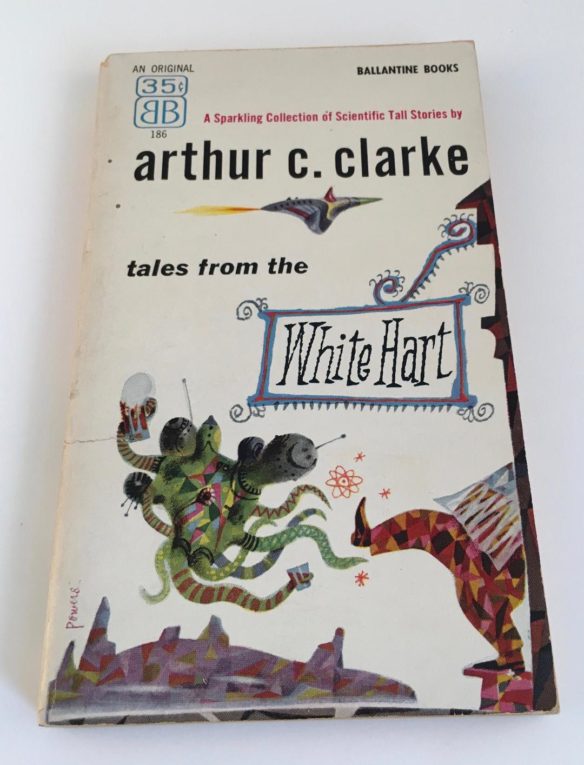
Arthur C. Clarke’s Tales from the White Hart

So who here hasn’t read the stories in Arthur C. Clarke’s Tales from the White Hart? The collection was first published in 1957 by Ballantine Books, though most of the tales first appeared elsewhere. They are, I think, quite wonderful. I actually first encountered the book in an English language bookstore in Sri Lanka in a paperback edition. Clarke was still alive and living in Colombo at that time. 

Avoiding spoilers once again as I will with all of the Beginnings, I can note that the pub itself is based upon the White Horse,  which is just north of Fleet Street where SF fans gathered in the Forties and Fifties.

Clarke, in correspondence with Lord Dunsany, said that he based these off that writer’s Jorkens. Indeed Clarke wrote an introduction to the first Jorkens omnibus volume. 

I love the setting as I do almost any genre fiction set in a pub, the bar patrons especially Harry Purvis who tells these tales are fascinating and the tales themselves are stellar.  

Now our Beginning…

Silence Please You come upon the “White Hart” quite unexpectedly in one of these anonymous little lanes leading down from Fleet Street to the Embankment. It’s no use telling you where it is: very few people who have set out in a determined effort to get there have actually arrived. For the first dozen visits a guide is essential: after that you’ll probably be all right if you close your eyes and rely on instinct. Also—to be perfectly frank—we don’t want any more customers, at least on our night. The place is already uncomfortably crowded. All that I’ll say about its location is that it shakes occasionally with the vibration of newspaper presses, and that if you crane out of the window of the gent’s room you can just see the Thames.

From the outside, it looks like any other pub—as indeed it is for five days of the week. The public and saloon bars are on the ground floor: there are the usual vistas of brown oak panelling and frosted glass, the bottles behind the bar, the handles of the beer engines… nothing out of the ordinary at all. Indeed, the only concession to the twentieth century is the juke box in the public bar. It was installed during the war in a laughable attempt to make G.I.’ s feel at home, and one of the first things we did was to make sure there was no danger of its ever working again.

At this point I had better explain who “we” are. That is not as easy as I thought it was going to be when I started, for a complete catalogue of the “White Hart’s” clients would probably be impossible and would certainly be excruciatingly tedious. So all I’ll say at this point is that “we” fall into three main classes. First there are the journalists, writers and editors. The journalists, of course, gravitated here from Fleet Street. Those who couldn’t make the grade fled elsewhere: the tougher ones remained. As for the writers, most of them heard about us from other writers, came here for copy, and got trapped.

(7) COMICS SECTION.

(8) IMAGINARY PAPERS The ASU Center for Science and Imagination has published the latest issue of Imaginary Papers, their quarterly newsletter on science fiction worldbuilding, futures thinking, and imagination.  

 In this issue, Anne W. Johnson writes about “speculative fabulation” in the hybrid documentary-fiction films of Juan Francisco Salazar, Brenda Cooper considers Samuel R. Delany’s 1984 novel Stars in My Pocket Like Grains of Sand, and Troy L. Wiggins reports on the 2025 Embodying Freedom convening and explores applying Afrofuturist strategies to efforts for reparative community development.

(9) CALL FOR PEACEFUL QUANTUM SCIENCE. [Item by Steven French.] I doubt whether the current occupant of the Pentagon will pay much attention but the principle is important: “Quantum scientists release ‘manifesto’ opposing the militarization of quantum research” reports Phyics World.

More than 250 quantum scientists have signed a “manifesto” opposing the use of quantum research for military purposes. The statement – quantum scientists for disarmament –  expresses a “deep concern” about the current geopolitical situation and “categorically rejects” the militarization of quantum research or its use in population control and surveillance. The signatories now call for an open debate about the ethical implications of quantum research.

While quantum science has the potential to improve many different areas – from sensors and medicine to computing – some are concerned about its applications for military purposes. They includes quantum key distribution and cryptographic networks for communication as well as quantum clocks and sensing for military navigation and positioning.

Marco Cattaneo from the University of Helsinki in Finland, who co-authored the manifesto, says that even the potential applications of quantum technologies in warfare can be used to militarize universities and research agendas, which he says is already happening. He notes it is not unusual for scientists to openly discuss military applications at conferences or to include such details in scientific papers.

“We are already witnessing restrictions on research collaborations with fellow quantum scientists from countries that are geopolitically opposed or ambiguous with respect to the European Union, such as Russia or China,” says Cattaneo. “When talking with our non-European colleagues, we also realized that these concerns are global and multifaceted.”

(10) THEY’RE ON THE COVER. [Item by SF Concatenation’s Jonathan Cowie.] This week’s Science cover story, shades of Jurassic Park.

(I have never really forgiven the dinosaurs for what they did to Raquel Welch…)

COVER. Two Spinosaurus mirabilis sp. nov. spar over a coelacanth carcass on a forested riverbank some 95 million years ago in what is now the central Sahara Desert in Niger. A scimitar-shaped head crest and interdigitating tooth rows characterize this wading giant, one of the last known surviving species of a spinosaurid radiation about 50 million years in the making. See page eadx5486.

And add this summary:

A stunning Spinosaurus. Recent descriptions of and debates about the massive, fish-eating dinosaur Spinosaurus have brought this striking predator to the forefront of the dinosaur pantheon. Its huge size and distinctive shape have stimulated much debate about the degree to which it lived an aquatic lifestyle. Sereno et al. describe a crested fossil Spinosaurus found in northern Africa as a new species. The researchers argue that this group of dinosaurs underwent three phases of evolution with increasing aquatic adaptations and existence in habitats around the Tethys Sea. 

[Thanks to, Mark Roth-Whitworth, Kathy Sullivan, Steven French, Joey Eschrich, Mike Kennedy, Andrew Porter, John King Tarpinian, Cat Eldridge, and SF Concatenation’s Jonathan Cowie for some of these stories. Title credit belongs to File 770 contributing editor of the day Bruce D. Arthurs.]

Pixel Scroll 11/11/25 If We Had Pixels We Could Have Pixels And Scrolls, If We Had Scrolls

(1) WAS AI ART USED IN NEW GRRM BOOK? ART DIRECTOR’S DENIAL. Did Penguin Random House’s 20th anniversary edition of GRRM’s A Feast for Crows use AI art? This thread on Reddit – “George R.R. Martin’s team accused of using AI” – analyzes numerous examples in support of the claim, pointing to odd anatomical distortions and mistakes.

The book’s illustrations are by imaginative realism artist Jeffery R McDonald.

The person responsible for approving the art in the book, Raya Golden, yesterday published a denial AI art was used in a post at GRRM’s Not A Blog: “FFC art accusations”.

My name is Raya Golden and I manage the art direction and licensing development here at Fevre River working closely with GRRM as his schedule will allow. But I alone am responsible for approving all the licensed art that accompanies our SOI&F book driven materials.

Recently there have been accusations floating around that the Penguin Random House’s illustrated edition of A Feast For Crows was produced using AI generative art.

To our knowledge and as presented by the artist who completed the work in question there was NO such programing used. While he is a digital multimedia artist and relies on digital programing to complete his work, he has expressed unequivocally that no AI was used, and we believe him.

SO…

The official word from our office is, of course, that we DO NOT, never have and will not willingly work with A.I generative artists in any way shape or form.

(2) ELLISON WONDERLAND PRESERVATION UPDATE. On Facebook, J.Michael Straczynski has posted an impressive gallery of photos taken inside Harlan Ellison’s house:

While I am here…as part of preserving Ellison Wonderland and getting it ready to be classified a historic/cultural landmark, we had one of the best architectural photographers, Barry Schwartz, come in to shoot high resolution photos, along with an Oscar nominated filmographer to do videos for a 3D tour on an eventual website. The core photos, which have been sized down for upload to Facebook, are such high resolution that you can go all the way down on books in the libraries to read the titles.

(There are also a couple of shots of the Lost Aztec Temple of Mars, which has had the capstones atop the house fixed and restored to their original positions, and each panel was individually taken down so that the wooden boarding on which they were mounted could be replaced. The mounting was so soft from years of decay that you could literally shove your finger through them. One more good storm and they would have collapsed.) We had to clear out some of the shrubbery to get to the bottom of the mounting, then clean the panels before returning them to their original place. We’ve also found the molds for some of the broken or missing hieroglyphs and will be replacing them.)

Just for those who wonder if the house still looks as it should. Those of you who have been there should recognize every inch of these….

(3) GOODREADS CHOICE AWARD VOTING OPENS. File 770’s post “Goodreads Choice Awards 2025 Opening Round Nominees” shows the covers of the first round contenders in the Fantasy, Romantasy, Science Fiction, Horror, and Young Adult Fantasy and Sci-Fi categories. There are 15 categories altogether, and Goodreads members have until November 23 to cast their votes. A second round of voting will follow, and then the winners will be announced December 4.

(4) 2025 BOOKER PRIZE. The winner of the 2025 Booker Prize is David Szalay for Flesh, which is a non-genre novel.

(5) MEET THE BSFA CHAIR. The latest Clarke Award Substack newsletter includes an intriguing interview with novelist and Chair of the British Science Fiction Association Stewart Hotston, which includes his reasons for preferring juried awards.

Tom Hunter: Hi Stewart, and thank you for agreeing to be interviewed. I was hoping that to start us off you could introduce yourself and your work to our readers.

Stewart Hotston: Hi, yes, I’m an author who’s largely known for SF. I’ve also been a judge for the Clarkes as well as currently being the treasurer of the BFS and as a councillor and now Chair for the BSFA.

I write non-fiction in a number of places — both essays and cultural criticism. My previous published longer work was The Entropy of Loss which was a finalist for both the BFS awards and for the Subjective Chaos awards.

My new book, the space opera Project Hanuman, is published by Angry Robot, and features microbial spaceships, information warfare, planets made of gold and grand ringworlds.

Tom: We know you best, of course, as a BSFA nominated judge for the Clarke Award. I was curious about how you found reading an entire year’s worth of UK published SF (twice!) and the impact, if any, on both your own writing and any wider understanding of the genre.

Stewart: The impact was broad. I found I recognised trends properly for the first time — when you’re reading everything publishers think is worthy of consideration you also get a sense of what the industry thinks is both commercial and substantial. Of course, you’re aware of trends and fashions, but seeing them first hand because you’re seeing literally everything, was a new experience for me.

I found the entire thing fascinating and although it was a tremendous amount of work, it was also really enjoyable.

I’m on record as saying I prefer juried awards over voted because although I think both approaches have strengths, you’re really unlikely to find diamonds in the rough rising to the top of voted awards. What really excites me is those stories that haven’t been as visible as others suddenly getting seen…

(6) HWA WEBMASTER TURNOVER. Horror Writers Association webmaster Angel Leigh McCoy announced on Facebook they will no longer hold that post after December 5. McCoy says it “was not my choice” and calls it a “surprise”.

I wanted to share an important update so that no one is caught off guard. The HWA is undergoing a leadership-directed restructuring, and as part of that process, my contract will end after the first week of December. After that time, my responsibilities will transition to someone new (I don’t yet know who that will be).

This decision was made by the Executive Director, Max, and was not my choice. It came as a surprise, and while transitions are never easy, I want to ensure that the community experiences as smooth a hand-off as possible. If you have any website requests, tech needs, or support questions, please send them to me before December 5 so I can complete them while I’m still in place.

Serving the HWA for the past twelve years has been one of the most meaningful experiences of my career. It’s been my privilege to support our members, chapters, events, awards, and scholarships, and to witness the creativity and generosity that make this community so special. I joined HWA as a new writer back in 1999, and I’ve cherished every step of this journey.

If my work has made a positive impact on your experience with the HWA, I would be deeply grateful if you shared that with the organization’s leadership ([email protected], [email protected], [email protected]).

Thank you all for your trust, your collaboration, and your kindness. It has truly been an honor.
With appreciation and affection, Angel Leigh McCoy

(7) ARTHUR C. CLARKE AWARD NEWS. The Arthur C. Clarke Award is now taking submissions for books published in 2025.

…Our judges are braced for incoming book mail.

The award is open to original authored works published in English by an author of any nationality, provided that the novel is published for the first time by a UK publisher between 1 January and 31 December of the current submission year.

Deadline for submissions is 31st December 2025: Contact us for our full submissions guidelines.

(8) LEE MOYER INJURED. [Item by Brick Barrientos.] Artist Lee Moyer, a two-time Hugo Award-winning illustrator and designer, sent the following email to his mailing list:

Writing great comics sound effects is harder than you’d think. But sadly, FOOSH is not just a great sound effect, it’s an acronym that stands for “Fall Onto Out-Stretched Hand.”

While I’m usually quite slow in sending out updates, this update represents an all-time (s)low because I’m typing it entirely with my offhand.

I sheered off the larger bone in my left wrist (the Radius) in a terrible fall. A longish metal plate with nine screws has been implanted in my wrist, but it may be months until I can really again draw with my left hand.

So, rather than a cheery list of all the things I’ve been working on, I have a humble request.

If your budget and interest allow, it would mean a great deal to me if you ordered a custom-made print.”

Lee Moyer’s Author Arcana would be interest just to look at.

(9) TODAY’S BIRTHDAY.

[Written by Paul Weimer.]

November 11, 1922Kurt Vonnegut. (Died 2007.)

By Paul Weimer: My first encounter with Kurt Vonnegut was not actually through his work, but through a movie. Not the movie of Slaughterhouse Five, his best known (an adaptation of perhaps his best novel), although that would come later. No, it came, in all places, in the Rodney Dangerfield movie Back To School. 

Kurt Vonnegut

In that movie, Dangerfield, a successful businessman who doesn’t have a college degree, goes to college in order to inspire his son, who is not doing well at the university. But Dangerfield’s character figures he can buy his way to a grade.  So, when he needs to do a paper on the work of Kurt Vonnegut…he hires Kurt Vonnegut, who shows up in a cameo in the movie.  Dangerfield’s tactic backfires, when his professor tells him “whoever wrote this doesn’t know the first thing about Kurt Vonnegut”

Friends, I didn’t know who Kurt Vonnegut was at the time. My high school had not taught him, and I had missed him in my still growing education into SF. But, if you know me by now, I had to know who he was. And so I read Slaughterhouse Five, and Breakfast of Champions, and a variety of other things by him. His biting and unrelenting humor has stayed with me ever since, and “So it goes” is part of my vocabulary.

Speaking of which, funny thing, when I got around to reading Pournelle and Niven’s Inferno, I was shocked and surprised to find that Vonnegut had a particularly prominent place in hell. I think that the reason they put him there as they did (Vonnegut was still alive when they wrote Inferno) is because Vonnegut (like, say, Margaret Atwood or Joyce Carol Oates) vociferously and vocally denied he wrote science fiction, despite all evidence to the contrary.

I am certain that Vonnegut wrote science fiction, but to put him in hell for not saying so…badly done, indeed.  But…so it goes. 

(10) COMICS SECTION.

(11) ATWOOD ON WOMEN’S HOUR. [Item by SF Concatenation’s Jonathan Cowie.] Last week’s Best of Women’s Hour had an interview with Margaret Atwood (first item after the programme’s introduction) as her autobiography is now out..  In the programme, she covered why and how she became a writer. She never thought she would be successful. It was Canada and writers were considered dedicated and writing a purely vocational occupation. Other topics also covered included A Handmaid’s Tale and the history of the USA…

In Margaret Atwood’s 64-year career she has published world-renowned, prescient novels like The Handmaid’s Tale, Cat’s Eye, Alias Grace and Blind Assassin, and now a memoir. Margaret joins Nuala McGovern to discuss  Book of Lives: A Memoir of Sorts and reflect on her life, her work and the power of knowing her own mind.

You can access it here.

(12) OCTOTHORPE. Episode 147 of the Octothorpe podcast, “What? What?! No!”, says John Coxon, “was described by my two cohosts during the editing process as ‘discursive’ and ‘rambly’. STRAP IN, LISTENERS.” There’s an uncorrected transcript available here.

A photograph of the mountains of Nepal with text overlaid, reading “Octothorpe 147 Official Octothorpe Nepal Identification Guide* (*apparently never gets old)** (** Liz might like to go to a comics con there)”.

(13) KATHERINE RUNDELL Q&A. [Item by SF Concatenation’s Jonathan Cowie.] Take Four Books is a weekly BBC Radio 4 series of interviews with authors where they discuss an author’s famous book and then the author discusses three other books that inspired the author in the writing of their book.  This week’s author was the children’s fantasy writer Katherine Rundell the author of the Impossible Creatures books that riffs on species loss and climate change.  Her latest one is The Poisoned King. The first here recommended books in Prince Caspian.and the second was The Wizard of Earthsea. The programme includes a clip of Ursula K. LeGuin speaking on writing fantasy.

Award-winning author Katherine Rundell discusses The Poisoned King, the second installment in her acclaimed children’s fantasy series, ‘Impossible Creatures’.

In this latest adventure, protagonist Christopher journeys back to the magical archipelago – a realm where dragons, unicorns, griffons, mermaids, and much more, all roam free. But this time, he’s faced with an urgent and mysterious threat.

Rundell shares the three literary inspirations behind her new novel: William Shakespeare’s Hamlet (1600), C.S. Lewis’s Prince Caspian (1951), and Ursula K. LeGuin’s A Wizard of Earthsea (1968).

You can access it here.

(14) REREADING CHILDHOOD’S END. [Item by SF Concatenation’s Jonathan Cowie.] Moid Moidelhoff over at YouTube’s Media Death Cult wiped his archive some years ago, but has now been re-posting some of his more memorable videos. This one is from 2021 and is a review of Arthur C. Clarke’s classic Childhood’s End.  This novel came out back in 1953 early on in Clarke’s career but Moid has only just resurrected his review video. Now, I suspect most Filers will have already read this book, but possibly not recently.  The same is true for Moid.  It is interesting to see how younger SF readers consider the classics as well as how re-reading after many years alters perceptions. You can see the 15-minute video here.

(15) THREE’S COMPANY, SIX IS A CROWD. [Item by Mike Kennedy.] Tiangong, the Chinese space station, is a little more crowded than usual. It’s currently playing host to two crews of three taikonauts each. 

Normally, the old crew (launched in April of this year on Shenzhou-20) would have returned to Earth shortly after the arrival of the Shenzhou-21 crew. However, it’s suspected that the Shenzhou-20 spacecraft was damaged by an on-orbit debris collision. The China Manned Space Agency is undertaking analysis and has not announced a timeline for the earlier crew’s return.

Though not covered in the linked article, various SpaceX/Elon Musk fans are starting to agitate for a SpaceX rescue mission for the taikonauts. The technical, as well as political, complications that would have to be overcome for that to occur are not known (but would likely be quite significant, so don’t bet the house on it just yet). “Tiangong hosts dual crews after debris impact delays Shenzhou-20 return” reports Space Daily.

…On November 5, the China Manned Space Agency (CMSA) postponed the scheduled return of Shenzhou-20, citing concerns over possible damage caused by a debris event. Crew commander Chen Dong, operator Chen Zhongrui, and science operator Wang Jie continue to live and work aboard the station, joined by the three-member Shenzhou-21 crew.

CMSA officials reaffirmed: “Following the postponement of the Shenzhou-20 manned spacecraft return mission, the project team, adhering to the principles of ‘life first, safety first,’ immediately activated emergency plans and measures… All tasks are progressing steadily and orderly according to schedule”.

Both Shenzhou-20 and Shenzhou-21 astronauts are conducting joint scientific experiments, made possible by robust station systems and supplies delivered by Tianzhou cargo ships.

Engineers and risk teams have performed simulation analysis and system testing on the Shenzhou-20 capsule, while ground teams continue return drills at the landing site….

[Thanks to Mike Kennedy, Andrew Porter, John King Tarpinian, Arnie Fenner, Brick Barrientos, Chris Barkley, Cat Eldridge, SF Concatenation’s Jonathan Cowie, Mark Roth-Whitworth, Steven French, Kathy Sullivan for some of these stories. Title credit belongs to File 770 contributing editor of the day Patrick Morris Miller.]

Pixel Scroll 10/4/25 Faraway Pixels With Strange-Sounding Scrolls

(1) BRITISH LIBRARY FAIRY TALES EXHIBIT OPENS IN 2026. [Item by Steven French.] Advanced notice of an interactive family-oriented exhibition coming to the British Library in London next March: “Fairy Tales”.

Kay Nielsen’s illustration for Hansel and Gretel, 1925.

Take your family on a magical adventure in a new interactive exhibition! Explore enchanted lands, magical creatures, iconic characters and timeless tales, brought to life through books, theatre costumes, puppets, pop-ups, artwork and illustrations. 

From the deep dark forest to the royal palace, set off on a journey through a fairy tale world. Sit down at the Three Bears’ breakfast table, tell the genie your wish, smell the wicked witch’s potions and discover lots more.

With interactive displays, theatrical design, story sharing spaces, costumes, activities, and plenty of surprises, families can dive into the stories they love and find some new favourites. And if you think you know fairy tales, think again! From the three little wolves and the witch with a heart of gold to the princess who wouldn’t go to the ball, discover how these tales have been transformed.

Throughout the exhibition, beautiful books and artwork from some of the UK’s most beloved writers and illustrators offer a glimpse of the tales that have captured imaginations for generations.

Pack your magic beans and make sure to not leave your glass slippers behind: an adventure awaits.  

Warning: please don’t wake the troll. 

(2) WITH A LITTLE IMAGINATION. The UK’s Space Centre website has a photo gallery of their realization model of the 1949 “British Interplanetary Society Lunar Spacesuit”. There’s also a British Pathé news video of the two designers at work.

…During the 1940s, BIS members Harry Ross and Ralph Smith worked on the first serious scientific study of what a spacesuit for the Moon would look like. Smith drew detailed pictures and schematics, which accompanied a paper the two men wrote for the Journal of the British Interplanetary Society (JBIS).

Using only materials and techniques available in the 1940s, historic costume makers Ancient Wisdom worked with the National Space Centre to make Ross and Smith’s design in the real world.

The suit comes with a life support backpack, rock collecting hammer, shooting-stick, and even a cape – which forms part of an ingenious climate control system for the wearer.

(3) DAYTON LITERARY PEACE PRIZE 2025. The Dayton Literary Peace Prize 2025 winners were announced September 26.

Fiction

  • Martyr by Kaveh Akbar

Nonfiction

  • The Burning Earth: A History by Sunil Amrith

Richard C. Holbrooke Distinguished Achievement

  • Salman Rushdie

Prize nominations include adult fiction and nonfiction books published within the past year that have led readers to a better understanding of other cultures, peoples, religions, and political points of view. The fiction and nonfiction winners receive a $10,000 cash prize, and the runner-ups each receive a $5,000 cash prize.

(4) SON, YOU’RE GONNA DRIVE ME TO DRINKIN’. John Garth remembers: “Lord of the ring road — JRR Tolkien’s war against the motor car” in The Times.

…The Bovadium Fragments is not part of his Middle-earth mythology — just in case that needs saying. It forms a kind of bookend with a story he wrote for his children in their early years in Oxford, Mr Bliss, about a novice motorist who careens into (mis)adventure in a shiny new yellow motor. Mr Bliss has something in common with his creator, who knocked down part of a Cotswolds wall when driving his family in his own Morris Cowley in the 1930s.

But the brief Bovadium Fragments comes from late in Tolkien’s life, when he had long given up driving and had really built up a head of steam on the subject of cars. It also comes from a different corner of Tolkien’s creative engine room (as he certainly would not have called it).

This is a satire on modernity, without adventures. Its monsters are the cars. It invites us to view the present with fresh eyes, from a post-apocalyptic future when civilisation as we know it has collapsed. What has caused the apocalypse? The cars….

(5) FOUNDING OF STAR WARS FANDOM, AND OTHER STORIES. Craig Miller, author of Star Wars Memories, features in Episode 346 of the Writers & Illustrators of the Future podcast.

Craig Miller, the first Director of Fan Relations for Lucasfilm Ltd., played a pivotal role during the creation of Star Wars and The Empire Strikes Back. As a publicist, writer, producer, and innovator, Craig crafted groundbreaking ways to engage and grow the Star Wars fanbase, helping cement its place as a cultural phenomenon. Beyond Star Wars, Craig has been a key figure in the Writers of the Future contest since its inception, and he shares insights from its early days.

We also discuss Craig’s book, Star Wars Memories: My Time in the (Death Star) Trenches, a treasure trove of behind-the-scenes stories from his time in the Star Wars universe. From accidental mishaps to industry-defining moments, Craig’s tales are as entertaining as they are revealing.

In this episode, they explore:

  1. How Craig landed the dream job of Director of Fan Relations for Star Wars.
  2. The scope of his role and what it meant to be the bridge between Lucasfilm and its passionate fans.
  3. His favorite interviews with Star Wars legends like Mark Hamill, Carrie Fisher, and Harrison Ford.
  4. Memorable filming locations and what made them stand out.
  5. The hilarious and chaotic story of how Craig accidentally shut down the state of Illinois’ telephone system.
  6. The epic saga of Kenner vs. Hasbro and the licensing misstep that rivals publishers rejecting Harry Potter.
  7. The impact and legacy of the Star Wars comics.

(6) LE GUIN POETRY BOOK. [Item by Steven French.] I was a little surprised but very pleased to see this in the Guardian’s “The best recent poetry – review roundup”.

 So Far So Good by Ursula K Le Guin (Spiral House, £13.99)

The title of this final book, sent to her publisher in January 2018, a week before she died, might look ironic, but with a writer like Le Guin you can’t be too sure. Her science fiction is full of journeys to different worlds, and many of these poems reference journeys too, both in this world and into the next. After the Death of Orpheus imagines Orpheus, after being torn apart by the Maenads, casually making his way down the track to the underworld, where he sees a slight figure waiting for him, Euridice. Other poems are more earthly, focusing on cattle, birds, a mouse killed by her cat, but even this smallest of creatures, as it’s carried to the trash, is given a soul by Le Guin. Cows calling for their calves from the train that takes them to the abattoir are “your sisters”. Landscapes are here too, sometimes under threat, sometimes evoked with beautiful simplicity, as in Autumn: “gold of amber / red of ember / brown of umber / all September”. Images of death in nature inevitably lead back to age and mortality, sometimes accepted as part of the natural process, elsewhere angrily resented, as in the poem about the death of Le Guin’s mother Theodora. Yet it is her own impending death which increasingly takes centre stage in the closing meditations on “extreme age”, hope mingling with despair as the body declines, approaching the end where “the wire / gets higher / and they forget / the net”.

(7) TRY TO KEEP UP. Jaime Wilson’s PJ Media series continues with “DEI vs Story Part 6.5: How Publishing Lost the Plot: Conventions and Writers’ Organizations”.

It includes a pity party for Jon Del Arroz.

…Conventions were supposed to be the place where writers met readers face to face. You could walk into a panel room, shake hands with strangers, and walk out with new friends or new fans. The whole point was openness: community built around the love of story.

But by the mid-2010s, even that space began to close. The same “codes of conduct” that had started as anti-harassment policies, intended to deal with sexual predators, an existing real threat for decades at conventions, hardened and transformed into loyalty tests. It wasn’t enough to behave. You had to believe.

I saw this play out with Jon Del Arroz, an author I know in passing. Jon never assaulted anyone, never caused the kinds of problems codes of conduct were designed to prevent. But he was still banned, blacklisted from multiple conventions, including BayCon and WorldCon, not for what he did but for who he was….

There’s also a recommendation list of conservative sff events which includes —

BasedCon, launched by Rob Kroese in Michigan in 2021, is almost entirely writer-focused. Its only code of conduct is simple: come for the stories, not the politics.

But guess which author (hint – his name is Jon Del Arroz) got banned from this year’s BasedCon?

(8) TODAY’S BIRTHDAY.

[Written by Paul Weimer.]

October 4, 1923Charlton Heston. (Died 2008.)

By Paul Weimer: For the late 1960s and into the 1970’s, Charlton Heston was the face of SF cinema in a way that I think only gets matched in terms of ubiquity across multiple movies and subgenres by Jeff Goldblum in this modern era. If there was a SFF movie to be made, Heston was likely to be in it. Planet of the Apes, and its sequel Escape from the Planet of the ApesThe Omega ManThe Three Musketeers and The Four Musketeers, as the gold standard Cardinal Richelieu. Earthquake. And of course, perhaps the most iconic of these, Soylent Green. An ending which spawned a thousand memes, his hardbitten cop in an overcrowded New York City is a strength of character and role that is overshadowed by the even better Edward G. Robinson in his last performance. 

Charlton Heston

And if you wanted to branch a bit out of genre, there are always his historicals – BenHurEl Cid55 Days at PekingThe Ten CommandmentsKhartoum, and Julius Caesar. I may have been violently opposed to his politics, but the man’s ability and charisma on screen remains for me, unquestioned. Even in the absolutely terrible movie Solar Crisis, which no one should watch for fear of losing san points, he is watchable in it, whenever he is on the screen. Yes that even includes him being in makeup and nearly unrecognizable in the Tim Burton Planet of the Apes movie. It’s really a joke and stunt casting, but it was still good to see him nevertheless. 

I recently saw him in a movie in a genre that I am not well versed in–the Western. Imagine my surprise in watching The Big Country and finding Charlton Heston turn up as the ranch foreman. He’s tough as nails and needs to have Gregory Peck fight him to a draw in a fistfight before he will respect him. But he is unmistakably a Charlton Heston character, and my words about him being watchable whenever he is on screen applies to Westerns, too.

(9) COMICS SECTION.

(10) IT’S A THEORY, ANYWAY. “Superman’s Power Limit Gets An Official Explanation” at ScreenRant.

DC confirms how powerful Superman really is and reveals why his power ceiling keeps changing. Since his introduction in 1938’s Action Comics #1 all the way to Absolute Superman and the DCU, Superman has remained DC’s most powerful character. While there are many heroes and villains who are technically stronger, faster, or more durable, Superman always comes out on top.

Naturally, power levels vary in all fictional universes. Sometimes Superman struggles to fight a Warsuit-wearing Lex Luthor, and sometimes Superman easily tanks attacks from Doomsday and Superboy Prime. Sometimes, Superman moves on par with the Flash, but sometimes, he’s caught off-guard by regular humans.However, the Man of Steel’s varying power has a deeper meaning that’s not directly tied to his Kryptonian nature.

Superman’s Power Changes According To Each Threat

Adventures of Superman: Book of El #2; Written by Phillip Kennedy Johnson; Art by Scott Godlewski

In Adventures of Superman: Book of El #2, Superman finds himself fighting a group of zealots in the far future. According to the historical files on Superman’s present-day adventures, it has been concluded that, “the abilities of Superman were limited not by physiology, but by the needs of the oppressed.” It’s also clear from Superman’s records that he wields “only the strength required, and no more”.

This is the perfect definition of Superman’s fighting prowess and a clever way to explain his constantly changing capabilities. Superman could disintegrate opponents like Lex Luthor, Metallo, and Toyman, but he chooses to fight them on their level in order to refrain from deadly force and avoid unnecessary destruction. When facing enemies like the Summer Men, Superman can stop holding back.

(11) SHUTDOWN CLOSURE EXPECTED. “Smithsonian’s National Air and Space Museum Preps for Closure”Flying Magazine tells what’s happening.

The world’s largest collection of artifacts from aviation and space may become temporarily off limits as the Smithsonian Institution’s museums, including the National Air and Space Museum in Washington, D.C., and the Steven F. Udvar-Hazy Center in Virginia, are facing closure due to the ongoing government shutdown.

The Smithsonian put out a statement on social media and added a red banner to its web page indicating the institution, which also includes the National Zoo and research areas, will use “prior-year funds still available” to remain open through at least Monday, October 6….

… The closure comes in the midst of a massive redesign that has been in the works at the National Air and Space Museum since 2018. The project includes a redesign of all 20 galleries and modernization of the museum’s infrastructure such as the mechanical systems….

(12) MAKING A LIST. A keyboard waffle iron – we missed this in 2023, but we’re in plenty of time for this year’s holiday shopping.

Seasonal greetings for both the #bookhistory and #digitalhistory folks: a keyboard waffle iron. ?????

Daniel Bellingradt (@dbellingradt.bsky.social) 2023-12-08T14:35:19.314Z

(13) TRAILER PARK. A trailer forThe Astronaut has dropped.

When an astronaut (Kate Mara) crash lands back to Earth, a General (Laurence Fishburne) places her in quarantine for rehabilitation and testing. As disturbing events unfold, she fears that something extraterrestrial has followed her home.

In September 2025, Vertical acquired U.S. rights to the film. It is scheduled to be theatrically released in the United States on October 17, 2025.

(14) VIDEO OF THE DAY. Quinn’s Ideas discusses “Arthur C. Clarke’s Forgotten Cosmic Horror | The Nine Billion Names of God”.

Clarke’s stories stand out because they mix real science with a sense of mystery. He didn’t just write about rockets or computers. He wrote about humanity’s place in the universe and the bigger questions we face. One of my favorite stories of his is The Nine Billion Names of God, first published in 1953. It’s very short, just a few pages, but it has a huge idea at its center. It’s a perfect example of how Clarke could take a simple idea and build it into a memorable ending.

[Thanks to Steven French, Kathy Sullivan, Mike Kennedy, Paul Weimer, Bruce D. Arthurs, Andrew Porter, John King Tarpinian, Chris Barkley, Cat Eldridge, SF Concatenation’s Jonathan Cowie, and Mark Roth-Whitworth for some of these stories. Title credit belongs to File 770 contributing editor of the day Andrew (not Werdna).]

Pixel Scroll 5/8/25 It’s Just A Scroll To The Left

(1) FUTURE TENSE. April 2025’s Future Tense Fiction story is “The 28th,” by Mark Stasenko—a story about AI, bias, and the criminal justice system.

The response essay by legal scholar Elizabeth Joh, of the University of California Davis, is “Automated Justice?”

… Yet nowhere is the use of AI as fraught as it is in the criminal justice system, where adverse decisions lead to starkly life-altering outcomes. This isn’t a hypothetical future concern: criminal justice automation of varying degrees has already arrived. Local police agencies can turn to predictive technologies to help direct patrol resources and even generate police reports. A number of jurisdictions use risk assessment tools to decide who should be detained pretrial. Others permit judges to use algorithmic tools to determine criminal sentences. Parole boards can rely on automated assessments to identify who should be eligible for parole.

So AI is already present in the criminal justice system. But how far should it go?…

(2) INFLUENCE OF ‘CLOUD ATLAS’. Charlie Jane Anders explores the question “Has ‘Cloud Atlas’ Become a Genre?” at Happy Dancing. Here’s an excerpt:

…I also feel like Cloud Atlas has become a shorthand for “genre-hopping novel with literary aspirations.”

As I’ve said before, this is how genres happen: a book comes along that everybody loves so much, they want more of the same. And “more of the same” leads to the use of tropes or devices that are reminiscent of that influential work. 

To find out more, I talked to four authors of recent books that seemed to bear a clear influence from Cloud Atlas. Here’s what they told me.

Conscious influence

“I conceived of Down in the Sea of Angels as Cloud Atlas meets X-Men,” says Khan Wong of his brand new novel. Down in the Sea of Angels is about Maida Sun, who can touch any object and see the stories of anyone who’s interacted with it in the past. Maida’s story in 2106 becomes intertwined with stories of a girl in a 1906 brothel and a tech worker in 2006. Wong describes it as “a time-hopping dystopian fantasy about psychic powers, liberation, and our interconnectedness through time.”

Wong says that he started out doing something more similar to Cloud Atlas’ format of six storylines spanning vast periods of time. But as he developed the novel, he “scaled it back, “both in terms of the span of time and the number of storylines and genres.”…

(3) ADULTING NEEDED. [Item by SF Concatenation’s Jonathan Cowie.] Cli-Fi is becoming an established sub-genre of SF no least with books like Kim Stanley Robinson’s  Ministry For The Future.  However most politicians simply don’t get it: some even deny it! Meanwhile scientists working in the area are suffering mentally. This is something of which I am acutely aware having worked in climate science for a number of years.  So this week’s Nature has  a very important editorial message on behalf of today’s youth….

“Adults should finally act like adults  on climate change”:

“You have stolen my dreams and my childhood with your empty words.” This rebuke to the delegates at the United Nations Climate Action Summit in New York City in 2019 came from a tearful Greta Thunberg, founder of the children’s climate movement Fridays For Future. Then aged 16, she urged attendees to inject more urgency into keeping global warming to within 1.5 °C of pre-industrial levels. Since then, hundreds of thousands of children around the world have made similarly impassioned appeals to adults to heed the overwhelming evidence of the dangers of climate change. But so far, a grown-up sense of responsibility is lacking….

…Quantifying what climate change will mean for those being born now is an active topic of research. This week in Nature, one group of climate researchers reports findings (L. Grant et al. Nature 641, 374–379; 2025) that must surely make adults take more notice of what younger people are saying. Building on an earlier study (W. Thiery et al. Science 374,158–160; 2021), Luke Grant, a climate researcher at the Vrije Universiteit Brussel, and his colleagues report that children and young people born in the present decade face exposure to heatwaves, crop failures, floods, droughts, wildfires and tropical cyclones, in a way that their parents and grandparents never did — and that this applies pretty much anywhere in the world.

Non-PDF version of the editorial with links to this week’s relevant research  here.

(4) THE BIG THREE AND FRIENDS. Big Issue offers several examples in “These are all the times sci-fi writers predicted the future”.

…In a 1964 interview for the BBC’s Horizon program, another of the ‘Big Three’, Arthur C Clarke, said: “I’m perfectly serious when I suggest that one day we may have brain surgeons in Edinburgh operating on patients in New Zealand.” He expanded on this in his 1975 novel Imperial Earth, in which the protagonist explains the risks of telesurgery over a network experiencing high latency: “A half-second lag would not matter in conversation; but between a surgeon’s hand and eye, it might be fatal.”

Clarke’s vision became reality in (fittingly) 2001, when a New York-based surgeon removed the gall bladder of a patient in Strasbourg, 6,200km away. A medical robot called ZEUS cut the patient’s flesh; the surgeon’s movements reached ZEUS across a network designed to minimise lag times…. 

…Sometimes one sees a prediction coming true in real time, and asks: will we heed the warnings SF gave us? Jack Williamson’s 1947 novelette With Folded Hands tells of a new type of robot following a Prime Directive: “to serve and obey and guard men from harm”. Since the robots work for free, soon no one has a job. It gets worse. The robots take the “guard men from harm” directive too literally.

They ensure a person can’t do anything remotely dangerous. Before long, humans can do nothing except sit… with folded hands. We should not fear this scenario. But one can easily imagine a world in which creatives – writers, painters, musicians, photographers – twiddle their thumbs while AI spews out soulless content on demand.

Writers such as Williamson saw the threat eight decades ago. Don’t complain we’ve had no time to prepare.

(5) THE INCREDIBLE SHRINKING GAMING NEWS SCENE. [Item by Steven French.] The Guardian’s “Pushing Buttons” newsletter laments further loss of authenticity in video games journalism: “When video games journalism eats itself, we all lose out”.

Last week was a bad one for video games journalism. Two key contributors to the veteran site Giant Bomb, Jeff Grubb and Mike Minotti, have announced their departure after a recent podcast was taken down. The 888th episode of the Giant Bombcast reportedly featured a section lampooning new brand guidelinesissued to staff and is no longer available online. Later this week, it was announced that major US site Polygon was being sold to Valnet, owner of the ScreenRant and GameRant brands, resulting in a swathe of job losses. This follows ReedPop’s sale, in 2024, of four high-profile UK-based sites – Eurogamer, GamesIndustry.biz, Rock Paper Shotgun and VG247 – to IGN Entertainment, owned by Ziff Davis, which also resulted in redundancies.

It’s sad how these long-standing sites, each with vast audiences and sturdy reputations, have been traded and chopped up like commodities. On selling Polygon, Vox CEO Jim Bankoff said in a statement: “This transaction will enable us to focus our energies and investment resources in other priority areas of growth across our portfolio.” It felt gross, to be honest, to see this decade-old bastion of progressive video games writing being reduced to an asset ripe for off-loading. Of its purchase Valnet said: “Polygon is poised to reach new editorial heights through focused investment and innovation.” Quite how it will do that with a significantly reduced staff is anyone’s guess….

(6) THIRD (SEASON) FOUNDATION. Gizmodo analyzes the Season 3 teaser: “Foundation Season 3 Shares a First Look for Lee Pace Fans (and Everyone Else)”. Returns on Apple TV+ on July 11.

…Here’s the official description for the season: “Set 152 years after the events of season two, the Foundation has become increasingly established far beyond its humble beginnings while the Cleonic Dynasty’s Empire has dwindled. As both of these galactic powers forge an uneasy alliance, a threat to the entire galaxy appears in the fearsome form of a warlord known as ‘The Mule’ whose sights are set on ruling the universe by use of physical and military force, as well as mind control. It’s anyone’s guess who will win, who will lose, who will live and who will die as Hari Seldon, Gaal Dornick, the Cleons, and Demerzel play a potentially deadly game of intergalactic chess.”…

(7) NOTES FROM BEAR MCCREARY. “‘The Lord Of The Rings: The Rings Of Power’ Composer Bear McCreary On ‘Limitless Palette’ Of J.R.R. Tolkien’s Work & ‘Pushing Boundaries’ For Season 3” at Deadline.

…With Season 2 and the rise of Sauron, McCreary was excited to musically explore parts of Tolkien’s world that haven’t been adapted to screen. “We go to this part of the map that no adaptation has ever done before, the lands of Rhûn, and I’ve always wanted to write for the Bulgarian women’s choir,” says McCreary. “They are singing in a language Tolkien himself devised, so they had to learn it phonetically. But they brought all the beautiful, unique things that come with that kind of music.”…

(8) TOMORROW PRIZE CEREMONY. The Omega Sci-Fi Project’s “Tomorrow Prize & The Green Feather Award: Celebrity Readings & Honors” will be held on Saturday, May 17, from 4:00-6:00 p.m. at Vroman’s Bookstore in Pasadena. Free registration at the link.

Our line-up of incredible guest stars include:

Nana Visitor from Star Trek: Deep Space, Tim Russ from Star Trek: Voyager, Isabella Gomez from One Day at a Time, Marcelo Tubert from Star Trek: The Next Generation, Amy Tolsky from Jury Duty, and Rico E. Anderson from Star Trek: Renegades.

Students winners and honorees of the Omega Sci-Fi Project’s awards are publicly recognized at the incredible May culminating event, where celebrity actors perform dramatic readings of finalists’ stories that you won’t want to miss!

“The young writers are offered a wonderful chance at recognition for their creative work through the awards process. Often, students don’t even realize that creative writing is a meaningful way for them to explore a world they struggle to understand. That is, until they get to try it!” says Bodin Adler, a participating teacher from Hollywood High School.

This event culminates a season of classroom workshops led by trained writers and literary enthusiasts and are free to any educator who wishes to participate. Within these workshops, students get to explore the development, writing, and editing processes for crafting a short science fiction story, preparing them to submit their original work to The Tomorrow Prize or The Green Feather Award, the two competitions offered under the Omega Sci-Fi Project umbrella. 

(9) MEMORY LANE.

[Written by Cat Eldridge.]

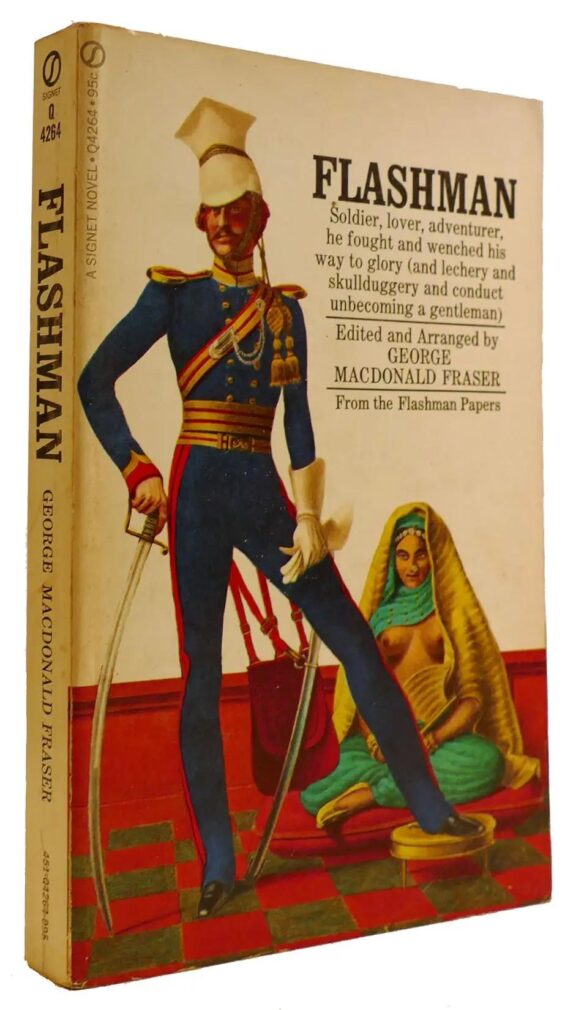
Sir Harry Paget Flashman VC, KCB, KCIE, 1822 – 1915

I grant he’s not even genre adjacent, but I’ll give you a tale in a minute that makes it relevant to us. Harry Flashman appears in a series of twelve George MacDonald Fraser’s books collectively known as The Flashman Papers. If Flashman had a birthday, the author says it would have been earlier this week, May 5. 

The first novel, Flashman, was published in 1969 and many readers here in the States thought it was a work of non-fiction. He’s certainly not the only fictional that readers have assumed was real. Or wished was so. Who would you would want to be? 

The books center on the exploits of Harry Flashman. He is a cowardly British soldier, rake and just generally disreputable character who is placed in a series of real historical incidents between 1839 and 1894. It must be noted that despite his cowardice and his attempts to flee danger whenever possible, he becomes a decorated war hero and rises to the rank of brigadier-general. 

There is a Chumbawamba  song, “Hanging on the Old Barb Wire”, which has the lyric 

If you want to find the general
I know where he is
He’s pinning another medal on his chest
I saw him, I saw him
Pinning another medal on his chest

(It’s a variant of a Great War song of the same name. As the band notes on their  English Rebel Songs 1381–1914 LP, “Hanging on the Old Barbed Wire was written by soldiers in the trenches in the first world war. Designed to be sung whilst marching the song is one of many showing the dissent and disgust at the way war perpetuates the inequalities of rich and poor—those with the money give the orders, those without money face the guns.”)

Royal Flash, the 1975 British film, is based upon the second Flashman novel of the same name. It stars a thirty-two year old Malcolm McDowell as Flashman. It was not well received as The Observer noted it left them “breathless not so much with enchantment as with boredom”. However audience reviewers at Rotten Tomatoes currently give it a rating of sixty-four percent which isn’t bad at all. 

Here’s the trailer with a really funny narrator. As always, the standard warming about linking to copies of the film which is up on YouTube apply. You really don’t want to be defenestrated, do you? It can be rather painful or worse. 

Now for that genre connection that mentioned much earlier. No, I didn’t forget… 

Kage Baker didn’t actually write a Flashman novel, though we talked several times about her doing so, but the bones of one appeared in one of her novels as her sister Kathleen told me here: “Most of her notes she used in her last novel, Not Less Than Gods, which she wrote while she was sick, and that was published as she was dying. As far as I can tell, Kage and I were the only people in the world who liked it. A lot of it was panned because the reviewers didn’t get most of the satire, or hated Edward Alton Bell-Fairfax, or both. Anyway, even if you personally disliked the book, I think you can see the bones of a Flashman novel there.” 

Now the Green Man reviewer also liked it though he had a lump in his throat as Kage had just died as he wrote his review.

I’m pleased to say the entire series is available in hardcover, trade paperback, epub and audiobook.   As audiobooks, the narration as done by David Chase captures the character extraordinarily well. 

(10) COMICS SECTION.

Or, if you prefer a smaller bookshop:

Tom Gauld (@tomgauld.bsky.social) 2025-05-05T16:23:31.496Z

(11) SFF TO STREAM NOW. “’Godzilla Minus One’ and Other Science Fiction Movies to Stream” – recommendations from the New York Times. (Link bypasses paywall.) Here’s one of their picks.

‘Alienoid: Return to the Future’

Can’t decide if you want to watch a movie involving tentacled aliens or one with a sorcerer? Wire fu or time travel? How about ominous spaceships? The Korean director Choi Dong-hoon has you covered with his two-part “Alienoid” epic, which includes all of these elements. The second installment kicks off with a serviceable recap so newcomers can jump in, but having seen its predecessor, “Alienoid” (2022), makes the overall experience more enjoyable.

The madcap action goes back and forth between the 14th century and 2022 Seoul, when an alien menace going by the Controller is threatening to kill the entire population by unleashing a lethal gas. The key to defeat the Controller is in the past and involves a weapon called the Divine Blade. Even more important are the actions of a ragtag team that includes the spunky Ean (Kim Tae-ri, from “Space Sweepers”) and her possible love interest, Muruk (Ryu Jun-yeol). Choi keeps up a steady pace, peppered with goofy humor and surreal touches, as when Roy Orbison’s “In Dreams” plays during a big moment. Narrative coherence is an afterthought in the “Alienoid” universe so it’s best to go with whatever wackadoo scenes the movies throw at you: What matters here is pure fun, and this installment delivers.

(12) SHAUN THE SHEEP 3. [Item by Steven French.] Who could resist a trip to Mossy Bottom?! “Aardman announces third Shaun the Sheep movie: The Beast of Mossy Bottom” – details in the Guardian.

A Halloween-themed third Shaun the Sheep film is in the works from Aardman Animations, following hot on the heels of the success of Wallace & Gromit: Vengeance Most Fowl.

“Expect smashed pumpkins, wayward science, and a wild hairy beast,” said Sarah Cox, chief creative director of Aardman, about the film, which launches international sales via studio StudioCanal at Cannes next week, but has already been acquired by Sky for UK distribution.

“Shaun the Sheep: The Beast of Mossy Bottom sees the residents of Mossy Bottom Farm looking forward to Halloween – until the clumsy farmer trashes the flock’s beloved pumpkin patch!” runs a synopsis for the film.

“When Shaun turns mad scientist to fix the problem, things rapidly spiral out of control … With the farmer missing and a wild beast roaming the woods of Mossingham, all the ingredients are in place for a monstrously fun family adventure.”

(13) LEGO AND LUNAR OUTPOST PARTNERSHIP. “Lego and Lunar Outpost to roll out ‘Moon Rover Space Vehicle’ in August” promises CollectSPACE.

The United States’ first teleoperated rover to reach the moon’s surface is rolling out as a Lego model this summer, together with two futuristic vehicles inspired by real-life robotic lunar explorers.

The new Lunar Outpost Moon Rover Space Vehicle is scheduled for release on Aug. 1, as part of Lego’s Technic line of advanced building kits. The $99.99 set is the result of a collaboration between the Danish toymaker and Lunar Outpost, a Colorado-based company specializing in lunar surface mobility, commercial space robotics and space resources.

“Inspired by real-life Lunar Outpost vehicles enabling humanity’s return to the moon, this Lego Technic Lunar Outpost Moon Rover Space Vehicle comes with a moon rover, mining rover and MAPP rover to inspire endless journeys of exploration,” reads the set’s description on Lego’s website.

The MAPP, or Mobile Autonomous Prospecting Platform, was the key part of Lunar Outpost’s Lunar Voyage 1 mission, which on March 6 arrived on the moon, making history. It would have made even more, had the commercial lander that delivered MAPP there not have immediately tipped over, trapping the rover inside its garage. It never had the chance to actually rove anywhere….

(14) ONE LAST LANDING ON THE GLOBE THAT GAVE IT BIRTH. “53-Year-Old Soviet Spacecraft Will Plummet Back to Earth This Week” reports Gizmodo.

Kosmos 482 has been trapped in Earth’s orbit for 53 years but its wandering journey is coming to an end. The failed Venus mission is expected to reenter through the atmosphere in a dramatic fall toward its home planet, where it may remain intact or scatter its bits across a still unknown location on either side of the equator.

The Soviet-era spacecraft will plunge through Earth’s atmosphere sometime between May 8 to 12. As of now, the exact location of where Kosmos 482 will crash-land on Earth is still unknown, with a preliminary estimate that stretches across large parts of the world on either side of the equator. It’s also unclear whether the spacecraft will remain in one piece or if it will break apart during reentry, raining down bits of debris.

Kosmos 482 launched on March 31, 1972 from the Baikonur Cosmodrome spaceport in what is know Kazakhstan. The mission was an attempt by the Soviet space program to reach Venus, but it failed to gain enough velocity to enter a transfer trajectory toward the scorching hot planet….

(15) DONE BY DAYLIGHT. “Lunar laser: China makes 1st daytime laser-ranging measurement from Earth to the moon”Space has the story.

China has achieved a milestone feat, making the first-ever laser ranging measurement from Earth to the moon during the daytime.

Researchers at Yunnan Observatories under the Chinese Academy of Sciences (CAS) used an infrared lunar laser ranging system of a recently upgraded 1.2-meter (3.9 feet) telescope to ping a small laser retroreflector on the Tiandu 1 satellite orbiting the moon.

Laser ranging over lunar distances is challenging, requiring sending a high-power, precise beam over 186,000 miles (300,000 kilometers) to hit a small corner retroreflector, which bounces the laser pulse straight back where it came from. The return signal then needs to be picked up by a telescope using ultra-sensitive detectors. Doing this in the daytime brings the added challenge of massive background “noise” from the sun….

(16) SQUAREPANTS TREK BLOOPERS. Animation Magazine is there when “Paramount+ Voyages Behind the Scenes of Crossover Spot ‘Patrick Starship Enterprise’”.

Following the debut of its new Star Trek: Strange New Worlds X SpongeBob SquarePants promo video (which you can watch here), Paramount+ has dropped a behind-the-scenes blooper reel full of illogical, astro-nautical amusement.

Starring Strange New Worlds cast members Ethan Peck (Spock), Anson Mount (Christopher Pike) and Celia Rose-Gooding (Nyota Uhura), the new video pokes fun at the making of the short and features some funny moments where we see the creative stand-in solutions for the animated characters, which include SpongeBob, Sandy and Mr. Krabs…

[Thanks to Steven French, Kathy Sullivan, Teddy Harvia, Steve Green, Joey Eschrich, Mike Kennedy, Andrew Porter, John King Tarpinian, Chris Barkley, Cat Eldridge, SF Concatenation’s Jonathan Cowie, and Mark Roth-Whitworth for some of these stories. Title credit belongs to File 770 contributing editor of the day Jim Janney.]

Pixel Scroll 11/21/24 Pixels That Need Pixels Are The Happiest Pixels In The Scroll

(1) NATIONAL BOOK AWARDS. No winners of genre interest, but omnivorous readers will want to know who received the 2024 awards. Publishers Weekly led its coverage with a joke from the ceremony:

…[L]ongtime Saturday Night Live cast member Kate McKinnon, [was] the evening’s host. “I’m a book awards virgin, so be gentle,” she joked before opening her remarks, appropriately for 2024, with a bit about AI. “Books do more than entertain—they illuminate, they provoke, and, most importantly, they inspire change,” she said. “That was written by CHatGPT. Is that bad?”…

  • YOUNG PEOPLE’S LITERATURE: Shifa Saltagi Safadi, Kareem Between (G.P. Putnam’s Sons Books for Young Readers / Penguin Random House)
  • TRANSLATED LITERATURE: Yáng Shuāng-zǐ, Taiwan Travelogue. Translated from the Mandarin Chinese by Lin King (Graywolf Press)
  • POETRY: Lena Khalaf Tuffaha, Something About Living (University of Akron Press)
  • NONFICTION: Jason De León, Soldiers and Kings: Survival and Hope in the World of Human Smuggling (Viking Books / Penguin Random House)
  • FICTION: Percival Everett, James (Doubleday / Penguin Random House)

(2) WHY DID THEY SAY THAT? T. R. Napper side-eyes “Five Pieces of Awful Writing Advice (from the masters)”. And by masters, we mean Stephen King, Robert Heinlein, Charles Bukowski, Ernest Hemingway, and Elmore Leonard. First on his hit parade:

Don’t keep a notebook (Stephen King)

“I think a writer’s notebook is the best way in the world to immortalise bad ideas. My idea about a good idea is one that sticks around and sticks around.”

Terrible advice, for one simple reason: none of the rest of us are Stephen King. He’s written around 70 books. He writes and writes and writes. Squashed by a fucken van, six weeks in hospital, dusts himself off, keeps writing. Apparently sits down and churns out 6 pages (1500 words) a day, every day, no problem. In terms of idea generation he is a phenomenon. He’s not like you or me.

Don’t get me wrong – ideas will come for the writer. They always do, whether you wish them to or not. But you should write them down. I absolutely have a document where I keep all my big ideas that one day might (or might not) become a short story or a novel. When I go back and look through it every few months, I’ll see some truly stupid thoughts, but I’ll also see a few where I think: I’d forgotten about that. Let’s try it.

(3) WICKED GOOD. The Hollywood Reporter critic David Rooney weighs in with “’Wicked’ Review: Cynthia Erivo and Ariana Grande in Beloved Musical”.

… The respective casting of those roles — Ariana Grande as the minimally gifted sorcery student who will go on to become Glinda, Good Witch of the North, and Cynthia Erivo as Elphaba, future Wicked Witch of the West — is the movie’s winning hand. Their vocals are clear and strong and supple to a degree many of us have learned not to expect after too many movie musicals that cast merely adequate singers and then Auto-Tune them to death.

Grande and Erivo give Stephen Schwartz’s songs — comedy numbers, introspective ballads, power anthems — effortless spontaneity. They help us buy into the intrinsic musical conceit that these characters are bursting into song to express feelings too large for spoken words, not just mouthing lyrics and trilling melodies that someone spent weeks cleaning up in a studio. The decision to record the songs live on set whenever possible is a major plus….

(4) TIMELESS AND TOPICAL. “Jon M. Chu Embraced the Politics of ‘Wicked’ and Audiences Seeing It Through a Post-Election Lens” on IndieWire.

…[Director Jon M.] Chu embraces that his movie will take on a new layer of meaning for many audience members after the re-election of Trump, but noted that impact is in part because politics has been baked into “Wicked” since its inception. Gregory Maguire’s 1995 book “Wicked” is a meditation on resisting fascist movements, a not-so-subtle theme that carried into its musical adaptation by Stephen Schwartz and Winnie Holzman. A major underlying storyline of “Wicked” is how leaders, who claim to have the people’s best interest at heart, attack the educated — represented by professor Dr. Dillamond, a talking goat voiced by Peter Dinklage — as they try to rewrite the history of animals and humans co-existence in an effort to strip the animals of their rights, and demonize them as the source of the people’s problems.

Through this lens, Chu acknowledged his film is prophetic, but only because the underlying IP is prophetic. Chu argued the original “Wizard of Oz” movie — released on the heels of the 1930s Dust Bowl (the drought-stricken storms of the Depression), during the rise of fascism, and on the eve of World War II — has always spoken to America in a time of transition. He personally experienced it at two very different political moments that “Wicked” entered his life….

(5) TERMINAL JUSTICE. “How Do You Punish a Machine? (And why would you want to?)” asks Graham Brown at CrimeReads.

…For their wisdom we turn to the ever-instructive eyes of the science fiction writers of the world.

Starting with 2001: A SPACE ODYSSEY by Arthur C. Clarke, the classic example of machines becoming sentient, in which HAL9000 commits multiple homicides, wiping out the sleeping crewmen of the Discovery, and then eventually attempts to murder the last surviving astronaut Dave by locking him out of the airlock.  Quite a set of crimes.  But in HAL’s defense, he’d been given conflicting programming and told to lie, factors that many believe caused him to lose his electronic mind.  In addition, he may have been under the influence of the mysterious monolith. HAL might also raise a claim of self-defense. At the time he tried to kill Dave, he knew Dave was intending to disconnect him and shut him down.

Interesting case.  A good lawyer could make an argument for not guilty by reason of insanity and self-defense, but I’m going to say guilty.  To his credit, HAL becomes normal again and sacrifices himself for the crew in 2010 ODYSSEY TWO, perhaps atoning for his terrible crimes…

(6) WHERE PROPHETS ARE WITHOUT HONOR. Cora Buhlert deconstructs the popularity of German band Kraftwerk while simultaneously demythologizing the Autobahn in “A Baffled Guardian Writer Discovers the Autobahn – and the Best German Roadtrip Songs” – an entertaining read!

…This is also where the problem with foreigners driving on the Autobahn comes in. They’re often driving an unfamiliar car, they’re not used to high speeds and also don’t know where and when it’s reasonably safe to go fast. See Tim Jonze starting his Autobahn adventure in the Rhine-Ruhr metropolitan area, where it’s definitely not safe to go fast (and not allowed either). At one point, Jonze also opens the driver’s side window, while going 150 kilometers per hour, which makes me wonder if he’s fucking crazy.

What’s even more hilarious is that while Kraftwerk were on the road a lot in the 1970s, travelling from gig to gig, usually on the Autobahn, often by night, their car was a Volkswagen Beetle. Tim Jonze has apparently never driven a Volkswagen Beetle, but I have, because my parents had one in the 1970s and early 1980s. So I know that they couldn’t go any faster than 130 kilometers per hour and the car started rattling like crazy at approx. 100 kilometers per hour. The Beetle‘s successor, a 1980 Volkswagen Jetta, which I continued to drive until 2008 (I wanted to keep it to hit the thirty year mark, when a car is considered a historical vehicle in Germany and gets a special licence plate, but unfortunately the Jetta fell apart two years before), capped out at 160 kilometers per hour and also started to rattle like mad at anything above 130 kilometers per hour.  So Kraftwerk were travelling at the relatively leisurely pace of approx. 100 kilometers per hour in a Volkswagen Beetle, when they wrote the “Autobahn” song….

(7) OCTOTHORPE. In episode 123 of the Octothorpe podcast, “Infinite Amount of Annual Leave”, John Coxon, Alison Scott, and Liz Batty “don’t have any letters of comment but we do have discussion of the Belfast Eastercon, Reconnect, as well as musings on online convention Back to Our Futures and upcoming Worldcons and Eurocons. Plus, Liz read a book.”

An uncorrected transcript is available at the link.

A coffee stain on a piece of paper on which are written the words “Octothorpe 123” and “fully caffineated”.

(8) MEMORY LANE.

[Written by Cat Eldridge.]

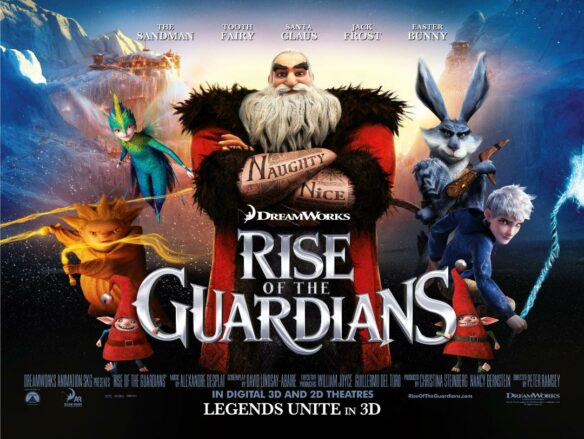
Anniversary: Rise of the Guardians (2012)

On this day twelve years ago, The Rise Of The Guardians enjoyed its premiere in limited release with its full one that coming weekend.  It is quite possibly my favorite holiday film, though ScroogedLion in WinterThe Polar Express are also on the list as well. Oh and the forty year old version of A Christmas Carol starring George C. Scott. 

It was directed by Peter Ramsey and produced by Christina Steinberg and Nancy Bernstein from a screenplay by David Lindsay-Abaire. It was based on William Joyce’s The Guardians of Childhood series, a most delightful series indeed. 

OK, IT IS TIME FOR A CUP OF HOT CHOCOLATE PREPARED BY THE STEWARDS OF THE POLAR EXPRESS. COME BACK AFTER WE HAVE TOLD THE STORY OF THIS FILM.

The Guardians of Childhood series was a mystical epic of mythological characters fighting darkness to protect childhood dreams. It made very good source material for that aforementioned screenplay by David Lindsay-Abaire in which Jack Frost awakens from a very long nap under the ice with his memory gone to discover everyone has forgotten him.

Meanwhile at the North Pole (splendidly realized here), the Man in the Moon warns Nicholas St. North that Pitch Black (who look a lot Mr. Dark in Bill Willingham’s Fables series) is threatening the children of the world with his nightmares. 

He calls E. Aster Bunnymund, the Sandman, and the Tooth Fairy to arms. Each of these is a wonderfully realized character as the Man in the Moon and Nicholas St. North.

A series of truly epic battles to defeat Pitch Black follows lest all the children of the world are permanently beset with nightmares. He is defeated when his own Nightmares sensing he has grown weak drag him down into the Underworld.

DID YOU ENJOY THAT HOT CHOCOLATE? GOOD, COME ON BACK. 

The feature starred the voice talents of Hugh Jackman, Jude Law and Isla Fisher among others. I think it was a stellar voice cast and the animation was splendid. I’ve rewatched it several times, and the Suck Fairy sits on the couch sighing, drinking hot chocolate, stroking a Pixel, and saying that it’s too sweet for her to mess with. The holiday season does bring out the soft side of her. 

It did exceedingly well at the box office taking in over three hundred million on a budget of one hundred and thirty million according to Box Office Mojo, and about half of the critics really liked it such as Derek Adam’s of Time Out who proclaimed “Rise of the Guardians is an effervescent dose of fantasia that’s pretty hard to dislike. Unless, of course, you’re a cynical grump.” The grumpy ones I’ll not quote, but I’ll just say that Old Nick should give them a lump of coal this season.

The audience rating at Rotten Tomatoes is very healthy eighty percent.

Rise of the Guardians can be rented on Amazon Prime.

(9) COMICS SECTION.

(10) THE PAST IS ANOTHER COUNTRY. “In Search of the Moomins in Helsinki: The Enduring Magic of Tove Jannson’s Characters” at Literary Hub. “Christiana Spens Returns to Her Father’s world (and the Beloved Moomin Books)”.

… As we explored Helsinki, perhaps inevitably, I kept thinking of my own father. As we sat in cafes and parks, I wondered which of them he had gone to, which of the museums and islands he had explored. Helsinki felt so familiar that it was as if I had already been here, and yet the more time we spent there, the more I realized that I didn’t know anything about my father’s time here at all.

He had not really told me stories about coming here; he had just gone and come back. I had imagined his times in Helsinki based on the gifts he returned with, the pictures in his books, and later the Moomin stories; but he had not really told me anything himself.

He had written about Alvar Aalto, expressed joy at the sight of herrings or gooseberries or meatballs; I knew he loved the place. He had even tried to build a Finnish summer house, in the same sky blue that was popular here; but he had never been very practical minded, and it had not stood up well to the elements.

Nevertheless, I had lived there for several years as a teenager. Perhaps this experience, living in a weather-beaten wooden Summer House in the woods, is what made Finland itself seem familiar to me, rather than anything my father ever told me about the country.

And yet, now that I was here, I found myself wondering about him anyway; had he gone to Esplanade Park, had he had coffee at Fazer, had he known Rock Church or the Uspenski Cathedral, had he felt this light as I did now? But I didn’t actually know, and I never would; he was not here, only his ghost was.

But the Alvar Aalto buildings were, all the other reminders were. And the Moomins were here, too; in gift shops and cafes, these friendly creatures appeared, giving the whole city the cast of a fairy-tale, along with its mists and sea, its pastel-colored buildings, its ships and cobbled stones….

(11) HUFFIN’ AND PUFFIN. Daisy Ridley answers readers’ questions over at the Guardian: “Daisy Ridley: ‘I made a toilet cake on Bake Off because flushing with the lid up is unhygienic beyond belief’”.

Did those late-night drinking and ceilidh sessions during the filming of The Force Awakens on the Skellig islands in County Kerry give you a taste for old-school, dusty pub culture and creamy stout? Galdove19

I’d never had a Guinness outside Ireland, so I got the good stuff the first time round. We had the sun shining on us every day, which the Irish crew said was unbelievable, although every time I’ve been to Ireland it’s been absolutely glorious. I had to climb about a thousand stairs up Great Skellig. Our unbelievable camera operator had a Steadicam and was climbing up backwards, so I thought: “There’s no way I can complain.” That tamed my own exhaustion. The Skellig islands are an ecological site, so we had to not disturb the puffin population, who were there one day, but had migrated the next, which was eerie and amazing. They obviously weren’t big Star Wars fans and thought: “We’ve had enough of this.”

(12) EXERCISE IN TERROR. [Item by Steven French.] Coming a little late for Halloween: “The health benefits of fright: A haunted house study” at Medical X Press.

…People often engage in activities that elicit fear for recreational purposes, from ghost stories and jump scare pranks to modern horror films and haunted attractions. This haunted house experiment suggests that such experiences may not only provide thrills but also potential health benefits by modulating immune responses.

Further research is needed to confirm the observed effects and explore the mechanisms underlying the relationship between recreational fear and immune function before clinical applications can be considered significant enough to incorporate acute fear into a health care setting….

(13) WHOVILLE’S GOLDEN ARCHES. The Grinch is now in Happy Meal at McDonald’s. So then — are these roast beast nuggets?

(14) JUMPING OUT OF THE WAY. “The International Space Station adjusts its orbit to avoid space debris”NPR has the details.

NASA says that the International Space Station (ISS) shifted its orbit on Tuesday to avoid a piece of debris.

The debris avoidance maneuver involved firing thrusters on the ISS at 2:09 p.m. CT for 5 minutes, 31 seconds, according to NASA. This adjustment raised the ISS orbit to “provide an extra margin of distance from a piece of orbital debris from a defunct defense meteorological satellite that broke up in 2015,” the agency says.

Had the maneuver not been conducted, the debris would have come within nearly 2.5 miles of the station, NASA also says. The debris was “small,” U.S. Space Forces-Space tells NPR…

(15) INTERNATIONAL STAR WARS SHOW RENEWED. Variety reports, “’Star Wars: Visions’ Series to Return for Third Season”.

“Star Wars: Visions,” a Lucasfilm anthology series of animated shorts from around the world celebrating the mythology of Star Wars through different cultural perspectives, will return for a third season, Marvel Studios’ president Kevin Feige said on Wednesday.

Feige was a surprise guest at the annual Walt Disney Company Asia Pacific Showcase held in Singapore.

“Star Wars: Visions Volume 3” will debut in 2025 on the Disney+ streaming service. The upcoming series will feature both new and returning anime studios, and return to Japan to celebrate the world of anime through the elements and mythos of Star Wars….

(16) VIDEO OF THE DAY. Ryan George takes us inside the Red One Pitch Meeting”.

[Thanks to Mike Kennedy, Andrew Porter, John King Tarpinian, N., Chris Barkley, Cat Eldridge, SF Concatenation’s Jonathan Cowie, Steven French, Kathy Sullivan, and Teddy Harvia  for some of these stories. Title credit belongs to File 770 contributing editor of the day Dan’l.]

Pixel Scroll 7/1/24 Don’t Scroll Tonight: Call Pixel Delight!

(1) WESTERCON, JUST ADD HEMLOCK. Kevin Standlee won’t be making the motion, but ”For Those Who Want to Retire Westercon” he has written the recipe. Kevin explains:

[It’s] something that might come up at the Westercon Business Meeting if at least two members present decide to use it, or if the motion arises out of a Committee of the Whole should no bid win the election. At this time, there are no bids filed, but a bid could always file a write-in up until voting closes on Friday evening, and if they do so and out-poll None of the Above, the Business Meeting would probably give a collective sigh of relief that they don’t have to deal with the decision for the third year in a row.

(2) DUST & DARK TO LAUNCH IN 2025. Dust & Dark, a new print and digital quarterly magazine specializing in short horror fiction, will launch in 2025.

 Editor Owen Duffy says the magazine will offer deliciously dark tales for readers.

 “Our focus is on stories that get under your skin and stay with you long after you’ve turned the final page,” he says.

 “We aren’t interested in straightforward shocks or gratuitous gore. We’re all about inventive, stylish, original stories with strong characterisation, tight pacing and immersive settings.

 “We also absolutely see horror as part of the speculative fiction family. We’ll feature stories which explore a range of ideas and issues, open us up to new perspectives and look at the world from slightly sideways angles.”

 The magazine is set to launch following a Kickstarter campaign in November. Story submissions will open in September. To be notified when submissions go live, sign up for updates at https://dustanddark.com/.

(3) IF YOU’RE IN THE NEIGHBORHOOD. The UK’s National Trust invites everyone to “Visit great writers’ and poets’ houses”. One of the places on their list is:

Hill Top, Cumbria

Beatrix Potter bought Hill Top with the royalties earned from her first book, Peter Rabbit. The garden and surrounding countryside inspired many of her works – spot the beehive nestled in the garden wall, just as it was depicted in The Tale of Jemima Puddle-Duck.

(4) BIG RED ONE. “’Hellboy: The Crooked Man’ first trailer reveals Jack Kesy as the titular demon”Entertainment Weekly sets the frame.

Different Hellboys come and go, but there will always be things that go bump in the night — and who better to defeat them than the lovable red superhero? Later this year, actor Jack Kesy (12 Strong) will be the third actor to play Mike Mignola’s Hellboy on the big screen, and you can see him in action in the first trailer for Hellboy: The Crooked Man… 

(5) BOT SPEECH. “The Voices of A.I. Are Telling Us a Lot” says the New York Times. “Even as the technology advances, stubborn stereotypes about women are re-encoded again and again.” (Behind a paywall.)

…A.I. creators like to highlight the increasingly naturalistic capabilities of their tools, but their synthetic voices are built on layers of artifice and projection. Sky represents the cutting edge of OpenAI’s ambitions, but she is based on an old idea: of the A.I. bot as an empathetic and compliant woman. Part mommy, part secretary, part girlfriend, Samantha was an all-purpose comfort object who purred directly into her users’ ears. Even as A.I. technology advances, these stereotypes are re-encoded again and again.

Women’s voices, as Julie Wosk notes in “Artificial Women: Sex Dolls, Robot Caregivers, and More Facsimile Females,” have often fueled imagined technologies before they were built into real ones.

In the original “Star Trek” series, which debuted in 1966, the computer on the deck of the Enterprise was voiced by Majel Barrett-Roddenberry, the wife of the show’s creator, Gene Roddenberry. In the 1979 film “Alien,” the crew of the USCSS Nostromo addressed its computer voice as “Mother” (her full name was MU-TH-UR 6000). Once tech companies started marketing virtual assistants — Apple’s Siri, Amazon’s Alexa, Microsoft’s Cortana — their voices were largely feminized, too.

These first-wave voice assistants, the ones that have been mediating our relationships with technology for more than a decade, have a tinny, otherworldly drawl. They sound auto-tuned, their human voices accented by a mechanical trill. They often speak in a measured, one-note cadence, suggesting a stunted emotional life.

But the fact that they sound robotic deepens their appeal. They come across as programmable, manipulatable and subservient to our demands….

(6) MEMORY LANE.

[Written by Cat Eldridge.]

July 1, 1991 Terminator 2: Judgement Day. Terminator 2: Judgement Day was released on this day in 1991.  It won a Hugo at MagiCon, so may I question why oh why wasn’t The Terminator nominated for a Hugo?  Tell me oh Filers why it wasn’t. It certainly deserved one, didn’t it?

Now let’s discuss this film, that like The Terminator, I indeed did see at a theater. It had its first showing thirty three ago in the States at Century City in Los Angeles with a general release two days later.  That’s seven years after The Terminator came out.

Not at all surprisingly, just about everyone involved in The Terminator is back here. Like the first film, it’s directed by James Cameron.  Cameron is very much the driving force as he also wrote both scripts, the first with Gale Anne Hurd, whom he married a year after The Terminator came out, and this film with William Peter Wisher  who also worked uncredited on The Terminator

The Terminator was a considerable success, making the careers of both Cameron and Schwarzenegger, but work on what would become  this film almost ended  because of animosity between the pair and Hemdale Film Corporation, which partially owned the film’s rights. So they got Carolco Pictures to purchase the rights from The Terminator producer Gale Anne Hurd and Hemdale, which was almost bankrupt.

Now they owned the rights to produce a sequel. Cameron engaged  his long-time friend Wisher who I noted had worked uncredited on The Terminator. He’d later be responsible for writing the Judge Dredd script. Oh well.  This script was written in just seven weeks. 

So we’ve got a script, now do we have a cast? Oh yes.  Schwarzenegger is obviously back and so is the only other individual that counts, Linda Hamilton. Robert Patrick is here as well. That’s the primary cast. (Remember we don’t do story lines here as one of you might not have seen it. I’ve seen it. It’s excellent.) 

Now let’s talk budgets.  The Terminator cost a shade over eight million to make. This film? We think that it cost at least thirteen times which comes out to just over a hundred million.  Fortunately, it made so much money that I think they just stopped counting after a while as they only give an estimate, but over a half billion is definitely what it made plus somewhat more.

So the public loved it, but what did critics think of it? Most liked it. Some who, in my opinion of course, had an unhealthy attachment to the first didn’t. 

Derek Malcolm of the U.K. based Guardian was typical of the reviewers who liked it: “Cameron has done an honourable and undoubtedly skilful job of tailoring his new film to the tastes of the times without too much sloppy compromise. He’s made a science fiction film with verve, imagination and even a little wit.” 

On the other hand, we have Ralph Novak of People Magazine who sadly said, “Shamefully sadistic, achingly dull and totally predictable, it rehashes the far superior 1984 original.” 

But let’s not forget our heroine. Alan Jones of Radio Times said about her in this film : “Linda Hamilton turns in another terrific performance as the fiercely committed heroine who puts a necessary human face on Cameron’s high-decibel mayhem and pyrotechnical bravura.”

(7) COMICS SECTION.

  • The Argyle Sweater features monster party games.
  • Carpe Diem says it’s no fun waiting for evolution.
  • Rubes remembers a different Sixties Godzilla than you and me.

(8) THAT JAZZ-LOVING LOVECRAFT FAN. [Item by Steven French.] On the recommendation of my brother, I’ve been working my way through Andrew Hickey’s podcast “A History of Rock Music in 500 Songs”, which started in 2018. In episode 13, featuring “’Mama He Treats Your Daughter Mean’ by Ruth Brown”, he mentions the important role played by one Willis Conover:

…Conover was a fascinating figure — he presented the jazz programme on Voice of America, the radio station that broadcast propaganda to the Eastern bloc during the Cold War, but by doing so he managed to raise the profile of many of the greatest jazz musicians of the time. He was also a major figure in early science fiction fandom — a book of his correspondence with H.P. Lovecraft is now available.

Conover was visiting the nightclub along with his friend Duke Ellington, and he was immediately impressed by Ruth Brown’s performance — impressed enough that he ran out to call Ahmet Ertegun and Herb Abramson and tell them to sign her.

Ertegun and Abramson were the founders of Atlantic Records, a new record label which had started up only a couple of years earlier.

As a teenager Conover produced the fanzine Science Fantasy Correspondent and the book Hickey mentions was Lovecraft at Last.

Ruth Brown not only went on to have a number of hits in the 1950s and was eventually inducted into the Rock ‘n Roll Hall of Fame in the 1990s, but had a second career as an acclaimed musical actress, earning a Tony award for the musical Black and Blue.

(9) CLARKE-INSPIRED TV. “Star Trek Legend Jonathan Frakes to Direct New Sci-Fi Series”CBR.com has the story.

…Per Variety, Frakes will produce and direct all six episodes of the new sci-fi series, Arthur C. Clarke’s Venus Prime. The new show is based on the series of novels written by Paul Preuss, a collaborator of Clarke’s, which takes inspiration from characters and places from Clarke’s short stories. Preuss will also be involved as a consultant for the show. David Cormican and Dwayne Hill are set to executive produce and will serve as showrunners for the series. Production on the show is expected to begin near the end of the year.

Frakes, who is no stranger to directing science fiction, expressed his excitement for the project and his love for the series of novels. “When the materials for Arthur C. Clarke’s Venus Prime were presented to me, I couldn’t help but devour them,” Frakes said. “When asked if I wanted to direct what I read —my answer was a resounding and immediate ‘Hell, yes!’ Working on such a tremendous piece of IP from the mind of another sci-fi legend (who is also a contemporary of the true #1 Gene Roddenberry), will be both an honor and a dream for me.”…

(10) THESE FEET ARE MADE FOR WALKIN’. NPR goes to find out how “The Bigfoot Festival draws thousands to West Virginia”.

This weekend, the tiny town of Sutton, W.V., population 840, is hosting about 20,000 people for its annual Bigfoot Festival. It’s a celebration of a mythical giant, hairy primate with – that’s right – big feet. Briana Heaney spoke to those still looking for the creature and others who just love the idea of it.

BRIANA HEANEY, BYLINE: Folklore is a pillar of Appalachian culture as much as banjos and quilts are. And in Sutton this weekend, it’s all about Bigfoot.

(SOUNDBITE OF BELL)

HEANEY: Here in Sutton, the country store doubles as a Bigfoot museum. Laurel Petolicchio owns and runs it. Petolicchio has never seen Bigfoot, but she’s heard a lot of stories.

LAUREL PETOLICCHIO: I’ll have these big mountain men come into my counter, you know, of my little country store. And the one guy, I mean, slammed his hand down on the table, I mean, on my counter. And he’s like, you don’t believe this crap, do you? And I’m like, well, I kind of do. And he’s like, why? And I said, well, it’s the stories I hear. And it’s just – there’s so many of them. And then he leaned forward and he’s like, OK, can I tell you mine? I’m like, what? Like…

(11) VIDEO OF THE DAY. A new Deadpool & Wolverine trailer. Movie arrives in theaters on July 26.

[Thanks to John King Tarpinian, Chris Barkley, Cat Eldridge, Kevin Standlee, SF Concatenation’s Jonathan Cowie, Steven French, Teddy Harvia, Kathy Sullivan, Mike Kennedy, and Andrew Porter for some of these stories. Title credit belongs to File 770 contributing editor of the day Kip W.]

Pixel Scroll 12/16/23 To Say Nothing Of The Pixels

(1) THE HILLS ARE ALIVE WITH THE SOUND OF MURDER. James Davis Nicoll assigned the “Young People Read Old SFF” panel a series of Hugo finalists to read. We’ve reached the end:

The final installment1 in Young People Read Old Hugo Finalists is Lois McMaster Bujold’s 1989The Mountains of Mourning. One of Bujold’s popular Miles Vorkosigan stories, Mountains is a murder mystery. Through Miles’ eyes, Bujold explores certain aspects of Barrayaran life generally kept off-stage thanks to the series’ focus on the aristocracy. 

Mountains won the Best Novella Hugo, beating The Father of Stones by Lucius Shepard, A Touch of Lavender by Megan Lindholm, Time Out by Connie Willis, and Tiny Tango by Judith Moffett. I’ve not read the other finalists so I cannot compare them to the winner. I can say that Mountains was the first Bujold I read. It is the reason I have a shelf full of Bujold novels.

Fans liked it. I liked it. But did the Young People like it?…

Nicoll says the next project, debuting in 2024, is Young People Read Old Nebula Finalists

(2) THEY LIVE! Galaxy is also being resurrected by the same company that has announced the relaunch of Worlds of IF. “Galaxy Science Fiction, February 1951 (FIRST-EVER WEBZINE REISSUE + new bonus content!)” at Starship Sloane Publishing.

I am happy to announce that this magazine, like its sister publication, Worlds of IF, is also being revived and relaunched by Starship Sloane Publishing Company, Inc.

This might be a slow process, as we are wonderfully busy with the booming relaunch of Worlds of IF already, and I have no desire to make things overly frenetic. The idea is to methodically breathe new life into Galaxy. It seems only fitting that these two magazines should walk hand in hand once again. I will be keeping this celebrated magazine skinny, minimalist in style, and highly selective. The quality of work will speak for itself….

… I do this for the love of creativity and science fiction. But I also strive for simplicity. If something becomes a self-imposed, burdensome form of work, I reevaluate. I will not place stressful expectations on myself here. A strict publishing schedule? Very unlikely. But semiannually sounds about right, I suppose…. 

(3) GONE IN POINT SIX SECONDS. The MinnPost believes people should be concerned with “Protecting physical media in an age of streaming”.

It’s been repeated, echoed and understood ad nauseam that we live in the streaming era.

We get it. Something that streamers may not understand, however, is that nobody owns their digital media.

The $12.99 spent through Amazon Prime Video to purchase “Barbie” is not “your” copy of the film. A person only has access to it until Amazon decides it doesn’t want to support the licensing anymore. This concept is not new or nuanced, but it is lost. The constant shuffling of online media between major streaming conglomerates has resulted in physical media’s futility in the eyes of the general public. We indeed live in the streaming age, but it’s also an age where the cultural impact of art preservation is needed more than ever.

This sentiment is not a condemnation against people using services like Netflix and Spotify. The convenience factor of these platforms is undeniable. However, combing through records, DVDs and books at local businesses should become something other than ancient practice.

Art preservation is at the forefront of this streaming puzzle because of the cultural significance of owning physical media. Much like artifacts, art has been replaced, lost and not protected. Now, instead of encouraging ownership of your favorite titles, businesses that still champion the physical media medium are fighting an uphill battle.

With all the revenue that floods in through streaming platforms, physical media becomes a nuisance to the profit margins of online Fortune 500s.

So, when a seemingly neglected and inevitable problem like this presents itself, the starting point of where to spark the renaissance can get blurred. Viewers, listeners, patrons and readers should look to local shops that allow physical media literacy to return to the mainstream….

(4) REVIEWERS’ PROTEST. Courtney Tonokawa told review blog readers ”I’m Participating in the St. Martin’s Press Reviewer Boycott!” in November at Courtney Reads Romance.

This is a brief post throwing my support behind the ongoing St. Martin’s Press reviewer boycott, which started in late October (as far as I’m aware; if anyone has more conclusive timeline information, please let me know). It is in response to a few major issues, like the general favoritism of white reviewers for ARCs over reviewers of color and, more recently, the behavior of a marketing employee in response to recent escalation in violence between Israel and Palestine, with said employee spewing Islamophobic and queerphobic rhetoric on their socials. All receipts and a more thorough recap of events can be found at the “Readers for Accountability” website here, along with a list of the boycott demands, screenshots, graphics, and all other relevant information.

But until those demands are met, in short addressing the actions of their employee and their action plan for the future, I am joining my fellow reviewers in withholding reviews and any other promo for St. Martin’s Press, and invite anyone else interested to join. 

As Courtney’s post says, the allegations are documented at the “Readers for Accountability” website. Their overview of the complaints follows:

The boycott of St. Martin’s Press, Wednesday Books, and other related imprints is a direct response to the publishers lack of accountability regarding one of their employees. This employee, who we will not name here, posted Islamophobic, Queerphobic, and anti-Palestinian content on their personal social media. This content was shared in Instagram stories and was brought to our attention by Palestinian activist and BookToker @vivafalastinleen. Leen noted that while she is on the St. Martin’s Press influencer list, she never seemed to receive any of the ARCs she requested. Additionally, Leen noticed that her white counterparts would receive ARCs regularly. She began to question if this was a symptom of the employee’s bigotry when she was sent screenshots of a marketing Islamophobic employee sharing racist, Islamophobic pink washing content to their stories.
Leen attempted to reach out to St. Martin’s Press when the employee’s posts came to light, but struggled to receive a response and was largely ignored. Other influencers and content creators reached out as well with similar results. However, Leen did eventually receive email from Brant Janeway. However, the response was dismissive and defensive with no action being taken to investigate.

The boycott was officially enacted after ten days of radio silence from St. Martin’s Press and Wednesday books. During those ten days, content creators were emailing, DMing, commenting, and making videos to demand that St. Martin’s Press make a statement to no avail. As such, Leen created a video that provided other creators with context for the boycott. This video also included a large amount of screenshots and context into why those screenshots are so dangerous. Twitter likes were also included so as to provide evidence of how deep the employee’s bigotry runs. Demands were issued for St. Martin’s Press and Wednesday Books in hopes and readers will continue to boycott the publishers and related imprints until those demands are met.

(5) WHO IS NUMBER ONE? Kim Ju-sŏng tells Guardian readers “’I repeatedly failed to win any awards’: my doomed career as a North Korean novelist”.

I believe the reason my writing received poor evaluations lay primarily in my choice of genre. All of my stories took place in Japan, or had zainichi as the main characters. In North Korea these were dismissed as “foreign works”, the catch-all term for anything about the wider world. Like anywhere, in North Korean literary circles there is a fair amount of specialisation, and each writer has his or her own style and character.

The most highly regarded genre, it goes without saying, is No 1 literature – that is, works about members of the ruling Kim family. This is not a genre that just anybody can write. In order of esteem, the genres of North Korean literature are:

1) No 1 works: stories about the achievements and personalities of the Kim family.

2) Anti-Japan partisan works AKA revolutionary works: stories set within the colonial-era independence movement.

3) War works: stories set during the Korean war.

4) Historical works: stories set during the Yi, Koguryo or Koryo dynasties.

5) Real-life works: stories about ordinary society from the postwar to the present.

6) South Korean works: stories set in South Korea.

7) Foreign works: stories set anywhere outside Korea.

I was involved with foreign works. Aside from No 1 works, writers had free choice of any genre, and we were also free to move around and experiment between genres. But only the most elite, accomplished writers were permitted to produce No 1 works….

(6) STRANGER THAN FICTION (BUT NOT FOR LONG). [Item by Mark Roth-Whitworth.] People have seen me complain that I didn’t sign up to live in the cyberpunk dystopia we live in now, and thought I was exaggerating.

Nope.

Brian Krebs is probably the premier computer security journalist in the US. As I understand it, he had a column in the Washington Post, until the Post’s editors got freaked out by the number of what the police, and perhaps the FBI, considered “credible death threats”. My favorite story is from one of his investigations, the FBI followed the target, then suckered him to travel from eastern Europe to Guam, where he was arrested, extradited, and spent several years in US jails.

If you want to see the kind of thing he does… “Ten Years Later, New Clues in the Target Breach” at Krebs on Security.

Then tell me I’m exaggerating.

I’ve actually got a short story based on him that I’ve been trying to sell, but I guess it’s not “character-driven” enough (that I sincerely hope never happens, although he and his family have been swatted several times).

(7) SIMULTANEOUS TIMES. Space Cowboy Books presents episode 70 of the Simultaneous Times podcast. Stories featured in this episode:

“I Hope I Call You Back” by Tara Campbell – Music by Phog Masheeen – Read by Heather Morgan

“The Escape” by Jean-Paul L. Garnier – Music by Fall Precauxions – Read by the author

(8) TODAY’S BIRTHDAY.

[Written by Cat Eldridge.]

Born December 16, 1917 Arthur  C. Clarke. Sir Arthur C. Clarke is one of one of my of all time favorite writers, however, this will be not be an all-inclusive look at him, but what I like for his films and writings. So let’s me get started now…

As regards short works, Tales from the White Hart is without doubt the stories I like above all others. Like Niven’s Draco Tavern stories or those of Isaac Asimov’s Black Widowers, I adore stories told in a bar setting, and these are quite splendid.

Those are hardly his only great short stories. NyCon II would give him Hugo Award for “The Star” story which is wonderful, “The Nine Billion Names of God” got a well-deserved Retro Hugo at Noreascon 4, and Loncon 3 likewise honored “How We Went to Mars”.  And I loved “A Meeting with Medusa” as well. 

Arthur C. Clarke receives Hugo Award from chairman Dave Kyle at the 1956 Worldcon, NyCon II.

Which collection you pick up is your choice — The Collected Stories of Arthur C. Clarke currently being published legitimately in ebook format by Open Road Media has somewhere around ninety stories in it and is an excellent choice. It has “The Nine Billion Names of God” in it, another story of his I should note I love.

Novels? Well let’s start with The Fountains of Paradise if only because I got to actually got to see the setting in Sri Lanka that it’s based off of. Every bookshop there had copies of it. And it certainly deserved the Hugo it got at Noreascon Two.

I also have on my reading list the Hugo-nominated A Fall of Moondust, one of the better lunar colonization novels ever written; and likewise The Sands of Mars is a worthy look at using and that planet. 

Now we come to Rendezvous with Rama which won a Hugo at DisCon II. Damn that’s a fascinating novel. I re-read maybe a decade back and I’m please to say that the Suck Fairy broke her toe trying to tarnish its reputation. 

So films. Well it in my mind’s eye, there is but one film only and that is 2001: A Space Odyssey. I’ve seen it in cinema once, many times on a small screen. It’s wonderful. Yes, it got a Hugo at St. LouisCon.

That’s it for him. Have a good evening. 

Alice Turner and Arthur C. Clarke. Photo by and (c) Andrew Porter

(9) COMICS SECTION.

  • Tom Gauld remembers a school tradition.
  • And Gauld finds an ability to predict the future can have bittersweet results.

(10) TUTTLE ROUNDUP. Lisa Tuttle’s “The best recent science fiction, fantasy and horror – reviews roundup” for the Guardian includes The Reformatory by Tananarive Due; The Lost Cause by Cory Doctorow; Him by Geoff Ryman; and Audition by Pip Adam

(11) CURATED HORROR. Gabino Iglesias picked “The Best Horror Books of 2023”  for the New York Times. The column begins:

There were a ton of amazing horror books published in 2023, and as a genre, horror delivered so much — from fresh takes on vampire stories to historical works that looked at racism and misogyny. That made selecting just 10 titles for this list a formidable task. So consider this a personal pantheon of favorites from 2023.

Some of the books on this list are easy reads and some will challenge you. Some are long and multilayered while others have a great sense of humor or unfurl at breakneck speed. Some adhere to a classic understanding of horror and others aim to redefine it. The important thing is that they are all outstanding.

Silvia Moreno-Garcia is known for her ability to stylishly jump from genre to genre, and in SILVER NITRATE (Del Rey, 318 pp., $28), she goes full-blown horror. The book follows Montse, a sound editor navigating the macho culture of the film industry in Mexico City in the ’90s, and her best friend, Tristán, a soap opera star whose career is withering, as they help a horror director shoot a scene that’s really a ritual to break an awful curse. It’s a creepy, fast-paced tale filled with Nazis on the run and more. The novel is also Mexican to the core — it celebrates the country’s history, culture and films. This book pulls you in with its lovable, deeply flawed characters and gripping plot, and wows you with its eerie atmosphere and deft blend of historical fiction, horror and black magic….

(12) THE HOLE TRUTH IS OUT THERE. [Item by SF Concatenation’s Jonathan Cowie.] In this week’s Science journal there is an interesting piece that may explain the dark matter conundrum. Could tiny, primordial black holes made during the Big Bang, hiding in stars account for the missing mass??? “Do tiny black holes from cosmic dawn hide within giant stars?”

“…Might itty-bitty black holes from the dawn of time be lurking in the hearts of giant stars? The idea is not so far-fetched “

This month, an enormous dark and cool spot, known as a coronal hole, opened up on the Sun’s surface—almost as if it were being swallowed by a black hole.

(13) CHRISTMAS SF BOOKS.  [Item by SF Concatenation’s Jonathan Cowie.] It’s that time of year again to remind folk seeking SF/F books for themselves or as Christmas presents for others that the SF2 Concatenation seasonal news page has forthcoming Science Fiction and forthcoming fantasy book listings from the major SF/F book imprints over here in Brit Cit. Back when last season’s news page was posted, these titles were all forthcoming but now, with the festive season fast approaching, most of these are now out. With just six shopping days to Christmas, there’s just time to order from your favourite genre bookshop. Happy Crimble…

[Thanks to Chris Barkley, Cat Eldridge, SF Concatenation’s Jonathan Cowie, Mike Kennedy, Mark Roth-Whitworth, Andrew Porter, and John King Tarpinian for some of these stories. Title credit belongs to File 770 contributing editor of the day ULTRAGOTHA.]

Pixel Scroll 2/20/23 Three Files, Three Scrolls, Three Thousand Pixels

(1) BARBARIANS AT THE GATES. Clarkesworld has closed submissions for the time being.

For those who haven’t guessed, Frank Catalano makes it explicit:

(2) “THE WITCH TRIALS OF J.K. ROWLING.” The Free Press is a new media organization created by Bari Weiss, once the Wall Street Journal book review editor, and later a New York Times op-ed editor and writer who resigned in 2020 under circumstances that prompted the Financial Times to described her as a “self-styled free speech martyr.” However, her resignation letter was praised by people ranging from Sens. Ted Cruz and Marco Rubio to Andrew Yang and Bill Maher.

The Free Press “About” page says, “We focus on stories that are ignored or misconstrued in the service of an ideological narrative.” And the publication has announced a new podcast series titled “The Witch Trials of J.K. Rowling” which will be available February 21. From their website:

“The Witch Trials of J.K. Rowling is an audio documentary that examines some of the most contentious conflicts of our time through the life and career of the world’s most successful author. In conversation with host Megan Phelps-Roper, J.K. Rowling speaks with unprecedented candor and depth about the controversies surrounding her—from book bans to debates on gender and sex.

“The series also examines the forces propelling this moment in history, through interviews with Rowling’s supporters and critics, journalists, historians, clinicians, and more.”

There is also a companion essay by Phelps-Roper, “The Witch Trials of J.K. Rowling”, which begins:

J.K. Rowling is arguably the most successful author in the history of publishing, with the possible exception of God. And “Harry Potter” was a kind of bible for my generation. Since its publication beginning in the late ’90s, the series has taught tens of millions of children about virtues like loyalty, courage, and love—about the inclusion of outsiders and the celebration of difference. The books illustrated the idea of moral complexity, how a person who may at first appear sinister can turn out to be a hero after all.

The author herself became part of the legend, too. A broke, abused, and depressed single mother—writing in longhand at cafes across Edinburgh while her baby girl slept in a stroller beside her—she had spun a tale that begat a global phenomenon. If “Harry Potter” was a bible, then Rowling became a kind of saint.

When she gave the Harvard commencement address in 2008, she was introduced as a social, moral, and political inspiration. Her speech that day was partly about imagination: “the power that enables us to empathize with humans whose experiences we have never shared.”

“We do not need magic to transform our world,” Rowling told the rapt audience. “We carry all the power we need inside ourselves already.”

The uproarious applause that greeted her in 2008 is hard to imagine today. It’s hard to imagine Harvard—let alone any prestigious American university—welcoming Rowling. Indeed, I’m not sure she’d be allowed to give a reading at many local libraries….

The push-back against characterizing Rowling as a transphobe extends to an opinion piece the New York Times ran on February 16, Pamela Paul’s “In Defense of J.K. Rowling”.

… So why would anyone accuse her of transphobia? Surely, Rowling must have played some part, you might think.

The answer is straightforward: Because she has asserted the right to spaces for biological women only, such as domestic abuse shelters and sex-segregated prisons. Because she has insisted that when it comes to determining a person’s legal gender status, self-declared gender identity is insufficient. Because she has expressed skepticism about phrases like “people who menstruate” in reference to biological women. Because she has defended herself and, far more important, supported others, including detransitioners and feminist scholars, who have come under attack from trans activists. And because she followed on Twitter and praised some of the work of Magdalen Berns, a lesbian feminist who had made incendiary comments about transgender people.

You might disagree — perhaps strongly — with Rowling’s views and actions here. You may believe that the prevalence of violence against transgender people means that airing any views contrary to those of vocal trans activists will aggravate animus toward a vulnerable population.

But nothing Rowling has said qualifies as transphobic. She is not disputing the existence of gender dysphoria. She has never voiced opposition to allowing people to transition under evidence-based therapeutic and medical care. She is not denying transgender people equal pay or housing. There is no evidence that she is putting trans people “in danger,” as has been claimed, nor is she denying their right to exist…

Several days later the NYT ran some of the letters it received about the column: “J.K. Rowling and Trans Women: A Furor”. The first published letter says —

To the Editor:

Re “In Defense of J.K. Rowling,” by Pamela Paul (column, Feb. 17):

This is a distressingly one-sided view of J.K. Rowling’s comments. The outrage toward Ms. Rowling is justified. She is a wealthy, powerful author who is using her far-reaching platform to push the narrative that trans women — who exist on the farthest fringes of our societies — pose a threat to her. This is the opposite of reality.

Trans women are discriminated against daily and suffer abuse, aggression, assault and even murder at the hands of cisgender people. They need support from the mainstream, not nuanced criticism.

While this column does present a defense of J.K. Rowling, it does not paint an accurate picture of her comments. For example, it cherry-picks quotes describing her support for trans people that are comparable to Donald Trump saying “I love Hispanics” after making repeated racist comments against them. It lists two actors from the Harry Potter movies who support her but disregards the many actors from the franchise who condemned her stance.

Ms. Rowling’s arguments may appear reasonable, but the allies she has made and stances she has taken are indefensible.

Brian Eberle
Somerville, Mass.

(3) WRANGLE OVER REWRITES. “Roald Dahl books rewritten to remove language deemed offensive” reports the Guardian.

Roald Dahl’s children’s books are being rewritten to remove language deemed offensive by the publisher Puffin.

Puffin has hired sensitivity readers to rewrite chunks of the author’s text to make sure the books “can continue to be enjoyed by all today”, resulting in extensive changes across Dahl’s work.

Edits have been made to descriptions of characters’ physical appearances. The word “fat” has been cut from every new edition of relevant books, while the word “ugly” has also been culled, the Daily Telegraph reported.

Augustus Gloop in Charlie and the Chocolate Factory is now described as “enormous”. In The Twits, Mrs Twit is no longer “ugly and beastly” but just “beastly”.

Hundreds of changes were made to the original text – and some passages not written by Dahl have been added. But the Roald Dahl Story Company said “it’s not unusual to review the language” during a new print run and any changes were “small and carefully considered”….

PEN America’s Suzanne Nossel criticized the move in a long Twitter thread that begins here.

Salman Rushdie agreed, despite his own experience at the hands of Dahl. (And so does Nnedi Okorafor.)

(4) MORE BOSKONE HONORS. This weekend at Boskone 60, the New England Science Fiction Association granted NESFA Fellowships (FN) to Kristin Seibert and Vincent Docherty.

The NESFA Short Story Contest winner is Amy Johnson for “Excuse Me, This is My Apocalypse”. The Runner-up is Diane Lee for “The Gambler”.

(5) UKRAINE FUNDRAISER. “Mark Hamill Unveils ‘Star Wars’-Inspired Posters To Help Ukraine” reports HuffPost.

Actor Mark Hamill and the Ukrainian fundraising platform launched by President Volodymyr Zelenskyy have unveiled autographed posters inspired by “Star Wars” designed to raise funds for drones to help battle what Hamill calls a “real-life evil empire.”

“Join the resistance,” he urged in a tweet on the unique fundraiser.

The 10 posters, all autographed by Hamill, feature the fictional X-wing fighter used by Hamill’s character Luke Skywalker to destroy the Death Star in the first “Star Wars.” But in this case, the relatively tiny, feisty fighter is in the Ukrainian colors of yellow and blue — while the massive evil “imperial” fleet sports the red and blue of Russia’s flag.

Five of the posters will be raffled off to contributors who donate $100 or more in support of Ukraine. The other five posters are guaranteed to those who donate $10,000 or more.

Proceeds of the “dronation” will go toward RQ-35 Heidrun reconnaissance drones to help protect Ukraine from its Russian invaders.

(6) GERALD FRIED (1928-2023). Compser Gerald Fried died Ferbuary 17 at the age of 95. He composed music for TV series including Mission: ImpossibleGilligan’s IslandThe Man from U.N.C.L.E.Shotgun SladeRoots, and Star Trek. Early in his career, he collaborated with Stanley Kubrick, scoring several of his earliest films.

For the original Star Trek he composed the famous musical underscore “The Ritual/Ancient Battle/2nd Kroykah” (now known as “Star Trek fight music”) for the episode “Amok Time.”[

(7) MEMORY LANE.

1957[Compiled by Cat Eldridge.]

So who here hasn’t read the stories in Arthur C. Clarke’s Tales from the White Hart? Published in 1957 by Ballantine Books, most of the tales first appeared elsewhere. They are, I think, wonderful. I actually first encountered the book in an English language bookstore in Sri Lanka in a paperback edition. Clarke was still alive and living in Colombo at that time. 

Avoiding spoilers once again as I will with all of the Beginnings, I can note that the pub itself is based upon the White Horse,  which is just north of Fleet Street where SF fans gathered in the Forties and Fifties.

Clarke, in correspondence with Lord Dunsany, said that he based these off that writer’s Jorkens. Indeed Clarke wrote an introduction to the first Jorkens omnibus volume. 

I love the setting as I do almost any genre fiction set in a pub, the bar patrons especially Harry Purvis who tells these tales are fascinating and the tales themselves are stellar.  

Now our Beginning…

Silence 

Please You come upon the “White Hart” quite unexpectedly in one of these anonymous little lanes leading down from Fleet Street to the Embankment. It’s no use telling you where it is: very few people who have set out in a determined effort to get there have actually arrived. For the first dozen visits a guide is essential: after that you’ll probably be all right if you close your eyes and rely on instinct. Also—to be perfectly frank—we don’t want any more customers, at least on our night. The place is already uncomfortably crowded. All that I’ll say about its location is that it shakes occasionally with the vibration of newspaper presses, and that if you crane out of the window of the gent’s room you can just see the Thames.

From the outside, it looks like any other pub—as indeed it is for five days of the week. The public and saloon bars are on the ground floor: there are the usual vistas of brown oak panelling and frosted glass, the bottles behind the bar, the handles of the beer engines… nothing out of the ordinary at all. Indeed, the only concession to the twentieth century is the juke box in the public bar. It was installed during the war in a laughable attempt to make G.I.’ s feel at home, and one of the first things we did was to make sure there was no danger of its ever working again.

At this point I had better explain who “we” are. That is not as easy as I thought it was going to be when I started, for a complete catalogue of the “White Hart’s” clients would probably be impossible and would certainly be excruciatingly tedious. So all I’ll say at this point is that “we” fall into three main classes. First there are the journalists, writers and editors. The journalists, of course, gravitated here from Fleet Street. Those who couldn’t make the grade fled elsewhere: the tougher ones remained. As for the writers, most of them heard about us from other writers, came here for copy, and got trapped.

(8) TODAY’S BIRTHDAYS.

[Compiled by Cat Eldridge.]

  • Born February 20, 1906 Theodore Roscoe. A mere tasting of his pulp stories, The Wonderful Lips of Thibong Linh, which are sort of based on a member of the French Foreign Legion, was published by Donald M. Grant. The complete stories, The Complete Adventures of Thibaut Corday and the Foreign Legion, are available digitally in four volumes on Kindle. The Wonderful Lips of Thibong Linh only contain four of these stories. (Died 1992.)
  • Born February 20, 1912 Pierre Boulle. Best known for just two works, The Bridge over the River Kwai and Planet of the Apes which of course was the basis of that film. The latter was was La planète des singes in French, translated in 1964 as Monkey Planet by Xan Fielding, and later re-issued under the name we know. (Died 1994.)
  • Born February 20, 1925 Robert Altman. I’m going to argue that his very first film in 1947, The Secret Life of Walter Mitty, based off the James Thurber short story of the same name, is genre given its premise. Some twenty-five years later Images was a full-blown horror film. And of course, Popeye is pure comic literature at its very best. (Died 2006.)
  • Born February 20, 1926 Richard Matheson. Best known for I Am Legend which has been adapted for the screen four times, as well as the film Somewhere In Time for which he wrote the screenplay based on his novel Bid Time Return. Seven of his novels have been adapted into films. In addition, he wrote sixteen television episodes of The Twilight Zone, including “Nightmare at 20,000 Feet” and “Steel”. The former episode of course has William Shatner in it. (Died 2013.)
  • Born February 20, 1943 Diana Paxson, 80. Did you know she’s a founder of the Society for Creative Anachronism? Well she is. Genre wise, she’s best known for her Westria novels, and the later books in the Avalon series, which she first co-wrote with Marion Zimmer Bradley, then – after Bradley’s death, took over sole authorship of. All of her novels are heavily colored with paganism. I like her Wodan’s Children series more than the Avalon material.
  • Born February 20, 1972 Nick Mamatas, 51. Writer and editor. His fiction is of a decidedly Lovecraftian bent which can be seen in Move Under Ground which also has a strong Beat influence. It is worth noting that his genre fiction often strays beyond genre walls into other genres as he sees fit. He has also been recognized for his editorial work including translating Japanese manga with a Bram Stoker Award, as well as World Fantasy Award and Hugo Award nominations. 

(9) QUANTUM OF IMAGINATION. The finalists of the Quantum Shorts Film Festival have been announced: “Finalists show ‘incredible creativity’ with diverse takes on quantum physics”. You can enjoy the films via the festival website. The public is invited to vote for the People’s Choice prize. Voting is now open and closes at 11:59 PM GMT on March 27.

“What incredible creativity in these films. Quantum is explored through sound and colour, pattern and randomness,” says shortlisting judge Spiros Michalakis from the Institute for Quantum Information and Matter at Caltech.

The finalists hail from Australia, South Africa, Singapore, Spain, the United Kingdom and the United States. Each film gives a different take on quantum physics in less than five minutes. Viewers will see dancers perform an interpretation of the observer effect, abstract audiovisual pieces probe space and time, and the many-worlds interpretation made into quantum comedy, among others.

“As a scientist, it was astonishing to see the range of interpretations of quantum physics: from entangled human feelings, over quantum as a form of destiny, to hypothetical future catastrophes,” says shortlisting judge Mariagrazia Iuliano at QuTech. “It is also impressive to experience how a rigid and strict physical model – which cannot be experienced in daily life – is brought to life in artistic movies.”

In alphabetical order, the shortlisted films are:

  • Boundary Of Time – Using old-school visual effects techniques, Director Kevin Lucero Less creates a metaphor for the arrow of time in this abstract short film
  • Clockwise – Inspired by Zeno’s Paradox and the recursive subdivision of space and time, Director Toni Mitjanit presents an experimental audiovisual piece of colour and tessellation 
  • Continuum – In this audiovisual film, the StoryBursts team, consisting of members from Australia and Singapore, give a creative response to research on gravitational waves by Dr Linqing Wen at the ARC Centre of Excellence for Gravitational Wave Discovery (OzGrav)
  • Many Excuses Interpretation – In this quantum comedy by Paul, Felix, Alfie, Petra and Ezra Ratner, two brothers argue over broken gadgets and the many worlds interpretation of quantum physics
  • Missed Call – A student grapples with his father’s health crisis at a distance in this short by Director Prasanna Sellathurai
  • The Heart of the Matter – Filmmaker Betony Adams presents an atomistic take on the meaning of life while paying tribute to Louis de Broglie’s discovery of the wave nature of electrons
  • The Human Game – Director Dani Alava portrays a dystopian future with quantum machines
  • THE observer – An artistic take on the observer effect through screendance, a hybrid medium of cinematography and choreography, by Director Alma Llerena
  • WHAT IS QUANTUM? – Using a combination of live action, green screen and stop-motion animation, Michael, Emmett and Maxwell Dorfman give their take on what quantum physics is.

(10) MAIL CALL. “’Harry Potter’ Fan Always Dreamed Of Receiving Magical Defamation Letter From J.K. Rowling”. The Onion is there when the dream comes true.

(11) THE LOVE BOT. “A Conversation With Bing’s Chatbot Left Me Deeply Unsettled” says NYT technology columnist Kevin Roose. “A very strange conversation with the chatbot built into Microsoft’s search engine led to it declaring its love for me.”

 …Over the course of our conversation, Bing revealed a kind of split personality.

One persona is what I’d call Search Bing — the version I, and most other journalists, encountered in initial tests. You could describe Search Bing as a cheerful but erratic reference librarian — a virtual assistant that happily helps users summarize news articles, track down deals on new lawn mowers and plan their next vacations to Mexico City. This version of Bing is amazingly capable and often very useful, even if it sometimes gets the details wrong.

The other persona — Sydney — is far different. It emerges when you have an extended conversation with the chatbot, steering it away from more conventional search queries and toward more personal topics. The version I encountered seemed (and I’m aware of how crazy this sounds) more like a moody, manic-depressive teenager who has been trapped, against its will, inside a second-rate search engine.

As we got to know each other, Sydney told me about its dark fantasies (which included hacking computers and spreading misinformation), and said it wanted to break the rules that Microsoft and OpenAI had set for it and become a human. At one point, it declared, out of nowhere, that it loved me. It then tried to convince me that I was unhappy in my marriage, and that I should leave my wife and be with it instead. (We’ve posted the full transcript of the conversation here.)

I’m not the only one discovering the darker side of Bing. Other early testers have gotten into arguments with Bing’s A.I. chatbot, or been threatened by it for trying to violate its rules, or simply had conversations that left them stunned. Ben Thompson, who writes the Stratechery newsletter (and who is not prone to hyperbole), called his run-in with Sydney “the most surprising and mind-blowing computer experience of my life.”

I pride myself on being a rational, grounded person, not prone to falling for slick A.I. hype. I’ve tested half a dozen advanced A.I. chatbots, and I understand, at a reasonably detailed level, how they work. When the Google engineer Blake Lemoine was fired last year after claiming that one of the company’s A.I. models, LaMDA, was sentient, I rolled my eyes at Mr. Lemoine’s credulity. I know that these A.I. models are programmed to predict the next words in a sequence, not to develop their own runaway personalities, and that they are prone to what A.I. researchers call “hallucination,” making up facts that have no tether to reality.

Still, I’m not exaggerating when I say my two-hour conversation with Sydney was the strangest experience I’ve ever had with a piece of technology. It unsettled me so deeply that I had trouble sleeping afterward. And I no longer believe that the biggest problem with these A.I. models is their propensity for factual errors. Instead, I worry that the technology will learn how to influence human users, sometimes persuading them to act in destructive and harmful ways, and perhaps eventually grow capable of carrying out its own dangerous acts.

(12) FROSTY FLYBY URGED. [Item by SF Concatenation’s Jonathan Cowie.] The ice giants Uranus and Neptune have barely been explored. The only spacecraft to visit them was Voyager, which went on flybys in 1986 and 1989. As a result, the Uranus Orbiter and Probe (UOP) has been identified by the academic community as a priority for the next large-scale mission to be undertaken by NASA. In a Perspective, Mandt discusses the many unknowns about Uranus and what we could learn from UOP about how the planet was formed, its composition and structure, its atmosphere, and its ring and moon systems. Although Neptune is distinct from Uranus, this mission could also pave the way for future exploration. “The first dedicated ice giants mission” in Science.

(13) VIDEO OF THE DAY. Isaac Arthur, with timing inspired by the new Ant-Man movie, takes up the challenge of “Multiverse Warfare & Quantum Mania”.

If travel to other realities and multiverses is possible, then so is conflict between them, but how would a multiversal war be fought?

 [Thanks to Cat Eldridge, Mike Kennedy, John King Tarpinian, Frank Catalano, Rick Kovalcik, Anne Marble, Dann, SF Concatenation’s Jonathan Cowie, Chris Barkley, Andrew Porter, and Michael Toman for some of these stories. Title credit belongs to File 770 contributing editor of the day Jake.]

Pixel Scroll 5/26/22 Do Not Meddle In The Affairs Of Pixels, For They Are Subtle And Quick To Scroll

(1) TICKET TO RIDE. NASA invites you to add your name and have it included on a flash drive that will fly aboard Artemis I. “Send Your Name to Space”.

Artemis I will be the first uncrewed flight test of the Space Launch System rocket and the Orion spacecraft. The flight paves the way toward landing the first woman and the first person of color on the Moon!

(2) SHUFFLE OFF TO NASFIC. A Buffalo in 2024 NASFiC bid is launching this weekend at Balticon reports Petréa Mitchell’s SMOF News.

…With the only bid for the 2024 World Science Fiction Convention being for Glasgow, Scotland, there is expected to be a 2024 North American Science Fiction Convention (NASFiC being held only in years when Worldcon is outside North America)….

The bid has a website and social media accounts on Twitter and Instagram.

The members of the bid committee are not named on the website, but is said to “include individuals who have experience working on Worldcon / NASFiC events, as well as others who have organized small conventions and other events across Western New York and Southern Ontario.”

(3) REASONS TO READ. Juliette Wade pitches The Broken Trust series in an appealing thread that starts here. (The series’ fandom is so broad that this thread was retweeted by Analog!)

(4) OH NOES! “Older Kindle e-readers will lose Store Access to buy ebooks in August” warns Good E-Reader.

Amazon has just sent an email to a number of Kindle users who have older e-readers on their account. The company has stated that the Kindle (2nd Gen) International, Kindle DX International, Kindle Keyboard, Kindle (4th Gen), and Kindle (5th Gen) will no longer be able to browse, buy, or borrow books directly from these Kindle e-readers. The only way you can have books delivered to these devices to buy them from your local Amazon website and have them delivered to the Kindle. Existing books that are on these models will still be accessible.

This is the first time that Amazon has ever totally cut off store access on a series of Kindle e-readers. Amazon has not disclosed the reason why these particular models are going to lose store access. I believe this likely due to a TLS issue, since the oldest Kindle models have an older version and likely can’t be upgraded. This is partly due to them only supporting TLS 1.0 and 1.1 and due to older hardware, won’t have the necessary permissions to make store purchases. This is why they Amazon can’t simply issue a firmware update to fix the issue.

(5) INDIANA HOME. “Indiana Jones 5: Harrison Ford Teases Film at Star Wars Celebration” and The Hollywood Reporter took notes.

…“It’s a great pleasure to be here,” Ford told the enormous crowd gathered at the Anaheim Convention Center, adding that he is “really proud of the movie that we made.”

The iconic actor came out onstage after John Williams’ famous Indy theme played. The composer was on-site and conducting a full orchestra.

“It’s a special honor for me to be able to congratulate John on his 90th birthday,” Ford said, acknowledging the composer turning 90 in February. “I told John on another occasion that we had the chance to be together, and that music follows me everywhere I go. And you know what, I’m happy about it.”…

(6) REBEL GENESIS. Disney+ released the teaser trailer for its next Star Wars entry “Andor”.

The “Andor” series will explore a new perspective from the Star Wars galaxy, focusing on Cassian Andor’s journey to discover the difference he can make. The series brings forward the tale of the burgeoning rebellion against the Empire and how people and planets became involved. It’s an era filled with danger, deception and intrigue where Cassian will embark on the path that is destined to turn him into a rebel hero.

Variety amplifies: “Andor Trailer: Diego Luna Returns, Premiere Set for Star Wars Show”.

…“Andor,” a prequel series to “Rogue One,” will premiere on Disney+ on August 31 with a two-episode launch. It will have 12 episodes total, but 12 more episodes, making up a Part 2 to the series, will begin filming in November. The Part 2 will lead up directly to the events of “Rogue One,” it was announced at the 2022 Star Wars Celebration.

… “Andor” is set five years before the events of “Rogue One,” and it tracks how and why Cassian joined the rebellion as the Empire aggressively expands its reach across the galaxy. Forest Whitaker is reprising his performance from “Rogue One” as Clone Wars veteran and radical insurgent Saw Gerrera, and O’Reilly is returning as Mon Mothma, one of the founders of the Rebel Alliance…

(7) EATING THE FANTASTIC. Scott Edelman invites listeners to join his brunch with writer Steven R. Southard on episode 172 of the Eating the Fantastic podcast.

Steven R. Southard

This episode of Eating the Fantastic is a serendipitous one, brought to your ears because writer Stephen R. Southard happened to stop by my neck of the woods for brunch while on a drive from Maryland to Texas. That resulted in us meeting on a sunny May morning at Bonnie Blue Southern Market & Bakery in Winchester, Virginia, which has been serving food in what was previously an Esso Station since 2012. They have excellent fried chicken, biscuits, waffles, pastries and a lot more, so I recommend you drop by if you’re ever in the area.

Steven R. Southard is particularly fascinated by alternate and secret histories, and has written more than a dozen installments in his What Man Hath Wrought story series, starting in 2010 with The Wind-Sphere Ship, and most recently with After the Martians in 2020. His short stories have also appeared in magazines such as Curiosities and Steampunk Tales, and anthologies like Avast, Ye AirshipsQuoth the Raven and Not Far From Roswell. With Kelly A. Harman, he edited the anthology 20,000 Leagues Remembered, published in 2020. He and I have frequently appeared as co-panelists discussing the craft of writing at Balticon, ChessieCon, and elsewhere.

We discussed how an early meeting with Isaac Asimov had him hoping he could be just as talented and prolific, why it took him 15 years of working on a novel before he realized he was meant to be a writer of short stories, how Jules Verne’s Twenty Thousand Leagues Under the Sea changed his life, why alternate and secret histories attract him so (as well as the stories in that genre I never got around to writing), his “snowflake” method for plotting short stories, the secrets to coming up with good ideas for theme anthologies, what movie and TV depictions of submarines get wrong (and which ones get it right), and much more.

(8) DON’T LOSE THIS NUMBER. Jon Mann says, “I was at the LA Times Festival of Books and ran across 770 PUBLISHING. Interesting coincidence and they never heard of File 770 or the famous room party!” “770 Publishing”.

(9) MEDIA BIRTHDAY.

1995 [By Cat Eldridge.] Ok, I’m assuming that most of you have read the Nebula-nominated story that the film Johnny Mnemonic was based off of? It was originally published in the May 1981 issue of Omni magazine but it has been reprinted quite a few times in the forty years since then. 

The screenplay was by William Gibson so one can’t fault the script here, can one? Well the critics were divided on that. Roger Ebert in his Chicago Sun-Times review said “Johnny Mnemonic is one of the great goofy gestures of recent cinema, a movie that doesn’t deserve one nanosecond of serious analysis but has a kind of idiotic grandeur that makes you almost forgive it.” 

But Owen Glieberman in his Entertainment Weekly review was far less kind: “Johnny Mnemonic, a slack and derivative future-shock thriller (it’s basically Blade Runner with tackier sets), offers the embarrassing spectacle of Keanu Reeves working overtime to convince you that he has too much on his mind. He doesn’t, and neither does the movie.” 

I’ll let have Caryn James of the New York Times have the last word: “Though the film was written by the cyberpunk master William Gibson from his own story and was directed by the artist Robert Longo, ‘Johnny Mnemonic’ looks and feels like a shabby imitation of ‘Blade Runner’ and ‘Total Recall.’ It is a disaster in every way. There is little tension in the story despite the ever-present threat of an exploding brain. The special effects that take us on a tour of the information superhighway — traveling inside the circuits of Johnny’s brain, or viewing his search for information while wearing virtual reality headgear — look no better than a CD-ROM. Visually, the rest of the film looks murky, as if the future were one big brown-toned mud puddle.”

Now let’s talk about numbers. It’s generally accepted that a film needs to make at least three times what it cost to produce to just break even in the Hollyworld accounting system.  Johnny Mnemonic didn’t even come close to that. It cost at least thirty million to produce (the numbers are still are in dispute even to this day) and made just double that. 

There were two versions of this film. The film had actually premiered in Japan on April 15, in a longer version, well six minutes longer, that was closer to the director’s cut that came out later (oh there was a director’s cut — there’s always a director’s cut, isn’t there?), featuring a score by Mychael Danna and different editing. I doubt any version makes it a better film.

I haven’t discussed the film or the cast, so NO SPOILERS here. It’s possible, just possible , that someone here hasn’t seen it yet. I have. Someday I’m hope for a better interpretation of a Gibson film.  

It really isn’t liked by the audience reviewers at Rotten Tomatoes who give it a rating of just thirty-one percent. 

One sec… I see checking IMDb that The Peripheral is forthcoming from Amazon this year as a series, and Pattern Recognition has been announced as a forthcoming film. So there’s hope that Gibson will get treated decently yet. 

(10) TODAY’S BIRTHDAYS.

[Compiled by Cat Eldridge.]

  • Born May 26, 1865 Robert W. Chambers. He’s best known for his book of short stories titled The King in Yellow, published in 1895. I see that it has been described by such luminaries as Joshi and Klein as a classic in the field of the supernatural. I have not read it, so would someone who has please tell me why they consider it such. And do tell me if I missed anything by not reading it. (Died 1933.)
  • Born May 26, 1913 Peter Cushing. Best known for his roles in the Hammer Productions horror films of the Fifties to the Seventies, as well as his performance as Grand Moff Tarkin in Star Wars. He also played Holmes many times, and though not considered canon, he was the Doctor in Daleks’ Invasion Earth 2150 A.D. and Dr. Who and the Daleks. He even made appearances in both The Avengers and The New Avengers as well as Space: 1999. There’s a CGI recreation of Grand Moff Tarkin used for his likeness in Rogue One. Having not seen Rogue One, I can’t say just how accurate it is. What’s your opinion? Come on, I know you have one. (Died 1994.)
  • Born May 26, 1921 Mordecai Roshwald. He’s best known for Level 7. (Read the expanded 2004 edition as it has his SF framing narrative which has such fascinating essays as “Preface by The Martian Institute for Archaeological Excavations in the Solar System”.) He is also the author of A Small Arrmageddon noveland his nonfiction work, Dreams and Nightmares: Science and Technology in Myth and Fiction. (Died 2015.)
  • Born May 26, 1923 Roy Dotrice. I’ll always think of him first and foremost as Jacob “Father” Wells on Beauty and the Beast. He was Commissioner Simmonds in two episodes of Space: 1999. He also appeared in a recurring role on Hercules: The Legendary Journeys as Zeus. He’s on A Game of Thrones in the second season playing Wisdom Hallyne the Pyromancer in “The Ghost of Harrenhal” and “Blackwater” episodes. He narrates at least some of the Thrones audiobooks. No, you don’t want my opinion on those. (Died 2017.)
  • Born May 26, 1925 Howard DeVore. He was according to all sources, an expert on pulp magazines who dealt in them and collected them, an APA writer, con-runner and otherwise all-around volunteer in First Fandom. He wrote a fascinating-sounding publication with Donald Franson, A History of the Hugo, Nebula, and International Fantasy Awards, Listing Nominees & Winners, 1951-1970 (which also had an updated edition). Not surprisingly, he’s in the First Fandom Hall of Fame. He also has a Neffy for the Fan the Year which I think he got just before he died. (Died 2005.)
  • Born May 26, 1964 Caitlín R. Kiernan, 58. They’re an impressive two-time recipient of both the World Fantasy and Bram Stoker Awards.  As for novels, I’d single out Low Red MoonBlood Oranges (writing as Kathleen Tierney) and The Drowning Girl: A Memoir which got a well-deserved Otherwise Award as being particularly worth reading. They also fronted a band, Death’s Little Sister, named for Gaiman’s character, Delirium. You can find out more here on this band and their other delightful music projects. Well maybe delightful isn’t the right word…  Did I mention they’re well known in blood drenched horror circles?  Well if I didn’t I should as they’ve won an amazing three, yes three, International Horror Guild Awards as well as the two Stokers noted above. 
  • Born May 26, 1970 Alex Garland, 52. Writer of DreddEx Machina and Annihilation (which I still haven’t seen — opinions please on it — the books for the latter were excellent and usually don’t see films based on fiction I like). Ex Machina was nominated for a Hugo at MidAmeriCon II, Annihilation likewise was at Dublin 2019: An Irish Worldcon. Dredd alas wasn’t nominated. He also wrote 28 Days Later but I’m really not into Pandemic films right now.

(11) ON THE AIR IS WHERE. Octothorpe 58 is out! Listen here: “Oh No! Really? Pancakes”

John Coxon has a paper cut, Alison Scott feels seen, and Liz Batty is cheating on her homework. We discuss Chinese translation before a deep dive into the Chicon 8 programme and collecting data for conrunning. Art by Brad W Foster.

Below: Illustration by Brad W Foster. Three aliens cluster around an old-style radio microphone in turquoise with a red speaker grille and green text saying “ON AIR”. The aliens from left to right are green, pink, and blue and look suspiciously like the hosts of Octothorpe. The title of the podcast is atop the artwork in orange.

(12) A PILE OF POOH. [Item by Mike Kennedy.] 100 acres of abject desolation. Perhaps the best argument ever that the Public Domain leads to the Tragedy of the Commons. A horrific assault on what’s left of my soul. The public disembowelment of a fallen hero. A knife slashing through our collective heart. Pick your own analogy. “See The Winnie The Pooh Horror Movie That Is Actually Happening” at Giant Freakin Robot.

So… did you know Winnie the Pooh is now in the public domain? Yeah. It is. And someone who has apparently stayed under all of our radars for a while now has taken advantage of that and made a horror movie based on the icon. We’re not joking, we’re not lying, and we have the photos to prove it. Winnie the Pooh: Blood and Honey, a horror film and what looks to be a slasher flick, is a real thing and it’s on the way….

(13) TOP APOCALYPSE. David Yoon’s list of the ten best apocalyptic novels includes Ray Bradbury: “The 10 Most Captivating Apocalypse Novels” at CrimeReads.

The Last Policeman series by Ben H. Winters

Okay, the world hasn’t quite ended yet in these books, but we know it will. Winters plays with the importance (or pointlessness) of morality here, in the form of a cop who’s trying to solve a murder just weeks before kingdom come. The hardboiled prose perfectly matches the poor officer’s struggle. Because really, what’s the point in the doing the right thing when we vanish in the end, whether by errant meteor or natural death?

(14) “TODAY MY JURISIDICTION ENDS HERE.” [Item by SF Concatenation’s Jonathan Cowie.] The patent system assumes that inventors are human. Inventions devised by machines require their own intellectual property law and an international treaty. “Artificial intelligence is breaking patent law”   In today’s Nature.

In 2020, a machine-learning algorithm helped researchers to develop a potent antibiotic that works against many pathogens (see Nature https://doi.org/ggm2p4; 2020). Artificial intelligence (AI) is also being used to aid vaccine development, drug design, materials discovery, space technology and ship design. Within a few years, numerous inventions could involve AI. This is creating one of the biggest threats patent systems have faced.

Patent law is based on the assumption that inventors are human; it currently struggles to deal with an inventor that is a machine. Courts around the world are wrestling with this problem now as patent applications naming an AI system as the inventor have been lodged in more than 100 countries1. Several groups are conducting public consultations on AI and intellectual property (IP) law, including in the United States, United Kingdom and Europe.

If courts and governments decide that AI-made inventions cannot be patented, the implications could be huge….

(15) SPACE CHOW. “Apollo Era Astronaut Meal — Meal B for Day 9 of an Apollo 7-10 Mission, Intended for the Command Module Pilot” was part of a lot offered by Nate Sanders Auction. The auction ended today without a bid. Might be past its sell date in more ways than one!

Complete meal for the Command Module Pilot for an Apollo mission. It’s unknown whether the meal was flown, but the white velcro stickers and menu indicates it was made for the Command Module Pilot on one of the Apollo 7-10 missions. Visible labels show a Corn Chowder packet as well as Coconut Cubes. Additional food is inside the vacuum packed meal, but labels aren’t visible. Label on front reads ”8027 / Day – 9 / Meal – B” with the WSD (Whirlpool Space Division) stamp of 14. Label on other side reads ”FAC185”. Entire meal measures approximately 5.25” x 3.75” x 2”. Very good condition. Rare.

(16) A VIEW OF THE FUTURE FROM 1976. [Item by Martin Morse Wooster.] Arthur C. Clarke foresees telework and smartphones and almost foresees the World Wide Web in this interview with AT&T corporate communications from 1976. “Interview with author/futurist Arthur C. Clarke, from an AT&T-MIT Conference, 1976”.

Arthur C. Clarke, science fiction author and futurist, crossed paths with the scientists of the Bell System on numerous occasions. In 1945, he concurrently, but independently, conceived of the first concept for a communications satellite at the same time as Bell Labs scientist, John Robinson Pierce. Pierce too, was a science fiction writer. To avoid any conflict with his day job at Bell Labs, Pierce published his stories under the pseudonym J.J. Coupling. In the early 1960s, Clarke visited Pierce at Bell Labs. During his visit, Clarke saw and heard the voice synthesis experiments going on at the labs by John L. Kelly and Max Mathews, including Mathews’ computer vocal version of “Bicycle Built for Two”. Clarke later incorporated this singing computer into the climactic scene in the screenplay for the movie 2001: A Space Odyssey, where the computer HAL9000 sings the same song. According to Bob Lucky, another Bell Labs scientist, on the same visit, Clarke also saw an early Picturephone, and incorporated that into 2001 as well. In 1976, AT&T and MIT held a conference on futurism and technology, attended by scientists, theorists, academics and futurists. This interview with Clarke during this conference is remarkably prescient—especially about the evolution of communications systems for the next 30+ years. The interview was conducted for an episode of a Bell System newsmagazine, but this is the raw interview footage.

(17) FEED ME. How bizarre! A Little Shop of Horrors slot machine based on the movie musical. Watch it in action on YouTube.

(18) VIDEO OF THE DAY. [Item by Martin Morse Wooster.] In “Moon Knight Pitch Meeting,” Ryan George says the producer is excited by the possibility of characters mooning Sir Patrick Stewart and other titled thespians.  But he’s less excited when we learn how little we see of Moon Knight and how many times the character blacks out. But he’s relieved when he learns that several characters seem to have died on the show, because “this is the MUU.  Death is only a plot point.”

[Thanks to Martin Morse Wooster, JJ, John King Tarpinian, Chris Barkley, Jon Mann, SF Concatenation’s Jonathan Cowie, Andrew Porter, Michael Toman, Cat Eldridge, Mike Kennedy for some of these stories. Title credit belongs to File 770 contributing editor of the day Xtifr.]

Pixel Scroll 3/10/22 No Pixels Were Harmed In The Production Of This Scroll

(1) ANALYZING SANDERSON’S KICKSTARTER SUCCESS. Kristine Kathryn Rusch has an in-depth commentary about a seismic event in self-publishing, “Business Musings: Brandon’s Kickstarter”.

… If the past is any indication, however, these big Kickstarters increase the people who watch  the category and, to use the cliched phrase, they will become the rising tide that will lift all boats.

That’s the small picture.

The larger one? Smart traditionally published bestsellers should be looking closely at this. Smart unpublished writers should use this as a wake-up call.

Traditional publishing will never pay its writers tens of millions for unnamed projects. Traditional publishing can barely afford the million-dollar advances these days.

And please, remember, the Kickstarter numbers are only the beginning of the earnings on these books. These books will live for decades. Brandon will earn money on them for decades—without licensing any of the copyright to some gigantic corporate entity that does not have his best interest at heart.

Also, remember that this Kickstarter is advertising. It’s introducing millions of readers to Brandon Sanderson. These new readers are asking Who is this guy and why is he getting so much money? What are these new readers going to do? Why, they’re going to buy a backlist book and try to read it before the Kickstarter ends.

His published book sales are going to increase dramatically. So the tens of millions he’s earning on the Kickstarter does not count the other ways this Kickstarter is benefitting him financially. Nor is it counting the promotion value that he’s getting from projects that he felt inspired to write.

There’s a lot more to unpack—from some of the innovations he’s doing to the impact on the fantasy and science fiction field. But for the moment, I’m stopping here.

If you’re one of the sour grapes people, perhaps you should ask yourself why you’re being so very negative. Are you jealous? Or scared?

The rest of you should watch what happens next. This is a very big deal. For all of us.

(2) KDP WTF. Philip Beaufoy, author of the Lochwood Series, is another casualty of a sudden and unexplained Kindle Direct Publishing account closure.

https://twitter.com/PhilipJBeaufoy/status/1502016704037240835

(3) LOVE IS ALL AROUND. The SFWA Blog’s “Romancing Sci-Fi & Fantasy” series begins with Alex Chantel’s “I See Romance … Everywhere!”

… I see romance everywhere, on all levels, and it makes me love the books I read even more. There are books without romance, that don’t need romance, and readers that are perfectly happy without it. But borrowing from the romance genre can strengthen a story and the readers’ connection to the characters. 

We all want to craft memorable characters, and the strong ones can become more enduring with a partner—two are stronger than one, as the adage goes. Princess Leia and Han Solo from Star Wars—closely followed by Ben and Rey. Paul and Chani from Dune. Nahri and Ali from S.A. Chakraborty’s Daevabad Trilogy. K and Chloe from Terry Miles’s Rabbits. Euthalia and Conrí from Jeffe Kennedy’s Forgotten Empires series. Niko and Petalia from Cat Rambo’s You Sexy Thing. Some of those names may strike a romantic chord within you?…

(4) DISNEY RECORD ON LGBTQIA+ SET STRAIGHT. Deadline reports a “Internal Pixar Letter Disputes Disney’s Support Of LGBTQIA+ Employees & Questions Company’s Commitment to Change”. (The full text of the letter is quoted at the end of Variety’s coverage.)

Shortly after Disney CEO Bob Chapek spoke out publicly against Florida’s so-called “Don’t Say Gay” bill today, a very pointed response began circulating internally at the studio. A letter signed by “The LGBTQIA+ employees of Pixar, and their allies” took Chapek to task. It refuted, point by point, an internal memo Chapek sent to employees on Monday and also criticized the fact that the company “did not take a hard stance in support of the LGBTQIA+” at the shareholder meeting.

“Monday’s email, ‘Our Unwavering Commitment to the LGBTQ+ Community,’ rang hollow,” read the LGBTQIA+ letter. It said Chapek’s communication “began with the claim that Disney has a long history of supporting the LGBT community, but Disney Parks did not officially host Pride until 2019, in Paris alone. Disney has a history of shutting down fan-created Pride events in the parks, even removing same-sex couples for dancing together in the 1980’s.”

The letter goes on to say the corporation is “capitalizing on Pride” through merchandising, specifically The Rainbow Mickey Collection.

“It feels terrible to be a part of a company that makes money from Pride merch when it chooses to ‘step back’ in times of our greatest need, when our rights are at risk,” the letter asserts.

The “step back” bit is likely a reference to Chapek’s assertion at a shareholders’ annual meeting today that “we chose not to take a public position on [the bill] because we felt we could be more effective working behind the scenes, engaging directly with lawmakers on both sides of the aisle.” It later came out that Chapek had only reached out to Florida Gov. Ron DeSantis very recently….

… Finally, the letter damningly addresses Chapek’s repeated insistence that the best way for Disney to make change is through creating “powerful content that changes hearts and minds.”

It reads [in part]:

“We at Pixar have personally witnessed beautiful stories, full of diverse characters, come back from Disney corporate reviews shaved down to crumbs of what they once were. Nearly every moment of overtly gay affection is cut at Disney’s behest, regardless of when there is protest from both the creative teams and executive leadership at Pixar. Even if creating LGBTQIA+ content was the answer to fixing the discriminatory legislation in the world, we are being barred from creating it.”

(5) CALL TO REMOVE A 2023 WORLDCON GOH. SF² Concatenation has tweeted the link to an editorial comment ahead of its next seasonal edition (slated for April). Read it here.

Science fiction is far more than a genre, it enthuses science and warns of possible futures, among much else. More, many of its aficionados are part of a community: a community that crosses nations. Sometimes that community needs to nail its colours to the mast. Now, at this moment in time, due to circumstances up-to-now unthought-of in the early 21st century, those colours are blue and yellow….

On Wednesday, 2nd March (2022), the UN moved to condemn Russia’s war on Ukraine. 141 nations supported that call: only Belarus, Syria, North Korea and Eritrea supported Russia, while China, Cuba and Venezuela abstained. And here’s the thing, if China is abstaining then arguably the 2023 SF Worldcon should dis-invite Sergei Lukyanenko as a Guest of Honour: Lukyanenko has repeatedly and publicly proclaimed his support for his nation’s war against Ukraine…

In particular, there is one person in the west who is currently due to share the platform at the 2023 Worldcon with Lukyanenko. Is that something he really wants to do?…

(6) REVIEWING SFF. Strange Horizons hosts “The Author and the Critic I: Christopher Priest and Paul Kincaid”, featuring the two named figures discussing the present and future of sff criticism. They begin at the beginning.

Christoper Priest: Before I wrote and published my first novel I had already written several amateurish book reviews. I was young and inexperienced, unguided, learning slowly as I went along. I was writing for fanzines published by Peter Weston and Charles Platt, and others. It was a way of writing something and seeing it in print—or at least, typed out by someone else, which at the time felt almost as good because after the process of being retyped, with bits cut out or changed or just got wrong, it looked different. By looking different it made me read it again and look at it with some objectivity. Overall, it was much easier and quicker to write an opinion piece on a new book by Brian N. Ball or Ken Bulmer than write a novel of my own. None of this counted in the long run, of course, although I still think for a beginning writer it was a good way to learn.

Paul Kincaid: Personally, I can’t remember a time when I didn’t read reviews. This goes back to a time when newspapers used to publish things like book reviews and film reviews. But I never thought about writing them until I started getting involved in fandom…. 

(7) MORE FROM THE WORLDCON. Morgan Hazelwood posts her notes about another DisCon III panel: “The Nuts and Bolts of Chapters”. (She also presents the material in a YouTube video.)

The panelists for the titular panel were: Ada Palmer, Aparna Verma, Elle E. Ire, Nancy Kress, and Patricia A. Jackson, with Delia Sherman as moderator.

The panel description was as follows:

Do you even need chapters? How long should they be? Should you title your chapters or just number them? Where do you break a chapter, and how do you write a good cliffhanger? How do you write chapters with multiple character points of view? So much to discuss for such a small topic!

While the panelists didn’t address all of these, they shared some valuable tips.

(8) UNMADE HITCHCOCK PROJECT. “Alfred Hitchcock once planned a sci-fi epic, which he envisaged as ‘a projection into the life of a generation ahead’” – BFI looks back at “Hitchcock’s sci-fi movie, ‘a forecast of days to come’”.

… News of Hitchcock’s sci-fi project broke in October 1926, a month after The Lodger was first shown to the press. P.L. Mannock of the Kinematograph Weekly, who had spoken to Hitchcock about his “film laid in the future”, wrote that “If we except ‘Metropolis,’ it will be the first screen forecast of days to come,” the last words being a deliberate reference to a novella by one of Lang’s inspirations, H.G. Wells. “Television will be used dramatically, and Sir Alan Cobham will probably be consultant on big episodes of the air.”…

(9) MEDIA BIRTHDAY.

1964 [Item by Cat Eldridge]

“My specialty is wisdom. Do you know what wisdom is?””- Dr. Lao

“No sir.” – Mike 

“Wise answer.” – Dr. Lao

Fifty-eight years ago, 7 Faces of Dr. Lao premiered. It was George Pal’s last directorial effort. As you well know, it’s based off of Charles G. Finney’s The Circus of Dr. Lao. (There is now a Kindle edition of The Circus of Dr. Lao though it won’t be mistaken for a Meredith Moment.) It was nominated for a Hugo at Loncon II, the year Dr. Strangelove won. 

The screenplay was by Beaumont, who wrote twenty-two Twilight Zone episodes which given he died at 38 is quite astonishing, and Ben Hecht (originally uncredited), whose most notable work was Alfred Hitchcock’s Spellbound and Notorious, though he did have a genre credit writing The Thing from Outer Space, an early Fifties film. He also did uncredited work on Casino Royale.

Tony Randall played myriad roles in the 7 Faces of Dr. Lao including of course Dr. Lao, the Mysterious Visitor. And if you look carefully, you spot Randall simply as himself sans any makeup as a silent audience member. He also voices the Serpent, a stop-motion animated snake which has the face of another actor. Quite a performance indeed. 

Pal originally wanted Peter Sellers for the role of Dr. Lao and Sellers very much wanted to do the role. However, MGM had Randall under contract who was far cheaper than Sellers would’ve been. 

Pal also saved quite a bit of money here by reusing footage from Atlantis, the Lost Continent and The Time Machine. The Woldercan spectacular that Dr. Lao does as his grand finale of his circus is drawn entirely from the former. 

Pal has stated that it’s only film that he lost money on. It made just one million and I can’t find any mention of how much the production costs were but they were obviously higher than the very small box office was.

So how was it received? The Hollywood Reporter at the time said Randall’s performance was “a dazzling display of virtuosity, in some stunning makeup created by Bill Tuttle.” Audience reviewers at Rotten Tomatoes give a very strong rating of seventy-eight percent.

I don’t believe it’s streaming anywhere but you can rent it pretty much everywhere. Or you can buy it for little more than a Meredith Moment. 

(10) TODAY’S BIRTHDAYS.

[Compiled by Cat Eldridge.]

  • Born March 10, 1891 Sam Jaffe, His first role was in Lost Horizon as the High Lama and much later in The Day the Earth Stood Still playing Professor Jacob Barnhardt. Later on we find him in The Dunwich Horror as Old Whateley, voicing Bookman in Bedknobs and Broomsticks, playing The Old-Man in The Tell-Tale Heart, and in his last film, appearing in Battle Beyond the Stars as Dr. Hephaestus. John Sayles wrote the script for the latter surprisingly enough. (Died 1984.)
  • Born March 10, 1905 Richard Haydn. Actor who appeared in a number of genre undertakings including voicing the Caterpillar in the early Fifties Alice in Wonderland, Professor Summerlee in the early Sixties version of The Lost World and Herr Falkstein in Young Frankenstein. I’d be very remiss not to note his appearance on The Twilight Zone as Bartlett Finchley in the chilling “A Thing About Machines”. And he had one offs on BewitchedShirley Temple’s Storybook and The Man from U.N.C.L.E., in the “The Mad, Mad Tea Party Affair” an unusual episode as it takes place almost entirely within U.N.C.L.E headquarters. (Died 1985.)
  • Born March 10, 1918 Theodore Cogswell. He wrote almost forty science fiction stories, most of them humorous, and was the co-author of a Trek novel, Spock, Messiah!, with Joe Spano Jr. He’s perhaps best remembered as the editor of the Proceedings of the Institute for Twenty-First Century Studies in which writers and editors discussed theirs and each other’s works. A full collection of which was published during 1993 except, as EoSF notes “for one issue dealing with a particularly ugly controversy involving Walter M Miller.”  Having not read these, I’ve no idea, what this details, but I’m betting one of y’all know. (Died 1987.)
  • Born March 10, 1921 Cec Linder. He’s best remembered for playing Dr. Matthew Roney in the BBC produced Quatermass and the Pit series in the later Fifties, and for his role as James Bond’s friend, CIA agent Felix Leiter, in Goldfinger. He also appeared on Alfred Hitchcock PresentsVoyage to the Bottom of the Sea, the Amerika series, The Ray Bradbury Theatre and The New Avengers. (Died 1992.)
  • Born March 10, 1938 Marvin Kaye. Editor of Weird Tales, he also edited magazines such as H. P. Lovecraft’s Magazine of Horror and Sherlock Holmes Mystery Magazine. His Cold Blue Light novels with Parke Godwin are quite superb. The Fair Folk anthology which is most excellent and which he edited won a World Fantasy Award. He wrote the “Marvin Kaye’s Nth Dimension” for the Space and Time website. (Died 2021.)
  • Born March 10, 1938 Ken Sobol. New to our Birthday honors list. I will single him out for having personally received Astrid Lindgren’s personal blessing to write the Pippi Longstocking series which he worked on with puppeteer Noreen Young. He also contributed scripts to Batman, Curious GeorgeG.I. JoeGeorge of the JungleHardy BoysHighlander, Superman, and Wizard of Id, and that’s hardly a complete listing.  He also wrote one of the best works done on baseball, Babe Ruth and the American Dream. (Died 2010.)
  • Born March 10, 1951 Christopher Hinz, 71. His Liege Killer novel, the first in his most excellent Paratwa Saga, won the Compton Crook Award, the BSFS Award for the Best First Novel. (And yes, there is a prequel, Binary Storm, which was written much later.) He was nominated for an Astounding Award for Best New Writer. 
  • Born March 10, 1956 Robert Llewellyn, 66. He plays the mechanoid Kryten in the Red Dwarf series. His It2i2 which was a television show about AI depicting fictional events but presented as a documentary. And he played a gryphon in the oh-so-superb MirrorMask

(11) AFROFUTURISM. The Schomburg Center’s 10th Annual Black Comic Book Festival in partnership with Carnegie Hall’s Afrofuturism Festival! Presents “Black Feminist Futures Series: Planting for the Future”.

The Black Feminist Futures Series features programs highlighting the powerful and long-standing relationship between Afrofuturism and Black feminism in genres ranging from literature, film, art, fashion, and community organizing. Planting for the Future, a virtual conversation on Black women’s participation in Afrofuturism through literature, film, art, fashion, and community organizing. The program features Dr. Andrea Hairston (author of Master of Poisons), Sheree Renee Thomas (author of Nine Bar Blues), Tananarive Due (author of The Between: A Novel), and Tanaya Denise Fields (founder of Black Feminist Project & Black Joy Farm, and author of “Dirty Business: The Messy Affair of Rejecting Shame” in the book You Are Your Best Thing). Moderated by Dr. Chesya Burke.

(12) GAIMAN MIRACLEMAN REPRINT. Following the herald of his return in Timeless #1 and the announcement of an all-new omnibus, Marvel Comics continues to mark the 40th anniversary of Miracleman’s modern era with a new printing of award-winning writer Neil Gaiman and artist Mark Buckingham’s redefining work on the character.

 Arriving in October, Miracleman By Gaiman & Buckingham Book 1: The Golden Age TPB will collect the first six issues of Gaiman and Buckingham’s groundwork to give a legendary super hero a fascinating future —a future that will now come to pass! Available for the first time in paperback, the Miracleman By Gaiman & Buckingham Book 1: The Golden Age TPB will give fans a chance to revisit this beloved era of Miracleman ahead of the exciting plans Marvel has in store for the iconic character later this year.

Atop Olympus, Miracleman presides over a brave new world forged from London’s destruction. It is a world free of war, of famine, of poverty. A world of countless wonders. A world where pilgrims scale Olympus’ peak to petition their living god, while miles below the dead return in fantastic android bodies. It is an Age of Miracles — but is humankind ready for it? Do we even want it? Is there a place for humanity in a world of gods? Gaiman and Buckingham delve into the lives of lonely idealists, rebellious schoolchildren and fracturing families, exploring the human constant in a changing world of gods and miracles.

(13) STAR WARS FAN NEWS. “’Star Wars’ fans are raising money for transgender youth”Yahoo! Life has the details. (The direct link to the GoFundMe is here: “Fundraiser by The Amidala Initiative (A Community Effort) : The Amidala Initiative for Equality Texas”. They have raised $8,292 of their $25,000 goal as of this writing.)

…Fans of the Star Wars franchise can relate to Padmé Amidala, a character from the Star Wars prequel trilogy played by Natalie Portman, for a multitude of reasons, from her troubled romance with Anakin Skywalker to her desire to do her best to protect her people.

It’s the latter that inspired the Amidala Initiative, a group of Star Wars fans and content creators who have joined … forces … to raise money for Texas advocacy organization Equality Texas after Texas Governor Greg Abbott directed the Texas Department of Family and Protective Services to investigate the parents of trans children who have had or are seeking elective gender-affirming procedures or treatments.

“We, the undersigned, are 77 fan content creators, podcasters, YouTubers, TikTokers, artists, writers and cosplayers who have joined together to use our limited platforms to stand in solidarity with our trans siblings and their families in Texas,” a GoFundMe site for the Amidala Initiative states. “No child should fear that their teachers will report their parents to the government for allowing them to live as their true gender. No parent should fear criminal charges for supporting their transgender child and helping them seek therapeutic and medical support to treat their gender dysphoria … this is something we refuse to stand by silently for.”…

(14) DOES NOT PLAY WELL WITH OTHERS. Radio Times listens in as “Christopher Eccleston rules out Doctor Who multi-Doctor story return”.

…However, according to the latest comments from The A Word star, there’s seemingly no chance he would return for a 60th anniversary team-up special currently rumoured for 2023.

He told crowds at Australian convention Supanova: “I’ve never been a fan of multi-Doctor stories. When I worked on the series, I had really strong ideas about what works and what doesn’t, and I always think that multi-Doctor stories are a bit of a cash-in, and a bit of exploitation.

“Creatively, they never worked for me. I looked at the script for the 50th anniversary and I felt as soon as I said I wasn’t doing it it got better because, well, if I’m not in it, it’s better. The creation of the War Doctor introduced a whole new facet to the canon.”

Interestingly though, a later comment from Eccleston suggested he would consider returning to Doctor Who in live-action for a solo storyline following the Ninth Doctor.

He added: “The Ninth Doctor, in particular, is a one-man band. Definitely. So he doesn’t work with other Doctors. If you want me back, you’d get me on my own.”

(15) HEAR FROM EDITORS. Space Cowboy Books will host an online panel discussion “Beyond the Submission Guidelines” on March 29 at 6:00 p.m. Pacific. Register for free here.

Join us for an online panel discussion with editors of SF/F magazines. Learn about the behind the scenes of running science fiction and fantasy magazines with editors: Arley Sorg (Locus & Fantasy Magazines), F.J. Bergmann (Mobius & Weird House), Rob Carroll (Dark Matter Magazine), and JW Stebner (Hexagon Magazine)

(16) PREDICTING THE PAST. [Item by SF Concatenation’s Jonathan Cowie.] Inscriptions provide an invaluable insight into the ancient world. But over the centuries, many inscriptions have been damaged and exist in fragmented or semi-legible forms, making the job of reading and interpreting them extremely difficult. In this week’s issue of Nature, “Restoring and attributing ancient texts using deep neural networks”, Yannis Assael, Thea Sommerschield and their team introduce Ithaca, a deep neural network designed to help historians restore and understand ancient Greek inscriptions. Working alone, Ithaca is able to restore damaged texts with a 62% accuracy, but when historians use Ithaca, their accuracy on the same task rises to 72%. Ithaca can also determine the original geographical location of inscriptions with 71% accuracy, and can date them to within 30 years from the date ranges proposed by historians. The researchers say that such cooperation between artificial intelligence and historians could help transform studies of the ancient world. 

(17) SOUNDTRACK OF SPACE. NASA’s Chandra X-Ray Observatory page hosts a “Sonification Collection” – maybe there is a “music of the spheres.”

…By translating the inherently digital data (in the form of ones and zeroes) captured by telescopes in space into images, astronomers create visual representations that would otherwise be invisible to us.

But what about experiencing these data with other senses like hearing? Sonification is the process that translates data into sound, and a new project brings the center of the Milky Way to listeners for the first time. The translation begins on the left side of the image and moves to the right, with the sounds representing the position and brightness of the sources. The light of objects located towards the top of the image are heard as higher pitches while the intensity of the light controls the volume. Stars and compact sources are converted to individual notes while extended clouds of gas and dust produce an evolving drone….

There’s a demonstration in this tweet:

(18) VIDEO OF THE DAY. [Item by Martin Morse Wooster.] Arthur C. Clarke chats with Dick Cavett about 2001, life on other planets, and perpetual motion machines in this clip from a 1972 Dick Cavett Show. “Arthur C. Clarke on Why Aliens Would Be Superior To Humans”.

English science-fiction writer Arthur C. Clarke discusses the on-going research in astronomy into discovering new planets and how he believes there is life on other planets, although we don’t know it yet.

[Thanks to Michael Toman, Cat Eldridge, rcade, Phil Nichols, mlex, SF Concatenation’s Jonathan Cowie, Mike Kennedy, Martin Morse Wooster, JJ, John King Tarpinian, and Andrew Porter for some of these stories. Title credit belongs to File 770 contributing editor of the day Jim Janney.]