Pixel Scroll 2/28/26 The Nature Of My Pixel Emergency? It’s Been Pixelated!

(1) HARLAND PRIJS 2025. [Item by Hinse Mutter.] Today the Harland Prijs 2025 writing contest (“Prijs” = Dutch for award) winner was announced at the Afternoon of the Fantastic Book in Utrecht, the Netherlands.

Pam Hage won for the story Foutmelding 404 (“Error Message 404”) and she receives €1000.

It is one award, for best short story (up to 7500 words) in the genre of scifi/fantasy/horror of the year 2025 in the Netherlands.  This edition had 267 entries, a record number.

The five best stories will be published for free in ebook in March on Hebban.nl (basically Dutch Goodreads). More info here.

It was a cute afternoon with some workshops and interviews as well, along with a book and art market and a few Star Wars cosplayers. I myself participated and came in 52nd (woohoo). Some pictures are on my Bluesky profile.


The stage at the Neude Utrecht Library, featuring Martijn Lindeboom, Heidi (in a mushroom hat), and Pam Hage, who is telling about her winning story. Photo by John Klein Haneveld

(2) HISTORICAL PLAQUE. “U.S. Has Annexed Canada in Toronto Artist’s Speculative Series” – chronicled in the New York Times’ “Canada Letter”. (Behind a paywall.)

Last winter, as Canada was becoming the persistent target of economic, verbal and social media attacks from President Trump, the Toronto multimedia artist Dara Vandor got to work imagining a nightmarish scenario — the annexation of Canada by the United States.

She hung the result — an aluminum plaque, 18 by 24 inches, memorializing a fictitious surrender on Aug. 11, 2031 — in an alley near her home. She did not expect to be continuing the narrative in the continuing series “Pax Americana” a year later.

For nine months Ms. Vandor produced and posted 18 historical plaques in stairwells and a forest, and on buildings, telephone poles and chain-link fences in Toronto, Ottawa, Montreal and Tofino, British Columbia. The signs recounted disturbing scenarios: an invasion by U.S. troops, a Canadian resistance and then a quick surrender in straightforward, chronological detail. Each plaque can stand alone, but taken together they tell a whole story.

People who stumbled on the signs had big feelings — confusion, anxiety and even fury, Ms. Vandor says. People also stole them, which was fine with her. On Tuesday, “Pax Americana” opens at the D.B. Weldon Library at Western University in London, Ontario. (Unlike those in the wild, these are meant to stay put.)

Alongside 20 new plaques will be a collection of books, also hypothetical. Many nod to Canada’s literary past, inside jokes only we would understand — “The Log Driver’s Waltz: Clearcutting a Northern Passage” and “Selected Canadian Apologies”. One volume, “The Lives of The Presidents 1789-2045,” highlights a five-term Trump dynasty….

(3) A ‘REAL’ WRITER. Nnedi Okorafor shared this terrible experience with Bluesky readers last week.

(4) SOLARPUNK ADVOCATE. Clive Thompson has a suggestion for Mother Jones readers: “Tired of Dystopian Sci-Fi? You Might Like Solarpunk”.

…But what enchanted me about [Cory Doctorow’s The Lost Cause] was its vibe of possibility. Here was a world where climate change had gotten worse, but people were adapting—cleverly using tech to rebuild communities that would generate far fewer emissions and far less waste than before. It was a glimpse of a new destination….

…Many solarpunk thinkers told me their first encounter with the idea, though he didn’t coin the term, was a 2014 essay by Adam Flynn, an American writer and public health strategist, titled “Solarpunk: Notes toward a manifesto”—his contribution to the Arizona State University sci-fi collaboration Project Hieroglyph.

“We’re solarpunks because the only other options are denial or despair,” Flynn wrote. Artists and activists needed to envision “ways to make life more wonderful for us right now, and more importantly for the generations that follow us…Imagine permaculturists thinking in cathedral time. Consider terraced irrigation systems that also act as fluidic computers. Contemplate the life of a Department of Reclamation officer managing a sparsely populated American southwest given over to solar collection and pump storage.”

Other writers were, it turns out, having similar thoughts. They were deeply worried about climate and weary of sci-fi’s doomerist turn. They wanted art that elucidated a way forward, so they set about creating fictional glimpses of a sustainable future. In a duet of novels, Becky Chambers sketched out a world where humanity had survived climactic collapse—the robots became self-aware and politely fled into the wilderness—and then figured out how to exist in a better balance with nature: Her characters live in skyscrapers engulfed with vines, ride e-bike camper vans powered by solar panel coatings, and have abandoned swaths of their world to the wild.

In Sarena Ulibarri’s 2023 novel Another Life, a communal society runs solar desalination plants that irrigate Death Valley. The 2018 Brazilian short-story anthology Solarpunk: Ecological and Fantastical Stories in a Sustainable World includes a classic hard-bitten-detective whodunit set in a world where homes have biodigesters that turn kitchen scraps into fuel.

Solarpunk often depicts technology deployed not to conquer nature, but to complement it—sometimes in deeply weird ways. In the story “Thank Geo,” by the author BrightFlame, humanity has wired trees with probes that let people talk to them….

(5) WHAT CAME FIRST? Douglas A. Anderson delves into the history of “Mothra” at Wormwoodiana.

As a youth I enjoyed the various Japanese monster films that showed up on late night television. We didn’t then know to call the monsters kaiju. Godzilla was most frequently encountered, but the monster and film that intrigued me the most was Mothra, because of its very surreal nature. I mean: an island in a radiation zone near Japan is found to be inhabited by savages, overseen by a pair of diminutive women who speak and sing in unison. After the women are taken away from the island by an unscrupulous businessman, in order to exploit them in a carnival-type show, they sing for rescue by Mothra, who, back on the island, hatches from a large egg, and as a larva swims gallantly over the sea, cocoons itself in Tokyo, and emerges as a very large moth with very slow-moving wings, which nonetheless compel hugely destructive winds. That is the kernel of the plot of the film Mosura, released in July 1961, with an English version released the following year as Mothra

I learned recently that the original novella (three connected stories by three different writers), made as a preliminary film treatment, was published in January 1961 in a periodical whose title translates to Asian Weekly Supplement. The story was titled “Hakko yosei to Mosura,” the three parts written successively by Shin’ichiro Nakamura, Takehiko Fukanaga, and Yoshie Hotta. It has now been translated into English for the first time, as The Luminous Fairies and Mothra. The slim book, published by the University of Minnesota Press, contains the translation (42 pages) and a Translator’s Afterword, by Jeffrey Angles, which is almost twice as long as the original story….

(6) A FOOTNOTE IN TELEVISION HISTORY. The Daytonian in Manhattan profiles “The 1931 Dumont Building – 515 Madison Avenue”.

As early as 1936, the burgeoning television industry was represented in 515 Madison Avenue by The Television Corporation of America.  It was joined by the Allen B. Dumont Laboratories, Inc., “manufacturers of television equipment.”  In 1938, Dumont installed a broadcasting antenna on the building and in May 1939 The New York Times reported it would erect an “outdoor studio” for “the transmission of tele-pictures.”  The article said it “will be equipped on a setback of the building to receive the benefit of daylight.  It will be roofed with glass so that inclement weather will not interfere with the schedule.”

Licensing of the Dumont Laboratories television station was granted in April 1940.  Later that year, the station made history.  On November 10, The New York Times reported:

Television has just played with honor and acclaim its most striking role in America’s greatest political show.  Last Tuesday it took its place alongside that more mature trouper of twenty-odd years of Presidential elections, the microphone.

According to the article, “nearly 4,000 television sets were in use,” as the results of the Presidential election came in.

The firm’s visible presence here gave the building its nickname, the Dumont Building.  The following January, the Allen B. Dumont Laboratories, Inc. demonstrated a “625 line definition” receiver here that produced enhanced clarity to the image.  The firm made history again that year by initiating “commercial” television.  The New York Times reported on May 11, “The DuMont station will specialize in outside pick-ups, such as baseball and football games and events.”…

… In 1958, the former Dumont rooftop station became home to the Columbia University WKCR-FM radio station.  It would remain until 1977.

(7) NEVERMORE TO SAY GOODBYE: MICHAEL HARPER (1954-2026). [Tribute by Dave Rowe reprinted with permission.] Michael Harper died on February 24th.  “He had his family around him to the end.”

A year and a day ago he announced he had pancreatic cancer that had spread to his liver.  “Prognosis: 12 months or less.”

He kept up correspondence detailing the ups and downs. What was working and what was not.  All with a stiff upper lip and at times a wry smile.

He came to Canada from India via Manchester, Britain, and Canadians (because they are quiet and sensible) have Medically Assisted Induced Death (aka MAID) for the terminally ill.  Michael said he’d prefer to die with his family around him, rather than receive the wretched news while  they were working abroad.

Michael and I have been friends for seven months shy of half a century.  Sharing a very similar sense of humor.  

Michael kept a youthful enthusiasm about anything and everything he was involved with.

He once said that if he ever produced a fanzine (which unfortunately he never did) he would entitle it BUMPH. Of all the thousands of fanzine names, was there ever a more valid one?

Life was the better for knowing him. 

(8) JOSEPH L. GREEN (1931-2026). [Item by Andrew Porter.] Joseph L. Green, author and science fiction fan, died suddenly on February 20. He was 95.

His daughter Rose-Marie Lillian wrote, “…My father unfortunately passed away on February 20 after a relatively short spate of bad health. The good news is that he was able to go peacefully on his terms, which is not an opportunity afforded everyone.”

His chief employment was in the American space program for which he worked for 37 years, retiring from NASA as Deputy Chief of the Education Office at Kennedy Space Center. His specialty was the preparation of NASA fact sheets, brochures and other such publications for the general public, in which complex scientific and engineering concepts were explained in layman’s language. One of his most important accomplishments was serving as editor and principal writer of the NASA report on the Challenger disaster. 

He also hosted celebrated launch parties for NASA liftoffs which were visible from his house.

Prior to retirement from NASA and becoming a full-time writer, Joseph Green produced five novels and about 70 fiction stories, the latter published primarily in the Analog and The Magazine of Fantasy & Science Fiction, and in original anthologies.

Fanac.org’s one-hour interview with him was posted to YouTube in 2024 – “Joseph L. Green – An Interview conducted by Edie Stern”.

(9) MEMORY LANE.

[Written by Cat Eldridge.]

Damnation Alley by Roger Zelazny

Roger Zelazny’s Damnation Alley is a novel that I’ll admit that I do like.  As a novel it works rather well with protagonist, if that’s the right description for Tanner, a landscape that is truly horrendous and a story that is interesting. The film, well, I’ll deal with that eventually. There will be spoilers for that. 

It was published first in 1969 by G.P. Putnam’s Sons. The cover art (which I think is utterly wrong for the novel) is by Jack Gaughan. It was by no means as bad as what Paul Lehr did for the Berkley Medallion cover that was the next edition.  A recent edition is from a Greek publisher, Mnemos, and there it’s renamed Route 666, but I like its cover over any of the others done so far. 

I did not know until now that a novella length version of this was first published in the October 1967 issue of Galaxy. Who here can tell me how significantly different the two versions are? That novella is in The Last Defender of Camelot collection which is available from the usual suspects.

The novella was nominated for a Hugo at Baycon, the year “Riders of the Purple Wage” by Philip José Farmer won. Lord of Light did win a Hugo that year. That was also the year all Best Dramatic Presentation nominees were Star Trek episodes.

Now the film. May I quote Doctor Seuss’ The Grinch? I thought it stink, stank stunk. 

Two actors, George Peppard and Jan Michael Vincent are really extraneous. Neither is known for his acting skills. They are somewhere in a missile silo in the southwestern desert with a small army of extras fighting over Playboy magazines (no, I’m not kidding) in the aftermath of civilization destroying in World War III. Albany is the only city in the United States still functioning why Albany who knows. Maybe the dry deep snows every year protected it.

Those Playboy magazines? A fight will break out somehow leading to a fire that ignites missiles (don’t ask please), destroys the bunker, and kills everyone but the two leads. Naturally.

We will get bad special effects monsters including giant scorpions beyond belief. It was supposed to cost around the 6-1/2 million dollars that it was budgeted for but it went way over budget. How the film cost that much is something only those who, well, I’ve no idea. 

So that explains why I found it so distracted, so badly done because it really wasn’t a film. It was a collection of stock footage put together like a seamstress who didn’t know what she was doing working with bits and pieces of cloth creating the Frankenstein a patchwork  of costumes for a kid going on Halloween where it didn’t matter that didn’t look good. 

It didn’t help that the script was really a piece of shit. It certainly had very little to do with the original novel. I’m not sure they actually read the novel. I think somebody told them hey this is what it was and they went from there.

Surprisingly Rotten Tomatoes give it a 34% rating. Of course it’s become a cult classic and Vishnu forbid us some films are bad enough that happens and this one certainly is bad enough.

(10) BONUS LEAP BIRTHDAY.

[Written by Cat Eldridge.]

February 29, 1952 Tim Powers, 74.

Now Tim Powers is a writer that I really admire. He’s decently prolific as he has twenty novels published. Now remember this essay is about what I like, so I may or may not mention what something that you, so please do t be too miffed by that. 

Tim Powers

Where to start?  That’s easy as it has to be The Anubis Gates. Victorian London and Egypt. Ancient Egypt. Time travel. Anubis. Oh ymmm. It’s on my list of To Be Listened To list as I’ve already read it several times and the sample at Audible indicates Bronson Pinchot does a great job of narrating this. 

Just as good in a very different manner is On Stranger Tides takes place during the so-called Golden Age of Piracy which was nothing of the kind, when an individual on his way from Britain to Haiti has a series of increasingly wild adventures. I know the novel was purchased to be part on the Pirates of Caribbean franchise. I’ve not seen the film, so I don’t know how much, if anything of his novel made it into the film, but I’m betting nothing except the name did.

Declare, a secret history of the Cold War, is extraordinary. I mean it really. When I was still actually reading novels as opposed to listening to them, as I’m doing now, I didn’t spend six to eight hours a day on one but I remember I did on Declare just to see where the story went. Stellar.

The Vickery and Castine series is just fun, and I mean that as a compliment. Set in contemporary LA, rogue federal agents Sebastian Vickery and Ingrid Castine can see ghosts and other things that are the secret reality of that city. It’s an ongoing series with four novels so far. Highly recommended. 

Then there’s Three Days to Never which I’m not convinced actually makes sense but is really fun to read with its wild mix of supernatural history of what actually happened, time travel and foreign agents. 

Ok, those are my picks as the Powers novels that I really like. So what’s your choices? 

(11) COMICS SECTION.

(12) SUPERMAN AGAINST ABUSE. [Item by SF Concatenation’s Jonathan Cowie.] It is rare that a radio programme grabs you especially at 3.00am in the small hours.  At that time, over here in Brit Cit, BBC Radio 4 (formerly the Home Service) hands over to the BBC World Service so we get a taste of what you folks are given.  Anyway, last night there was a 40 minute documentary on aspects of metal but the first 20 minutes were devoted to the Man of Steel, a.k.a. Superman.  Actually, the subject was Joe Straczynski is an award-winning comic book writer and filmmaker.  It turns out that as an impoverished child, and son of a mother who did not want him and alcoholic and violent father, he sought recluse in science fiction and would steal SF books from his local shop, carefully read them and then return them, finding the most scary part putting them back because if he was caught he knew he would not be believed.  Back then his idol was Superman.

He went on to write (among much else) Superman Earth One and had himself as a ten-year old included (see cover below).

Today, Joe Straczynski is an award-winning comic book writer and filmmaker. He’s created TV shows like Babylon 5, Sense8 and the movie Changeling, directed by Clint Eastwood and starring Angeline Jolie. But he had a tough start to life. Joe was born into a loveless household full of abuse. His escape came through the pages of Superman comics. For him, the ‘Man of Steel’ saved his life and helped form his own moral character, steering him to a better life. Outlook’s Andrea Kennedy spoke to Joe back in 2019.

You can access the programme here  but if outside Brit Cit you may need to subscribe to BBC.

(13) ANOTHER GAME TV ADAPTATION. “’God Of War’: First Look At Kratos & Atreus In Prime Video Series” at Deadline.

We’re getting the first look at Ryan Hurst and Callum Vinson as Kratos and Atreus, respectively, as production begins on Prime Video‘s God of War. You can see the photo above.

The live-action adaptation of PlayStation’s ancient mythology-themed video game, from Sony Pictures Television and Amazon MGM Studios, has received a two-season order.

From writer, showrunner and executive producer Ronald D. Moore (OutlanderFor All Mankind), God of War follows father and son Kratos (Hurst) and Atreus (Vinson) as they embark on a journey to spread the ashes of their wife and mother, Faye. Through their adventures, Kratos tries to teach his son to be a better god, while Atreus tries to teach his father how to be a better human….

(14) RED PLANET COMES TO VISIT. “Last chance to see Mars sculpture in cathedral” reports BBC.

People on the Isle of Man have a final chance to see Mars up close this weekend.

The installation Mars: From Imagination to Science by artist Luke Jerrum draws to a close on Monday at Cathedral Isle of Man in Peel.

The artwork featuring detailed NASA imagery has been on display since 7 February.

Lay preacher and event organiser Rosemary Clarke said about 11,000 people had so far been to see it prior to its final weekend and there had been a “general happy feel about it” from those who visited.

“It’s certainly been a success and it’s just so rewarding to see people come in,” she said.

The exhibition is free to attend and the cathedral is open daily between 09:00 and 21:00 GMT.

The sculpture, has previously been exhibited in several UK locations, as well as in France, Singapore and the United States, followed on from a similar Moon display last year.

Isle of Man Today shared this photo: “Pictures show giant Mars sculpture on display at cathedral”.

(15) IS GOD HIDING IN A TV SHOW? [Item by SF Concatenation’s Jonathan Cowie.] Now, this might seem something of a stretch, but is it?!!!!  Is it really?  Moid Moidelhoff – the British uber-SF-geek behind the quantamazing, magnetically monopolled and fantasomagorical  Media Death Cult YouTube channel – has found connections between hundreds of TV shows and films. What he did was to find over 600 connections and counting (just check that… ‘over 600 connections and counting’!) between films and TV shows. These shows, and their neighbourly connections, he painstakingly constructed from multi-coloured post-it notes on his living room wall. (Much to his wife’s annoyance.)

For example, several shows connect to  St Elsewhere, Oz, Beat, Law and Order, Special Victims Unit. And… Detective John Munch from Special Victims Unit crosses over into Arrested Development to investigate the Bluthe family, and Tobias (again from Arrested Development) is seen in the Collector’s Museum of Avengers: Infinity War.  Of course, this is an Easter Egg put there by the Russo Brothers who directed both Avengers: Infinity War> and some episodes of Arrested Development.  From here, you can see that the connections spread out through the entire Marvel Cinematic Universe….!  Alas, Moid did not have enough coloured Post-It Notes for all of that.

This is a physical representation of the greatest fan theory, the most intricate, interlinked, media hypothesis, the world has ever seen…  We are dealing with several layers of consciousness and realities within realities.  He even finds a connection between these fictional worlds with our reality (other than they are all too obviously shows/films made in our reality). This, is the Tommy Westphall Universe!

But Moid, never satisfied, wants even more! He seeks a unified theme that ties the whole Gordian’s Knot together! Something more satisfying that Tommy Westphall is a metaphor for ‘the simulation is real’.  Maybe it is in this as yet not fully-explored thread that emanates from Firefly which connects to Aliens, which connects to Bladerunner which is an adaptation of Phil K. Dick’s Do Androids Dream of Electric Sheep?… Perhaps it is time to ask Hugh Everett III to step up? (Doncha just’ dig alternatives to the Copenhagen interpretation?)

We may have discovered the DNA of all speculative, drama, entertainment, information and reality, hiding in the corridors of a fictional Boston Hospital and echoed in the mind of a 20th century SF author….

Spooky, huh?

You can see the 12-minute video below….  Tread boldly (but softly, oh, so softly).

[Thanks to Mark Roth-Whitworth, Kathy Sullivan, Steven French, Hinse Mutter, Andrew (not Werdna), Dave Rowe, Mike Kennedy, Andrew Porter, John King Tarpinian, Cat Eldridge, and SF Concatenation’s Jonathan Cowie for some of these stories. Title credit belongs to File 770 contributing editor of the day Mark Roth-Whitworth.]
Pixel Scroll 11/26/22 A Pixel Short And A Scroll Late

(1) THE NEW NUMBER ONE. The ever-widening circle of people who are hearing about the death of beloved sf author Greg Bear has resulted in File 770’s obituary notice “Greg Bear (1951-2022)” becoming the site’s most-read post ever. It passed 55,000 hits today.

The previous two record-holders were both from 2015, “Sunday Business Meeting at Sasquan” and “Viewing the Remains of Bradbury’s Home”, each with over 50K hits.  

(2) TOASTS TO GREG BEAR. Also, today at 4:21 p.m. in each time zone people have been offering a rolling toast to Greg Bear, and some have posted photos – like Walter Jon Williams on Facebook.  

Astrid Bear’s own comment on Facebook details what was in her glass:

I sit here near Seattle WA as the skies darken. It’s been an overcast day with occasional rain, so there is no hope of a golden sunset here at ground level. In my glass is a wee dram of Zaya rum from Trinidad and Tobago, one of Greg’s favorites. I am hearted to consider this toast rolling along the globe as sunset travels westward. I know people will be toasting in Australia, Europe, and the Americas, as each in their turn see the shadows draw long.

The memories of Greg will remain with those of us who knew and loved him for many years to come. His books will live on for many more years, even centuries. And that is a grand thing.

To Greg!

——–

Tasting notes: a lot of caramel and vanilla. Almost crème brulee in a glass. The label says “Trinidad and Tobago/Land of the Hummingbird.” Greg loved watching the hummingbirds that come to our flowers and feeders, and he managed to get some very good photographs of them.

(3) BUTLER’S EARLY DAYS. E. Alex Jung chronicles “The Spectacular Life of Octavia E. Butler” at Vulture.

…In her family, Butler went by Junie, short for Junior, and in the world, she went by Estelle or Estella to avoid confusion for people looking for her mother. As a girl, she was shy. She broke down in tears when she had to speak in front of the class. Her youth was filled with drudgery and torment. The first time she remembered someone calling her “ugly” was in the first grade — bullying that continued through her adolescence. “I wanted to disappear,” she said. “Instead, I grew six feet tall.” The boys resented her growth spurt, and sometimes she would get mistaken for a friend’s mother or chased out of the women’s bathroom. She was called slurs. It was the only time in her life she really considered suicide.

She kept her own company. In her elementary-school progress reports, one teacher wrote that “she dreams a lot and has poor concentration.” That was true. She did dream a lot, and she began to write her dreams down in a large pink notebook she carried around with her. “I usually had very few friends, and I was lonely,” Butler said. “But when I wrote, I wasn’t.” By the time she was 10, she was writing her own worlds. At first, they were inspired by animals. She loved horses like those in The Black Stallion. When she saw an old pony at a carnival with festering sores swarmed by flies, she realized the sores had come from the other kids kicking the animal to make it go faster. Children’s capacity for cruelty stayed with her. She went home and wrote stories of wild horses that could shape-shift and that “made fools of the men who came to catch them.”…

(4) BRINGING THEM BACK TO LIGHT. Cora Buhlert’s new “Fancast Spotlight” is “Tales from the Trunk”.

Tell us about your podcast or channel.

Tales from the Trunk is a podcast about the stories that we, as writers, have had to give up on for one reason or another. Every episode, an author comes on to read a story out of their trunk, or in the case of book tour episodes to read an excerpt from a new or forthcoming release, and chat about the writing life, the reasons that some stories just don’t make it, and why every word you write is its own victory. Episodes come out on the first and third Friday of every month.

Who are the people behind your podcast or channel?

Tales from the Trunk is hosted and produced by author Hilary B. Bisenieks (that’s me). I’m joined each episode by a guest author who works in science fiction, fantasy, horror, and beyond….

(5) GOING HOG WILD. Cora Buhlert has also debuted another “Masters-of-the-Universe-Piece Theatre: ‘Pig Invasion’”.

… Now I have a soft spot for pigs in general and the villain Pig-Head is a delightfully goofy character, a pig with a Samurai-style helmet in the most mid 1980s colour scheme ever. So once I spotted him for a good price, I bought him.

Since I like taking photos of new arrivals, I made a short photo story to post on Twitter before Twitter goes belly-up altogether, something which is looking increasingly likely.

So let’s see what happens when Pig-Head invades Eternia….

(6) CLOUDS OF PUNK WITNESS. New Lines Magazine appears to have a -punk suffix movement issue, since they published articles about cyberpunk and solarpunk.

Twenty minutes into the future, the transformative effects of computers and networks necessitate that misfits, outcasts and dissenters living on the fringes rebel against the abuse of cutting-edge science and tech for pleasure, profit and power.

That may seem extreme, but if “Star Trek” and its ilk were the summations of the optimism of the Atomic Age, this is the logical conclusion to the nihilism of the Information Age — one where technology won’t usher in the world of tomorrow. One where the solutions of yesterday will be our undoing; one where we wish we had dismantled the system we now live in before it was too late.

…Enter Solarpunk. By its simplest definition, Solarpunk is a literary and art movement which imagines what the future could look like if the human species were actually to succeed in solving the major challenges associated with global warming, from reducing global emissions to overcoming capitalist economic growth as the primary motor of human society. These seemingly titanic tasks are actually pragmatic necessities dictated by scientific knowledge. We know, for example, that it is simply impossible to have infinite economic growth on a finite planet. And yet, this impossibility is exactly where we are still heading towards as a species…

(7) THOUGHT EXPERIMENT. Inverse speculates, “If Neanderthals had survived, this is what the world might look like now”.

For 99 percent of the last million years of our existence, people rarely came across other humans. There were only around 10,000 Neanderthals living at any one time. Today, there are around 800,000 people in the same space that was occupied by one Neanderthal. What’s more, since humans live in social groups, the next nearest Neanderthal group was probably well over 100 kilometers away. Finding a mate outside your own family was a challenge.

Neanderthals were more inclined to stay in their family groups and were wary of new people. If they had outcompeted our species (Homo sapiens), the population density would likely be far lower. It’s hard to imagine them building cities, for example, because they were genetically disposed to be less friendly to those beyond their immediate family…

(8) MEMORY LANE.

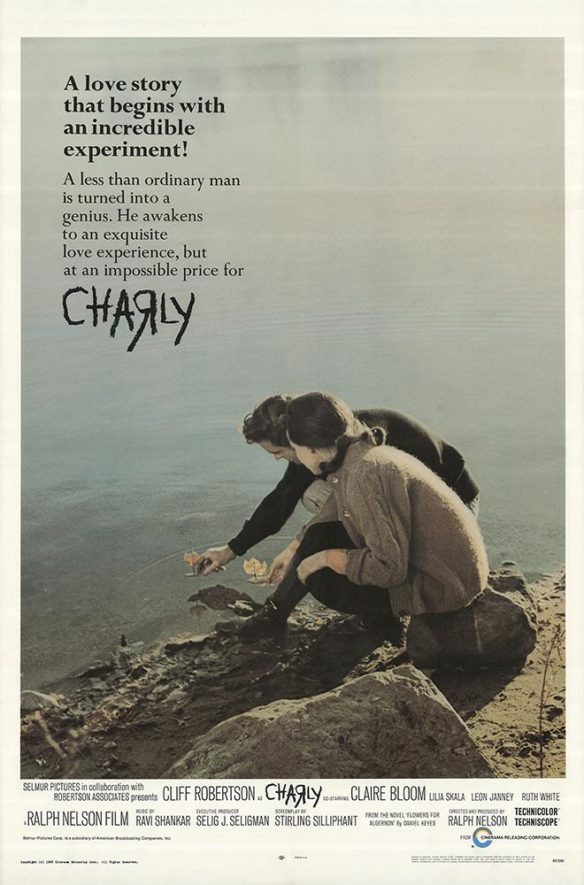
1968 [By Cat Eldridge.] Charly 

So let’s talk about the film that was based off a Hugo Award winning story. 

Charly premiered fifty-four years ago on this date. It was based off “Flowers for Algernon” which is a short story and a novel by Daniel Keyes. The short story, written in 1958 and first published in the April 1959 issue of The Magazine of Fantasy & Science Fiction, would win the Hugo Award for Best Short Story at Pittcon. The novel was published in 1966 and was the joint winner of that year’s Nebula Award for Best Novel with Samuel R. Delany’s Babel-17

The scriptwriter for this film was Stirling Silliphant who is best remembered for his screenplay for In the Heat of the Night for which he won an Academy Award the previous year.  Not genre but worth noting is he created the Perry Mason series.

The movie had an outstanding cast of Cliff Robertson, Claire Bloom, Leon Janney, Lilia Skala and Dick Van Patten. 

I’m not going to detail the film here as I’m assuming y’all have seen, so no spoilers this time. May I say I found it a terribly depressing film and leave it at that? 

It’s worth noting that the short story became “The Two Worlds of Charlie Gordon”, a 1961 television adaptation for The United States Steel Hour in which Robertson had also starred. The UCLA Film & Television Archive has it legally up on YouTube so you can watch that version here.

William Goldman was to write the screenplay on the strength of his No Way to Treat a Lady novel and got $30,000 to write a screenplay. However, Cliff Robertson was pissed off with Goldman’s work and he hired to Silliphant write a draft which he found most satisfactory.

It was a hit by the studio, making eight times its budget of just a million dollars. 

I think Vincent Canby, critic for the New York Times, summed it up best in saying that it is a: “self-conscious contemporary drama, the first ever to exploit mental retardation for…the bittersweet romance of it.”  It is still way too depressing and ethically questionable for me, but that’s me. I’ll entertain other opinions of course. 

(9) TODAY’S BIRTHDAYS.

[Compiled by Cat Eldridge.]

  • Born November 26, 1897 Naomi Mary Margaret Mitchison, Baroness Mitchison, CBE (née Haldane). Author of many historical novels with genre trappings such as The Corn King and the Spring Queen and The Bull Calves but also new wave SF such as Memoirs of a Spacewoman, pure fantasy Graeme and the Dragon and an Arthurian novel in Chapel Perilous. (Died 1999.)
  • Born November 26, 1919 Frederik Pohl. Writer, editor, and fan who was active for more seventy-five years from his first published work, the 1937 poem “Elegy to a Dead Satellite: Luna” to his final novel All the Lives He Led. That he was great and that he was honored for being great is beyond doubt — If I’m counting correctly, magazines he edited won three Hugos, fiction he wrote won three Hugos and two Nebula Awards, and at the end of his career he circled back around and won the 2010 Best Fan Writer Hugo. His 1979 novel Jem, Pohl won a U.S. National Book Award in the one-off category Science Fiction. SWFA made him the 12th recipient of its Damon Knight Memorial Grand Master Award in 1993, and he was inducted by the Science Fiction and Fantasy Hall of Fame in 1998. OK, setting aside Awards which are fucking impressive, there’s the matter of him editing Astonishing StoriesGalaxy Science FictionWorlds of If, and Super Science Stories which were a companion to Astonishing Stories, plus the Star Science Fiction anthologies – and well let’s just say the list goes on. I’m sure I’ve not listed something that y’all like here. As writer, he was amazing. My favorite was the Heechee series though I confess some novels were far better than others. Gateway won the Hugo Award for Best Novel, the 1978 Locus Award for Best Novel, the 1977 Nebula Award for Best Novel, and the 1978 John W. Campbell Memorial Award for Best Science Fiction Novel. Very impressive. Man Plus I think is phenomenal, the sequel less so. Your opinion of course will no doubt vary. The Space Merchants co-written with Cyril M. Kornbluth in 1952 is, I think, damn fun. (Died 2013.)
  • Born November 26, 1936 Shusei Nagaoka. Artist and Illustrator from Japan who is best known for his music album cover art in the 1970s and 1980s. He designed covers for many of Earth, Wind and Fire’s albums, and many of his covers were very distinctively SFFnal; especially notable are Out of the Blue, by Electric Light Orchestra and When We Rock, We Rock, and When We Roll, We Roll by Deep Purple. His art also graced numerous genre books, including Tepper’s After Long Silence, Attanasio’s The Last Legends of Earth, and Reed’s Down the Bright Way. He helped to design the 1970 Osaka World’s Fair Expo, and had one of the first artworks which was launched into outer space and attained orbit, via the Russian Mir Space Station, in 1991. He won a Seiun Award for Best Artist in 1982. (Died 2015.) (JJ) 
  • Born November 26, 1940 Paul J. Nahin, 82. Engineer and Writer of numerous non-fiction works, some of genre interest, and at least 20 SF short fiction works. Time travel is certainly one of the intrinsic tropes of SF, so certainly there should be at least one academic that specializes in studying it. Oh, there is: I present this Professor Emeritus of electrical engineering at the University of New Hampshire who has written not one, but three, works on the subject, to wit: Time Machines: Time Travel in Physics, Metaphysics, and Science FictionTime Travel: A Writer’s Guide to the Real Science of Plausible Time Travel, and Time Machine Tales: The Science Fiction Adventures and Philosophical Puzzles of Time Travel. No mere dry academic is he, as he’s also had stories published in genre venues which include Analog, Omni, and Rod Serling’s The Twilight Zone Magazine. (JJ)
  • Born November 26, 1949 Victoria Poyser-Lisi, 73. Artist, Illustrator, Teacher, and Fan who was inspired at the 1979 World Fantasy Convention to become a genre artist. She did more than a hundred covers and interior illustrations for fanzines, magazines, and books, and won two of her three Hugo Award nominations for Best Fan Artist. She now works in collaborative children’s book illustration and instructional painting books, and teaches drawing and painting courses in Colorado. (JJ) 
  • Born November 26, 1961 Steve Macdonald, 61. Musician, Writer, Singer, Filker, and Fan. He served for several years as the Evangelista for the Pegasus Awards (the Filkers’ most prestigious awards, given out by the Ohio Valley Filk Fest), and was responsible for many changes in the award process that led to greater participation among the voting base. In 2001, he attended ten filk conventions around the world and recorded filkers singing “Many Hearts, One Voice”, a song he had composed; the tracks were merged electronically for the WorlDream project to celebrate the new millennium. He has won six Pegasus Awards, for Best Performer, Writer/Composer, Filk Song, Adapted Song, Dorsai Song, and Myth Song. He has been Filk Guest of Honor at numerous conventions, and was inducted into the Filk Hall of Fame in 2006, after which he emigrated to Germany to marry fellow filker Katy Droge, whom he had met eight years before at OVFF. (JJ)

(10) COMICS SECTION.

  • Mutts is one of the many comics paying tribute to Charles Schulz today on the 100th anniversary of his birth.

(11) MAKING NEW STAR WARS FANS. The conclusion of Andor has people raving (favorably). Here’s a transcript of NPR’s “Movie Review: ‘Andor’”. Beware spoilers.

…DEL BARCO: Showrunner Tony Gilroy created the show after working on “Rogue One” and having written movies such as “Michael Clayton” and the “Bourne Identity” franchise. For many years, he’s been fascinated with empires and revolutions throughout history.

GILROY: I mean, I have a library downstairs just on the Russian Revolution alone. I can go between the Montagnards and the Haitians and the ANC and the Irgun and the French Resistance and the Continental Congress. And literally, you could drop a needle throughout the last 3,000 years of recorded history, and it’s passion. It’s need. It’s people being swept away by betrayal and their own ability and failure to commit. And, oh, my God, it’s just everything.

DEL BARCO: Gilroy infused that kind of drama into “Andor,” and he’s been pleasantly surprised by the passionate reaction by critics and fans, even those like himself who were not necessarily hardcore “Star Wars” aficionados before….

(12) JPLRON. Space.com introduces listeners to “’Blood, Sweat & Rockets:’ Podcast series looks at colorful founders of NASA’s Jet Propulsion Lab”. The direct link to the podcast is: Blood, Sweat and Rockets.

The early years of rocketry weren’t all about horn-rimmed glasses and slide rules. 

Some of the 20th century’s most important aerospace pioneers were incredibly colorful characters — folks like Jack Parsons, a handsome young chemist who conducted occult rituals with L. Ron Hubbard and sold bootleg nitroglycerine during the Great Depression.

Parsons’ many interests also extended to the nascent field of rocket science: He helped establish the Jet Propulsion Laboratory (JPL) in Southern California, which eventually became NASA’s lead center for robotic exploration.

…A new podcast called “Blood, Sweat & Rockets (opens in new tab)” delves into the lives and work of Parsons and his circle, which included fellow JPL co-founders Frank Malina and Theodore von Kármán. Some of these ambitious engineers, Parsons and Malina among them, were part of a group called the Suicide Squad. The name came from their aggressive approach to rocket research, as the podcast will doubtless detail….

(13) SHADES OF WEIRD TALES. Cora Buhlert has done a “Retro Review” for “’The Hanging of Alfred Wadham’ by E.F. Benson”, which she feels is “a not very good ghost story” that appeared in Weird Tales in 1929.

 …In addition to satirical novels about upper class people being jerks, Benson also wrote a lot of ghost stories and this is what brought him to the attention of H.P. Lovecraft, who wrote admiringly about Benson’s work in “Supernatural Horror in Literature”, and finally to Weird Tales….

(14) SF SCREENPLAY CONTEST. The Geneva International Science in Fiction Screenplay Awards are taking entries through December 2. Full details at the link.

GISFSA is a science related and Sci-Fi screenplay contest based out of Geneva, Switzerland, sponsored by the local production company, Turbulence Films, and CineGlobe the film festival of the CERN (European Organization for Nuclear Research).

Our roots in scientific research and connections makes GISFSA the premiere science and sci-fi screenplay contest. We connect winners with the most reputable scientists in the world, who regularly advise on sci-fi pictures.

When submitting a screenplay, all content is analyzed through our sponsors at Scriptmatix, the industry’s leading content evaluation technology company.

For Screenplay Contests:
CONTEST ENTRIES receive analytics on their screenplay’s execution across multiple categories.
ENTRIES + ANALYSIS receive full analytics and evaluative write-ups….

(15) CAST(ING) OF HUNDREDS. “’The sheer scale is extraordinary’: meet the titanosaur that dwarfs Dippy the diplodocus” in the Guardian.

It will be one of the largest exhibits to grace a British museum. In spring, the Natural History Museum in London will display the skeleton of a titanosaur, a creature so vast it will have to be shoehorned into the 9-metre-high Waterhouse gallery.

One of the most massive creatures ever to have walked on Earth, Patagotitan mayorum was a 57-tonne behemoth that would have shaken the ground as it stomped over homelands which now form modern Patagonia. Its skeleton is 37 metres long, and 5 metres in height – significantly larger than the museum’s most famous dinosaur, Dippy the diplodocus, which used to loom over its main gallery.

…The remains of Patagotitan mayorum were uncovered in 2010 when a ranch owner in Patagonia came across a gigantic thigh bone sticking out of the ground. Argentinian fossil experts later dug up more than 200 pieces of skeleton, the remains of at least six individual animals.

Casts have been made of these bones by the Museo Paleontológico Egidio Feruglio in Trelew, Patagonia, and these form the skeleton that will go on display in London in March.

“The number of bones uncovered represents a treasure trove of material,” said Sinead Marron, the exhibition’s lead curator. “It means we now know a lot more about this species than we do about many other dinosaurs.”…

(16) GOOD NIGHT OPPY REVIEW. The New York Times shows why “This Mars Documentary Required Many Sols”.

Early in the documentary “Good Night Oppy,” footage from late 2002 shows Steve Squyres, clad in scrubs, staring down in quiet awe, his eyes welling up as he shakes his head in disbelief. Squyres, the principal investigator for NASA’s first Mars rover mission, is watching his babies take their first steps.

That at least is the sense one gets from the improbably sentimental journey at the core of this movie (which begins streaming Wednesday on Amazon Prime Video) about the Mars exploration rovers Spirit and Opportunity (a.k.a. Oppy). Squyres vividly remembers experiencing this exact moment from the film.

“The first time it sort of came to life, it was a very, very moving experience,” he said recently over Zoom.

Squyres had long awaited the moment. A former geologist, he had worked on Mars exploration proposals for 10 years, including three failed submissions to NASA, before spending another six years, including three cancellations and revivals of the mission, building the machines.

As much as “Good Night Oppy” chronicles the depth of the human achievement behind the Mars rover mission — which was initially planned for a roughly 90-day stretch but instead lasted 15 years — the film is anchored most of all by a kind of pure devotion and connection to the rovers.

(17) VIDEO OF THE DAY. How It Should Have Ended says this is “How Top Gun Maverick Should Have Ended”.

[Thanks to Andrew Porter, Michael Toman, Cat Eldridge, Cora Buhlert, Francis Hamit, Jack William Bell, Mike Kennedy, JJ, John King Tarpinian, and Chris Barkley for some of these stories. Title credit belongs to File 770 contributing editor of the day Lis Carey.]

Pixel Scroll 11/4/18 The Scrolled Fan and the Spree

(1) EDELMAN GOH SPEECH AT WFC44. World Fantasy Con GoH Scott Edelman has posted a video of his speech, which is a call for inclusiveness in many dimensions of conrunning and the sff community. Scott hired the ASL interpreter seen in the video at his own expense, reports Andy Duncan.

(2) ARISIA 2019 NEWS. Arisia Inc. announced that Bjo and John Trimble will remain as GoHs, as will artist Elizabeth Leggett, but not Daniel Older and Malka Older.

It is with respect and regret that we are confirming what Daniel Older reported in his social media; he and his sister, Malka Older will not be participating in Arisia 2019. We asked each guest to make the choice they felt most comfortable with, and Malka and Daniel let us know they could not participate as things stood.

Our Fan Guests of Honor, Bjo and John Trimble, have confirmed that they would like to continue to be our guests. Lastly, as we shared from her social media post earlier, Elizabeth Leggett will continue to be our Artist Guest of Honor.

On top of Arisia 2019’s other problems, their venue is one of seven Boston area Marriott hotels where workers are on strike, and Arisia leadership are creating contingency plans because they won’t hold the con there if the strike is still going on. An unofficial Facebook page published the text of the staff email on the subect:

We cannot hold a convention in a hotel that is striking. If the strike continues, we see two possible options, and are looking for your help to determine which one is best. We can either move the convention to another property, or cancel Arisia 2019. We will need to work together to determine a timeline to make the go/no-go decision, as well as which of the two outcomes we should choose in the event the strike continues….

(3) PARDON THE INTERRUPTION. Some booksellers are retaliating against a new AbeBooks policy: “Booksellers Protest Amazon Site’s Move to Drop Stores From Certain Countries” – the New York Times has the story.

More than 250 antiquarian book dealers in 24 countries say they are pulling over a million books off an Amazon-owned site for a week, an impromptu protest after the site abruptly moved to ban sellers from several nations.

The flash strike against the site, AbeBooks, which is due to begin Monday, is a rare concerted action by vendors against any part of Amazon, which depends on third-party sellers for much of its merchandise and revenue. The protest arrives as increasing attention is being paid to the extensive power that Amazon wields as a retailer — a power that is greatest in books.

The stores are calling their action Banned Booksellers Week. The protest got its start after AbeBooks sent emails last month to booksellers in countries including South Korea, Hungary, the Czech Republic and Russia to say that it would no longer “support” them. “We apologize for this inconvenience,” the company said….

(4) MORE MEXICANX. Stephen C. Tobin covered the MexicanX Initiative for Latin American Literature Today: “The Long-Overdue Recognition of Mexicanx Science Fiction at This Year’s WorldCon76”.

The Initiative sprang forth from the seedling of an idea by one of this year’s WorldCon76 Guest of Honor, illustrator John Picacio. In the past he has twice won a Hugo Award –the crown jewel of science fiction awards– and was also invited to be this year’s Master of Ceremonies for the Hugos. His being Mexican-American led him to discover that no Guest of Honor or Hugo Award MC had ever been a brown person. “I thought it’s great to be the first,” he said, “but who cares if you’re the last? That’s the question I kept thinking about: who would come behind me? I break the door down, but then who’s coming through the door after me?” Initially, he thought he would sponsor one or two people (i.e., pay for their membership fees) out of his own pocket, but then his friend and novelist John Scalzi said he would do the same. Shortly after, more people agreed to sponsor, and before long, when the number reached 10 people, the whole process gained the momentum of a sizable snowball just picking up speed down a mountain. At that moment, Picacio decided to aim for sponsoring 50 people and gave the project its official title of The Mexicanx Initiative. By convention time, approximately 15 Mexicanx nationals along with 35 Mexicanx-Americans held sponsorships. (A similar origin story lies behind the bilingual anthology A Larger Reality: Speculative Fiction from the Bicultural Margins, which was published just for the Initiative at WorldCon76 and receives an in-depth treatment in the prologue to the dossier.) Ultimately, Picacio said, this was not just merely some brown people getting together but “this was a human endeavor, like George R.R. Martin said [at the Hugo Awards after party]. It was all cultures getting together to bring in another that wasn’t really being included.”

(5) A DISTURBANCE IN THE FORCE.

(6) SUB SANDWICH. Quartzy posits “Nine sci-fi subgenres to help you understand the future”. The fifth is —

5. Solarpunk

“What does ‘the good life’ look like in a steady-state, no-growth, totally sustainable society?”

According to “On The Need for New Futures,” a 2012 article on Solarpunk.net, that’s the question this movement—which melds speculative fiction, art, fashion and eco-activism—seeks to answer. In the same post, Solarpunk’s anonymous founders warn, “We are starved for visions of the future that will sustain us, and give us something to hope for.” Yet what if we dreamed differently? What if we tried to answer a separate question: What does a sustainable civilization look like, and how can we get there?

As Olivia Rosane puts it, what if we tried to “cancel the apocalypse?”

Solarpunk is the opposite of cyberpunk’s nihilism, offering stories, the founders say, about “ingenuity, positive creation, independence, and community.” These narratives are often framed around infrastructure as both a form of resistance and as the foundations for a new way of life—the eponymous solar panels feature heavily.

What to read

Kim Stanley Robinson, Mars trilogy (beginning with Red Mars,1992)

“I’ve always written utopian science fiction,” says Robinson. He’s one of the best world-builders in contemporary sci-fi, and these stories of terraforming Mars are super worked-through, both technically and sociopolitically. They describe a future in which humans just might be able to achieve ecosystem balance.

Cory Doctorow, Walkaway (2018)

This is far less utopian than Robinson’s work, but perhaps, quietly, just as hopeful. In a world wracked by climate change and fully captured by corporate power, most people live grinding lives of toil in “Default” cities. Yet 3-D printing has created post-scarcity, and so Doctorow’s trio of characters simply secede and walk away into the lands in between, and start to rebuild the world. “The point of Walkaway is the first days of a better nation,” one says.

Check out Sunvault: Stories of Solarpunk and Eco-Speculation (2017, eds. Phoebe Wagner and Brontë Christopher Wieland), the first English-language collection of solarpunk fiction . For stories from Brazil and Portugal, there’s Solarpunk: Ecological and Fantastical Stories in a Sustainable World (2014 / English 2018, ed. Gerson Lodi-Ribeiro).

(7) BETTER LUCK NEXT TIME. James Davis Nicoll wonders if we missed the chance at a real-life Rendezvous with Rama: “Recent Interstellar Asteroid May Have Been Alien Artifact, Speculates New Paper”.

… “Just what is ‘Oumuamua?” you may ask. I am so glad you asked. It’s the first ever verified interstellar object traversing our solar system. It was discovered in late 2017. Unlike Rama, it was only spotted over a month after its first and only perihelion. Also unlike Rama, there weren’t any space probes conveniently located where they could be diverted to take a close look. And of course, unlike Rama, we have NO nuclear-powered crewed spacecraft bopping around the Solar System, let alone one in the right place at the right time to visit ‘Oumuamua….

(8) MARTENSSON OBIT. “[Swedish fan] Bertil Mårtensson died this morning, from the effects of inhaling smoke and soot during a fire in his apartment kitchen last Thursday – he was weakened from other illnesses, and unable to escape from the apartment,” John-Henri-Holmberg announced on Facebook.

The Science Fiction Encyclopedia has an entry about his writing career here.

(9) TODAY’S BIRTHDAYS.

[Compiled by Cat Eldridge and JJ.]

  • November 4, 1920 – Sydney Bounds, Writer, Editor, and Fan from England who was a prolific author of short fiction, and novels — not just science fiction, but also horror, Westerns, mysteries, and juvenile fiction — from 1946 until his death in 2006. He was an early fan who joined Britain’s Science Fiction Association in 1937 and was active in fandom there. He worked as an electrician on the Enigma machine during World War II, and while in the service, he started publishing the fanzine Cosmic Cuts. The film The Last Days on Mars (an adaptation of “The Animators”) and the Tales of the Darkside episode “The Circus” are based on stories by him. In 2005, two collections of his fiction were released under the title The Best of Sydney J. Bounds: Strange Portrait and Other Stories, and The Wayward Ship and other Stories. In 2007, the British Fantasy Society honored him by renaming their award for best new writer after him.
  • November 4, 1934 – Gregg Calkins, Writer, Editor, and Fan. Mike Glyer’s tribute to him reads: “Longtime fan Gregg Calkins died July 31, 2017 after suffering a fall. He was 82. Gregg got active in fandom in the Fifties and his fanzine Oopsla (1952-1961) is fondly remembered. He was living in the Bay Area and serving as the Official Editor of FAPA when I applied to join its waitlist in the Seventies. He was Fan GoH at the 1976 Westercon. Calkins later moved to Costa Rica. In contrast to most of his generation, he was highly active in social media, frequently posting on Facebook where it was his pleasure to carry the conservative side of debates. He is survived by his wife, Carol.”
  • November 4, 1950 – John Vickery, 68, Actor of Stage and Screen. Wearing making makeup and prosthetics is something this performer did very well, as he appeared as a Cardassian military officer in Deep Space Nine’s “The Changing Face of Evil”, a Betazoid in Star Trek: The Next Generation’s “Night Terrors”, and a Klingon in Star Trek: Enterprise‘s “Judgment”. In Babylon 5 and its spinoff Crusade, he had dual roles, as Neroon and Mr. Welles, and he had guest parts in episodes of Medium and The Others. A veteran stage actor, he originated the role of Scar in The Lion King on Broadway.
  • November 4, 1955 – Lani Tupu, 63, Actor and Director from New Zealand. He’d be on the Birthday scroll just for being Crais on the Farscape series, but he’s actually been in several other genre undertakings, including the 1989 Punisher, Robotropolis, and Finders Keepers. He also had guest parts in episodes of Tales of the South Seas, Time TraxArthur Conan Doyle’s The Lost World, and the Australian remake of the Mission: Impossible series (which if you haven’t seen it, is quite excellent; I just found it in DVD format sometime in the past month).
  • November 4, 1953 – Kara Dalkey, 65, Writer and Musician. Author of YA fiction and historical fantasy. She is a member of the Pre-Joycean Fellowship (which, if memory serves me right, includes both Emma Bull and Stephen Brust) and the Scribblies. Her works include The Sword of Sagamore, Steel Rose, Little Sister, and The Nightingale; her Water Trilogy blends together Atlantean and Arthurian mythologies. She’s been nominated for Mythopoeic and Tiptree Awards.
  • November 4, 1953 – Stephen Jones, 65, Editor from England. He is a prolific Anthologist — and that is putting quite mildly, as he went well over the century mark in edited anthologies quite some time ago. The Mammoth Book of Best New Horror accounts for seventeen volumes by itself, and his editions of The Mammoth Book of (Pick A Title) run for at least another for another dozen. He has also authored a number of horror reference works, such as The Art of Horror Movies: An Illustrated History, Basil Copper: A Life in Books, and H. P. Lovecraft in Britain. He chaired the World Fantasy Conventions in 1988 and 2013, and has himself been a Guest of Honor at a World Fantasy Convention. His work has won a whopping 22 British Fantasy Awards, 5 Stoker Awards, and 3 World Fantasy Awards. In 2006, the British Fantasy Society recognized him with the Karl Edward Wagner Award for outstanding contribution to the genre.
  • November 4, 1965 – Kiersten Warren, 53, Actor who has had roles in Bicentennial Man, Independence Day, 13 Going on 30, The Astronaut Farmer, The Thinning, and The Invisible Mother, and guest roles on episodes of Night Man, Wolf Lake, and Fringe.
  • November 4, 1970 – Anthony Ruivivar, 48, Actor whose genre appearances include Starsthip Troopers and The Adjustment Bureau, along with a plethora of recurring roles in TV series Frequency, The Haunting of Hill House, American Horror Story, Scream, Revolution, and the new Beauty and the Beast, and recurring voice roles in Beware the Batman and Avengers Assemble.

(10) COMICS SECTION.

  • Brevity turns to Auric Goldfinger for a laugh.

(11) CHUCK TINGLE’S HALLOWEEN COSTUME. This has probably never been done before.

(12) HELP NEEDED BY LONGTIME ASFA, SFWA, WHC VOLUNTEER MAURINE DORRIS. “Medical for Maurine Dorris” is a fundraiser on Facebook started by Joann Cavitt Parsons. To date they’ve raied $1,000 of the $10,000 goal. Latest update is that her cancer is Stage 4, with widespread metastases.

Older fans, especially in the South, will remember Maurine Dorris as a force to be reckoned with. She and JoAnn Parsons ran more ASFA suites and SFWA suites than I can remember.  They started World Horror Convention, and ran the first two, in Nashville, TN.

Maurine fell at home last week and broke her hip. Happens to lots of us these days. Sadly, while in the ER for that, it came out that she has metastatic cancer in multiple sites.

Maurine has never been well blessed with money. The only insurance she has is Medicare Part A, because she felt that she couldn’t even afford Part B. She was widowed at an early age, and has only one son. She lives by herself, in a trailer on the property of her best friend JoAnn Parsons and her husband.

Maurine has decided not to treat the cancer, and to return home as soon as possible. Clearly, she will need help. JoAnn has started a GoFundMe account for her, which I hope that you will be kind enough to share.

(13) POWERFUL LINEUP. Joe Sherry recalls an influential 1975 Pamela Sargent anthology in “Feminist Futures: Women of Wonder” at Nerds of a Feather.

…How familiar readers are with the twelve writers of Women of Wonder likely depends on how well and broadly read they are with the overall field of science fiction. For many, Vonda McIntyre may only be known as the writer of one Star Wars novel (The Crystal Star) and five Star Trek novels. Other readers will know McIntyre from her three Hugo Awards and one Nebula Award.

Pamela Sargent put together a powerful lineup of writers (and stories), some of which have become absolute giants of the field. Anne McCaffrey. Ursula K. Le Guin. Joanna Russ. Marion Zimmer Bradley (more on her later)….

(14) FILE TYPE. Paul Weimer adds an entry to Ursula K. Le Guin’s dossier for Nerds of a Feather — “Feminist Futures: The Word for World is Forest”.

…Finally, there is our Athshean protagonist, Selver. It is from his semi-omniscient point of view that we get the major worldbuilding of the novel as regards to how the Athesheans see themselves, and how their societies actually work. Davidson and even Lyubov, for his sympathies for the native inhabitants, simply doesn’t see or know about….

Legacy: The novella’s polemic, strong, unyielding tone meant that it had an immediate impact on readers, especially since it was in the high profile Again, Dangerous Visions anthology edited by Harlan Ellison. It deservedly was nominated for and won a Hugo award. It’s anti-colonial and ecological themes were likely the greater focus of readers at the time, given the Vietnam War, and the realization and maturation of the work into recognition for its gender and feminist ideals is something that has become a function of seeing it placed within the Hain-verse. …

(15) BOOK LIFE. This time the author of The Traitor Baru Cormorant supplies the titles for Nerds of a Feather’s recurring feature — “6 Books with Seth Dickinson”.

  1. How about a book you’ve changed your mind about over time–either positively or negatively? Guns, Germs, and Steel. When I read it in high school I thought it was the smartest thing ever written. Now it’s pretty obviously reductionist. (I’m not, like, clever for figuring this out, there’s a bot on the history reddit whose only job is to post disclaimers about GG&S.)I used to think Pale Fire was a clever postmodern novel with a ‘true’ story hidden behind the one we’re given. Now I know that Zembla is real and John Shade failed its people.God, I can never remember enough books.

(16) AQUAMAN. They call this trailer “Aquaman – Attitude.”

[Thanks to JJ, John King Tarpinian, Marcia Kelly Illingworth, Mike Kennedy, Cat Eldridge, Martin Morse Wooster, Chip Hitchcock, Carl Slaughter, and Andrew Porter for some of these stories. Title credit goes to File 770 contributing editor of the day Jayn.]