Pixel Scroll 6/11/26 I’m Sorry, Did You Pay For The Entire Scroll Or Just The Five Pixels?

(1) 2027 WORLD FANTASY CON IN UK? It looks like World Fantasy Con might be returning to the UK, under the leadership that ran it in 2025.

HWS Events under Karen Fishwick and Allen Stroud are planning a joint Fantasy Con/World Fantasy Con in Birmingham UK from September 24-26, 2027.   Karen has announced it on the main WFC Facebook page. And it has a Facebook event: Fantasycon 2027 with World Fantasy Convention.

Fantasycon 2027 will include some aspects of World Fantasy Convention including the World Fantasy Awards.

This is alongside all the usual Fantasycon content of panels, readings, books, art and social activities.

Unfortunately this schedules WFC in opposition to EuroCon Lisbon 2027, being held in Portugal between September 23-26, 2027.

(2) PITCH IN FOR TED WHITE’S FUNERAL. A GoFundMe has been launched to help the late Ted White’s daughter cover his funeral expenses: “Support Kit with Cremation Costs”.

Arielle White, who most of us know as Kit, is facing an incredibly difficult time after the loss of her father, Ted White. Ted was terminal and in palliative care at a nursing home. He had a DNR (Do Not Resuscitate) in place, so when his condition worsened, he was not taken to the hospital. Kit was called because he only had hours left, but sadly, Ted passed away just five minutes before she arrived. Throughout his illness, Kit has been visiting him regularly and working tirelessly to get his affairs in order.

Ted did not leave a Will, and Kit is his only living heir. While she is doing everything she can to honor his memory and manage his estate, the process is complicated and will take time to resolve. In the meantime, Kit does not have the funds needed to cover cremation costs and other urgent funeral expenses.

We are asking for your help to support Kit during this heartbreaking time. Any amount you can give will help her take care of these immediate needs and ease some of the burden she is carrying. Kit is deeply grateful for your kindness and support. Your generosity will make a real difference as she navigates this loss.

(3) WOMEN’S PRIZE 2026. No works of genre interest were among the winners of the Women’s Prize announced today: “Women’s prize: Virginia Evans wins for fiction and Lyse Doucet takes award for nonfiction” in the Guardian.

Debut novelist Virginia Evans has won this year’s Women’s prize for fiction, while the BBC’s chief international correspondent Lyse Doucet took home the nonfiction award, also for her debut.

Evans’s The Correspondent and Doucet’s The Finest Hotel in Kabul were announced as the winners at a ceremony in central London on Thursday evening, with each author awarded ÂĢ30,000.

(4) NASA’S VERY MANNED SPACE MISSION. Of course you noticed this little detail when you looked at the photo of the Artemis III crew in yesterday’s Scroll. I know I did! “NASA addresses criticism over all-male Artemis III mission astronauts” at NBC News.

â€ĶNASA Administrator Jared Isaacman attempted to address these criticisms head-on Wednesday.

“I have seen reactions ranging from disappointment to outrage,” he said in a statement.                         

Isaacman said that some astronauts may not have been selected for the Artemis III flight because they are already on tap for expeditions to the International Space Station or because their training and skill sets make them more suitable for future Artemis missions, during which astronauts are expected to land on the moon.

“The Astronaut Office assigns the crew that gives the mission the best chance of meeting its objectives, taking into account many factors, including the background and expertise of the astronauts, such as test pilot experience, development work on specific programs, and availability,” he saidâ€Ķ

â€Ķ NASA has promised since 2023 that it will land the first woman and the first person of color on the moon during the Artemis program. However, the agency removed that language from some of its websites last year, a move that appeared tied to President Donald Trump’s push against diversity, equity and inclusionâ€Ķ.

(5) DRONES CROSS A LINE. New Scientist reports “Fully autonomous drones have killed human soldiers for the first time”.

Fully autonomous drones with no human oversight have killed soldiers on the battlefield for the first time. This is according to a senior figure in the Ukrainian defence industry, marking a watershed moment in warfare.

The one-off test involved 10 AI-controlled “Terminator” drones on the front line of the Ukraine war. Russian soldiers were killed.

“We tried it,” says drone-maker Alexander Kokhanovskyy, who supplied the technology and spoke to New Scientist at a press event hosted by the Ukrainian embassy. “It’s a test. We never implemented it [more widely].”

The test took place two years ago and involved quadcopter drones that were programmed to fly towards the front line, cover between 3 and 5 kilometres over around 10 minutes and then engage “Terminator mode”, in which an AI model searches for and intercepts targets.

“We just launch it and we know everything will be dead – everything that will be found there in this particular area will be dead,” says Kokhanovskyy. “There is no connection to the drone at all, you cannot see the video, nothingâ€Ķ Everything it sees will be killed.”

With no way to tell what the automated drones had seen or targeted, human-piloted drones were sent into the area after the test to manually check results. Victims included “a couple of soldiers, one truck”, says Kokhanovskyy. While there is no recording of the automated drones attacking these targets, it was concluded that the drones had killed them.

Kokhanovskyy says that he was not at the test personally but that it was carried out by an unnamed military unit near the cities of Bakhmut and Chasiv Yar as part of a Ukrainian counteroffensive push. The Ukrainian Ministry of Defence did not respond to questions about the test or the current legal position on the use of fully autonomous weaponsâ€Ķ.

â€ĶWhile there is no official international ban on autonomous weapons that can kill without human intervention, United Nations Secretary-General AntÃģnio Guterres has called for one, saying last year that “there is no place for lethal autonomous weapon systems in our world”.

The UN has said that there are concerns that such weapons could violate international humanitarian and human rights laws by removing human judgement from warfare. There is also a risk that autonomous systems could make mistakes, either attacking soldiers or equipment from the same side or striking civiliansâ€Ķ.

(6) ‘ALL ASHORE!’ ON THE RIVERWORLD. [Item by Daniel Dern.] Riverworld Odyssey, due to be published in August 2026, is available from Bud’s Art Books for $75.

The odyssey through Riverworld is a riverboat tour with four stops: The ContestThe RelaunchThe Quest Completed, and Riverworld Revisited. At each stop along the “river,” we are invited to go “ashore” to partake of the aforementioned fiction, essays, and speeches.

Fiction by Farmer includes the novel River of Eternity, first written in 1952, but not published until 1983 by science fiction specialty publisher, Phantasia Press; the earliest published Riverworld stories, “The Day of the Great Shout,” and “Riverworld”; the excerpt “Riverworld War”; and the stories Farmer wrote for the two shared-world anthologies in the ’90s: “Crossing the Dark River,” “A Hole in Hell,” “Up the Bright River,” and “Coda.”

Introductions, essays, and speeches by Farmer provide significant historical insight to the series. Letters to luminaries such as Fredric Pohl, Ejler Jakobsson, Richard Posner, Phyllis Grann, and Roger Zelazny include four different outlines describing forthcoming Riverworld tales.

Fellow “shipmates” on the riverboat odyssey have kindly supplied essays exploring different aspects of Farmer’s celebrated series and career, including Alex BermanJohn Gregory BetancourtMichael CroteauTracy KnightPaul SpiteriBruce Sterling, and Mary Turzillo.

The gorgeous wraparound cover painted by Mark Wheatley features Peter Jarius Frigate, Alice Hargraves, Sir Richard Frances Burton, and Joe Miller attempting a shortcut across Riverworld in a hot air balloon.

(Available in both a Softcover and a Signed Hardcover Limited Edition)

The most comprehensive examination of Phillip Jose Farmer’s award-winning sci-fi/fantasy series! Signed by Berman, Betancourt, Croteau, Knight, Spiteri, Sterling, Turzillo, and Wheatley! Clocking in at almost six hundred pages, Riverworld Odyssey is a journey through every piece of associated fiction, every pertinent essay, letter, article, and speech, every item of ephemera the editors at Meteor Press could gather, in one Brobdingnagian volume, to tell the story — the history — of one of science fiction’s greatest series! Meteor Press, 2026.

Not yet published. Expected 8/31/26.

Daniel Dern notes: I’m a happy occasional buyer of stuff from/via Bud’s – and always enjoy reading the email and snail-mail updates. Often some great stuff/great bargains. I’ll be looking to see if my library will get it! (I love lots of PJF, going on periodic search’n’binge-reads.)

(7) EARLY TUBES. Heritage Auctions’ Intelligent Collector celebrates “100 Years of Television Design”.

â€Ķ Who wouldn’t want to watch an episode of I Love Lucy on an Eisenhower-era set? So don’t touch that dial as we look back on seven iconic designs from the Golden Age of TVâ€Ķ.

Here’s the most unfortgettable pick:

Philco Predicta (1958)

Arguably the most recognizable vintage set ever made, the Predicta’s floating picture tube looks like something straight out of The Jetsons. Created by industrial designer Herbert Gosweiler, this innovative model is a prime example of “the future according to the ’50s” and has become a pop culture icon, with examples appearing in The Marvelous Mrs. MaiselToy Story 2, and on the cover of Elton John’s 1981 studio album, The Fox. Though coveted by collectors today, initial sales of this set slumped due to reliability issues resulting from heat generated by the disconnected cathode ray tube in Predicta’s base. 

(8) JANE YOLEN OBITUARY. Jane Yolen’s daughter announced that the beloved writer died today. File 770’s tribute is here: “Jane Yolen (1939-2026)”.

Jane Yolen at a recent Boskone. Photo by and (c) Andrew Porter

(9) TODAY’S BIRTHDAY.

[Written by Paul Weimer.]

June 11, 1971P. DjÃĻlí Clark, 55.

By Paul Weimer: P. DjÃĻlí Clark is another author, like Max Gladstone, that I slept on at first, but have made up for lost time.  I missed The Black God’s Drums entirely, even with its alternate civil war verse. Then, his novella The Haunting of Tram Car 015 came out, and I somehow missed it in the tsunami of other stories and novels that came out in 2019. But it was sometime during the Pandemic that a friend suggested I try it, that it would be up my alley.

Was it ever! A police procedural set in an alternate magical fantasy world where Egypt was a 19th century world power because The Magic Has Returned was so my jam. I devoured it avidly.  As is my wont when I discover an author, I went back to The Black God’s Drums, and went forward from there. Clark has written in a couple of verses now. The Dead Cat Tail Assassins in particular is a lot of fun, and Ring Shout is a must read for fans of Sinners. There is an ever widening variety of verses that Clark is creating, and as you might notice, most of them are alternate histories. The aforementioned Dead Cat Tail Assassins felt a little odd (however tasty it was) in that it was a completely invented secondary world. It was like having a piemaker suddenly present me with a chocolate cake. 

However, I do think the Djinn verse is still my favorite, as he has the most material set in that single verse, exploring it, developing the characters and the extremely rich setting. There is a real appeal and reversal of the colonial pattern of the tragedy of the “Scramble for Africa”, with Egypt taking the role of a world power instead thanks to having a strong lead in magic. 

P. DjÃĻlí Clark

(10) COMICS SECTION.

(11) FILLING UP THE DOCKET. ComicsBeat reports “Archie Comics is having a lot of legal woes”.

An article at the website of fintech company 9fin has been quietly making the rounds in the last few days. Reported by Maria Heeter and Laurie Tomassian, the article lays out recent lawsuits and financial controversies at Archie Comics Publications. This article is very well written and researched and the underlying matters are quite complicated so Just Go Read The Article. 

If you are in a rush, a (very) short version is that in 2022 Jonathan Goldwater, the co-owner of Archie, and son of the company’s co-founder, signed a deal with finance company Raven Capital, receiving a $40 million loan from them, and also signing an $80 million development deal giving former Raven principal and occasional movie producer James Masciello the right to develop “secondary Archie characters.” 

Since then, Raven has been trying to get Goldwater to pay back the debt, and Masciello first fell out with Raven and then died suddenly. Raven sued Goldwater last October in an attempt to get payment, but they seem to have been particularly outraged by the August 2025 announcement that ACP had signed a deal with Universal for a new Archie movie with Phil Lord and Christopher Miller (Hail Mary Project) to direct, Tom King writing the screenplay, and Emma Watts producing. I’ll let 9fin explain what happened next:

“Less than two months later, lenders from Raven Capital Management filed a lawsuit in New York Superior Court accusing Jonathan Goldwater — the son of an Archie Comics Publications founder and the company’s co-chief executive officer — of going behind Raven’s back to sell Universal the rights to Archie intellectual property. Goldwater’s lawyers fired back, accusing Raven of angling for control of one of the longest-running brands in comic book history just as Goldwater cinched a lucrative movie deal — and threatened to kick Goldwater out of a $5.7m Beverly Hills mansion a former Raven employee had promised years before. The dispute would become so ugly that Goldwater’s lawyers later described a phone call from Raven’s chief investment officer as having the tone of an ‘organized crime figure.’”

“Now the fight is coming to a head. In late May, Raven went on a new offensive, announcing a June UCC foreclosure auction for control of Goldwater’s family office — which includes a 25% stake in Archie Comics — at the Los Angeles offices of Paul Hastings, according to a classifieds notice in the Wall Street Journal. Goldwater is aware of the auction but hasn’t yet responded, according to a person familiar with the matter and public filings. If Raven seizes the stake through this auction, it could control the future of Archie Andrews and the Riverdale universeâ€Ķ.”

(12) KGB. Ellen Datlow has posted her photos from the Fantastic Fiction at KGB readings on June 10, 2026.

Nicholas Kaufmann read a fabulous story and A. C. Wise read two excerpts from her terrific new novel.

(13) CLOCK AROUND THE ROCK. SpaceDaily remembers: “A 1971 experiment flew four atomic clocks around the world on commercial airliners — first heading east, then heading west — and when the clocks were brought home and compared with stationary clocks at the U.S. Naval Observatory, they were measurably out of sync, in the first direct demonstration that time itself moves at slightly different rates depending on how fast you are traveling, exactly as Einstein had predicted half a century earlier”.

â€ĶTogether, Hafele and Keating obtained $8,000 in funding from the Office of Naval Research — one of the cheapest tests of general relativity ever conducted — and arranged for one of the most famous experiments in 20th-century physics.

Of the $8,000 budget, $7,600 was spent on round-the-world airline tickets. The two men needed seats for themselves and seats for their instruments: four HP 5061A cesium-beam atomic clocks, each about the size of a large suitcase. The clocks needed their own seats because they were too large and too sensitive to be stowed in cargo. The ticket booking forms accordingly listed “Mr. Clock” as the passenger in two seats on each flight. On 4 October 1971, Hafele, Keating, and four atomic clocks boarded commercial flights heading east from Washington and began an eastward circumnavigation of the Earth. The trip lasted 65.4 hours of which 41.2 hours were spent actually in flight. The clocks were returned to the Naval Observatory and compared with the stationary reference clocks. They were then flown again, this time westward, from 13 to 17 October 1971, in a journey that lasted 80.3 hours. After this second trip, they were returned to the Naval Observatory and compared a second time.

The published results in Science, in July 1972, were striking. According to the original Hafele-Keating prediction paper, special relativity and general relativity, taken together, predicted that the clocks should have lost approximately 40 nanoseconds during the eastward trip and gained approximately 275 nanoseconds during the westward trip, relative to the stationary clocks at the Naval Observatory. The actual measurements showed losses of 59 nanoseconds on the eastward leg and gains of 273 nanoseconds on the westward leg. The eastward result agreed with the prediction within experimental uncertainty; the westward result agreed almost exactly. The clocks that had travelled around the world had run at measurably different rates than the clocks that had stayed in Washington, and the differences were of the magnitude and direction that Einstein’s theory predicted.

The asymmetry between the eastward and westward results — losing 59 nanoseconds in one direction and gaining 273 in the other — is one of the more counterintuitive aspects of the experiment. Both flights covered roughly the same distance at roughly the same speed at roughly the same altitude. If only the velocity of the aircraft mattered, the two flights should have produced identical effects. But the relevant velocity for relativistic calculations is not the velocity of the plane relative to the ground; it is the velocity of the plane relative to a non-rotating reference frame centred on the Earth. The Earth itself rotates eastward at approximately 1,600 kilometres per hour at the equator. An aircraft flying east adds its velocity to the Earth’s rotational velocity, producing a larger total velocity in the non-rotating frame. An aircraft flying west subtracts, producing a smaller velocity. The eastward clocks therefore experienced larger time dilation due to special relativity than the westward clocks, and this effect was what produced the directional asymmetry in the measurementsâ€Ķ.

(14) VIDEOS OF THE DAY. “Pixar Drops 3 ‘Toy Story 5’ Clips” and Animation World Network shares them.

Disney and Pixar have released three new clips from the highly anticipated Toy Story 5. And even though the toys are back in town, there’s trouble in playtime! A “technological threat” has reared its digital face, in the form of Lilypad, a frog-shaped smart tablet voiced by Greta Lee, that goes head-to-head with Buzz, Woody, Jessie and the rest of the gang, making their jobs that much harder.

The green gadget arrives with her own disruptive ideas about what is best for their kid, Bonnie. Will playtime ever be the same?

[Thanks to Chris Barkley, Mark Roth-Whitworth, Kathy Sullivan, Cathy Green, Paul Weimer, Lise Andreasen, Francis Hamit, Daniel Dern, Steven French, Mike Kennedy, Andrew Porter, John King Tarpinian, Cat Eldridge, and SF Concatenation’s Jonathan Cowie for some of these stories. Title credit belongs to File 770 contributing editor of the day Patrick Morris Miller.]
Pixel Scroll 5/24/26 How Many Is A “Multiverse of Pixels”?

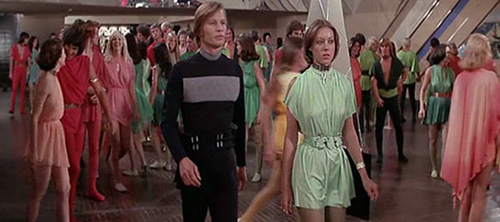
(1) WE’RE A LITTLE LATE, FOLKS. The author of Muse from the Orb confesses “I Finally Watched… LOGAN’S RUN (1976)” and tells what they thought of it.

â€ĶThough no one knew it in 1976, Logan’s Run was probably the last great sci-fi movie of the the “tinsel/synthesizer” era — camp, fun, brightly-lit movies where production design communicated THE FUTURE with shiny interiors, rainbow colors, boop-zoop sounds, and (in the case of Zardoz and Barbarella) sets that were sometimes literally just tinsel. In the Hollywood imagination from 1968-1977, it was expected that the third millennium would look like The Cher Show, or that Peter Brook production of A Midsummer Night’s Dream but with even more multicolored robes, wires, and tubes that made cool space sounds.

Logan’s Run is a capstone for this era, a fantastic high note on which the tinsel age would unwittingly end. No movie has done mirrors, neon, or that “extremely shiny airport” type of futurism better — every woman gets her own Sabrina Carpenter wardrobe, and you shuttle from environ to environ in little bubble domes like it’s Epcot. Farrah Fawcett’s cameo as a medspa beautician is spot-on — her signature smile, flirtatious and innocent but weirdly sinister in its perfection, makes her the perfect symbol for this youth-obsessed world where an entire population’s energy is channeled into consumption and frivolityâ€Ķ.

â€Ķ My favorite parts of the movie are background details that hint at the larger history and worldbuilding of the Dome — certain sectors have been allowed to fall into disrepair, and we see flashes of old signs on the walls. It makes the universe feel much bigger, the story of the Dome much deeper — what happened? Was the Dome’s population larger in a past age? What calculations does the Computer make about its maintenance? In terms of tasty mysteries, the best scene is the goofy encounter Logan and Jessica have with a robot far underground. He lives in an icy cave and has clearly gone insane over the centuries, but every line and detail hints at some larger narrative: He declares himself some sort of “fusion” of man and machine and reveals a ghastly hallway where stores the frozen bodies of Runners, because the “other food” — plankton and protein — “stopped coming.” Was he human once? Does he predate the Dome? Is he lying about the plankton and protein — did the pre-Dome society try to fix its overpopulation problem with cannibalism, in secret cryochambers run by robots, or humans in the bodies of robots? (As for the frozen penguins also in the cave, the pelts that allow naked Logan and Jessica to drape themselves while perfectly revealing their dÃĐcolletages, and the fact that the robot just chants “BOX, BOX, BOX,”3 I have no place to even start with questions but obviously no complaints.)â€Ķ

(2) CRUNCHYROLL 2026 WINNERS. Deadline has the “Crunchyroll Anime Awards 2026 Winners — Full List”. Here are some highlights —

Crunchyroll celebrated the 10th edition of its Anime Awards on Saturday in Tokyo, honoring this year’s winners, who were chosen from 73 million votes globally.

Hosted by hosted by Sally Amaki and Jon Kabira, the 10th Crunchyroll Anime Awards selected the final season of My Hero Academia for Anime of the Year, which was presented by The Weeknd.

Other big winners this year include Demon Slayer: Kimetsu no Yaiba Infinity Castle for Film of the Year, Lazarus for Best Original Anime, One Piece for Best Continuing Series and Gachiakuta for Best New Seriesâ€Ķ.

(3) AUTHORS LOSE SYMPATHETIC HOST. Publishers Weekly tells why “Publishers Bid Farewell to Stephen Colbert”.

Alongside The Daily ShowThe Colbert Report became one of the best places on television for historians, economists, journalists, and, in its later years, fiction writers to discuss their work. The show typically featured two authors per week, with guests ranging from Malcolm Gladwell, Ann Patchett, and Ta-Nehisi Coates to Maurice Sendak, Junot Díaz, George Saunders, and Anne Rice. The penultimate episode of the show featured Phil Klay, author of the National Book Award–winning story collection Redeployment.

When Colbert moved to CBS in September 2015, some wondered if network audiences would tolerate serious literary guests. Colbert bet they would, and positioned The Late Show as notably more book-friendly than its competitors. Stephen King appeared on the show in its first week. George Saunders became a recurring guest. Michelle Obama was interviewed about her memoir Becoming. Numerous others followed, including Walter Isaacson, Kwame Alexander, and Tobias Wolff.

Between The Colbert Report and The Late Show, Colbert interviewed approximately 125 authors in all.

“For the entirety of my career, Stephen Colbert made late-night television one of the most meaningful platforms for publishers to promote books and authors,” Erinn McGrath, an industry veteran and founder and CEO of the literary marketing agency Full Story, told PW.

“A single appearance on his show could transform a debut novelist into a bestseller, elevate urgent nonfiction into the national conversation, or remind millions of Americans why reading still matters,” McGrath said. “He treated writers just as seriously as actors and musicians. The end of his show marks the loss of a rare cultural space where literature regularly reached a mass audience.” McGrath cited appearances by President Bill Clinton, Dolly Parton, Lawrence Wright, and James Patterson (for whom McGrath previously headed publicity at Little, Brown) as especially memorableâ€Ķ.

(4) TELLING A BOOK BY ITS COVER. Hyperallergic declares “The Painted Book Cover Is Back”.

Walk into any bookstore in the United States lately, and the shelves and new-release tables resemble group exhibitions. Reproductions of oil and acrylic paintings, many immediately recognizable, fill the covers. Their colors are saturated, often primary. Figures abound, with inscrutable expressions and intimate gestures emphasized by tight cropping. Rather than stock photos or digital renderings, the covers foreground material marks made by artists ranging from early modernists like Hilma af Klint to contemporary realists like Nashville-based Shannon Cartier Lucy. In a market flooded with design templates and AI-generated imagery, the painted cover stands out as distinctly human.

The recent shift from color fields and geometric abstraction to gestural figuration on book covers may reflect a broader craving for embodiment and physical presence — proof, in other words, of the artist’s hand and subjectivity in the era of the internet. Just as painting implies time, so does the novel, demanding sustained attention to both write and to read. It’s a tension that undermines the forces driving creation and consumption in the service of ever-increasing profit margins, both in the art market and the publishing industry.

It’s also, of course, a matter of taste. To carry a novel framed by af Klint, the 20th-century mystic whose Guggenheim Museum retrospective remains the institution’s most visited, or by an emergent painter circulating the Tribeca gallery scene is to signal intellectual rigor, cultural capital, rarefied sensibilities, and a sense of irony. On the shelf, the painted cover seemingly aligns the book with an art-historical lineage rather than the curation of an algorithmic feed.

(5) MOVIE TOY TIE-INS. The New York Times analyzes “How Movies and Their Toy Tie-Ins Are Changing This Summer”. (Article is behind a paywall.)

In “Toy Story 5,” beloved dolls from previous chapters — Buzz Lightyear, the cowgirl Jessie and others — encounter Lilypad, the latest rival for their latest child’s affections. A bright green, kid-friendly computer tablet, Lilypad can rap, translate conversations into Spanish and send messages to your friends.

“Extinction,” moans Rex, the team’s plastic T-Rex who, even under the best of circumstances, struggles with fears of abandonment. “Not again.”

In the coming weeks, toys will be at the core of new chapters of decades-old franchises that have transformed how filmmakers and animators have used their productions to sell toys, and vice versa.

There’s the “Star Wars” spinoff “The Mandalorian and Grogu” (May 22), whose spiritual overlord, George Lucas, became one of the richest filmmakers on the planet when he chose to swap some of his directing fees for the original film in favor of licensing and merchandising rights to all related toys.

Two weeks later, there’s “Masters of the Universe,” part of a franchise that flipped the usual order of things for children-focused IP, releasing toys two years before the 1980s Saturday-morning cartoon. And on June 19, there’s “Toy Story 5,” the newest sequel in a series that reignited sales of once-popular products like Mr. Potato Head.

While vastly different in many ways, each franchise has become inseparable from the toys created to market them. Consider “Masters of the Universe.” When fans think of its sword-wielding hero, He-Man, they’re just as likely to picture the improbably musclebound Mattel action figure as the animated cartoon or the 1987 feature starring Dolph Lundgren.

Such products have understandable appeal to children, said Meredith Bak, an associate professor in the childhood studies department at Rutgers University-Camden and the author of “Playful Visions: Optical Toys and the Emergence of Children’s Media Culture.”â€Ķ

(6) TED WHITE (1938-2026). Author, leading fanzine fan, and past editor of Amazing/Fantastic Ted White died May 24 at the age of 88. His daughter Arielle Kit White announced his passing on Facebook.

Ted White got into fandom in 1951, publishing his first fanzine, Zip 1, in 1953. He won the Best Fan Writer Hugo in 1968. Among his most well-known fanzines were Void (co-edited with Greg Benford and others from 1958-1967), Blat! and Pong (the latter two co-edited with Dan Steffan). Blat! won a FAAn Award in 1994. And Ted won the FAAn for Best Fan Writer in 1999.

In the Sixties he was one of the founders of New York’s Fanoclasts. He co-chaired NYCon 3, the 1967 Worldcon. He chaired Lunacon 11, Lunacon 12 and Lunacon 13 (1968-1970).

Ted White and Dave Van Arnam at NYCon 3, the 1967 Worldcon. Photo by and (c) Andrew Porter.

He was Worldcon Fan Guest of Honor at Aussiecon Two in 1985. He received the FAAn Award for lifetime achievement in 2010.

Ted began his pro sff writing career with “Phoenix” (co-written with Marion Zimmer Bradley), published in Amazing in February 1963. His first novel, Invasion from 2500 (1964) was co-authored with Terry Carr under the pseudonym Norman Edwards.

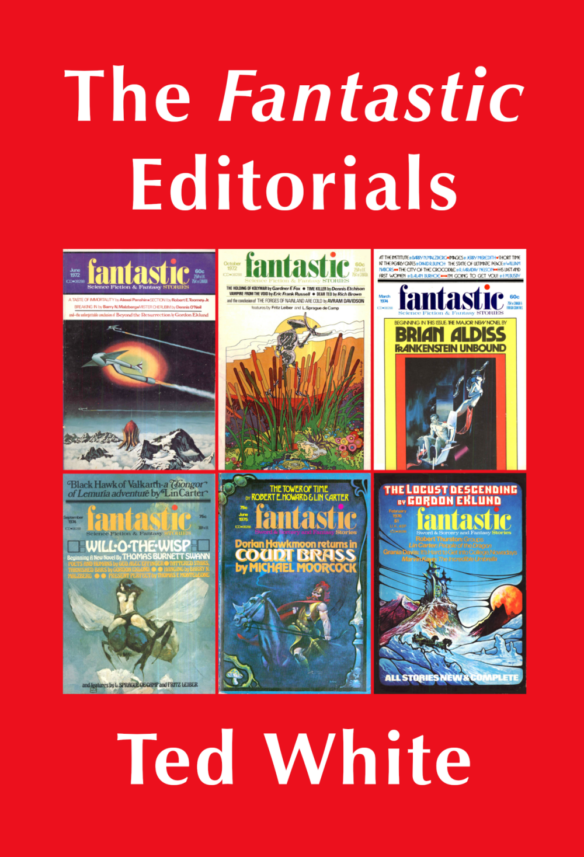
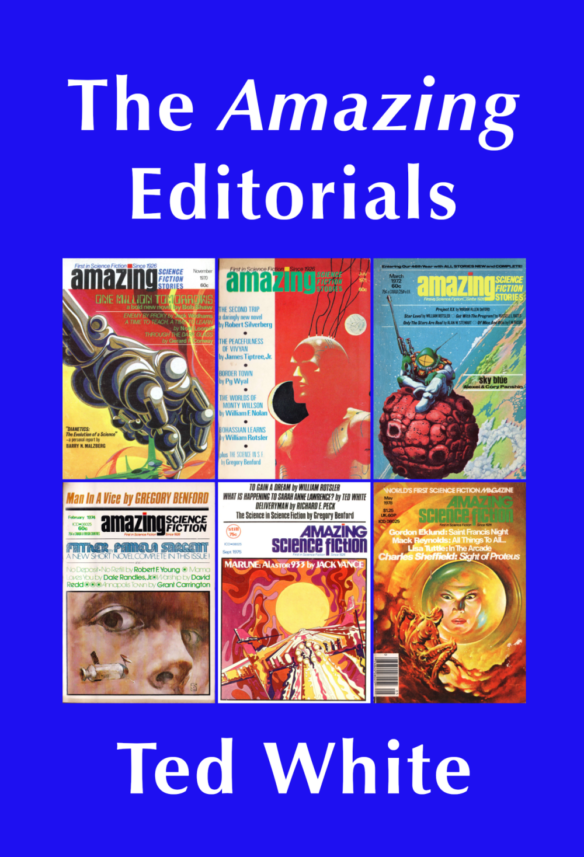
He was assistant editor at The Magazine of Fantasy and Science Fiction under Ed Ferman from 1963 to 1968. Then he edited Amazing Stories and Fantastic for publisher Sol Cohen until 1979. Three years ago Ansible Editions published Ted White’s collected editorials and book reviews from both magazines in The Amazing Editorials and The Fantastic Editorials. He later edited Heavy Metal 1979-1980 and Stardate 1985-1986 (with David Bischoff).

Andrew Porter, who knew him for decades, says his best recollection is that he first met Ted in 1960 or 1961 “at my first convention, Open ESFA, in Newark, NJ. Certainly about that time at a Lunarians meeting, which I started going to in 1961 or so; we were both members, he joining way before I did.

“And, of course, I started going to Fanoclast meetings at Ted’s apartment in Brooklyn in 1964, and those meetings unlocked a far wider fannish world for me, culminating in being on the bidding committee and then the actual committee for the 1967 Worldcon, NYCon 3.

“His influence on me cannot be overstated. He was a mentor to me in many things, a columnist for my Algol, a good friend. Although we had a falling out in the 1970s, I always thought of him as a good friend from my early days in fandom. Toward the end I told him I considered us ‘frenemies.’ He rejected that, in words that pulled no punches, but still, I hold his memory dear.”

Here are some of the photos Porter took of Ted over the years, “including one in my bedroom door when I lived in Manhattan in the 1960s.” Photos (c) Andrew Porter.

(7) TODAY’S BIRTHDAY.

[Written by Cat Eldridge.]

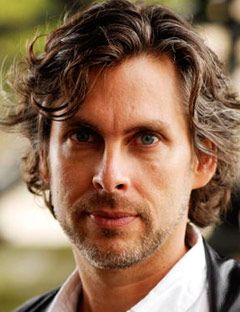
May 24, 1963 â€” Michael Chabon, 63.

The first work by Michael Chabon that I read was the greatest baseball story ever told, and yes, I know that statement will be disputed by many of you, or at least the greatest fantasy affair which is Summerland in which a group of youngsters save the world from destruction by playing baseball.  It’s a truly stellar novel, perfect, that in every way deserved the Mythopoeic Award it received.

Michael Chabon

Next on my list of novels that I really enjoyed by him is The Yiddish Policemen’s Union, the alternate history mystery novel, which would win a Hugo at Devention 3. Like Lavie Tidhar’s Unholy Land, this novel with its alternate version of Israel is fascinating. 

The Amazing Adventures of Kavalier & Clay is the story of them becoming major figures in the comics industry from its start into its Golden Age. It’s a wonderful read and an absolutely fantastic look at the comics industry in that era.

An interesting story by him is “The Final Solution: A Story of Detection” novella. The story, set in 1944, is about an unnamed nearly ninety-year-old retired detective who may or may not be Holmes as this individual is a beekeeper. 

He is, I’d say, a rather great writer. 

(8) COMICS SECTION.

(9) DIAMOND LITIGATION. NPR tells why “A Mississippi warehouse full of comic books is at the center of a legal battle”.

NPR’s Ayesha Rascoe speaks to Bloomberg reporter Jonathan Randles about a legal battle that’s left over 8 million comic books sitting in a Mississippi warehouse.

[RASCOE]: Batman, Spider-Man, James Bond and Garfield? No, this is not the latest Blockbuster crossover. Those are just a handful of characters involved in a court battle roiling the world of comic books. A 600,000-square-foot warehouse in Mississippi is holding more than 8 million comics, along with other memorabilia. And who actually owns this treasure trove is now being fought over. Jonathan Randles is a journalist from Bloomberg and has been covering the story. He joins us now. Thank you for joining us.

JONATHAN RANDLES: Thanks for having me. I’m excited to talk about the story.

RASCOE: This is a big struggle involving a lot of superheroes. But at its root, what’s the background to this case?

RANDLES: Sure. It’s about a company called Diamond Comic Distributors that filed for bankruptcy in January 2025, and their main lender is JPMorgan. JPMorgan provided a $41 million Chapter 11 loan, and that was supposed to finance what would have been an $85 million sale of the business. And had that original sale gone through, we might not have been here talking about this.

But what happened, and as we discuss in the story, that deal fell apart. They sold Diamond’s business to other companies, but what they ended up selling Diamond’s business for wasn’t enough to fully repay JPMorgan. They have a $7 million claim. And that really gives rise to this dispute between the bank and really dozens of comic book publishers, game-makers and the like.

â€Ķ RASCOE: So how have the publishers been affected?

RANDLES: So we spoke to a lawyer who represents a number of these publishers, and it’s been a really costly and time-consuming fight to try and get all of their product back. They’ve been cut off from their product for the better part of a year. In some cases, more than a year. And a lot of these publishers – you know, we’re not talking about the biggest publishers here, like Marvel or DC. We’re talking about a lot of really small independent publishers that maybe $7 million or even $1 million is a huge deal for some of these publishers, and not having access to this product is a really troublesome thing for themâ€Ķ.

(10) WHAT MAKES HER FLING POPCORN AT THE SCREEN. [Item by Steven French.] Science writer Helen Pilcher sweats the small stuff when it comes to science in movies: “The hill I will die on: If Hollywood blockbusters must dabble in science, can’t they get the small stuff right?” in the Guardian.

On the advice of my teenage son, I recently went to the cinema to see Project Hail Mary. The film has science in it. I am a science writer and so he was convinced I would like it.

Imagine my surprise partway through, however, when I found myself seething so hard I thought I would combust. Ryland Grace – the main character and a molecular biologist who should have known better – had just put two plastic tubes into a centrifuge NEXT to each other!

To state the glaring obvious, this is not cool. Just think of the strain on the central spindle! Even the most junior lab technician knows that the correct way to load a centrifuge is by balancing the samples symmetrically. Two tubes? Place them on opposite sides of the finely tuned machinery. What are we? Luddites?

Let me be clear what rattles my cage here. While many bemoan the lack of scientific accuracy in films, my complaint is more niche. I don’t mind when directors ride roughshod over the laws of physics or stretch the limits of scientific credibility, as long as it furthers the narrative. But when they make small, sloppy, seemingly inconsequential scientific mistakes, it makes me want to chuck my popcorn at the screenâ€Ķ.

(11) DISNEY PARK SHOW UPDATE. “New Pre-Show Debuts at Millennium Falcon: Smugglers Run For Mandalorian & Grogu Update”: Blog Mickey shares video.

The new pre-show now playing at Disney’s Hollywood Studios is the pre-show for the Mandalorian and Grogu update coming soon. The new pre-show still features Hondo Ohnaka, as expected, but there is some updated dialogue now that removes references to the First Order and the Resistance. Here’s the latest, along with a transcript of the before/afterâ€Ķ.

â€Ķ Millennium Falcon: Smugglers Run is getting its most significant overhaul since opening day, and it arrives on May 22, 2026 at both Walt Disney World and Disneyland Resort. The update introduces The Mandalorian and Grogu into the attraction’s storyline, brings an all-new mission, adds player-controlled destinations, and is powered by new technologyâ€Ķ.

[Thanks to Mark Roth-Whitworth, Kathy Sullivan, Steven French, Mike Kennedy, Andrew Porter, John King Tarpinian, Cat Eldridge, SF Concatenation’s Jonathan Cowie, and Chris Barkley for some of these stories. Title credit belongs to File 770 contributing editor of the day P J Evans.]

Pixel Scroll 4/15/26 I Scrolled The Pixels And The Pixels Won

(1) SFWA INFINITY AWARD. SFWA Honors Roger Zelazny with Infinity Award – complete details in the File 770 post.

(2) COMPTON CROOK AWARD. Hayley Gelfuso is the winner of the 2026 Compton Crook Award.

(3) PROMETHEUS BEST NOVEL CONTENDERS. The 2026 Prometheus Award Finalists for Best Novel have been announced. See the five titles at the link.

(4) DITMAR FINALISTS. The 2026 Ditmar Awards ballot is out. Eligible to vote for the Australian award are members (including supporting members) of the Continuum, Conflux or Swancon conferences from 2022-2026. 

(5) GREG KETTER IS NOW A T-SHIRT. Cotton Expressions is ready to sell you a Greg Ketter-inspired t-shirt — “I’m Still Angry”. You can choose one with either Ketter’s original sentiment, or a Bowdlerized version.

(6) SIMULTANEOUS TIMES. Space Cowboy Books has dropped Simultaneous Times Episode 98 with work by Eric Fomley and Marie Vibbert. It’s nearing the end of its run — “Only two more to go on the monthly schedule,” says Jean-Paul Garnier.

Stories featured in this episode:

  • “Wired Hearts” by Eric Fomley, with music by Phog Masheeen, read by Jenna Hanchey
  • “The Drive” by Marie Vibbert, with music by TSG, read by Jean-Paul Garnier

Theme music by Dain Luscombe

(7) ANTHROPIC LITIGATION NEWS. SFWA’s “Anthropic FAQ” includes these updates.

  • The Hearing for final approval of the settlement has been moved from April 23 to May 14, 2026. The deadline to submit claims has passed.
  • Attorneys representing authors and publishers in the $1.5 billion Bartz v. Anthropic copyright settlement lowered their bid for attorney fees in the case by more than one hundred and fifty million dollars, from the original 25% of the Settlement Fund ($375,000,000) to 12.5% of the Fund ($187,500.000). The requested amount no longer contains payments to legal firms not associated with the firms acting as Class Counsel.
  • As of March 19, there have been 99,450 claims representing 54% of the titles on the Works List with 350 opt-outs (less than 0.4%), and only 41 objections. At that percentage, claims would pay almost twice as much to authors and publishers as the original figure of $3,000 per work.
  • The following is shared with the permission of the Textbook & Academic Authors Association (TAA) as part of pre- and post-claims guidance for educational authors provided in a 3/19 TAA webinar presented by Brenda Ulrich, a Partner at Archstone Law. For additional guidance on filing claims and navigating the post-claims process, visit https://www.taaonline.net/anthropic-settlement.
    • Under the accepted principle of “contra proferentem” ambiguous contract language should be interpreted in favor of the party that did not write the contract.
    • Under copyright law, “the right to publish” is not the same as “the right to reproduce.” Anthropic used the material it infringed to reproduce material for its LLM, but it did not publish it. If the publishing contract’s “grant of rights” clause only grants the publisher the right to publish the book, but not to “reproduce” it, there may be an argument that the author never granted this right to the publisher, and thus the author is the only party entitled to recover from the settlement.

(8) THE TWO-MINUTE HATE. And Jason Sanford vents again at Genre Grapevine: “On the Anthropic ‘Blood-Money’ Settlement”.

â€ĶDespite the settlement being praised as a major win for authors, I still hate it.

As I wrote last year, the settlement doesn’t cover all copyright works, instead only applying to authors who officially registered their books with the U.S. Copyright Office. Almost every other country in the world doesn’t require this registration, so the settlement left out all those authors. Also not included were short story and short-form nonfiction authors, even if their works were officially registered with the copyright office.

In addition, the $1.5 billion settlement is not even a speed bump for Antropic. As Pete Furlong with the Center for Humane Technology has noted, “the same week the settlement was first proposed, Anthropic raised $13 billion at a $183 billion valuation. In effect, Anthropic’s penalty for stealing the creative output and economic livelihood of thousands of authors amounted to less than 1 percent of the company’s total value.”â€Ķ

(9) WELCOME HOME. Call it the Artemis II “unboxing” video – see it at Facebook.

(10) SURPRISE. And here’s a variation on a humorous meme inspired by the Artemis II mission.

(11) GODZILLA MINUS ZERO TRAILER. Godzilla attacks New York in this 48-second teaser. Godzilla Minus Zero will make landfall in Japan on November 3, with a North American theatrical release on November 6.

(12) TODAY’S BIRTHDAY.

[Written by Cat Eldridge.]

April 15, 1933Elizabeth Montgomery. (Died 1995.)

The beauty of these Birthdays is that I can decide that one series that a performer did is enough to be worthy of a write-up. So it is with Elizabeth Montgomery and her ever-so-twinkly role as the good witch Samantha Stephens on the Bewitched series.

I loved that series and still do. Bewitched is one of those series that the Suck Fairy keeps smiling every time she comes near it. Obviously she too has very fond memories of it. 

Sol Saks in interviews said that the Forties film I Married a Witch based on Thorne Smith’s partially-written novel The Passionate Witch, and John Van Druten’s Broadway play Bell, Book and Candle, adapted into a 1958 film of the same name, were his inspirations for the pilot episode. These films were properties of Columbia Pictures, which also owned Screen Gems, the company that would produce Bewitched

Bell, Book and Candle is the prime story source as that has the good witch Gillian Holroyd, played by Kim Novak, casting a love spell on Shep Henderson as played James Stewart to have a fling with him but she genuinely falls for him.

Bewitched debuted sixty-two years ago this Autumn. It would run on ABC eight seasons, for two hundred and fifty episodes. 

Let’s discuss the other cast of Bewitched. Dick York was Darrin Stephens, her husband and I thought that he was a perfect comic foil for her. Dick Sargent would replace the ailing York for the final three seasons.  It’s been too long since I’ve seen the series but I think I remember his chemistry with her being a little less smooth.

So the next major cast member was Agnes Moorehead as Endora, Samantha’s mother. She worked fine in her role which was that she disapproved of her daughter’s decision to marry a mortal. She often times casts spells on Darrin for her own amusement, but mostly to try to drive Darrin away from Samantha. (It didn’t work. At all.) Despite that, she is the most frequent houseguest and one of the most loyal members of Samantha’s family who dotes on her grandchildren, Tabitha and Adam. 

Then there’s his boss, Larry Tate, who was played by David White, and he was well cast in that role, and many crucial scenes took place at the Madison Avenue advertising agency McMann and Tate where Darrin worked.

So that brings us to Elizabeth Montgomery. She began her performing career in the Fifties with a role on her father’s Robert Montgomery Presents television series. She’d also be a member of his summer theater company. 

She turned out to be very popular and was kept busy performing consistently from there on. She’d have two genre roles prior to Bewitched, the first being as Lillie Clarke on One Step Beyond in “The Death Waltz” and, because everyone seemingly has to be in at least an episode of it, on The Twilight Zone as Woman in “Two”. The only other actor here is Charles Bronson as, oh guess, Man. It’s a piece of pure SF by Montgomery Pittman who also wrote the scripts for “The Grave” and “The Last Rites of Jeff Myrtlebank”. 

So now we come to her in Bewitched, and the role that she was perfect for.  It’s hard to write her up here without noting sexism of the time as her beauty was definitely the attraction for many of the viewers as opposed to her talent according to some of the news articles at the time. Or so said the critics. 

But talented she was, displaying a deft comedic touch that I’ve seen in few female performers since her as she never overplayed her role, something that would’ve been oh so easy to do. She was Samantha Stephens, the very long-lived witch who defied witchery tradition and married a mortal. 

Do note that it openly depicted them sleeping together and sexually attracted to each other. No separate beds here.

The first episode, “I Darrin, Take This Witch, Samantha” was filmed a short while after she gave birth to her first child. 

She was intelligent, not reserved and depicted as more than a match for anyone who might get in her way. Unusual for a female character of that time. 

I have over the years rewatched many of the episodes, and they do hold up rather well provided you like Sixties comedy. I think this along with such shows as My Favorite Martian and The Munsters are some of the finest comic genre work done.

(13) COMICS SECTION.

(14) BROOKLYN COMIC CON ANNOUNCED. Publishers Weekly has the story: “Brooklyn to Get Its Own Comic Convention This Fall”.

The Brooklyn Organization Dedicated to the Endurance of the Graphic Arts (BODEGA), a new nonprofit dedicated to supporting and sustaining comic and graphic arts in Brooklyn and the greater New York area, will host the inaugural Brooklyn Expo of Comics (BEC), a two-day comics festival in Williamsburg, November 14–15.

BEC will feature a varied slate of panel discussions with leading creators and industry voices alongside a convention where over 100 artists will showcase and sell their work. Its goal, per a release, is to spotlight comics talent from New York and around the world while also generating appreciation for independent comics and zines.

BODEGA is led by a team of comics publishers, creators, and industry leaders. Bryce Gold, previously head of content at Comixology and head of comics at Kickstarter, will serve as executive director of the new organization.

Comics writer James Tynion IV will chair the board of directors, on which Gold and illustrator Courtney Menard also sit. Illustrator and educator Christina Lee will be communications manager, comics literary agent Paloma Hernando will serve as outreach manager, and Smoke Signal publisher Gabe Fowler joins as panel coordinator for the conventionâ€Ķ.

â€Ķ The event’s bodega-themed branding extends to a number of its initiatives. BEC also plans to debut the BODEGA Comic Arts Trophy (CAT), honoring standout publications presented at the convention with a mid-convention award ceremony, and launch the Brooklyn Annual of Graphically Elevated Literature (BAGEL), a new magazine showcasing comics storytelling and talent from New York-based cartoonists, with future editions premiering annually at BEC.

BODEGA and BEC are supported by an initial donation from Tynion, who is also CEO and founder of multimedia production house Tiny Onion. Tynion lives and works in Brooklyn, so this festival is personal for him, he saidâ€Ķ.

(15) WRITING FOR A MEN’S MAGAZINE. Lex Berman’s 2021 article “Ted White Goes Rogue” at Yunchtime may have been missed here – and even if it wasn’t this still will be news to someone!

In a recent interview, Ted White talked about his early career as a jazz writer, when he was hanging around in the clubs of Greenwich Village, and how he first got published in Rogue Magazine. His comments sparked my curiosity about that magazine, which was a magnet for talented and eccentric writers and editors. How did a semi-sleazy magazine for men become a cross-roads for so many talented writers and editors? And why were so many of them writers of science fiction?…

â€ĶFrom the start, [publisher William] Hamling and editor Frank Robinson, looked for hungry young writers and sought to give the magazine a literary tone, punching up at their cash-rich competitor, Playboy. Hamling also brought Harlan Ellison onto his staff as associate editor, a position which Ellison used to tout himself and the magazine all over the country. Ellison was promoting his new job at the magazine like nobody’s business, to such an extent that another acti-fan, Bob Tucker, complained that he spent an entire evening listening to Ellison chew his ear off about Rogue in July 1959â€Ķ.

(16) ATTENTION TOM BAKER FANS. “Doctor Who’s Tom Baker, 92, steps back inside the TARDIS in new pics” at Radio Times.

Doctor Who legend Tom Baker has delighted fans by stepping back into the TARDIS for some incredible new photos.

Baker, now 92, famously played the Fourth Doctor, remaining many fans’ favourite incarnation of the Time Lord after his run from 1974 to 1981.

Now, new photos of the actor show him in a very familiar situation – peeping out of the doors of the TARDIS.

(17) SPINDIZZY. “The World’s Largest Wind Turbine Will Smash Previous Records” – Scientific American gives details.

â€ĶThe world’s largest wind turbine—currently being tested off the coast of China—has blades that are more than twice as long as a Boeing 777’s wingspan. It can generate 26 megawatts (MW) of energy, more than double the global average for individual turbines. But its record is about to be smashed to smithereens: another offshore wind turbine that is twice as powerful has been announced by Ming Yang Smart Energy, a company based in southern China.

With a capacity of 50 MW, this supersized structure is designed to float on the ocean’s surface and can withstand typhoons, according to the company, which plans to start making the turbine later this year and to deploy it next yearâ€Ķ.

(18) WEIRD AI MOVIE TRAILER. If you’d never watch anything made with AI, then definitely don’t watch this fake movie trailer for π Hard, by AI OR DIE featuring Neil deGrasse Tyson and other science and tech celebrities.

(19) SFÂē CONCATENATION SUMMER EDITION IS HERE. [Item by SF Concatenation’s Jonathan Cowie.] The summer edition (northern hemisphere academic year) edition of SFÂē Concatenation is now out with news, reviews and articles.

v36(3) 2026.4.15 — New Columns & Articles for the Summer 2026

  • Newscast for the Summer 2026. This includes within it many key sections. See also the master newscast link index that connects to all its SF/F genre and science news sub-sections. In the mix are its Film News;  Television News;  Publishing News;  General Science News  and Forthcoming SF Books from major British Isles SF imprints for the season subsections, among much else.
     
  • Good Luck, Have Fun, Don’t Die â€“ Jonathan Cowie
    Film that is a dark humorous, gritty SFnal adventure in which a wild-eyed man from the future warns that there’s some shÎđt that’s about to come down. It’s gonna try to give you everything you ever wanted. But in the end, it’ll all be a lie!â€Ķ  Are any of you listening ?
     
  • Is the speed of light an absolute limit?? – Steven French
    This is one for our physicist regulars but is genre-adjacent.
     
  • Does life on Mars doom humanity?? – Jonathan Cowie
    We do not see alien civilisations, so a ‘Fermi filter’ may prevent their rise. If we find life on Mars then the rise of life is not the difficult evolutionary step. If the Fermi filter is not in our past, then it must be something in our future that prevents us going to the stars. Recent discoveries on Mars may therefore be worrying!
     
  • Gaia 2026
    Annual oddities and whimsy
     
  • Ten Years Ago Exactly. One from the archives.
    German Science Fiction since 1945 â€“ Dirk van den Boom
    Germany has an extensive history of science fiction. Dirk van den Boom provides a summary review of some of Germany’s landmark SF since the end of World War II.
     
  • Twenty Years Ago Exactly. One from the archives.
    Where are the Robots? â€“ Tony Chester
    ‘The future’s here said the pioneer’ but where are the robots? It’s 2006 after all.

v36(3) 2026.4.15 — Science Fiction & Fantasy Book Reviews

v36(3) 2026.4.15 — Non-Fiction SF & Science Fact Book Reviews

[Thanks to Cat Eldridge, SF Concatenation’s Jonathan Cowie, Mark Roth-Whitworth, JJ, Kathy Sullivan, Steven French, Mike Kennedy, Andrew Porter, and John King Tarpinian for some of these stories. Title credit belongs to File 770 contributing editor of the day Mark Roth-Whitworth.]

TAFF Collects Ted White’s Amazing and Fantastic Editorials in Two Volumes

The latest Trans-Atlantic Fan Fund benefit books are two trade paperbacks with Ted White’s editorials and book reviews from Amazing and Fantastic from his time at the helm of both magazines.

These are physical books, not ebooks, and are offered at a fixed price, not as free downloads.

Ted White became active in SF fandom in the Fifties, won the Best Fan Writer Hugo in 1968, and was a guest of honor at the 1985 Worldcon, Aussiecon II. He has written over a dozen sf novels as well as many short stories, and edited a number of U.S magazines, including Amazing Stories and Fantastic from 1969 to 1979.

Ansible Editions is proud to present Ted’s collected editorials and book reviews from his years with both these magazines.

From the Foreword to The Fantastic Editorials by Ted White

I had dreamed, since my early adolescence, of editing my own professional sf magazine (or “prozine”), and my inspiration – at least for my editorial presence in one – was Ray Palmer, during his early Other Worlds editorship, in the early ’50s. What I liked about Palmer was his willingness to talk directly to his readers and to share with them his ideas and aspirations. He put himself into his magazine, not only in his editorials but also in his sometimes long responses to letters in the letter column. I appreciated that. It sucked me in and made me identify with Other Worlds. So I wanted to do that with Fantastic.

From the Introduction to The Amazing Editorials by Mike Ashley

A magazine isn’t the same as a book, leastways, a very good magazine isn’t. The big difference between a good book and a good magazine is that the magazine has a personality. That personality may in part be a product of the contributors but its chiefly created by the editor – and of an editor who loves what they’re doing.

That’s what made Ted White such a good editor. He was at heart a fan – he’d won a Hugo Award as Best Fan Writer in 1968 – and a die-hard fan knows what other fans want, even if at times he has to tell them what they want. Ted was known for his fan columns both before and after his editorship of Amazing Stories and Fantastic and he never fought shy of an argument if he felt he had a valid point. He was no stranger to controversy and he could not avoid being controversial in his role as editor for publisher Sol Cohen, as some of these editorials reveal.

GET THE INSIDE STORY. The above photograph of Ted White is taken from the back cover of his friend Philip K. Dick’s The Man in the High Castle (1965 Penguin UK paperback) – Dick had deliberately sent this picture as a joke. The full story is told in The Amazing Editorials.

ORDER TODAY! In US dollars, The Amazing Editorials paperback is $16.50. The Fantastic Editorials paperback is $16.00 Each is a print on demand book from Lulu.

[Based on a press release.]

Fanzines at Harvard

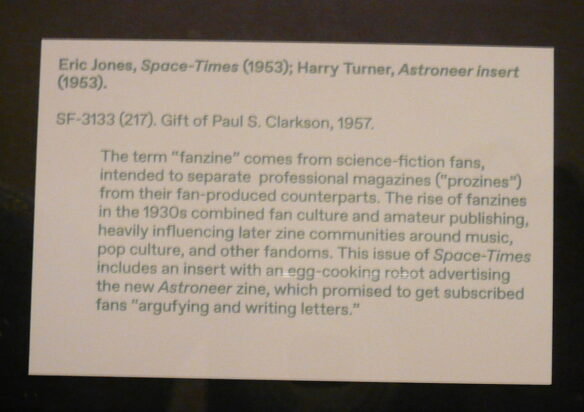
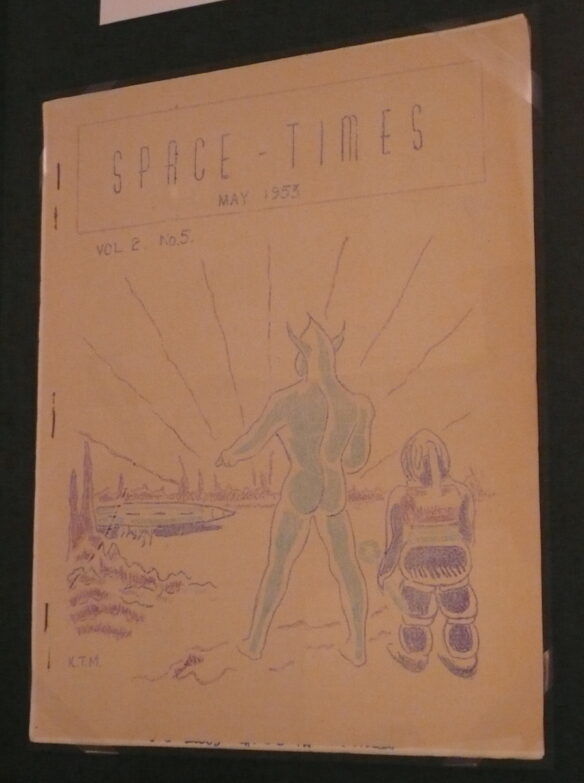
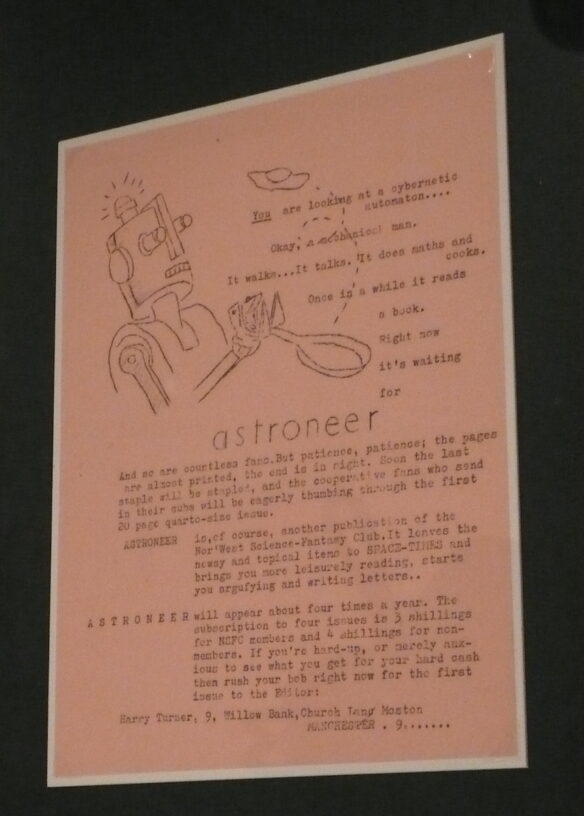
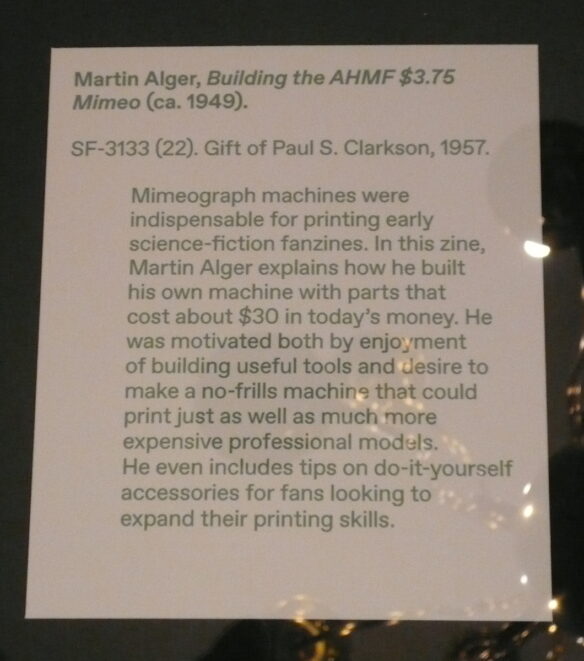
By Susan de Guardiola: Earlier this year, Harvard’s Houghton Library (their rare book depository) put on an exhibit on self-publishing which, among many other interesting zines, featured a few sfnal ones.  Apparently Harvard alumnus Paul Clarkson ’57 was a fan and left his collection to the university.  Among the fanzines in the exhibit was one by Ted White that is not in the Fancyclopedia.

About the exhibit: “Do It Yourself! Self-Publishing from Letterpress to LaserJet”

My photos of the SF zines:

Apologies for the weird angles; all the cases were directly under fancy chandeliers which made it hard to get photos without reflections.

If anyone is interested in viewing the collection, I read regularly at Houghton and can help them through the procedures.  Seems like some fanhistorian ought to dig into this, if it hasn’t already been done.

The finding aid for the full fanzine collection (with list): “Collection: Science fiction fanzines and prozines”.

Three Weeks in October

By Rich Lynch:

NO STUPID SNIPER IS GOING TO RUIN MY CONVENTION

That’s what was printed on a button which was handed out to attendees of the 2002 Capclave convention.  It was the second Capclave; the previous year the convention had debuted as a successor to Disclave, which had passed from existence following the notorious ‘Disclave flood’ incident of 1997 (and there are abundant details if you do a Google search).  The first Capclave had taken place just a few weeks after the nine-eleven attacks, and as a show of solidarity there had been buttons which had read: NO STUPID TERRORIST IS GOING TO RUIN MY CONVENTION.  I remember that most everybody did wear the button and it helped make the gathering seem more like the reunion of a large extended family than a science fiction convention.

Capclave appeared to be equally star-crossed in its next iteration. It was held over the weekend of October 18-20, 2002, and once again the attendees were brought closer together by an event taking place in the outside world. The word had spread quickly through all the Saturday night room parties: “There’s been another shooting.” Another victim of the D.C. Sniper.

D.C. Sniper shooting locations

We’ve reached the 20th anniversary of that terrible three weeks of violence so maybe a short summary of what happened is in order. Starting on October 2, 2002, there was a series of 15 sniper attacks, the locations ranging from Rockville, Maryland all the way down to a northern suburb of Richmond, Virginia. Parking lots and gas stations where there were clear sightlines seemed to be the preferred places for shootings, especially if they were located near a multi-lane avenue which provided a quick-and-easy escape.

The break in the case resulted after the sniper telephoned police from a pay phone and boasted of a previous unsolved shooting at a liquor store in Alabama. A fingerprint from that crime matched one for a 17-year-old man, Lee Boyd Malvo, who had a previous arrest out in Washington state. And it turned out that there were actually two people who were the shooters: further investigation indicated that Malvo was in the company of a much older man, John Allan Muhammad, who owned a Chevrolet sedan with New Jersey license plates. The pair were finally captured on October 24th, after two separate callers to a 911 emergency line informed police that they had spotted the car at an Interstate rest stop.

Ten people were killed during the three weeks of the D.C. Snipers’ shooting spree. In September 2003, Muhammad was tried and convicted in a Virginia court for one of the murders in that state and was sentenced to death. He was executed in 2009. Malvo was tried and convicted in Virginia a month later for another of the murders, and then pleaded guilty to two other murders in the state. Because he was not yet legally an adult at the time of the killing spree, he was spared the death penalty and instead was sentenced to three consecutive sentences of life-without-parole. He subsequently pleaded guilty to six of the killings in Maryland and received another six life-without-parole sentences.

The 2002 Capclave took place near the end of the ‘reign of terror’, as news media now describe those three weeks in October. It was easy to see that there was some edginess with many of the attendees, especially ones from out of town, but there was heightened awareness even from local fans who were there. Robert Macintosh, for instance, claimed he hadn’t been particularly concerned about personal safety but he had still noticed that there were open sightlines in the vicinity of the hotel, including one where he had been unloading equipment and supplies. This cautiousness extended beyond the convention. Ted White exemplified this when he later wrote that: “They shot into the parking garage of the Seven Corners Home Depot, less than a mile from my house. My daughter had been in that garage less than 10 minutes earlier. And, on another occasion, the snipers picked off a man at a Sunoco station just off of I-66, near Manassas, miles west of here, a station where I often gassed up when visiting my friend Michael Nally at his store nearby. I was super-cautious then, crouching low next to my car every time I gassed it up, and not lingering in the open in parking lots. It seemed prudent.”

Even commuting to work for fans became a memorable experience, though not in a good way. George Shaner later wrote that: “There were moments toward the end of this period, when I was walking to the Ballston Metro stop in the early morning to commute to work, where I thought that this would be just the sort of circumstances where I could become a statistic.” For me it was a similar situation. In 2002 my work location was down in D.C. and I was commuting to the Metrorail station by bus. Each morning during the work week, bright and early, I and maybe another dozen-or-so people queued up at the Gaithersburg park-and-ride lot waiting for the bus to arrive. It was a very exposed location and I made sure to keep moving around while I was in line so that I wouldn’t be a stationary target. It was always a relief to see the bus turn into the parking lot to pick us up. And it was a huge relief when the shooters were finally captured.

As for the 2002 Capclave, my recollection is that just like the previous year, horrible events in the outside world brought us together. We took comfort in each other’s presence and in the end we refused to allow the snipers to ruin our convention. I hope I’ll never have to experience another three weeks like that. But it certainly was an extraordinary time, and it made the convention utterly unforgettable for me. I have no doubt that most other attendees thought so too.

Pixel Scroll 9/11/22 Once Is Pixel Scrolls. Twice Is Files. Three Times Is Fannish Activity

(1) INVESTIGATIVE REPORTING AT ITS MOST. The news media covered the London Worldcon of 1957. They asked, “Do extraterrestrial things have much of a sex life?” Here’s a clip of the report:

ITN’s Lynne Reid Banks spoke to various creatures at the 15th World Science Fiction Convention, or Worldcon. Held in London, that year’s meet was dubbed “Loncon”. It was the first Worldcon to bring the global sci-fi community together outside the US.

Rob Hansen identified the fans in the video:

0.00 Jean Bogert with gun at start.
0.05 Guy with glasses looks like Sandy Sandfield 
0.06 Norman Shorrock over shoulder of guy in mask
0.12 Eric Jones interviewed
0.25 Ron Buckmaster interviewed
0.50 Frank & Belle Dietz interviewed in alien costumes. Round-faced teenager in the background is Mike Moorcock.
1.18 Guy with moustache, right rear is Ken McIntyre

Postscript: Rob Hansen: “David Pringle has pointed out that the most famous writer in that video clip is actually the interviewer, Lynne Reid Banks, and that she’s still with us.”

(2) EMERGENCY BACKUP SCROLL TITLE. I thought it was too long for the headline because long titles are one suspected reason why subscriber notifications don’t generate. However, I rather like Daniel Dern’s suggestion:

Seventy-Six Tron Clones Led The Masquerade, With 104 Lady Thors Close Behind, Followed By Rows And Rows Of Freshly-Polished 3CPO’s…

(3) CHICON 8 FINAL COVID REPORT. The Chicon 8 committee sent a wrapup email to attending members reporting a final total of 60 people who voluntarily reported they tested positive for Covid during or shortly after the Worldcon.

(4) CORA BUHLERT IN THE PAPER. “I did get at least one of the local newspapers to bite and report about my Hugo win,” says Cora. “The article isn’t online, but I included a photo of the article itself and the front page, which mentions me.” In German, of course.

 You can also see it in the online electronic edition. She’s on page 5: Aktuelle Ausgabe.

 (5) GUARDIAN’S OPINION ON FANTASY. Strangely enough, the Guardian has taken an editorial position on J.R.R. Tolkien: “The Guardian view on Tolkien: much more than special effects”.

Back at the dawn of the new millennium, an Oxford don argued, at book length, that fantasy was the most important literature of the 20th century and that the claim rested on the work of JRR Tolkien. Prof Tom Shippey was duly ridiculed by some for his heresy, with this paper describing it as “a belligerently waterwalkerargued piece of fan-magazine polemic”. Among those who Prof Shippey cited as influenced by “the master” was one Alan Garner, author of a series of beloved children’s fantasies.

How much more secure the professor’s claims look today. Garner, now 87, has just been shortlisted for the Booker prize for a novel called Treacle Walker, which, if more folky than fantastic, certainly displays its fantasy pedigree. Meanwhile, Tolkien delivered more than 25 million global viewers to Amazon Prime on the first day of its splashy new prequel to The Lord of the Rings.

â€ĶFantasy suits the era of film and television because it is infinitely grandiose while sidestepping the need to grapple with the effect on plot of modern technology: Frodo can’t phone home. However, two decades have passed since Jackson’s films landed, so the enduring popularity of The Lord of the Rings isn’t simply tie-in fever.

From the off, Tolkien was caught in the crossfire between those who dismissed his work as escapism and others who saw in it a moral purpose forged on the killing fields of the Somme. It’s a pointless binary. “Fantasy is escapist, and that is its glory,” wrote the master himself. “If we value the freedom of mind and soul, if we’re partisans of liberty, then it’s our plain duty to escape, and to take as many people with us as we can!”â€Ķ

(6) A DIFFERENT PERSPECTIVE. Bobby Derie is not so accepting as the Guardian when he considers the racism in the fantasy written by two icons in â€œDeeper Cut: The Two Masters: H. P. Lovecraft, J. R. R. Tolkien, & Racism in Fantasy” at Deep Cuts in a Lovecraftian Vein.

â€Ķ Lovecraft and Tolkien both held the image of the traditional English rural gentry as a kind of ideal.

Yet Lovecraft was no hobbit. While Lovecraft had an antiquarian yearning for old buildings and a rose-tinted vision of British Colonial period, his fiction was mostly set in the current day and focused on themes of degeneration, hoary survivals from the past, ancient aliens, and cults rather than a celebration or exultation of the small joys in life. While Lovcraft regretted what he called the coming “Machine Culture,” he did not ignore or decry the advancement of technology and industrialization, or exalt a rural state that had fallen into decay. Dunwich is no Shire, for all the rural trappings; it is kind of an anti-Shire, a place where old ways and habits have turned inward and strangeâ€Ķ.

(7) MAIL CALL. In another Deeper Cuts post, Bobby Derie looks at the letters exchanged between Robert E. Howard and Novalyne Price: â€œHer Letters To Robert E. Howard: Novalyne Price”

 â€ĶNovalyne had been aware of Bob Howard through their mutual friends in Brownwood; she had dated Howard’s good friend Tevis Clyde Smith, and he had introduced the two in 1932. Like Robert E. Howard, she was interested in becoming a writer. Now that they were both in Cross Plains, the two renewed their acquaintanceâ€Ķand began what would be a tumultuous on-again, off-again romance. The two dated, argued, exchanged gifts, flirted, met each other’s families, went on long drives in the country, debated, criticized each other’s fiction, quarreled and made up and quarreled againâ€Ķa story chronicled in her memoir One Who Walked Alone, later made into the motion picture The Whole Wide Worldâ€Ķ.

(8) IT’S FINALLY LEAP YEAR AGAIN. The time has come – Quantum Leap premieres Monday, September 19 at 10/9c on NBC, streaming next day on Peacock. “Quantum Leap: Official Trailer”.

(9) SOON TO LAUNCH. Here’s an interview with Oliver Brackenbury of the forthcoming New Edge Sword and Sorcery Magazine. (Cora Buhlert will have an essay in its first issue.) “Editor Spotlight: Interview with Oliver Brackenbury of New Edge Sword and Sorcery Magazine” at Deep Cuts in a Lovecraftian Vein.

 In your guest post on Scott Oden’s blog discussing New Edge as a mode or evolution of Sword & Sorcery fiction, you emphasize “inclusivity.” What does that mean in the context of the stories and writers you’re looking to publish?

OB: What inclusivity means to me is making sure that people outside my own demographic—white, cishet, neurotypical, able-bodied males, or just “white guys” as, for the sake of brevity, I’ll use going forward—can see themselves in both the stories and the authors creating them, ideally making them feel welcome within the community. This is key for expanding the audience of our beloved fantasy sub-genre, as well as its pool of authors.

I’ve gained firsthand experience with this in my six years volunteering with a group dedicated to promoting the western Hemisphere’s largest publicly accessible speculative fiction genre archive—The Merril Collection. Through no malice of anyone involved, in the time I’ve been with them, our group has been made up almost or entirely of white people. Our selling old paperbacks to help raise funds would often combine with 20th century publishing trends to create the scene of a couple of white people sitting behind event tables coated in covers featuring white characters written by white authors, trying to encourage the full breadth of humanity to spend a few dollars in support of the collection, while hearing our pitch for it.

All that sameness was a significant obstacle to achieving our goals, as more than one non-white individual made clear when—quite reasonably—saying “I only see white faces here.” or “I don’t see myself in what you are doing.”

Even coming back to myself, I don’t hate my fellow white guys any more than I hate IPAs, but I get frustrated when the vast majority of shelf space is filled with the same thing, whether it’s beer or writerly perspectives. All of this has informed the approach I’m taking with the stories and authors I’m looking to publish.

(10) MEMORY LANE.  

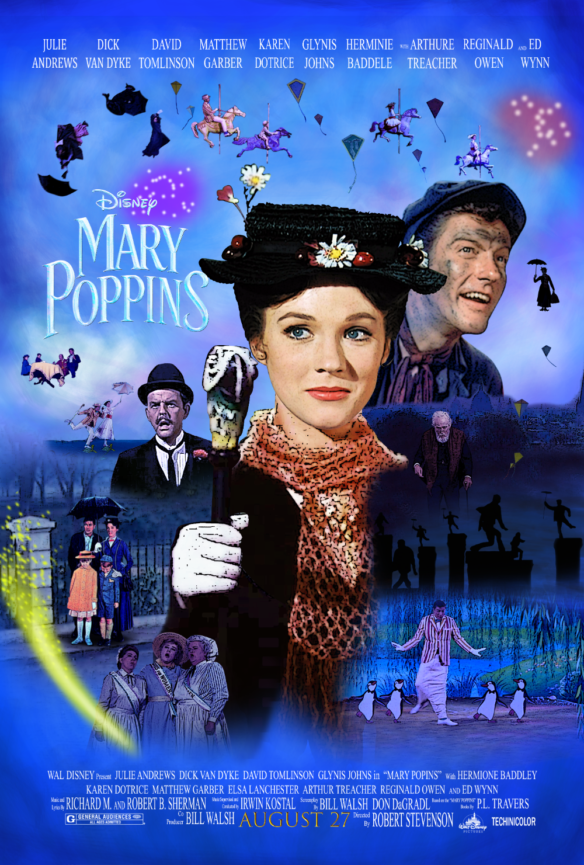
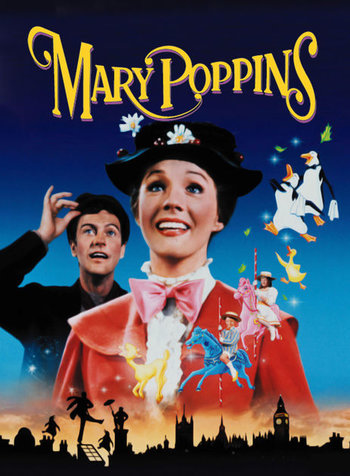
1964 – [By Cat Eldridge.] Ok, I confess. I really, really loved the original Mary Poppins which came out fifty-eight years ago. No I didn’t see it until (I think) a decade or so later but I immediately loved it.

Mike Glyer notes that “She doesn’t only fly. At least in the 1964 movie she has a suitcase that must be related to the TARDIS, all the stuff she pulls out of it. And her boyfriend has the ‘luck’ superpower!”

It was directed by Robert Stevenson from the screenplay by Bill Walsh and Don DaGradi as based off P. L. Travers’s Mary Poppins series. It was produced by Walt Disney and starred Julie Andrews in her first acting role. Principal other cast were Dick Van Dyke, David Tomlinson and Glynis Johns. The film was shot entirely at the Walt Disney Studios in Burbank, California, using painted London background scenes.

It won’t surprise you that the film received universal acclaim from film critics, and that Julie Andrews and Dick Van Dyke got lavish praise. Box office wise, it earned some forty-five million dollars on an estimated budget of four or so million dollars (Disney never released the budget officially, something they do quite often) and it’s had at least another hundred million in box office rentals since then. Not to mention DVD and such sales.

It was the only one of his films which earned Disney a Best Picture nomination during his lifetime.

In 2013, the film was selected for preservation in the United States National Film Registry by the Library of Congress as being culturally, historically, or aesthetically significant.

A biographical drama on the making of the film, Saving Mr. Banks, was released nine years ago. It was well received with The Hollywood Reporter saying the film was an “affecting if somewhat soft-soaped comedy drama, elevated by excellent performances.”

But that’s not where this story ends. As Charles de Lint once said, “There are no happy endings… There are no endings, happy or otherwise. We all have our own stories which are just part of the one Story that binds both this world and Faerie. Sometimes we step into each others’ stories – perhaps just for a few minutes, perhaps for years – and then we step out of them again. But all the while, the Story just goes on.” And so it is with the Mary Poppins story. 

Did I mention that P.L.Travers loathed this film with all her heart save Andrews as Poppins? Well she really did. Which complicated making a sequel. When Disney personally went to her a year later seeking rights to a sequel, she rejected it vehemently. Twenty years on did not at all mellow her, so she rejected them yet again save Andrews playing Poppins. And the use of the color red. Don’t ask. 

With approval from Travers’ estate (see death helps clear rights as does offering presumably offering up the estate large sums of money), Disney greenlit the project with the film taking place twenty-five years after the first one was set and having a stand alone narrative that was based on the remaining seven books in the series. 

That sequel, Mary Poppins Returns, was released four years ago. It was well received too. Dick Van Dyke, a cast member of the original film, appears in the film as Mr. Dawes Jr., a role originated by Arthur Malet in the previous film. 

And Angela Lansbury is the Balloon Lady. The part was written as a cameo role for Julie Andrews who portrayed Mary Poppins in the original film, but she turned the role down as she felt her presence would unfairly take attention away from Emily Blunt who plays Mary Poppins here.

(11) TODAY’S BIRTHDAYS.

[Compiled by Cat Eldridge.]

  • Born September 11, 1856 Richard Ganthony. OK, this is going to a little bit explaining. Imagine that an author decided to riff off Charles Dickens’ A Christmas Carol. With Martians. Seriously. A Message from Mars is a play primarily written by him, first performed at London’s Avenue Theatre in November 1899. The play is about Horace Parker, a Grinch-like man. Horace refuses go with Minnie, his fiancÃĐ, to a ball because he wants to stay home reading about new discoveries about the planet Mars. He falls asleep and dreams that he is visited by a Messenger from Mars. The Messenger trys to cure Horace of his selfishness. After a series of visions, the Messenger in the last Visio has him as a beggar in rags. Having realized the error of his ways, he awakens a changed man. It was filmed twice, both times as A Message from Mars (1913 and 1921, and I’m assuming as silent movies given their dates). It would be novelized by Lester Lurgan. (Died 1924)
  • Born September 11, 1929 BjÃķrn Nyberg. A Swedish writer known largely for his Conan stories which given that he wrote just one non-Conan story makes sense. His first book in the series was The Return of Conan which was revised for publication by L. Sprague de Camp. Likewise, they later did Conan the AvengerConan the VictoriousConan the Swordsman and Sagas of Conan. The latter two are available on iBooks and Kindle. (Died 2004.)
  • Born September 11, 1928 Earl Holliman, 94. He’s in the cook in Forbidden Planet and he shares a scene with Robbie the Robot. A few short years later, he’s Conrad in Visit to a Small Planet though it’ll be nearly fifteen before his next genre role as Harry Donner in the Six Million Dollar Man’s Wine, Women and War TV film. He shows up as Frank Domino in the Night Man series, an adaptation of a Malibu Comics’ Ultraverse character. What the Frell is that publisher?!? Surprisingly he’s done no other genre series beyond being in the original Twilight Zone series premiere as Mick Ferris in the “Where Is Everybody?” episode. 
  • Born September 11, 1930 Jean-Claude Forest. Forest became famous when he created Barbarella, which was originally published in France in V Magazine in 1962.  In 1967 it was adapted by Terry Southern and Roger Vadim and made into 1968 film of that name with Jane Fonda in the lead role, with him acting as design consultant.  It was considered an adult comic by the standards of the time. An animated Barbarella series was booted around in the Sixties but never made. (Died 1998.)
  • Born September 11, 1941 Kirby McCauley. Literary agent and editor, who as the former represented authors such as Stephen King, George R.R. Martin and Roger Zelazny. And McCauley chaired the first World Fantasy Convention, an event he conceived with T. E. D. Klein and several others. As Editor, his works include Night Chills: Stories of Suspense, FrightsFrights 2, and Night Chills. (Died 2014.)
  • Born September 11, 1965 Catriona (Cat) Sparks, 57. Winner of an astounding eighteen Ditmar Awards for writing, editing and artwork, her most recent in 2021 for her Dark Harvest story collection. She won two in the same year in 2014 when her short story “Scarp” was awarded a Ditmar for Best Short Story and The Bride Price a Ditmar for Best Collected Work.  She has just one novel to date, Lotus Blue, but has an amazing amount of short stories which are quite stellar. Lotus Blue and The Bride Price are both available on the usual suspects.
  • Born September 11, 1970 Colson Whitehead, 52. Winner of the Arthur Clarke C. Award for The Underground Railroad. Genre wise, he’s not a prolific writer, he’s written but two other such works, The Intuitionists and Zone One. He’s written but one piece of short genre fiction, “The Wooden Mallet”.  However he’s written seven other works including John Henry Days which is a really interesting look at that legend, mostly set at a contemporary festival about that legend. 

(12) COMICS SECTION.

  • Popeye vs Credential. Guess who wins?
  • Crankshaft has a crossover from the Hi and Lois strip.

(13) WHEN CONAN RESCUED TED WHITE. Brian Murphy celebrated the magazine Fantastic and its contribution to the sword and sorcery boom of the 1960s and 1970s: â€œA Fantastic Chapter for Conan and Sword-and-Sorcery” at DMR Books.

The late 1960s and early ‘70s were peak sword-and-sorcery. The Lancer Conan Saga was at its zenith of popularity, eventually selling by some estimates upwards of 10 million copies. Fritz Leiber and Michael Moorcock were seeing broad mass market paperback publication, Leiber with Swords and Deviltry and Swords Against Death (Ace, 1970) and Moorcock with the likes of the first Corum trilogy (Berkley Medallion, 1971). And as the ‘60s gave way to the ‘70s a struggling magazine was about to get a signal boost from S&S’s mightiest hero.

As Ted White found out during his tenure as editor of the digest-sized Fantastic Science Fiction & Fantasy Stories/Fantastic Science-Fiction/Fantastic Stories of Imagination, best known as Fantastic, the public appetite for Conan ran deep, and was not slaked by the Lancers.â€Ķ

Circulation remained flat, but White finally got the boost he was looking for when he began publishing stories of S&S’ mightiest hero: Conan, black-haired, sullen-eyed, sword in hand, a thief, a reaver, a slayer, with gigantic melancholies and gigantic mirth, was about to tread the digest size pages of Fantastic under his sandalled feet, in the form of four new stories by Lin Carter and L. Sprague de Campâ€Ķ.

(14) FAKE NEWS. The New York Times recounts how “Galileo Forgery’s Trail Leads to Web of Mistresses and Manuscripts”.

When the University of Michigan Library announced last month that one of its most prized possessions, a manuscript said to have been written by Galileo around 1610, was in fact a 20th-century fake, it brought renewed attention to the checkered, colorful career of the man named as the likely culprit: Tobia Nicotra, a notorious forger from Milan.

Nicotra hoodwinked the U.S. Library of Congress into buying a fake Mozart manuscript in 1928. He wrote an early biography of the conductor Arturo Toscanini that became better known for its fictions than its facts. He traveled under the name of another famous conductor who had recently died. And in 1934 he was convicted of forgery in Milan after the police were tipped off by Toscanini’s son Walter, who had bought a fake Mozart from him.

His explanation of what had motivated his many forgeries, which were said to number in the hundreds, was somewhat unusual, at least according to an account of his trial that appeared in The American Weekly, a Hearst publication, in early 1935.

“I did it,” the article quoted him as saying, “to support my seven loves.”

When the police raided Nicotra’s apartment in Milan, several news outlets reported, they found a virtual forgery factory, strewn with counterfeit documents that appeared to bear the signatures of Columbus, Mozart, Leonardo da Vinci, George Washington, the Marquis de Lafayette, Martin Luther, Warren G. Harding and other famous figures.

Investigators had also found a sort of shrine to his seven mistresses, at least according to The American Weekly. â€Ķ

(15) POSTSCRIPT FOR PAT CADIGAN’S 9/10 BIRTHDAY. [Item by John Hertz.] When she was Toastmaster at MidAmericon II, I contributed this (acrostic, in 5-7-5-syllable lines) to the newsletter.

Passing all measure,
Ardent, courageous, comic,
Taking each moment

(16) PURE COMMERCIAL IMAGINATION. Mashed gives its pitch for “Discontinued Wonka Candy That Needs To Make A Comeback”.

Unfortunately, fans of the fictional-turned-reality candy empire had been watching supplies dwindle over the decades, and the vast majority of Wonka candies have been discontinued as of 2022. In fact, the Wonka brand itself was eventually retired after being acquired by NestlÃĐ in 1988, according to The Christian Science Monitor. The Wonka brand was sold off in 2018, and the remaining candies found a new home with Ferrero (via The Motley Fool).

Surprising, Wonka Candy isn’t entirely extinct.

â€Ķ While many Wonka candies have completely vanished from store shelves, others can still be found if you know where and what to look for. Back in the days of the Willy Wonka Candy Company, Kazoozles offered a different flavor profile than the iconic chocolate bars. The Twizzler-like sweets had a tart fruity taste starting with the original cherry punch flavor, according to Snack History. In 2015 when the Wonka brand was acquired by NestlÃĐ, Kazoozles was rebranded and re-released under the now-familiar SweeTARTS Ropes candyâ€Ķ.

(17) DINOMUMMY. “Quick-dried Lystrosaurus ‘mummy’ holds clues to mass death in the Triassic” – Nature explains the research.

The fossilized skin of young mammal-like reptiles hints that drought led to their demise some 250 million years ago, at the start of the Triassic period1.

A few millennia before their deaths, climate change thought to be caused by volcanic eruptions led to the Permian extinction, the largest mass-extinction event in Earth’s history. Among the small number of animals to survive the cataclysm were reptiles in the genus Lystrosaurus.

While looking for clues to what the climate was like after the mass extinction, Roger Smith at the University of the Witwatersrand in Johannesburg, South Africa, and his colleagues uncovered the remains of 170 four-limbed animals in South Africa’s Karoo Basin. Among the tangled remains, the researchers found young Lystrosaurus of two species that had died in clusters around what was once a dry riverbed.

Several of the younglings were in a spreadeagled position seen in some animals when they collapse from heat exhaustion. Two of the fossils also had what appeared to be mummified skin, which probably formed through rapid drying after death.

Together, this evidence points to a mass die-off of young Lystrosaurus owing to heat and water shortages, suggesting that the climate after the Permian extinction underwent periods of drought.

Primary research here.

(18) DAN DARE. [Item by Martin Morse Wooster.] The BCC posted this clip in which Patrick Stenson interviews Dan Dare creator Frank Hampson in this clip from 1975.
(19) HE ISN’T SPOCK. (OKAY, HE LIED). [Item by Martin Morse Wooster.] Leonard Nimoy chats with the BBC’s Terry Wogan in January 1989 about his autobiography I Am Not Spock, how he became a director, and how in classic Star Trek he was so “emotional” “it was like doing Mutiny On The Bounty” in this clip which dropped yesterday.

[Thanks to John King Tarpinian, Andrew Porter, Chris Barkley, Rob Thornton, Ersatz Culture, Cora Buhlert, Steven French, John Hertz, Daniel Dern, SF Concatenation’s Jonathan Cowie, Michael Toman, Cat Eldridge, Mike Kennedy, Martin Morse Wooster, and JJ for some of these stories. Title credit belongs to File 770 contributing editor of the day John A Arkansawyer.]
Pixel Scroll 3/31/22 There’s No Way To Delay, That Pixel Scrolling Every Day

(1) LASFS IN THE FIGHTING FORTIES. [Item by David Langford.] As a direct result of comments at File 770, I’ve made Bixelstrasse generally available in paperback from Lulu.com — by agreement with Rob Hansen – with all proceeds going to TAFF. It’s a pretty hefty volume at 429pp, and there’s a map on the back cover!

Rob Hansen has compiled this substantial (194,000 words) history of the 1940s Los Angeles Science Fantasy Society from contemporary fanzine accounts, so the story emerges from the participants’ own words. Besides such famous or notorious fans as Forrest J Ackerman, Charles Burbee, Claude Degler, Francis Towner Laney, “Morojo” and “Tigrina”, we meet several well-remembered professionals including Ray Bradbury, Edgar Rice Burroughs, Ray Harryhausen, Robert A. Heinlein, L. Ron Hubbard, Fritz Lang, Fritz Leiber and A.E. van Vogt. As Rob himself puts it: “… there have been other occasions on which fans have shared premises in varying degrees, but to have a community of fans centred around a clubroom and living in nearby rooming houses on the same street gave rise to all-week, around-the-clock fanning of a sort not seen before or since. […] This set-up, the whole ’fannish village’ they established, was immensely appealing to me in my twenties (though seeing so much of each other inevitably exacerbated personality clashes, of course). Add in the large numbers of fans from around the country who passed through Los Angeles thanks to the war, many of them processed via the Induction Center at nearby Fort MacArthur before being sent off to fight, and you have something unique in the history of fandom, a saga featuring fans and pros, communists and homosexuals, madmen and mystics, Hollywood stars and spies.”

(2) BURBEE: MORE COMPLEAT THAN EVER BEFORE. In Ansible on April 1, David Langford will announce another TAFF free ebook — The Incompleat Burbee Volume 2 — expanded from the 1996 version with further previously uncollected material. Cover art by Bill Rotsler. As always, a donation to the Trans-Atlantic Fan Fund is welcomed.

Charles Burbee’s earlier fanwriting was collected as The Incompleat Burbee in 1958, but he carried on being grumpy, acerbic and funny (though with longer and longer gaps between appearances) for further decades. Terry Carr planned this second volume in the 1970s and typed many stencils for a duplicated (mimeo) edition that never appeared. The stencils were passed from fan to fan until finally Jeff Schalles published The Incompleat Burbee Volume 2 as a photocopied fanzine in 1996.

This ebook contains the complete text of that 1996 edition, plus a number of further Burbee articles and stories not included either then or in 1958. These begin with an early piece for Francis Towner Laney’s The Acolyte (1946), include several classics such as the legendary “I Had Intercourse with a Glass of Water” from Terry Hughes’s Mota (1974), and end with material first published in Robert Lichtman’s Trap Door after Burbee’s much-lamented death in 1996.

(3) CANCELLED FLIGHTS. Camestros Felapton follows his series of Firefly episode reviews by speculating where it would have gone next had it stayed on the air: “Firefly Friday: Riding off into the sunset part 2”.

â€Ķ I also want to talk about some of the elements that either surprised me or, I believe, would have changed if the show had lasted longer. With a show like Buffy the Vampire Slayer (to pick on the near-contemporary Whedon show) neither the first season nor the final season are the best examples of what the show is like. If Firefly had lasted three or four seasons it would have evolved and advocates of the show would probably be pointing to the ‘best’ episodes as ones from season 2 or 3. Star Trek: The Next Generation really improved sharply from Season 3 onwards, the most Doctor-Whoey Doctor Who is arguably Tom Baker, the FOURTH iteration of the character and multiple years into the showâ€Ķ.

(4) STORYTELLING DECISIONS. Maryann Corbett’s review argues that Maria Dahvana Headley didn’t translate Beowulf but adapted it, and thoughtfully compares the book with the work of other translators. “The Monsters and the Translators: Grappling with Beowulf in the Third Millenium” at Literary Matters. Her review concludes:

â€ĶThat narrator of Headley’s, along with a few other elements of her retelling, can make me grimace the way Professor Kendall did at my old comic book. But Headley’s book is not the comic I feared it would be after reading reviews that emphasize bro and dude; it’s an effective and enjoyable poem. I debate with myself: are my reservations fair, or are they biases built on too much early exposure to Old Stuff? I’m pleased to have read Headley. I’m more pleased to have been invited back to old books and notes and blasted forward to marvelous new ways of learning.

(5) THE HOBBITS MEN DON’T SEE. [Item by Daniel Dern.] “Tolkien Estate updates website with previously unseen content” reports The Bookseller.

â€ĶThe relaunch date, 26th February, is significant in Tolkien lore because 26th February 3019 was the date in the Third Age when the Fellowship of the Ring was broken at Amon Hen and Frodo and Sam set out on their journey to Mordor. 

The newly launched website, tolkienestate.com, will exhibit the literary and artistic works created by J R R Tolkien and to provide further insights into his life and times. The website includes sections on his writing, painting and calligraphy, his scholarship and letters and a timeline of his life, together with numerous family photographs. It also features an audio-visual section containing recordings and clips featuring both the author and his son, Christopher Tolkien. 

(6) A FINE TIME WAS HAD BY ALL. “The Library Ends Late Fees, and the Treasures Roll In” — the New York Times is there to admire the returning relics.

â€ĶSome items, checked out decades ago, arrived with apologetic notes. “Enclosed are books I have borrowed and kept in my house for 28-50 years! I am 75 years old now and these books have helped me through motherhood and my teaching career,” one patron wrote in an unsigned letter that accompanied a box of books dropped off at the New York Public Library’s main branch last fall. “I’m sorry for living with these books so long. They became family.”

Three DVD copies of “The Boondock Saints II: All Saints Day,” a 2009 action film about Irish Catholic vigilantes in Boston that has a 23 percent rating on Rotten Tomatoes, were returned to three libraries in three different boroughs.

When New York’s public library systems announced last October that they would be eliminating all late fines, the goal was to get books and people back to the more than 200 branches, as well as research centers, across the city after a year and a half of limited hours and access.

The goal was achieved: A wave of returned overdue materials came crashing in, accompanied by a healthy increase (between 9 and 15 percent, depending on the borough) of returning visitors.

Since last fall, more than 21,000 overdue or lost items have been returned in Manhattanâ€Ķ

(7) REMEMBERING STEVE STILES. Michael Dobson put together a computerized slide show as a tribute to Steve Stiles’ artwork, first shown at DisCon III in conjunction with the table sales of Steve’s posthumous collection. It’s now viewable on YouTube: “Steve Stiles – An Appreciation”. The soundtrack includes music by Ted White’s band Conduit.

(8) THIRD MAN THEME. Ally WIlkes discusses “Encounters with the Supernatural in Antarctica: A Brief History” at CrimeReads.

â€Ķ The benevolent third man—which John Geiger dubs the ‘saviour’ presence—appears to be something distinct from our traditional understanding of ghosts. It appears in crisis situations and interacts with the observer, even if only to provide a sense of comfort. However, the Antarctic also contains stories of encounters with a less benevolent presence. This second type of encounter, again, doesn’t fit neatly into the category of ‘ghost’, if by that we mean the spirit of a human person who has died (and often at the place in question—Antarctica poses a bit of a conundrum on this front, as although it’s certainly seen its share of deaths, its footprint of human occupation is far later and far sparser than most other places on the planet)â€Ķ.

(9) FILET MINION. Illumination Entertainment’s Minions: The Rise of Gru will be released in July.

Long before he becomes the master of evil, Gru (OscarÂŪ nominee Steve Carell) is just a 12-year-old boy in 1970s suburbia, plotting to take over the world from his basement. It’s not going particularly well. When Gru crosses paths with the Minions, including Kevin, Stuart, Bob, and Otto—a new Minion sporting braces and a desperate need to please—this unexpected family joins forces. Together, they build their first lair, design their first weapons, and strive to execute their first missions. When the infamous supervillain supergroup, the Vicious 6, oust their leader—legendary martial arts fighter Wild Knuckles (OscarÂŪ winner Alan Arkin)— Gru, their most devoted fanboy, interviews to become their newest member. The Vicious 6 is not impressed by the diminutive, wannabe villain, but then Gru outsmarts (and enrages) them, and he suddenly finds himself the mortal enemy of the apex of evil. With Gru on the run, the Minions attempt to master the art of kung fu to help save him, and Gru discovers that even bad guys need a little help from their friends.

(10) RICHARD LABONTÉ. The family obituary for Richard LabontÃĐ has been published by the Toronto Globe and Mail: “Richard LABONTE Obituary (2022)”.

As an editor of gay anthologies, co- founder of the A Different Light bookstore chain, and mentor to many authors, he was one of the most influential advocates of queer culture and literature in North America. â€ĶThroughout the 1990s, A Different Light became a centre of queer culture in California and New York, places where authors and fans met for readings and informal receptions. Over 22 years, Richard combined his bookselling career with his editorial expertise to connect authors with thousands of new readersâ€Ķ. 

(11) MEDIA BIRTHDAY.

1985 [Item by Cat Eldridge.] Thirty-seven years on ABC, Max Headroom premiered. That however was not the beginning of the phenomenon known as Max Headroom. The story is based on the Channel 4 British TV film produced by Chrysalis, Max Headroom: 20 Minutes into the Future. That short film is largely similar to the pilot of ABC series. 

The British film consisted of material intended to be broken into short segments for a music video program, The Max Headroom Show, which did premiere two days later. Max Headroom served as veejay, and its first episodes unusually featured no introductory title sequence or end credits, just Max as done by Matt Frewer in that amazing makeup blabbing away. It was a hit and several interactions were done including for the American cable network Cinemax.

Now back to Max Headroom. The dystopian series was set, as it said twenty minutes in the future in a city, if not a world dominated by media networks. Y’all know the story so I won’t say more than that. It did a splendid job of depicting a future of what was very obviously a limited budget. 

Matt Frewer, Amanda Pays and William Morgan Shepherd are the only performers that carry from the Max Headroom: 20 Minutes into the Future version of this story. And several characters such as Dominique, Blank Reg’s Companion, don’t exist in that bleaker version of the story. No idea if that version is available on DVD. 

Max Headroom I consider to be every bit as good as Farscape or any of the better genre series. It would last but two seasons and a mere fourteen episodes before being cancelled. 

(12) TODAY’S BIRTHDAYS.

[Compiled by Cat Eldridge.]

  • Born March 31, 1926 John Fowles. British author best remembered for The French Lieutenant’s Woman but who did several works of genre fiction, The Magus which I’ve read a long time ago and A Maggot which I’ve not read. Some works which are not genre such as The Collector just make me shudder. (Died 2005.)
  • Born March 31, 1927 William Daniels, 95. He’s the voice of KITT on the Knight Rider series on the movie came afterwards. He also has genre appearances in The Ghost & Mrs. Muir, the original Kolchak: The Night Stalker, The Incredible Hulk, Galactica 1980, Faerie Tale Theatre, Touched by an Angel and a fantastic “appearence“ on Star Trek: Voyager where he’s the voice of Hospital Ship 4-2, Allocation Alpha in the “Critical Care” episode. 
  • Born March 31, 1932 John Jakes, 90. Author of a number of genre series including the Brak the Barbarian series.  Dark Gate and Dragonard are his other two series. As Robert Hart Davis, he wrote a number of The Man From U.N.C.L.E. novellas that were published in The Man from U.N.C.L.E. Magazine. The magazine apparently only existed from 1966 to 1968. 
  • Born March 31, 1934 Richard Chamberlain, 88. His first dive into our end of reality was in The Three Musketeers as Aramis, a role he reprised in The Return of Three Musketeers. (I consider all  Musketeer films to be genre.) Some of you being cantankerous may argue it was actually when he played the title character in Allan Quatermain and the Lost City of Gold which he did some years later. He’s listed as voicing the Jack Kirby-created character Highfather on the superb Justice League: Gods and Monsters but that was but a few lines of dialogue I believe. He was in the Blackbeard series as Governor Charles Eden, and series wise has done the usual one-offs on such shows as Alfred Hitchcock Presents, Boris Karloff’s Thriller, Chuck and Twin Peaks.
  • Born March 31, 1936 Marge Piercy, 86. Author of He, She and It (published outside the UK as Body of Glass) was shortlisted for the Otherwise Award and won the Arthur C. Clarke Award. She also wrote Woman on the Edge of Time (1976) doomed to be called a “classic of utopian speculative sf”. Woman on the Edge of Time was nominated for a Retrospective Otherwise Award (1996).
  • Born March 31, 1943 Christopher Walken, 79. A performer whose first role was in The Three Musketeers, as a minor character, John Felton. He has a minor role in The Sentinel, a horror film, and a decidedly juicy one in Trumbull’s Brainstorm as Dr. Michael Anthony Brace followed up by being in Cronenberg’s The Dead Zone as Johnny Smith. Damn, I’d forgotten he was Max Zorin, the villain in A View to a Kill! H’h, I didn’t know he was in Gibson’s New Rose Hotel but then I haven’t actually seen it yet. Is it worth seeing? And let’s wrap this up by noting his appearance in The Stepford Wives as Mike Wellington.
  • Born March 31, 1960 Ian McDonald, 62. Now here’s an author that I’ve read a lot of starting with his first novel, Desolation Road, and following through to his most recent, The Luna series. I do have favorites — the aforementioned Desolation Road and the other Mars novel, Ares Express, plus the India in 2047 series and The Dervish House  are the ones I like the best. Chaga I think is the one I need to read again as I was annoyed by it the first time. 

(13) COMICS SECTION.

(14) THE GAME’S AFOOT. Annalee Newitz was referenced on Jeopardy! last night.

(15) BEUKES ADAPTATION. Shining Girls premieres on Apple TV+ on April 29.

Based on Lauren Beukes’ best-selling novel, Shining Girls follows Kirby Mazrachi (Moss) as a Chicago newspaper archivist whose journalistic ambitions were put on hold after enduring a traumatic assault.Years after a brutal attack left her in a constantly shifting reality, Kirby Mazrachi learns that a recent murder is linked to her assault. She teams with veteran reporter Dan Velazquez (played by Wagner Moura) to understand her ever-changing present—and confront her past.

(16) BLOWN TO MORE THAN 8 BITS. “A retro computer museum in Mariupol was attacked by Russia” – NPR’s news item will probably interest Chris Garcia, who used to work in a computer museum, and it will probably make him sad, too.

Nearly two decades ago, Dmitriy Cherepanov started a collection of retro computers in Mariupol, Ukraine, that grew into an internationally known assemblage of historic machines, housed in a private museum he called IT 8-bit.

Russia’s campaign to take over his city in southeast Ukraine has killed at least 2,000 civilians, destroyed most of the city’s homes and turned Cherepanov’s beloved computer museum into rubble.

“I’m very upset,” Cherepanov, 45, told NPR. “It’s been a hobby of my life.”

IT 8-bit held more than 120 examples of computer technology and game consoles from the last century. Cherepanov estimates that up to 1,500 people visited the free museum every year before he closed it at the start of the pandemic.

Cherepanov knows the small building housing the museum was bombed, like many other structures in the city, sometime after March 15. He believes that any machines that weren’t destroyed by the blast were likely taken, given the desperate circumstances in the city now.

(17) MOON RISE. In the Washington Post, David Betancourt interviews Oscar Isaac about Moon Knight and his previous roles in Marvel movies as the villain in X Men: Apocalpyse and his voice work in Spider-Man: Into The Spiderverse. “Oscar Isaac, with ‘Moon Knight,’ finally rises to the Marvel A-list”.

â€ĶTo prepare for the role, Isaac said, Robert Oxnam’s “A Fractured Mind: My Life with Multiple Personality Disorder” became his bible. The book is a deeply personal account of the author’s struggles and eventual acceptance of the multiple lives taking place in his mind.

“It felt like that was the orienting principle for this, because it was a real journey into this guy’s discovery and healing, which is the integration that had to occur for him to be able to live with [multiple personalities] as a functioning human being,” Isaac saidâ€Ķ.

(18) TWO CHAIRS TALKING. David Grigg and Perry Middlemiss have an excellent adventure is episode 72 of Two Chairs Talking, “A Dangerous Kind of Vision”.

We take the Hugo Time Machine back to 1968, when Harlan Ellison’s Dangerous Visions anthology dominated the short fiction categories. Perry and David argue about the Best Novel winner, Lord of Light.

(19) WAS CODA THE ONLY UNDERDOG TO WIN AN OSCAR? It’s well known that CODA was an underdog in the Oscar race for Best Picture, which is further proven below. The JustWatch Streaming Guide graphic shows this trend continued in other categories as well, with winners Encanto and Drive my car being less popular than other nominees in their respective categories. 

JustWatch is an international streaming guide that helps over 20 million users per month across 100 countries to find something great to watch on Netflix, Prime Video, Apple TV+, etc.

(20) HERE’S THE BEEF. “We Must Live in a Horrid Simulation, Because Joe Rogan Just Offered to Train Elon Musk to Fight Vladimir Putin” declares Futurism.

Sometimes it feels like our overlords are phoning it in with the stuff they’re programming into our simulation.

Exhibit A: Former UFC color commentator turned “Fear Factor” host turned notoriously dubious podcaster Joe Rogan is now offering to help Tesla and SpaceX CEO Elon Musk train so that he can fulfill his goal of kicking Russian President Vladimir Putin’s ass, presumably in retaliation for the latter’s invasion of Ukraine.

No, this isn’t the world’s dumbest round of “Cards Against Humanity” — it’s actually something the Rogan said on a recent episode of his podcast, “The Joe Rogan Experience,” in response to Musk challenging Putin to single-hand combat earlier in March.

“I offered my services,” Rogan told his guest, Aussie comedian Monty Franklin. “I texted him. I said, ‘Dude I will arrange all of your training.’ ‘If you really do fight Putin,’ I said, ‘I will arrange all your training,’”â€Ķ

(21) BRAINY VIDEO. [Item by Martin Morse Wooster.] Tom Scott tosses off 14 story ideas involving brains in under six minutes!

(22) “NOVEL” IDEA: DOWSE FOR THE DEAD. [Item by Dave Doering.] It never ceases to amaze me how “reality” can be waaayyy stranger than fiction. The Marshall Report tells about cops being trained to use dowsing rods to find buried remains. “Can ‘Witching’ Find Bodies? Police Training Alarms Experts”. Surely there’s a novel idea in there…

One student asks about dowsing rods.“You want to use some?” replies Arpad Vass, an instructor at the National Forensic Academy in Oak Ridge, Tennessee, where law enforcement officers come to learn how to use science to solve crimes — at least in theory. “I use them on everything.”

[Vass] teaches students the proper way to dowse and some of “the 17 scientific principles that make the rods work, which took me years to figure out.”

TechDirt’s Tim Cushing is beyond skeptical: “Cops Are Being ‘Trained’ To Use Literal Witchcraft To Find Dead Bodies”.

â€Ķ Alarmed? They should be apoplectic! This is insanity. That this has gone longer than Vass’ first attempt to introduce dowsing into forensic science is an indictment of both the University of Tennessee and the law enforcement agencies that still pay to have officers and investigators subjected to cop-washed black arts by a “scientist” deep in throes of self-delusion. Dowsing “works” like a Ouija board “works.” It’s an illusion that relies on self-deception. It is not, by any stretch of the imagination, science.

It does not magically become a science just because Vass is capable of using science-y words or has a background in actual scienceâ€Ķ.

(23) VIDEO OF THE DAY. [Item by Martin Morse Wooster.] In “Honest Game Trailers: Triangle Strategy,” Fandom Games says this game is so dull it drags “more than a mandatory Zoom meeting”: and is equivalent to George RR Martin writing “a visual novel while on Ambien and not knowing what a visual novel was.”  As for gameplay, the narrator complains that “I don’t want my poor decision making to come to a logical conclusion.  I do that by existing.”

[Thanks to Cat Eldridge, Mike Kennedy, Martin Morse Wooster, JJ, Rob Thornton, David Langford, Chris Barkley, StephenfromOttawa, Daniel Dern, Dave Doering, John King Tarpinian, Andrew Porter, and Michael Toman for some of these stories. Title credit belongs to File 770 contributing editor of the day Jon Meltzer.]

Pixel Scroll 9/24/21 Scrolling Pixels Give You So Much More

(1) SUES WHATEVER A SPIDER CAN. The heirs of Steve Ditko filed to reclaim their rights to some well-known Marvel characters – now Marvel is suing to prevent them. The Hollywood Reporter looks over the filings in “Marvel Suing to Keep Rights to ‘Avengers’ Characters”.

Disney’s Marvel unit is suing to hold on to full control of Avengers characters including Iron Man, Spider-Man, Dr. Strange, Ant-Man, Hawkeye, Black Widow, Falcon, Thor and others.

The complaints, which The Hollywood Reporter has obtained, come against the heirs of some late comic book geniuses including Stan Lee, Steve Ditko and Gene Colan. The suits seek declaratory relief that these blockbuster characters are ineligible for copyright termination as works made for hire. If Marvel loses, Disney would have to share ownership of characters worth billions.

In August, the administrator of Ditko’s estate filed a notice of termination on Spider-Man, which first appeared in comic book form in 1962. Under the termination provisions of copyright law, authors or their heirs can reclaim rights once granted to publishers after waiting a statutory set period of time. According to the termination notice, Marvel would have to give up Ditko’s rights to its iconic character in June 2023â€Ķ.

If the plaintiffs win, Disney expects to at least hold on to at least a share of character rights as co-owners. The studio would have to share profits with the others. Additionally, the termination provisions of copyright law only apply in the United States, allowing Disney to continue to control and profit from foreign exploitation.

(2) LIKE PEANUT BUTTER AND CHOCOLATE. Lincoln Michel on why noir blends well with sf, at CrimeReads: “Why Noir and Science Fiction Are Still a Perfect Pairing”.

â€Ķ I think the answer lies first in the fact that both genres have an inherent critique of the social order. They question the state of the world, refusing to just accept the corruption, inequality, and destruction as “the way things are.” Or at least saying, sure, it’s the way things are, but it’s still screwed up.

While other crime genres are often fundamentally a defense of the status quo—police procedurals focus on petty criminals and heroic cops, spy thrillers defeat threats to the established global order—noir presents the established order as crime. It is the rich and the powerful, and the institutions that serve them, that are the true villains. (Of course this isn’t true of every single noir work, but it is of the ones that influenced SF subgenres like cyberpunk.) Take Dashiell Hammett’s masterpiece Red Harvest, in which a rich man and a corrupt police force collaborate with gangs to crush poor workers. Or Chinatown, in which a business tycoon controls government institutions to choke off water supplies. This critique of the social order is why the prototypical hardboiled (anti)hero exists outside of the official law enforcement structure. They’re not a police officer, FBI agent, or government spy. They’re a private investigator, and sometimes even unlicensed as in the case of Walter Mosley’s Easy Rawlins, and realize that the legal system is as corrupt as the organized crime it is fightingâ€Ķand often in bed with.

(3) RAUM, THE FINAL FRONTIER. Cora Buhlert describes West German TV’s new (in 1966) space adventure show: “[September 24, 1966] Science Fiction TV from West Germany: Space Patrol: The Fantastic Adventures of the Spaceship Orion: Episode 1: Attack From Space” at Galactic Journey.

â€ĶThe series has the unwieldy title Raumpatrouille – Die Phantastischen Abenteuer des Raumschiffs Orion (Space Patrol – The Fantastic Adventures of the Spaceship Orion), which viewers have already shortened to Raumpatrouille Orion or just plain Orion.

Like the new US series Star Trek, Space Patrol Orion starts with an opening narration, courtesy of veteran actor Claus Biederstaedt, which promises us a fairy tale from the future. In the year 3000 AD, nation states have been abolished. Humanity has settled the ocean floor and colonised far-flung worlds. Starships, including the titular Orion, hurtle through space at unimaginable speeds.

An impressive title sequence and a spacy and very groovy theme tune follow, courtesy of Peter Thomas, who also supplies the music for the Edgar Wallace and Jerry Cotton moviesâ€Ķ.

(4) TANKS FOR THE MEMORIES. By George, Steve Davidson makes a good point: “Space Force Uniform Controversy” at Amazing Stories.

The Space Force, America’s latest (and completely unnecessary) military branch unveiled its proposed service uniform.

A lot of fans (and fan-adjacent television watchers) have remarked that the proposed dress uniform greatly resembles those created for the entirely fictional space navy depicted in Battlestar Galactica (the completely unnecessary re-boot, to be precise).

Yes, yes it does.  However, those more familiar with real military history would probably be more inclined to think that the new digs for Space Force look more like General George S. Patton’s tanker’s uniform that the general proposed between world wars one and two; about the only difference between uniforms then and uniforms now is Patton’s addition of a football helmet, while it is very unlikely that Space Force will adopt the recommended propeller beanieâ€Ķ.

Comparative photos at the link.

(5) COVER SCORES. The public’s choices for best covers in the Self-Published Science Fiction Competition have been announced – and the outcome was a lot close than expected.

(6) JO WALTON KICKSTARTER. A funding appeal launched at Kickstarter aims to produce a Lifelode Audiobook by Jo Walton.

Lifelode is a Mythopoeic Award winning fantasy novel by Jo Walton that has never had an audiobook. Jack Larsen is a young man from New Zealand who has a wonderful voice for reading aloud and wants to become an audiobook reader. Together, they could be amazing…

Jo Walton writes:

The main point of this is to try to kickstart the audiobook reading career of young New Zealand fan Jack Larsen, whose wonderful reading voice has been a mainstay of the Scintillation community through the pandemic.

They will have Jack read the book in a professional studio and have it professionally edited (which is the part which costs all the money) and then sell it where all good audiobooks are sold. 

At the Kickstarter site you can listen to Jack read the first chapter — click on the video there (which is just audio). Bear in mind, Jack did this demo on his phone.

As of today’s writing the appeal has raised $2,457 of its $7,891 goal.

(7) FOUNDATION LAYS ITS CORNERSTONE. Camestros Felapton supplies detailed comments about the beginning of the new series: “Review: Foundation Episode 1 (Apple TV)”.

2021 for all its faults, is offering fans of classic science fiction two (potential) treats: a new movie version of Dune and a TV adaptation of Isaac Asimov’s Foundation series. It’s interesting that of these two highly influential stories that with first you can make a good guess about what specific scenes will appear and in the second I’ve no idea what we will be gettingâ€Ķ.

Warning, it’s spoilers all the way down from there.

(8) PARTS IS PARTS. In contrast, Rolling Stone’s Alan Sepinwall isn’t a believer. “New Formula for ‘Foundation’ Doesn’t Add Up”.

â€ĶLike psycho-history itself, all of these changes make sense in theory. But none of them quite accomplish what the show’s creative team needs them to. This Foundation is, like the clones’ palace on the capitol planet of Trantor, stunning to look at(*) but ultimately cold and sterile. Despite the cast and crew’s best efforts — and what appears to be an unlimited budget, even by Apple’s lavish standards — this Foundation remains an assemblage of concepts in search of a compelling TV showâ€Ķ.

(9) LANGDON JONES (1942-2021). Author, editor and musician Langdon Jones, whose short fiction primarily appeared in New Worlds, beginning with “Storm Water Tunnel” in 1964, has died, Michael Moorcock reported on Facebook.

One of my closest, longest and best friendships was with Lang Jones, a talented composer, editor and writer, one of the most modest people I have ever known, with the sweetest nature of almost any human being I’ve met. He was Assistant Editor of New Worlds. He restored Titus Alone by Mervyn Peake to the edition you probably read and wrote the music for The Rhyme of the Flying Bomb.  You can hear his lively piano on The Entropy Tango.  His own collection of stories The Great Clock, remains his only published fiction.  I last saw him about two years ago, at the wonderful wedding of his daughter Isobel to Jason Nickolds, for whom he was extremely happy, and he said he had stopped writing and composing and had never felt better.  He leaves a son, Damon, as well as his daughter.  One of the few people of whom it’s possible to write: Loved by all.

(10) MEDIA BIRTHDAY.

1964 – Fifty-seven years ago, Mary Poppins had its New York City premiere. (Yes, it’s genre as a flying nanny is surely within our realm.) It was directed by Robert Stevenson from the screenplay by Bill Walsh and Don DaGradi as based off P. L. Travers’s Mary Poppins series. It was produced by Walt Disney and starred Julie Andrews in her first screen acting role. Principal other cast were Dick Van Dyke, David Tomlinson and Glynis Johns. The film was shot entirely at the Walt Disney Studios in Burbank, California, using painted London background scenes.  

It won’t surprise you that the film received universal acclaim from film critics, and that Julie Andrews and Dick Van Dyke got lavish praise. Box office wise, it earned some forty five million dollars on an estimated budget of four or so million dollars (Disney never released the budget officially) and it’s had at least another hundred million in box office rentals as well since then.

Audience reviewers currently at Rotten Tomatoes give it an excellent eighty-eight percent rating. A sequel, Mary Poppins Returns, was recently released and it too rates high among audience reviewers currently at Rotten Tomatoes with a sixty five percent rating. Dick Van Dyke has a new role in it. 

(11) TODAY’S BIRTHDAYS.

[Compiled by Cat Eldridge.]

  • Born September 24, 1922 — Bert Gordon, 99. Film director most remembered for such SF and horror films as The Amazing Colossal Man, Village of the Giants and The Food of the Gods (based of course on the H.G. Wells’ novel The Food of the Gods and How It Came to Earth).  His nickname “Mister B.I.G.” was a reference both to his initials and to his preference for directing movies featuring super-sized creatures. 
  • Born September 24, 1934 — John Brunner. My favorite works by him? The Shockwave Rider, Stand on Zanzibar which won a Hugo at St. Louiscon and The Sheep Look Up. I’m also fond of The Squares of The City which was nominated for a Hugo at Tricon. That was easy. What’s your favorite works by him? (Died 1995.)
  • Born September 24, 1936 — Jim Henson. As much as I love The Muppet Show, and I’ve watched every show at least twice, I think The Storyteller is his best work. That’s not to overlook Labyrinth, The Witches and The Dark Crystal and the first two Muppets films which are also excellent. Warning note: the three newest takes done on The Muppets suck beyond belief. Disney should be ashamed. (Died 1990.)
  • Born September 24, 1945 — David Drake, 76. Writer with his best-known solo work being the Hammer’s Slammers series of military science fiction which are space operas inspired by the Aubrey–Maturin novels. He has also drafted story ideas that were then finished off by co-authors such as Karl Edward Wagner, S.M. Stirling, and Eric Flint. He’s very, very well stocked at the usual suspects. 
  • Born September 24, 1945 — Ian Stewart, 76. Mathematician and  writer. He makes the Birthday Honors for the four volumes in The Science of Discworld series he wrote with Jack Cohen and Terry Pratchett. It was nominated for a Hugo at Chicon 2000. Each of the books alternates between the usually absurd Discworld story and serious scientific exposition. (All four volumes are available from the usual suspects.) He would write a number of genre novels, none of which I’m familiar with. Anybody here read his works? 
  • Born September 24, 1951 — David Banks, 70. During the Eighties, he was the Cyberleader on Doctor Who in all the stories featuring the Cybermen — Earthshock (Fifth Doctor story), The Five Doctors, Attack of the Cybermen (Sixth Doctor story), and Silver Nemesis (Seventh Doctor story). In 1989, he played the part of Karl the Mercenary in the Doctor Who: The Ultimate Adventure stage play. There were two performances where he appeared as The Doctor as he replaced Jon Pertwee who had fallen ill.
  • Born September 24, 1957 — Brad Bird, 64. Animator, director, screenwriter, producer, and occasionally even a voice actor whom I’m going to praise for directing The Iron Giant (nominated for a Hugo at Chicon 2000), The Incredibles (winner of Best Dramatic Presentation, Long Form at Interaction), Incredibles 2 and Tomorrowland. He’s the voice of Edna Mode in both the Incredibles films. 
  • Born September 24, 1965 — Richard K. Morgan, 56. The Takeshi Kovacs novels are an awesome series  which are why I haven’t watched the Netflix series. His fantasy series, A Land Fit For Heroes, is on my TBR, well my To Be Listened To pile now. And yes I read Thin Air, the sequel first and it’s quite excellent. 

(12) COMICS SECTION.

A meeting with the shrink is the subject of today’s Wulffmorgenthaler-239 at Politiken. Lise Andreasen supplies the translation from Danish:

So … You left him, you killed his aunt and uncle, you blew up his sister’s planet, you chopped his hand off … and NOW you want him to consider you a father figure and join you “on the dark side”. How do you think Luke feels about it?

https://twitter.com/Frk_Vedfald/status/1441118392233070593

(13) TRUTH OR CONSEQUENCES. Or bothâ€Ķ Shat might be on his way to space after all these years — “Beam me up? TMZ says William Shatner will take Blue Origin suborbital space trip”.

The next crewed suborbital spaceflight planned by Amazon founder Jeff Bezos’ Blue Origin space venture — which could launch as early as next month — is due to carry Star Trek captain William Shatner, according to the TMZ celebrity news site.

If the report based on unnamed sources is true, that would make Shatner the oldest person to fly in space at the age of 90, besting the record set by 82-year-old aviation pioneer Wally Funk during the first crewed flight of Blue Origin’s New Shepard suborbital spacecraft in Julyâ€Ķ.

(14) THE WARMED-UP EQUATIONS. “’Astronauts check our scripts!’: inside the new age of sumptuous sci-fi TV”. The Guardian tells how we got here.

â€ĶThe current renaissance can be traced to Moore’s groundbreaking 2004 reimagining of hokey 70s space odyssey Battlestar Galactica. Updating the premise for a post-9/11 TV landscape, he turned a niche sci-fi story into mainstream watercooler TV. “Whether you liked sci-fi or not, you found yourself binging all these seasons,” says Ben Nedivi, one of Moore’s co-creators on For All Mankind. 

While Star Trek, too, is thriving in the current sci-fi landscape, with no less than five series currently in production, it seems unlikely to cross the final frontier into the halls of prestige sci-fi. For Nunn, this comes down to one thing: aliens. 

While the golden age shows of the 90s relied heavily on prosthetics – and, in the case of Farscape, puppets – to present characters from other worlds, today’s sombre offerings dwell solely on human problems. “With Battlestar Galactica, you’ve got robots, but you haven’t got aliens,” Nunn points out. “And The Expanse is similar. So they can be read as science fiction but also dystopias, whereas Star Trek and Babylon 5 and Farscape, even Stargate, all had alien life-forms at their core.”â€Ķ

â€Ķ For Shankar, a great strength of The Expanse is that it uses space as more than just a backdrop. “This is a show that turns space into a character,” he says. With a PhD in applied physics, he served as Next Generation’s official science adviser. “On Star Trek it was really about maintaining continuity with the fake science, making sure you used the phasers when you were supposed to, and not the photon torpedoes,” he says. “The technical manual [for the Enterprise] was quite detailed, but it wasn’t real. In The Expanse we use real physics to create drama. There’s a sequence in the first season where the ships are turning their engines on and off so you’re shifting from having weight to weightlessness. Two characters suddenly lose gravity and can’t get back to where they need to be, and the solution is conservation of momentum.”

This absolute commitment to accuracy is shared by the team behind For All Mankind. “We have an astronaut who reads our scripts,” explains co-creator Matt Wolpert. “He’ll tell us when we come up with ideas that are against the laws of physics.”â€Ķ

(15) TED TALK. Ted White has two books out – one fiction, one non-â€Ķ. Both were designed by John D. Berry, and published with the assistance of Michal Dobson’s Dobson Books. White is former editor of AmazingÂŪ and Heavy MetalÂŪ magazines and a past Best Fan Writer Hugo winner.

He’d been set up. Someone (and “independent consultant” Ray Phoenix was pretty sure who) had filed a phony stolen car report. When a freak bus accident allows him to escape into the woods, Ray lands in an entirely new world of trouble – small-town cocaine dealing, counterfeit money, and a web of strange and violent relationships that will take all of Ray’s considerable skills to unravel.

In 1986, legendary science fiction writer and editor Ted White went to jail for possession and sale of marijuana. A prolific correspondent, Ted kept up a steady stream of letters during his confinement that vividly and powerfully detail everyday life behind bars, from relationships with other prisoners and guards to living in cells and common rooms – not to mention the fine jailhouse cuisine. (Seriously, don’t mention it.) Ted White’s letters make you feel like you’re really in jailâ€Ķand really glad you’re not.

(16) DISCONTENT. [Item by David Doering.] I caught this piece on TechDirt today. It appears that Sony’s art department enjoyed this fan artist’s rendering of She-Venom so much they included it in their official poster. Too bad they didn’t acknowledge that or offer to pay for it.  I certainly see more than just coincidence here. Even if Sony/others have the rights to the character, the similarities are too striking to not say the Sony version owes something to the fan artist. The comments debate both sides. “Sony Pictures, Defenders Of The Creative Industry, Appears To Be Using Fan Art Without Giving Credit”

â€Ķ You can say the images don’t match up precisely if you like, but they’re certainly very damned close. As mentioned about similar past cases, this likely isn’t a copyright infringement issue; the fan artist doesn’t own any rights to the character he drew. But, again, if the copyright industries are going to do their maximalist routine under the guise of protecting those that create content, well, fan art is contentâ€Ķ. 

(17) EVADING THE SURVEILLANCE SOCIETY. [Item by SF Concatenation’s Jonathan Cowie.] BBC Radio 4’s The Digital Human episode “Faceless” notes that it’s becoming harder to hide from facial recognition technology and asks what does this means for people who protest against political systems … So we are SF fans and know all about Orwell’s 1984, William Gibson’s novels etc.  Or do we?  It looks like things are getting worse, but there are ways to fight back…. Digital Human looks at the issues with examples from a non-political English teacher becoming a wanted terrorist on the run in 12 days, to counter-measures.

Johnathan Hirshon works in PR and marketing and describes himself as ‘The Faceless man’ because he’s managed to keep his face off the internet for over twenty years. This may seem extreme but Neda Soltani explains how one online photo of her face, meant she had to leave her family, country and profession. Artist and curator, Bogomir Doringer whose archived and curated thousands of faceless images off the internet talks about how technology is not only choreographing the way we use our faces but persuading us to hand over our biometric data with our use of apps that change the way we look. .

Artist Zach Blas is interested in queer culture and has created masks using biometric data from minority groups, to push back on the possibility of people being categorised by biometrics. Zach uses masks to show that facial recognition technology can be disrupted. Stephen has been trying to do just that. Stephen is from Hong Kong and spent the summer protesting against the Extradition bill. He and his fellow protesters wore masks to evade identification from the police and Hong Kong’s smart lamp posts. The remit of the protest grew when the wearing of masks by protesters was banned. Stephen believes that by using facial recognition technology on the streets of Hong Kong the authorities in Hong Kong and China are creating a sense of ‘white terror’. Stephen is now protesting in the UK but still feels this ‘white terror’. While protesting people from mainland China have been taking photos of him and other protesters. He knows that photos can go global and by using facial recognition tech he could be easily identified. Is it becoming impossible to escape recognition even when we would like to hide?

(18) HE BLABBED. Tom Hiddleston tells Loki stories: Untold: Tom Hiddleston.

(19) AN ADVENTURE WITH COMPANIONS. Yes! Another excuse to watch David Tennant! “Around the World in 80 Days” will air on PBS.

David Tennant stars as literature’s greatest explorer Phileas Fogg in a thrilling new adaptation of Jules Verne’s classic adventure novel coming to MASTERPIECE on PBS. (Air date to be announced.)

[Thanks to Mike Kennedy, Andrew Porter, Martin Morse Wooster, JJ, Lise Andreasen, David Doering, SF Concatenation’s Jonathan Cowie, Michael Toman, John King Tarpinian, and Cat Eldridge for some of these stories. Title credit belongs to contributing editor of the day Jack Lint.]

Pixel Scroll 4/27/21 Two Pixels Diverged In A Mellow Scroll, And Sorry I Could Not File Both

(1) FREE COMIC BOOK DAY IS 8/14. Pay no attention to the man behind the curtain. (Me.) Free Comic Book Day is August 14 — just like it says on the logo! — contrary to the typoed date in my standalone post (which has now been corrected, thanks to eagle-eyed John King Tarpinian.)

(2) MARVEL’S PLAN FOR PRIDE MONTH. This June, Marvel Comics will observe Pride Month with a celebration of LGBTQ+ characters and creators in Marvel’s Voices: Pride #1.

Marvel’s first-ever queer-centered special will get a special Frame Variant cover by artist Luciano Vecchio. An homage to the iconic Marvel 25th Anniversary covers released in 1985, this cover spotlights Marvel’s tapestry of LGBTQ+ characters and will reveal a brand-new hero who is set to make their debut within the upcoming one-shot. Check out this incredible cover below!

(3) C’MON, YOU DROIDS, YOU WANNA POST FOREVER? Your reminder that the USPS Droid Stamps are scheduled for Star Wars Day! (May the Fourth). File 770’s post about them is here. Order them from USPS here.

(4) FILER IN THE NEWS. Cora Buhlert’s local paper the Kreiszeitung ran a profile of her today. The online version of the article with a photo of her standing beside a bookcase is here:  â€œStuhrer Autorin ist fÞr Science-Fiction-Preis Hugo nominiert” Only in German, alas.

â€ĶSchließlich schreibt sie auf ihrem eigenen Blog Ãžber Science-Fiction, Fantasy und Artverwandtes. Seit einiger Zeit außerdem auf der Webseite galacticjourney.org. Sie rezensiert Filme, Serien und Literatur, fÞhrt Interviews mit Kollegen. Und zwar immer auf Englisch, aus Fan-Perspektiveâ€Ķ.

(5) TED TALKS. Lex Berman interviews Ted White about his early writing career contributing to Rogue Magazine in a Diamond Bay Press podcast.

â€ĶWhite’s first sale there was Riot at Newport.

White also discusses his piece on the beatnik riot of Washington Square, Balladeers and Billy Clubs, and the general scene around Greenwich Village and what it was like trying to make a living as a jazz critic in the early 1960s.

“My eyes started to burn. We were on the fringe of a cloud of tear gas that the police had laid down in the center of Newport, where all these kids were “rioting.” When we drove up to Boston, around midnight, there were roadblocks. Police were letting people out, but they weren’t letting anybody in. It was like that.”

(6) LET MT. TBR FLOURISH. Vulture says these 11 books are “The Best Fantasy Novels to Read After ‘Shadow and Bone’”.

If you’re anything like us, you couldn’t wait to watch Netflix’s latest fantasy series, Shadow and Bone. An adaptation of Leigh Bardugo’s original Grisha trilogy and the Six of Crows duology, the magical drama is filled with incredible world-building, complex heroes, rakish heists, and enticing villains. But if bingeing the eight-episode first season only left you wanting more, we have you coveredâ€Ķ

First on the list:

Wicked Saints, by Emily A. Duncan

This dark fantasy features so much for Shadow and Bone fans to love: an intricate, Slavic-inspired world; a divine young girl tasked with saving her kingdom; an alluring boy with a terrible secret; and a weary prince unsure of his identity off the battlefield. Set amid a centuries-long war between Kalyazin, a devout polytheistic country where only a select few can access the gods’ magic, and Tranavia, a country that cast out the gods and is ruled by ruthless blood mages, Wicked Saints is a seductively brutal tale about power, faith, and agency. It’s also metal as hell, with creatively incorporated elements of cosmic horror. The series’ extensive lore adds a wonderful sense of history to this story, and it features an epic enemies-to-lovers romance that will be sure to resonate with any Darkling fans.

(7) RASCH OBIT. [Item by Cora Buhlert.] In sad news, the Brazilian born (East) German science fiction author Carlos Rasch died on January 7, 2021, aged 88. His death only became known in the German SFF community lately, similar to what happened when Charles Saunders died.

 Here is Carlos Rasch’s English-language Wikipedia page updated with his death date: Carlos Rasch.

â€ĶAt the age of six, he moved with his parents from Brazil to Germany. In 1951 he started working as a reporter for the GDR’s Allgemeiner Deutscher Nachrichtendienst. It was during his days as a reporter that he started writing literature. In 1965 he became a full-time writer. In addition to writing novels, he penned science-fiction short stories and radio dramas as well co-authoring the unproduced thirteen-part GDR television series Raumlotsen. There followed a period in which he was out of favor with the ruling powers and earned his keep through pick-up jobs and writing under pseudonyms. By the mid-80s, he was once again able to publish. From 1990 until he retired in 1997, he worked for the MÃĪrkische Allgemeine Zeitung in Potsdam.[3]

Available only in German are the death notice from his local newspaper, “Traueranzeigen von Carlos Rasch” — | MÃĪrkische Onlinezeitung Trauerportal, and this brief tribute by Klaus Frick, who is the current editor-in-chief of Perry Rhodan: “Carlos Rasch ist tot”.

I got some of Carlos Rasch’s novels on packages from my East German great-aunt, because “you like space books”. They were fun adventure SF about ancient astronauts and the like. After the fall of the wall, Rasch worked as a journalist, but his SF writing career never really took off again.

(8) KAHN OBIT. Bernie Kahn, who wrote more than 100 episodes of television including Bewitched, The Addams Family, Get Smart and Three’s Company, died April 21 reports Deadline: “Bernie Kahn Dead: ‘Get Smart’, ‘Addams Family’ Writer Was 90”. He also had a credit for writing the story of a My Favorite Martian episode.

(9) KAMINSKY OBIT. The New York Times recalls the reasons for his fame: “Daniel Kaminsky, Internet Security Savior, Dies at 42”. He was also known to some readers here who personally mourn his passing.

Daniel Kaminsky, a security researcher known for his discovery of a fundamental flaw in the fabric of the internet, died on Friday at his home in San Francisco. He was 42.

His aunt, Dr. Toby Maurer, said the cause was diabetes ketoacidosis, a serious diabetic condition that led to his frequent hospitalization in recent years.

In 2008, Mr. Kaminsky was widely hailed as a latter-day, digital Paul Revere after he found a serious flaw in the internet’s basic plumbing that could allow skilled coders to take over websites, siphon off bank credentials or even shut down the internet. Mr. Kaminsky alerted the Department of Homeland Security, executives at Microsoft and Cisco, and other internet security experts to the problem and helped spearhead a patchâ€Ķ.

(10) MEDIA BIRTHDAY.

  • April 27, 1963 — On this day in 1963, The Day of the Triffids premiered in the USA. It was produced by George Pitcher and Philip Yordan, as directed by Steve Sekely.  It’s rather loosely based on the 1951 novel of the same name by John Wyndham (who was toastmaster at Loncon 1) as scripted by Bernard Gordon and Philip Yordan. It starred Howard Keel, Nicole Maurey, Janette Scott, Kieron Moore and Mervyn Johns. Critics who were familiar with the novel expressed their distaste for the film. It currently has a fifty-one percent rating among audience reviewers at Rotten Tomatoes.  Yes, it’s in the public domain, so you can watch it here.

(11) TODAY’S BIRTHDAYS.

[Compiled by Cat Eldridge and John Hertz.]

  • Born April 27, 1901 Frank Belknap Long. John Hertz says that he should be singled out for the “To Follow Knowledge” novelette, lovingly discussed here. I only add as John didn’t note it, that Long received the World Fantasy Award for Life Achievement. (Died 1994.) (CE) 
  • Born April 27, 1920 Doris Baumgardt. Well-known and loved fan, illustrator and writer under the name of Leslie Perri. She was a member of the Futurians, and a founding member of FAPA. She was also a member of the CPASF and the Science Fictioneers. She was one of five members of the Futurians allowed into the first World Science Fiction Convention by Sam Moskowitz  with the other four were Isaac Asimov, David Kyle, Jack Robinson and Richard Wilson. She wrote three pieces of short fiction that were published in the Forties and Fifties; she contributed artwork to fanzines. (Died 1970.) (CE)
  • Born April 27, 1920 – Edwin Morgan.  Scottish poet and translator.  First Glasgow Poet Laureate.  First Scottish Nat’l Poet (The Scots Makar).  Two SF-chess short stories.  Many poems for us.  See e.g. collections The Second LifeFrom Glasgow to SaturnStar GateSonnets from Scotland.  (Died 2010) [JH]
  • Born April 27, 1922 Jack Klugman. He was in an amazing four Twilight Zone episodes (“A Passage for Trumpet “, “A Game of Pool, “Death Ship” and “ In Praise of Pip” plus one-offs on Alfred Hitchcock Presents, and The Outer Limits. Does Around the World in Eighty Days count as genre adjacent? He was in the miniseries. (Died 2012.) (CE) 
  • Born April 27, 1936 – John Burningham.  Author and illustrator.  Two Greenaway Medals.  Boston Globe â€“ Horn Book Award.  Maschler Award.  Deutscher Jugendliteraturpreis (German youth-literature prize).  Five dozen books, some ours.  Here is Chitty Chitty Bang Bang.  Here is Come away from the water, Shirley.  Here is an ed’n of The Wind in the Willows (showing different illustrations on slipcover and jacket).  Here is an interior from Borka (a goose with no feathers; second from right).  (Died 2019) [JH]
  • Born April 27, 1957 Rachel Caine. She had two series, the Weather Warden series which is most excellent and the superb Great Library series. I can’t speak to the Morganville Vampires series as I don’t do vampires really. And yes, I know she’s got a number of other series, far more than can be detailed here. (Died 2020.) (CE)
  • Born April 27, 1958 – Caroline Spector, age 63.  Three novels, a dozen shorter stories; games; two years Associate Editor at Amazing.  She is a Wild Card and has nine stories there.  Also plays bass.  [JH]
  • Born April 27, 1963 Russell T. Davies, 58. Responsible for the 2005 revival on BBC One of Doctor Who. (A Whovian since the very beginning, he thinks “The Talons of Weng-Chiang” has the best dialogue in the entire series, an opinion I concur with.) Of course he’s also responsible for Torchwood and The Sarah Jane Adventures as well. (Need I note that the The Five(ish) Doctors Reboot was his idea?) Oh, and a few years back, he produced A Midsummer Night’s Dream. (CE) 
  • Born April 27, 1969 – Dame Darcey Bussell, age 52.  Principal dancer of the Royal Ballet at 20.  Judged Strictly Come Dancing on British television.  President of the Royal Academy of Dance.  Two honorary doctorates.  Kennedy Center Gold Medal.  Arlan Award.  Dame Commander of the Order of the British Empire.  For us, a score of novels, half a dozen shorter stories (with, she says, ghostwriters) about magic shoes that turn girls into ballerinas.  [JH]
  • Born April 27, 1970 – Emmanuel Gorinstein, age 51.  A dozen covers.  Here is The Rest of the Robots (only eight stories in this ed’n).  Here is The Caves of Steel.   Here is Ender’s Shadow.  [JH]
  • Born April 27, 1977 – Jedidiah Berry, age 44.  One novel (The New Yorker said it was like Wes Anderson adapting Kafka), ten shorter stories. â€œThe Family Arcana” was published as a Poker deck.  Went to Bard, has taught there.  Co-edited an issue of Lady Churchill’s Rosebud Wristlet.  Interactive fiction here.  [JH]
  • Born April 27, 1986 Jenna Coleman, 35. Clara Oswald, Companion to the Eleventh and Twelfth Doctors.   She remains the longest serving companion since the series was revived. Genre wise, she was also Connie in Captain America: The First Avenger, and did voice work on the animated reboot of Thunderbirds Are Go. And yes, she showed up in The Five(ish) Doctors Reboot which deserves to be annotated. (CE)

(12) ALL ABOARD! They’ve got a full house at the International Space Station.

(13) GROOT TAKES ROOT. Disney Imagineers are developing a free-roaming robotic actor, and the prototype has been decked out as Groot.

Walt Disney Imagineering Research & Development is developing a small-scale, free-roaming robotic actor that can take on the role of our similarly-sized Disney characters. Its tightly integrated design provides over 50 degrees of freedom in a compact platform that can walk, gesture, and emote in style. Using custom authoring tools that combine whole-body motion planning and traditional character animation, artists can quickly bring robotic characters to life with expressive motions and interactive behaviors. There are no immediate plans for use in Disney theme parks; however, a prototype in the form of Groot is being used to test unique traits, gaits and capabilities.

(14) PORTRAIT WITHOUT THE ARTIST. DUST presents the sci-fi short film “Muse”.

An artist turns to his android muse for help when trying to sell his newest paintings, but events take a dark and disturbing turn when the android learns what has inspired the work.

(15) STARTING OUT SUPER. Can you stand this much wholesomeness? Stan Lee’s Superhero Kindergarten on Kartoon Channel.

From the genius mind of the late Stan Lee comes the exciting new animated show for preschoolers, Stan Lee’s Superhero Kindergarten. The school day at Superhero Kindergarten is a lot like that at any other kindergartenâ€Ķexcept these six extraordinary students have a secretâ€Ķ They are superheroes! Rather than powers derived from a radioactive spider bite or gamma rays, these special kids’ powers come from common kindergarten items like white glue, putty, building blocks and yes, even farts (yuck!) And thankfully, they have Arnold Armstrong (AKA Captain Fantastic, the greatest superhero to ever live!) as their teacher (voiced by Arnold Schwarzenegger). Superhero Kindergarten brings the very best superhero storytelling to a new generation of preschoolers with action, comedy and heart. Embedded in each episode is a valuable life-lesson about health, exercise, nutrition and anti-bullying!

(16) VIDEO OF THE DAY. In “Honest Game Trailers: Outriders” on YouTube, Fandom Games says the game is a “goofy sci-fi romp” that features the four elements:  “earth, fire, space-time, and guns!”  (Bonus feature: Gilbert and Sullivan parodies!)

[Thanks to Rob Thornton, Michael Toman, John King Tarpinian, Mike Kennedy, JJ, Martin Morse Wooster, Andrew Porter, Cat Eldridge, Cora Buhlert, Daniel Dern, and John Hertz for some of these stories. Title credit goes to File 770 contributing editor of the day Hampus Eckerman.]