(1) HAPPY 100TH AMAZING! Today is the 100th anniversary of the first appearance of Amazing Stories. The magazine’s current publisher, Steve Davidson, says:

…Our best information informs us that the magazine was first distributed on Wednesday, March 10th, 1926. It was a cold day in Manhattan, the city where The Experimenter Publishing Company was headquartered. No doubt that Hugo Gernsback was happy to see it’s bright, neon yellow cover on the newsstands, featuring an illustration by an artist who would soon come to be known as the father of Science Fiction art, Frank R. Paul.
Gernsback established the Science Fiction genre by not only giving it a magazine where it could express itself, he defined its original parameters in his opening editorial titled “A New Kind Of Magazine”. He stated that “scientifiction” was
“a charming romance interwoven with scientific fact and prophetic vision”
which today we interpret as meaning a well-written, entertaining story, based in known scientific understanding and extrapolating into possible futures….
(2) WHAT COULD BE MORE CONVENIENT? A Workshop for Professional Novelists – Sandusky, Ohio, 2026 has been announced on The World of Cat Rambo. The workshop runs from September 10-14. Full details and cost information at the link. Applications are open until March 31. Cat Rambo talked about it today in a new Facebook video.
Working together, Donald Maass and C.C. Finlay have created a workshop for mid-career writers: those novelists who are already creating income from their books, whether they are traditionally or independently published, but still want more.
Donald Maass, a renowned name in the craft of writing, and founder of the Donald Maass Literary Agency, along with C.C. Finlay, a successful novelist and award-winning editor, will co-teach a workshop for professional novelists in conjunction with the Wayward Wormhole. Scheduled for September 2026, this critique-focused weekend offers a twist on most craft workshops by assuming applicants are already well past the basics and are interested in forwarding their skills with professional guidance and quality peer critiques. This workshop is for those who reach higher.
Donald Maass founded the Donald Maass Literary Agency in New York in 1980. He is the author of The Career Novelist, Writing the Breakout Novel, The Fire in Fiction, The Breakout Novelist, Writing 21st Century Fiction, The Emotional Craft of Fiction, and over sixty novels.
C.C. Finlay has published five novels and a short story collection. His fiction has been nominated for the Hugo Award for Best Novella, the Nebula Award for Best Novella, and the Sidewise Award. In 2003 he was a finalist for the John W. Campbell Award for Best New Writer In January 2015, Finlay was named the ninth editor of The Magazine of Fantasy and Science Fiction, and served until the January/February 2021 issue. In 2021, he won a World Fantasy Award for his work editing the magazine.
The Wayward Wormhole is an off-shoot of the Rambo Academy for Wayward Writers, which has been serving up classes, workshops, and community for writers since 2011.
To find out more about the Sandusky workshop, which is open to traditionally and independently published writers, see Workshop for Professional Novelists – Sandusky, Ohio, 2026.
(3) BADGES AND RIBBONS AS ARTISTIC COLLECTIBLES. James Bacon noted, “I was delighted to see Irish comic artist Anthea West selling amazing badges and ribbons as an artistic collectable amongst her vast selection of creative amazingness at Dublin Comic Con”.


(4) JEOPARDY! [Item by Andrew Porter.] Tonight on Final Jeopardy the category was “Books and Authors.”
CLUE: In this 1897 work the title character enters an inn with his face almost entirely covered in bandages.
All three contestants got it wrong!
What is “The Man in the Iron Mask?”
What is “The Phantom of the Opera?”
What is “Dracula?”
Correct answer (which I guessed in about 3 nanoseconds), “What is ‘The Invisible Man’?”
(5) SILVERBERG Q&A. Author and (of course!) fan Robert Silverberg gave was interviewed by Edie Stern via Zoom during Corflu 43 in February. The session now can be viewed on YouTube.
Robert Silverberg, award winning author and science fiction icon, has given many interviews, but none like this. In this entertaining and very charming discussion, conducted via zoom for a full Corflu audience, Bob talks about his fannish career, from his early days in the Queens Science Fiction League, to his entry in FAPA, and how he went from “seething with the desire to be a professional SF writer” to writing over a thousand books and shorter works. In this recording, you’ll find wonderful anecdotes about Bob’s fannish life from his first convention and introduction to Harlan Ellison, to his friendships with larger than life figures Bill Rotsler and Bob Tucker, and many stories of Lee Hoffman, Dean Grennell, Randall Garrett and others. You’ll hear stories of conventions, of editors and the back and forth of Q&A with a room full of fanzine fans.
(6) DON’T STEAL THIS BOOK. [Item by Steven French.] Signatories include Alan Moore, Alastair Reynolds and Kazuo Ishiguro: “Thousands of authors publish ‘empty’ book in protest over AI using their work” reports the Guardian.(Direct link — Don’t Steal This Book.)

About 10,000 writers have contributed to Don’t Steal This Book, in which the only content is a list of their names. Copies of the work are being distributed to attenders at the London book fair on Tuesday, a week before the UK government is due to issue an assessment on the economic cost of proposed changes in copyright law.
By 18 March ministers must deliver an economic impact assessment as well as a progress update on a consultation about the legal overhaul, against a backdrop of anger among creative professionals about how their work is being used by AI firms.
The organiser of the book, Ed Newton-Rex, a composer and campaigner for protecting artists’ copyright, said the AI industry was “built on stolen work … taken without permission or payment”.
He added: “This is not a victimless crime – generative AI competes with the people whose work it is trained on, robbing them of their livelihoods. The government must protect the UK’s creatives, and refuse to legalise the theft of creative work by AI companies.”
Other authors who have contributed their names to the book include the Slow Horses author, Mick Herron; the author Marian Keyes; the historian David Olusoga; and Malorie Blackman, the writer of Noughts and Crosses….
(7) LEE MARTINDALE OBITUARY. Writer, Named Bard, and toastmistress Lee Martindale died March 10.
In a 2004 interview Martindale told Strange Horizons:
KMH: Have you had any personal experiences that helped shape your career as a writer?
LM: In 1991, a viral inflammation left me, very suddenly, the better part of a paraplegic. Part of what enabled me to get my head around that and move on with my life was being able to take something I did in the occasional spare minute to full-time. My husband encouraged the move. He’s also a solid first reader, a good proof-reader, and remarkably adept at knowing when to slide sandwiches under the office door and tiptoe away.
She sold her first story in 1992, “YearBride,” to Marion Zimmer Bradley for the Snows of Darkover anthology (1994).
During her career she published four collections. She also edited the anthology Such A Pretty Face, the first anthology to bring together stories featuring fat protagonists. Said Martindale, “the fat characters were strong and positive; they didn’t apologize for taking up space.”
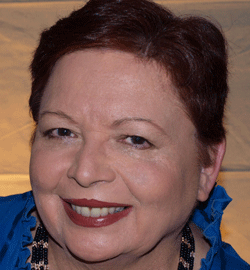
Martindale joined SFWA in 1999, and became a Lifetime Active Member, serving two 3-year terms on the Board of Directors. She was the author and driving force behind the organization’s Accessibility Guidelines. Beginning in 2005, she served as the Mediation Specialist on the Grievance Committee and in 2008 she took on the position of SFWA Ombudsman.
She received the Kevin O’Donnell, Jr. Service to SFWA Award in 2019. When SFWA President Cat Rambo announced the award she reflected on her time working with Martindale, “Lee’s service to SFWA includes driving the creation of SFWA’s accessibility guidelines, which have been used by dozens of events outside SFWA’s own, serving for years on the SFWA board and representing it there and at events with a consistent, fair, and business-minded presence, and her current role as part of SFWA’s Grievance Committee. She was a leader in diversity issues such as accessibility and the size rights movement, publishing a book of essays, Prejudice by the Pound, in 2008…..”
(8) MEMORY LANE.
[Written by Cat Eldridge.]
Frederik Pohl’s Gateway Wins the Hugo for Best Novel (1978)
Forty-eight years ago at IguanaCon II where Tim Kyger was the Chair, Harlan Ellison was the pro guest, and Bill Bowers was the fan guest, Frederik Pohl’s Gateway won the Hugo for Best Novel.
The other nominated works for that year were The Forbidden Tower by Marion Zimmer Bradley, Lucifer’s Hammer by Larry Niven and Jerry Pournelle, Time Storm by Gordon R. Dickson, and Dying of the Light by George R. R. Martin.

Pohl’s novel was serialized in the November and December 1976 issues of Galaxy prior to its hardcover publication by St. Martin’s Press. A short concluding chapter, cut before publication, was later published in the August 1977 issue of Galaxy.
It would win damn near every other major Award there was as it garnered the John Campbell Memorial for Best Science Fiction Novel, the Locus Award for Best First Novel, the Nebula Award for Novel and even the Prix Pollo Award for Best Science Fiction Novel published in France. It was nominated for but did not win the Ditmar Award.
It’s the opening novel in the Heechee saga, with four sequels that followed. It is a most exceptional series. I’ve read I think all of them.
I’m chuffed that Pohl was voted a Hugo for Best Fan Writer at Aussiecon 4. Who can tell what works got him this honor?
Gateway of course is available at the usual suspects.
If I’m remembering right, there was talk of a film for awhile.
(9) COMICS SECTION.
- Bizarro has cooking tips for dragons. (That is, for dragons doing the cooking.)
- Mother Goose and Grimm like this mythical upgrade.
- The Pajama Diaries tries to design a website.
(10) EXPANDED ICONOGRAPHY. “Penguin Random House UK unveils Playful Penguins” at Famous Campaigns. [Click for larger image.]
There are brand mascots. And then there are birds with an 90-year publishing pedigree.
Penguin Random House UK has introduced the ‘Playful Penguins’, a new suite of illustrations created as part of its wider visual identity refresh.
Think less corporate logo, more character ensemble cast.
Illustration has been stitched into Penguin’s DNA since 1935, when Edward Young sketched the original bird for the brand’s launch….

(11) OBSTACLES TO MAKING AN EARTHLIKE MARS. [Item by Steven French.] Looks like those who read Kim Stanley Robinson (referenced here), including certain billionaires, are going to have to put a pin in their dreams, at least for a while: “Terraforming Mars isn’t a climate problem—it’s an industrial nightmare” at Phys.org.
Even when the idea of terraforming Mars was originally put forward, the idea was daunting. Changing the environment of an entire planet is not something to do easily. Over the following decades, plenty of scientists and engineers have looked at the problem, and most have come to the same conclusion—we’re not going to be able to make Mars anything like Earth anytime soon. A new paper available in pre-print on arXiv from Slava Turyshev of NASA’s Jet Propulsion Laboratory is a good explainer as to why….
… Continuing to raise the overall atmospheric pressure would eventually result in a global pressure of 62.7 mbar, which is enough pressure so that human blood wouldn’t boil on the surface at 37℃. That sounds like a necessity if we’re truly going to “terraform” Mars. The final step would be a fully breathable atmosphere with a thick nitrogen buffer and around 210 mbar of oxygen (and 500 mbar total pressure), along with a much higher temperature.
While those might seem like reasonable goals for a project as massive as terraforming the planet, the scale really gets terrifying when talking about what each of those milestones actually means. For example, to get to just 1 mbar of pressure, we would need to add 3.89×10¹⁵ kg of gas. That is almost equivalent to the entire mass of Deimos—Mars’ smaller moon. Scaling that up to a full breathable atmosphere requires more like 1018 kg, such as Janus, an irregular moon of Saturn. To be fair to the optimists out there, there are expected to be hundreds of bodies of that size in the solar system, so for the purpose of giving atmosphere to one of the eight planets, it might be worth sacrificing one….
(12) JUDGE DREDD. [Item by SF Concatenation’s Jonathan Cowie.] I first encountered Judge Dredd way back when I was barely into my 20s and I have stuck with him over the years. (Well, he is the law and you know how I am when it comes to constitution adherence.) Back in the day, before 2000AD was a well known thing, my college SF society, Hatfield PSIFA (now Hertfordshire University PSIFA), went to visit the 2000AD offices on a couple of occasions, had Dredd story writer Alan Grant as the guest at one of its annual dinners, and the 2000AD team as one of the GoHs at the second Shoestringcon, (the other GoH was Ian Watson – since you didn’t ask). That spawned a few puffs for our group in 2000AD itself including a PSIFA Mega-City One block and Tharg saying that he is off to ‘Hatfeeld’s world’..

Since those early days – frighteningly nearly half a century ago – Dredd has gone on to have his own monthly Megazine, two cinematic adaptations (an awful Stallone one that turned a small profit, and an excellent, modest-budget Karl Urban one that failed to make a profit and so we lost the two sequels that had been story-outlined), countless Dredd novels, and a number of similarly-titled computer games and even a trilogy of Batman comic cross-overs. The Dreddverse is surprisingly big.
And now, from the wastes of the Cursed Earth. Otto, of the Exits Examined YouTube channel, has taken a 50-minute dive into the world of Dredd, and I can testify that it is well informed.
“The Complicated History of Judge Dredd” includes some good tips on how to catch up on Judge Dredd depending on how much time you wish to invest.
[Thanks to Steven French, Mike Kennedy, Andrew Porter, Juli Marr, John King Tarpinian, Cat Eldridge, SF Concatenation’s Jonathan Cowie, Mark Roth-Whitworth, and Kathy Sullivan for some of these stories. Title credit belongs to File 770 contributing editor of the day Steve Davidson.]
