The BSFA Awards have been presented annually since 1970. The awards are voted on by members of the British Science Fiction Association and by the members of the year’s Eastercon, the national science fiction convention, held since 1955. This year’s Eastercon, Iridescence, was held at the Hilton Birmingham Metropole Hotel from April 3-6.
BEST AUDIO FICTION
The Dex Legacy Series 3 by Emily Inkpen (Alternative Stories)
BEST ARTWORK
Fractal Series (12 book tessellated cover) by Nick Wells (Flame Tree Press)
BEST COLLECTION (For collections and anthologies)
Blood in the Bricks by Neil Williamson (Newcon Press)
BEST NON-FICTION (LONG)
Colourfields: Writing About Writing About Science Fiction by Paul Kincaid (Briardene Books)
BEST NOVEL
When There Are Wolves Again by E.J. Swift (Arcadia)
BEST SHORT FICTION (For short written works of fiction and their equivalent)
Godzilla as a Young Man Named Mike by E.M. Faulds (Podcastle; Escape Artists)
BEST NON-FICTION (SHORT) (For short written works and their equivalent)
Spec Fic and the Politics of Identity: Finding the Self by Eugen Bacon (Strange Horizons)
BEST SHORTER FICTION (For novellas, novelettes and other works that are not novel length)
The Apologists by Tade Thompson (Clarkesworld)
BEST TRANSLATED SHORT FICTION This award is selected by an appointed BSFA Jury. The Jurors for this award are Cristina Jurado, Rachel Cordasco, Franceso Verso, Eliza Filimon and Nadya Mercik.
Anita Moskát for Liecraft
BEST FICTION FOR YOUNGER READERS
Doctor Who: The Robot Revolution by Una McCormack (Target)
Libby, the leading library reading app, unveils the winners of the third annual Libby Book Awards, recognizing the best books, audiobooks and digital experiences of the year. Selected by expert librarians from across North America, this year’s winners highlight standout works that captured the hearts of readers, featuring both debut authors and beloved names in the literary world.
The complete list is at the link. Here are the winners of genre interest.
(2) SANDERSON OUT FOR ANOTHER RECORD FUNDRAISER. [Item by David Doering.] Hoid’s Storybook Collection by Brandon Sanderson at BackerKit has already raised $7 million from 42,000 backers – and the appeal still has 22 days left to run!
Welcome to the Hoid’s Storybook Collection! I’m so glad you’re here. The inception of this campaign came when I wrote the story of “The Dog and the Dragon” for Rhythm of War. People had been asking me if they could get a picture book version of the “Wandersail” story from The Way of Kings and “The Girl Who Looked Up” from Oathbringer—but I’d been hesitant, as those stories felt like they were for different audiences. With “The Dog and the Dragon,” it clicked for me that what I was writing weren’t quite picture books, and weren’t quite graphic novels, but fables. And they were for everyone.
We’ve chosen to make the presentation of each of these books individual to the given story. Some (like Wandersail) are luxurious, graphic depictions intended to be the perfect collection piece for a Stormlight enthusiast. Others (like The Dog and the Dragon) have been designed to evoke a classic children’s book, to be read to those who are younger.
However, at their core, these are stories Hoid chose to tell to provoke questions in the listener, regardless of their age. I am so proud of how they turned out, and grateful for the work of the artists over the many years it took to put this project together. (And so excited to add The ChasmFriends Get a Pet to the mix, for those who have been asking for a fully illustrated version of that.)
Also, please don’t forget The Fires of December! If picture books aren’t your thing, you can get your dose of Hoid through this novel, which has quickly become one of the books that make me the most proud. Either way, thank you. Hoid is not me, but I do often feel I’m writing from the heart when I’m using his voice.
(3) BIDS FILE FOR 2028 WORLDCON SITE SELECTION. The LAcon V committee says two bids filed the necessary paperwork to appear on the Site Selection ballot:
Brisbane in 2028
Nuremberg 2028
Here are the links to the documents on the LAcon V website.
A debut novel exploring the long-term effects of prejudice and secrecy on a lesbian couple in the 1980s has won the Nero Gold prize.
Claire Lynch was presented with the £30,000 award for her book A Family Matter at a ceremony in London on Wednesday evening….
…The Nero book awards, run by Caffè Nero, were launched in 2023 after Costa Coffee abruptly ended its book awards in June 2022. The prizes aim to point readers “of all ages and interests” towards the best books published in the UK and Ireland over the past year.
Lynch’s novel was among four category winners announced in January, with each subsequently competing for the Nero Gold prize for overall book of the year. A Family Matter won the debut fiction category and was chosen for the overall Gold prize. The other category winners were Seascraper by Benjamin Wood, which won the fiction category; Death of an Ordinary Man by Sarah Perry, winner of the nonfiction category; and My Soul, A Shining Tree by Jamila Gavin, which won the children’s fiction award. Each of the four category winners received £5,000….
(5) BURN NOTICE. Joyce Carol Oates posted this snark in response to Sad Puppy author Brad R. Torgersen’s opinion of the Beatles. Thread on X.com starts here.
(6) YOU COULD LOOK IT UP. Lew Wolkoff says, “You can tell John Hertz that the Oxford English Dictionary says that contact most certainly IS a verb.”
oed.com says, “verb, transitive, to get into contact or to touch with…”
Contact as a verb appears first in the writings of Eden in 1834 and was first published in 1893.
“There is more, but that should do it.”
I assured Lew that will make no difference to John. Indeed, today John sent this reaction to Andrew (not Werdna)’s prior citation showing that “’Contact’ has been used as a verb since the 1830s” —
So?
President Lincoln told of s boy who, when asked how many legs his calf would have if he called its tail a leg, replied “Five”; Lincoln said, “Calling the tail a leg would not make it a leg.”
(7) 2026 KURD LAßWITZ PREIS NEWS. The finalists for the 2026 Kurd Laßwitz Preis were announced today. The award is given to works written in or translated into the German language and published during the previous year. See the list in File 770’s post.
(8) BSFA AWARDS 2026 SHORTLISTS. The British Science Fiction Association released the BSFA Awards 2026 shortlists over the weekend.
(9) ROBERT E. HOWARD FOUNDATION AWARDS. Likewise, the 2026 Robert E. Howard Awards shortlists are out. The award is presented by the Robert E. Howard Foundation. The winners will be announced June 13 during Howard Days in Cross Plains, TX.
(10) ‘HILDE’ HILDEBRAND TRIBUTE. Bruce D. Arthurs reports his wife, “M.R. ‘Hilde’ Hildebrand (1946-2026)”, died yesterday. Read his profile about her at the link.
(11) MEMORY LANE.
[Written by Cat Eldridge.]
Stranger in a Strange Land (1962)
Sixty-four years ago at Chicon III where Earl Kemp was the Chair, Wilson Tucker was Toastmaster and Theodore Sturgeon was the Guest of Honor, Robert A. Heinlein’s Stranger in a Strange Land won the Hugo for Best Novel. It had been published the previous year by G. P. Putnam’s Sons.
Other nominated works that year were Dark Universe by Daniel F. Galouye, Sense of Obligation (also called Planet of the Damned) by Harry Harrison, The Fisherman (also known as Time Is the Simplest Thing) by Clifford D. Simak and Second Ending by James White. I know all those authors and have read deeply of them save Daniel F. Galouye. Tell me about him please.
It was his third Hugo in six years after Double Star at NyCon II and Starship Troopers at Pittcon. He’d win his fourth and final Hugo for The Moon is a Harsh Mistress at NyCon 3 in another five years.
The working title for the book was A Martian Named Smith which was also the name of the screenplay started by a character at the end of the novel. If I remember right, that was Jubal Harshaw but it has been at least thirty years since I read I, I’m just thinking that.
I must note Jubal for me is the most interesting and enjoyable character in the book, an older experienced man who questioned everything, but with compassion, honor and a truly open heart. Harshaw also appears in three later Heinlein novels, The Number of the Beast in the coda, The Cat Who Walks Through Walls and To Sail Beyond the Sunset which I’ll confess I never finished.
Needless to say the novel is available from the usual suspects. There’s also an audiobook, one of myriad audiobooks done of his novels.
As always the artwork below is for the first edition.
(13) LIBRARY SCI-FI COMPETITION. [Item by Olav Rokne.] The International Federation of Library Associations (IFLA) is about to turn 100, so they’re asking the question “what does the next century bring for the work of libraries?”
Best-selling romantasy author Sarah J Maas, who has sold more than 75 million books worldwide, has announced two new novels in her A Court of Thorns and Roses (ACOTAR) series.
The 40-year-old American author announced the publishing of her two new books on Alex Cooper’s Call Her Daddy podcast on Wednesday evening, telling fans “the story that was finally ready to come out of me was big – really, really big”.
Her books, which have been published in 40 languages, blend the romance and fantasy genres, and her two latest works will be released in October this year and January 2027.
She is credited with fuelling interest in the romantasy genre, which has skyrocketed in popularity due to its discussion on #BookTok, which is the literature discussion side of TikTok.
Speaking about her new novels, she said “it came out of me in a way that surprised me”, and that there would essentially be four parts being told across three books – ACOTAR 6, ACOTAR 7 and then in a fourth, unannounced book.
“It’s meant to be read ideally as one massive, massive story as opposed to like in a trilogy,” Maas explained.
“It’s not a trilogy. Arcs aren’t wrapped up. It’s like in the way you take my book, it’s like if you expand it all of part one, all of part two, all parts, it would be huge like that.
“And so I just decided, I’ve never told a story that way. This is how it wants to come out,” she also added.
She hasn’t released a book in the ACOTAR series since 2021, so this is an unusual move to publish two within months of each other….
Nearly two and a half decades after Firefly was canceled, Nathan Fillion and several original cast members have fans buzzing with fresh speculation about a reboot ahead of a mysterious big “announcement.”…
…Now, something unusual has been unfolding on Nathan Fillion‘s Instagram, as he has been sharing videos of himself visiting the homes of his former Firefly co-stars – including Gina Torres, Morena Baccarin, Sean Maher, and Summer Glau – and telling them that “it’s time.”…
…In another recent post, visiting the home of Summer Glau, the caption confirms that an “announcement [is] coming soon…“ Of course, all this sudden activity on social media with the cast has fans buzzing and speculating about its meaning. Clearly, it hints at some kind of reunion, but what exactly it will be remains uncertain. Fillion’s latest update sees him at the front door of former co-star Jewel Staite, finally revealing that the teased announcement will be revealed on Sunday, March 15….
German director Fritz Lang’s still awe-inspiring, sci-fi-spawning Metropolis of 1927—with its indelible Expressionist images of fluorescent-ringed robots, behemoth industrial architecture, and a sadly familiar dystopian society—has perked the antennae of electronic musicians for decades. Kraftwerk claimed direct descendence from the film, referencing its concepts on groundbreaking 1978 album Die Mensch-Maschine, explicitly in track “Metropolis.” Giorgio Moroder took up soundtracking it in 1984, giving the politically charged yet still sentimental story a goofy layer of rock schmaltz (hello, Billy Squier), though one of Moroder’s own contributions, “Machines,” captures some of his classic dance floor spirit.
Detroit techno wizard Jeff Mills took up the Metropolis baton in 2000s, releasing what would be the first of three completely separate scorings of the film to “reintroduce and educate the theories and ideology” of the film to new generations as the new millennium dawned. Metropolis—the tale of an exploited caste of workers breaking free from their oligarchic oppressors by joining together with them to build a new world, as well as an Orpheus-like love story—has famously been in a state of restoration for almost a century, thanks to studio mangling and the ravages of time. As recently as 2010 (the year of Mills’ second score), 25 whole minutes of footage, not seen in 80 years, were rediscovered and integrated.
So successive sonic re-evaluations definitely make sense, especially coming from one of electronic music’s most crucial visionaries. Mills will be in town to perform his latest iteration “Metropolis Metropolis: Cinemix,” Sat/7, 7pm-10pm at the Palace of Fine Arts, SF—live, alongside the film—as part of the awesome Unabridged event series from the As You Like It party crew, bringing Detroit sounds to the Bay Area though next weekend. (The night before he does the film, he’ll be at the 1015 Folsom club to celebrate 30 years of his brilliant “Live at the Liquid Room Tokyo” mix, which turned very, very many people onto his raw, cosmic techno sounds.)…
(17) HELL’S LIVING ROOM. [Item by Andrew Porter.] “Look Inside Richard Hell’s East Village Tenement Apartment” in the New York Times. Way too many books in an apartment he’s been in since the 1970s. Interactive article, hence the link, which bypasses NYT paywall.
One thing that’s never changed is this rent-stabilized apartment, where Mr. Hell, now 76, spends his days surrounded by poetry and literature. “The dominant message” of the place, he said, is ‘this person likes books.’”
His collection numbers in the thousands, despite periodic attempts to cull it. “I had a transcendent experience three or four years ago when I decided I was going to finally dust my books, and had to take all of them down by hand,” he said. “It was sublime. I couldn’t restrain myself from going through each book. Every one had a whole story for me.”…
… Mr. Hell moved to New York at the age of 17 determined to be a poet. But New York “wasn’t the bohemian paradise I’d fantasized it was going to be,” he said. “Everybody was really competitive, even though there was nothing to win.” Disillusioned, he turned to music. “I thought, as long as I’m going to be here, I might as well be in some profession where I can make a living,” he said with a laugh….
[Thanks to John King Tarpinian, Cat Eldridge, SF Concatenation’s Jonathan Cowie, Lew Wolkoff, Olav Rokne, David Doering, John Hertz, Mark Roth-Whitworth, Kathy Sullivan, Steven French, Mike Kennedy, and Andrew Porter for some of these stories. Title credit belongs to File 770 contributing editor of the day Mark Roth-Whitworth.]
The BSFA Awards have been presented annually since 1970. The awards are voted on by members of the British Science Fiction Association and by the members of the year’s Eastercon, the national science fiction convention, held since 1955. This year’s Eastercon, Iridescence, will be at the Hilton Birmingham Metropole Hotel from April 3-6, where the winners will be announced.
Voting is open to all BSFA members and attendees of the convention until 23:59 on April 3.
The British Science Fiction Association has released the longlists of nominees for the BSFA Awards for work published in 2025.
The awards are voted on by members of the British Science Fiction Association who may vote for up to four nominations in each category to proceed to the shortlists.
The winners will be announced at the year’s Eastercon, Iridescence, which will be held in Birmingham, UK April 3-6, 2026.
The complete longlists of nominees follow the jump.
The British Science Fiction Association today announced the winners of the BSFA Awards for work published in 2024 in a ceremony at Eastercon, Reconnect, in Belfast.
SHORT FICTION
‘Why Don’t We Just Kill the Kid in the Omelas Hole’ by Isabel J. Kim (Clarkesworld)
SHORTER FICTION (NOVELETTE AND NOVELLA EQUIVALENT)
Saturation Point by Adrian Tchaikovsky (Solaris)
NOVEL
Three Eight One by Aliya Whiteley (Rebellion Publishing)
FICTION FOR YOUNGER READERS
Doctor Who: Caged by Una McCormack (Penguin)
COLLECTIONS
Punks4Palestine: An Anthology of Hopeful SciFi for an Uncertain Future ed Jasen Bacon (Hyphen Press)
AUDIO
The Personal Touch by Rick Danforth (Manawaker Studio’s Flash Fiction Podcast)
ART
Cover – Nova Scotia Vol 2 by Jenni Coutts (Luna Press Publishing)
SHORT NON-FICTION
‘Why A.I. Isn’t Going to Make Art’ by Ted Chiang (New Yorker, August 31 2024)
LONG NON-FICTION
Track Changes by Abigail Nussbaum (Briardene Books)
BEST TRANSLATED SHORT WORK (Juried Award)*
‘Bone by Bone’ by Mónika Rusval, translated from Hungarian by Vivien Urban (Samovar)
*Our Jurors for this award are Cristina Jurado, Rachel Cordasco and Nadya Mercik.
The BSFA Awards have been presented annually since 1970. They are voted on by members of the British Science Fiction Association and members of the year’s Eastercon, the national science fiction convention, held since 1955.
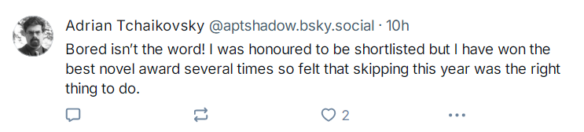
Tchaikovsky did keep his novella Saturation Point in contention in the BSFA “shorter fiction” category.
And this week he also accepted three Hugo Award nominations, two in the Best Novel category, Alien Clay and Service Model, and the other for Best Series, The Tyrant Philosophers.
Nicholas Whyte’s post about the Nebula and BSFA shortlists and the Goodreads and LibraryThing stats at From the Heart of Europe shows Tchaikovsky’s Alien Clay has more than 10 times as many people rating it as all the other BSFA Award novel finalists added together, so it would have had unsurpassed reader recognition on its side in that race. (In contrast, Whyte’s study “2025 Hugo final ballot: Goodreads / LibraryThing stats” shows that among Hugo finalists Service Model ranks third and Alien Clay sixth in number of Goodreads ratings.)
Congratulations to Chris M. Barkley and Jason Sanford for their article being among the finalists: “The 2023 Hugo Awards: A Report on Censorship and Exclusion” – which was simultaneously published by File 770 and Genre Grapevine, and so it would have been nicer if the BSFA announcement hadn’t failed to name File 770.
(2) ACE EDDIE AWARDS. The American Cinema Editors (ACE) announced the “ACE Eddie Winners” on March 15. The awards recognize outstanding editing in 14 categories of film, television and documentaries. The complete list is at the link. The winners of genre interest are:
BEST EDITED FEATURE FILM (COMEDY, THEATRICAL)
Wicked Myron Kerstein, ACE
BEST EDITED ANIMATED FEATURE FILM
The Wild Robot Mary Blee
BEST EDITED SINGLE CAMERA COMEDY SERIES
What We Do in the Shadows (603 – Sleep Hypnosis) Liza Cardinale, ACE Dane McMaster, ACE
BEST EDITED ANIMATED SERIES:
X-Men ’97 (105 – Remember It) Michelle McMillan
Also recognized were filmmaker Jon M. Chu who received the ACE Golden Eddie Filmmaker of the Year Award, recognizing a filmmaker who exemplifies distinguished achievement in the art and business of film. Film editors Maysie Hoy, ACE and Paul Hirsch, ACE received Career Achievement Awards for their outstanding contributions to film editing.
…To Victorian Londoners, crime was terrifying and out of control. Penny Dreadfuls, cheap pamphlets blending the lurid and the sensationalist, contributed to the feeling that violent crime was lurking behind every street corner, waiting to spring out of every shadow with a knife drawn and ready to kill.
Jack the Ripper, with the entire city at his heels, murdered and mutilated his way through the streets of London — preying on the same underworld he seemed to spring out of. And then, suddenly and without resolution, he disappeared, and slipped back into the shadows. Ready to spring out again, at any moment. A knife held against the entire city.
And then, out of these same shadows, stepped a hero. A man of science, who brought order to a dangerous world in the throes of calamitous change. A man who obeyed only a strict moral code, rather than the letter of an unjust law. A man who not only did not obey the class structure, but openly flaunted it — in his very first adventure, he reproached a King for saying a lower-class woman was not on his level. This was a man who would help anyone in need — as long as the case was interesting enough. He had no interest in money or class; he was as happy with a king’s simple portrait as he was with the proverbial king’s ransom. He was a man who didn’t just protect the city, but even adapted some of its worst bits, such as the young and ruthless pickpockets, to help him in his quest.
That man was, of course, Sherlock Holmes. And it’s no wonder he became a sensation when he first appeared in the Strand Magazine in 1891 — emerging into the city and wider society that he did.
(Author’s note: I’m setting aside the first novels for a few reasons. But in any case, it was the Adventures that exploded in popularity, and would’ve been most readers’ first introduction to Sherlock.)…
(4) WON’T BE IN SEATTLE. Count Australian sff author Jeremy Szal among those who are checking out of attending the Seattle Worldcon.
The AI apocalypse is primed for an explosive launch in the Black Mirror season 7 trailer, which previews a bloody, bombastic batch of six new episodes — including the return of Cristin Milioti (The Penguin) in a sequel to 2017’s epic “USS Callister” episode.
Netflix revealed Thursday the first preview of Charlie Brooker’s beloved sci-fi anthology, which welcomes a wealth of stars to its seventh season, including Issa Rae, Tracee Ellis Ross, Awkwafina, Rashida Jones, Chris O’Dowd, Emma Corrin, Oscar-nominated actor Paul Giamatti, and Will Poulter (reprising the role of Colin Ritman from 2018’s interactive Bandersnatch movie).
In addition to teasing Milioti’s return alongside fellow “USS Callister” stars Jimmi Simpson, Paul G. Raymond, Milanka Brooks, Osy Ikhile, and Billy Magnussen, the Black Mirror season 7 trailer gives us a glimpse at a few of the new installment’s harrowing episodes….
Blockbusters … have always been deceptively difficult to replicate; on some level, most of them seek some kind of overwhelming sensation, whether it’s thrills, big laughs, melodrama, spectacular visuals or some combination; these things can be faked or strung along (plenty of middling mega-movies have been big hits), but the presentation is part of that fakery, which in turn can be part of the fun. A well-crafted one can sweep you up in the moment even if what they’re doing isn’t all that clever or insightful and leaves you with empty calories; JJ Abrams owes his whole career to this phenomenon. The Netflix auteur movies, meanwhile, are made with the confidence that they will transcend their humble smaller screens (or maybe the serene knowledge that at least they’ll be shown at a lot of festivals before they make it to streaming). The most striking aspect of their mockbuster cousins is how they feel infused with the knowledge that this avenue is closed to them; it’s almost astonishing how inept they are at faking otherwise. Movies like The Electric State can throw around millions of dollars, big stars and cutting-edge effects, but they just can’t shake the bone-deep knowledge that they’re content first….
…As previously announced, this year’s winners of the juried Outstanding Individual Achievement in Animation honors are background designer Philip Vose (Merry Little Batman), viz-dev artist Miho Tomimasu (Orion and the Dark), animation supervisor Elena Najar (Merry Little Batman), character designer Lesego Vorster (Kizazi Moto: Generation Fire), digimatte artist Lauren Zurcher (Orion and the Dark), art director Guillaume Fesquet (Merry Little Batman) and storyboard artist David Lux (Snoopy Presents: Welcome Home, Franklin)….
CAFÉ winners of genre interest included:
Children or Family Viewing Series
Fraggle Rock: Back to the Rock (Apple TV Plus) [The Jim Henson Company /Apple]
Fiction Special
The Velveteen Rabbit (Apple TV Plus) [Magic Lamp Pictures/Apple]
Preschool Animated Series
The Tiny Chef Show (Nickelodeon)
Children’s or Young Teen Animated Series
Marvel’s Moon Girl and Devil Dinosaur (Disney+)
Animated Special
Orion and the Dark (Netflix)
Voice Performer in a Children’s or Young Teen Program
Eric Bauza as Daffy Duck & Bugs Bunny – Teen Titans Go! (Cartoon Network)
Younger Voice Performer in a Preschool, Children’s or Young Teen Program
Jacob Tremblay as Orion – Orion and the Dark (Netflix)
Writing for a Children’s or Young Teen Animated Series
“Dancing with Myself” – Marvel’s Moon Girl and Devil Dinosaur (Disney+)
Mystery fans love ingenious misdirection in their plots, and novels can be even more mysterious when the setting itself adds layers of intrigue. Creepy old buildings have a long history in mystery fiction, and the novels I’m diving into today use architecture as a key part of the puzzle….
In the middle of this list:
The Name of the Rose – Umberto Eco
This classic novel is dominated by a medieval abbey’s labyrinthine library that’s filled with secret passageways and hidden rooms. Friar William of Baskerville and his apprentice are investigating the mysterious deaths of several monks at the abbey, and the architecture both provides clues and mirrors the deeper symbolic meaning behind the crimes.
DPD notes, Alex Williams’ obituary for Moore has a refreshing, remarkable depth (and presumed accuracy) with respect to sf stuff, e.g.:
Chris Moore, a British artist who conjured fantastical worlds with high-sheen covers for books by science-fiction masters like Philip K. Dick, Arthur C. Clarke and Alfred Bester, and who lent his artistry to albums by Rod Stewart and Fleetwood Mac, died on Feb. 7 at his home in Charmouth, on the southwestern coast of England. He was 77.
… Moore provided memorable interstellar images for various editions of notable books by Mr. Dick — including his novel “Do Androids Dream of Electric Sheep?,” the basis of the 1982 film “Blade Runner” — as well as works by Kurt Vonnegut, Isaac Asimov, Ursula K. Le Guin, H.G. Wells, Alastair Reynolds, J.G. Ballard, Stephen King and many others.
…While best known for his visual journeys through the cosmos, Mr. Moore produced a wide range of illustrations. He created the art for several album covers, including Fleetwood Mac’s “Penguin” (1973) and Mr. Stewart’s “The Vintage Years 1969-70” (1976), as well as contributing images to magazines like Omni and Asimov’s Science Fiction. And he designed wallpaper tied to the Star Wars film “The Empire Strikes Back” (1980).
…He exhibited his work for the first time in 1995, at the World Science Fiction Convention in Glasgow, where he realized that there was a market for his originals, which he began selling….
DPD adds: So I’m sure I saw those there, and for all I know, crossed paths with Moore.
(10) TODAY’S BIRTHDAY.
[Written by Cat Eldridge.]
March 19, 1928 — Patrick McGoohan. (Died 2009.)
I will not make any deals with you. I’ve resigned. I will not be pushed, filed, stamped, indexed, briefed, debriefed or numbered. My life is my own. — Number 6
I don’t how times I’ve seen the opening of The Prisoner series as it’s been separately shown from the episodes online pretty much since video came to the Internet. Not sure in what context I was watching it but it was, without doubt, one of the best openings I’ve seen.
Then there was the series. Weird, thrilling, mysterious. Eminently watchable over and over and over again. Was it SF? Or was it a spy series set in the very near future? Who knew? And then there was Number Six, the never named intelligence agent played by Patrick McGoohan. He seemed destined to play this role.
He was an American-born Irish actor, director, screenwriter, and producer. Now it turns out that The Prisoner was his creation. He was also one of the writers – there were five in fact — and he was one of four directors. In other words, he had his hand in every facet of the series and its sixteen episodes.
Before he was that unnamed intelligence agent he was, and I’m not at all convinced that McGoohan meant this to be a coincidence, secret agent John Drake in the Danger Man espionage series. I’ve seen a few episodes, it’s well crafted.
Danger Man (retitled Secret Agent in the United States for the revived series) was a British television series broadcast between 1960 and 1962, and again between 1964 and 1968. (A neat bit of history here: Ian Fleming was brought in to work on series development, but left before that was complete. Apparently, he didn’t like the way the secret service was to be portrayed.)
After The Prisoner, McGoohan’s next genre endeavor was as the narrator of Journey into Darkness is a British television horror film stitching together two episodes derived from late Sixties anthology television series Journey to the Unknown.
We are now leaving genre and headed for, well the Columbo series. Why so? Because he was good friends with Peter Falk and directed five episodes of the series, four of which he appeared in, winning two Emmys in the process. McGoohan was involved with the series in some way from 1974 to 2000.
He was said that his first appearance on Columbo was probably his favorite American role. He had top billing as Col. Lyle C. Rum, fired from a military academy, in “By Dawn’s Early Light”, one of the Columbo films that preceded the series.
His daughter Catherine McGoohan appeared with him in the episode “Ashes To Ashes” The other two Columbo episodes in which he appeared are “Identity Crisis” and “Agenda For Murder”.
Yes, he reprised his role as Number Six for The Simpsons in “The Computer Wore Menace Shoes”. Homer Simpson fakes a news story to make his website more popular, and he wakes up in a prison that is a holiday resort. As Number Five, he meets Number Six.
McGoohan’s last movie role was as the voice of Billy Bones in the animated Treasure Planet.
He received the Prometheus Hall of Fame Award for The Prisoner.
The Prisoner is streaming on Prime. No, not awful remake (shudder) but the original one.
(12) THE SHADOW KNOWS. ThePulp.Net takes us from Victor Jory to Alec Baldwin and beyond in “The Shadow on film”.
As in radio, The Shadow’s film career began with him as an announcer of detective stories, not as a lead character. In 1931 — the same year that the namesake pulp began — The Shadow began introducing a series of two-reel mysteries for Universal Studios.
It was five years before The Shadow returned to the screen. This time silent-screen actor Rod La Rocque appeared in The Shadow Strikes for Grand National Pictures. The 1937 film featured detective Lamont “Granston,” who like Cranston in the radio program was The Shadow. In 1938, La Rocque returned, this time as Lamont Cranston, in International Crime. The Shadow isn’t the main character, but rather radio sleuth Cranston is.
The Shadow is back in the lead role in a 15-chapter Columbia serial. The Shadow starred hawk-nosed actor Victor Jory….
… Alec Baldwin is the latest to assume the role in The Shadow. The 1994 film enjoyed the trappings of a robust budget. The art direction and production were splendid, but the script was lacking. Disappointingly for pulp purists, its story, like the previous motion pictures, was an amalgam of influences from The Shadow’s past in print, radio and film. On top of that, screenwriter David Koepp or director Russell Mulcahy added several curious twists to the story, such as Margo Lane being psychic, and Lamont Cranston being police commissioner Wainwright Barth’s nephew….
(13) A SOLAR ECLIPSE… FROM THE MOON. [Item by Mark Roth-Whitworth.] Firefly Aerospace’s Blue Ghost lander, which successfully touched down in Mare Crisium on March 2, 2025 got a pic of the *Earth* eclipsing the Sun… “Private Lunar Lander Captures Stunning ‘Diamond Ring’ Eclipse from the Moon’s Surface” at Daily Galaxy. You can see the image at the link.
For the first time in history, a privately operated lunar lander has captured images of a total eclipse from the Moon’s surface. Firefly Aerospace’s Blue Ghost lander, which successfully touched down in Mare Crisium on March 2, 2025, recently transmitted breathtaking images of a “diamond ring” eclipse—a rare celestial phenomenon that occurs when the Sun emerges from behind Earth, forming a brilliant ring of light in the lunar sky….
A mysterious phenomenon at the centre of our galaxy could be the result of a different type of dark matter.
Dark matter, the mysterious form of unobserved matter which could make up 85% of the mass of the known universe, is one of science’s biggest manhunts.
In this first of its kind study, scientists have taken a step closer to understanding the elusive mystery matter. They believe a reimagined candidate for dark matter could be behind unexplained chemical reactions taking place in the Milky Way…
Dr. Shyam Balaji, Postdoctoral Research Fellow at King’s College London and one of the lead authors of the study explains, “At the centre of our galaxy sit huge clouds of positively charged hydrogen, a mystery to scientists for decades because normally the gas is neutral. So, what is supplying enough energy to knock the negatively charged electrons out of them?
“The energy signatures radiating from this part of our galaxy suggest that there is a constant, roiling source of energy doing just that, and our data says it might come from a much lighter form of dark matter than current models consider.”
Primary research: Pedro De la Torre Luque et al, (2025) Anomalous Ionization in the Central Molecular Zone by Sub-GeV Dark Matter, Physical Review Letters, vol. 134, 101001
(15) VIDEO OF THE DAY. [Item by SF Concatenation’s Jonathan Cowie.] Around tea time, about 65 million years ago, a large pebble hit the Earth, wiping out many birds with a single stone. (I really have never forgiven the dinosaurs for what they did to Raquel Welch.) Recently there has been news of asteroid 2024 YR4 possibly hitting Earth in 2032. It now looks like it will be a near miss, but what other dangers are there out there? Keep watching the skies…. Over at PBS Space Time Matt O’Dowd looks at the chaotic Solar system that otherwise might puzzle Bruce Willis…
Giant space rocks are definitely going to hit the Earth again. We actually do know how to deflect them, but only if we find them and correctly assess their risk. But the solar system is a chaotic place. How is it even possible to tell if a space rock will one day collide with the Earth?
[Thanks to Steven French, Kathy Sullivan, Teddy Harvia, Oscar Dunham, Mike Kennedy, Andrew Porter, John King Tarpinian, Chris Barkley, Cat Eldridge, SF Concatenation’s Jonathan Cowie, and Mark Roth-Whitworth for some of these stories. Title credit belongs to File 770 contributing editor of the day Daniel Dern.]
The British Science Fiction Association today announced the shortlist of nominees for the BSFA Awards for work published in 2024.
The BSFA Awards have been presented annually since 1970. They are voted on by members of the British Science Fiction Association and members of the year’s Eastercon, the national science fiction convention, held since 1955.
The winners will be announced at the Eastercon, Reconnect, to be held at the Hilton Lanyon Place and the Belfast ICC from April 18-21.
Voting by members of the BSFA and Reconnect will open soon.
Finalists for the British Science Fiction Association Awards for publications in 2024.
SHORT FICTION
‘Unquiet on the Eastern Front’ by Wole Talabi (Subterranean Press)
‘The Portmeirion Road’ by Fiona Moore (Clarkesworld)
‘Why Don’t We Just Kill the Kid in the Omelas Hole’ by Isabelle Kim (Clarkesworld)
‘Intrinsic – Extrinsic – Terrific’ by Aliya Whiteley Luna Press Publishing
SHORTER FICTION (NOVELETTE AND NOVELLA EQUIVALENT)
Navigational Entanglements by Aliette de Bodard (Tordotcom)
Charlie Says by Neil Williamson (Black Shuck Books)
What Happened at the Pony Club by Fiona Moore (Fusion Fragment)
Saturation Point by Adrian Tchaikovsky (Solaris)
NOVEL
Alien Clay by Adrian Tchaikovsky (Orbit Books)
Calypso by Oliver K Langmead (Titan Books)
Rabbit in the Moon by Fiona Moore (Epic Publishing)
Three Eight One by Aliya Whiteley (Rebellion Publishing)
FICTION FOR YOUNGER READERS
Doctor Who: Caged by Una McCormack (Penguin)
Somewhere Beyond the Sea by T J Klune (Tor)
Rebel Dawn by Ann Sei Lin (Walker Books)
Benny Ramirez and the Nearly Departed by Jose Pablo Iriarte (Alfred A. Knopf Books for Young Readers)
COLLECTIONS
Punks4Palestine: An Anthology of Hopeful SciFi for an Uncertain Future ed Jasen Bacon (Hyphen Press)
Schrodinger’s Wife (And Other Possiblities) by Pippa Goldschmidt (Goldsmith’s Press)
Nova Scotia Vol 2 Neil Williamson and Andrew Wilson (eds) (Luna Press Publishing)
Human Resources by Fiona Moore (Newcon Press)
Fight Like a Girl 2 Roz Clarke and Joanne Hall (eds) (Wizards Tower)
Convergence Problems by Wole Talabi (Astra Publishing House)
AUDIO
The Dex Legacy: Swarm & Shadows of Trauma by Emily Inkpen (Alternative Stories and Fake Realities)
The Personal Touch by Rick Danforth (Manawaker Studio’s Flash Fiction Podcast)
Doctor Who: The Quin Dilemma by Chris Chapman, Robert Valentine, Jacqueline Rayner (Big Finish Productions)
Torchwood: The Hollow Choir by Helen Marshall and Malcolm Devlin (Big Finish Productions)
Mother Death Learns a Trick by Addison Smith (Escape Pod)
ART
Cover – Fathomfolk by Kelly Chong (Orbit)
Cover – Nova Scotia Vol 2 by Jenni Coutts (Luna Press Publishing)
Cover – A Jura for Julia by Fangorn (Newcon Press)
Cover – ParSec Magazine #11 by Fangorn (PS Publishing)
SHORT NON-FICTION
‘Why A.I. Isn’t Going to Make Art’ by Ted Chiang (New Yorker, August 31 2024)
‘Beyond Conventions: Unleashing the Palestinian Struggle Through the Science Fiction Lens’ by Yasmin Kana (Shoreline of Infinity)
‘Considering the Cosy Turn in SFF: Who Gets to be Comforted?’ by Liz Bourke (Self-published)
‘An Afrofuturistic Dystopia and the Afro-irreal’ by Eugen Bacon (Bloomsbury)
‘Science Fiction and Abolishing the Police’ by S J Groenewegen (Shoreline of Infinity)
‘The 2023 Hugo Awards: A Report on Censorship and Exclusion’ by Chris M Barkley and Jason Sanford (File 770 and Genre Grapevine)
‘Machine Learning in Contemporary Science Fiction’ by Jo Lindsey Walton (SFRA Review)
LONG NON-FICTION
Track Changes by Abigail Nussbaum (Briardene Books)
Spec Fic for Newbies Vol 2: A Beginner’s Guide to Writing More Subgenres of Science Fiction by Tiffani Angus and Val Nolan (Luna Press Publishing)
The Book Blinders by John Clute (Norstrilia Press)
Keith Roberts’s Pavane: A Critical Companion by Paul Kincaid (Palgrave)
JG Ballard’s Crash: A Critical Companion by Paul March Russell (Palgrave)
BEST TRANSLATED SHORT WORK (Juried Award)*
‘The Coffee Machine’ by Celia Corral-Vázquez, translated from Spanish by Sue Burke (Clarkesworld)
‘Bone by Bone’ by Mónika Rusvai, translated from Hungarian by Vivien Urban (Samovar)
‘Songs of the Snow Whale’ by K.A. Teryna translated from Russian by Alex Shvartsman (Reactor)
‘The Rambler’ by Shen Dacheng, translated from Chinese by Cara Healey (Clarkesworld)
‘You Glow in the Dark’ by Liliana Colanzi translated from Spanish by Chris Andrews (You Glow in the Dark)
‘Unicorn 2512’ by Nora Nagi translated from the Arabic by Mayada Ibrahim (Egypt + 100)
*Our Jurors for this award are Cristina Jurado, Rachel Cordasco and Nadya Mercik.
(1) DOWN THESE MEAN TWEETS. Less than 24 hours after The Self-Published Science Fiction Competition announced its new “SPSFC Code of Conduct” (linked in yesterday’s Scroll), the SPSFC management announced they were removing a writer named Devon Eriksen from the contest for violating the CoC. They did not specify why, which in these post-JDA-lawsuit times is regarded as wisdom. However, it’s clear what the host of Indie Book Spotlight believed:
And this exchange being on X.com, large numbers of people claimed to be unable to understand the problem, beginning with this fellow:
So the Indie Book Spotlight host put up a screenshot with a lengthy quote by Eriksen showing what they had in mind, which I’m not going to repost but which can be read here.
Devon Eriksen’s public response to being banned was (1) to claim he wasn’t aware he was even entered in the contest, and (2) to mock the whole proceeding at length, which you can read at X.com or in File 770’s screencaps — image-1, image-2, image-3, image-4, image-5, image-6. Or not at all, if you prefer.
“The worst is not. So long as we can say ‘This is the worst,’ ” go the lines from King Lear quoted in Emily St. John Mandel’s 2014 novel Station Eleven. Any stories we tell about the end of the world will have to be fictional, since once the real thing occurs, no one will be around to describe it. As the British journalist Dorian Lynskey relates in his erudite, delightfully witty, and strangely cheering new book, Everything Must Go: The Stories We Tell About the End of the World, the fact that we can only ever speculate on the subject makes us speculate all the more frantically. “There is simply no end of ends,” Lynskey writes of the books, movies, TV shows, pop songs, and video games we’ve created to depict the apocalypse—or its near misses and the aftermaths thereof….
… Apocalyptic narratives are, of course, always more about the vexing present than the enigmatic future. Everything Must Go encompasses the stories told by doomsday cults, scientific Cassandras, pulp novelists, video game designers, and Hollywood movies. The idea that the world will one day come to an end is an especially Western notion, Lynskey points out, with its roots in the Book of Revelation. That strange document, with its psychedelic signs and portents, Lynskey writes, “supplies the Bible with a narrative arc and gives humanity’s story a theatrical finale.” Other cultures steeped in different religions may view time as cyclical, but the Judeo-Christian tradition sees it as an arrow, going in one direction, to an inevitable conclusion. As terrifying as the prospect of apocalypse can be, Lynskey writes, “it rescues believers from the endless mess of history by weaving past, present and future into a coherent, satisfying whole with an author, a message and an ending.”…
(3) THOUGHTS ABOUT AWARDS VOTING. BSFA’s Vector has republished Jo Lindsay Walton and Polina Levontin’s article “Gender, Democracy, and SF/F Literary Awards” from Foundation 149 (winter 2024).
This article explores cultural and design dimensions of non-governmental voting systems, focusing on science fiction and fantasy (SFF) literary awards voted for by fans, with a focus on the British Science Fiction Awards. The design of such voting systems needs to juggle a range of goals, one of which is fairness with regard to gender — acknowledging that ‘fairness’ is not straightforward to define, particularly given such awards are embedded within broader gender inequalities. Our analysis suggests that men have been more likely than women to vote for works by men, and also more likely to vote in ways that amplify the influence of men’s votes under an Alternative Vote System. We suggest that SFF awards are cultural spaces which lend themselves to experimentation with new democratic forms, and briefly offer potential sources of inspiration. Just as SFF has aspired to be a space to think about the future of technology, gender, the environment, and many other issues, SFF award spaces could be spaces for thinking about the future of democracy. We also offer recommendations to SFF awards designers and communities to address gender bias (emphasising reflective practices over technical solutions), and to continue to explore how aesthetic and cultural values and identities are constructed and negotiated within SFF award spaces, and beyond….
Everyone else got there a long time ago but I’ve only recently read Adrian Tchaikovsky’s sci-fi masterpiece Children of Time. Cautionary, richly imaginative and deeply, unexpectedly humane, it was both utterly unputdownable and a welcome relief from the current resignation to dystopia.
I’ve also been taking delight in Edward Carey’s glorious novelEdith Holler. Set in a Norwich that is at once fictional, historical and fantastical, he transports the reader into the world of brilliant 12-year-old Edith who is cursed to never leave her family’s tumbledown theatre … until fate decides otherwise. Filled with the author’s witty, curious observations and alive with his own illustrations, it’s a novel like no other.
(5) CARL BRANDON SOCIETY 2024 ACCOMPLISHMENTS. SFWA distributed this report with the latest Singularity newsletter.
Thanks so much for your continuing support of and interest in the Carl Brandon Society. In these parlous times, we depend on you, and we want you to be able to depend on us. In the past several years, we’ve all been through a lot. Our focus—as individuals, as an organization, as countries within the world—has shifted. At the Carl Brandon Society, we’re slowly working through how we need to position ourselves during and after that shift.
We’re moving from a small, social organization of readers and writers with big dreams but essentially no money to a still-small organization with some tools to accomplish some of those large goals. With Covid reduced but still circulating, we’re figuring out how to be safe at in-person events, while expanding our online events, which allow us to serve writers and readers in the wider world, not just in the United States.
2024 Accomplishments
Awarded Octavia E. Butler scholarships to students at Clarion and Clarion West workshops
Held three online workshops: Cosmic Horror with Premee Mohamed, DIY workshop with Suzan Palumbo, and Decolonial Worldbuilding with Helen Gould
Held a children’s book fair in conjunction with Seattle Public Library and Mam’s Book Store
Distributed books left after book fair to several Seattle area school libraries
Hired Program Director Isis Asare out of a pool of outstanding qualified applicants
We are determined to stay focused on our work despite the current political climate. We believe it’s important, and we believe you think so, too.
Sincerely, K. Tempest Bradford, Jaymee Goh, Susheela Bhat Harkins, Shiv Ramdas, Victor Raymond, Kate Schaefer, Nisi Shawl, and Yang-Yang Wang The Carl Brandon Society Steering Committee
P.S. We’re sending a donation of $1000 to Octavia’s Bookshelf, the Black-owned bookstore in Los Angeles that has stepped up as a community resource in the wake of the devastating fires. Octavia was one of our founding members. Please consider donating to the bookstore to help rebuild that community.
The Carl Brandon Society is recognized by the IRS as a qualified 501(c)3 organization, and all donations to it are tax-deductible to the full extent of the law. No goods or services were provided in exchange for this donation. Our federal tax I.D. number is 27-0140141.
(6) MEMORY LANE.
[Written by Paul Weimer.]
February 4, 1993 — Groundhog Day film (premiered this day)
By Paul Weimer: One of the pinnacles of time travel movies is a movie that doesn’t think that it’s a genre movie: Groundhog Day.
Consider: We have no reason, no mechanism, nothing we can point to as to why Phil Connors (Bill Murray in peak mode, having shed some of the questionable elements of his Ghostbusters character and just playing an unpleasant weatherman but without some of the sleazier elements from the prior movie). We are not meant to like Phil at the beginning. He is dismissive, arrogant, cruel and I wouldn’t want to spend an hour, much less a day, with him on a road trip.
And so, after getting trapped in Punxsutawney the night of Groundhog Day thanks to a blizzard he didn’t accurately predict, he wakes up on the morning of February 2nd again. And again. And again and again.
Murray’s Phil does what many of us would do in this situation at first. He tries to escape the town by any which means he can. When that fails, when his universe shrinks to the horizon of the town, he then takes subtle advantage of the situation, seeing what he can do. He goes through cycles of mania and depression and tries to kill himself, to no avail. He tries to kill Phil the Groundhog, figuring he is the reason for the time loop.
Nothing works.
And then comes the slow turn. Phil decides, with an eternity of the same day, to make use of his gift. He learns things, ranging from flipping cards to literature to French to chiropractic back adjustment to playing the piano. What starts as a sleazy way to seduce Andie McDowell’s Rita turns into a genuine romance. The wacky comedy of the first part of the movie turns into a more considered romantic-comedy-drama of a man who over thousands of days learns to do better and be better.
But the movie shows it can’t all go his way, and is surprisingly nuanced for it. Consider Phil’s multiple attempts to save a dying homeless man’s life, to no avail. No matter what Phil does, the man ultimately dies, each and every time. It’s a poignant philosophical, or even religious look at fate, destiny, and the limits of what we can change…but an acknowledgement that, what we can change for the better, we MUST change for the better.
Fantasy, comedy, philosophy. And wonderful performances all around. A beautifully filmed movie of a town that was already locally famous (I had long heard of it and its annual celebration but it was too far away to ever visit) but it became globally famous thanks to the movie. The movie is a pinnacle of early 1990’s filmmaking. It never thinks it’s a genre movie but it is genre enough that we are invested in Phil’s slow transformation.
And so, after thousands of tries, after a day spent helping the town, Phil finally breaks free of his time loop, ending his purgatory (or maybe it’s a Bardo) as inexplicably as it began.
One of the pinnacles of time travel movies is a movie that doesn’t think that it’s a genre movie: Groundhog Day.
(8) TOP 5 OVERRATED SF WRITERS? [Item by SF Concatenation’s Jonathan Cowie.] The Outlaw Bookseller has a bit of a click-baity offering on his followers’ most over-rated SF writers. (Actually, I have some sympathy with a couple of their choices — but what do I know?). This came out just a couple of days ago but already has had nearly 8,000 views… “Your Top 5 Most OVERRATED SCIENCE FICTION WRITERS- I respond to your comments”.
Steve asked for your views on which SF authors and books receive undue praise and here are the results…and as ever, he responds to your comments in kind….
(9) COMIC RELIEF. Camestros Felapton has had a busy day. Thanks to another of his posts, “Extra Scuttlebutt”, we’re now aware of the insulting things that Larry Correia has been saying about Jon Del Arroz, and the low esteem in which Vox Day holds Correia – because Vox publishes comics by JDA and therefore feels obliged to run interference for one of “his” authors. Below is Vox’s rationalization for violating omerta; then you can read a selection of Correia’s vituperative quotes at Vox Popoli’s post “Churchill, FDR, and Stalin” [Internet Archive link].
Back in the days when the Sad Puppies were the #GamerGate of the science fiction world, I reached a gentleman’s agreement with Larry Correia and Brad Torgersen, two of the first three leaders of the Sad Puppies, after they decided that they did not want to be directly connected to me or the group that became known as the Rabid Puppies. I told them at the time that this separation was a mistake for them, and that there were more Rabid Puppies than Sad Puppies, but they refused to believe that and insisted it was necessary for reasons that I will leave to them to explain.
However, they did agree that given the amount of media scrutiny we were all under, it would serve little purpose for us to attempt to speak for, or about, each other in public. All three of us knew that the media was going to try very hard to utilize anything that we would say to undermine the others. To their credit, and to mine, none of us gave the media any material for ten years.
Unfortunately, I have now concluded it is time to end that gentlemen’s agreement because a) it is now clear and undeniable that these are two men who are not, and perhaps never were, on the side of what is right or what is true, b) they are not gentlemen, and c) they have been repeatedly lying about one of my authors for several years….
… Now, to a certain extent, this is a tempest in a teapot. Literally no one in our greater community has given a quantum of a damn about what Larry Correia thinks ever since he opted out of leading the Sad Puppies more than a decade ago. Being a flagrant Never-Trumper, a civic nationalist, and a Mormon, he’s as irrelevant to the tens of thousands of Castalia, Arkhaven, and Unauthorized fans as I am to his readership. And I doubt more than two percent of our community has ever even heard of Brad Torgersen.
But nevertheless, as we’ve seen again and again, what permits wickedness to thrive is the tolerance and the silence of those who know better. And what Larry and Brad have been doing for years, the twisted rhetoric they have been repeatedly attempting to pass off as the truth, is neither good, nor beautiful, nor true. They no longer merit respect or restraint on my part….
With a population of 5,000, Winchcombe is a pretty town of honeycomb-coloured limestone and timber-framed buildings. The Wilcock family home is a neat 1960s detached house on a quiet cul-de-sac on the outskirts of town. Early in the morning of 1 March, Cathryn Wilcock, a retired primary school teacher, opened the curtains of her living room and noticed a pile of dark lumps and powder at the edge of her driveway. It looked as though someone had upended an old barbecue.
The Winchcombe meteorite had probably travelled more than 100m miles to reach our planet. Had it landed just a few metres to the left it would have fallen into a thick privet hedge and probably never been discovered. Had it landed a few metres closer to the road, Cathryn would have assumed it was rubbish churned up by a passing car and swept it away. Instead, her husband, Rob, went out to investigate.
Rob immediately recognised that something strange had occurred. He got together some rubber gloves, old yoghurt pots and plastic bags and went outside to pick up the stones.
(11) FANTASTIC 4 TRAILER LIVE RELEASE EVENT. [Item by Marc Criley.] I think this pretty much caught most all of us in Huntsville by surprise!
The Fantastic 4: First Steps Trailer release was held at the US Space and Rocket Center in Huntsville, Alabama — the “Rocket City” — and was live-streamed on YouTube. All four stars were present beneath the Saturn 5 rocket exhibit as they and the crowd counted down to the trailer release.
The trailer is shown at the end of the release event video. However, if you want to cut to the chase…
[Thanks to Chris Barkley, Cat Eldridge, SF Concatenation’s Jonathan Cowie, Marc Criley, Jeffrey Smith, Steven French, Kathy Sullivan, Teddy Harvia, Mike Kennedy, Andrew Porter, and John King Tarpinian for some of these stories. Title credit belongs to File 770 contributing editor of the day Daniel Dern. Title footnote [1] From Marvel comics/movie: “Ego the Living Planet” in the Wikipedia.]
Northeast Airport lies on Grant Avenue in Philadelphia. I live on Grant Avenue, some five minutes from the site of the departure of a Lear Jet medical transport plane that took off at a few minutes past six last evening with a little girl being transported home following life-saving surgery.
I was enroute to my girlfriend Shelly’s home to go out to dinner at Tiffany’s Restaurant on the Boulevard. I had considered taking Roosevelt Boulevard North down to Oxford Circle, as it may have been a faster trip but, at the last second, decided to follow Bustleton Avenue down to Castor, instead.
I arrived at Shelly’s house at a few moments past six. We drove down Levick Street to the boulevard, and turned left into the middle lanes to continue our journey. Within seconds we were dodging police vehicles, fire trucks, and ambulances trying desperately to reach Cottman Avenue and Roosevelt Boulevard amidst screaming sirens where, thirty seconds after takeoff, the Lear Medical Jet had crashed into Cottman Avenue near the boulevard, across from the Roosevelt Mall where I had grown up.
Traffic was being re-routed from virtually every direction, and I found it difficult to keep from being hit by other oncoming busses and trucks while attempting to crossover onto nearby side streets. As I passed Cottman Avenue on the boulevard, I turned to my left and saw flashing lights, emergency vehicles, and bright flames bursting into the rainy night sky.
Had I decided to travel down Roosevelt Boulevard on my way to the Oxford Circle, as I had originally planned, I might have traveled past the outside lanes of Roosevelt Boulevard, at the corner of Cottman Avenue going South, just at the moment of impact of the small jet into the congested community adjoining the fatal crash.
It took us over an hour to finally reach our dinner destination on a trip that normally might have taken fifteen or twenty minutes. We didn’t know just what had occurred mere inches from our travels North on the boulevard until we reached Tiffany’s, and were told by the staff that a plane had fatally crashed into our tightknit community. We were shaken, but glad to be alive.
Our hearts go out to our neighbors in our surrounding community, and to the families of those who perished in this terrible, nightmarish tragedy. May God Rest Their Sweet Souls.
Science fiction writer Octavia Butler wrote in her 1993 novel “Parable of the Sower” that Feb. 1, 2025, would be a time of fires, violence, racism, addiction, climate change, social inequality and an authoritarian “President Donner.”
That day is today.
The big picture: ThisBlack History Month, which begins this year on a day of Butler’s dystopian vision, Axioswill examine what the next 25 years may hold for Black Americans based on the progress in the first quarter of this century.
Through her fiction, Butler foresaw U.S. society’s direction and the potential for civil societies to collapse thanks to the weight of economic disparities and climate change — with blueprints for hope.
Afrofuturist writers today interpret Butler’s work as metaphorical warnings that appear to be coming true and a call to action….
Octavia Butler
(6) A CITY ON MARS REVIEW. [Item by Kyra.] Published in 2023.
A City On Mars, by Kelly Weinersmith and Zach Weinersmith
Nonfiction/Related
Can you make babies in space? Should corporations govern space settlements? What about space war? Are we headed for a housing crisis on the Moon’s Peaks of Eternal Light—and what happens if you’re left in the Craters of Eternal Darkness? Why do astronauts love taco sauce? Speaking of meals, what’s the legal status of space cannibalism? The Weinersmiths investigate perhaps the biggest questions humanity will ever ask itself—whether and how to become multiplanetary.
This is a clear-eyed look at the current barriers to settling space, including technological, physiological, sociological, and legal issues. This may be a must-read for anyone interested in the subject; it’s not the deepest possible examination (it is a pop-science book, after all), but it’s probably one of the broadest.
(7) GET READY FOR WASTED WEEKEND. Booktube luminary Criminolly has been hosting an event called Garbaugust, including the reading of some trashy books in August. Last year he added a mini-event, Wasted Weekend. It’s coming up again on February 15-16. Grammaticus Books wants viewers to pick their book: “I Need YOU to VOTE FOR….” But I don’t know – these are not names I associated with the word “trashy” —
Vote for your favorite trashy novel for this year’s Wasted Weekend. A reading event created by CriminOlly. Choose from a diverse selection of books by authors such as Samuel R. Delany, L. Sprague DeCamp, Terrence Dicks, Frederick Pohl, C.M. Kornbluth and of course…Lin Carter the King of Trash!
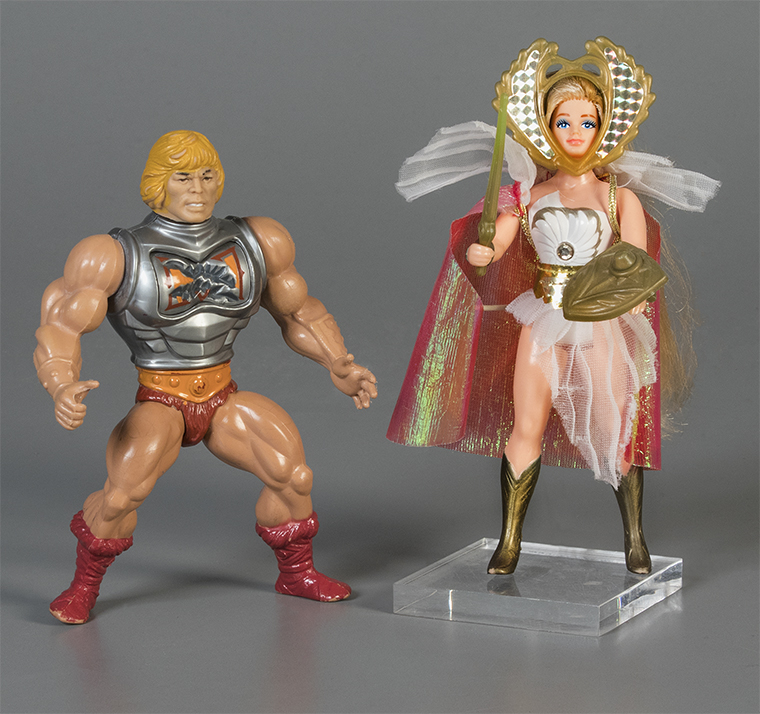
(8) JOHN ERWIN: CORA BUHLERT’S FAVORITE HE-MAN. [Item by Cora Buhlert.] John Erwin [who died December 20] was my He-Man. For most Germans, their He-Man is either Norbert Langer, who voiced him in the long-running German audio drama series, or Sasha Hehn or Heiko Liebig, who voiced him in the German dub of the Filmation He-Man and She-Ra cartoons.
But even though I first heard He-Man speak in the Filmation cartoon He-Man and the Masters of the Universe, I didn’t watch the German dub, but the English version via Sky Channel, when my Dad worked in the Netherlands in the 1980s. And in that cartoon, the voice of He-Man and his alter ego Prince Adam was none other than John Erwin.
If you rewatch the iconic opening narration of the cartoon – where John Erwin explains the entire premise of the series in one minute and ten seconds – you’ll notice the subtle difference between Prince Adam’s more youthful tones (Adam turned nineteen in the course of the series, while John Erwin was 47, when he first voiced him) and He-Man’s booming heroic voice.
However, John Erwin didn’t just voice He-Man and Prince Adam, but as was common with Filmation, he voiced multiple other characters in the He-Man and She-Ra cartoons as well, showcasing his amazing range. And so John Erwin lent his voice to Skeletor’s henchmen Beast-Man, Whiplash and Webstor. He was the delightfully dim-witted heroic warrior Ram-Man and the wise but grumpy dragon Granamyr as well as many one-of guest characters.
Beyond He-Man, John Erwin appeared in the western series Rawhide alongside Clint Eastwood, one of his comparatively few parts in front of the camera, and voiced Reggie in various Archie cartoons over the years. He was also the voice of Morris the Cat in the commercials for 9-Lives cat food. And if you ever needed proof that dragons are related to cats, just compare the snarky Morris to the equally snarky Granamyr.
Voice actors are unseen and often unsung. This is unfair, because their talent is what brings cartoon characters to life and turns them into icons. John Erwin’s voice played a big part in turning the Filmation He-Man cartoon into the runaway success that it was and in turning He-Man into the iconic hero he became.
(9) TODAY’S BIRTHDAY.
[Written by Paul Weimer.]
February 1, 1954 — Bill Mumy, 71.
By Paul Weimer: Bill Mumy’s intersection with my genre show watching boils down to three properties, and they are the three ones that you think they are. I first saw him as the mutant overpowered psychic child Anthony in one of the most terrifying Twilight Zone episodes of all time, “It’s a Good Life”. What happens when a young boy develops psychic powers and takes control of the town. Nothing good…I mean, no wait, Anthony, I mean, it’s a good life. I swear, it’s a good life. The whole idea that he cuts off the town from the rest of the universe is terrifying in and of itself, isn’t it? You can’t escape him, you can’t escape his power. Mumy also appears in a few other Twilight Zone episodes in various roles, but they are nothing compared to the power and centrality of his performance in “It’s a Good Life”
His role as Will Robinson in Lost in Space couldn’t be any different. I stumbled across episodes of Lost in Space in reruns not long after seeing the Twilight Zone episode. As the naive, but well-meaning youngest child of the Robinson family, Will Robinson couldn’t be any different than the psychic Anthony. Whether with Robbie, or Dr. Smith (and it seemed he spent more time with either of them than the rest of his family), he showed the childlike wonder of being on alien planets. I was delighted he had a small role in the recent remake of Lost in Space, too, as the “real” Zachary Smith. (He gets his identity stolen by Parker Posey’s character). That was a neat bit of turnaround, and not at all stunt casting.
The other genre work I associate Mumy with is, of course, Babylon 5, and Lennier. As the assistant to Delenn, he stands with Vir (Stephen Furst) as one of the two maintained underlings in the diplomatic corps. While Vir feels like an everyman (as the Centauri as, outwardly very much human), Lennier could show, on occasion, through Mumy’s acting, just how alien and not-human the Minbari were. He was meek, mild and deferential…until he needed not to be, and then could be all too inhumanly dangerous and determined. And given that this story is ultimately a tragedy, Lennier’s story is one that hits me in the feels, from start to finish. Such great acting. I remember when watching “Midnight on the Firing Line” and seeing his name in the credits and wondering what the child actor had become. He had become a fine adult actor, that’s what.
Happy birthday!
Bill Mumy
(10) COMICS SECTION.
Broom Hilda wonders if she has what it takes to be a writer.
(11) THE TEST OF TIME. The Unofficial Hugo Book Club Blog analyzes the Best Dramatic Hugo finalists of 1984 as part of their continuing series: “Big Worldcon Is Watching (Hugo Cinema 1984)”.
L.A. Con II, the 42nd Worldcon, was the largest World Science Fiction Convention of all time up to that point, with more than 8,000 fans in attendance (to this day, only the 2023 Worldcon in Chengdu, China has eclipsed that number). Science fiction cinema was bigger than ever. The Hugo Awards were bigger than ever. But in 1984, the Hugo for Best Dramatic Presentation was still considered a second-tier award.
“We will now proceed with the minor awards: Best Dramatic Presentation,” Toastmaster Robert Bloch quipped as he introduced the nominees: Bradbury adaptation Something Wicked This Way Comes, special effects maestro Douglas Trumbull’s Brainstorm, early hacking movie Wargames, blockbuster Return of the Jedi, and Oscar Best Picture contender The Right Stuff.
It’s an uneven shortlist that reveals both a tension between the populism and the insularity to which the award was often prone….
Remember the plot to the 1984 sci-fi blockbuster “The Terminator”?
“There was a nuclear war,” a character explains. “Defense network computers. New… powerful… hooked into everything, trusted to run it all. They say it got smart, a new order of intelligence. Then it saw all people as a threat, not just the ones on the other side. Decided our fate in a microsecond: extermination.”
It seems like either the execs at OpenAI have never seen it or they’re working overtime to make that premise a reality.
Don’t believe us? OpenAI has announced that the US National Laboratories will use its deeply flawed AI models to help with a “comprehensive program in nuclear security.”
As CNBC reports, up to 15,000 scientists working at the institutions will get access to OpenAI’s latest o1 series of AI models — the ones that Chinese startup DeepSeek embarrassed on the world stage earlier this month.
According to OpenAI CEO Sam Altman, who announced the partnership at an event in Washington, DC, the tech will be “focused on reducing the risk of nuclear war and securing nuclear materials and weapons worldwide,” as quoted by CNBC.
I once saw an episode of America’s Dumbest Criminals where a man called the cops to report his car stolen, only for it to turn out he’d stolen it from someone else in the first place. I couldn’t help thinking of him this week while watching OpenAI’s Sam Altman wet his pants about the fact that a Chinese hedge fund might have made unauthorised use of his own chatbot models, including ChatGPT, to train its new little side project. This is the cheaper, more open, extremely share-price-slashing DeepSeek.
As news of DeepSeek played havoc with the tech stock market, OpenAI pressed its hanky to its nose and released a statement: “We are aware of and reviewing indications that DeepSeek may have inappropriately distilled our models, and will share information as we know more,” this ran….
…So, to put it another way … wait, Sam – you’re not telling us that the Chinese hedge fund crawled all over your IP without asking and took it for themselves? Oh my God, IMAGINE?! You must feel used and abused. Financially violated. Like all your years of creativity were just grist to some other bastard’s mill. Like a host organism. Like a schmuck. Like Earth’s most screamingly preposterous hypocrite….
(14) SUPERHAMLET. From Christopher Reeve’s appearance on The Muppet Show long ago: “Brush Up Your Shakespeare”.
(15) VIDEO OF THE DAY. [Item by SF Concatenation’s Jonathan Cowie.] Moid Moidelhoff over at Media Death Cult considers the sense of place as a principal character in some SF/F… “When Location is the Main Character”.
[Thanks to Mike Kennedy, Andrew Porter, John King Tarpinian, Olav Rokne, Mark Roth-Whitworth, Chris Barkley, Cat Eldridge, SF Concatenation’s Jonathan Cowie, Steven French, Kathy Sullivan, and Teddy Harvia for some of these stories. Title credit belongs to File 770 contributing editor of the day Daniel Dern.]