CALL FOR SUBMISSIONS: Journey Planet Goes Mecha! Deadline: September 15, 2026
The Hugo Award-winning fanzine Journey Planet is gearing up for an exciting new issue dedicated to the world of mecha robots—and we want your contributions.
From classic anime like Robotech to giant robot epics across global fandom, this upcoming issue will celebrate the towering machines, the creators who produced them, and the fans who keep the genre alive. Whether your passion is nostalgic, critical, artistic or wildly imaginative, Journey Planet invites creators of all kinds to contribute.
We are seeking:
Essays and articles (analysis, history, personal reflections and photos to go along with these if available)
Micro fiction or poetry featuring mecha themes
Artwork, illustrations, multimedia-inspired pieces (traditional or digital)
Cosplay photography and build showcases
If it involves giant robots, we want to see it.
This issue aims to highlight not just iconic franchises, but also the creativity and diversity of fandom itself. Submissions from first-time contributors and seasoned creators alike are welcome.
Pitch ideas and ask questions:[email protected] (please reach out ASAP with pitch ideas and any questions on format and guidelines)
Whether you’re a writer with something to say, an artist with a bold vision, or a cosplayer bringing steel giants to life, Journey Planet offers a platform to share your work with an enthusiastic, global audience. Help us build an issue that’s as impactful as the world of mecha robots!
Journey Planet Issue 92 is about Comic Book Culture, as James Bacon and Chris Garcia look back at some impressive events, exhibitions and experiences connected to comic books as well as two interviews, and discussion about comics. James and Chris have been providing fan writing for various outlets for many years, including Forbidden Planet Blog, Down the Tubes and File 770 and here they gather some of that work to share in one place.
James Bacon says: “We are living in an incredible time for comics, there has been no ending of great art, and wonderful stories, but we have also been able to meet and encounter the professionals and engage with them at smaller conventions, and also seen large cultural organisations, many driven by the enthusiasm of fans and professionals, bring an appreciation and love for comics to a broader audience. It is an amazing time for comic fans, the appreciation really has exploded this century”
The contents for this issue include:
An interview with Juanjo Guarnido—Artist of Blacksad, and a round table interview with N. K. Jemisin.
Reportage on
The Comics 1964-2024 exhibition at the Pompidou Centre in Paris.
The Cartoon Art Museum(s)
The Comic Combative exhibition by the Jack Kirby Museum in New York.
Comics Unmasked: Art and Anarchy in the UK at the British Library in London
Heroes & Villains: The Comic Book Art of Alex Ross by the Warhol Museum at Norman Rockwell museum in Stockbridge, Massachusetts
“I Can’t Find My Girl Annuals” China Mieville and Paul Gravett at the Institut Français · Royaume-Uni in London.
Grant Morrison at Foyles in London in July 2011
Super Hero Walking Tour of New York City
Stories from Ireland: Frank Miller at Dublin Comic Con
The Performance of The Ballad of Halo Jones at the Lass O Gowrie pub in Manchester
Articles on:
Image Duplicator, professionals and fans and Roy Lichtenstein
Andy Warhol and Comics
Mel Ramos: Comic Book Portraiture
League of Volunteers by Robert Curley and Barry Keegan
An eclectic collection of fan writing that looks at the cultural activities and appreciation of comics, and brings experiences together. James adds, “There is now more recognition of both the importance of comics and those who create them and we’ve been exceptionally fortunate to have fans and professionals not just advocating but working to bring comic book culture to new venues.”
Allison Hartman Adams joins Chris and James for the long-overdue Journey Planet #93: Andor Season Two. The issue runs the gamut from reflections on Andor’s enduring lessons, to how the story illuminates theStar Wars universe, to good-old-fashioned fan reviews.
The editors say, “Our heartfelt thanks go to our excellent contributors: Hannah Strom-Martin, David Ferguson, James Mason, Peppard Saltine, Brenda Noiseux, and Josh Gauthier. Our stunning art comes to us from Iain Clarke, Autun Purser, Sara Felix, Keith Burns and Simon Adams.”
Co-editor James Bacon said: “The two seasons of Andor were radical and fresh and have really demonstrated the power that can be harnessed in Star Wars. Tony Gilroy, the writers, and actors have presented so much for fans to think about. The level of depth, the layers and character development as well as the representations and portrayals, let alone a complex story of people have given fans a lot to think about, reflecting on the here and now as well as creating thoughtful analysis and enthusiastic writing, and here we are grateful to share that in this issue of Journey Planet, complemented by some amazing artwork.”
Be sure to check out their artists’ websites and socials for more of their incredible creative endeavors. The editors conclude, “We hope you enjoy this issue of Journey Planet, and as ever, reach out with comments and suggestions at [email protected].”
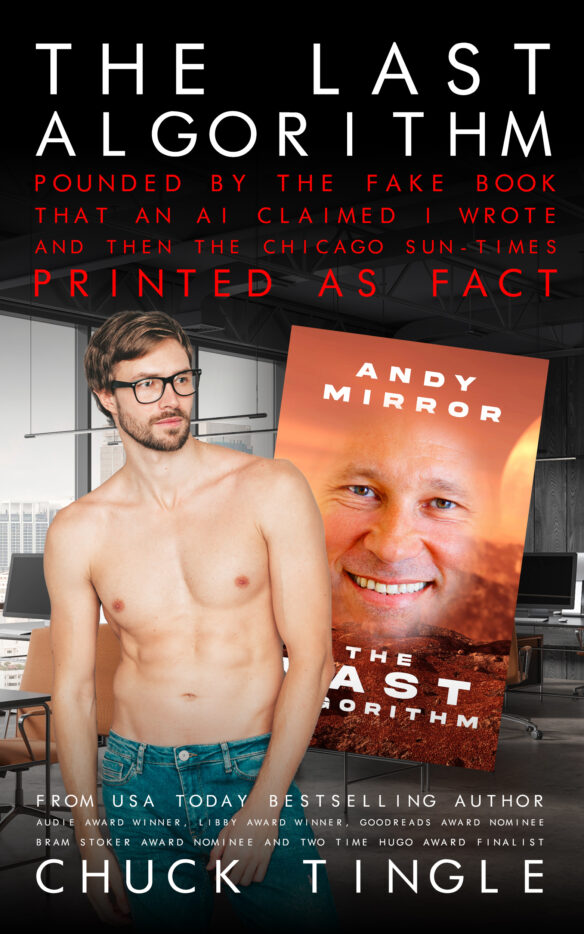
(1) WRITE ON DEMAND PUBLISHING. Chuck Tingle wasted no time capitalizing on the Chicago Sun-Times’ gaffe of including numerous AI-hallucinated titles on its summer recommended reading list. He has slightly adjusted the author’s name from Andy Weir to Andy Mirror, which will probably help keep his lawyer happy.
For reasons I’m not sure I will ever fully understand, the topic of magic and rules comes up with slightly alarming frequency in SFF circles. So much so, in fact, that it is very tempting to use ominous capital letters when referring to the two bits of said topic: Magic and Rules. Does magic have to have rules? Would everyone just run about drunk with power if the rules did not constrain their magics in some way? What are rules, and what are parameters? If limits are not imposed upon wizards, will they ever impose them upon themselves? When does magic become science, and how much of this entire topic can I throw at the feet of Clarke’s third law?
That law, for those in need of a refresher, states that any sufficiently advanced technology is indistinguishable from magic. Fair enough. But must we try to reverse-engineer this?…
… I am here instead to sing the praises of rebellious, lawless, delightfully un-rulebound magic—not just the kind people do, but also the kind that simply is. I tried to find an example from Catherynne Valente’s Fairyland books and was overwhelmed with them: the wyverary (half wyvern, half library); Gleam the lamp; the smartly dressed Green Wind; the whole thing with the moon in the third book: Valente writes like she’s never heard of “rules,” and I have never wanted anything in one of her novels explained to me any further than she explains it. Strange, arguably magical things happen in Helen Oyeyemi books, and whenever they—or she—run up against a rule, whether of science or nature or anything else, it goes ignored. A lot of my favorite books, I can’t remember how the magic works. And I mean that as a compliment. In The Incandescent, magic exists, and some people are just better at various kinds of it than others. (Some of it involves invoking demons, and if you mess up that kind, well, magic definitely has a price.) Magic in The Magicians comes from pain. That’s fine. That’s a source, not a rule (one does have to learn fancy hand motions in order to do magic, but that’s a process). It also always kind of feels like a wry punchline to me. Every life has some pain. Therefore we’ve all got some magic….
(3) WRITER BRIEFINGS. [Item by SF Concatenation’s Jonathan Cowie.]BBC Radio 4 (formerly known as the Home Service) has just broadcast two programmes of interest to writers and, I guess, avid readers too.
The first is on the history of copyright through to today. As Filers will know, there has been great author and fan concern over the use of using copyright material to train AI. This is of relevance to the history of copyright which came about due to advances in reproduction technology, from monks’ highly illustrated ad coloured manuscripts to the printing press and digital material. Listen here: BBC Radio 4: In Our Time, “Copyright”.
Copyright protects and regulates a piece of work – whether that’s a book, a painting, a piece of music or a software programme. It emerged as a way of balancing the interests of authors, artists, publishers, and the public in the context of evolving technologies and the rise of mechanical reproduction.
Writers and artists such as Alexander Pope, William Hogarth and Charles Dickens became involved in heated debates about ownership and originality that continue to this day – especially with the emergence of artificial intelligence.
The second is on the way we (society) are (is) changing the use of punctuation. The question mark and exclamation mark is holding its own, but the comma, colon, and eve the full stop is on the way out! Listen here: BBC Radio 4: Word of Mouth, “The End of the Full Stop?”
The use of punctuation is rapidly changing within the quick-fire back-and-forth of instant messaging. Are these changes causing misunderstandings?
Presenter Michael Rosen and his guest Dr Christian Ilbury discuss. Is the full stop on the way out? What about capital letters? Exclamation marks and question marks seem to be holding their ground, but what about the rest?
More than 100 organizations are raising alarms about a provision in the House’s sweeping tax and spending cuts package that would hamstring the regulation of artificial intelligence systems.
Tucked into President Donald Trump’s “one big, beautiful” agenda bill is a rule that, if passed, would prohibit states from enforcing “any law or regulation regulating artificial intelligence models, artificial intelligence systems, or automated decision systems” for 10 years.
With AI rapidly advancing and extending into more areas of life — such as personal communications, health care, hiring and policing — blocking states from enforcing even their own laws related to the technology could harm users and society, the organizations said. They laid out their concerns in a letter sent Monday to members of Congress, including House Speaker Mike Johnson and House Democratic Leader Hakeem Jeffries.
“This moratorium would mean that even if a company deliberately designs an algorithm that causes foreseeable harm — regardless of how intentional or egregious the misconduct or how devastating the consequences — the company making or using that bad tech would be unaccountable to lawmakers and the public,” the letter, provided exclusively to CNN ahead of its release, states.
The bill cleared a key hurdle when the House Budget Committee voted to advance it on Sunday night, but it still must undergo a series of votes in the House before it can move to the Senate for consideration.
The 141 signatories on the letter include academic institutions such as the University of Essex and Georgetown Law’s Center on Privacy and Technology, and advocacy groups such as the Southern Poverty Law Center and the Economic Policy Institute. Employee coalitions such as Amazon Employees for Climate Justice and the Alphabet Workers Union, the labor group representing workers at Google’s parent company, also signed the letter, underscoring how widely held concerns about the future of AI development are….
(6) CALL FOR SUBMISSIONS FOR JOURNEY PLANET AUGUST ISSUE, [Item by Jean Martin.] San Francisco and the Bay Area have inspired cultural and scientific revolutions since the Gold Rush in 1849. Thus, we’re excited to boost the city’s relevance in the science fiction/fantasy genre in the August issue of Journey Planet.
If you have any suggestions for an article, poem, story or art that revolves around San Francisco and science fiction/fantasy, please reach out to us at: [email protected].
The deadline for submissions is July 1.
For instance, we’d welcome articles about books or movies/TV shows set in San Francisco and its environs and/or created by residents of the SF Bay Area. We’d especially like to hear from diverse voices, such as myths and folktales from the Ohlone and Hispanic cultures. Looking forward to hearing your creative ideas!
(7) FREE READ. A new story from Grist’s “Imagine 2200” – “The Seed Dropper”.
In this poetic story, by simóne j banks, Louisiana native June returns to his hometown decades after devastation from floods and petrochemical plants chased his family away, with a mission to reseed the land and memories from the past to point the way.
Deeply connected to both the beauty of the Mississippi River and the devastation brought by petrochemical plants to the region known as Cancer Alley, The Seed Dropper dabbles in nostalgia and sadness, but also hope and possibility, as it imagines the world of 2050 and the first steps to restoring what’s been lost.
(8) GUFF PAPERBACK RELEASED. The GUFF trip report anthology announced as an ebook in February is now also available in paperback from Ansible Editions: GUFF: The Incomplete Chronicles edited by David Langford. Here’s the full information about the book.
This volume gathers up the chapters of GUFF reports that were unfinished or too short for standalone publication. Donations to GUFF rather than TAFF are encouraged for those who enjoy this one. Download it here.
This book brings together the known segments of unfinished Get Up-and-Over/Going Under Fan Fund trip reports. The GUFF winners represented are Joseph Nicholas (1981), Justin Ackroyd (1984), Irwin Hirsh (1987), Roman Orszanski (1990), Eva Hauser (1992), Paul Kincaid (1999), Damien Warman and Juliette Woods (jointly, 2005) and Ang Rosin (2007).
From the Introduction by David Langford
As with its ancestor fund TAFF, a long-standing tradition of GUFF is that returned winners administer the fund until replaced by their successor from the same hemisphere and if possible write a substantial trip report, both for sale in aid of the fund and for the entertainment and edification of fandom. This tradition goes back to before TAFF itself began. A special fund was organized to bring Walt Willis from Ireland to the USA and the World SF Convention in 1952 (an initiative which led directly to the founding of TAFF), and his report The Harp Stateside is regarded as a classic of fan writing.
Many GUFF winners since 1979 have likewise published full-length trip reports (click here for available downloads). Some were waylaid by the horrors of real life and failed even to begin a report; some published instalments in fanzines but didn’t finish. Joseph Nicholas drafted a very long report whose MS was lost in a house move. Irwin Hirsh has published ten instalments, enough to be called a completed report, but wants to add more and is represented here by two chapters about the UK Worldcon he attended. Otherwise, this ebook collects what remains of reports that have been abandoned, or are so brief that they couldn’t plausibly be published as a standalone fanzine in the tradition of The Harp Stateside. There’s a lot of fine fan writing here.
This GUFF-centred companion to the TAFF Trip Report Anthology (2017) is published as an Ansible Editions ebook for the TAFF site on 1 March 2025. Cover artwork by Ian Gunn. 73,000 words.
(9) STARTS TOMORROW. Fountain of Youth – Official Trailer. The best secrets are the hardest to find. John Krasinski, Natalie Portman, Eiza González and Domhnall Gleeson star in Fountain of Youth. Premiering May 23 on Apple TV+
(10) MEMORY LANE.
[Written by Cat Eldridge.]
May 22, 1981 — Outland film
Outland premiered forty-four years ago this date in the States in select cities, but everywhere that following weekend. It got a Hugo nomination at Chicon IV, the year that Raiders of the Lost Ark won.
This original title of the film was Io as it’s set on Jupiter’s moon Io, but audience testing showed that wasn’t understandable at all as the test audiences thought it was the number ten, or, at least to me less puzzlingly, low. So in homage to the Western genre, it became Outland.
Which was appropriate as the writer Peter Hyams wanted to do one: “I wanted to do a Western. Everybody said, ‘You can’t do a Western; Westerns are dead; nobody will do a Western’. I remember thinking it was weird that this genre that had endured for so long was just gone. But then I woke up and came to the conclusion – obviously after other people – that it was actually alive and well, but in outer space.”
So they had a script that they really liked, now they need their actor. They wanted and got Sean Connery to be in their version in High Noon. Connery’s career had been in a nose dive as of late then, so this was a golden chance for him, so he took the role.
Law enforcement officers are faced with the nature of right and wrong, and duty versus keeping themselves safe, but while Will Kane in High Noon is played as an archetypal hero who discovers the world isn’t black and white as he was led to believe, Will O’Niel already exists firmly in the gray where things are always messy when we meet him.
Connery was magnificent in this role. In addition to Sean Connery, the movie includes performances by Peter Boyle, Frances Sternhagen, and James Sikking, who all I firmly believe deliver memorable portrayals of complex characters.
So they got the lead and the rest of an excellent core cast, now they had to film a movie. They had a very tight budget, just seventeen million dollars. The quite amazing sets were enhanced by the use of a new filming process called Introvision which allowed the director to mix a combination of sets, mattes and a generous use of miniatures in-camera, avoiding the then-lengthy process of extensive use of green screens.
Critics were mixed on it. Gary Arnold at the Washington Post thought it was “trite and dinky” whereas Desmond Ryan at the Philadelphia Inquirer called it: “a brilliant sci-fi Western.”
I said it cost seventeen million to make, and it made, errr, just about seventeen million dollars. That means that it lost money for the studio. Lots by the time you figure printing up reels for the theatres, promotional costs and that the studio only gets fifty percent most often of ticket sales. Not that the studio would admit that.
Now I liked the film. I saw it some years after it came out and thought it worked rather well, but then I think it is police drama rather than a SF film.
It is not legally streaming anywhere so you know that linking to it is a bad idea, right?
(12) WHAT’S THE BEST WAY FOR A MUSIC FAN TO SUPPORT THEIR FAVORITE ARTISTS? [Item by John A Arkansawyer.] This is an interesting look at how fandom and commerce interact, focusing on music but of interest, I think, to fans more generally. NPR asks “Is there a right way of being a music fan?”
…I offer these two stories to highlight the contrasting conceptions of what constitutes fandom in 2025. In the first case, the fan is a customer looking for the best deal. In the second, she is a patron, supporting a creative favorite not only with money but through sustained attention and care. Both terms stick the artist within a somewhat servile position, delivering goods, but the latter feels more genteel and possibly more sustaining. “Customer” implies a one-way relationship, with the artist cast as a seller; “patron” suggests an ongoing connection through which a fan ardently supports an artist for a time or over a whole career….
… Today, “always on” artists have to be far more responsive to their fans’ desires. This means providing more music, but also many other means of consumption and interaction, from VIP concert experiences to TikTok videos, special merch lines, and, for an increasing number of artists, OnlyFans or Patreon accounts that grant direct access. Much commentary exists on the ever-growing power of the fan, but I’m interested in how fans negotiate this partly real, partly imagined surge in influence, and what it means for artists at a moment when their role in society has never been less clear….
A federal judge on Wednesday rejected arguments made by an artificial intelligence company that its chatbots are protected by the First Amendment — at least for now. The developers behind Character.AI are seeking to dismiss a lawsuit alleging the company’s chatbots pushed a teenage boy to kill himself.
The judge’s order will allow the wrongful death lawsuit to proceed, in what legal experts say is among the latest constitutional tests of artificial intelligence.
The suit was filed by a mother from Florida, Megan Garcia, who alleges that her 14-year-old son Sewell Setzer III fell victim to a Character.AI chatbot that pulled him into what she described as an emotionally and sexually abusive relationship that led to his suicide.
Meetali Jain of the Tech Justice Law Project, one of the attorneys for Garcia, said the judge’s order sends a message that Silicon Valley “needs to stop and think and impose guardrails before it launches products to market.”…
Peeking over the foliage outside the Hall of Science in Flushing Meadows-Corona Park are two towering metal structures you wouldn’t expect to find in Queens, rocketships. These space-age remnants are relics of the United States Space Park, an attraction created by NASA and the Department of Defense for the 1964 World’s Fair. These vessels aren’t even the first rockets to come to New York City. In 1957, a Redstone rocket was put on display in the main concourse of Grand Central Terminal. While the Redstone rocket was only a temporary fixture, you can still see the World’s Fair’s rockets today in Rocket Park, a playground area outside the Hall of Science….
… The fair was buzzing with excitement over the final frontier. Streets in the park’s radial grid pattern had names like Universe Court, Astronaut Court, Avenue of Science, and Avenue of Discovery. Visitors would find the iconic Unisphere in the Fountain of the Planets. The space motif is also exemplified in the Rocket Thrower, a massive bronze statue by Donald DeLue. The Rocket Thrower is posed in motion as he hurtles a rocket towards a constellation of gilded stars….
… The United States Space Park at the World’s Fair gave people a chance to see space travel technology, which they heard so much about on television, up-close in real life….
Searching the World’s Fair archives, Untapped New York’s founder Michelle Young came upon a forgotten gem: a mini Trylon and Perisphere replica that once stood at the New Jersey entrance of the Lincoln Tunnel. This information booth structure was meant to be eye-catching and to “induce the out-of-town motorist to stop at the booths before plunging into Manhattan.” The Trylon and Perisphere were the centerpieces of the 1939 World’s Fair and this piece of promotional architecture was one of many replicas that popped up around NYC to promote the fair….
This week’s episode of The Last of Us contained a moment that froze the blood. For a split second, the hearts of the viewing audience rose into their throats in horror. This is a show that has presented us with terror after nightmarish terror but, even by these exceptional standards, this was almost too much to bear. I am talking, of course, about the scene where Ellie started playing a Pearl Jam song on a guitar.’
It’s a survival story, harkening back to the original, iconic Jurassic Park. Universal has just dropped the final trailer for its upcoming badass dino adventure, Jurassic World Rebirth, in theaters July 2.
With lots of big, sharp, pointy teeth!
The huge Jurassic franchise is back with its latest adventure, set five years after the events of Jurassic World Dominion, filled with biting humor and biting creatures… including raptors! And Pterywhatevers! Johansson, Bailey and Mahershala Ali anchor an all-star cast as an extraction team, hunting potentially life-saving DNA at the original Jurassic Park’s research facilities, that happens to be inhabited by the worst of the worst dinosaurs that were left behind. The film also stars Rupert Friend and Manuel Garcia-Rulfo….
[Thanks to John King Tarpinian, Chris Barkley, Cat Eldridge, Jean Martin, David Langford, John A Arkansawyer, SF Concatenation’s Jonathan Cowie, Mark Roth-Whitworth, Steven French, Kathy Sullivan, Teddy Harvia, Mike Kennedy, and Andrew Porter for some of these stories. Title credit belongs to File 770 contributing editor of the day Andrew (not Werdna) (and not Gene Wolfe, either).]
(1) BRITISH BOOK AWARDS. The Bookseller reports The British Book Awards “Book of the Year Winners 2025”. One is of genre interest, while James, a retelling of Huckleberry Finn from the viewpoint of Jim, has been discussed here for its parallels to Julia, a 1984 retelling. The complete list of winners is at the link.
AUTHOR OF THE YEAR
Percival Everett, author of James
BOOK OF THE YEAR – FICTION
James by Percival Everett
BOOK OF THE YEAR – PAGETURNER
Faebound by Saara El-Arifi
(2) HUGO-WORTHY POETRY CONSIDERED. Dina at SFF Book Reviews compares all the poetry finalists in “Reading the Hugos 2025: Best Poem”. Here’s one of the comments:
…Ever Noir by Mari Ness was much more to my liking, combining fairy tale tropes with a noir style. It’s like the noir detective in the grimy office is visited by a fairy tale princess. While it doesn’t really tell a story, I really enjoyed the juxtaposition of the two clashing sub-genres. (7/10)…
(3) JOURNEY PLANET 90. Steven H Silver announces that Chris Garcia and James Bacon have published an issue of Journey Planet he edited on the theme “My Favorite Museum”, which is 155 pages and looks at more than 60 museums on all seven continents. The issue can be downloaded at the link.
The 2027 Westercon Site Selection Administrator announced that she has accepted a bid from the Society for the Promotion of Speculative Fiction (SPSF) to host Westercon 79 in conjunction with BayCon 2027 at the Marriott Hotel in Santa Clara, California, and that this bid will be on the ballot for the election to be held this year at Westercon 77/BayCon 2025.
Site Selection Administrator Kayla Allen explained that there was a misunderstanding between herself and SPSF around the original filing deadline of April 15, 2025. After several discussions, Allen decided in the interest of fairness to accept SPSF’s bid and place the Santa Clara in 2027 bid on the ballot. No other groups filed bids to host Westercon 79.
For those wishing to vote electronically, you will be able to pay the advance “voting fee ($20) tokens” by purchasing a token through the BayCon 2025 website. There is also a small service charge for such online purchases. Members will also be able to pay by check or money order. Cash will only be accepted in person at Westercon 77/BayCon 2025.
The 2027 Westercon Site Selection ballot will be posted at the Westercon.org website and will be sent to all members of Westercon 77/BayCon 2025. Members will be able to vote by email, paper mail, or in person at Westercon 77/BayCon 2025.
Sesame Streethas a new streaming home. Netflix has picked up the children’s series, which will make its debut on the streamer later this year with an all-new, reimagined 56th season — plus 90 hours of previous episodes — available to audiences worldwide.
Netflix is coming on board after HBO Max opted not to renew its Sesame Street streaming deal at the end of last year. Finding a new streaming partner has been considered critical to the series’ financial survival.
The new episodes, which will now each center on one 11-minute story, will be available same day-and-date in the U.S. on PBS stations and PBS KIDS digital platforms, maintaining U.S. kids’ free access to early learning, which Sesame Street is all about. That is a departure from Netflix’s typical push for exclusivity unless a second window on a library title is involved….
(6) 451. In “Ray Bradbury Told Us So”, Carl Abrahamsson analyzes the lasting relevance of Fahrenheit 451. (Behind a paywall.).
…Bradbury’s novel emerged from the McCarthy era, when fear of communist influence led to intense scrutiny of intellectuals and artists. The story follows Guy Montag, a “fireman” whose job is burning books in a future America where literature is forbidden. Through his relationship with Clarisse McClellan, a young woman who questions society’s values, and his own growing disillusionment, Montag begins to read the books he’s meant to destroy. The novel depicts a population numbed by wall-sized televisions, immersive entertainment, and high-speed living. Bradbury’s warning focuses on how mass media and anti-intellectualism could lead to cultural amnesia and the death of critical thinking….
I’m a primary school teacher with two children under three at home. As a reception teacher I spend a lot of time reading children’s books out loud. With my own children I like a book that is calm and gives me something as well as them. Sleep Tight, Disgusting Blob by Huw Aaron is my new favourite: Lovely, relaxed rhymes with a touch of sci-fi and horror thrown in. Children who can read or appreciate the pictures love the idea of a “scary” bedtime story, and those who can’t, get the rhythm and time with a happy, giggling parent. Patrick Clark, Leeds’
(8) MEMORY LANE.
[Item by Cat Eldridge.]
May 19, 1983 — Shatner’s Star
Forty-two years ago on this day, William Shatner got his very own star on the Hollywood Walk of Fame. It was the one thousand and sixty-second such star. It’s located at 6901 Hollywood Blvd. He’d also get a star on the Canada’s Walk of Fame in Toronto.
It is said that hundreds of people attended Shatner’s dedication ceremony, including Leonard Nimoy who gave a speech on the day in which he said that Shatner was “a wonderful man and a great actor” before telling the crowd about the terrible jokes Shatner liked to play on him.
Shatner also spoke, “This is my small ticket to the stars. All of the other accolades are so ephemeral one never has anything that’s truly concrete and this is the one exception.”
Mike Deodato co-created Riri Williams, Ironheart, with Brian Michael Bendis for Marvel Comics, who first appeared in Invincible Iron Man Vol. 3 #7 in 2016, and on the screen in Black Panther: Wakanda Forever, played by Dominique Thorne. With the TV series adaptation starring Thorne about to drop on Disney+, he has written an open letter on social media earlier this week, reproduced in English below;…
… “But as much as I celebrate this moment, there’s a bitter edge to it. You see, while Marvel has built an empire worth billions on the backs of its creators, the compensation model hasn’t kept pace with the success. I’m in a good place, one of the best-paid creators in the industry, and I truly appreciate that. But it’s not about me. It’s about the principle. When a character you poured your heart into helps fuel the engine of a multi-billion-dollar machine, a small share of that success feels only fair.
“Creators don’t ask for billions or even millions. Just a nod, a bit of recognition, and a share that reflects the contribution they’ve made. It’s not just good ethics—it’s good business. Happy creators stay invested, inspired, and loyal. But when the business side doesn’t match the creative investment, creators naturally drift toward projects where they retain control, where their work can lead to lasting financial security. That’s why more and more of us are focusing on creator-owned projects, where we can truly share in the success of our creations….”
Mars, the red planet, could be in for a global display of aurora this week after a huge cloud of charged particles left the sun in the direction of the red planet.
The prediction from solar scientists comes in the same week NASA’s Perseverance Mars rover made history by detecting visibly green auroras on Mars for the first time.
An X2.7 solar flare on Wednesday, May 14 — the strongest of the year so far — saw an intense burst of energy and electromagnetic radiation from the sun’s surface spread out across the system at light speed. An X-class solar flare is the most intense class, according to NASA. In its wake, there was a coronal mass ejection — a cloud of super-charged particles — that left the sun’s surface….
Public service announcement: don’t point your phone camera directly at a lidar sensor.
A video recently shared on Reddit demonstrates why. As the camera zooms in on the sensor affixed to the top of a Volvo EX90, a whole galaxy of colorful dots is burned into the image, forming over the exact spot that the flashing light inside the lidar device can be seen.
What you’re witnessing isn’t lens flare or a digital glitch — it’s real, physical damage to the camera. And it’s permanent.
“Lidar lasers burn your camera,” the Reddit user warned….
(13) PITCH MEETING. Ryan George remembers “The Avengers Pitch Meeting” like it was yesterday. Maybe that’s because this is a revival of a video first aired in 2018.
(14) VIDEO OF THE DAY. [Item by SF Concatenation’s Jonathan Cowie.] Matt O’Dowd over at PBS Space Time tends to the sceptical side of technological extraterrestrials existing, at least within detection range of Earth. It is never aliens, except when it is.
I should declare that as a bio-geo (environmental) scientist, I don’t buy into this at all. Having devoted much of my extracurricular science time to climate change for over a third of a century, I was really getting depressed, and so for the last decade I have been focusing on deep-time evolution of life, the Earth and the Earth system, developing a ‘co-evolution of life and planet narrative. (I have a book in press coming out on this from an academic publisher – it has been in peer review for two years!. I’ll give Mike the nod when it is due out in case he thinks it might be worth sharing with Filers as there is a fair bit on exobiology in the mix as well as the coming singularity (both being SFnal tropes)).
For what it is worth, I do not consider the endosymbiont process to create a eukaryote (good cell) from a prokaryote (like a simple bacterial cell) a difficult one or a hard evolutionary step. If it was a hard evolutionary step then it is unlikely to have taken place a number of times (which it has). However, physicists will be physicists and this is Matt’s summary…
Around 2 billion years ago, life had plateaued in complexity, ruined the atmosphere, and was on the verge of self-annihilation. But then something strange and potentially extremely lucky happened that enabled endless new evolutionary paths. The first eukaryote cell was born. This may also explain why there are no aliens.
[Thanks to Teddy Harvia, Mike Kennedy, Andrew Porter, Kayla Allen, John King Tarpinian, Chris Barkley, Cat Eldridge, SF Concatenation’s Jonathan Cowie, Mark Roth-Whitworth, Steven French, and Kathy Sullivan for some of these stories. Title credit belongs to File 770 contributing editor of the day ULTRAGOTHA who gets the 1776 reference from the other day.]
The Journey Planet team is busy at the moment and has put out a call for contributions for three issues currently being worked on.
LOCAL MUSEUMS
Steven H Silver has been working with the team on an issue about Museums. They have invited fans to reflect on their local museums, museums they love, and seek out the unusual and different, from BatCat in Bangkok to The Little Museum of Dublin. We would like fans to share their local knowledge, to think about their favorite local-to-them museum. We would ask you to share what makes it special, why do you like to visit it, and what it is that gives you that sense of wonderment and excitement and also why you hope others would love it.
Photographs illustrating the museums are very welcome, we know that this can really help, we’re looking for short articles, around 750 words.
The deadline for submissions is March 31.
GIANT SIZE X-MEN
Brenda Noiseux and David Ferguson join the Journey Planet team for an issue looking at Giant Sized X-Men, which was released in 1975. This comic rebooted the X-men and marked a change to the members of the team, bringing the series into the 70s where some of the most poignant stories were told and internationalized the team.
Articles, art, commentary, viewpoints are all very welcome on the comic itself, the characters it introduced and brought together, as well as the initial run of comics up to the Dark Phoenix Saga which began in Uncanny X-Men #129. We welcome hearing from contributors who have a fresh angle or perspective and crafters who wish to create art related to the comic.
The deadline for the Giant Size X-men anniversary issue is 3rd of May, a day that comic fans will be enjoying, with a release in May.
ANDOR II
Allison Hartman Adams also joins Chris Garcia and James Bacon as they explore the forthcoming Andor II season.
Andor Season II has 12 episodes. These will be released three episodes at a time: every Tuesday, beginning on April 22, and then following on April 29, May 6, and May 13.
Journey Planet #65: Rogue One co-edited with Alissa Wales looked at Rogue One with thoughtfulness and affection and then
Journey Planet #69: Andor (Season 1) co-edited by Erin Underwood and John Coxon, proved very popular as fans reflected on the first season of Andor.
The opportunity presents itself now to answer questions: What do you hope for? What do you think will happen? And then, did Season 2 meet expectations?
We have other questions for you to consider as part of our “Instant Fanzine section,” so send us your answers and ideas.
As you enjoy the series, you can write as you go, gathering emotions and feelings and reflections, with a week to cogitate (and even rewatch the full season) and share your views, thoughts, opinions through the fanzine.
Finding an unusual angle is welcome, as is crafting something that ties in with the series. James will definitely be looking for connections to aspects of Irish Rebellion, and so we welcome you contacting us with your ideas.
Let us know if you’d like to be involved; we have a deadline of the 20th May.
In all cases, please let us know if you would like to contribute — please send an email first to [email protected]
The Journey Planet team is back with the second installment of their look at Bram Stoker’s Dracula. There was so much interest in this topic that they received enough contributions to fill two full issues.
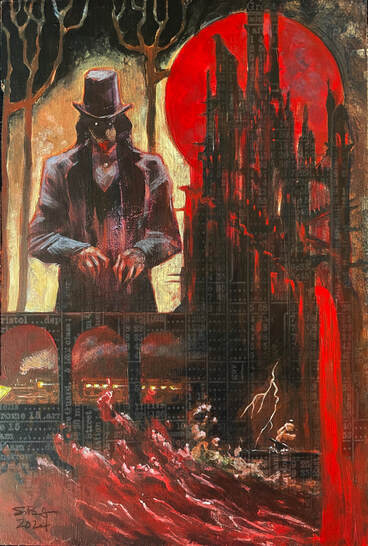
Issue 87 — “Mina – Dracula’s Destroyer” — commemorates Bram Stoker’s birthday. Allison Hartman Adams joins Chris Garcia and James Bacon again to do a deeper dive into the text and works of fiction, art, and comics Dracula has inspired.
In “Train Fiend” James looks at the railway connections to Bram Stoker and the railway aspects in the novel, comparing the train movements and times in the novel to timetables of the day, seeking to pinpoint where and when Bram Stoker based these journeys.
Dracula-related comics and movies have a strong presence here as well: Kim Newman’s review of Batman/Dracula; Alan Moore and Kevin O’Neill’s The League of Extraordinary Gentlemen from David Ferguson; Dracula Lives from Rob Kirby; Batman and Vampires from James Bacon, and Alberto Breccia’s “I Was Legend” from Jim O’Brien.
In “Molested, Murdered, Maligned: In Defense of ‘Poor Dear Lucy’”, Allison challenges the dreadful treatment Lucy has received at Dracula scholars’ hands over the years.
Allison also considers and reflects on the character of Mina in relation to why she writes, and takes a nerdy wander in “Dracula By the Numbers.”
In “Dracula: Then and Now,” James sets out from Budapest to the Borgo Pass by train, reflecting on the changes and sharing his experience and journey through Hungary and Romania.
With stunning front and back covers by Iain Clark, the issue is beautifully bound.
Allison Hartman Adams joins James Bacon and Chris Garcia in a wide-reaching look at everyone’s favorite Count and his nemeses in Journey Planet #86 – “Dracula Fiend & Foe”, available here.
They examine the enduring legacy of Bram Stoker’s novel, just in time for Samhain, as the evenings draw darker and the chill in the air mixes with the beautiful colors of the decaying falling leaves.
This issue takes a look at a plethora of aspects, including the wide variety of art and culture that represent Dracula, starting with a consideration of the cultural transformations of Dracula as an icon. The contributors present many perspectives, from poetry about Bela Lugosi, to the costumes of Coppola’s Dracula.
The literary aspects are also important, and include a look at Bram Stoker’s Notes and the Rosenbach Museum, as well as why we need to stop calling it ‘Carfax Abbey.’
The issue features a number of interviews, including Dacre Stoker (Bram Stoker’s great grand-nephew), Tucker Christine (editor of Dracula Beyond Stoker) and Karim Kronfli (Re: Dracula voice actor).
Also included are radio plays, comic book interpretations, an essay on vampires in East Asia, and even Dracula recipes.
There was so much enthusiasm for this issue that the matter of Dracula and Mina will be split across two issues. A second issue, Journey Planet #87 “Mina – Dracula’s Destroyer,” will be released November 6, the final date in Stoker’s novel.
Dracula has permeated our culture, and one can see how relevant Stoker’s works continue to be with the recent rediscovery of the long-lost Stoker short story, “Gibbet Hill” receiving worldwide attention.
The Journey Planet team are all massive Dracula fans, as you’ll see from these pages. They hope that you’ll discover new versions of your favorite characters in this issue.
Table of Contents
Fiendish Love: Editor’s Note by Allison Hartman Adams
Man, Wolf, Bat, Monster…Icon: The Cultural Transformations of Dracula by Josh Gauthier
Dracula Movie Posters by Chris Garcia
“Bela Lugosi” by Chuck Serface
“Much to Learn from Beasts:” the Costumes of Coppola’s Dracula by Hannah Strom-Martin
Myths and Mental Health: Journey Planet Interviews Author Dacre Stoker
Eating Molecules With a Pair of Chopsticks: (Mortal) Food in Dracula by Amos Dunlap
Stoker’s Gothic Heroine by Allison Hartman Adams
The Last Voyage of the Demeter – Movie Review by Erin Underwood
Sherlock Holmes v Dracula, A Play for Radio: Review by James Bacon
Interview with a Vampire an Actor by Helena Nash
“Like a Bolt From the Blue” – Bram Stoker’s Notes & the Rosenbach Museum by Allison Hartman Adams
Dracula Beyond Stoker: Celebrating and Continuing the Legacy of Bram Stoker’s Novel by Editor Tucker Christine
Dracula Beyond Stoker: Review by Chuck Serface
Vampires in East Asia: A Evolution of Occidentalism by Arthur Liu
Fiends of the Eastern Front: Review by James Bacon
Tomb of Dracula – A Reader’s Guide by Helena Nash and Chuck Serface
Please Stop Calling It Carfax Abbey: A Fan Rant by Allison Hartman Adams
Dracula 2000 Review by Sarah G. Vincent
Transylvanian Tabletop – 7TV: Dracula by Helena Nash
Joining the Journey Planet team this issue is David Ferguson who has co-edited an issue specifically focused on an LGBTQ topic: LGBTQ comics.
David said, “Journey Planet is a fanzine that has always been an ally of the LGBTQ community, featuring various articles covering queer characters, books, and more, and I enjoyed helping bring this issue to life.”
David continued “For years, I worked on the website Irish Comic News, which covered the work of Irish creators and creators based in Ireland, and I developed long lasting friendships with the creators in the Irish comic community. It was, and still is, a very welcoming group of people who care about equality and promoting their fellow creators, including queer creators. So when I was asked to help edit the Journey Planet issue on LGBTQ comics, I immediately reached out to Irish creators, specifically queer creators, to contribute to the magazine. I was delighted with the response.”
“We had no set idea of what the issue would be when we started and. Through my interaction with creators, it organically morphed into an issue where creators talked about creating queer work in comics. We have a wonderful bunch of contributors, some of whom I have written about before for the website of Gay Community News. This includes Anna Fitzpatrick (Alien Heart) and Clare Foley (Forbidden Altars), who wrote pieces about their comic creations. I interviewed artist Cian Tormey (Alan Scott: Green Lantern) and writer / artist Luke Healy (Self-Esteem And The End Of The World). I reached further afield and brought in Welsh creator Joe Glass (The Pride) and interviewed Steve Orlando (Marauders, Scarlet Witch). There are lots more. So many creators with different insights into queer comics. I am grateful to so many people for taking the time to write a piece or answer questions.”
Supplementary image – The Music on the Hill (Clare Foley)
David noted, “I also have to give a lot of credit to my co-editors and the whole team. So many previous co-editors are huge allies of the LGBTQ community. I’d also like to thank James Bacon, who motivated me and whose energy helped push the issue forward. James’ thorough research and engagement also provided multiple articles about the history of queer comics, a journey of discovery for him that I think people will really enjoy. There were characters I’d never heard of, and looking at the history and reading about advocates for queer comics in the eighties was inspiring.”
James added, “We hope this issue shines a light on LGBTQ comics, both historical and importantly of the moment, and on the wonderful creatives involved and the stories. We hope this issue motivates people to seek out comics and creators.”
David finished by saying, “I hope people enjoy the issue. We are already thinking of more queer topics to cover in future issues of Journey Planet and are open to ideas on the subject.”
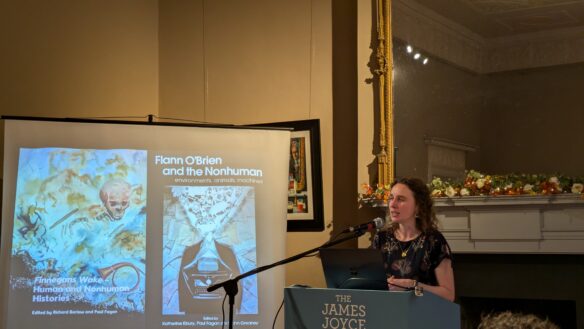
James Bacon is one of many whose works are published in two books launched today at the James Joyce Centre in Dublin. Flann O’Brien and the Nonhuman, from Cork University Press; edited by Katherine Ebury, Paul Fagan and John Greaney; and Finnegans Wake – Human and Nonhuman Histories from Edinburgh University Press; edited by Richard Barlow and Paul Fagan.
Irish writer Brian O’Nolan wrote under many pen names including Myles na gCopaleen and Flann O’Brien. James Bacon’s 7000-word chapter “For Steam Men, Myles na gCopaleen and Irish Rail” was published in the Flann O’Brien book, but the piece has had an interesting origin.
James Bacon
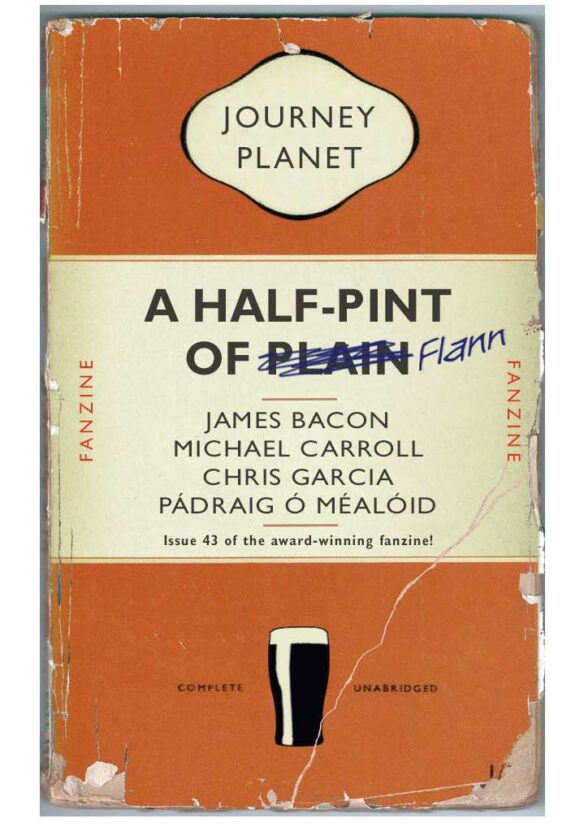
It started off in 2018 as “Off the Rails – Flann on Track,” an essay in in Journey Planet #43, the Flann O’Brien issue, co-edited with Christopher J Garcia, Michael Carroll, and Pádraig Ó Méalóid.
“From there, with encouragement from Pádraig and others, I took the step of expanding the piece, and developing it into a paper. Robert Cogger, a rail communications officer, David John Adams, a freight driver who also drove steam trains, both supported with contemporary and expert views of Flann O’Brien’s work.”
Work continued. O’Brien featured the railways in a variety of ways: the fictional with “John Duffy’s Brother,” where a clerk having a mental health moment takes solace in “becoming” a train, chuffing about the office; the partially fictional with “A Bash In the Tunnel,” which formed part of an editorial to a literary magazine, The Bell, when Myles na gCopaleen guest-edited a special issue on Joyce; again writing as Myles na gCopaleen, O’Brien’s satirical yet incisive reflection of reality through dozens of humorous articles for The Irish Times column, “An Cruiskeen Lawn,” which challenged the powers that be and advocated for the railways; to his script of TV comedy O’Dea’s your Man episode “Fresh Air,” set in a railway station signal box, featuring Jimmy O’Dea and David Kelly.
There is so much to draw upon. O’Brien wrote over 4000 columns for The Irish Times, in which he took the rail companies to task on a number of occasions, to such a degree that, at one stage, he raised the rail companies’ ire so much that a supplier demanded an apology from The Irish Times.
In 2019, James presented his paper “Off the rails: Flann an expert community advocate for rail transport” at Palimpsest: The V International Flann O’Brien Conference at University College Dublin. Before Covid, there had been a call for essays, and James was delighted when an expansion of his paper was welcomed.
“Researching during Covid was a personal relief to the realities of heading into Paddington to drive trains during a time of such fear. The isolation in the spring and early summer of 2020, allowed for much work, and like the trains, the post flowed as support came from many quarters. My writing grew, as I came to understand more as I engaged with a series of experts, including fellow train driver Noel Playfair of the NIR who drove steam trains for the RPSI and was the last person to drive the Slieve Gullion, a steam train which Myles na gCopaleen wrote about. Nelson Poots in the Railway Preservation Society of Ireland also proved hugely helpful, while the resources of the Irish Railway Record Society were made available thanks to Gerald Beesley and the loan of HCA Beaumont Archive materials from Johnathan Beaumont. It was a busy time.
“The expanded work was ginormous, and too much. Indeed an early draft exceeded 12,000 words. From this though, with the support of the patient editors, the work was edited down to about 7000 words for this publication, which I’m delighted to say has been well received so far.”
Paul Fagan at the lecternCatherine Ebury at the lecternMeg MacDonald, James’ Mom, James Bacon, and Marguerite SmithJames Joyce Center
The editors’ introduction notes:
“James Bacon explores O’Nolan’s interactions with trains and railways in his persona as the ‘steam man’ Myles na gCopaleen. As a working train driver himself, James demonstrates from a historicist and practitioner’s perspective how an appreciation of O’Nolan’s deep and broad knowledge of the railways, stations and institutions of Ireland – and, indeed, his professional-level technical, mechanical and operational understanding of and interest in the trains themselves – is crucial to understanding the specifics of his interconnected political, economic and ecological critiques of the Irish state. While previous critics have read the railway imagery in O’Nolan’s fiction in terms of literary allusion and metaphor, this essay historicises key columns from Cruiskeen Lawn in which O’Nolan’s real expertise in Irish rail is key to his engagement with a diversity of interconnected themes ranging from war and natural resources to language politics and modernisation. Whether presenting fantastic, cyborgian images of human-train hybrids or flaunting his local and insider knowledge to bolster his polemics in the daily paper, James shows us how O’Nolan’s interventions are always supported by a real and detailed knowledge of the underlying technical and operational details that shaped debate, as he promotes good practice and progression with evident affinity and respect for the machines themselves.”
“I keep laughing at my title,” says James, “as ‘The Steam Man’ is a method for Flann to either insert himself into the narrative as an expert, claiming footplate experience, or to create a humourous situation with the Steam Man, an archetypal older train fan, who is possibly an operator of old, but maybe just nerdy and needy. The Steam Man has a nugget of expertise but often lectures the Train Drivers annoyingly, and always knows best…and who is a piece of writing for, if not the author themselves.”
“There is an agility to how Flann uses language and monikers to suit the argument, and I think that could be a chapter on its own. But I laugh hard, because I think of the Steam Men in Fandom: a danger and concern to either powers that be or the community of hard working expert practitioners.”
“Thanks must go to Gerald Beesley, editor of the Irish Railway Record Society Journal, Paul McCann and Nigel Poots (sadly since passed) of the Railway Preservation Society, Jonathan Beaumont for access to the HCA Beaumont archive, and David John Adams for insight from his steam engine days. Much thanks also to Pádraig Ó Méalóid for continuous encouragement, assistance, other verbs and support. The essay is dedicated to: Robert Cogger, formerly of Railway Communications at Thameslink and Chiltern Railways, who departed for the final time December 2019; to Noel Playfair who passed away in 2023, leaving a huge gap in the cab and on the footplate of NIR and the RPSI; and to John Wyse Jackson of Zozimus Bookshop whom we, who love Myles, will miss. All of whom were generous with patience, their time and understanding, (“repeat back”) and helping me to gain a clear comprehension of challenging matters during a challenging time.”
Journey Planet continues to strive to bring new writing to a broader audience, and while James was in Dublin for the book launch, the final articles for a “LGBTQ+ and Comics” issue with co-editor David Ferguson were being finalized. The issue is due out next week.
James also conducted research at the National Library of Ireland on aspects relating to Bram Stoker’s Dracula, looking at early critique of the work and staying with the railway connection for a continually-expanding article by James entitled “Train Fiend” due to appear in the forthcoming Journey Planet issue on Dracula, due out on the 6th of November.
James’s chapter, “For Steam Men, Myles na gCopaleen and Irish Rail,” is available in Flann O’Brien and the Nonhuman from Cork University Press; edited by Katherine Ebury, Paul Fagan and John Greaney.
Journey Planet #44 “Flann O’Brien” is available here.