Last fall, Antonio Bricio, an engineering consultant who lives in Guadalajara, Mexico, finished a draft of his first novel, a science fiction thriller about a government conspiracy to bury the history of humanity’s first contact with alien refugees.
After querying 20 literary agents and getting a string of rejections, he spent several months furiously revising it in hopes of one day landing a publisher.
Now, Bricio worries that the already taxing process of getting a publishing deal as a debut author has become even more fraught. He fears that agents and publishers will avoid taking risks on unknown authors over concerns that they might have written the book using artificial intelligence.
The panic and paranoia over A.I.-generated books exploded last month, when a major publisher, Hachette, decided to cancel the release of a horror novel, “Shy Girl,” by Mia Ballard, in the United States over evidence suggesting that it had been partly produced by A.I. Hachette also pulled the book in the United Kingdom, where it released “Shy Girl” last year after Ballard initially self-published it.
When Bricio learned about the novel’s cancellation on social media, his stomach dropped. He said he does not use A.I. to write, except to occasionally translate a stray word or phrase from his native Spanish into English, in which he is also fluent, using the A.I. translation program DeepL. But he wondered what an A.I. detector would say about his work.
So he paid for a subscription to Originality.ai and uploaded a chapter of his novel. The detector was 100 percent confident that he had used A.I. in some way.
Bricio searched for the phrases that had tripped up the detector, deleted some sentences and reran it. This time, the program said it was 100 percent certain that a human had written it. Eventually, Bricio had a chat conversation with a customer service representative, who told him that if he received results that incorrectly flagged his work as A.I.-generated, he might need a different model of the program.
The back and forth only left Bricio more unsettled. The Originality.ai reports on his draft, which he shared with The Times, showed that adding or deleting even just a few sentences produced wildly different results.
“What if publishers or agents start running these A.I. tools on everybody?” Bricio said. “Everybody is going to walk on eggshells from now on.”…
Passengers forced to spend thousands of pounds to return to the UK after their EasyJet flight left without them said border control delays caused by the European Union’s new entry-exit system had been a “nightmare”.
More than 100 people missed their flight to Manchester from Milan’s Linate airport on Sunday while stuck in what the airline described as “unacceptable” passport control queues.
Some travellers reported vomiting and passing out as they tried to get through biometric and facial recognition checks rolled out under the new European Entry-Exit System (EES) on Friday.
Carol Boon said the experience was “just horrible”, while Max Hume said he had been forced to spend £1,800 to get home.
European airports and airlines said there had been significant disruption to their operations, with passengers facing long delays – in some cases missing flights – since the EU digital border control system became fully operational on Friday.
The new system obliges third-country nationals – including Britons – who enter the Schengen free travel zone to register biometric information, including facial scans and fingerprints.
Further checks take place when they leave.
According to ACI Europe, which represents airports, and A4E, which speaks for European airlines, initial reports have shown passenger waiting times of two-to-three hours at border control during peak times.
On one occasion, no-one had arrived at the departure gate at the time it was meant to close for a flight. Only 12 passengers had turned up 90 minutes later….
The California Science Center announced Monday that construction has been completed on its new Samuel Oschin Air & Space Center, bringing the highly anticipated expansion one step closer to its public debut.
The culmination of a master project plan adopted in 1993, the sleek 20-story, 200,000-square-foot new building rising over Exposition Park will nearly double the museum’s exhibit space and anchor a $450-million campaign to permanently house the retired space shuttle Endeavour….
… The Samuel Oschin Air & Space Center will be split into three galleries — air, space and shuttle — containing aerospace artifacts and hands-on exhibits demonstrating scientific principles.
At the heart of the new addition is Endeavour itself, displayed in a vertical “ready-to-launch” configuration that’s never been replicated with real hardware outside of a NASA or Air Force facility. The display includes rocket boosters from manufacturer Northrop Grumman and a massive external fuel tank from NASA…
… With several observation areas spanning the nearly 200-foot tall shuttle stack, Rudolph said the new installation will offer visitors “views that almost no one’s ever seen.”
A cutting-edge building design by architectural firm ZGF Architects contributes to that awe-inspiring experience with a 2,000-ton curved structural framework of diagonally intersecting steel beams called a diagrid, which eliminates interior columns and allows visitors unobstructed views of the shuttle stack.
The idea is that “you don’t have a sense there’s a building at all,” said Ted Hyman, partner at ZGF Architects. Instead, you’re meant to feel like you’re standing on a launch pad outside. The dimness of the shuttle gallery also assists in the immersive fantasy, both as an artistic choice and a practical one due to the shuttle’s sensitivity to light…
(5) IAN WATSON (April 20, 1943-April 13, 2026). Ian Watson died April 13 a week short of his 83rd birthday.
Ian Watson. Photo by Gamma.
The SF Encyclopedia says he began his career as a UK teacher and author lecturing in English in Tanzania (1965-1967) and Tokyo (1967-1970) before writing his first sf “Roof Garden Under Saturn” for New Worlds in 1969. His first SF novel, The Embedding: A Novel of Mind Control, appeared in 1973. Overall he published some 40 books, the most notable of which are The Jonah Kit (Gollancz 1975, winner of the British Science Fiction Award in 1978), The Embedding (a 1976 Nebula nominee, and second-place tie for the John W. Campbell Memorial Award 1974), and Miracle Visitors (Gollancz, 1978), with the latter two listed in David Pringle’s Science Fiction: The 100 Best Novels.
He won another British Fantasy Award in 2010 for the short story “The Beloved Time of Their Lives”, co-authored with Roberto Quaglia.
He was honored as a European Grand Master by the European SF Society in 2024.
Watson was also a prolific contributor to fanzines and convention publications going back to the Seventies. Ansible Editions collected fifty of those pieces in Watto’s Wisdom: Zine and Con Writing by Ian Watson last year (find it here). One highlight is his long and surreally comic memoir of working with Stanley Kubrick to develop Brian Aldiss’ story “Super-Toys Last All Summer Long” into the film script for the 2001 movie A.I.: Artificial Intelligence.
In the early 2000s Watson founded the Northampton Science Fiction Writers Group, which organized several SF conventions called Newcon (because they were new) and led to the setting up by fellow member and author Ian Whates of independent NewCon Press, which subsequently published among much else the first English edition of Ian´s erotic satire Orgasmachine,
For many years Ian lived in a tiny village in Northamptonshire, UK, but a return invitation to the Semana Negra in 2010 led to him relocating to Gijón in the north of Spain to live with translator Cristina Macía, whom he married in January 2013.
Ian Watson at 1987 Worldcon. Photo by and (c) Andrew Porter.
(6) SID KROFFT (1929-2026). Sid Krofft, who with his late brother Marty created and produced H.R. Pufnstuf and Land of the Lost (and the 2009 feature based on the latter) died April 10 in Los Angeles.
Sid and Marty Krofft began their careers producing children’s television with “H.R. Pufnstuf,” a live-action program about a boy (actor Jack Wild) in a fantastic land with a dragon for a friend (H.R. Pufnstuf, voiced by Lennie Weinrib) and a witch — Witchiepoo, played by Billie Hayes — for an enemy; as conceptualized, the show followed the interactions between human actors; actors in colorful, oversized costumes; and life-size puppets with enormous heads….
In 2007 TV Guide named “H.R. Pufnstuf” No. 27 on its list of the top cult shows ever….
After “H.R. Pufnstuf,” the brothers created the series “Lidsville,” involving hat people and starring Charles Nelson Reilly, and “The Bugaloos,” about winged bug people in a rock ‘n’ roll band in a magical forest who must contend with an enemy, Benita Bizarre, played by character actress Martha Raye.
Another show in the classic Krofft style was 1973’s “Sigmund and the Sea Monsters,” which starred child actors Johnny Whitaker and Scott Kolden and featured oversized puppets. Sigmund, played by little person Billy Barty…
…The brief series “The Lost Saucer,” starring Jim Nabors and Ruth Buzzi, and “Far Out Space Nuts,” starring Bob Denver and Chuck McCann, followed [in 1974]. The former series brought aliens to Earth; the latter followed two janitors accidentally launched into space.
“Electra Woman and Dyna Girl” (1976) progressively featured a female superhero (played by Deidre Hall) and her female sidekick (Judy Strangis)….
(7) TODAY’S BIRTHDAY.
[Written by Cat Eldridge.]
April 13, 1950 — Ron Perlman, 76.
Hellboy of course as we all well know. I was surprised that the Hellboy movie wasn’t nominated for a Hugo but Hellboy II: The Golden Army was at Anticipation. Both are excellent in different ways.
Ron Perlman in 2022. Photo by Miguel Discart.
Ron Perlman was in my opinion the perfect performer to be Hellboy. Not only did he have the physicality to pull off the role but he had the presence to pull off that role even though he was under Harbour’s makeup prosthetics to the point that he had to express himself by overcoming the limitations that those prosthetics placed upon his natural facial expressions. And he did that magnificently.
Of course his voice was a major aspect of it. That deep, resonating voice. Perfect for a demon that liked a lot of cats. He used that voice later when there were two Hellboy animated films and a short, all quite well done.
Everything about him worked here. The outfit, the gun, the cigar, his backstory. Yes, I know it all came from Mike Mignola but getting it to the screen that way was amazing, it really was. And I have read all of the all Hellboy stories up to the last decade when it stopped really being interesting though I did keep reading the Hellboy and the B.P.R.D. series as I think that really fantastic.
The movie was likewise fantastic as I thought it was just perfect with everything being stellar. Well almost. I wasn’t thrilled by the Tom Manning character but I’m fairly sure that I wasn’t supposed to be. So I can’t count how many times I’ve seen it, at least a half dozen now.
Hellboy II: The Golden Army was excellent though a quieter film if that’s the right word for it. The absolute highlight here is the spectacular Goblin Market. I’ve not looked to see but is this based off a particular Mignola graphic novel?
So now for other genre work. I’m only including that where he’s in makeup as I’ll be including images of him in each of those makeups.
He was in The Island of Doctor Moreau film of the same name as the story by H. G. Wells. His character was a juicy role indeed, the Sayer of the Law, a blind sheep/goat/human hybrid who is the priest figure among the hybrids.
He’s Deiter Rheinhart, a pureblood vampire and a member of the Bloodpack, a group of vampires specially trained by the House of Damaskinos to hunt Blade in Blade II. Need I say he comes to a bad end?
He’s the Reman Viceroy in Star Trek: Nemesis. Reman Viceroy was the title of Romulan Praetor Shinzon’s Reman adviser, Vkruk.
And of course, there’s the beloved by many Vincent in the Beauty and the Beast series. Loved the series, wasn’t at all fond of the way that they wrapped it up.
Reid Wiseman had one last decision to make before leaving his spacecraft post-splashdown: leave something behind in accordance with NASA’s post-splashdown checklist, or not?
Reid Wiseman, the NASA Artemis 2 commander, was supposed to leave a little plushie moon toy — called Rise — for later retrieval from his Integrity Orion spacecraft. But after 10 days floating alongside the mascot to the moon and back again, Wiseman had a different thought about that procedure.
“I was supposed to leave Rise in Integrity … but that was not something I was going to do,” Wiseman wrote on X on Saturday (April 11).
Officially, Rise is a zero-gravity indicator created by Lucas Ye, a third grader from California. It’s a mini-moon, with an Earth-colored cap brimmed with stars. Inside the little toy are over 5 million names on an SD card, submitted by folks around the world looking to fly their monikers to the moon….
…Nasa’s entire budget – everything it takes to send human beings beyond Earth – is $24.4bn. A rounding error beside the $1.5tn proposed for defense.
And yet.
Victor Glover, the first Black man to travel into deep space, floated to the window and watched the planet go small:
“In all of this emptiness – this is a whole bunch of nothing, this thing we call the universe – you have this oasis, this beautiful place that we get to exist together.”
Christina Koch pressed her face to the glass beside him, the first woman to travel around the moon, and the two of them made hearts with their hands, Earth burning blue and alone behind the window.
When asked to describe the mission in a single word, she said: “humility”. Then: “We would never be here if it weren’t for so many people who came before us, starting with Neil Armstrong, Katherine Johnson, civil rights movement leaders, everyone who worked on this spacecraft before us.” Katherine Johnson: the mathematician whose calculations got Apollo there, whose name the credits left out until we were forced to remember.
Reid Wiseman watched the whole globe fill his window, Africa, Europe, the emerald northern lights curling at the edges. “It paused all four of us in our tracks.”
Jeremy Hansen, breaking the distance record Jim Lovell’s crippled Apollo 13 had held for 56 years, asked mission control if the crew could name something.
“We lost a loved one,” he said, his voice breaking. “Her name was Carroll. The spouse of Reid, the mother of Katie and Ellie.” He pointed to a bright spot on the surface. “A bright spot on the Moon. We would like to call it Carroll.”
They held each other for a long time after that.
A bright spot on the moon, visible to her children, bears her name now. It will outlast all of us.
And then Koch, crossing into the moon’s gravitational pull at 12.37 in the morning, radioed down:
“We are now falling to the moon rather than rising away from Earth.”
Four years ago, I wrote about the James Webb Space Telescope unfurling into space – how it felt to watch human beings aim their finest inventions not at each other, but outward, into the oldest questions of our origins, with nothing behind it but awe.
Webb looked out. Artemis carried us there.
Four bodies, breathing, grieving, pressing their faces to the glass of a spacecraft they named Integrity.
Apollo came first, planted flags in her territory – bleached white by 50 years of radiation, indistinguishable now from surrender.
Now, Artemis: the huntress, lunar, wild, sovereign, who protected the untamed and punished those who violated the sacred. In the Chinese tradition, Chang’e stole immortality and fled to the Moon. She lives there still.
Hansen carried the Seven Sacred Teachings of the Anishinaabe people to the moon on his mission patch: respect, love, courage, humility, honesty, wisdom, truth – created by Henry Guimond of Sagkeeng First Nation, who never imagined his work would travel this far.
Carl Sagan wrote: “We are made of star-stuff. We are a way for the cosmos to know itself.”
Not observers. Not inheritors. Something stranger and more fragile than that….
… For 10 days, Reid Wiseman, Victor Glover, Christina Koch and Jeremy Hansen have sought to make real NASA’s credo of doing near-impossible things. They have gone farther into deep space than any other people. They have seen parts of the lunar far side never viewed by human eyes. They witnessed a 53-minute solar eclipse. They even prompted President Trump to ask if he could have their autographs.
The astronauts have showed us many things during their journey: their love for one another and humanity as a whole; their awe at the outcome of their explorations; their feeling of “moon joy.”
Here is what their mission looked like from their trip to the launchpad through their journey around the moon and back.
(12) TITLE INSPIRATION. Daniel Dern points to the Ella Fitzgerald version of Gershwin’s “Nice Work If You Can Get It”.
[Thanks to Andrew Porter, John King Tarpinian, Cat Eldridge, SF Concatenation’s Jonathan Cowie, Mark Roth-Whitworth, Kathy Sullivan, Steven French, and Mike Kennedy for some of these stories. Title credit belongs to File 770 contributing editor of the day Daniel Dern.]
Our recommendations are compiled annually by the Locus reviewers, editors, and columnists; outside reviewers; and other professionals and well-known critics of genre fiction and non-fiction. This year we looked at over 1,000 titles between short and long fiction….
…This year we had recommendations from Liza Groen Trombi, reviews editor Jonathan Strahan; Locus reviewers Liz Bourke, Jake Casella Brookins, Alex Brown, Paul Di Filippo, Paula Guran, Niall Harrison, Rich Horton, Paul Kincaid, Russell Letson, Archita Mittra, Ian Mond, Colleen Mondor, Abigail Nussbaum, Alexandra Pierce, Wole Talabi, Gary K. Wolfe, and Alvaro Zinos-Amaro; staffers Bob Blough, Tim Melody Pratt, and Eleanor Trombla; and outside critics James Bradley, Cheryl Morgan, and Graham Sleight. Input for the non-fiction section also came from Eugen Bacon and Farah Mendlesohn. The art book section had advice from Arnie Fenner, Karen Haber, and Locus senior editor Francesca Myman. Short fiction recommendations added in anthologists and reviewers John Joseph Adams, Sean Dowie, Maria Haskins, Allan Kaster, Charles Payseur, Nisi Shawl, Bogi Takács, and A.C. Wise.
This year we are adding a new category for Translated Novels! For those recommendations we had input and assistance from Gautam Bhatia, Rachel Cordasco, Jukka Halme, Cristina Jurado, Roseanna Pendlebury, Carlos Arturo Serrano, Alex Schvartsman, and Jared Shurin.
On the list are –
31 science fiction novels, 27 fantasy novels, 14 horror novels, 14 young adult novels, 13 first novels, and 19 translated novels
20 collections, 18 anthologies
15 nonfiction works, 20 art books
31 novellas, 17 novelettes, and 63 short stories.
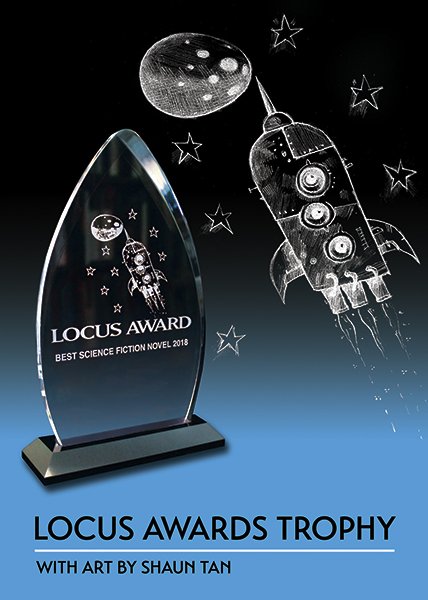
PARTICIPATE IN THE POLL. The 2025 Poll & Survey is now accepting votes from all to decide the winners of the Locus Awards. The poll closes April 15. The Locus Awards will be presented on May 30 during the Bay Area Book Festival.
(1) SEATTLE WORLDCON 2025 CHAIR APOLOGIZES. Kathy Bond today posted an “Apology and Response From Chair” at the Seattle Worldcon 2025 website to address the brewing controversy about the committee using ChatGPT as part of its process for screening program participants.
(2) 2025 LOCUS AWARDS SHORTLISTS. The 2025 Locus Awards finalists have been posted at Locus Online. See the full list at the link. The Locus Awards winners will be announced June 21 during the in-person Locus Awards Ceremony, held in Oakland, California.
(3) PUPPIES AIN’T WHAT THEY USTA BE. In “Locus Slate Shenanigan Update” Camestros Felapton scores Jon Del Arroz’ efforts to push his picks onto the Locus Awards shortlist.
Early in April I posted about an attempt by Jon Del Arroz/Fandom Pulse (and others) to game the Locus voting with a last minute slate. So how did the JDA slate perform?
OK, I have to do some complex data crunching here. Well, my provisional results come out at a whopping 0% of JDA slated works made it….
(4) 2025 EDGAR AWARDS. Mystery Writers of America announced the winners of the 2025 Edgar Awards on May 1.
Publishers Weekly reports the ceremony was marred by the use of AI images, and this is being compared with the Worldcon’s own LLM kerfuffle.
An opening video, surveying treatments of the genre on the big and small screen, was narrated by a creepy AI version of Humphrey Bogart, complete with imperfect lip-syncing, later followed by one featuring an even creepier, black cat-holding, artificially-generated Edgar Allan Poe.
(5) ELRIC’S EARS: THE DEFINITIVE ANSWER. Cora Buhlert has written an article about Elric of Melniboné for the Seattle Yesterday, Today and Tomorrow Blog, which got responses from both Michael Whelan and Michael Moorcock, settling the question whether Elric has pointed ears or not. “Fantastic Fiction: Elric of Melniboné: Tortured Elf Emperor with a Cursed Sword”. See their comments at the link.
…Elric was born out of a conversation between John Carnell, editor of the British magazine Science Fantasy, and the young writer Michael Moorcock, wherein both proclaimed their love for the sort of fantasy adventure stories—soon to be called “sword and sorcery”—that had been published in the pulp magazine Weird Tales some thirty years earlier but were considered hopelessly passé by the early 1960s. Carnell remarked that he would be open to publishing “that Conan stuff,” so Moorcock wrote The Dreaming City, the first Elric story, which appeared in the June 1961 issue of Science Fantasy…
…“I think everything that’s in the book is in the show basically,” explained Paul Weitz. “We early on got in touch with Martha Wells kind of as fans and, so there are things that are added to the story, sort of like filling in the cracks, but anytime that we had an idea like that, we would call up Martha and say, ‘Hey, here’s what we’re thinking of, what do you think?’ And she’d either say, ‘Oh, that’s a cool idea’ or ‘Well, maybe think about this instead. That was a huge, huge relief.
“I think that part of the thing for us was never feeling like we were like we were padding stuff,” he continued as he explained why they made the changes they did….
…This year our judges received 112 eligible submissions from 49 UK publishing imprints and independent authors.
If you’re interested in how this compares to previous years, you can see past lists and analysis here: clarkeaward.medium.com
The TLDR though is this is pretty much a Goldilocks Zone year. Not the highest ever numbers received, but not worryingly low, and more on par with where we’ve landed in terms of recent submissions history for both books received and publishers entering.
A caveat as always about our terminology: this is a simple list of submissions of eligible books received, not a ‘long-list’ or other form of juried selection, but simply those books sent to our judges for them to consider as potential future Arthur C. Clarke science fiction book of the year winners….
(8) MEMORY LANE.
[Written by Paul Weimer.]
Iron Man film (2008)
By Paul Weimer: “I am Iron Man”
Although the Hulk movie preceded it, Iron Man started the Marvel Cinematic Universe, and for good or ill, the modern age of superhero movies. I can’t claim to know that was going to happen at the time–but I was excited. My movie-watching friend Mike, although well versed in horror and some comics, had no idea who Iron Man was. He had never read any of his comics and didn’t know his deal. So sitting in the movie theater with him, previews rolling, I explained Iron Man’s story (as I had gotten it fifteen years earlier, first). He was fascinated, I sold him on the idea that although Iron Man was maybe C-Tier (compared to Spidey, and Hulk and other high well known Marvel Superheroes), this could be fun.
And then we settled in to watch.
Shorn of the need to set up any mythology (although it effortlessly does), future movies, or refer to previous continuity (except for the credit cookie scene with Fury), Iron Man I is still in my top tier of Marvel movies. The story is straightforward enough, and Robert Downey Jr. (who was still somewhat damaged goods, remember) redeemed his entire career playing Tony Stark. Having read the comics, when I saw Obadiah Stane show up, I realized, but didn’t tell my movie going partner, just what was in store.
“Icing problem?”
“You might want to look into it.”
Favreau’s direction, Matthew Libatique’s cinematography are excellent in use of color, lighting and imagery.
I think that the real best relationship in this movie is not between Downey and Paltrow (although her Pepper Potts is every inch what is needed for the role) but between Downey and Bettany (who does the voice of JARVIS). Bettany once again (like in Master and Commander and A Knight’s Tale) plays the second part of a double act to more well known actor with charm, humor and a lot of fun. Forget Vision and Scarlet Witch (sorry Elisabeth Olsen), the Iron Man/JARVIS is where it’s at. Their sometimes acidic and always funny relationship is what makes the beats of the movie really sing.
Just writing this piece has the Black Sabbath song running through my head.
And hey, this is the movie that launched a movie franchise…and at the same time, in the world of comics, catapulted Iron Man to A-Tier.
When, movies later, Downey says “I am Iron Man” and does his snap and defeats Thanos at the cost of his own life, that was all originally set up and grounded from the original Iron Man movie.
(10) ARCHIPELACON 2 IS DRAWING NEAR. Finland’s national convention and this year’s Eurocon, Archipelacon 2, The Nordic SF and Fantasy Convention, announced today over 700 memberships have been sold, out of a total maximum of 1 000.
The convention will take place in Mariehamn, Åland on 26-29 June, at the Alandica Culture & Congress Centre. The second Archipelacon is a follow-up to the now legendary first edition, which was held in the same venue in 2015.
We have a stellar lineup of Guests of Honour: Ann VanderMeer, Jeff VanderMeer, Mats Strandberg, and Emmi Itäranta. For full presentations please visit our website https://archipelacon.org/guests-of-honour/
Preparations for the event are in full swing. Last minute programme proposals can be submitted via the programme form, but please hurry if you have suggestions. The form can be found here.
The final programme will be published in early June.
We are also looking for volunteers. If you are interested in making Archipelacon 2 happen, please sign up on our website at https://archipelacon.org/volunteer/
Archipelacon 2 is financed by sales of memberships and T-shirts, vendor table rentals, as well as grants. This year’s event has received grants from PAF, Suomen Kulttuurirahasto, and Svenska Kulturfonden. We thank our sponsors for their generous support!
The Psyche spacecraft launched nearly two years ago and is currently on its way to rendezvous with a unique asteroid in an effort to understand the origins of Earth. Although it’s still a few years away from orbiting the asteroid, which bears the same name, the Psyche mission has run into an issue with its propulsion system that forced it to power off its thrusters.
NASA engineers with the Psyche mission are investigating the root cause of a recent decrease in fuel pressure in the spacecraft’s propulsion system, an issue that needs to be resolved before mid-June so that it doesn’t affect the mission’s trajectory. “The mission team has chosen to defer thrusting while engineers work to understand the pressure decrease,” NASA wrote in an update.
Psyche launched in October 2023, beginning a 2.2 billion-mile journey to a metal-rich asteroid located in the main belt. The spacecraft began firing its thrusters in May 2024, using a solar electric propulsion system that relies on solar energy to generate power for four electric thrusters. On April 1, the spacecraft detected a pressure drop in the line that delivers xenon gas to the thrusters, which went from 36 pounds per square inch (psi) to about 26 psi, according to NASA. In response to the sudden decrease, the spacecraft automatically powered off its thrusters…
“Let’s do the time warp again!” This year marks the 50th anniversary of the musical film “The Rocky Horror Picture Show.” To celebrate the occasion, a newly restored and remastered version of “The Rocky Horror Picture Show” will be let loose in 4K Ultra HD, along with the debut of a new anniversary logo.
Audiences were first introduced to the movie in 1975 and it quickly became a cult classic. It’s based on the musical play by Richard O’Brien, and has continued to grow with late-night screenings, fan costumes, and has created a unique moviegoing experience with dance parties. To this day, “The Rocky Horror Picture Show” still makes history as the longest-running theatrical release of all time.
The Walt Disney Studios Restoration team oversaw the 10-month project to digitally scan and preserve the film.
[Thanks to Andrew Porter, John King Tarpinian, Chris Barkley, Nina Törnudd,Cat Eldridge, SF Concatenation’s Jonathan Cowie, Mark Roth-Whitworth, Steven French, Kathy Sullivan, Teddy Harvia, and Mike Kennedy for some of these stories. Title credit belongs to File 770 contributing editor of the day Mark.]
The Locus Science Fiction Foundation today announced the top ten finalists in each category of the 2024 Locus Awards, chosen by voting on an open public ballot.
The Locus Awards winners will be announced June 22, 2024, during the in-person Locus Awards Ceremony in Oakland, California with MC Henry Lien and special guest Connie Willis.
The top ten finalists in each category are:
SCIENCE FICTION NOVEL
The Jinn-Bot of Shantiport, Samit Basu (Tordotcom)
A Fire Born of Exile, Aliette de Bodard (Gollancz; JAB Books)
Red Team Blues, Cory Doctorow (Tor; Ad Astra)
Furious Heaven, Kate Elliott (Ad Astra; Tor)
Translation State, Ann Leckie (Orbit US; Orbit UK)
The Terraformers, Annalee Newitz (Tor; Orbit UK)
Starter Villain, John Scalzi (Tor; Tor UK)
Lords of Uncreation, Adrian Tchaikovsky (Orbit US; Tor UK)
System Collapse, Martha Wells (Tordotcom)
The Road to Roswell, Connie Willis (Del Rey)
FANTASY NOVEL
To Shape a Dragon’s Breath, Moniquill Blackgoose (Del Rey)
The Best Science Fiction of the Year: Volume 7, Neil Clarke, ed. (Night Shade)
Christmas and Other Horrors, Ellen Datlow, ed. (Titan UK)
The Year’s Best African Speculative Fiction (2022), Oghenechovwe Donald Ekpeki & Eugen Bacon & Milton Davis, eds. (Caezic)
Never Whistle at Night, Shane Hawk & Theodore C. Van Alst Jr., eds. (Vintage)
The Best American Science Fiction and Fantasy 2023, R.F. Kuang & John Joseph Adams, eds. (Mariner)
Out There Screaming, Jordan Peele & John Joseph Adams, eds. (Random House; Picador)
New Suns 2, Nisi Shawl, ed. (Solaris UK)
The Book of Witches, Jonathan Strahan, ed. (Harper Voyager US; Harper Voyager UK)
Mothersound: The Sauútiverse Anthology, Wole Talabi, ed. (Android)
The Best of World SF: Volume 3, Lavie Tidhar, ed. (Ad Astra)
COLLECTION
The Essential Peter S. Beagle, Volumes 1 & 2, Peter S. Beagle (Tachyon)
Zen and the Art of Starship Maintenance and Other Stories, Tobias S. Buckell (Apex)
The Wishing Pool and Other Stories, Tananarive Due (Akashic)
White Cat, Black Dog, Kelly Link (Random House; Ad Astra)
No One Will Come Back For Us, Premee Mohamed (Undertow)
Jackal, Jackal, Tobi Ogundiran (Undertow)
Skin Thief, Suzan Palumbo (Neon Hemlock)
Lost Places, Sarah Pinsker (Small Beer)
The Best of Michael Swanwick, Volume Two, Michael Swanwick (Subterranean)
The Best of Catherynne M. Valente, Volume One, Catherynne M. Valente (Subterranean)
MAGAZINE
Analog
Asimov’s
Beneath Ceaseless Skies
Clarkesworld
F&SF
FIYAH
khōréō
Strange Horizons
Tor.com
Uncanny
PUBLISHER
Angry Robot
DAW
Gollancz
Neon Hemlock
Orbit
Small Beer
Subterranean
Tachyon
Tor
Tordotcom
EDITOR
Neil Clarke
Ellen Datlow
Oghenechovwe Donald Ekpeki
Arley Sorg & Christie Yant
Jonathan Strahan
Lynne M. Thomas & Michael Damian Thomas
Sheree Renée Thomas
E. Catherine Tobler
Ann & Jeff VanderMeer
Sheila Williams
ARTIST
Brom
Rovina Cai
Kinuko Y. Craft
Julie Dillon
Bob Eggleton
Abigail Larson
John Picacio
Charles Vess
Michael Whelan
Alyssa Winans
NON-FICTION
The Fiction Writer’s Guide to Alternate History, Jack Dann (Bloomsbury Academic)
42: The Wildly Improbable Ideas of Douglas Adams, Kevin Jon Davies, ed. (Unbound UK)
Wish I Was Here: An Anti-Memoir, M. John Harrison (Serpent’s Tail; Saga 2024)
All These Worlds, Niall Harrison (Briardene)
101 Horror Books to Read Before You’re Murdered, Sadie Hartmann (Page Street Publishing)
Space Crone, Ursula K. Le Guin (Silver)
Ex Marginalia: Essays on Writing Speculative Fiction by Persons of Color, Chinelo Onwualu, ed. (Hydra House Books)
A Traveller in Time: The Critical Practice of Maureen Kincaid Speller, Maureen Kincaid Speller (Academia Lunare)
Owning the Unknown: A Science Fiction Writer Explores Atheism, Agnosticism, and the Idea of God, Robert Charles Wilson (Pitchstone)
Being Michael Swanwick, Alvaro Zinos-Amaro (Fairwood)
ILLUSTRATED AND ART BOOK
The Culture: The Drawings, Iain M. Banks (Orbit US; Orbit UK)
Home to Stay! The Complete Ray Bradbury EC Stories, Ray Bradbury, adapted by Al Feldstein, art by Jack Davis, Frank Frazetta, Al Williamson, Wallace Wood, et al. (Fantagraphics)
The Pen & Ink Drawings of Tony DiTerlizzi, Tony DiTerlizzi (self-published)
Reflected glory isn’t enough – maybe it was never enough. Now some writers are demanding an explicit share of the glory when anthologies win awards.
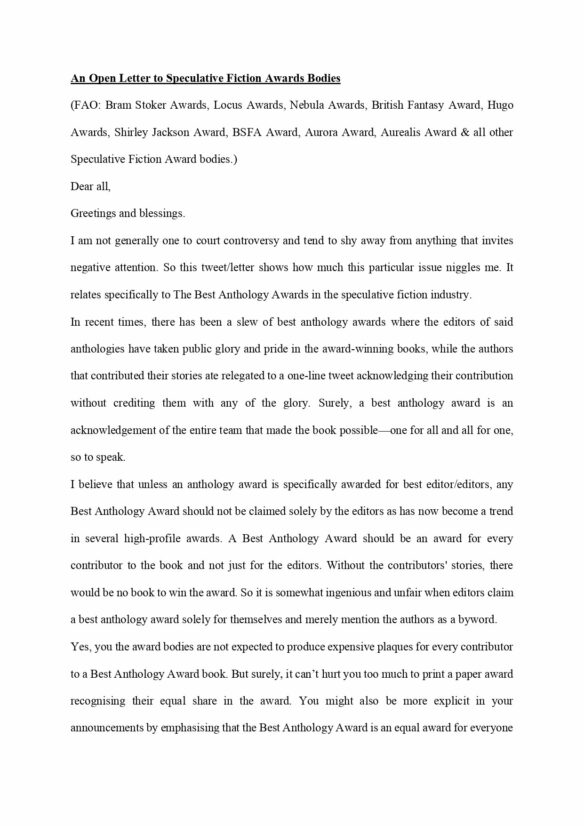
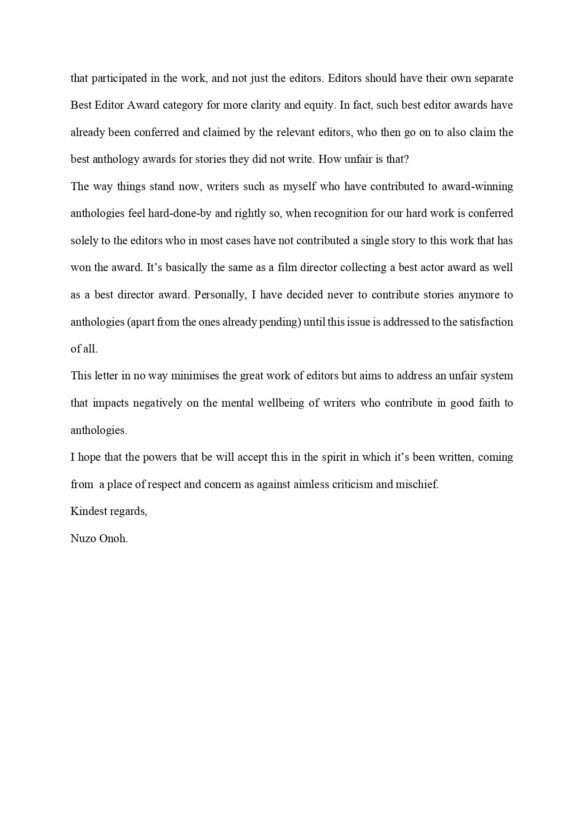
Nuzo Onoh, a Nigerian-British writer of Igbo descent popularly known as the “Queen of African Horror”, wrote in an open letter posted immediately after the Locus Awards were announced last weekend: “A Best Anthology Award should be an award for every contributor to the book and not just for the editors.” Her call is gaining traction.
What supporters are pressing for is that everyone with a story in the anthology be treated as sharing any Best Anthology award. “Pins or certificates and names included should be happening for all award-winning anthologies. The editor steers the ship, but writers should be publicly credited,” tweeted Dan Coxon, a 2022 British Fantasy Award winner.
A few of the groups with Best Anthology awards have already responded.
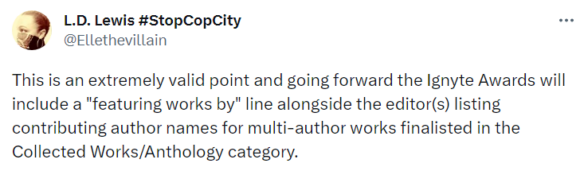
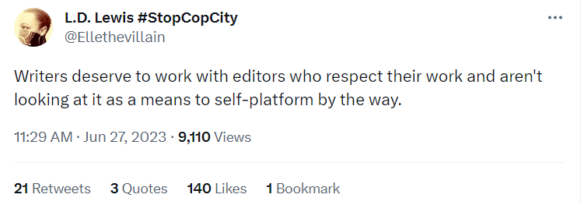
L. D. Lewis of the Ignyte Awards:
The Ignyte Awards now display “Featuring works by” information for the 2023 finalists, having recently added the names of writers to Best Anthology/Collected Works titles that previously showed only the names of the editors. L. D. Lewis said:
Nuzo Onoh has also heard from the Locus Award people:
So guys, today's email was to Locus awards. I've just received a reply from them-"Dear Nuzo, Thank you for your thoughtful letter. I will take this all under consideration and see what changes we can make to recognize the contributors more equally." I think this is very positive.
— Nuzo Onoh "Queen of African Horror" (@NuzoOnoh) June 28, 2023
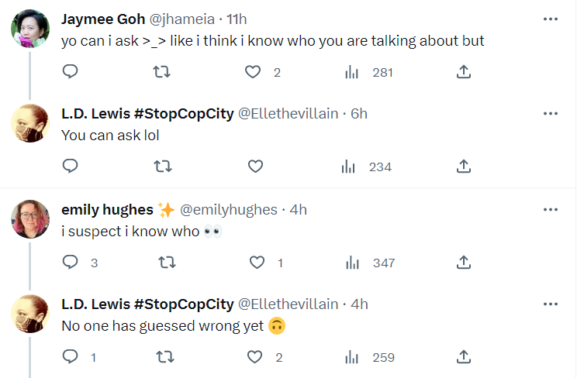
There has been much behind-the-scenes discussion that this represents a backlash against one or more editors of recent award-winning anthologies. For example:
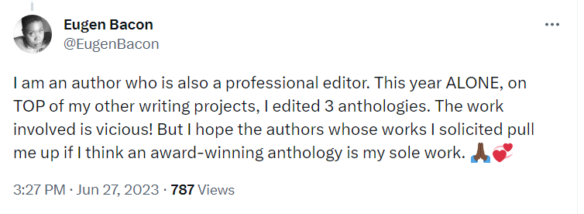
Eugen Bacon said:
However, Nuzo Onoh today tweeted:
Dear editors, pls know that our push to get contributors added in best anthology awards is not an attack on you or your integrity. It's a quest for equality fairness & recognition & requires our joint efforts. Pls come on board & show your authors that you support & value them????????
— Nuzo Onoh "Queen of African Horror" (@NuzoOnoh) June 28, 2023
Although neither the Hugos, the Nebulas, nor the Seiun Awards have a Best Anthology category, many other major international sff awards have added one over the years.
The Locus Awards have had an Anthology category of some stripe since the second year of existence, 1972. (For the first several years it was restricted to Original Anthologies.) The World Fantasy Awards added a Best Anthology category in 1988. The Horror Writers Association and the British Fantasy Society each added a Best Anthology category to (respectively) the Bram Stoker Awards and British Fantasy Awards in 1999. In Australia, the Ditmar Awards given at the national convention have honored Collected Work since 2000, which encompasses anthologies and single-author collections, and the Aurealis Awards added a Best Anthology category in 2009.
The Hugos recognize fiction editors themselves, in a category created in 1973 and split in 2007 into two categories, for editing Long Form and Short Form works.