Papers by Indian Journal of Archaeology
National Trust For Promotion of Knowledge: Indian Journal of Archaeology, 2021
This article by Shamoon Ahmad and Amit Jain gives the details of the coin hoard containing 18 coi... more This article by Shamoon Ahmad and Amit Jain gives the details of the coin hoard containing 18 coins found from village Khedi Khushnaam district Shamli U.P., and presently kept in Shahjad Rai Research Institute. The examination confirms that all coins are silver tankas belonging to the reign of Alā-ud-dīn Muhammad Shāh of Khiljī dynasty of Delhi Sultanate who ruled from 1296 A.D. to 1316 A.D. Out of 18 coins, 8 coins were issued from Hazrat Delhi and 7 coins were issued from Dār-ul-Islām, mint of 3 coins could not be deciphered.
National Trust For Promotion of Knowledge: Indian Journal of Archaeology, 2021
This article by Dhanushka Kumara Jayaratne examines the original location of the Wāyā Ulpatha (Co... more This article by Dhanushka Kumara Jayaratne examines the original location of the Wāyā Ulpatha (Commonly known as Viyaulpatha) pillar inscription in Anuradhapura District of Sri Lanka. At present, this pillar inscription is located in the Wāyā Ulpatha temple premises and it has been moved from its earlier location several times. Recent archaeological explorations conducted in this region uncovered evidences from many settlements including some ancient monastic sites. The methodology of the present work is in fivefold: literature and cartographical review, field survey, personal communications and remote sensing data. The purpose of this study was to identify the physical and spatial relationships between the pillar inscriptions and to gather newly discovered archaeological evidences.
National Trust For Promotion of Knowledge: Indian Journal of Archaeology, 2021
This article by Vijay Kumar, Alok Ranjan & Swami Virjanand Daivkarni gives the details of 1674 se... more This article by Vijay Kumar, Alok Ranjan & Swami Virjanand Daivkarni gives the details of 1674 seals & sealings collected from the sites of Agroha, Ahichhatra, Jaunpur, Kaushambi, Lucknow, Mohanbadi, Naurangabad, Sugha and Sunet etc. kept at Haryana State Archaeological Museum, Gurukul Jhajjar District Jhajjar Haryana. The highlights of this collections are Greek Sealings found from different sites of North India, Indo-Parthian Sealing from Kaushambi, Sealings of commercial Settlements, a sealing with the image of Ganesh, sealings of Shrenis, the Banker’s sealing, Vrishani sealings, sealings of Kumaramatya & Dandanayak, sealing with legend Dharmorakśatirakśitah, the rise of local Gurus, the sealings of Padmanabha, the sealings with legend siddhirastu, Dharmakartavyam, Jitam Bhagwata and datvyam bhotvyam, sealings of Shalabhanjika, sealing of combined cult of Shiva & Vishnu and Royal Sealings of Panchala, Magha & Yaudheya kings.
National Trust For Promotion of Knowledge: Indian Journal of Archaeology, 2021
This article by Dr. Nilkamal Singha and Dr. Oinam Ranjit Singh is about ever-changing landscape o... more This article by Dr. Nilkamal Singha and Dr. Oinam Ranjit Singh is about ever-changing landscape of Assam. The landscape has undergone considerable changes since human set foot in the region. These changes initially were insignificant but after the introduction of agriculture, these have become significant and visible. There are other factors responsible for shaping and reshaping of landscape of Assam up to 1200 A.D. The present paper examines various periods from prehistoric to early medieval. It also examines the aspects like Agriculture specially rice cultivation, migration & religion and their role in shaping of the landscape of Assam.
National Trust For Promotion of Knowledge: Indian Journal of Archaeology, 2021
This article by Ubaid Ahmad Dar explores the initial findings that could be utilized to link the ... more This article by Ubaid Ahmad Dar explores the initial findings that could be utilized to link the still persistent crucial cultural elements of the Bakarwal pastoral tribe based in Kashmir Himalayas with those of excavated Neolithic sites of Kashmir valley i.e. Burzahom Srinagar, Gufkral Anantnag and Kanispura J & K, through the study of continuity and change. The aim is to draw a general comparative analogy between the two cultural periods and give groundwork for the forthcoming Ethnoarchaeological study in the region.
National Trust For Promotion of Knowledge: Indian Journal of Archaeology, 2021
This article by Shubhrakanti Baul gives the result of archaeological explorations in the Dulung R... more This article by Shubhrakanti Baul gives the result of archaeological explorations in the Dulung River valley of the Subarnarekha basin, West Bengal in eastern India. Plenty of lithic implement has been found from the drainage basin of the river. The exploration has been conducted in different phases over the past two years. Implements are from twenty-eight different locations of the valley. These sites have yielded Lower Palaeolithic tools like hand-axes, choppers, bifacial cutting tools, cleavers, scrapers, and cores of and microliths like lunates, scrapers, microblade and debitage. Most of the sites are located near the paleochannels of the Dulung river and in the vicinity of rivers. Palaeolithic tools are mostly found on the ferricrete surface exposed after the erosion of the topmost latosol layer, sometimes tools have been found stuck in the ferricrete layer. Microliths have been found over loosely ferruginous surfaces and also at the junctions of the ferricrete layer and latosol layer.
National Trust For Promotion of Knowledge: Indian Journal of Archaeology, Jan 2022
This article by Vijay Kumar, Alok Ranjan & Sanjai Agarwal is the catalogue of 331 seals & sealing... more This article by Vijay Kumar, Alok Ranjan & Sanjai Agarwal is the catalogue of 331 seals & sealings kept at kept at Government Museum Mathura district Mathura U.P., Patna Museum & Bihar Museum district Patna Bihar and Sanjai Agarwal’s Collection Bareilly district Bareilly U.P. The votive sealings with Pratityasamutpadagatha is an important feature of this article.
National Trust For Promotion of Knowledge: Indian Journal of Archaeology, Jan 2022
This article by Dr. Sujeet Nayan & Moirangthem Jackson Singh gives the details of recent archaeol... more This article by Dr. Sujeet Nayan & Moirangthem Jackson Singh gives the details of recent archaeological investigations in Mizoram and produce ample evidence that megaliths are widely scattered in various parts of the state. The archaeological site Vangchhia which is believed to be the point from where the Mizos entered their present homeland. It occupies a special place in the megalithic map of the state. Megaliths such as richly carved menhirs and rock art in the form of petroglyphs are profusely found on the site. Till date, the Mizos, like many other tribal groups in northeast India have a living megalithic tradition. This paper makes an attempt to throw light on these antiquarian remains and how it inter-relates with the past and present Mizo society. A scientific study of these material remains gives vital clues about the past Mizo society. During recent exploration works, the structural remains similar to Vangchhia have been discovered in other parts of the region which suggests a close cultural resemblance. Erecting megaliths is one of the striking features associated with the Mizo culture and tradition. These megaliths have different types and functionalities. These served as memorials to the dead as well as to the living. The characteristic features of megaliths in Mizoram include the raising of upright stones, alignments, table-stones, cairns etc.
National Trust For Promotion of Knowledge: Indian Journal of Archaeology, Jan 2022
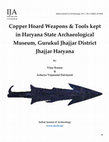
This article by Vijay Kumar & Amit Rai Jain is the catalogue of copper hoard weapons, tools & orn... more This article by Vijay Kumar & Amit Rai Jain is the catalogue of copper hoard weapons, tools & ornaments kept in in Shahjad Rai Research Institute, Baraut district Baghpat U.P. This collection includes celts, flat celts, harpoons, shouldered axes, swords, antennae sword, chisels, Khanti, leather hole cutter, bangle, anthropomorphic figure and a ring.
National Trust For Promotion of Knowledge: Indian Journal of Archaeology, Jan 2022
Megalithic Culture indicates ‘huge stone burial culture’ which are the predominant archaeological... more Megalithic Culture indicates ‘huge stone burial culture’ which are the predominant archaeological remains of the Iron Age that represents a formative stage of the history of Kerala in general and Wayanad district in particular. Due to the unavailability of habitational evidences the Iron Age researches of Kerala are mainly based on grave goods which provide possible clues related to the material culture of Iron Age people. Wayanad a small hilly district of Kerala yielded varied types of megalithic burial monuments. Sulthan Bathery, a Taluk of Wayanad district is very rich in such kind of Archaeological evidences. The typology, architecture and grave goods obtained from megalithic monuments of the study area indicate that the people who belonged to this culture were technologically advanced and were aware about every form of livelihood. However, no systematic explorations and excavations have been conducted in the study area to understand the characteristics features of Megalithic people and their livelihood till date.
National Trust For Promotion of Knowledge: Indian Journal of Archaeology, Jan 2022
This article by Ravinder & Manoj Kumar Singh is based on preliminary exploratory research which a... more This article by Ravinder & Manoj Kumar Singh is based on preliminary exploratory research which aimed to undertake a pilot survey of two already explored archaeological sites namely Kondapeta and E. Ramapuram in Sagileru river basin, Andhra Pradesh. These sites were revisited to get an insight into the prevailing culture of primitive men and to understand the potentiality of harbouring prehistoric cultures. This exploration resulted in the discovery of two new prehistoric sites namely Modampalle and Nallaguntla. The study was undertaken primarily by pedestrian ground surveying through systematic direct visual observation of the area and the lithic assemblages found. The early men occupied these regions commencing from the lower Palaeolithic up to the Upper Palaeolithic period, demonstrating a gradual cultural evolution of man.
National Trust For Promotion of Knowledge: Indian Journal of Archaeology, Jan 2022
This paper by G. H. Inoka Dilhani is based on the study of 139 theses/dissertations accepted by t... more This paper by G. H. Inoka Dilhani is based on the study of 139 theses/dissertations accepted by the Postgraduate Institute of Archaeology (PGIAR) during the period of 2000 -2018, which are available in the Library. The main purpose of this study was to investigate the subject areas of research in archaeology and related disciplines. The main objective of this study was to find out the year and language wise distribution, to identify the subject coverage and the postgraduate research trends in the field of archaeology in Sri Lanka in last two decades. This study would prove to be of importance for researchers because it gives the details of ongoing research works carried out in field of Archaeology in Sri Lanka. A lack of stability in the growth of the discipline of archaeology could be observed in the past 20 years. More specifically, a downfall was recorded in the period of 2009-2012.
National Trust For Promotion of Knowledge: Indian Journal of Archaeology, Jan 2022
Megalithic Culture indicates ‘huge stone burial culture’ which are the predominant archaeological... more Megalithic Culture indicates ‘huge stone burial culture’ which are the predominant archaeological remains of the Iron Age that represents a formative stage of the history of Kerala in general and Wayanad district in particular. Due to the unavailability of habitational evidences the Iron Age researches of Kerala are mainly based on grave goods which provide possible clues related to the material culture of Iron Age people. Wayanad a small hilly district of Kerala yielded varied types of megalithic burial monuments. Sulthan Bathery, a Taluk of Wayanad district is very rich in such kind of Archaeological evidences. The typology, architecture and grave goods obtained from megalithic monuments of the study area indicate that the people who belonged to this culture were technologically advanced and were aware about every form of livelihood. However, no systematic explorations and excavations have been conducted in the study area to understand the characteristics features of Megalithic people and their livelihood till date.
National Trust For Promotion of Knowledge: Indian Journal of Archaeology, Jan 2022
This article by Alka Srivastava gives the atlas of pollen characters of Subfamily Mimosoideae whi... more This article by Alka Srivastava gives the atlas of pollen characters of Subfamily Mimosoideae which includes trees, shrubs and herbaceous plants under light microscopy. This atlas could be used as a reference by future researchers for comparison with the pollen remains found from different excavated sites.
National Trust For Promotion of Knowledge: Indian Journal of Archaeology, Jan 2022
This article by Himandri Dash gives the details of archaeological investigations conducted in the... more This article by Himandri Dash gives the details of archaeological investigations conducted in the Middle Mahanadi valley region of Odisha during the last few decades. These have brought to light the evidence of human occupation from the Lower Paleolithic period to the Early Historic period. A large numbers of beads were found as a result of this archaeological investigation in the Middle Mahanadi Valley Region of Odisha. The beads discovered help us to understand the manufacturing techniques, raw materials, individual ideology, and also the aesthetic sense of the user. This paper aims to discuss the distribution of beads from Proto-Historic and Early-Historic sites of Middle Mahanadi Valley, Odisha.
National Trust For Promotion of Knowledge: Indian Journal of Archaeology, Apr 2022
This article by Asif Ali & Mohammad Saquib gives the information about the earliest mosques of Is... more This article by Asif Ali & Mohammad Saquib gives the information about the earliest mosques of Islam were simple and austere. As Islam reached from the Arab region to the rest part of the world, the ubiquitous need for a place of worship developed several styles of mosque architecture. The earliest examples of mosques style in the region where Islam reached were indigenous and traditional. With the passage of time, the mosque architecture developed with the amalgamation of immigrated techniques and the regional indigenous architecture. With the arrival of Muslims in India, several indigenous styles were adopted for the earliest mosques. In Gujarat, a trabeated system with corbelled domes and richly ornamented pillars and ceilings was dominated by medieval architecture. Hence a similar style was adopted for the early mosques of medieval Gujarat. Later the arcuated system was blended with the indigenous architecture and a new style evolved. The features like minarets, arches and domes were added as the style grew. This paper investigates the development of mosque architecture in medieval Gujarat through several case studies.
National Trust For Promotion of Knowledge: Indian Journal of Archaeology, Apr 2022
This article by Kisha Shanker & Devendra Kumar Gupta throws light on the management perspective o... more This article by Kisha Shanker & Devendra Kumar Gupta throws light on the management perspective of site museums in India which has more than thousand museums under various private, state and national agencies. It has around thirty two cultural sites which have been included in the World Heritage List by UNESCO. These sites are important landmarks for any country and thus their story needs to be told, the best possible way of informally educating masses about these are museums. In this regard, site museums become very important. The advantage of a site museum is that it tells the story of a single site through time and space. This work is based on on-the-ground research, interviews with museum workers, and a review of the literature. Essentially, it provides information on the current state of site museums in India that are part of World Heritage Sites, with a focus on management issues. The article finishes with a management model to give a long-term and effective plan for maximising the power of museums as cultural and social institutions.
National Trust For Promotion of Knowledge: Indian Journal of Archaeology, Apr 2022
This article by Brij Mohan describes 14 megalithic sites found in the Adhaura block district Kaim... more This article by Brij Mohan describes 14 megalithic sites found in the Adhaura block district Kaimur, Bihar. These megalithic sites are generally found in all the parts of the Adhaura region like foothills, forests or in the vicinity of villages. The megaliths are mainly of Menhir or cairn circles variety. Some are combination of the two. Cultural material was also recovered from a few megalithic sites.
National Trust For Promotion of Knowledge: Indian Journal of Archaeology, Apr 2022
This article by Vijay Kumar, Amit Rai Jain & Atul Mishra gives the details of 82 copper hoard wea... more This article by Vijay Kumar, Amit Rai Jain & Atul Mishra gives the details of 82 copper hoard weapons, tools, ornaments & other objects which were recovered from different places in northern India. Shahjad Rai Research Institute recently acquired 4 anthropomorphic figures, 3 Celts, 4 bar Celts, 7 flat Celts, 5 antennae swords, 1 short sword, 3 chisels, 30 bangles, 4 currier’s knife, 1 knife, 3 helix shaped bars, 3 shouldered axe, 4 leather hole cutter, 1 harpoon, 1 flat axe & 1 pointed bar. The collection of Atul Mishra contains 17 copper hoard objects. It consist of 2 shouldered axes, 1 harpoon, 3 celts, 7 bar celts, 1 sword, 2 bangles and 1 knife.
National Trust For Promotion of Knowledge: Indian Journal of Archaeology, Apr 2022
This article by Huma Matloob gives the details of study the old buildings located within the camp... more This article by Huma Matloob gives the details of study the old buildings located within the campus of Aligarh Muslim University for their thermal comfort performance and energy efficiency achieved through the design elements. These buildings are found to be performing well in extreme weather conditions providing much-needed effort without much involvement of electrical and mechanical devices. The study aims to provide some insight into efficient building design for contemporary designers.



Uploads
Papers by Indian Journal of Archaeology