
📰【microsoft】Microsoftが発表した「Zero Trust for AI」入門──AI導入を加速しながら守る新しい設計図

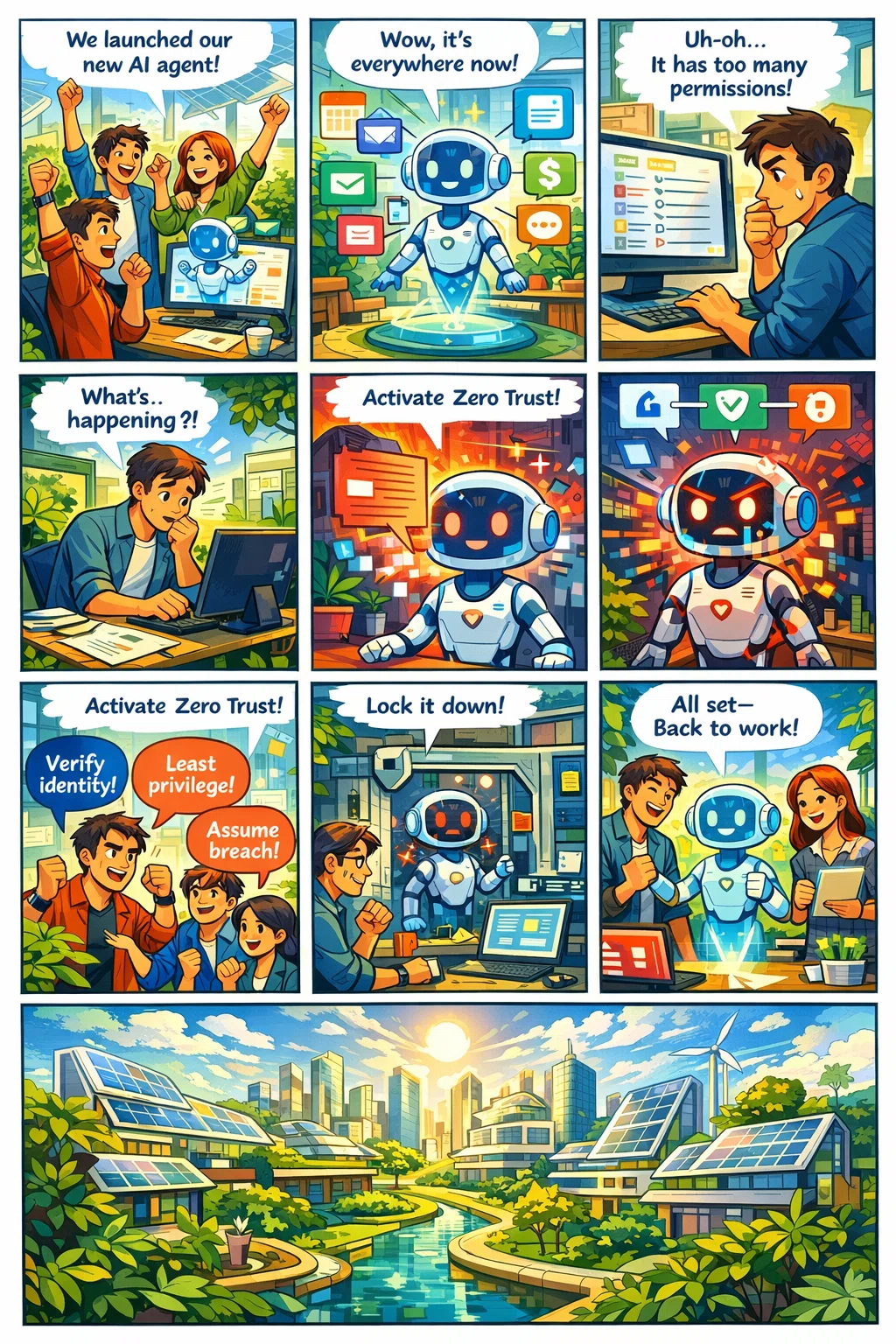
AIを社内で使うのは当たり前。でも、便利さの裏で「AIが何にアクセスできるのか」「誤作動したら誰が止めるのか」は、まだ整っていない企業も多い。Microsoftの“Zero Trust for AI”は、AI時代の働き方を前に進めながら、同時に守るための現実的な答えだ。
https://www.microsoft.com/en-us/security/blog/2026/03/19/new-tools-and-guidance-announcing-zero-trust-for-ai/
owner:microsoft
タイトル:New tools and guidance: Announcing Zero Trust for AI
日時:2026/03/19
“https://www.microsoft.com/en-us/security/blog/2026/03/19/new-tools-and-guidance-announcing-zero-trust-for-ai/”
🌐 English Summary
Microsoft has announced “Zero Trust for AI” (ZT4AI), a framework that extends the company’s established Zero Trust security model to the full AI lifecycle, including data ingestion, model training, deployment, and agent behavior. The core message is that AI systems create new trust boundaries that older security models do not fully address. In particular, Microsoft argues that autonomous and semi-autonomous AI agents can become dangerous if they are overprivileged, manipulated, or poorly governed. To address this, the company applies three familiar Zero Trust principles to AI: verify explicitly, apply least privilege, and assume breach.
The announcement includes four practical updates. First, Microsoft added a dedicated AI pillar to its Zero Trust Workshop. This updated workshop now covers 700 security controls across 116 logical groups and 33 functional swim lanes. Second, the Zero Trust Assessment tool has been expanded with Data and Networking pillars, while an AI-specific assessment pillar is planned for summer 2026. Third, Microsoft introduced a Zero Trust reference architecture for AI to help teams understand where controls should be applied across AI systems. Fourth, it published patterns and practices for major security problems such as AI threat modeling, AI observability, securing agentic systems, safety engineering, and defense-in-depth for indirect prompt injection.
Overall, this is less a single product launch than a governance and security operating model. Microsoft is trying to give security, IT, and engineering teams a structured path from strategy to assessment to implementation, so organizations can scale AI adoption without losing control over identities, data, networks, and agent behavior.
🇯🇵 日本語要約
Microsoftは2026年3月19日、「Zero Trust for AI(ZT4AI)」を発表した。これは従来のゼロトラストをAI時代向けに拡張する考え方で、データ取り込み、モデル学習、デプロイ、AIエージェントの挙動まで、AIライフサイクル全体に一貫してセキュリティ原則を適用しようというものだ。発表の背景には、AIが既存のセキュリティ境界を壊しつつあるという問題意識がある。人間の利用者だけでなく、AIエージェント自身が判断し、外部ツールや社内データにアクセスし、場合によっては自律的に行動するようになると、従来の「人が操作する前提」の防御だけでは足りない。Microsoftは、権限過多・誘導・誤整合を起こしたAIエージェントを“double agents”のような存在として捉え、明示的な検証、最小権限、侵害前提というゼロトラストの3原則をAIにもそのまま適用すべきだと説明している。
今回の発表では、実務に直結する4つの更新が示された。第1に、Zero Trust Workshopに新しいAIピラーが追加された。これはシナリオベースで組織の成熟度や改善手順を整理するための枠組みで、現在は700のセキュリティコントロール、116の論理グループ、33の機能スイムレーンをカバーする。第2に、Zero Trust Assessmentツールには既存のIdentity、Devicesに加えてDataとNetworkingの評価項目が追加された。さらにAI専用ピラーも2026年夏に提供予定とされている。第3に、Zero Trust for AIのリファレンスアーキテクチャが公開された。これにより、ポリシーベースのアクセス制御、継続的検証、監視、ガバナンスをAIシステム上でどう組み合わせるかを、セキュリティ、IT、エンジニアリングの各部門が共通認識として持てるようになる。第4に、AI向け脅威モデリング、AI observability、agentic systemの保護、安全工学、間接プロンプトインジェクション対策といった「パターンと実践知」が提示された。
重要なのは、これは単なる新機能の紹介ではなく、「AI導入を進めながら、どう安全運用へ落とし込むか」という導線を示した点にある。記事では、セキュリティ担当者が直面している最大の課題を「何をすべきか分かっていても、どう実装するかに落ちないこと」だとしている。つまりMicrosoftは、戦略→診断→実装の流れを一本化し、AI活用を止めるのではなく、統制しながら拡大する方法論を提供しようとしている。AIをめぐる攻防がモデル単体の問題から、ID・データ・ネットワーク・監視・権限設計まで含む“全体設計”の問題へ移っていることを示す記事だ。
📚 重要語彙 12語
lifecycle
日本語訳:ライフサイクル、全工程
Example: Security must cover the entire AI lifecycle, not only deployment.explicit
日本語訳:明示的な
Example: Companies should verify access requests explicitly before allowing an AI agent to act.privilege
日本語訳:権限、特権
Example: Least privilege reduces the damage an AI tool can cause.breach
日本語訳:侵害、漏えい
Example: A strong system is designed as if a breach will eventually happen.governance
日本語訳:統治、ガバナンス
Example: Good AI governance helps teams balance innovation and safety.resilience
日本語訳:回復力、耐性
Example: Network segmentation can improve resilience during an attack.observability
日本語訳:可観測性
Example: AI observability makes it easier to trace harmful behavior.deployment
日本語訳:導入、展開
Example: Security reviews should happen before and after deployment.autonomous
日本語訳:自律的な
Example: Autonomous agents require tighter controls than ordinary software tools.prescriptive
日本語訳:具体的手順を示す、処方的な
Example: The workshop is prescriptive, so teams can move from discussion to action.alignment
日本語訳:整合、足並み
Example: Alignment between IT and security teams is essential for AI adoption.remediate
日本語訳:是正する、修復する
Example: Organizations need a fast way to remediate AI-related security gaps.
📺 外部参照情報
YouTube関連動画
AI with Zero Trust Security
Reddit(USA)関連トピック
Applying Zero Trust to Agentic AI and LLM Connectivity — anyone else working on this?
👤 記事に登場する人物
Mike Adams
Microsoft SecurityのCustomer Experience Engineering担当Corporate Vice President。今回の記事の執筆者で、企業がAI導入を進める中で、セキュリティ運用へどう落とし込むかを整理している。Hammad Rajjoub
MicrosoftのSecure Future InitiativeとZero Trust関連で登壇している人物で、2025年のMicrosoft Security BlogではSecurity MarketingのDirectorとして実践的ガイダンスを発信している。Eric Sachs
Microsoft Identity & Network AccessのCorporate Vice President。ID基盤とアクセス管理の文脈でMicrosoftのゼロトラスト戦略を牽引してきた幹部として紹介できる。
🔑 主要キーワード補足
Zero Trust Assessment
ゼロトラストの成熟度や設定状況を自動評価する仕組み。今回の更新ではDataとNetworkingが追加され、AI向け専用ピラーは2026年夏予定とされた。Indirect Prompt Injection
外部コンテンツやツール連携を経由して、AIの挙動を間接的に誘導する攻撃。Microsoftはこれに対して、入力処理、ツール分離、ID、メモリ制御、実行時監視を組み合わせる多層防御を推奨している。
🌏 日本の関連状況(英日)
English
Japan is also moving toward structured AI governance and security. METI’s AI Guidelines for Business present unified guidance for safe and secure AI use, while Japan’s IPA/AISI updated its AI safety evaluation guide and red-teaming guide in April 2025. In government digital policy, the Digital Agency’s standard guidelines also describe Zero Trust architecture as a core access-control approach. This means Microsoft’s Zero Trust for AI aligns with broader Japanese trends: stronger AI governance, more testing, and more security-by-design.
日本語
日本でも、AIの安全利用を制度や実務で支える流れが強まっている。経済産業省の「AI Guidelines for Business」は、安全・安心なAI活用に向けた統一的なAIガバナンス原則を提示している。さらにIPAのAISIは2025年4月、AIセーフティの評価観点ガイドとレッドチーミング手法ガイドを改訂し、マルチモーダルモデルやRAGを含む実践的な評価・検証に踏み込んだ。デジタル庁の標準ガイドラインでも、Zero Trust Architectureが中核的なアクセス制御の考え方として示されている。つまり日本でも、AI活用を広げるほど「ゼロトラスト」「評価」「監視」が重要になる点で、今回のMicrosoft発表と方向性はかなり近い。
💭 話題を広げるための具体的テーマ3つ
Should AI agents be treated like human employees in access control?
Model Answer
AI agents should not be treated exactly like human employees, but they should be governed with an equally strict or even stricter access model. Human users can be trained, corrected, and held accountable in ways that current AI systems cannot. By contrast, an AI agent may operate at high speed, across multiple systems, and with incomplete predictability. That makes traditional role-based access insufficient if it assumes stable intent or safe judgment. A better approach is to treat AI agents as non-human identities that require explicit verification, narrow entitlements, continuous monitoring, and fast containment. For example, an AI agent that reads customer support tickets may not need permission to modify billing records or send outbound messages without human approval. Organizations should also separate identity, tool use, and data access into distinct control layers. In practice, this means short-lived credentials, scoped API permissions, policy-based approval, runtime logging, and human escalation paths. Some people argue that too many controls will slow innovation, but weak controls can destroy trust and create far larger costs later. As AI agents become more autonomous, organizations will need to design them less like helpful assistants and more like powerful contractors working under strict supervision. This balance between utility and restraint will likely define successful enterprise AI adoption in the next few years.Is prompt injection mainly a technical issue or a governance issue?
Model Answer
Prompt injection is both a technical issue and a governance issue, and treating it as only one of the two is a mistake. On the technical side, prompt injection exploits the way language models process instructions from multiple sources, especially when they are connected to tools, web content, email, or enterprise documents. That means developers need strong input filtering, tool isolation, context separation, memory controls, and runtime monitoring. However, technical defenses alone are not enough because organizations must also decide what an AI system is allowed to do when it receives ambiguous or malicious instructions. This is where governance becomes essential. Governance defines who approves tool access, which data sources are trusted, what logging is required, when human review must happen, and how incidents are investigated. Without governance, teams often deploy AI systems faster than they can understand the risks. In that environment, prompt injection stops being a narrow model problem and becomes an enterprise control failure. Good governance does not replace engineering; it gives engineering a structure. It turns vague concerns into policies, workflows, and accountability. Therefore, the most realistic answer is that prompt injection is a socio-technical problem. It begins in model behavior, but it scales through weak design decisions, unclear ownership, and missing operational guardrails. The organizations that handle it best will combine technical depth with disciplined governance.How can companies adopt AI quickly without sacrificing security?
Model Answer
Companies can adopt AI quickly without sacrificing security if they stop treating security as a final approval gate and instead build it into the adoption path from the beginning. One reason security slows projects is that teams often launch pilots first and ask control questions later. A stronger model is to begin with a clear architecture: what the AI system will access, which identities it will use, which tools it can invoke, what data it can retain, and how its actions will be monitored. Frameworks like Zero Trust for AI are useful because they give companies a phased path from strategy to assessment to implementation. Security then becomes an enabler rather than a blocker. In practice, fast and safe adoption depends on a few habits: classifying sensitive data early, assigning least-privilege permissions, logging all high-risk actions, testing systems with red teaming, and requiring human approval for critical operations. It also helps to start with narrower use cases before expanding into autonomous workflows. Another important point is cross-functional alignment. Security, IT, legal, and business teams must agree on risk thresholds and success metrics. When organizations skip that alignment, they usually gain speed for a few weeks and lose months later in rework or incident response. So the real answer is not “move slower” or “move recklessly.” It is to move in a structured way, using controls that scale with capability. That is how trust becomes a growth advantage rather than a cost center.
🏷️ 記事の背景
English
As AI agents gain access to enterprise data, tools, and workflows, classic Zero Trust models are being extended to cover non-human identities and AI-specific risks.
日本語
AIエージェントが社内データや業務ツールへ接続し始めたことで、人間中心だったゼロトラストをAI向けに拡張する必要が高まっている。
🏷️ ハッシュタグ
#AIセキュリティ #ゼロトラスト #生成AI #AIエージェント #サイバーセキュリティ #情報セキュリティ #企業DX #ガバナンス #AIガバナンス #プロンプトインジェクション #レッドチーミング #可観測性 #データ保護 #ネットワークセキュリティ #アクセス制御 #最小権限 #Microsoft #Copilot時代 #AI導入 #セキュリティ設計 #AISecurity #ZeroTrust #GenerativeAI #AIAgents #CyberSecurity #EnterpriseAI #PromptInjection #ThreatModeling #Observability #DataProtection #LeastPrivilege #Governance #AgenticAI #SecurityArchitecture #MicrosoftSecurity #RiskManagement #教育 #英会話 #習い事 #2026 /03/19 #2026 #2026 /03
↓👍イイネを押してもらえると嬉しいです
