
Tanigorō Kawata – Ota City’s Unsung Pioneer of Straw Hat Innovation #29

・Introduction
“Often, the true architects of local history remain
hidden in the shadows,
their immense contributions known only to a few.
In Ota City, Tokyo (東京都大田区),
one such overlooked figure is
Tanigorō Kawata (川田谷五郎),
From his base in Rokugō (当時の六郷村),
in the City’s southern region,
Kawata's pioneering spirit and ingenuity
laid the foundation for an entire industry.
His life story is a powerful testament to
innovation, perseverance, and global vision—
a legacy long overdue for recognition.”
Note: This article is more in‐depth than usual
(over 6,800 words),
as it explores Tanigorō Kawata’s legacy in full detail.
You’re welcome to read it in parts or
revisit as your interest leads you.
Craft to Industry:
The Birth of Japan’s Straw Hat Legacy
Tanigorō Kawata,
(15 March 1837 [Tenpō 8] ‐
12 October 1911 [Meiji 44]),
served as a local magistrate
in what is now Ota City, Tokyo.
One day while walking through Yokohama (横浜),
he noticed a straw hat
worn by a foreign visitor.
Inspired by Ōmori‐zaiku (大森細工),
a traditional straw‐braiding craft from southern Tokyo,
he set out to create
Japan’s first Western‐style straw hat material.
In 1872 [Meiji 5],
he introduced an innovative braiding method
he called “Bakkan Sanada”
(麦稈真田, literally “straw‐braid Sanada”),
a name that would soon become
synonymous with quality and craftsmanship.
In Wikipedia,
Tanigorō Kawata
(though unfortunately spelled 河田
instead of 川田 there)
is listed as the creator of
"Japan's first straw hat."
However, other sources indicate that
the first "straw‐braided summer hat (straw hat)"
was exhibited at the
First National Industrial Exhibition
in 1877 [Meiji 10],
causing a discrepancy in information.

(Tsuji family, craft inheritors).
Ōmori-zaiku: A traditional Straw-braiding
This colorful turtle-shaped piece showcases
the fine technique of Ōmori-zaiku
— a craft that originated in Ōta City, Tōkyō,
and is now preserved by artisans in Shuzenji, Shizuoka.
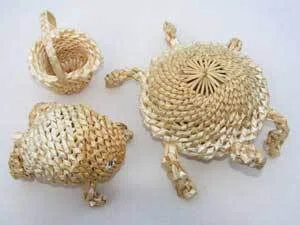
The Restored Ōmori-zaiku Craft
These hand-braided straw items—
featuring turtle and animal figures—
are examples of restored Ōmori-zaiku,
a traditional craft once flourishing in Ōta City, Tōkyō.
Imperial Recognition:
Tanigorō’s National Acclaim
Tanigorō's groundbreaking work
soon drew national attention.
At the Second National Industrial Exhibition
in 1881 [Meiji 14],
his innovative straw hats
were prominently showcased,
rekindling appreciation for his
Bakkan Sanada technique.
As a result,
he was granted a personal audience
with Emperor Meiji
and honored for his remarkable contribution.
Booming Demand: A Business Expands
The recognition Tanigorō received at the exhibition
triggered a surge in demand for his straw hats.
By 1883 [Meiji 16],
this growing popularity
led him to significantly expand his operations,
establishing three new factories
to meet the needs of an expanding market.

(Rokugō Local History Journal)
A rare historical photograph
of the Kawata Shōkai straw hat factory during the Meiji era.
This facility was the industrial core of
Tanigorō Kawata’s pioneering enterprise,
where his innovative Bakkan Sanada technique gave rise to
Japan’s first Western-style straw hats.
Innovation Under Pressure:
Kyōgi Sanada and Legacy
By August 1891 [Meiji 24],
competition in the
straw hat industry had grown
increasingly fierce.
In response, Tanigorō,
together with his eldest son Hirotarō (廣太郎),
developed a new manufacturing technique known
as Kyōgi Sanada. (経木真田)
further advancing their craft and
maintaining their competitive edge.
The Green Ribbon of Honor:
A Life Woven into History
On 1 May 1899 [Meiji 32] ,
in recognition of his
decades of dedicated public service
and industrial innovation,
Tanigorō
was awarded the
Medal with Green Ribbon (緑綬褒章) —
one of Japan’s highest honors
for civil merit—
highlighting the national value
of his lifelong contributions.
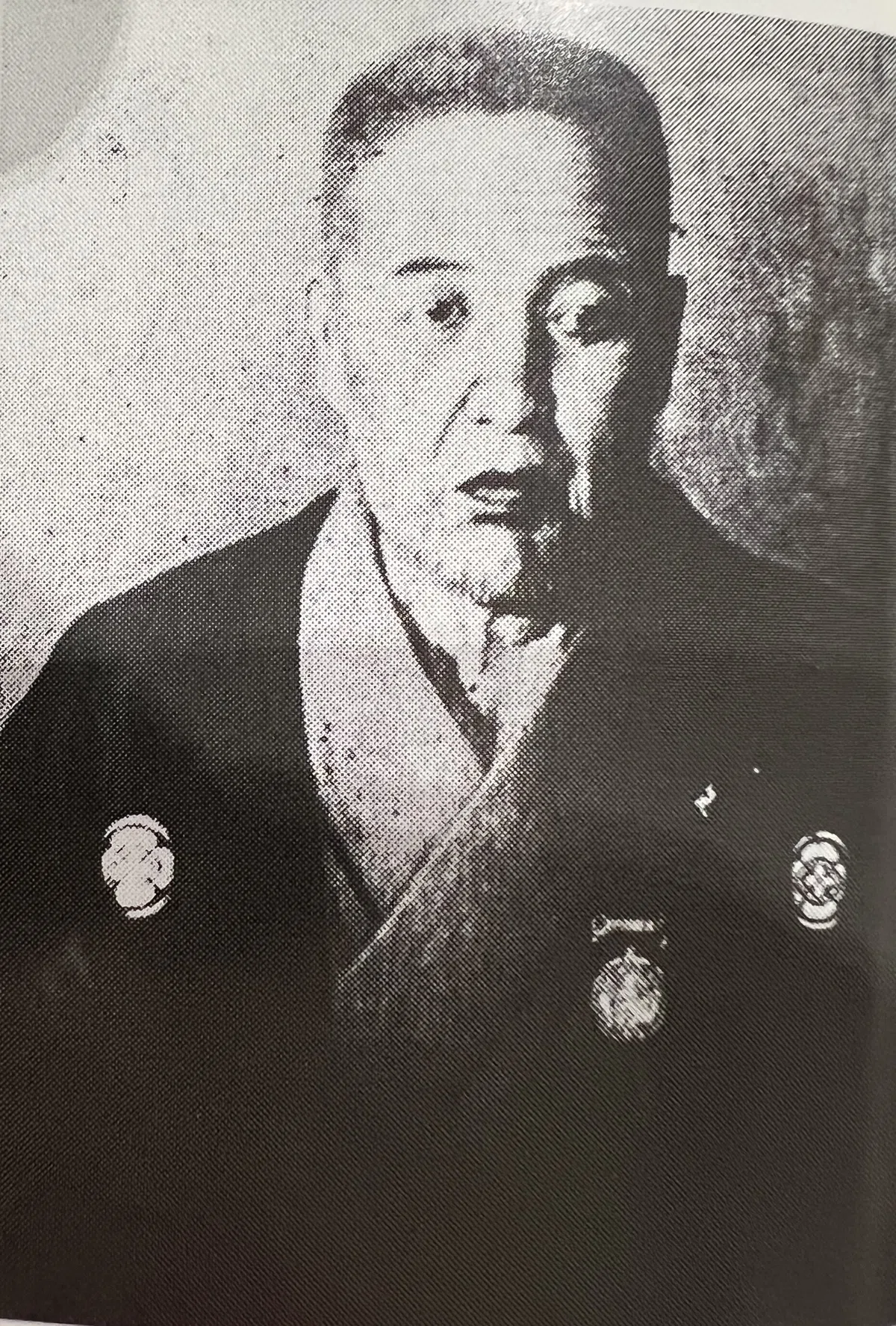
(Rokugō Local History Journal)
Tanigorō wearing Japan's Medal with Green Ribbon.
Global Acclaim:
The St. Louis World’s Fair
In 1904 [Meiji 37],
his straw hats were showcased at the
St. Louis World’s Fair
(officially the Louisiana Purchase Exposition) ―
in the United States,
one of the era’s largest international expositions,
where they won a gold medal and
catapulted his reputation onto the world stage.

"St. Louis World’s Fair poster"
Farewell to a Pioneer
Tanigorō Kawata passed away on
12 October 1911 [Meiji 44],
at the age of 74.
His death marked the end of a pioneering life
that transformed a local craft into a
nationally and
internationally recognized industry.
Fading of a 60‐Year Straw Hat Legacy
Two decades after his passing,
in 1931 [Showa 6],
straw hat production in the Rokugō area of Ota City
came to a quiet end—
its once-celebrated legacy slowly fading into obscurity,
and its visionary founder nearly forgotten.
REMEMBER TANIGORŌ KAWATA:
Why His Name Faded -
and How to Revive It
It is truly unfortunate that
such a remarkable pioneer remains
largely unrecognized in Ota City today.
The fading of his name does a disservice to
the profound impact he had on the
region’s industrial and cultural heritage.
But sharing his story—
as you have done through social media—
is a powerful act of restoration.
It breathes life back into
a nearly forgotten legacy.
I sincerely hope that
Tanigorō Kawata’s name will one day be
celebrated widely,
earning its rightful place among
Ota City’s most influential and
inspiring historical figures.
My Take:
Teach Tanigorō Kawata
to Every Ota City Child
At the very least,
I believe that
pivotal yet unsung figures like
Tanigorō Kawata
should be part of the curriculum in
Ota City's elementary and middle schools.
His contributions are not just a
footnote in local history—
they’re foundational to the
growth of this community.
Teaching students about trailblazers like
Tanigorō
helps instill pride in their hometown,
fosters a deeper connection to its
cultural heritage,
and encourages them to
carry that pioneering spirit forward.
Remembering him isn’t just about
honoring the past.
It’s about
shaping how the next generation understands
where they come from—
and what they’re capable of achieving.
Tanigorō’s Genealogy: A Line Untraced
Despite the concentration of
Kawata families still living near
Keikyu Corporation’s Zōshiki Station,
Tanigorō Kawata’s direct bloodline
remains untraced.
This absence of genealogical records
adds a layer of historical mystery to the
legacy of one of
Ōta City’s most quietly influential pioneers.

Keikyu Coporation Zōshiki Station,
Ota City, Tokyo

If this topic interests you,
you can find related content in Japanese
under #27 and #29
Header image generated using Gemini (AI-generated content).
#かえる11号
#Otapedia
#デジタルアーカイブ
#SDGs11
#大田区
#六郷特別出張所
#雑色
#川田谷五郎
#川田商店
#人力車
#麦稈真田の父
#大田区東京都議会議員の父
#勧業博覧会
#川田麦藁商会
#東京荏原郡麦藁組紐営業組合
#経木真田
#緑綬褒章
#川田兵右衛門
#川田廣太郎
#川田諒次
#雑色駅の父
#大森八景園
#宝泉寺
#東京府荏原郡麻真田工業
#ヒンメリ
#大林寺
#日好住職
#大森細工
#真田紐
#麦わら帽子
#ジョン・モリス
#島田十郎兵衛
#大森麦稈細工沿革略記
#麦稈及経木真田同業組合
#セントルイス万国博覧会
#荏原郡物産共進会
#高橋喜三郎
#ブラザー工業
#高橋雄喜次
#辻親子
#修善寺
#民藝麦わらの店晨 ~あした~
#代田朝義
#大森麦わら細工の会
#大田区特別顕彰区民
#大田区準特別顕彰区民
#大田区裏名誉区民
#大田区無名の偉人
#大田区無名の企業
#大田区無名の産業
#大田区無名の組織・集団
#大田区陰の功労者
#大田区未顕彰の地域遺産
#大田区記憶の日
いいなと思ったら応援しよう!
 いつもご覧いただき、誠にありがとうございます。
皆様からの温かいご支援が、
私の活動の大きな支えとなります。
いつもご覧いただき、誠にありがとうございます。
皆様からの温かいご支援が、
私の活動の大きな支えとなります。