
【介入パターンの解析📊】『Japanese Foreign Exchange Interventions, 1971-2018:Estimating a Reaction Function Using the Best Proxy』:先行研究解説 No.10💝2023/10/24

Introduction:卒業論文は早めに仕上げたい💛
私もいよいよ卒業論文の執筆に
取りかかる時期がやって参りました👍
何事もアウトプット前提のインプットが
大事であると、noteで毎日発信してきました
これは、どのような内容で
あっても当てはまります👍
論文を一概に読んでも
記憶に残っていなかったり
大切な観点を忘れてしまっていたりしたら
卒業論文の進捗は滞ってしまうと思います
だからこそ、この「note」をフル活用して
卒業論文を1%でも
完成に向けて進めていきたいと思います
私の卒論執筆への軌跡を
どうぞご愛読ください📖
今回の参考文献🔥
今回、読み進めていく論文は
こちらのURLになります👍
『Japanese Foreign Exchange Interventions, 1971-2018: Estimating a Reaction Function Using the Best Proxy』
Takatoshi Ito(a), Tomoyoshi Yabu(b)
(a) School of International and Public Affairs, Columbia University, and GRIPS, Tokyo
(b) Department of Business and Commerce, Keio University
読み終えた先行研究📚
『日本の為替介入の分析』 伊藤隆敏・著
経済研究 Vol.54 No.2 Apr. 2003
『Effects of the Bank of Japan’s intervention on yen/dollar exchange rate volatility』21 November 2004
Toshiaki Watanabe (a), Kimie Harada(b)
『The Effects of Japanese Foreign Exchange Intervention: GARCH Estimation and Change Point Detection』
Eric Hillebrand Gunther Schnabl Discussion
Paper No.6 October 2003
Japanese Foreign Exchange Interventions, 1971-2018: Estimating a Reaction Function Using the Best Proxy
December 12, 2019
Takatoshi Ito(a), Tomoyoshi Yabu(b)
(a) School of International and Public Affairs, Columbia University, and GRIPS, Tokyo
(b) Department of Business and Commerce, Keio University
前回のお復習い📝
4. Patterns of intervention
Fig. 3, panels (a) and (b), show monthly data of the yen/dollar rate and amounts of interventions by the Japanese monetary authorities.
Panel (a) shows the movement of the yen/dollar rate. The dotted line represents the past-five-year moving-average of the yen/dollar rate.
Panel (b) shows that in the 1970s and 1980s, interventions were very “frequent and symmetric”: yen-selling interventions as well as yen buying interventions were frequently conducted.
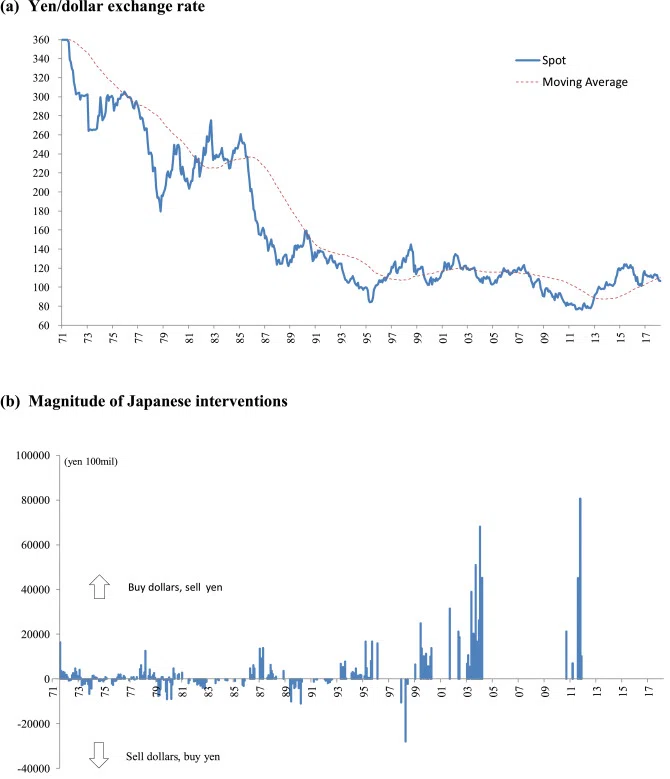
The yen had been on a long-term appreciation trend, as shown in panel (a), throughout the 1970s and 1980s.
It has been well documented that the authorities intervened in an attempt to stop this appreciation, presumably to prevent adverse effects on export industries.
図3のパネル(a)と(b)は、円/ドルレートと日本の金融当局による介入額の月次データを示しています
パネル(a)は円/ドルレートの動きを示しています
なお点線は、円/ドルレートの過去5年間の移動平均(Moving Average)を表しています
パネル(b)は、1970年代と1980年代には、介入が非常に「頻繁かつ対称的(symmetric)」であったことを示しています
つまり、頻繁に「円売り介入(yen-selling interventions)」と円買い介入(yen buying interventions)」が行われていたのです
円は、パネル(a)に示すように、1970年代から1980年代にかけて長期にわたって円が増価する傾向にありました
おそらく輸出産業への悪影響を防ぐために、通貨当局がこの円高トレンドを阻止しようと外国為替市場に介入したことは十分に過去の記録として残されているのです
However, it was little publicized that yen depreciation was also resisted by selling the dollar.
Three hypotheses could explain the symmetric interventions.
First, the authorities genuinely believed that the long-run trend could not be resisted, yet it was the authorities’ role to reduce “excess” volatilities, upside and downside.
Second, merely resisting yen appreciation by buying US dollars, would only have resulted in ever-accumulating foreign reserves that would have been exposed to increasing evaluation losses, which could have triggered political criticism.
Third, the interest rate in Japan was similar or even higher than the US interest rate during the 1970s and 1980s; hence, building up foreign reserves meant that interest income might not cover domestic interest payments to fiscal bills that are liabilities in the foreign exchange special accounts.
The “quasi-fiscal” costs were real concerns in Japan during the 1970s and 1980s.
しかし、円の減価もドル売りによって抵抗されるように実施されたことはあまり知られていないのです
ここで、対称的な介入を説明できる仮説は3つあると考えられます
第一に、通貨当局は、円高の長期的な傾向には抵抗できないと心底信じていましたが、為替レートにおける「過剰な」ボラティリティの乱高下を減らすことが通貨当局の役割であったという仮説です
第二に、単に円高に抵抗しただけであるという仮説です
仮に米ドルを購入したとしても、外貨準備は過剰に蓄積され続けるだけで、評価損が増大する可能性があり、政治的批判を引き起こす可能性があったからです📝
第三に、1990年代の日本の金利は、1970年代と1980年代における米国の金利と同等かそれ以上でした
したがって、外貨準備の蓄積は、外為特別会計の負債である財政手形への国内利払いを利子収入でカバーできない可能性があることを示唆していたのです
このような「準-財政(“quasi-fiscal” costs)」コストは、1970年代から1980年代にかけて日本経済における本当の懸念であったとされています
For the reasons mentioned above, whenever the yen depreciated to some extent, like in 1973 and 1979 (due to the oil crises), 1981-82, and 1989, the yen was bought back, which appears to slow the yen's depreciation and to keep foreign reserves at a reasonable level.
This attitude of symmetric interventions changed in the 1990s. After 1992, the only instance of sizable dollar-selling interventions was 1997-98 when the banking crisis of Japan caused a sharp yen depreciation.
The magnitude of interventions became distinctively large while the frequency of interventions was reduced. In particular interventions in 2003-04 and 2011 were very large.
上記でに述べた理由により、1973年と1979年(石油危機による)、1981年から1982年、1989年のように、円がある程度減価(depreciate)すると必ず円が買い戻され、円安のペースが鈍化し、円安(yen's depreciation)が維持されるように見えます
そして、外貨準備高は妥当な水準に維持されているように見受けられます
ですが、この対称的介入の姿勢は1990年代に変化しました
1992年以降、大規模なドル売り介入が行われたのは、日本の銀行危機で急激な円安が起こった1997~98年のみで、介入の規模は際立って大きくなり、介入の頻度は減少したと言えます
また、特に2003~2004年と2011年の介入はそれぞれ非常に大規模でした
本日の解説は、ここまでとします
このような歴史や先行研究をしっかり理解した上で、卒業論文執筆に取り組んでいきたいです
今回、私が卒業論文執筆において取り上げる
24年ぶりの「円安是正」介入は本当にレアな経済政策
ということを再認識できたような気がします💖
私の研究テーマについて🔖
私は「為替介入の実証分析」をテーマに
卒業論文を執筆しようと考えています📝
日本経済を考えたときに、為替レートによって
貿易取引や経常収支が変化したり
株や証券、債権といった金融資産の収益率が
変化したりと日本経済と為替レートとは
切っても切れない縁があるのです💝
(円💴だけに・・・)
経済ショックによって
為替レートが変化すると
その影響は私たちの生活に大きく影響します
だからこそ、為替レートの安定性を
担保するような為替介入はマクロ経済政策に
おいても非常に重要な意義を持っていると
推測しています
決して学部生が楽して執筆できる
簡単なテーマを選択しているわけでは無いと信じています
ただ、この卒業論文をやり切ることが
私の学生生活の集大成となることは事実なので
最後までコツコツと取り組んで参ります🔥
本日の解説は、以上とします📝
今後も経済学理論集ならびに
社会課題に対する経済学的視点による説明など
有意義な内容を発信できるように
努めてまいりますので
今後とも宜しくお願いします🥺
マガジンのご紹介🔔
こちらのマガジンにて
卒業論文執筆への軌跡
エッセンシャル経済学理論集、ならびに
【国際経済学🌏】の基礎理論をまとめています
今後、さらにコンテンツを拡充できるように努めて参りますので何卒よろしくお願い申し上げます📚
最後までご愛読いただき誠に有難うございました!
あくまで、私の見解や思ったことを
まとめさせていただいてますが
その点に関しまして、ご了承ください🙏
この投稿をみてくださった方が
ほんの小さな事でも学びがあった!
考え方の引き出しが増えた!
読書から学べることが多い!
などなど、プラスの収穫があったのであれば
大変嬉しく思いますし、投稿作成の冥利に尽きます!!
お気軽にコメント、いいね「スキ」💖
そして、お差し支えなければ
フォロー&シェアをお願いしたいです👍
今後とも何卒よろしくお願いいたします!
いいなと思ったら応援しよう!
 よろしければ、応援お願いします!
いただいたチップはクリエイターとしての活動費に使わせていただきます!
引き続き何卒よろしくお願いいたします💛
よろしければ、応援お願いします!
いただいたチップはクリエイターとしての活動費に使わせていただきます!
引き続き何卒よろしくお願いいたします💛