
ラ英196-Your most recent movie is the most moving film I've ever seen.

#ラジオ英会話 #ラ英196 #English_Grammar
## Slides

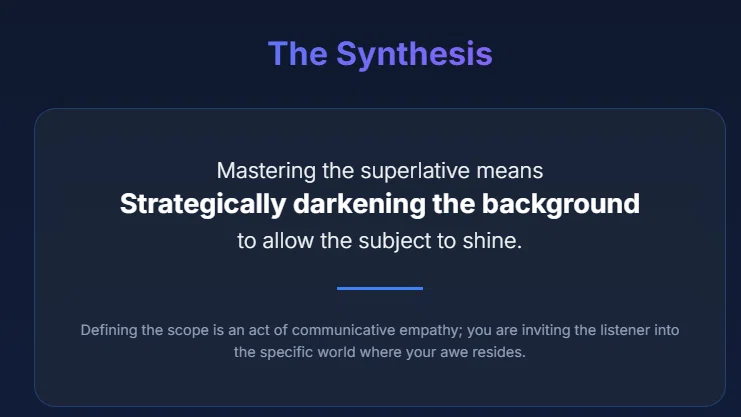


## Speaker notes
Speaker’s Notes: The Cognitive Superlative
Target Audience: British English Educator (35, 6+ years in Japan) Objective: Deconstructing the "Best" through Cognitive Delineation
01. Title Slide: Contouring the "Best"
The Narrative: Welcome everyone. Today, we aren't just looking at the "-est" suffix. We are looking at a psychological event. After six years in Japan, you've likely noticed that Japanese speakers often treat the superlative as a static label. In contrast, for a native English speaker, the superlative is a Dynamic Gaze. It is about how we "contour" or draw a line around a specific entity to separate it from the "Ground." We are essentially shifting our perspective from a wide-angle lens to a laser-focused spotlight.
Key Terminology:
Cognitive Contouring: The mental act of drawing a boundary around a concept.
Delineation: The precise description or mapping of the edges of a category.
Salience: The quality of being particularly noticeable or important; prominence.
Visual Representation:
[ Ground / Background ] -> [ Contouring ] -> [ Salient Figure ]
  .  .  .  .  .  .  .         _______           _______
  .  .  .  .  .  .  .      /         \        /   * \
  .  .  .  .  .  .  .     |   ( ? )   |  =>  |  THE!   |
  .  .  .  .  .  .  .      \ _______ /        \ _____ /
02. The Necessity of "Scope"
The Narrative: This is the most critical hurdle for learners. Why do we need "in the world" or "of the three"? Because the superlative has no meaning in a void. We must first construct a Mental Container or Scope. Without a boundary, brilliance has no "home." In the British mind, we are obsessed with the "The"—the definite article—because it implies that the boundary is so tight that only one thing can fit. If you haven't defined the scope, you haven't earned the "The."
Key Terminology:
Mental Container: A cognitive frame that limits the field of comparison.
Scope Delineation: Setting the specific parameters (spatial or temporal) of a claim.
The "The" Logic: The prerequisite of uniqueness established by a boundary.
03. Updating our Intuition
The Narrative: Modern ELT in Japan often focuses on "comparing three or more." This is a sterile, mathematical rule. Instead, we should teach Scanning and Salience. Imagine a radar. The radar Scans the field (the scope), and when it finds the highest peak, that peak becomes Salient. It "pops out" of the background. This is a move from a static list to a dynamic search. We aren't just counting items; we are seeking a peak.
Key Terminology:
Scanning: The mental survey of all members within a defined scope.
Figure-Ground Segregation: The process of separating an object from its background.
Dynamic Search: Treating grammar as a process of finding, not just labeling.
ASCII Diagram of Scanning:
  [ SCOPE ]           [ SCANNING ]         [ SALIENCE ]
   _ _ _ _             _ _ _ _ _            _ _ _ _ _
  | o o o |           | / / / / |          | . . . . |
  | o o o |    ==>    | / / / / |   ==>    | .  * . |
  | o o o |           | / / / / |          | . . . . |
   ‾ ‾ ‾ ‾             ‾ ‾ ‾ ‾ ‾            ‾ ‾ ‾ ‾ ‾
 (Potential)          (Process)            (Result)
04. The Architecture of Perception
The Narrative: When we say "This is the best burger in London," we are building an architecture. First, we lay the foundation: London. Then, we build the walls: The category of burgers. Finally, we place the crown: The specific burger. Notice how the "Scope" acts as the canvas. If the canvas is "I've ever seen," the architecture is temporal, spanning years of memory. If it's "in my group," it's social.
Key Terminology:
Spatial Canvas: Using physical locations to bound a superlative.
Temporal Canvas: Using time (especially Present Perfect) to bound a superlative.
Profiling: Choosing which specific traits to highlight within the architecture.
05. Semantic Containers (In vs. Of)
The Narrative: British English is sensitive to the "flavor" of prepositions. "In" represents Enclosure—you are inside a box (London, the team). "Of" represents Partition—you are a piece of a pie. This is a subtle but profound shift. "Of the three" implies a mechanical separation of units. "In the class" implies a holistic environment. This distinction helps students understand that prepositions aren't just glue; they are the shape of the container.
Key Terminology:
Enclosure (In): The subject is situated within a spatial or social boundary.
Partitive Separation (Of): The subject is extracted from a constituent set.
Constituent Set: The total group that makes up the "whole."
06. The Power of the "Gap"
The Narrative: In the sentence "The best film I've ever seen," where is the object of "seen"? It's gone. It's a Cognitive Gap. In linguistics, this gap isn't empty; it's a magnet. It pulls the listener's focus back to the "film." This "Cognitive Tension" is what gives the superlative its weight. We are literally creating a hole in the sentence that can only be filled by the subject we just mentioned. It forces the brain to loop back and admire the subject again.
Key Terminology:
Syntactic Gap: The missing element in a relative clause.
Cognitive Tension: The mental pull created by a gap that directs attention back to the antecedent.
Antecedent: The noun (e.g., "film") that the gap refers back to.
Gap Logic Diagram:
 [ FILM ] <------- (Pull) ------- [ I have seen { GAP } ]
    ^                                             |
    |_____________________________________________|
                 Mental Loop / Reinforcement
Key Takeaways
Scope First, Subject Second: Teach students to define the "where/when" before the "what."
Uniqueness is Earned: The word "the" is a reward for a perfectly defined boundary.
Grammar is a Gaze: Encourage learners to see superlatives as a way of looking at the world, not just a way of speaking.
Embrace the Gap: Use relative clauses to create the "focusing effect" that native speakers use for emphasis.
#blog #EnglishEducation #CognitiveLinguistics #TeachingInJapan #GrammarDeepDive #Superlatives #LinguisticsForTeachers #BritishTeacher
## Key terms
## References
## Textbook
最上級に頻繁に伴うのが「範囲」を表すフレーズ。「何の中で一番なのか」を示すフレーズです。
今日の一文
Your most recent movie is the most moving film I've ever seen.
最上級は「もっとも~」。そのため、何の中で「最も~なのか」、その範囲を示すフレーズがしばしば求められます。この文の I've ever は、中でも高頻出のフレーズ。
この文のthe most 以降は、「私がこれまで見た最も感動的な映画」という関係代名詞節による修飾ですが、最上級に求められる「範囲」を与える表現となっています。
### Example
This is the best book I've read so far.
現在完了形を使って範囲を述べるときによく使われるのがso farやyetなど。「今まで」というニュアンスです。
The most delicious cake I've tried yet.
(今まで試した中で最も美味しいケーキ)など気軽に使ってください。
This is the best restaurant in town.
範囲を述べる際によく使われるのはin~。
in the world 世界で
in the family その家族で
in the neighborhood 近所で
in my group 私のグループで
など
「囲い」「内部」が意識されているときに使われます。
She is the tallest of all.
of all(全員の中で)、of the three(三人の中で)など、ofが使われることもよくあります。「中」といった内部への意識はありません。単にofプラス名詞で説明しているだけ。the tallestをallで説明する意識でthe tallest of allを音読してみてください。
## A Situation of story
Mr. Jake: He is 35 years old. He is his talk show host.
Ms. Kato Kyoko: She is an famous actoress on movies, 72 years old.
### precondition and dialogues
ジェイクのトーク番組。今日のゲストは日本のベテラン俳優カトウ・キョウコです。
Jake: And we're back with actor Kato Kyoko. Kyoko, I've been a huge fan of yours for years.
Kyoko: Thank you, Jake. It's nice to hear that from someone your age.
Jake: Ha-ha. Now, your career spans over half a century.
Kyoko: It feels unreal when you put it like that.
Jake: And most of those films have become classics.
Kyoko: Yes, I've been very lucky to work with many talented directors.
Jake: But I must say, your most recent movie is the most moving film I've ever seen.
Kyoko: Thank you. We put a lot of hard work into making it.
いいなと思ったら応援しよう!
 Generative AIを使って何ができるかを実践しています。応援ありがとうございます。