
Part 8-2: Various Implications and Concerns Derived from the Analysis

Summary
Overview of This Article
In this article, Part 8-2, I organize the possible ethical issues that may remain hidden if the hypothesis presented in Part 8-1 is assumed, as well as the difficulty of recognizing victimization and the potential impact on democracy and fair competition.
Please note that this article reflects the perspective of one directly involved individual, based on my own records of experiences and publicly available information.
Position of This Article Within the Series
This article corresponds to the portion under consideration indicated by the pink frame in the analytical structure of this series shown in the figure below.
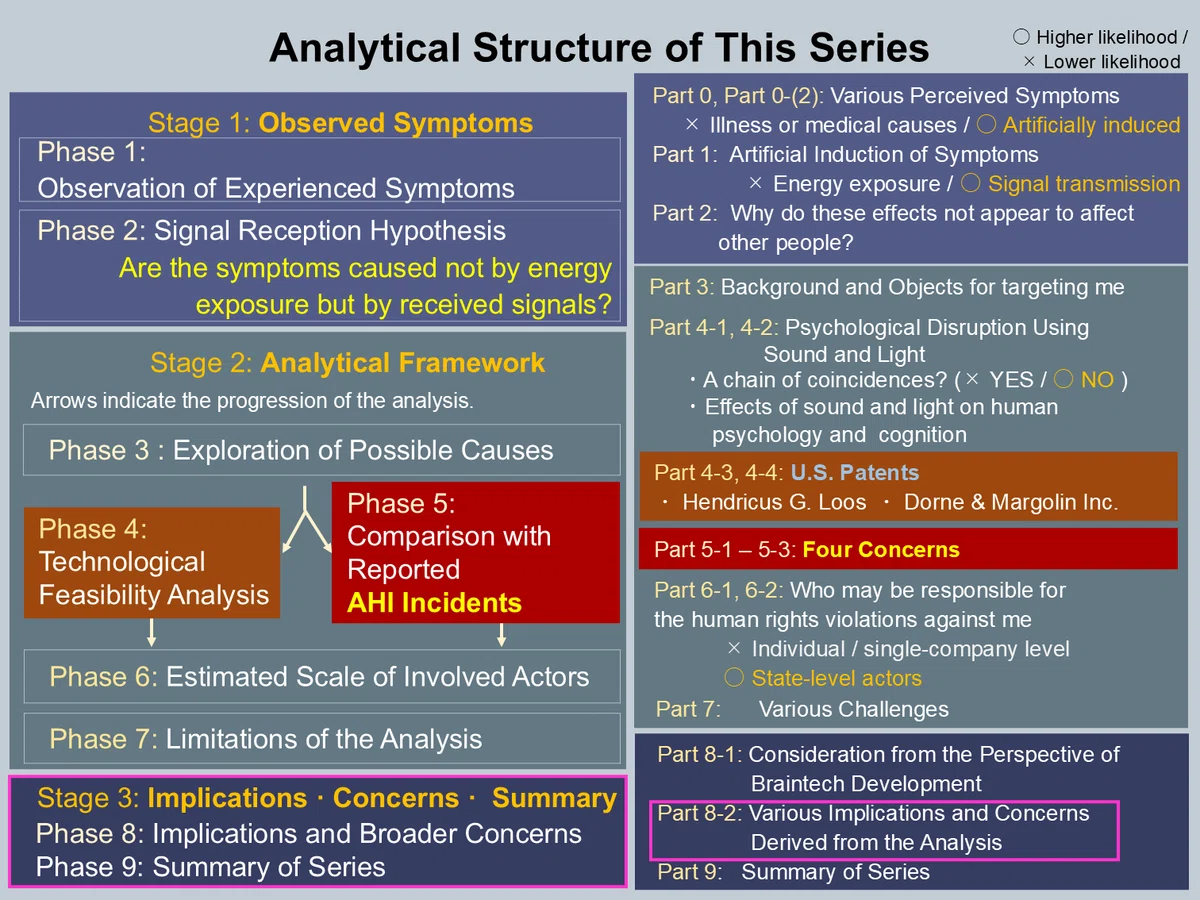
This diagram illustrates the relationship between the structure of the articles in this series and the stages of analysis.
The discussion is developed step by step, including the organization of observed phenomena, examination of analytical frameworks, verification of technical feasibility, and consideration of the entities involved.
Overview of the Series
For an overview of the entire series, please refer to the series guide below and the list at the end of this article.

1. Introduction
In the previous article, Part 8-1, I examined what kinds of connections may be conceivable from the perspective of braintech development, focusing on what I believe may be the true purpose behind AHI-like incidents and my own case — namely, the development of braintech based on fully remote manipulation.
In this article, Part 8-2, I organize the possible ethical issues that may remain hidden if the hypothesis presented in Part 8-1 is assumed, as well as the difficulty of recognizing victimization and the potential impact on democracy and fair competition.
The content discussed in this article does not assert any specific fact as definite. Rather, it is a hypothetical consideration based on my own records of experiences and publicly available information.

2. Implications and Concerns Derived from the Analysis
2-1. Avoidance of the Emergence of Ethical Issues
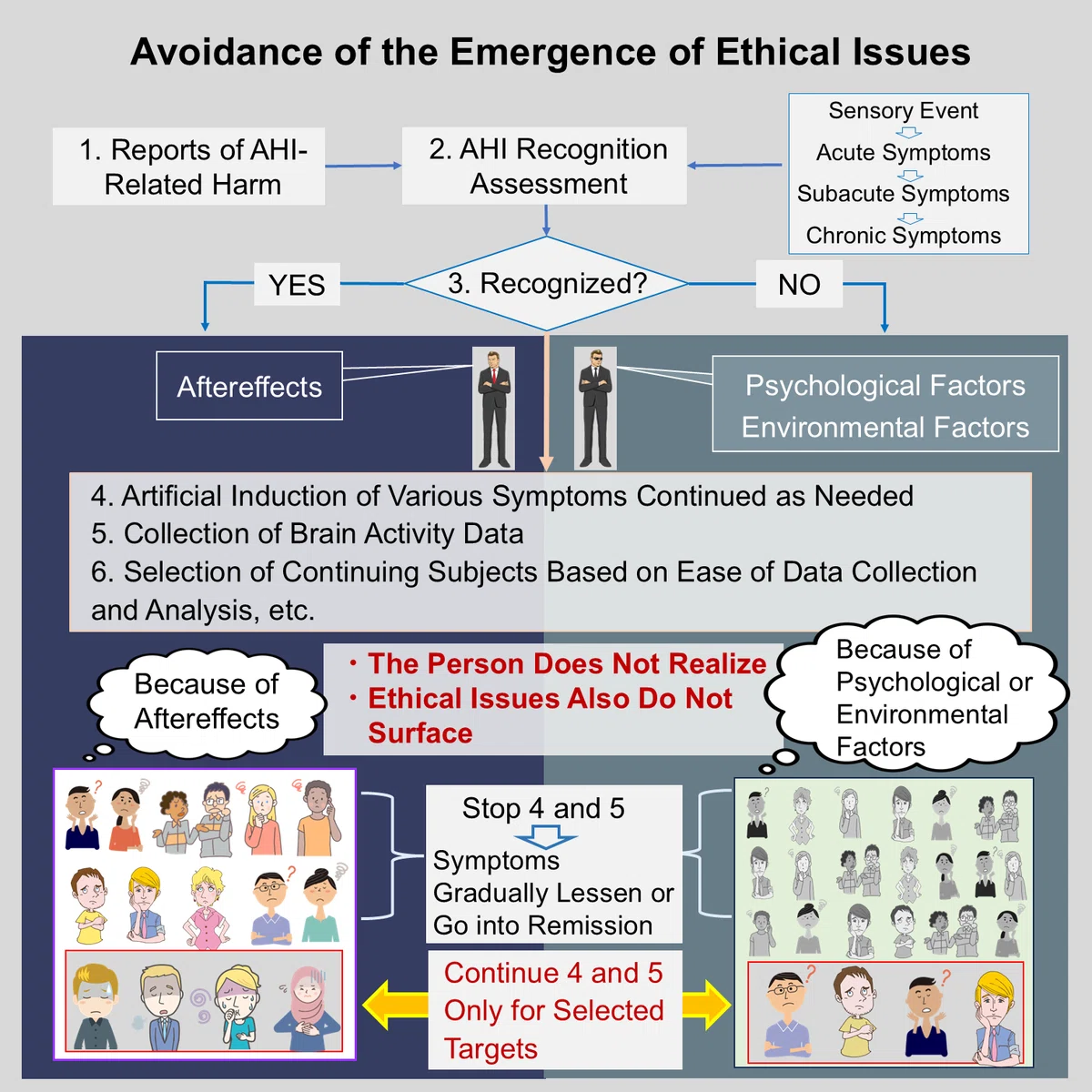
If it is assumed that the development of braintech based on fully remote manipulation lies behind AHIs, the following situations may be conceivable with regard to people who have reported AHI-related harm.
Both recognized victims and non-recognized individuals may tend to understand the symptoms they are aware of as aftereffects of having experienced a Sensory Event, or as being caused by their own psychological or environmental factors.
Because there are people among both recognized victims and non-recognized individuals whose symptoms gradually lessen or go into remission, those whose symptoms continue may increasingly come to believe the above explanations.
In other words, even if there are people among recognized victims or non-recognized individuals who are being used for the development of braintech based on fully remote manipulation, many of the targets would likely remain unaware both of that fact and of the possibility that at least some of their continuing symptoms are being artificially induced.
Therefore, issues related to what may be called human experimentation — including informed consent — as well as ethical issues involving privacy violations and the infliction of severe suffering on subjects, may remain hidden and fail to surface.

2-2. Expansion of Victims Who Do Not Recognize Their Victimization or Whose Reports Are Not Accepted
The following discussion is based on the content discussed in Section 2-3-1 of Part 8-1.
As an initial stage in the development of braintech based on fully remote manipulation, it may become necessary to address the following challenges:
Simplifying the analysis of brain activity signals
Understanding model patterns across various types of brain activity
As a way of addressing these challenges, it may be necessary to impose extremely strong stress on the target and maintain a certain state of stress.
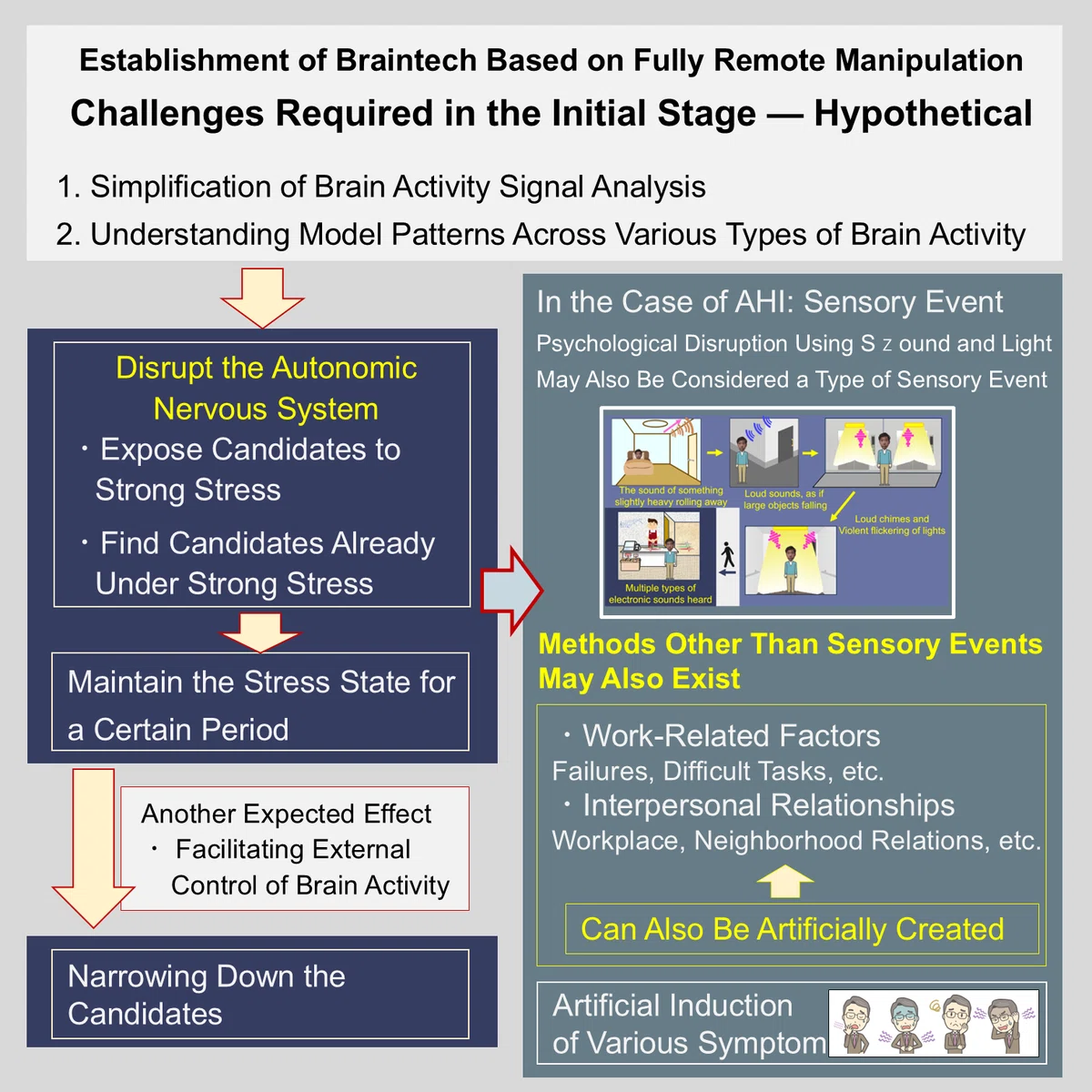
The above approach may also be understood as having the purpose of strongly disrupting the target’s autonomic nervous system. In that case, psychological disruption using sound and light may also be considered a type of Sensory Event.
In such a case, it may not always be necessary to make the target experience a Sensory Event. This is because there may be many people whose autonomic nervous systems are already in a state where they can be strongly disrupted by methods milder than a Sensory Event.
I believe that, by shortly before I experienced the above psychological disruption, I had already been kept in a state in which my autonomic nervous system was highly susceptible to disruption by other means.
There is, however, an even larger problem.
Since publicly reported AHI cases primarily involve people connected to the U.S. government and similar groups, even if an ordinary civilian experiences similar symptoms, the matter may be treated as a psychological or environmental issue, may not be taken up, or the person may be placed in a situation where even speaking out becomes difficult.
For that reason, even if an ordinary civilian perceives similar symptoms, there may be a possibility that the matter is treated as a psychological or environmental issue, is not taken up, or that the person is placed in a situation where even speaking out becomes difficult.
This situation seems similar to my own case as an unknown individual who has continued to report incidents for many years, while experiencing the failure of various institutions that hold the key to resolving the matter to respond.
Therefore, the number of people who are being used, have been used, or may be used in the future for the development of braintech based on fully remote manipulation may be quite substantial.

3. Surface-Level Democracy and Surface-Level Fair Competition
3-1. Impact on Democratic Procedures
If braintech based on fully remote manipulation were used by a malicious actor in elections, I believe that something like what is shown in Figure 3 could occur.
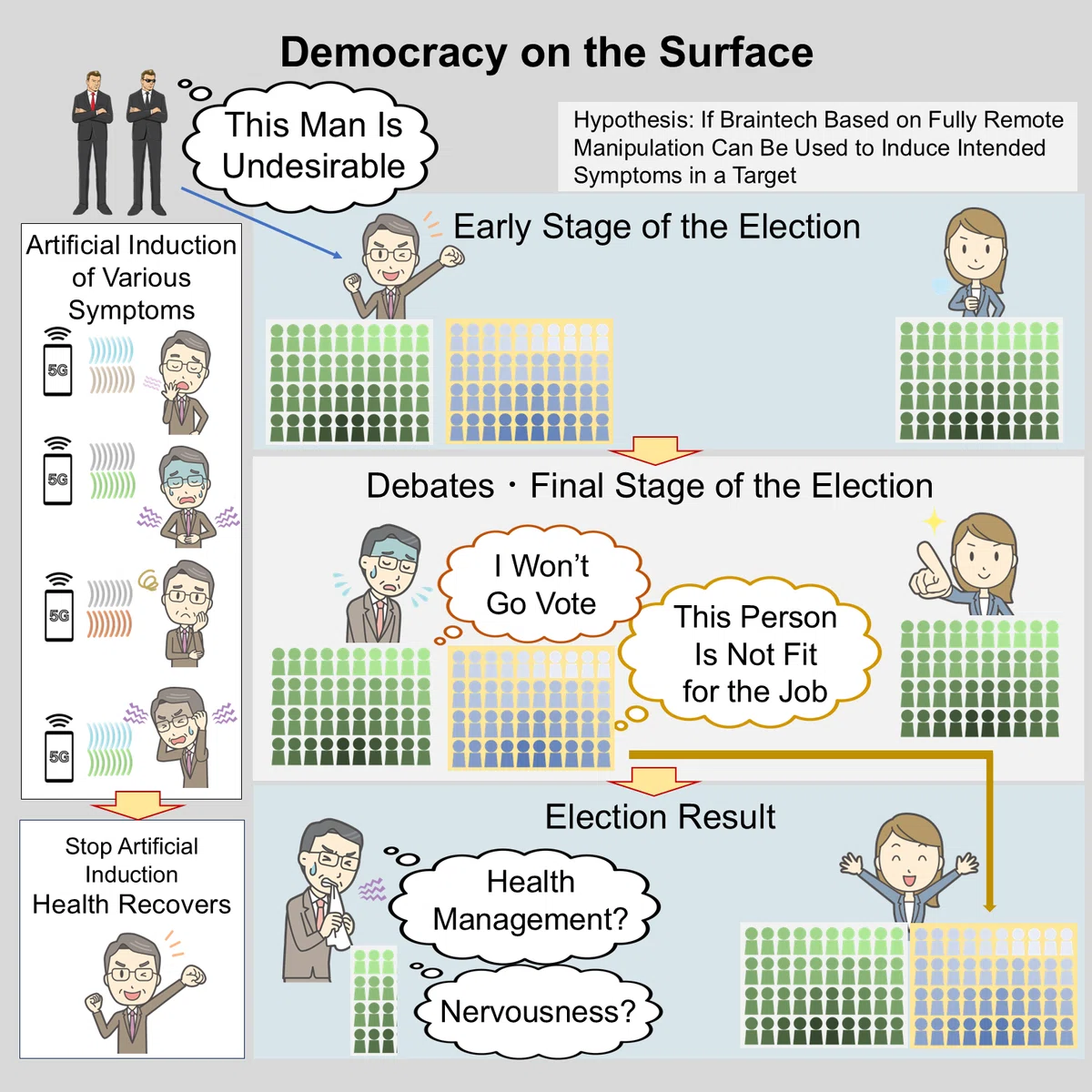
In the above case, I believe it would be unlikely that either of the two candidates, or the voters, would realize that the election result had been manipulated by a malicious actor.
Even in a presidential election, I believe it would be possible for a malicious actor to use this technology against a candidate who is inconvenient for them, before, during, or after an important debate, thereby placing that candidate in a condition in which they are unable to debate adequately.
Then, even if the targeted candidate appeared healthy again the day after the debate, I think no one, including the candidate, would understand the true reason.
In actual election reporting as well, a candidate’s physical condition and performance in debates may attract significant attention.
What I am discussing here is a general concern: if such technology exists and is abused, it could affect democratic procedures in a way that outwardly appears to be natural ill health or a decline in judgment.
The eviction lawsuit filed against me in September 2024 is currently pending before the Supreme Court. I believe that what happened to me in the courtroom of the Tokyo High Court — where, as the appellant, immediately after the start of oral argument, my field of vision narrowed, I could barely hear what was being said, and these various symptoms almost disappeared near the end of the oral argument — was also an incident similar to what I have described in this section.
I also believe that this kind of abuse could potentially be applied in the world of sports.

3-2. Obstruction of Fair Competition
If braintech based on fully remote manipulation were used by a malicious actor in various fields of research and development, I believe that something like what is shown in Figure 4 could also occur.
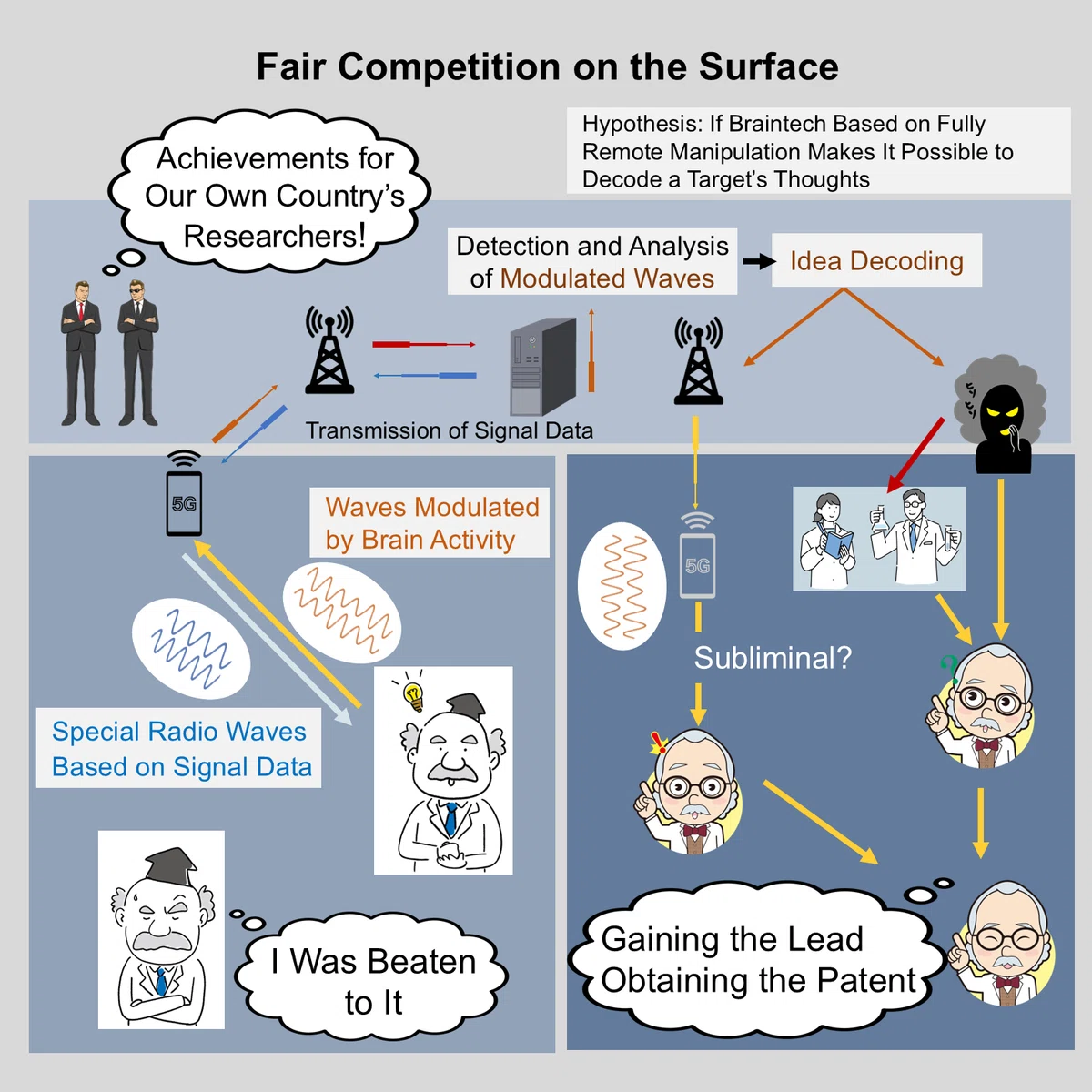
In this case as well, the researcher whose idea was stolen may only be able to perceive the situation as simply having been “beaten to it.” Depending on the situation, even the person who made use of the idea may mistakenly believe that they came up with it themselves.
I believe that such abuse could also occur in the field of art, and there are also concerns that it could be applied to diplomacy and intelligence activities.

4. Conclusion
If it is assumed that the purpose of developing braintech based on fully remote manipulation lies behind AHIs and my own case, one serious concern arises. Some people who have reported AHI-related harm may not notice this purpose, regardless of whether they have been officially recognized as victims.
In addition, issues related to what may be called human experimentation, including informed consent, as well as ethical issues involving privacy violations and the infliction of severe suffering on subjects, may remain hidden and fail to surface.
If methods that strongly disrupt the target’s autonomic nervous system are being used as a way to address challenges in the early stages of the above development, then the Sensory Events considered in relation to AHIs may not be essential.
Since publicly reported AHI cases primarily involve people connected to the U.S. government and similar groups, even if ordinary civilians were subjected to similar attacks, they might not recognize them as AHI-related harm, or their claims might not be taken up even if they spoke out.
Therefore, the number of people who are being used, have been used, or may be used in the future for the development of braintech based on fully remote manipulation may be quite substantial.
Furthermore, if braintech based on fully remote manipulation were abused, I believe it could lead to an extremely serious situation: surface-level democracy and surface-level fair competition.

5. Future Plan
In this article, I organized the ethical and social concerns that could arise if the hypothesis examined in Part 8-1 is assumed.
In the next article, I plan to provide an overall summary of this series.
<Update: May 10, 2026>
On May 9, 2026, I published Part 9 as the concluding article of this series.

