
Part 9: Overall Summary of the Series

1. Introduction
In this article, I will provide an overall summary of this series.
In the articles published so far, I have examined, step by step, the symptoms I perceive, the possibility of artificial induction, comparisons with AHI-like incidents, the possible scale of the actors involved, the limits of analysis, and possible points of connection with braintech development.
In this article, I will organize those points of discussion and then address the responsibility of the institutions, companies, and individuals that may possess relevant information, as well as the concerns that ultimately remain through this series.

2. What This Series Has Examined
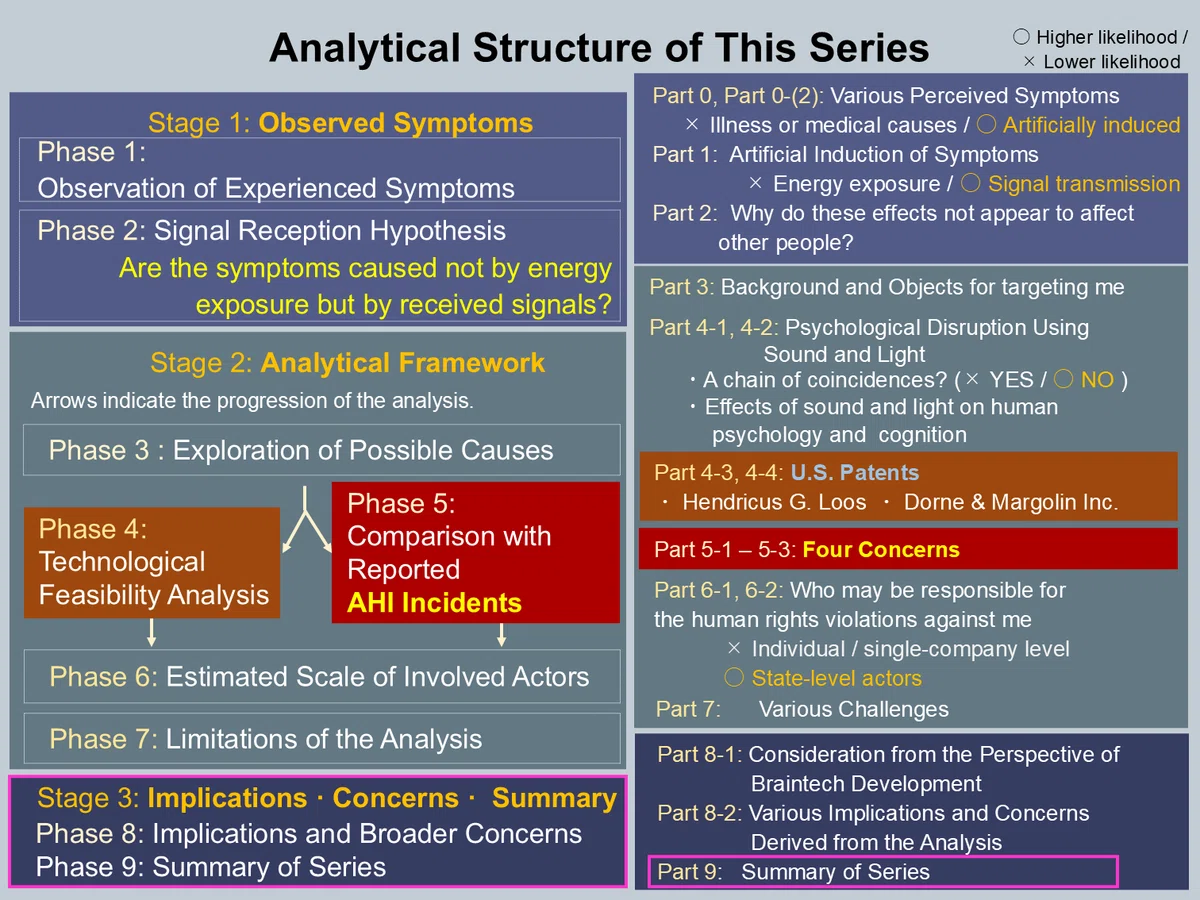
This figure shows the correspondence between the article structure of this series and the stages through which the analysis has progressed.
The discussion has developed in stages: organizing observed events, examining analytical frameworks, considering technological feasibility, and analyzing possible actors.
2-1. Stage 1: Perceived Symptoms
This series began by taking into account the fact that many of the symptoms I perceive could potentially occur due to causes such as autonomic nervous system dysfunction. At the same time, I also considered the circumstances under which my own symptoms have appeared, and presented the following observations.
2-1-1. Phase 1: Observation of Perceived Symptoms
Part 0, Part 0-2:
Assuming that various symptoms are being artificially induced may constitute a coherent interpretation.
2-1-2. Phase 2: Signal-Reception Hypothesis
Part 1:
If the symptoms are being artificially induced, they may not be occurring simply as a result of exposure to energy such as electromagnetic waves. Rather, they may be occurring as a result of interactions between signals, such as electromagnetic signals, and the nervous system.
Part 2:
As possible reasons why the artificial induction of symptoms does not affect other people, I considered several possibilities, including multiple signals, on/off signals, heightened signal sensitivity, and irradiation from close range using small devices.

2-2. Stage 2: Development of the Analysis
2-2-1. Phase 3: Consideration of the Background
Part 3:
I examined why an unknown individual such as myself might have come to be placed in this situation, as well as what the true purpose might be. In doing so, I referred to my parents’ backgrounds and past examples involving the former Japanese military and the CIA.
Ultimately, I stated that I could not avoid the conclusion that the development of fully remote-controlled braintech may be the objective.
Part 4-1, Part 4-2:
I described why the incident I refer to as “psychological disruption using sound and light,” which occurred on March 5, 2018, at a hotel in Tokyo and a nearby convenience store, is difficult to interpret as the result of a mere chain of coincidences. I also discussed the influence that this operation appears to have had on my cognition and behavior.
2-2-2. Phase 4: Possibility of Technological Realization
Part 4-3, Part 4-4:
I introduced and examined patent technologies by Hendricus G. Loos and Dorne & Margolin Inc. in order to consider whether technologies may exist that could make possible the artificial induction of various symptoms or fully remote-controlled braintech.
As a result, I concluded that the artificial induction of symptoms cannot be said to be impossible.
2-2-3. Phase 5: Comparison with AHI Incidents
Part 5-1, Part 5-2, Part 5-3:
Based on the fact that many of the symptoms I perceive overlap with various symptoms reported by AHI victims, I compared my case with AHI, focusing on their differences (Part 5-1).
I also expressed concerns regarding the hypothesis that AHI begins with a Sensory Event, as well as concerns about the possibility that some AHI victims may have been left unrecognized.
Furthermore, I suggested that the same true purpose I consider possible in my own case may also lie behind AHI (Part 5-2).
I also expressed concern that there appears to be a tendency to limit the possible actors behind AHI to hostile foreign states (Part 5-3).
2-2-4. Phase 6: Estimating the Scale of the Actors Involved
Part 6-1, Part 6-2:
When considering the actors that may be continuously committing human rights violations against me, the situation does not appear reducible to either a simple state actor, such as a single government agency, or a non-state actor, such as a single private entity.
Rather, it suggests the possibility of a complex structure involving broad coordination capacity and information-sharing.
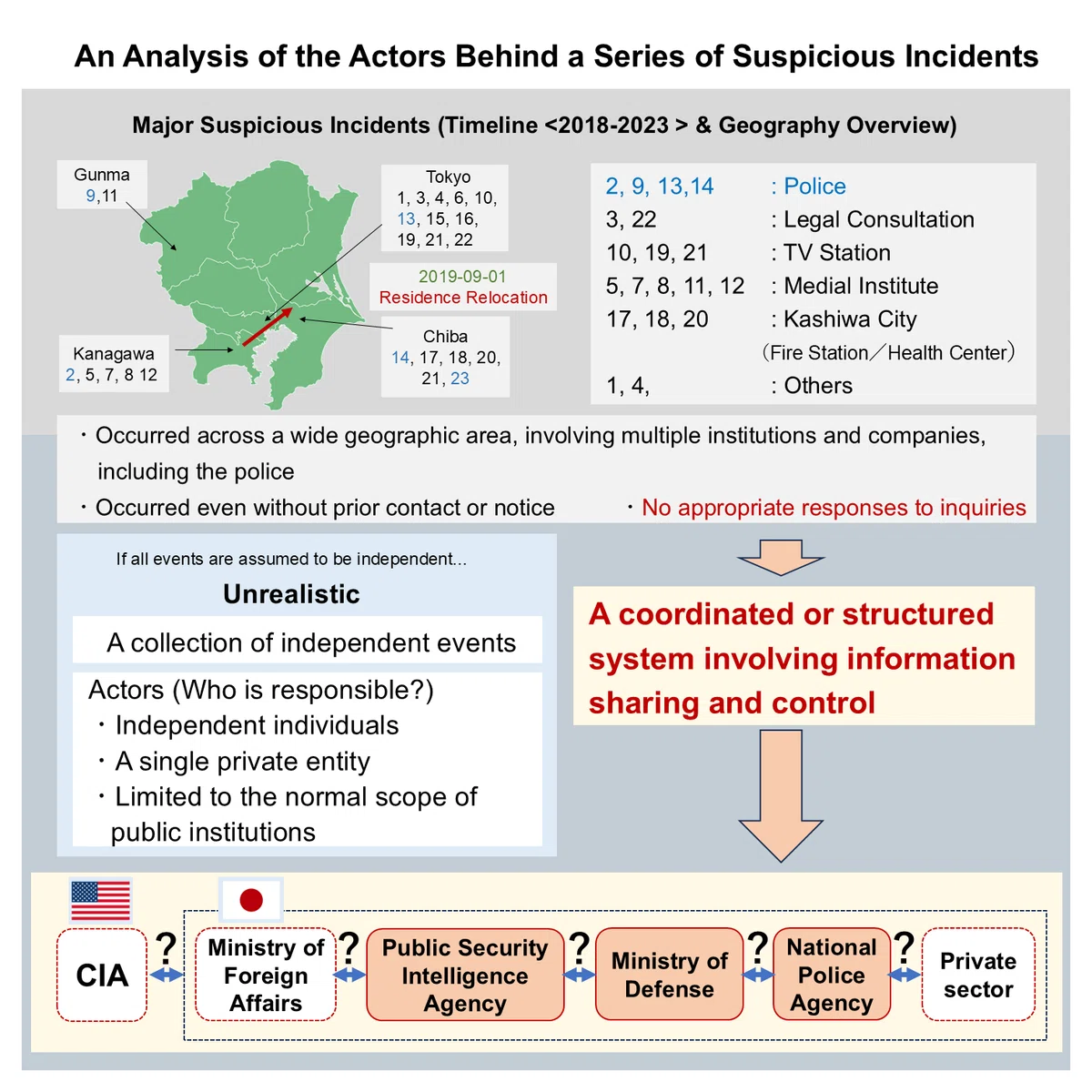
This figure conceptually organizes the possibility of structural involvement premised on control or information-sharing, based on common patterns observed across multiple institutions and companies.
This figure is a hypothetical organization of the issue and does not assert the involvement of any specific institution.
2-2-5. Phase 7: Limits of the Analysis
Part 7:
I organized the reasons why the truth of Anomalous Health Incidents (AHI) has not been clarified, and why my claims regarding human rights violations have not been publicly addressed, from the perspective of three difficulties:
the difficulty of identifying the actors due to insufficient disclosure of information;
the difficulty of recognizing victimization because the symptoms overlap with common disorders; and
the difficulty of identifying the technology used.

2-3. Stage 3: Implications, Concerns, and Summary
Phase 8: Implications and Concerns Derived from the Analysis
Part 8-1, Part 8-2:
I reconsidered the content of Parts 4 and 5, which had been examined from the perspective of AHI victims and my own human rights violations, from the perspective of brain technology development. I also examined how this perspective may relate to AHI and to my own case (Part 8-1).
As a result, I came to believe that this may constitute a point of connection with the AHI victimization situation examined up to Part 7, as well as with the true reason that may lie behind my own case.
I then organized the ethical issues that may remain hidden if the hypothesis considered in Part 8-1 is assumed, the difficulty of recognizing victimization, and the potential impact on democracy and fair competition (Part 8-2).
If we assume that the development of fully remote-controlled braintech lies behind AHI and my own case, the following possibilities may arise:
Some people who reported AHI-related harm may remain unaware of the above purpose, regardless of whether they were officially recognized as victims.
Various ethical issues may also remain hidden.
If, as a method for addressing early-stage development challenges, a technique is being used that severely disrupts the autonomic nervous system of target individuals, then the Sensory Event considered in AHI may not necessarily be essential.
Even if ordinary citizens were subjected to similar attacks, they might not realize that possibility themselves, or even if they raised their voices, their claims might not be taken seriously.
Furthermore, if fully remote-controlled braintech were to be abused, I believe it could lead to an extremely serious situation in which democracy and fair competition exist only on the surface.

3. Responsibility of Institutions, Companies, and Individuals That Possess Information
Throughout this series, I have tried to suppress definitive or emotional expressions as much as possible, while taking into account the fact that many of the events occurring around me lack clear objectivity. I have emphasized the logical structure of my inferences.
This is because I wanted to avoid having my claims misunderstood as inflammatory, and instead present them in a form that allows readers to make their own judgment.
This series began in September 2025. In the end, it has taken more than eight months. This is the result of my managing, somehow, to continue writing while continuing to experience the artificial induction of various symptoms.
I am not an expert in any field. However, on a personal level, it is clear to me that what is happening to me is not ordinary. Therefore, behind the various suspicious events I have experienced at many institutions and companies, and behind the various abnormal symptoms I have continued to perceive for many years, there must be some reason other than psychological or environmental factors.
Originally, I should not have had to conduct such detailed analysis and examination myself. The various suspicious events I have experienced involve multiple police jurisdictions, multiple medical institutions, multiple television stations, and many other institutions, companies, and citizens. They should have the ability to recognize the possibility that something extraordinary is occurring.
It is extremely regrettable that, while U.S. media outlets, journalists, and lawyers continue to struggle to clarify the truth of AHI, the matter appears to be facing the risk of being shelved because the intelligence authorities at the center of the issue are not disclosing appropriate information. At the same time, Japanese media organizations and others, which may also hold keys to clarifying the truth of AHI, continue to remain silent in response to my inquiries.
If they had responded sincerely to my inquiries, I believe I would not have had to lose my ability to work, face an eviction lawsuit that I believe may be related to this matter, and waste so much time and financial resources.

4. Final Remarks
Why do the actors causing these various events ultimately tolerate my social media postings, even while obstructing them in various ways?
One hypothesis is that, because I have been treated as an object of observation and use over a long period of time, they may believe that I still have some form of utility value going forward.
Considering that I have had various suspicious experiences since I was young, it is possible that they have accumulated a vast amount of data from me over a very long period of time. Given that research and development never truly end in any field, I infer that they may wish to continue using me in the future.
Another hypothesis is that the actors allow me to post on social media while continuing to inflict suffering on me, in order to prevent third parties from recognizing the seriousness of the situation.
Considering that nine years have already passed since AHI was publicly reported, and that AI is developing rapidly, the concerns I have expressed throughout this series may already be close to the point of no return.
If, far in the future, the actors behind AHI incidents or the human rights violations against me, as well as their true purpose, are publicly revealed in some form, I expect that it will already be completely too late with respect to the concerns described above.
I wish to avoid inflammatory wording. However, if the hypothesis is correct, I am concerned that society may one day even need defensive technologies capable of detecting or interfering with fully remote-controlled braintech signals.
Reports of new AHI incidents in the United States appear to have stopped. Those in the United States who are pursuing the truth of AHI seem to have reached an impasse because they cannot obtain sufficient and appropriate information. They also appear to be concerned that AHI may be left unresolved.
At present, Japan’s National Diet is deliberating a bill to establish a National Intelligence Council and a National Intelligence Bureau as its operational body. I am not opposed to the enactment of this bill.
However, I am left wondering who, exactly, is coordinating the events occurring to me. And if a National Intelligence Bureau is established, I remain concerned that this incident may be treated as if it never happened, just as appears to be happening with AHI in the United States.
If things continue as they are, I am concerned that society may move toward a state in which democracy and fair competition appear to be maintained in form, while in substance they are hollowed out.
For the Japanese institutions, companies, and individuals mentioned above, maintaining silence may be the safest choice.
However, if that silence delays the clarification of the truth and leaves harm and concerns unaddressed, I believe their responsibility will become extremely heavy.

Overview of the Series
For an overview of the entire series, please refer to the series guide below and the list at the end of this article.
