
Part 5-2: On the Possibility that Human Experimentation Underlies AHIs

AHI=Anomalous Health Incidents
Summary
Position of This Article within the Series
This article corresponds to the section outlined in yellow in the analytical framework of this series shown in the figure below (i.e., the scope examined in this article).
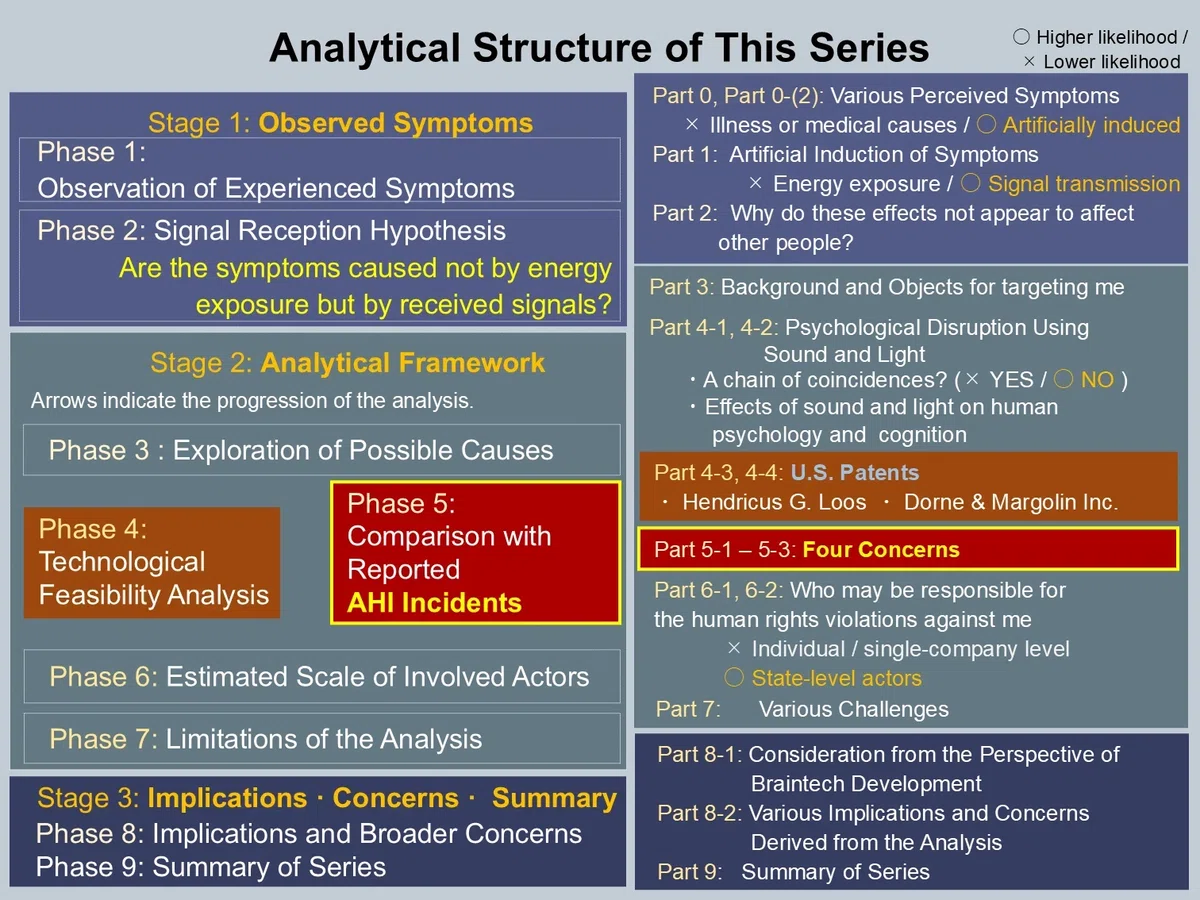
This diagram illustrates the relationship between the structure of the articles in this series and the stages of analysis.
The discussion is developed step-by-step, including the organization of observed phenomena, examination of analytical frameworks, verification of technical feasibility, and consideration of the entities involved.

Overview of the Series
For an overview of the entire series, please refer to the series guide below and the list at the end of this article.

Overview of This Article
In Part 5-2, I discuss the possibility that, among both individuals who have been recognized as AHI victims and those who have not, there may be people who—like myself—have been used as subjects in human experimentation.
This article does not presuppose any specific conclusion. Instead, it aims to examine this issue based on publicly available information and technical knowledge.
Note: This article is not a scientific paper written by experts, but a personal analysis conducted by an individual directly involved, based on my own records and publicly available information.
Note: Following the publication of the series guide, the summary section and Chapter 1 of this article was substantially revised on March 23, 2026.

1. Introduction
In Part 5-(1), published on January 30, 2026, I presented two concerns arising from similarities and differences between AHI victims’ symptoms and those I have perceived:
Concern (1): Is the AHI hypothesis correct?
Concern (2): Have some victims been overlooked?
In Part 5-(1), published on January 30, 2026, I presented two concerns based on similarities and differences between symptoms reported by AHI victims and those I have perceived:
Concern (1): Is the AHI hypothesis correct?
Concern (2): Have some victims been overlooked?
In this article, I present a third concern based on my own experiences. Drawing on publicly available information and technical considerations, I examine the possibility that some AHI-related or AHI-like cases may involve elements of intentional human experimentation.

2. Concern (3): Possible Selection of Human-Experiment Subjects Behind AHIs
My third concern is that not only recognized AHI victims but also some individuals who were not officially recognized may have been used as subjects in human experimentation, as I believe may be the case for me.
Since AHIs were first reported in 2016, many individuals—including embassy personnel and their families—have continued to report harm over several years. Meanwhile, the U.S. government’s disclosures and efforts to determine the cause have appeared limited or cautious. Historical precedent also exists: the CIA’s human experimentation program MK-ULTRA operated for years before becoming public, and many related documents were later destroyed.
Against this background, it is understandable that such concerns might arise.
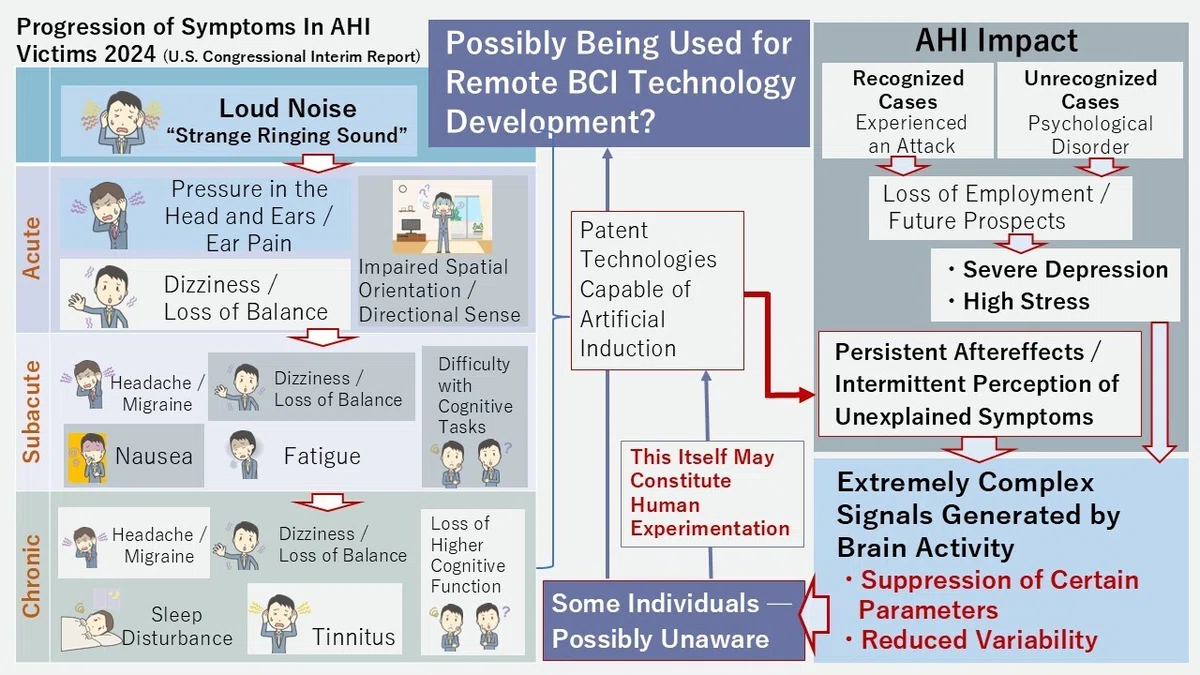
This conceptual diagram outlines the reported transition from acute to chronic symptoms among AHI victims, alongside potential psychological and social consequences experienced by both recognized and unrecognized cases. It suggests that prolonged stress and persistent unexplained symptoms may alter patterns of brain activity, potentially reducing signal variability and making neural processes easier to monitor or influence. The figure also highlights the possibility that such conditions could inadvertently serve as a form of human experimentation without the subject’s awareness.
Many recognized AHI victims—and even those not recognized—may feel that they have lost their careers and future prospects, leading to severe depression and stress. If they also continue to experience unexplained symptoms or long-term aftereffects, these psychological burdens may intensify.
Signals generated by brain activity are extraordinarily complex. However, psychiatry and neuroscience widely acknowledge that prolonged depression or stress can alter patterns of brain activity. Under such conditions, certain parameters of neural signals may be suppressed or their variability reduced, potentially making brain activity easier to monitor or control.
I believe that among those who reported AHI harm, there may be individuals whose brain activity becomes unusually easy to observe in this way—people like myself.
(Hypothetical framework)
Individual-specific and highly complex brain activity
→ Strong stress
→ Partial suppression or attenuation of certain signals
→ In some individuals, brain activity may become easier to monitor or influence
If research and development of remote brain-computer interfaces (BCIs) underlies AHIs, as suggested by my experiences, it may not target everyone indiscriminately but rather select individuals whose brain activity is comparatively easier to monitor or influence.
The illustration below summarizes this hypothesis.
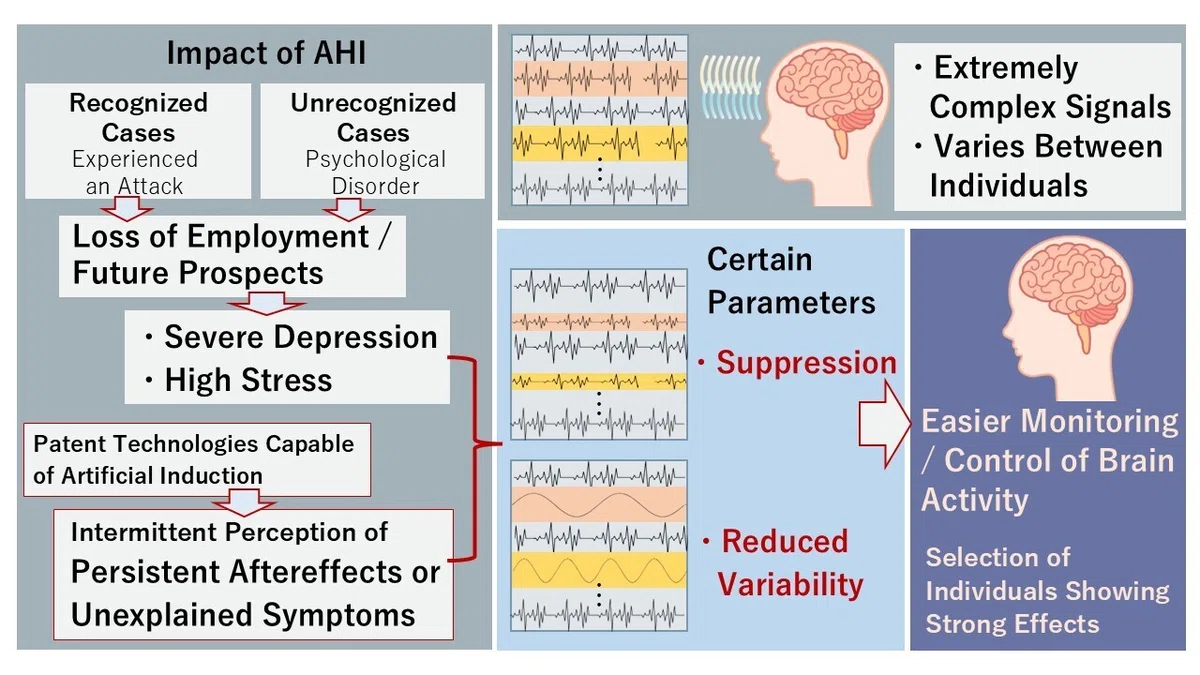
The diagram proposes that individuals experiencing severe psychological stress, loss of social stability, and continuing unexplained symptoms may exhibit changes in neural signal parameters—such as suppression of certain components or reduced variability—thereby making brain activity comparatively easier to analyze or influence. It also suggests that individuals showing stronger effects may be selectively targeted or identified, although this remains a hypothesis.

3. The Nuremberg Code and the Declaration of Helsinki
Part 3 introduced the CIA’s secret program MK-ULTRA, which involved human experimentation and operated from 1953 until the mid-1960s before being exposed through congressional investigations.
(Britanica MK-ULTRA CIA mind-control program)
The Nuremberg Code (1947), addressing medical experiments on human subjects, states that:
The voluntary consent of the subject is absolutely essential.
Experiments must avoid all unnecessary physical and mental suffering.
The Nuremberg Code is a set of ethical principles articulated in the judgment of the trials held after World War II in response to the unethical human experiments conducted by Nazi researchers on prisoners held in concentration camps.
The Declaration of Helsinki, adopted by the World Medical Association, likewise requires that participation in medical research be based on free and informed consent. It allows limited exceptions—such as proxy consent—only under strict conditions when individuals lack the capacity to consent.
The Nuremberg Code (1947 judgment version and 1949 published version) and the Declaration of Helsinki (2024 revision) are widely available in English through official sources.

4. Victims May Not Realize They Are Being Experimented On
Many recognized AHI victims likely interpret their symptoms as aftereffects of the event they experienced.
Those not recognized as victims may attribute their symptoms to stress or psychological factors.
In either case, it would be difficult for individuals to suspect that some of their symptoms—or the experiences themselves—might have been artificially induced, let alone used to monitor or influence brain activity.
If such a structure were to exist, covert experimentation could occur without subjects’ awareness, rendering informed consent meaningless.
I believe I began to suspect I was being experimented on around 2014. By March 2018, following what I describe as psychological destruction operations using sound and light, I became convinced of it. I only began to recognize possible technical aspects around 2023.
If unrecognized AHI cases include individuals used as experimental subjects, my situation may resemble that category. This will be discussed separately.
Conversely, if such operations are considered another form of AHI “event,” my case may also resemble recognized AHI cases.

5. Conclusion
This article has examined the possibility that some AHI-related or AHI-like cases may involve elements of intentional human experimentation.
AHI victims and complainants include U.S. personnel and their families. Reports of suspected incidents continued for years, yet perpetrators and causes remain unidentified, and information appears fragmented.
Regardless of who may be responsible, it seems unlikely that the primary purpose was simply to demonstrate technological superiority or exert political pressure by harming U.S. personnel.
There are similarities between the symptoms reported by AHI victims and those I have experienced. Patented technologies exist that could theoretically induce such symptoms artificially. I also perceive parallels between official responses to AHIs and the responses I received from various institutions when I sought help.
Taken together, these factors make it difficult to rule out the possibility that organized activity—including actions equivalent to human experimentation—may underlie AHIs, potentially aimed at developing technologies capable of remotely monitoring and influencing human brain activity (remote BCI).
Acute, subacute, and chronic symptoms could, in principle, be artificially induced. Even if identical stimuli were applied to multiple individuals, responses might differ depending on the person.
In this sense, inducing such symptoms itself could constitute human experimentation.
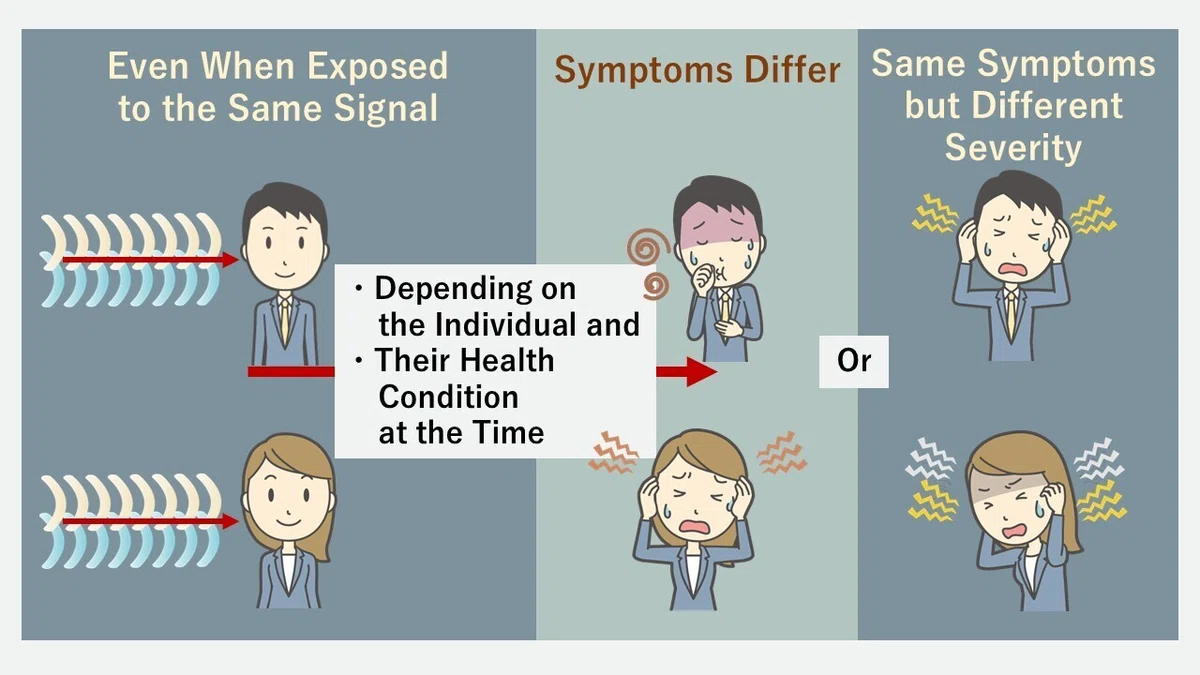
Even when exposed to the same signal, individuals may experience different symptoms or similar symptoms with varying degrees of severity, depending on personal factors and health status at the time. This variability highlights the difficulty of interpreting symptom patterns and underscores the possibility that uniform external inputs could produce heterogeneous outcomes across a population.
Taken together, these considerations suggest that AHIs should not be explained by a single hypothesis alone, but require examination from multiple possible perspectives.

6. Future Plans
In Part 5-(3), I plan to examine another concern: whether AHIs could represent attacks by hostile states.
<Update: March 10, 2026>
On March 9, 2026, I published Part 5-(3) as a continuation of the series.

