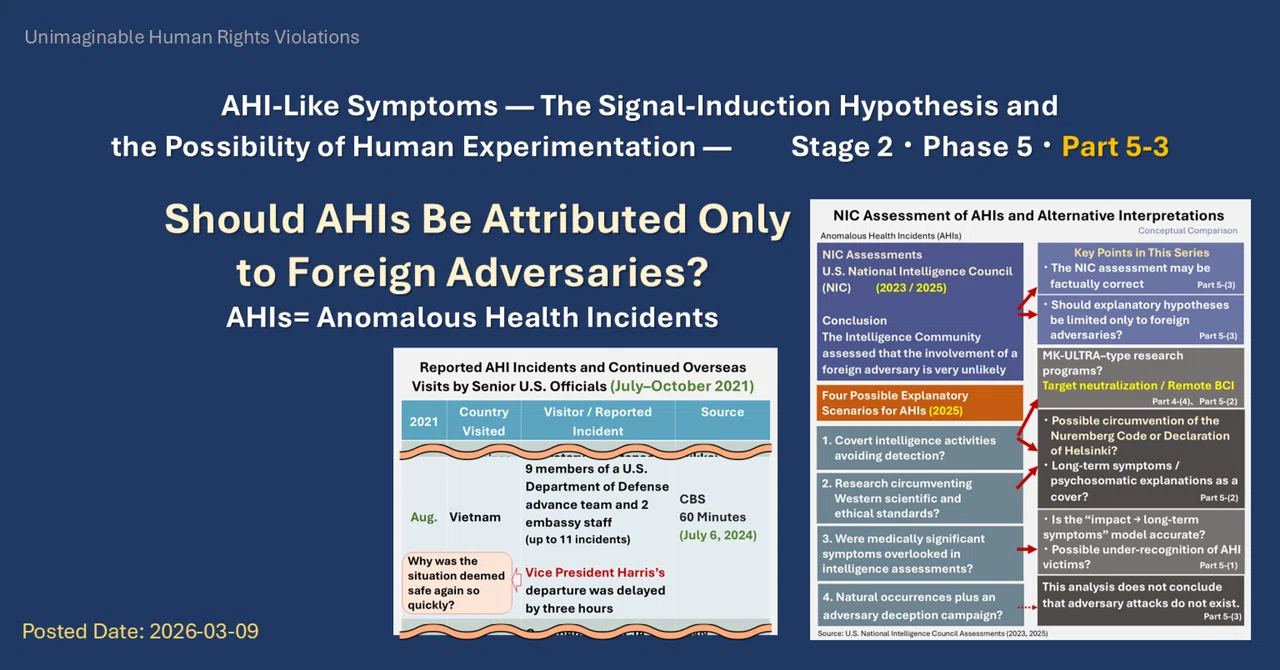
Part 5-3: Should AHIs Be Attributed Only to Foreign Adversaries?

AHIs = Anomalous Health Incidents
Summary
Position of This Article within the Series
This article corresponds to the section outlined in yellow in the analytical framework of this series shown in the figure below (i.e., the scope examined in this article).
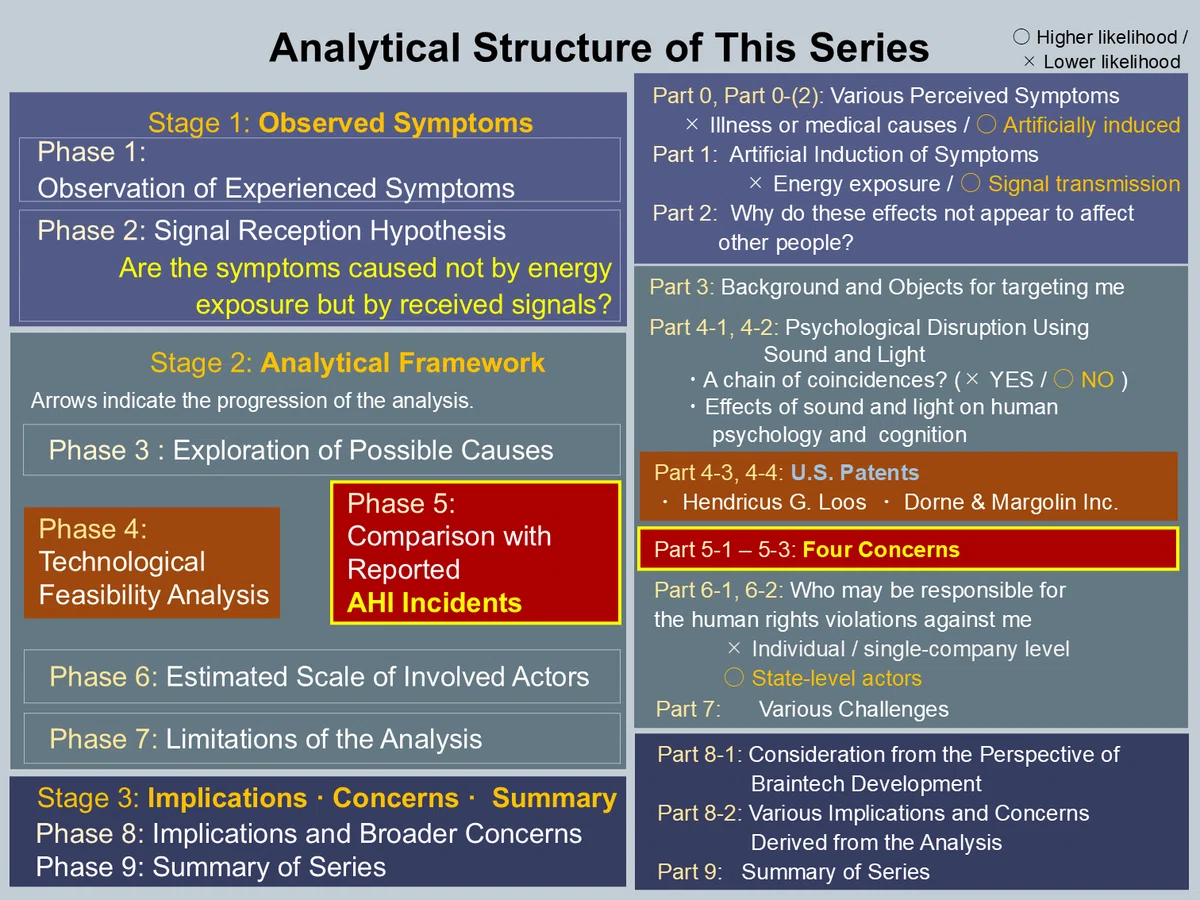
This diagram illustrates the relationship between the structure of the articles in this series and the stages of analysis.
The discussion is developed step-by-step, including the organization of observed phenomena, examination of analytical frameworks, verification of technical feasibility, and consideration of the entities involved.

Overview of the Series
For an overview of the entire series, please refer to the series guide below and the list at the end of this article.

Overview of This Article
Based on the discussions so far, this article organizes a fourth concern:
whether it is appropriate to interpret the causes of AHIs solely as attacks by foreign adversaries, or whether other possibilities should also be considered.
In particular, the analysis is conducted in light of the following points:
・ The possibility that powerful actors may be involved in the background of the extraordinary human-rights violations I have described
・ The fact that, despite repeated AHI reports, overseas visits by senior U.S. officials were not cancelled
・ The historical existence of MK-ULTRA in the United States
・ Research conducted by the U.S. Army related to brain function and control
・ The existence of U.S. patents that do not rely on microwave-based energy
Taken together, these points suggest the need to re-examine whether it is appropriate to limit explanations of AHIs to a single framework.
Note:
This article is not a scientific paper written by specialists.
It is an examination conducted by an individual directly involved, based on personal records and publicly available information.
Similarly, the literature cited in this series is not analyzed from a specialist standpoint but is organized based on my personal interpretation of publicly available sources.
Note: Following the publication of the series guide, the summary section of this article was substantially revised on March 23, 2026.

1. Introduction
In Part 5-1 (January 30, 2026), I compared symptoms reported by AHI victims with symptoms I have personally perceived and presented two concerns:
Personal Concern (1): Is the current explanatory model of AHIs correct?
Personal Concern (2): Have some victims been overlooked?
In Part 5-2 (February 26, 2026), I discussed:
Personal Concern (3): The possibility that some AHI cases may involve the selection of subjects for human experimentation.
In this article, building upon the discussions in Parts 5-(1) and 5-(2), I examine public assessments issued by U.S. intelligence agencies regarding the causes of AHIs, as well as criticisms of those assessments.
In particular, I examine whether it is appropriate to limit explanations of AHIs solely to attacks by foreign adversaries.

2. The Hypothesis of Foreign Adversary Attacks
U.S. intelligence agencies have assessed that the involvement of foreign adversaries in AHIs is “very unlikely.”
However, individuals working to investigate AHI cases and assist victims have expressed dissatisfaction with the limited disclosure of information.
Many of them continue to regard foreign adversary attacks as a plausible explanation.
2-1. Family Members of Diplomats Also Affected
Given that many U.S. diplomats and intelligence personnel have reported symptoms, it is understandable that many observers initially assume the possibility of foreign adversary attacks.
Diplomats and intelligence personnel are engaged in national-security work, and if a foreign state attempted to conduct intimidation or attacks using advanced technology, they could reasonably become potential targets.
However, one point that deserves careful consideration is that family members of diplomats have also reported similar symptoms.
If these incidents were part of a foreign operation, targeting diplomats themselves might appear strategically reasonable.
But the widespread involvement of family members raises additional questions.
This suggests that the issue should be reconsidered:
whether AHIs can truly be explained solely within a foreign-adversary attack framework, or whether multiple factors may need to be considered.

3. Technological Background and Historical Cases
In discussions about AHIs, explanations focusing on foreign adversary attacks have often been emphasized.
However, when considering the historical development of technologies capable of influencing human perception and physiology, as well as the structure of military research programs, the situation may not necessarily be explained within such a simple framework.
Taken together, the points discussed in Sections 3-1 through 3-4 suggest that it may be premature to limit discussion of AHI causes only to foreign adversaries.
3-1. Research on Technologies Affecting Neural and Sensory Systems
The research papers and patents introduced in my previous articles were produced by American researchers.
These technologies appear primarily intended for medical applications, but they may also be adaptable for incapacitating targets.
Some of Loos’s patents, for example, explicitly mention incapacitation as a potential objective.

3-2. Biological-Effects Research by Military and Intelligence Organizations
A program broadcast by the German public broadcaster DW on October 9, 2021 discussed brain-computer interfaces (BCIs).
The report noted that BCI technologies are also being explored for military purposes.
Research aims include the ability to influence soldiers’ anxiety or aggression, or even suppress the perception of pain.
According to the report, U.S. Army laboratories have been intensively researching such applications since 2010.
This technology also lends itself to other uses like military purposes. The helmets shown in this film have electromagnets, as used in EEG. These are supposed to be able to control the brains of soldiers in the future in order to influence their anxiety or their aggression. What about pain? Can you stop me feeling it? U.S. Army laboratories have been intensively researching such applications since 2010. This is really happening.

3-3. Research Cooperation Among Allied Countries
As will be explained briefly in Part 7, the human-rights violations I believe I have experienced appear unlikely to have been carried out by individual actors or private organizations acting alone.
Furthermore, as discussed in Part 0, the various symptoms I have perceived over many years appear more reasonably interpreted as artificially induced.
At the same time, considering the technological background discussed in Sections 3-1 and 3-2, it would be difficult to assume that technologies capable of inducing such symptoms were developed within Japan alone.
However, cooperation between Japanese organizations and non-allied foreign actors in developing such technologies seems unlikely.
Similarly, it would be difficult to imagine U.S. organizations cooperating with adversary states in developing technologies intended for military incapacitation.

3-4. Historical Cases of Human Experimentation
In Part 3, I introduced the CIA’s secret program MK-ULTRA as a historical example of human experimentation.
Most documents related to MK-ULTRA were destroyed in 1973 by order of the CIA director at the time.
However, documents later released contain the following statement:
“to manipulate an individual’s mental state and alter brain function”
These historical examples suggest that it may also be inappropriate to categorically dismiss the possibility of state involvement in certain forms of human-rights violations.

4. Questions Raised by Case Examples
4-1. AHI Reports Before Visits by Senior U.S. Officials
The figure below summarizes reported AHI incidents and foreign visits by senior U.S. officials between July and October 2021.
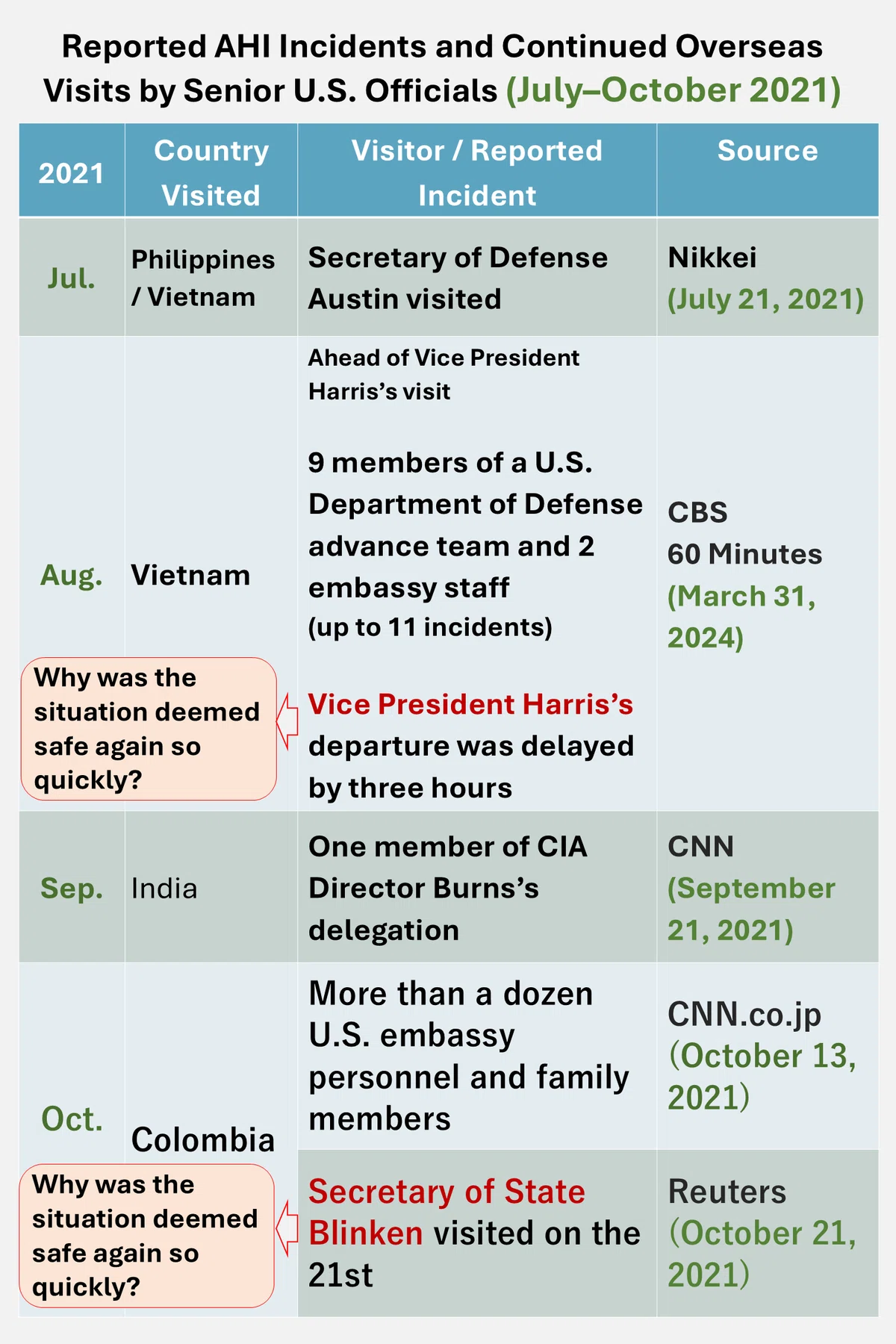
In August 2021, Vice President Kamala Harris visited Vietnam.
Shortly before the visit, reports emerged that two embassy staff members and nine members of a pre-visit advance team experienced symptoms suspected to be AHIs.
Despite these reports, the Vice President’s visit was delayed only three hours.
Similarly, in October 2021, more than a dozen U.S. embassy staff members and family members in Colombia reportedly experienced suspected AHI symptoms.
Nevertheless, Secretary of State Antony Blinken proceeded with a scheduled visit to the country.
During a three-month period, more than twenty U.S. personnel and their family members reportedly experienced suspected AHI symptoms.
Despite this, visits by senior officials were not cancelled.
If the possibility of foreign adversary attacks had been strongly assumed, one might question whether such visits would have proceeded as planned.
This again raises the question of whether AHIs can be explained solely within a foreign-adversary attack framework, or whether additional factors should be considered.

5. Scenarios Presented in the NIC Report
Against this background, it is useful to examine how the U.S. intelligence community itself has assessed the possible causes of AHIs.
Considering the points discussed above, it appears necessary to carefully examine the claim that AHIs were caused by attacks by a specific foreign adversary.
In fact, U.S. intelligence agencies have conducted investigations and released the following assessment.
the National Intelligence Council (NIC) stated that most intelligence agencies concluded:
Based on the results of these three lines of inquiry, most IC agencies have concluded that it is “very unlikely” a foreign adversary is responsible for the reported AHIs.
The NIC maintained its earlier conclusion that foreign adversary involvement is unlikely.
However, in its 2025 update, the U.S. intelligence community also outlined four possible scenarios to explain AHIs.
1. A covert intelligence activity evading detection
2. A scientific breakthrough that circumvents Western scientific and ethical standards
3. Critical medical symptoms relevant for the IC to evaluation were hidden among more common symptoms
4. Early natural incidents inspired an adversary to develop a harassment device as part of a deception campaign
Among these scenarios, (1) through (3) appear consistent with the concerns raised throughout this series.
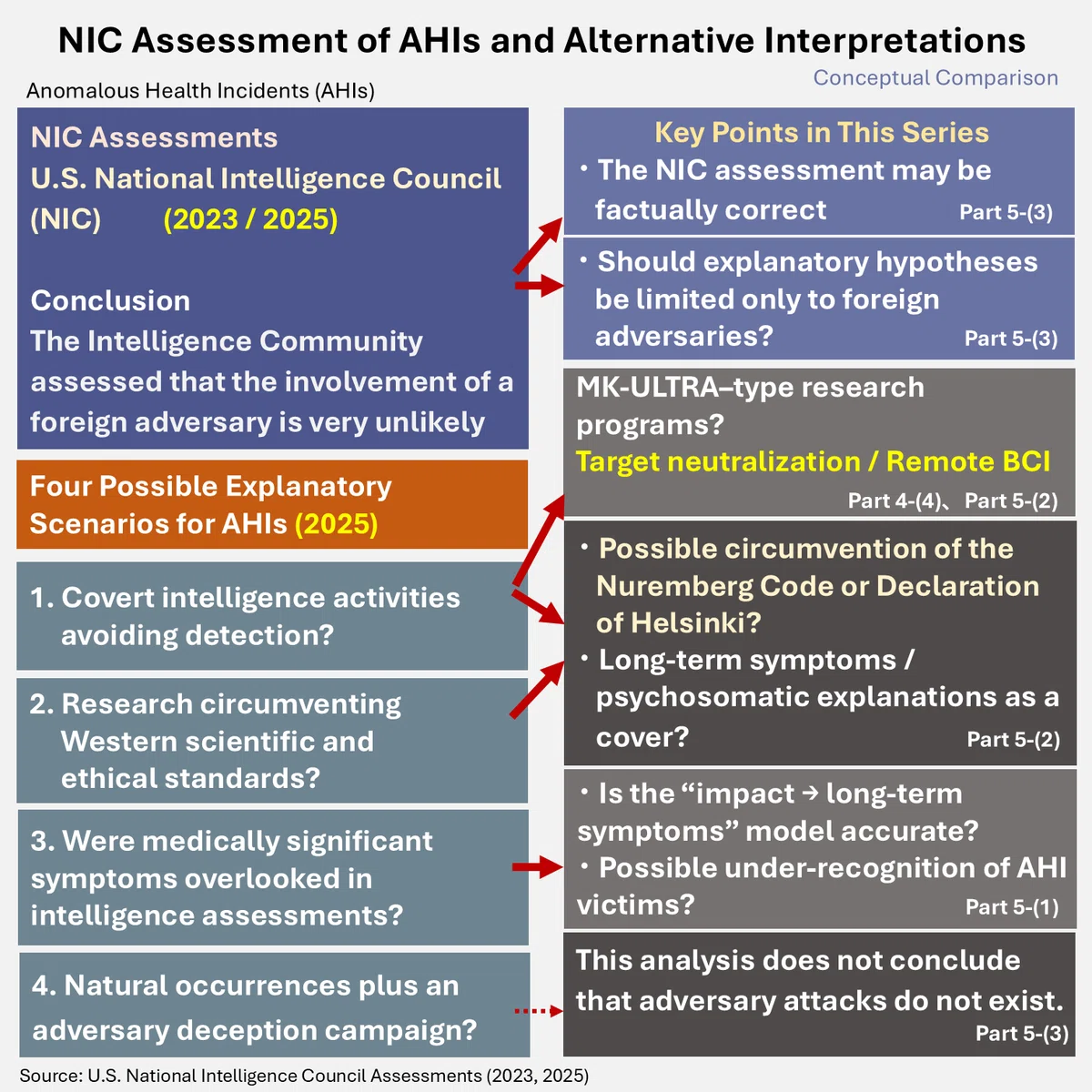
These observations suggest that AHIs may need to be examined from perspectives beyond the foreign adversary hypothesis.
This raises broader questions about whether existing analytical frameworks fully capture the range of possible explanations.

6. Conclusion
Therefore, when considering the background causes of AHIs, it may be inappropriate to rely exclusively on the explanation of foreign adversary attacks.
Instead, continued examination based on publicly available research and greater transparency in information disclosure appears necessary.
The multiple scenarios presented by the NIC also highlight the importance of evaluating the issue across a broad range of possibilities.
At present, many discussions appear to focus primarily on the possibility of foreign adversary attacks.
However, when considering together:
the composition of victims and the continuation of overseas visits by senior officials,
research on technologies affecting neural and sensory systems,
biological-effects research by military and intelligence agencies,
cooperation among allied countries, and
historical cases of human experimentation,
it may be advisable to re-examine the issue without restricting the explanation solely to foreign adversaries.
At the same time, it cannot be completely ruled out that adversaries may exploit the ongoing uncertainty surrounding AHIs.
Therefore, this article does not claim that foreign adversary attacks do not exist.
Rather, it questions whether it is appropriate to limit discussion exclusively to that explanation.
Ultimately, the issue of AHIs is not only a medical or diplomatic matter, but also relates to the future use of neurotechnology and the protection of human rights.

7. Future Topics
In the following parts, based on the analytical structure of this series, I will examine the following issues:
The actors responsible for the human-rights violations I have described
The implications if AHI symptoms can be artificially induced
The remote BCI technologies that I personally consider a concern
The potential risks if such technologies become widely used
<Update: March 29, 2026>
On March 27 and March 28, 2026, I published Part 6-1 and 6-2, respectively as a continuation of the series.

