
Part 5-1: Differences Between the Symptoms of Anomalous Health Incidents (AHIs) Victims and Myself — Symptoms and Concerns

AHI=Anomalous Health Incidents
Summary
Position of This Article within the Series
This article corresponds to the section outlined in yellow in the analytical framework of this series shown in the figure below (i.e., the scope examined in this article).
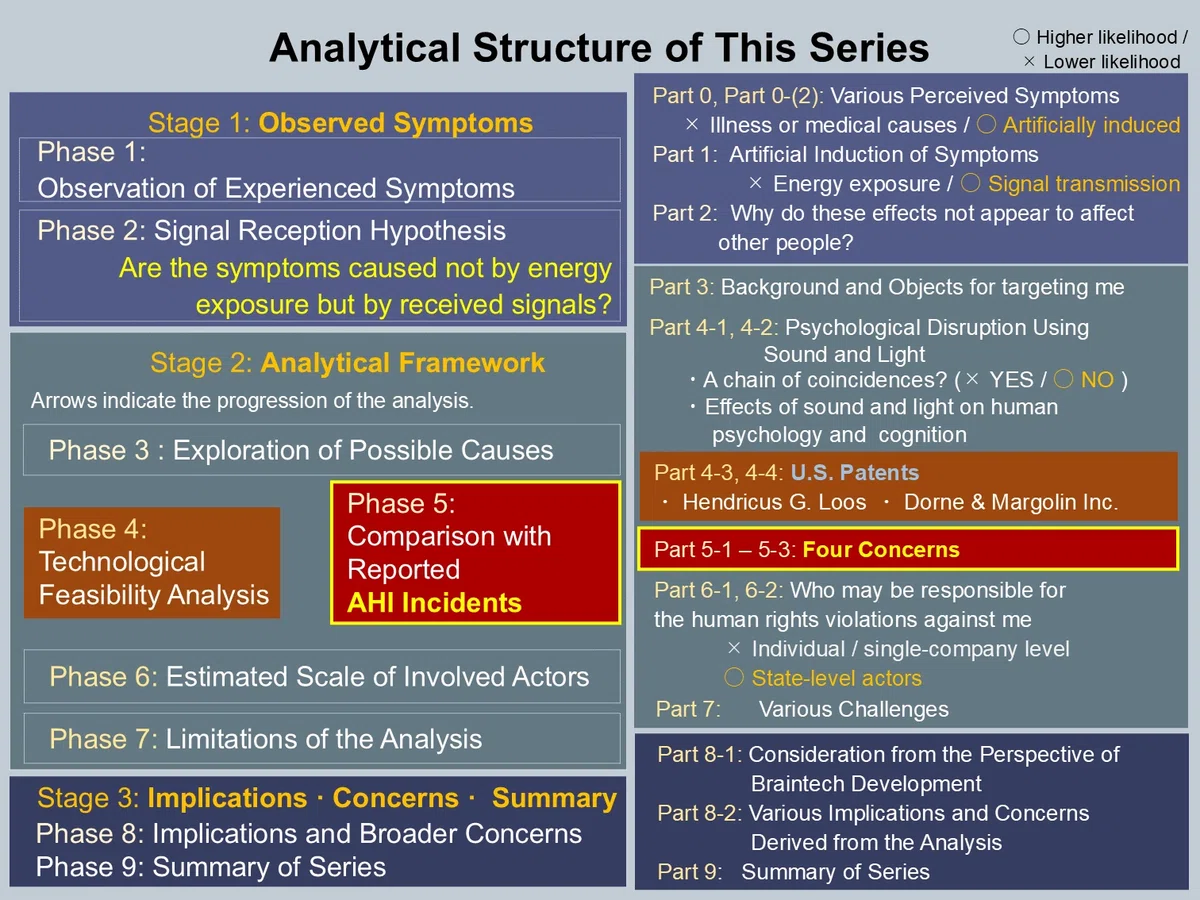
This diagram illustrates the relationship between the structure of the articles in this series and the stages of analysis.
The discussion is developed step-by-step, including the organization of observed phenomena, examination of analytical frameworks, verification of technical feasibility, and consideration of the entities involved.

Overview of the Series
For an overview of the entire series, please refer to the series guide below and the list at the end of this article.

Overview of This Article
In Part 5-(1), I compare the symptoms reported by victims of Anomalous Health Incidents (AHIs) with the various symptoms and phenomena I have perceived over many years.
Based on the differences between them, I explain my personal concerns regarding whether the prevailing hypothetical models of AHIs are in fact valid, and whether there may be unrecognized victims who have not been properly identified.
This article does not assume any predetermined conclusion; rather, its purpose is to examine these issues based on publicly available information and technical knowledge.
This article is not a research paper authored by specialists. It is an analysis conducted by an individual directly concerned, based on personal records of lived experience and publicly available information.
Note: Following the publication of the Series Guide, the Summary and Chapter 1 of this article were substantially revised on March 22, 2026.


1. Introduction
In this article, I explain the differences between the symptoms of victims of Anomalous Health Incidents (AHIs) and my own, as well as the concerns I hold regarding the AHI incidents.
Drawing on my own experiences, I present this analysis based on the considerations developed throughout this series.

2. The 2022 JASON Report
In February 2022, the scientific advisory group known as JASON, which provides advice to the U.S. federal government, published an analysis and hypotheses concerning Anomalous Health Incidents (AHIs)
(An Analysis of Data and Hypotheses Related to the Embassy Incidents, hereafter referred to as the “JASON Report 2022”).
In this report, AHIs are described as “the Embassy Incidents,” likely because the analysis was based on data from U.S. embassy personnel affected in Havana, Cuba.
In the appendix of the report, a questionnaire for incident reporting is proposed, listing the following primary subjective symptoms:
Sound
Pressure (specify location on the body)
Heat sensation (specify location on the body)
Pain (specify location on the body)
Smell (describe)
Physical sensations such as buffeting or vibration
Ringing in the ears
Nausea
Dizziness
Headache
What I wish to emphasize in this section is that I have experienced almost all of the symptoms listed in this questionnaire, and that some—such as tinnitus and pain—are symptoms I continue to perceive on an almost daily basis.
Previously, I summarized my own responses to this questionnaire in a separate note article.
Although there may be additions or corrections to my earlier responses, I have not attempted to force my experiences to fit the AHI framework.
Regardless of whether my case is ultimately related to AHIs or not, I am aware that providing inaccurate explanations could hinder future clarification of the truth.

3. Interim Report from the 2024 U.S. Congressional Hearing
In December 2024, the U.S. House Permanent Select Committee on Intelligence (HPSCI) released an interim report concerning Anomalous Health Incidents, commonly referred to as “Havana Syndrome.”
https://intelligence.house.gov/uploadedfiles/unclassified_ahi_report.pdf
The report states that the symptoms observed in AHI victims show a stage-based progression, in which subacute and chronic symptoms are regarded primarily as aftereffects.
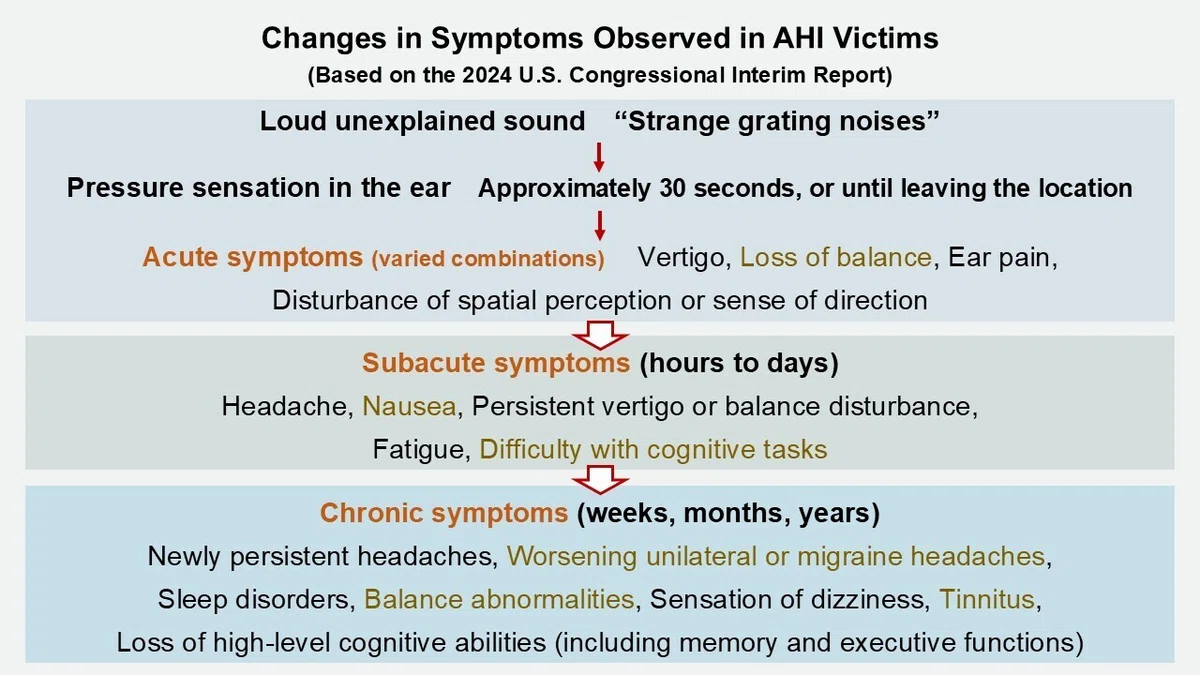
Interim Report by Chairman Rick Crawford, Subcommittee on the Central Intelligence Agency,
House Permanent Select Committee on Intelligence, U.S. House of Representatives
(Overview, December 2024)
Note on terminology used in this article
For the purpose of explanation in this article, I refer to the sudden sensory abnormalities (such as sound or pressure sensations) perceived immediately before the onset of acute symptoms as “impact.”

4. Differences Between My Symptoms and Those of AHI Victims
In short, the key difference lies in whether symptom onset follows a staged progression.
In the case of individuals identified as AHI victims, symptoms are categorized into stages:
Impact → Acute symptoms → Subacute symptoms → Chronic symptoms
In contrast, the various symptoms I have experienced cannot be clearly distinguished according to such stages.
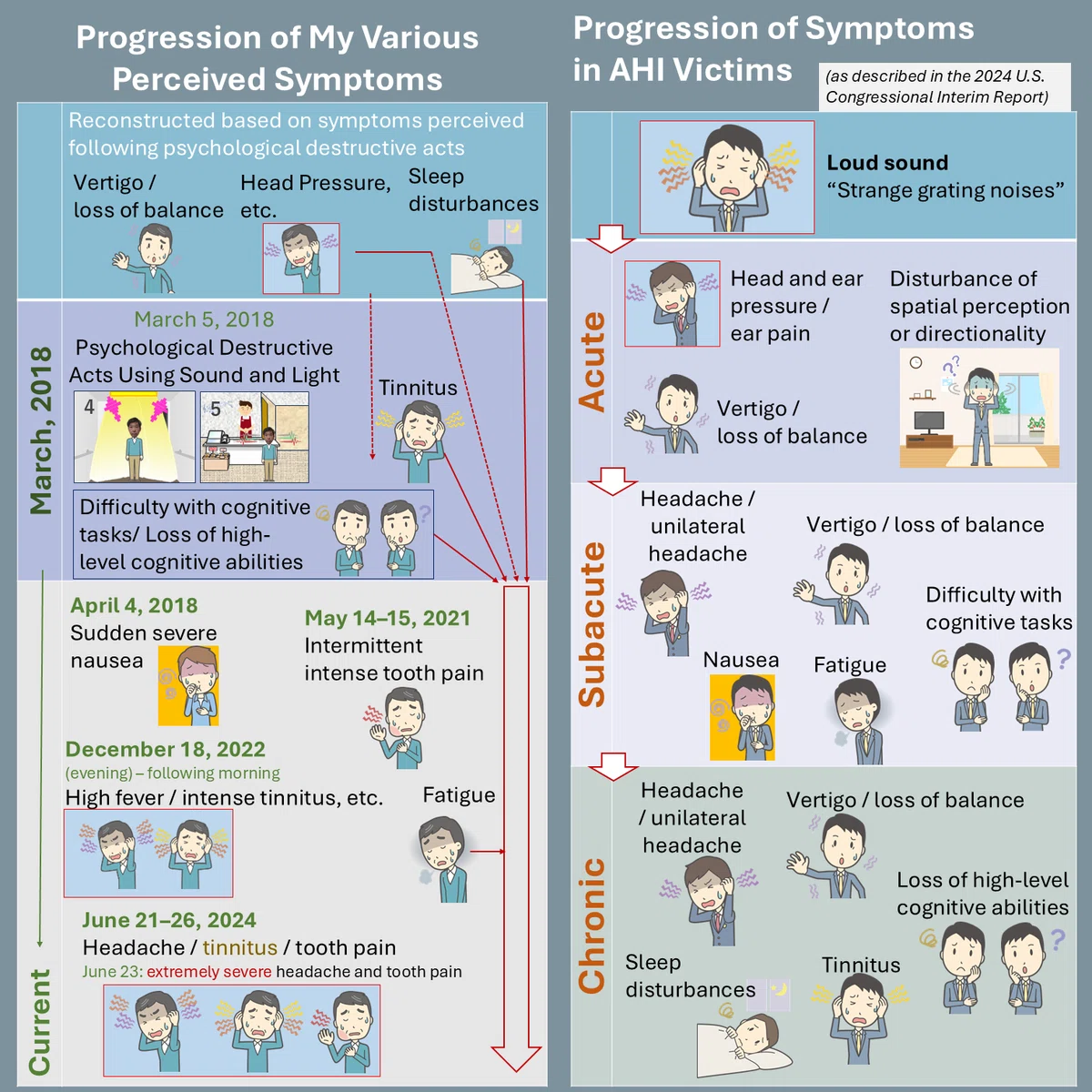
This figure is intended to illustrate differences in the order and overlap of symptom onset, not the severity of symptoms.
Figure 2 compares the progression of symptoms reported by AHI victims with representative symptoms that I have perceived or have previously experienced.

4-1. Phenomena Considered Comparable to “Impact” in AHI Victims
Severe tinnitus
I previously analyzed and published a note article in February 2025 explaining why the tinnitus I experience cannot reasonably be attributed to illness.
” The Cause of Tinnitus Attacks Is Not a Disease "
On the evening of December 18, 2022, continuing through the following morning, I experienced extremely intense tinnitus.
It was so severe that I felt there was a real risk of losing my sanity if it continued.
Unlike my usual tinnitus, this sensation felt as though it was occurring inside my head itself.
Although I also had a high fever at the time, other symptoms and phenomena—such as genital pain—were present simultaneously, making it unlikely that the tinnitus was merely a result of fever.
In other words, during this episode I continuously perceived a powerful sound over an extended period—something comparable to the stimulus believed to trigger acute symptoms in AHI victims.

4-2. Phenomena Considered Comparable to Acute / Subacute Symptoms
4-2-1. Severe headache
In June 2024, I again experienced intense tinnitus, extreme tooth pain, and severe headaches.
The pain was so unbearable that I seriously contemplated suicide.
As discussed in my July 2024 article “Toothache and Headache Attacks,” if tooth pain were caused by cavities or periodontal disease, it would not resolve without treatment.
For this reason, I believe the tooth pain was highly likely to have been artificially induced.
If so, the headache may not have been caused directly by the tooth pain either.
Notably, this severe headache occurred more than a year and a half after the episode I consider comparable to the AHI “impact” event.
4-2-2. Nausea
On the morning of April 4, 2018, while riding a crowded train, I suddenly became extremely unwell and was forced to get off the train.
Although it had been some time since I last rode a crowded train, I had experienced such conditions many times during my student years.
After sitting on a bench on the platform and letting several trains pass, I was eventually able to board again.
I examined the reasons why this episode was likely artificially induced in an article published in October 2024.
This symptom therefore corresponds to what would be considered a subacute symptom in AHI victims.
However, importantly, this episode occurred before I experienced phenomena comparable to the AHI “impact.”

4-3. Symptoms Not Dependent on a Fixed Order
Taken together, in my case, symptoms corresponding to impact events, acute symptoms, and subacute symptoms reported in AHI victims appear not to occur as aftereffects of a single triggering incident, but rather to arise independently and without a consistent sequence.

5. Personal Concerns Regarding the AHI Incidents
A defining characteristic of reported AHI cases is that symptoms progress step by step from acute to subacute and then to chronic stages, with chronic symptoms regarded as aftereffects.
In contrast, my experience involves repeatedly perceiving severe headaches or dramatic amplification of tinnitus while already experiencing symptoms such as tinnitus, localized bodily pain or pressure, and declines in cognitive or thinking ability.
The greatest obstacle to clarifying the true nature of AHIs is, in my view, the failure of U.S. government agencies to disclose information appropriately.
For reference, in January 2025, the National Intelligence Council (NIC) published an updated assessment on AHIs as of December 2024.
https://www.dni.gov/files/ODNI/documents/assessments/NIC-Unclassified-ICA-Updated-Assessment-AHI-December2024.pdf
Based on the similarities and differences between the symptoms reported by AHI victims and those I have experienced, I would like to outline my personal concerns below.

5-1. Personal Concern (1): Is the AHI Hypothesis Correct?
One of my concerns is whether the prevailing hypothesis—that AHI victims suffered neurological damage after experiencing an “unexplained loud sound”—may itself be obstructing accurate identification of the true cause.

5-2. Personal Concern (2): Are Victims Being Overlooked?
Another concern is that individuals whose experiences did not conform to the prevailing hypothesis may not have been officially recognized as AHI victims, despite the possibility that they were in fact affected.

6. Conclusion and Future Plans
Although many of the symptoms reported by AHI victims overlap with those I have experienced, differences in how those symptoms emerged raise serious questions regarding the current causal hypothesis and the potential for unrecognized victims.
I have additional concerns beyond those discussed here, which I intend to discuss in a subsequent article.
<Update: March 10, 2026>
On February 26, 2026, I published Part 5-(2) as a continuation of this series.
<Update: March 22, 2026>
On February 6, 2026, I published Part 6 as an interim review summarizing the content from Part 0 through Part 5-(1).
However, following the publication of the “Series Guide” on March 17, 2026, that article has been set to private.
Part 6 is planned to be republished in the future under a new theme.

