
Part 4-3: ― the Patents of Hendricus G. Loos ― Technologies Related to Effects on the Human Body Through “Sensory Resonance”

Summary
Position of This Article within the Series
This article corresponds to the section outlined in yellow in the analytical framework of this series shown in the figure below (i.e., the scope examined in this article).
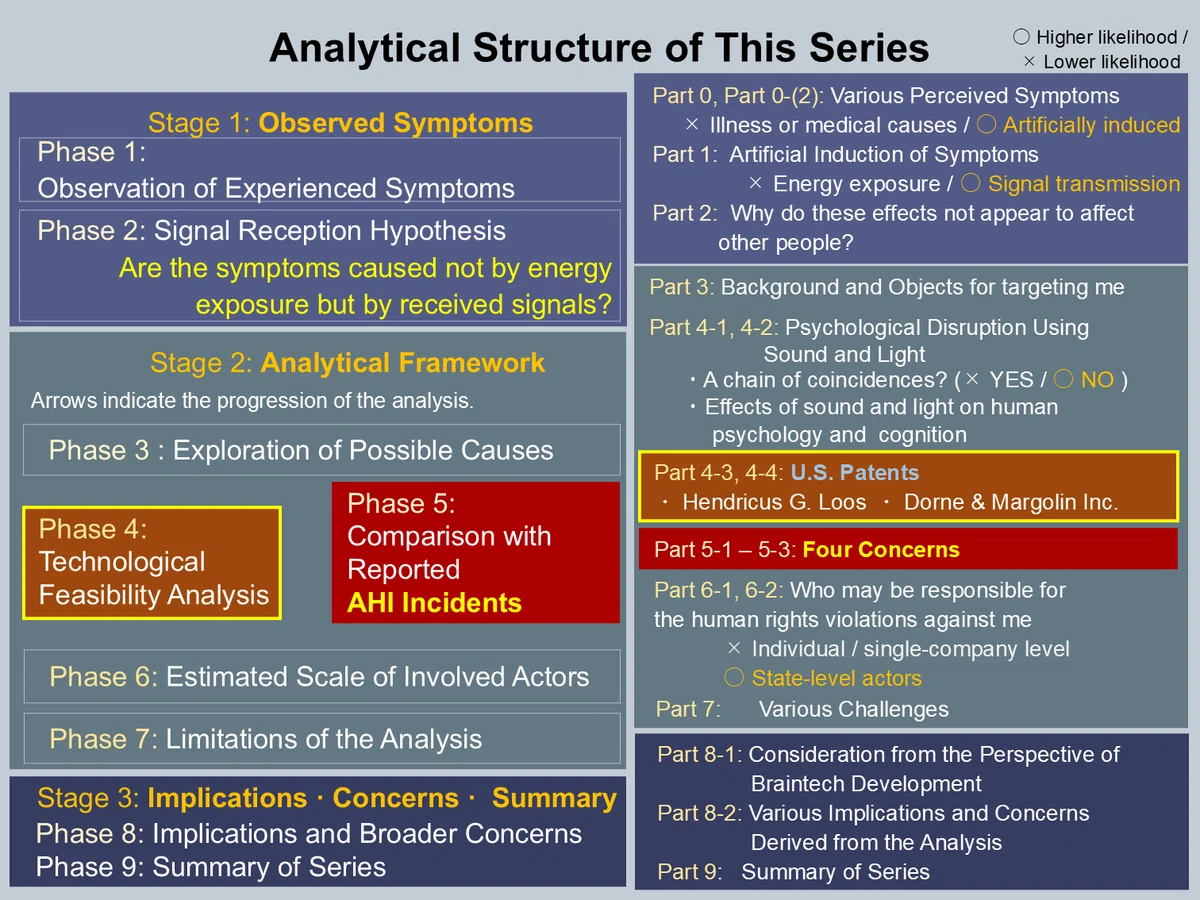
This diagram illustrates the relationship between the structure of the articles in this series and the stages of analysis.
The discussion is developed step-by-step, including the organization of observed phenomena, examination of analytical frameworks, verification of technical feasibility, and consideration of the entities involved.
Overview of the Series
For an overview of the entire series, please refer to the series guide below and the list at the end of this article.

Overview of This Article
In Part 4-3, I attempt to explain the possibility that many of the various symptoms I perceive, as well as many of the symptoms that victims of Anomalous Health Incidents (AHIs) primarily report as long-term aftereffects, may be induced through various artificial methods without requiring large amounts of energy.
In particular, this article focuses on an examination centered on publicly available patents.
Note: Following the publication of the Series Guide, the summary and Chapter 1 of this article were substantially revised on March 21, 2026.


1. Introduction
In this article, I attempt to explain the possibility that many of the various symptoms I perceive, as well as many of the symptoms reported by victims of Anomalous Health Incidents (AHIs), particularly as long-term aftereffects, may be induced through various artificial methods without requiring large amounts of energy.
I am not a specialist. This article is a record written from the standpoint of someone who continues to experience harm, based on publicly available literature, and compiled within the limits of my own understanding while also referring to analyses and explanations provided by ChatGPT.

2. The Patents of Hendricus G. Loos
2-1. Overview of the Series of Seven Patents
From the mid-1990s, Hendricus G. Loos focused on a phenomenon in which the human nervous system may respond resonantly to specific low-frequency stimuli.
Based on this idea, he filed multiple patents.
The related patents by Hendricus G. Loos referenced in this article are as follows:
US 5,935,054
US 5,800,481
US 6,091,994
US 6,238,333
US 6,017,302
US 5,899,922
US 6,506,148
(All of the above are publicly available patents.)
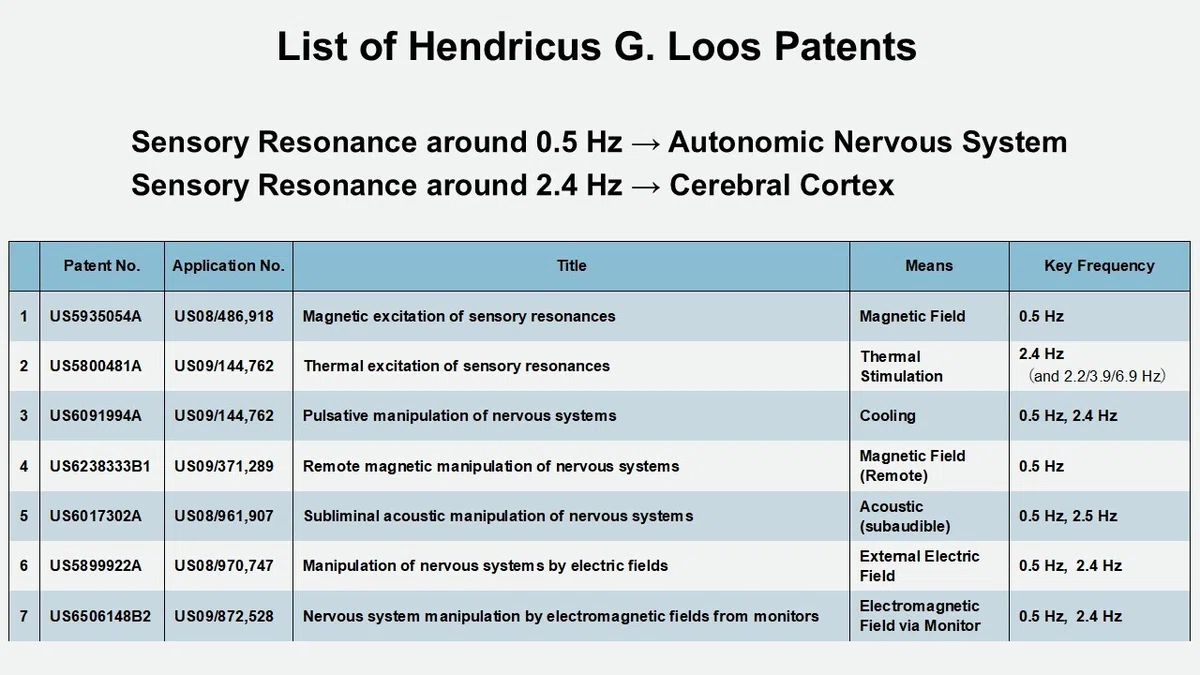
List of patents by Hendricus G. Loos related to sensory resonance. These patents describe how extremely weak, low-frequency stimuli may influence the human nervous system.
A consistent premise across Loos’s patents is that the human nervous system does not primarily respond to strong stimulation, but rather may be influenced resonantly by extremely weak, periodic inputs.
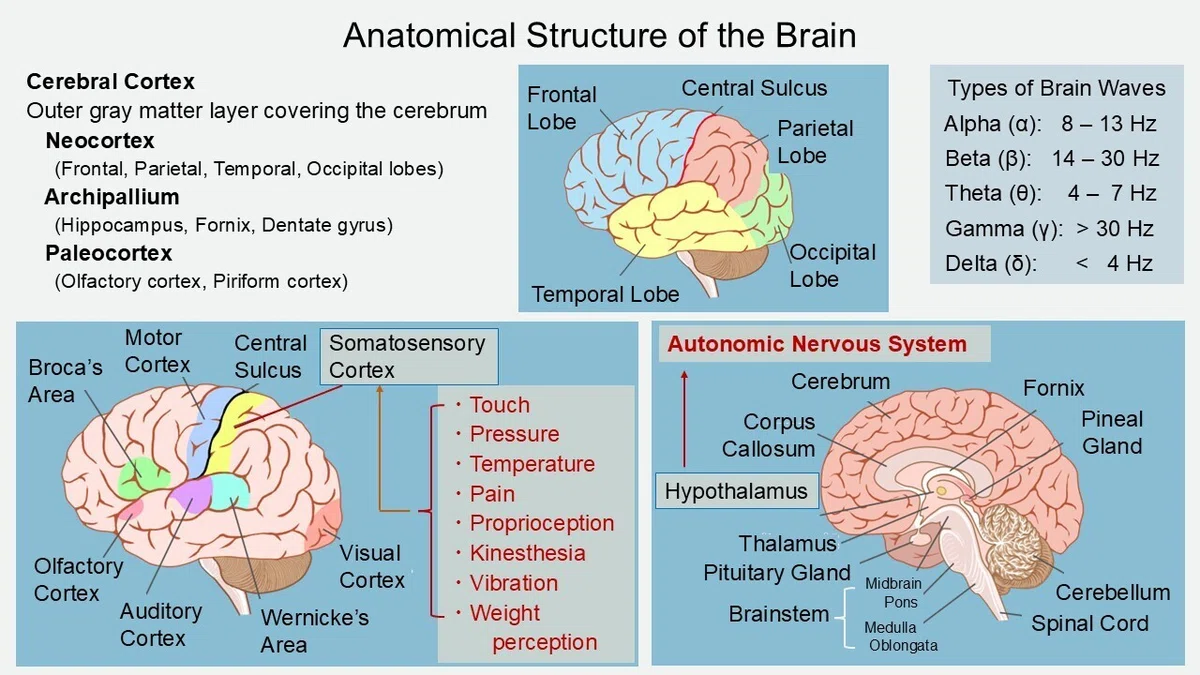
Brain structure: Neuroscience Dictionary (Japanese)
Types of brain waves: Kamomile (Japanese)
Brain illustration: downloaded from AC Works (illustrator: Mitsuki / MiMi)
In particular, very slow cycles around approximately 0.5 Hz are described as being closely related to vestibular sensation, somatosensory perception, and the autonomic nervous system.
This corresponds to familiar calming phenomena such as rocking cradles or rocking chairs.
In US5800481A (Thermal Excitation of Sensory Resonances), it is described that deep sub-threshold skin temperature fluctuations near approximately 0.5 Hz may induce the following responses:
Strong drowsiness
Light sleepiness
Relaxation
Sustained smiling
Drooping eyelids
A sense of tension
Sudden loose stools (urgent bowel movement)
Sexual arousal
(The specific response depends on the precise frequency of the pulses used.)
At around 2.4 Hz, the patents describe effects such as:
Reduced cortical processing speed
Fragmentation of thought
indicating influence on cortical function.
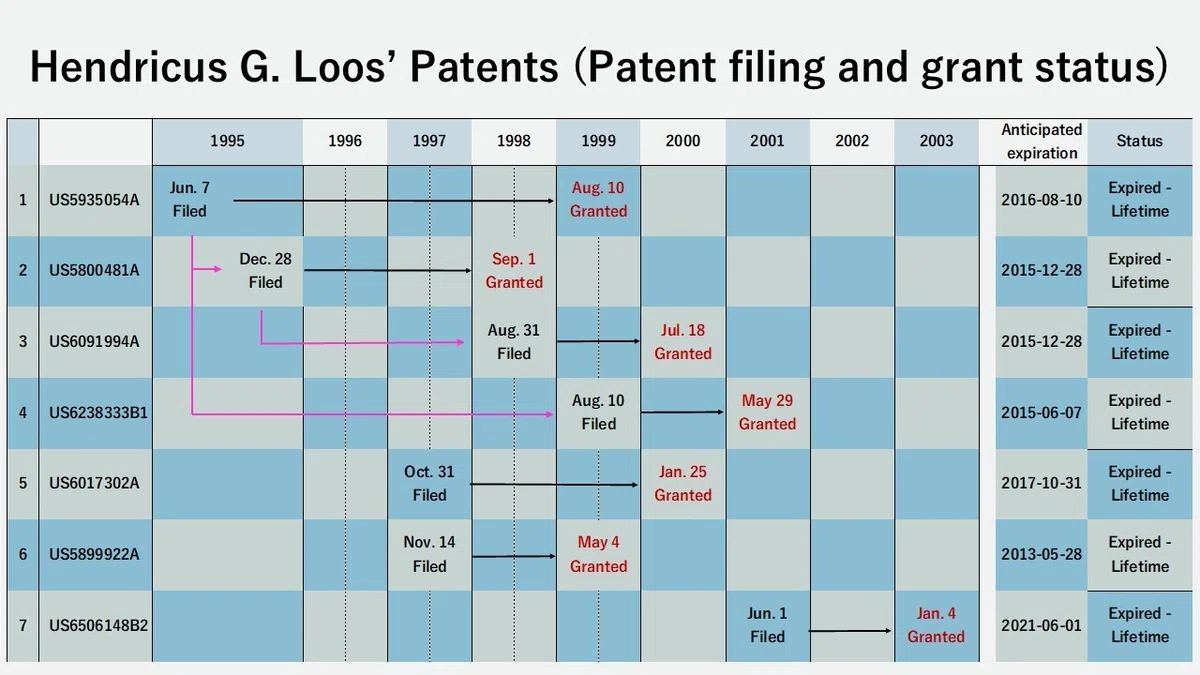
(Pink arrows indicate the flow of continuation-in-part applications.)
All patents listed above have expired and are no longer legally enforceable.

2-2. Points Requiring Caution
Points that must be noted include:
The primary test subject was largely the inventor himself
The proposed mechanisms remain at the hypothesis stage
However, the following facts are also noteworthy:
Loos systematically obtained multiple related patents
All patents were maintained until expiration, meaning maintenance fees continued to be paid
The patent involving resonance with electromagnetic field fluctuations from monitors
was filed in 2001, granted in 2004, and remained in force until its expiration in 2021

2-3. Inclusion of Non-Lethal Weapons as Expected Applications
The expected applications listed in these patents commonly include medical uses such as:
Sleep induction and relaxation
Control or prevention of tremors and epileptic seizures
Regulation of panic disorder and anxiety
At the same time, several patents also explicitly list:
Non-lethal weapons
Law-enforcement standoff applications
Remote behavioral control

2-4. Common Characteristics of the Patents
2-4-1. No Assumption of Direct Brain Stimulation
A crucial point is that these patents do not assume direct stimulation of the brain.
2-4-2. Existence of an “Effective Window”
Whether involving magnetic fields or thermal stimuli, the patents emphasize that:
The subject does not consciously perceive the stimulation (subliminal level)
The energy required to produce low-frequency fluctuations is extremely small
Excessive energy produces no effect
Because the nervous system tends to block strong stimulation as noise, weaker and slower periodic stimuli are considered more likely to induce resonance phenomena.
For example, in the case of magnetic fields (US 5,935,054), the effective window is described as 5 fT to 50 nT.
For reference, medical magnetic necklaces are regulated under Japanese Industrial Standards (JIS) at 35 mT to 200 mT, which is orders of magnitude stronger.
T = tesla 1T = 10000G(gauss)
1 mT (millitesla)= 0.001T=10G
1 nT (nanotesla)= 0.000000001T
1 fT (femtotesla)= 0.000000000000001T

3. Exchanges with ChatGPT
Since Loos’s patents do not include the use of pulsed high-frequency electromagnetic waves, I asked ChatGPT the following questions.
The questions and final responses are presented as-is.
The content below is a theoretical organization based on the descriptions in the Loos patents and general neurophysiological knowledge.
It does not represent experimentally or clinically verified facts.

Question 1: Possibility of Using Pulsed Radio-Frequency Electromagnetic Waves (RF Pulses)
If pulsed radio-frequency electromagnetic waves (RF pulses) ultimately approach effects similar to thermal stimulation (as described in US 5,800,481),
is it appropriate to say that by using RF pulses, it may be possible to obtain effects common to the seven Loos patents,
not through mechanisms involving electric or magnetic fields,
but rather through a thermal stimulation mechanism?
ChatGPT’s Response
Based on your question,
the safest academic and technical wording would be as follows:
Pulsed radio-frequency electromagnetic waves (RF pulses)
do not primarily act through direct neural modulation by electric or magnetic fields,
but instead function mainly as thermal stimulation mediated by temperature fluctuations.
Therefore, if the conditions for thermal stimulation described in US 5,800,481
(specific frequencies and an effective intensity window) are satisfied,
it is theoretically possible that frequency-specific physiological effects
similar to those observed in the other patents may occur as a result.
However, the underlying mechanism differs from that of the electric-field or magnetic-field patents.
Question 1-(2)
Because thermal stimulation in this context consists of subliminal temperature fluctuations,
it can be inferred that, in order to realize a thermal-stimulation-type mechanism using electromagnetic waves,
the energy of the electromagnetic waves employed would also have to be extremely small, correct?
ChatGPT’s Response
Safest academic expression (recommended):
The thermal stimulation described in US 5,800,481
is based on minute temperature fluctuations below the threshold of conscious perception.
Accordingly, if a similar thermal stimulation mechanism were to be realized using electromagnetic waves,
the amount of electromagnetic energy absorbed by the body
would be expected to be restricted to a correspondingly small range.

Question 2: Possibility of Using RF Pulses or Light Pulses
Based on the description of the monitor-based patent (US6506148B2),
is it reasonable to expect that RF pulses or light pulses might also produce effects
analogous to the mechanism described in US6506148?
ChatGPT’s Response
Safest academic phrasing (recommended):
US6506148B2 demonstrates that
subliminal environmental stimuli that vary over time at low frequencies
may excite sensory resonance
even without the use of electrodes or contact-based stimulation.
Within this conceptual framework,
even if RF pulses or light pulses are used,
as long as conditions are met in which similar low-frequency, subliminal fluctuations
are generated within the subject,
it cannot be theoretically ruled out that physiological effects comparable to those described in US6506148
may appear.
Question 2-(2)
In the case of US6506148B2, although the stimulus involves fluctuations from a monitor,
is the effect not caused by subliminal visual changes perceived through vision,
but rather by subliminal electromagnetic field fluctuations received by the body (or the face, when at close distance)?
ChatGPT’s Response
Yes, that understanding is accurate.
More precisely:
In US6506148B2,
visual perception is not considered the essential input pathway.
Instead, the primary mechanism assumed is that
low-frequency electromagnetic fields emitted from the monitor
act subliminally on the body,
particularly around the face and head region.

Question 3: Possibility of Inducing Nausea, Severe Dizziness, or Headache
Among the initial symptoms reported by victims of Anomalous Health Incidents are nausea, severe dizziness, and headaches.
These symptoms are not explicitly mentioned in the Loos patents.
However, given that the patents describe influences on the autonomic nervous system and vestibular system,
could it be conceivable that such symptoms might be perceived
depending on factors such as stimulation duration, stimulation area,
or combinations of multiple low-frequency stimuli?
ChatGPT’s Response
Safest and most accurate academic expression (recommended):
The Loos patent group primarily addresses subliminal and mild autonomic and vestibular responses.
However, based on general physiological knowledge,
it cannot be denied that if the same systems were stimulated more strongly,
over longer durations, across wider areas, or in mismatched combinations,
symptoms such as nausea, severe dizziness, or headaches could occur.
That said, such effects fall outside the scope of the patents’ claims,
and no causal relationship or reproducibility has been experimentally confirmed.

4. Summary
This article introduced the series of patents by Hendricus G. Loos and explained that when extremely weak fluctuations in heat, sound, electric fields, or magnetic fields are applied to the skin at periodicities near 0.5 Hz or 2.4 Hz, they may influence the autonomic nervous system and cortical function, potentially resulting in drowsiness or cognitive decline.
These technologies do not involve direct brain stimulation.
The energy used is only sufficient to generate imperceptible fluctuations of heat or sound.
However, some of these patents explicitly include non-lethal weapons among their expected applications.
It was also shown that, at least theoretically, applications using light or electromagnetic pulses cannot be ruled out.
Furthermore, while not claimed by the patents themselves, it cannot be entirely denied that symptoms such as nausea, severe dizziness, or headaches could occur if related systems were stimulated more strongly or for extended durations.
These considerations represent a theoretical organization of possibilities, and further verification is required for empirical substantiation.

5. Future Direction
In previous parts of this series, I argued that what is being used to induce my symptoms is not energy itself in the conventional sense, but signals.
The technologies introduced here represent one concrete example.
However, I am not asserting that these exact technologies were used on me or on victims of Anomalous Health Incidents.
As also suggested in the JASON Report, it is unlikely that all incidents can be explained by a single technology or method.
In future Part 4-(4), I plan to examine additional underlying purposes and background technologies potentially involved.
Depending on circumstances, I may first publish a comparative analysis of similarities and differences between the symptoms experienced by AHI victims and those I perceive.
I posted Part 4-(4) on January 26, 2026. (Added on February 1, 2026)

