
Part 4-4: On the Possibility of Remote Monitoring and Control of Human Brain Activity

Summary
Position of This Article within the Series
This article corresponds to the portion enclosed by the yellow frame (the subject of examination in this article) within the analytical framework of this series, as shown in the figure below.
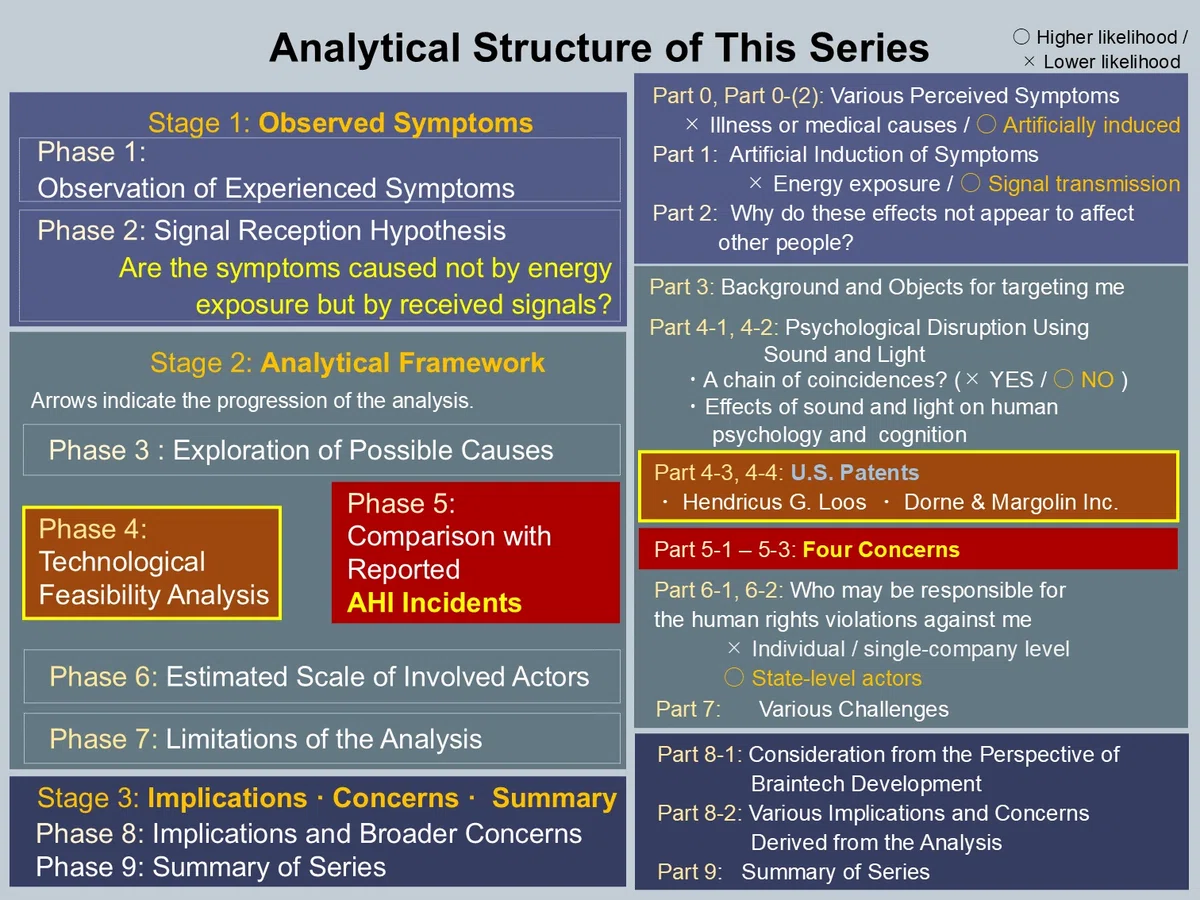
This diagram illustrates the relationship between the structure of the articles in this series and the stages of analysis.
The discussion is developed step-by-step, including the organization of observed phenomena, examination of analytical frameworks, verification of technical feasibility, and consideration of the entities involved.

Overview of the Series
For an overview of the entire series, please refer to the series guide below and the list at the end of this article.

Overview of This Article
In Part 4-4, in addition to records of my personal experiences, I examine currently published research in neuroscience, previously established patents, and the current state of ultra-weak signal detection technologies. By comparing these elements, this article explores the question of whether human cognition, perception, and brain activity can, in fact, be externally monitored and interfered with.
Rather than presupposing a specific conclusion, the purpose of this article is to organize the scope and limitations of this possibility based on publicly available information and technical knowledge.
*Note: This article is not an academic paper written by a specialist, but an analysis conducted by an individual directly involved, based on personal experience records and publicly available information.*
Note: Following the publication of the Series Guide, the summary and Chapter 1 of this article were substantially revised on March 21, 2026.


1. Introduction
On March 5, 2018, I experienced an event in a hotel and a convenience store in Shinjuku, Tokyo, involving phenomena using sound and light (which I personally refer to as “psychological disruption operations”).
Eight years have passed since that time.
While continuing to perceive various forms of distress on a daily basis, I have persistently raised concerns regarding human rights violations. Given that this situation has continued over a prolonged period, it is possible that there are additional objectives beyond merely causing distress.
Based on my experiences, I consider that one possible objective may be the development of technologies capable of remotely monitoring, interfering with, and controlling brain activity—what may be described as a domain related to remote BCI (Brain-Computer Interface) or remote BMI (Brain–Machine Interface).
In this article, by comparing my personal experiences with currently available scientific and technological information and patent data, I examine, from a technical perspective, the extent to which human cognition, perception, and brain activity could be externally monitored and interfered with.

2. My Personal Experiences
The following are records of my subjective experiences.
They do not determine their causes, but are organized as possibilities I have personally considered.
2-1. Experiences in Which I Felt That My Thoughts Were Reflected Externally
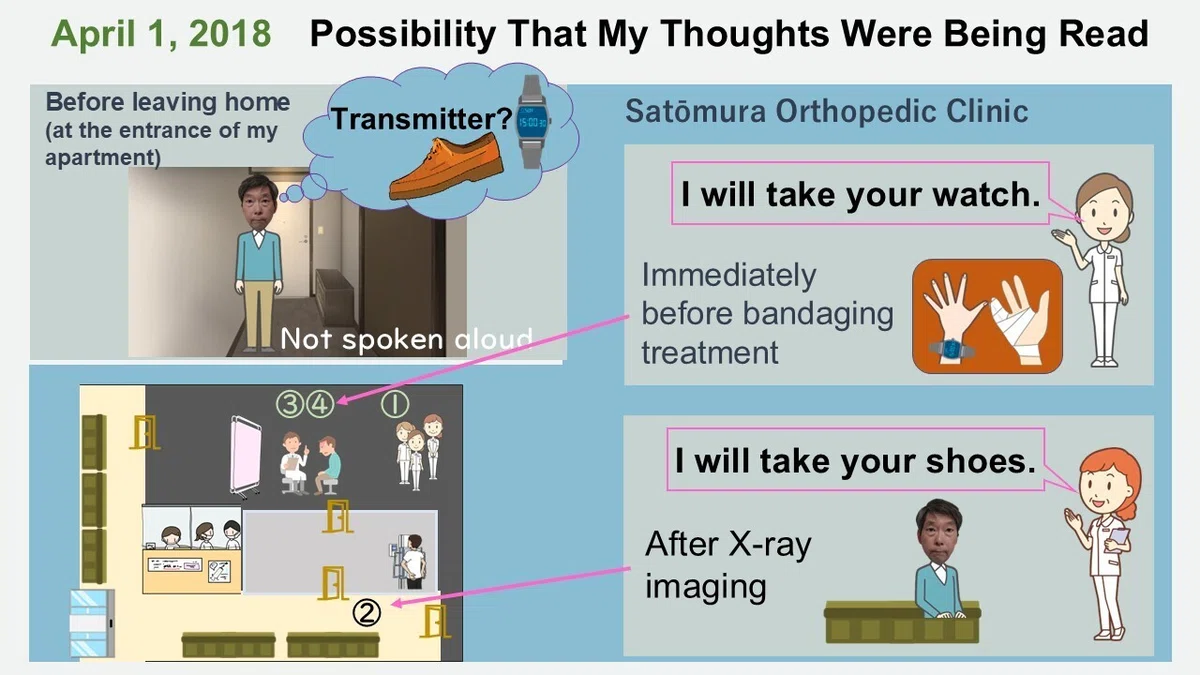
On April 1, 2018, I visited an orthopedic clinic to have an injury near my right little finger examined.
After an X-ray was taken, I was waiting in the corridor when a nurse approached and said, “We will take your shoes.”
Although I initially handed them over, I soon felt something was strange and took them back.
On another occasion, at a polling station set up in a junior high school gymnasium, a young boy suddenly shouted the names of political candidates and political parties so loudly that his voice echoed throughout the gym.
As I recall, when the candidate’s name was shouted, I had just finished writing it.
When the political party name was shouted, it occurred just before I was about to write it.
In both cases, I felt as though the content I had been consciously thinking about was immediately presented externally in verbal form.

2-2. Experiences Related to Visual Perception
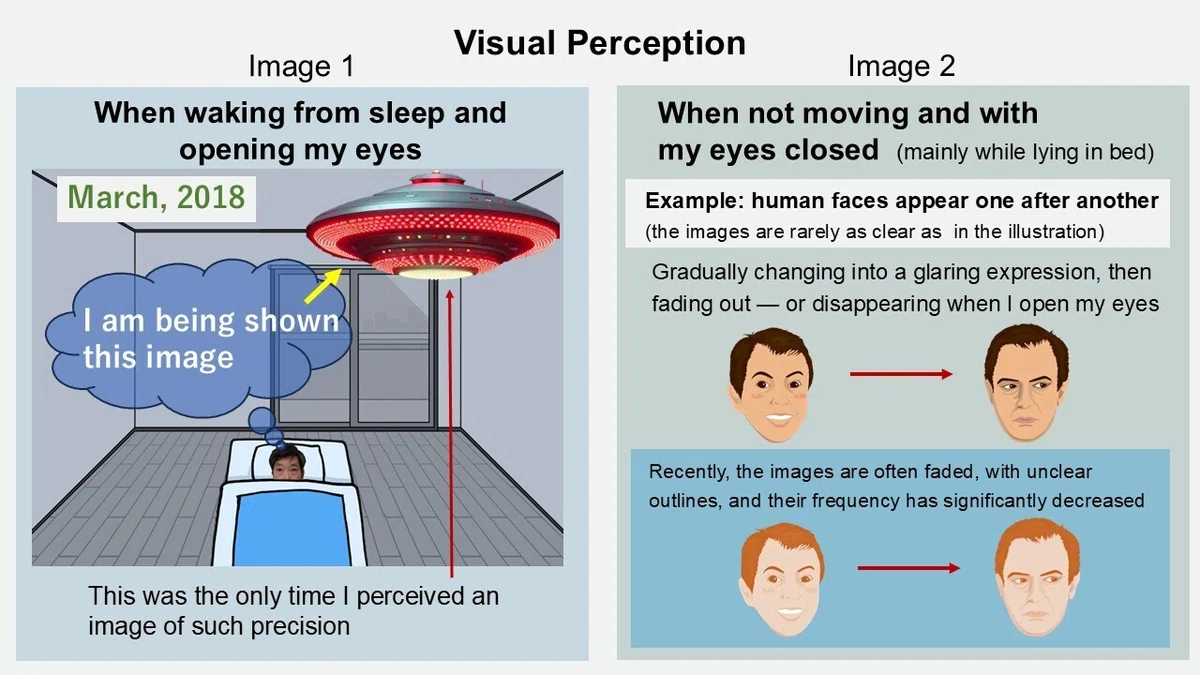
Image 1
One night in March 2018, I awoke to see what appeared to be a large unidentified object near the ceiling.
Although the lower part was not bright red as depicted in the illustration, countless small red lights were blinking.
The object also appeared to move slightly closer toward me.
While observing this, I kept telling myself that this image must have been shown to me.
After that, I have not perceived visuals of such high precision.
However, until quite recently, when waking up and opening my eyes, I frequently perceived images — mainly object-like forms — moving within my visual field.
Image 2
In addition, when lying in bed or upon awakening, especially with my eyes closed, I often perceived successive human faces appearing one after another, eventually changing into expressions that seemed to glare at me.
Characteristics and Common Features of These Visual Perceptions
Characteristics
In the case of Visual Pattern 2, there are instances in which images that I had just visually perceived before lying down are transformed into simplified, anime-like visuals, as well as cases where highly detailed and elaborate scenes are perceived.
However, in many cases, both Visual Patterns 1 and 2 differ from dreams or imagination. Rather, they tend to appear as if something is being unilaterally presented—either conveying some form of message to me or attempting to induce a sense of fear.
In addition, it seems possible that multiple methods of image transmission may be being attempted.
Common Features
The following points are common to both types of visual perception:
They have only been perceived when I am in a stationary state
They have not been perceived during computer-related tasks
They temporarily disappear or fade when I open and close my eyes or shake my head vigorously
Note: This section was previously titled “Characteristics and Differences of These Visual Perceptions,” but was revised on March 21, 2026, to “Characteristics and Common Features of These Visual Perceptions” with partial modifications to the content.

2-3. Experiences in Which I Felt That What I Was Seeing Was Being Monitored
This is only one example, but when I notice and pick up a small piece of trash in my room while cleaning, or when I pick up a ladybug that has been blown onto my balcony, the tinnitus attacks (*) often intensify at that precise moment.
(*) I have explained in Part 0, Part 0-(2), and in “Why the cause of my tinnitus is not illness” that these tinnitus attacks are artificially induced.

3. Examples of Currently Published BCI Research
What I wish to emphasize in this section is that, regardless of whether the method is invasive or non-invasive (that is, whether or not it directly damages the body), research is progressing in which:
the content intended by a subject, and
images imagined by a subject
are inferred through brainwave analysis, and in which technologies capable of precisely stimulating neural activity are being applied to medicine and sports.
Research aimed at developing non-invasive brain–computer interfaces (BCIs) that aim to decode intended language from brain activity has been ongoing for many years.
It should be noted that all such studies are conducted after brainwave data are learned in advance with the cooperation of the subject, and they are not designed to indiscriminately read the thoughts of unspecified individuals.
Through the decoding of brainwave signals, the following types of BCI technologies are being developed:
Converting what a subject wishes to convey into speech
Reconstructing what a subject has seen or imagined
Operating computer games solely through intention
Examples include:
Reconstruction of perceived or imagined images (Osaka University, reported in March 2022)
Operating computer games using only thoughts (University of Texas at Austin; access to the link is currently restricted)
(Added on May 16, 2026) You can view it from the following website.
Controlling Gmail or robotic arms based on brainwave data
In Japan, the company ARAYA is developing BMI technologies that enable Gmail operation and remote control of robotic arms using brainwave data.
In these projects, such technologies are referred to as BMI (Brain–Machine Interface).
At the end of the YouTube video linked at the beginning of the article, it is also stated that technologies capable of precisely stimulating neural activity are beginning to be used for rehabilitation of people with severe physical disabilities, as well as for transferring sensory skills of professional athletes.

4. Existence of Patents for Remote Monitoring and Modulation of Brain Waves
In April 1976, the American antenna company Dorne & Margolin Inc. obtained a patent titled:
“Apparatus and Method for Remotely Monitoring and Altering Brain Waves.”
This patent was published as US 3,951,134A and remained valid until its expiration in April 1993.
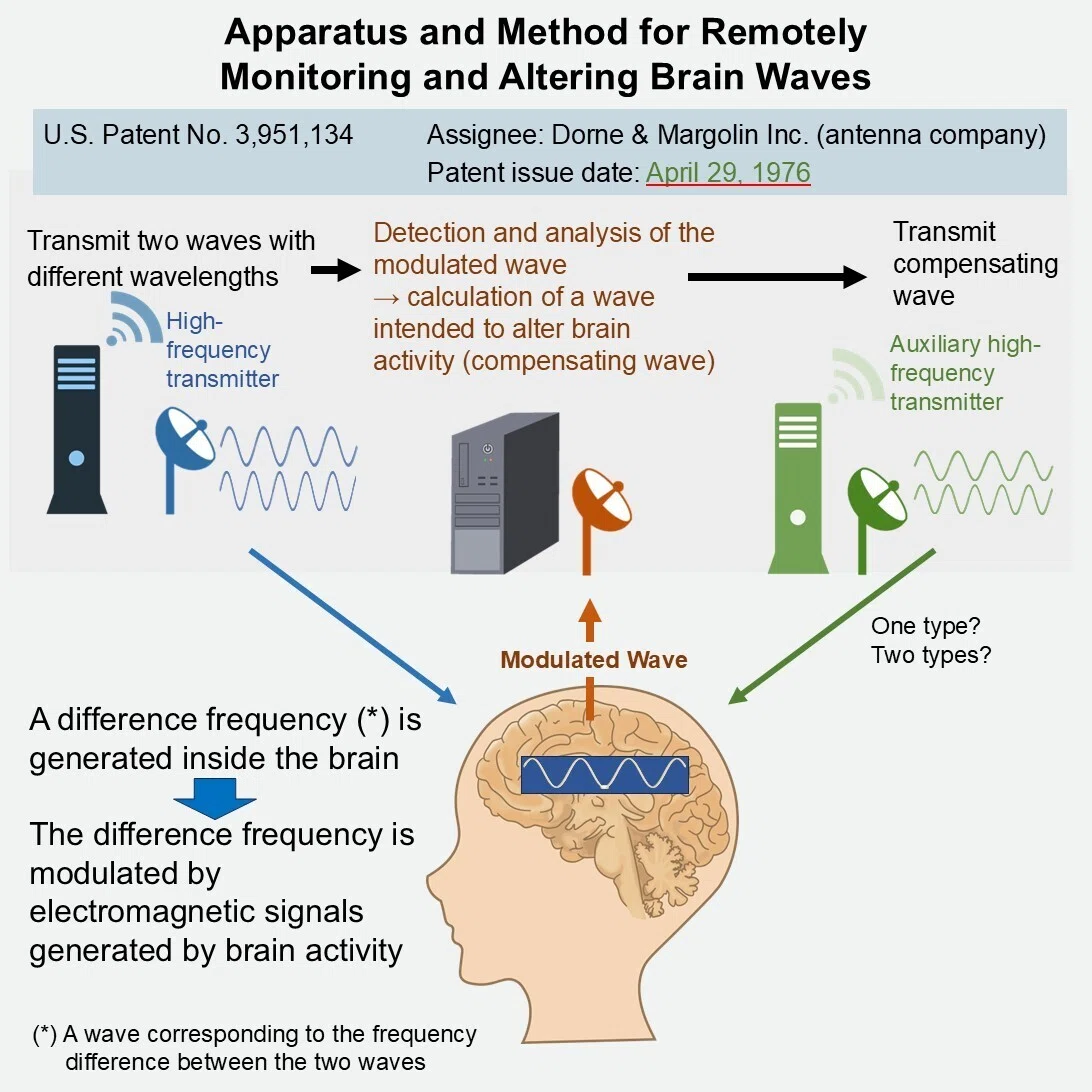
What deserves attention is the fact that, at least half a century ago, the concept of remotely observing and modulating brain waves had already been formalized as a patent and maintained by an American antenna company.
According to the patent, the method involves the following theoretical process:
Two waves of different wavelengths are intended to reach the interior of the skull.
Within the skull, a difference frequency is generated from these two waves.
This difference frequency is modulated by electromagnetic activity produced by brain function.
The modulated difference frequency is then detected and analyzed.
Furthermore, based on the analyzed results:
signals intended to alter brain activity may be generated, and
by transmitting these signals into the subject’s skull,
it is theoretically possible to alter brain activity.
The patent provides examples using electromagnetic waves of 100 MHz and 210 MHz.
Regarding the compensating wave, it is unclear from the patent documentation whether a single wave is sufficient or whether two waves of different wavelengths are required.
For this reason, the diagram intentionally avoids presenting a definitive conclusion.
Considering the advances in modern signal control technology, it is reasonable to assume that far more precise frequency control would be theoretically possible today than at the time this patent was filed.
It is also conceivable that, by superimposing frequency components close to brain activity onto high-frequency carrier waves, and by analyzing components further modulated by brain activity, similar objectives could theoretically be achieved.
This consideration is based on my personal experiences in combination with historical patent descriptions, and is presented as a theoretical possibility rather than a confirmed fact.

5. Ultra-Weak Signal Detection Technology
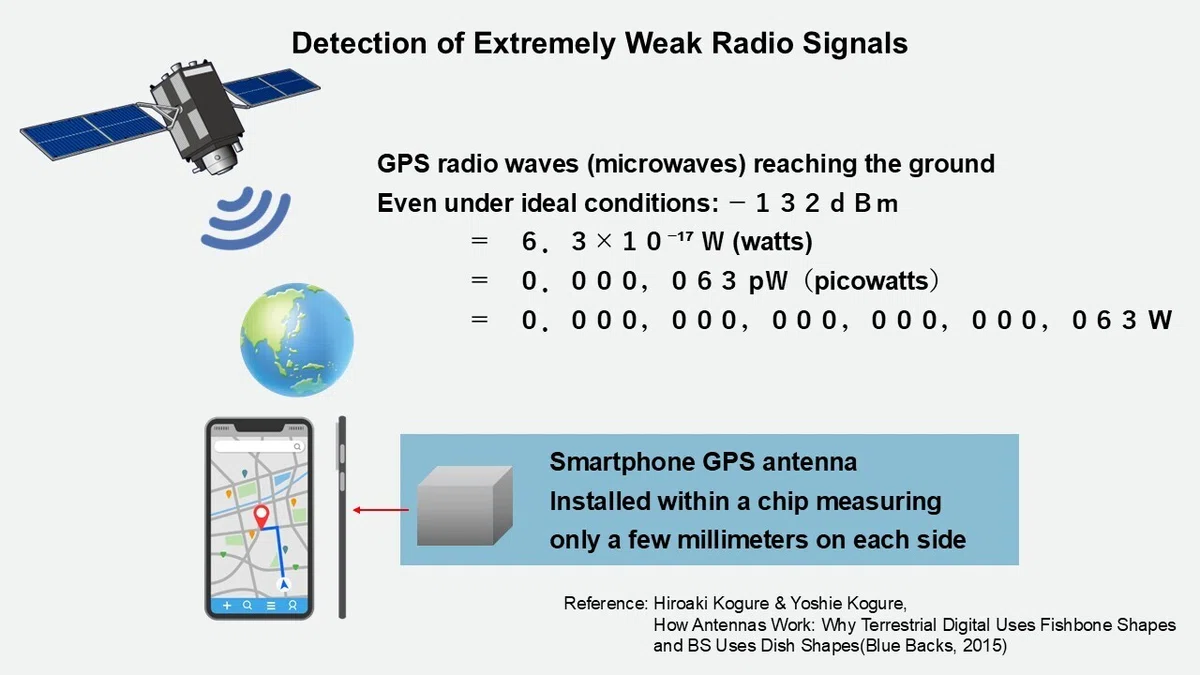
The methods assumed in the patent described above, as well as those mentioned at the end of the previous section, would require the use of extremely weak electromagnetic signals, making detection technology a critical issue.
However, even smartphones manufactured more than a decade ago contain receiver chips capable of stably detecting extremely weak power levels of approximately –132 dBm (on the order of 10⁻¹⁷ W) using antennas embedded in semiconductor chips only a few millimeters in size.
Therefore, it cannot be theoretically ruled out that technologies capable of detecting extremely weak electromagnetic signals generated by brain activity may exist.
It is also important to note that the technologies discussed here do not involve directly detecting brain waves themselves, but rather analyzing components of externally transmitted signals that have been modulated by brain activity.

6. Conclusion
The technologies discussed in this article — including those capable of artificially inducing the symptoms I have described and those that could realize a form of remote BCI — are not in general use.
For that reason, readers may naturally feel skepticism toward my analysis.
However, the phenomena described in Chapter 2 are events that I directly experienced and documented.
Therefore, I believe there is a substantial possibility that some factor — including external factors — is involved in making them possible.
In the military and intelligence fields, research content and operational realities are often not publicly disclosed due to the nature of such technologies.
Since March 2018, I — an otherwise unknown individual — have experienced numerous suspicious incidents, and the hotels, convenience stores, police departments, medical institutions, and television stations involved have repeatedly failed to respond to my inquiries over several years.
As a pattern of institutional response to an individual’s inquiries, this degree of consistency is difficult to regard as merely coincidental.
In addition, some of the symptoms described in Part 0, as well as the severe pain near my right back molar that has not yet been discussed in this series, would be difficult to induce in only a very limited part of the body without controlling brain activity.
For these reasons, I have examined in this article the technologies that could theoretically make such phenomena possible — namely, technologies capable of remotely monitoring, interfering with, and controlling brain activity.
This article does not assert that any of the technologies described here are in fact being used.
However, I believe it cannot be entirely ruled out that some form of technology capable of artificially inducing the symptoms and phenomena I perceive is being developed in secrecy.

7. Future Plans
In a subsequent article, I plan to explain the differences between the symptoms experienced by victims of Anomalous Health Incidents (AHIs) and my own symptoms, as well as my personal questions regarding AHI-related cases.
I posted Part 5-(1) on January 31, 2026. (Added on February 1, 2026)

