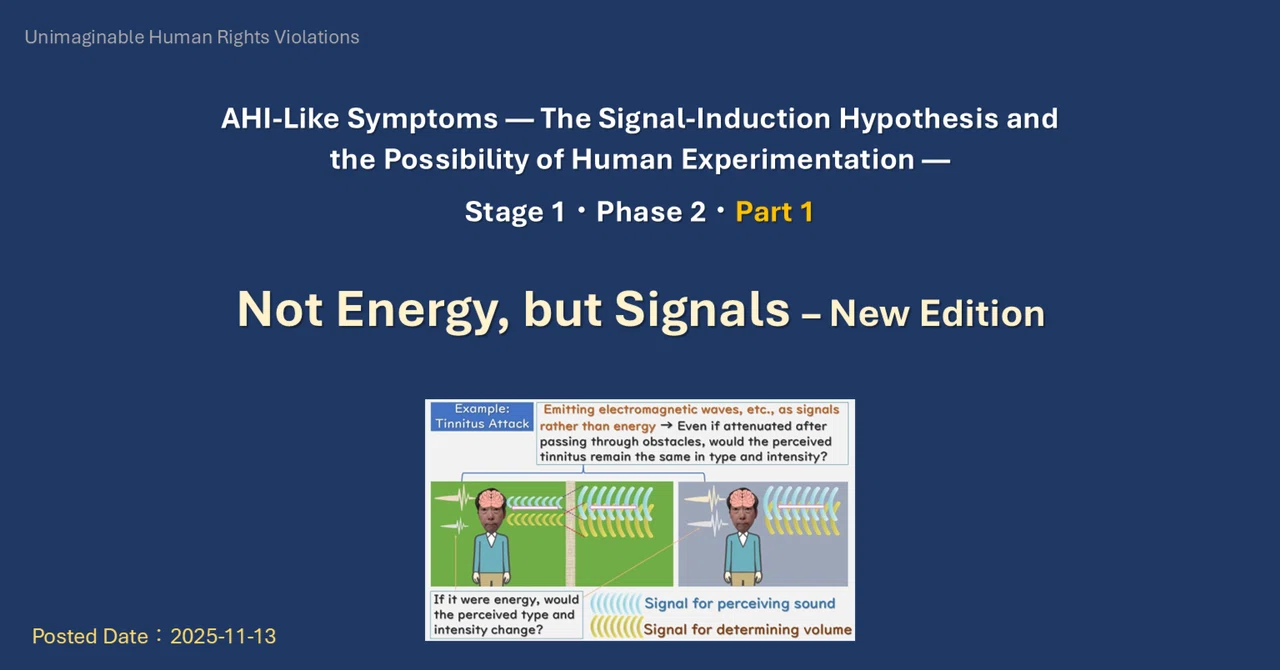
Part 1: Not Energy, but Signals – New Edition

Summary
In Part 0, I organized the argument that the symptoms I experience on a daily basis—such as tinnitus and pain—are more reasonably understood as being artificially induced by external factors rather than arising from pathological causes.
In Part 1, I showed, based on my own experiences, that it is more consistent with the observed characteristics of these symptoms (such as the lack of change with shielding or distance) to assume that what is being received is not electromagnetic energy itself, but rather “signals” that the brain processes as perceptual experiences.
A summary has been added to the beginning, and the earlier version of Part 1 has been made private.


1. Introduction
In Part 0, I discussed why it is more rational to conclude that the symptoms I experience daily—such as tinnitus and pain sensations—are not caused by pathological factors, but rather artificially induced from external sources.
In this article (Part 1), I examine how such “induction mechanisms” might actually function.

2. Symptoms Occur Despite the Absence of Any Physical Device
I am not wearing or implanted with any device.
Nor can I find any visible equipment or suspicious object either inside or outside my room.
Nevertheless, the symptoms persist. Therefore, the possible means being employed may include:
Electromagnetic waves, including infrared radiation
Low-frequency or ultrasonic sound waves outside the human audible range
These media have also been considered in discussions of the Anomalous Health Incidents (AHIs) reported over several years since 2016, although attention there has mainly focused on the energy exposure aspect of such radiation.

3. Possible Reception Not as “Energy” but as “Signals”
This is where the key point arises.
I am continuously subjected to what I call tinnitus attacks and genital pain attacks, and they share the following features:
Once the attack begins at a certain intensity,
・ The perceived intensity remains unchanged wherever I move in the room.
・ It does not change even when I cover myself with a blanket.
・ It does not change even when I move to another enclosed space such as the restroom.
・ It remains the same even through multiple walls.
If the cause were energy—such as heat, acoustic pressure, or radiation intensity—then
the strength should vary depending on distance, material, and shielding.
It would also be impossible to uniformly fill a room containing various obstacles with energy, or to detect my movements in real time and continuously adjust the exposure level accordingly.
Yet, the intensity is perceived as nearly constant.
From this, one can deduce the following hypothesis:
The emitted factor is not “energy itself,”
but a signal processed by the brain as perception.

4. What Can Be Explained by the “Signal” Hypothesis
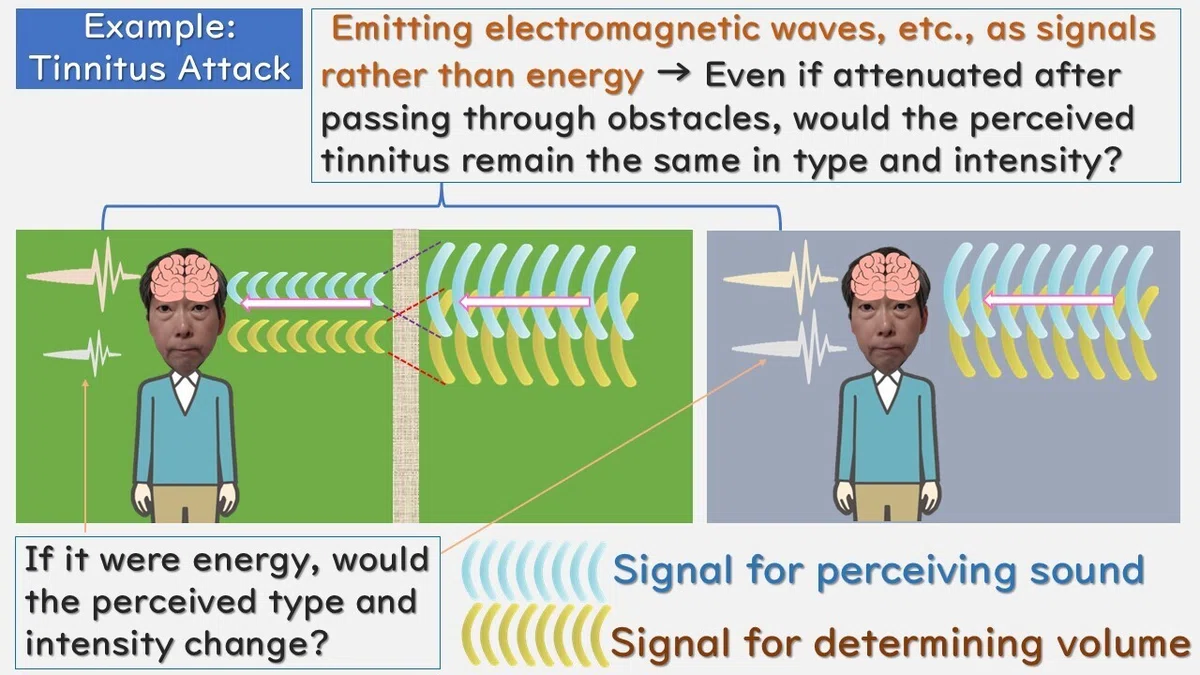
As illustrated in the attached diagrams, taking tinnitus as an example:
One signal may induce the perception of sound, and
Another may determine the perceived volume (intensity).
It is also conceivable that the sound’s intensity or quality could be adjusted solely by modulating the signal output.
If the phenomenon involves reception of “signals” rather than direct energy exposure, then:
Perceived intensity would remain constant even with attenuation through walls.
No external or visible equipment would be necessary.
Identical symptoms could arise regardless of spatial position.
These observations are consistent with the “signal” hypothesis and contradict the “energy” hypothesis.

5. Summary So Far
In Part 0, I explained that the symptoms I perceive are artificially induced.
In this Part 1, I have presented the rationale for assuming that electromagnetic waves or similar media are utilized,
and that the emission involves signals rather than raw energy.

6. Toward the Next Discussion
However, one unresolved question remains:
Why is it that only I perceive these symptoms, even when surrounded by other people?
Regarding this point, I have already begun exploring possible explanations, including factors such as the brain’s receptive state, synchronization conditions, and potential mechanisms for individual identification.
These topics will be discussed sequentially in the next parts of this series.
※ Based on the original version posted on October 16, 2025, this article is a new edition with a completely reorganized structure and updated content.
Part 2 was posted on November 18, 2025 (Added on February 8, 2026).

