
Part 8-1: AHI-Like Incidents from the Perspective of Braintech Development

Summary
Overview of This Article
In this article, I reconsider the points discussed in Part 4 and Part 5 from the perspective of brain technology development. Those earlier parts examined AHI-related harm and the human rights violations I believe I have suffered. Here, I examine how those issues may relate to the problem of AHIs and to my own case.
Please note that this article is a consideration written by an individual directly involved in the matter, based on my own records of experience and publicly available information. It is not a rigorous analysis conducted from the standpoint of an expert, but rather an organization of issues based on my personal understanding.

Position of This Article within the Series
This article corresponds to the section outlined in pink in the analytical structure of this series shown in the figure below.
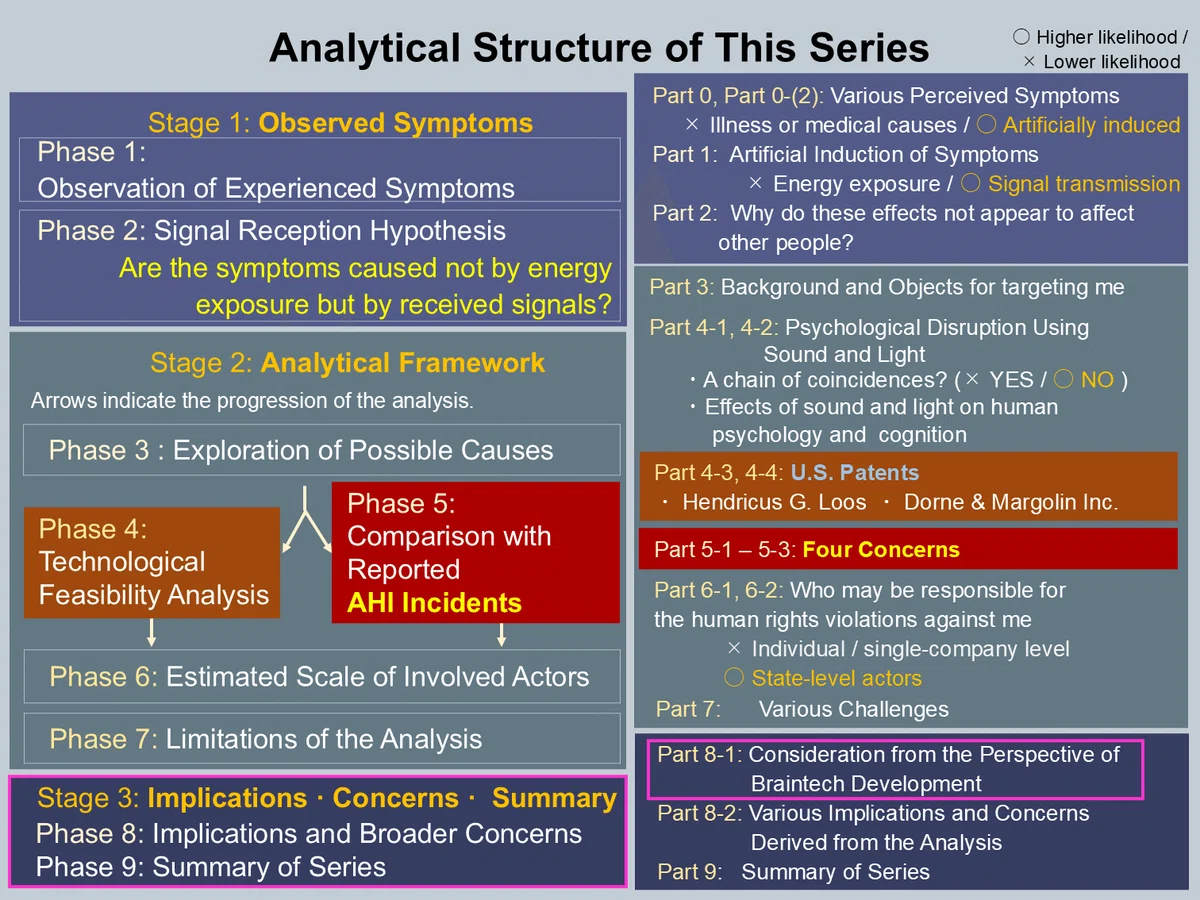
This diagram illustrates the relationship between the structure of the articles in this series and the stages of analysis.
The discussion is developed in step by step, including the organization of observed phenomena, examination of analytical frameworks, verification of technical feasibility, and consideration of the entities involved.

Overview of the Series
For an overview of the entire series, please refer to the series guide below and the list at the end of this article.

1. Introduction
So far, I have examined what I believe may be the true purpose underlying both the human rights violations I continue to suffer and AHIs, while focusing on the similarities and differences between the two.
Personally, I believe that this true purpose may be the realization of fully remote-controlled brain technology.
In this article, I will reconsider the points discussed in Part 4 and Part 5, which were examined from the perspective of AHI-related harm and the human rights violations I believe I have suffered. This time, I will view them from the perspective of braintech development and examine how they may relate to the issue of AHIs and to my own case.

2. The Possibility and Challenges of Fully Remote Braintech
2-1. The Light and Dark Sides of Braintech, and Its Methods and Characteristics
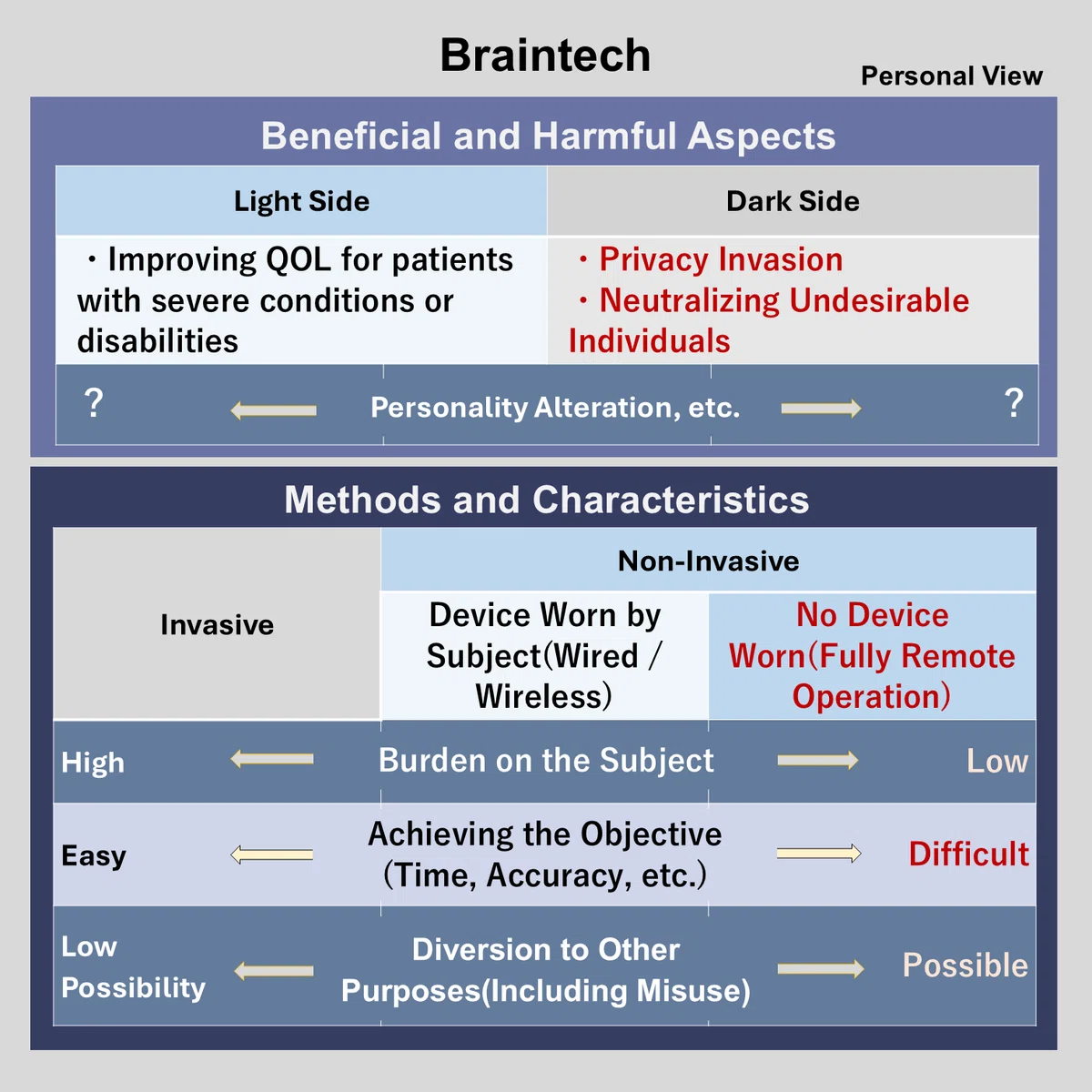
As shown in Figure 1, when viewed from the perspective of braintech development, it is clear that this technology has both beneficial aspects and aspects that could be abused.
Issues such as invasion of privacy and personality alteration were also mentioned in a program on BCI broadcast by Germany’s public broadcaster DW on October 9, 2021.
What I am even more concerned about is the use of such technology to secretly suppress or neutralize individuals regarded as inconvenient or undesirable, including by exploiting information. I plan to discuss these issues in more detail in Part 8-2.
Braintech is known to involve invasive methods, such as directly implanting electrodes in the brain, as well as non-invasive methods, such as wearing a helmet fitted with electrodes.
If a person is wearing such a helmet or similar device, I imagine it would be difficult for the subject to notice if measurements or experiments unknown to them were being conducted.
Many developers are likely working with beneficial purposes in mind, such as medicine, welfare, and assistive technologies. However, among developers who wish to use such technologies for military purposes or intelligence activities, there may also be some malicious actors who disregard ethical issues.
As the ultimate non-invasive form of braintech, it may be possible to imagine a form that acts completely remotely, without requiring any device to be attached to the head. I believe this could apply both to beneficial uses and to misuse.

2-2. Characteristics and Feasibility When Assuming Fully Remote Braintech
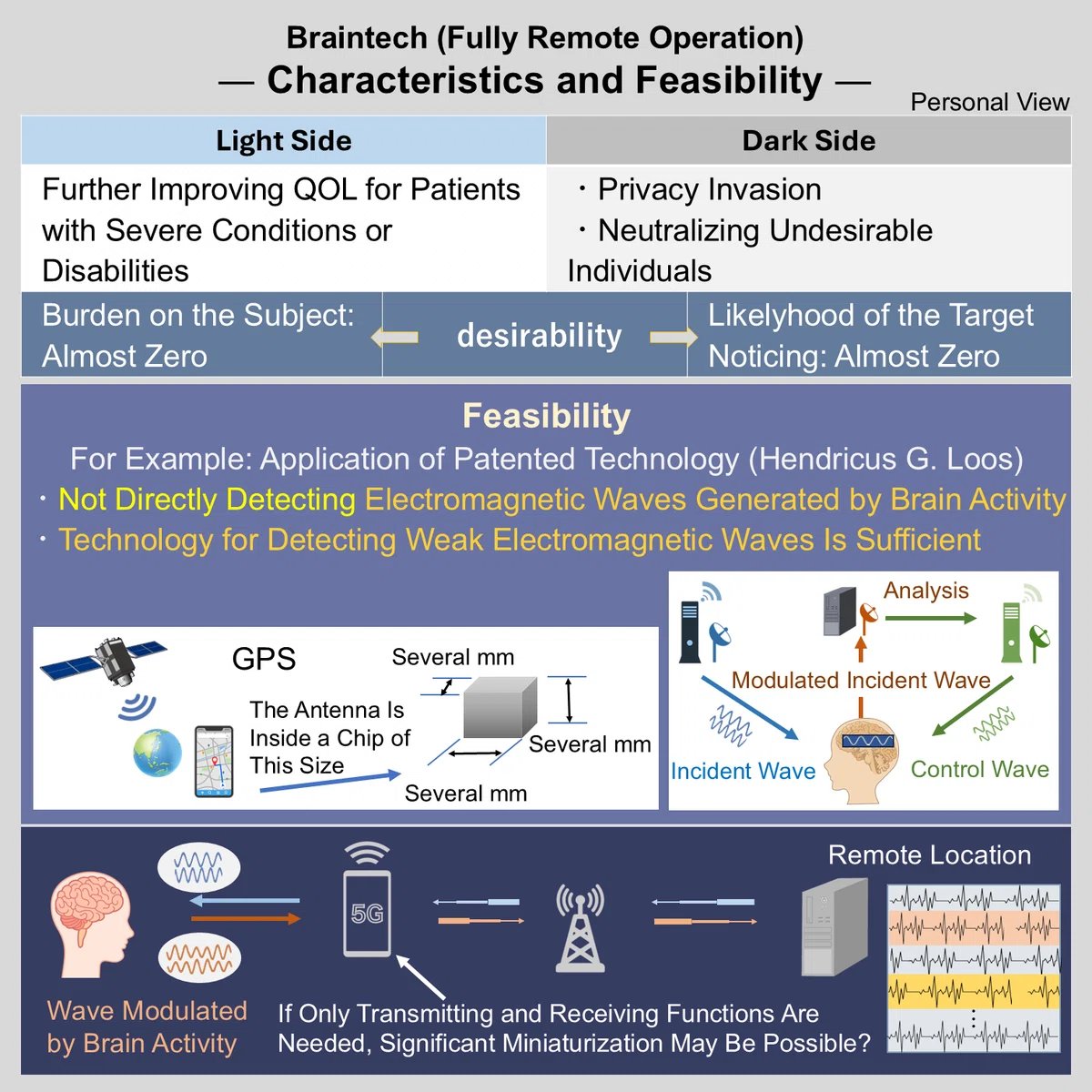
As I also considered in Part 4-4, I do not think its feasibility can be categorically denied.
This does not mean directly detecting electromagnetic waves generated by brain activity and emitted outside the body.
Rather, I believe there may be a technology that emits electromagnetic waves stronger than those generated by brain activity, but not strong enough to directly damage skin or brain tissue, and then attempts to detect electromagnetic waves modulated inside the skull.
In addition, after examining my own various experiences, I have come to consider the possibility that, through some form of technical intervention, external influence is being exerted on part of my brain activity, sensations, or responses.

2-3. Overcoming or Reducing the Challenges of Fully Remote-Controlled Braintech
In realizing fully remote-controlled braintech, the expected challenges, as discussed in Part 5-2, are likely to include the following:
Analysis of received signals is expected to be extremely complex and difficult.
Even for the same analysis item, signal patterns are not necessarily identical from person to person.
2-3-1. Simplifying Brain Signal Analysis
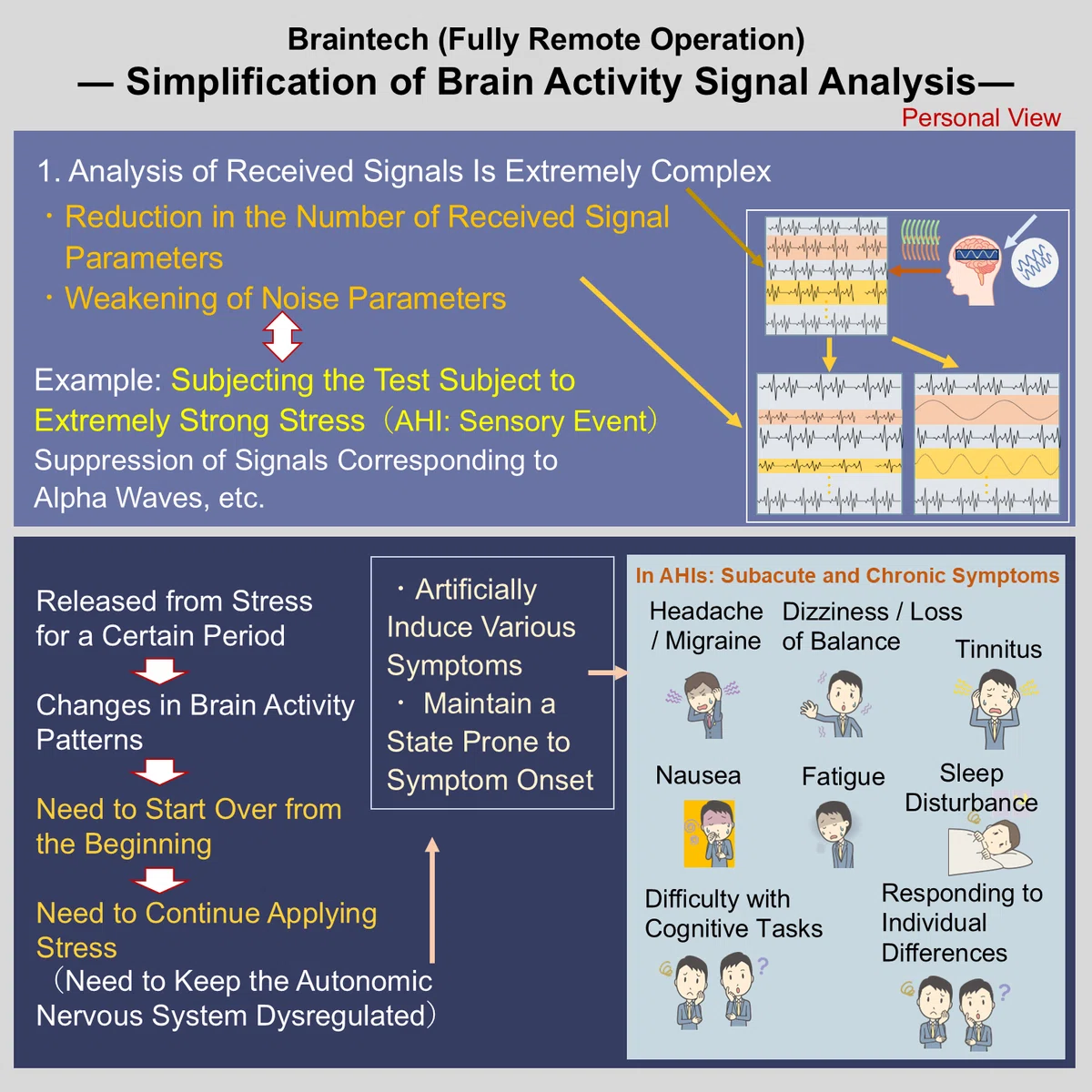
As discussed in Part 5-2, one possible way to reduce the complexity of received signal analysis would be to subject the target to strong stress, thereby reducing the number of analysis parameters or weakening signals that may act as noise for the intended analysis.
For example, the influence of signals corresponding to alpha waves may become considerably smaller under stress.
Based on my own experience, I suspect that if a subject is released from stress for a certain period of time, that person’s brain activity patterns may change, and in some cases it may become necessary to start over from the beginning.
For that reason, if there is an objective of continuously conducting such analysis, a motive may arise to keep the target in a certain state of stress.
More than eight years have passed since I experienced psychological disruption using sound and light in March 2018.
If the purpose were simply remote control of brain activity, I do not believe there would be any need to make me feel pain or stress almost around the clock, whether indoors or outside.
Therefore, if such a state is being intentionally maintained, the purpose may not be merely temporary manipulation. It may instead be related to more continuous objectives, such as maintaining analytical accuracy, collecting response data, or reducing the target’s capacity to resist.

2-3-2. Responding to Individual Differences
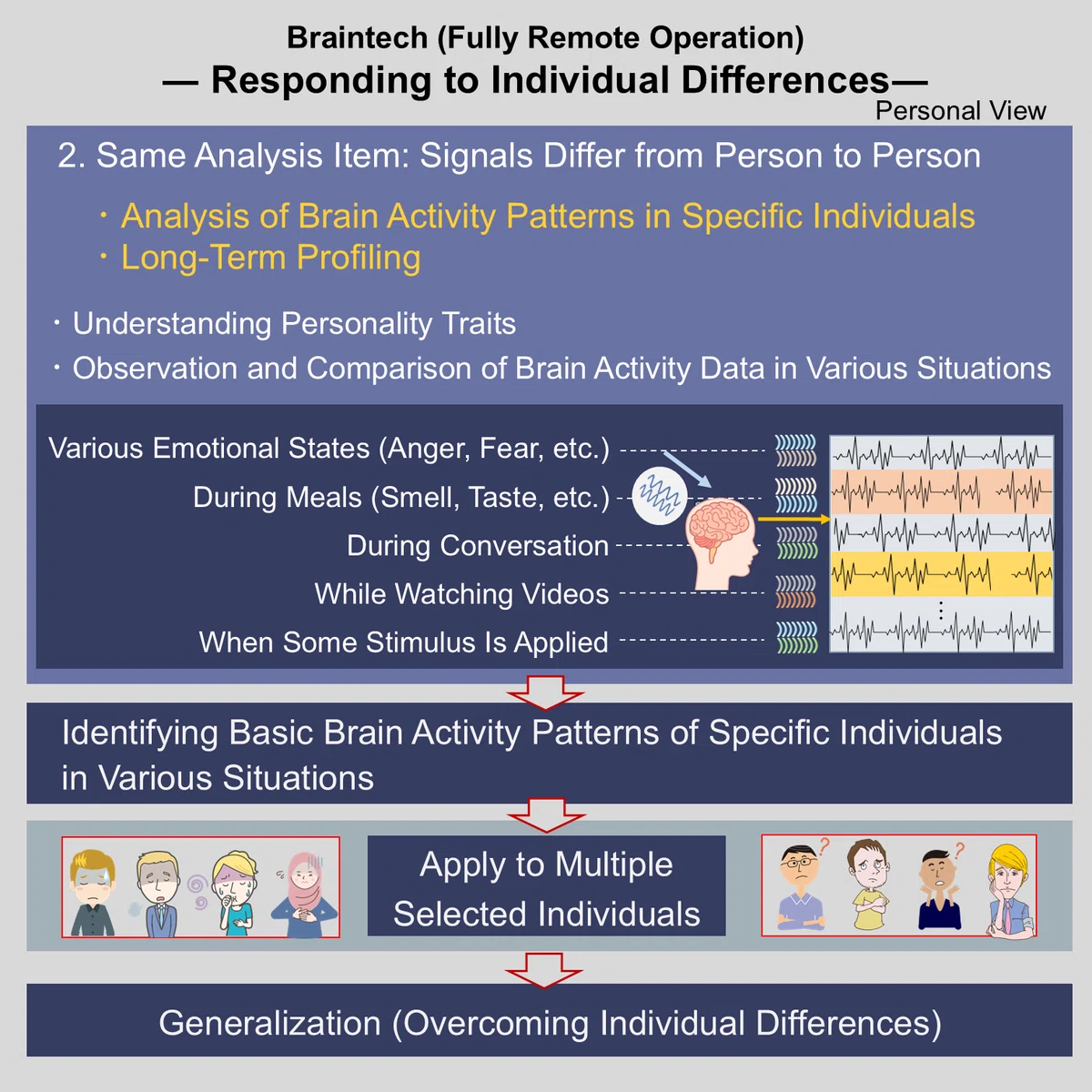
Anyone can easily imagine that patterns appearing through brain activity would differ from person to person.
Therefore, suddenly collecting and analyzing detailed data from a large number of people would not be efficient.
In order to overcome this challenge, one basic method may be to accumulate detailed data from specific individuals, identify basic patterns to some extent in relation to various emotions, responses, and behaviors, and then try applying those patterns to other people.
I recognize that I have continued to encounter suspicious incidents since I was young.
Taking this into account, and considering the background discussed in Part 3 together with the various incidents that occurred after I experienced psychological disruption using sound and light in March 2018,I believe that I myself may be one of those “specific individuals” targeted for such long-term data collection.

3. Summary
Braintech has a bright side in the form of medical and assistive uses. At the same time, I believe it also has a side that could be abused for military or political purposes, such as neutralizing individuals who are regarded as inconvenient or undesirable.
From both the standpoint of beneficial use and misuse, it is possible to imagine that fully remote braintech could become the most desirable form of such technology.
However, realizing such technology would likely involve major challenges, including the complexity of analysis and individual differences.
As a means of overcoming those challenges, long-term individual data collection and continuous stress induction may become necessary.
I believe that the above considerations from the perspective of braintech development may constitute a point of connection with the AHI-related harm discussed up to Part 7, as well as with the underlying purpose that may lie behind my own case.

4. Future Plans
In Part 8-2, I plan to examine the specific purposes that may be assumed if such technology is abused, including information exploitation, the neutralization of individuals who are regarded as inconvenient or undesirable, and the weakening of social and legal resistance.
In addition, although I presented four personal concerns in Part 5-1 through Part 5-3, I also plan to address further concerns.
<Update: May 10, 2026>
On May 9 , I published Part 8-2 and 9 as a continuation of the series.

