
Part 4-2: Human Experimentation Using Sound and Light (Revised)

This article is a revised version intended to improve clarity and refine its expression.
The original Part 4-2, posted on January 12, 2026, was made private on March 19 of the same year.
Summary
Position of This Article within the Series
This article corresponds to the section outlined in pink in the analytical framework of this series shown in the figure below (i.e., the scope examined in this article).
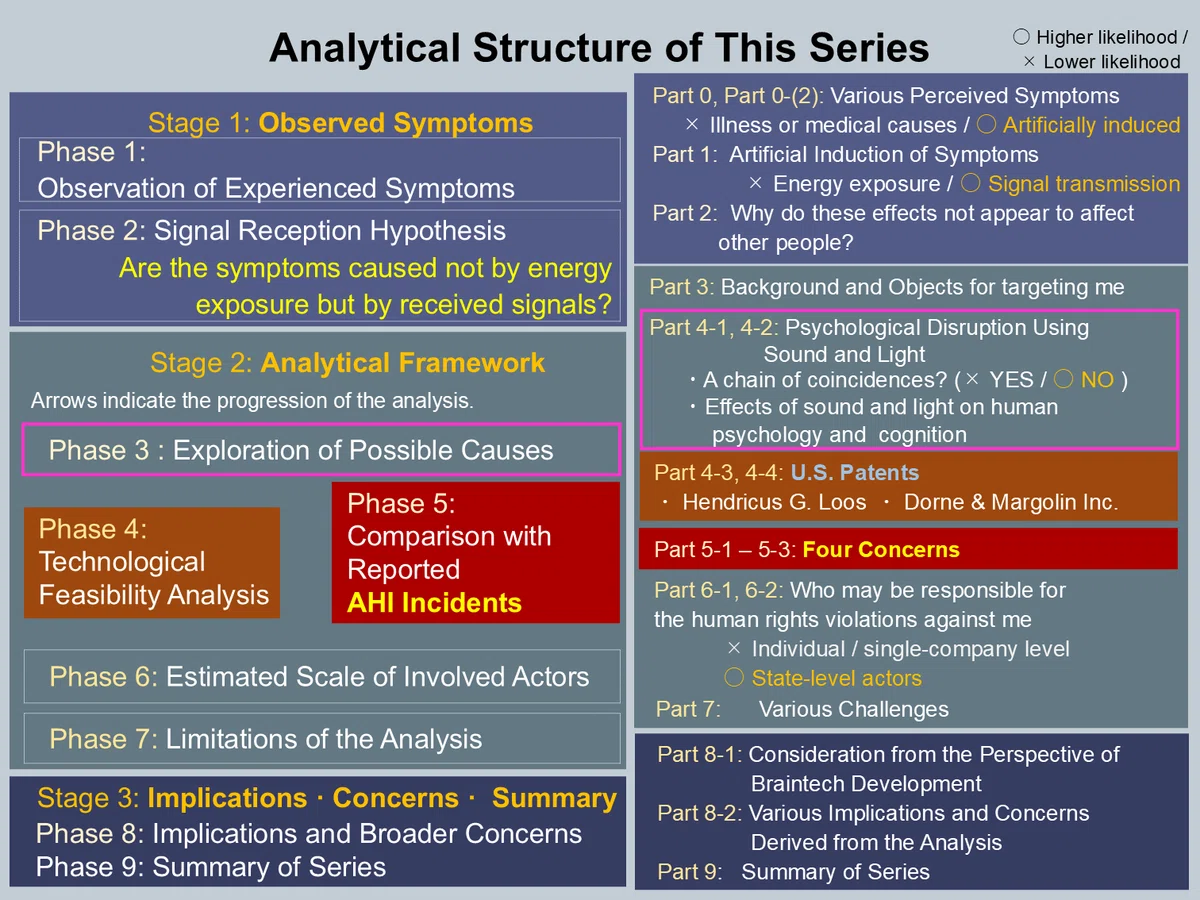
This diagram illustrates the relationship between the structure of the articles in this series and the stages of analysis.
The discussion is developed step-by-step, including the organization of observed phenomena, examination of analytical frameworks, verification of technical feasibility, and consideration of the entities involved.

Overview of the Series
For an overview of the entire series, please refer to the series guide below and the list at the end of this article.

Overview of This Article
In Part 4-2, I focus on one of the proposed explanations for the phenomena I refer to as “psychological disruption operations using sound and light,” as outlined in Part 4-1.
The possible explanations include:
・ the strengthening of mind control
・ making the public perceive me as mentally unstable, thereby invalidating my claims
・ facilitating the monitoring and control of brain activity
This article explains the first point: the strengthening of mind control.

1. Introduction: Psychological Disruption Operations Using Sound and Light
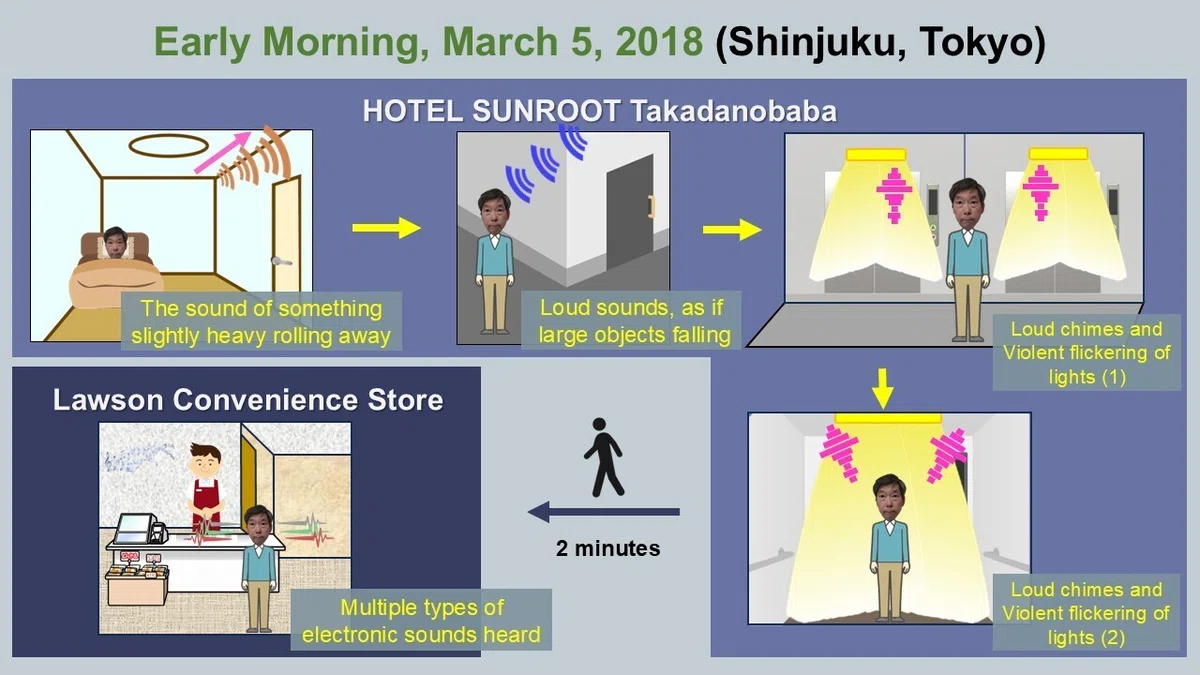
In Part 4-1, I briefly outlined that the series of events I refer to as “psychological disruption operations using sound and light” should not be understood as a coincidence of unrelated incidents, but rather as a serious matter that may have been carried out intentionally.
I consider that multiple objectives may have been involved in the background of this incident. The explanations currently hypothesized include:
the strengthening of mind control
making the public perceive me as mentally unstable, thereby invalidating my claims
facilitating the monitoring and control of brain activity
In this article, I focus on the first point: the strengthening of mind control.

2. Established Facts on the Effects of Sound and Light on Humans
2-1. Flickering Light
As demonstrated by the incident in December 1997, in which nearly 700 viewers of a popular animated television program were hospitalized after experiencing photosensitive seizures, it is widely recognized that prolonged exposure to flickering light may have adverse effects on human health.
This incident is described in the declassified U.S. Army report Bioeffects of Selected Nonlethal Weapons (fn. 1) (2006), specifically in the section “Incapacitating Effect: Disruption of Neural Control,” beginning on page 8 and discussed across pages 10 to 11.
The report is available at the following link:
https://archive.org/details/cr-bioeffects-of-selected-non-lethal-weapons
Although I did not personally watch the program in question, I believe that the flickering light I experienced—while intense—was likely not as severe as that depicted in the above-mentioned incident.

2-2. Loud Sound
In the NHK program Close-Up Gendai, broadcast on April 5, 2023, a scene was shown in which Ukrainian children taken to Russia were gathered in a dark room filled with loud sound.
The environment evoked a space similar to a nightclub setting.
According to the program, such conditions are said to have psychological effects, including making children more likely to become compliant.
In addition, the footage frequently showed flashes of light resembling red laser beams.
I also paid attention to this aspect, as I considered it to have similarities with what I refer to as “psychological disruption operations using sound and light.”
↓ Program information page (the program itself is currently not available for streaming)

3. Psychological Disruption Using Multiple Distinct Sounds
3-1. Experience on March 5, 2018 (Supplement)
The sounds I experienced at a hotel and a Lawson convenience store on March 5, 2018 were not loud low-frequency sounds. However, on March 7 and March 11 (or possibly March 10) of the same year, I heard different types of sounds, including distinct voices and low-frequency tones.

3-2. “Chant of Dread”
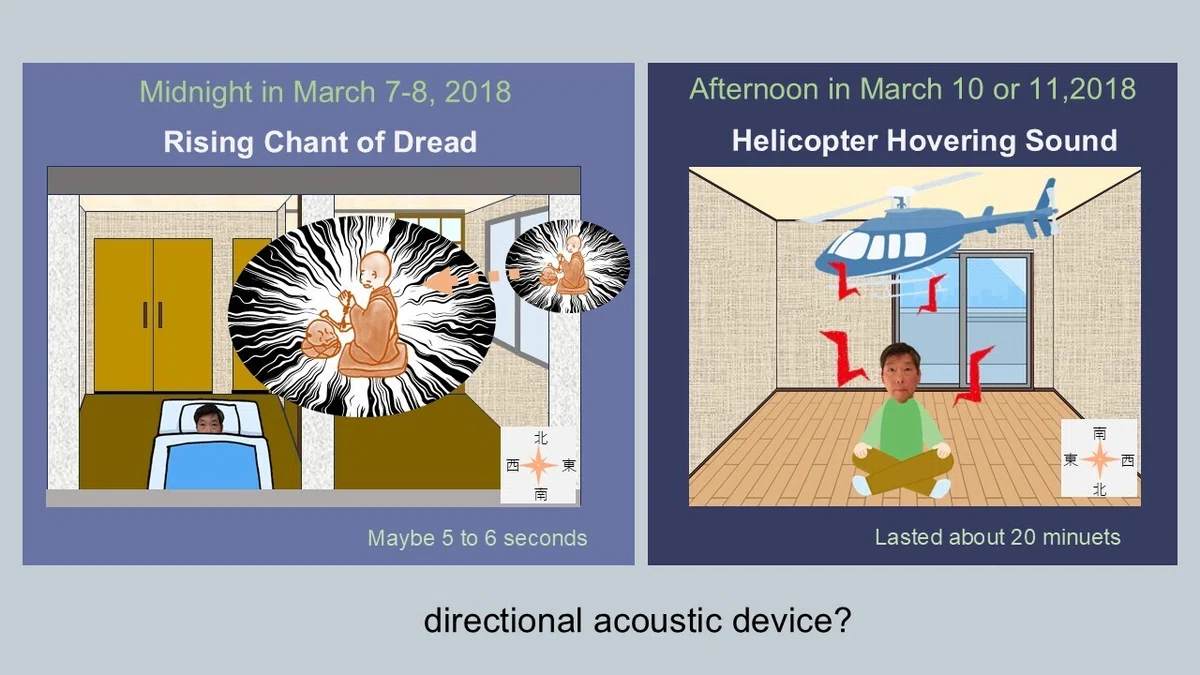
In the late hours of March 7, 2018, I heard a highly disturbing voice that I refer to as the “Chant of Dread.”
This occurred toward the end of another incident that took place earlier that day. I intend to describe that separate incident on another occasion.
While lying down in bed, I suddenly began to hear a voice coming from a room on the eastern side of my home, adjacent to the exterior wall. The voice sounded as if it carried anger and was intended to evoke fear.
From the moment I began to hear it, I felt a strong fear that “continuing to listen to this would lead to something serious.”
This feeling was similar to what I experienced when multiple electronic sounds began playing in front of the register at the Lawson store; however, the intensity of fear caused by this voice was significantly greater.
When the volume reached its peak, I braced myself, but the sound quickly faded out.
I estimate that it lasted approximately 10 to 15 seconds.
Afterward, the same sound began again, and I braced myself once more; however, it faded out again before reaching a high volume.
3-3. Helicopter Hovering Sound
On the afternoon of March 10 or 11, 2018, shortly after returning home from shopping, I began to hear a sound resembling a helicopter hovering.
It was a loud, low-frequency sound, so intense that it felt as if a helicopter were hovering just above the ceiling.
I recall that it continued for approximately 30 minutes. After the sound ended, I experienced a strong sense of fatigue.
It is generally unlikely for an actual helicopter to hover at low altitude over a residential area for an extended period.
I felt as though I was being subjected to some form of punishment, and I remained seated cross-legged, continuing to listen to the sound without resisting.

4. Possible Technologies Involved
Regarding the loud chime sounds and intense flashing lights observed in locations such as hotel elevators, I consider them to be within the range of what is technically feasible.
However, phenomena such as multiple electronic sounds heard near my ears, the “Chant of Dread,” and the helicopter hovering sound would likely be difficult to accept at face value.
I have experienced many other unusual events as well. These will be organized separately and reported in due course.
If such experiences are presented without careful consideration, they may lead readers to conclude that I am mentally unstable or attempting to promote conspiracy theories, thereby undermining my primary objectives, namely:
to report ongoing, unimaginable violations of human rights that I have been subjected to
to examine the potential connection to Anomalous Health Incidents (AHI)
to explore the possibility of even more concerning underlying motives behind these events
I am fully aware of these risks. With that understanding, I ask for your consideration in recognizing that I am documenting these experiences intentionally.
4-1. Control of Light Flickering
I believe that the flickering of the lights in these instances—whether controlled programmatically or manually—was artificially switched off.
4-2. Sound in Hotels and Indoor Spaces
At present, I consider the possibility that sounds heard in hotel rooms and hallways may have involved some form of directional acoustic device. However, it remains unclear whether these effects were produced using what is known as the Haas effect, commonly utilized in environments such as movie theaters.
4-3. Possibility of Directional Acoustic Devices
I also consider the possibility that sounds such as the “Chant of Dread” and the helicopter hovering noise may have been produced using a form of directional acoustic technology.

5. Effects of Psychological Disruption on Cognition and Behavior
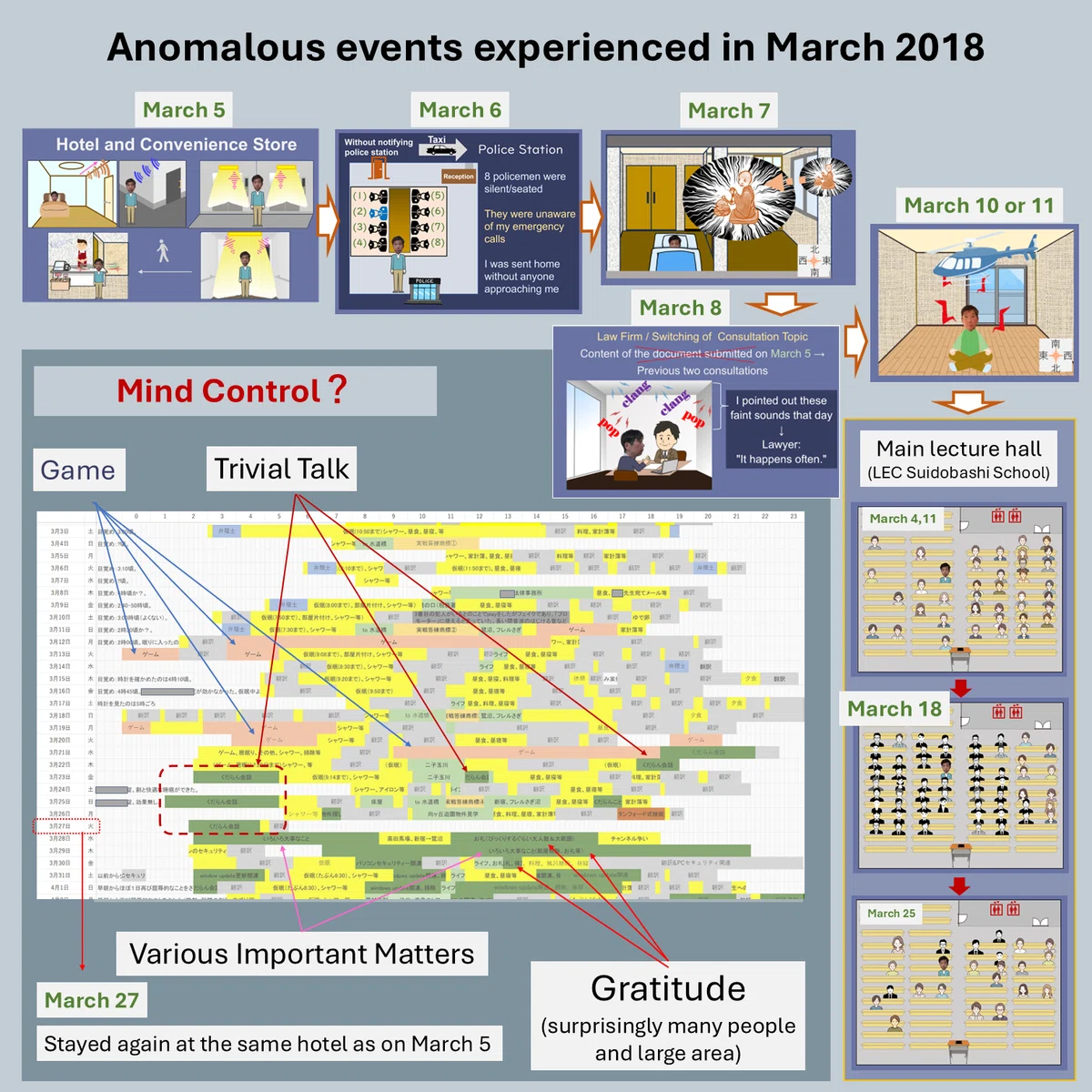
The purpose of this chapter is not to emphasize any peculiarities in my behavior itself, but rather to retrospectively organize the changes that occurred in my cognition, judgment, behavior, and record-keeping after being subjected to psychological disruption using sound and light.

5-1. Chain of Unusual Events
As shown in Figure 3, following exposure to psychological disruption using sound and light, multiple unusual events occurred in rapid succession within a short period of time.
The incidents on March 6 (involving a police officer at the Imperial Palace), March 8 (at a law office), and March 18 (at a lecture hall of LEC Suidobashi Main School) have already been reported. Clicking the underlined sections will open the corresponding articles.
Although my diary from this period does not document the specific attacks, such as tinnitus attacks, I was experiencing tinnitus attacks almost continuously on a daily basis, similar to my current condition. However, at that time, I perceived a wider variety of tinnitus-like sounds than I do now.
Other types of attacks will also be described in future posts.

5-2. Alteration of Records and Mind-Controlled State
In Figure 3, I would like to draw attention to the portions of my diary labeled “Game,” “Trivial Talk,” “Various Important Matters,” and “Gratitude.”
Initially, I had written somewhat more specific details in these sections, but I later rewrote them, thinking that “detailed records should not be kept.”
“Gratitude” remained unchanged, while “Trivial Talk” may have been replaced with different wording and subsequently modified again.
Regarding “Gratitude,” I clearly remember what I actually did. My actions in the lecture hall on March 25—one week after the lecture hall at LEC Suidobashi Main School had been occupied by people in suits on March 18—served as the starting point.
In addition, I stayed at Hotel Sunroute Takadanobaba on March 27 and again on June 1. The reasons for these stays were related to what I referred to as “Game” or “Trivial Talk.” I also used Lawson convenience stores during this period.

5-3. Self-Perception at the Time and Present Evaluation
For a period after experiencing psychological disruption using sound and light, I had come to believe that these actions had been arranged for some reason in order to help me, who had been suffering for many years.
Although I will omit the details, what I wish to emphasize is that I recognize that I was in a state of being strongly influenced.
At the same time, I was aware that if others had observed my behavior, they would likely have regarded me as mentally unstable.
This reflects the extent to which I had endured significant distress over a prolonged period prior to being subjected to psychological disruption.

6. Conclusion
Regarding the purpose of the psychological disruption using sound and light that I experienced, the possibilities I currently consider include:
the strengthening of mind control
making the public perceive me as mentally unstable, thereby invalidating my claims
facilitating the monitoring and control of brain activity
Among these, this article has focused on the strengthening of mind control, explaining that I recognize March 2018 as a period during which I was particularly strongly affected.
From a technical perspective, I have also suggested the possibility that various sounds and lights were applied to me—who was already in a psychologically weakened state—using methods that are not ordinarily encountered.

7. Future Plans
In the upcoming Parts 4-3 and 4-4 of this series, I plan to discuss the various symptoms I have perceived, such as pain and discomfort in different parts of my body, as well as technologies that may have the potential to artificially induce such symptoms.
I also intend to explore the possibility of more serious technologies underlying psychological disruption and the infliction of pain.
<Added on February 1, 2026>
On January 19 and January 26, 2026, I published Part 4-(3) and Part 4-(4), respectively.

