
Part 7: Challenges in Clarifying the Truth

Summary
Overview of This Article
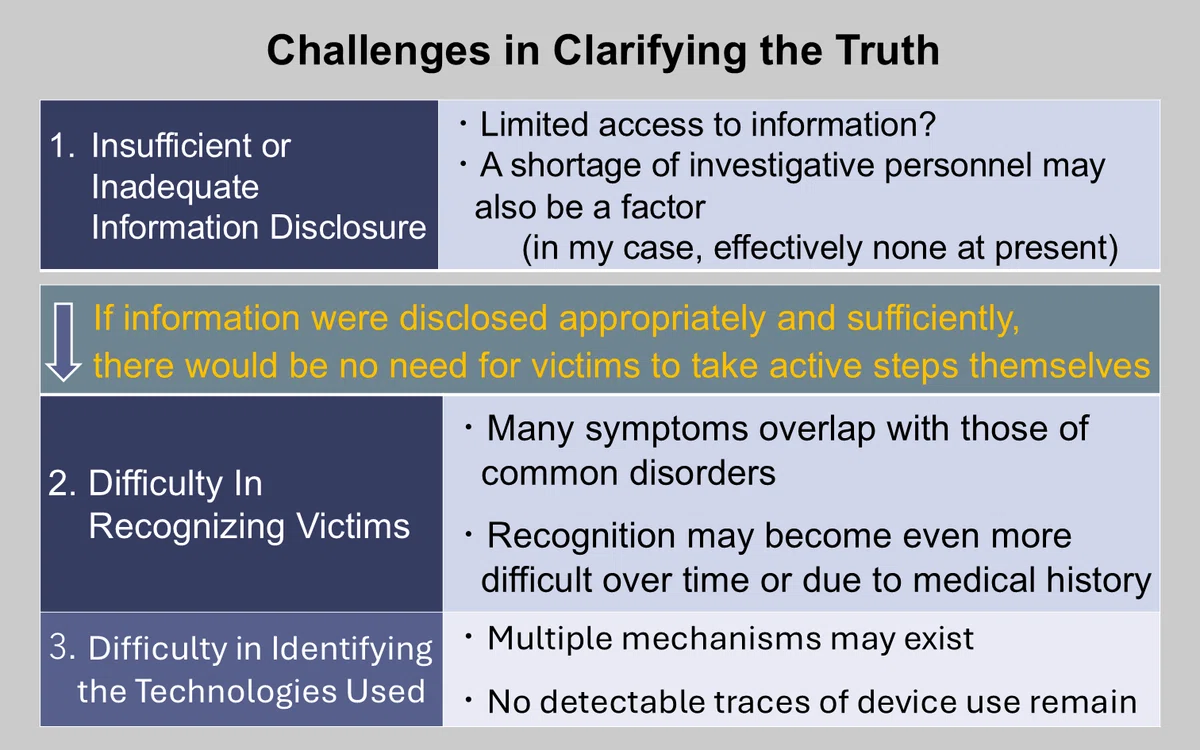
This article organizes the reasons why progress in clarifying the truth behind Anomalous Health Incidents (AHIs), as well as in publicizing my claims of human rights violations, has been slow, from the following three perspectives:
- Difficulty in identifying responsible actors due to insufficient information disclosure
- Difficulty in recognizing victims because symptoms overlap with common disorders
- Difficulty in identifying the technologies used
Note: This article represents an analysis conducted by an individual directly involved, based on personal experience records and publicly available information. It is not a rigorous expert analysis but rather an analysis based on personal understanding.

Position of This Article Within the Series
This article corresponds to the highlighted section within the analytical framework of this series.
The discussion continues follows a stepwise structure: organizing observed phenomena → analytical framework → technological possibilities → actor analysis.
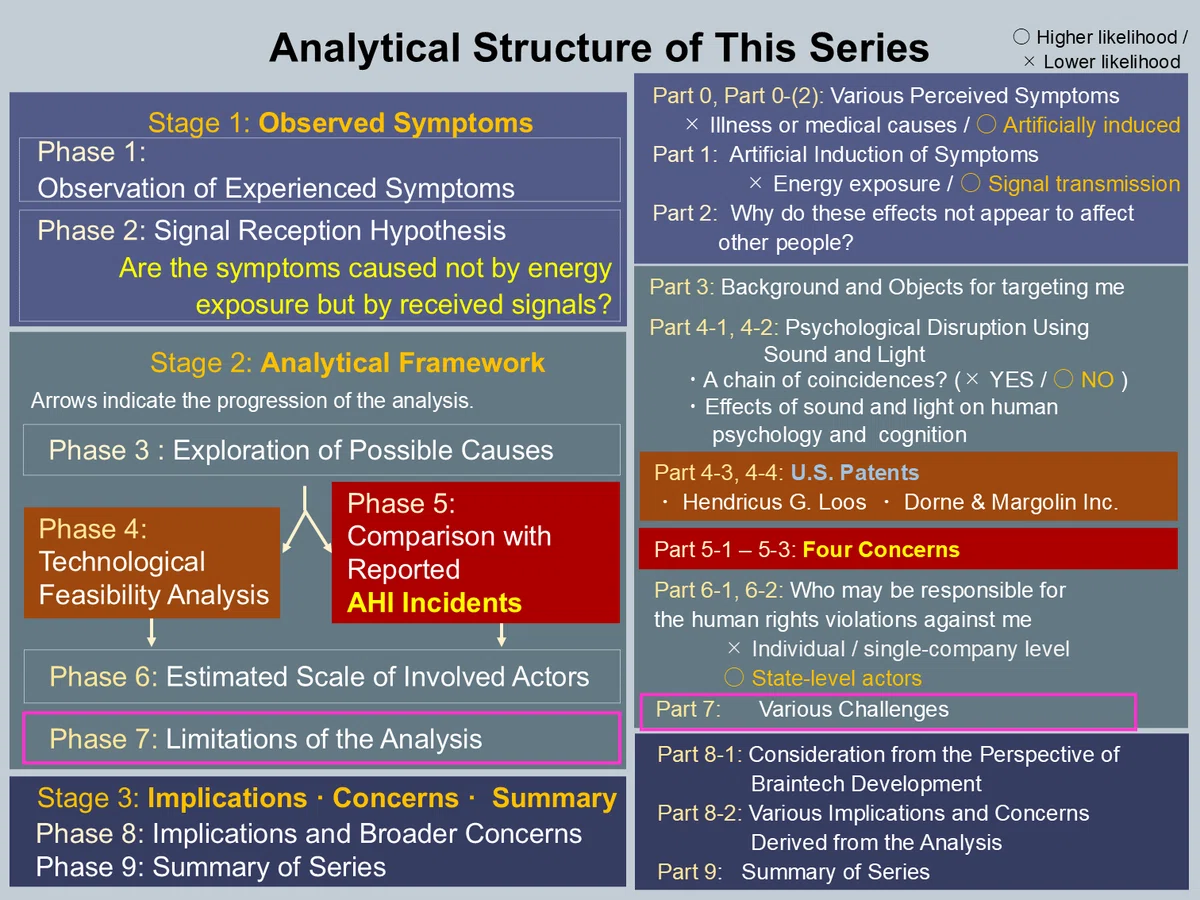
This diagram illustrates the relationship between the structure of the articles in this series and the stages of analysis.
The discussion is developed step by step, including the organization of observed phenomena, examination of analytical frameworks, verification of technical feasibility, and consideration of the entities involved.

Overview of the Series
For an overview of the entire series, please refer to the series guide and the list at the end of this article.

1. Introduction
This article organizes the reasons why progress in clarifying the truth behind AHIs and publicizing my claims has been slow, from the following three perspectives:
Difficulty in identifying actors due to insufficient information disclosure
Difficulty in victim recognition due to symptom overlap with common disorders
Difficulty in identifying the technologies used

2. Insufficient Information Disclosure / Unidentified Actors
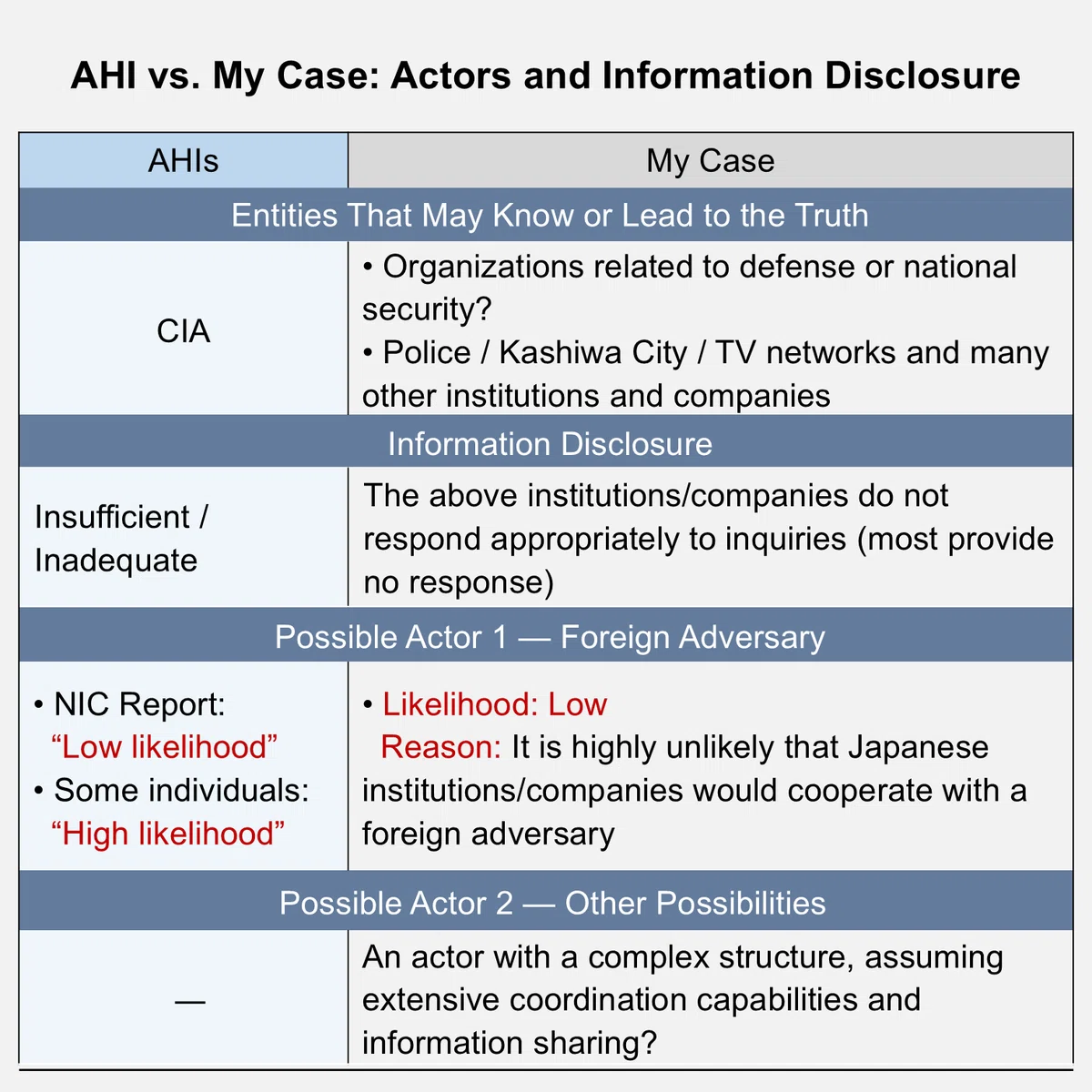
Reference: Investigating the Intelligence Community’s Conclusions on Anomalous Health Incidents: Is the Intelligence Community Hiding the Real Reason for This Phenomenon?, December 2024
In both AHI cases and my own case, the primary reason the truth remains unclear is that the institutions that should disclose information are not providing it appropriately.
It has also been pointed out that investigative systems are insufficient and access to information is restricted.
As a result, opinions differ regarding the responsible actors in AHI cases.
According to the latest assessment by the U.S. Intelligence Community (NIC), the actors have not been identified, and the likelihood of involvement by foreign adversaries is considered low. However, some investigators suggest possible involvement by foreign adversaries.
In my case, based on observations of AHI-related phenomena, the questions arising from them, and my own experiences, I consider the possibility of a domestic research program related to neuroscience or defense research.
In other words, I assume the possibility of an actor with a complex structure. From a technical perspective, cooperation with organizations such as the U.S. Department of Defense or the CIA is also conceivable.
Personally, I believe that AHIs may also involve domestic research programs related to neuroscience or defense research.
However, I do not intend to completely deny the possibility that foreign adversaries may be involved in some AHI cases.

3. Complexity of Symptom Onset and Similarity to Other Disorders
3-1. Complexity of Symptom Onset
3-1-1. In the Case of AHIs
Symptoms in AHI victims are classified into the following stages:
Sensory Event
Acute symptoms
Subacute symptoms
Chronic symptoms
Symptoms after the subacute stage are generally considered residual effects.
At each stage, the symptoms perceived by victims vary widely.
3-1-2. In My Case
In my case, I have experienced many of the symptoms reported by AHI victims, and some continue to this day.
I also believe that I have experienced phenomena corresponding to what may be considered Sensory Events multiple times.
However, I do not clearly recognize that my symptoms developed in the same staged progression as in AHI cases.

3-2. Summary of Section 3-1
In AHI cases, the variation in combinations of symptoms and their severity among individuals appears to be one factor making it difficult to identify causes.
Furthermore, without experiencing a Sensory Event, it may be difficult to be recognized as an AHI victim.
In my case, not following the staged progression from a Sensory Event may be one reason why my claims are not easily understood.
As a result, even if the underlying cause differs, symptoms may be interpreted within existing diagnostic frameworks.
Additionally, related concerns are discussed in Part 5-1 of this series:
Personal Concern (1): Is the AHI hypothesis valid?
Personal Concern (2): Could there be cases where AHI victims are not properly recognized?

3-3. Overlap Between Symptoms and Common Neurological Disorders
The figure below summarizes the relationship between AHI symptoms and those of neurological disorders.
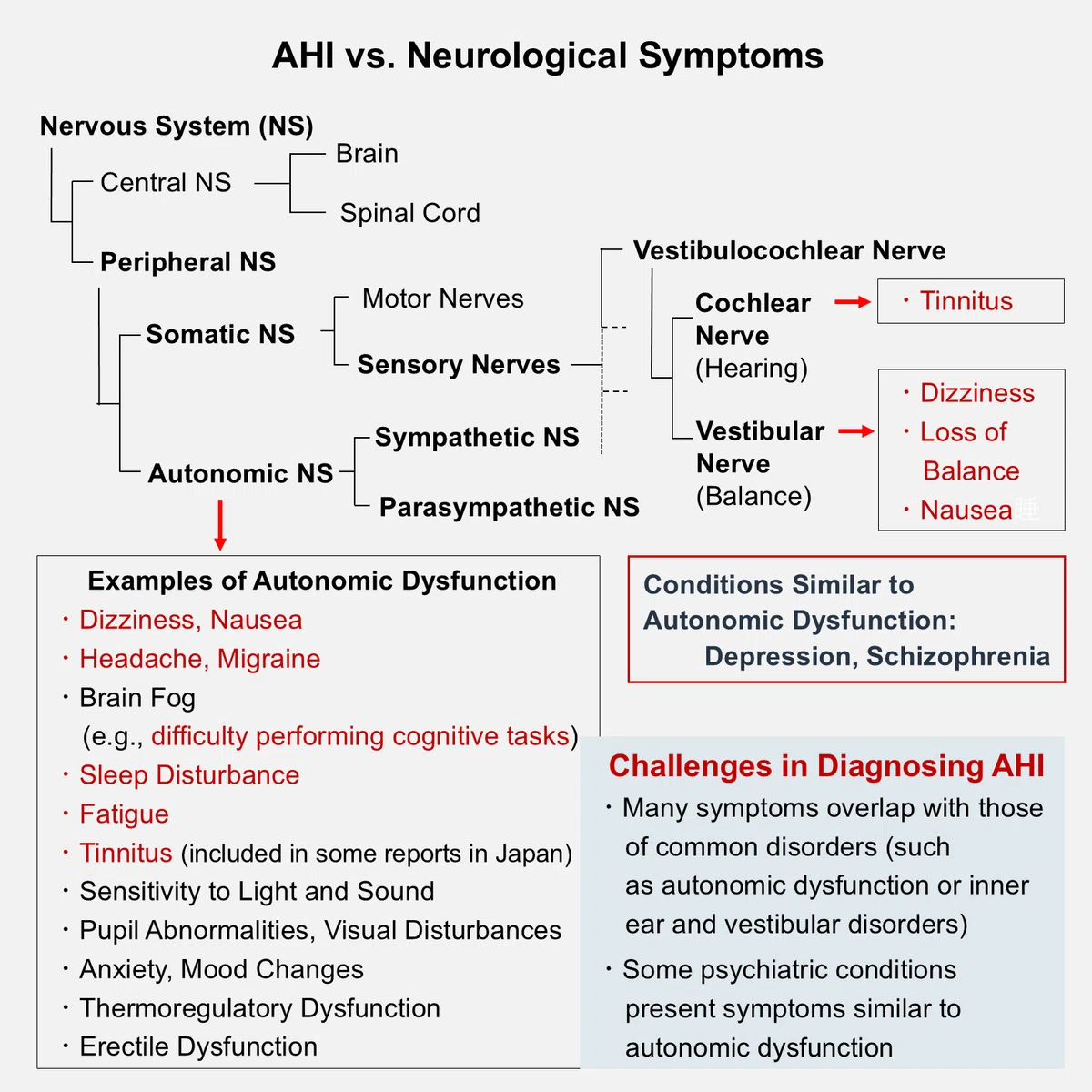
References: 1. MEDLEY(Japanese), an online medical encyclopedia created by physicians, “Autonomic Nervous System Disorder”, 2. Cleveland Clinic, “Dysautonomia”, 3. YouTube (Japanese), Goro / Learn the Human Body Through Illustrations, “Overview of the Nervous System,” “Autonomic Nervous System”
Many symptoms overlap with common neurological disorders, which is likely one of the reasons why AHI recognition is difficult.
Conditions such as depression and schizophrenia are also said to resemble autonomic nervous system disorders.
I had a long history of psychiatric treatment from 1996 to January 2018.
I disclosed this history in letters sent to organizations such as TV Tokyo in 2018 and to former defense ministers in 2022.
I was aware that claiming to be subjected to human experimentation or torture would naturally lead others to suspect mental instability.
On social media, I disclosed my psychiatric history after learning that technologies capable of artificially inducing various symptoms may exist.

3-4. Summary of Section 3-3
Because AHI involves a hypothesis of “Sensory Event → residual symptoms,” as time passes after the Sensory Event, the likelihood of being recognized as a victim through current testing methods may decrease.
There is a risk that cases may instead be diagnosed as mild autonomic dysfunction caused by stress or psychological factors.
In my case, being unknown and unemployed may create a bias in which most people interpret my claims as mental instability or autonomic dysfunction.
Additionally, although I recognize this may sound like a victim-based suspicion, I record the following concern:
There may be individuals disseminating information that leads others to interpret my claims as mental instability or autonomic dysfunction.
If this concern is valid, it may further reduce my ability to effectively communicate my claims.

4. Difficulty in Identifying the Technologies Used
4-1. Reported Cases in AHI Investigations and My Own Inference
Declassified findings from February 2022 suggest that some AHI cases cannot be easily explained by known environmental or medical factors and may involve external stimuli.
This point was also referenced in a U.S. congressional hearing in May 2024.
The figure below compares possible devices used for external stimulation, based on reported AHI cases, my own experiences, and insights derived from multiple references.
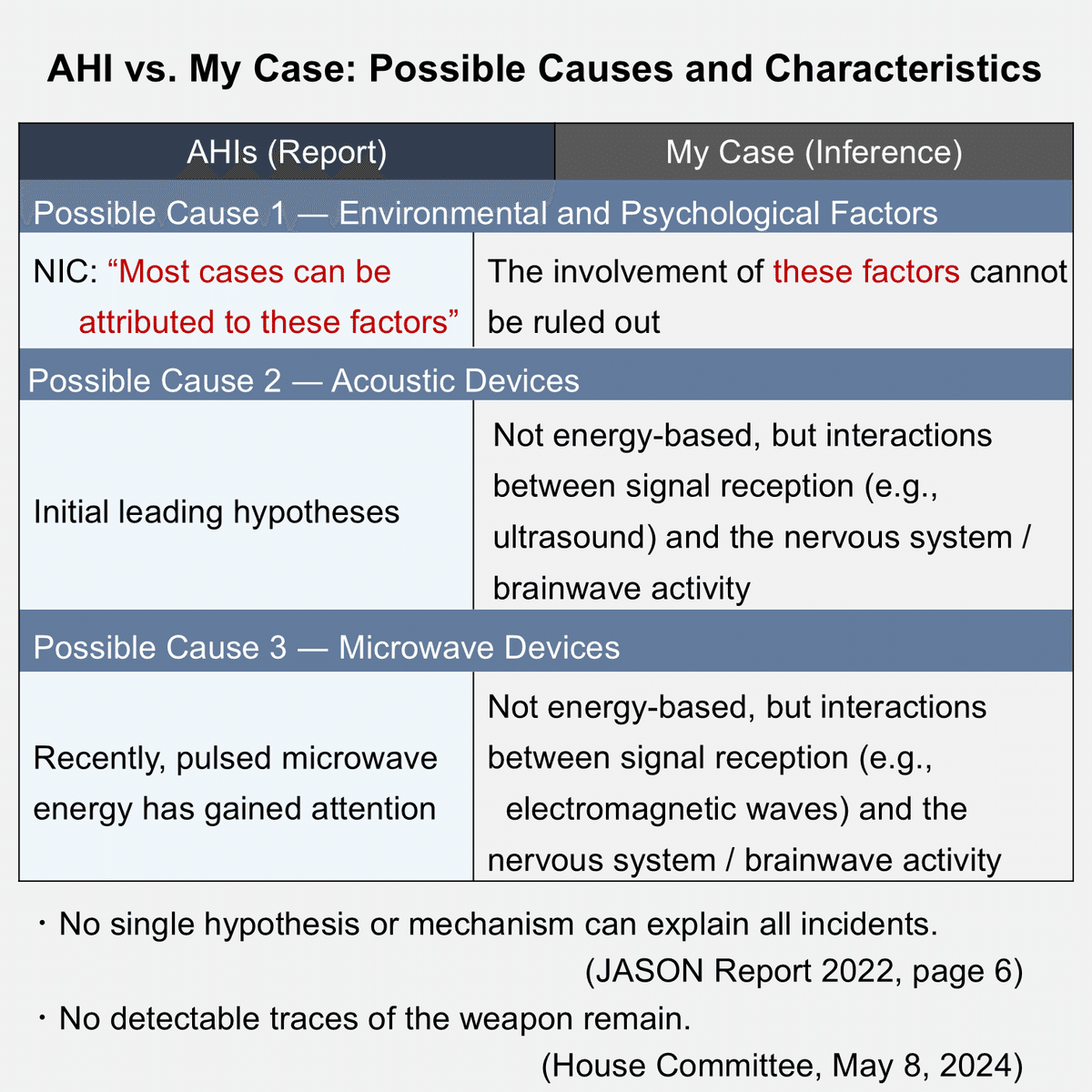
References:
1. Investigating the Intelligence Community’s Conclusions on Anomalous Health Incidents: Is the Intelligence Community Hiding the Real Reason for This Phenomenon? December 2024
2. An Analysis of Data and Hypotheses Related to the Embassy Incidents, February 10, 2022 (JASON Report 2022)
The NIC report states that most reported cases are due to environmental or psychological factors.
However, I am concerned about the possibility that some AHI victims are not being properly recognized (as discussed in Part 5-1).
Regarding myself, I do not deny the possibility that environmental or psychological factors may have some influence.
This is because I have endured severe experiences over many years, and institutions that could hold the key to resolving the issue—such as police and television networks—have consistently failed to respond appropriately.
Under such circumstances, it is difficult to say that my mental state is always stable.
Initially, acoustic devices were considered a leading explanation after AHIs were first reported in 2017.
Attention shifted to microwave energy exposure around the summer of 2018.
Currently, pulsed microwave energy is a focus of discussion.
The 2022 JASON report states that no single hypothesis can explain all observed events.
Based on my own experiences, I agree with this view.

4-2. Additional Considerations
In a U.S. hearing in May 2024, it was also discussed that weapons used may leave no detectable traces.
In my case, there are currently no visible injuries that can be clearly attributed to attacks.
I am able to go outside, and people who see me would likely not perceive that I have been subjected to severe harm.
I am also able to communicate through social media.
Why the entity causing my suffering allows such activities is something I plan to address separately.

4-3. Summary of Chapter 4
The difficulty in identifying technologies arises from:
Inability to identify the specific technologies or devices used
The possibility of multiple hypothetical mechanisms
The absence of physical traces left by weapons
These factors contribute to difficulties in determining causes and recognizing victims.

5. Conclusion
This article has organized the reasons why progress in clarifying the truth behind AHIs and publicizing my claims has been slow, from the following three perspectives:
Difficulty in identifying actors due to insufficient information disclosure
Difficulty in victim recognition due to symptom overlap with common disorders
Difficulty in identifying the technologies used
In principle, clarifying the truth should be the responsibility of institutions that hold the relevant information.
Victims should not need to engage in speculation or personal analysis regarding causes or technologies.
However, due to insufficient information disclosure, difficulty in interpreting symptoms, and challenges in identifying technologies,
a structure has emerged in which responsibilities that should be borne by information-holding institutions are effectively shifted onto victims.

6. Future Plans
In Part 8, based on the discussions from Part 0 through Part 7, I will organize the implications and concerns derived from this series.
<Update: May 10, 2026>
On May 9 , I published Part 8-1, 8-2 and 9 as a continuation of the series.

