
(実践解説)「プロジェクト発信型英語プログラムProject-based English Program/PEP©鈴木佑治」(3)...プロジェクト発信英語プログラムの基本的な考え方, コンセプト(With English, Spanish, Chinese Versions)

Front photo:Me at Canal, Georgetown in early spring.

「(実践解説)「プロジェクト発信型英語プログラムProject-based English Program/PEP©鈴木佑治」 (2)コンセプト編(2回目)|鈴木佑治 N.Yuji Suzuki」の続き(3)です。
プロジェクト発信型英語プログラムの基本的な考え方
■ 今持てる英語能力を発信型英語能力に転換する
このテキストの目的は、自分の関心事を基にプロジェクトを行い、その成果を英語で発信することです。 文法・語彙・発音などの英語そのものについての知識を教えることではありません。できる、できないに 関わらず、皆さんが今持っている英語の「蓄え」を生かして、プロジェクトを行い積極的にコミュニケー ションする「場」を提供することです。間違っても構いません、まず自分の意見が相手に分かってもらえ るよう努力することです。分かってもらえるまで何度も何度も繰り返せばいいのです。ネイティブ・スピ ーカーのように英語が使えなくても一向に構いません。十分な英語力が無いからといって消極的にならず、 今ある英語力を最大限に生かして、相手が分かるまで自分の考えを伝える努力をしてみましょう。正しい 文法や発音を気にして厳密な尺度にはめてしまうと、自己表現を犠牲にしてしまいます。世界中の人々は、 皆さんの英語そのものよりも、皆さんの考えを知りたがっているのです。自分の関心や考えを大切にして、 英語で自分なりに表現することから始めましょう。それをし続ければ、やがて皆さんのまわりには英語で コミュニケーションする友達がたくさん集まり、皆さんの英語も上達することでしょう。焦らずに今でき ることから始めましょう。重要なことは生涯続ける(lifelong)ことです。
■プロジェクトを通して成果発表
プロジェクト発信型英語とは プロジェクトを通してその成果を英語で発表し、意見を交換し、コミュニケーションを活発に行います。 手始めに、自分がどのようなことに関心を持っているかを簡単にself-appealするところから始めますが、 その関心をただぺらぺらと話すだけではすぐネタ切れして、コミュニケーションが停滞してしまいます。 そこで、自分の関心について、しっかりとリサーチをします。大学の授業では、きちんとリサーチした内 容を自分なりに表現することが求められるからです。英語の授業も例外ではありません。すなわち、自分 が関心をもつ事柄の調査・分析をしっかり行い、自分独自の見解を立てることができるまで追究すること です。下の図が示すように、しっかりとしたリサーチを基に、ディスカッションをし、その成果をプレゼ ンテーションし、またさらにリサーチをしてテーマを絞り、ディベートやシンポジウムを行います。かい つまんで言うと、リサーチ、ディスカッション、ディベート・シンポジウムができる高度なプロフェッシ ョナル・スキルが身につくはずです。当然、その過程で聞き、書き、読み、話しの4技能も磨かれます。こ うした発信型の能力は、大学のみならず、国際社会でも広く要求されます。
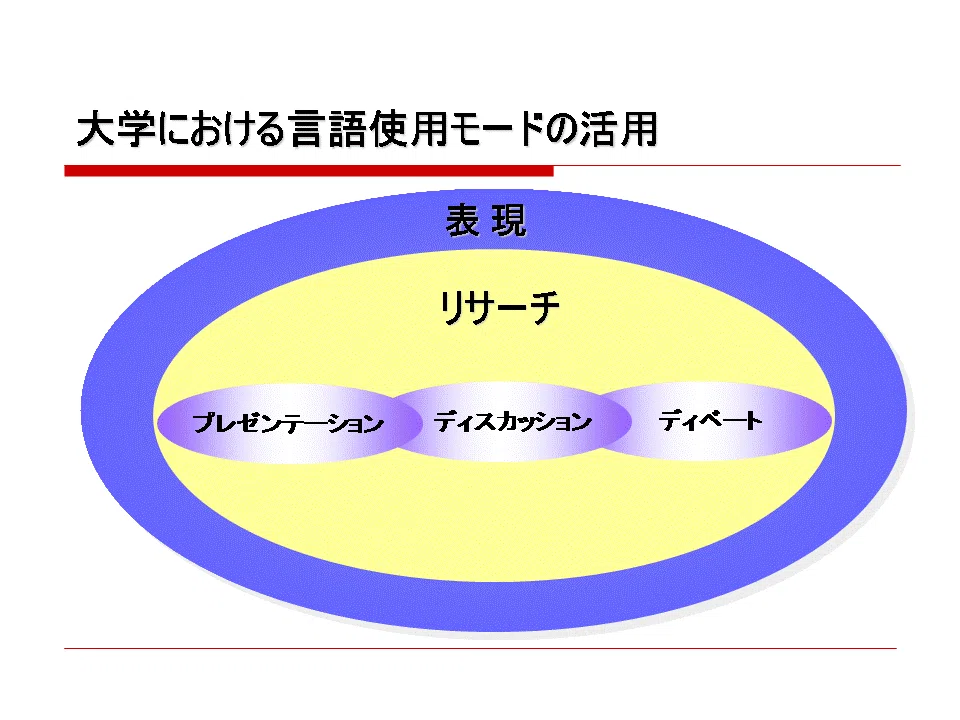
■ プロジェクト発信型英語の学生の位置づけ
一方的に何かの知識を学ぶのではなく、学生の関心をテーマにプロジェクトは展開されるので、学生の 皆さんが主役です。皆さんの発信活動が授業そのものを構成します。授業は先生ではなく、学生の皆さん が中心になって創り上げるものなのです。最後に授業について評価しますが、授業についての評価であり 教員についての評価ではありません。教員についての評価はその一部に過ぎないからです。皆さんの授業 活動が活発であれば、授業評価は良くなり、授業活動が停滞すれば、授業評価は悪くなります。
■ 先生の役割
学生が自由に発信できる環境を作るには、先生の役割も従来のそれとは違います。プロジェクトは学生 の関心を中心に進められますから、テーマについては学生の方が、先生よりも知っている場合があります。 先生は学生のプロジェクトに耳を傾けるうちに、それぞれのプロジェクトに関心を持つようになり、知識 と情報が豊かになるでしょう。自分の関心を学生に押し付けるのではなく、むしろ学生自身の関心事に耳 を傾けることによって、自分が考えてもみなかった未知のものに挑戦することになります。先生は自分が 知らないことに直面するわけですから、今まで通りの知識を伝授するという教員像ではなく、むしろアド バイザーとして学生の自主的な発信活動を側面から手助けして促進する役割を担います。先生はすべての ことを知ることはできませんし、その必要もありません。自分の学問分野の経験をふまえて、物事をどの ようにリサーチし、まとめていったらよいのか学生に示唆を与えることが大切です。学生が自分なりに英 語で表現することを促し、表現されたものは全て肯定的に評価することができるファシリテーターとして の役割を担うことになるでしょう。
■ 教室の位置づけ
これまでは、先生が学生に英語についての知識を教え、それについて覚えたかどうかテストするという 一方的な知識伝授型の授業であったため、教室という空間は先生の声だけが響く受け身型の授業の場でし た。プロジェクト発信型英語の教室という空間は、マーケット・プレイス(市場)に喩えることができま す。教室は、授業外活動として教室の外で行われるプロジェクトの成果という産物を持ち寄り、見せ合い、 それについて意見を交換する活気ある場になります。今でも日本の各所では朝市が開かれ、そこには採れ たての産物が並びます。朝市で売る人は、自分の畑で採れた自慢の産物をそこに並べて売り、買う人は、 それについていろいろな意見を言いながら買ったりしてそこでは活発な売買が繰り広げられています。こ こでの教室という場は、外で採れた知的産物を発表し合うマーケット・プレイスなのです。英語で語るコ ンテンツは、教室で採れるものではなく、教室の外で採れるものです。教室は、その発表と意見交換の場 となります。インターネットで世界各国の教室とつなげば、教室はたちまちグローバル市場に生まれ変わ ります。自分のプロジェクトの成果が、世界の多くの人に伝わると思うと活気が湧いてきます。
(実践解説)プロジェクト発信型英語プログラムProject-based English Program/PEP(4)......使用テキスト『プロジェクト発信型英語-Do Your Own Project in|鈴木ゆうじ N.Yuji Suzukiに続く
【Translation in English】
The basic philosophy of the Project-based English Program
■ Transforming Your Current English Ability into Expressive Communication Skills
The purpose of this text is to help you create and carry out a project based on your personal interests and express the results in English. It is not intended to teach grammar, vocabulary, pronunciation, or other technical aspects of the English language. Regardless of your current level, the goal is to provide a space where you can use the English you already know to actively engage in communication.
It’s okay to make mistakes. What matters most is making the effort to get your ideas across. Repeat yourself as many times as needed until you are understood. You don’t have to speak like a native speaker. Don’t let the lack of “perfect” English stop you from expressing your thoughts. Use what you have to the fullest. If you obsess over perfect grammar and pronunciation, you may sacrifice self-expression.
People around the world are more interested in your ideas than in the accuracy of your English. So value your own interests and thoughts, and start expressing them in your own way in English. If you continue doing this, you will naturally attract people with whom you can communicate in English, and your English will improve over time. Don’t rush — just start with what you can do now. The key is to continue this as a lifelong practice.
■ Presenting Project Outcomes
Project-based English means carrying out a project and presenting your findings or insights in English, engaging in active communication and exchanging opinions. As a first step, you’ll begin with a simple self-appeal explaining your interests. However, merely talking about what you like will soon run out of steam and stall communication.
That’s why in this approach, you’re expected to research your area of interest thoroughly. University-level work requires students to present what they’ve learned through research in their own words — English classes are no exception. This means conducting detailed investigation and analysis and developing your own perspective.
As shown in the diagram below (not included here), this process begins with solid research, followed by discussion, presentation of results, further research to refine your theme, and eventually, engaging in debates or symposiums. In short, you will develop high-level professional skills like research, discussion, debate, and symposium organization. Naturally, all four English skills — listening, writing, reading, and speaking — will be enhanced.
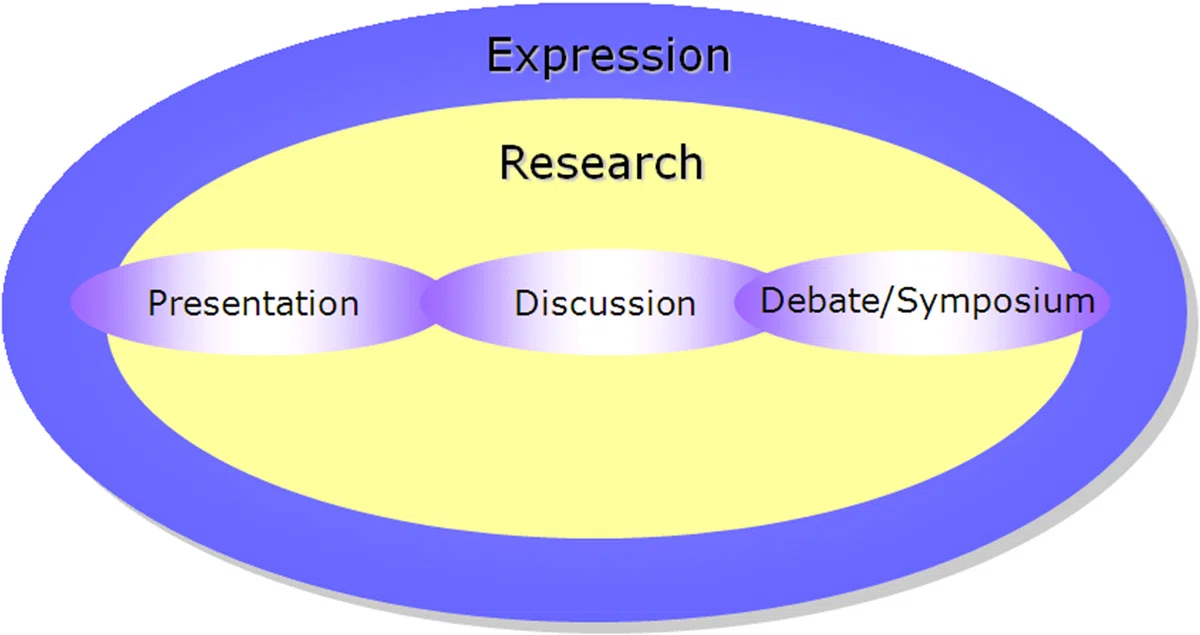
These expressive, output-focused skills are not only essential for university life but are also in high demand globally.
■ The Role of the Student in Project-Based English Program
Rather than passively learning knowledge, students take the lead by working on projects related to their own interests. You are the main actor. Your project presentations and activities form the core of the class itself. The class is not something that the teacher creates — it's something you and your fellow students build together.
At the end of the course, the class will be evaluated, but this is an evaluation of the class, not solely the instructor. The teacher’s contribution is just one part of that. If your class activities are vibrant and productive, evaluations will be positive. If they stagnate, evaluations will reflect that too.
■ The Role of the Teacher
To create an environment where students can freely express themselves, the teacher’s role must differ from traditional norms. Since the project revolves around student interests, students may sometimes know more about the topic than the teacher. As the teacher listens to students’ projects, they too become engaged and gain new knowledge and perspectives.
Rather than imposing their own interests on students, teachers are encouraged to listen to students’ passions. This opens doors to unknown, unexpected ideas, and even challenges the teacher’s own assumptions. Confronting unfamiliar subjects, teachers must shift from the traditional role of knowledge-giver to that of advisor — supporting and facilitating student-led initiatives.
Teachers don’t need to know everything. What’s more important is drawing on their academic experience to guide students on how to research and organize information. Teachers act as facilitators who encourage students to express themselves in English and positively reinforce all attempts at expression.
■ The Role of the Classroom
Traditionally, the classroom was a space where teachers delivered knowledge about English and tested whether students had memorized it — a passive environment where only the teacher's voice echoed.
In project-based English, however, the classroom can be compared to a marketplace. It becomes a lively space where students bring the products of their outside research — their projects — to share and exchange ideas.
Even now in Japan, morning markets are held in various places, filled with freshly harvested produce. Sellers proudly display crops from their own fields, and buyers engage in lively conversation and exchange of opinions as they shop. Similarly, the classroom becomes a marketplace of ideas where intellectual goods harvested outside the classroom are presented and discussed.
The content for English communication doesn’t come from within the classroom — it comes from outside experiences. The classroom serves as the space for presentation and exchange. And when connected to classrooms around the world via the internet, it instantly becomes a global marketplace. The thought that your project could be shared with people around the world brings an exciting sense of purpose.
============
【Traducción al españo】
La filosofía básica del Project-based English Program
■ Transformar la capacidad actual de inglés en una capacidad comunicativa orientada a la difusión
El objetivo de este texto es realizar un proyecto basado en los intereses personales de los estudiantes y difundir los resultados en inglés. No se trata de enseñar conocimientos sobre el inglés en sí, como gramática, vocabulario o pronunciación. Independientemente del nivel que tengas, este programa proporciona un espacio para aprovechar al máximo tu "reserva" actual de inglés, realizar un proyecto y participar activamente en la comunicación. No importa cometer errores; lo esencial es esforzarse por hacerse entender. Puedes repetir las veces que sea necesario hasta lograrlo. No pasa nada si no puedes usar el inglés como un hablante nativo. Lo importante es no volverse pasivo por falta de competencia y, en cambio, utilizar al máximo las habilidades que ya tienes para transmitir tus ideas hasta que el otro comprenda. Si te enfocas demasiado en usar una gramática y pronunciación correctas, podrías sacrificar tu capacidad de expresión. La gente en el mundo quiere conocer tus ideas más que tu inglés. Valora tus propios intereses y pensamientos, y comienza expresándolos a tu manera en inglés. Si continúas haciéndolo, poco a poco harás muchos amigos con los que comunicarte en inglés, y también mejorarás tu inglés. No te apresures: empieza con lo que puedes hacer ahora. Lo importante es continuar durante toda la vida (lifelong).
■ Presentación de resultados a través de proyectos
El inglés orientado a la difusión de proyectos consiste en presentar en inglés los resultados de un proyecto, intercambiar opiniones y activar la comunicación. Para comenzar, se hace una breve self-appeal (autopresentación) sobre los propios intereses. Sin embargo, si solo hablas superficialmente sobre tus intereses, pronto se agotará el tema y la comunicación se estancará. Por eso, es importante investigar a fondo sobre el tema de interés. En la universidad, se espera que los estudiantes expresen con sus propias palabras los contenidos que han investigado adecuadamente. Las clases de inglés no son una excepción. Es decir, se debe investigar y analizar cuidadosamente el tema de interés hasta que se pueda formular una opinión propia.
Como muestra el siguiente esquema, basado en una investigación sólida, se realiza una discusión, luego se presentan los resultados, se continúa con una investigación más profunda, se delimita el tema, y se llevan a cabo debates o simposios. En resumen, se desarrollan habilidades profesionales avanzadas como la investigación, la discusión, el debate y el simposio. Por supuesto, en ese proceso también se pulen las cuatro habilidades lingüísticas: escuchar, escribir, leer y hablar. Estas habilidades comunicativas orientadas a la difusión no solo son necesarias en la universidad, sino que también son ampliamente requeridas en la sociedad internacional.
■ Rol del estudiante en el Programa de Inglés para la Difusión de Proyectos
En lugar de aprender pasivamente conocimientos impartidos unilateralmente, los proyectos se desarrollan a partir de los intereses de los estudiantes, por lo que ustedes son los protagonistas. Sus actividades comunicativas constituyen la esencia misma de la clase. Las clases no las construye el profesor, sino ustedes. Al final se realiza una evaluación del curso, pero esta se refiere al curso en sí, no al profesor. La evaluación del docente es solo una parte de ella. Si las actividades de ustedes son activas, la evaluación del curso será buena; si son pasivas, la evaluación será baja.
■ El rol del profesor
Para crear un entorno en el que los estudiantes puedan expresarse libremente, el papel del profesor también debe cambiar. Como los proyectos se basan en los intereses de los estudiantes, a veces los estudiantes pueden saber más que el profesor sobre el tema. Al escuchar sus proyectos, el profesor también se interesará por ellos y enriquecerá su propio conocimiento. En lugar de imponer sus intereses, el profesor debe escuchar los intereses de los estudiantes, lo cual le lleva a enfrentarse a lo desconocido.
Dado que el profesor se enfrenta a temas que no domina, su rol no es el del tradicional transmisor de conocimientos, sino el de asesor que apoya y promueve las actividades autónomas de expresión de los estudiantes. El profesor no necesita saberlo todo. Lo importante es que, con base en su experiencia académica, oriente a los estudiantes sobre cómo investigar y sintetizar la información. Deberá asumir el papel de facilitador, alentando la expresión individual en inglés y evaluando positivamente todo lo expresado.
■ El papel del aula
Hasta ahora, las clases han sido espacios pasivos donde el profesor transmite conocimientos sobre inglés y se evalúa si los estudiantes los han memorizado. En cambio, el aula en el Programa de Inglés para la Difusión de Proyectos puede compararse con un mercado. Es un lugar dinámico donde se reúnen los productos —los resultados de los proyectos realizados fuera del aula— para mostrarlos, compartirlos e intercambiar opiniones.
En Japón aún existen los mercados matutinos, donde se exhiben productos recién cosechados. Quienes venden presentan con orgullo los productos de sus huertos, y quienes compran comentan sobre ellos mientras el comercio fluye animadamente. Así, el aula se convierte en un mercado donde se presentan productos intelectuales cosechados fuera de ella. El contenido que se transmite en inglés no se produce dentro del aula, sino fuera. El aula es el espacio para su presentación e intercambio. Si conectamos nuestras aulas con otras en todo el mundo a través de Internet, el aula se transforma inmediatamente en un mercado global. Pensar que los resultados de tu proyecto pueden llegar a personas de muchos países genera entusiasmo.
=======
【中文翻译】
The Project-based English Program的基本理念
■ 将现有的英语能力转化为输出型英语能力
本教材的目的,是以自身的兴趣为基础开展项目,并将其成果用英语进行表达与传播。它并不教授语法、词汇、发音等英语本身的知识。无论英语是否流利,我们的目标是利用你“现有的英语储备”,开展项目,并提供一个积极进行交流的“场所”。犯错误也没关系,关键是努力让对方理解你的想法。只要不断重复,直到对方理解即可。即使不能像以英语为母语的人那样使用英语,也完全没有问题。不要因为英语水平不足就变得消极,而是要最大限度地发挥现有的英语能力,努力将自己的想法传达给对方。如果太在意语法是否正确、发音是否标准,从而套用严格的标准,那么你的自我表达就会受到限制。世界各地的人们感兴趣的,并不是你说的英语本身,而是你所表达的思想和观点。请珍视自己的兴趣和想法,从用英语表达自己的观点开始。只要坚持下去,身边就会逐渐聚集起能用英语交流的朋友,你的英语水平也一定会提升。不要着急,从现在能做到的事情开始。最重要的是要终身持续(lifelong)地进行下去。
■ 通过项目发表成果
所谓“项目发信型英语”,是指通过项目来用英语发表成果,交换意见,并积极进行交流。首先,从简单地展示“自己对什么感兴趣”开始进行自我表达(self-appeal),但如果只是随意聊聊兴趣,很快就会词穷,交流也会停滞。因此,必须对自己的兴趣领域进行扎实的调研。这是因为在大学课程中,要求你要基于认真调研的内容,进行个性化的表达。英语课也不例外。换句话说,必须对感兴趣的主题进行深入的调查与分析,直到能够提出自己独到的见解为止。正如下图所示,在扎实调研的基础上开展讨论,发表成果,然后进一步深入调研,聚焦主题,进行辩论和研讨会。简而言之,你将获得能够进行调研、讨论、辩论、研讨的高级专业技能。当然,在这个过程中,听、说、读、写四项基本技能也会得到提升。这样的输出型能力不仅在大学中需要,在国际社会中也同样被广泛要求。
■ 项目发信型英语中学生的定位
这不是被动地学习某些知识,而是以学生的兴趣为出发点来开展项目,因此学生是课堂的主角。大家的表达与输出活动本身构成了课堂内容。课堂并不是由教师主导,而是由学生们共同构建的。虽然最后会对课程进行评价,但这仅是对课程本身的评价,而不是对教师的评价。教师的评价只是其中的一部分。如果学生们积极参与课堂活动,课程评价自然就会好;相反,如果课堂缺乏活力,评价也会随之下降。
■ 教师的角色
要营造一个学生可以自由表达的环境,教师的角色也与以往不同。由于项目是以学生的兴趣为中心展开的,因此有时学生对主题的了解甚至超过教师。在倾听学生的项目过程中,教师也会逐渐对每个项目产生兴趣,积累更多的知识与信息。不是将自己的兴趣强加给学生,而是通过倾听学生的兴趣,挑战自己以前未曾接触过的未知领域。教师也会面临自己不熟悉的内容,因此不再是传统的知识传授者,而是作为顾问(adviser)在一旁支持、促进学生的自主发信活动。教师不可能知道所有事情,也没有必要知道一切。基于自己学术领域的经验,向学生提供关于如何开展调研与总结的建议更为重要。教师的角色是引导学生勇于用英语进行表达,并对学生所表达的一切给予积极评价,即担任促进者(facilitator)的角色。
■ 教室的定位
以往的英语课是教师单方面传授知识,并通过测试检验学生是否记住,因此教室成了只有教师声音回荡的被动式学习场所。而在“项目发信型英语”中,教室可以比喻为一个“市场”(marketplace)。教室成为一个充满活力的空间,学生将课堂外的项目成果带入教室,彼此展示并交换意见。在日本各地,如今仍有许多早市,人们在市场上展示自己种植的新鲜作物并进行买卖。教室就是这样一个展示自己“知识性成果”的市场。用英语表达的内容并不是在教室内产生的,而是在教室外产生的。教室只是展示与交换意见的场所。如果通过互联网将教室与世界各地的课堂连接起来,教室就能立刻变成一个“全球市场”。一想到自己的项目成果能够被世界各地的人们看到,就会感到无比兴奋与动力。
いいなと思ったら応援しよう!
 サポートいただけるととても嬉しいです。幼稚園児から社会人まで英語が好きになるよう相談を受けています。いただいたサポートはその為に使わせていただきます。