数学の学び方 by Richard Borcherds

This is not a sequel to the following article on "LOST IN MATH":
However, in the above article I referred to the Moonshine Conjecture, which has triggered this article:
The Moonshine Conjecture and Advice for Math Students
| Richard Borcherds | TEDxNiendorf
Richard Borcherds
is a British mathematician currently working in quantum field theory. He is known for his work in lattices, group theory, and infinite-dimensional algebras, for which he was awarded the Fields Medal in 1998.
While questions by youngsters in the preamble on Elliptic Modular Functions and Monster Group as well as its linkage with Moonshine theory are just perfunctory, Richard Borcherds explained the motivation for the theory based on finding closeness of two numbers that appear in different theories of mathematics in a plain language.
The moonshine conjecture has started off by John McKay, who noticed that, as I mentioned, the monster lives in 196883 dimensions. And John McKay was looking at the elliptic modular function and noticed that one of its coefficients was 196884. So it sort of differs by one. And very roughly, the moonshine conjecture is to try and explain this coincidence... and the first problem is to know whether it's just a coincidence or whether it's meaningful... there are an awful lot of coincidences that are just coincidences. I mean , you can walk down the street and notice, wow, that car number plate has the same three digits as my Social Security number. Well, that's just meaningless because if you get a lot of numbers, some of them are going to be the same just by coincidence.
Those who are fascinated by numerology will never understand what Richard Borcherds says...
① 196883
The monster group is the highest order sporadic group M with group order being

where the divisors are precisely the 15 supersingular primes (Ogg 1980). The monster group is also called the friendly giant group. It was constructed in 1982 by Robert Griess as a group of rotations in 196883-dimensional space without a computer😮
Here is a list of 26 sporadic groups (散在型単純群):
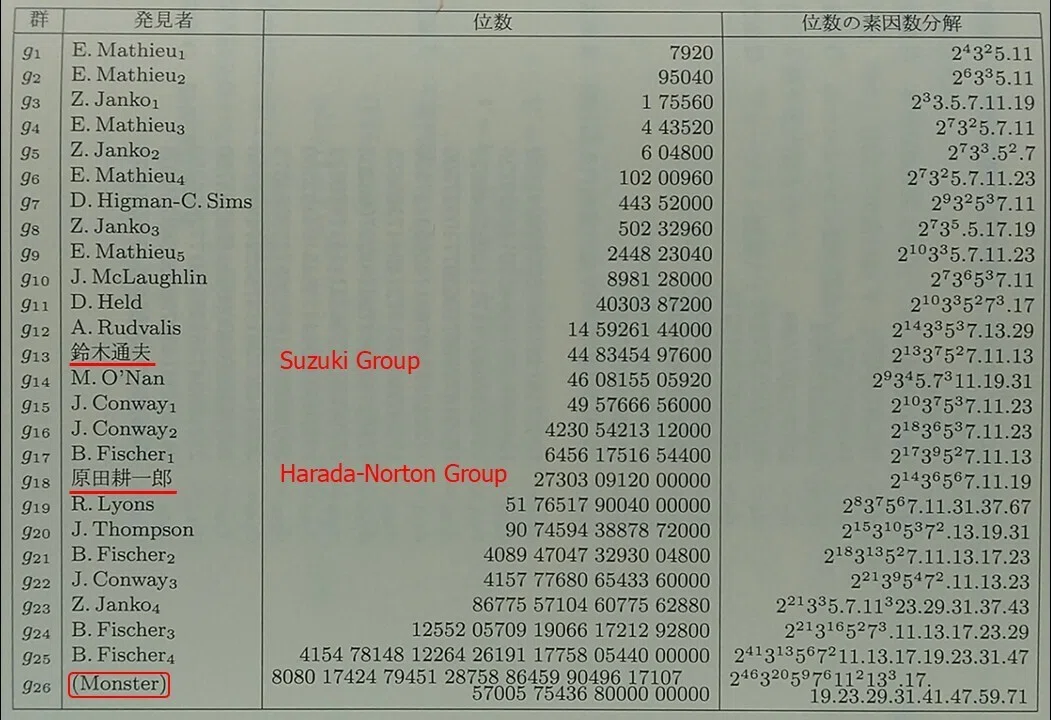
Please note that the above list is different from the list in the following article:
② 196884
196884 appears in q-series of j-invariant j(τ) written as a Laurent series:

Richard Borcherds talked about Replication crisis and briefly about AI, but the following advice was pretty instructive:
The key way of trying to learn mathematics is to forget about proofs or theorem or abstract work, and just look at a key example. So every area of mathematics, there are 1 or 2 really key examples that kind of capture all the important ideas. Let me give an example. Suppose you want to learn the theory of Lie groups... You could start by reading the definition of a Lie group and reading up lots of theorems about it and studying their proofs. And this is completely the wrong way to learn Lie groups. What you should do is pick one particular Lie group, and the best one might be, say, the group of two by two matrices with determinant one. And then you really study that group in detail. And that's the right way to learn Lie groups, because this particular example sort of contains all the interesting properties of general abstract Lie groups.
My non-expert partial translation of the above into Japanese is:
…例えばリー群の勉強を例に考えてみる。リー群の定義を読むことから始めて沢山ある定理とその証明を読むことによってリー群の勉強をすることが出来るが、これは全く誤った方法である。そうではなく、リー群の一つ(例えば 行列式が 1 である 2×2 行列からなる群)を例に取って、その群に関して徹底的に調べ上げることが正しい勉強法である。というのはこの例が一般的な抽象的なリー群の興味ある性質を全て含んでいるからである…
The above advice by Richard Borcherds sounds convincing, and I recently had an incredibly eye-opening experience in learning a modular curve X₀(11). This case provided me with a very good learning opportunity of many things:
Looking into X₀(11), it automatically caused me to look at the curve from different perspectives, and helped me understand Vélu's formulas relative to isogenies of elliptic curves by going through somewhat lengthy calculations of elliptic curves. Also I am reasonably comfortable in navigating through LMFDB (The L-functions and modular forms database), which is much more than just knowing its presence.
Then, I continued my study of X(11), a curve of genus 26, and came across the following stunning result:
Theorem. Let k be a field of characteristic 3, containing a 11th root of unity. Then, Aut(X(11)) ≅ M₁₁ (Mathieu group).
(翻訳)単位元 1 の原始11乗根を含む標数 3 の体の上で定義された X(11) の自己同型群は マシュー群 M₁₁ と同型である
This M₁₁ is called g₁ in the table of sporadic groups by 原田耕一郎 above.
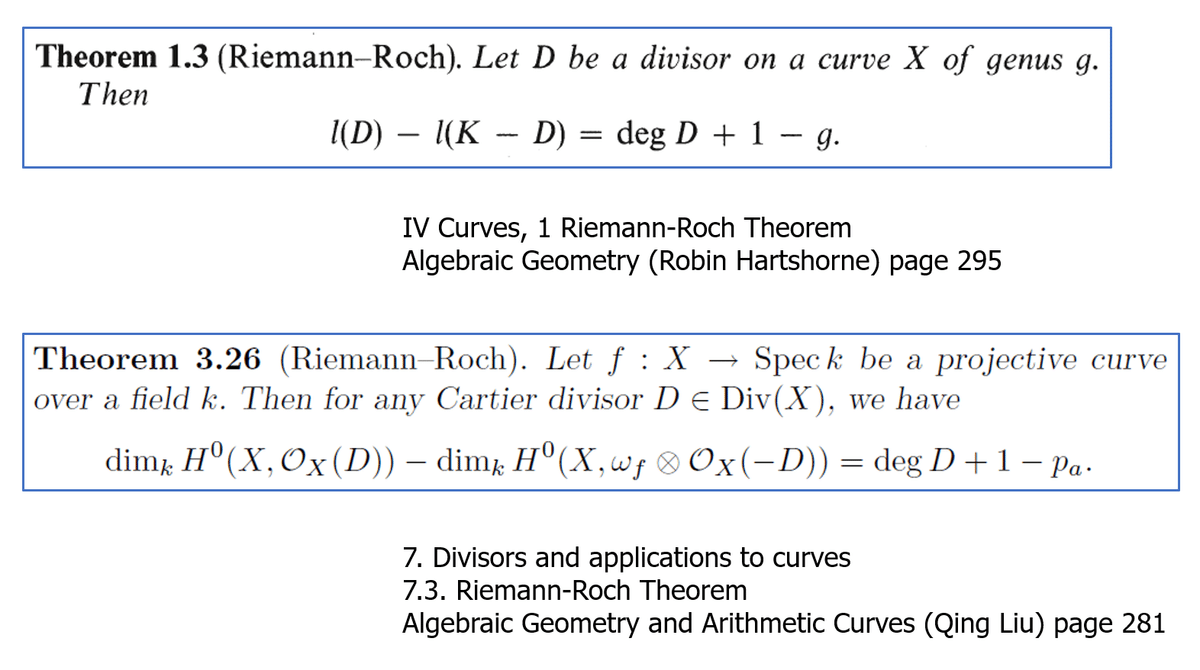
On the other hand, here's an excerpt from "Algebraic Geometry" (by Robin Hartshorne) which is considered a standard textbook in algebraic geometry:
In this chapter we apply the techniques we have learned earlier to study curves. But in fact, except for the proof of the Riemann-Roch theorem, which uses Serre duality, we use very little of the fancy methods of schemes and cohomology. So if a reader is willing to accept the statement of the Riemann-Roch theorem, he can read this chapter at a much earlier stage of his study of algebraic geometry. That may not be a bad idea, pedagogically, because in that way he will see some applications of the general theory, and in particular will gain some respect for the significance of the Riemann-Roch theorem. In contrast, the proof of the Riemann-Roch theorem is not very enlightening.
Again, let me share my non-expert translation:
…リーマン・ロッホの定理を認めてしまうことで、読者の代数幾何学の勉強のかなり初期段階においてこの章を読むことが出来る。それにより一般論がどのように適用されるかを見ることが出来る上、リーマン・ロッホの定理の重要性を理解出来るので、教育上これは決して悪い考えではない。対照的に、リーマン・ロッホの定理の証明はあまり啓発的とは言えない。
In reality, "Riemann-Roch Theorem" is so powerful, and one can learn many examples using Riemann-Roch Theorem.
I have to admit, however, that only after reading "Algebraic Geometry and Arithmetic Curves" by Qing Liu, I found Robin Hartshorne's textbook much easier.
The following YouTube video is a very easy introduction for the 196883-dimensional monster:
Group theory, abstraction, and the 196,883-dimensional monster
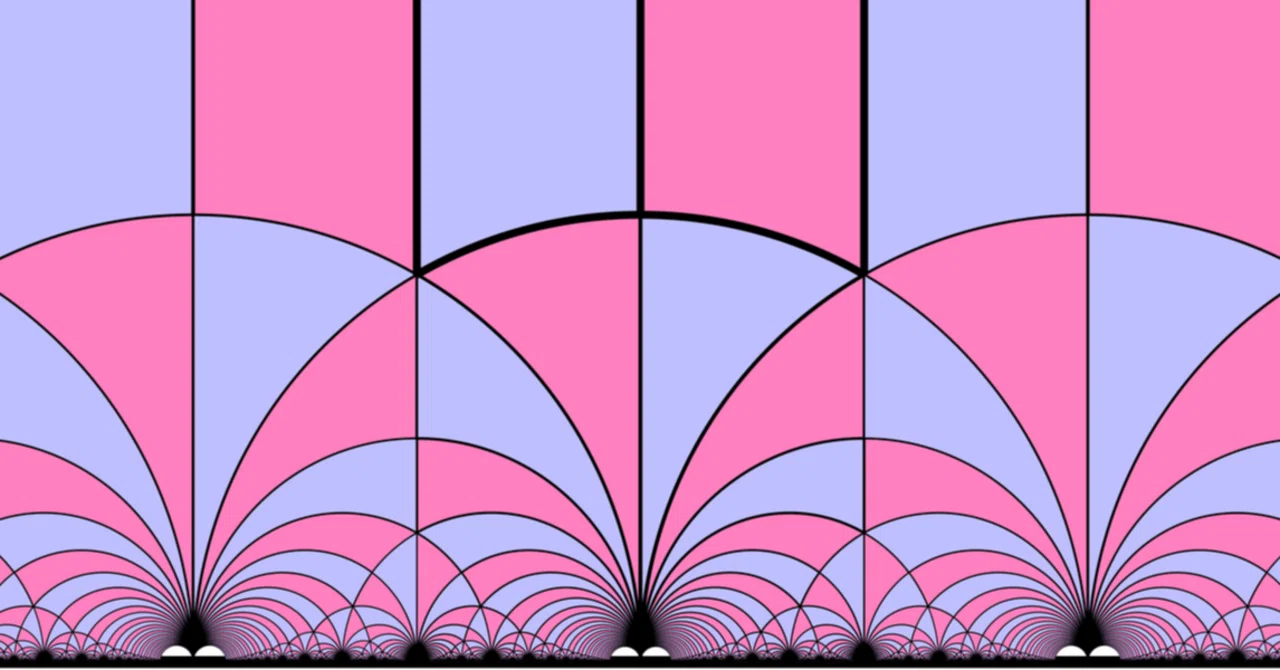
Header Image Credit: Neozhaoliang/Wikimedia Commons via
How String Theory Solved Math’s Monstrous Moonshine Problem
(5th February 2024)
https://www.scientificamerican.com/article/how-string-theory-solved-maths-monstrous-moonshine-problem/
■
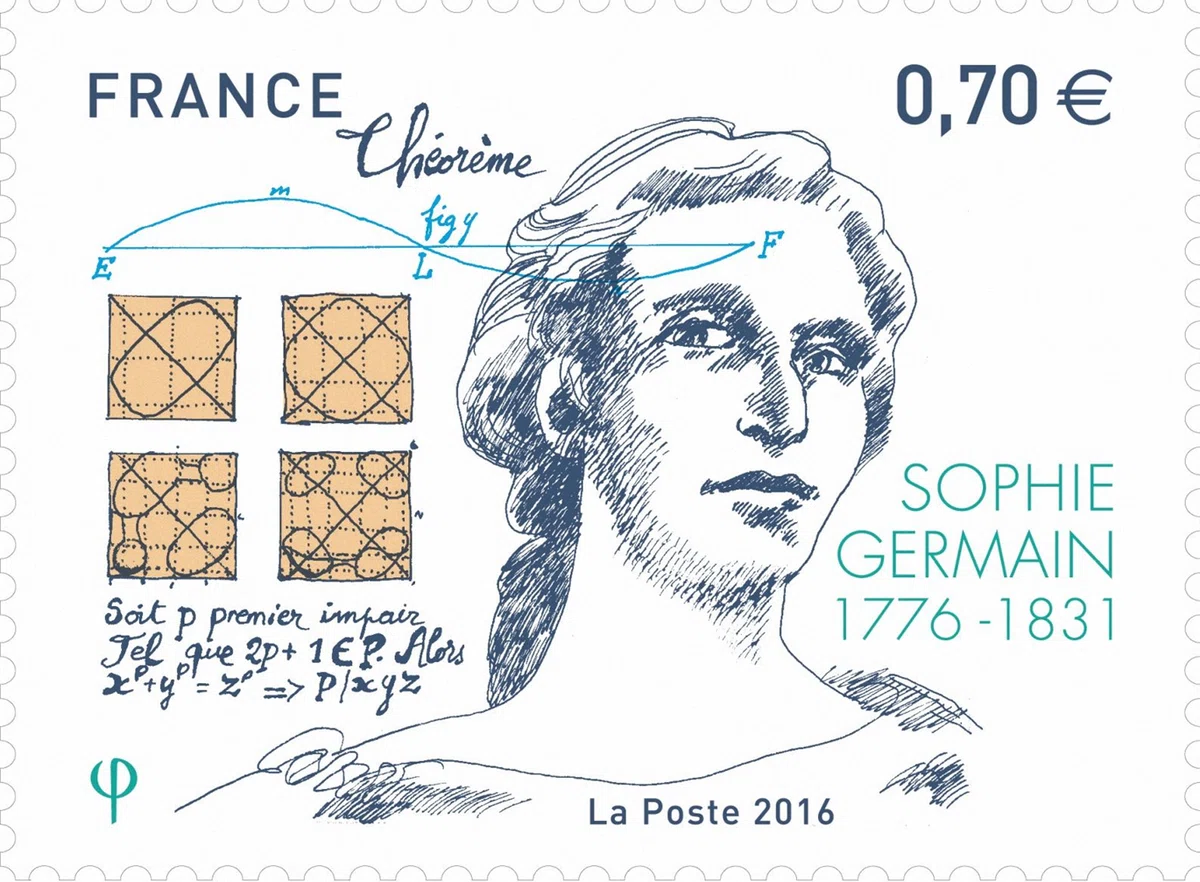
P.S. Marie-Sophie Germain, a French mathematician, physicist, and philosopher, died OTD in 1831. Her name is forever etched in the mathematical world with Sophie Germain Prime owing to her work on Fermat's Last Theorem / Dernier théorème de Fermat.